Polymyxin B in combination with doripenem against heteroresistant
Acinetobacter baumannii
: pharmacodynamics of new dosing strategies
Gauri G. Rao
1,2, Neang S. Ly
1,2, Ju¨rgen B. Bulitta
1,3, Rachel L. Soon
1,2, Marie D. San Roman
1,2, Patricia N. Holden
1,2,
Cornelia B. Landersdorfer
4, Roger L. Nation
4, Jian Li
4, Alan Forrest
1,5and Brian T. Tsuji
1,2*
1Laboratory for Antimicrobial Pharmacodynamics, School of Pharmacy and Pharmaceutical Sciences, University at Buffalo, The State
University of New York, Buffalo, NY, USA;2The New York State Center of Excellence in Bioinformatics & Life Sciences, University at Buffalo, The State University of New York, Buffalo, NY, USA;3Center for Pharmacometrics and Systems Pharmacology, College of Pharmacy,
University of Florida, Orlando, FL, USA;4Drug Delivery, Disposition and Dynamics, Monash Institute of Pharmaceutical Sciences, Monash University, Melbourne, Australia;5Eshelman School of Pharmacy, The University of North Carolina at Chapel Hill, NC, USA
*Corresponding author. Tel:+1-716-881-7543; Fax:+1-716-849-6890; E-mail: [email protected]
Received 13 October 2015; returned 3 January 2016; revised 14 June 2016; accepted 19 June 2016
Objectives:Polymyxin B is being increasingly utilized as a last resort against resistant Gram-negative bacteria. We examined the pharmacodynamics of novel dosing strategies for polymyxin B combinations to maximize efficacy and minimize the emergence of resistance and drug exposure againstAcinetobacter baumannii.
Methods:The pharmacodynamics of polymyxin B together with doripenem were evaluated in time– kill experi-ments over 48 h against 108cfu/mL of two polymyxin-heteroresistantA. baumanniiisolates (ATCC 19606 and
N16870). Pharmacokinetic/pharmacodynamic relationships were mathematically modelled using S-ADAPT. A hollow-fibre infection model (HFIM) was also used to simulate clinically relevant polymyxin B dosing strategies (traditional, augmented ‘front-loaded’ and ‘burst’ regimens), together with doripenem, against an initial inocu-lum of 109cfu/mL of ATCC 19606.
Results:In static time– kill studies, polymyxin B concentrations.4 mg/L in combination with doripenem 25 mg/L resulted in rapid bactericidal activity against both strains with undetectable bacterial counts by 24 h. The math-ematical model described the rapid, concentration-dependent killing as subpopulation and mechanistic synergy. In the HFIM, the traditional polymyxin B combination regimen was synergistic, with a.7.5 log10reduction by
48 h. The polymyxin B ‘front-loaded’ combination resulted in more rapid and extensive initial killing (.8 log10)
within 24 h, which was sustained over 10 days. With only 25% of the cumulative drug exposure, the polymyxin B ‘burst’ combination demonstrated antibacterial activity similar to traditional and ‘front-loaded’ combination strategies. The polymyxin B ‘front-loaded’ and ‘burst’ combination regimens suppressed the emergence of resistance.
Conclusions:Early aggressive dosing regimens for polymyxin combinations demonstrate promise for treatment of heteroresistantA. baumanniiinfections.
Introduction
The emergence of antimicrobial resistance is a major threat to human health and is jeopardizing our ability to treat infections.1 Gram-negative resistance is at the top of the infectious diseases research agenda,2 as new therapeutic options are urgently
needed. The CDC has highlightedAcinetobacter baumannii, a Gram-negative ‘superbug’, as a serious threat to human health.3 Gram-negative pathogens account for 70% of the infections among intensive care unit patients and there has been an alarm-ing increase in the incidence of nosocomial infections caused by
A. baumannii.4
A. baumanniiis an extremely difficult pathogen to treat as it has an ability to adapt through multiple mechanisms of re-sistance in the face of antibiotic therapy. Clinicians have already been confronted with the reality of infections caused by
A. baumanniistrains that are resistant to all clinically available agents except polymyxins (polymyxin B and colistin) and tigecyc-line.5,6Together with the first report of plasmid-mediated poly-myxin resistance inE. colithat could be transferred to other Gram-negative strains,7the reports send a very strong warning. Colistin is administered as an inactive prodrug, colistin methane-sulfonate (CMS), and requires conversionin vivointo the active form of colistin, a process that occurs slowly and incompletely
#The Author 2016. Published by Oxford University Press on behalf of the British Society for Antimicrobial Chemotherapy. All rights reserved.
For Permissions, please e-mail: [email protected]
J Antimicrob Chemother
2016;
71
: 3148 – 3156
in humans.8Polymyxin B does not suffer from these limitations as it is administered as the active antibiotic. The pharmacokinetic (PK) and pharmacodynamic (PD) knowledge necessary to opti-mize dosing for polymyxin B is limited,9,10and suboptimal dosing at currently recommended doses may have contributed to increased resistance in Gram-negative pathogens.10,11 Dose escalation of daily doses of polymyxin B is impractical as nephro-toxicity is a major dose-limiting adverse effect that occurs in up to 60% of patients even with currently recommended dosage regi-mens as administered.12–14Polymyxin B combination therapy has been shown to be more effective against MDRA. baumannii
strains as compared with monotherapy with polymyxin B.15,16 Previousin vitrostudies have shown that polymyxin combinations with a carbapenem are highly bactericidal againstA. baumannii17
although the rapid bactericidal activity of this combination is fol-lowed by regrowth with the emergence of resistant subpopula-tions.18Therefore, this underscores the need to develop novel
strategies to combatA. baumanniifocused on polymyxin combi-nations to maximize bactericidal activity, minimize resistance and decrease drug exposure.
In an attempt to define optimal dosing strategies for poly-myxin B combinations with doripenem, we first examined via sta-tic time – kill studies the concentration – response relationship across a wide range of polymyxin B and doripenem concentra-tions alone and in combination againstA. baumannii. Next, we employed mechanism-based mathematical models to guide the design of new polymyxin B combination regimens. Finally, we simulated traditional and novel polymyxin B combination regi-mens in the hollow-fibre infection model (HFIM) and profiled the dynamics of subpopulations over 10 days.
Materials and methods
Antibiotics, medium and bacterial isolates
Analytical grade polymyxin B sulphate was purchased from Sigma-Aldrich (St Louis, MO, USA) and doripenem was provided by Shionogi Inc. (Florham Park, NJ, USA). Fresh stock solutions of polymyxin B and doripenem were prepared immediately prior to each experiment and filter sterilized using a 0.22mm Millex GP filter (Millipore, Bedford, MA, USA). Cation-adjusted Mueller – Hinton broth (CAMHB) (Difco, Detroit, MI, USA) supplemented with calcium (25 mg/L) and magnesium (12.5 mg/L) was used as the growth medium for all time– kill and HFIM experiments.
MIC values were determined in quadruplicate according to CLSI guide-lines.19A. baumanniiATCC 19606 (polymyxin B MIC 0.5 mg/L; doripenem MIC 2 mg/L) and a clinical isolate N16870 (polymyxin B MIC 0.5 mg/L; dori-penem MIC 16 mg/L) were studied. Both isolates were polymyxin hetero-resistant, demonstrating the presence of subpopulations on agar plates containing.2 mg/L polymyxin B.20
Time –kill experiments
Static time – kill experiments were performed as previously described21 against a starting inoculum (108cfu/mL) over 48 h to characterize the concentration – effect relationship of polymyxin B and doripenem. In brief, prior to each experiment, bacterial isolates were subcultured on Mueller– Hinton agar and incubated overnight at 378C. Bacteria from the overnight growth were added to CAMHB to produce a bacterial suspension that was subsequently diluted to provide the starting inoculum mentioned above. Serial samples were collected at 0, 1, 2, 4, 6, 8, 24, 28, 32 and 48 h for the determination of bacterial counts. After appropriate dilutions with saline, samples of bacterial cell suspension (50mL) were spirally plated on
Mueller–Hinton agar plates using a Whitley automatic spiral plater (WASP; Don Whitley Scientific, Shipley West Yorkshire, UK). Colonies were counted by a ProtoCOL automated colony counter (Synbiosis, Cambridge, UK) after an incubation period of 24 h at 378C. The lower limit of counting was 20 cfu/mL. Time–kill experiments were conducted at polymyxin B concentra-tions of 0.5, 1, 2, 4, 8, 16, 32 and 64 mg/L, and a doripenem concentration of 25 mg/L, alone and in combination.
HFIM
The HFIM was used to evaluate the effect of selected polymyxin B and dori-penem monotherapy and combination regimens on bacterial burden and sup-pression of resistance againstA. baumanniiATCC 19606 over 240 h, as previously described.22Cellulosic hollow-fibre cartridges (C3008; Fiber Cell System, Inc., Fredrick, MD, USA) were utilized in all experiments. Twenty-three samples (0.5 mL) were serially collected over 240 h to determine bacterial counts for each experiment. Samples were quantified for the total population by depositing appropriately diluted bacterial samples on CAMHA plates, as pre-viously described.23Aliquots of the diluted sample were plated on CAMHA plates containing 0.5, 1, 2, 3, 4, 6, 8 or 10 mg/L polymyxin B for in-depth ana-lysis of the time-course of resistant subpopulations at pre-dose at 24, 48, 72, 96, 144, 192 and 240 h, as previously described.20
HFIM experiments consisted of clinically achievable monotherapy and combination therapy regimens, which were informed by mechanism-based population modelling of the static time – kill experiments. The rationale for dosing polymyxin B as a continuous infusion was based on the flat PK profile seen in critically ill patients receiving polymyxin B. Patients in this study received polymyxin B doses ranging from 0.45 to 3.38 mg/kg/day every 12 h. Based on this previous study, the unscaled population estimate of the half-life was 11.9 h andfAUCs ranged from 6.2 to 53.5 mg.h/L with a median of 26.5 mg.h/L, average of 29.4 mg.h/L and standard deviation of 10.4 mg.h/L.24The experimental design consisted of a no treatment control arm and eight monotherapy and combination regimens, as follows:
(a) Polymyxin B traditional monotherapy: free steady-state concentration (fCss) of 2 mg/L administered as a continuous infusion, based on the PK in critically ill patients.24
(b) Polymyxin B traditional monotherapy: as above but with afCssof 5 mg/L administered as a continuous infusion.
(c) Doripenem monotherapy:fCmaxof 25 mg/L every 8 h based on PK in critically ill patients.25
(d) Combination of polymyxin B traditional (fCssof 2 mg/L continuous infusion) and doripenem (fCmaxof 25 mg/L every 8 h).
(e) Combination of polymyxin B ‘front-loaded’ (fCssof 5 mg/L continuous infusion for 24 h followed byfCssof 2 mg/L thereafter) and doripenem (fCmaxof 25 mg/L every 8 h).
(f) Combination of polymyxin B ‘burst 2’ (fCssof 2 mg/L continuous infu-sion for 24 h followed by no polymyxin B thereafter) and doripenem (fCmaxof 25 mg/L every 8 h).
(g) Combination of polymyxin B ‘burst 5’ (fCssof 5 mg/L continuous infu-sion for 24 h followed by no polymyxin B thereafter) and doripenem (fCmaxof 25 mg/L every 8 h).
(h) Combination of doripenem ‘burst’ (fCmaxof 25 mg/L every 8 h×3 doses followed by no doripenem thereafter) and polymyxin B trad-itional regimen (fCssof 2 mg/L continuous infusion).
Polymyxin B concentrations were quantified by analysing polymyxin B1 and B2 using a validated high-performance LC-MS/MS approach as previously described by Cheahet al.26 Analysis of independently pre-pared quality control samples indicated good reproducibility (coeffi-cients of variation ≤8.39%) and accuracy (observed concentrations were within≤10.0% of target concentrations). The limit of quantifica-tion was 0.1 mg/L.
Population mathematical modelling of static
time – kill data
Mechanism-based population PD modelling was performed to estimate the exposure– response relationship for time–kill studies for both bacterial isolates to propose front-loaded and other novel regimens for evaluation in the HFIM. Models with differing susceptibilities to polymyxin B and dori-penem were considered. The final number of pre-existing subpopulations was based on the objective function, plausibility of parameter estimates, standard diagnostic plots and visual predictive checks. The total bacterial population was modelled as the sum of these pre-existing subpopulations. The final model consisted of four subpopulations for ATCC 19606 and N16870 (Figure S1, available as Supplementary data atJACOnline). Bacterial replication was modelled using the life-cycle growth replication model,21in which each subpopulation was described by two states: a vegetative state and a replicating state. The two states had the same sus-ceptibility but differed in their growth phase. The action of polymyxin B was described using a target site-binding model, and bacterial killing by poly-myxin B was modelled as a second-order process. The killing effect of dori-penem was described by a first-order saturable process.
Modelling the combinatorial PD of polymyxin B and
doripenem in the HFIM
The interaction between polymyxin B and doripenem was modelled by considering two different synergistic interactions for the combination. Polymyxin B and doripenem are not subject to the same resistance mechanisms.27,28Hence, the time-course of polymyxin B and doripenem
interactions was modelled as ‘subpopulation synergy’, in which polymyxin B killed the doripenem-resistant subpopulations and vice versa. The second synergistic interaction was ‘mechanistic synergy’, in which the kill-ing activity of doripenem was enhanced by polymyxin B and vice versa. The final model included both proposed synergistic interactions of subpopula-tion and mechanistic synergy (see the Supplementary data available at JACOnline, including Figure S1 and the differential equations).
Model estimation
Candidate models describing the time-course of combination drug effects on bacteria were simultaneously fitted to all viable total population count profiles of the two isolates studied in time – kill experiments. Estimation was performed using parallelized S-ADAPT software (version 1.57) facili-tated by SADAPT-TRAN using the importance sampling Monte Carlo para-metric expectation maximization method (pmethod¼4).29An additive residual error model on a log10scale was used for bacterial counts
≥100 cfu/mL. To account for high sampling error at low concentrations, an error model containing both proportional and Poisson distributions was used for the bacteria.21
Results
The concentration–response profiles for polymyxin B alone and in combination with doripenem against twoA. baumanniiisolates with a starting inoculum of 108cfu/mL based on static time–kill
studies are shown in Figure1. The profiles with polymyxin B
10
(a) Polymyxin B Monotherapy (ATCC 19606)
8
6
Lo
g10
cf
u/mL
4
2
0
0 6 12 18 24 30 Time (h)
36 42 48 10
(b) Polymyxin B Monotherapy (N16870)
8
6
4
2
0
0 6 12 18 24 30 Time (h)
36 42 48
Growth control PMB 0.5mg/L PMB 1.0mg/L PMB 2.0mg/L PMB 4.0mg/L PMB 8.0mg/L PMB 16.0mg/L PMB 32.0mg/L PMB 64mg/L
Growth control DOR 25mg/L
PMB 1mg/L+DOR 25mg/L PMB 2mg/L+DOR 25mg/L PMB 4mg/L+DOR 25mg/L PMB 8mg/L+DOR 25mg/L 10
(c) Polymyxin B Combination (ATCC 19606)
8
6
Lo
g10
cf
u/mL
4
2
0
0 6 12 18 24 30 Time (h)
36 42 48 10
(d) Polymyxin B Combination (N16870)
8
6
4
2
0
0 6 12 18 24 30 Time (h)
36 42 48
Figure 1. Observed and fitted viable counts for the time–kill experiments for mono and combination therapies with polymyxin B and doripenem against
ATCC 19606 (a, c) and N16870 (b, d). PMB, polymyxin B; DOR, doripenem. This figure appears in colour in the online version ofJACand in black and white in the print version ofJAC.
concentrations of 0.5, 1.0 and 2.0 mg/L against both isolates (Figure1a and b) were no different from the growth control. High polymyxin B concentrations of 16, 32 and 64 mg/L resulted in early bactericidal activity by 8 h. However, extensive regrowth was observed for all polymyxin B concentrations except at the high-est concentration of 64 mg/L. Doripenem monotherapy displayed minimal activity against both isolates with an inoculum of 108cfu/mL (Figure1c and d). Interestingly, the combination of
polymyxin B (across the concentration range 2–8 mg/L) and dori-penem (25 mg/L) was markedly synergistic against both isolates. Against a high bacterial density of ATCC 19606 (Figure1c) and N16870 (Figure1d) polymyxin B≥2 mg/L in combination with dori-penem demonstrated rapid bactericidal activity, while polymyxin B ≥4 mg/L in combination with doripenem resulted in undetectable bacterial counts by 28 h.
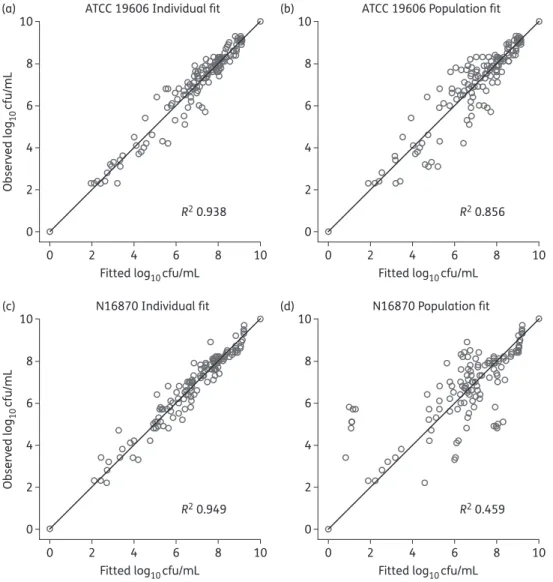
The mathematical model described the rapid, concentration-dependent killing of polymyxin B based on known mechanisms of action of polymyxin B and doripenem. The model described the time-course of bacterial killing and regrowth well (Figure1). Population pre-dictions were reasonably precise and unbiased (Figure2). The model
diagnostics generated based on observed viable counts versus indi-vidual (population) fitted shown in Figure2(a–d) indicates that the individual fits for N16870 (R2¼0.949) were more precise as
com-pared with ATCC 19606 (R2¼0.938). On the other hand, the popula-tion fits for ATCC 19606 (R2¼0.856) were better as compared with those for N16870 (R2¼0.459). Based on the estimated EC50,
55.7% and 70.8% of the binding sites for Mg2+ and Ca2+ (Table S1) are required to be unoccupied by Mg2+or Ca2+to achieve an effective polymyxin B concentration that is 50% of its concentra-tion in broth for ATCC 19606 and N16870, respectively. Models with a total of four subpopulations with differing susceptibilities to poly-myxin B and doripenem were adequate to describe the antibacterial activity of polymyxin B and doripenem.
Based on the modelling of the time –kill data, polymyxin B achieved 7.4-fold greater killing against the susceptible populations of N16870 as compared with ATCC 19606, and killing of the polymyxin-resistant subpopulations was much slower for both strains (Table S1). In the model for doripenem monotherapy, the maximum killing rate constant (KmaxSS) of the doripenem-susceptible
subpopulation was 1.19 h21
for ATCC 19606 and 1.73 h21
for N16870.
ATCC 19606 Individual fit (a)
0
0 2 4
Fitted log10cfu/mL 6 8
R2 0.938
10 2
Observ
ed log
10
cf
u/mL
4 6 8 10
ATCC 19606 Population fit (b)
0
0 2 4
Fitted log10cfu/mL 6 8
R2 0.856
10 2
4 6 8 10
N16870 Individual fit (c)
0
0 2 4
Fitted log10cfu/mL 6 8
R2 0.949
10 2
Observ
ed log
10
cf
u/mL
4 6 8 10
N16870 Population fit (d)
0
0 2 4
Fitted log10cfu/mL 6 8
R2 0.459
10 2
4 6 8 10
Figure 2. Observed versus individual fitted (population fitted) for ATCC 19606 (a, b) and N16870 (c, d).
The killing of the doripenem-resistant subpopulation by doripenem was estimated to be very slow. The combination was modelled as polymyxin B effectively killing the doripenem-resistant subpopulations and doripenem killing the polymyxin B intermediate and resistant sub-populations with proposed synergistic interactions between subpopu-lations and mechanisms (Figure S1).
In the HFIM, polymyxin B traditional monotherapy (fCssof 2 mg/L
continuous infusion) was bacteriostatic againstA. baumanniistrain
ATCC 19606, with,1 log10cfu/mL killing over 240 h compared with
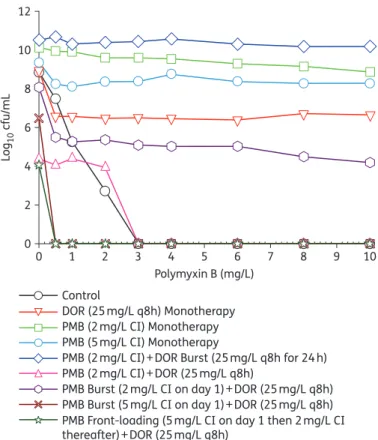
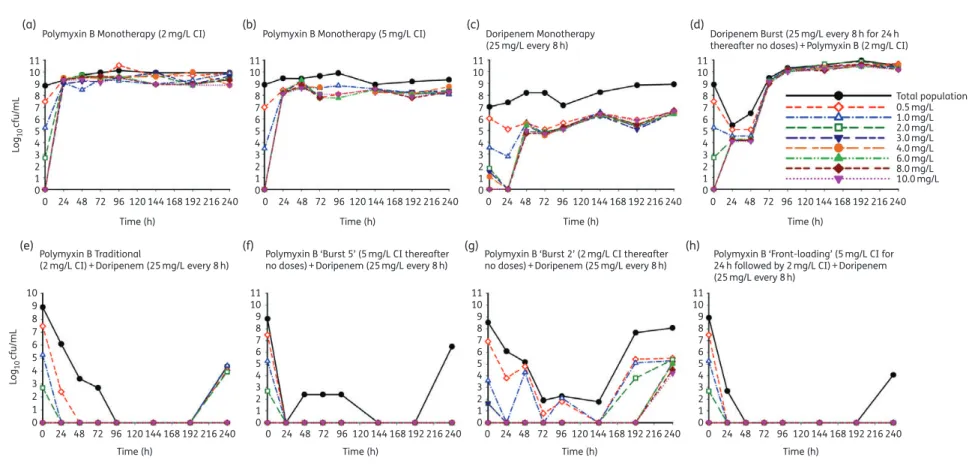
the growth control (Figure3and Figure4). Emergence of resistance by 24 h in real-time population analysis profiles confirmed the emergence of resistance secondary to monotherapy with poly-myxin B, with subpopulations growing on agar plates containing 0 – 10 mg/L polymyxin B (Figure4and Figure5). Increasing the exposure to polymyxin B in the HFIM with a polymyxin B traditional monotherapy regimen (fCssof 5 mg/L continuous infusion) resulted
0
0 24 48 72 96 Time (h)
120 144 168 192 216 240 2
4
Lo
g10
cf
u/mL
6 8 10 12
Control
DOR (25mg/L q8h) Monotherapy PMB (2mg/L CI) Monotherapy PMB (5mg/L CI) Monotherapy
PMB (2mg/L CI)+DOR Burst (25mg/L q8h for 24h)
PMB Burst (2mg/L CI on day 1)+DOR (25mg/L q8h)
PMB Front-loading (5mg/L CI on day 1 then 2mg/L CI thereafter)+DOR (25mg/L q8h)
PMB Burst (5mg/L CI on day 1)+DOR (25mg/L q8h) PMB (2mg/L CI)+DOR (25mg/L q8h)
Figure 3. An HFIM was utilized to simulate various mono and combination
regimens against a high inoculum of 109cfu/mL of A. baumannii ATCC 19606. PMB, polymyxin B; DOR, doripenem. The total bacterial counts for the following regimens simulated: Control, growth control with no antibiotic; DOR (25 mg/L q8h) monotherapy, DOR traditional monotherapy (fCmaxof 25 mg/L every 8 h); PMB (2 mg/L CI) monotherapy, PMB traditional monotherapy (fCssof 2 mg/L administered as a continuous infusion); PMB (5 mg/L CI) monotherapy,fCssof 5 mg/L administered as a continuous infusion; PMB (2 mg/L CI)+DOR Burst (25 mg/L q8h for 24 h), combination of PMB traditional (fCssof 2 mg/L continuous infusion) and DOR ‘burst’ (fCmaxof 25 mg/L every 8 h×3 doses followed by no DOR thereafter); PMB (2 mg/L CI)+DOR (25 mg/L q8h), combination of PMB traditional (fCssof 2 mg/L continuous infusion) and DOR (fCmaxof 25 mg/L every 8 h); PMB Burst (2 mg/L CI on day 1)+DOR (25 mg/L q8h), combination of PMB ‘burst’ (fCssof 5 mg/L continuous infusion for 24 h followed by no PMB thereafter) and DOR (fCmaxof 25 mg/L every 8 h); PMB Burst (5 mg/L CI on day 1)+DOR (25 mg/L q8h), combination of PMB ‘burst’ (fCssof 2 mg/L continuous infusion for 24 h followed by no PMB thereafter) and DOR (fCmaxof 25 mg/L every 8 h); PMB Front-Loading (5 mg/L CI on day 1 then 2 mg/L CI thereafter)+DOR (25 mg/L q8h), combination of PMB ‘front-loading’ (fCssof 5 mg/L continuous infusion for 24 h followed byfCssof 2 mg/L thereafter) and DOR (fCmaxof 25 mg/L every 8 h). This figure appears in colour in the online version ofJACand in black and white in the print version ofJAC.
0
0 1 2 3 4
Polymyxin B (mg/L)
5 6 7 8 9 10
2 4
Lo
g10
cf
u/mL
6 8 10 12
Control
DOR (25mg/L q8h) Monotherapy PMB (2mg/L CI) Monotherapy PMB (5mg/L CI) Monotherapy
PMB (2mg/L CI)+DOR Burst (25mg/L q8h for 24h)
PMB Burst (2mg/L CI on day 1)+DOR (25mg/L q8h)
PMB Front-loading (5mg/L CI on day 1 then 2mg/L CI thereafter)+DOR (25mg/L q8h)
PMB Burst (5mg/L CI on day 1)+DOR (25mg/L q8h) PMB (2mg/L CI)+DOR (25mg/L q8h)
Figure 4. Population analysis profiles at 240 h profiling the emergence of
resistant subpopulations grown on polymyxin B-containing agar for the regimens shown in Figure3. PMB, polymyxin B; DOR, doripenem. Control, bacterial subpopulations present at time 0 h (without any treatment); DOR (25 mg/L q8h) monotherapy, DOR traditional monotherapy (fCmaxof 25 mg/L every 8 h); PMB (2 mg/L CI) monotherapy, PMB traditional monotherapy (fCssof 2 mg/L administered as a continuous infusion); PMB (5 mg/L CI) monotherapy, fCss of 5 mg/L administered as a continuous infusion; PMB (2 mg/L CI)+DOR Burst (25 mg/L q8h for 24 h), combination of PMB traditional (fCssof 2 mg/L continuous infusion) and DOR ‘burst’ (fCmaxof 25 mg/L every 8 h×3 doses followed by no DOR thereafter); PMB (2 mg/L CI)+DOR (25 mg/L q8h), combination of PMB traditional (fCssof 2 mg/L continuous infusion) and DOR (fCmaxof 25 mg/L every 8 h); PMB Burst (2 mg/L CI on day 1)+DOR (25 mg/L q8h), combination of PMB ‘burst’ (fCssof 5 mg/L continuous infusion for 24 h followed by no PMB thereafter) and DOR (fCmaxof 25 mg/L every 8 h); PMB Burst (5 mg/L CI on day 1)+DOR (25 mg/L q8h), combination of PMB ‘burst’ (fCssof 2 mg/L continuous infusion for 24 h followed by no PMB thereafter) and DOR (fCmaxof 25 mg/L every 8 h); PMB Front-Loading (5 mg/L CI on day 1 then 2 mg/L CI thereafter)+DOR (25 mg/L q8h), combination of PMB ‘front-loading’ (fCssof 5 mg/L continuous infusion for 24 h followed byfCssof 2 mg/L thereafter) and DOR (fCmaxof 25 mg/L every 8 h). This figure appears in colour in the online version ofJACand in black and white in the print version ofJAC.
11 (a) 10 9 8 7 6 5 4 3 Lo g10 cf u/mL 2 1 0
24 48 72 96 120 144
Time (h)
Polymyxin B Monotherapy (2 mg/L CI)
168 192 216 240 0 11 (b) 10 9 8 7 6 5 4 3 2 1 0
24 48 72 96 120 144
Time (h) Polymyxin B Monotherapy (5 mg/L CI)
168 192 216 240 0 11 (c) 10 9 8 7 6 5 4 3 2 1 0
24 48 72 96 120 144
Time (h) Doripenem Monotherapy (25 mg/L every 8 h)
168 192 216 240 0 11 (d) 10 9 8 7 6 5 4 3 2 1 0
24 48 72 96 120 144
Time (h)
Doripenem Burst (25 mg/L every 8 h for 24 h thereafter no doses) + Polymyxin B (2 mg/L CI)
168 192 216 240
Total population 0.5 mg/L 1.0 mg/L 2.0 mg/L 3.0 mg/L 4.0 mg/L 6.0 mg/L 8.0 mg/L 10.0 mg/L 0 10 (e) 9 8 7 6 5 4 3 Lo g10 cf u/mL 2 1 0
24 48 72 96 120 144
Time (h) Polymyxin B Traditional
(2 mg/L CI) + Doripenem (25 mg/L every 8 h)
168 192 216 240 0 11 (f) 10 9 8 7 6 5 4 3 2 1 0
24 48 72 96 120 144
Time (h)
Polymyxin B ‘Burst 5’ (5 mg/L CI thereafter no doses) + Doripenem (25 mg/L every 8 h)
168 192 216 240 0 11 (g) 10 9 8 7 6 5 4 3 2 1 0
24 48 72 96 120 144
Time (h)
Polymyxin B ‘Burst 2’ (2 mg/L CI thereafter no doses) + Doripenem (25 mg/L every 8 h)
168 192 216 240 0 11 (h) 10 9 8 7 6 5 4 3 2 1 0
24 48 72 96 120 144
Time (h)
Polymyxin B ‘Front-loading’ (5 mg/L CI for 24 h followed by 2 mg/L CI) + Doripenem (25 mg/L every 8 h)
168 192 216 240 0
Figure 5. Time-course of the observed emergence of resistance on polymyxin B-containing agar plate regimens with an initial inoculum of109cfu/mL in response to the detailed regimens simulated in the HFIM. (a) Polymyxin B monotherapy (2 mg/L CI),fCssof 2 mg/L administered as a continuous infusion. (b) Polymyxin B monotherapy (5 mg/L CI),fCssof 5 mg/L administered as a continuous infusion. (c) Doripenem monotherapy (25 mg/L every 8 h), doripenem traditional monotherapy:fCmaxof 25 mg/L every 8 h. (d) Doripenem Burst (25 mg/L every 8 h for 24 h thereafter no doses)+Polymyxin B (2 mg/L CI), combination of doripenem ‘burst’ (fCmaxof 25 mg/L every 8 h×3 doses followed by no doripenem thereafter) and polymyxin B traditional (fCssof 2 mg/L as a continuous infusion), (e) Polymyxin B Traditional (2 mg/L CI)+Doripenem (25 mg/L every 8 h), combination of polymyxin B traditional (fCss of 2 mg/L continuous infusion) and doripenem (fCmaxof 25 mg/L every 8 h). (f) Polymyxin B ‘Burst 5’ (5 mg/L CI thereafter no doses)+Doripenem (25 mg/L every 8 h), combination of polymyxin B ‘burst’ (fCssof 5 mg/L continuous infusion for 24 h followed by no polymyxin B thereafter) and doripenem (fCmaxof 25 mg/L every 8 h). (g) Polymyxin B ‘Burst 2’ (2 mg/L CI thereafter no doses)+Doripenem (25 mg/L every 8 h), combination of polymyxin B ‘burst’ (fCssof 2 mg/L continuous infusion for 24 h followed by no polymyxin B thereafter) and doripenem (fCmaxof 25 mg/L every 8 h). (h) Polymyxin B ‘Front-loading’ (5 mg/L CI for 24 h followed by 2 mg/L CI)+Doripenem (25 mg/L every 8 h), combination of polymyxin B ‘front-loading’ (fCssof 5 mg/L continuous infusion for 24 h followed byfCssof 2 mg/L thereafter) and doripenem (fCmaxof 25 mg/L every 8 h). This figure appears in colour in the online version ofJACand in black and white in the print version ofJAC.
in initial killing up to 3 log10in the first 6 h, followed by substantial
regrowth (Figure3). Polymyxin B traditional monotherapy regimens withfCssof 2 and 5 mg/L showed similar activity against the total
population beyond 8 h and with respect to the emergence of poly-myxin resistance (Figure5a and b). Doripenem traditional mono-therapy (Figure3) demonstrated bacteriostatic activity over the entire duration of the experiment and did not alter the emergence of resistance to polymyxin B (Figure5c).
The combination of the polymyxin B traditional regimen (fCssof
2 mg/L continuous infusion) and doripenem (fCmaxof 25 mg/L
every 8 h) was synergistic againstA. baumannii ATCC 19606, with a 7.5 log10cfu/mL reduction by 48 h. This combination
regi-men resulted in complete eradication at 72 h that was sustained until 192 h (Figure3) and.3 log10cfu/mL regrowth at 240 h
(Figure4). The cumulative reduction over time in the log ratio area of bacterial counts is presented for each regimen in Table S2. The combination of polymyxin B traditional regimen and doripenem reduced the time-averaged bacterial load at each timepoint, with a maximal reduction in AUCcfuof 3.36 log10
by 240 h compared with the growth control (Table S2). Population analysis profiles confirmed the emergence of resistance, with polymyxin-resistant subpopulations growing on agar contain-ing 0–2 mg/L polymyxin B up to 24 h and suppression until 192 h (Figure4).
The proposed novel dosing strategies of the combination of polymyxin B ‘front-loaded’ and doripenem and the combination of polymyxin B ‘burst’ and doripenem were also evaluated against a dense bacterial inoculum (109cfu/mL) ofA. baumanniiATCC
19606 in the HFIM (Figure3). The polymyxin B ‘front-loaded’ com-bination resulted in more rapid and extensive initial killing (.8 log10
cfu/mL) with an improved time to eradication. Front-loaded com-bination regimens completely eradicatedA. baumanniiat 48 h compared with traditional combination regimens that resulted in eradication at 72 h. Additionally, there was a modest improvement in bacterial killing with the polymyxin B front-loaded regimen, with AUCcfureduction of 3.48 log10by 240 h compared with the growth
control. Population analysis profiles for the polymyxin B ‘front-loaded’ combination regimen (Figure5h) resulted in sus-tained suppression of resistance beyond 48 h until 192 h, with min-imal polymyxin B resistance compared with the polymyxin B traditional combination regimen (Figure5e).
The combination of doripenem ‘burst’ (fCmaxof 25 mg/L every
8 h×3 doses followed by no doripenem thereafter) and poly-myxin B traditional (fCssof 2 mg/L continuous infusion) did not
affect the total bacterial population beyond 48 h, given the dra-matic regrowth after the initial 3 log reduction in cfu/mL between 24 and 48 h (Figure3). The combination of polymyxin B ‘burst 5’ (fCssof 5 mg/L continuous infusion for 24 h followed
by no polymyxin B thereafter) and doripenem (fCmaxof 25 mg/L
every 8 h) provided rapid initial and sustained killing similar to the combination of polymyxin B ‘front-loaded’ and doripenem regimen. There was a 3.49 log10reduction in AUCcfucompared
with the growth control by 240 h, and cumulative exposure to polymyxin B over 240 h was reduced to only 25% of the exposure resulting from the combination of polymyxin B traditional with doripenem (Table S2). The polymyxin B ‘burst 2’ combination regi-men, i.e. combination of polymyxin B ‘burst 2’ (fCssof 2 mg/L
con-tinuous infusion for 24 h followed by no polymyxin B thereafter) and doripenem (fCmaxof 25 mg/L every 8 h) resulted in.8 log10
cfu/mL reduction by 72 h with6 log10regrowth beyond 144 h,
with an AUCcfuof 2.74 log10compared with the growth control.
The cumulative exposure to polymyxin B was only 10% of the combination of polymyxin B traditional with doripenem regimen (Table S2).
All polymyxin B combination regimens (‘burst’, ‘front-loaded’ and traditional) maintained extremely low bacterial counts near quantifiable limits over 192 h of the 240 h of therapy, even in the complete absence of an immune system. The traditional (Figure5e), ‘burst 5’ (Figure5f) and ‘front-loaded’ (Figure5h) com-bination regimens demonstrated complete suppression of resistant subpopulations. Further, the ‘burst 5’ polymyxin combination regi-men as a 5 mg/L continuous infusion for the first 24 h (Figure3) was able to achieve similar early antibacterial killing activity as the front-loaded regimen and traditional regimens (Figure3) with a comparable drug exposure profile. In other words, with only 25% of the cumulative drug exposure, the polymyxin B ‘burst 5’ combin-ation demonstrated antibacterial killing activity similar to trad-itional and ‘front-loaded’ combination strategies.
Discussion
A. baumanniicontinues to be a pathogen of great medical signifi-cance.30To combat this difficult-to-treat pathogen, we
deter-mined that novel dosing strategies centred on polymyxin B combinations involving ‘front-loading’ and ‘burst’ dosing were highly promising by maximizing initial killing and suppression of resistance while minimizing cumulative drug exposure and poten-tial toxicity. Although the front-loaded regimen demonstrated increased killing, this is balanced against toxicodynamic consid-erations as the probability of nephrotoxicity increases with increases in cumulative exposure (AUC). Our data suggest that front-loaded regimens achieve an exposure of 552 mg.h/L with similar or greater efficacy over 10 days compared with traditional dosing regimens with an exposure of 480 mg.h/L. The ‘burst 5’ regimen showed very promising efficacy with exposure of 120 mg.h/L over 10 days. Further reduction of over 50% in poly-myxin B exposure was achieved by the ‘burst 2’ regimen with an exposure of 48 mg.h/L over 10 days. Importantly, the ‘burst 5’ and ‘burst 2’ polymyxin regimens were able to achieve nearly identical antibacterial activity to traditional and ‘front-loaded’ polymyxin regimens at 25% and 10% of the cumulative polymyxin exposure, respectively. Polymyxin showed rapid bactericidal activityin vitro
and the PD of polymyxin B is most closely linked to the AUC/MIC ratio.18Based on our and previous time–kill studies, monotherapy with polymyxin B leads to rapid initial decline followed by exten-sive regrowth. Hence, the combination regimens with administra-tion of polymyxin in a high-intensity fashion, based on the mechanism-based modelling, provided an effective way of addressing the subpopulations that are resistant to either poly-myxin B or doripenem.
In regards to the mechanistic advantages of polymyxin combinations, we further refined a previously developed mechanism-based mathematical model for colistin monother-apy31and colistin combinations32based on the known mechan-ism of the antibacterial activity of polymyxins and doripenem. The proposed population PD model well characterized the time-course of bacterial growth and killing due to monotherapy and combination regimens against bothA. baumanniiisolates. This mathematical model described the rapid concentration-based killing of polymyxin B monotherapy well. As polymyxin B is
structurally similar to colistin with the exception of one amino acid residue, theD-leucine at position 6,33we based the combination
mathematical model on the known mechanisms of action on the previously constructed colistin and doripenem mathematical models and applied them to polymyxin B. We similarly hypothe-sized that disruption of the bacterial outer membrane by binding to the lipid A of LPS resulted in increased permeability of the outer membrane that enhanced the penetration of doripenem and binding to its target site in the periplasmic membrane.34
Indeed, the model well characterized the dynamics of bacterial response to polymyxin B combinations. The refinement of this mathematical model that was now applied to polymyxin B may serve as an important framework for the design of future polymyxin-based combination regimens.
By administering polymyxin B in a non-traditional fashion, these new regimens are promising as they decrease the over-all exposure while preserving high antibacterial activity. Sandri and colleagues in their PK study in 24 critically ill patients ex-plored the lower limit of the current polymyxin B published dosing guideline of 1.5 mg/kg/day, resulting in an exposure of 228 mg.h/L over 10 days (IQR¼189 – 292 mg.h/L); at the upper limit of 2.5 mg/kg/day the exposure is 380 mg.h/L over 10 days (IQR¼316 – 487 mg.h/L).24Pogueet al.14evaluated the impact
of a colistin loading dose of 5 mg/kg/day on the occurrence of acute kidney injury and concluded that this colistin loading dose in 64 patients out of 162 patients was not associated with an increased risk of acute kidney injury. Therefore, the early, aggres-sive polymyxin dosing strategies presented here may be of poten-tial benefit for infections in critically ill patients, many of whom are already at significant risk of developing acute renal injury.
We acknowledge potential limitations in the present study. Only twoA. baumanniiisolates were studied: future investigations should encompass additional strains with differing MIC profiles to confirm these findings. In profiling the detailed bacterial dynam-ics over 10 days in HFIMs, it is important to appreciate that these results were generated in a broth nutrient-rich environment that was optimal forA. baumanniigrowth. Although the mathematical model was based on the known mechanisms of action of each drug, we did not identify killing of quiescent versus non-quiescent cells or quantify the relative contributions of each antibiotic to bacterial killing. The PD response of combinations presented in this investigation may also differ in biological fluids, particularly considering the differences in site-specific PK in humans. It is also important to note that interaction of polymyxin B together with doripenem may also differ in patients, as it has been shown that there is a unique relationship between granulocyte-mediated killing and antibiotics.35Finally, there have been no
con-trolled human studies evaluating these new high-intensity dosing regimens of polymyxin B. Overall, these new findings are promis-ing and systemic evaluation of novel polymyxin combination dos-ing strategiesin vivois necessary for future translation to the clinical setting.
Funding
This study was supported by the National Institutes of Health, National Institute of Allergy and Infectious Diseases (R01AI111990). C. B. L. is an Australian National Health and Medical Research Council (NHMRC) Career Development Fellow. J. L. is an NHMRC Senior Research Fellow.
Transparency declarations
None to declare.
Disclaimer
The content is solely the responsibility of the authors and does not neces-sarily represent the official views of the National Institute of Allergy and Infectious Diseases or the National Institutes of Health.
Supplementary data
Supplementary data, including Figure S1 and Tables S1 and S2, are avail-able atJACOnline (http://jac.oxfordjournals.org/).
References
1 World Health Organisation.Antimicrobial Resistance Global Report on Surveillance2014.
2 Infectious Diseases Society of America. The 10ב20 initiative: pursuing a global commitment to develop 10 new antibacterial drugs by 2020.Clin Infect Dis2010;50: 1081– 3.
3 Centers for Disease Control.Antibiotic Resistance Threats in the United States, 2013. 2013.
4 Gaynes R, Edwards JR. Overview of nosocomial infections caused by gram-negative bacilli.Clin Infect Dis2005;41: 848–54.
5 Gordon NC, Wareham DW. A review of clinical and microbiological outcomes following treatment of infections involving multidrug-resistantAcinetobacter baumanniiwith tigecycline.J Antimicrob Chemother2009;63: 775–80.
6 Vasilev K, Reshedko G, Orasan Ret al. A Phase 3, open-label, non-comparative study of tigecycline in the treatment of patients with selected serious infections due to resistant Gram-negative organisms including Enterobacter species,Acinetobacter baumanniiandKlebsiella pneumo-niae.J Antimicrob Chemother2008;62Suppl 1: i29–40.
7 Liu YY, Wang Y, Walsh TRet al. Emergence of plasmid-mediated colistin resistance mechanism MCR-1 in animals and human beings in China: a micro-biological and molecular micro-biological study.Lancet Infect Dis2016;16: 161–8.
8 Garonzik SM, Li J, Thamlikitkul Vet al. Population pharmacokinetics of colistin methanesulfonate and formed colistin in critically ill patients from a multicenter study provide dosing suggestions for various categories of patients.Antimicrob Agents Chemother2011;55: 3284–94.
9 Sandri AM, Landersdorfer CB, Jacob Jet al. Pharmacokinetics of polymyxin B in patients on continuous venovenous haemodialysis.J Antimicrob Chemother2013;68: 674–7.
10 Zavascki AP, Goldani LZ, Cao Get al. Pharmacokinetics of intravenous polymyxin B in critically ill patients.Clin Infect Dis2008;47: 1298– 304.
11 Gales AC, Jones RN, Sader HS. Contemporary activity of colistin and polymyxin B against a worldwide collection of Gram-negative pathogens: results from the SENTRY Antimicrobial Surveillance Program (2006-09). J Antimicrob Chemother2011;66: 2070–4.
12 Koomanachai P, Tiengrim S, Kiratisin Pet al. Efficacy and safety of colis-tin (colistimethate sodium) for therapy of infections caused by multidrug-resistantPseudomonas aeruginosaandAcinetobacter bauman-niiin Siriraj Hospital, Bangkok, Thailand.Int J Infect Dis2007;11: 402– 6.
13 Kubin CJ, Ellman TM, Phadke Vet al. Incidence and predictors of acute kidney injury associated with intravenous polymyxin B therapy.J Infect 2012;65: 80– 7.
14 Pogue JM, Lee J, Marchaim Det al. Incidence of and risk factors for colistin-associated nephrotoxicity in a large academic health system. Clin Infect Dis2011;53: 879– 84.
15 Falagas ME, Kasiakou SK, Saravolatz LD. Colistin: the revival of polymyx-ins for the management of multidrug-resistant Gram-negative bacterial infections.Clin Infect Dis2005;40: 1333– 41.
16 Paul M, Leibovici L. Combination antimicrobial treatment versus mono-therapy: the contribution of meta-analyses.Infect Dis Clin North Am 2009;23: 277–93.
17 Bergen PJ, Tsuji BT, Bulitta JBet al. Synergistic killing of multidrug-resistantPseudomonas aeruginosaat multiple inocula by colistin com-bined with doripenem in an in vitro pharmacokinetic/pharmacodynamic model.Antimicrob Agents Chemother2011;55: 5685–95.
18 Tam VH, Schilling AN, Vo Get al. Pharmacodynamics of Polymyxin B against Pseudomonas aeruginosa. Antimicrob Agents Chemother 2005;49: 3624– 30.
19 Clinical and Laboratory Standards Institute.Performance Standards for Antimicrobial Susceptibility Testing: Fifteenth Informational Supplement M100-S15. CLSI,Wayne, PA, USA, 2005.
20 Bergen PJ, Forrest A, Bulitta JB et al. Clinically relevant plasma concentrations of colistin in combination with imipenem enhance pharmacodynamic activity against multidrug-resistantPseudomonas aeruginosaat multiple inocula.Antimicrob Agents Chemother2011;55: 5134– 42.
21 Bulitta JB, Ly NS, Yang JCet al. Development and qualification of a pharmacodynamic model for the pronounced inoculum effect of ceftazi-dime againstPseudomonas aeruginosa.Antimicrob Agents Chemother 2009;53: 46– 56.
22 Tsuji BT, Rybak MJ, Lau KLet al. Evaluation of accessory gene regulator (agr) group and function in the proclivity towards vancomycin intermedi-ate resistance inStaphylococcus aureus.Antimicrob Agents Chemother 2007;51: 1089– 91.
23 Bergen PJ, Bulitta JB, Forrest Aet al. Pharmacokinetic/pharmacody-namic investigation of colistin against Pseudomonas aeruginosa using an in vitro model. Antimicrob Agents Chemother2010; 54: 3783 – 9.
24 Sandri AM, Landersdorfer CB, Jacob Jet al. Population pharmacokinet-ics of intravenous polymyxin B in critically ill patients: Implications for selection of dosage regimens.Clin Infect Dis2013;57: 524– 31.
25 Matthews SJ, Lancaster JW. Doripenem monohydrate, a broad-spectrum carbapenem antibiotic.Clinical Therapeutics2009;31: 42–63.
26 Cheah S-E, Bulitta JB, Li Jet al. Development and validation of a liquid chromatography – mass spectrometry assay for polymyxin B in bacterial growth media.J Pharm Biomed Anal2014;92: 177–82.
27 Paterson DL, Depestel DD. Doripenem.Clin Infect Dis2009;49: 291– 8.
28 Davies TA, Shang W, Bush Ket al. Affinity of doripenem and compara-tors to penicillin-binding proteins inEscherichia coliandPseudomonas aer-uginosa.Antimicrob Agents Chemother2008;52: 1510– 2.
29 Bulitta JB, Landersdorfer CB. Performance and robustness of the Monte Carlo importance sampling algorithm using parallelized S-ADAPT for basic and complex mechanistic models.AAPS J2011;13: 212– 26.
30 Peleg AY, Seifert H, Paterson DL.Acinetobacter baumannii: emergence of a successful pathogen.Clin Microbiol Rev2008;21: 538– 82.
31 Bulitta JB, Yang JC, Yohonn Let al. Attenuation of colistin bactericidal activity by high inoculum ofPseudomonas aeruginosacharacterized by a new mechanism-based population pharmacodynamic model.Antimicrob Agents Chemother2010;54: 2051–62.
32 Ly NS, Bulitta JB, Rao GGet al. Colistin and doripenem combinations againstPseudomonas aeruginosa: profiling the time course of synergistic kill-ing and prevention of resistance.J Antimicrob Chemother2015;70: 1434–42.
33 Velkov T, Roberts KD, Nation RLet al. Pharmacology of polymyxins: new insights into an ‘old’ class of antibiotics.Future Microbiol2013;8: 711–24.
34 Rosenthal KS, Storm DR. Disruption of theEscherichia coliouter mem-brane permeability barrier by immobilized polymyxin B.J Antibiot (Tokyo) 1977;30: 1087– 92.
35 Drusano GL, Liu W, Kulawy Ret al. Impact of granulocytes on the anti-microbial effect of tedizolid in a mouse thigh infection model.Antimicrob Agents Chemother2011;55: 5300–5.