Development and Validation of an Improved PCR Method Using the
23S-5S Intergenic Spacer for Detection of Rickettsiae in
Dermacentor
variabilis
Ticks and Tissue Samples from Humans and Laboratory
Animals
Madhavi L. Kakumanu,aLoganathan Ponnusamy,aHaley T. Sutton,aSteven R. Meshnick,bWilliam L. Nicholson,c Charles S. Appersona,d
Department of Entomology, North Carolina State University, Raleigh, North Carolina, USAa
; Department of Epidemiology, Gillings School of Global Public Health, University of North Carolina, Chapel Hill, North Carolina, USAb
; Rickettsial Zoonoses Branch, National Center for Emerging and Zoonotic Infectious Diseases, Centers for Disease Control and Prevention, Atlanta, Georgia, USAc
; Comparative Medicine Institute, North Carolina State University, Raleigh, North Carolina, USAd
A novel nested PCR assay was developed to detect
Rickettsia
spp. in ticks and tissue samples from humans and laboratory
ani-mals. Primers were designed for the nested run to amplify a variable region of the 23S-5S intergenic spacer (IGS) of
Rickettsia
spp. The newly designed primers were evaluated using genomic DNA from 11
Rickettsia
species belonging to the spotted fever,
typhus, and ancestral groups and, in parallel, compared to other
Rickettsia
-specific PCR targets (
ompA
,
gltA
, and the 17-kDa
protein gene). The new 23S-5S IGS nested PCR assay amplified all 11
Rickettsia
spp., but the assays employing other PCR targets
did not. The novel nested assay was sensitive enough to detect one copy of a cloned 23S-5S IGS fragment from “
Candidatus
Rick-ettsia amblyommii.” Subsequently, the detection efficiency of the 23S-5S IGS nested assay was compared to those of the other
three assays using genomic DNA extracted from 40 adult
Dermacentor variabilis
ticks. The nested 23S-5S IGS assay detected
Rickettsia
DNA in 45% of the ticks, while the amplification rates of the other three assays ranged between 5 and 20%. The novel
PCR assay was validated using clinical samples from humans and laboratory animals that were known to be infected with
patho-genic species of
Rickettsia
. The nested 23S-5S IGS PCR assay was coupled with reverse line blot hybridization with
species-spe-cific probes for high-throughput detection and simultaneous identification of the species of
Rickettsia
in the ticks. “
Candidatus
Rickettsia amblyommii,”
R. montanensis
,
R. felis
, and
R. bellii
were frequently identified species, along with some potentially
novel
Rickettsia
strains that were closely related to
R. bellii
and
R. conorii
.
R
ickettsia
species are Gram-negative, obligate intracellular
bac-teria vectored by a diverse array of arthropods (
1
). These
bac-teria are broadly categorized into the spotted fever group (SFG),
the typhus group (TG), and two ancestral groups of rickettsiae (
2
).
Rickettsiae are noteworthy because of their global distribution
and the large array of species identified as human pathogens (
3
).
Ticks are the principal vectors of SFG rickettsiae, and in particular,
Dermacentor variabilis
Say, the American dog tick, is an
estab-lished vector of
Rickettsia rickettsii
, the causative organism of
Rocky Mountain spotted fever (RMSF). Reported cases of SFG
rickettsioses (including RMSF) have escalated in the United States
in recent years, with a concomitant decrease in the case fatality rate
(
4
). Consequently, the increase in reported cases of illness could
be caused by less virulent strains of
R. rickettsii
(
5
,
6
). However,
recent studies of
Rickettsia
prevalence in
D. variabilis
have either
failed to detect
R. rickettsii
(
7–11
) or found it to be exceedingly
rare (
12
,
13
). Accordingly, it is possible that mildly pathogenic
Rickettsia
strains, some of which may be novel species (
4
,
14–16
),
are responsible for the escalation of reported cases. To understand
the role of novel pathogens in driving the recent increase in SFG
rickettsioses, investigations of the diversity of
Rickettsia
species in
D. variabilis
ticks should be carried out (
17
).
PCR-based assays are commonly used for surveillance of
rick-ettsial pathogens in field-collected ticks (
18
). The 17-kDa protein
gene,
ompA
,
ompB
,
SCA4
, and
gltA
are some of the commonly
targeted genes for detection of
Rickettsia
species infection in ticks
(
8
,
13
,
19–21
). Recently, the 23S-5S intergenic spacer (IGS) has
been reported to be a robust target for detection of
Rickettsia
(
22–
24
). The 23S-5S IGS is a noncoding region of DNA that is present
in
Rickettsia
species (
25
,
26
). The 23S-5S IGS has conserved ends
and hypervariable central regions exhibiting sequence diversity,
making it an additional target for identification of
Rickettsia
DNA
to the species level (
22
). While PCR assays targeting different
re-gions of the
Rickettsia
genome have been used successfully to
de-tect rickettsiae in environmental samples, inconsistencies in the
amplification rates of different gene targets in the same samples is
not uncommon (
8
,
23
). This problem could potentially result
from a lack of specificity of the primers for potentially novel
spe-cies or to low copy numbers of the target genes.
The objective of our study was to develop a new set of primers
Received27 September 2015Returned for modification6 November 2015
Accepted16 January 2016
Accepted manuscript posted online27 January 2016
CitationKakumanu ML, Ponnusamy L, Sutton HT, Meshnick SR, Nicholson WL, Apperson CS. 2016. Development and validation of an improved PCR method using the 23S-5S intergenic spacer for detection of rickettsiae inDermacentor variabilisticks and tissue samples from humans and laboratory animals. J Clin Microbiol 54:972–979.doi:10.1128/JCM.02605-15.
Editor:B. W. Fenwick
Address correspondence to Charles S. Apperson, [email protected].
for a nested 23S-5S IGS PCR assay that would increase the
effi-ciency of amplification of
Rickettsia
spp. even at low abundance.
We then coupled the 23S-5S IGS PCR assay with reverse line blot
(RLB) hybridization for high-throughput screening and
simulta-neous identification of
Rickettsia
in ticks.
MATERIALS AND METHODS
Primer design and PCR optimization for the 23S-5S IGS.A set of new primers were designed for a nested PCR assay targeting an⬃350-bp DNA fragment from the 23S-5S IGS region ofRickettsia. The 23S-5S IGS se-quences of someRickettsiaspp. (including SFG and ancestral groups) were retrieved from GenBank and aligned using the Clustal W program (27). We used the MEGA version 6 software package (28) to identify 20- to 22-bp regions that were conserved among all groups ofRickettsia. The newly designed nested-PCR primers were RCK/23-5N1F (5=TGTGGAA GCACAGTAATGTGTG 3=) and RCK/23-5N1R (5=TCGTGTGTTTCAC TCATGCT 3=). The amplification conditions of the thermocycler were optimized by conducting temperature gradient PCR on genomic DNA (gDNA) of some knownRickettsiaspecies (positive-control DNA) and on tick samples that were previously identified as positive for rickettsiae. After optimization, assays were conducted on genomic DNA from 11 known species ofRickettsiabelonging to the SFG and the typhus and ancestral groups (Table 1). The DNAs for theRickettsiaspp. were obtained from the Rickettsial Zoonoses Branch, Centers for Disease Control and Prevention (Atlanta, GA, USA), except forR.monacensis, for which cell culture material was obtained from Fuller Laboratories (Fullerton, CA, USA).
Primary PCR amplifications were conducted in a 20-l reaction mix-ture consisting of 1l of genomic DNA (2 ng), 10l of AmpliTaq Gold PCR master mix (catalog no. 4398881; Life Technologies, USA), 1l of primer RCK/23-5-F (10M), 1l of primer RCK/23-5-R (10M) (22), and 7l of nuclease-free water. The nested-PCR mixture consisted of 1l of primary amplicons as template DNA, 10l of AmpliTaq Gold PCR master mix, 1l of primer RCK/23-5N1F (10M), 1l of primer RCK/ 23-5N1R (10M), and 7l of nuclease-free water. Biotin-modified (5= end) nested primers were used if the amplicons were to be used in RLB hybridization reactions. The PCR conditions used for amplification of 23S-5S IGS fragments were as follows: 95°C for 10 min, 35 cycles of 94°C for 30 s, 60°C for 30 s, and 65°C for 1.5 min, and a final cycle of 65°C for 7 min (for the primary reaction; modified protocol of Lee et al. [23]) and 95°C for 10 min, 30 cycles of 94°C for 30 s, 57°C for 30 s, and 72°C for 1.5 min, and a final cycle of 72°C for 10 min (for the nested reaction). All the primers and probes used in this study were ordered from Life Technolo-gies (Grand Island, NY, USA).
Amplification of positive-control Rickettsia. We compared our nested 23S-5S IGS PCR assay with nested/seminested PCR assays
employ-ing three commonly used genes (gltA,ompA, and the 17-kDa protein gene) for detection ofRickettsiaspp. in ticks. The PCR assays were carried out using genomic DNA for the above-mentioned 11Rickettsiaspp. A concentration of 2 ng gDNA from each positive-control sample was used as the template in primary PCR for all the PCR targets. The PCR mixture (20l) was comprised of 10l of reaction buffer and 1l each of forward and reverse primers (10M) with 1l of genomic DNA (2 ng) in the primary reactions, and 1l of the amplicon from the primary PCR was used as the template in subsequent nested PCR assays. Negative controls (reaction mixture with no DNA) were included in each set of PCRs. PCR primers used to amplify the 17-kDa protein gene (29),ompA(30,31), and
gltA(32,33) and assay conditions used for the gene targets were described by Lee et al. (23). The amplicons, including 23S-5S IGS fragments, were subjected to electrophoresis on ethidium bromide-stained 1.2% agarose– Tris-acetate-EDTA (TAE) gels, and the banding patterns were visualized by UV transillumination. The amplicons were purified and subjected to DNA sequencing (Sanger) using the forward primer from the nested/ seminested reactions. Two separate PCR assays were completed for each
Rickettsiasp. for all four gene/IGS targets.
DNA extraction fromD. variabilisticks.Depleted adult ticks, col-lected from field sites in North Carolina by flagging vegetation (34), were preserved in 95% ethanol upon collection and stored at⫺20°C until they were processed. Genomic DNA was extracted individually from 40D. variabilisadult ticks, using methods previously described (35). Crude DNA samples were purified with the Wizard DNA Clean-Up System (Pro-mega, Madison, WI, USA), and the purified DNA was quantified with a NanoDrop (Thermo Scientific, Wilmington, DE, USA). All 40 tick genomic-DNA samples were normalized to a concentration of 75 ng/l and stored at⫺20°C for later use.
Comparison of the amplification efficiencies of PCR assays target-ingRickettsiain field-collected ticks.Genomic-DNA samples from the 40D. variabilisticks that had been normalized to 75 ng/l DNA were amplified for 4Rickettsiagenus-specific PCR targets (23S-5S IGS,gltA,
ompA, and the 17-kDa protein gene). All the DNA samples were analyzed using the respective PCR thermocycling conditions outlined above, with two replicate (separate) assays completed for each tick/PCR target.
Validation of 23S-5S IGS nested PCR assay. (i) Tick samples.The new nested PCR assay was further validated using genomic DNA from 17 pools ofD. variabilisticks, which were tested previously for SFG rickett-siae by PCR targeting theompBgene (10).
(ii) Clinical samples.In addition to ticks, three samples of gDNA from humans were tested using the nested 23S-5S IGS assay as described above. These samples were from a larger set of samples from clinical patients who were tested forR. rickettsiiinfection by Kato et al. to confirm RMSF (36). Similarly, blind tests were conducted using genomic-DNA samples from skin and organ tissues from laboratory animals (dogs, guinea pigs, goats,
TABLE 1Amplification of four gene/IGS targets of 11Rickettsiaspecies with an initial template (gDNA) concentration of 2 ng/l
Positive-control species (strain)
PCR amplificationa
17-kDa nested gltAnested ompAseminested 23S-5S IGS nested “CandidatusRickettsia amblyommii” (Darkwater) ⫹ ⫹ ⫹ ⫹
R. bellii(369C) ⫺ ⫺ ⫺ ⫹
R. canadensis(2678 [McKeil]) ⫺ ⫹ ⫺ ⫹
R. conorii(Moroccan) ⫹ ⫹ ⫹ ⫹
R. massiliae(Mtu1) ⫹ ⫹ ⫹ ⫹
R. monacensis(unknown strain) ⫹ ⫹ ⫹ ⫹
R. montanensis(Tick) ⫹ ⫹ ⫹ ⫹
R. parkeri(Maculatum 20) ⫹ ⫹ ⫹ ⫹
R. rhipicephali(3-7-乆-6) ⫹ ⫹ ⫹ ⫹
R. rickettsii(Sheila Smith) ⫹ ⫹ ⫹ ⫹
R. typhi(Wilmington) ⫹ ⫹ ⫺ ⫹
and rabbits) that had been challenged withR. rickettsii(37) orR.slovaca
(G. Zemtsova, unpublished studies). Also, genomic DNA from skin, blood and other organ tissue samples (lung, liver, spleen, kidney, and lymph node) taken from some of the laboratory animals were extracted in our laboratory (35) and analyzed forRickettsiausing the new PCR assay. All the clinical samples were tested twice in separate PCR assays, each using 2.5l of template DNA in the primary cycle and 1l of the primary amplicon in the subsequent nested cycle. Zemtsova et al. originally tested the samples from laboratory animals that were experimentally infected withRickettsiausing a SYBR green-based real-time PCR with 5l of template DNA (37). 23S-5S IGS fragments amplified from clinical sam-ples were sequenced as described below to confirm the identity of the
Rickettsiaspp.
Quality control of PCR assays.All tick and clinical tissue samples were processed in a nonventilated PCR enclosure. PCRs were prepared in the nonventilated PCR enclosure or a laminar flow hood, which were located in separate rooms. On each occasion, prior to being used, the work areas were thoroughly cleaned with ethanol and exposed to UV light. Every PCR run included positive-control (DNA fromR. parkeri) and negative-control (PCR mixture but no template DNA) samples.
Establishing the limits of detection.Plasmid DNA ligated with tar-geted PCR fragments of “CandidatusRickettsia amblyommii” was used to establish the limits of detection (38). Briefly, 23S-5S IGS,ompA, andgltA
PCR fragments of “CandidatusRickettsia amblyommii” were cloned sep-arately using the pGEM-T Cloning kit (catalog no. A1360; Promega, Mad-ison, WI, USA). Individual white colonies from each plate were picked and grown overnight at 37°C in LB broth supplemented with ampicillin (100g ml⫺1). Plasmid DNA from each overnight culture was extracted
using an UltraClean Standard Mini Plasmid Prep kit (catalog no.12301; Mo Bio Laboratories Inc., CA, USA). The identities of inserts from the plasmid DNA were confirmed by amplifying them with vector primers M13F (5=CCCAGTCACGACGTTGTAAAACG 3=) and M13R (5=AGCG GATAACAATTTCACACAGG 3=) and sequencing and analyzing the DNA fragments using BLASTN (39). Subsequently, primary and nested PCR assays of the 3 targets were conducted, using their respective proto-cols (as described above), on 10-fold serial dilutions of plasmid DNA ranging from 106to 1 copy perl. The copy number in the dilutions was
calculated using the DNA copy number calculator on the Life Technolo-gies website. To determine if tick genomic DNA interfered with the am-plification ofRickettsiaDNA, a series of plasmid DNA dilutions, each spiked with 75 ng ofD. variabilisDNA that was negative forRickettsia
DNA, were also tested concurrently.
RLB hybridization. RLB hybridization was conducted using
⬃350-bp 23S-5S IGS nested amplicons ofRickettsiaDNA from positive controls andD. variabilisticks as described by Lee et al. (23). Briefly, amplicons from 23S-5S IGS nested PCR assays displaying a band of the expected size on agarose electrophoresis gels were diluted by mixing 10 l of the PCR product and 180l of 2⫻SSPE (1⫻SSPE is 0.18 M NaCl, 10 mM NaH2PO4, and 1 mM EDTA [pH 7.7])-0.1% SDS
solu-tion and used in RLB hybridizasolu-tion assays. The hybridizasolu-tion temper-ature was 52°C for 1 h, and the stripping solution concentration and temperature were 0.5% SDS and 60°C, respectively. Hybridized PCR products were detected by chemiluminescence with a ChemiDoc-ItTS2 imaging system (UVP, Upland, CA, USA) following incubation of the membrane in ECL detection liquid (Amersham, Little Chalfont, Buckinghamshire, United Kingdom).
Sequencing and phylogenetic analyses.Nucleotide sequence analysis of the 23S-5S IGS fragments was used to confirm the identity of the Rick-ettsiaspp. used as positive controls and to identify theRickettsiaspp. in the
D. variabilisDNA samples that were analyzed by RLB hybridization. At-tempts were also made to sequence amplified DNA from the other three PCR targets. The forward primers used in the nested PCR were employed for sequencingRickettsiaspp. (23-5SN1F [23S-5S IGS], 190.70p [ompA, 5=ATGGCGAATATTTCTCCAAAA 3=] RpCS896p [gltA, 5=GGCTAAT
GAAGCAGTGATAA 3=], and 17kN1F [the 17-kDa protein gene, 5=CAT TACTTGGTTCTCAATTCGGT 3=]), which was performed by Eton Bio-Science, Inc. (Research Triangle Park, NC, USA). DNA sequences were identified by searching (BLASTN) on the partialRickettsiasequences in the NCBI database.
The 23S-5S IGS sequences from the positive-controlRickettsiaspp. and ticks were aligned with sequences deposited in GenBank using Clustal X version 2.0 (27), and the sequences were trimmed at both ends to an average length of 330 bp. Phylogenetic analysis was conducted by the neighbor-joining method (40), using the Kimura two-parameter model with partial gap deletion and a cutoff of 95% site coverage. The evolution-ary distance was calculated, and bootstrap analysis with 1,000 iterations was carried out with the MEGA6 software package (28).
Nucleotide sequence accession numbers.The 23S-5S IGS sequences of the knownRickettsiaspp. generated in this study were submitted to GenBank (accession no.KT340601toKT340611). The 23S-5S IGS,
gltA, andompAsequences fromD. variabilisticks were also deposited in GenBank (accession no.: 23S-5S IGS, KT374186 toKT374204; gltA, KT374205toKT374212;ompA,KT374213toKT374216).
RESULTS
Amplification of positive-control
Rickettsia
spp. and limits of
detection.
Attempts were made to amplify four PCR targets (the
17-kDa protein gene,
ompA
,
gltA
, and 23S-5S IGS) from 11
Rick-ettsia
species, including members of the SFG and TG,
R. bellii
, and
R. canadensis
(
Table 1
). The 23S-5S IGS nested method amplified
all
Rickettsia
spp., producing a band of the expected size,
⬃
350 bp.
The identities of 23S-5S IGS nested amplicons of 11 positive
con-trols were confirmed by sequencing and by aligning them to
known
Rickettsia
sp. sequences from GenBank. At the same DNA
concentration, the PCR targeting
ompA
amplified all the SFG
rick-ettsiae, but not
R
.
bellii
,
R. canadensis
, or
R. typhi
. The
gltA
assay
amplified all but
R. bellii
, and the 17-kDa protein gene assay did
not produce visible bands for
R. bellii
and
R. canadensis
. Failure to
amplify
gltA
of
R
.
bellii
appeared to be due to mismatches of
re-verse primers for the primary (4 of 22 nucleotides) and nested (3
of 19 nucleotides) amplifications with the target gene sequence
(GenBank accession no.
DQ146481.1
).
Amplifications of serially diluted plasmid DNA ligated with
23S-5S IGS,
ompA
, and
gltA
amplicons of “
Candidatus
Rickettsia
amblyommii” were tested separately to compare their levels of
detection. As little as 1 copy of the 23S-5S IGS fragment in the
primary PCR was enough to produce a highly visible gel band in
the nested PCR. The sensitivity of the
ompA
gene was on par with
that of the 23S-5S IGS; however, the sensitivity of
gltA
gene
am-plification was 10-fold lower than that of the other two PCR
targets. The amplification sensitivity decreased by one 10-fold
dilution in the presence of tick DNA for all three PCR targets.
Serial-dilution assays for the three targets were repeated twice
in separate PCR amplifications.
(ii) Clinical samples.
Clinical samples from humans and
lab-oratory animals were used to further validate the nested 23S-5S
IGS assay. All three DNA samples from humans known to be
infected with
R. rickettsii
tested positive using the nested assay
based on visual detection of bands of the expected size on agarose
electrophoresis gels. These amplicons were sequenced and found
to be 99 to 100% homologous to
R. rickettsii
(GenBank accession
no.
CP006010.1
). The results of the blind tests of samples from
laboratory animals carried out with the new nested PCR assay
were highly concordant with those of the real-time PCR tests. The
23S-5S IGS nested assay detected
Rickettsia
DNA in 88% (15 of 17)
of the gDNA samples that were reported positive when tested by
real-time PCR. For the tissue samples extracted in our laboratory,
the 23S-5S IGS nested assay detected DNA of
Rickettsia
in 4 of 5
samples that were positive by real time-PCR. Notably, the nested
23S-5S IGS assay detected
Rickettsia
DNA in one sample that was
reported to be negative by real-time PCR. The majority (12 of 17)
of
Rickettsia
-positive tissue samples were from skin, but skin
com-prised only 65% (13 of 20) of the total number of tissue samples
tested.
Rickettsia
DNA was detected in skin samples resected at the
site of the tick bite, as well as from distally located sites. Generally,
rickettsiae were not detected in organ tissue samples from the
spleen, heart, kidney, or lung. The
Rickettsia
spp. in laboratory
animal clinical samples were 99 to 100% homologous to partial
23S-5S IGS sequences of
R. rickettsii
(accession no.
CP006010.1
)
and
R
.
slovaca
(accession no.
CP003375.1
) deposited in GenBank.
Comparison of the amplification efficiencies of PCR assays
targeting
Rickettsia
in field-collected ticks.
Attempts were made
to amplify
Rickettsia
spp. from 40
D. variabilis
DNA samples with
the 4 PCR targets. After the primary 23S-5S IGS amplification,
only 2 out of the 40 samples (5%) showed bands of the expected
size in agarose electrophoresis gels in both replications (
Fig. 1
),
but the detection rate increased to 45% (18/40) after the nested
step in the assay. The other PCR assays amplified only between 5
and 20% of the samples after the secondary PCR amplification
(
Fig. 2
).
Reverse line blot hybridization and nucleotide sequence
analysis.
A reverse line blot hybridization assay was used for
high-throughput identification of 23S-5S IGS nested amplicons from
D. variabilis
ticks. All control DNAs hybridized with the
Rickettsia
genus probe (GP-RICK) and also hybridized with the intended
DNA probes specific for SFG and TG species of
Rickettsia
. All 18 of
the 23S-5S IGS-positive samples from 40
D. variabilis
samples
hybridized to the
Rickettsia
genus-specific probe. The samples
predominantly hybridized to the “
Candidatus
Rickettsia
amblyo-mmii”-specific probe but also to probes for
R. conorii
,
R
.
mon-tanensis
,
R
.
bellii
, and
R
.
massiliae
. Some unknown species of
Rick-ettsia
and SFG species were also detected (
Table 2
). The RLB
results were further evaluated by nucleotide sequencing of 23S-5S
IGS amplicons (
Table 2
). BLAST results for the 23S-5S IGS
se-quences showed high (99 to 100%) similarity to “
Candidatus
Rickettsia amblyommii,”
R. montanensis
,
R. bellii
, and
R. felis
and
the presence of some potentially novel
Rickettsia
species.
Nucleo-tide sequence analysis was generally congruent with the RLB
hy-bridization results (
Table 2
). Concurrently, amplicons from the
other PCR targets (
gltA
,
ompA
, and the 17-kDa protein gene) that
produced visible bands on agarose gels were also sequenced, and
the sequences showed the highest similarity to
R. montanensis
and
“
Candidatus
Rickettsia amblyommii”.
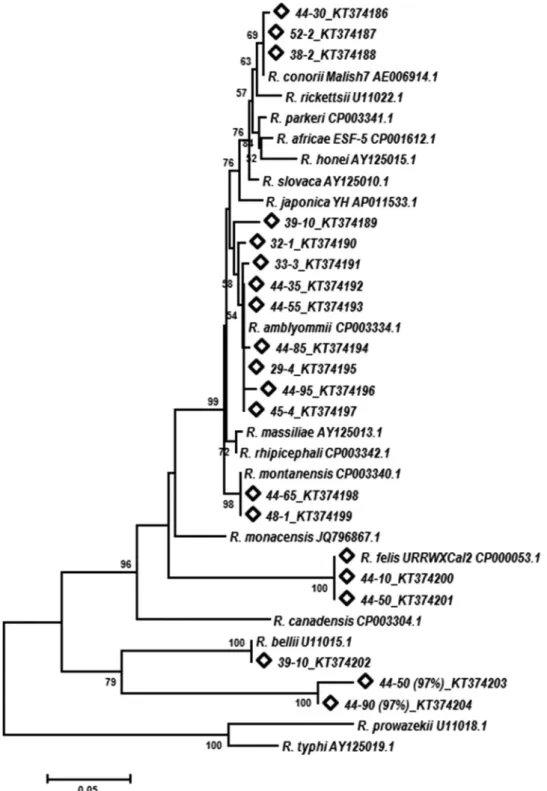
Phylogenetic analysis.
Phylogenetic analysis of
Rickettsia
spp.
using the neighbor-joining method showed that
D. variabilis
ticks
contained a diverse group of rickettsiae. Potentially novel
Rickett-sia
spp. with 97% similarity to
R. bellii
were placed on a separate
branch. Multiple ticks contained a
Rickettsia
species that was
placed on the same branch as
R. conorii
. Rickettsiae identified
through sequence match analysis as “
Candidatus
Rickettsia
am-blyommii,”
R
.
montanensis
, and
R. felis
in this study were aligned
with these species in the phylogenetic tree (
Fig. 3
).
DISCUSSION
Our novel nested 23S-5S IGS PCR assay was shown to be a robust
molecular tool for detecting
Rickettsia
species. Developing new
diagnostic tools and improving the existing ones facilitates
molec-ular epidemiological investigations of tick-borne diseases (
17
). In
this regard, the new nested assay should find utility in detecting
Rickettsia
spp. in ticks and clinical samples. Pathogen surveillance
in field-collected ticks by PCR amplifying specific gene targets is a
widely used practice for determining the prevalence and diversity
of the genus
Rickettsia
in a given environment (
8
,
19–21
,
24
,
41
).
We found that our nested 23S-5S IGS PCR assay outperformed
the 17-kDa protein gene,
ompA
, and
gltA
, which are commonly
FIG 1Representative PCR amplification of Rickettsia 23S-5S IGS from genomic-DNA samples ofD. variabilisticks. Primary (top) and nested (bot-tom) amplifications are shown. Lanes 1, marker; lanes 2,R. conoriipositive control; lanes 3 to 15, representative tick samples.Rickettsia-positive samples are shown in lanes 3, 4, 7, 8, 11, and 14. The amplicon in lane 12 is not of
Rickettsiaorigin.
used gene targets in molecular surveys of rickettsiae in ticks and
other environmental samples. In light of the increasing number of
cases of SFG rickettsiosis (
4
), which could potentially be caused by
new
Rickettsia
spp. (
4
,
6
), it is essential to develop new and/or to
improve existing molecular assays to increase the detection rate of
SFG and other rickettsiae vectored by ticks and other
blood-feed-ing arthropods (
17
).
The new nested 23S-5S IGS assay amplified all 11
positive-control
Rickettsia
spp. representing the SFG, TG, and ancestral
groups. In contrast, at the same template gDNA concentration,
other gene targets failed to amplify all the phylogenetic groups of
Rickettsia
, making 23S-5S IGS a robust target for pan
-Rickettsia
detection. The utility of a conventional PCR assay targeting the
Rickettsia
23S-5S IGS was reported previously (
22
); however,
add-ing a nested step substantially improved the sensitivity of the
as-say. The highly conserved ends and the hypervariable central
re-gions make it an ideal target for understanding the phylogenetic
relationships of SFG and other species of
Rickettsia
(
2
,
25
). The
greater efficiency of 23S-5S IGS for
Rickettsia
detection compared
to other PCR targets is likely due to greater overall coverage and
primer specificity across the genus. The occurrence of the 23S-5S
IGS in the SFG and the typhus and ancestral rickettsial groups is a
major strength of our newly developed assay.
The American dog tick (
D. variabilis
) is an established vector of
RMSF. However, recent studies have generally reported that
ⱕ
10% of ticks were infected with SFG rickettsiae, and
R. rickettsii
,
the causal organism of RMSF, was rarely detected (
13
,
42–45
). The
newly developed 23S-5S IGS PCR assay used in this study detected
DNA of
Rickettsia
spp. in 18/40 (45%)
D. variabilis
ticks tested,
while other PCR assays amplified
Rickettsia
spp. from 5 to 20% of
the same samples of tick gDNA. In our nested PCR assays for the
Rickettsia
23S-5S IGS, 7 of 18 tick samples were positive in both
replicates. Similarly, we observed differences in the patterns of
sample positivity for the two replications of the 17-kDa protein
gene,
ompA
, and
gltA
gene targets. Generally, for all PCR targets,
samples that produced visible bands in the primary PCR were
positive in both replications. These findings suggest that the low
abundance of
Rickettsia
DNA in some tick genomic-DNA samples
may have affected amplification regardless of the PCR target.
While we did not detect
R. rickettsii
in any of the
D. variabilis
ticks that were screened, we detected DNA of an
R. conorii
-like
species in some ticks.
R. conorii
is the pathogen causing
Mediter-ranean spotted fever (
3
) and is closely related to
R. rickettsii
. To
our knowledge, this
Rickettsia
species has not been reported to
occur in North America, and additional studies will be required
to further characterize the organism. Interestingly, the
R. conorii
-like 23S-5S IGS fragment amplified in the present study from
D.
variabilis
is 99 to 100% homologous in nucleotide sequence to a
23S-5S IGS fragment amplified from
Amblyomma americanum
Linn. in our previous study (
23
). This finding suggests that these
ticks might have become infected with the rickettsia by feeding on
the same vertebrate host species.
RLB hybridization assay of the 23S-5S IGS nested amplicons
identified diverse
Rickettsia
spp. in
D. variabilis
ticks. The
PCR-RLB assay has been shown to be a sensitive and specific assay for
detection and identification of pathogenic and nonpathogenic
Rickettsia
spp. (
22
,
23
,
46
,
47
). Notably, adding a nested step in the
PCR amplification of the 23S-5S IGS fragments substantially
im-proved the sensitivity of the assay for detection of rickettsiae at low
abundance. The phylogenetic analysis of the 23S-5S IGS sequence
data confirmed the presence of potentially novel
Rickettsia
species
in
D. variabilis
ticks. Use of the nested 23S-5S IGS PCR-RLB
hy-bridization assay for high-throughput screening of additional
TABLE 2PCR amplification success ofRickettsia23S-5S IGS fragments from 18D. variabilisadult ticks and comparison of the identification of
Rickettsiaspp. through Sanger sequencing versus RLB hybridization of the same 23S amplicons
Sample identifier code
Amplification success for
replicatea Nucleotide sequence identification for replicateb
RLB hybridization identification
1 2 1 2
29-4 ⫹ ⫺ “CandidatusRickettsia amblyommii” ⫺ “CandidatusRickettsia amblyommii” 32-1 ⫹ ⫹ “CandidatusRickettsia amblyommii” R. bellii “CandidatusRickettsia amblyommii,”
R. massiliae
33-3 ⫹ ⫹ “CandidatusRickettsia amblyommii” “CandidatusRickettsia amblyommii” “CandidatusRickettsia amblyommii”
38-2 ⫹ ⫺ R. conorii ⫺ R. conorii
39-10 ⫹ ⫹ R. bellii R. rhipicephali R. bellii
44-10 ⫹ ⫹ ⫺ R. felis Unknown SFG
44-30 ⫺ ⫹ ⫺ R. conorii R. conorii
44-35 ⫺ ⫹ ⫺ “CandidatusRickettsia amblyommii” “CandidatusRickettsia amblyommii”
44-45 ⫹ ⫺ ⫺ ⫺ R. conorii
44-50 ⫹ ⫹ R. felis R. bellii Unknown SFG
44-55 ⫹ ⫹ “CandidatusRickettsia amblyommii” “CandidatusRickettsia amblyommii” “CandidatusRickettsia amblyommii”
44-65 ⫹ ⫹ R. montanensis R. montanensis R. montanensis
44-85 ⫺ ⫹ ⫺ “CandidatusRickettsia amblyommii” “CandidatusRickettsia amblyommii”
44-90 ⫺ ⫹ ⫺ R. montanensis Unknown SFG
44-95 ⫹ ⫺ “CandidatusRickettsia amblyommii” ⫺ “CandidatusRickettsia amblyommii”
45-4 ⫺ ⫹ ⫺ “CandidatusRickettsia amblyommii” “CandidatusRickettsia amblyommii” 48-1 ⫹ ⫹ R. montanensis R. montanensis R. montanensis
52-2 ⫹ ⫺ R. conorii ⫺ R. conorii
a⫹, PCR amplicon was detected on the agarose gel;⫺, PCR amplicon was not detected on the agarose gel.
b⫺
field-collected
D. variabilis
adults will be reported in a subsequent
publication.
ACKNOWLEDGMENTS
We thank Holly Gaff of the Department of Biology at Old Dominion University for providing samples of tick genomic DNA used in validating our PCR assay. Also, we are obliged to Cecilia Kato for the gift of human
DNA samples and Michael Levin, Galina Zemtsova, and Alyssa Snellgrove for the generous gift of genomic DNA and tissue samples from laboratory animals. We are grateful to Lee Fuller of Fuller Labs for the generous gift of
R.monacensiscell culture material.
The findings and conclusions in this report are ours and do not nec-essarily represent the official position of the Centers for Disease Control and Prevention.
FUNDING INFORMATION
HHS | CDC | National Institute for Occupational Safety and Health (NIOSH) provided funding to Steven R. Meshnick under grant number 5R01OH009874.
REFERENCES
1.Azad AF, Beard CB.1998. Rickettsial pathogens and their arthropod vectors. Emerg Infect Dis 4:179. http://dx.doi.org/10.3201/eid0402 .980205.
2.Vitorino L, Chelo IM, Bacellar F, Zé-Zé L.2007. Rickettsiae phylogeny: a multigenic approach. Microbiology153:160 –168.http://dx.doi.org/10 .1099/mic.0.2006/001149-0.
3.Macaluso KR, Paddock CD.2014. Tick-borne spotted fever group rick-ettsioses andRickettsiaspecies, p 211–215.InSonenshine DE, Roe RM (ed), Biology of ticks, vol 2. Oxford University Press, New York, NY. 4.Openshaw JJ, Swerdlow DL, Krebs JW, Holman RC, Mandel E, Harvey
A, Haberling D, Massung RF, McQuiston JH.2010. Rocky Mountain spotted fever in the United States, 2000 –2007: interpreting contemporary increases in incidence. Am J Trop Med Hyg83:174 –182.http://dx.doi.org /10.4269/ajtmh.2010.09-0752.
5.Botelho-Nevers E, Raoult D.2011. Host, pathogen and treatment-related prognostic factors in rickettsioses. Eur J Clin Microbiol Infect Dis30:
1139 –1150.http://dx.doi.org/10.1007/s10096-011-1208-z.
6.Parola P, Labruna MB, Raoult D. 2009. Tick-borne rickettsioses in America: unanswered questions and emerging diseases. Curr Infect Dis Rep11:40 –50.http://dx.doi.org/10.1007/s11908-009-0007-5.
7.Ammerman NC, Swanson KI, Anderson JM, Schwartz TR, Seaberg EC, Glass GE, Norris DE.2004. Spotted-fever groupRickettsiain Dermacen-tor variabilis, Maryland. Emerg Infect Dis10:1478 –1481.http://dx.doi.org /10.3201/eid1008.030882.
8.Trout Fryxell RT, Steelman C, Szalanski A, Billingsley P, Williamson P.
2015. Molecular detection ofRickettsiaspecies within ticks (Acari: Ixodi-dae) collected From Arkansas United States. J Med Entomol52:500 –508. http://dx.doi.org/10.1093/jme/tjv027.
9.Moncayo AC, Cohen SB, Fritzen CM, Huang E, Yabsley MJ, Freye JD, Dunlap BG, Huang J, Mead DG, Jones TF.2010. Absence ofRickettsia rickettsiiand occurrence of other spotted fever group rickettsiae in ticks from Tennessee. Am J Trop Med Hyg83:653– 657.http://dx.doi.org/10 .4269/ajtmh.2010.09-0197.
10. Nadolny RM, Wright CL, Sonenshine DE, Hynes WL, Gaff HD.2014. Ticks and spotted fever group rickettsiae of southeastern Virginia. Ticks Tick-Borne Dis5:53–57.http://dx.doi.org/10.1016/j.ttbdis.2013.09.001. 11. Williamson PC, Billingsley PM, Teltow GJ, Seals JP, Turnbough MA,
Atkinson SF.2010.Borrelia,Ehrlichia, andRickettsiaspp. in ticks removed from persons, Texas, USA. Emerg Infect Dis16:441.http://dx.doi.org/10 .3201/eid1603.091333.
12. Carmichael JR, Fuerst PA.2010. Molecular detection ofRickettsia bellii,
Rickettsia montanensis, andRickettsia rickettsiiin aDermacentor variabilis
tick from nature. Vector-Borne Zoonotic Dis10:111–115.http://dx.doi .org/10.1089/vbz.2008.0083.
13. Stromdahl EY, Jiang J, Vince M, Richards AL. 2011. Infrequency of
Rickettsia rickettsiiinDermacentor variabilisremoved from humans, with comments on the role of other human-biting ticks associated with spotted fever group rickettsiae in the United States. Vector-Borne Zoonoic Dis
11:969 –977.http://dx.doi.org/10.1089/vbz.2010.0099.
14. Raoult D, Parola P.2008. Rocky Mountain spotted fever in the USA: a benign disease or a common diagnostic error? Lancet Infect Dis8:587– 589.http://dx.doi.org/10.1016/S1473-3099(08)70210-X.
15. Renvoisé A, Mediannikov O, Raoult D.2009. Old and new tick-borne rickettsioses. Int Health1:17–25.http://dx.doi.org/10.1016/j.inhe.2009.03 .003.
16. Dahlgren FS, Paddock CD, Springer YP, Eisen R, Barton Behravesh C.
2016. Expanding range ofAmblyomma americanumand simultaneous changes in the epidemiology of spotted fever group rickettsiosis in the United States. Am J Trop Med Hyg94:35– 42.http://dx.doi.org/10.4269 /ajtmh.15-0580.
17. Eremeeva ME.2012. Molecular epidemiology of rickettsial diseases in North America. Ticks Tick-Borne Dis3:332–337.http://dx.doi.org/10 .1016/j.ttbdis.2012.10.022.
18. Richards AL.2012. Worldwide detection and identification of new and old rickettsiae and rickettsial diseases. FEMS Immunol Med Microbiol
64:107–110.http://dx.doi.org/10.1111/j.1574-695X.2011.00875.x.
19. Anstead CA, Chilton NB.2013. Detection of a novelRickettsia (Alpha-proteobacteria: Rickettsiales) in rotund ticks (Ixodes kingi) from Sas-katchewan, Canada. Ticks Tick-Borne Dis4:202–206.http://dx.doi.org /10.1016/j.ttbdis.2012.11.013.
20. Henning TC, Orr JM, Smith JD, Arias JR, Norris DE.2014. Spotted fever group rickettsiae in multiple hard tick species from Fairfax County, Virginia. Vector-Borne Zoonotic Dis14:482– 485.http://dx.doi.org/10 .1089/vbz.2013.1534.
21. ToledoÁ Olmeda AS, Escudero R, Jado I, Valcárcel F, Casado-Nistal MA, Rodríguez-Vargas M, Gil H, Anda P.2009. Tick-borne zoonotic bacteria in ticks collected from central Spain. Am J Trop Med Hyg81:67–74. 22. Jado I, Escudero R, Gil H, Jiménez-Alonso MI, Sousa R, García-Pérez
AL, Rodríguez-Vargas M, Lobo B, Anda P.2006. Molecular method for identification ofRickettsiaspecies in clinical and environmental samples. J Clin Microbiol44:4572– 4576.http://dx.doi.org/10.1128/JCM.01227-06. 23. Lee S, Kakumanu ML, Ponnusamy L, Vaughn M, Funkhouser S, Thornton H, Meshnick SR, Apperson CS.2014. Prevalence of Rickett-siales in ticks removed from the skin of outdoor workers in North Caro-lina. Parasit Vectors7:607.http://dx.doi.org/10.1186/s13071-014-0607-2. 24. Lommano E, Bertaiola L, Dupasquier C, Gern L.2012. Infections and coinfections of questingIxodes ricinusticks by emerging zoonotic patho-gens in Western Switzerland. Appl Environ Microbiol78:4606 – 4612. http://dx.doi.org/10.1128/AEM.07961-11.
25. Fournier P-E, Zhu Y, Ogata H, Raoult D.2004. Use of highly variable intergenic spacer sequences for multispacer typing ofRickettsia conorii
strains. J Clin Microbiol42:5757–5766.http://dx.doi.org/10.1128/JCM.42 .12.5757-5766.2004.
26. Vitorino L, Zé-Zé L, Sousa A, Bacellar F, Tenreiro R. 2003. rRNA intergenic spacer regions for phylogenetic analysis ofRickettsiaspecies. Ann N Y Acad Sci990:726 –733.http://dx.doi.org/10.1111/j.1749-6632 .2003.tb07451.x.
27. Larkin MA, Blackshields G, Brown N, Chenna R, McGettigan PA, McWilliam H, Valentin F, Wallace IM, Wilm A, Lopez R.2007. Clustal W and Clustal X version 2.0. Bioinformatics23:2947–2948.http://dx.doi .org/10.1093/bioinformatics/btm404.
28. Tamura K, Stecher G, Peterson D, Filipski A, Kumar S.2013. MEGA6: molecular evolutionary genetics analysis version 6.0. Mol Biol Evol30:
2725–2729.http://dx.doi.org/10.1093/molbev/mst197.
29. Oliveira KA, Oliveira LS, Dias CC, Silva A, Jr, Almeida MR, Almada G, Bouyer DH, Galvao MA, Mafra C.2008. Molecular identification of
Rickettsia felisin ticks and fleas from an endemic area for Brazilian spotted fever. Mem Inst Oswaldo Cruz103:191–194.http://dx.doi.org/10.1590 /S0074-02762008000200011.
30. Regnery RL, Spruill CL, Plikaytis BD.1991. Genotypic identification of rickettsiae and estimation of intraspecies sequence divergence for portions of two rickettsial genes. J Bacteriol173:1576 –1589.
31. Roux V, Fournier PE, Raoult D.1996. Differentiation of spotted fever group rickettsiae by sequencing and analysis of restriction fragment length polymorphism of PCR-amplified DNA of the gene encoding the protein rOmpA. J Clin Microbiol34:2058 –2065.
32. Choi YJ, Jang WJ, Ryu JS, Lee SH, Park KH, Paik HS, Koh YS, Choi MS, Kim IS.2005. Spotted fever group and typhus group rickettsioses in hu-mans, South Korea. Emerg Infect Dis11:237–244.http://dx.doi.org/10 .3201/eid1102.040603.
33. Roux V, Rydkina E, Eremeeva M, Raoult D.1997. Citrate synthase gene comparison, a new tool for phylogenetic analysis, and its application for the rickettsiae. Int J Syst Bacteriol47:252–261.http://dx.doi.org/10.1099 /00207713-47-2-252.
34. Smith MP, Ponnusamy L, Jiang J, Ayyash LA, Richards AL, Apperson CS.2010. Bacterial pathogens in ixodid ticks from a Piedmont County in North Carolina: prevalence of rickettsial organisms. Vector-Borne Zoo-notic Dis10:939 –952.http://dx.doi.org/10.1089/vbz.2009.0178. 35. Ponnusamy L, Gonzalez A, Van Treuren W, Weiss S, Parobek CM,
Juliano JJ, Knight R, Roe RM, Apperson CS, Meshnick SR. 2014. Diversity of Rickettsiales in the microbiome of the lone star tick, Ambly-omma americanum. Appl Environ Microbiol80:354 –359.http://dx.doi .org/10.1128/AEM.02987-13.
36. Kato CY, Chung IH, Robinson LK, Austin AL, Dasch GA, Massung RF.
2013. Assessment of real-time PCR assay for detection ofRickettsiaspp. andRickettsia rickettsiiin banked clinical samples. J Clin Microbiol51:
314 –317.http://dx.doi.org/10.1128/JCM.01723-12.
blood and tissue samples from laboratory animals. PLoS One10:
e0116658.http://dx.doi.org/10.1371/journal.pone.0116658.
38. Eremeeva ME, Dasch GA, Silverman DJ.2003. Evaluation of a PCR assay for quantitation ofRickettsia rickettsiiand closely related spotted fever group rickettsiae. J Clin Microbiol41:5466 –5472.http://dx.doi.org/10 .1128/JCM.41.12.5466-5472.2003.
39. Altschul SF, Gish W, Miller W, Myers EW, Lipman DJ.1990. Basic local alignment search tool. J Mol Biol215:403– 410.http://dx.doi.org/10.1016 /S0022-2836(05)80360-2.
40. Saitou N, Nei M.1987. The neighbor-joining method: a new method for reconstructing phylogenetic trees. Mol Biol Evol4:406 – 425.
41. Maina AN, Jiang J, Omulo SA, Cutler SJ, Ade F, Ogola E, Feikin DR, Njenga MK, Cleaveland S, Mpoke S.2014. High prevalence ofRickettsia africaevariants inAmblyomma variegatumticks from domestic mammals in rural western Kenya: implications for human health. Vector-Borne Zoonotic Dis14:693–702.http://dx.doi.org/10.1089/vbz.2014.1578. 42. Feng WC, Murray ES, Burgdorfer W, Spielman JM, Rosenberg G, Dang
K, Smith C, Spickert C, Waner JL.1980. Spotted fever group rickettsiae inDermacentor variabilisfrom Cape Cod, Massachusetts. Am J Trop Med Hyg29:691– 694.
43. Fritzen CM, Huang J, Westby K, Freye JD, Dunlap B, Yabsley MJ, Schardein M, Dunn JR, Jones TF, Moncayo AC.2011. Infection
prev-alences of common tick-borne pathogens in adult lone star ticks ( Ambly-omma americanum) and American dog ticks (Dermacentor variabilis) in Kentucky. Am J Trop Med Hyg85:718 –723.http://dx.doi.org/10.4269 /ajtmh.2011.10-0583.
44. Pagac BB, Miller MK, Mazzei MC, Nielsen DH, Jiang J, Richards AL.
2014.Rickettsia parkeriandRickettsia montanensis, Kentucky and Tennes-see, USA. Emerg Infect Dis20:1750.http://dx.doi.org/10.3201/eid2010 .140175.
45. Yunik ME, Galloway TD, Lindsay LR.2015. Assessment of prevalence and distribution of spotted fever group rickettsiae in Manitoba, Canada, in the American dog tick,Dermacentor variabilis(Acari: Ixodidae). Vec-tor-Borne Zoonotic Dis15:103–108.http://dx.doi.org/10.1089/vbz.2014 .1692.
46. Khrouf F, M’Ghirbi Y, Znazen A, Jemaa MB, Hammami A, Bouattour A.
2014. Detection ofRickettsiainRhipicephalus sanguineusticks and Cteno-cephalides felisfleas from Southeastern Tunisia by reverse line blot assay. J Clin Microbiol52:268 –274.http://dx.doi.org/10.1128/JCM.01925-13. 47. Burri C, Dupasquier C, Bastic V, Gern L.2011. Pathogens of emerging
tick-borne diseases,Anaplasma phagocytophilum,Rickettsiaspp., and