THE EFFECTS OF THE EUROPEAN UNION ON CORRUPTION CONTROL IN CENTRAL AND EASTERN EUROPE BEFORE AND AFTER ACCESSION
Svet Derderyan
A dissertation submitted to the faculty at the University of North Carolina at Chapel Hill in partial fulfillment of the requirements for the degree of Doctor of Philosophy in the Department
of Political Science.
Chapel Hill 2015
Approved by: Milada Vachudova
iii ABSTRACT
Svet Derderyan: The Effects of the European Union on Corruption Control in Central and Eastern Europe before and after Accession
(Under the direction of: Milada Vachudova)
This dissertation evaluates the effectiveness of the EU in promoting lasting liberalizing reforms in Central and Eastern Europe (CEE) before and after accession. It focuses on an area of governance with deep implications for both the quality of democracy and the prospect of economic development in the region – corruption control. The major finding is that since enlargement the EU has not had such strong direct and far-reaching effects as it did before accession.
In analyzing corruption control both as a dependent variable as well as an independent one affecting FDI, I make three claims and substantiate each using a mixed-method approach featuring both time-series analyses and qualitative methods, such as case studies and expert survey data analyses.
First, civil society development has stagnated since accession and so has its otherwise positive influence on corruption control: the exodus of most external donors and the EU’s complicated procedures for applying for funding have crippled anti-corruption NGOs’ capacities to monitor and advocate reforms.
iv
funding and Cooperation and Verification Mechanism (in the cases of Bulgaria and Romania) as well as spillover effects from various chapters of the acquis have sufficed to prevent backsliding per se, but have not been able to reverse the post-accession trend of a slowdown in reform.
v
TABLE OF CONTENTS
LIST OF TABLES………...viii
LIST OF FIGURES………...………...x
LIST OF ABBREVIATIONS………...………xii
CHAPTER I: THE LIMITS OF THE EU’S “TRANSFORMATIVE POWER”………1
Overview and Contributions………....3
Conclusion………...8
References………..11
CHAPTER II: INCAPACITATED? THE ADVERSE EFFECTS OF EU ACCESSION ON ANTI-CORRUPTION CSOS’ CAPACITIES TO AFFECT CORRUPTION CONTROL IN CENTRAL AND EASTERN EUROPE………13
Civil Society and Corruption……….15
Theoretical Framework………. 17
The EU pre-accession process and the anti-corruption struggle: Conditions enabling and undermining the empowerment of CSOs in the pre-accession period……….17
Accession and the anti-corruption struggle: Conditions undermining the empowerment of the CSO sector ………..21
Hypotheses: Increasing Capacity Before Accession, Declining Capacity After...23
Methodological Framework………...24
Results………26
Time Series………29
vi
Survey Results………...34
Selecting anti-corruption NGOs for process tracing………..37
Case Studies………...39
Center for Economic Development (CED)………….………...40
Center for the Study of Democracy (CSD)………47
Conclusion……….56
References………..59
Appendix A: Civil Society Weakness and Corruption Control in the 10 post-communist countries of the 5th Enlargement 1997-2011………...62
A1: Cross-validation: Civil Society Weakness and Corruption in the in the 10 post-communist countries of the 5th Enlargement 1999-2012 as measured by Freedom House………..72
Appendix B: Variable measurement and Descriptive Statistics………77
Appendix C: Examples of mechanisms of corruption control utilized by Bulgarian NGOs………..……….81
CHAPTER III: CORRUPTION ON THE ROPES: THE EFFECTIVENESS OF EU LEVERAGE IN FIGHTING CORRUPTION IN CENTRAL AND EASTERN EUROPE BEFORE AND AFTER ACCESSION………..82
Corruption in CEE: The state of play………84
Challenges to post-accession compliance in various areas. Is corruption different?...88
Theoretical Framework and Hypotheses………...90
Methodological Framework………...92
Operationalization of the dependent variable – Corruption………...93
Operationalization of the independent variables - EU Candidacy Process and Full Membership………..………...96
Control Variables and Alternative Explanations………...98
vii
Causal Mechanisms……….106
Conclusion………...116
References………119
Appendix A: Variable measurement and Descriptive Statistics………..122
CHAPTER IV: BENEATH THE VEIL OF HOPE: THE EFFECTS OF EU SIGNALING ON FOREIGN INVESTORS’ SENSITIVITY TO CORRUPTION BEFORE AND AFTER EU MEMBERSHIP………..…………...126
EU accession, corruption, and FDI………..129
Theoretical Framework………133
Hypotheses………...137
Methodological Framework……….139
Alternative Explanations………..141
Time Series Analysis………...146
Survey………..150
Interviews……….159
Conclusion………...162
References………164
Appendix A: FDI in the 12 countries of the 5th enlargement 1996-2012………167
Appendix B: Variable measurement and Descriptive Statistics ……….174
viii
LIST OF TABLES
Chapter II
Table 1: Alternative Explanations……….30
Table 2: Effects of Civil Society Weakness on Corruption Control Before and After EU Accession………...…………32
Table 3: Drivers of CSO Empowerment before Accession………...35
Table 4: Reasons why access to funding sources became more difficult after accession……….37
Table 5: Descriptive Statistics and Difference of Means Test………...39
Table 6: CSD Grants by sponsor………...50
Table B.1: Variable Measurement……….77
Table B.2: Descriptive Statistics………80
Chapter III Table 1: Independent Variable – EU Candidacy Process………..96
Table 2: Independent variable – Full Membership………97
Table 3: The Effects of EU Candidacy and Membership on Corruption Levels………103
Table A.1: Variable Measurement………...122
Table A.2: Descriptive Statistics………..125
Chapter IV Table 1: Stages of Conditionality and When They Applied to Particular Countries…………...141
Table 2: FDI Drivers Before and After EU Accession………147
Table 3: FDI Post-accession of a Fund of Funds……….159
Table 4: FDI in EU and non-EU post-communist countries………161
ix
Table B.2: Descriptive
x
LIST OF FIGURES
Chapter II
Figure 1: Bulgarian civil society weakness before and after EU accession (2007)………...27
Figure 1.1: Bulgarian corruption control before and after EU accession………..27
Figure 2: EU pre-accession effect on NGOs and NGO’s impact on Corruption………..34
Figure 3: NGO Collective impact after Membership and Sources after accession………...36
Figure 4: Relevance score of various Bulgarian anti-corruption CSOs before and after accession………38
Figure 5: CED Number of Corruption-related projects……….43
Figure 5.1: CED Percentage of Corruption-related projects………..43
Figure 6: CED Number of Corruption-related publications………..44
Figure 6.1: CED Percentage of Corruption-related publications……….……..44
Figure 7: CED before accession………46
Figure 7.1: CED after accession………46
Figure 8: USAID and EU grants to CSD 2001-2011……….50
Figure 9: CSD publications 2002-2012……….51
Figure 9.1: Percentage Corruption-related publications by CSD 2002-2012………52
Figure 10: Open Society publications 2002-2012……….53
Figure 10.1: Percentage Corruption-related publications by Open Society 2002-2012…………53
Figure 11: CSD before accession………...54
Figure 12: CSD after accession……….54
Figure 13: OS before accession……….55
xi Chapter III
Figure 1: Corruption levels in Percentile Ranks………85
Figure 2: Corruption in Bulgaria 1997-2011………...109
Figure 2.1: Corruption in Romania 1997-2011………110
Figure 3: Government Promotion of Private Sector Development………..112
Figure 4: Quality of Public and Civil Service………..114
Figure 5: Quality of the Police and the Courts………115
Chapter IV Figure 1: Corruption Control and FDI in the 12 countries that joined the EU in 2004-07……..127
Figure 2: FDI in Bulgaria in millions of USD 1996-2012………...151
Figure 3: Effects of corruption on FDI before and after accession………..153
Figure 4: Current state of FDI and the reasons for it………...154
Figure 5: Conditions for the Availability Heuristic……….155
Figure 6: Reasons to invest in Bulgaria………...157
xii
LIST OF ABREVIATIONS
BG Bulgaria
CC Corruption Control
CED Center for Economic Development CEE Central and Eastern Europe
CEO Chief Executive Officer
CIDA Canadian International Development Agency CLS Center for Liberal Strategies
CPI Corruption Perception Index CSD Center for the Study of Democracy CSO Civil Society Organization
CSP Center for Social Practices
CVM Cooperation and Verification Mechanism DfID UK Department for International Development EBRD European Bank for reconstruction and Development ERDF European Regional Development Fund
EU European Union
FDI Foreign Direct Investment FIA Foreign Investment Act GDP Gross Domestic Product
GTZ German Association of Technical Assistance LDV Lagged dependent Variable
xiii
NORAD Norwegian Agency for Development and Cooperation OECD Organization for Economic Cooperation and Development OPAC Operational Programme Administrative Capacity
OS Open Society
PHARE Poland and Hungary: Assistance for Restructuring their Economies S&C Structural and Cohesion Funds
SAPARD Special Accession Programme for Agricultural and Rural development SIDA Swedish International Development Cooperation Agency
TI Transparency International TSCS Time Series Cross-Sectional UN United Nations
UNDP United Nations Development Project
USAID United States Agency for International Development USD United States Dollar
WB World Bank
1
Chapter I: The limits of the EU’s “transformative power”
The European Union’s (EU) eastern enlargement that took place between 2004 and 2007 incorporated ten post-communist countries into the Union, expanded its population by more than a 100 million citizens, and turned it into the world’s largest commercial and financial market, with a GDP of more than $13 trillion. The significance of this historic event, however, extends far beyond geography, demography and economics and has deep symbolic implications. As the EU Commission President at the time Romano Prodi put it, “Five decades after our great project of European integration began, we are celebrating the fact that Europeans are no longer kept apart by artificial ideological barriers.“ This was a moment when after more than a decade of difficult and painful transitions, ten post-communist Central and Eastern European (CEE) countries finally broke free from their communist legacies and joined the ranks of the developed world. The implementation of the EU’s membership conditionality meant that authoritarianism and central planning were now buried in the past. Democracy and the free market were “the only game in town.”
2
of economic development in the region – corruption control. To what extent have the EU accession process and subsequently membership enabled CEE states to catch up with the older and more established democracies and more developed economies of Western Europe? To answer this question I look at the interplay between supranational (EU) and domestic pressures (civil society) for corruption control as well as the consequences of corruption control or lack thereof for Foreign Direct Investment (FDI), one of the key sources of economic growth, in the region.
The major finding is that since enlargement the EU has not had such strong direct and far-reaching effects on corruption control as it did before accession. This finding falls in line with the arguments of several scholars who demonstrate that the EU’s effect on democratic development (unlike economic development) after accession has been modest at best (Epstein and Jacoby, 2014). They show that corporate state capture and political competition (Innes, 2014), democratic backsliding (Sedelmeier, 2014), extreme current account deficits (Jacoby, 2014) and consumption growth that is faster than productivity gains (Epstein, 2014) limit CEE’s prospects for catchup with west European countries.
My work contributes to this literature by suggesting that progress in corruption control has been stymied in CEE as a result of EU membership. In analyzing corruption control both as a dependent variable whose trends have to be explained as well as an independent one which affects other important aspects of post-communist development, such as FDI, I make three claims.
3
applying for funding have crippled anti-corruption NGOs’ capacities to monitor and advocate reforms.
Second, EU leverage has been weaker after accession and anti-corruption reform has consequently slowed down: supranational pressures from the EU in the form of conditional funding and Cooperation and Verification Mechanism (CVM) (in the cases of Bulgaria and Romania) as well as spillover effects from various chapters of the acquis have sufficed to prevent backsliding per se, but have not been able to reverse the post-accession trend of a slowdown in reform.
Third, looking at corruption control as an independent variable, the effects of its stagnating trend post-accession include a decline in FDI: although FDI was steadily increasing during the pre-accession period (and corruption control was irrelevant for investors at that time), rates of investment have surprisingly returned to pre-enlargement levels soon after accession, as investors have become more concerned about lack of progress in corruption control.
Overview and Contributions
4
(Epstein 2008), pension reform (Orenstein, 2008), enhancing liquidity after the financial crisis (Jacoby, 2014) etc.
At the same time, the EU’s influence has been weaker and declining after accession with regards to taxation (Appel, 2011), budgetary controls (Hallerberg and Yläoutinen, 2010), the application of minority rights rules (Sasse, 2008), political party platforms (Vachudova, 2008; Haughton,2014), political competition and corporate state capture (Innes, 2014), democratic backsliding (Sedelmeier, 2014), anti-corruption reform (Pop-Eleches and Levitz, 2010), and civil society (Mungiu-Pippidi, 2010).
What these studies point at is that on balance the EU has had stronger economic effects than political, and that its new post-communist members have had significant problems with various aspects of democratic consolidation (Epstein and Jacoby, 2014). Corruption control is no exception.
Given the established importance of domestic factors in effecting policy change (Vachudova 2005, Börzel and Risse, 2003; Jacoby, 2004; Haughton, 2012; Dimitrova and Buzogány, 2014), the first article of the dissertation explores the role of civil society organizations (CSOs) in inducing anti-corruption reforms. The main question it raises is how the EU has impacted CSOs' capacity to fight corruption. Utilizing a mixed-methods approach, the article shows that first the EU pre-accession process amplified the impact of CSOs but then, paradoxically, EU membership undermined their significance.
5
process tracing and expert survey data analysis to test how exactly the EU affected the capacity of CSOs to shape domestic incentives before and after accession.
My contributions to the existent literature on civil society and corruption fall in several areas. First, I offer an alternative theoretical argument to the debate whether the EU accession process helped or hurt CSOs in CEE. I show that the EU had a nuanced effect first strengthening, but then inadvertently undermining the impact of these organizations. Second, I identify and trace the two causal logics behind this dynamic. Before accession, CSOs took advantage of empowerment opportunities, such as more funding and the EU’s encouragement of collaboration with governments. In making this argument I also unpack the tools that this empowerment provided – advocacy and monitoring – and demonstrate how CSOs employed these tools to effect specific anti-corruption reforms. After membership, the withdrawal of most external donors from the area and the EU’s insistence that CSOs apply for EU funding through the various ministries of their own state led to specific problems with the financing of projects and the retention of staff which translated into weakening capacities.
But is the declining influence of civil society post-accession justification to expect backsliding in corruption control in this time period? To shed more light on this question, my second dissertation article takes a broader perspective1. Taking into account various aspects of the EU pre–accession process and post-accession pressures this article asks whether corruption levels were curbed during the pre-accession period and more importantly whether any such gains were sustained after that. Utilizing a mixed-methods approach I show that supranational pressures from the EU were strong both pre- and post-membership and the ten post-communist
1
A version of this article was published in an edited volume, EU Enlargement: Current Challenges and
6
countries performed well in both time periods, although there is definitely evidence of a slowdown in reform after accession.
There are several contributions to the literatures on EU leverage and post-accession compliance that I make. First, employing time series analysis and accounting for an array of alternative explanations I refute the skepticism about these countries’ success in trying to curb corruption before membership as well as the expectation for backsliding afterwards. Second, I unpack the causal mechanisms behind this result. Using historical process tracing I show that corruption received a lot of visibility during the accession period through the Commission Regular Reports in which the EU demanded reforms that served to decrease corruption levels during the pre-accession period. After accession, gains in the fight against corruption were not negated, albeit progress in reform slowed down, as the relative loss of leverage in this time period was compensated by the combined effect of three causal mechanisms. First, there were positive pressures coming from continued EU leverage - conditional Structural and Cohesion Funds and CVM reports (in the cases of Bulgaria and Romania). Second, there is evidence of increased linkage - socialization effects leading to higher demands for accountability of public officials. Third, there are substantial spillover effects from implementing the acquis in other areas – the reduction of the role of the state in the economy, increasing bureaucratic capacity and improvements in the legal system.
7
specifically, the article raises the question of whether positive signaling during the EU pre-accession process trumped other important factors for FDI, such as corruption, only for them to resurface after membership and have the expected impact on investor confidence. Put more simply, the article evaluates the differential effect of corruption on FDI inflows in Central and Eastern Europe during the different stages of the EU accession progress.
I hypothesize that explicit signaling by the EU during the negotiations phase increases investor confidence and causes investors to discount the importance of otherwise relevant factors, such as corruption. The situation changes after accession as the EU no longer sends such signals to investors. Thus, once a country is part of the bloc, technical factors reemerge as important and investors punish countries that are perceived as lagging behind or backsliding in the area of corruption.
The article features a mixed method approach. First, I use time-series analysis covering data from 1996 to 2011 to establish that corruption did not have a significant impact on FDI before accession but did afterwards. Then, I present the results of expert survey data and a brief case study to demonstrate the specific psychological mechanisms that allowed signaling to cause investors to be less risk avert prior to EU membership.
8
guidebook principles dominate economic actors’ decision-making, corruption matters, and its effect on FDI is negative. Second, I suggest that cognitive shortcuts, such as the availability heuristic, help explain behavior when investors operate in information-scarce environments as they tend to assign disproportionate weight to signals perceived as legitimate.
Conclusion
So what do these findings suggest about the EU’s longer-term effects, and particularly the CEE prospects for catching-up and overcoming the east-west divide? There are three conclusions and lessons that this dissertation draws.
First, it is clear that EU pressures work best when they take place in conjunction with domestic factors (Dimitrova and Buzogány, 2014). The fact that the EU provided opportunities, including funding, for civil society organizations to be a part of the accession process and alert the Commission of problems and inefficiencies enabled civil society to exert meaningful influence on corruption control. Since accession, complicated EU procedures for accession funding have led to a stagnation of the sector as many civil society actors have found it hard to finance anti-corruption activities. The lesson to be drawn here is the following: the key to revival of the sector is for the EU to remove the funds application process from the grip of domestic governments, which do not want anti-corruption funded and would methodically create barriers preventing CSOs from getting funded and exposing them. Given the close correlation between corruption control and strength of civil society it seems that this would be the sensible way to restore some of these countries’ more hopeful pre-accession anti-corruption track record.
9
were not negated by the granting of membership (Pop-Eleches and Levitz, 2010). Continued EU leverage in the form of conditional funding and CVMs combined with increased linkage with western Europe and spillover effects of other chapters of the acquis have prevented backsliding. On the other hand, however, these countries still remain much more corrupt than the western European members (except for Greece and Italy). The lessons here is the following: the EU can exert much more pressure on countries during the accession period as its leverage post-accession naturally decreases. The implications of this lesson can be nicely traced in the context of the Croatian accession in2013. Croatia’s negotiations were much slower, especially in their final phase as the Commission required the country to jump through many more hurdles than Bulgaria and Romania, particularly on corruption and judicial reform. It is too early to say whether this approach has led to a markedly different post-accession trajectory in anti-corruption in Croatia, but the idea of the Commission updating its strategies based on learning is encouraging.
10
on the ground, including slowdown in corruption reform, made it difficult to justify high rates of investment.
The lessons here are mainly for the investors. Decision makers can be affected by bold, striking, and vivid information, such as the EU’s positive endorsement of a country’s accession path. Rather than constructing careful cost-benefit analyses they may draw conclusions based on limited data and over-extrapolate, especially if others are doing the same (herding behavior). Thus, one could say that bounded rationality and inferential shortcuts can be partially responsible for overinvestment in CEE in the pre-accession period, and the drop in FDI shortly after accession merely signifies the return of comprehensive rational approaches.
11
REFERENCES
Appel, H. 2011. Tax Politics in Eastern Europe: Globalization, Regional Integration and the Democratic Compromise. Ann Arbor, MI: University of Michigan Press.
Börzel, T. and Risse, T. 2003. Conceptualizing the Domestic Impact of Europe. In Featherstone, K. and Radaelli, C. eds. The Politics of Europeanization Oxford: Oxford University Press. Bohle, D. and Greskovits, B. 2012. Capitalist Diversity on Europes Periphery. Ithaca, NY: Cornell University Press.
Drahokoupil, J. 2009. Globalization and the State in Central and Eastern Europe: The Politics of Foreign Direct Investment. London: Routledge.
Dimitrova, A. and Buzogány, A. 2014. Post-Accession Policy-Making in Bulgaria and Romania: Can Non-state Actors Use EU Rules to Promote Better Governance? JCMS 52 (1), 139–156. Epstein, R.A. 2014. Overcoming “Economic Backwardness” in the European Union. JCMS 52 (1), 17–34.
Epstein, R.A. and Jacoby, W. 2014. Eastern Enlargement Ten Years On: Transcending the East–West Divide? JCMS 52 (1), 1-16.
Epstein, R.A. 2008. In Pursuit of Liberalism: International Institutions in Postcommunist Europe Baltimore, MD: Johns Hopkins University Press.
Epstein, R.A., 2008. Transnational actors and bank privatization. In Transnational Actors in Central and East European Transitions. University of Pittsburgh Press
Ellison, D. 2006. Divide and Conquer: The European Union Enlargements Successful Conclusion? International Studies Review 8 (1), 150–165.
European Commission. 2010. Europe 2020: A Strategy for Smart, Sustainable and Inclusive Growth. COM (2010) 2020 final, 3 March.
Fernández, J. 2002. The Common Agricultural Policy and EU Enlargement. Eastern European Economics 40 (3), 28–50.
Haughton, T. 2012. Battlefields, Ammunition and Uniforms: The Past and Politics in Post-Communist Central and Eastern Europe. Comparative European Politics 11, 249–260. Hallerberg, M. and Yläoutinen, S. 2010. Political Power, Fiscal Institutions and Budgetary Outcomes in Central and East Europe.Journal of Public Policy 30 (1), 4–62.
Jacoby, W. 2014. The EU Factor in Fat Times and in Lean: Did the EU Amplify the Boom and Soften the Bust? JCMS 52 (1),52–70.
12
Kaminski, B. 1999. The EU Factor in Trade Policies of Central European Countries. Working Paper 2239 Washington, DC: World Bank.
Mayhew, A. 1998. Recreating Europe Cambridge: Cambridge University Press. Medve-Bálint, G. 2014. The Role of the EU in Shaping FDI Flows to East Central Europe. JCMS 52 (1), 35–51.
Mungiu-Pippidi, A. 2010. The Experience of Civil Society as an Anticorruption Actor in Eastern and Central Europe, European Research Center for Anti-Corruption and State-building
Orenstein, M. 2008. Out-liberalizing the EU: pension privatization in Central and Eastern Europe. JEPP 15 (6),899 – 917.
Pop-Eleches, G. and Levitz, P. 2010. Why No Backsliding? The EUs Impact on Democracy and Govrnance Before and After Accession. Comparative Political Studies 43: 457.
Sedelmeier, U. 2014. Anchoring Democracy from Above: The European Union and Democratic Backsliding in Hungary and Romania after Accession. JCMS 52 (1),105–121.
Sedelmeier, U. 2014. Anchoring Democracy from Above: The European Union and Democratic Backsliding in Hungary and Romania after Accession. JCMS 52 (1), 105–121.
Sasse, G., 2008. The politics of EU conditionality: the norm of minority protection during and beyond EU accession. Journal of European Public Policy 15(6), 899-917.
Sedelmeier, U. 2008. After conditionality: post-accession compliance with EU law in East Central Europe. Journal of European Public Policy 15(6), 806-825.
Vachudova, M. 2005. Europe Undivided: Democracy, Leverage, and Integration After Communism. Oxford: Oxford University Press.
Vachudova, M. 2008. Tempered by the EU? Political parties and party systems before and after accession. Journal of European Public Policy, 15(6), 861-879.
13
Chapter II: Incapacitated? The adverse effects of EU accession on anti-corruption CSOs’ capacities to affect corruption control in Central and Eastern Europe
A lot of the literature on the EU’s 5th
enlargement has focused primarily on leverage, compliance, and the possibility of backsliding (Grabbe, 2006; Schimmelfennig and Sedelmeier eds. 2005; Pop-Eleches & Levitz, 2010a; 2010b; Vachudova, 2009). Most of these works look at the direct EU efforts to affect governance but also underline that EU leverage works only in conjunction with domestic pressure, either through cooperation of governments or through opposition parties pressing political leaders to deliver certain results (Vachudova, 2005). Given the established importance of domestic factors, it is then justified to also explore the role of civil society organizations (CSOs) in affecting policy outcomes (Morrof and Pfister, 2010). In this article I evaluate the impact of civil society, and particularly non-governmental organizations (NGOs), on one of the most problematic areas of governance in the post-communist world - corruption.
The main question I raise is how the EU pre-accession process and post-accession institutional changes have impacted CSOs' capacities2 to fight corruption. Drawing on the literature on Europeanization and civil society I argue that during the EU pre-accession process the impact of CSOs on corruption was amplified through conditional and direct funding as well as the EU’s insistence that civil society actors participate in the implementation of various reforms associated with the acquis. I also argue that paradoxically EU membership then
2 I define capacities as the ability to access financial resources that can be used to fund successful anti-corruption
14
undermined the influence of CSOs as the complicated bureaucratic procedures associated with applying for EU funds combined with the exodus of other institutional actors that provided financial support before accession led to a funding crisis that incapacitated many anti-corruption CSOs.
The article features a mixed-method approach. Looking at the 10 post-communist states that joined the EU in 2004-07 I employ time-series analysis to establish the positive influence of CSOs on corruption control before accession as well as the lack thereof post-accession. I then focus on the qualitative case study of Bulgaria and, drawing parallels to the other nine Eastern European EU members, apply historical process tracing and expert survey data analysis to test how exactly the EU affected the capacity of CSOs to shape domestic incentives before and after accession.
15
The rest of the paper is organized as follows. First, I review the literature on the ways in which civil society improves governance and on its state in CEE. Then, I trace the historical involvement of the EU in seeking to empower the sector. In this section I outline the ways in which it strengthened CSOs before accession but I also show how granting membership led to a series of changes in the institutional terrain that translated into weakening the sector. Based on this background I then generate my hypotheses and test them using time-series analysis, expert survey analysis, and historical process tracing. I conclude by outlining the implications of my findings for the prospects of civil society and corruption control in CEE.
Civil Society and Corruption
As much academic literature has demonstrated, building civil society has been a central priority in the post-communist democratization agenda. According to liberal democratic theory, while the state should provide a government that is subject to free and fair elections, a strong and plural civil society guards against excesses of the state and legitimates its authority when based on the rule of law (Diamond, 1994). Such guarding against excesses and legitimating of authority take place by checking the government’s accountability, a dynamic directly related to effective corruption control (Klitgaard, 2000):
𝐶𝑜𝑟𝑟𝑢𝑝𝑡𝑖𝑜𝑛 = 𝑚 (𝑀𝑜𝑛𝑜𝑝𝑜𝑙𝑦 𝑜𝑓 𝑝𝑜𝑤𝑒𝑟) + 𝑑 (𝐷𝑖𝑠𝑐𝑟𝑒𝑡𝑖𝑜𝑛 𝑏𝑦 𝑜𝑓𝑓𝑖𝑐𝑖𝑎𝑙𝑠)
16
A vibrant civil society contributes to increasing accountability and thus decreasing corruption in two distinct ways. First, through monitoring CSOs can diagnose problems, assess actual situations, and point out publically or specifically to shortcomings in government policies. Second, through policy advocacy CSOs can clarify the specific changes needed, identify the possible coalitions necessary for the outcomes to be achieved, and build popular support for an issue (NGO Corruption Fighters’ Resource Book).3 For these reasons scholars overwhelmingly agree on the importance of civic organizations for achieving better democratic outcomes and greater government accountability (Carothers, 2006; Linz and Stepan, 1996; Schedler, Diamond and Plattner, 1999). In fact, focusing on CEE specifically, some empirical analyses (Karklins, 2005; Holmes, 2006) have shown that the media and civil society have been the most effective promoters of anti-corrupt politics in the region.
At the same time, the effectiveness of CSOs as a major corruption fighter has also been criticized. Compared to Western Europe and the United States, civil society in CEE has not been as active and influential (Howard, 2003; Toepler and Salomon, 2003). Similarly, NGOs in the region are often viewed with distrust by the government and by the public (Grodeland, 2006). Furthermore, given that in the nascent democracies of CEE CSOs are almost exclusively externally funded, they have felt little need to engage in constructive dialogue with the wider community in which they operate (Fagan, 2005) and often operate with little prospects of long term financial sustainability (Carothers and Ottaway, 2000). It is exactly this dynamic that has made them so vulnerable to the eventual exit of these external donors. Therefore, while there are many ways in which a strong civil society can lead to better democratic outcomes and less corruption, it is questionable whether CSOs in CEE have the capacities to do this in a sustained
17
manner. To what extent have these organizations been empowered by the EU pre-accession process and how resilient are their capacities to continue to effect change in the post-accession period? What specific mechanisms and technical tools do they use to build up pressure for reform? It is these questions that the rest of this article addresses.
Theoretical Framework
The theoretical section of this study is organized as follows. First, I present the ways in which the EU pre-accession process sought to empower CSOs as well as the arguments as to why these measures may not have had much impact. Then, I outline the institutional changes in the post-accession period that might have undermined the capacities of many CSOs to exert influence.
The EU pre-accession process and the anti-corruption struggle: Conditions enabling and undermining the empowerment of CSOs in the pre-accession period
Corruption became an important topic on the agenda of both academics and policy makers as soon as the CEECs started their transitions in 1989 – well before the EU entered the field in 1997. Initially, organizations, such as USAID and the World Bank soon followed by others4, took the lead in encouraging awareness raising and capacity building (Michael and Bowser, 2010). When the EU entered the stage in the late 1990s it sought to empower civil
4
18
society further granting these organizations participatory rights, encouraging cooperation between them and the government, and providing them with funding and knowledge transfer opportunities. This was a broad platform but it also focused specifically on anti-corruption CSOs since corruption was considered one of the main challenges of the post-communist transition, as featured in the EU Regular Reports on Hungary in 1999 and 2000, Latvia 1999, Poland 2002, Bulgaria 2001, and Romania 2001 among many others (Derderyan, 2013).
In order to assist CEEC with the adoption of the acquis and the Copenhagen criteria, the EU offered CSOs encouragement in four broad areas specified in the civil society literature. At the same time the pre-accession process also sustained certain conditions that were not conducive to the emergence of a strong civil society.
So how did the EU pre-accession process empower civil society in CEE? First, CSOs were granted participatory right and had the opportunity to alert the Commission of implementation problems during the pre-accession period by monitoring activities of the state. In this way the EU was aiming to increase both the effectiveness, by tapping into the knowledge base of non-state actors, and the democratic legitimacy of the process (Finke, 2007).
19
were set up for the monitoring of the SAPARD and PHARE programs which enabled some CSOs to considerably strengthen their capacities (Bruszt, 2008).
Third, the EU also allocated direct payments for CSOs in order to strengthen their capacities (Kutter and Trappman, 2010; Andonova, 2004; Iankova, 2009). The objective was to enable these organizations to participate in the political arena and to strengthen their own democratic and organizational structure. CSOs could apply for short term project grants to perform services related to the implementation of EU law.5 Such grants could be used for both monitoring and policy advocacy activities.
Finally, the EU Commission tried to also increase CSOs’ levels of expertise by encouraging collaboration with like-minded organizations on the EU level. CSOs from CEEC were assisted in building relationships with transnational networks and European umbrella organizations (Euro-groups) to learn more about implementation of EU law (Pleines, 2010, Koutalakis, 2010). Thus, CSOs were given the opportunity to both raise their domestic profile and also gain greater international recognition (Kuttern and Trappman, 2010).
Some scholars, however, doubt the impact and durability of these capacity-building measures. They point at potential vulnerabilities created or sustained by EU involvement in the pre-accession period.
First of all, while supporting civil society, the eastern enlargement, in conjunction with the legacies of the communist system, also entailed countervailing forces that served to empower the state. The pressure to meet the deadlines set by Brussels encouraged a top-down approach to the implementation of the acquis, often decreasing the opportunities for CSOs involvement
20
(Raik, 2006). In fact, this dynamic may have strengthened the positions of the state in this relationship by strengthening the core executives (Zubek, 2008).
Second, the extreme reliance on external funding and donors impeded the development of strong internal capacities of CSOs. It made them responsive to these donors’ agendas rather than their own priorities and detached them from any nascent grass-root constituencies that were in the process of formation (Kutter and Trappmann, 2010). Facing funding problems, CSOs found it difficult to retain qualified personnel as experienced activists often left for jobs in the private sector. This further weakened their capacities by introducing organizational instability.
Third, a political culture unconducive to openness and collaboration with non-state actors persisted (Kohler-Koch, 2000). Thus, even as the EU encouraged and required cooperation between the state and CSOs in the pre-accession period, this cultural antagonism often translated into limited collaboration (Fagan, 2004).
21
Accession and the anti-corruption struggle: Conditions undermining the empowerment of the CSO sector
While there are questions about whether the pre-accession process truly empowered civil society in CEE or not, little research has been done on what happened afterwards or whether the effects of pre-accession empowerment persisted, especially in the area of corruption. In order to contextualize the conditions conducive to declining capacity of anti-corruption CSOs in post-accession period, it is useful to briefly outline the change in the institutional scenario after EU membership. While I discuss this in the context of data on Bulgaria, the dynamic described below was identical for all countries that joined in 2004-07 and varied slightly only based on how fast a country was approaching membership.
First, before 2007 (the year when Bulgaria joined), external donors were abundant. Collectively they accounted for more than 80% of all funding for NGOs (NIT Bulgaria 2006). USAID, the German Association of Technical Assistance (GTZ), the UK Department for International Development (DfID), the Norwegian Agency for Development and Cooperation (NORAD), the Swedish International Development Cooperation Agency (SIDA), the Canadian International Development Agency (CIDA), and the Soros Foundation all sponsored NGOs in various good governance initiatives. As EU accession was knocking on the door, all these agencies were withdrawing and relocating their capital and expertise to the Western Balkans (mainly Croatia, Macedonia and Serbia).
(1990-22
1996): $206 million, to the Years of Political Stability and Rapid Reform (1997-2001): $192 million, to the Years of Consolidation, Stability and EU Accession (2002-2007): $166 million.6 The funding cycles of the other major international donors followed the same logic.
The other major change in the institutional context was the manner in which CSOs could apply for EU, now the dominant source of sponsorship. There were two avenues. The first one was following the application procedures familiar from the pre-accession days. According to these, one could apply for grants directly with the European Commission but only if they are in a consortium with CSOs from at least another five countries and if they could independently finance at least 20% of the project cost. In other words, big NGOs with international network of contacts and some funding available at hand were favored.
Second, after acceding to the Union, every country became part of the common cohesion policy and is eligible for financial assistance through the European Regional Development (ERDF) and Social Funds (ESF), managed within the framework of seven operational programs. One of these programs is the Operational Program Administrative Capacity (OPAC) and one of its main purposes is to provide for trained and active civil society structures. It is financed by the ESF and implementation of the partnership principle, the enhanced interaction between the civil society sector and the public authorities, is believed to be of central strategic importance (Todorakov, 2010). The presumption is that this interaction could bring greater effectiveness, transparency and accountability in the policy-making process. Thus, starting in 2007, CSOs could apply for these funds only through the various ministries of the state, which in turn made them vulnerable to the incompetency or corruption of the state’s administration (Index of Bulgarian Civil Society 2008-2010, Open Society).
23
Collectively, these two changes in the institutional context might have substantially diminished the capacity of most CSOs (except for the very big ones) to exert influence.
Hypotheses: Increasing Capacity Before Accession, Declining Capacity After
This historical overview about the opportunities and limitations that CSOs faced in the pre- and post- accession periods informs my expectations. In the pre-accession period, the issue of corruption was characterized by a high level of visibility through the Commission Regular Reports (Derderyan, 2013). Because of this reason the state had significant incentives to cooperate and respond to pressures from the EU since it did not want to be delayed or excluded from the process (Vachudova, 2005). At the same time CSOs had access to funding opportunities from various sources, which allowed them to temporarily possess greater action capacities and organizational stability. In other words, in terms of financial resources, CSOs were in a good position to employ skilled personnel and fund projects related to corruption control. Because of these two reasons, greater willingness of the state to cooperate and especially greater financial capacity, I hypothesize that CSOs were able to exert pressure for reform in this time period (through being more engaged in the policy proposal (advocacy), implementation, and evaluation (monitoring) stages of anti-corruption initiatives).
24
government that can to a large extent determine how easy or how difficult it would be for an NGO to receive funding from the EU. This naturally introduces a bias that can diminish the chances of (watchdog) CSOs trying to get funding for a project that would expose the corrupt or incompetent nature of the current government. This process is generalizable to all EU member states. Second, in order to compete for funding on the EU level without the state's assistance, CSOs need to have resilient internal bureaucratic organizations, provide high matching funds (between 20 and 80 percent), and be a part of strong international networks, something that only the larger and more established organizations are (Index of Bulgarian Civil Society 2008-2010, Open Society). Thus, given the key role the state plays in securing EU funding for most CSOs post-accession, I expect that anti-corruption CSOs (looking to expose and criticize the government) would have a difficult time accessing funds and would hence experience decreasing capacities.
My argument, therefore, is three fold: 1) Anti-corruption CSOs exerted a significant influence before accession but there was a sharp decline in their effectiveness after accession; 2) Reduced variation in funding sources has been decisive in this as external donors moved out; 3) Also key are the EU high bureaucratic capacities for direct individual applications and/or greater governmental mediation in selecting projects and funding for CSOs.
Methodological Framework
25
and that this effect was not sustained after accession. Second, I supplement the findings from the statistical analysis by evaluating the results of an expert survey I administered in Bulgaria in the summer of 2012. Its focus is on the sources of funding and empowerment as well as the relative strength of the CSO sector before and after the EU accession. The survey was administered in person and via email and featured leaders of specific CSOs (6), journalists (3), academics (4), and businessmen (2). Third, I present a qualitative study on Bulgaria based on interviews with key actors in the CSO sector and archival research conducted in the summers of 2011 and 2012. The purpose of this case study is to identify the causal mechanisms through which the publicity of corruption that NGOs create introduces incentives for government officials to reform. The qualitative data that I collected allowed me to conduct detailed historical process tracing and draw the causal lines between the availability of funding, the actual anti-corruption projects, and the specific reforms that the government implemented before and after accession.
26 Results
As a starting point it is useful to look at the strength of the civil society sector in CEE. I use the Civil Society measure from the Freedom House Nations in Transit dataset7, which taps into the “organizational capacity and financial sustainability, and the legal and political environment” in which civil society groups operate (NIT, 2010). Importantly, in this Freedom house index lower values indicate greater strength of the sector. Thus, to make the graphs easier to read I have relabeled the index Civil Society Weakness clarifying that a decreasing trend means that the weakness of the sector also decreases. Figures 1 and 1.1 below illustrate the evolution of Bulgarian civil society and Bulgarian corruption control (higher values indicate better corruption control) between 1997 and 2011.
7
27
Figure 1: Bulgarian civil society weakness before and after EU accession (2007)
Source: Civil Society Index, Freedom House. Available at:
http://www.freedomhouse.org/country/bulgaria, accessed on September 9, 2013 Figure 1.1: Bulgarian corruption control before and after EU accession
Source: Control of Corruption Index 1997-2011, World Bank. Available at:
http://info.worldbank.org/governance/wgi/index.aspx#doc, accessed on January 7, 2015
1 1.5 2 2.5 3 3.5 4
1997 1998 1999 2000 2001 2002 2003 2004 2005 2006 2007 2008 2009 2010 2011
BG Civil Society Weakness
-1 -0.8 -0.6 -0.4 -0.2 0 0.2 0.4 0.6 0.8 1
28
There are two interesting trends in this graph. First is the clear high correlation between civil society weakness and corruption control in the pre-accession period (Correlation Coefficient = -0.84) and the lack of such strong relationship the post-accession (Correlation Coefficient = -0.12). Second, while evidently civil society in Bulgaria has not regressed or backslided per se after 2007, it has also not continued to improve. In all the four years after Bulgaria’s EU accession the strength of the sector has remained stagnant at 2.5. Similarly, corruption control has at best only modestly improved in this time period. The 2012 Freedom House Nations in Transit (NIT) report points at the lack of financial stability as the main reason for the stagnation: “the ability of nongovernmental organizations (NGOs) to raise funds domestically remains limited, impeding the emergence of rich feedback links between NGOs and local communities.8” Interestingly, the 2007 report, the last time when Bulgarian civil society showed any signs of progress, also stresses this problem and delineates the issues that would end up haunting the sector with remarkable predictive capacity: “Over the last 17 years, Bulgaria has managed to develop a vibrant civil society. However, the nongovernmental organization (NGO) sector has still not developed sustainable fund-raising mechanisms. The Bulgarian civil society sector was formed with a top-down approach, led by donor demands and visions and not by Bulgarian citizens. This is the major reason most NGOs are still heavily dependent on foreign donors and do not enjoy public support. A significant number of large foreign NGOs and their donors began to withdraw from Bulgaria in 2006, which will likely cause funding problems for some organizations …. On the other hand, the accession of Bulgaria to the EU will open new funding possibilities to Bulgarian NGOs. New challenges are arising in developing special skills and capacity for writing project proposals and managing projects under the strict and
29
bureaucratic rules of the European Commission.”9 Impressively, this analysis written in 2007 sums up nicely the problems the sector has continued to experience ever since.
Importantly, the trend of a stagnating or mildly backsliding civil society development after membership and a slowdown (or backsliding) in corruption control is not unique to Bulgaria. It is generalizable to eight out of the ten post-communist countries that joined in 2004-07 (with only Poland where corruption improved significantly after accession despite lack of further development of its (otherwise very strong) civil society sector and Estonia where civil society improved slightly but corruption control remained largely unchanged after its accession). Graphs on all ten countries displaying these trends are available in Appendix A.
Time Series
The statistical part of this study utilizes a panel data approach to examine the effects of civil society weakness on corruption in the CEE countries before and after accession. Data on corruption control and a number of alternative explanations which may affect corruption (Table 1) are available for the ten post-communist EU members over the period 1997-2011. Appendix B details the operationalization of the dependent and independent variables.
30 Table 1: Alternative Explanations
Drivers of Corruption Studies Identifying these factors Relationship
Civil Society Weakness Karklins (2005) A vibrant civil society serves as a check on corruption
Economic Development Sandholtz and Gray (2003) Effect varies among low, middle and high-income countries
Competition Ades and Di Tella (1999) Open economies must be less corrupt
Level of Democracy Montinola and Jackman (2002) Democratic practices inhibit corruption
Freedom of the Press Karkins (2005) Independent media is a check on corruption
Abundance of Natural Resources
Ades and Di Tella (1999) Abundance of natural resources may create opportunities for rent seeking
Neighborhood Diffusion Effects
Sandholtz and Gray (2003) Corruption is higher in countries surrounded by corrupt neighbors Size of the Public sector LaPalombara (1994) Greater size of the public sector is
negatively correlated to corruption control
Model specification
31
32
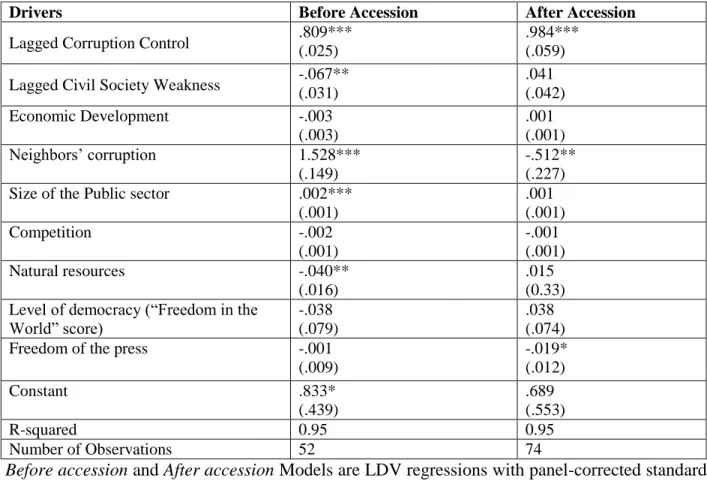
Table 2: Effects of Civil Society Weakness on Corruption Control Before and After EU Accession
Drivers Before Accession After Accession
Lagged Corruption Control .809*** (.025) .984*** (.059)
Lagged Civil Society Weakness -.067** (.031) .041 (.042)
Economic Development -.003
(.003)
.001 (.001)
Neighbors’ corruption 1.528***
(.149)
-.512** (.227) Size of the Public sector .002***
(.001)
.001 (.001)
Competition -.002
(.001)
-.001 (.001)
Natural resources -.040**
(.016)
.015 (0.33) Level of democracy (“Freedom in the
World” score)
-.038 (.079)
.038 (.074)
Freedom of the press -.001
(.009)
-.019* (.012)
Constant .833*
(.439)
.689 (.553)
R-squared 0.95 0.95
Number of Observations 52 74
Before accession and After accession Models are LDV regressions with panel-corrected standard errors. ∗∗∗p < .01; ∗∗p < .05; ∗p < .10. One-tailed tests where appropriate.
33
study, these control variables have signs and levels of statistical significance broadly consistent with theory and prior studies.
The results of the statistical analysis and the descriptive country graphs in Appendix A suggest that the trend of stagnating or increasing civil society weakness after accession and slower progress in corruption control shown in Figures 1 and 1.1 is one that is generalizable beyond the context of Bulgaria. There are reasons, however, that justify looking at the Bulgarian case in some more detail. First, Bulgaria is the country where the corruption climate after accession worsened most significantly. Only a year after joining the EU and within the first attempts of disbursement of structural funds, blatant corruption schemes in the management of the funds were exposed. As a result the Commission froze a substantial amount of funds for Bulgaria thus drawing a direct link between the government’s low administrative capacity and its inability to tackle corruption. Second, the EU’s rules for applying for funding are universal for all members, so looking at how these rules may inhibit the ability of anti-corruption CSOs to apply for grants in any one country (especially the one whose corruption problems are the most serious) can reveal to a large extent the causal story in all.
34 Survey results
The results of the survey confirm the main expectations outlined above. First of all, the fifteen experts overwhelmingly agree that the EU accession process strengthened the CSO sector in Bulgaria and that CSOs had a strong collective impact on the battle against corruption before accession.
Figure 2: EU pre-accession effect on NGOs and NGO’s impact on Corruption
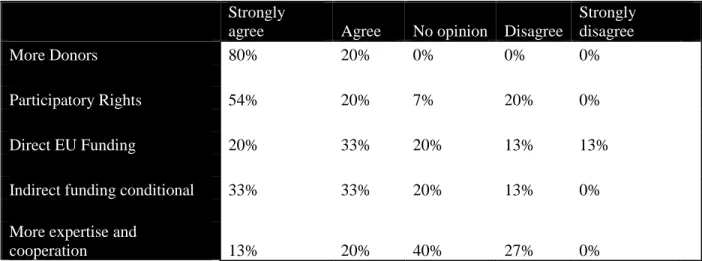
In answering how exactly the pre-accession period empowered the civil society sector, the experts are unanimous that the presence of more donors was crucial. In terms of the EU in particular, 74% identify the participatory rights given by the EU as important in the empowerment of CSOs. 53% agree that direct funding from the EU was key with only 26% disagreeing. Indirect funding conditional on cooperation with the state or local governments is identified as a more prominent mechanism: 66% agree and only 13% disagree. Providing more expertise and opportunities for cooperation is identified as a strong mechanism of empowerment by 33% of the experts with 27% disagreeing.
47% 53%
0% 0%
0%
EU pre-accession effect
on NGOs
Strengthened them a lot
Strengthened them a little
No effect
Weakened them a little
20%
66%
14% 0% 0%
NGO Collective Impact
pre-accession
A lot stronger
Stronger
No opinion
Weaker
35
Table 3: Drivers of CSO Empowerment before Accession
Strongly
agree Agree No opinion Disagree
Strongly disagree
More Donors 80% 20% 0% 0% 0%
Participatory Rights 54% 20% 7% 20% 0%
Direct EU Funding 20% 33% 20% 13% 13%
Indirect funding conditional 33% 33% 20% 13% 0%
More expertise and
cooperation 13% 20% 40% 27% 0%
36
Figure 3: NGO Collective impact after Membership and Sources after accession
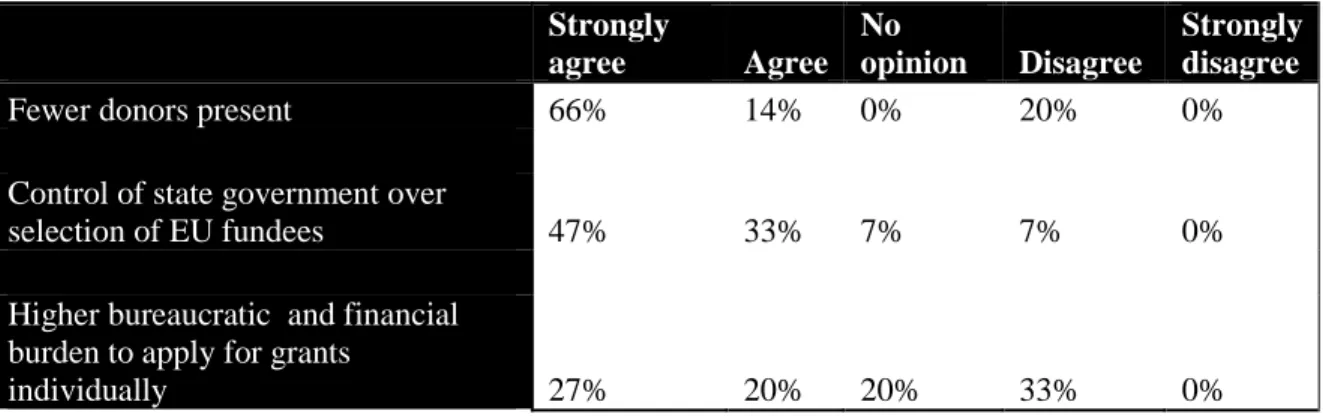
The table below provides further insight into the reasons why experts believe the availability and acquisition of financial resources is more limited in the post-accession period. Some 80% specify the absence of as many donors as before accession as the main reason for lack of resources providing evidence for part two of my argument. Another majority of 80% points at the EU’s insistence on the partnership principle requiring CSOs to go through the complex and lengthy bureaucratic processes of the state when applying for EU funding. About half the experts suggest that the difficulty to apply for grants directly (given the matching funds and transnational network requirements) is another impediment to financial stability for CSOs. These results are in line with part three of my argument.
0% 13% 0%
80% 7%
NGO Collective Impact
After Accession
A lot stronger
Stronger
No opinion
Weaker
A lot weaker
20%
80%
Sources After accession
More
37
Table 4: Reasons why access to funding sources became more difficult after accession
Strongly
agree Agree No
opinion Disagree
Strongly disagree
Fewer donors present 66% 14% 0% 20% 0%
Control of state government over
selection of EU fundees 47% 33% 7% 7% 0%
Higher bureaucratic and financial burden to apply for grants
individually 27% 20% 20% 33% 0%
Selecting anti-corruption NGOs for process tracing
38
Figure 4: Relevance score of various Bulgarian anti-corruption CSOs before and after accession
Source: Survey data; 15 NGO experts, 2012
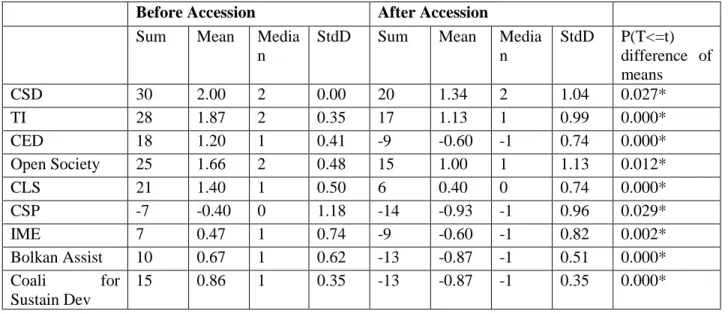
While eight of the nine organizations were identified as having a strong impact on the fight against corruption prior to accession, four of these become considerably less important in the post-accession period. The variance in relevance among the major anti-corruption CSOs between the two periods is also supported by the difference in standard deviations: 11.75 before
-10 -5 0 5 10 15 20 25 30
Relevance Score Before
Relevance Score Before
-20 -15 -10 -5 0 5 10 15 20 25
Relevance Score After
39
accession and 14.61 after. Furthermore, a difference of means test shows statistical significance at the 0.05 level for every single CSOs when the mean scores for the two periods were compared.
Table 5: Descriptive Statistics and Difference of Means Test
Before Accession After Accession
Sum Mean Media
n
StdD Sum Mean Media n
StdD P(T<=t) difference of means
CSD 30 2.00 2 0.00 20 1.34 2 1.04 0.027*
TI 28 1.87 2 0.35 17 1.13 1 0.99 0.000*
CED 18 1.20 1 0.41 -9 -0.60 -1 0.74 0.000*
Open Society 25 1.66 2 0.48 15 1.00 1 1.13 0.012*
CLS 21 1.40 1 0.50 6 0.40 0 0.74 0.000*
CSP -7 -0.40 0 1.18 -14 -0.93 -1 0.96 0.029*
IME 7 0.47 1 0.74 -9 -0.60 -1 0.82 0.002*
Bolkan Assist 10 0.67 1 0.62 -13 -0.87 -1 0.51 0.000*
Coali for Sustain Dev
15 0.86 1 0.35 -13 -0.87 -1 0.35 0.000*
Case studies
40
Center for Economic Development (CED)
The Center for Economic Development was far more able to exert influence targeted at corruption control before the accession to the EU. There were two main reasons for this. First, the organization had access to more and more variable funding sources with more simplified procedures for applying for funds. This increased its independent capacity for action. Second, due to explicit EU requirements and the fact that the country was still on the accession queue, there was greater willingness by the state and local governments to cooperate on various projects pertaining to corruption control. After accession, limited funding opportunities beyond the EU and complicated procedures for applying for EU grants decreased the capacity of the organization to induce policy change.
During the accession period, the EU encouraged NGOs to participate in the political process and alert the Commission of various challenges. Thus, in 2002-03 CED championed the “Transparency of the public auctions” project which led to several publications outlining the underlying reasons for corruption in this field as well as suggested measures that should be taken to eliminate it. This advocacy project was sponsored by the Open Society Institute and the Soros Foundation and raised awareness about the problem resulting in the explicit inclusion of this issue in the EU Commission Regular Reports for the next few years until the Bulgarian government took measures to ameliorate the problem on the eve of accession. Thus, the EU’s encouragement to identify issues that need attention combined with the availability of funds through external donors, strengthened the CED capacity in the accession period.
41
Velingrad municipality”, financed by USAID (expert interview, Summer 2012). The project led to the development of sustainable monitoring and communication mechanisms through which business organizations and local authorities can identify and target corrupt practices. The project was so successful that the EU was willing to provide more funding through its PHARE programme to expand its scope and include another 12 municipalities. The PHARE funding was conditional on the cooperation of national and subnational governments with different businesses and NGOs (Bruszt, 2008; Gasior-Niemiec, 2010; Grosse, 2010), which made both the willingness and the capacity of these actors to cooperate more pronounced.
42
Furthermore, having lost valuable staff members after accession (now down to nine) the organization has found it difficult to master the elaborate EU grant application process operated by the state administration. As its other donors (most notably USAID) withdrew and the opportunities for funding through the EU became more limited (due to their conditional nature and the state’s limited willingness to cooperate and the “gatekeeping” role of the Bulgarian state), the capacity of CED to exert influence drastically decreased, thus providing evidence for parts two and three of my argument.
Bolkan Assist dealt with similar types of pressures. According to one of the interviewed experts, the organization was “unlucky” enough to actually qualify for funding for one of its projects through the Structural funds. The bureaucratic hurdles that the state administration created then in terms of requiring additional materials were quite substantial to put it mildly. The organization struggled to meet all requirements and its employees found the process “exhausting” and “demeaning”. Eventually, it took more than a year until Bolkan Assist received the funds that it had rightfully qualified for (expert interview, Summer 2011).
43 Figure 5: CED Number of Corruption-related projects
Source: http://ced.bg/projects.php, accessed on January 1, 2013
Figure 5.1: CED Percentage of Corruption-related projects
Source: http://ced.bg/projects.php, accessed on January 1, 2013
0 2 4 6 8 10 12 14 16 18 20
2002 2004 2006 2008 2010 2012
CED Corruption-related projects
# of Projects
# of Corruption-related Projects
0% 5% 10% 15% 20% 25% 30% 35% 40% 45%
2002 2003 2004 2005 2006 2007 2008 2009 2010 2011 2012
CED % Corruption-related projects
44
Figure 6: CED Number of Corruption-related publications
Source: http://ced.bg/publications.php, accessed on January 1, 2013
Figure 6.1: CED Percentage of Corruption-related publications
Source: http://ced.bg/publications.php, accessed on January 1, 2013
0 5 10 15 20 25 30
35
CED Corruption-related publications
# of publications
# of Corruption related publications
0% 5% 10% 15% 20% 25%
2002 2003 2004 2005 2006 2007 2008 2009 2010 2011 2012