The effect of relational capabilities in the
process of value co-creation within the context
of SME’s
Author: Jan-Willem Kamp
University of Twente P.O. Box 217, 7500AE Enschede
The Netherlands
ABSTRACT
:
This paper studied the effect of relational capabilities in process of value
co-creation within the context of SME’s. Additionally the paper aims to determine a set
of organizational and relational tools used by firms to effectively co-create value. There
is vagueness within the topic of relational capabilities in the context of value co-creating.
The research builds upon a sample set of 19 SME’s active in varying industries and
branches located in the region of Twente. The methodology employed involved a
pre-structured interview token into account both supplier and customer perspective for each
SME. The findings resulted in a clear understanding of relational capabilities within the
context of value co-creation. Additionally for each of the five constructs within the
process of value co-creation described by (Stenroos and Jaakkola, 2012) a set of
relational capabilities was structured. The outcome of the study offers managerial
application within businesses by delivering an optimizing tool for relational activities
with customers, partners and other third parties in the process of value co-creation.
Currently, literature about the role of relational capabilities within co-creational
processes is not that large. New insights and outcomes of this study can function as basis
on which further research on this topic can be build. Next to this, it opens new
opportunities for new aspects related to the topic of co-creation for example the role of
communicational activities within the process of value co-creation, which appeared as
imperative phenomenon within the process of value co-creation.
Supervisors:
Dr. Raymond Loohuis, MBA
Dr. Mathias de Visser
Keywords
VALUE CO-CREATION RELATIONAL CAPABILITIES RESOURCES AND CAPABILITIES
COMMUNICATION WITHIN CO-CREATION LONG-TERM RELATIONSHIPS
PARTNERSHIPS
Permission to make digital or hard copies of all or part of this work for personal or classroom use is granted without fee provided that copies are not made or distributed for profit or commercial advantage and that copies bear this notice and the full citation on the first page. To copy otherwise, or republish, to post on servers or to redistribute to lists, requires prior specific permission and/or a fee.
7th IBA Bachelor Thesis Conference, July 1st, 2016, Enschede, The Netherlands.
1. INTRODUCTION
Following Vargo and Lusch (2004) marketing have shifted to a service dominant logic. New insights revised the logic focused on intangible resources, co-creation of value and relationships. There was shift from tangible towards intangibles, such as skills, information and knowledge and perhaps more
encompassing towards interactivity, connectivity and ongoing relationships. The original term co-producer used in the goods-dominant logic got replaced by the term co-creator. This new marketing thought obtained a substantial marketing role. Value is perceived and evaluated by the customer. Value-in-use is the evaluation of the service-experience; it is the judgment of the customer taking into account all functional- and emotional outcomes of the service consumed. (Vargo and Lusch, 2014 e-book) From this perspective, supplier firms can only offer value propositions that resonate with the value-in-use perceptions of customers (Grönroos 2008). S-D logic makes the consumers’ role key in the value-creation process. High-quality interactions enable the customer to co-create unique experiences with the firm and are key to unlock new sources of competitive advantage. Value has to be created jointly both by firm and consumer. (C.K. Prahalad and Venkat Ramaswamy, 2004) Value co-creation is conceptualized by (Stenroos and Jakkoola, 2012) as joint problem solving, which involves supplier and customer resources integrated in a collaborative interaction process. Sternroos and Jakkoola propose a process-oriented model that probes into the black box of co-creation processes. In their model, it is proposed that suppliers apply their specialized professional skills, methods and judgment, while customers contribute resources such as knowledge, in order to create optimal value-in-use, i.e. the best possible balance between the value-in-use to be achieved and the required sacrifices. The paper of (Stenroos & Jaakkola, 2012) adds very significant contribution by constructing and empirically grounded framework that presents a dyadic problem solving process through which value co-creation occurs in the context of KIBS. However, as mentioned by (Ngugi, I. K., Johnsen, R. E., & Erdélyi, P, 2010) and several others (Dyer and Chu, 2003; Dyer and Singh, 1998; Forsström, 2005; Möller, 2006; Ulaga, 2001; Wagner and Hoegl, 2006) the relational touch is getting very important in terms of co-creation in marketing
relationships. The last couple of decades it has become clear that collaboration between entities is growing. There is a growing recognition that collaborative relationships between firms in business markets can offer opportunities to create competitive advantages. Co-creation offers firms and their network of actors’ significant opportunities for innovation, as each actor offers access to new resources through a process of resource integration. The interaction process between actors (firms, customers etc.) can offer them opportunities to facilitate value creation for and with each other. (Grönroos 2008) Current literature reveals the significant possible contribution of interaction process between firms with arising opportunities to facilitate value creation for and with each other (Payne, A. F., Storbacka, K., & Frow, P., 2008) (Grönroos, 2008).
According to (Ngugi, Johnsen and Erdélyi, 2010) inter-organizational relationships have received increasingly attention. It is more and more common to collaborate for firms, which underlines the importance of relational capabilities. Besides increasing sales and profits volumes, gaining access to new markets, developing innovations enhanced relational capabilities led to better co-creational value in relationships (Ulaga, W., & Eggert, A. (2001).
The role of relational capabilities within the dyadic problem solving process of value co-creation is not clear according to Stenroos and Jakkoola. Next to this, no clear interpretation is present about relational capabilities within co-creational processes in other literature. However, (Ngugi et al, 2010) and (Johnsen and Ford, 2006)’s studies focused on relational capabilities for value co-creation and innovation in SME’s. There study was based on smaller supplier - larger customer relationships. With relational capabilities is meant those capabilities that are perceived to be fundamental in enhancing the co-creational relationship from both the customer and supplier’s. Resources of a company are integrated and activated through interaction with other parties (Johnsen and Ford, 2006). Relational capabilities explain what firms in relationships can do for each other, the functions they will conduct, and the width and importance of these functions (Hakansson and Ford, 2002). (Ngugi et al, 2010) specified four types of relational capabilities including: technological capabilities, human capabilities, managerial systems-based capabilities, and cultural interaction capabilities. All four types of capabilities will be explained in the theoretical part of this paper.
As continuation of all the former this study aims to clarify the role and effect of relational capabilities in the process of value co-creation, within the context of SME’s. The research takes
into account resources and capabilitiesfrom a supplier
perspectivein order determine how these could contribute to
co-creational processes within the context SME’s including customers, partners and other third parties.
The research done in this paper, contrary to (Ngugi et al, 2010) is not specifically related to this type of smaller supplier-larger customer relationship. However, the set of relational
capabilities indicated in his research will be taken into account in this study. These relational capabilities form a fundament to build upon. To avoid any confusion regarding terminology it should been said that resources in fact are organizational resources or assets, which are for example: human resources, intellectual capital and capital equipment (Amit, R., & Schoemaker, P. J., 1993). Capabilities are defined as invisible assets that are fimr-specific and developed over time through complex ineraction among the firms’ resources (Teece, D. J., Pisano, G., & Shuen A., 1997). These resources should be utilized or combined into relational capabilities that in turn will gain prospering conditions to succeed in the process of value co-creation. The topic worked out and discussed in this paper is
about which relational capabilitiesfrom a supplier perspective
2. THEORETICAL FRAMEWORK
S-D logic attributes importance of customer involvement during the process as a co-creator of value. (Lusch and Vargo, 2006). Nowadays there is an increasing recognition of the important role of processes regarding co-creation. S-D logic emphasizes marketing as a set of processes and resources with which the company seeks to create value propositions. Processes include the procedures, tasks, mechanisms, activities and interactions that can support the co-creation of value. According to (Adrian F. Payne & Kaj Storbacka & Pennie Frow, 2007) managing the process-based value co-creation framework consists of three main components: Customer value-creating processes, supplier value-creating processes and encounter processes. This framework from a theoretical perspective, integrates several streams of work within the evolving S-D logic literature. These include the customer as a co-creator of value; marketing as a ‘fundament’ of relationships, encounters and dialogue; knowledge as a fundamental source of competitive advantage; and the focus on operant resources as the key unit of exchange. It highlights the roles of customer and supplier and that these together create value and the importance of core competences such as learning and knowledge. Further, it emphasizes a view of the relationship experience that is interactive, longitudinal, individual and contextual. It also demonstrates that both customer learning and organizational learning form key components of co-creation, and they are closely related to customer and supplier processes.
It is a clear indication saying that relational aspects in terms of co-creational processes are of high importance. Collaboration takes an essential place in today’s competitive world. Co-creational value has a lot to do with a firms’ capacity to collaborate by which in turn a firm is building their
competitiveness. Developing relational capabilities can be seen as imperative in this context. (David Ballantyne & Richard J. Varey, 2006) also emphasized that co-production of value requires that marketers view service interactions relationally. Relationships are emergent by nature, a consequence of learning together over time. The former applies to firms, customers, and all other exchange parties. It is the quality of the relationship that can be ‘managed’, not the relationship as such, and this is a common misconception. How to manage
relationship quality is a consequence of learning together over time. This is an important issue, because relationships that are beneficial to all parties provide structural support that is useful for sustaining further value-creating activities.
Relational capital often is based on the inter-personal dynamics of partner firms’ representatives. Although two firms or business units may agree to work together to achieve a common purpose, achieving the desired outcome is not guaranteed. The implementation of the agreement is strongly influenced by the interaction between the individuals who represent their respective firms. (Jamie D. Collins, Michael A. Hitt, 2006) To sustain relationships especially in dynamic environments and changing supplier requirements, considering and enhancing relational capabilities is key. Relational capabilities are used to build relational capital with partners. Relational capital is a resource that can be leveraged to enhance knowledge transfer processes. According to (Johnsen and Ford, 2006) four types of capabilities are critical in the development and management of larger customer-smaller supplier relationships, namely: technological capability, human capability, managerial systems-based capability, and cultural interaction capability. However these capabilities determined in the perspective of larger customer-smaller supplier relationships they can add value to the outcome of this research; determining what the role and effect is of relational capabilities within the process of co-creation value. Other literature stresses already the importance
of professional knowledge and competence. Supplier resources that are key in contributing to value creation include e.g. professional knowledge and competence, robust and relevant applied knowledge, procedures, facilities and equipment (Olaru, D., Purchase, S., & Peterson, N., 2008).
Technological relational capabilities include for example the technical systems and procedures in supplier and customer firms. Unique technological capabilities may enhance suppliers’ ability to create technical systems or technologies that are valuable to their customers. Mutual identification of
technological requirements in the relationship between supplier and customer enables technological developments to better predicted and planned. For example, for firms to respond to requirements special monitoring system were developed to automatically satisfy changing needs from customers. Besides this according to (Ngugi et al, 2010), supplier technologies and technical systems were customized to suit requirements of customers. Next to this, cross-functional teams can bring together different sources of expertise, which will be improving future product developments. Communication and feedback obtained from customers is very important related to the former.
Human relational capabilities relate to development of knowledge by suppliers and customers’ employees. The skills and knowledge base of the firm are part of the human relational capabilities. Firms are sharing and transferring knowledge of individuals and groups. Knowledge sharing between customers and suppliers enhances the learning process. (Carrizo Moreira, A., 2009). (Vargo and Lusch, 2004a) have recognized the fundamental importance of human skills, competencies, and the accumulated work experiences of employees. Knowledge takes two forms, tacit knowledge and explicit knowledge. Tacit knowledge is abstract and can be gained by employees through observation, imitation, and mutual experience. Explicit knowledge is highly codified and is transmittable in formal, systematic language is media-based and can be digitized, duplicated and circulated. (Polanyi, 1966; Nonaka and Takeuchi, 1995). Knowledge is a fundamental source of competitive advantage regarding (Vargo and Lusch, 2004a). Learning accelerates capability development, reduces time and risk involved when creating new products and technologies. Likewise, learning leads to new knowledge that could not exist without dyadic learning interactions between firms. Which can be labeled as generating tacit knowledge because it is derived from learning with other partners to improve both firms’ value
creating process. (Ngugi et al, 2010). Managerial systems
relational capability relate to unique structures and methods that enable the creation of knowledge that give each firm its own character. This capability involves ways of creating knowledge and controlling knowledge in relationships (Johnsen and ford, 2006). It is about how suppliers’ and customers develop their structures, strategies and relationships. Managerial systems capability for example may influence relationship characteristics through the development of strong and effective management structure and resources that could enable a supplier to appear well resourced, managed or structured by its counterpart. In summary, this phenomenon is about bilateral, interactive development and participating of both supplier and customer to help with implementing processes, planning issues or other activities all with the aim to foster collaborative relationships. (Ngugi et al, 2010)
knowledge transfer, especially tacit knowledge (Collins, J. D., & Hitt, M. A., 2006).
The supplier’s ability to learn, understand and relate to the culture and values of its customer would influence how the supplier coped with conflict and inconsistency in its customer relationship. Cultural differences are a major source of potential conflict between firms involved in cross-border partnerships (Spicer, 1997; Weber and Camerer, 2003) For example when knowledge needs to transferred and crosses two or more cultures, achieving and sustaining a competitive advantage based on knowledge is often challenging (Collins, J. D., & Hitt, M. A., 2006). Building a shared culture and values may offer opportunities to develop greater intensity and value co-creation opportunities to enhance the relationship.
The four mentioned relational capabilities are determined by (Ngugi et al, 2010) and supplier firms should understand, evaluate and develop these capabilities because these are of great use in their relational activities with partners. Small and medium-sized suppliers could use these relational capabilities in order to support value co-creation especially in the context of dynamic and changing environments.
This study with the aim to determine the role of relational capabilities crucial in the collaborative activities of the value co-creational process will be building upon the framework of (Stenroos and Jaakkola, 2012). In their study a framework was constructed of how co-creation might be encountered and displays a very clear design of how it might look like. The framework presents a dyadic problem solving process through which value co-creation occurs. Basically, two conceptual parts or processes are interconnected, at on one hand the “problem solving process” and at the other hand the “process of value co-creation”. Optimal value-in-use should be the outcome of the former model presented by (Stenroos and Jaakkola, 2012). Research from (Lindgreen & Wynstra, 2005) assumes that customers seek to maximize the perceived benefits and minimize the sacrifices. An optimal value proposition would involve the best possible balance between the value-in-use to be achieved and the required sacrifices. According to (Vargo and Lusch, 2008a) together with (Woodruff, 1997) and (Woodruff and Flint, 2007) value-in-use can be defined as an outcome, purpose or objective for a customer obtained through a product or service offered by a supplier. It is a preferential judgment of the meaning of a product by a buyer or a seller. (David Ballantyne & Richard J. Varey, 2006) The following five identified collaborative activities constituting the process of value co-creation of complex offerings: 1) diagnosing needs; co-creation begins with an identification of the needs and the goals for the exchange. Both customers and suppliers noted that it is typically the responsibility of the professional to use their specialist knowledge and experience to identify what the customer really needs. Inexperienced customers in particular are not sufficiently knowledgeable to identify and determine their problems and needs in depth, which makes it important for the supplier to propose the diagnosis, in other words to assist the customer in articulating their problem. 2) Designing and producing the solution; after diagnosing the need, the parties undertake a negotiation process to specify the problem and optimal value proposition for its resolution. Designing the solution is the most important activity in creating optimal value-in-use. All parties included should not fail in contributing their resources and integrating them in collaboration otherwise the outcome will be not satisfying customers needs. 3) Organizing the process and resources; organizing the problem solving process and required resources merits the status of a key activity in the value co-creation process. 4) Managing value conflicts; this construct is about how to deal with differences regarding expected value as outcome of the process. The last
one, 5) implementing the solution takes into account the period starting from when the product or service is delivered till the customer needs no support anymore which for example could differ significantly per firm. These five activities do not necessarily follow each other in a linear fashion, but may be parallel and iterative. When the customer creates value through experiences in an accumulating process, the firm as a service provider may facilitate the customer’s value creation by producing and delivering resources and processes that represent potential value, or expected value-in-use, for the customer. In conclusion, the customer is the value creator, and a firm facilitates value for its customers The firm is responsible for the production process which is used as a global term for design, development, manufacturing, delivery, back office and front-office processes (Grönroos, C., & Voima, P., 2013).
3. METHODOLOGY
In order to study the effect of relational capabilities in co-creation processes within the context of SME’s a qualitative research design was chosen to obtain new contributing findings on this particular phenomenon. From the basis, the
methodology used for this research was based on the grounded theory of (Ngugi et al, 2010) and (Stenroos and Jaakkola, 2012). This methodology is designed to further develop effective theory. Existing theories on the field of co-creation and imperative capabilities are complemented with the input from this study. Existing theories and concepts were used as fundament to build upon, and will lead to new, complementing knowledge to literature on this domain. (Strauss and Corbin, 1994). However, this type of qualitative research does not insist on utilization or development of theory. Creating theory is not the goal as such; other interpretations derived from the research could lead to useful and significant results. It consists of interplay between existing theories with data obtained in this research that possibly can be developed to new, significant insights at the spectrum of co-creation interactions within SME’s especially on the field of relational capabilities supporting the co-creation value process. (livescience) During the research process an inductive why of reasoning is used since specific observations, referring to the output of the 19
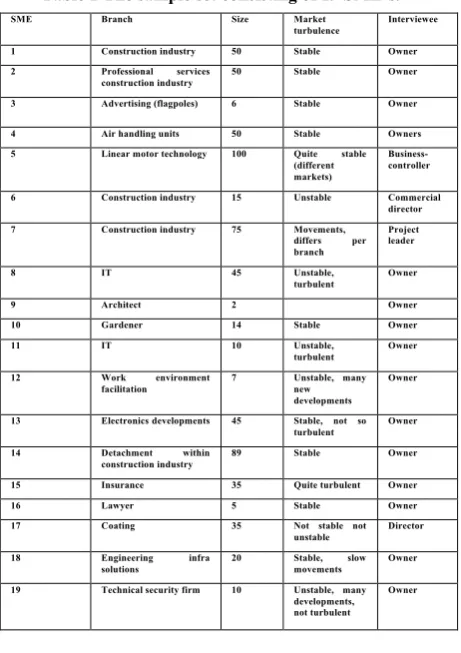
interviewed SME’s, are used to make broader generalizations. This research is not making use of purposive sampling since the sample concentrates on SME’s, not related to a specific industry. The firms were randomly picked out of a list of hundreds of SME’s located in the region Twente.
The exact sample set can be found at the data analysis part. The goal of this research is to determine the effect of relational capabilities needed in the process of value co-creation and in order to investigate the effect, relational capabilities should be identified. The main data collection method in this study was interviewing and the collaborative activities, mentioned in the theoretical framework, in the joint problem solving process functioned as the five main elements during the interviews. These five elements according to (Stenroos & Jaakkola, 2012) were determined as the main activities or elements of co-creation processes; therefore these were used as building blocks for this study. Although the main focus of this research is determining the effect and role of relational capabilities facilitating the process of co-creation within SME context, the co-creation process itself plays a central role.
Each of the five constructs existed of two or more questions, which ended up in a questionnaire of in total 24 questions (can be found in the appendixes). Twelve questions were asked for both perspectives supplier and customer. During the interviews a pre-structured way of interviewing was used to leave room for interviewers to ask supplementary questions in order to get deeper understanding of the co-creational activities and the associated role of firms’ relational capabilities within the process of value co-creation.
The majority of the interviewees were owners or partners of their firms. In all probability, they are the most appropriate to ask about the value creation processes between them and their clients. Definitely for this sample because it encompasses SME’s that are relatively small in size. Compared to larger, more complex firms the chance of more reliability is higher since owners of smaller firms are better informed about co-creational interaction with clients, partners and other third parties. All interviews were recorded and afterwards transcribed into word processing packages in order to compare them easily with each other. The interviews duration ranged from half an hour to two hours often influenced by a combination of way of answering, enthusiasm showed and personal interest of the interviewee. The conducted interviews were divided in two parts, in the first part the firms have been approached from a
supplier perspective and in the second part the firms have been
approached from a customer perspective. For both perspectives
the same questionnaire was conducted, which resulted in clear understanding of the role of relational capabilities, applied in the process of co-creation. Both perspectives of one supplier firm can be compared which denotes how they are operating and how their suppliers are operating. It showed how suppliers described and reviewed their own processes and activities and at the same time described and reviewed the processes and activities of the suppliers serving them. The created
composition, considering both perspectives, led to clarification of co-creational activities and contributes to a broad set of relational capabilities. The ultimate goal of this research is to understand the role of relational capabilities and detect which relational capabilities are enabling an energetic value co-creational process. The research aims to empirically proof the importance of relational capabilities and how these affect the process of co-creation. Additionally the paper aims to determine an overview of relational tools used by firms to effectively co-create value. In terms of literature this research mainly builds upon (Stenroos and Jaakkola, 2012) and (Ngugi et al., 2010) The joint problem solving process of value co-creation of (Stenroos and Jaakkola, 2012) in combination with the relational capabilities of (Ngugi et al, 2010) is strongly connected demonstrated by this study. Relational capabilities and value co-creation are intertwined.
4. DATA ANALYSIS
Table 1 The sample set consisting of 19 SME’s.
SME Branch Size Market
turbulence Interviewee
1 Construction industry 50 Stable Owner
2 Professional services construction industry
50 Stable Owner
3 Advertising (flagpoles) 6 Stable Owner
4 Air handling units 50 Stable Owners
5 Linear motor technology 100 Quite stable (different markets)
Business-controller
6 Construction industry 15 Unstable Commercial director
7 Construction industry 75 Movements, differs per branch
Project leader
8 IT 45 Unstable,
turbulent
Owner
9 Architect 2 Owner
10 Gardener 14 Stable Owner
11 IT 10 Unstable,
turbulent
Owner
12 Work environment facilitation
7 Unstable, many new developments
Owner
13 Electronics developments 45 Stable, not so turbulent
Owner
14 Detachment within
construction industry 89 Stable Owner
15 Insurance 35 Quite turbulent Owner
16 Lawyer 5 Stable Owner
17 Coating 35 Not stable not unstable
Director
18 Engineering infra solutions
20 Stable, slow movements
Owner
19 Technical security firm 10 Unstable, many developments, not turbulent
Owner
5. RESULTS
The obtained findings derived from the interviews resulted in a set of as common used relational capabilities to successfully working towards co-creational end results. For each construct in the framework of (Stenroos and Jaakkola, 2012) a set of organizational and relational capabilities were used to stimulate and activate positive conditions to obtain co-created value. Value co-created with customers, partners leading by the firm as organizer and facilitator. The findings of this study acknowledged an increasing importance for firms participating and committing partnerships with entities possessing potential value-adding characteristics in order to prosper co-creational value. The findings provide a clear and broad insight in how small medium sized enterprises are approaching their idea of satisfying their clients and create value. For each of the five constructs belonging to the joint problem solving process of value co-creation, a set of relational capabilities was determined assessed as supportive in the process of co-creation and is explained below.
5.1
Diagnosing needs
The most important asset that derived from the interviews is the essence of well-developed expertise and knowledge within the firm. It is fundamental in diagnosing customer needs according to the supplier firms interviewed because it forms the basis of creating a solution to the clients’ problem. Several firms mentioned that their clients lack sufficient knowledge about the specific solution context, which makes it hard for them to exactly say what they expect and clients are not always able to serve out all information needed for the supplier. Therefore without specialist knowledge a supplier firm will not be able to filter the right information from the client and cannot optimize the final solution. According to the former a complementary
role come into play for a good organized way of transferring knowledge. It became clear that communicational problems occur because of insufficient and too few contact moments. It will be further explained in the part of managing conflict issues. A major organizational asset is possessing specialist knowledge and expertise as already mentioned. An example of creating specialisms is achieved by dividing a company into separate divisions with each its own specialism enabling specific knowledge to be developed for diagnosing customer needs and serve clients more effectively. The following citations illustrate these findings:
“Because of the fact that we have so many different clients we cannot serve them in one firm. We have direct clients, Internet clients, consultancy clients, agents etc. We did not think that was a good idea. How to identify clients’ needs? Who should do what? Therefore we separated the firm into several LLC’s and divided our employees over these LLC’s. Subsequently we told our employees operating in the different LLC’s to work in the mind-set of their new clients. It created specialisms in our firm because from that moment each LLC faces specific clients.”
(Assurance firm)
Being aware of new developments related to new technologies, new customer and partner activities, market fluctuations is crucial because it enables suppliers to be better prepared in defining customer needs. Corresponding to the fact that firms should be aware of new developments, rules and laws the existence of a continuous educational program running within the firm is often present. It will enhance employees’ specialist knowledge and offers better conditions to diagnose customer needs. A key supportive role for supplier firms to monitor the market is making use of their strong network. Firms are trying to absorb what is happening in their industry and what is happening at (potential) clients by networking activities. The interviewed supplier firms have mentioned analyzing capacities as important to diagnose the customers’ needs which is quite obvious. Many supplier firms said that interaction with clients should be relational orientated. Firms need to focus on
relationships building and try to prosper close relationships with clients. It has been said that structural relationship building based on personal contact or close contact between supplier firm and customer resulted in a more the customer. The customer starts to feel more comfortable which leads to more transparency from the customer. With this the process of diagnosing the clients’ needs becomes more easy and efficient. Below it gives an illustration of how relational activities are contributing to diagnose needs:
“What is very important is that we maintain a relation with our client. Identifying the right customer need is only possible if I know my customer. In the first conversation you will not show the back of you tongue. It takes more time before a client will trust you as a supplier. We need to get know each other and based on this perhaps commitment will originate. The client will feel comfortable and want to purchase it from us. (Work environment facilitation)
What was pointed out too during the interviews was the stance of being proactive as a firm towards your clients.
said earlier. An example is given below:
“As a rule our clients and we start a conversation, most likely with a specific request as outcome a dialogue entered into. Subsequently we are invited to do a tender. We try to be proactive in all industries in which our clients are operating and to go into great depth to trace the organizations’ goals of the client. What we are actually saying is that we are active in three different areas about which we posses excellent expertise. In these specific areas we strive to think and act like our clients and therefore we are proactive.” (Consultancy firm for construction and real estate industry)
Another supportive organizational asset derived from the interviews with the aim to diagnose customers’ need was the usage of a composed references portfolio. It has been said that visualizing concepts or possible end solutions can help the customer and comfort the customer. A reference portfolio seconds a supplier firm to detect the customers’ needs since customers now do have real ideas and examples. In these portfolio’s previous projects, products or services are stored. However, one firm said that it could be the case that the references do not agree with the customers needs and therefore limit customers. Firms are even making use of demo accounts, in the IT world, to let hem experience their new potential service.
5.2 Designing and producing the solution
For this construct suppliers are asked how the process is organized or designed after the customer needs have been diagnosed. What came out as very important and again indicates the importance for firms to develop relational capabilities is the fact that several firms mention that they are cooperating/collaborating with key partners and even competitors in order to succeed in delivering value. It became clear that the right partners offer a supplier firm more possibilities especially when their own knowledge base or capacity base is to limited. Several firms noted that when customer needs cannot be satisfied with their own and knowledge partners or outsiders are involved to add their creativity. Mostly before the inclusion of partners internal cooperation occurs after the needs are diagnosed. A firm critically assesses his internal specialist knowledge if has the capacity to succeed in satisfying a specific customer. According to this, one firm mentioned that their competitive advantage is that they have a diverse employee base including employees with different specialisms. Next-door this company emphasizes the importance of integrating other firms possessing qualities their own firm lacks and can be value-adding to their co-creational process. Many firms have stressed structural communication as a point of attention. Interaction between customer and supplier on one hand needs to be stimulated because of changing needs of the customer and at the other hand because of any difficulties occurring in the producing process of the supplier. It helps supplier firms to change the outcome of the process in a way the customer will be more satisfied. By fast and accurate communication clarity and transparency is accommodated which satisfies the interest of the customer. Firms explained that customers value this type of operating while it clarifies the progress of the process and the customer knows where it stands. The firms strive to be instant accessible for customers and simultaneously keeping the customer up to date during the process. Moreover, customers feel well treated by firms communicating like this and are faster inclined to recommend the firm to new people, partners or firms. A couple of firms are using a method in which one person from the supplier firm is responsible for the whole
process of one customer. The firms said that with this
vagueness is reduced and the firms are able to control the whole process from “diagnosing needs” to “implementing the solution” more effective and efficient. The competences of the responsible person are qualified and checked if they fit with the organization in question. Other firms applying executive teams that control the designing and producing phase by continuously monitoring three pillars: planning, budget, quality. What was mentioned too was the usage of treatment plans which could be for example a matrix including responsibilities and deadlines allocated to the people in the process. In order to make sure that the supplier firm is designing and producing a product or service that will satisfy customer needs several relational capabilities, assets and resources were mentioned in the interviews as helpful. The most common said is the ability to maintain contact through discussion and they based this on the motive that “measuring is knowing”. One firms dropped the term “customer need management” which could be an appropriate umbrella term covering all activities in order to keep up with customer preferences. To illustrate the former phenomenon an example is given below:
We taking our customers with us through the whole developing process. Beforehand we set a couple of moments during the project at which we team up and determine if the client is still satisfied with the specifications set at the beginning. Finally we close a developing pathway like this with an acceptation phase. During this phase the customer receives the product and tests if it complies with the demands of the customer. If you find out something in the end then it is very harmful. That is why we take the client with us regularly and set up review moments. (Electronic developments)
In addition to customer need management we have the phenomenon project documentation that was invented to prevent wrong customer expectations. The principle of using project documentation is that firms record in the beginning of the process what can be expected of the outcome of the designing and producing process in order to counteract misunderstandings. Likewise firms introduced controlling systems, which can control the operations of supplier firms, and detect when their own suppliers are not delivering in time. With this they can inform their customers about a possible delay in the production process at an early stage. Their customers can take account of it and prepare if necessary. Noteworthy too is that supplier firms prefer to work with proactive customers. Customers who are participating in the process in a way they behave honest, accurate and decisive. So firms argue for a customer portfolio with proactive companies and or private individuals.
5.3 Organizing the process and resources
In order to prosper and facilitate co-creational processes firms need to dispose of many relational capabilities and resources. The former two constructs clarified which resources and capabilities and to what extend these should be developed when diagnosing customers’ needs and designing and producing the solution. This construct relates to how to organize the process and resources and goes into detail about the more general relational capabilities. First of all, a firm should have the best knowledge and specialists in house. It is fundamental of being competitive against your competitors and in terms of co-creation you are able to satisfy your customers. This is what the owner of insurance firm said about this topic:
programs. If a client caught you on the fact that you do not have enough expertise he will leave. It is a key success factor to possess specialist knowledge. I am a big fan of Steve Jobs. He said: “you should always hire the very best people you can find, for your specific expertise area. It does not matter how much it cost.” I do not have that much money but I try to realize that at my own maximum level.” (Insurance firm)
Matching to the former mentioned, of possessing excellent expertise is the partner portfolio of firms. By selecting right partners with specific excellent expertise the value of the end product of the supplier firm will increase. Building a strong partner network enabled faster cooperation, better solutions and more satisfied customers. Longer relationships can be seen as a long learning process by which experiences are obtained and with this knowledge is gained. Firms assess their future partners on a specific set of characteristics. Important aspects are the passion within the company, the people and if they fit with each other, a certain drive needs to be present, a transparent way of cooperation and a proactive attitude. All of these combined with excellent expertise make what firms encounter as preferable doing business with. The most important ability according to the former about partnership is that firms especially manager, owners, people with management functions are capable of deploying other parties. People tend to default to ask the help of an external party who is certainly way further developed on that specific subject. One of the
interviewees mentioned, “being to proud” as one of the reason of not involving a third party. Furthermore supplier firms prefer to achieve tight chain integration; a high level of interaction between customer- supplier firm- suppliers with the aim to deliver more high value service, solutions or products. Firms support faster participation of partners. They prefer faster involvement in each other’s operations to effectively influence the outcome of the co-creation process. An example of chain integration and choosing the right supplier or partner:
“I want to demonstrate that we are looking for suppliers who are communicating in a transparent way with us. A supplier who can easily clarify how their product is build and what their vision is. They should be able to say: “no you should not do it like this, go back to your customer and tell about my solution.” This supplier possess the know-how, we are not. And if there is also a good match, in relational context, than we are able to communicate very well and improve our activities regarding customers. The supplier offers us expertise and know-how, which is build upon years of experience. That is what I call chain integration. We do not have suppliers but partners.” (Work environment facilitation firm)
The firms stated that a great network is very helpful too. Networking contributes to knowledge exchange, leads to capacity support and helps with monitoring ongoing trends or developments. A couple of firms are member of branch organizations. These organizations create events and bring firms together. During these events knowledge is exchanged and joint problems regarding specific subjects are discussed. Communication is imperative regarding accomplishing effective and sufficient co-creation. The interviews
demonstrated that a significant part of all problems concerning co-creational processes between supplier and customer is accrued to insufficient communication. With insufficient communication is meant: low frequency of communication, unclear knowledge exchange, incomplete information, and non-proactive communication.
An example of firms valuing good communication:
“I would never choose another product purely because this could be cheaper. Initially we speak with our current suppliers and partners, they are our first choice. It is a matter of granting something to someone. If the communication is not sufficient, it will cost you much more than when you take into account the expenses of a product exclusively.” (Coating firm)
Soft skills next to hard skills are mentioned as very useful. With soft skills the firms allude to the set of social skills of
employees and how they cooperate with their colleagues and with their clients. Especially, the last one was emphasized since the firms stressed the importance to possess the skills to manage different types of clients. As explained in the construct of diagnosing needs firms scan employees’ competences and connect them with the right customers, partners or suppliers. A flexible organizational culture according the interviewed firms is required to prosper co-creation. Being a flexible company stimulates creativity. Customers appreciate that are flexible and that you are trying to satisfy their needs irrespective of complications that might occur during the designing and producing of a solution phase. Moreover, during the total process of co-creation it is imperative to handle flexible as a company. Based on the interviews, both from supplier and customer perspectives firms appreciate and expect flexibility, as it is a sign of trustworthiness. Besides this, automation of specific processes is used by a couple of firms as tool to make processes more efficient. Firms digitalized some part of their operations and created online customer facilitation. Online access to for example databases, bodies of knowledge and personal product information is created.
5.4 Managing value conflicts
For this construct the firms where asked to describe how they deal with differences related to the expected value of the end solution between them and their customers. Instant
communication is what came out as major key to diminish the chance of large differences in the expected value of the product and the actual value of the product. A couple of milestones were planned before hand and serve as control moments. Firms register a contract, which acts as an offer in which is described what to expect. Communication issues are by far the greatest cause of differences between expected value of the supplier firms and the customer. Firms ask their customers to express their selves about what they expect about the communication during the process. Afterwards the supplier firm reacts on it and states how they want to organize it. A mutual agreement is made probably with the result: mutual expectations on how to communicate. Which in turn leads to better communication between supplier and customer during the process and empowers the outcome of the final co-created solution. Again flexibility needs to be introduced now related to this construct. A flexible firm according to the data is able to adapt to changing demand. Not diagnosing the right criteria in the initial analysis of the customer needs is also causing conflicting value expectations. One firm mentioned that they have to improve their way of questioning during the phase of diagnosing customer needs. More specific and detailed questions should be used during their diagnosing process in order to avoid
obscurities. Other ways to prevent problems regarding expected
regarding meeting specific agreements concerning for example about pricing issues. An example is given underneath:
“If we getting closer with each other and we see each other at service clubs, the relation is getting to close to do good business. To say for example that someone should have delivered better quality or that the costs were too high.”(Gardener)
5.5 Implementing the solution
The data proposes that relation management after the supplier firm delivered their solution to customer should not be rushed. It takes time for customer to get used therefore coordination after sale is crucial. In the first couple of years after the introduction of the product several firms are equipping their customers with new knowledge and new developments during meetings and briefings. Firms said that try to adopt an accessible attitude with the reason to stimulate their customers to ask for advise, help or support. However some firms suggested that their role after the customers’ purchase should be developed. To illustrate this read the citation below about the owner of construction company:
“People can make the difference; in this company nearly every everyone is a technician or business oriented. Not always the most communicative people, most of them want to calculate a formula. These people do you have to force to communicate, do aftersales and drink a cup of coffee with business relations. It is going above average so I cannot complain but I think it can be more structural. Aftersales is often the origin of new
opportunities. If you want to be good in relation management then we have to take care of our aftersales.” (Construction firm)
An effective after sales guidance will be affected by the communicational approach the firm uses. Furthermore differs it per each type of firm. The research sample includes a wide divergence of small and medium sized enterprises. A few firms
used digital customer service. For example, one firm is logging everything for each customer individually from the start of co-creation process till the moment the customer stops using their solution, product or service. Their reason behind it has to do with the changing life of a customer. If a customer has problems or is dissatisfied the database is there to find back what happened in the past and with this functions as facilitator to overcome the dissatisfaction of a customer. Several other firms monitor their customers future plans in order to succeed in future cooperation. Firms also keep contact with customers to learn and absorb new findings and problems regarding their product or service. A returning aspect also for this construct is the use of other partners to successfully implement solutions.
6. CONCLUSION
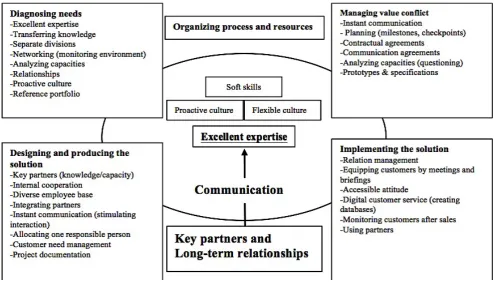
This paper has the end goal of describing the effect of relational capabilities that prosper the process of value co-creation within the context of SME’s. As said at the beginning of this paper collaboration is considered essential in today’s competitive world. (Prahalad and Ramaswamy, 2004) suggest that in the context of value co-creation. The research done contributes and delivers new evidence to the literature concerning co-creation and marketing relationships. The importance of finding and selecting the right key partners and developing partnerships for the longer term has been proven in this research within the context of SME’s. (M Christopher, A Payne, D Ballantyne, 2013) This study increases the understanding of which relational tools can be used to facilitate the process of value co-creation. The four constructs (diagnosing needs, designing and producing the solution, managing value conflicts, implementing the solution) were used as building blocks and this study created a set of relational and organizational capabilities and skills in order to facilitate each of these four constructs. This study contributes by delivering a tentative framework
[image:9.595.53.548.475.757.2]specifically focusing on allocating certain relational capabilities and skills to the four constructs of co-creation according to (Stenroos and Jaakkola, 2012). In the tentative framework the fifth construct (organizing process and resources) functions as
major key since it is about the general relational capabilities and capacities a firm should possess to create a fertile co-creational climate. The created tentative framework emphasizes essence of in-house expertise of a firm and the accompanying role of key partners and external parties to utilize more potential expertise. All in order to contribute to the process of value co-creation in which firms, customers and third parties strive for mutual valuable outcomes. Within the context of value co-creation firms should develop a flexible and proactive way of operating. According to the data it prospers more successful and tight cooperation between firms and their customers and partners. This research had not the aim to study in detailed how business relationships should be faced but it describes which relational capabilities and skills are facilitating the co-creational process between firm and customer.
(Ngugi et al, 2010) and (Johnson and Ford, 2006) discussed four types of relational capabilities explained earlier in this
paper. Technological relational capabilities are about integrated
technical systems and procedures across supplier and customer. Logging, registering and monitoring systems and online accessible services are examples of technological relational capabilities derived from this study. These relational capabilities simplify communication and the exchange of
information between supplier and customer. Managerial
system-based relational capabilities are about bilateral, interactive development and participating of both supplier and customer to help with implementing processes, planning issues or other activities all with the aim to foster collaborative relationships. One outcome of this study fits with this relational capability. Firms stressed the importance of chain integration and with this the importance of a closer interplay within the chain between customer, supplier and from supplier to a third partner. (Forsström and Törnroos, 2005) suggest that co-creation of value needs mutual investments and bonding as well as mutual learning and/or unlearning in order to be able to develop and exploit mutual resource constellations in the focal
dyad. Human relational capability aims for bilateral
development of knowledge by employees of both customer and supplier firm, which is exactly what firms in this research appoint. Firms proposed to strive for high levels of expertise within their organization. Adopting an open stance towards potential value delivering partners should be created. However, many firms tend to keep focus on internal assets and do not utilize structural collaborations with other firms in order to strengthen knowledge/expertise and stimulate the learning process by which new valuable experiences are obtained. According to the interviews firms affirm mutual willingness needs to be present. The data provides evidence for the presence
of cultural similarities between firms. There cultural relational
capabilities should be present; bilateral development of both values and culture needs to occur. (Ngugi et al, 2010) Managers mentioned the importance of similar working cultures when selecting firms for a partnership. Data shows that certain similar characteristic needs to be present: a certain passion, a flexible and proactive culture and a transparent cooperation. (CK Prahalad, V Ramaswamy, 2004) claimed that a continuous dialogue is part of the process of co-creation. The same goes for this study although communication appears to be the greatest cause of limited co-created value. The research pointed out that many firms predicate insufficient communication during the process of value co-creation as a disrupter of the expected value of the solution. In summary, this study increased the
understanding of the effect of relational capabilities within the process of value co-creation. Additionally a set of relational tools/capabilities is structured that can be found in the tentative framework (figure 1). It contributes by its explaining how and which relational capabilities firms us in order to facilitate their
co-creational processes. Communication as such came out as key factor in the process of value co-creation besides the fundamental asset excellent expertise. In this context
communication is defined as all interactions within the process between firm, customers, partners and other stakeholders. It appeared to be a key component in the process of value co-creation within the context of SME’s.
7. MANAGERIAL IMPLICATIONS
This research proved the importance of relational capabilities within the context of value co-creation processes. This study can help managers to facilitate their value co-creation processes. It offers managers a framework that can be applied within their business operations and have the potential to trigger new consideration of ongoing processes within business operations related to customer and partner/supplier management.
8. LIMITATIONS/FURTHER RESEARCH
APPENDIX 1. PRESTRUCTURED
INTERVIEW GUIDE USED FOR WHOLE
DATA SET
INTERVIEW:
Name Company: Function interviewee: Branch/Market/Industry: Size of the employee base: Turbulence of the industry:
(Stable, movements, technological developments)
A. From supplier perspective
Diagnosing needs:
· How do you identify the customer needs of your customers?
· What are the barriers / obstacles in the process of identifying customer needs?
Designing and producing the solution:
· What’s the process after the customer needs of your customers
are identified?
· How do you know if the possible solution satisfies the
customer?
· What is your role in this process, what does this role involve
exactly? What do you expect from your client?
Organizing process and resources:
· How do you facilitates the process to solve the problem / to
cooperate?
· How do you find out what resources are relevant to the
organization of the process?
· Which resources (people, knowledge, processes, partners?) are
used in the organization of the process?
· How the customer participates in the process? (Active/passive,
significant/small role)
Managing value conflicts:
· How do you deal with differences in the expected value of the
solution between you and the client?
· What is or could be the reason of the difference in the
expected value between you and the client?
Implementing the solution
· How do you ensure that the customer can implement the
solution successfully?
B. From customer perspective
Diagnosing Needs:
· How are your customer needs identified by your supplier?
· What are the barriers / obstacles in identifying your customer
needs by your supplier?
Designing and producing the solution:
· What is the intern process for you after your supplier identifies
your customer need?
· How do you know whether the possible solution that your
supplier provides satisfies your customers’ need?
· What is your role in this process, what does this role involve
you think? What do you expect from your supplier?
Organizing process and resources:
· How is the process facilitated in order to solve the problem /
to cooperate?
· How do you know which resources are relevant to the intern
organization of the process?
· Which resources (people, processes, knowledge, partners) are
important?
· How does the supplier participates in this process?
Managing value conflicts:
· How do you deal with the difference in expectations of value
between you and the supplier?
· What is or could be the reason that there’s a difference in
expectations in value between you and the supplier?
Implementing the solution:
· How do you make sure that you as customer, the solution can
be implemented successfully in your organization?
REFERENCES
Aarikka-Stenroos, L., & Jaakkola, E. (2012). Value co-creation in knowledge intensive business services: A dyadic perspective
on the joint problem solving process. Industrial Marketing
Management, 41(1), 15-26.
Amit, R., & Schoemaker, P. J. (1993). Strategic assets and
organizational rent. Strategic management journal, 14(1),
33-46.
Ballantyne, D., & Varey, R. J. (2006). Creating value-in-use through marketing interaction: the exchange logic of relating,
communicating and knowing. Marketing theory, 6(3), 335-348.
Carrizo Moreira, A. (2009). Knowledge capability flows in buyer-supplier relationships: Challenges for small domestic
suppliers in international contexts. Journal of Small Business
and Enterprise Development, 16(1), 93-114.
Christopher, M., Payne, A., & Ballantyne, D. (2013). Relationship marketing. Taylor & Francis
Collins, J. D., & Hitt, M. A. (2006). Leveraging tacit knowledge in alliances: The importance of using relational capabilities to build and leverage relational capital. Journal of Engineering and Technology Management, 23(3), 147-167.
Forsström, B., & Törnroos, J. Å. (2005, September). The role of interdependencies for value co-creation in buyer-seller
partnerships in business markets. In 21th annual IMP
Conference, Rotter-dam.
Grönroos, C. (2008). Service logic revisited: who creates value?
And who co-creates?. European business review, 20(4),
298-314.
Grönroos, C., & Voima, P. (2013). Critical service logic:
making sense of value creation and co-creation. Journal of the
Japhet Lawrence and Usman Tar (2013). The use of Grounded Theory Technique as a Practical Tool for Qualitative Data Collection and Analysis.
Johnsen, R. E., & Ford, D. (2006). Interaction capability development of smaller suppliers in relationships with larger
customers. Industrial Marketing Management, 35(8),
1002-1015.
Lacey A. and Luff D (2007).| Qualitative Research Analysis. The NIHR RDS for the East, Midlands / Yorkshire & the Humber.
Lawrence, J., & Tar, U. (2013). The use of grounded theory technique as a practical tool for qualitative data collection and
analysis. The Electronic Journal of Business Research Methods,
11(1), 29-40.
Lindgreen, A., & Wynstra, F. (2005). Value in business
markets: What do we know? Where are we going?. Industrial
Marketing Management, 34(7), 732-748.
Lusch, R. F., & Vargo, S. L. (2014). The service-dominant logic of marketing: Dialog, debate, and directions. Routledge.
Ngugi, I. K., Johnsen, R. E., & Erdélyi, P. (2010). Relational capabilities for value co-creation and innovation in SMEs. Journal of small business and enterprise development, 17(2), 260-278.
Nonaka, I., & Takeuchi, H. (1995). The knowledge-creating company: How Japanese companies create the dynamics of innovation. Oxford university press.
Olaru, D., Purchase, S., & Peterson, N. (2008). From customer
value to repurchase intentions and recommendations. Journal of
Business & Industrial Marketing, 23(8), 554-565.
Overton, W. F. (Ed.). (2013). Reasoning, necessity, and logic:
Developmental perspectives. Psychology Press.
Payne, A. F., Storbacka, K., & Frow, P. (2008). Managing the
co-creation of value. Journal of the academy of marketing
science, 36(1), 83-96.
Prahalad, C. K., & Ramaswamy, V. (2004). Co-creation
experiences: The next practice in value creation. Journal of
interactive marketing, 18(3), 5-14.
Vargo, S. L., & Lusch, R. F. (2004). Evolving to a new
dominant logic for marketing. Journal of marketing, 68(1),
1-17.
Strauss, A., & Corbin, J. (1994). Grounded theory
methodology. Handbook of qualitative research, 273-285.
Teece, D. J., Pisano, G., & Shuen, A. (1997). Dynamic
capabilities and strategic management. Strategic management
journal, 509-533.
Ulaga, W., & Eggert, A. (2001). Developing a standard scale of
relationship value in business markets. In IMP Conference
proceedings.
Vargo, S. L., & Lusch, R. F. (2004). The four service marketing myths remnants of a goods-based, manufacturing model.
Journal of service research, 6(4), 324-335.
Vargo, S. L., & Lusch, R. F. (2008). Service-dominant logic:
continuing the evolution. Journal of the Academy of marketing
Science, 36(1), 1-10.
Weber, R. A., & Camerer, C. F. (2003). Cultural conflict and
merger failure: An experimental approach. Management
science, 49(4), 400-415.
Woodruff, R. B. (1997). Customer value: the next source for
competitive advantage. Journal of the academy of marketing
1.
PAGE SIZE AND PAPER LENGTH
All material on each page should fit within a rectangle centered on the page, beginning 2.54 cm (1") from the top of the page and ending with 2.54 cm (1") from the bottom. The right and left margins should be 1.9 cm (.75"). The text should be in two 8.18 cm columns with a .83 cm (.33") gutter. Page format is International A4.
The paper should not exceed 10 pages, formatted in this
format, inclusive all tables and figures; but exclusive appendices and lists of references.
2.
TYPESET TEXT
2.1
Normal or Body Text
Please use a 9-point Times Roman font, in which these guidelines have been set. The goal is to have a 9-point text, as you see here. Right margins should be justified, not ragged.
2.2
Title and Authors
The title (Arial 18-point bold), authors' names (Helvetica 12-point) and affiliations (Helvetica 10-12-point) run across the full width of the page – one column wide. We recommend to give NO e-mail address to prevent you from commercial communication. See the top of this page.
2.3
First Page Copyright Notice
Please leave the Copyright Notice on the first page as it is but change the date and the number of the conference, if necessary.
2.4
Subsequent Pages
Except the title page, the subsequent pages start at the top of the page, and in double-column format. The two columns on the last page should be as close to equal length as possible.
2.5
References and Citations
Footnotes should be Times New Roman 9-point, and justified to
the full width of the column.1
Use the “APA Reference format” for references – that is, a numbered list at the end of the article, ordered alphabetically and formatted accordingly. See examples of some typical reference types, in the new “APA Reference format”, at the end of this document. Within this template, use the style named
references for the text. Acceptable abbreviations, for journal names, can be found here:
http://library.caltech.edu/reference/abbreviations/
The references are also in 9 pt., but that section (see Section 7) is ragged right. References should be published materials accessible to the public. Please apply the APA style throughout the whole paper;
http://www.apastyle.org/ .
3.
TABLE/ FIGURES/CAPTIONS
Place Tables/Figures/Images in text as close to the reference as possible (see Figure 1). It may extend across both columns to a maximum width of 17.78 cm (7”).
1A footnote in 9-point Times New Roman.
Captions should be Times New Roman 9-point bold. They should be numbered (e.g., “Table 1” or “Figure 2”), please note that the word for Table and Figure are spelled out. Figure’s captions should be centered beneath the image or picture, and Table captions should be centered above the table body.
4.
SECTIONS
The heading of a section should be in Times New Roman 12-point bold in all-capitals flush left with an additional 6-12-points of white space above the section head. Sections and subsequent sub- sections should be numbered and flush left. For a section head and a subsection head together (such as Section 3 and subsection 3.1), use no additional space above the subsection head.
4.1
Subsections
The heading of subsections should be in Times New Roman 12-point bold with only the initial letters capitalized. (Note: For subsections and subsubsections, a word like the or a is not capitalized unless it is the first word of the header.)
4.1.1
Subsubsections
The heading for subsubsections should be in Times New Roman 11-point italic with initial letters capitalized and 6-points of white space above the subsubsection head.
4.1.1.1
Subsubsections
The heading for subsubsections should be in Times New Roman 11-point italic with initial letters capitalized.
4.1.1.2
Subsubsections
The heading for subsubsections should be in Times New Roman 11-point italic with initial letters capitalized.
5.
ACKNOWLEDGMENTS
Our thanks to ACM SIGCHI for allowing us to modify templates they had developed.
6.
REFERENCES
[image:13.595.340.530.74.187.2]Check the APA reference style