Commitment, Capacity, and Community: the Politics of
Multilevel Health Reform in Spain and Brazil
by
Sandra Chapman Osterkatz
A dissertation submitted to the faculty of the University of North Carolina at Chapel Hill in partial fulfillment of the requirements for the degree of Doctor of Philosophy in the Department of Political Science.
Chapel Hill 2013
Approved by:
Evelyne Huber
Liesbet Hooghe
Gary Marks
Alfred P. Montero
c 2013
ABSTRACT
SANDRA CHAPMAN OSTERKATZ: Commitment, Capacity, and Community: the Politics of Multilevel Health Reform in Spain and Brazil.
(Under the direction of Evelyne Huber)
Inequality is a primary concern for many social and political actors, yet often the
distributive profile of society seems over-determined by structure and institutions.
Federalism, ethnic heterogeneity, and greater numbers of veto actors are near
uni-versally associated with higher levels of inequality and less generous public support
for the most vulnerable members of society. A key challenge for scholars has been
unpacking multilevel governance and empirically assessing the way the territorial
dis-tribution of authority interacts with other forces that determine policies, inhibiting
clear theorizing about why and how particular territorial arrangements matter for
distributive outcomes. In this dissertation I choose two “hard” cases in which we
would not expect equity-enhancing social policy reforms and assess a similar attempt
at universal health reform in both cases. Spain and Brazil share long histories of
authoritarian rule, ethno-linguistic or racial heterogeneity, lack of fiscal capacity, and
asymmetry in the territorial distribution of authority. Spain has been more successful
than Brazil at establishing a universal health system that is efficient, sustainable, and
broadly supported in society. In both cases the role of structural factors has been
significant, yet I argue that particular constellations of ideological commitment at
multiple levels of government and at key moments in the reform process, combined
with fiscal and administrative capacity, explain much of the difference in outcomes. I
take a mixed-method approach, using statistical and comparative historical analysis
ACKNOWLEDGMENTS
If it takes a village to raise a child, it takes a city for a parent to finish a dissertation.
Juggling research, travel, teaching, and parenting has proved the most difficult part
of this process, so I want to acknowledge those who made this possible, first and
foremost. My partner, Sol Osterkatz, picked up his life to travel around the world
over the course of a year and a half, working nights and weekends so that he could
take care of our son while I did interviews. My mother, Jean Chapman, has been an
unwavering supporter and provided childcare so that I could teach, read, and write.
All her life she has walked the walk—using her intellect, as well as her hands (and
feet!), in the pursuit of justice. And despite the fact that he had no say in the matter,
Nathan Osterkatz (with much more grace than his parents at times) has spent the
past few years deftly managing life on the road.
I have a tremendous committee that has actively supported me throughout
grad-uate school. Evelyne Huber has been a steadfast ally and advisor, helping me meet
my goals for degree completion and taking the time to read every one of my pages
several times, providing clear insights and constructive feedback at every step. John
Stephens is the person whose course got me interested in pursuing a PhD to begin
with, and has worked with me on this project for many years. Liesbet Hooghe and
Gary Marks have been dedicated, enthusiastic, and tireless in their support. Al
Mon-tero inspired me to take on the challenge of a cross-national subnational comparative
project with his own research on Spain and Brazil and has been more than generous
with his time and advice these past few years. I am deeply grateful to all of you for
your mentoring—as a student and a new parent, it has meant a great deal. I would
Reynolds in my home department for their professional and personal support.
This project would not have been possible without a variety of funding sources.
Field research was made possible by a Tinker pre-dissertation field research grant
(2009), a UNC Graduate School off-campus grant (spring 2011), and a US
Depart-ment of Education Foreign Language and Area Studies grant (fall 2011-spring 2012).
Summer research funding came from the European Research Council Advanced Grant
#249543 “Causes and Consequences of Multilevel Governance” and the Uhlman Fund
from the UNC Chapel Hill Political Science Department.
In Brazil I would like to thank Marta Arretche for all her input and assistance, as
well as the Centro de Estudos da Metr´opole for research support and data. Without
the generosity of the academics and policy makers who took the time to meet with me
in Bahia, S˜ao Paulo, Rio de Janeiro, and Bras´ılia, the project would not have been
possible. I am indebted to Wendy Hunter and Kurt Weyland for talking through my
project in its early stages, helping with contacts, and providing advice for traveling
in Brazil with a baby. Natasha Borges Sugiyama, Kristin Wylie, Paula Leal, Lauren
Biddle, and Russel Bither-Terry offered advice, support, and contacts during our time
in Brazil. In particular, I would like to thank Cristiani Vera Machado for her frequent
consultations on health policy in Brazil, F´abio and Ana Gomes for their friendship
and intellectual support during our trips both in 2009 and 2011, and Vanessa Migone
for being a fabulous caretaker and friend to Nathan in S˜ao Paulo.
In Spain I am deeply grateful to have had the love and support of our second family,
Susana Palomos and Alain Gonz´alez (y familia). I extend many thanks to Mar´ıa
Calle Su´arez and her family, who took me into their home and helped me understand
Extremaduran politics, as well as answering many questions and sharing contacts over
the past few years. I am grateful for the friendship and academic support of Iv´an
In the Basque Country, Gorka Espiau has been a good friend and generous resource
over the years. I would like to express my gratitude to the academics and policy
makers who took the time to meet with me and answer my questions in Castilla y
Le´on, Madrid, and the Basque Country.
A dissertation is a long commitment and requires that we subordinate other
as-pects of life to research at various times. My greatest fear in combining motherhood
with graduate school was facing tradeoffs that I would regret later, either by not
finishing or being unavailable as a parent. My amazing family and wonderful support
community helped us all come through mostly unscathed. None of this would have
been possible without my partner, who talked through my project on our morning
dog walks and for the past six months has been a single parent on the weekends and
evenings after coming home from his other full time job, so that I could write. Along
with my mom I want to thank our sisters, Joyce and Leah, and Sol’s parents, Svea
and Arnie, for their support over the past six years.
We are grateful to the large circle of friends, both near and far, who have provided
encouragement and a sympathetic ear. You are too many to list and too dear to risk
leaving someone out. Yet I want to express my deepest gratitude, in particular, to
the academic mothers and fathers who have been such a source of strength for me
personally—professors in my department and at other programs, graduate student
colleagues with kids, and friends who have also juggled this life.
Finally, I want to thank my dad, Yonni Chapman—UNC PhD, civil rights
his-torian, and life long activist—who died while I was pregnant in my third year of
graduate school and never got to meet his grandson or see me finish. I edited your
dissertation, helped with your research, and saw you hooded just as I was beginning
my own graduate school adventure. You always supported me and I know you would
TABLE OF CONTENTS
1 THE DEMOCRAT’S CONUNDRUM . . . 1
1.1 Case Selection . . . 6
1.2 Understanding Health Outcome Indicators . . . 10
2 THEORY . . . 13
2.1 Equity-Enhancing Health Reform . . . 13
2.2 Determinants of Health Inequality . . . 20
2.3 The Territorial Distribution of Authority . . . 21
2.4 Commitment . . . 32
2.4.1 Commitment vs. Electoral Strategy . . . 34
2.5 Conflict Over the Reference Community . . . 38
2.6 Capacity . . . 42
2.7 Timing and Sequence . . . 46
2.8 Democracy . . . 49
2.9 Income Inequality . . . 51
2.10 Income and Growth. . . 52
3 EVIDENCE FROM THE SPANISH ACS AND BRAZILIAN STATES . . . 53
3.1 Health Outcomes . . . 55
3.2 Equity-Enhancing Health Policy . . . 58
3.3 Territorial Distribution of Authority . . . 60
3.4 Power Constellations . . . 63
3.6 Capacity . . . 67
3.7 Race . . . 68
3.8 Democracy . . . 69
3.9 Income Inequality . . . 70
3.10 Income and Growth. . . 71
3.11 Analytic Technique . . . 71
3.12 Results . . . 72
3.13 Discussion . . . 74
3.14 Conclusion . . . 83
4 SPAIN . . . 85
4.1 Health Inequality in Spain . . . 92
4.2 Foral Regimes: The Basque Country and Navarre . . . 94
4.3 Health Politics Before Democracy . . . 98
4.4 The Transition and the UCD: 1975-1982. . . 100
4.5 Socialist Government in the New State of the Autonomies: 1982-1993 . . 112
4.6 The Rise and Fall of the PP: 1996-2004 . . . 122
4.7 The Third Way in Spain: 2004-2011 . . . 132
4.8 Entrenched Economic Crisis: the PP after 2011 . . . 137
4.9 Case Study: Extremadura. . . 138
4.9.1 Overview. . . 139
4.9.2 Multilevel Health Reform in Extremadura . . . 141
4.9.3 Extremadura and Andalusia in Comparative Perspective. . . 152
4.9.4 Extremadura: Conclusion . . . 154
4.10 Case Study: The Basque Country . . . 156
4.10.1 Overview. . . 157
4.10.3 Commitment or Capacity?: Comparison with Navarre. . . 182
4.10.4 The Basque Country: Conclusion. . . 186
4.11 Case Study: Castilla y Le´on . . . 188
4.11.1 Overview. . . 189
4.11.2 Multilevel Health Reform in Castilla y Le´on . . . 190
4.11.3 The PP Context . . . 200
4.11.4 Castilla y Le´on: Conclusion . . . 202
4.12 Spain: Conclusion. . . 203
5 BRAZIL . . . 207
5.1 Health Inequality in Brazil . . . 217
5.2 Health Politics Before Democracy . . . 218
5.3 Democratic Transition, the Sanitaristas and the Constitution of 1988. . . 225
5.4 Neoliberalism and the PMDB: 1989-1994 . . . 230
5.5 The Capable Centrists: Cardoso and the PSDB from 1995-2002. . . 236
5.6 The Rise of the PT: 2002-2011 . . . 245
5.7 Multilevel Health Reform in Bahia . . . 252
5.7.1 Overview. . . 252
5.7.2 The State of Bahia . . . 258
5.7.3 Cear´a: the Outlier . . . 268
5.7.4 Capital City: Salvador da Bahia . . . 271
5.7.5 Municipal Reform in the Interior . . . 275
5.7.6 Bahia and the Northeast: Conclusion . . . 276
5.8 Multilevel Health Reform in the State of S˜ao Paulo . . . 277
5.8.1 Overview. . . 278
5.8.2 The State of S˜ao Paulo . . . 281
5.8.4 Minas Gerais: A Contrast in the Southeast . . . 288
5.8.5 S˜ao Paulo: Conclusion . . . 290
5.9 Chapter Conclusion . . . 291
6 COMPARISON. . . 297
6.1 Territorial Distribution of Commitment . . . 298
6.2 Territorial Distribution of Capacity . . . 301
6.3 Territorial Distribution of Authority . . . 302
6.4 Sequence . . . 307
6.5 Timing in International Context . . . 309
6.6 Models of Reform and Elite Strategy. . . 311
6.7 Alternative Explanations . . . 317
6.8 Conclusion . . . 321
7 CONCLUSION . . . 325
A TABLES AND GRAPHS . . . 334
LIST OF TABLES
3.1 Variables, Measures, and Sources for Spanish ACs and Brazilian States 54
3.2 Determinants of Primary Care Reform in the Spanish ACs. . . 75
3.3 Impact of Primary Coverage on Infant Mortality in the Spanish ACs . . 76
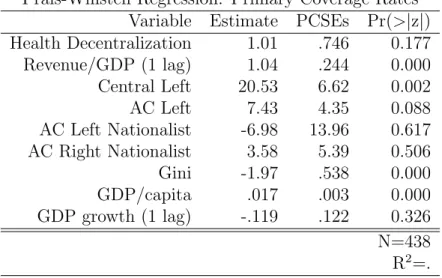
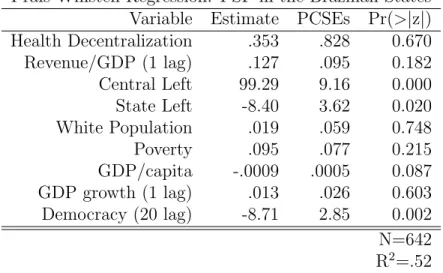
3.4 Determinants of PSF Coverage in the Brazilian States. . . 77
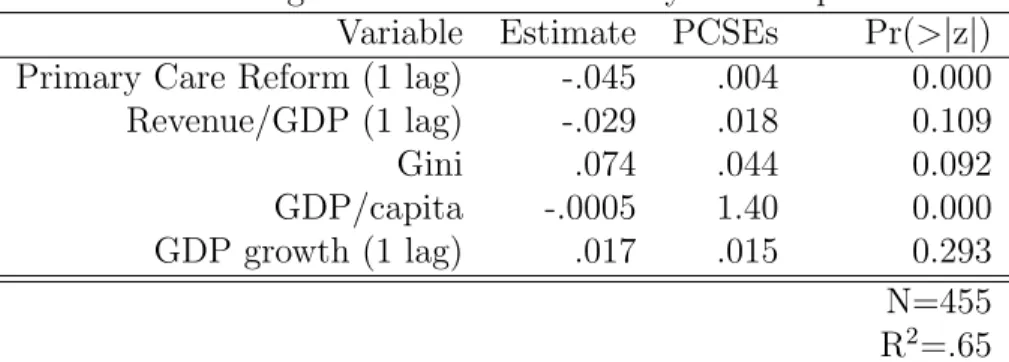
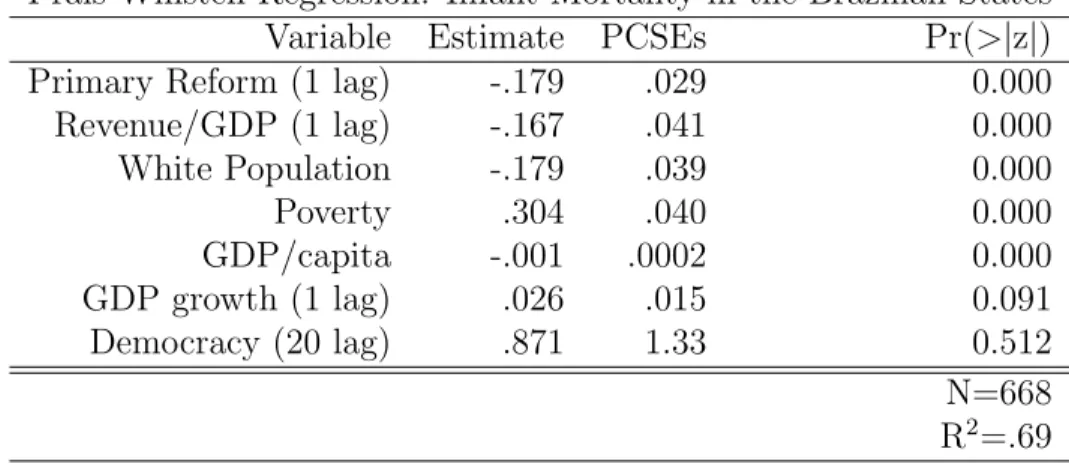
3.5 The Impact of PSF Coverage on Infant Mortality in the Brazilian States 78 A.1 Commitment, Capacity, and Decentralization in the Spanish ACs . . . 347
A.2 Commitment, Capacity, and Decentralization in the Brazilian States. . . 348
A.3 Spanish Parties . . . 349
A.4 Brazilian Parties. . . 353
A.5 Impact of Spanish Health and Decentralization Policies . . . 357
A.6 Impact of Spanish Fiscal Policies on Equity-Enhancing Health Reform 358 A.7 Primary Care Reform and Commitment in the Spanish ACs . . . 359
A.8 Spanish Partisanship, Capacity, and Primary Reform Coverage . . . 360
A.9 Health Authority in the Brazilian States . . . 361
A.10 Bahian Partisanship, Capacity, and PSF Coverage . . . 362
A.11 S˜ao Paulo Partisanship, Capacity, and PSF Coverage . . . 363
LIST OF FIGURES
2.1 Regional Authority Index: Self Rule Dimensions . . . 25
2.2 Regional Authority Index: Shared Rule Dimensions . . . 26
3.1 Race in the Brazilian States . . . 69
3.2 Comparison of Effects on Spanish Primary Care Reform . . . 75
3.3 Comparison of Effects on Spanish Infant Mortality . . . 76
3.4 Comparison of Effects on Brazilian PSF . . . 77
3.5 Comparison of Effects on Brazilian Infant Mortality . . . 78
4.1 Spanish Infant Mortality. . . 93
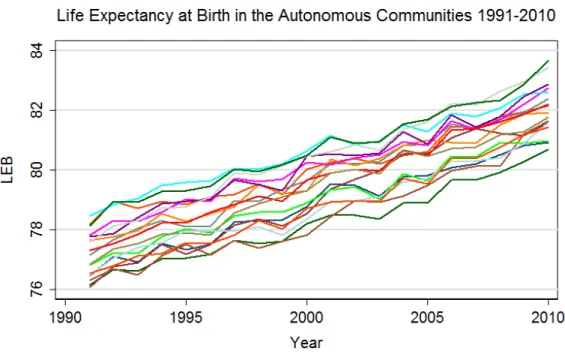
4.2 Spanish Life Expectancy. . . 94
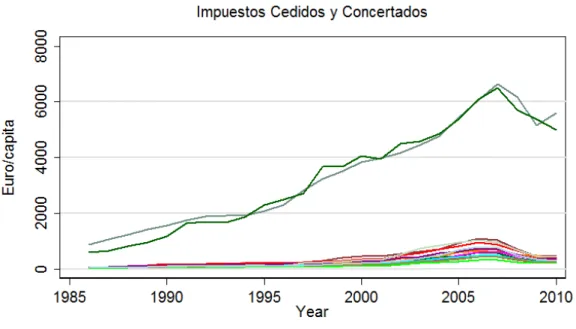
4.3 Ceded Taxes in Spain . . . 97
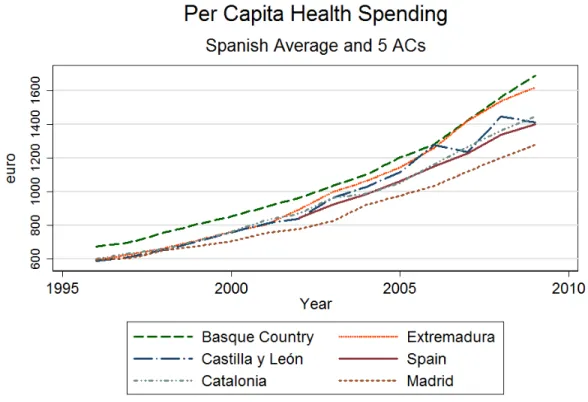
4.4 Health Spending in a Subset of ACs . . . 130
4.5 Basque Government Partisanship . . . 161
5.1 Brazilian Income and Infant Mortality Over Time . . . 218
5.2 Infant Mortality in Bahia and the Northeast: 1981-2008. . . 254
5.3 Poverty in Bahia and the Northeast: 1981-2008 . . . 255
5.4 Income Inequality in Bahia and Cear´a: 1980-2010. . . 256
5.5 PSF in Bahia and Cear´a: 1998-2010 . . . 270
5.6 GDP per Capita in S˜ao Paulo and the Southeast: 1985-2009. . . 280
5.7 Revenue/GDP in S˜ao Paulo and the Southeast: 1985-2009 . . . 281
A.1 Infant Mortality in Brazil. . . 334
A.2 Infant Mortality in Spain . . . 335
A.4 PSF Coverage Rates in Brazil . . . 337
A.5 Primary Coverage Among Early Decentralizers . . . 338
A.6 Primary Coverage Among Late Decentralizers . . . 339
A.9 Northeastern Ginis 1981-2009 . . . 340
A.10 Southern Ginis 1981-2009 . . . 341
A.11 Income: Extremadura, Basque Country, and Castilla y Le´on . . . 342
A.12 Ginis: Extremadura, Basque Country, and Castilla y Le´on . . . 343
A.13 IMR: Extremadura, Basque Country, and Castilla y Le´on . . . 344
A.14 LEB: Extremadura, Basque Country, and Castilla y Le´on . . . 345
A.15 Health Ministers: Extremadura, Basque Country, and Castilla y Le´on . 346 A.7 Left and Minority Nationalist Parties by Autonomous Community . . . 355
LIST OF ABBREVIATIONS
AC Autonomous Community
ACS Agentes Comunit´arios de Sa´ude
ACM Antˆonio Carlos Magalh˜aes
AI Atos Institucionais
ANS Agˆencia Nacional de Sa´ude Suplementar
AP Alianza Popular
ARENA Alian¸ca Renovadora Nacional
BNG Bloque Nacionalista Galego
CC Coalici´on Canarias
CCOO Comisiones Obreras
CIB Comiss˜ao Intergestores Bipartite
CISNS Consejo Interterritorial del Sistema Nacional de Salud
CIT Comiss˜ao Intergestores Tripartite
CiU Converg`encia i Uni´o
CNS Conselho Nacional de Sa´ude
CONASEMS Conselho Nacional de Secret´arios Municipais de Sa´ude
CONASS Conselho Nacional de Secret´arios de Sa´ude
CPFF Consejo de Pol´ıtica Fiscal y Financiera
DAB Departamento da Aten¸c˜ao B´asica
EA Eusko Alkartasuna
EAJPNV Eusko Alderdi Jeltzalea-Partido Nacionalista Vasco
EE Euskadiko Ezkerra
EH Euskal Herritarrok
ETA Euskadi Ta Askatasuna
EPF Encuesta de Presupuestos Familiares
EU European Union
FCI Fondo de Compesaci´on Interterritorial
FPE Fondo de Participa¸c˜ao dos Estados
FUNRURAL Fundo de Assistˆencia e Previdˆencia do Trabalhador Rural
GDP Gross Domestic Product
GP General Practitioner
HB Herri Batasuna
IAPI Instituto de Aposentadoria e Pens˜oes dos Industri´arios
IBGE Instituto Brasileiro de Geograf´ıa e Estat´ıstica
IMSERSO Instituto de Mayores y Servicios Sociales
INAMPS Instituto Nacional de Assistˆencia M´edica da Previdˆencia
INE Instituto Nacional de Estad´ıstica
INGESA Instituto Nacional de Gesti´on Sanitaria
INP Instituto Nacional de Previsi´on
INPS Instituto Nacional de Previdˆencia Social
INSALUD Instituto Nacional de la Salud
IPEA Instituto de Pesquisa Econˆomica Aplicada
IRPF Impuesto sobre la Renta de las Personas F´ısicas
IRYDA Instituto de Reforma y Desarrollo Agrario
ISFAS Instituto Social de las Fuerzas Armadas
IU Izquierda Unida
LISMI Ley de Integraci´on Social del Menusv´alido
LO Ley Org´anica
LOFCA Ley Org´anica de la Financiaci´on de las Comunidades Aut´onomas
LOTC Ley Org´anica del Tribunal Constitucional
MDB Movimento Democr´atico Brasileiro
MPAS Ministerio de Previdˆencia e Assistˆencia Social
MSC Ministerio de Sanidad y Consumo
MUFACE Mutualidad de Funcionarios del Estado
MUGEJU Mutualidad General Judicial
NHS National Health Service
NOAS Norma Operacional de Assistˆencia `a Sa´ude
NOB Norma Operacional B´asica
OECD Organization for Economic Cooperation and Development
PA Partido Aragon´es
PAB Piso de Aten¸c˜ao B´asica
PACS Programa de Agentes Comunitarios de Sa´ude
PADI Programa de Asistencia Dental Infantil
PAS Programa de Agentes de Sa´ude
PCE Partido Comunista Espa˜nol
PDS Partido Democr´atico Social
PDT Partido Democr´atico Trabalhista
PFL Partido da Frente Liberal
PIASS Programa de Interioriza¸c˜ao de A¸c˜oes de Sa´ude e Saneamento
PIE Participaci´on en los Ingresos del Estado
PMDB Partido do Movimento Democr´atico Brasileiro
PP Partido Popular
PPS Partido Popular Socialista
PSB Partido Socialista Brasileiro
PSC Partit dels Socialistes de Catalunya
PSDB Partido da Social Democracia Brasileira
PSE Partido Socialista de Euskadi
PSF Programa Sa´ude da Fam´ılia
PSN Partido Socialista de Navarra
PSOE Partido Socialista Obrero Espa˜nol
PT Partido dos Trabalhadores
PTB Partido Trabalhista Brasileiro
RAI Regional Authority Index
RMI Renda M´ınima de Inserci´on
SES Servicio Extreme˜no de Salud
SIAP Sistema de Informaci´on de Atenci´on Primaria
SNS Sistema Nacional de Salud
SUS Sistema ´Unica de Sa´ude
TCU Tribunal de Contas da Uni˜ao
UBS Unidades B´asicas de Sa´ude
UCD Uni´on del Centro Democr´atico
UFBa Universidade Federal da Bahia
UGT Uni´on General de Trabajadores
UNESCO United Nations Educational, Scientific and Cultural Organization
UPN Uni´on del Pueblo Navarro
VAT Value Added Tax
1 THE DEMOCRAT’S CONUNDRUM
Inequality is a primary concern for many social and political actors, for a variety of
reasons including an ideological preference for social justice, desire to remove barriers
to economic development, and concern about crime and public security. Yet often the
distributive profile of society seems over-determined by fairly immobile institutional
characteristics. Within the broad literature in comparative political economy and the
welfare state, federalism, ethnic heterogeneity, and greater numbers of veto actors are
near universally associated with higher levels of inequality and less generous public
support for the most vulnerable members of society.
Not only are these structural features of society unlikely to go away, they have
become increasingly salient. Immigration, globalization, and conflict have made many
countries more diverse over time. Achieving governance structures that can channel
the aspirations and identities of the inhabitants of a territory lies at the heart of
the democratic endeavor, so the territorial distribution of authority is often front
and center as countries transition away from authoritarianism. Forty per cent of
the world’s people live in federal polities, most of which are highly diverse. Even
in non-federal societies, multilevel governance has become an increasingly important
component of state reform. Given this reality, there is a pressing need for multilevel
theories of politics.
Under what conditions, then, can policy makers in these countries hope to
success-fully implement “equity-enhancing”1 reforms, despite what appear to be inauspicious
1Widely used today to explore the distributional impact of social policies, one of the first to
structural conditions? To answer this question one must shift away from
“control-ling for” diversity, federalism, or veto actors at the country level and articulate the
mechanisms by which particular constellations of policies, actors, and institutions—at
multiple territorial levels—generate outcomes in a given historical context.
As we shall see, multilevel territorial analyses are methodologically challenging.
The territorial distribution of authority is usually policy-specific and the interests
of territorial actors are highly contingent, depending a great deal on their relative
position in the central and even international political economy and shifting over
time as conditions change. I take up this challenging analytical problem by
assess-ing the trajectory of multilevel health reform in Spain and Brazil—middle-income
countries that represent “hard” cases for successful countrywide equity-enhancing
reform. Policy makers in these countries faced high levels of decentralization,
territo-rially concentrated inequality, and ethno-linguistic or racial heterogeneity, as well as
asymmetry in the territorial distribution of authority, limited capacity, and several
economic crises. Both countries had long years of centralizing military rule followed
by “third wave” pacted transitions to democracy. In both cases the transition process
included the creation of a new constitution—Spain in 1978 and Brazil in 1988. Both
constitutions guaranteed health care as a universal citizenship right and coverage and
access the responsibility of public authorities. In addition, both had achieved fairly
high levels of coverage under authoritarianism, which might make reform less pressing
(Falleti 2010b).
After the new constitutions, the reform processes diverge and variation exists both
within and between the countries in the realization of the new mandate, as well as the
overall process of decentralization and state reform. In both cases some structural
characteristics made implementation more difficult while other factors helped propel
but Spain was able to consolidate a high quality system early on, which included
publicly provided primary care for all, as well as specialist, curative, and emergency
services, which are all overwhelmingly used across the population.
Brazil, on the other hand, has struggled to extend various aspects of universal
coverage, of which primary care was the weakest link early on. While nearly all
Brazilians use the public system for complex and expensive hospital care, the primary
network is still almost exclusively used by the poor. Access, quality, and coverage
vary across regions in both countries, but far more so in Brazil.
I argue that the timing and content of decentralization, the presence (or lack)
of actors ideologically committed to equity-enhancing reform at crucial moments in
the reform process, and the fiscal and administrative capacity of those responsible for
reform have been the driving forces behind variation in outcomes. Tables A.1 and A.2
summarize the levels of commitment, capacity, and health authority at different points
in time in the two countries, relationships that are discussed in more detail in the
chapters that follow.
Ideological commitment to equity could conceivably come either from left/right
partisanship or from commitment to social solidarity within a salient and territorially
defined identity group. While for some actors the two are difficult to disentangle,
I expect ideological commitment on the left to generally trump nationalism in the
successful implementation of equity-enhancing reforms. In addition, it is not
hetero-geneity, as such, that places constraints on equity-enhancing reform. Rather, it is the
presence of high levels of conflict over actors’ visions of the legitimate territorial scope
for redistribution—what I call the “reference community” for policy making—which
hampers reform.
As the only political actors capable of redistribution or policy implementation
for countrywide equity-enhancing reform. If central authority, commitment, and
ca-pacity are lacking at important moments in the reform process, the results should be
less equity-enhancing.
The international context was influential for the health reform process in both
countries. Choosing cases in different world regions allows one to say something about
the differing experiences of multilevel health reform in the European Union (EU)
sphere of influence vs. the Latin American context. Policy legacies and starting points
matter and were held constant along some important dimensions by the case selection,
while varying on others. Finally, while democracy is not necessary or sufficient for
equity-enhancing reform, it is a clear and powerful enabling force, particularly with
regard to the ability of committed actors to gain access to power.
The consistent findings that federalism, ethnic heterogeneity, veto points, and even
some forms of decentralization make redistribution more difficult capture dimensions
of reality that have been under-theorized and empirically under-tested. Focusing
on comparable attempts at equity-enhancing reform under conditions of asymmetric
multilevel governance permit a nuanced assessment of the conditions for successful
reform. I take a mixed-method approach to empirical analysis, utilizing time series
data with the regions as the unit of analysis in Chapter 2 to explore the
relation-ship of the hypothesized causal variables to a particular component of health reform
(universal primary care coverage), as well as testing the impact of reform on health
outcomes at the regional level. In addition to careful consultation of primary and
secondary sources, the empirical evidence presented in this dissertation comes from
18 months of field research—Spain in 2012 and Brazil in 2009 and 2011.
In Chapter 3 I elaborate the theory for case study analysis. In Chapters 4 and
5 I use comparative historical analysis to trace the process of democratization,
the center, theComunidades Aut´onomas (ACs, Autonomous Communities), and—to
a lesser degree—the provinces and in Brazil at the level of the center, the Unidades
Federativas (Federative Units or states), and the municipalities. In the case studies
I consider health reform in the broader context of social policy and service
provi-sion, as well as fiscal policy. This dissertation is therefore part of an expanding body
of scholarship that assesses crucial questions in political science through a multilevel
territorial lens while striving to increase the availability of regional-level data to allow
for more sophisticated theory testing2.
In Chapter 6 I step back and consider the potential to draw conclusions from
com-parison of the two country cases. I argue that differences in presidential vs.
parliamen-tary system, as well as federal institutions have been less relevant for equity-enhancing
policy reform in these cases than the timing and sequence of decentralization and the
presence of ideological commitment at the center during key moments in the reform
process. Higher levels of inequality and lower levels of development in Brazil have
been potent historical constraints on equity-enhancing reform, particularly regarding
the ability of the central government to implement a progressive tax system that
would permit adequate funding of social policy commitments. The weakness of the
health reform in Brazil has been due in large part to the fact that it took much longer
for ideologically committed actors who prioritized redistribution to win control of the
central government, as well as the particular constraints those actors faced in the
Latin American context.
In Chapter 7 I offer a brief summary and conclusion, considering the policy
im-plications of the results. Ultimately, the process of reform in both countries suggests
that the equity-enhancing policies necessary to undergird a sustainable process of
2This literature is extensive and includes case studies as well as projects that combine theorizing
redistribution can be implemented even when the stars are far from aligned in their
favor. Clear conditions can be laid out for creating the ideal (and next best)
environ-ments for successful reform, given a context of multilevel governance and diversity.
That funding has never been sufficient and reform never complete in either country
has made them particularly vulnerable to economic crisis. Fiscal pressures since 2008
have exposed the weakness in both reforms and in the Spanish case, threatens to bring
the health system to its knees. Yet the gains made since the democratic transitions
and the guarantees in the constitutions continue to be important rallying points for
the defense of health reform in both countries.
1.1 Case Selection
For all the reasons discussed above, Spain and Brazil represent “hard” cases
(Eck-stein 1975) where we would expect equity-enhancing reform to be difficult to achieve.
But why these particular countries and why not consider a broader group of cases in
both regions? The focus of this dissertation—on regional variation within a country
in the context of multilevel governance—requires that the unit of analysis be below
the level of the country. In Spain there are 17 ACs and in Brazil 27 states, which for
the statistical analysis offers over 400 unit years for Spain and over 600 for Brazil,
depending on the model. While multilevel, cross-national comparisons may be on
the horizon as data availability improves, the need to control for both cross country
and regional level differences poses some challenges. Within country analysis of the
regions allows me to hold political institutions and shared history constant.
For an inquiry with so many moving pieces, balancing variation and commonality
with care is essential. It is fairly uncommon for decentralization to be substantively
asymmetric across units with the same constitutional status (in the same “tier”). Yet
in both of these countries the distribution of policy responsibilities has varied between
yet assessing decentralization in a particular policy area when regions shift from a
shared starting point to asymmetry offers the closest approximation.
Still, cross-national comparison is central to comparative political studies and for
generalizing beyond a particular world region or country experience. While not all
theories must travel widely, the relationship between multilevel governance and
suc-cessful equity-enhancing reform can be articulated in a way that permits the
genera-tion of expectagenera-tions beyond these particular cases. I therefore choose two countries in
different world regions where the institutional and historical conditions surrounding
decentralization and policy reform are broadly comparable.
Spain and Brazil both share classic features of Latin American and Southern
Euro-pean development patterns and had similar high levels of income and land inequality,
as well as welfare state effort, before the transition to democracy (Huber and Stephens
2012; Frankema 2009). Both countries had long periods of conservative
authoritar-ian rule in which early welfare programs were implemented in efforts to incorporate
the growing working class, with Social Europe as a powerful point of reference, even
in Brazil (Weyland 1996). Democratic transitions in both cases were pacted, rather
than revolutionary. The pro-democracy efforts in both countries were protagonized
by actors on the left who also supported substantive decentralization.
In both cases, Bismarckian social insurance schemes covered large portions of
formal sector workers in a hierarchical fashion, though the nature of the labor force
meant that this provided higher levels of coverage in Spain than in Brazil. In addition,
while in Spain this health provision had a large public component, in Brazil it was
almost exclusively contracted with private providers, which generated different policy
legacies for the extension of public coverage down the road.
1984 and in Brazil in 1988. The reform process involved efforts to guarantee
univer-sality and bring together the disparate pre-existing schemes for access to care. In
neither case was a National Health Service (NHS) created in the pure sense, as public
agencies were permitted to contract for services with private providers rather than
provide them directly and the systems were never fully integrated. Private medical
providers and interests have been the strongest opponents to reform in both countries
and have made reform significantly more difficult. Yet direct public provision of the
majority of services in the public system, free at the point of delivery, and with
uni-versal access has been the goal and the standard, despite differences and difficulties
in consolidation.
The territorial distribution of authority over health has differed, as has the nature
of regional finance, but in both cases the central government retains control of the
basic structure and definition of the system, while regions (and in the case of Brazil,
municipalities) provide the infrastructure and services. While in Spain both policy
scope and fiscal autonomy have varied regionally over time, in Brazil only the level
of authority in health policy has varied asymmetrically. These broadly shared
char-acteristics of structure, politics, and reform make it possible to explore the impact
of differences in decentralization, timing and sequence, commitment, and capacity in
the two cases.
Several differences between the two country cases should be mentioned. First,
while both have high levels of ethno-linguistic or racial heterogeneity, the
character-istics of these differences vary. In Spain, minority national groups are clearly tied
to particular territories and have been politically salient for centuries. Spain has
no history of forced labor, even though the cultural rights of minority groups have
been a salient and contested issue. In Brazil, indigenous groups have tended to be
administration. Racial domination of indigenous peoples and African slaves and their
descendants has been a defining element of power relations. Ethnic mixing and the
radical changes in urbanization and land use over time have diminished the ties
be-tween particular territories and ethnic groups in Brazil. While land rights are a salient
political issue with an important ethnic dimension, they are not primarily focused on
the political rights of self-determination for groups in certain territories. Minority
nationalism in Spain, however, has a territorial base and has defined the organization
of and conflicts over the state since its inception.
For Spain, Europe has been the dominant frame of reference for policy making.
Economic performance, democracy, and policy are always considered in comparison
with the rest of Europe. EU preferences and norms were salient in both progressive
tax reform and the design of health care in the early 1980s and have continued to
matter since Spain joined the EU in 1986. Brazil is a big country with a big internal
market and has historically been less interested in looking to its neighbors or
inter-national organizations for direction. Yet the strength of the Washington Consensus
in the region, combined with the timing of health reform implementation, meant
that neoliberalism was more influential for the orientation of technocrats and
pol-icy makers there. As we shall see, Spain experienced similar pressures at the same
time, but its geo-political context was different and it had progressed much further
in consolidating its health system by the time neoliberal influence peaked. These
trends generated strong pressures for cost-containment in both health systems, even
though in comparative terms both systems were frugal and efficient and neither had
yet achieved full extension across their populations or territories.
There are also significant differences in the organization of political institutions.
Brazil is a presidential system with open list proportional representation for the
for the states. Spain is a parliamentary system with closed list proportional
repre-sentation and an upper chamber that is partly elected from the provinces and partly
by AC governments, which has never served as a functional body of territorial
repre-sentation. Parties in Spain are highly disciplined and programmatic, while in Brazil
programmaticness, discipline, and party loyalty vary significantly among parties, with
only the Partido dos Trabalhadores (PT, Worker’s Party) historically possessing all
three. These features represent constraints, making reform less likely. Yet as I discuss
in Chapter 6, these have not been the dominant roadblocks to reform in either case.
Within each country I include regional case studies chosen on the basis of
varia-tion in commitment and capacity. In Spain the regions are Extremadura, the Basque
Country, and Castilla y Le´on. Extremadura is a case of high commitment
through-out and low capacity at the through-outset while Castilla y Le´on is a case of intermediate
capacity and low commitment and the Basque Country of high commitment and
high capacity. In Brazil the cases are Bahia and S˜ao Paulo. Bahia is a case of low
capacity throughout and low commitment at the outset, while S˜ao Paulo is a case of
high capacity and intermediate commitment. In both cases I include shadow cases
of contrasting regions. For Brazil I also include assessment of municipal variation,
assessing the capital cities of the states in contrast to other municipalities. In the
statistical analysis all ACs and states are included and the time periods are dictated
by data availability, generally beginning in the early 1980s for both countries. In
the case studies I consider the historical preconditions to reform in some detail, but
focus primarily on the democratic period. In Spain the ACs did not exist before the
democratic transition.
1.2 Understanding Health Outcome Indicators
In Chapters 2 and 3 I discuss the indicators of health outcomes used in the
different stories, a brief summary of the possible measures and how they respond
to policies and changes in society can be helpful. Infant mortality rates, which I
use in regression analysis, are a good choice for testing the impact of public policies
concerned with equity but present some challenges, as well. Precisely because infant
mortality responds fairly quickly to modest investments in improved access to basic
health and sanitation, and is concentrated among the poor, it is usually the first
indicator of health outcomes to improve as levels of economic development rise. Yet
this means that infant mortality often declines even when structural factors do not
seem to support improvements in health.
In Spain and Brazil, infant mortality has been declining since the middle of the
20th century and made rapid improvements under authoritarian rule as economic
de-velopment increased in the seventies. It is therefore relevant that subnational analysis
shows regional infant mortality to be significantly impacted by variation in the extent
of primary care reforms in both countries, particularly in Spain where convergence to
quite low levels had already taken place.
Life expectancy is a measure of health outcomes at the other end of the cycle and is
much more difficult to tackle with public policies and can mask substantive differences
between groups and across age cohorts. Life expectancy is impacted by every input
over the course of someone’s life and is therefore affected by culture, behavior, the slow
accumulation of environmental stressors, and sometimes even biology. Women tend
to live longer than men by five or six years, even when domestic violence is common,
formal equality is low, and rates of depression and anxiety are higher among women.
Life expectancy in good health is increasingly being utilized by the international
health community, and is much more clearly affected by public policies related to
oc-cupational and housing safety, quality of the environment, social class and community
While asking patients about their health is the most direct and reliable way to
obtain accurate information about an individual, health surveys are still plagued with
the typical problems of survey data. In addition, health perceptions change frequently
and may be biased not randomly, but by cultural or structural differences in attitudes
of respondents. Because health surveys and nuanced measures such as life expectancy
in good health are generally not available below the country level, we are left with
indicators such as infant mortality and life expectancy for cross-sectional comparison.
These are meaningful measures that provide empirical information about the reality
in a particular community, yet it is still helpful to understand the limitations of the
2 THEORY
What are inequalities in health and health care? The question is not as
straight-forward as it might appear. The most commonly accepted definition was produced
by Margaret Whitehead in 1992 as part of an initiative by the Programme on Health
Policies and Planning of the World Health Organization (WHO) Regional Office for
Europe:
Equity in health implies that ideally everyone should have a fair oppor-tunity to attain their full health potential and, more pragmatically, that no one should be disadvantaged from achieving this potential, if it can be avoided...Equity is therefore concerned with creating equal opportunities for health and with bringing health differentials down to the lowest level possible...Equity in health care is defined as: equal access to available care for equal need, equal utilization for equal need, [and] equal quality of care for all. (1992: 8)
We can see from this definition why health inequality is not determined exclusively
by health policies, yet how equity-enhancing public policies are necessary as part
of an overall realization of health. The definition also suggests that some crucial
causal variables for equity-enhancing reform are also important for equity in health
outcomes.
2.1 Equity-Enhancing Health Reform
Health outcomes are determined by a wide array of factors, some of which are
behavioral or environmental, and many of which are difficult to impact with public
policy in the short term. Yet health policies are quite directly the result of political
action. Equity in health care should be increased by improvements in universality,
these characteristics of health care are “equity-enhancing.” Because both countries
have constitutional guarantees of public responsibility for health care as a universal
citizenship right, accompanied by National Health Systems designed to fulfill this
guarantee, measures of equity in health policy are broadly comparable. The concepts
of universality, quality, access, sustainability, and progressiveness of financing are
incorporated into the case study assessments of policy legacies in both countries.
The type of care prioritized by public policy matters for sustainability and equity,
as well as for outcomes. Curative hospital care and specialist care are inherently more
costly than preventive and primary care (Donaldson 1996; McGuire 2010). Specialist
care is also less effective in producing improved health outcomes compared to primary
care (Starfield, et al 2005) and in most countries is more intensively used by wealthier
individuals1. Consuming curative health services carries with it the inherent risk
associated with the treatment itself, which is often significant. Universal access to
primary care is one of the most important determinants of health for the poor in
developing countries (McGuire 2010). The empirical support for high quality primary
care as the foundation for universal public health systems is strong, so this is the
dimension I explore in the statistical analysis.
Primary care is also an important policy from a hypothesis testing perspective.
In countries where markets for private health services exist (true in both Spain and
Brazil), primary care is the one part of a public health system whose only utterly
dependent stakeholders are the poor. Middle and upper class users can afford to
access primary care privately because it is relatively inexpensive, while very few people
in any society can afford to privately purchase specialist and complex hospital care
1See Hanratty, et al 2007; Victora, et al 2000; Palencia, et al 2011; Vikum, et al 2011. Generally,
without assistance. Defense of public primary care is therefore fundamentally about
concern for those at the bottom. Because it is the most effective form of health care in
terms of the ratio of inputs (money) to outputs (good health outcomes), it should be a
natural choice for public investment, particularly when resources are tight. Therefore,
when an established health system faces resource constraints, primary care should be
the first place to invest and the last place to cut for actors committed to equity.
That international organizations have discovered these features of primary care
and begun to support them in poor countries as part of an overall emphasis on
means-testing makes them no less equity-enhancing. The evidence from the literature on
basic universalism2 suggests that certain forms of targeting may not be regressive or
unsustainable when populations are overwhelmingly poor. Improving the life chances
of those at the bottom is a first step in enabling democratic participation as well
as improving levels of education and human capital development. Regardless, the
primary care reforms assessed in this chapter are both universal—not means-tested.
Despite the importance of primary care, the most urgent procedures cannot be
managed through prevention and basic care, so a constitutional guarantee of universal
coverage must include far more. Universality is achieved when all inhabitants of the
territory have an equal right to receive the health services that enable good health.
The government must guarantee this right through capable oversight and regulation,
as well as systems to ensure access and coverage, or it will not be realized. Limitations
to universality are less equity-enhancing3. Formally excluding from the public system
those who could pay for services privately is regressive because it diminishes pressure
for the public system to be “good enough” for those who have alternatives. It also
2Filgueira, et al 2005; Huber 2010; Mart´ınez Franzoni 2012; Huber, Pribble, and Stephens 2009.
3The literature on why universality is better for equity than targeting and means-testing is large.
decreases the number of political stakeholders who would defend the system against
retrenchment or demand its expansion (Korpi 1980; Huber and Stephens 2001).
Pub-lic systems will do the best job for the most needy when they must pass muster with
those who could go elsewhere for care. Services just for the poor tend to be poor
services.
Universal direct access also reduces administrative costs by eliminating the need
to determine eligibility and enforce exclusion from coverage. The equity-enhancing
capabilities of services that are directed to the poor are somewhat greater in places
where the poor are a majority of the population and services therefore reach a broad
electoral base. Yet this “basic universalism”is still more vulnerable than truly
uni-versal services, as we shall see in the case of Brazil. It may be impossible to achieve
perfectly, but universality is the key to political sustainability.
Universality of access also includes whether people are capable of using the services
that are provided. If transportation is inadequate or expensive, clinics and hospitals
are not accessible to particular population groups, or are understaffed, access is
lim-ited. Linguistic and cultural competency is also important for access, particularly in
multi-ethnic societies.
Equity-enhancing health coverage should include those services for health
edu-cation, prevention, and treatment, which have been empirically proven to improve
health outcomes. More is not always better if the public system is spending scarce
resources on expensive new technology with no proven track record, or that works no
better than less expensive conventional treatments (Ellwood 1988; Evans 2001). In
most advanced industrial countries, public health systems struggle with the pressures
of citizens and private medical interests to cover an array of services that may have
even when they may be equity-enhancing by eliminating wasteful spending and
redi-recting it to services that do a better job of improving the quality of life and health
of the population. Yet major areas of health coverage that decrease future costs and
play a crucial role in individual health are often still under-covered, including dental
care (particularly for the young), mental health services, women’s health, health
edu-cation, and prevention. These challenges are present for political actors of all stripes,
in most countries.
Universal access does not require direct public provision, yet particular forms of
organization tend to be more or less equity-enhancing. If private medical
practi-tioners operate alongside the public system, permitting dual practices by individual
providers is problematic because it creates incentives to channel low cost patients to
private practices and high cost patients to the public system (Gonz´alez 2004). When
a framework for public provision of care exists, choosing to contract services with
private providers rather than hire through the public system may limit the collective
bargaining and workplace protections of health workers, which are often stronger in
the public sector. Choosing to support private provision rather than strengthen
in-vestment in an existing public system can lead to the loss of popular support for the
public system, as users develop a set of assumptions about where care will be best. In
addition, evidence suggests contracting services privately with public money is more
expensive than directly hiring service providers (Barros 2010).
It is sometimes argued that the use of private services by those with means could
remove some of the burden of use from the public health system, yet there is no
evidence of a descent in the use of public services connected to the use of private
alternatives—particularly because for emergencies and hospitalization, the most
ex-pensive services, the vast majority of the Spanish and Brazilian populations use public
Catalan health centers (where experiments with “contracting out” in Spain have gone
the furthest) finds no evidence of efficiency gains in the purchase of health services
where there exist public-private contracts (Puig-Junoy and Ort´un 2004).
Yet as we shall see in the case studies, some regions have developed innovative
systems of public contracting with public employees to introduce incentives for
per-formance and cost control that have helped to keep the systems solvent without
compromising their equity-enhancing nature. In addition, if regulation and oversight
of private services is identical to that used for the public sector, there may be minimal
differences in the equity-enhancing nature of funding and provision of services, or the
rights of health workers.
Quality of care can be measured in a number of ways but they are almost all
con-tested4. Both process (how care is provided, in what settings, with what resources
available and applied) and outcome measures are part of the story of quality (Zeisler
and Pettiti 2006: 236). Yet causal links between process and outcomes are hard to
prove. Whether users believe their services are high quality (a patient-focused
out-come indicator) depends entirely on what they believe they should be getting, which
is conditioned by how good the system has been historically and cultural expectations
about public care. Where expectations are low, satisfaction may be higher. Indicators
of avoidable hospital illnesses and deaths, or deaths from infections contracted in the
hospital are indicators of malpractice but do not touch on other aspects of quality.
Higher levels of household private health spending indicate poor coverage by the
public sector (leaving important services out that must then be paid for privately),
poor quality (inducing the purchase of private health insurance by those who can
afford it), or both. Such data have been used cross-nationally to assess the
equity-enhancing nature of health policy (van Dooslaer, et al 1999; Huber and Stephens
2012). Unfortunately, reliable regional data on private health spending are limited5.
The more progressive the financing of social policy, the more progressive a given
policy will be, ceteris paribus. The most redistributive way to fund social policy in
a country is through progressive taxes raised over the entire population and spent
with a criterion of need. Health care is usually financed in four ways: taxes, social
insurance, private insurance, and out of pocket payments (Wagstaff and van Doorslaer
2000). In the comparative historical analysis I discuss changes in the composition of
financing over time. If regions are lucky enough to be in a lower-income country
that is a member of the EU, they may even be able to finance social policy with
revenue raised progressively over people in wealthier countries. Where transfers for
the center are used for health financing, per capita formulas are less equity-enhancing
than formulas with a need-based criterion, but more than when criteria are politically
subjective or based on formulas not related to either need or population.
Quantifying the progressivity of tax systems is complex. Direct taxation of income
and wealth tend to be more equity-enhancing sources of financing than consumption
and payroll taxes6. Within any particular type of tax, the burden can vary
signifi-cantly depending on the structure of the tax. If services are included in consumption
taxes or finished and luxury goods are taxed at higher rates than basic necessities,
consumption taxes can be made less regressive. Changes to income tax rates and
5In Spain, I compiled regional data on private household spending from the Household Budget
Survey (Encuesta de Presupuestos Familiares), which are only available for 1998-2010. There is a major break in comparability in 2006 when the survey was fundamentally restructured and it does not include several sources of private spending captured by the OECD for its cross-national dataset. The most significant issue for the Spanish case, however, is that variation is minimal. In all ACs for this time period, public spending as a portion of total health spending is between 80 and 90 per cent using public and private household health spending data. This makes it almost impossible to gain traction in the statistical model.
6For in-depth discussion of the progressivity of financing for health policy see Wagstaff and van
brackets significantly modify the burden on different income groups. Whether caps
are placed on payroll taxes impacts how progressive they are. The system of
deduc-tions and credits modifies the overall distributive character of the tax system, as does
the capacity of the government to collect taxes and prevent fraud. While a case study
of fiscal policy in Spain and Brazil is beyond the scope of this project, the theoretical
expectations are clear and I discuss significant shifts that impact the financing of
health and social policy in the case studies.
2.2 Determinants of Health Inequality
A commission within the Spanish Health Ministry in 2010 spent two years
work-ing with regional health secretariats and academics to produce a report namwork-ing the
following culprits in social inequalities in health, in order of importance: 1) The
dis-tribution of power, wealth, and resources, 2) Living and working conditions over the
course of the life cycle, 3) Dignified housing and access to physical spaces that favored
good health and health behaviors, 4) Equity-enhancing health services, and 5)
Infor-mation, oversight, research, and education7. This is in line with the Acheson report in
1998 from the United Kingdom, which found that sufficient means, income inequality,
access to health care, education levels, environment, and lifestyle all played a role in
determining health inequalities (Acheson, et al 1998; Gordon 1999). While
democ-racy is excluded from these studies, which took place within consolidated democratic
regimes, citizen participation in governance and oversight were important in both.
In his groundbreaking book on public policy and health outcomes in developing
countries, Jim McGuire (2010) argues that human welfare requires access to the
basic inputs for quality of life—economic sufficiency, safe water and basic sanitation,
education, access to basic health care, family planning—and that these are determined
by both economic factors such as income and inequality, as well as public policy
and service uptake. Democracy matters not only in its theorized role as guarantor
of the expression of public preferences, but as an often transformative force in the
way individuals interact with their communities and form expectations about their
relationship with public institutions. This vision of how health “happens” finds strong
empirical support in his case studies and statistical analysis.
2.3 The Territorial Distribution of Authority
In terms of its impact on equity, a series of case studies have been conducted
in poor countries by international financial institutions (often in the role of policy
advisors) to understand the impact of decentralization. While these institutions took
a strong normative position in favor of decentralization in the early 1990s based on
theoretical assumptions regarding efficiency and subsidiarity, subsequent investigation
has found little evidence of improvement in policy or outcomes after reform8. This
has caused a shift to more nuanced positions over time (Qian and Weingast 1995;
Weingast 1995; Oates 1999; 2005).
A common finding in the comparative political economy literature is that
fed-eralism is related to higher inequality9. However, as Jonathan Rodden points out,
federalism is not the cause of anything, but is simply an indicator that may or may not
tell us something about the institutional processes at work within a country (2005).
Yet levels of regional authority do tend to be higher in federal systems and the veto
points literature clearly lays out the mechanisms by which increased numbers of actors
capable of blocking policy inhibits redistributive reform10.
8Empirical studies finding increased inequality under decentralization include Kim, Hong and
Ha 2003; Kanbur and Zhang 2002; Zhang 2006. For health policy decentralization, the empirical evidence has been overwhelmingly negative, finding that it generally worsens equity and effciency, except in regions with high levels of administrative and fiscal capacity (Akin, et al 2001; Angeles, et al 1999; Bossert and Beauvais 2002; Fiedler and Suazo 2002; Blas and Limbambala 2001; Bossert, et al 2000; 2003; Saltman, et al 2011).
9Linz and Stepan 2000; Beramendi and Anderson 2008; Obinger, Liebfried, and Castles 2005;
Weir, Orloff, and Skocpol 1988.
Studies of decentralization have become more prevalent in comparative politics
in recent years, yet have tended to focus on determinants of decentralization, its
relationship to democracy, or the intergovernmental balance of power, rather than
on inequality and social outcomes11. Comparative historical studies of advanced
industrial countries have explored the nexus between welfare states, territory, and
nationalism in the past decade12. Obinger, Castles, and Liebfried argue that “the
impacts of federalism on welfare state development are multiple, time-dependent, and
contingent on a number of contextual parameters, including, most conspicuously, the
design of federal institutions and the power resources of social and political actors”
(2005: 2).
In research on ethnic diversity and impulses for redistribution, high levels of ethnic
heterogeneity are consistently associated with less support for redistribution13. These
findings offer support for assessing power constellations at multiple territorial levels,
and for identifying the way conflicts over the reference community can produce shifts
in the territorial rules of the game, but do not tell us much about precisely what to
expect from decentralization.
This diverse literature has been unable to coalesce around a given set of
expec-tations regarding the impact of shifts in the territorial distribution of authority on
distributive outcomes in large part because of a lack of comparable data. Perceiving
both the problems of widely differing operationalizations for decentralization and the
paucity of data available to study its effects, Hooghe, Marks, and Schakel (2010)
de-veloped the Regional Authority Index (RAI) to measure eight dimensions of regional
11On causes and relationship with democracy see Montero and Samuels 2004; Montero 2001b;
Cornelius, Eisenstadt, and Hindley 1999; Diamond and Tsalik 1999; Eaton 2001; Gibson 2004 and Samuels and Mainwaring 2004 on federalism; Manor 1999. On the intergovernmental balance of power see Falleti 2005, 2010 and Montero 2001a.
12B´eland and Lecours 2008; Obinger, Castles, and Liebfried 2005; McEwen and Moreno 2005.
authority in 42 OECD countries for 1950-2006. We have expanded the dataset to
include 27 Latin American cases and several in Southeast Asia through 2010, the
number of dimensions from eight to ten, and to cover periods of authoritarian rule
(Hooghe, et al 2014 forthcoming). The dimensions are split between the concepts of
self-rule and shared-rule. Increased shared rule should generally be associated with
constraints on equity due to the effect of veto players, while the impact of self-rule
within the region will depend on commitment and capacity.
The RAI is the best existing conceptual framework for parsing out the different
types of regional authority. The extension of the dataset beyond the OECD is recent
and there have been few efforts to theorize how different dimensions might impact
equity-enhancing reform. In Spain and Brazil, the territorial distribution of
author-ity shifts over time and across regions. There is not enough variation to capture
most dimensions in the quantitative analysis. But in the case studies, the territorial
distribution of authority is considered in more detail. Increased shared rule should
be associated with constraints on equity due to the effect of veto players, while the
impact of self-rule within the region will depend on commitment and capacity.
Territorial units can exert influence up, down, or across depending on the formal
distribution of authority as well as their actual power (sometimes economic,
some-times cultural, technical, or historical). The focus of this dissertation is the central
government of a country and the highest intermediate territorial level of government
within it. In both Spain and Brazil there are also supranational and local actors
that exert influence over the distributional impact of health policies and cannot be
ignored. While there are important ways in which territorial units exert authority
upward or laterally, the primary application of territorial authority is within the unit.
A country government generally has more authority within the country than it has
and regional governments usually have more authority over their own territory than
they have over the central government or other regions.
In Figures 2.1 and 2.2 one can see the operationalization of the RAI dimensions.
Institutional depth is the extent to which regional government is autonomous rather
than deconcentrated, while representation is the extent to which a region is endowed
with an independent legislature and executive. Both are features of self-rule. Having
elected, non-deconcentrated regional political institutions increases ideological
varia-tion among policy makers in a country, compared to having only a central government.
Even if the responsibilities of the regional institutions are initially few and regional
demands for self-rule did not drive the decision to decentralize, non-deconcentrated
regional governments can be expected to try to expand their policy scope and
re-sources, particularly if they are accountable to regional voters. They should also
express regional positions and preferences, attempting to become veto players, even
if they have little authority in shared rule or self rule in a given policy area. This
increases the possibilities of conflict over the territorial scope of the reference
com-munity. Whether or not this constitutes a (new) source of intergovernmental conflict
depends on what the relationship of the center was with the regions before increases
in representation and/or institutional depth took place.
Regional institutions of self-rule represent the mechanisms by which the
num-ber of veto players begins to increase (deconcentrated regions can have no say in
shared-rule, by definition) and the evidence about quality of regional governance
compared to central governance is unclear. Yet regional governments can potentially
be held accountable for regional performance more easily than central governments,
and where minority nationalisms or historical regional identities are strong,
institu-tions of regional self-rule are a crucial part of democratic government. Expectainstitu-tions
Figure
2.1:
Regional
Authorit
y
Index:
Self
Rule
Figure
2.2:
Regional
Authorit
y
Index:
Shared
Rule
Policy scope is the range of policies for which a regional government is responsible.
Several authors have found that decentralized countries have poorer performance on
public service delivery and pro-poor public spending (Ravallion 2002; West and Wong
1995), particularly in health care (Treisman 2000; Saltman, et al 2011). Yet Santos
(1998) finds pro-poor outcomes under participatory budgeting reforms in Brazil. I
argue this is because the impact of decentralization is indirect. The amount of
au-thority different levels of government have in particular policy areas influences how
important their levels of commitment and capacity are, which influence outcomes
more directly.
Decentralized policy scope should still be expected to increase variation in policy
provision relative to a hypothetically uniform centralized starting point, yet some
pol-icy areas are more likely than others to have been uniformly applied in the territory
prior to decentralization. Centralized policies that require investments in
infrastruc-ture or staffing of regional offices (health, education, culinfrastruc-ture, transportation, public
works) are likely to show more variation than those that are applied from the
cen-ter (taxation, social security, unemployment insurance). The mechanisms through
which commitment and capacity influence outcomes are the same regardless of the
territorial distribution of authority, so if commitment and capacity were lacking prior
to decentralization, regional inequalities in the application of policies and in social
outcomes likely existed even under centralization.
Fiscal autonomy is the extent to which regional governments can independently
tax their own populations and borrowing autonomy is the extent to which they can
borrow. This definition of fiscal autonomy is substantively different from that used
in most previous literature14. As an indicator of self-rule, measures that include how
much money a central government decides to transfer to a region are inappropriate,