BARRIERS TO PRIVATE WELL AND SEPTIC MANAGEMENT: AN ANALYSIS OF HOMEOWNER DECISION-MAKING
Chelsea Marie Fizer
A thesis submitted to the faculty at the University of North Carolina at Chapel Hill in partial fulfillment of the requirements for the degree of Master of Science in the Department of Environmental Sciences and Engineering in the Gillings School of Global Public Health.
Chapel Hill 2016
Approved by:
ABSTRACT
Chelsea Marie Fizer: Barriers to Private Well and Septic Management: An Analysis of Homeowner Decision-Making
(Under the direction of Jacqueline MacDonald Gibson)
ACKNOWLEDGEMENTS
I would like to thank my advisor, Jacqueline MacDonald Gibson, without whom this project would not have been possible. She has served as a great source of inspiration to me during my two years as her student. I am very fortunate to have a mentor that sets high standards while also maintaining an optimistic and supportive attitude. I would also like to thank Wandi Bruine de Bruin for her invaluable guidance on research methods throughout the project. Additionally, I would like to thank Courtney Woods for serving as a committee member and mentor. I am thankful for my time as her student, during which she taught me the importance of integrating scientific evidence and community-based evidence together to find effective solutions to public health issues. This project also would not have been possible without my undergraduate research team: Emily Barrus, Rachel Canty, Andria Fernandez, and Ella Wickliff. Even with busy schedules, they put countless hours into learning about my research and coding interviews. I appreciate all the effort they put into helping me create a quality project and meet deadlines. I would also like to thank members of the MacDonald-Gibson research group and my fellow classmates for the time and energy they put into reviewing my work. Their insightful feedback has immensely improved my project. Notably, I would like to thank Kelsey Pieper for her guidance on creating the private well and septic system expert models for my research. I would also like to give special thanks to Angela Brammer for her graphic design work with those models. Finally, I owe a debt of gratitude to my family and friends for providing me with endless love and support, even in the most difficult times. They have served an integral role in my
TABLE OF CONTENTS
LIST OF TABLES ... vii
LIST OF FIGURES ... viii
CHAPTER 1: INTRODUCTION ... 1
CHAPTER 2: METHODS ... 3
2.1 Study participants ... 3
2.2 Interview Design ... 3
2.3 Direct Question Analysis ... 6
2.4 Mental Model Analysis ... 7
CHAPTER 3: RESULTS ... 9
3.1 Direct questions ... 9
3.2 Private well system expert model ... 13
3.3 Private septic system expert model ... 14
3.4 Expert model node frequency ... 15
CHAPTER 4: DISCUSSION ... 28
4.1 Testing ... 28
4.2 Links between septic systems, water contamination, and health ... 29
4.3 Septic maintenance ... 29
4.4 Cost and control ... 30
4.6 Recommendations ... 31
CHAPTER 5: CONCLUSIONS ... 33
APPENDIX 1: INTERVIEW SCRIPT ... 34
APPENDIX 2: RECRUITMENT LETTER SCRIPT ... 37
LIST OF TABLES
LIST OF FIGURES
Figure 1. Private well owner self-reported water testing frequencies. ... 10
Figure 2. Interviewee and neighbor water preferences. ... 11
Figure 3. Expert model of private well water systems. ... 14
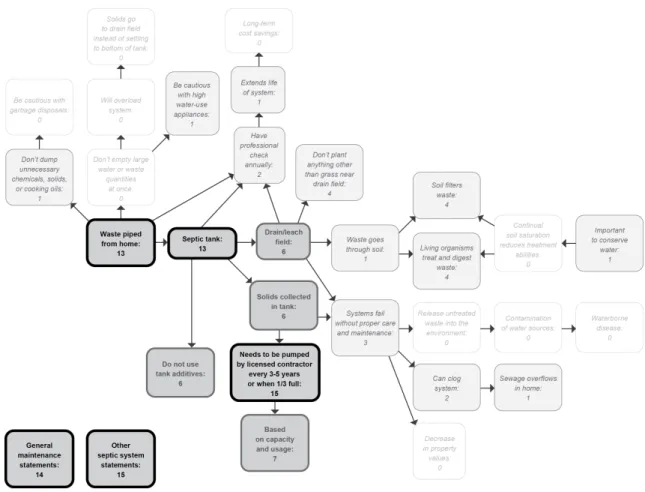
Figure 4. Expert model of private septic systems. ... 15
Figure 5. Frequency with which well system expert model topics were mentioned by interviewees (n=18). ... 17
Figure 6. Frequency with which septic system expert model topics were mentioned by interviewees (n=18). ... 18
CHAPTER 1: INTRODUCTION
Approximately 44.5 million people in the United States rely on private well systems as their primary water source (Maupin et al., 2014). North Carolina is one of the most dependent states, with over three million people using private well systems (Maupin et al., 2014). Private well systems are unregulated by national drinking water standards, which makes homeowners responsible for ensuring their own water quality (United States Environmental Protection Agency, 2015a). It has been well documented that these unregulated systems are prone to contamination, leading to a wide range of adverse health outcomes, including acute gastrointestinal illness, diabetes, cancer, adverse birth outcomes, and methemoglobinemia (Borchardt et al., 2012; Del Razo et al., 2011; DeFelice, Johnston, & MacDonald Gibson, in press; Manassaram et al., 2010; Saint-Jacques, Parker, Brown, & Dummer, 2014; Vahter, 2009). Private wells are especially prone to contamination when located near failing septic systems (Arnade, 1999). This poses water-related health risks, notably for residents living in one of the nearly 50% of North Carolina homes relying on private septic systems (United States
Environmental Protection Agency, 2015b).
In order to minimize contamination and associated illnesses, it is important for
need to be introduced or corrected to best motivate homeowners and improve their decision-making.
To identify relevant knowledge gaps and misconceptions, we investigated homeowner perceptions, practices, and preferences as they relate to maintenance and operation of private well and septic systems. We did so by conducting semi-structured interviews with private well owners according to a framework known as the mental models method for developing risk communication. Interviewees lived in areas of Wake County, North Carolina that have been excluded from municipal water and sewer services through historic zoning practices although the areas are close in proximity to these services. The findings from these interviews will inform a larger scale survey-based study. This will ultimately determine how to direct scientific
communication in a way that most effectively improves maintenance and operation practices, therefore reducing health risks associated with private drinking water systems.
CHAPTER 2: METHODS
This study was approved by the UNC Chapel Hill Institutional Review Board (study number 14-3017).
2.1 Study participants
Participants were recruited from a study by Stillo III that tested for fecal indicator bacteria (FIB) levels in private wells (2015). All participants from Stillo III’s study were private well owners living in extraterritorial jurisdictions in Wake County, North Carolina with majority (>50%) black populations. Recruitment letters were sent to each of the 57 subjects from Stillo’s study offering a $50 gift card for participation. The first 20 people to respond were enrolled. At the census block level, these 20 participants resided in areas with an average black population of 65 percent. A sample size of 20 was used because it has been found to be an adequate number for gathering the most common beliefs in a population (Morgan, Fischhoff, Bostrom, & Atman, 2002).
2.2 Interview Design
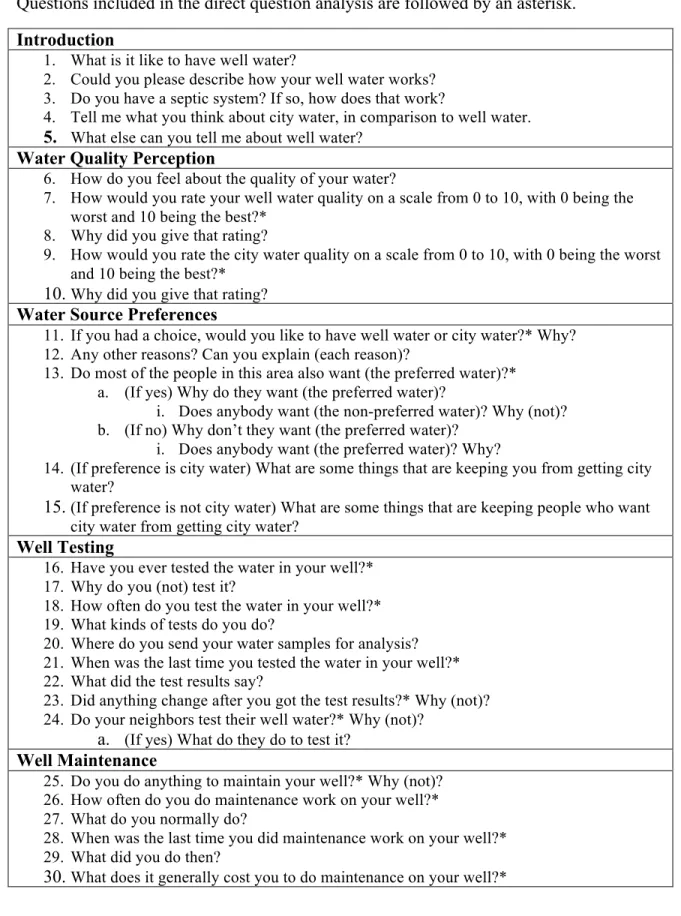
the interview progressed, more narrowly framed questions were asked about water quality perception, water source preferences, well testing, well maintenance, septic maintenance, characteristics of well and septic systems, and pros and cons of city and well water. At the conclusion of the interview, participants had the opportunity to discuss any topics not previously covered in the interview. Interview questions are listed in Table 1. The full interview script is available in Appendix 1.
Table 1. Interview questions. Questions were asked in the same order for each interviewee. Questions included in the direct question analysis are followed by an asterisk.
Introduction
1. What is it like to have well water?
2. Could you please describe how your well water works?
3. Do you have a septic system? If so, how does that work?
4. Tell me what you think about city water, in comparison to well water.
5. What else can you tell me about well water?
Water Quality Perception
6. How do you feel about the quality of your water?
7. How would you rate your well water quality on a scale from 0 to 10, with 0 being the
worst and 10 being the best?*
8. Why did you give that rating?
9. How would you rate the city water quality on a scale from 0 to 10, with 0 being the worst
and 10 being the best?*
10.Why did you give that rating?
Water Source Preferences
11. If you had a choice, would you like to have well water or city water?* Why?
12. Any other reasons? Can you explain (each reason)?
13. Do most of the people in this area also want (the preferred water)?*
a. (If yes) Why do they want (the preferred water)?
i. Does anybody want (the non-preferred water)? Why (not)?
b. (If no) Why don’t they want (the preferred water)?
i. Does anybody want (the preferred water)? Why?
14. (If preference is city water) What are some things that are keeping you from getting city
water?
15.(If preference is not city water) What are some things that are keeping people who want
city water from getting city water? Well Testing
16. Have you ever tested the water in your well?*
17. Why do you (not) test it?
18. How often do you test the water in your well?*
19. What kinds of tests do you do?
20. Where do you send your water samples for analysis?
21. When was the last time you tested the water in your well?*
22. What did the test results say?
23. Did anything change after you got the test results?* Why (not)?
24. Do your neighbors test their well water?* Why (not)?
a. (If yes) What do they do to test it?
Well Maintenance
25. Do you do anything to maintain your well?* Why (not)?
26. How often do you do maintenance work on your well?*
27. What do you normally do?
28. When was the last time you did maintenance work on your well?*
29. What did you do then?
Septic Maintenance
31. Do you do anything to maintain your septic system?* Why (not)?
32. What do you do to maintain your septic system?
33. How often do you do maintenance on your septic system?*
34. When was the last time you did maintenance work on your septic system?*
35. What did you do then?
36.What does it generally cost you to do maintenance on your septic system?*
Characteristics of Well and Septic System
37. Do you know when your well was installed?*
38. How deep is your well?*
39. Is your well a hand-dug well, a bored well, or a drilled well? Pros and Cons of Water Types
40. Overall, have you enjoyed having well water?*
41. What are some good things about having well water?
42. What are some bad things about having well water?
43. What do you think are some good things about having city water?
44. What do you think are some bad things about having city water?
45. Do you know of anyone on city water who has noticed any unusual water tastes, colors,
or smells?*
a. If so, please explain
46. Do you know of anyone on city water who has gotten sick from their water?*
a. If yes, please explain
47. Have you ever noticed any unusual tastes, colors, or smells with your water?*
a. If yes, please explain
48. Do you know of anyone else on well water that has experienced unusual tastes, colors, or
smells with their water?*
a. If yes, please explain
49. Have you ever gotten sick from your water?*
a. If yes, please explain
50. Do you know of anyone else that has gotten sick from their well water?*
a. If yes, please explain
Exit Question
51. Is there anything else you did not have the chance to tell me?
2.3 Direct Question Analysis
2.4 Mental Model Analysis
To set a basis for the mental model analysis process, expert model diagrams were created for private well systems and private septic systems. The private well model was created based on literature review (Benham & Ling, 2013; NC Department of Health and Human Services, 2015; United States Environmental Protection Agency, 2015a; Virginia Cooperative Extension, n.d.; Water Systems Council, n.d.). The model was then revised based on feedback from an expert in the field (K.J. Pieper, personal communication, 2015). The private septic model was created using the same method (K.J. Pieper, personal communication, 2015; National Environmental Services Center, 2004; United States Environmental Protection Agency, 2015b).
All nodes in the well and septic models were assigned a code for interview analysis. In cases where most interviewees vaguely discussed a group of nodes at once rather than
referencing them individually, multiple codes were merged into one. An additional list of codes was added to the analysis based on common interview topics that did not fit into any of the expert models. These topics are cost, detecting water quality through sensory information, available water quantity, control over water quality, vulnerability of well systems to weather, well water as a clean and “natural” water source, and the process of connecting to the city water system.
two codes. We then created a frequency measure by calculating the number of interviewees that mentioned each possible code.
CHAPTER 3: RESULTS 3.1 Direct questions
3.1a Testing frequency
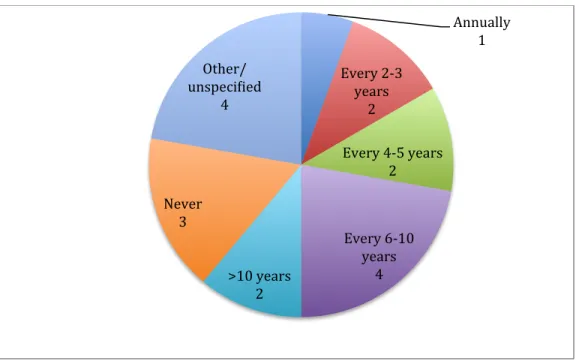
Figure 1. Private well owner self-reported water testing frequencies. Responses were obtained from 18 interviewees.
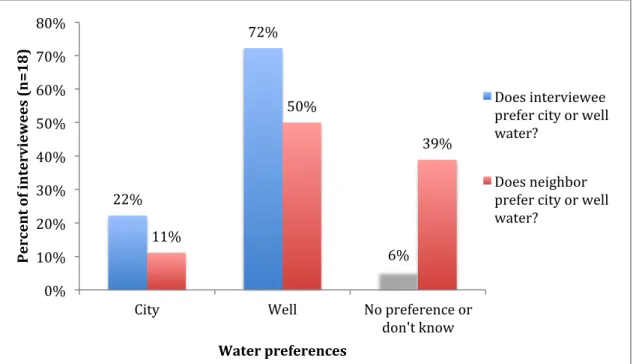
3.1b Water preferences
To determine the water preferences of Wake County private well users, we asked if the interviewee and their neighbors prefer well or city water. We found that 22% of the interviewees preferred city water, 72% preferred well water, and 11% were unsure or had no preference (Figure 2). When asked about neighbors’ preferences, 11% of interviewees said their neighbors preferred city water, 50% said their neighbors preferred well water, and 39% were unsure. These responses indicate that our participants prefer to use well water rather than municipal water.
Annually 1
Every 2-‐3 years
2
Every 4-‐5 years 2
Every 6-‐10 years
4 >10 years
2 Never
3
Other/ unspeciBied
Figure 2. Interviewee and neighbor water preferences. Responses were obtained from interviews of 18 private well system owners.
We also asked interviewees to rank private well and city water quality on a scale of 0 to 10, with 0 being the worst and 10 being the best. In cases where the interviewee gave a range rather than a single number, we recorded the average of the range’s minimum and maximum. The mean well water ranking for all interviewees was 7.7 ± 2.0 (n=18). The mean city water ranking was 7.6 ± 1.7 (n=16). These results show that Wake County private well owners rank well and city water quality almost equally.
3.1c Interviewee practices and experiences
In order to maintain well and septic system health, it is important for system owners to follow proper maintenance and testing procedures. To obtain an overview of homeowner
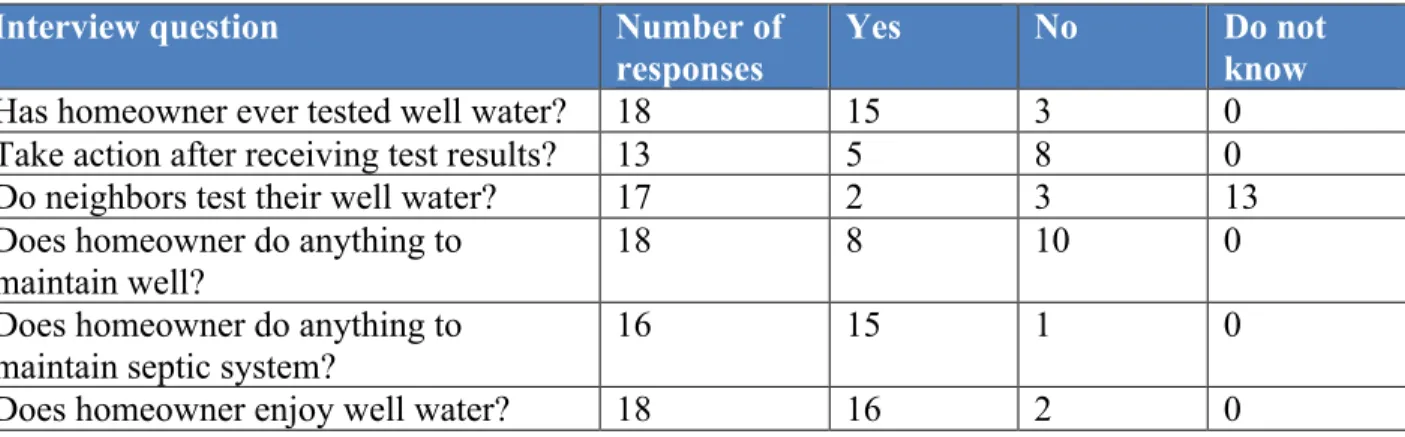
practices, we asked dichotomous questions about their maintenance and testing habits. Out of 18 responses, 15 interviewees claimed they have tested their well water at any point in time (Table 2). Of 18 responses, 8 people said they do maintenance work on their wells. Of 16 responses, 15 homeowners reported that they have septic maintenance practices.
22%
72%
6% 11%
50%
39%
0% 10% 20% 30% 40% 50% 60% 70% 80%
City Well No preference or don't know
P
er
ce
n
t o
f i
n te rv ie w ee
s
(n
=
1
8
)
Water preferences
Does interviewee prefer city or well water?
Table 2. Homeowner private well and septic system management practices
Interview question Number of
responses
Yes No Do not
know
Has homeowner ever tested well water? 18 15 3 0
Take action after receiving test results? 13 5 8 0
Do neighbors test their well water? 17 2 3 13
Does homeowner do anything to maintain well?
18 8 10 0
Does homeowner do anything to
maintain septic system? 16 15 1 0
Does homeowner enjoy well water? 18 16 2 0
To learn about private well owner experiences that may affect water preferences and perceptions, we asked interviewees binary qualitative questions about well and city water. The majority of interviewees (14, n=18) reported that they have not noticed unusual tastes, colors, or smells in either their well water or city water (Table 3). All 18 interviewees also reported that they have not been sick from their own well water.
Table 3. Homeowner experiences with private well and city systems
Interview question Number of
responses
Yes No
Is anything preventing access to city water? 14 11 3 Know anyone on city water who has noticed
unusual tastes, colors, or smells in their water? 18 2 16
Know anyone sick from city water? 18 0 18
Has homeowner experienced unusual tastes,
colors, or smells in their well water? 18 4 14
Know anyone else on well water that has
noticed unusual tastes, colors or smells? 18 2 16
Has homeowner ever been sick from own well
water? 18 0 18
3.2 Private well system expert model
To identify what homeowners need to know about their private well system, we created an expert model based on literature review and expert consultation. One of the most important practices for private well owners is regular water quality testing (Fig. 3). It is recommended that private well water be tested annually for bacteria, every three years for pH and total dissolved solids, and every five years for pesticides. If contaminants are detected, homeowners should take immediate action to remediate the problem and to minimize exposure via ingestion, inhalation, and dermal contact. It is also important for well owners to properly maintain any point-of-entry or point-of-use water treatment systems that may be installed in the home. Treatment system maintenance frequency depends on treatment type, water quality, and water usage. Additionally, homeowners can ensure functionality of their private well system by conducting regular
Figure 3. Expert model of private well water systems. This model was derived through literature review and expert consultation.
3.3 Private septic system expert model
cooking oils. Failure to employ proper septic management practices can lead to system failure, which can contaminate nearby water sources.
Figure 4. Expert model of private septic systems. This model was derived through expert consultation and literature review.
3.4 Expert model node frequency
pump reliance on electricity, water filter upkeep, bacteria testing frequency, pH and total dissolved solids testing frequency, dermal contact, inhalation, water heater, pipes, and contamination through corrosion, biofilm growth, and cross connections were mentioned
infrequently (by 1-5 homeowners). Pesticides, pesticide testing frequency, keeping the well area clean, and looking for cracks, holes, and corrosion were not mentioned at all.
For the septic diagram, the most frequently mentioned nodes were waste piped from the home to the septic tank, “needs to be pumped by licensed contractor every 3-5 years or when 1/3 full,” “general maintenance statements,” and “other septic system statements,” each mentioned by 13-15 people. Nodes concerning drain field waste treatment processes, system failure, clogging, sewage overflowing into the home, planting near drain field, professional inspections, water conservation, high water-use appliances, and dumping unnecessary chemicals, solids, or cooking oils were mentioned infrequently (by 1-5 homeowners). Garbage disposals, the
Figure 5. Frequency with which well system expert model topics were mentioned by
Figure 6. Frequency with which septic system expert model topics were mentioned by
interviewees (n=18). Thicker lines represent nodes that were mentioned by a higher number of interviewees.
We also identified topics mentioned by homeowners that were not included in the expert models and calculated the frequency with which these non-expert codes were discussed (Fig. 7). Regarding wells, all homeowners mentioned cost. All interviewees also discussed their ability to detect water quality through sensory information such as taste, smell, and appearance. Fourteen homeowners discussed their amount of available water. Some participants described their water as having unlimited usage compared to city water while other people expressed concerns about having an inadequate well water supply. Thirteen homeowners discussed the process of
non-expert topics include control over water quality, vulnerability of the well system to weather, and private wells as a “natural” water source.
Figure 7. Frequency with which non-expert codes were mentioned by interviewees (n=18). These codes were applied to topics mentioned by private well owners that were not included in the private well and septic system expert models.
Based on the frequency of expert and non-expert codes, we identified the following major topics to explore further: 1) well water testing, 2) assessing water quality with sensory
information, 3) links between septic systems, well contamination, and health, 4) septic
maintenance, 5) well maintenance, 6) dermal contact and inhalation as exposure routes, 7) cost, water availability, and control, and 8) connecting to the municipal water system.
3.4a Well water testing
One of the most important homeowner practices for ensuring safe well water quality is regular testing. Although all 18 interviewees mentioned water testing, very few mentioned correct ideas about specific testing guidelines (Fig 5). Six interviewees mentioned bacteria, but
0 2 4 6 8 10 12 14 16 18 Well water is clean because it is "natural"
Vulnerability of well system to weather Control over water quality Process of connecting to city system Water quantity available Detecting water quality through sensory
information
Cost
Number of interviewees (n=18)
Non
-‐expert topic
only three participants discussed annual testing. Three homeowners mentioned pH and total dissolved solids, but only one interviewee talked about testing every three years. Pesticides and the associated testing recommendation were not mentioned by any of the interviewees. This indicates that many homeowners are unaware of specific testing types or their recommended frequencies.
To further explore homeowner understanding of testing, we examined statements
assigned to the well testing node (Fig. 5). One of the most knowledgeable participants explained “I test [my water] once a year because it was, it’s the recommendation, and for peace of mind.” Some participants understood the importance of water quality analysis, but indicated lack of regular testing practices. For example, one interviewee stated “periodically I'm having to test the well again to make sure that there's nothing wrong with my water…and perhaps other
contaminants that I may not catch, because I might not test my water as regularly as I should.” Another interviewee stated, “we probably should be [testing our water] every three or four years at least,” indicating a misconception about adequate testing frequency. Other homeowners indicated a more severe lack of understanding. After describing a bacterial contamination issue from several years ago, one participant said, “Oh, I haven’t had it tested since that incident… Should I have had it tested again?” These statements make it clear that there is confusion among homeowners regarding adequate water testing frequency.
to it.” These statements indicate a lack of awareness about testing procedures and their importance in ensuring safe drinking water.
3.4b Assessing water quality with sensory information
All 18 interviewees mentioned using sensory information to assess water quality. Interviewees expressed that visual qualities, smell, and taste are the most easily accessible information. As one homeowner put it:
I don't know, [about my water quality] because I haven't had results from the tests, but right now I feel like [my water quality is] fine as far as the human eye can see and the nose can smell and my hands can feel. Those are the only things I have, my senses. Many interviewees expressed that they were comfortable with their water quality as long as it appears normal, and that they became cautious if they could sense a change. For example, one participant said “I think water should be clear as water should be and if it’s anything other than that, I wouldn’t want to cook or drink with it.” Many participants conveyed that their testing practices and remedial actions are prompted by sensory information. One such interviewee stated “Basically, when we first moved in [we tested the water] because our water tasted funny.”
Another interviewee had found resources to help them link smells and appearance to specific water quality issues and remediation options: “I had a list provided by the health department that would tell you what the different smells or color rings that you would get if your water was hard or if it was too much this or that in it…” These statements point out the emphasis that
homeowners place on sensory information in decision-making. 3.4c Links between septic systems, well contamination, and health
found that only one interviewee mentioned septic waste as a source of well contamination (Fig. 6). We also found that no one mentioned failing septic systems as a cause of waterborne disease. This indicates that homeowners do not realize the important links between a functioning septic system, good water quality, and health.
3.4d Septic maintenance
One of the most important septic maintenance practices is pumping the tank regularly. We found that 13 interviewees mentioned pumping their septic system (Fig. 6). Many
interviewees expressed pumping their tanks either within the 3-5 year range or according to their tank’s capacity:
[I have the septic tank pumped] maybe every three years or so… and the tank does have to be emptied once every, well, for my use it’s rated about once every ten years, and I just had it emptied not long ago.
A few other interviewees discussed pumping their tanks, but demonstrated misconceptions about the recommended frequency. For example, one homeowner stated that “You know, once [the septic tank] gets full, you have to have them to come out and clean it out.” Another participant said, “I know if we ever get a bad odor, then we have to have [the septic tank] cleaned out… I know it’s been about 15 years [since I last had the septic tank pumped].” These observations suggest that although pumping was a frequent topic, some homeowners still lack knowledge about its importance or recommended frequency.
quantities at one time would overload the septic system and reduce its functionality. Although one interviewee mentioned putting chemicals down the drain, no one discussed correct ideas about dumping unnecessary chemicals, solids, or cooking oils and the resulting harm on the system. These findings suggest that homeowners are unaware of many ways they can ensure the functionality of their septic system.
3.4e Well maintenance
To ensure private well functionality and cleanliness, homeowners should conduct routine maintenance practices. We found that nodes associated with specific routine well maintenance practices are missing from homeowner mental models (Fig. 5). Only one interviewee mentioned having an annual well inspection. Although three people mentioned inspecting the well to protect water sources and two people mentioned inspection by a licensed contractor, interview
comments mostly described initial home inspections or a lack of regular homeowner inspection practices.
We also observed that 17 interviewees mentioned general well maintenance that did not apply to any of the more specific nodes. Some homeowners described the importance of routine maintenance, such as one interviewee that described regular shock chlorination practices:
I mean with anything to do with a home or that comes attached to the home, you have to do maintenance on it and you have to keep it up, so when I first bought the house, I was kind of given just verbal instructions on how to maintain the well, how to keep it clean… every so often you have to shock the water maybe about once a year and several things like that. Yeah. That’s it.
However, many interviewees appeared to be unaware of well maintenance practices. One
anything to maintain it. There's nothing you do, I do to maintain it. It's just wait until something happens.” These observations suggest that many homeowners lack awareness of specific routine well maintenance procedures and their importance.
3.4f Dermal contact and inhalation as exposure routes
The well frequency diagram shows that only one person mentioned inhalation and three people mentioned dermal contact associated with well water (Fig. 5). However, only one of those interviewees discussed useful information linking exposure to a health outcome. Other people mentioned that they do not drink their water because of its poor quality, but that they still shower in it, bathe in it, and use it for washing clothes and dishes. Some interviewees saw the avoidance of ingesting the water as an excuse to forgo testing. When asked why they do not test their water, one such person responded, “Because we don’t drink it.” This suggests that homeowners are unaware of health effects from water contaminants via dermal contact and inhalation.
3.4g Cost, water availability, and control
Cost was a topic mentioned by all interviewees (Fig. 7). Homeowners frequently mentioned that they do not have to pay for their well water. Some stuck with this simple description, but others went on to specify that they do not have a monthly bill. A few people further elaborated upon their well’s cost in comparison to city services:
I [do not] need a water bill... I [do not] have additional taxes to cover the cost of the water service… One of the downsides of well water is that you have to incur [maintenance] costs, and so there’s risk if the pump fails or other parts fail.
purchasing.” Collectively, these expense-related statements indicate that cost is a main factor in a homeowner’s decision-making process.
Water availability was mentioned by 14 participants. Some interviewees described their water supply as unlimited. Many people explained that relying on a well instead of the city system gives them freedom to use whatever water quantity they choose. One interviewee stated, “I can use [my well water] as I see fit… [My water is] not regulated by somebody telling me you can’t use any water for this, or you can’t use any water for that the way they do.” On the other hand, some homeowners described having a well as a barrier to accessing an adequate water quantity. One interviewee explained “…when I do do laundry, yes, I notice that the well tank, the pump will shut down while it’s, -- either it overheats or there’s not enough water in the well because I’m using so much.” Another participant said, “I would rather have the water… add more convenience to my lifestyle… I would love to have [my well water] more accessible.” These statements signal that convenient access to an adequate water quantity is a top priority for homeowners.
Control over water quality was discussed in 10 interviews. Many interviewees expressed that they felt more in control with private well water rather than city water. As one homeowner put it:
Like a terrorist attack on a municipal water system. That seems kind of scary this way. Also we have a very enclosed water system and we don’t - we’re not at the mercy of everyone else.
These observations indicate that control over water quality is emphasized in homeowner mental models.
3.4h Connecting to the municipal water system
Thirteen interviewees mentioned the process of connecting to the city water system (Fig. 7). Most comments addressed either physical accessibility to the municipal system or connection cost. Some participants discussed the lack of city water access: “right now, in the area that I am in, what's keeping people from getting city water is the fact that they have not made it
accessible.” A few interviewees expressed a desire to have access to the city system: “I would just love to have public access to water as my other utilities that I have… I like my community, but this is the only thing I hate about it, the well water.” Another homeowner stated:
Nobody has been given the option [to connect to the city system] and if you ask why, I don't know. That is beyond me as to why that has not occurred. Those are things that have to be asked to the city and the politicians and the county.
Other interviewees discussed connection cost as a barrier to municipal system access. For example, one participant stated:
But I know I’m going to have to [deal with well water the rest of my life] because I can’t afford to have the city tapped in and I'm out in the country… It’s like five houses on this street that we all have well water and we would like to have city water.
that connection costs and accessibility influence the type of water system that residents of unincorporated Wake County, North Carolina areas use.
CHAPTER 4: DISCUSSION
In this study, we have shown that private well and septic owners do not understand well water testing guidelines and the importance of following them. We found that testing is often inhibited by the common homeowner perception that water quality problems can be detected by appearance, taste, and smell. We also found that homeowners do not recognize critical links between maintaining a functioning septic system, maintaining adequate well water quality, and health outcomes. Additionally, we have demonstrated that cost and control are key components of decision-making for private well owners.
4.1 Testing
and Hampton et al. (2014). Additionally, a survey found that of the 20% of homeowners that do not test, 33% do not because their water appears clean (Borsuk, Rardin, Paul, & Hampton, 2014). These survey results, as well as a study of private well owners in the City of Hamilton, Ontario (Canada) by Jones et al. support our observation that private well owners do not think about contaminants they cannot sense (Borsuk, Rardin, Paul, & Hampton, 2014; Jones et al. 2005). This is problematic because many water contaminants cannot be detected through human senses (Schwartz, et al., 1998). A third reason private well owners do not test is because they are unaware of exposure via dermal contact and inhalation. Rather, homeowners only consider ingestion as a source of water contamination exposure. This leads many people to believe that if they stop drinking their well water, they can avoid testing or taking remedial actions.
4.2 Links between septic systems, water contamination, and health
Our results indicate that homeowners do not realize the important links between
maintaining a properly functioning septic system, good water quality, and health. We found that only one interviewee mentioned septic waste from a failing system as a source of well water contamination and no one mentioned the waste as a cause of waterborne disease. This suggests that homeowners do not perceive septic maintenance as a means to avoid bacterial water
contamination and gastrointestinal illness. Similarly, a study of three North Carolina cities found that most key water and sewer decision-making officials did not link septic failure, water
contamination, and health risks to surrounding unincorporated community members (Naman and MacDonald Gibson, 2015).
4.3 Septic maintenance
Similarly, Schwartz et al. reported that over one third of private well and septic owners in three counties of upstate New York have never pumped their septic tanks (1998). Additionally, we found that there is a severe lack of homeowner knowledge about routine maintenance practices that extend the lifetime of private septic systems. These results, in conjunction with evidence from the upstate New York population, show that homeowners do not employ these generally low-cost septic maintenance practices (Schwartz et al., 1998).
4.4 Cost and control
We found that cost and control are major components of a homeowner’s mental model. Cost was a main interviewee focal point. Many participants expressed cost as a major reason for preferring private well water to the municipal system. A few homeowners also described cost as a barrier to achieving optimal water quality. This is supported by the previously mentioned Borsuk, Rardin, Paul, & Hampton study, showing that cost prevents water testing and treatment (2014).
Control is associated with both water quality and the water amount that the well owner is able to use. We found that some homeowners feel safer without relying on a municipal system, while others acknowledge the benefit of having consistent municipal water quality monitoring. These ideas regarding control over water quality were also observed in the previously mentioned Jones et al. study (2005). We also found that some homeowners enjoyed using their water
4.5 Limitations
Prior research supports that this study’s sample size (n=18) is adequate for eliciting major beliefs in a population (Morgan, Fischhoff, Bostrom, & Atman, 2002). However, our sample size cannot be used to determine prevalence of the beliefs. In order to measure prevalence, a larger-scale survey must be administered. Another limitation is the potential bias introduced by the enrollment methods. Participants previously volunteered to have their water tested in a study by Stillo III (2015). Additionally, we enrolled the first twenty people that responded to recruitment letters. The influence of these two bias sources is unclear. On the one hand, our enrollment methods could have led to inclusion of participants that are more proactive than the general population. However, it is also possible that our study subjects experience more water quality problems, potentially from lack of well and septic management, and therefore were prompted to act.
4.6 Recommendations
We recommend that the findings from our study be used to develop a large-scale survey, which will measure prevalence of beliefs among private well owners in majority black areas excluded from municipal water services in Wake County, North Carolina. Our findings,
combined with survey-based findings, should direct future communications intended to improve private well and septic system management practices. These communications should focus on increasing homeowner testing frequency, improving septic management practices, and helping homeowners understand links between their wells, septic systems, and health. Future
refrigerator or in another visible place in the home. These communications should be provided to both current and future homeowners. We suggest that public health officials go over these
communications when initially giving them to homeowners. We also suggest that public health official contact information be provided on communications to homeowners to facilitate follow-up questions and discussion.
CHAPTER 5: CONCLUSIONS
Our study reveals that private well owners in Wake County, North Carolina do not test frequently enough to adequately detect and address water contamination. Testing is inhibited by well owner lack of awareness about recommended testing guidelines, overreliance on sensory information, and poor understanding of exposure pathways. The lack of testing is exacerbated by a poor well owner understanding of the links between private septic systems, well water
contamination, and health outcomes. Although many homeowners pump their septic tanks, our study highlights that many people are still unaware of the importance of pumping and how often it should be done. Septic owners are also unaware of other simple, routine maintenance practices that will improve and extend the life of their septic system. Additionally, we found that cost and control are key components of a homeowner’s mental model. Based on our findings, we
APPENDIX 1: INTERVIEW SCRIPT
Basic Prompts- These will be used to elicit additional information from participants following the main interview questions if needed.
• “Anything else?”
• “Can you tell me more?”
• “Anything else? Don’t worry about whether it’s right. Just tell me what comes to mind.” • “Can you explain why?”
Introduction
In this interview, I will ask you questions about well water. I want to understand how you think about well water and issues related to it. Sometimes I may ask the same question more than once. I do this to make sure that I understand everything you say. Please tell me everything that comes to mind. If something I say does not make sense, please ask me to explain.
The interview should take around 30 minutes to an hour. We estimate that there will be a total of 20 participants. I will not record your name or any personally identifying information with your responses. If you ever feel uncomfortable answering a question, we can skip it and move on to the next one. You are also welcome to stop the interview at any point. If you choose to skip questions or end the interview, you will still receive compensation. Do I have your permission to begin asking you questions?
• What is it like to have well water?
• Could you please describe how your well water works? • Do you have a septic system? If so, how does that work?
• Tell me what you think about city water, in comparison to well water • What else can you tell me about well water?
Water Quality Perception
• How do you feel about the quality of your water?
• How would you rate your well water quality on a scale from 0 to 10, with 0 being the worst and 10 being the best?
• Why did you give that rating?
• How would you rate the city water quality on a scale from 0 to 10, with 0 being the worst and 10 being the best?
• Why did you give that rating? Water Source Preferences
• If you had a choice, would you like to have well water or city water? Why? • Any other reasons? Can you explain (each reason)?
• Do most of the people in this area also want (the preferred water)? o (If yes) Why do they want (the preferred water)?
§ Does anybody want (the non-preferred water)? Why (not)? o (If no) Why don’t they want (the preferred water)?
• (If preference is city water) What are some things that are keeping you from getting city water?
• (If preference is not city water) What are some things that are keeping people who want city water from getting city water?
Well Testing
• Have you ever tested the water in your well? o Why do you (not) test it?
o (If yes) How often do you test the water in your well? § What kinds of tests do you do?
§ Where do you send your water samples for analysis? § When was the last time you tested the water in your well? § What did the test results say?
§ Did anything change after you got the test results? Why (not)? • Do your neighbors test their well water? Why (not)?
o (If yes) What do they do to test it? Well Maintenance
• Do you do anything to maintain your well? Why (not)?
o (If yes) How often do you do maintenance work on your well? § What do you normally do?
§ When was the last time you did maintenance work on your well? § What did you do then?
§ If you are comfortable with me asking, what does it generally cost you to do maintenance on your well?
Septic Maintenance (if they have a septic system)
• Do you do anything to maintain your septic system? Why (not)? o (If yes) What do you do to maintain your septic system?
§ How often do you do maintenance on your septic system?
§ When was the last time you did maintenance work on your septic system? § What did you do then?
§ What does it generally cost you to do maintenance on your septic system? Characteristics of Well and Septic System
• Do you know when your well was installed? • How deep is your well?
• Is your well a hand-dug well, a bored well, or a drilled well? [If the participant does not know the difference, explain: “A hand-dug well is dug by hand and typically lined with stones, brick, or concrete. A bored well is created by driving pipe into the ground with an auger until the water table is reached. Drilled wells require drilling very deep to reach water beneath the bedrock.”)
Pros and Cons of Water Types
• Overall, have you enjoyed having well water?
• What are some bad things about having well water?
• What do you think are some good things about having city water? • What do you think are some bad things about having city water?
• Do you know of anyone on city water who has noticed any unusual water tastes, colors, or smells?
o If so, please explain
• Do you know of anyone on city water who has gotten sick from their water? o If yes, please explain
• Have you ever noticed any unusual tastes, colors, or smells with your water? o If yes, please explain
• Do you know of anyone else on well water that has experienced unusual tastes, colors, or smells with their water?
o If yes, please explain
• Have you ever gotten sick from your water? o If yes, please explain
• Do you know of anyone else that has gotten sick from their well water? o If yes, please explain
Exit Question
APPENDIX 2: RECRUITMENT LETTER SCRIPT Dear Potential Participant Name,
I am writing to ask your help in a research study of drinking water quality in North Carolina. The first 20 participants will receive a $50 Visa gift card, in addition to the gift card that will be rewarded from participation in the related water quality study being conducted by Frank Stillo. The objective of this study is to learn about preferences and behaviors among well water users. In order to accomplish this objective, the research team is asking that you participate in one interview via telephone that will last 30 minutes to an hour. Your name and address will not be recorded with your interview responses. Additionally, only the research team will have access to your information. The results will inform future water resources planning and public health protection programs.
Participation in this study will not affect your compensation from Mr. Stillo’s study.
Additionally, if you choose to enroll in this follow-up study, you will receive the results of your water quality test following completion of the interview. If you choose not to enroll, you will receive your results immediately from Mr. Stillo.
If you would like to participate or have any questions about this study, please contact Chelsea Fizer at XXX-XXX-XXXX or [email protected]. This study is completely voluntary. However, this research can benefit the public health of your community.
Sincerely,
REFERENCES
Arnade, L. J. (1999). Seasonal correlation of well contamination and septic tank distance.pdf. Ground Water, 37(6), 920–923. doi:10.1111/j.1745-6584.1999.tb01191.x
Benham, B., & Ling, E. (2013). Virginia Household Water Quality Program : Household Water Treatment, 1–10.
Borsuk, M., Rardin, L., Paul, M., & Hampton, T. (2014). Arsenic in Private Wells in New Hampshire.
Borchardt, M. A.; Spencer, S. K.; Kieke, B. A.; Lambertini, E.; Loge, F. J. Viruses in nondisinfected drinking water from municipal wells and community incidence of acute gastrointestinal illness. Environ. Health Perspect. 2012, 120 (9), 1272–1279.
Bruine de Bruin, W., & Bostrom, A. (2013). Assessing what to address in science
communication. Proceedings of the National Academy of Sciences of the United States of America, 110, 14062–14068. doi:10.1073/pnas.1207851
DeFelice, N. B., Johnston, J. E., MacDonald Gibson, J. (in press). Reducing Emergency Department Visits for Acute Gastrointestinal Illnesses in North Carolina (USA) by Extending Community Water Service. Environmental Health Perspectives.
Del Razo, L. M.; García-Vargas, G. G.; Valenzuela, O. L.; Castellanos, E. H.; Sánchez-Peña, L. C.; Currier, J. M.; Drobná, Z.; Loomis, D.; Stýblo, M. Exposure to arsenic in drinking water is associated with increased prevalence of diabetes: a cross-sectional study in the Zimapán and Lagunera regions in Mexico. Environ. Health 2011, 10 (1), 73.
Jones, A. Q., Dewey, C. E., Doré, K., Majowicz, S. E., McEwen, S. A., Waltner-Toews, D., … Mathews, E. (2005). Public perception of drinking water from private water supplies: focus group analyses. BMC Public Health, 5, 129. doi:10.1186/1471-2458-5-129
Manassaram, D. M.; Backer, L. C.; Messing, R.; Fleming, L. E.; Luke, B.; Monteilh, C. P. Nitrates in drinking water and methemoglobin levels in pregnancy: a longitudinal study. Environ. Health 2010, 9, 60.
Maupin, M. A., Kenny, J. F., Hutson, S. S., Lovelace, J. K., Barber, N. L., & Linsey, K. S. (2014). Estimated use of water in the United States in 2010. U.S. Geological Survey Circular 1405. Reston, VA. doi:10.3133/cir1405
Morgan, M. G., Fischhoff, B., Bostrom, A., & Atman, C. J. (2002). Risk communication: a mental models approach. Cambridge: Cambridge University Press.
National Environmental Services Center. (2004). Maintaining Your Septic System—A Guide For Homeowners. Pipeline: National Environmental Services Center, 15(4), 1–8.
NC Department of Health and Human Services. (2015). Well water and health. Retrieved from http://epi.publichealth.nc.gov/oee/programs/wellwater.html
Saint-Jacques, N.; Parker, L.; Brown, P.; Dummer, T. J. Arsenic in drinking water and urinary tract cancers: a systematic review of 30 years of epidemiological evidence. Environ. Health 2014, 13 (1), 44.
Schwartz, J. J., Waterman, A. B., Lemley, A. T., Wagenet, L. R., Landre, P., & Allee, D. J. (1998). Homeowner perceptions and management of private water supplies and wastewater treatment systems. Journal of Soil and Water Conservation, 53(4), 315–319. Retrieved from
http://www.scopus.com/inward/record.url?eid=2-s2.0-0032250968&partnerID=40&md5=c60641a58a03c4a40407aae7e834fb1f
Stillo III, F. (2015). Community Water Systems vs Private Wells: A Comparison of Water Quality on the Fringes of Municipalities (Master's thesis). Retrieved from Carolina Digital
Repository.
Swistock, B. R., Clemens, S., Sharpe, W. E., & Rummel, S. (2013). Water quality and management of private drinking water wells in Pennsylvania. Journal of Environmental Health, 75(6), 60–6.
United States Environmental Protection Agency. (2015a). About Private Water Wells. Retrieved February 21, 2016, from http://www.epa.gov/privatewells/about-private-water-wells
United States Environmental Protection Agency. (2015b). Septic Systems Overview. Retrieved February 21, 2016, from http://www.epa.gov/septic/septic-systems-overview
Vahter, M. Effects of arsenic on maternal and fetal health. Annu. Rev. Nutr. 2009, 29, 381–399. Virginia Cooperative Extension. (n.d.). Ten tips for managing your private well water supply.