ANTI-MARKOVNIKOV ADDITION REACTIONS OF OXY-ACIDS TO ALKENES ENABLED BY PHOTOREDOX CATALYSIS
David S. Hamilton
A dissertation submitted to the faculty at the University of North Carolina at Chapel Hill in partial fulfillment of the requirements for the Degree of Doctor of Philosophy in the Department of Chemistry.
Chapel Hill 2014
Approved by: David A. Nicewicz Erik J. Alexanian Joseph L. Templeton Maurice S. Brookhart
ABSTRACT
David S. Hamilton: Development of a Catalytic Platform for the Direct, Anti-Markovnikov Addition of Oxy-Acids to Alkenes via Cation-Radical Intermediates
(Under the direction of David A. Nicewicz)
The addition of nucleophiles to alkenes with complete anti-Markovnikov selectivity employing reagents in catalytic quantities has been a major challenge for the field of organic synthesis, and Past efforts employing primarily transition-metal catalysis have only partially solved this long-standing problem. This work describes the development of a novel two-component catalytic system comprised of a photoredox catalyst and a catalytic hydrogen-atom donor, which we have demonstrated to be capable of carrying out the addition of oxy-acids to alkenes with complete regioselectivity. Some rudimentary mechanistic experiments are included to highlight the importance of both catalytic species used in the system, and applications to the synthesis of cyclic ethers and lactones are detailed. Other noteworthy applications of this system are discussed, as are preliminary results for future applications of the detailed catalytic platform.
ACKNOWLEDGEMENTS
Arguably the most incredible thing about the prospect of publishing something is the opportunity to write some genuine and long overdue thank-yous, and to have them be a part of record for eternity.
Graduate school has been the ultimate humbling experience. If I have learned anything during my time here, it is this: though there is only one name on any dissertation, the amount of support from others that it takes to get anyone to the finish line is enormous. It certainly would take a stronger person than I to do this alone. I have been blessed with the most supportive family imaginable. Mom (Paula Raney-Hamilton), Dad (Scott Hamilton), Lauren: The patience you’ve shown me when I’ve hit my wits end on so many occasions has been incredible. To my many incredible friends, be they the old that I’ve known since I was a toddler, or the new that I’ve met in my time in the incredible town that is Chapel Hill: the many chats and trips to the bar (to both celebrate victory and commiserate in defeat) have made the good days memorable, and the truly awful days bearable.
To my labmates in the Nicewicz group: I will be extraordinarily lucky if I ever have the
opportunity to work with such an eclectic, intelligent, and overall fantastic group of people ever again. It has been an honor to work, learn, and celebrate side-by-side with each and every one of you for the last five years as our lab has grown from nothing to something really awesome. I was told once that
To my boss, Dave Nicewicz: I owe you the ultimate thanks for taking a flyer on me to help start your lab, for giving me such an interesting project to work on, and for giving me the latitude and space to come up with some really useful ideas (amongst all the truly terrible ones as well). You’ve been
incredibly supportive and patient every step of the way, and couldn’t have asked for a better advisor. I can leave here and honestly say that I worked for one of the good people in Chemistry today. It has been an honor and privilege to say the least, and I look forward to seeing where your career goes from here.
With respect to the work that appears in these pages, contributions were made by two very bright undergraduates (David Dong and Colin Price), who aided in the preparation of some of the compounds tested. Additionally, the computational results were obtained by Nathan Romero, as were some
thermodynamic parameters for the acridinium salt. Beyond these specific contributions, thanks must be extended to members of the Alexanian, Meek, Johnson, Gagné, Waters, and Crimmins labs, for your intellectual input in a myriad of conversations, as well as for your generosity in sharing materials and instrumentation.
PREFACE
TABLE OF CONTENTS
CHAPTER 1: ALKENE HETEROFUNCTIONALIZATION AND CHALLENGES ASSOCIATED WITH OBTAINING ANTI-MARKOVNIKOV REGIOSELECTIVITY ... 1 !
1.1 Introduction ... 1 !
1.2. Markovnikov’s Rule ... 2 !
1.3. Circumvention of Markovnikov’s Rule ... 5 !
1.4. Anti-Markovnikov Products from Reagent-Controlled Approaches ... 6 !
1.5 Transition Metal-Catalyzed Approaches to Direct Anti-Markovnikov
Heterofunctionalization Reactions: Hydroamination ... 7 !
1.6. Transition Metal-Catalyzed Approaches to Direct Anti-Markovnikov
Heterofunctionalization Reactions: Hydroetherification and Hydration. ... 11 !
1.7. Summary ... 13 !
REFERENCES ... 15 !
CHAPTER 2: THE CATION-RADICAL APPROACH TO THE
HETEROFUNCTIONALIZATION OF OLEFINS ... 17 !
2.1. Introduction ... 17 !
2.2. Anti-Markovnikov Heterofunctionalization: a Computational Analysis ... 17 !
2.3. Anti-Markovnikov Heterofunctionalization: Electrochemical Approaches ... 19 !
2.4. Anti-Markovnikov Heterofunctionalization: Photoredox Approaches ... 20 !
2.5. Attempted Hydroetherification of a Model Substrate Utilizing Prior Art ... 25 !
2.6. Consideration of Organic Photo-oxidants ... 26 !
2.7. Initial Results – Alkenol Cyclization Utilizing 9-Mesityl,10-Methylacridinium
2.8. Reaction Byproduct Analysis ... 30 !
2.9. Summary ... 33 !
REFERENCES ... 34 !
CHAPTER 3: THE USE OF HYDROGEN ATOM DONOR ADDITIVES
TO EFFECT THE DIRECT, ANTI-MARKOVNIKOV HYDROETHERIFICATION
OF ALKENOLS ... 37 !
3.1. Introduction ... 37 !
3.2. Catalytic Strategy Incorporating a Hydrogen-Atom Donor Additive. ... 39 !
3.3. Rationale for the Unique Utility of 2-Phenylmalononitrile. ... 42 !
3.4. Control Experiments to Validate the Catalytic Method ... 42 !
3.5. Evaluation of Reaction Scope ... 44 !
3.6. Complementarity to Brønsted-Acid Catalysis ... 47 !
3.7. The Use of Other Nucleophiles ... 48 !
3.8. Further Discussion of Selectivity ... 49 !
3.9. Summary ... 50 !
REFERENCES ... 52 !
CHAPTER 4 – IMPROVEMENTS TO THE ANTI-MARKOVNIKOV HYDROETHERIFICATION REACTION, AND EXTENSION TO
HYDROLACTONIZATION ... 54 !
4.1. Introduction ... 54 !
4.2. Establishing the Role of the Additive as a Hydrogen Atom Donor ... 54 !
4.3. Re-visitation of Hydrogen Atom Sources ... 58 !
4.4. Re-optimization of the Hydroetherification Reaction with Thiophenol
Employed as Hydrogen-Atom Donor ... 61 !
!
4.7. Expansion of the New System to Hydrolactonization ... 65 !
4.8. Applications to Total Synthesis and Medicinal Chemistry –
Catechin Metabolites ... 69 !
4.9. Applications to Total Synthesis – Access to the Dihydroisocoumarin Motif ... 73 !
4.10. Summary ... 74 !
REFERENCES ... 76 !
CHAPTER 5 – OTHER APPLICATIONS OF THE IDENTIFIED CATALYTIC SYSTEM
AND FUTURE DIRECTIONS ... 78 !
5.1. Introduction. ... 78 !
5.2 Other Anti-Markovnikov Transformations Developed in the
Nicewicz Laboratory Based on the Previously Described Dual-Catalyst System. ... 78 !
5.3. Regioselective Polar Radical Crossover Cycloadditions. ... 81 !
5.4. Other Possible Future Directions for the Cation-Radical Intermediates. ... 82 !
5.5. Conclusions ... 83 !
REFERENCES ... 85 APPENDIX 1: SELECTED METHODS ... 86 A1.1. General Methods ... 86 !
A1.2. Synthesis of Alkenol Substrates ... 87 !
A1.3. Anti-Markovnikov Hydroetherification Reactions Using 2-Phenylmalononitrile ... 99 !
A1.4. Other Anti-Markovnikov Hydrofunctionalizations Using 2-Phenylmalononitrile ... 106 !
A1.5. Markovnikov-Selective Hydroetherification Reaction Catalyzed by Triflic Acid ... 107 !
A1.6. Method for Kinetic Trials ... 108 !
A1.7. Synthesis of Alkenoic Acids. ... 109 !
A1.9. Deprotection Conditions for Catechin Metabolite Products. ... 126 !
A1.10. Regioselective Oxy-chlorination of an Alkenol. ... 128 !
REFERENCES ... 129 !
LIST OF TABLES
Table 3.1. Results of Hydrogen Atom Donor Screen ... 41 !
Table 3.2. Control Experiments Confirming the Necessity of All Species
to Promote Efficient Reactions. ... 43 !
Table 3.3. 2-Phenylmalononitrile Loading Screen ... 43 !
Table 3.4. Electronic Diversity in Alkenol Cyclizations ... 44 !
Table 3.5. Variation in Alkenol Backbone Structure ... 45 !
Table 3.6. Demonstration of Cyclization Modes and Substrate Complexity with a
Number of 2-Methyl-2-Butene-Derived Alkenols ... 46 !
Table 4.1. Screen of Second-Generation H-Atom Donors ... 61 !
Table 4.2. Control Experiments and Other Optimization of Second Generation System ... 62 !
Table 4.3. Solvent Effect on the Hydroetherification Reaction. ... 63 !
Table 4.4. Comparison of Thiophenol System to First-Generation System with 2-PMN ... 64 !
Table 4.5. Observation of Decarboxylation of Alkenoic Acid Upon Inclusion of Base. ... 66 !
Table 4.6. Scope of Hydrolactonization Reactions to form γ-Butyrolactones
from Styrenyl-Alkenoic Acids ... 67 !
Table 4.7. Hydrolactonization Reactions of Exotic Substrate Motifs ... 69 !
Table 4.8. Results for Key Lactonization Step to Form Catechin Metabolite
Precursors and Derivatives. ... 72 !
LIST OF FIGURES
Figure 1.1. A Sampling of Alkenes Available from Petroleum Cracking or Natural Sources. ... 2 !
Figure 1.2. Addition Reaction to an Asymmetric Alkene. ... 2 !
Figure 1.3. Justification for Markovnikov Regioselectivity Upon Electrophilic
Activation of Alkenes. ... 4 !
Figure 1.4. Representative Industrial-Scale Transformations Demonstrating the Utility
of Markovnikov-type Reactivity. ... 4 !
Figure 1.5. Polarity Effects in Addition Reactions of Nucleophiles to Alkenes. ... 5 !
Figure 1.6. Anti-Markovnikov Selectivity of Hydroboration Reactions. ... 6 !
Figure 1.7. Some Reactions Allowing for Functional Group Interconversion of Organoboron Adducts, Giving Rise to Formal Anti-Markovnikov
Heterofunctionalizations of Alkenes. ... 7 !
Figure 1.8. Hartwig’s First-Generation Anti-Markovnikov Hydroamination System
(Intermolecular Variant). ... 9 !
Figure 1.9. Modified System for Intramolecular Hydroamination of 1,1-Disubstituted Styrenes. ... 9 !
Figure 1.10. Ruthenium-Catalyzed Hydroamination of Styrene and Derivatives. ... 10 !
Figure 1.11. Buchwald’s Anti-Markovnikov Hydroamination of Unactivated Alkenes. ... 11 !
Figure 1.12. Anti-Markovnikov Hydroetherification Promoted by a
Rhodium-TPP Hydride Promoter. ... 12 !
Figure 1.13. The Grubbs System for “Triple-Relay Catalysis”, Giving Rise to Products
of Anti-Markovnikov Hydration. ... 13 !
Figure 2.1. Comparison of Intermediates and Selectivities of Reactive
Intermediates Proceeding to Produce Heterofunctionalized Products ... 18 !
Figure 2.2. Resonance Depiction of a Generic Alkene Cation-Radical ... 18 !
Figure 2.3. Computational Results for Addition of Methanol to 2-Methyl-2-Butene
Cation-Radical ... 19 !
Figure 2.6. Reduction Potentials of a Variety of Oxidants and Photo-oxidants, and
Oxidation Potentials of Some Representative Alkenes (vs. SCE, MeCN) ... 22 !
Figure 2.7. Additions to Alkene Cation-Radicals Affected by 1-Cyanonaphthalene
and Irradiation ... 23 !
Figure 2.8. Example of Photo-NOCAS Type Reactivity ... 24 !
Figure 2.9. Mizuno’s Hydroetherification of Alkenols. ... 24 !
Figure 2.9. Cyclization of a Generic Alkenol Substrate Upon Exposure to
Cyanoarene Photooxidant Conditions ... 26 !
Figure 2.11. Oxidizing States of 9-Mesityl,10-Methyl Acridinium Ion and Exhibited
Redox Reversibility ... 27 !
Figure 2.12. Hypothetical Mechanism for Anti-Markovnikov Heterofunctionalization
of Alkenes with Mesityl Acridinium Ion as a Photocatalyst ... 29 !
Figure 2.13. Anti-Markovnikov Hydrofunctionalization of Alkenol B11 Under
Irradiation in the Presence of 9-Mesityl,10-Methylacridinium Perchlorate ... 30 !
Figure 2.14. Highlights of Spectroscopic Evidence for the Structural Assignment
of Byproduct B18 ... 32 !
Figure 2.15. Possible Mechanisms for the Formation of Compound B18 ... 33 !
Figure 3.1. Summary of Deuterium Labeling Experiments for Photoinduced
Lactonization Promoted by 1-Cyanonaphthalene ... 38 !
Figure 3.2. Possible Mechanisms for Gassman’s Photoinduced Lactonization ... 38 !
Figure 3.3. Anti-Markovnikov Hydroamination through Stoichiometric Generation
of an Alkene-Cation Radical, Promoted by Tributyltin Hydride. ... 39 !
Figure 3.4. Outline of Mechanism Incorporating a Radical Relay Strategy ... 40 !
Figure 3.5. Properties of the 2-Phenylmalononitrile Additive in All States of the
Proposed Catalytic Cycle ... 42 !
Figure 3.6. Anti-Markovnikov Cyclization of a Styrene Derivative through a 6-endo
Cyclization Mode with Complete Selectivity. ... 47 !
Figure 3.7. Complementarity of New Method for Direct, Catalytic anti-Markovnikov
Figure 3.8. Anti-Markovnikov Hydrofunctionalizations Demonstrated
with Alternative Nucleophiles. ... 49 !
Figure 3.9. Relative Energies of Substituted Radicals ... 50 !
Figure 4.1. Mechanism with Postulated Turnover-Limiting Step ... 55 !
Figure 4.2. Incorporation of Label from 9-Cyanofluorene Into Product Material. ... 56 !
Figure 4.3. Observation of a Kinetic Isotope Effect for the Hydroetherification of an
Alkenol Using 9-Cyanofluorene as H-Atom Donor. ... 57 !
Figure 4.4. Demonstration that Continuous Illumination is Necessary for Reaction Progression ... 57 !
Figure 4.5. Polarity Reversal Catalysis: Theory and Application ... 58 !
Figure 4.6. Partial Depiction of One Global Electrophilicity Scale for Radicals ... 59 !
Figure 4.7. The Thiol-Ene Reaction Promoted by Photoredox Catalysis, with Selected Scope ... 60 !
Figure 4.9. Thiophenol as Catalytic Redox-Active Hydrogen Atom Donor ... 65 !
Figure 4.10. Mechanism for Observed Decarboxylation. ... 66 !
Figure 4.11. Catechin and Metabolite M4 ... 70 !
Figure 4.12. Lambert’s Synthesis of Catechin Metabolite M4 ... 70 !
Figure 4.13. Chang’s Synthesis of Catechin Metabolite M4 ... 71 !
Figure 4.14. Deprotection of Catechin Metabolite Precursors to Form
Natural Products. ... 72 !
Figure 4.15. Natural Products Incorporating the Dihydroisocoumarin Motif ... 74 !
Figure 4.16. Synthesis of an Dihydroisocoumarin via anti-Markovnikov
Hydrolactonization ... 74 !
Figure 5.1. Dual Reaction Vectors of Alkene Cation-Radicals. ... 78 !
Figure 5.2. Anti-Markovnikov Hydrocarboxylation of Alkenes. ... 79 !
Figure 5.3. Anti-Markovnikov Hydroamination of Alkenes. ... 80 !
Figure 5.5. Polar-Radical Crossover Cycloaddition to form Tetrahydrofuran Products. ... 82 !
LIST OF EQUATIONS
Equation 2.1. Equation for Gibbs Free Energy of Photoinduced Electron Transfer ... 21 !
LIST OF ABBREVIATIONS
(4-NO2)-thiophenol 4-Nitrothiophenol
(4-OMe)-thiophenol 4-Methoxythiophenol
1-CN-Np 1-Cyanonaphthalene
2-PMN 2-Phenylmalononitrile
9-CN-Fl 9-Cyanofluorene
9,10-DCA 9,10-Dicyanoanthracene
AcOH Acetic Acid
AIBN Azobisisobutyronitrile
Anethole (E)-1-Methoxy-4-(1-propenyl)benzene
BDE Bond Dissociation Energy
BHT Butylated Hydroxy Toluene
BOC Tert-butoxycarbonyl
bpy 2,2'-bipyridine
bpz 2,2'-bipyrazine
BQ Benzoquinone
Bu Butyl
Cod 1,5-cyclooctadiene
DCE 1,2-Dichloroethane
DCM Dichloromethane
DDQ 2,3-Dichloro-5,6-dicyano-1,4-benzoquinone
DMSO Dimethylsulfoxide
DPEPhos (Oxydi-2,1-phenylene)bis(diphenylphosphine)
DPPB 1,4-Bis(diphenylphosphino)butane
DPPPent 1,4-Bis(diphenylphosphino)pentane
DTBP Di-tert-butyl peroxide
HAT Hydrogen Atom Transfer
HBr Hydrobromic Acid
HCl Hydrochloric Acid
HI Hydroiodic Acid
HMBC Heteronuclear multiple-bond correlation spectroscopy
HOMO Highest Occupied Molecular Orbital
kcal Kilocalorie
LE Locally-Excited
LED Light-Emitting Diode
LUMO Lowest Occupied Molecular Orbital
MeCN Acetonitrile
MeOH Methanol
Mes-Acr 9-Mesityl, 10-Methylacridinium Ion
NADH Nicotinamide adenine dinucleotide
NMR Nuclear Magnetic Resonance
NOCAS Nucleophile Olefin Combination, Aromatic Subsititution
NOESY Nuclear Overhauser effect spectroscopy
PET Photoinduced Electron Transfer
PhH Benzene
PhMe Toluene
PhSH Thiophenol
PRC Polarity Reversal Catalysis
SCE Saturated Calomel Electrode
SEGPHOS 4,4'-Bi-1,3-benzodioxole-5,5'-diylbis(diphenylphosphane)
SOMO Singly Occupied Molecular Orbital
TPP Tetraphenylporphyrin
Triflyl Trifluoromethanesulfonyl
CHAPTER 1: ALKENE HETEROFUNCTIONALIZATION AND CHALLENGES ASSOCIATED WITH OBTAINING ANTI-MARKOVNIKOV REGIOSELECTIVITY
1.1 Introduction
The field of organic synthesis remains a vital area of chemical research, even with the tremendous
strides made in the development of synthetic methodology over the last century and a half. While some
would argue that we have entered an age where any desired chemical structure can be built using existing
knowledge of chemical reactivity, the efficiency with which compounds can be prepared represents one
major challenge facing modern synthetic chemists1. The ability to forge new chemical bonds with high
yield and selectivity, from inexpensive and readily available feedstocks, and with the generation of
minimal and benign waste products, represent a few of the cornerstones of the ideal synthetic
transformation2. The development of new reactions that allow for the direct formation of new chemical
bonds in a single step, rather than through a string of sequential reactions, represents one such approach to
the improvement of synthetic efficiency, providing avenues to save the practicing synthetic chemist both
time and resources, while also allowing for the minimization of waste products. New catalytic methods in
particular, offer possible solutions to many of these challenges.
One functionality commonly used as a branching point for diversification in chemical synthesis is
the alkene (also referred to as an olefin). Comprised of a simple carbon-carbon double bond, a number of
olefinic building blocks are sourced from petrochemical cracking as well as from natural sources3 (Fig.
1.1), and there is little doubt that these compounds represent one of the most prevalent classes of organic chemical feedstock. Additionally, there exist a vast array of protocols for the synthesis of complex
alkenes, including (but certainly not restricted to) such vital transformations as the Wittig reaction,
Figure 1.1. A Sampling of Alkenes Available from Petroleum Cracking or Natural Sources.
!
Equally as important as methods for the sourcing or construction of olefins is the broad reactivity profile that this simple element of unsaturation provides to the synthetic organic chemist, as the carbon-carbon double bond provides for an impressive assortment of avenues for scaffold diversification, allowing for structural elaboration to more complex molecular entities.
1.2. Markovnikov’s Rule
!
Addition reactions of acids to alkenes are one class of reaction that possesses many of the characteristics of the previously described “ideal” chemical reaction. In this type of transformation, all atoms of the two requisite starting materials are incorporated into the end product. However, when the alkene is not symmetric, two potential products can form upon addition (Fig. 1.2), rendering control of the regioselectivity of this transformation vital to overall efficiency.
Figure 1.2. Addition Reaction to an Asymmetric Alkene.
!
“Markovnikov’s Rule” is one of the fundamental principles of alkene reactivity, and provides a general rule of thumb for the prediction of the regioselectivity for addition reactions. First coined by Russian chemist Vladimir Markovnikov in 1870, this illustrious rule arose from the observation that the addition of hydrochloric acid across an alkene proceeded to give chlorination on the more substituted of the carbon atoms5. Interestingly, this discovery was likely fortuitous6, as the requisite characterization methods for the products of addition were not available at the time of Markovnikov’s seminal disclosure, and it was not actually for several decades that Markovnikov’s rule would be confirmed by thorough
OH
H-X R
X H +
R H
X R
Asymmetric Alkene
study7. Initially, Markovnikov’s rule was meant only to describe the addition of mineral acids (e.g. HCl, HBr, HI) to alkenes, however, the use of the term has been broadened in modern times to encompass the pattern of regioselectivity observed for the addition of all classes of protic nucleophiles to alkenes and alkynes8.!
While Markovnikov’s rule is renowned partly due to its inherent simplicity as a mnemonic, the underlying mechanistic basis for the rule is fundamental, especially when considering the design of new, selective addition reactions. The regioselectivity profile of these transformations can be traced back to the innate electronic polarity of the alkene starting material that is undergoing addition9. In particular, the direct heterofunctionalization reaction is the result of an alkene with nucleophilic character being
activated by a proton acting as an electrophile. This can give rise to two possible carbocation
intermediates. The lower energy intermediate formed by protonation is the more substituted of the two carbocations, due to the higher degree of stabilization as the result of donation of electron density into the vacant p-orbital from neighboring σC-H bonds. The barrier to formation for this intermediate is also lower than protonation to form a carbocation at the alternative, less-substituted site, giving rise to an overall kinetic preference for the more substituted carbocation. This intermediate is very electrophilic and readily combines with even weak nucleophiles (water, alcohols, etc.) to furnish the overall product of addition. For the sake of simplicity, an energy diagram depicting such an addition reaction, that of hydrobromic acid to propene, is seen in Fig. 1.3.
Lewis-acidic zeolite promoter3 (Fig. 1.4). Both of these compounds are commercialized and used on the multi-ton scale every year, highlighting the broad applicability and importance of these transformations.
Figure 1.3. Justification for Markovnikov Regioselectivity Upon Electrophilic Activation of Alkenes.
Figure 1.4. Representative Industrial-Scale Transformations Demonstrating the Utility of Markovnikov-type Reactivity. HBr Me Br H + Me H Br E Me H
Me CH2 H Me Less Stable More Stable Me Br H Major Me H Br Minor Reaction Coordinate Me + HBr Minor Major CH3
H2SO4
CH3 H
OSO3H H2O
CH3 H OH CH3 NH3 Zeolite Promoter Isopropanol (Rubbing Alcohol) 90-97% Regioselectivity CH3 H NH2 Isopropyl Amine
1.3. Circumvention of Markovnikov’s Rule
!
The remarkable utility of this predictable regioselectivity pattern, however, presents the practicing synthetic chemist with something of a conundrum. The innate nucleophilic nature of an alkene, and the manner in which it is polarized, provides efficient access to only half of the potential products that could arise from additions of acids to alkenes (Fig. 1.5). While Brønsted acid, Lewis acid, and transition metal protocols have all been developed for Markovnikov-type addition reactions10, reversal of the regioselectivity of addition reactions to furnish the so-called “anti-Markovnikov” products remains a major challenge in organic synthesis, and is one which chemists have been seeking solutions to for decades. In fact, one well-known perspective penned in the 1990’s described catalytic methods for anti-Markovnikov heterofunctionalization of alkenes with water or ammonia as one of the top “Ten Challenges for Catalysis”11 It is clear from underlying electronic principles that circumvention of Markovnikov’s rule to give rise to the Anti-Markovnikov products is indeed a major challenge that requires unique and creative approaches. Given the importance of access to such products, an array of methods to circumvent the issues presented by polarization of alkenes have been developed.
Figure 1.5. Polarity Effects in Addition Reactions of Nucleophiles to Alkenes.
!
!
!
R ∂+
∂
-+ X-H ∂+ ∂
-R X
H R = alkyl, aryl, heteroaryl, OR', NR'2
Markovnikov Regioselectivity Polarity Aligned R
H X
1.4. Anti-Markovnikov Products from Reagent-Controlled Approaches
!
The best-known manner of circumventing the innate electronic preference for Markovnikov-type products is through the use of reagent control, which provides two ways in which selectivity can be altered. The first, and likely more intuitive of these methods of control, involves disfavoring the
formation of the Markovnikov product by addition of steric bulk to the activating reagent interacting with the alkene: driving the more bulky group towards the less substituted carbon by nature of through-space interactions. The second, and perhaps less-obvious approach, is to invert of polarity of the activating agent, rendering the hydrogen atom on the activating reagent nucleophilic. This aligns the polarities of the reagent and the alkene to favor the anti-Markovnikov adduct.
Both strategies were combined some time ago in the form of the classic and well-known “Brown hydroboration reaction”, for which half of the Nobel Prize was awarded in 1979. Developed in the laboratory of the reaction’s namesake, H.C. Brown, hydroboration reactions were found to provide convenient access to primarily anti-Markovnikov substituted products12, based both on the inverted polarity of the B-H bond, and the additional steric bulk that can be incorporated around the Boron atom through the use of large ligands (Fig. 1.6). A remarkable amount of chemistry has been developed around this paradigm, including the development of reagents that give near exclusive Anti-Markovnikov
selectivity for hydroborated products, and chiral boron reagents that give rise to high levels of observed enantioselectivity.13. The borylated products that result from the addition of boranes and derivatives to alkenes are versatile, in the sense that a number of secondary transformations can be carried out to give access to heterofunctionalized products14–16 (Fig. 1.7).
Figure 1.6. Anti-Markovnikov Selectivity of Hydroboration Reactions
!
!
R ∂+
∂ -+
∂+ ∂
-H-BR2
R H
BR2
Figure 1.7. Some Reactions Allowing for Functional Group Interconversion of Organoboron Adducts, Giving Rise to Formal Anti-Markovnikov Heterofunctionalizations of Alkenes
This methodology does come with limitations. First and foremost, it must be noted that useful secondary functionalizations frequently require the use of highly reactive reagents or harsh oxidants that do not necessarily scale well to industrial synthesis. Also of importance is the waste created in these transformations: as these processes generate, at the very least, a third of an equivalent of boron waste in addition to the byproducts of any secondary transformations. Synthetically, one of the most important gaps left by this methodology is the lack of flexibility with regards to the formation of cyclic systems. The sum of these limitations have led a number of groups to develop alternative strategies to try and circumvent the use of methods based on stoichiometric boron reagents, particularly through the utilization of catalytic strategies.
1.5 Transition Metal-Catalyzed Approaches to Direct Anti-Markovnikov Heterofunctionalization Reactions: Hydroamination
The past several decades have ushered in an era in synthetic chemistry marked by an explosion of methods using transition-metal catalysis for the formation of new chemical bonds. As such, new methods
for alkene heterofunctionalization using transition metal activation have been sought, and a number of interesting transformations have been developed as a result. The majority of these efforts have been directed towards the production of products arising from Markovnikov selectivity, and have been reviewed in detail 8,10. However, the field has also seen the development of a few useful alkene heterofunctionalization reactions that exhibit anti-Markovnikov selectivity, each of which warrants
R H
BXn
NaOOH
BCl3, BnN3
I2
R H
OH
R H
NHBn
R H
The first system is a novel catalytic platform relying on rhodium catalysis to affect both inter-17 and intramolecular18 anti-Markovnikov hydroamination of styrenes, primarily using cyclic amines as the aminating reagent, and was developed by Hartwig and coworkers (Fig. 1.8). A key barrier that had to be overcome in the development of this chemistry was circumvention of β-hydride elimination to give undesired enamine side products. It was speculated in this communication that the ligand employed, DPEPhos, helps to favor the formation and reinforces the stability of a metallocyclic intermediate that disfavors an undesired pathway leading ultimately to enamine byproduct, and involves coordination with a second equivalent of styrene.
In a follow-up communication disclosing an intramolecular variant of this chemistry, the identity of not only the ligand set, but of the amine nucleophile as well, was found to be vital to the selectivity of the transformation for product over enamine, and by association, the overall yield of the reaction. A simple ligand switch from DPEphos to a more flexible DPPB ligand scaffold enabled smooth
intramolecular reactions to form 2,4-disubstituted piperdine rings with high synthetic efficiency (Fig. 1.9). This reaction, however, was found to be ineffective with alternative substitution patterns, as the desired intramolecular, Anti-Markovnikov hydroamination did not occur when substitution was incorporated to neighbor either the styrene motif, or the amine nucleophile.
Additionally, the Hartwig lab has devised a third catalytic system for anti-Markovnikov
Figure 1.8. Hartwig’s First-Generation Anti-Markovnikov Hydroamination System (Intermolecular Variant)
Figure 1.9. Modified System for Intramolecular Hydroamination of 1,1-Disubstituted Styrenes
Interestingly, this reaction was found to be affected not by a Ruthenium complex assembled from simple coordination of the added DPPPent ligand to the metal center, but rather the active catalyst is the product of the Ruthenium center activating a C-H bond on the ligand, followed by protonolysis of the ensuing Ruthenium hydride to generate the active cationic Ruthenium catalyst. While it was found that an array of dialkylamines can be added to the styrene motif, it is once again important to point out that the alkene undergoing addition was required to be a styrene derivative possessing only substitution on the aryl ring. HNRR' (Limiting) + R R NRR' H 5 mol %
[Rh(cod)(DPEPhos)]BF4 4.0 equiv.
PhMe, 70 ºC
15 Examples 41-72% Yield Rh H N R R Ar Ar Rh NHRR' N Rh R R' Ar H Ar NRR' Ar NRR' Rh Ar Product Ar NRR' Byproduct Ar NRR' Rh Ar Me H β-Hydride Elimination Reductive Elimination O PPh2 PPh2
DPEPhos Hartwig and Coworkers
H N Me R R' R''
5 mol % [Rh(cod)(DPPB)]BF4
PhMe, 70 ºC
R R' N R'' Me PPh2 PPh2
DPPB = 9 Examples
Figure 1.10. Ruthenium-Catalyzed Hydroamination of Styrene and Derivatives
!
One other transition metal-catalyzed approach of note was recently disseminated by the
Buchwald lab21. The employment of a reactive copper hydride catalystwas found to affect Markovnikov-type hydrometallation of styrene derivatives, promptly followed by oxidative addition to an electrophilic hydroxylamine derivative. C-N bond-forming reductive elimination occurs, and high levels of
enantioselectivity were observed when the appropriate SEGPHOS ligand was employed. Interestingly, a switch of substrate class to terminal aliphatic olefins led to a switch in selectivity to favor the formation of adducts arising from Anti-Markovnikov amination (Fig. 1.11). This was postulated to be due to the significantly diminished effect of electronic stabilization in the generated copper-alkyl intermediates for this class of substrate, which enabled steric interactions to become the dominant force driving selectivity. The copper catalyst was found in both cases to be efficiently turned over in the presence of excess silane acting as a hydride donor.
R
5 mol % Ru(cod)(2-methylallyl)2 7 mol % DPPPent / 10 mol % CF3SO3H
Dioxane, 100 ºC, 24 h
HNRR' + R
NRR'
14 Examples 40-96% Yield
HN O
Ph
Ph NR2
N O H
Ru P Ph
Ph P
Ph Ph H
OTf
Ru P Ph
Ph P
Ph Ph H
OTf Nucleophilic Addition
Figure 1.11. Buchwald’s Anti-Markovnikov Hydroamination of Unactivated Alkenes
!
Additional chemistry has been recently developed for anti-Markovnikov hydroamination of alkenes based on the Grubbs “triple-relay” system, which will be discussed in more detail in the next section22.
1.6. Transition Metal-Catalyzed Approaches to Direct Anti-Markovnikov Heterofunctionalization Reactions: Hydroetherification and Hydration.
Direct, catalytic anti-Markovnikov additions of oxygen-centered nucleophiles to alkenes are even less prevalent than their amination counterparts. To date, there are only a pair of examples of such reactions to be found in the literature catalyzed by transition metals. The first example was disseminated by Sanford and Groves23 in 2004, with their promoter of choice being a Rhodium tetraphenylporphyrin-hydride complex capable of carrying out the anti-Markovnikov hydrometallation of olefins (Fig. 1.12). When oxygen nucleophiles were tethered to the substrate, reductive elimination was found to be induced by the addition of an equivalent of strong base. It is thought that this process was the result of a “non-traditional” reductive elimination possessing character more typical of an SN2 reaction, with an anionic oxygen or nitrogen-centered nucleophile causing expulsion of an anionic Rhodium complex. The
Alkyl Alkyl
+ Bn N Bn OBz
2 mol % Cu(OAc)2
Alkyl Alkyl N Bn Bn LCuH R H CuL R H Cu L OBz N Bn Bn R
R = Alkyl R' = Alkyl, H
N
Bn Bn
OBz R3SiH
R H N(Bn)2 R' R' R' R' 9 Examples 87-95% Yield 2.2 mol % DBTM-SEGPHOS
2.0 equiv. DEMS THF, 40 ºC, 36 h
DBTM-SEGPHOS O O O O PAr2 PAr2
the hydride complex. It was reported that a number of cyclic ethers and amines could be formed by this protocol, but the conflicting necessity of both strongly basic and strongly acidic conditions at various
points in the reaction does not allow for the operation of a closed catalytic cycle: thereby requiring the reaction to be carried out in stepwise fashion. In addition to this drawback, the authors observed
diminished yields or no reactions with either additional substitution on the alkene precursor, or when the closure of cyclic systems with sizes other than five or six was attempted. In these instances, the authors noted the occurrence of a simple E2-type elimination reaction, reforming the alkene starting material rather than the desired cyclic products.
Figure 1.12. Anti-Markovnikov Hydroetherification Promoted by a Rhodium-TPP Hydride Promoter.
An indirect, yet one-pot protocol for anti-Markovnikov hydration has also been disclosed by the Grubbs laboratory24 (Fig. 1.13). This approach was reliant on multiple catalytic cycles operating in tandem, and the authors titled the employed strategy “triple-relay catalysis”. The first stage of this
R Nuc
1) RhH(TPP) 2) (n-Bu)4NOH
or KOt-Bu DMSO Nuc = -OH, -NHTs
X R R = H, Me
N N N
N Rh
H
RhH(TPP)
RhH(TPP)
Nuc R (PPT)Rh
H Rh(TPP)
R Nuc
BASE X
R H
H
reaction involves the Palladium-catalyzed Wacker-type oxidation of a styrene to produce a t-butyl enol ether with anti-Markovnikov selectivity. Benzoquinone acts as the terminal oxidant for this first cycle,
with an added copper catalyst and benzoquinone acting as an electron relay system to facilitate regeneration of the Palladium catalyst. The intermediate enol ether then undergoes hydrolysis by an equivalent of generated acid, affording the linear aldehyde. In turn, the aldehydes generated were efficiently hydrogenated by Shvo’s catalyst, with an isopropanol co-solvent fulfilling the role of
stoichiometric reductant. This transformation is remarkable for the oxidation/reduction cycles operating in tandem in the same reaction vessel, as well as for its superb levels of observed selectivity for the linear, anti-Markovnikov adducts, the basis of which is presumed to be the steric demand of the t-Butyl group in the Wacker step forming the enol ether. Importantly, however, was that selectivity was lost when moving from styrenyl-type substrates to aliphatic olefins, with slight preference for the Markovnikov adducts observed instead, thus limiting the scope of the transformation.
Figure 1.13. The Grubbs System for “Triple-Relay Catalysis”, Giving Rise to Products of Anti-Markovnikov Hydration.
!
R + H2O
10 mol % Shvo's Catalyst 10 mol % PdCl2(MeCN)2
20 mol % CuCl2, 80 mol % BQ
i-PrOH/t-BuOH (1:2), 85 ºC
R OH H 10 Examples 42-84% Yield O O Benzoquinone (BQ) Ru Ru H OC CO OC CO PhO Ph Ph Ph PhO Ph Ph Ph H Shvo's Catalyst Ar [Pd] [Cu] t-BuOH, BQ
[H2]BQ
Ar Ot-Bu H2O
t-BuOH [H+]
i-PrOH
CH3COCH3
1.7. Summary
!
Though some selective protocols have been developed for both inter- and intramolecular
heterofunctionalization reactions of olefins with anti-Markovnikov selectivity, it is clear that in all
instances, the scope of olefins that can undergo heterofunctionalization with high degrees of selectivity
are limited. In addition, our assessment of precedent found in the literature led us to believe that, despite
several unique and creative approaches to the problem of direct, catalytic addition of nucleophiles to
alkenes with complete selectivity, the strategies that have been employed to furnish products of
anti-Markovnikov heterofunctionalization have not been unified, and target only small parts of the overarching
problem of anti-Markovnikov heterofunctionalization of unactivated alkenes. As such, we were inspired
to develop a more general strategy for the addition of an array of nucleophiles to a broader subset of
alkenes.
REFERENCES
(1) Newhouse, T.; Baran, P. S.; Hoffmann, R. W. The Economies of Synthesis. Chem. Soc. Rev. 2009,
38, 3010–3021.
!
(2) Trost, B. M. Atom Economy—A Challenge for Organic Synthesis: Homogeneous Catalysis Leads the Way. Angew. Chem. Int. Ed. Engl. 1995, 34, 259–281.
!
(3) Weissermel, K.; Arpe, H.-J. Frontmatter. In Industrial Organic Chemistry; Wiley-VCH Verlag GmbH, 2008
!
(4) Wang, J. Stereoselective Alkene Synthesis; Springer; Vol. 327.
!
(5) Markownikoff, W. I. Ueber Die Abhängigkeit Der Verschiedenen Vertretbarkeit Des
Radicalwasserstoffs in Den Isomeren Buttersäuren. Justus Liebigs Ann. Chem. 1870, 153, 228–259.
!
(6) Hughes, P. Was Markovnikov’s Rule an Inspired Guess? J. Chem. Educ. 2006, 83, 1152.
!
(7) Maass, O.; Wright, C-H Molecular Attraction and Velocity of Reactions at Low Temperatures of Unsaturated Hydrocarbons. J. Am. Chem. Soc. 1924, 46, 2664–2673.
!
(8) Beller, M.; Seayad, J.; Tillack, A.; Jiao, H. Catalytic Markovnikov and Anti-Markovnikov Functionalization of Alkenes and Alkynes: Recent Developments and Trends. Angew. Chem. Int. Ed. 2004, 43, 3368–3398.
!
(9) Smith, M. B. March’s Advanced Organic Chemistry, 7th Edition; 7th ed.; Wiley VCH, 2013.
!
(10) Front Matter and Index. In Catalytic Heterofunctionalization; Togni, A.; Grützmacher, H., Eds.; Wiley-VCH Verlag GmbH, 2001
!
(11) Haggin, J. Chemists Seek Greater Recognition for Catalysis. Chem. Eng. News Arch. 1993, 71, 23– 27.
!
(12) Brown, H. C. Hydroboration—a Powerful Synthetic Tool. Tetrahedron 1961, 12, 117–138.
!
(13) Brown, H. C.; Singaram, B. The Development of a Simple General Procedure for Synthesis of Pure Enantiomers via Chiral Organoboranes. Acc. Chem. Res. 1988, 21, 287–293.
!
(14) Brown, H.; Rao, B. C. Communications - Selective Conversion of Olefins into Organoboranes Through Competitive Hydroboration, Isomerization and Displacement Reactions. J. Org. Chem.
1957, 22, 1137–1138.
!
(15) Brown, H. C.; Heydkamp, W. R.; Breuer, E.; Murphy, W. S. The Reaction of Organoboranes with Chloramine and with Hydroxylamine-O-Sulfonic Acid. A Convenient Synthesis of Amines from Olefins via Hydroboration. J. Am. Chem. Soc. 1964, 86, 3565–3566.
!
!
(17) Utsunomiya, M.; Kuwano, R.; Kawatsura, M.; Hartwig, J. F. Rhodium-Catalyzed Anti-Markovnikov Hydroamination of Vinylarenes. J. Am. Chem. Soc.2003, 125, 5608–5609.
!
(18) Takemiya, A.; Hartwig, J. F. Rhodium-Catalyzed Intramolecular, Anti-Markovnikov Hydroamination. Synthesis of 3-Arylpiperidines. J. Am. Chem. Soc.2006, 128, 6042–6043.
!
(19) Utsunomiya, M.; Hartwig, J. F. Ruthenium-Catalyzed Anti-Markovnikov Hydroamination of Vinylarenes. J. Am. Chem. Soc.2004, 126, 2702–2703.
!
(20) Takaya, J.; Hartwig, J. F. Mechanistic Studies of Ruthenium-Catalyzed Anti-Markovnikov Hydroamination of Vinylarenes:# Intermediates and Evidence for Catalysis through π-Arene Complexes. J. Am. Chem. Soc.2005, 127, 5756–5757.
!
(21) Zhu, S.; Niljianskul, N.; Buchwald, S. L. Enantio- and Regioselective CuH-Catalyzed Hydroamination of Alkenes. J. Am. Chem. Soc.2013, 135, 15746–15749.
!
(22) Bronner, S. M.; Grubbs, R. H. Formal Anti-Markovnikov Hydroamination of Terminal Olefins.
Chem. Sci.2013, 5, 101–106.
!
(23) Sanford, M. S.; Groves, J. T. Anti-Markovnikov Hydrofunctionalization of Olefins Mediated by Rhodium–Porphyrin Complexes. Angew. Chem. Int. Ed.2004, 43, 588–590.
!
(24) Dong, G.; Teo, P.; Wickens, Z. K.; Grubbs, R. H. Primary Alcohols from Terminal Olefins: Formal Anti-Markovnikov Hydration via Triple Relay Catalysis. Science2011, 333, 1609–1612.
CHAPTER 2: THE CATION-RADICAL APPROACH TO THE HETEROFUNCTIONALIZATION OF OLEFINS
2.1. Introduction
As previously discussed, the basis on which the vast majority of alkene heterofunctionalization
chemistry has been developed has been the activation of a nucleophilic alkene by an electrophile, with the
intermediates proceeding to give products with Markovnikov select6 tivity upon addition of a
nucleophile. Though transition-metal catalysis has provided some solutions to the problem of catalytic,
anti-Markovnikov heterofunctionalization, we felt that reactions proceeding through alkene cation-radical
intermediates could provide an alternative activation pathway that could provide access to products of
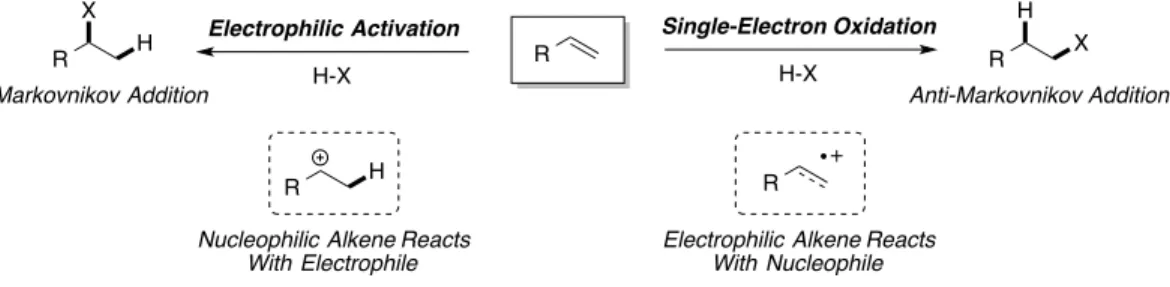
anti-Markovnikov addition (Fig. 2.1).
Alkene cation-radicals are, in their essence, alkenes with a single electron removed. This highly
reactive species, as a result, possesses elements of both radical and cationic character, with the spin and
charge elements shared between the atoms comprising the π-system: be it the two carbon centers
comprising an isolated alkene, or distributed over a larger molecule with extended conjugation (Fig. 2.2).
The element of charge renders the alkene cation-radical electrophilic, and susceptible to attack by an
exogenous or tethered nucleophile1. The relevant literature in this field suggested to us that nucleophilic
addition to alkene cation-radicals would proceed with high levels of selectivity for anti-Markovnikov
products.
2.2. Anti-Markovnikov Heterofunctionalization: a Computational Analysis
!
Though experimental evidence for the anti-Markovnikov regioselectivity of cation-radical
Figure 2.1. Comparison of Intermediates and Selectivities of Reactive Intermediates Proceeding to Produce Heterofunctionalized Products
!
Figure 2.2. Resonance Depiction of a Generic Alkene Cation-Radical
!
course, computational justification for anti-Markovnikov selectivity of additions of nucleophiles to alkene
cation-radicals was laid out in 1996 by Arnold and coworkers2 (Fig. 2.3). In this study, the authors considered the nucleophilic addition of methanol to a set of alkenes, but for clarity only the addition of
methanol to 2-methyl-2-butene (B1) will be illustrated here. Calculations revealed that, prior to addition,
a methanol nucleophile complexed to the alkene cation-radical (B2), suggesting the formation of a
three-membered, bridged intermediate (3). This species was found to collapse to either of two distonic
cation-radical intermediates (B4a, B4b) in a process estimated (though not confirmed) to be reversible, and was
followed by deprotonation of the intermediate by a second equivalent of methanol to form substituted
radical species (B5a, B5b). Regardless of the rate-limiting step, the relative stabilities of the ensuing
intermediates were believed to govern the selectivity of methanol addition, with a preference of 1.2
kcal/mol for distonic cation-radical B4b, and 1.5 kcal/mol for the deprotonated radical B5b, both the
result of the anti-Markovnikov addition manifold.
!
!
!
!
R Electrophilic Activation
H-X
Single-Electron Oxidation H-X
R H
X
R X
H
R H
Markovnikov Addition Anti-Markovnikov Addition
R
Nucleophilic Alkene Reacts With Electrophile
Electrophilic Alkene Reacts With Nucleophile
R
[-e-]
R = R
+
Figure 2.3. Computational Results for Addition of Methanol to 2-Methyl-2-Butene Cation-Radical
!
2.3. Anti-Markovnikov Heterofunctionalization: Electrochemical Approaches
!
Anti-Markovnikov selectivity for nucleophile addition to alkene cation-radicals is also
well-precedented experimentally2. The most intuitive examples of methods designed to take advantage of the
reactivity pattern of nucleophiles with alkene cation-radicals arose from the laboratory of Moeller and
coworkers (Fig. 2.4). In their work, electrochemical oxidation was used to generate alkene
cation-radicals (B7) from olefinic substrates with tethered nucleophiles (B6)3,4. Cyclization by the appended
nucleophiles was found to proceed with anti-Markovnikov selectivity (B8). However, the strongly
oxidizing conditions employed in these methods also affected a secondary oxidation event, and the
substituted radical intermediate in all cases proceeded to form a carbocation (B9). This intermediate then
recombined with a molecule of exogenous methanol to form product (B10). Despite the dioxygenation
observed, the demonstrated regioselectivity indicated that the desired anti-Markovnikov regioselectivity
could be obtained in the crucial addition step. It was also clear from this example that electrochemical
methods for cation-radical generation would not be appropriate for the net redox-neutral alkene
heterofunctionalization that we were hoping to affect. For the interested reader, an insightful and detailed
mechanistic study of this transformation is available5.
Me
Me Me
[-e-] Me
Me Me
+ 2 MeOH
Me Me Me MeO H Me Me Me OMe H +MeOH +MeOH Distonic Cation-Radicals Me Me Me MeO Me Me Me OMe + MeOH2
+ MeOH2 Substituted Cation-Radicals
Favored by 1.5 kcal/mol Favored by 1.2
Figure 2.4. Regioselective Difunctionalization of Alkenols by Anodic Oxidation
!
2.4. Anti-Markovnikov Heterofunctionalization: Photoredox Approaches
!
Given the tendency of electrochemical approaches to affect multi-electron oxidations of organic
molecules, a more controlled method for alkene cation-radical generation is necessary to prevent
over-oxidation of the generated cation-radical intermediates. The solution to this problem, in practice, has
been the use of single-electron oxidants to generate alkene cation-radicals. While there are some
examples of reactions proceeding through alkene cation-radicals that are generated by ground-state
chemical oxidants, these oxidants are not strong enough to accept an electron from the majority of
un-activated alkenes6.
As a result, the majority of successful transformations proceeding through alkene cation-radical
intermediates have exploited a phenomenon known as photoinduced electron transfer (PET) to generate
the reactive species (Fig. 2.5) 7–10. In this process, a photon promotes a single electron from the HOMO to the LUMO of a molecule. This leaves an electron hole in the lower-energy of the two SOMOs formed
by excitation. If the SOMO is low enough in energy, an electron can be transferred from the donor to the
acceptor, forming a radical-ion pair (assuming that the interacting species are both neutral prior to
transfer). The thermodynamics of PET processes can calculated from the equation for the Gibbs energy
of photoinduced electron transfer (Eq. 1)11, though in most cases a simplified relation (Eq. 2) is useful for predicting electron transfer electron transfer between an excited acceptor and a donor. Boiled down to its
essence, Eq. 2 simply states that electron transfer is exergonic if the oxidation potential of the donor is
R OH MeO n RVC anode Pt cathode 30% MeOH / THF
0.03 M Et4NOTs 2,6-Lutidine, 2F/mol R O MeO n OMe R OH MeO n
[-e-] R
OH MeO n R O MeO n
-H+ [-e-] R
O MeO n + MeOH -H+ R O MeO n OMe R = H, Me, Bn
n = 1, 2, 3
B6 B7 B8 B9 B10
lower than the sum of the reduction potential of the acceptor plus the excited state energy (E0,0), a value
calculated from the intersection of absorption and emission spectra of the photo-oxidant. For reference, a
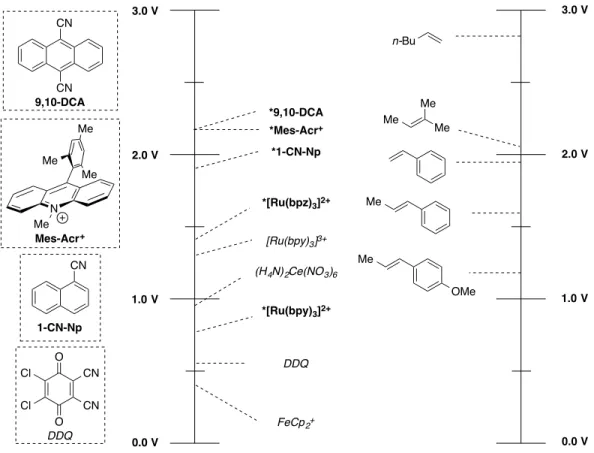
scale showing the reduction potentials of common ground-state (italics) and excited state (bold) oxidants
is show in Fig. 2.4., with the oxidation potentials of some common organic molecules shown in parallel to put the strengths of these oxidants in perspective.
Figure 2.5. Frontier Molecular Orbital Depiction of Photoinduced Electron Transfer
!
Equation 1. Equation for Gibbs Free Energy of Photoinduced Electron Transfer ∆!!=!!
! ! !! !!∙ ! −!!! ! !!⋅ +!!! !!∙!!⋅ −!! !" −!!!,!
Equation 2. Simplified Inequality for Prediction of Spontaneous Electron Transfer Electron transfer is exergonic if:
!!"#∗ ! !!⋅ >!!
!"! !!∙ ! ! LUMO
HOMO
HOMO
Acceptor Donor
hν
SOMO
SOMO
HOMO
Acceptor* Donor
SOMO
MO
SOMO
Acceptor Donor
Decay
Ground State Excited State
Radical-Ion Pair
Electron Transfer Back-Electron
Figure 2.6. Reduction Potentials of a Variety of Oxidants and Photo-oxidants, and Oxidation Potentials of Some Representative Alkenes (vs. SCE)
While seminal work on the addition of polar solvents to particular, privileged alkene
cation-radicals generated by PET had carried out over a decade prior 12,13, a pair of vital works on the use of PET
to affect nucleophilic addition to unactivated alkene cation-radicals were published in 1987 by the
Gassman lab. The first involved the addition of water, methanol, and acetic acid to 1-methylcyclohexene,
promoted by the combination of an appropriate photo-oxidant (1-cyanonaphthalene) and biphenyl, which
was hypothesized to act as a co-oxidant or electron relay14. Importantly, irradiation with ultraviolet light
was necessary for productive reactions to occur. In the second work, Gassman also disclosed a
photoinduced lactonization reaction, wherein an alkenoic acid was demonstrated to cyclize to a lactone
with anti-Markovnikov selectivity15. In all cases demonstrated, 1-cyanonaphthalene was employed in a
super-stoichiometric amount in comparison to product generated, and yields of all products were
generally low. However, the regioselectivity obtained from these reactions serves as a vital benchmark
for heterofunctionalization via the cation-radical (Fig. 2.7). 3.0 V 2.0 V 1.0 V 0.0 V 3.0 V 2.0 V 1.0 V 0.0 V Me Me Me Me OMe Me O O Cl Cl CN CN
FeCp2+ *[Ru(bpy)3]2+ (H4N)2Ce(NO3)6
Figure 2.7. Additions to Alkene Cation-Radicals Affected by 1-Cyanonaphthalene and Irradiation
!
Further work in this vein has been also been carried out by Yamashita in the context of
hydroamination of olefins via a PET mechanism16. In addition to the novelty of the studied
transformation, this work included thorough study of the byproducts of reactions, and it was found that a
frequent byproduct of these reactions was derived from oxidant incorporation into the final products.
This type of reactivity pattern was later termed the “photo-NOCAS” (Photochemical Nucleophile-Olefin
Combination, Aromatic Substitution) reaction by Arnold and coworkers, and its associated reactivity
pattern has been well studied2,17,18 (Fig. 2.8). While an interesting reaction in its own right, the arylation
side-reaction serves to complicate the use of cyanoarene-derived photo-oxidants as catalysts for
heterofunctionalization reactions.
!
!
!
!
!
!
!
!
Me Me OH 50 mol % 1-CN50 mol % Biphenyl 300-400 nm, 70:30 MeCN:H2O
37 % Yield d.r. = 1.4:1
Me Me
OMe 50 mol % 1-CN
50 mol % Biphenyl 300-400 nm, 60:40 MeCN:MeOH
42 % Yield d.r. = 1:1
Me Me
OAc 50 mol % 1-CN
50 mol % Biphenyl 300-400 nm, 60:40 MeCN:AcOH
36 % Yield d.r. = 1.6:1
Me Me
O HO
50 mol % 1-CN 50 mol % Biphenyl 300-400 nm, 45:55 MeCN:H2O
Me O O + Me O O 42% Yield 5% Yield
Me
CN
Figure 2.8. Example of Photo-NOCAS Type Reactivity
!
Other work on nucleophilic additions to olefins by a photon-induced process has been carried out
by Mizuno and coworkers. In an initial publication, the authors were able to demonstrate the efficient
cyclization of alkenols derived from chain extension of 1,1-diphenylethylene19 (Fig. 2.8). This work has
been extended to include an enantioselective example from Inoue and coworkers, utilizing a chiral
photosensitizer in concert with ultraviolet light to promote the transformation, but again the alkenes
employed were restricted to 1,1-diphenylethylene derivatives20. The authors postulated that the reactivity
observed is the result of a polarized exciplex, rather than the formation of discrete, solvent-separated
cation-radicals (Fig. 2.9). Up to the point of our contributions, these transformations were the only
known processes that employed catalytic amounts of a photosensitizer to promote heterofunctionalization
reactions of olefins.
Figure 2.9. Mizuno’s Hydroetherification of Alkenols.
!
Me Me
Me
+ UV-Light Me
Me Me + CN CN MeOH OMe -H+ Me Me OMe Me + CN CN CN CN - CN Me Me OMe Me CN + HCN CN CN Ph Ph HO R n
5 mol % 9,10-DCA
λ < 400 nm Benzene Ph Ph O R n Ph Ph R HO δ+ DCA
δ- CN
This body of work demonstrated two things to us. First, there was precedent for the
heterofunctionalization of olefins with a few different nucleophiles to unactivated alkenes, and
extraordinary levels of regioselectivity favoring the anti-Markovnikov adduct could be achieved.
However, it was also clear that these processes were either a) inefficient with respect the amounts of
photo-oxidant that had to be employed, as well as the nature of the excitation that was required for
reactions to occur, or b) restricted in terms of the demonstrated alkene scope. As such, we elected to
further explore this reactivity pattern, to see if we could take an intriguing but restricted reactivity pattern
out of the realm of obscurity, and develop a more synthetically applicable catalytic system for the
anti-Markovnikov heterofunctionalization of olefins.
2.5. Attempted Hydroetherification of a Model Substrate Utilizing Prior Art
!
We elected to begin our studies on the development of such a platform with the
hydroetherification of alkenols, as at the outset of our study, the only precedent that existed for this
transformation were the aforementioned chemistry developed by Groves21, and the specialized
hydroetherification chemistry developed by Mizuno19. We chose to start by optimizing this
transformation on alkenol B11 as our model substrate for several reasons. First was the fact that this
substrate was found to possess a relatively high oxidation potential. At 1.95 V (MeCN, vs. SCE), we felt
that the substrate was indicative of a typical, unactivated alkene that we could potentially target for
cyclization. Secondly, the asymmetric substitution pattern of the alkene allows for unambiguous
determination of the Markovnikov and anti-Markovnikov products, and the relative lack of strain in the
developing rings (5 vs. 6) would give us a good probe for the regioselectivity of the reaction, without
developing ring strain having a large effect on the consequent selectivity of the reaction.
Subjecting the alkenol substrate to both Gassman’s conditions (0.5 equiv. 9-cyanonaphthalene,
0.5 equiv. biphenyl, MeCN as solvent, UV-irradiation) and Mizuno’s conditions (0.2 equiv.
mass balances and only small amounts of product tetrahydrofuran B12 in crude reaction mixtures. Thus,
we felt that we had identified a transformation with ample space for improvement and optimization.
Figure 2.9. Cyclization of a Generic Alkenol Substrate Upon Exposure to Cyanoarene Photooxidant Conditions
Our initial hypothesis was that this transformation was not limited by the oxidation of substrate,
but rather by the photo-oxidants employed. That some conversion occurred was likely indicative of
electron transfer leading to the desired, highly reactive cation-radical intermediates. The low yields
observed were consistent with the low yields obtained in Gassman’s original reactions, and we had
correctly anticipated that Mizuno’s conditions would not give rise to productive reactions given the lack
of a 1,1-diphenylethylene unit for formation of the requisite exciplex.
2.6. Consideration of Organic Photo-oxidants
!
Our proposed remedy to the poor yields and the high oxidant loadings required for conversion
was to approach the problem through the deployment of alternative photo-oxidants. Given the
development of a vast array of reactions driven by electron transfer, and the associated development of a
multitude of photo-oxidants, this seemed to us to be a viable strategy. In examining the literature for
potential photo-oxidants to deploy for a catalytic, cation-radical mediated hydroetherification of alkenols,
one stood out to us as a potentially applicable catalyst: 9-mesityl,10-methylacridinium perchlorate22.
Pioneered by Fukuzumi, et al., the initial disclosure of this compound focused primarily on its posited
long-lived (indefinite at cryogenic temperatures) and high-energy charge-transfer state, resulting from
Me Me
HO Ph
Ph 5 mol % 9,10-DCA
λ < 400 nm Benzene 96 h Me Me O Ph Ph Me Me HO Ph Ph Me Me O Ph Ph 50 mol % 1-CN
50 mol % Biphenyl
λ < 400 nm MeCN
96 h
5% Yield, 21% Conversion
15% Yield, 47% Conversion
intramolecular charge transfer from the mesityl moiety at the 9-position of the acridinium ring, to the excited acridinium chromophore23 (Fig. 2.11). This was in contrast to most organic photo-oxidants,
which tend to have lifetimes reported to be on the order of nanoseconds24. Fukuzumi’s hypothesis for the existence of this state was that the methyl groups projected over the acridinium ring served to hold the mesityl group rigidly perpendicular to the acridinium ring, enabling charge transfer and separation but essentially prohibiting back electron transfer from the acridine radical back to the mesityl cation-radical. The existence of such a long-lived state, however, has been a contentious issue in the literature, and has been the subject of a vigorous and still ongoing debate25–31. In addition to the interesting photophysics of
this molecule, Fukuzumi importantly demonstrated the electrochemical reversibility of single-electron transfer to the acridinium moiety, indicating that the ensuing radical was persistent, and by extention we postulated that the acridinium photocatalysts were more likely than the cyanoarene photo-oxidants to remain intact as a catalytic intermediate.
Figure 2.11. Oxidizing States of 9-Mesityl,10-Methyl Acridinium Ion And Exhibited Redox Reversibility N Me Me Me Me
λ = 430 nm
N Me Me Me Me Decay
*
Locally Excited Singlet E*1/2red = +2.15 V
N Me
Me Me Me
Charge Transfer State E1/2red = +2.05 V Decay? Unresolved Debate N Me Me Me Me Reduced State (Acridine Radical)
E1/2ox = -0.52 V Oxidation (By Acceptor)
Ground State E1/2red = -0.52 V
Electrochemical Redox Reversibility
Exhibited
- e
-+ e
-CT + e
Acridinium-based photocatalysts had also been demonstrated to be robust catalysts in synthesis
before we employed it in our chemistry. Fukuzumi and coworkers have disclosed a number of
transformations utilizing this species, primarily employing it for its unique ability to affect oxidation of
organic molecules and inorganic ions, and the ensuing acridine radical’s ability to reduce oxygen to form
superoxide radical-anion intermediates or hydrogen peroxide as an end product32–37. Besides this motif’s
ability to act as both a strong oxidant in the excited state, and as a moderate reductant as the ground state
conjugate radical, the acridinium photocatalyst also possessed a number of other properties that we felt
would be advantageous to the system we were seeking to develop. The cationic nature of the
photo-oxidant would render the reduced species to be a neutral radical, minimizing coulombic attraction
between the acridine radical and the cation-radical of the alkenol substrate. In turn, this would enable a
more efficient formation of solvent-separated ion pairs and reduce effects of back-electron transfer.
Additionally, the photocatalyst has as strong absorbance band in the visible light region (λ = 430 nm).
Given that a number of companies have developed convenient PAR38 LED bulbs that screw into simple
light sockets that emit photons at wavelengths centered between 450-465 nm, the synthetic setup we
would be able to employ would be far more simple than the high-pressure mercury lamps or ultraviolet
lightboxes required for reactions with UV-active photo-oxidants.
Focusing on how we anticipated that this reaction could proceed in a catalytic fashion, the reader
is directed to Fig. 2.12. Irradiation of the mesityl-acridinium photooxidant with blue light would generate
the singlet excited state of the photo-oxidant, which could then act directly as a photooxidant for alkenol
B11, or proceed to carry out oxidation through the ensuing charge-transfer state. Intramolecular
nucleophilic addition of the pendant alcohol to the oxidized alkene (B13) would first produce the bridged
intermediate (B14) first posited by Arnold, and then collapse to form either of two distonic cation-radicals
in equilibration with one-another (B15, B16). We then proposed that the more energetically favorable
tertiary radical species (B15) could be reduced by the acridine radical, and proton-transfer from the
protonated oxygen center to the newly formed carbanion would furnish product (B12) selectively, with
Figure 2.12. Hypothetical Mechanism for Anti-Markovnikov Heterofunctionalization of Alkenes with Mesityl Acridinium Ion as a Photocatalyst
2.7. Initial Results – Alkenol Cyclization Utilizing 9-Mesityl,10-Methylacridinium Perchlorate as Photocatalyst
With this proposed mechanism in mind, we exposed alkenol B11 to irradiation with blue light,
using 5 mol % 9-mesityl,10-methyl acridinium perchlorate (5 mol %) as the photocatalyst. Care was
taken to rigorously degas the solution to prevent oxygen from interfering with the reaction, which could
occur by oxidizing the acridinium photocatalyst (thus preventing reduction of the intermediate radicals),
or by trapping intermediate radicals as peroxides. Additionally, the reaction was irradiated for an
extended period (96 hours) to allow for maximal conversion in a reasonable period of time. The results
obtained from this initial trial were promising (Fig. 2.13). The desired product of anti-Markovnikov
hydroetherification (B12) was observed, and notably we did not observe the product of Markovnikov
weight byproducts, likely as a result of oligomerization. Additionally, we observed the evolution of an
interesting major reaction byproduct (B18).
Figure 2.13. Anti-Markovnikov Hydrofunctionalization of Alkenol B11 Under Irradiation in the Presence of 9-Mesityl,10-Methylacridinium Perchlorate
2.8. Reaction Byproduct Analysis
!
Careful analysis of characterization data for the isolated byproduct led to the assignment of this
byproduct as polycyclic ether B18 (Fig. 2.13), and this assignment was supported by several lines of
evidence (Fig. 2.14). First, the mass spectrum obtained of the material indicated a molecular weight of
264 Da, indicative of a product that had been oxidized by two electrons and two protons. The 1H NMR
spectrum of the isolated material indicated significant upfield shifting of some of the aromatic resonances
from one of the phenyl groups in the backbone, and the methyl groups on the substrate were observed as
singlet resonances. Additionally, the diastereotopic protons observed suggested that the desired ring had,
in fact, been formed. This led us to believe that a bond had formed between the tertiary carbon radical
intermediate and one of the aryl groups. This hypothesis was confirmed by a 1H-13C HMBC crosspeak
between the two singlet methyl groups and carbons belonging to one of the aromatic rings. Finally, a 1
H-1H NOESY experiment produced a spectrum demonstrating several through-space interactions, most
distinctively between the signals corresponding to the methyl groups (importantly, presenting as singlets)
and a single aryl proton, as well as only one methyl group showing a cross-peak with a proton resonance
posited to be on the bridging methylene unit. Computational optimization of the molecular geometry of Me
Me
Ph Ph
HO
5 mol % Mes-Acr-ClO4 450 nm
DCE, 0.5 M 96 hr Me Me O Ph Ph
36% Yield, 83% Conversion