CONDUCTING A PRE-IMPLEMENTATION ASSESSMENT OF MATERNAL INFANT EARLY CHILDHOOD HOME VISITING SERVICES FOR ORANGE
COUNTY, NORTH CAROLINA
Robyn J. Wood
A project submitted to the faculty at the University of North Carolina at Chapel Hill in partial fulfillment of the requirements for the degree of Doctor of Nursing Practice in the
School of Nursing.
Chapel Hill 2017
ABSTRACT
Robyn J. Wood: Conducting a Pre-Implementation Assessment of MIECHV Services for Orange County
(Under the direction of Shawn Kneipp)
TABLE OF CONTENTS
LIST OF TABLES ... iv
CHAPTER 1: CONDUCTING A PRE-IMPLEMENTATION ASSESSMENT OF MIECHV SERVICES FOR ORANGE COUNTY ...1
Background and Significance: Risk Factors for Children in Poverty ...2
Maternal Infant Early Childhood Home Visiting ...3
DNP Project Purpose ...3
Clinical Questions ...4
The Role of the DNP Student in a Pre-Implementation Assessment...4
Conceptual and Theoretical Framework ...6
Diffusion of Innovation Theory ...6
Community Engagement ...8
Review of Literature: Level of Evidence for Intervention Options ...10
NFP Evidence ...10
HFA Evidence ...14
CHAPTER 2: METHODOLOGY ...21
Phase I: Establishing the Need for MIECHV Programming and Searching for Evidence ...21
Design ...21
Archival Review ...21
Phase II: Development of the Pre-implementation Assessment ...25
Step 1: Development of the Technical Report ...25
Introduction ...25
Project Purpose ...25
Maternal Infant Early Childhood Home Visiting ...25
Program Under Consideration for Adoption...26
Demographics and Current Programming ...26
Comparison of Outcomes ...26
Considerations for Implementation...27
Funding ...28
Implementation Lessons for the Field...29
Theme One NFP ...29
Theme Two NFP ...29
Theme Three NFP ...29
Theme Four HFA ...29
Theme Five HFA ...29
Similar Challenges ...30
Step 2: Development of Brief Informational View...30
Phase III: Dissemination ...31
CHAPTER 3: DISCUSSION ...32
Feedback ...32
Conclusion ...35
APPENDIX 1: PRE-IMPLEMENTATION ASSESSMENT ...37
APPENDIX 2: VIDEO LINKS ...81
LIST OF TABLES
LIST OF ABBREVIATIONS AFDC Aid to Families With Dependent Children CCNC Community Care North Carolina
CC4C Care Coordination for Children CPS Child Protective Services DOI Diffusion of Innovations FSA Family Success Alliance HCZ Harlem Children’s Zone HFNY Healthy Families New York
HomVee Home Visiting Evidence of Effectiveness LBW Low Birth Weight
MIECHV Maternal Infant Early Childhood Home Visiting OCHD Orange County Health Department
CHAPTER 1: CONDUCTING A PRE-IMPLEMENTATION ASSESSEMENT OF MIECHV SERVICES FOR ORANGE COUNTY
may prove an integral part of the pipeline for Orange County’s most vulnerable mothers and their children.
Background and Significance: Risk Factors for Children in Poverty
Children living in poverty are at risk for reduced cognitive, social, emotional and physical health into adulthood. These negative outcomes come at a great cost to both the individual and society. Poor children are at risk for diminished cognitive development (Hair et al., 2015) and depth of poverty is inversely related to IQ scores (Yoshikawa, Aber & Beardslee, 2012). Poverty exposure in early childhood has been shown to have a greater impact on cognitive development than when poverty exposure begins in later childhood or adolescence (Anderson et al., 2014, Costello et al., 2010). Impoverished children are more likely to have poor self-regulatory skills, more impulsive behavior, and decreased coping and resilience compared with children from more affluent homes (Evans & Kim, 2013; Mazza et al, 2017). The behavioral impacts of childhood poverty may continue into adulthood, and are associated with diminished employment status, higher rates of incarceration, and increased addictive and violent behavior (Nikulina, Widom, & Czaja, 2011; Sharkey et al., 2012).
The long-term societal cost of childhood poverty is staggering. The economic and educational cost of childhood poverty is estimated at $500 billion annually
(Educational Testing Services, 2013). Given the long-term social and economic impact of childhood poverty, The Orange County Health Department has chosen to take aggressive action in creating a multifaceted anti-poverty initiative.
Maternal Infant Early Childhood Home Visiting
The Maternal, Infant, and Early Childhood Home Visiting (MIECHV) Program
was established in 2010 when the Affordable Care Act was signed into law (USDH,
2014). This program provided $1.5 billion to states over five years for home visiting
models that serve at-risk pregnant women and their children from birth to age five
(USDH, 2014). The act stipulated that at least 75% of the distributed funds were to be
spent on programs that meet vigorous standards for research and are deemed to be
evidence-based (USDH, 2014). Over the last seven years, the MIECHV program has
grown with bipartisan support. Currently, there is a proposal to increase MIECHV federal
funding from $400 million to $800 million per year as part of the DocFix legislation. In
the most recent review, the Home Visiting Evidence of Effectiveness (HomVee) analysis
has identified nineteen MIECHV program models that meet vigorous standards for
evidence.
DNP Project Purpose
considering factors at the local level that may support or hinder successful
implementation of these programs, the FSA will be prepared to present the Nurse Family Partnership and Healthy Families America to their community partners for consideration as part of a county wide effort to mitigate the devastating effects of childhood
poverty. These two specific programs were chosen for evaluation in collaboration with representatives from the Orange County Department of Health because of their alignment with the mission of the FSA, feasibility of possible implementation in Orange County, and their relative depth and breadth of demonstrated positive impacts. In addition, NFP and HFA are two of only six (out of nineteen) models that have been able to replicate favorable effects in the same domain across two or more samples (USDH, 2016). Clinical Questions
What are the potential facilitators and challenges to adopting Healthy Families America or the Nurse Family Partnership as an adjunct to current home visiting services in Orange County North Carolina? How do the outcomes of these programs fit with the goals of the Family Success Alliance? What are the key implementation characteristics of these two programs, and how do they align with the geographic, personnel, and
demographic factors in Orange County that must be considered prior to program adoption?
The Role of the DNP student in a Pre-Implementation Assessment
to implement evidence-based practice in a variety of settings. Implementation science refers to the “study of factors that influence the full and effective use of innovations in practice” (NIRN, 2015). The pre-implementation assessment provided to the OCHD is based on the highest quality available evidence. In the DNP Essentials, the American Association of Colleges of Nursing states that DNP programs should focus heavily on “practice that is innovative and evidence-based, reflecting the application of research findings” (p.3). Evidence-based practice refers to “the integration of the best research evidence, clinical research and patient values in making decisions about the care of individual patients” (IOM, 2003). The American Association of Colleges of Nursing (AACN) encourages DNP training programs to “consider a broad range of academic-practice partnerships, eg: with school systems, prisons, public health departments…that allow DNP students to engage in the full planning, implementation and evaluation of a project that impacts healthcare outcomes” (p. 10).
In their pivotal publication The Future of Public Health the Institute of Medicine (1988) states that public health decisions are often “driven by crises, panic and the concerns of interest groups” (p.4). Instead, public health departments are encouraged to adopt evidence-based approaches in order to meet objectives (Brownson et al., 2010). The implementation of evidence-based public health (EBPH) has been shown to result in improved access to higher quality information about what is effective, increased
In keeping with the AACN recommendations for interagency cooperation, this pre-implementation assessment represents a partnership between the DNP student, university faculty, OCHD personnel and the community at large as represented by the Family Success Alliance. By utilizing the expertise of the DNP student to analyze and synthesize the best available evidence, potential program adopters can avoid the pitfalls of being “driven by crises” and instead choose programming with rigorously tested and replicated positive impacts, and which offers the community the greatest likelihood of a positive return on investment.
Conceptual and Theoretical Framework
Though NFP and HFA are each grounded in theory, it is important to note that for the purpose of this project, the theoretical focus is not based on the theories supporting the interventions themselves, but rather on theories that help to explain the ways in which innovations are adopted and rejected, and the manner in which communities and
stakeholders are involved in decision making and program planning. Given the focus of this project is on adoption and implementation considerations that will involve multiple community stakeholders, the assessment provided here relies on the tenets of the Diffusion of Innovation theory (Rogers, 2003), as well as the concept of community engagement to frame the discussion of MIECHV services in Orange County.
Diffusion of Innovation (DOI) Theory. The Diffusion of Innovation (DOI)
an innovative idea or product. The key elements in Diffusion of Innovation theory include the innovation itself, adopters, communication channels, time, and social system (Rogers, 2003). The rate at which an innovation spreads is dependent on the specific characteristics of each of these elements (Rogers, 2003). Though it was originally designed to explain the diffusion of agricultural innovations, this theory has been widely adopted across many disciplines and is well known in public health practice. Given that the task of this project is to provide information for the adoption of an evidence-based program in a novel setting, the Diffusion of Innovation Theory provides a useful framework for conceptualizing the necessary steps to facilitate program adoption and implementation.
For the purpose of this project, the innovation is the Nurse Family Partnership or
Healthy Families America home visiting program. Rogers defines an innovation as an
“idea, practice or object that is perceived as new by an individual or other unit of
adoption” (Rogers, 2003). The actual newness of the idea is irrelevant, but if the
adopting individual or institution perceives an idea as new it is considered an innovation.
Though both NFP and HFA have been in existence for decades, both are innovations in
the context of the Orange County Health Department. The DOI describes the attributes of
innovations including relative advantage, compatibility, complexity, trialability, and
observability (Rogers, 2003). These attributes provide a practical means to make the case
for a given program’s adoption.
the innovations are the Healthy Families America or Nurse Family Partnership programs. By partnering with a doctoral student to create this report, a communication channel was established to allow the transfer of information from one unit to the other, specifically from the student to the organization. The pre-implementation assessment provides
information to the FSA, Health Department and other interested parties about the relative advantage (in terms of return on investment and outcomes), compatibility (in terms of the goals of the FSA, and fit within the context of the community), complexity (of the
interventions themselves, fidelity standards and funding challenges), trialability, and observability (in terms of other agencies’ experiences).
Community Engagement
An additional theoretical perspective that must be considered in developing this
pre-implementation assessment is that of community engagement. Community
engagement is the integration of values, strategies, and actions that support meaningful
partnerships (Minkler & Wallerstein, 2003). These partnerships should ideally include
mutual respect, shared power, active participation, equity, mutual benefits, and flexibility
both in goal setting and choosing methods that fit community needs (Moini &
Fackler-Lowrie, 2005; Minkler&Wallerstein, 2011).
Research demonstrates that a population can achieve long term improvements in
health when people are involved in their communities, and that community engagement
has the potential to decrease health disparities (O’Mara-Eves et al., 2013). The concept of
community engagement stresses the importance of involving a community in
health-related decision making and increasing community participation in health promotion,
engagement is at the heart of the work undertaken by the Family Success Alliance. In
creating the Family Success Alliance, the Orange County Health Department is
demonstrating their commitment to community participation and engagement by using
input from community stakeholders to plan programs based on the needs and priorities of
Orange County.
After identifying six zones with a high relative percentage of children living in
poverty, the FSA targeted neighborhoods and housing complexes with higher poverty
levels and conducted a survey that touched on a variety of subjects, including what
community and school resources were most useful and what residents felt was lacking in
their area, along with demographic and language data. The FSA reached out to each
community to identify zone champions. These champions were often affiliated with
schools in the respective zones, in roles such as teachers, school social workers or
administrators, and were invited to make the case for their zone to be the pilot site for
FSA work. Community listening sessions were conducted to discuss potential
programming for the zones, as well as establish overall goals for the FSA. Community
partners were established. These partners are organizations within Orange County that are
working to connect families to existing programs and resources. Zone navigators were
hired in each of the pilot zones. Zone navigators are paid positions, wherein the
navigators serve as a link between the FSA and families. Navigators attend FSA
meetings, and also assist in connecting families to necessary resources. Finally, an
advisory council has been established. This is a group of community leaders including
members of local governmental agencies, non-profits, elected officials and zone
Review of Literature: Level of Evidence for Intervention Options
NFP Evidence. The HomVee analysis awarded 19 studies of nurse home visitors
a high rating. A brief discussion of those highly rated studies is included below, along with additional cost related research not include in HomVee.
The Nurse Family Partnership has demonstrated positive outcomes in three rigorously designed randomized controlled trials. The Elmira study was set in rural New York, 400 women were enrolled 89% of whom were white. Nurse-visited mothers had higher rates of smoking cessation, improved maternal diet, decrease in pregnancy
induced hypertension, more attempts at breastfeeding, improved parent/child interaction, fewer child healthcare encounters for injury or ingestion, fewer subsequent pregnancies and live births for the mother, fewer closely spaced pregnancies, fewer months using food stamps and welfare, and higher rates of living with the father of the child (Olds, Henderson, Chamberlin & Tatelbaum 1986; Olds et al., 1988; Olds et al.,1994; Olds et al.,1998). There were also positive effects on low birth weight and pre-term deliveries in teens and smokers (Olds et al., 1986), and mothers enrolled in NFP had an 82% increase in the number of months worked by the 46th month post delivery (Olds et al., 1988). Many of these findings were sustained in the two years after the program ended, specifically decreased accidents and ingestions, fewer ED visits, improved parental coping per physician records, and homes had fewer hazards (Olds et al., 1994).
(Olds et al., 1998). Women enrolled in NFP were less likely to be found to be the perpetrators of child abuse as measured by verified CPS reports (Olds et al., 1997), and were less likely to have been arrested in a review of New York State records (Olds et al., 1997). Zielinski, Eckenrode and Olds (2009) also found that at 15 years
post-intervention, the group differences in state verified abuse and neglect were greater that at earlier measurements (.29 verified CPS reports in intervention group vs .54 in
comparison group, p< .001). These differences were the greatest among highest risk families. In addition, they looked at the timing of maltreatment as measured by the first CPS report and found that 68% of the index children in the comparison group made it to age 15 years without a reported incident of abuse compared with 76% of nurse visited children (Zielinski, Eckenrode & Olds, 2009). These findings suggest that early home visiting may have a profound effect in parenting practices later on.
There were also positive impacts in increasing child spacing and fewer lifetime pregnancies for mothers who were enrolled in NFP for their first pregnancy (Olds et al., 1997). In a 19 year follow up (Eckenrode, 2010), daughters of nurse visited mothers were less likely to have entered the criminal justice system, and those born to higher risk (unmarried, low-income) mothers utilized less Medicaid and had fewer children at age 19.
cohort, with decreased child maltreatment, greater spacing between births, fewer
pregnancies, decreased use of AFDC, and decreased use of food stamps (Kitzman et al., 2000; Kitzman et al., 2010; Holmberg; Olds et al., 2004, Olds et al., 2002). In addition there were decreased incidents of pregnancy-induced hypertension, and fewer pediatric ED visits for injuries and ingestions (Kitzman et al., 1997). In a 12 year follow up, NFP mothers reported less substance use for themselves and their children, academic
achievement was improved for children born to mothers with low psychological resources, and there were fewer reports of internalizing mental health problems for children born to mothers with low psychological resources (Kitzman et al, 2010; Olds et al., 2010).
The Denver study (n=735) was designed to determine whether lay professionals trained to deliver NFP methods would achieve the same positive outcomes as nurse home visitors (Olds et al., 2002; Olds et al., 2007). The study subjects were 47% Latina, 35% non-Hispanic white, 15% African American and 3% American Indian or Asian. In that study, there was a group of women randomized to a control, a nurse visited group, and a group visited by trained laypersons. Although nurse visitors’ outcomes supported earlier findings, home visiting by the trained laypersons was not found to improve outcomes, except in cases where the mother had low psychological resources (Olds et al., 2002; Olds, Robinson et al., 2004; Olds et al., 2007; Holmberg et al, 2011, Olds et al., 2014). These findings provide the evidence driving the NFP requirement that the program be delivered by registered nurses with at least a bachelor’s degree.
Appendix B) in seven of eight domains assessed. Healthy Families America (HFA) was the only program found to have statistically significant positive impacts in all eight domains (Assessment Appendix C) when considering both primary and secondary outcome measures (USDH, 2014). Both new randomized controlled trials and
longitudinal analyses of earlier NFP cohorts continue to support the positive impact this program has for families even years after program participation (Eckenrode, 2010; Kitzman et al., 2010; Olds et al., 2004; Olds, 2013).
Multiple independent agencies have conducted evaluations and found NFP to be a financially sound investment. The RAND Corporation (Karoly et al., 2005), The
Washington State Institute for Public Policy (Aos et al., 2004), and the Brookings Institute (Isaacs, 2008) have endorsed NFP as a cost-effective intervention. The US Department of Health conducted the HomVEE analysis to compare the relative
effectiveness and cost effectiveness of home visiting programs and found NFP to be cost effective (USDH, 2014). The Washington State Institute for Public Policy has estimated the cost savings gained from the NFP program to be between $1.61 to $5.80 per dollar spent.
intangible outcomes can be controversial as it forces the researcher to assign dollar amounts to somewhat subjective questions. Consider for example, how much “preventing language delay” is worth. Those wishing to focus on only tangible measures can instead use the “total government savings” metrics (Assessment Table 11) as outlined by Miller, wherein he used more conventional methods of monetizing outcomes.
Some key findings in Miller’s analysis which represent an immediate return on investment include a 60% decrease in infant mortality, a 31% reduction in second birth 2 years post-partum, an 18% reduction in pre-term births for the index child and a 37.7% decrease in subsequent pre-term births (Miller, 2013). In addition, Miller found a 23% increase in full immunization for children ages 0-2, helping to diminish later barriers to school entry. Longer-term outcomes such as decreased Medicaid costs through age 18, and decreased reliance on TANF and food stamps through 10 years post-partum demonstrate a significant economic benefit for recipients and taxpayers.
HFA Evidence. The HomeVee analysis awarded 13 studies supporting Healthy
Families America a “high” rating. A brief overview of those studies’ findings is discussed below, along with additional cost related research not included in HomVee.
was a modest impact on decreasing neglect (Duggan, McFarlane, Fuddy et al., 2004). HSP did not demonstrate statistically significant program impacts on parental risks (Duggan et al., 2007), and there was no overall effect on maltreatment or measures of potential maltreatment (Duggan et al., 2007). There was not significant increase on at-risk mothers’ desire for or utilization of community services (Dugan, Fuddy et al., 2004). There was a decrease in poor maternal mental health measured at one of the three
agencies (Duggan, Fuddy et al., 2004). In families that received seventy five percent of more of visits, there was a significant decrease in problematic maternal alcohol
consumption and a decrease in repeat incidents of intimate partner violence (Dugan, Fuddy et al., 2004). Study authors suggest that the modest results of this RCT may be attributable to erratic implementation and many participants’ failure to receive the full dose of home visiting. In a two year follow up, mothers were less likely to suffer poor mental health one year after the intervention ended, and at two years were found to be more likely to use non-violent discipline techniques (Duggan, McFarlane, Windham et al., 1999).
In another RCT set in Alaska, 364 families were recruited with 179 randomized into the program and 185 into the comparison group. Participants were 22% Alaskan Native, 55% Caucasian, 8% multiracial and 15% other. Families were enrolled across six Healthy Families Alaska sites, those receiving the intervention were shown to have greater parenting self-efficacy using the TETI self-efficacy scale, were less likely to have a poor home learning environment, and were more likely to use center-based parenting services (Caldera et al., 2007). In addition, enrolled children were more likely to have a normal score on the BSID and CBCL measures of cognitive behavioral development in young children, and more likely to have health care coverage (Caldera et al., 2007).
Another HFA randomized controlled trial was undertaken in California. In a primarily urban area of San Diego, 515 families were initially recruited and ultimately randomized with 241 in the program group and 241 in the comparison group. Participants were 26.8% Spanish speaking Hispanic, 19.3% English speaking Hispanic, 24.2%
Caucasian, 19.5% African American and 10.2% Asian or other. Children in the program were more likely to have completed a higher number of well-child visits and were more likely to have a normal score on the BSID and CBCL questionnaires that asses mental, motor and behavioral development in young children (Landsverk et al., 2002). Mothers showed a decrease in mildly abusive behaviors and decreased psychological aggression toward the index child (Landsverk et al., 2002).
attendance of school or vocational training for enrolled mothers, and a higher percentage of enrolled mothers reported never shouting at or slapping their infants’ hands (LeCroy & Krysik, 2011).
The Healthy Families New York (HFNY) study is the largest RCT for Healthy Families America to date. This study randomized 1173 women from three sites into a program group (n=579) and a comparison group (n=594). The women were 34% white/non-Latina, 45% African American/non-Latina, and 18% were Latina. For some parts of the evaluation, women were separated into subgroups. The Recurrence Reduction Opportunity (RRO) subgroup was comprised of mothers with a previous confirmed report of neglect or abuse. The High Prevention Opportunity (HPO) subgroup was comprised of first time mothers enrolled prenatally.
For the sample as a whole, women enrolled in HFNY were approximately one fourth as likely to commit acts of serious physical abuse as those in the comparison group (DuMont, Mitchell-Herzfield, Greene et al., 2008). For the HPO subgroup, there was a decrease in harsh parenting, lowered frequency of minor physical aggression and decreased psychological aggression perpetrated by the mothers at year one (DuMont, Mitchell-Herzfeld, Greene et al., 2008). At the one year interviews, women in the RRO subgroup were less likely to have a CPS report for abuse or neglect (41.5% vs 60.4%; p<.10). This is a significant finding, because for the sample as a whole, women enrolled in HFNY were more likely to have a CPS report for abuse or neglect, which may be attributable to surveillance bias. Logistic regression analyses were used to try to
rapid repeat birth decreased the program effectiveness by up to 35% (DuMont, Mitchell-Herzfield, Greene et al., 2008). Further investigation revealed that intensive family planning during the prenatal period was the most significant correlate (r= -.15) with confirmed CPS reports (DuMont, Mitchell-Herzfield, Greene et al., 2008). It is unclear, however why this effect was more profound for the RRO subgroup, nor is the rapid repeat birth rate reported across groups.
In a seven-year follow up, more HFNY children were enrolled in gifted education and special education (Dumont, Mitchell-Herzfield, Ehrhard-Dietzel et al., 2010)
compared with controls. Seven years post intervention, mothers in the HPO subgroup were using non-violent discipline more frequently than comparison the group, were less likely to self-report committing serious physical abuse, and were less likely to have a CPS report for abuse or neglect (Dumont, Mitchell-Herzfield, Ehrhard-Dietzel et al., 2010).
have attended a greater number of prenatal visits (Lee et al., 2009), though neither of these outcomes can be demonstrated as the cause of decreasing the incidence of LBW.
Like NFP, the WSIPP has evaluated the costs and benefits for HFA periodically since 2003. For the first time in 2016, WSIPP found HFA to have a positive return on investment projecting a $1.21 return for every dollar spent and a 51% chance that the program will yield a positive return. The 2012 evaluation found HFA to have a negative return, costing just over $2.00 per dollar spent. Notably, the 2016 findings for both NFP and HFA were based on the same 2012 data as previous reports, with only methodology changing for monetizing various outcomes. As the WSIPP numbers and methodology are somewhat fluid, it can be helpful to look at other economic evaluations.
An additional factor limiting availability of large scale economic evaluations may be that HFA allows implementation sites to tailor the program to meet identified needs in a given community, resulting in less stringent fidelity standards. It is difficult, then, to generalize possible outcomes or savings for any given HFA site to other HFA
CHAPTER 2: METHODOLOGY
Phase I: Establishing the Need for MIECHV Programming and Searching for Evidence
Design. The design of this assessment was developed with input from
representatives of the OCHD and the Family Success Alliance. A preliminary meeting with the Director of Nursing took place to discuss the possibility of a pre-implementation assessment for evidence based Maternal, Infant, and Early Childhood Home Visiting services in Orange County. A subsequent meeting took place with the initial leadership of the FSA, which was attended by the DNP student, the program director, project
coordinator, community outreach specialist and informatics manager. This meeting determined which programs should be reviewed and what information might be helpful in considering implementation of each of these programs. Informational videos were created with input from FSA director and key community stakeholders.
Partnership.’ The United States Department of Health Home Visiting Evidence of
Effectiveness (HomVee) analysis was extensively considered in the selection of programs for discussion. In addition, the implementation manuals for each program selected were downloaded and studied to inform this report.
Key Informant Experiences. In addition to reviewing implementation manuals and other publications surrounding the NFP and HFA programs, key informants were sought out with program administrators for every implementation site of each program in North Carolina to provide information on their implementation successes and challenges. Contact was initiated via email as well as telephone. Questions related to staffing,
challenges, implementation support, data collection and client demographics were asked and answered as time allowed (Assessment Appendix F). Additional key informants were comprised of regional implementation specialists for NFP, research coordinators for HFA and NFP, and the public policy/legislative coordinator for NFP. These interviews were used to identify themes around implementation, as well as to inform the legislative and funding aspects of the technical report.
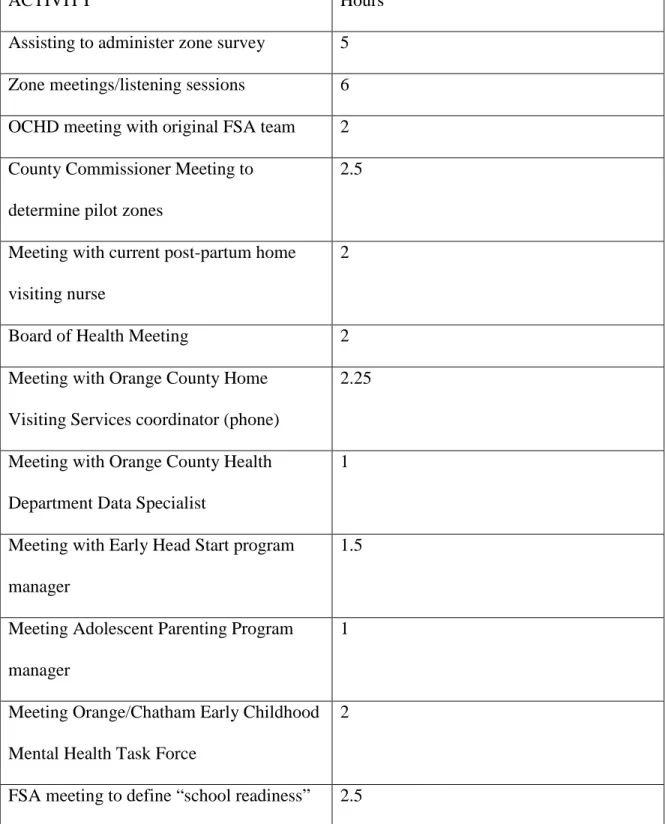
Community Engagement. The Family Success Alliance is developing programming to support vulnerable communities using the tenets of community
Table 1 – Student Community Experiences
ACTIVITY Hours
Assisting to administer zone survey 5 Zone meetings/listening sessions 6 OCHD meeting with original FSA team 2 County Commissioner Meeting to
determine pilot zones
2.5
Meeting with current post-partum home visiting nurse
2
Board of Health Meeting 2
Meeting with Orange County Home Visiting Services coordinator (phone)
2.25
Meeting with Orange County Health Department Data Specialist
1
Meeting with Early Head Start program manager
1.5
Meeting Adolescent Parenting Program manager
1
Meeting Orange/Chatham Early Childhood Mental Health Task Force
2
Phase II: Development of the Pre-Implementation Assessment
Step 1: Development of the Technical Report. The components of the
pre-implementation assessment (Appendix 1) were informed by discussions with OCDH staff, FSA personnel and UNC faculty advisors. A broad overview of the elements of the final product is presented below.
Introduction. This section describes the disproportionate number of children in
Orange County who are living in poverty, as well as the genesis of the Family Success Alliance as a means to mitigate some of the negative impacts of poverty on children. There is a brief introduction to the CC4C and CCNC case management programs that are largely aimed at cost containment. This section was primarily designed to familiarize the reader with the magnitude of poverty in Orange County.
Project Purpose. This section outlines the process by which the HFA and NFP
programs were chosen for evaluation and describes the parameters to be discussed. The reader is made aware that there will be a focus on fit, cost, and return on investment as well as a discussion of local factors that may assist or hinder implementation of each program.
Maternal Infant Early Childhood Home Visiting. An overview of MIECHV
these programs, using the outcomes deemed evidence-based in the HomVee analysis allowed for an unbiased comparison and discussion of proven impacts.
Programs Under Consideration for Adoption. The NFP and HFA programs are
introduced. A broad overview of each program including their goals and target populations are presented.
Demographics and Current Programming. An overview of census, Medicaid,
WIC and child protective services data are presented in this section, making the case for the need for additional supportive programming.
This section also provides a brief overview of current services available to at-risk women and children in Orange County. Descriptions of case management/cost
containment programs such the Pregnancy Medical Home (PMH), Obstetrical Case Management, and Care Coordination for Children are provided. In addition, specialized programming such as the Adolescent Parenting Program, Kidscope Outreach Services, and the Orange County Head Start/Early Head Start program are discussed. The general goals and populations served are highlighted for these programs in order to illustrate that additional MIECHV services may be a useful adjunct to current offerings in Orange County.
Comparison of Outcomes. This segment of the report highlights some of the
prior to the 28th week of gestation. NFP is a program largely based on prevention, where HFA originated primarily issues of abuse and neglect.
In the A Note About First Time Mothers subheading, an overview of the evidence supporting or refuting first time mothers as the ideal candidates for MIECHV
interventions is reviewed. Galano and Huntington’s (2012) finding that the differences between outcomes for primiparous and multiparous women enrolled in HFA were less than the differences between intervention and control groups is discussed. Galano and Huntington further assert that once risk factors are corrected for, primiparous and multiparous women reap similar benefits from home visiting.
Several tables in this section of the analysis are devoted to comparing outcomes for these programs as demonstrated by the HomVee study. Assessment Table 2 reviews the number of studies that were eligible for review for each program, Assessment Table 3 showed the number of positive impacts in primary and secondary outcome measures for each program, and Assessment Table 4 outlined the expected outcomes for NFP as described by Miller (2013). The table based on the principles of Miller (2013) is a
powerful tool that succinctly synthesizes NFP outcome data into concrete projections that implementing agencies may use to predict long and short-term impacts. Unfortunately, there is no analogous data for Miller’s projections for HFA, likely due to a lack of necessary longitudinal data.
Considerations for Implementation. The goal of this section is to provide the
reader with an overview of what NFP and HFA would require in terms of staffing, funding, training, technology and data management. This section of the
analysis, which have been modified to show a side-by-side comparison of HFA and NFP. Prerequisites for implementation, training considerations, and fidelity standards are presented in table form. Some key distinctions between the programs include a looser inclusion criteria for HFA, allowing enrollment pre or post-natally, and the ability of program administrators to target different populations and vary the goals of HFA at different implementation sites.
Additional tables for cost estimates per family per year for each program, and a three-year “year over year” projection of costs is provided. Notably, though NFP requires home visitors to be a nurse with a minimum of a bachelor’s degree, the cost differences between the two programs are minimal. Finally, there is a discussion of return on
investment for each program. The Washington State Institute for Public Policy (WSIPP) conducts periodic reviews for MIECHV programs to determine return on investment (ROI) and in their 2016 review found the Nurse Family Partnership and Healthy Families America to have a return of $1.61 and $1.21 respectively. The reader is informed that this is the first time WSIPP has found HFA to have a positive ROI, though NFP has always shown a positive return. In addition, other agencies such as the Coalition for Evidence Based Policy and the RAND institute have deemed NFP a cost-effective intervention. This section also outlines the findings of the HFNY study (Dumont et al., 2010), which found HFA to be cost effective only for women enrolled pre-natally and those with a prior report of abuse or neglect.
Funding. This section outlines some of the common federal, state and local
Implementation Lessons from the Field. This section is devoted to discussing the
information gathered by speaking directly with HFA and NFP program administrators. During these discussions, a question guide was used to ensure uniformity across conversations. Meetings took place both in-person and over the phone. Several themes unique to each program emerged which were highlighted in the technical report.
Theme One NFP. Program administrators for NFP repeatedly cited the ease of
data collection as a strength of NFP. The Evidence to Outcomes (ETO) system was described as user friendly and as an asset to the program.
Theme Two NFP. The “strength based approach” used at all levels of management
for NFP was cited as creating a very positive work environment, while challenging staff to strive always for improvement.
Theme Three NFP. Managers who were part of the launch aspect of bringing NFP
into a community expressed enthusiastically that there was tremendous support at the national and local levels from the National Service Office at every step in the process. From building the community advisory board to creating a referral base, administrators felt that NFP was a “well oiled machine” as far as implementation set up and follow through.
Theme Four HFA. Program administrators for HFA were largely in agreement
that they liked being able to tailor the intervention to their community, though several admitted this very likely hindered outcomes research and possibly dilutes the intervention itself.
Theme Five HFA. HFA program personnel stated that they felt that their outcomes
doing a lot of good, and we just can’t prove it.” HFA currently does not collect outcomes data at every implementation site. In addition, because the intervention can be tailored at individual sites, replication across sites is made difficult. A telephone interview with the HFA national research coordinator elaborated on this theme. This person has been somewhat recently hired, and is tasked with attempting to capture the impacts of HFA. She introduced the idea that because HFA targets women with prior CPS referrals, there is a significant sample bias. In addition, because the intervention is designed to identify and refer caregivers who are abusive, there is an additional surveillance bias. Effectively, she asserts that abusive tendencies are being identified and documented more frequently in HFA program participants precisely because they are looking for it, not because it is more prevalent. She further asserts that the difference between primary outcomes (what can be found in official documentation such as ED visits, CPS referrals) and secondary outcomes (parent self-reports of abusive behaviors) can be very informative when evaluating program effects.
Similar Challenges. Program administrators for both programs cite similar
challenges related to insecure funding, staff burnout, logistical challenges associated with scheduling in-home visiting, and providing services to women with undiagnosed or untreated mental illness.
Step 2: Development of Brief Informational Videos. Two brief videos were
MIECHV programming along with a brief introduction to the NFP and HFA programs. The other assumes viewers’ knowledge of the FSA and its mission and goes deeper into a comparison of the HFA and NFP programs.
Phase III: Dissemination
In order to share the findings of the pre-implementation assessment, a technical report document was assembled. This document was distributed at a “lunch and learn” conference at the Orange County Health Department and a corresponding Power Point presentation was delivered to key stakeholders in the Health Department, FSA and community. Attendees included the FSA program director, the OCHD Director of Nursing, one of the FSA Zone Navigators, the Director of Kidscope, a clinical social worker with KidScope (a local provider of social-emotional health services for children), the OCHD Director of Home Visiting, the OCHD director of Health Behavior
Interventions, the OCHD Interim Health Director, an outcomes specialist from UNC’s Frank Porter Graham Institute, and the director for Early Head Start. In the parlance of DOI theory, the attendees were largely opinion leaders, or those who are influential in spreading positive or negative information about a particular innovation (Rogers, 2003).
CHAPTER 3: DISCUSSION Feedback
After presenting the technical report at the OCHD lunch and learn and a brief discussion at the Orange Chatham Early Childhood Mental Health Task Force, several attendees asked questions related to equity. Stakeholders are concerned about equity and want to choose a program that has been tested and proven effective across ethnicities. In addition, they want to ensure that programs are delivered by home visitors and program administrators that are culturally competent. Specifically, there was interest in both whether NFP and HFA were tested in non-white populations, as well as whether there was any “equity training” for home visitors to address issues of cultural competence.
To address these concerns, the DNP student provided FSA leadership with the review of literature above. Notably, though both programs were testing using
assumptions based on ethnicity, asking respectful questions and treating each client as an individual.
Discussion of Key Clinical Questions
What are the potential facilitators and challenges to adopting Healthy Families America or the Nurse Family Partnership as an adjunct to current home visiting services in Orange County North Carolina?
The Family Success Alliance has identified a gap in prenatal to pre-school services in Orange County. This creates an opportunity for the adoption of an evidence-based home MIECHV program. The strength of the evidence for NFP in particular, its demonstrated positive impacts, return on investment and long-term program effects are powerful measures that can be used to persuade stakeholders to adopt. Though interest in MIECHV programming in general and NFP in particular is quite high at this time,
barriers remain. In the setting of a public health department, and the FSA, the strong emphasis on community engagement can be a challenge. If the health department is the adopter, but is allowing the “community” to decide what programming to choose, there can be conflict. Laypersons and stakeholders alike may not understand the importance of adopting an evidence-based program. It is crucial that not only community leaders, but also other leaders with extensive knowledge of the importance of strong evidence-based practice be at the table to hear and determine which programs meet the needs of the community.
How do the outcomes of these programs fit with the goals of the Family Success Alliance?
The outcomes of both of these programs align with the goals of the FSA. Using primary outcome measures, both programs improve school readiness, child health, and positive parenting practices, and decrease child maltreatment. NFP also improves child health, and has significantly more positive impacts in the HomVee analysis across outcome domains.
What are the key implementation characteristics of these two programs, and how do they align with the geographic, personnel, and demographic factors that must be considered prior to program adoption?
Though NFP requires that home visitors be nurses with a bachelor’s degree, Orange County should easily be able to recruit for these positions. Given the proximity to schools of nursing, there should be an adequate applicant pool to choose from.
Geography was cited as a challenge for all key informants involved in home visiting. The six zones identified by the FSA as having a disproportionate number of children living in poverty are fairly spread out and will create a logistical challenge for program
administrators.
Stakeholders are concerned about equity and want to choose a program that has demonstrated positive impacts across demographics. NFP has been tested in rigorous RCTs across rural and urban populations with significant numbers of Caucasian, Latina, and African American women and results have remained largely consistent. While HFA has been tested among women of varying ethnicities, these studies largely do not
limits the number of families that can be served with this program. Though HFA allows the program to be offered to all at-risk women, it is notable that program effects are most powerful and return on investment is greatest among first time mothers enrolled
prenatally and those with a previous CPS referral (DuMont, Mitchell-Herzfield, Greene et al., 2008).
Lessons Learned
Community Engagement is a key element of the work of the Family Success Alliance. In partnering with the FSA, the DNP student was able to participate firsthand in multiple stages of the planning and development of programming. Perhaps the most meaningful lesson learned is related to these events. While the concept of community engagement is a very appealing one, it became clear that this type of engagement is only as diverse and as meaningful as those participants who are “at the table.” Translating the theory of community engagement into practice is fraught with challenges, including but not limited to determining how to reach and engage the people most in need of services, determining who best represents those people, and ultimately giving the community evidence-based options in a format and forum that is meaningful to them.
Conclusion
that NFP unfortunately cannot serve. The decision to implement NFP must be considered in the long term, with the understanding that at some point, all moms are first time moms. By identifying and supporting at-risk first time mothers, the FSA has an opportunity to positively impact that mother child dyad as well as future children born to that mother.
In presenting the findings of this assessment to the OCHD, there was clear enthusiasm for NFP. Though some attendees expressed an interest in HFA and specifically its ability to serve women regardless of parity and the flexibility in implementation, the majority seemed to gravitate toward the strength of evidence in support of NFP. Following the PowerPoint presentation, there was an in-depth
discussion of the desire to serve all families. While HFA does allow for recruitment of women regardless of parity, it is crucial to note that the HFNY and other studies demonstrate that this program typically only offers a return on investment for those women who enroll prenatally and those with a previous CPS referral.
Going forward, the OCHD will further disseminate these findings to the
community and seek input into choosing a program that meets both long and short-term goals of the FSA.
APPENDIX 2: VIDEO LINKS
REFERENCES
American Association of Colleges of Nursing (2006). The essentials of doctoral education for advanced nursing practice. Retrieved from http://www.aacn.edu/ Anderson, S., Leventhal, T., & Dupéré, V. (2014). Exposure to neighborhood affluence
and poverty in childhood and adolescence and academic achievement and behavior. Applied Developmental Science, 18(3), 123-138.
Aos S, et al. Benefits and costs of prevention and early intervention programs for youth. Olympia, WA: Washington State Institute for Public Policy; 2004 Sep. 04-07-3901. http://www.wsipp.wa.gov.libproxy.lib.unc.edu/pub.asp?docid=04-07-3901
Ascher, R., & Edwards, R. (2013). Place really does matter: Using area-based measures to investigate associations between poverty and low birth weight in arizona (CSTE health disparities pilot project). Paper presented at the 2013 CSTE Annual
Conference,
Bair-Merritt, M. H., Jennings, J. M., Chen, R., Burrell, L., McFarlane, E., Fuddy, L., & Duggan, A. K. (2010). Reducing maternal intimate partner violence after the birth of a child: A randomized controlled trial of the hawaii healthy start home visitation program. Archives of Pediatrics & Adolescent Medicine, 164(1), 16-23.
Brownson, R. C., Baker, E. A., Leet, T. L., Gillespie, K. N., & True, W. R. (2010). Evidence-based public health Oxford University Press.
Caldera, D., Burrell, L., Rodriguez, K., Crowne, S. S., Rohde, C., & Duggan, A. (2007). Impact of a statewide home visiting program on parenting and on child health and development. Child Abuse & Neglect, 31(8), 829-852.
Chambliss, J. W. (1998). An Experimental Trial of a Home Visiting Program to Prevent Child Maltreatment,
Costello, E. J., Erkanli, A., Copeland, W., & Angold, A. (2010). Association of family income supplements in adolescence with development of psychiatric and substance use disorders in adulthood among an American Indian population. JAMA, 303(19), 1954-1960.
Duggan, A., Caldera, D., Rodriguez, K., Burrell, L., Rohde, C., & Crowne, S. S. (2007). Impact of a statewide home visiting program to prevent child abuse. Child Abuse & Neglect, 31(8), 801-827.
Duggan, A., Fuddy, L., Burrell, L., Higman, S. M., McFarlane, E., Windham, A., & Sia, C. (2004). Randomized trial of a statewide home visiting program to prevent child abuse: Impact in reducing parental risk factors. Child Abuse & Neglect, 28(6), 623-643.
Duggan, A., McFarlane, E., Fuddy, L., Burrell, L., Higman, S. M., Windham, A., & Sia, C. (2004). Randomized trial of a statewide home visiting program: Impact in preventing child abuse and neglect. Child Abuse & Neglect, 28(6), 597-622.
DuMont, K., Mitchell-Herzfeld, S., Greene, R., Lee, E., Lowenfels, A., Rodriguez, M., & Dorabawila, V. (2008). Healthy families new york (HFNY) randomized trial: Effects on early child abuse and neglect. Child Abuse & Neglect, 32(3), 295-315.
Dumont, K., Kirkland, K., Mitchell-Herzfeld, S., Ehrhard-Dietzel, S., Rodriguez, M. L., Lee, E., ... & Greene, R. (2010). A randomized trial of Healthy Families New York (HFNY): Does home visiting prevent child maltreatment. Rensselaer, NY: New York State Office of Children & Family Services and Albany, NY: The University of Albany,
State University of New York.
Eckenrode, J., Campa, M., Luckey, D. W., Henderson, C. R., Cole, R., Kitzman, H., . . . Olds, D. (2010). Long-term effects of prenatal and infancy nurse home visitation on the life course of youths: 19-year follow-up of a randomized trial. Archives of Pediatrics & Adolescent Medicine, 164(1), 9-15.
Eckenrode, J., Zielinski, D., Smith, E., Marcynyszyn, L. A., Henderson Jr, C. R., Kitzman, H., . . . Olds, D. L. (2001). Child maltreatment and the early onset of problem behaviors: Can a program of nurse home visitation break the
link? Development and Psychopathology, 13(04), 873-890.
Educational Testing Service Center for Research on Human Capital and Education (2013). Poverty and Education: Finding the way forward. Retrieved from http://www.ets.org/s/research/pdf/poverty_and_education_report.pdf
El-Kamary, S. S., Higman, S. M., Fuddy, L., McFarlane, E., Sia, C., & Duggan, A. K. (2004). Hawaii's healthy start home visiting program: Determinants and impact of rapid repeat birth. Pediatrics, 114(3), e317-26. doi:10.1542/peds.2004-0618 [doi] Evans, G. W., & Kim, P. (2013). Childhood poverty, chronic stress, self‐regulation, and
Fielding, J. E., & Briss, P. A. (2006). Promoting evidence-based public health policy: Can we have better evidence and more action? Health Affairs (Project Hope), 25(4), 969-978. doi:25/4/969 [pii]
Fielding, J. E., & Briss, P. A. (2006). Promoting evidence-based public health policy: Can we have better evidence and more action? Health Affairs (Project Hope), 25(4), 969-978. doi:25/4/969 [pii]
Galano, J., & Huntington, L., (2012). COMPARISON OF PRIMIPAROUS AND MULTIPAROUS MOTHERS, Healthy Familiies Participation, Outcomes, Challenges and Adaptations. The Pew Center for the States
Hair, N. L., Hanson, J. L., Wolfe, B. L., & Pollak, S. D. (2015). Association of child poverty, brain development, and academic achievement. JAMA Pediatrics, 169(9), 822-829.
Holmberg, John; Luckey, Dennis; Olds, David. (2011) Teacher data for the Denver Year-9 follow-up. Unpublished report submitted to the U.S. Department of Justice. Institute of Medicine (US). Committee for the Study of the Future of Public Health.
(1988). The future of public health National Academy Press.
Isaacs J. (2007) Cost-effective investments in children. Washington, D.C.: Brookings Institution; Budget options series
Karoly L., et al. (2005) Early childhood interventions: proven results, future promise. Santa Monica, CA: RAND Corporation
Kitzman, H. J., Olds, D. L., Cole, R. E., Hanks, C. A., Anson, E. A., Arcoleo, K. J., . . . Holmberg, J. R. (2010). Enduring effects of prenatal and infancy home visiting by nurses on children: Follow-up of a randomized trial among children at age 12 years. Archives of Pediatrics & Adolescent Medicine, 164(5), 412-418.
Kitzman, H., Olds, D. L., Henderson, C. R., Hanks, C., Cole, R., Tatelbaum, R., . . . Shaver, D. (1997). Effect of prenatal and infancy home visitation by nurses on pregnancy outcomes, childhood injuries, and repeated childbearing: A randomized controlled trial. Jama, 278(8), 644-652.
Kitzman, H., Olds, D. L., Sidora, K., Henderson Jr, C. R., Hanks, C., Cole, R., . . .
Klebanov, P. K., Evans, G. W., & Brooks-Gunn, J. (2014). Poverty, ethnicity, and risk of obesity among low birth weight infants. Journal of Applied Developmental
Psychology, 35(3), 245-253.
Landsverk, J., Carrilio, T., Connelly, C., Ganger, W., Slymen, D., Newton, R., . . . Jones, C. (2002). Healthy families san diego clinical trial: Technical report. Child and Adolescent Services Research Center, Children's Hospital-San Diego, San Diego, California.Executive Summary Available by Sending an e-Mail to Jlandsverk@ Aol.Com,
LeCroy, C. W., & Krysik, J. (2011). Randomized trial of the healthy families arizona home visiting program. Children and Youth Services Review, 33(10), 1761-1766. Lee, E., Mitchell-Herzfeld, S. D., Lowenfels, A. A., Greene, R., Dorabawila, V., &
DuMont, K. A. (2009). Reducing low birth weight through home visitation: A randomized controlled trial. American Journal of Preventive Medicine, 36(2), 154-160.
Mazza, J. R. S., Lambert, J., Zunzunegui, M. V., Tremblay, R. E., Boivin, M., & Côté, S. M. (2017). Early adolescence behavior problems and timing of poverty during childhood: A comparison of lifecourse models. Social Science & Medicine, 177, 35-42.
Miller, T.R. (2013). Nurse Family Partership Home Visitation: Costs, outcomes and return on investment. Pacifica Institute for Research and Evaluation.
Minh, A., Matheson, F. I., Daoud, N., Hamilton-Wright, S., Pedersen, C., Borenstein, H., & O'Campo, P. (2013). Linking childhood and adult criminality: Using a life course framework to examine childhood abuse and neglect, substance use and adult partner violence. International Journal of Environmental Research and Public
Health, 10(11), 5470-5489.
Minkler, M., & Wallerstein, N. (2011). Community-based participatory research for health: From process to outcomes John Wiley & Sons.
Moini, M., Fackler-Lowrie, N., & Jones, L. (2005). Community engagement: Moving from community involvement to community engagement—A paradigm shift. PHP Consulting,
National Implementation Research Network (2015). Retrieved from
http://nirn.fpg.unc.edu/learn-implementation/implementation-science-defined Nikulina, V., Widom, C. S., & Czaja, S. (2011). The role of childhood neglect and
Olds, D. L., Eckenrode, J., Henderson, C. R., Kitzman, H., Powers, J., Cole, R., . . . Luckey, D. (1997). Long-term effects of home visitation on maternal life course and child abuse and neglect: Fifteen-year follow-up of a randomized trial. Jama, 278(8), 637-643.
Olds, D. L., Holmberg, J. R., Donelan-McCall, N., Luckey, D. W., Knudtson, M. D., & Robinson, J. (2014). Effects of home visits by paraprofessionals and by nurses on children: Follow-up of a randomized trial at ages 6 and 9 years. JAMA
Pediatrics, 168(2), 114-121.
Olds, D., Henderson, C. R., Cole, R., Eckenrode, J., Kitzman, H., Luckey, D., . . .
Powers, J. (1998). Long-term effects of nurse home visitation on children’s criminal and antisocial behavior. Journal of the American Medical Association, 280(14), 1238-1244.
Olds, D. L., Henderson, C. R.,Jr, Chamberlin, R., & Tatelbaum, R. (1986). Preventing child abuse and neglect: A randomized trial of nurse home
visitation. Pediatrics, 78(1), 65-78.
Olds, D. L., Henderson, C. R.,Jr, & Kitzman, H. (1994). Does prenatal and infancy nurse home visitation have enduring effects on qualities of parental caregiving and child health at 25 to 50 months of life?Pediatrics, 93(1), 89-98.
Olds, D. L., Henderson, C. R.,Jr, Tatelbaum, R., & Chamberlin, R. (1986). Improving the delivery of prenatal care and outcomes of pregnancy: A randomized trial of nurse home visitation. Pediatrics, 77(1), 16-28.
Olds, D. L., Henderson, C. R.,Jr, Tatelbaum, R., & Chamberlin, R. (1988). Improving the life-course development of socially disadvantaged mothers: A randomized trial of nurse home visitation. American Journal of Public Health, 78(11), 1436-1445. Olds, D. L., Kitzman, H., Cole, R., Robinson, J., Sidora, K., Luckey, D. W., . . .
Holmberg, J. (2004). Effects of nurse home-visiting on maternal life course and child development: Age 6 follow-up results of a randomized trial. Pediatrics, 114(6), 1550-1559. doi:114/6/1550 [pii]
Olds, D. L., Robinson, J., O'Brien, R., Luckey, D. W., Pettitt, L. M., Henderson, C. R.,Jr, . . . Talmi, A. (2002). Home visiting by paraprofessionals and by nurses: A
randomized, controlled trial. Pediatrics, 110(3), 486-496.
O'Mara-Eves, A., Brunton, G., McDaid, G., Oliver, S., Kavanagh, J., Jamal, F., . . . Thomas, J. (2013). Community engagement to reduce inequalities in health: A systematic review, meta-analysis and economic analysis. Public Health
Sharkey, P. T., Tirado-Strayer, N., Papachristos, A. V., & Raver, C. C. (2012). The effect of local violence on children’s attention and impulse control. American Journal of Public Health, 102(12), 2287-2293.
Spencer, N., Thanh, T. M., & Louise, S. (2013). Low income/socio-economic status in early childhood and physical health in later childhood/adolescence: A systematic review. Maternal and Child Health Journal, 17(3), 424-431.
United States Department of Health and Human Services (2014). Home visiting evidence of effectiveness, an executive summary. Retrieved from:
http://homvee.acf.hhs.gov/document.aspx?rid=5&sid=20&mid=2
Yoshikawa, H., Aber, J. L., & Beardslee, W. R. (2012). The effects of poverty on the mental, emotional, and behavioral health of children and youth: Implications for prevention. American Psychologist, 67(4), 272.
Zielinski, D. S., Eckenrode, J., & Olds, D. L. (2009). Nurse home visitation and the prevention of child maltreatment: Impact on the timing of official