Characterization of Mentorship Programs
in Departments of Surgery in the United States
Melina R. Kibbe, MD; Carlos A. Pellegrini, MD; Courtney M. Townsend Jr, MD; Irene B. Helenowski, PhD; Marco G. Patti, MD
IMPORTANCEMentorship is considered a key element for career satisfaction and retention in academic surgery. Stakeholders of an effective mentorship program should include the mentor, the mentee, the department, and the institution.
OBJECTIVEThe objective of this study was to characterize the status of mentorship programs
in departments of surgery in the United States, including the roles of all 4 key stakeholders, because to our knowledge, this has never been done.
DESIGN, SETTING, AND PARTICIPANTSA survey was sent to 155 chairs of departments of surgery in the United States in July 2014 regarding the presence and structure of the mentorship program in their department. The analysis of the data was performed in November 2014 and December 2014.
MAIN OUTCOMES AND MEASURESPresence and structure of a mentorship program and involvement of the 4 key stakeholders.
RESULTS Seventy-six of 155 chairs responded to the survey, resulting in a 49% response rate. Forty-one of 76 of department chairs (54%) self-reported having an established mentorship program. Twenty-five of 76 departments (33%) described no formal or informal pairing of mentors with mentees. In 62 (82%) and 59 (78%) departments, no formal training existed for mentors or mentees, respectively. In 42 departments (55%), there was no formal
requirement for the frequency of scheduled meetings between the mentor and mentee. In most departments, mentors and mentees were not required to fill out evaluation forms, but when they did, 28 of 31 were reviewed by the chair (90%). In 70 departments (92%), no exit strategy existed for failed mentor-mentee relationships. In more than two-thirds of
departments, faculty mentoring efforts were not recognized formally by either the department or the institution, and only 2 departments (3%) received economic support for the mentoring program from the institution.
CONCLUSIONS AND RELEVANCEThese data show that only half of departments of surgery in the United States have established mentorship programs, and most are informal,
unstructured, and do not involve all of the key stakeholders. Given the importance of mentorship to career satisfaction and retention, development of formal mentorship programs should be considered for all academic departments of surgery.
JAMA Surg. 2016;151(10):900-906. doi:10.1001/jamasurg.2016.1670 Published online July 6, 2016.
Invited Commentary page 907
Supplemental contentat jamasurgery.com
CME Quizat
jamanetworkcme.comand CME Questionspage 996
Author Affiliations:Department of Surgery, University of North Carolina, Chapel Hill (Kibbe, Helenowski, Patti); Editor,JAMA Surgery(Kibbe); Department of Surgery, University of Washington, Seattle (Pellegrini); Department of Surgery, University of Texas Medical Branch at Galveston (Townsend).
M
entorship has been recognized as a key element of career satisfaction because it has a very important influence on career guidance, researchproductiv-ity, and personal development.1-22Traditionally, mentoring has
been seen as a relationship between a senior person, the men-tor, and a less experienced colleague, the mentee. This rela-tionship is both dyadic, because it is between 2 individuals (the mentor and the mentee), and hierarchical, because the mentor is usually several years older and serves as a role model, teacher, advisor, and sponsor for the younger mentee. While this classic dyad was the cornerstone of mentoring for many decades, an increasing number of academic health science uni-versities are recognizing the need for establishing a formal and structured mentorship program, a program that must in-clude not only the mentor and the mentee but also the
depart-ment and the institution.1,6,10,12,16,18,20,22
The department and the institution are key stakeholders who have an important role in the establishment of a mentoring program and derive substantial benefits from its success.
Given the importance of mentorship to career
satisfac-tion and retensatisfac-tion3-6,11,12
and that, to our knowledge, the pres-ence and structure of mentorship programs in departments of surgery in the United States remains unknown, the goal of this study was to characterize the status of mentorship programs in departments of surgery in the United States. We hypoth-esized that significant variability existed among depart-ments with respect to the structure of the faculty mentorship program and the involvement of the key stakeholders. To ad-dress this hypothesis, a survey was developed that adad-dressed the following 6 areas: (1) mentee-mentor pairing, (2) training for mentees and mentors, (3) commitment to the mentee-mentor relationship, (4) evaluation of the mentee-mentee-mentor re-lationship, (5) how failed mentee-mentor relationships are ad-dressed, and (6) recognition of the mentee-mentor relationship. Information from this study will provide insight into mentor-ship programs and may help the chairs of academic depart-ments of surgery to establish structured mentorship programs that involve all 4 key stakeholders.
Methods
Study Approval
This research project was reviewed by the institutional review board of Northwestern University, Chicago, Illinois. This research was determined to not constitute research with human participants; thus, institutional review board approval was not required.
Study Design
A survey regarding the presence and structure of a mentor-ship program was sent to all chairs of departments of surgery in the United States. The email list for the department of sur-gery chairs was obtained from the Society of Surgical Chairs membership directory, which is available online from the American College of Surgeons website. Participation in the survey was anonymous and voluntary. The invitation to respond to the questionnaire was sent by email in early July
2014 to all the members of the Society of Surgical Chairs in the United States (n = 155). The survey response tool was set up such that each surgeon was able to respond only once to the survey. Respondents answered online using an internet-based survey tool (SurveyMonkey.com Corporation). To improve the response rate, 2 subsequent follow-up emails were sent to all members of the Society of Surgical Chairs in late July 2014 and early September 2014. In addition, all incorrect email addresses were identified and corrected, and appointment of any new chairs during the prior year were confirmed to be on the membership list and were added if they were not.
Survey
The questionnaire consisted of 19 questions regarding the presence and description of a departmental mentoring
pro-gram (eAppendix in theSupplement). Most questions were
either a yes/no or a multiple-choice answer. One question about a continuous variable contained a free-text answer box. The questions addressed the presence of an established mentorship program within each department and character-ized the role of the 4 stakeholders (ie, mentor, mentee, department, and institution).
Data Analysis
Results presented in the article were calculated based on the number of responses received to each individual question. Thus, a nonresponse was not considered a negative answer Figure 1. Types of Pairing of Mentees With Mentors
0 10 15 20 25 30
Percentage 5
Other Mentee-mentor relationship type
Provided by Division Chief
No Mentor
Formal
Informal
Key Points
QuestionWhat is the status of mentorship programs in departments of surgery in the United States?
FindingsResults of a survey sent to 155 chairs of departments of surgery with a 49% response rate showed that only half of departments of surgery in the United States have established mentorship programs, and most are informal, unstructured, and do not involve all of the key stakeholders.
because it was not included in the numerator or denominator in determining the percentage of responders who answered each question.
Statistical Analysis
Data were analyzed using the 1-sample χ2
test, the Mann-Whitney rank sum test, and the Fisher exact test. Data are presented as mean (SE) where appropriate. For statistical
analysis, test statistics with aPvalue at or less than .05 were
considered to be significant.
Results
Overall, 76 of 155 responses were received, resulting in a 49% response rate. Among the departments included in the re-sults, the mean (SE) number of faculty was 59 (5), and the median was 50. Forty-one chairs (54%) self-reported that they had an “established” mentorship program in their depart-ment, while 35 chairs (46%) felt that while mentoring occurred within their department, it was nonstructured.
Pairing of Mentors and Mentees
In 53 of 76 departments (70%), the faculty were paired with mentors, with the pairing being either informal (17 of 76, men-tee chooses the mentor [22%]), formal (19 of 76, menmen-tee is as-signed to mentor [25%]), provided by the division chief (15
[20%]), or via other means (2 [3%]) (Figure 1). The remaining
faculty members (23 [30%]) did not have a mentor. Of the pro-grams that paired mentors with mentees, 25 of 48 propro-grams (52%) paired mentees with 1 mentor, while 23 of 48 programs (48%) paired mentees with 2 or more mentors.
Training for Mentors and Mentees
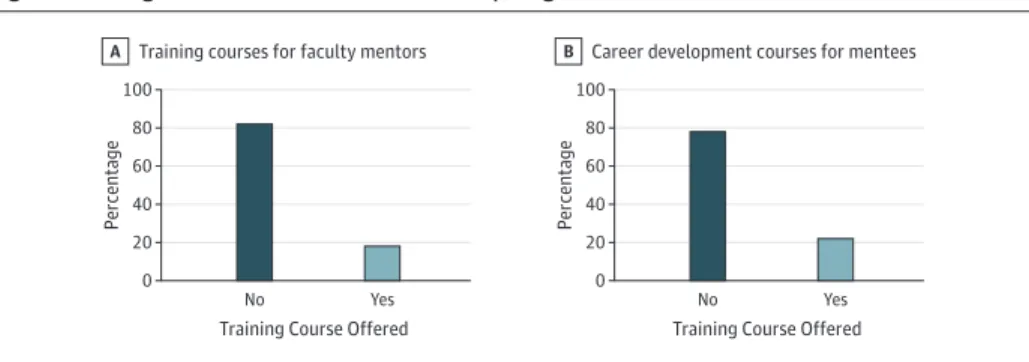
Sixty-two departments (82%) offered no official training
courses for faculty mentors (Figure 2A). Of the 14
depart-ments that offered training courses for mentors, 3 were offered by the department (21.4%), 8 were offered by the medical school (57.2%), and 3 were offered by the university (21.4%). Seventy-eight percent of programs did not require mentees to attend a career development course (Figure 2B). When required, the career development course was offered by the department (6 of 17 departments [35%]), medical school (7 of 17 departments [41%]), university (2 of 17 ments [12%]), or outside of the institution (2 of 17 depart-ments [12%]).
Commitment to the Relationship
In almost all departments, neither the mentors (71 [93%]) nor the mentees (70 [92%]) were required to sign a mentor or mentee contract. In addition, only 28 departments (37%) asked mentees to fill out a form stating their short-term and long-term goals on establishing the mentor-mentee relation-ship. Forty-two programs (55%) had no formal requirement regarding how often the mentor should meet with the men-tee. Of the 34 programs that did have requirements (45%), 6 required meetings annually (18%) while 28 required meetings every 3 or 6 months (82%).
Evaluation of the Mentor-Mentee Relationship
Only 28 of 76 departments (37%) required mentors to fill out an evaluation form on the faculty mentee while only 9 departments (12%) required mentees to fill out an evaluation form on the faculty mentor. When required, the frequency of the requirement to fill out the evaluation form was at least annually for the mentors in 26 of 28 programs (93%) and annually for the mentees in 7 of 9 programs (78%). In the 31 departments where evaluation forms were filled out, 28 had evaluation forms reviewed by the chair (90%), 11 by a divi-sion chief (35%), 6 by a vice chair (19%), 3 by a mentoring committee (10%), and surprisingly, 7 by a medical school faculty affairs committee, dean, or vice/associate dean (23%).
Failed Mentor-Mentee Relationship
In 70 departments (92%), no exit strategy (ie, “no-fault divorce” or meeting with the department chair) had been set
for failed mentor/mentee relationships (Figure 3).
Figure 2. Training Courses Associated With Mentorship Programs
100
80
60
40
20
0
Percentage
Training Course Offered
No Yes
Training courses for faculty mentors
A
100
80
60
40
20
0
Percentage
Training Course Offered
No Yes
Career development courses for mentees
B
A, Percentage of departments that offer training courses for faculty mentors. B, Percentage of mentees who are required to attend career development courses.
Figure 3. Exit Strategies for Failed Mentor-Mentee Relationships
100
80
60
40
20
0
Percentage
Formal Exit Strategy
No Yes
Recognition of the Mentor-Mentee Relationship
In 52 departments (68%), the work of the mentor was not officially recognized either financially or academically (Figure 4A). Twenty-three departments (30%) recognized faculty mentoring activities as part of the promotion pack-age, 6 recognized the effort (ie, time or relative value unit considered in the calculation for overall compensation) (8%), and 6 recognized it financially (ie, salary or bonus) (8%). Regarding institutional recognition, most institutions (54 [71%]) did not recognize the mentorship program within the department of surgery or the effort of the faculty men-tors (57 [75%]) (Figure 4B). Only 2 institutions (3%) pro-vided economic support for the mentorship program within a department of surgery.
Comparison of Programs With and Without
Established Mentorship Programs
Characteristics of programs that self-identified as having an established mentorship program were compared with pro-grams that self-identified as not having an established men-torship program. Interestingly, programs with established mentorship programs were larger (mean faculty of 70 vs 47,
P= .02). As would be expected, programs with established
mentorship programs were significantly more likely to require mentees to fill out forms stating their short- and
long-term goals (61% vs 9%,P< .001), require a regular
fre-quency of meetings between the mentor and mentee (73%
vs 11%,P= .002), require mentors to complete an
evalua-tion form about the mentees (63% vs 6%,P= .009), and
have the evaluation form reviewed by the department chair
(63% vs 6%,P< .001). Lastly, programs with established
mentorship programs were more likely to be recognized by
the institution (49% vs 6%,P= .001), and the mentoring
activities of the faculty member were more likely to be rec-ognized for academic promotion or by effort (61% vs 11%,
P= .004).
Discussion
Our study shows that approximately half of departments of sur-gery have established mentorship programs and that, among those that have them, the structure varies significantly. In-deed, while more than two-thirds of departments helped to pair mentors with mentees, less than one-fourth used an in-formal pairing that allows the mentees to choose their men-tors. For most departments, no formal training existed for either the mentor or mentee. Only slightly more than half of depart-ments had requiredepart-ments for the frequency of scheduled meet-ings between the mentor and mentee, but most departments did not require the mentor or mentee to fill out evaluation forms about the success of the relationship, nor were exit strat-egies in place for failed mentor-mentee relationships. Lastly, in most departments, faculty mentoring efforts were not rec-ognized formally by either the department or the institution. These data clearly show that significant variability exists among departments of surgery with respect to the structure of faculty mentorship programs and that active engagement of all 4 key stakeholders is lacking in most of them.
These data have important implications for the career de-velopment of academic surgeons. When successful academic physicians are asked about the factors that played a significant role in their career, mentorship is uniformly quoted as a key
element.3,4,6,8,12
However, review of the literature shows little evidence to support this claim because, to our knowledge, there are no prospective randomized trials comparing the careers of physicians who had mentors with the careers of those who did not, and there are no long-term longitudinal studies assessing the value of mentorship. Even with the lack of prospective data on mentorship, there are several studies that have described the positive effects of mentorship. For instance, in a survey of 4000 mentees in 24 medical schools in the United States, Palepu
et al5found that compared with nonmentored faculty,
men-Figure 4. Recognition of Faculty Mentoring Efforts
80
40 50 70
60
30
20
10
0
Percentage
Recognition Not Officially
Recognized
Recognized as Part of Promotion Package
Recognized as Effort
Recognized Financially Recognition by the department
A
80
40 50 70
60
30
20
10
0
Percentage
Recognition Mentorship
Program Not Recognized
Faculty Effort Not Recognized
Recognized and Provided
Economic Support Recognition by the institution
B
tored faculty spent more time on research and were more likely to obtain grants. Other studies have shown a positive effect of
mentoring on faculty retention6
and scholarship.11
In addition, mentorship has been associated with career satisfaction in the areas of career guidance, research productivity, and personal
development.3,4For instance, DeCastro et al4surveyed 1708
cli-nician-researchers between 2010 and 2011 who received Na-tional Institutes of Health K08 and K23 career development
awards between 2006 and 2009.4Although the study had
limi-tations, such as the self-reported nature of data collection and the fact that the participants had already shown the ability to secure funding from the National Institutes of Health, it iden-tified a correlation between some aspects of mentoring (eg, men-tor behavior, menmen-tor prestige, and collegiality of the menmen-tor- mentor-mentee relationship) and career satisfaction. Finally, a report from the University of Toronto has shown that mentoring is also
important for promotion, a surrogate for academic success.12
In
their study, Morrison et al12examined the time to promotion
for faculty before and after implementation of a formal men-torship program and also between mentored and nonmen-tored faculty regardless of the time to promotion. These au-thors found that mentorship was independently associated with a reduction in time to promotion. Based on their observation, they concluded that a formal mentoring program supported by the institution has a positive effect on faculty advancement.
Considering the positive effect of mentoring on career
sat-isfaction and possibly on career success, we and others1,6,10,12
believe that a mentorship program within a department of sur-gery should be carefully designed, with the involvement of the 4 key stakeholders (the mentor, the mentee, the department, and the institution) clearly defined. Our study showed that when established mentorship programs were compared with those without a structure, important differences became evi-dent. Specifically, in departments with self-identified men-torship programs, there was more often the involvement of the department in pairing mentors with mentees; the require-ment for the require-mentees to clearly state their short- and long-term goals and to schedule regular meetings; the require-ment for the require-mentor to evaluate the require-mentee and for the chair to review the evaluation forms; recognition of the mentoring activities for academic promotion; and recognition of the men-toring program by the institution. Similarly, in a review of 18
academic mentoring programs, Kashiwagi et al10recognized
the value of a formal and structured program and identified 7 components that were considered essential for its success: (1) pairing of mentors and mentees; (2) mentor preparation; (3) planning committees; (4) formal curricula; (5) mentor/ mentee contract; (6) mentoring activities; and (7) program funding and participant compensation.
We found that 30% of faculty were not mentored. Among the 70% who were mentored, only 22% of the mentees were able to choose their mentor (ie, informal pairing). This is probably the most successful dyadic relationship because the mentee can select somebody who is knowledgeable, is honest, has experi-ence with the department and the institution, has a well-established track record of mentorship, and shares common values. Mentees should be able to choose more than 1 mentor because the health care environment makes it very difficult for
1 mentor to provide adequate guidance for all aspects of an aca-demic career (ie, research, grant writing, clinical activities,
par-ticipation to academic medical societies).10,16
This strategy of having mentees choose their mentors allows mentees “to man-age up,” a common corporate concept in which the mentee must clearly state his or her needs, must plan and set the meeting
agenda, complete assigned tasks, and request feedback.15
In our study, 20% of the mentees were assigned a mentor by the de-partment (ie, formal pairing). We believe this is not an ideal situ-ation because mentees often believe that an assigned mentor
is a forced type of relationship and a cause of failure.13For this
reason, we believe it is best when the department chair helps the mentee to identify a mentor, supporting a natural, un-forced process. The remaining 20% of faculty members were mentored by the division chief. This relationship can be prob-lematic because it has an inherent imbalance of power and po-tential conflict of interests and should thereby be managed
care-fully and with proper oversight to avoid abusive situations.19
In most departments, there was no official training for faculty mentors. This may be a problem because while some individuals, particularly those who had effective mentors, are ready to serve this role, others need formal training on how to be a good mentor. Mentoring skills can be taught like any other skill through book reading and attending
work-shops, seminars, or courses.10The University of California,
San Francisco has been a leader in the development of men-torship programs, and this institution has recognized the seminal importance of training mentors through established Mentor Development Programs to be effective teachers,
par-ticularly in the area of translational research.1,20
Thanks to this program, mentors uniformly reported increased confi-dence in their mentoring skills such as the ability of helping their mentees in approaching translational research, manag-ing their laboratory, identifymanag-ing professional goals, buildmanag-ing professional collaborations, and understanding the
expecta-tions for advancement and promotion.1
At the same time, it is essential to provide formal training to the mentees. There are well-established career develop-ment courses for residents, fellows, and junior faculty such as the one sponsored by the Association for Academic Surgery. During this course, participants are taught how to choose a mentor, write and revise a manuscript, deliver an effective pre-sentation, prepare an abstract for a national meeting, prop-erly design a study, and statistically analyze the study re-sults. These courses provide essential information for the academic surgeon. For instance, during the Academic Surgi-cal Congress in 2013, the Association for Academic Surgery held a session on “The Art and Science of Publishing,” during which the results of a survey of Association for Academic Surgery and
Society of University Surgeons members were disseminated.23
It was disappointing to discover how many of the respon-dents did not know about key elements of publishing such as authorship, guest authorship, plagiarism, self-plagiarism,
fraud, fabrication, and conflict of interest.23
the mentor nor the mentee were required to sign a contract. This simple document guarantees that both parties in the re-lationship understand the expectations established in the
be-ginning of the relationship.10In addition, most programs did
not require the mentors (63%) or mentees (88%) to fill out a form assessing how the relationship was progressing and which goals had been achieved. Monitoring the relationship in re-gards to personal (eg, respect, punctuality, honesty, and fre-quency of meetings) and professional (eg, manuscripts, grants, promotion, participation, and leadership positions in na-tional and internana-tional societies) aspects of their career is of
key importance.2,16,20
Another reason routine evaluation of the mentor-mentee relationship should be performed is to deter-mine whether potential areas of conflict are present and
whether the relationship is failing.13,14On the part of the
men-tors, failure is present when the mentee does not perform ac-cording to the initial plan or lacks respect. On the part of the mentees, failure is often expressed as the mentor not giving credit to their work, such as taking ownership of research grants, patents, or publications, or focusing on his or her re-search and not allowing the mentees to explore their own ideas. After careful analysis, if the relationship is deemed failed, an exit strategy, such as a “no-fault divorce,” should be
implemented.14,24Our study showed that in 92% of
depart-ments, no exit strategy had been set for failed mentor-mentee relationships. Thus, we believe that evaluation forms should be regularly filled out by both the mentor and the men-tee, and they should be reviewed by a mentoring committee and the chair of the department to ensure ongoing successful mentor-mentee relationships.
Our study also shows that most departments and institu-tions do not recognize or reward the work of the mentor either financially or academically. This is a potential barrier to effec-tive mentoring for the following reasons: (1) the time a men-tor dedicates to a mentee is time not spent on his or her own professional and personal activities; (2) mentors are usually senior surgeons who have an increased demand for clinical, research, and administrative tasks; and (3) it takes away an im-portant incentive. Some institutions reward the effort of men-tors either financially (eg, relative value units, salary sup-port) or academically (eg, awards for excellence in mentoring,
consideration in the promotion application).10-13,16,20For
in-stance, the University of California, San Francisco formally rec-ognizes mentoring as equivalent to teaching in the promo-tion process, and faculty are required to describe their
mentoring activities in the curriculum vitae.20Lastly, we found
that only 3% of institutions provided economic support for the mentorship program within a department of surgery. We be-lieve that an effective mentoring program cannot be estab-lished by the chair of the department of surgery without the open and transparent approval and support of the institu-tion. Given the return on investment that the medical school can receive from a formal mentoring program in terms of eco-nomic gain (federal and nonfederal grants), program devel-opment, national ranking, and particularly retention and
recruitment,6,7,9,14,17support for these programs should be
developed at all institutions.
Our study has some limitations. First, the data obtained in this study were via self-reporting; thus, bias may exist. Second, the survey was entirely anonymous. This limited our ability to track the data back to individual institutions and per-form additional analyses such as the impact on extramural funding, publications, retention, promotion, private vs pub-lic institution, safety-net burden of the hospital, and term of the chair of surgery. Third, while we achieved a response rate of nearly 50%, the data in this article are not representative of all 155 departments across the United States. A response bias may exist such that chairs of departments of surgery with more structured mentorship programs were more inclined to an-swer the survey. Fourth, these data are survey data represent-ing a srepresent-ingle point in time and do not reflect longitudinal data on the effect of a mentorship program on the career develop-ment of faculty. Even with these limitations, we believe the data presented herein provide meaningful insights into the nature of mentorship programs.
Conclusions
Our data show that the presence and structure of mentorship programs in departments of surgery across the United States are highly variable with respect to the pairing of mentors with mentees, commitment to the relationship, training provided, and recognition by all 4 key stakeholders. Because mentor-ship has been shown to be one of the most important factors for career satisfaction (and possibly success), development and maintenance of an established faculty mentorship program with the involvement of the department and the institution may lead to greater faculty satisfaction, productivity, and retention.
ARTICLE INFORMATION
Accepted for Publication:March 25, 2016. Published Online:July 6, 2016. doi:10.1001/jamasurg.2016.1670
Author Contributions:Dr Patti had full access to all the data in the study and takes responsibility for the integrity of the data and the accuracy of the data analysis.
Study concept and design:Kibbe, Pellegrini, Townsend, Patti.
Acquisition, analysis, or interpretation of data: Kibbe, Helenowski, Patti.
Drafting of the manuscript:Kibbe, Pellegrini, Patti.
Critical revision of the manuscript for important intellectual content:Kibbe, Townsend, Helenowski, Patti.
Statistical analysis:Kibbe, Helenowski. Administrative, technical, or material support: Kibbe, Pellegrini, Townsend.
Study supervision:Kibbe, Patti.
Conflict of Interest Disclosures:None reported. Disclaimer:Dr Kibbe is the Editor ofJAMA Surgery but was not involved in the editorial review or the decision to accept the manuscript for publication.
Previous Presentation:This manuscript was presented at the annual meeting of the American College of Surgeons; October 6, 2015; Chicago, Illinois.
Additional Contributions:We thank Kayla Dangerfield, Northwestern University, for her editorial review of the manuscript.
REFERENCES
and Translational Science Institute Mentor Development Program.Clin Transl Sci. 2009;2(3): 216-221.
2. Anderson L, Silet K, Fleming M. Evaluating and giving feedback to mentors: new evidence-based approaches.Clin Transl Sci. 2012;5(1):71-77. 3. Wasserstein AG, Quistberg DA, Shea JA. Mentoring at the University of Pennsylvania: results of a faculty survey.J Gen Intern Med. 2007;22(2): 210-214.
4. DeCastro R, Griffith KA, Ubel PA, Stewart A, Jagsi R. Mentoring and the career satisfaction of male and female academic medical faculty.Acad Med. 2014;89(2):301-311.
5. Palepu A, Friedman RH, Barnett RC, et al. Junior faculty members’ mentoring relationships and their professional development in U.S. medical schools.
Acad Med. 1998;73(3):318-323.
6. Ries A, Wingard D, Gamst A, Larsen C, Farrell E, Reznik V. Measuring faculty retention and success in academic medicine.Acad Med. 2012;87(8):1046-1051.
7. Alexander H, Lang J.The Long-term Retention and Attrition of US Medical School Faculty. Washington, DC: AAMC; 2008:8. 8. Powell DW. Mentoring: then and now.
Gastroenterology. 2014;147(3):550-553. 9. Bucklin BA, Valley M, Welch C, Tran ZV, Lowenstein SR. Predictors of early faculty attrition at one Academic Medical Center.BMC Med Educ. 2014;14:27.
10. Kashiwagi DT, Varkey P, Cook DA. Mentoring programs for physicians in academic medicine: a systematic review.Acad Med. 2013;88(7):1029-1037.
11. Sambunjak D, Straus SE, Marusić A. Mentoring in academic medicine: a systematic review.JAMA. 2006;296(9):1103-1115.
12. Morrison LJ, Lorens E, Bandiera G, et al; Faculty Development Committee, Department of Medicine, Faculty of Medicine, University of Toronto. Impact of a formal mentoring program on academic promotion of Department of Medicine faculty: a comparative study.Med Teach. 2014;36(7):608-614.
13. Straus SE, Chatur F, Taylor M. Issues in the mentor-mentee relationship in academic medicine: a qualitative study.Acad Med. 2009;84(1):135-139. 14. Straus SE, Johnson MO, Marquez C, Feldman MD. Characteristics of successful and failed mentoring relationships: a qualitative study across two academic health centers.Acad Med. 2013;88 (1):82-89.
15. Zerzan JT, Hess R, Schur E, Phillips RS, Rigotti N. Making the most of mentors: a guide for mentees.
Acad Med. 2009;84(1):140-144.
16. Keyser DJ, Lakoski JM, Lara-Cinisomo S, et al. Advancing institutional efforts to support research mentorship: a conceptual framework and self-assessment tool.Acad Med. 2008;83(3):217-225. 17. Pololi LH, Evans AT, Civian JT, et al. Mentoring faculty: a US national survey of its adequacy and
linkage to culture in academic health centers.
J Contin Educ Health Prof. 2015;35(3):176-184. 18. Pfund C, House SC, Asquith P, et al. Training mentors of clinical and translational research scholars: a randomized controlled trial.Acad Med. 2014;89(5):774-782.
19. Pololi L, Knight S. Mentoring faculty in academic medicine: a new paradigm?J Gen Intern Med. 2005;20(9):866-870.
20. Johnson MO, Subak LL, Brown JS, Lee KA, Feldman MD. An innovative program to train health sciences researchers to be effective clinical and translational research mentors.Acad Med. 2010;85 (3):484-489.
21. Strong EA, De Castro R, Sambuco D, et al. Work-life balance in academic medicine: narratives of physician-researchers and their mentors.J Gen Intern Med. 2013;28(12):1596-1603.
22. Blixen CE, Papp KK, Hull AL, Rudick RA, Bramstedt KA. Developing a mentorship program for clinical researchers.J Contin Educ Health Prof. 2007;27(2):86-93.
23. Kibbe MR, Sarr MG, Livingston EH, Freischlag JA, Lillemoe KD, McFadden DW. The art and science of publishing: reflections from editors of surgery journals.J Surg Res. 2014;186(1):7-15.