A MATTER OF DEGREES:
EDUCATIONAL CREDENTIALS AND RACE AND GENDER DISCRIMINATION IN THE LABOR MARKET
S. Michael Gaddis
A dissertation submitted to the faculty of the University of North Carolina at Chapel Hill in partial fulfillment of the requirements for the degree of Doctor of Philosophy in the
Department of Sociology.
Chapel Hill 2013
Approved by:
Karolyn Tyson
Philip Cohen
Arne Kalleberg
Douglas Lee Lauen
Ted Mouw
ABSTRACT
S. MICHAEL GADDIS: A Matter of Degrees:
Educational Credentials and Race and Gender Discrimination in the Labor Market (Under the direction of Karolyn Tyson)
Racial and gender inequality in economic outcomes, particularly among the
college educated, persists throughout U.S. society. Scholars debate whether this
inequality stems from differences in human capital (e.g. college selectivity, GPA, major)
or employer discrimination on the basis of race and gender. However, limited measures
of human capital and the inherent difficulties in measuring discrimination using
observational data make determining the cause of these differences in labor market
outcomes a difficult endeavor. This research examines employment opportunities for
hypothetical graduates of elite top-ranked universities versus less selective institutions. I
use an experimental computerized audit design to create matched candidate pairs and
apply for 1,008 jobs on a national job search website. The results show that although a
credential from an elite university results in more call-backs for all candidates, black
candidates from elite universities only do as well as white candidates from less selective
universities. Moreover, race results in a double penalty: when employers respond to
black candidates it is for jobs with lower starting salaries and of lower quality than those
of white peers. These racial differences in response rates and starting salary ranges
suggest that a bachelor’s degree, even one from an elite institution, cannot fully
iv
statistically significant, race and gender interact to create a tiered system of opportunities.
Finally, the results suggest that college major selection plays a critical role for black but
not female candidates. Overall this research finds that both racial discrimination and
ACKNOWLEDGEMENTS
A number of people have contributed to my personal intellectual development and
the research and writing contained in these pages. Without them, this journey would not
have been possible. I extend my most sincere and humble thanks to everyone involved in
this process.
I am extremely grateful to Karolyn Tyson and Doug Lauen for their superb
mentorship. On countless occasions, one or both of you have kept me sane and led me
back to the right path. Your insights have shaped me into the scholar I am today. My
other dissertation committee members, Philip Cohen, Arne Kalleberg, Ted Mouw, and
Devah Pager have provided invaluable feedback and overwhelming support at every step
of the way.
During the data collection process my friends and colleagues were generous with
their time. I am indebted to Devah Pager, Charlie Kurzman, Lawrence Rosenfeld, and
David Tegnell for much needed assistance during the IRB process. I also thank Carrie
Fox, Jason Freeman, Quaneisha Reynolds, and Amber Wells, who provided their voices
in various stages of the data collection process to help make the voicemail messages
perfect. Chirstine Bruzzese and Larry D. Schoen helped simplify the name process for
me by providing me with access to the birth records data. Chris Gaddis, my amazingly
smart brother, single-handedly made the data collection process possible; without him,
vi
information systems and databases which proved very useful during this process.
I benefited from a variety of people’s comments on earlier drafts of this work
either for funding purposes or otherwise. Those people include Jennifer Jennings, Kendra
Bischoff, Andy Andrews, and Raj Ghoshal. This research was generously supported by a
University of North Carolina Department of Sociology Pilot Project Award, the Jurg
Steiner Summer Research Fellowship from UNC’s Graduate School, and a National
Academy of Education/Spencer Dissertation Fellowship.
Everyone needs at least a few great teachers and I have certainly had my fair
share. Sociologists Jim Ainsworth, Jeremy Reynolds, Stephanie Bohon, and Woody Beck
molded me and got me excited about sociology before graduate school. And before that,
I had Kathy Finch to teach me about writing, Alfred Watkins and Bob Lewis to teach me
the beauty of music and to be persistent, Susan DeBardeleben to notice my “keen eye for
the social world” (all the way back in middle school) and Craig Piercy to teach me how
to teach and be patient with students.
I would not be where I am today without the unwavering support and love of my
family and friends. I never thought Ron Jacak and I would end up in the same place,
each pursuing a Ph.D., but I am glad we did, as we became better friends because of it.
Colin Campbell, JD Daw, Jason Freeman, Raj Ghoshal, Allison Mathews, Andrew
Payton, Ashton Verdery, Brandon Wagner, and Amber Wells have all been along on the
graduate school ride with me and you all have made it a much more enjoyable ride.
Thank you for the many years of support, both personally and professionally. Erin
Fortney encouraged and ultimately led me to return to college after a multi-year hiatus.
and Katie Day, Kai Hein, Jennifer Hertzog, Chris Holtzinger, Michael Matthews, Gabe
McLemore, Matt Sapp, Brent Schnee, Torry Skurski, Justin Tucker, and Lin Wormley
have shaped and will continue to shape my thoughts and identity. Thank you all.
Finally, and most importantly my partner and my parents have been there during
every step of the process and maintained extraordinary patience when I’m sure I have
been difficult to deal with. Carrie Fox has endured an absurd number of hours listening
to me talk about sociology, and yet she still loves and supports me. My parents are the
greatest parents I could have ever hoped for and taught me a lot about the social world,
education, hard work, and inequality, whether they realize it or not. To the three of you:
thank you so much for every little part of you that is reflected in me. I can only hope I
viii
TABLE OF CONTENTS
LIST OF TABLES ... xi
LIST OF FIGURES ... xiii
INTRODUCTION ...1
Educational Credentials ...2
Discrimination...3
Using an Audit Study to Examine Inequality ...4
Organization ...4
Chapter I. THE EFFECTS AND MECHANISMS OF EDUCATIONAL CREDENTIALS IN THE LABOR MARKET ...6
Does Education Affect Labor Market Outcomes? ...6
Why Do Educational Credentials Matter? ...9
Why Might Where You Receive Your Education Matter? ...16
Does Where You Receive Your Education Matter? ...21
Why Might Your College Major Matter? ...24
Does Your College Major Matter? ...25
Summary and Research Questions on Educational Credentials ...26
II. THE INFLUENCE OF RACE AND GENDER ...38
Race and Gender Differences in Educational Credentials and Labor Market Outcomes ...38
How Might Race and Gender Interact with Educational Credentials? ...57
Are There Race and Gender Differences in the Effect of College Selectivity on Labor Market Outcomes? ...61
Summary and Research Questions on Race, Gender, and Educational Credentials ...63
III. AN AUDIT STUDY: DATA AND METHODS ...69
Experimental Research Design – Audit Methodology...69
Audit Methodology – Pilot Data Collection Round 1 ...72
Audit Methodology – Pilot Data Collection Round 2 ...81
Audit Methodology – Full Data Collection ...88
IV. CALL ME, MAYBE? EDUCATIONAL CREDENTIALS AND DISCRIMINATION IN THE LABOR MARKET ...122
Comparisons of Employer Responses by Single Characteristics ...123
Logistic Regressions of Employer Responses ...127
Educational Credentials or Racial Discrimination? ...128
The Combination of Race and Other Characteristics...131
Educational Credentials or Gender Discrimination? ...133
A Snapshot of the Labor Market ...135
V. SORTED AND SORTED AGAIN: FURTHER EVIDENCE ON EDUCATIONAL CREDENTIALS AND DISCRIMINATION IN THE LABOR MARKET ...156
How Much Do These Jobs Potentially Pay? ...156
What Types of Jobs Can Candidates Potentially Get? ...149
The Final Sorting Process ...160
VI. CONCLUSIONS, IMPLICATIONS, AND NEW DIRECTIONS ...166
x
Race and Gender ...169
APPENDICIES ...173
Chapter 2 Appendix ...173
Chapter 3 Appendix ...177
Chapter 4 Appendix ...179
LIST OF TABLES
Table
1. Table 1.1 Unemployment Rate by Educational Attainment, 2010 ...30
2. Table 1.2 Earnings by Educational Attainment, 2010 ...31
3. Table 1.3 Educational Attainment over Time...32
4. Table 1.4 Number of Degrees Conferred over Time ...33
5. Table 1.5 Postsecondary Sector by Family Income, 2007-8 ...34
6. Table 1.6 Estimated Average Total Cost of Attendance over Time ...35
7. Table 1.7 College Major by Share and Average SAT Scores ...36
8. Table 1.8 Mean Wages of Selected College Majors ...37
9. Table 2.1 Educational Attainment over Time by Race...65
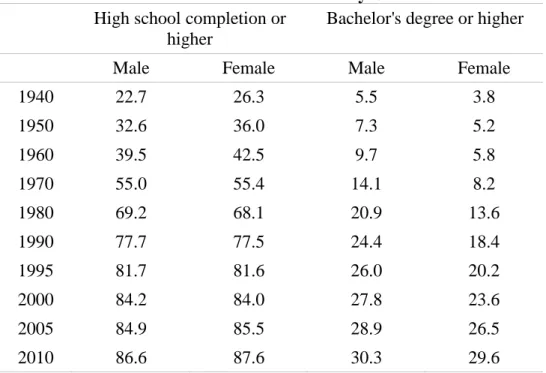
10. Table 2.2 Educational Attainment over Time by Gender ...66
11. Table 2.3 Unemployment by Educational Attainment, 2010 ...67
12. Table 2.4 Earnings by Educational Attainment, 2010 ...68
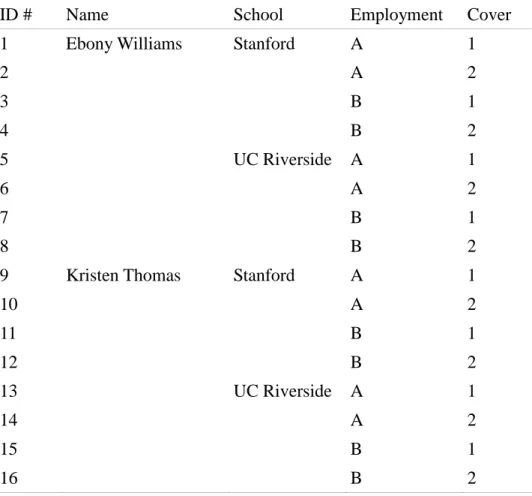
13. Table 3.1 Audit Design Matrix – First Round of Pilot Data Collection...108
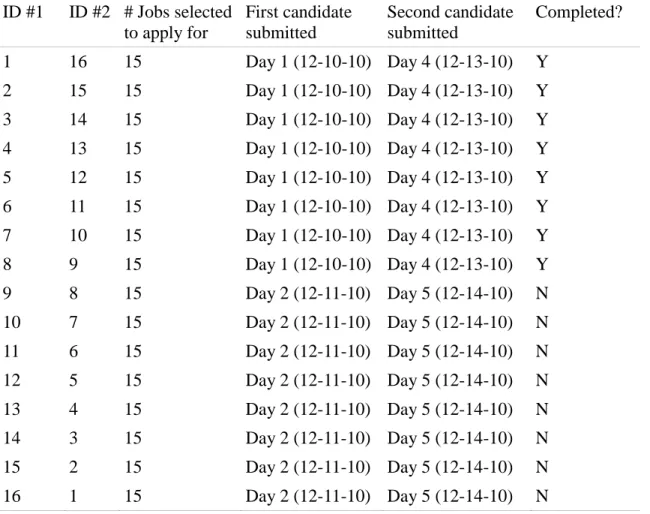
14. Table 3.2 Candidate Profiles and Submission Timeline – First Round of Pilot Data Collection ...109
15. Table 3.3 Audit Design Matrix – Second Round of Pilot Data Collection ... 110
16. Table 3.4 Candidate Profiles and Submission Timeline – Second Round of Pilot Data Collection ... 111
17. Table 3.5 Employer Responses by College – Second Round of Pilot Data Collection ... 112
18. Table 3.6 Employer Responses by Race – Second Round of Pilot Data Collection ... 112
xii
20. Table 3.8 Basic Matching Procedure – Full Data Collection ... 114
21. Table 3.9 Names by Mother’s Race and Mother’s Education... 115
22. Table 3.10 Audit Design Matrix – Full Data Collection ... 116
23. Table 3.11 Applicant Descriptive Statistics – Full Data Collection ... 117
24. Table 3.12 Employer Descriptive Statistics – Full Data Collection ... 118
25. Table 4.1 Logistic Regressions Predicting Employer Response ...137
26. Table 4.2 Fixed-Effects Logistic Regression Predicting Total Employer Response ...138
27. Table 4.3 Logistic Regressions Predicting Employer Response (with Race Interactions) ...139
28. Table 4.4 Logistic Regressions Predicting Employer Response (with Gender Interactions)...140
29. Table 5.1 OLS Regressions Predicting Listed Salary Range of Job Advertisements ...162
30. Table 5.2 OLS Regressions Predicting Listed Salary Range of Job Advertisements (Alternate) ...163
31. Table 5.3 OLS Regressions Predicting Listed Salary Range of Job Advertisements (Alternate 2) ...164
LIST OF FIGURES
Figure
1. Figure 3.1 Sample Resume – Aubrey Clark, Duke University ... 119
2. Figure 3.2 Sample Resume – Nia Price, University of North Carolina at Greensboro ...120
3. Figure 3.3 Employer Descriptive Statistics – Full Data Collection ...121
4. Figure 4.1 Employer Responses by College Selectivity ...141
5. Figure 4.2 Employer Responses by College Major ...142
6. Figure 4.3 Employer Responses by Race ...143
7. Figure 4.4 Employer Responses by Social Class ...144
8. Figure 4.5 Employer Responses by Gender ...145
9. Figure 4.6 Employer Responses by Region ...146
10. Figure 4.7 Employer Responses by Race and College Selectivity ...147
11. Figure 4.8 Employer Responses by Race and College Major ...148
12. Figure 4.9 Employer Responses by Race and Social Class ...149
13. Figure 4.10 Employer Responses by Race and Gender ...150
14. Figure 4.11 Employer Responses by Race and Region ...151
15. Figure 4.12 Employer Responses by Gender and College Selectivity ...152
16. Figure 4.13 Employer Responses by Gender and College Major ...153
17. Figure 4.14 Predicted Probabilities of Employer Response (Race, Gender, Social Class, and College Selectivity) ...154
18. Figure 4.15 Predicted Probabilities of Employer Response (Race, Gender, College Selectivity, and College Major) ...155
19. Figure 4A.1 Employer Responses by Gender and Social Class ...182
xiv
21. Figure 4A.3 Employer Responses by Gender and College Major ...184
INTRODUCTION
Economic inequality on the basis of race and gender remains an important topic in
U.S. society today. Prior to the civil rights movement of the 1950s and 1960s and the
feminist movement in the 1960s through the 1980s, racial and gender inequality were a
given. Structural barriers and outright discrimination prevented or severely limited
African-Americans and women from certain educational and occupational sectors. When
doors were open to these groups, they often were for opportunities that did not equal
those of white men.
However, during the past three decades racial and gender economic inequality
both have declined significantly. Policy, public opinion, and social backlash over unequal
treatment have slowly prodded progress forward. But despite the expansion of
opportunities at all levels of education and more diversity across occupational sectors,
economic inequalities still persist. Among bachelor's degree holders, women make
approximately 75% of the wages of men, black men make approximately 75% of the
wages of white men, and black women make approximately 90% of the wages of white
women (Bradbury 2002). In fact, racial differences in earnings (Cancio, Evans, and
Maume 1996; Zhang 2008) and unemployment (Wilson, Tienda, and Wu 1995) are
highest among bachelor's degree holders. This raises the question: What explains current
2
Educational Credentials
One potential explanation is simple differences in educational credentials across
groups. Even among bachelor’s degree holders, important qualitative variables such as
where people go to college and their major of choice may explain economic inequality.
However, we must come to two conclusions to accept the educational credentials
argument. First, there must be a tangible effect of educational credentials on labor
market outcomes. In other words, does having a college degree from an elite university
such as Harvard increase an individual’s opportunities in the labor market over a degree
from a less selective university such as the University of Massachusetts at Amherst?
Second, there must be significant disparities from the overall population in the
percentages of individuals from different social background categories with certain
educational credentials. For instance, are black graduates from Harvard
under-represented compared to white graduates from Harvard?
A significant portion of this dissertation addresses the educational credentials
issue. There is no denying that simply obtaining a college degree is beneficial.
Individuals with a bachelor's degree earn nearly $22,000 more per year than individuals
with just a high school diploma and expected lifetime earnings for holders of bachelor's
degrees are 66% higher than for high school graduates (Baum, Ma, and Payea 2010).
What is still unclear is what contributes to the inequality among bachelor’s degree
holders. As educational attainment has expanded dramatically over the past few decades,
obtaining a bachelor's degree differentiates an individual from other individuals less now
than it did in the past. This increase in bachelor's degree holders has been matched by an
Murnane 1992). Essentially, educational credentials from different institutions and in
different majors of study result in horizontal stratification, or differences between
individuals with the same educational attainment (Gerber and Cheung 2008). With the
number of college graduates growing every year, attention to this additional layer of
inequality that stems from higher education is more important now than ever.
Discrimination
The other major explanation for economic inequality is discrimination. But does
discrimination in the U.S. still occur today? This may seem like a simple question for
social science researchers, but measuring and explaining discrimination is far from a
simple task. Surveys show that the general public either doesn't believe racial
discrimination still exists or that it is not a major hindrance in the lives of non-whites
(Bonilla-Silva 2010; Schuman et al. 2001). Social science research on discrimination has
come under attack, while media figures debate the existence of discrimination and its
impact on various groups. Even prominent economist James Heckman has referred to
discrimination as “the problem of an earlier era” (1998:102), while Stephen and Abigail
Thernstrom argue that the serious decline in overt racial discrimination can be equated to
a more racially harmonious America (1997). The matter is not just academic;
discrimination has been cited as both a reason to overturn affirmative action in college
admissions (and to legal effect in California) (Connerly 2008) and as a reason to maintain
such programs (Bowen and Bok 2000).
The modern debate has shifted due to the legal changes just a few short decades
ago that now protect women and minorities. While researchers in the 1980s and even
4
surveys and interviews, fear of lawsuits and social desirability bias reduce the viability of
these research methods in assessing discrimination today. Moreover, many employers
may rationally engage in a form of discrimination known as statistical discrimination by
using stereotypes and inferred group averages to make important employment decisions
without malicious intent.
Using An Audit Study to Examine Inequality
I suggest that researchers have ignored an important tool in the methodological
repertoire that can help shed some light on educational credentials and discrimination in
the labor market. An experimental research design known as the audit study provides a
unique way to match similar individuals to examine how differences between them affect
an observed outcome. This methodology has been used in a variety of disciplines to
examine issues such as housing and labor market discrimination. In particular,
researchers have focused on the low-wage labor market but this method also lends itself
well to examine questions regarding the effect of educational credentials on labor market
outcomes. In this dissertation, I use a more modern application of the audit methodology
to examine educational credentials and discrimination in greater detail.
Organization
In the first chapter of this dissertation, I review the evidence on the effects and
mechanisms of educational credentials in the labor market with particular attention to
differences in attainment across groups and over time. In Chapter 2, I explore the
literature on discrimination and highlight the evolution of methods to distinguish
discrimination as the nature of discrimination itself changed over time. Chapter 3
dissertation: two rounds of pilot studies and a full round of data collection from which I
draw on in the results chapters. The next two chapter include analyses of the results of
my audit study. These chapters are divided into two types of dependent variables:
employer responses to candidates and characteristics about the jobs for which candidates
receive responses. In Chapter 6, I wrap-up with discussions of the implications of my
CHAPTER 1.
THE EFFECTS AND MECHANISMS OF EDUCATIONAL CREDENTIALS IN THE LABOR MARKET
Does Education Affect Labor Market Outcomes?
“The development of the diploma from universities...support[s] their holders' claims to...monopolize socially and economically advantageous positions.” Max Weber, from “The 'Rationalization' of Education and Training”
(1922/1978:1000)
In theorizing about the role of education in society, Weber (1922/1978) suggested
that education may serve as a selection mechanism and promote the most deserving
members of society in a meritocratic fashion, or may conversely serve as an instrument of
those in power to maintain and reproduce the current system. This basic question has led
to much debate among scholars in an effort to determine whether education serves as a
pathway for mobility or if the game is rigged and simply reproduces the existing social
structure. From one perspective, the U.S. education system is a model of contest
mobility, one that promotes individual competition based on merit (Turner 1960). From
another perspective, it is a nearly closed system that restricts mobility to a limited few
(Sorokin 1927/1959).
Early queries into this issue, known as status attainment research in sociology,
sought to uncover the most important factors in determining occupational status and
earnings. Such research hinges on two possible findings. First, if background
in an individual's adult status, the education system limits social mobility. Conversely, if
years of education are the most important factor in an individual's adult status, the
education system promotes social mobility.
Among early status attainment research, a number of scholars using different data
sources consistently found that educational attainment is the most important factor in
explaining occupational status. One standout piece of work is Blau and Duncan's The American Occupational Structure (1967). Using advanced statistical techniques for the time, the authors found that a respondent's education has the largest effect on both the
occupational status of their first job and their current (at the time of the survey)
occupation. However, father's education and occupation also have direct effects on
respondent's education and thus indirect effects on respondent's occupation. This
mediating effect is of critical importance because it suggests reality is somewhere
between a full meritocratic system and a system the reproduces social structure.
Other status attainment research and research in the tradition of the Wisconsin
Model (Sewell and Hauser 1975) supports Blau and Duncan's findings and suggests that
the education system contributes to social mobility, albeit not completely devoid of
influence from social class origin (Alexander and Eckland 1975; Duncan, Featherman,
and Duncan 1972; Eckland 1965; Lipset and Bendix 1959; Sewell, Haller, and Ohlendorf
1970; Sewell, Haller, and Portes 1969; Sewell and Hauser 1972, 1975; Sewell and Shah
1967). However, it is important to note that the vast majority of this research is based on
the experiences of white men. Additionally, findings from the Coleman report (Coleman
et al. 1966), which suggest that family background characteristics play a significant role
8
(Jencks et al. 1972; Jencks et al. 1979) highlight the importance of social class and other
background characteristics in mediating the effect of education on earnings. Although
this research raises doubts about the overall contribution of education in social mobility
versus social reproduction, it still presents significant evidence of the influence of
education on labor market outcomes.
Recent, albeit correlational and cross-sectional, data give some additional insights
on the connection between educational attainment and labor market outcomes. As Table
1.1 indicates, educational attainment is negatively correlated with unemployment rates.
Even during the recession economy of 2010, unemployment rates were lower for more
highly educated groups. This pattern is replicated across all racial groups and for both
men and women, even if some groups benefit more than others (see section 2 for an
in-depth discussion). Scholars suggest that the benefit to education is even more
pronounced during a recession: employers are more reluctant to lay-off more educated
workers (Mincer 1991) and simultaneously increase job qualification requirements
(Devereux 2004).
Table 1.2 shows mean earnings by educational attainment in 2010 using data from
the Current Population Survey. This table suggests that earnings are positively correlated
with educational attainment. Even individuals with some college, but no degree, earn
more than high school graduates. Bachelor's degree holders earn nearly 180% as much as
individuals with a high school degree. Once again, all racial groups and both men and
women have similar patterns.
More sophisticated models agree with the basic patterns presented here (Grusky
2000). Since the early status attainment studies, researchers have developed more
advanced statistical techniques and collected better data with larger sets of control
variables. The effects of social origin (e.g. social class) and ascribed statuses (e.g. race,
gender) on educational attainment (Alon and Tienda 2007; Buchmann and DiPrete 2006;
Goldrick-Rab 2006; Lucas 2001), as well as the effect of educational attainment on labor
market outcomes (Elman and O'Rand 2004; Goldin and Katz 2008; Warren, Hauser, and
Sheridan 2002) are well established areas of inquiry in sociology and economics.
However, scholars typically simplify educational attainment by using either a linear
variable representing the total number of years of schooling or a non-linear variable
representing the highest degree obtained (see Smith 1995). In the following sections, I
make a case that in today's society of expanding educational credentials more attention
should be paid to the nuances within these categories, as horizontal stratification may
serve to help researchers explain social inequality and processes of mobility in greater
detail. First, though, I turn to the rich theory regarding the mechanisms of educational
credentials.
Why Do Educational Credentials Matter?
“Education is the most important determinant yet discovered of how far one will go in today's world.” Randall Collins, from The Credential Society (1979:3) In 1980, just one year after Collins' influential book The Credential Society,
17.0% of the U.S. population 25 and older had at least a bachelor's degree, up from 7.7%
in 1960 (U.S. Department of Education 2009: Table 8). By 2009, this percentage had
grown to 29.5% (ibid). In just a few short decades, a college education for their children
has become the goal of the vast majority of families. But college requires foregoing
10
increasing college enrollments and graduates suggest that both potential employees and
employers see value in education. If we believe that education has at least some
influence independent of social class origin on occupational status, the next step is to
investigate why education has value in the labor market.
Scholars invoke two main sociological theories, the functionalist and the conflict
perspectives, as potential explanations for the necessity of education and credentials in
the labor market and thus the rise of educational attainment over time. Functionalist
theory stems from Davis and Moore (1945), who argue that society must match a variety
of individuals to locations within society in an efficient manner (also see Merton 1963
and Parsons 1967 for more detailed treatises on functionalism). An adaptation of this
theory states that education serves to provide individuals with the skills and knowledge
required of employees to perform certain jobs (Collins 1971). Thus, as society becomes
more technologically advanced, employers require more workers with greater education.
Certain jobs are always more complex and/or important than others and society must be
able to steer the best individuals to those jobs. The value of education comes in matching
the needs of employers with the skills and knowledge of employees.
A. Why Do Educational Credentials Matter? Human Capital
David Bills (2004) frames the functionalist perspective as one based in a
meritocratic world. An efficient society must get the most intelligent, able, and driven
members of society into the most complex, demanding, and important jobs. In a fully or
mostly meritocratic society, this is accomplished by associating the highest level of
rewards with these jobs. Individuals are then encouraged to work hard to win these
The idea of the U.S. as a meritocratic society is undoubtedly the dominant
paradigm in popular culture and media. Economists since at least the 1950s have adopted
these ideas in developing theories and empirical research to explain the links between
educational attainment and the labor market (Becker 1964; Blaug 1972; Bowman 1966;
Mincer 1958, 1989; Schultz 1962). Known as human capital theory, this work suggests
that individuals enter the labor force with no previous work experience and thus no
history of job specific skills. Schooling, however, provides individuals with general
skills and abilities (human capital) that are valuable in a wide variety of jobs. Human
capital theorists argue that individuals act rationally by investing in education, while
employers act rationally by investing in those individuals who are educated. Thus, under
human capital theory, the value of education comes from the general skills and abilities
that education provides to students.
Human capital theory is not without its critics, however. What is unclear from
human capital theory is how employers measure the skills and abilities obtained from
education, as researchers themselves do not measure but instead proxy for these concepts
using educational attainment (Bills 2003; Kingston 2006; Rosenbaum 1986). Nor do
researchers even have a firm grasp of what these skills are, as Bowles, Gintis, and
Osborne point out: “...we know surprisingly little about what skills make up the vector of
individual capabilities contributing to higher earnings” (2001:1137). Like the
functionalist perspective itself, the existence of the specified outcome is often used as
evidence supporting the theory (Bills 2004). This critique has led, in part, to more
specific although not more easily measurable theories regarding the link between
12 2003).
Screening, also known as filtering, provides employers a way to sort individuals
on typically difficult to observe measures such as skills, ability, motivation, punctuality,
or perseverance (Arrow 1973a; Riley 1976; Stiglitz 1975; Wolpin 1977), while signaling
provides individuals with a way to tell employers about these characteristics (Berg 1971;
Spence 1973, 1974, 1981, 2002). Employers have imperfect information about these
individual characteristics but know that they impact productivity and job performance.
Yet, according to these theories, individuals know themselves better than anyone else.
Education, then, serves two purposes: (1) it provides individuals with a way to signal
information about their skills and abilities to employers and (2) it provides employers
with an existing sorting mechanism, as only the most motivated individuals with the
highest ability levels can get into and complete college. Under this theory, education may
or may not increase an individual's knowledge, abilities, and skills but nonetheless is
useful to employers (Psacharopoulos 1979; Thurow 1975; and see Brown and Sessions
1999 for a review).
Just as human capital theory struggles with issues of measurement, testing
theories of screening and signaling is difficult as well. From the signaling perspective,
how does one measure how well individual choice in education captures skills, ability,
and motivation? Scholars have been critical of the lack of empirical tests of these
theories (Borjas 1991; Manski 1993). However, recent work examining what students
learn in college suggests that overall modern colleges are not significantly increasing the
skills and abilities of graduates, but rather putting a stamp of approval on their
B. Why Do Educational Credentials Matter? Cultural Capital
In contrast to the functionalist perspective, conflict theory suggests that certain
groups have status within certain domains, such as economic, power, or cultural, and
work to maintain an advantage over other groups (Weber 1922/1978). Thus, groups can
maintain advantages in employment by enacting cultural standards of educational
requirements as barriers to entry (Collins 1971). Employers maintain status groups by
hiring similar individuals on the basis of group membership using educational credentials
as a marker. Scholars also often draw upon the work of Pierre Bourdieu (Bourdieu 1977;
Bourdieu and Passeron 1970) to explain credentialism as a form of cultural capital that
works to exclude members outside of the upper class.
One of the earliest works from this viewpoint on educational credentials was Ivar
Berg's Education and Jobs: The Great Training Robbery (1971). Using data from the 1950s and 1960s to measure change, he argues that educational attainment during this
time outstripped the skill demands of jobs. He finds that skills are mostly learned after
employment. Additionally, he uses interview data to examine the use of educational
requirements and finds that employers often report the use of education as a “screening
device” (15). He uses this evidence to make the case that the human capital theorists are
wrong and education serves a different function in society:
“Educational credentials...will most certainly reinforce the formidable class barriers that remain, even without the right within families to pass benefices from parents to their children.” (1971:185).
Thus, educational attainment may signal something different to employers other than the
unobservable characteristics suggested by economists: social class.
14
In his review of the previous research and data, he finds a pattern of evidence that
supports the conflict theory. Like Berg, he suggests that there is a mismatch between
educational attainment and the technological skill requirements of jobs and that skills
come from experience in the labor force. Moreover, he suggests that the available
evidence indicates that education does not increase productivity. Like Bourdieu (1977),
Collins argues that educational attainment creates and reinforces a particular cultural
disposition through socialization and credentials serve to certify the existence of that
cultural disposition.
In an argument that parallels the cultural capital hypothesis, Samuel Bowles and
Herbert Gintis (1976) reject the human capital focus on skills and instead posit that
employers seek certain types of behavior that are enforced by schools. Known as the
correspondence principle, this theory suggests that higher education and more selective
schools enforces critical thinking and independence, while lower tracks of educational
attainment enforce passivity and obedience. Over time, their argument has shifted
somewhat to focus on the importance of more general non-cognitive skills and behavior
(2000; 2002) but still suggests the importance of educational attainment to employers.
The language behind these theories is broad and often does not clearly specify
some of the concepts used to explain why educational attainment matters in the labor
market. Although scholars use a number of data sources and conceptualizations to try to
understand these processes, empirical support is scattered and somewhat weak (Kingston
2006). Much of the debate on human capital in recent years focuses on the separate
effects of ability (IQ, test scores, grades, etc.) and educational attainment (Bowles, Gintis,
2000). Some credentialists cite a “sheepskin effect”, or a non-linear effect of educational
attainment on labor market outcomes to suggest evidence against human capital theory
(Belman and Heywood 1991), although there is limited empirical support for this effect
(Hunter and Leiper 1993; Jaeger and Page 1996; Jencks et al. 1979). Still others
recommend more macro-level approaches that focus on over-education and skill
differentials between workers and positions (Brown 1995; Labaree 1997).
Employment projections from the U.S. Bureau of Labor Statistics (2010) shed
some light on the overall situation in the labor market. The projections suggest that
between 2008 and 2018, nearly 51 million job openings will become available. An
overwhelming majority of these job positions require less than a bachelor's degree. In a
separate analysis of the match between required education and training versus actual
employment by educational attainment, data from 2008 suggest that many employees are
overeducated compared to what their job requires (Ramey 2010). These results are quite
suggestive of Berg (1971), Collins (1979) and the other scholars in the tradition of
credentialism.
It is important to pause and take stock of the theories presented here. In a society
based on merit, employers use educational attainment to help them select the employees
with the best skills, abilities, motivation, etc. In a society based on social reproduction,
employers use educational attainment to help them select the employees with the proper
group membership, cultural values, and behavior. The literature suggests that the U.S. is
a mix of these two worlds, perhaps leaning more to the side of meritocracy. My intent is
not to adjudicate between these theories, but rather to highlight the importance of
16
credentials in making hiring decisions, one thing is for certain: during the early stages of
an individual’s employment career, the information available to employers is extremely
limited. These individuals do not yet have a proven track record of employment, forcing
employers to rely on educational credentials as a proxy. In the next section, I suggest that
the expansion of educational attainment in the U.S. has increased the importance of
where individuals obtain their degrees.
Why Might Where You Receive Your Education Matter?
In the previous two sections, I established that education affects labor market
outcomes and discussed theories regarding why education matters for entry into the labor
market. However, differentiation of educational attainment has dramatically changed in
the decades that followed much of the theories discussed. In 1970, a high school diploma
was still a credential that separated an individual from nearly half of the U.S. population
(see Table 1.3). By 2010, that mark signifies nearly nothing on its own, as 87% of the
population has at least completed high school (ibid). The percentage of college graduates
has followed a similar path, increasing every decade. Between 1970 and 2010, the
percentage of the population with a bachelor's degree or higher grew from 11% to nearly
30%. A number of scholars argue that it is the desire of individuals to distinguish
themselves through educational attainment, and not the skill needs of the labor market,
that has driven increases in educational credentials (Brown 1995; Collins 1979; Labaree
1997).
Prior theoretical work on educational inequality suggests that as a particular level
of educational attainment becomes more commonplace, individuals must distinguish
1972; Lucas 2001; Raftery and Hout 1993). With the expansion of higher education, the
premium in the return to a college degree over a high school degree has fluctuated but
inequality among college graduates has risen (Freeman 1976; Hoxby and Long 1999;
Levy and Murnane 1992). Employers now have a larger pool of applicants to choose
from who fit certain educational requirements. If the skill requirements of jobs have kept
up with the expansion of education, or if employers want to keep barriers at the same
relative levels, they realistically have two options: increase the educational requirements
of jobs even further or be more selective among those with similar educational
attainment. The first option would lead to more job openings requiring master's and
higher degrees. The second option would lead to greater value to credentials from more
selective colleges.
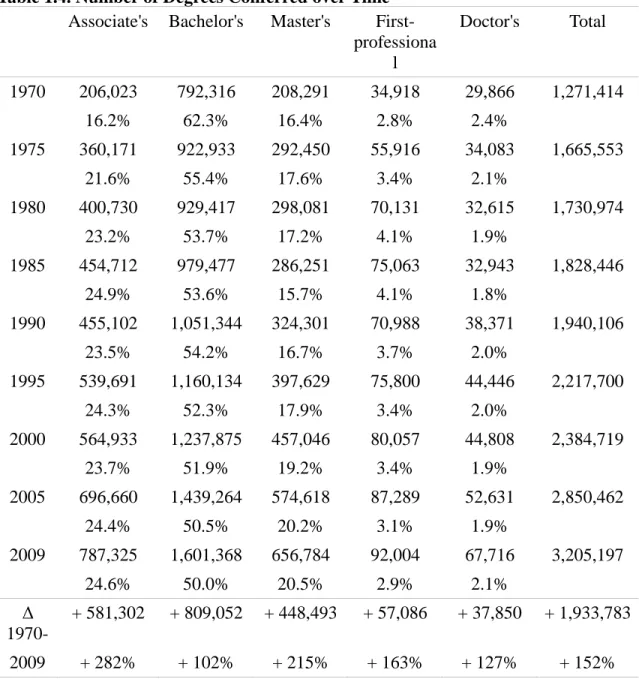
To address the first option, let's examine the number of degrees conferred by type
over time. The numbers in Table 1.4 indicate that in 1970, 62% of degrees conferred
were bachelor's degrees and 16% of degrees conferred were master's degrees. By 2009,
these numbers had shifted so that only 50% of degrees conferred were bachelor's degrees
and 21% of degrees conferred were master's degrees. In raw numbers, 809,052 more
bachelor's degrees were conferred in 2009 compared to 1970 (a 102% increase) and
448,493 more master's degrees were conferred in 2009 compared to 1970 (a 215%
increase). We can also see that over this time the growth of associate's degrees (282%
increase) outpaced the growth of both bachelor's and master's degrees. These changes
likely indicate more specific specialization on the low end of the labor market (associate's
degrees prepare individuals for specific jobs) or the population’s growing understanding
18
job requirements at the high end of the labor market. A movement to increase job
requirements and select only those with greater than a bachelor's degree is possible,
although unlikely the norm. Data from the U.S. Bureau of Labor Statistics indicate that
in 2008, 90% of all jobs required a bachelor's degree or less, suggesting that many
employees are overeducated (Ramey 2010). Bachelor's degrees still make up the
majority among degrees conferred and degree holders (in terms of those who are college
educated). Thus, most employers choose employees from a large group of individuals
entering the job market who are homogeneous in terms of total educational attainment,
but heterogeneous in other ways. Perhaps the most important or at least easily measured
way is where an individual obtains their degree.
A. Why Might Where You Receive Your Education Matter? Human Capital
If we believe that the U.S. is a meritocratic society, one where employers look for
the most skilled employees, why might we expect where an individual obtains their
college degree to matter? One reason is that more selective schools produce graduates
with better skills and abilities. In fact, if we accept the ideas of some screening theorists
(Psacharopoulos 1979; Thurow 1975), the “black box” of education doesn't even have to
alter the skills and abilities of the inputs. The most selective colleges simply work as a
screening device for employers, selecting the best individuals out of high school and
eventually passing them along into the labor market.
At minimum, then, do the top colleges and universities have students with greater
skills and abilities at entry? This is a difficult question to answer because, as you will
recall, the human capital scholars admit to having only a vague sense of what these skills
scores are related to job performance and productivity independent of educational
attainment (Hunter 1986; Schmidt 2002; Schmidt and Hunter 1998; although see Hauser
2011 for an alternative view). Scholars also suggest that using educational attainment as
a screening device results in candidates with higher cognitive ability (Berry, Gruys, and
Sackett 2006). Thus, if we consider cognitive ability to at least proxy for the skills and
abilities that human capital researchers stress, we can examine how this varies among
different colleges.
If we believe SAT scores are a valid measure of cognitive ability, then more
selective schools do indeed have students with greater ability: the top 20 colleges in the
U.S. News and World Report national rankings (2011) have average SAT scores between
2002 (25th percentile) and 2286 (75th percentile), while colleges ranked 100 positions
lower (101-120) have average SAT scores between 1552 (25th percentile) and 1893 (75th
percentile) (author calculations from National Center for Education Statistics 2011).
Additional findings from the Intercollegiate Studies Institute suggest that political and
historical literacy are correlated with selectivity (Toby 2010:126). Other research
suggests that the most selective colleges also rely on test scores more in admissions
factors (Alon and Tienda 2007). These results suggest that the most elite colleges at least
select the students with the highest skills and abilities, even if they do not alter them
during an individual's college career.
B. Why Might Where You Receive Your Education Matter? Cultural Capital
Conversely, if the U.S. is a society that reproduces the social structure, one where
employers look for the individuals from the “proper” social background, why might we
20
more selective schools enroll students of high social status and class backgrounds. As
Table 1.5 shows, nearly 40% of college students from the lowest income bracket attend
public 2-year colleges, compared to only 17% of college students from the highest
income bracket. Meanwhile, 45% of college students from the highest income bracket
attend public 4-year colleges, compared to only 32% of college students from the lowest
income bracket, and 26% of college students from the highest income bracket attend
private not-for-profit colleges, compared to only 12% of college students from the lowest
income bracket. Data from the National Educational Longitudinal Survey suggest that
the disparity is even wider when selectivity is considered (see Soares 2007:4). Clearly,
students from privileged social class background take more of the enrollment slots at the
top colleges and universities (for additional research, see Kingston and Lewis 1990).
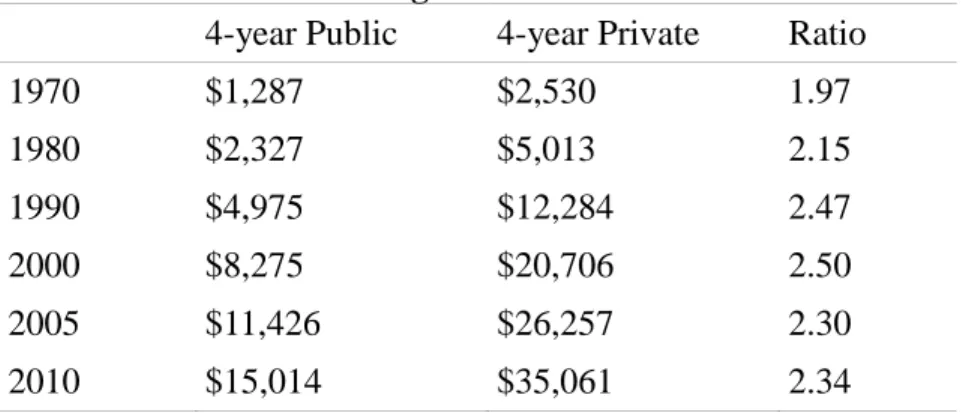
Attendance, if not acceptance, at the top universities likely presents a class barrier due to
the maintenance over time of a large gap (at least 2.0 since 1970) between the estimated
attendance costs of a 4-year private versus 4-year public institution (see Table 1.6).
Finally, at least among public universities, students from the most advantaged social
backgrounds are more likely to graduate (Bowen, Chingos, and McPherson 2009) and the
graduation rate gaps between income quartiles are highest at the most selective colleges
(Carnevale and Rose 2003).
The theory and data presented in this section suggest that employers have more
power than individual job seekers. With the percentage of college graduates continually
increasing, employers can afford to be more discerning among college graduates, whether
justified by job demands or not. It is unlikely that this oversupply of college graduates
outcomes, there are well defined, if not well tested reasons why this occurs, and the
expansion of higher education has changed the options for employers. In the next
section, I turn to the limited existing research on the effect of college selectivity on labor
market outcomes.
Does Where You Receive Your Education Matter?
In 2010, tuition and fees cost $38,416 at Harvard University, the number 1 ranked
national university by U.S. News and World Report (2011). By contrast, out-of-state
tuition and fees at the 99th ranked University of Massachusetts-Amherst were a little over
half that sum at $20,307 (ibid). Students, parents, educators, and researchers alike stand
to benefit from knowing if more selective schools are worth the additional cost.
Surprisingly, some of the most recent research in this area suggests that they are not, at
least in terms of an effect on income (Dale and Krueger 2002, 2011). Still, other results
show that students at more selective colleges are more likely to graduate, more likely to
attend graduate or professional programs, and earn higher wages on the labor market
(Alon and Tienda 2005; Bowen and Bok 2000; Brand and Halaby 2006; Brewer and
Ehrenberg 1996; Light and Strayer 2000; Zhang 2005).
Early research in this area typically uses broad categorical classification such as
elite or prestigious schools and estimates the effects of these categories on occupational
status and income later in life (Griffin and Alexander 1978; Havemann and West 1952;
Morgan and Duncan 1979; Solmon 1973; Solmon and Wachtel 1975). These studies find
positive and significant effects of college type on occupational status and wages, but
much like the early status attainment literature, many of these studies focus only on
22
More recent studies using the categorical comparison use more representative
samples. One such study uses data from the National Longitudinal Study of the High
School Class of 1972 (NLSHS72) and High School and Beyond to examine the effect of
a degree from different colleges on wages (Brewer, Eide, and Ehrenberg 1999). The
authors find significant positive effects on wages from attending elite and middle-tier
private institutions and a limited effect from attending an elite public institution when
compared to a bottom-tier public institution. Additionally, Monks (2000) finds a wage
benefit to a degree from a research institution compared to a liberal arts university.
However, not all research finds significant effects of college selectivity, suggesting that
there may be difficulties in measuring returns in the labor market (see Dale and Krueger
2002, 2011).
Research that uses non-experimental data is subject to potential bias due to the
correlation between unobserved factors that may influence both admission and attendance
at selective colleges and the examined outcomes, such as graduation rates and wages
(Foster and Rodgers 1979; Gerber and Cheung 2008). For example, student ability and
motivation may be partially or completely unmeasured, but we may assume these
variables are correlated with both a student's attendance at a more selective school and
her success on the labor market. A student may choose not to go to a more selective
college if she believes the eventual wage benefit will not outweigh the cost of tuition,
leading to biased estimates in regression coefficients. Selection bias makes it difficult to
determine if employers place different values on college degrees based on college
selectivity.
more sophisticated methodological techniques to address selection bias. Black and Smith
(2004) primarily use ASVAB test scores to match similar individuals from different
institutions using propensity scores and find that college selectivity has a positive effect
on wages. However, the authors also note a number of difficulties in using this method
with their data, particularly in matching attendees of non-selective colleges with high
propensities to attend a highly selective college. Using a regression discontinuity design
Hoekstra (2009) finds that white men who barely made the admissions cut-off at a
flagship state university experience 20% higher wages than white men who barely missed
the admissions cut-off, suggesting that the credential itself, rather than prior human
capital, increases value in the labor market. Dale and Krueger (2002) use the College and
Beyond Survey (C&B) to examine wage returns 15 years after graduation. The authors
find no effect of college selectivity when matching students based on institutions they
were admitted to but did not attend. In a follow-up piece, Dale and Krueger (2011)
include an additional cohort from the C&B and again find no effect of college selectivity
on earnings in models adjusted for selection. Additional research that addresses selection
bias finds varying results on the existence and size of bias in non-adjusted OLS
regression estimates examining the effect of college selectivity on wages (Behrman,
Rosenzweig, and Taubman 1996; Brand and Halaby 2006; Long 2008). Thus, although
research that does not adjust for selection suggests that there is an effect of college
selectivity on wages, the research that does adjust for selection presents mixed findings.
One recent qualitative study focuses on the employers and recruiters who are in
positions to hire recent graduates (Rivera 2011). The author finds that nearly 80% of the
24
candidates. Additionally, these employers often mentioned that they only reviewed
candidates from elite private schools. In some cases, firms had strong ties with specific
elite schools, spending millions of dollars on recruitment activities and using a full time
employee liaison at these schools. This research suggests that, at least in some cases of
elite schools, individuals may reap large benefits from both the signal of their degree and
the social capital unlocked by their institution.
Why Might Your College Major Matter?
Although the choice of where to obtain a degree is ultimately vitally important to showing human and cultural capital in the labor market, what to study, or college major choice, is also a critical part of an individual’s ability to display their skills to employers
in the labor market. In fact, college major choice may represent both human capital, such
as ability and preparation, and other characteristics, such as expectations regarding future
earnings and preferences (Altonji, Blom, and Meghir 2012). Thus, although college
major choice may represent human capital, employers do not know for certain how strong the link between college major choice and human capital is for any single individual.
Some college majors have clear pathways between choice and career (also known as
occupational specificity – see Roksa and Levey 2010 for a review), such as engineering
or nursing. Other college majors ideally prepare individuals for a wider range of
employment prospects, such as math and the social sciences. In this section, I am more
interested in those college majors because they require employers to make assumptions
and predictions about human capital.
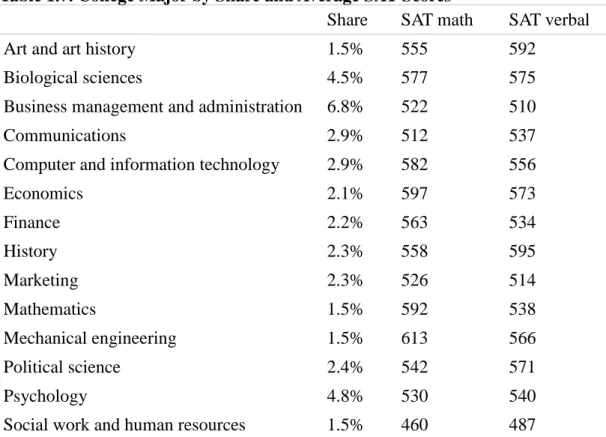
Data from the National Center for Education Statistics’ Baccalaureate and Beyond
college entry and college major choice. Table 1.7 shows a selected group of college
majors, the overall share from the sample for each major, and the average SAT scores for
each major. Students who major in social work and human resources (460 math, 487
verbal SAT scores) or business management and administration (522 math, 510 verbal
SAT scores) appear on the low end of the human capital scale. Students who major in
economics (597 math, 573 verbal SAT scores) or history (558 math, 595 verbal SAT
scores) appear on the low end of the human capital scale. These descriptive statistics
show that there is a significant amount of variation in human capital among college major
choice.
Does Your College Major Matter?
Much like the literature on college selectivity, the literature on college major
choice is unclear on whether certain college majors have a causal effect on earnings and
other labor market outcomes or simply reflect selection into certain majors on the basis of
prior human capital characteristics. Cross-sectional data show significant variation in
mean wages based on college major. Table 1.8 shows that individuals who major in
social work and human resources ($23,190) or psychology ($24,610) are on the low end
of wages, while individuals who major in economics are on the high end of wages
($43,150).
Early research in this area suggests large effects on earnings for business,
engineering, health, mathematics, and science focused majors (Berger 1988; Rumberger
1984; Rumberger and Thomas 1993). In an attempt to separate human capital from
selection or preferences, Rumberger and Thomas (1993) separately control for college
26
mathematics, and science majors, are rewarded for higher GPAs within major while GPA
does not matter for other majors. Other more recent studies also report premiums to
certain majors even after accounting for GPA, changes in major over time, and rigor of
curriculum (Arcidiacono 2004; Grogger and Eide 1995; Hamermesh and Donald 2008).
An analysis of nationally representative data examining college selectivity and
college major on first year earnings also does well in capturing employer assumptions
about the human capital value of particular degrees since employer have no lengthy
employment and salary history to draw upon during the decision making process.
Thomas (2000) conducts such an analysis using the Baccalaureate and Beyond and finds
that engineering and health major significantly outperform education and humanities
majors. Research examining specific majors instead of broad categories is quite limited
but one example finds large effects on wages for majors such as computer science,
economics, engineering, and mathematics (Altonji, Blom, and Meghir 2012).
One final possibility remains in explaining differences in the economic returns to
college major. Not all college majors lead to similar employment opportunities across
sectors. For instance, Roksa (2005) finds that graduates from certain majors, particularly
those that are traditionally female-dominated, are more likely to be employed in the
public and nonprofit sectors, which explains a significant portion of their lower wages.
Summary and Research Questions on Educational Credentials
The evidence on the quantitative aspect of educational credentials is clear: more years of educational attainment results in better outcomes on the labor market.
those effects? The answer to these questions represents an important piece in
understanding racial and gender economic inequality in the U.S. today. If educational
credentials, particularly the differences in college selectivity and college major, have no
effects on labor market outcomes, it suggests that racial and gender discrimination must
play an incredibly large role in economic inequality. However, if these differences
among college degree holders are important to labor market outcomes, discrimination
might be a minor factor in economic inequality. These questions lead me to my first set
of formal research questions for this study:
(1)Does having a degree from an elite college, rather than a less selective college,
have positive effects on (a) the likelihood of receiving an employer response, (b)
the salary range of jobs, and (c) the type of job?
(2)Does having an economics degree, rather than a psychology degree, have positive
effects on (a) the likelihood of receiving an employer response, (b) the salary
range of jobs, and (c) the type of job?
To address these questions regarding educational credentials, I conducted an
experiment known as an audit study that examines the effects of college selectivity and
college major in the early stages of the labor market. Chapter 3 discusses this type of
research in more detail and gives the specifics of my data collection and analysis. In
Chapters 4 and 5, I present the results from this research. There are some advantages and
28
First, much of the previous literature struggles with addressing specific
mechanisms of educational credentials. The theory is well developed, and Gerber and
Cheung (2008) suggest that research examining college selectivity can consolidate the
various theories into four main mechanisms: (1) human capital, (2) signaling, (3) social
capital, and (4) selection. In terms of college selectivity, I cannot address differences
between mechanisms (1), (2), and (4) but I can remove social capital as a potential
mechanism. In my research, I used candidates to apply for jobs online and employers
had no existing contact or network connections to each candidate, thus eliminating any
social capital effects. Additionally, in terms of college major, I am able to control for
selection into certain employment sectors and examine only outcomes for private and
nonprofit sectors.
Next, it is important to note the differences in outcomes and timing from most of
the prior literature. In my research, candidates did not move beyond the initial contact
phase (typically a request for an interview). Although this is an important phase in telling
us how far candidates might potentially go by showing how opportunities become
constrained early in the process, it does not tell us who would eventually get a job or their
final salary. Moreover, my research focuses on the labor market immediately after
graduation, before employers have additional signals of human capital such as
employment and salary history. As other researchers suggest (Ishida, Spilerman, and Su
1997) the effect of college selectivity at an individual's entry point into the labor market
is likely driven mostly by the signaling effect. The critical contribution of addressing
these questions using the audit data is that it presents the opportunity to examine the
career.
The audit method allows me to isolate the effects of college selectivity and college
major on likelihood of employer response and other characteristics associated with the
job application. Thus, the first stage of this research is to examine whether educational
credentials matter in the labor market, separate from social background characteristics.
In the next chapter, I review the literature on discrimination and race and gender
30
Table 1.1. Unemployment Rate by Educational Attainment, 2010 Unemployment Rate
Less than a high school degree 14.9
High school degree 10.3
Some college 9.2
Associate degree 7.0
Bachelor's degree or more 4.7
Note: Sample of individuals 25 years old and over. Source: Bureau of Labor Statistics 2010.
Table 1.2. Earnings by Educational Attainment, 2010 Earnings
Less than a high school degree $22,635
High school degree $32,812
Some college $38,612
Associate degree $41,529
Bachelor's degree or more $68,603
Note: Sample of individuals 25 years old and over. Source: U.S. Census Bureau, Current Population Survey, 2010 Annual Social and Economic Supplement
32 Table 1.3. Educational Attainment over Time
High school completion or higher
Bachelor's degree or higher
1910 13.5 2.7
1920 16.4 3.3
1930 19.1 3.9
1940 24.5 4.6
1950 34.3 6.2
1960 41.1 7.7
1970 55.2 11.0
1975 62.5 13.9
1980 68.6 17.0
1985 73.9 19.4
1990 77.6 21.3
1995 81.7 23.0
2000 84.1 25.6
2005 85.2 27.6
2010 87.1 29.9
Note: Sample of individuals 25 years old and over. Source: National Center for Education Statistics, 2010 Digest of Education Statistics, Table 8.
Table 1.4. Number of Degrees Conferred over Time Associate's Bachelor's Master's
First-professiona l
Doctor's Total
1970 206,023 792,316 208,291 34,918 29,866 1,271,414
16.2% 62.3% 16.4% 2.8% 2.4%
1975 360,171 922,933 292,450 55,916 34,083 1,665,553
21.6% 55.4% 17.6% 3.4% 2.1%
1980 400,730 929,417 298,081 70,131 32,615 1,730,974
23.2% 53.7% 17.2% 4.1% 1.9%
1985 454,712 979,477 286,251 75,063 32,943 1,828,446
24.9% 53.6% 15.7% 4.1% 1.8%
1990 455,102 1,051,344 324,301 70,988 38,371 1,940,106
23.5% 54.2% 16.7% 3.7% 2.0%
1995 539,691 1,160,134 397,629 75,800 44,446 2,217,700
24.3% 52.3% 17.9% 3.4% 2.0%
2000 564,933 1,237,875 457,046 80,057 44,808 2,384,719
23.7% 51.9% 19.2% 3.4% 1.9%
2005 696,660 1,439,264 574,618 87,289 52,631 2,850,462
24.4% 50.5% 20.2% 3.1% 1.9%
2009 787,325 1,601,368 656,784 92,004 67,716 3,205,197
24.6% 50.0% 20.5% 2.9% 2.1%
Δ 1970-
+ 581,302 + 809,052 + 448,493 + 57,086 + 37,850 + 1,933,783
2009 + 282% + 102% + 215% + 163% + 127% + 152%
Note: Author calculations from data from degree-granting institutions that grant associate's or higher degrees and participate in Title IV federal financial aid programs. Source: National Center for Education Statistics, 2010 Digest of Education Statistics, Table 287.
34
Table 1.5. Postsecondary Sector by Family Income, 2007-8
< $40k 40k – 79.999 80k-119.999 >= 120k
Public 2 year 39% 37% 28% 17%
Public 4 year 32% 36% 44% 45%
Private Not for profit
12% 14% 18% 26%
For profit 8% 4% 2% 1%
Other 9% 9% 9% 10%
Table 1.6. Estimated Average Total Cost of Attendance over Time 4-year Public 4-year Private Ratio
1970 $1,287 $2,530 1.97
1980 $2,327 $5,013 2.15
1990 $4,975 $12,284 2.47
2000 $8,275 $20,706 2.50
2005 $11,426 $26,257 2.30
2010 $15,014 $35,061 2.34
Note: Figures are listed in current dollars. Source: National Center for Education Statistics, 2010 Digest of Education Statistics, Table 345.
36
Table 1.7. College Major by Share and Average SAT Scores
Share SAT math SAT verbal
Art and art history 1.5% 555 592
Biological sciences 4.5% 577 575
Business management and administration 6.8% 522 510
Communications 2.9% 512 537
Computer and information technology 2.9% 582 556
Economics 2.1% 597 573
Finance 2.2% 563 534
History 2.3% 558 595
Marketing 2.3% 526 514
Mathematics 1.5% 592 538
Mechanical engineering 1.5% 613 566
Political science 2.4% 542 571
Psychology 4.8% 530 540
Social work and human resources 1.5% 460 487
Table 1.8. Mean Wages of Selected College Majors Mean Wages
Art and art history $25,570
Biological sciences $27,260
Business management and administration $31,560
Communications $28,170
Computer and information technology $35,830
Economics $43,150
Finance $38,210
History $29,520
Marketing $32,900
Mathematics $37,760
Mechanical engineering $40,430
Political science $33,320
Psychology $24,610
Social work and human resources $23,190