Previous tonsillectomy modifies odds of
tonsil and base of tongue cancer
Jose P Zevallos*
,1,2,3,5, Angela L Mazul
3,5, Nidia Rodriguez
3, Mark C Weissler
1, Paul Brennan
4,
Devasena Anantharaman
4, Behnoush Abedi-Ardekani
4, D Neil Hayes
2and Andrew F Olshan
2,31Department of Otolaryngology/Head and Neck Surgery, University of North Carolina at Chapel Hill School of Medicine, 170 Manning Drive, CB 7070, Chapel Hill, NC 27599, USA;2Lineberger Comprehensive Cancer Center, University of North Carolina at Chapel Hill, Chapel Hill, NC, USA;3Department of Epidemiology, Gillings School of Global Public Health, University of North Carolina at Chapel Hill, Chapel Hill, NC, USA and4International Agency for Research on Cancer (IARC), Lyon, France
Background: Tonsillectomy is a commonly performed surgical procedure that involves removal of the palatine tonsils. The purpose of this study is to examine the association between previous tonsillectomy and odds of oropharyngeal squamous cell carcinoma (OPSCC) in a large population-based case–control study. We hypothesise that previous tonsillectomy is associated with a decreased odds of tonsil cancer with no impact on the odds of developing base of tongue (BOT) cancer.
Methods: This was a population-based, frequency-matched case–control study with multinomial logistic regression, including 1378 controls, 108 BOT cancer cases, and 198 tonsil cancer cases. Demographic and risk factor data were collected using a structured questionnaire during an in-home visit conducted by trained nurse-interviewers. The human papillomavirus (HPV) tumour status was determined through Luminex-based multiplex PCR and p16 status by immunohistochemistry.
Results:Previous tonsillectomy was associated with a nearly two-fold increased odds of BOT cancer (OR¼1.95, 95% CI 1.25–3.06,
P¼0.003) and a large decrease in the odds of tonsil cancer (OR¼0.22, 95% CI 0.13–0.36, Po0.001). When HPV status was
considered, tonsillectomy was associated with a decreased odds of HPV-positive tonsil cancer (OR¼0.17, 95% CI 0.08–0.34,
Po0.001) and an increased risk of HPV-positive BOT cancer (OR¼2.46, 95% CI 1.22–4.95, P¼0.012). When p16 status was
considered, tonsillectomy was associated with an increased odds of p16-positive BOT cancer (OR¼2.24, 95% CI 1.16–4.35,
P¼0.017) and a decreased odds of p16-positive tonsil cancer (OR¼0.14, 95% CI 0.07–0.31,Po0.001).
Conclusions:Previous tonsillectomy modifies the odds of both tonsil and BOT cancer, with decreased odds of tonsil cancer and increased odds of BOT cancer. A history of previous tonsillectomy may play a role in OPSCC risk stratification when considered along with other covariates such as sexual history, smoking status, and age.
Oropharyngeal squamous cell carcinoma (OPSCC) is an increas-ingly common cancer of the upper aerodigestive tract, and includes cancers arising from the tonsils, base of tongue (BOT), soft palate, and lateral and posterior pharyngeal walls. Although traditionally associated with heavy tobacco and alcohol consumption, it is estimated thatB60–70% of incident OPSCC cases are attributable to human papillomavirus (HPV) (D’Souza et al, 2007; Anget al, 2010; Chaturvediet al, 2011). A rise in HPV-positive OPSCC has
occurred since the 1980s in the United States that has been attributed to changing sexual practices beginning in the 1960s (Ernsteret al, 2007; Chaturvediet al, 2013). The HPV epidemic has changed the demographic characteristics of OPSCC patients considerably. Patients with HPV-positive OPSCC are generally younger than those with HPV-negative OPSCC and are often never smokers. An association with increased number of sexual partners and earlier sexual debut has also been demonstrated
*Correspondence: Dr JP Zevallos; E-mail: [email protected] 5
These authors contributed equally to this work.
Received 14 October 2015; revised 29 January 2016; accepted 14 February 2016; published online 15 March 2016
&2016 Cancer Research UK. All rights reserved 0007 – 0920/16 Keywords:oropharyngeal cancer; HPV; tonsillectomy
(D’Souzaet al, 2009; Hecket al, 2010). The HPV-positive OPSCC is an increasingly significant public health problem; it is projected that by 2020 HPV-positive OPSCC will overtake cervical cancer as the most common HPV-related malignancy in the United States (Chaturvediet al, 2011).
Tonsillectomy is a commonly performed surgical procedure that involves removal of the palatine tonsils, most often in children for hypertrophic tonsils, chronic infection, or obstructive sleep apnoea (Derkay, 1993). The rates of tonsillectomy in the United States have changed significantly over the past several decades. Rosenfeld and Green (1990) and others (Derkay, 1993; Ericksonet al, 2009) demonstrated a sharp decline in tonsillectomy rates beginning in the late 1970s. It is well established that an increase in HPV-related OPSCC began to increase in the 1990s (Chaturvedi et al, 2008, 2011, 2013). The association between tonsillectomy and risk of OPSCC has not been extensively investigated. A recent study of the Danish Cancer Registry suggests a reduction in risk of tonsil cancer in patients with a previous history of tonsillectomy (Fakhryet al, 2015). The purpose of this study is to examine the association between previous tonsillectomy and risk of OPSCC using a large North Carolina population-based head and neck cancer case–control study. We hypothesise that previous tonsillectomy is associated with a decreased risk of tonsil cancer with no impact on the risk of BOT cancer.
MATERIALS AND METHODS
Study population. The Carolina Head and Neck Cancer Study (CHANCE) is a population-based case–control study of squamous cell carcinoma of the head and neck (Divaris et al, 2010). Case ascertainment utilised rapid ascertainment of newly diagnosed cancer cases through the North Carolina Central Cancer Registry. Cases were diagnosed with primary squamous cell carcinoma of the oral cavity, pharynx, and larynx between 1 January 2002 and 28 February 2006, were aged 20 to 80 years at diagnosis, and resided in a 46-county region in central North Carolina. Benign tumours, carcinomas in situ, papillary carcinomas, and adenocarcinomas were excluded. Controls were identified through the North Carolina Department of Motor Vehicle records and were frequency matched with cases on age, race, and sex.
The Carolina Head and Neck Cancer Study enrolled 1368 total cases; however, as we are only interested in OPSCC, we restricted the tumour site to only the oropharynx (N¼372). Race other than European American and African American were excluded from the analysis because of sparse numbers (N¼11). As we are interested specifically in the OPSCC subsites, cases were classified into two categories: (1) BOT: C01.9 and C02.4 and (2) tonsil: C09.0, C09.1, C09.8, and C09.9. We excluded OPSCC of the vallecular (C10.0;N¼10), soft palate (C05.1, C05.2;N¼23), and unspecified subsites (C10.8 and C10.9; N¼23) because of small sample size. The HPV typing and p16 immunohistochemistry was performed on all cases of oropharyngeal tumours for which tumour blocks were available (N¼213). All European-American and African-American controls were included in the analysis (N¼1378). This study was approved by the institutional review board at the University of North Carolina at Chapel Hill.
Questionnaire and clinical assessment. Demographic, lifestyle, oral health, diet, and other risk factor information were collected using a structured questionnaire during an in-home visit conducted by trained nurse-interviewers. The median time between diagnosis and in-home interview was 4 months (inter-quartile range: 3–6 months). Two questions addressed a history of previous tonsillectomy, including, ‘Were your tonsils removed?’ and ‘How old were you when tonsils removed?’ For subjects who were unable to recall the exact age of tonsillectomy, the subject was
able to answer child, teenager, or adult. Age at tonsillectomy was defined as before 13 years of age (child) and after 13 years of age (teenager and adult). The CHANCE questionnaire focussed on lifestyle and medical and family history risk factors. Interviewers did not collect information on tonsillectomy performed as part of the diagnostic workup or OPSCC therapy. Confounders to be adjusted for in statistical models were selected a prioribased on their potential association with risk of OPSCC and tonsillectomy. Confounders obtained from the questionnaire included: age race, sex, smoking (o10 pack-years and X10 pack-years), insurance status (private, Medicare/Medicaid, none, and other), education (some high school, completed high school, some college and above), alcohol (1 drink or less per week/41 drink a week), and number of sexual partners (0–1, 2–5, 6–14, and 14þ).
p16 immunohistochemistry and HPV typing. Immunohisto-chemistry (IHC) for p16 was performed according to the protocol provided with the CINtec Histology p16INK4aKit (Ref 9511, mtm laboratories, Heidelberg, Germany) for the qualitative detection of the p16 antigen on slides prepared from formalin-fixed, paraffin-embedded biopsies. The p16 IHC scoring method used in this study was developed based on the methodology by Koo et al (2009), where expression was scored based on the percentage (0%¼0, 1–10%¼1, 11–50%¼2, 51–80%¼3, and 81–100%¼4) and intensity (none¼0, weak¼1, moderate¼2, and strong¼3) of nuclear or cytoplasmic staining, and a combined score ofX4 was considered positive for p16 overexpression. This algorithm has been previously published in a study from the International Agency for Research on Cancer (IARC) (Anantharaman et al, 2013), and has been compared with other p16 scoring methods with similar results (Weinberger et al, 2006; Smeets et al, 2007; Singhi and Westra, 2010). The HPV typing was determined through DNA extraction and genotyping by Luminex-based multiplex PCR (TS-E7-MPG, IARC, Lyon, France) (Gheit et al, 2006; Schmittet al, 2006, 2010). Tumours were classified as HPV-positive if they were HPV-positive for HPV16 or HPV18.
Statistical analysis. Differences in descriptive statistics by OPSCC subsite were estimated using the w2 test and Fisher’s exact test when cells were sparse. Unconditional logistic regression was used to calculate odds ratio (OR) adjusted with the confounders and matching factors: age, race, and gender. Subsite-specific adjusted ORs were calculated with unconditional multinomial logistic regression. To further explore the role of HPV, conditional logistic regression was used to calculate HPV/p16 status and subsite stratified ORs based on the matching factors, including age (defined in 7 categories), race (White/Black), and sex. All statistical analyses were implemented using SAS 9.3 (SAS Institute, Cary, NC, USA).
RESULTS
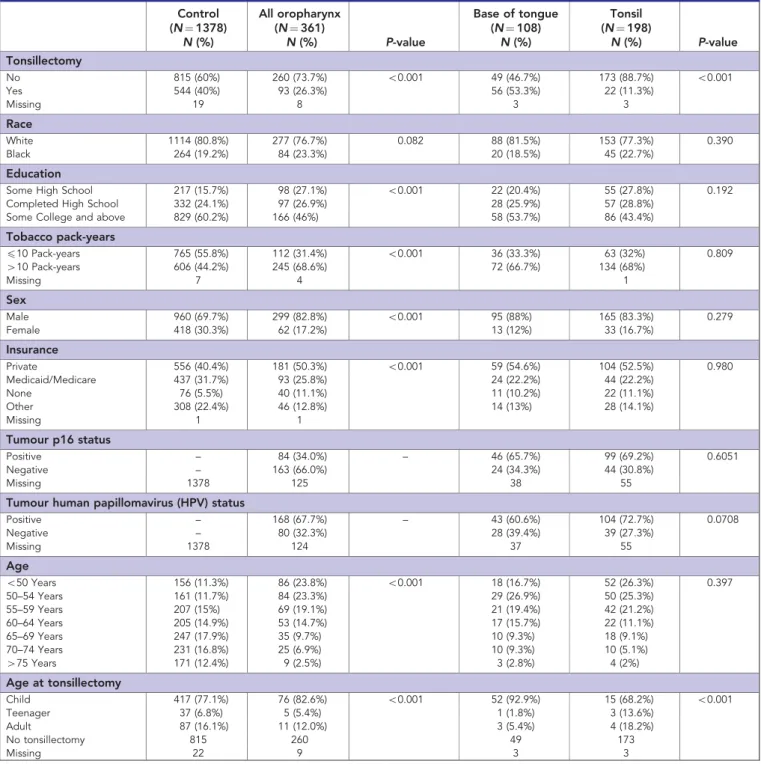
were significantly more likely to have undergone the procedure in childhood (92.9% among BOT cases and 68.2% among tonsil cancer cases, Po0.001).
Table 2 presents the results of the logistic regression model for selected factors and the odds of OPSCC by subsite. A greater number of sexual partners and 410 pack-year tobacco history were associated with an increased odds of all OPSCC, tonsil, and BOT cancers compared with controls. When all OPSCC cases were evaluated, there was a significantly decreased odds of cancer associated with previous tonsillectomy (OR¼0.63, 95% confidence interval (CI) 0.47–0.85, P¼0.003). When OPSCC subsite was considered, previous tonsillectomy was associated with a nearly two-fold increased odds of BOT cancer (OR¼1.95, 95% CI 1.25–3.06,P¼0.003) and a large decrease in the odds of tonsil
cancer (OR¼0.22, 95% CI 0.13–0.36, Po0.001). We found tonsillectomy not associated with sites of head and neck cancer not commonly associated with HPV (Supplementary Table S1). We then considered whether age at tonsillectomy affected the risk of OPSCC by subsite (Table 3). Childhood tonsillectomy (ageo13 years) was strongly associated with increased odds of BOT cancer (adjusted OR¼2.46, 95% CI 1.55–3.92, Po0.001), and no association was noted with tonsillectomy after age 13 years (OR¼0.33, 95% CI 0.08–1.42, P¼0.138). Tonsillectomy before age 13 years (OR¼0.19, 95% CI 0.10–0.33,Po0.001) and after age 13 years (OR¼0.32, 95% CI 0.14–01.00,P¼0.017) was associated with a significantly decreased odds of tonsil cancer.
In an exploratory analysis including cases with available tumour tissue, we then examined the odds of tonsil and BOT cancer by
Table 1.Descriptive statistics and comparisons between controls and all oropharynx cases and comparisons by subsite
Control (N¼1378)
All oropharynx (N¼361)
Base of tongue (N¼108)
Tonsil (N¼198)
N(%) N(%) P-value N(%) N(%) P-value
Tonsillectomy
No 815 (60%) 260 (73.7%) o0.001 49 (46.7%) 173 (88.7%) o0.001
Yes 544 (40%) 93 (26.3%) 56 (53.3%) 22 (11.3%)
Missing 19 8 3 3
Race
White 1114 (80.8%) 277 (76.7%) 0.082 88 (81.5%) 153 (77.3%) 0.390
Black 264 (19.2%) 84 (23.3%) 20 (18.5%) 45 (22.7%)
Education
Some High School 217 (15.7%) 98 (27.1%) o0.001 22 (20.4%) 55 (27.8%) 0.192
Completed High School 332 (24.1%) 97 (26.9%) 28 (25.9%) 57 (28.8%)
Some College and above 829 (60.2%) 166 (46%) 58 (53.7%) 86 (43.4%)
Tobacco pack-years
p10 Pack-years 765 (55.8%) 112 (31.4%) o0.001 36 (33.3%) 63 (32%) 0.809
410 Pack-years 606 (44.2%) 245 (68.6%) 72 (66.7%) 134 (68%)
Missing 7 4 1
Sex
Male 960 (69.7%) 299 (82.8%) o0.001 95 (88%) 165 (83.3%) 0.279
Female 418 (30.3%) 62 (17.2%) 13 (12%) 33 (16.7%)
Insurance
Private 556 (40.4%) 181 (50.3%) o0.001 59 (54.6%) 104 (52.5%) 0.980
Medicaid/Medicare 437 (31.7%) 93 (25.8%) 24 (22.2%) 44 (22.2%)
None 76 (5.5%) 40 (11.1%) 11 (10.2%) 22 (11.1%)
Other 308 (22.4%) 46 (12.8%) 14 (13%) 28 (14.1%)
Missing 1 1
Tumour p16 status
Positive – 84 (34.0%) – 46 (65.7%) 99 (69.2%) 0.6051
Negative – 163 (66.0%) 24 (34.3%) 44 (30.8%)
Missing 1378 125 38 55
Tumour human papillomavirus (HPV) status
Positive – 168 (67.7%) – 43 (60.6%) 104 (72.7%) 0.0708
Negative – 80 (32.3%) 28 (39.4%) 39 (27.3%)
Missing 1378 124 37 55
Age
o50 Years 156 (11.3%) 86 (23.8%) o0.001 18 (16.7%) 52 (26.3%) 0.397
50–54 Years 161 (11.7%) 84 (23.3%) 29 (26.9%) 50 (25.3%)
55–59 Years 207 (15%) 69 (19.1%) 21 (19.4%) 42 (21.2%)
60–64 Years 205 (14.9%) 53 (14.7%) 17 (15.7%) 22 (11.1%)
65–69 Years 247 (17.9%) 35 (9.7%) 10 (9.3%) 18 (9.1%)
70–74 Years 231 (16.8%) 25 (6.9%) 10 (9.3%) 10 (5.1%)
475 Years 171 (12.4%) 9 (2.5%) 3 (2.8%) 4 (2%)
Age at tonsillectomy
Child 417 (77.1%) 76 (82.6%) o0.001 52 (92.9%) 15 (68.2%) o0.001
Teenager 37 (6.8%) 5 (5.4%) 1 (1.8%) 3 (13.6%)
Adult 87 (16.1%) 11 (12.0%) 3 (5.4%) 4 (18.2%)
No tonsillectomy 815 260 49 173
HPV and by p16 status (Table 4). Tonsillectomy was associated with a decreased odds of HPV-positive tonsil cancer (OR¼0.17, 95% CI 0.08–0.34,Po0.001) and a decreased but imprecise odds of
HPV-negative tonsil cancer (OR¼0.66, 95% CI 0.24–1.81, P¼0.415). Conversely, tonsillectomy was associated with an increased odds of HPV-positive BOT cancer (OR¼2.46, 95% CI
Table 2.Adjusted odds ratio for all oropharyngeal cancer cases and by subsite compared with controlsa
Oropharyngeal cancer Base of tongue cancer Tonsil cancer
OR (95% CI) P-value OR (95% CI) P-value OR (95% CI) P-value Tonsillectomy
No Ref – Ref – Ref –
Yes 0.63 (0.47–0.85) 0.003 1.95 (1.25–3.06) 0.003 0.22 (0.13–0.36) o0.001
Number of sexual partners
0–1 Ref – Ref – Ref –
2–5 2.44 (1.40–4.27) 0.002 2.1 (0.84–5.21) 0.110 3.44 (1.5–7.91) 0.004
6–14 3.81 (2.19–6.60) o0.001 3.42 (1.42–8.27) 0.006 5.69 (2.49–13) o0.001
14þ 4.65 (2.65–8.18) o0.001 3.75 (1.52–9.21) 0.004 7.73 (3.33–17.96) o0.001
Education
Some High School Ref – Ref – Ref –
Completed High School 0.61 (0.41–0.91) –0.015 0.67 (0.34–1.32) –0.248 0.59 (0.36–0.97) –0.037
Some College and above 0.45 (0.31–0.66) o0.001 0.54 (0.29–1.03) 0.061 0.4 (0.25–0.64) o0.001
Pack-years
o10 Pack-years Ref – Ref – Ref –
X10 Pack-years 2.2 (1.62–2.97) o0.001 1.91 (1.18–3.09) 0.009 2.23 (1.5–3.32) o0.001
Insurance
Private Ref – Ref – Ref –
Medicaid/Medicare 0.84 (0.57–1.25) 0.393 0.59 (0.3–1.13) 0.113 0.78 (0.46–1.31) 0.341
None 0.92 (0.55–1.53) 0.743 0.86 (0.37–1.98) 0.717 0.93 (0.51–1.72) 0.823
Other 0.7 (0.45–1.09) 0.112 0.6 (0.3–1.19) 0.1434 0.81 (0.47–1.41) 0.464
Alcohol
p1 Drink per week Ref – Ref – Ref –
41 Drink per week 1.72 (1.16–2.56) 0.007 1.23 (0.67–2.27) 0.503 1.67 (0.98–2.84) 0.058
Abbreviations: CI¼confidence interval; OR¼odds ratio; Ref¼reference value. a
Odds ratios are all mutually adjusted for in addition to matching factors (age, race, and gender).
Table 3.Adjusted odds ratios for age at tonsillectomy by oropharyngeal subsite compared with controlsa
Base of tongue Tonsil
OR (95% CI) P-value OR (95% CI) P-value
Age at tonsillectomy
No tonsillectomy Ref – Ref –
o13 years 2.46 (1.55–3.92) o0.001 0.19 (0.1–0.34) o0.001
X13 years 0.33 (0.08–1.42) 0.138 0.32 (0.14–0.72) 0.006
Number of sexual partners
0–1 Ref – Ref –
2–5 2.22 (0.89–5.54) 0.087 3.46 (1.5–7.95) 0.004
6–14 3.5 (1.45–8.45) 0.005 5.71 (2.5–13.05) o0.001
14þ 3.96 (1.61–9.73) 0.003 7.8 (3.36–18.15) o0.001
Education
Some High School Ref – Ref –
Completed High School 0.66 (0.34–1.31) 0.234 0.59 (0.36–0.96) 0.034
Some College and above 0.5 (0.26–0.94) 0.031 0.4 (0.25–0.64) o0.001
Pack-years
o10 Pack-years Ref – Ref –
X10 Pack-years 1.88 (1.16–3.04) 0.011 1.66 (0.98–2.83) 0.061
Insurance
Private Ref – Ref –
Medicaid/Medicare 0.59 (0.31–1.15) 0.120 0.78 (0.47–1.32) 0.360
None 0.81 (0.35–1.87) 0.624 0.92 (0.5–1.7) 0.797
Other 0.59 (0.3–1.18) 0.138 0.81 (0.47–1.41) 0.457
Alcohol
p1 drink per week Ref – Ref –
41 drink per week 1.30 (0.7–2.39) 0.402 2.24 (1.51–3.32) o0.001
Abbreviations: CI¼confidence interval; OR¼odds ratio; Ref¼reference value. a
1.22–4.95,P¼0.012) and a weak and imprecise increase in odds of HPV-negative BOT cancer (OR¼1.24, 95% CI 0.46–3.31,P¼0.671). Tonsillectomy was also associated with a significantly increased odds of p16-positive BOT cancer (OR¼2.24, 95% CI 1.16–4.35,P¼0.017) and only a weak increase in odds of p16-negative BOT cancer (OR¼1.21, 95% CI 0.43–3.36, P¼0.716). Tonsillectomy was associated with decreased odds of p16-positive tonsil cancer (OR¼0.14, 95% CI 0.07–0.31,Po0.001). A decrease of p16-negative tonsil cancer was also seen, but the OR had a very wide CI (OR¼0.81, 95% CI 0.31–2.10,P¼0.670). Finally, similar results were noted between previous tonsillectomy, HPVþ/p16þ BOT cancer (OR¼2.18, 95% CI 1.1–4.4), and HPVþ/p16þ tonsil cancer (OR¼0.16, 95% CI 0.08–0.37).
DISCUSSION
This population-based case–control study explores the association between previous tonsillectomy and odds of OPSCC. We found that previous tonsillectomy was associated with a significantly decreased odds of OPSCC overall that was driven by a sharp and expected decrease in tonsil cancer specifically. These data suggest that tonsillectomy results in a reduction of oropharyngeal lymphoid tissue susceptible to malignant transformation (Fakhry et al, 2015). An unexpected finding from this analysis was the positive association between odds of BOT cancer and previous tonsillectomy. Although having a tonsillectomy is inversely associated with odds of tonsil cancer, our data suggest that tonsillectomy may be associated with an increased odds of BOT cancer. One possible explanation is lingual tonsillar hypertrophy in patients with a history of tonsillectomy, resulting in increased lymphoid tissue in the BOT. Enlargement of the lingual tonsils has been noted in up to one-third of paediatric patients undergoing adenotonsillectomy (Frickeet al, 2006), and is a recognised cause of persistent sleep apnoea and airway obstruction in this population (Jesberg, 1956; Golding-Wood and Whittet, 1989; Cohle et al, 1993; Jones and Cohle, 1993; Breitmeieret al, 2005; Abdel-Azizet al, 2011; Friedmanet al, 2015). Our data suggest that the odds of BOT cancer is strongly increased in patients undergoing tonsillectomy as children (age o13 years) compared with adolescents and adults (age 413 years). The difference in odds of BOT cancer by age of tonsillectomy further supports the possible association between lingual tonsillar hypertrophy and increased susceptibility to BOT cancer. The most common indication for tonsillectomy in children is obstruction secondary to adenotonsillar hypertrophy (Smith and Pereira, 2007; Macfarlaneet al, 2008). In contrast, the most common indication for tonsillectomy in adults is chronic or recurrent tonsillitis (Hoddeson and Gourin, 2009).
An exploratory analysis of the association between tonsillect-omy, tonsil, and BOT cancer, and HPV status yielded interesting results. When both subsite and HPV status were considered, we demonstrated that tonsillectomy was associated with a significantly decreased odds of HPV-positive tonsil cancer and a decreased but insignificant odds of HPV-negative tonsil cancer. The weaker association between tonsillectomy and HPV-negative tonsil cancer may result from susceptibility of nonlymphoid tissues of the tonsillar region (anterior tonsillar pillars, posterior tonsillar pillars, and tonsillar fossa) to HPV-negative, tobacco-associated cancer even in the setting of previous tonsillectomy. Ultimately, the decrease in odds of tonsil cancer in patients with a history of tonsillectomy is expected and logical. The association by HPV status should be explored further in larger studies. With respect of HPV-positive and HPV-negative BOT cancer, our data suggest that the association between tonsillectomy and an increased odds of BOT cancer is strongest for HPV-positive tumours. The reason for this difference by HPV status remains unclear and warrants further investigation, and may reflect a relatively small sample size of HPV-negative tumours.
Recently, the possibility of prophylactic tonsillectomy as a method of secondary OPSCC prevention has been considered (Chaturvedi, 2015; Fakhry et al, 2015). Although we demonstrate a reduction in overall risk of OPSCC cancer associated with tonsillectomy, our study was not designed to address this question. It is important to consider that despite being a commonly performed surgery, the morbidity of tonsillectomy is not insignif-icant (Randall and Hoffer, 1998; Windfuhr et al, 2008, 2009). Furthermore, as demonstrated by Fakhryet al(2015), the relative rarity of OPSCC further precludes tonsillectomy from being an effective method of prevention. Vaccination against high-risk HPV types has the potential to serve as a safer and more effective method of primary prevention of OPSCC than tonsillectomy (D’Souza and Dempsey, 2011). Nonetheless, when considered along with other covariates such as sexual history, smoking status, and age, a history of tonsillectomy may play a role in risk stratification (Chaturvedi, 2015; Fakhryet al, 2015).
This study has several limitations, many of which are inherent to the case–control study design. The use of self-reported tonsillectomy questionnaire data presents the possibility of recall bias and differential misclassification by disease status. However, recall of tonsillectomy would be very long for both the cases and the controls and at the time of recruitment. Because most tonsillectomies among cases and controls occurred at a very young age, medical record abstract is not feasible. Two previous studies have examined the accuracy of tonsillectomy recall, demonstrating sensitivity and specificity of recall were 92.7% and 77.5% in one study and 78.9% and 80.1% in the other, respectively (Krallet al, 1988; Linetet al, 1989). Using the false discovery and false omission rates from these studies, we conducted a sensitivity
Table 4.Adjusted odds ratio for tonsillectomy and oropharyngeal subsite and HPV/p16 status compared with controlsa
Base of tongue/HPVþ Base of tongue/HPV Tonsil/HPVþ Tonsil/HPV
OR (95% CI) P N(%) OR (95% CI) P N(%) OR (95% CI) P N(%) OR (95% CI) P N(%) Tonsil removed
No Ref – 17 (65.4%) Ref – 21 (72.4%) Ref – 99 (79.2%) Ref – 32 (82.1%)
Yes 2.46 (1.22–4.95) 0.012 9 (34.6%) 1.24 (0.46–3.31) 0.671 8 (27.6%) 0.17 (0.08–0.34) o0.001 26 (20.8%) 0.66 (0.24–1.81) 0.415 7 (17.9%)
Base of tongue/p16þ Base of tongue/p16 Tonsil/p16þ Tonsil/p16
Tonsil removed
No Ref – 21 (44.7%) Ref – 16 (66.7%) Ref – 95 (92.2%) Ref – 36 (81.8%)
Yes 2.24 (1.16–4.35) 0.017 26 (55.3%) 1.21 (0.43–3.36) 0.716 8 (33.3%) 0.14 (0.07–0.31) o0.001 8 (7.8%) 0.81 (0.31–2.10) 0.67 8 (18.2%)
Abbreviations: CI¼confidence interval; HPV¼human papillomavirus; OR¼odds ratio; Ref¼reference value. a
analysis (methods in Supplementary Material) and found that our estimates for tonsillectomy and tonsil cancer are very stable to changes in recall (Supplementary Table S2). However, for BOT cancer as differential recall between cases and controls widens, the estimates move closer to null and eventually crosses the null (Supplementary Table S1). It is unlikely that recall was that dramatically different between the cases and the controls. Another important limitation of this study is that tumour tissue was not available for all OPSCC samples in this cohort, limiting our analysis including HPV to a secondary, exploratory analysis. Tonsil cancer samples were more likely to be typed and this could potentially lead to selection bias affecting our analysis by HPV and p16 status. However, subjects with available HPV status and those without were similar with respect to demographics, age, smoking history, number of sexual partners, and stage at presentation, suggesting that HPV status would be similar between those typed and nontyped. Possible selection bias would not affect our overall results with respect to risk of tonsilvsBOT cancer, or our results incorporating age at tonsillectomy, as all cases were included in these analyses. Furthermore, our results involving HPV and p16 typing were stratified by subsite, thus diminishing the potential impact of any selection bias. A final limitation of this study is that some of the comparisons were based on small numbers and ORs were associated with wide CIs. Despite these limitations, this study offers important insight into the association between previous tonsillectomy and risk of OPSCC.
The major strengths of this study include a relatively large number of diverse patients and a population-based, case–control study design. The availability of detailed smoking, HPV tumour status, sexual history, socioeconomic status, and other demo-graphic covariates, as well as a frequency-matched control group, add to the validity of our findings. Data on age of tonsillectomy allowed us to demonstrate that the majority of cases and controls underwent tonsillectomy as children and presumably for reasons other than suspected oropharyngeal cancer. A very small fraction of cases and controls underwent tonsillectomy within 10 years of OPSCC diagnosis or enrolment in CHANCE, respectively. When a sensitivity analysis was conducted excluding subjects with a history of tonsillectomy within 10 years of enrolment in CHANCE, there were no significant differences in the study findings.
In conclusion, this population-based case–control study demonstrates that previous tonsillectomy is associated with a decreased odds of tonsil cancer and an increased odds of BOT cancer. Although these finding do not necessarily support the role of tonsillectomy as primary prevention, tonsillectomy should be considered when evaluating risk for OPSCC.
ACKNOWLEDGEMENTS
This study was supported in part by the National Cancer Institute (R01-CA90731) and the Lineberger Cancer Control Education Program (R25 CA57726).
CONFLICT OF INTEREST
The authors declare no conflict of interest.
REFERENCES
Abdel-Aziz M, Ibrahim N, Ahmed A, El-Hamamsy M, Abdel-Khalik MI, El-Hoshy H (2011) Lingual tonsils hypertrophy; a cause of obstructive sleep apnea in children after adenotonsillectomy: operative problems and management.Int J Pediatr Otorhinolaryngol75: 1127–1131.
Anantharaman D, Gheit T, Waterboer T, Abedi-Ardekani B, Carreira C, Mckay-Chopin S, Gaborieau V, Marron M, Lagiou P, Ahrens W, Holcatova I, Merletti F, Kjaerheim K, Talamini R, Simonato L, Castellsague X, Macfarlane TV, Biggs AM, Thakker N, Znaor A, Thomson P, Canova C, Conway DI, Healy CM, Tommasino M, Pawlita M, Brennan P (2013) Human papillomavirus infections and upper aero-digestive tract cancers: the ARCAGE study.J Natl Cancer Inst105: 536–545.
Ang KK, Harris J, Wheeler R, Weber R, Rosenthal DI, Nguyen-Tan PF, Westra WH, Chung CH, Jordan RC, Lu C, Kim H, Axelrod R, Silverman CC, Redmond KP, Gillison ML (2010) Human papillomavirus and survival of patients with oropharyngeal cancer.N Engl J Med363: 24–35.
Breitmeier D, Wilke N, Schulz Y, Albrecht K, Wenzel V, Kleemann WJ, Panning B, Troger HD (2005) The lingual tonsillar hyperplasia in relation to unanticipated difficult intubation: is there any relationship between lingual tonsillar hyperplasia and tonsillectomy?Am J Forensic Med Pathol 26: 131–135.
Chaturvedi AK (2015) Tonsillectomy and risk of oropharyngeal cancer: implications for research and prevention.Cancer Prev Res (Phila)8(7): 577–579.
Chaturvedi AK, Anderson WF, Lortet-Tieulent J, Curado MP, FERLAY J, Franceschi S, Rosenberg PS, Bray F, Gillison ML (2013) Worldwide trends in incidence rates for oral cavity and oropharyngeal cancers.J Clin Oncol 31: 4550–4559.
Chaturvedi AK, Engels EA, Anderson WF, Gillison ML (2008) Incidence trends for human papillomavirus-related and -unrelated oral squamous cell carcinomas in the United States.J Clin Oncol26: 612–619.
Chaturvedi AK, Engels EA, Pfeiffer RM, Hernandez BY, Xiao W, Kim E, Jiang B, Goodman MT, Sibug-Saber M, Cozen W, Liu L, Lynch CF, Wentzensen N, Jordan RC, Altekruse S, Anderson WF, Rosenberg PS, Gillison ML (2011) Human papillomavirus and rising oropharyngeal cancer incidence in the United States.J Clin Oncol29: 4294–4301. Cohle SD, Jones DH, Puri S (1993) Lingual tonsillar hypertrophy causing
failed intubation and cerebral anoxia.Am J Forensic Med Pathol14: 158–161. D’Souza G, Agrawal Y, Halpern J, Bodison S, Gillison ML (2009) Oral sexual behaviors associated with prevalent oral human papillomavirus infection.
J Infect Dis199: 1263–1269.
D’Souza G, Dempsey A (2011) The role of HPV in head and neck cancer and review of the HPV vaccine.Prev Med53(Suppl 1): S5–S11.
D’Souza G, Kreimer AR, Viscidi R, Pawlita M, Fakhry C, Koch WM, Westra WH, Gillison ML (2007) Case-control study of human papillomavirus and oropharyngeal cancer.N Engl J Med356: 1944–1956. Derkay CS (1993) Pediatric otolaryngology procedures in the United States:
1977-1987.Int J Pediatr Otorhinolaryngol25: 1–12.
Divaris K, Olshan AF, Smith J, Bell ME, Weissler MC, Funkhouser WK, Bradshaw PT (2010) Oral health and risk for head and neck squamous cell carcinoma: the Carolina Head and Neck Cancer Study.Cancer Causes Control21: 567–575.
Erickson BK, Larson St DR, Sauver JL, Meverden RA, Orvidas LJ (2009) Changes in incidence and indications of tonsillectomy and adenotonsillectomy, 1970-2005.Otolaryngol Head Neck Surg140: 894–901.
Ernster JA, Sciotto CG, O’Brien MM, Finch JL, Robinson LJ, Willson T, Mathews M (2007) Rising incidence of oropharyngeal cancer and the role of oncogenic human papilloma virus.Laryngoscope117: 2115–2128. Fakhry C, Andersen KK, Christensen J, Agrawal N, Eisele DW (2015) The
impact of tonsillectomy upon the risk of oropharyngeal carcinoma diagnosis and prognosis in the Danish Cancer Registry.Cancer Prev Res (Phila)8(7): 583–589.
Fricke BL, Donnelly LF, Shott SR, Kalra M, Poe SA, Chini BA, Amin RS (2006) Comparison of lingual tonsil size as depicted on MR imaging between children with obstructive sleep apnea despite previous tonsillectomy and adenoidectomy and normal controls.Pediatr Radiol36: 518–523.
Friedman NR, Prager JD, Ruiz AG, Kezirian EJ (2015) A pediatric grading scale for lingual tonsil hypertrophy.Otolaryngol Head Neck Surg154(1): 171–174.
Gheit T, Landi S, Gemignani F, Snijders PJ, Vaccarella S, Franceschi S, Canzian F, Tommasino M (2006) Development of a sensitive and specific assay combining multiplex PCR and DNA microarray primer extension to detect high-risk mucosal human papillomavirus types.J Clin Microbiol 44(6): 2025–2031.
Heck JE, Berthiller J, Vaccarella S, Winn DM, Smith EM, Shan’gina O, Schwartz SM, Purdue MP, Pilarska A, Eluf-Neto J, Menezes A, Mcclean MD, Matos E, Koifman S, Kelsey KT, Herrero R, Hayes RB, Franceschi S, Wunsch-Filho V, Fernandez L, Daudt AW, Curado MP, Chen C, Castellsague X, FERRO G, Brennan P, Boffetta P, Hashibe M (2010) Sexual behaviours and the risk of head and neck cancers: a pooled analysis in the International Head and Neck Cancer Epidemiology (INHANCE) consortium.Int J Epidemiol39: 166–181.
Hoddeson EK, Gourin CG (2009) Adult tonsillectomy: current indications and outcomes.Otolaryngol Head Neck Surg140: 19–22.
Jesberg N (1956) Chronic, hypertrophic, lingual tonsillitis.AMA Arch Otolaryngol64: 3–13.
Jones DH, Cohle SD (1993) Unanticipated difficult airway secondary to lingual tonsillar hyperplasia.Anesth Analg77: 1285–1288.
Koo CL, Kok LF, Lee MY, Wu TS, Cheng YW, Hsu JD, Ruan A, Chao KC, Han CP (2009) Scoring mechanisms of p16INK4a immunohistochemistry based on either independent nucleic stain or mixed cytoplasmic with nucleic expression can significantly signal to distinguish between endocervical and endometrial adenocarcinomas in a tissue microarray study.J Transl Med7: 25.
Krall EA, Valadian I, Dwyer JT, Gardner J (1988) Recall of childhood illnesses.
J Clin Epidemiol41: 1059–1064.
Linet MS, Harlow SD, Mclaughlin JK, Mccaffrey LD (1989) A comparison of interview data and medical records for previous medical conditions and surgery.J Clin Epidemiol42: 1207–1213.
Macfarlane PL, Nasser S, Coman WB, Kiss G, Harris PK, Carney AS (2008) Tonsillectomy in Australia: an audit of surgical technique and
postoperative care.Otolaryngol Head Neck Surg139: 109–114. Randall DA, Hoffer ME (1998) Complications of tonsillectomy and
adenoidectomy.Otolaryngol Head Neck Surg118: 61–68.
Rosenfeld RM, Green RP (1990) Tonsillectomy and adenoidectomy: changing trends.Ann Otol Rhinol Laryngol99: 187–191.
Schmitt M, Bravo IG, Snijders PJ, Gissmann L, Pawlita M, Waterboer T (2006) Bead-based multiplex genotyping of human papillomaviruses.J Clin Microbiol44: 504–512.
Schmitt M, Dondog B, Waterboer T, Pawlita M, Tommasino M, Gheit T (2010) Abundance of multiple high-risk human papillomavirus (HPV) infections found in cervical cells analyzed by use of an ultrasensitive HPV genotyping assay.J Clin Microbiol48: 143–149.
Singhi AD, Westra WH (2010) Comparison of human papillomavirus in situ hybridization and p16 immunohistochemistry in the detection of human papillomavirus-associated head and neck cancer based on a prospective clinical experience.Cancer116: 2166–2173.
Smeets SJ, Hesselink AT, Speel EJ, Haesevoets A, Snijders PJ, Pawlita M, Meijer CJ, Braakhuis BJ, Leemans CR, Brakenhoff RH (2007) A novel algorithm for reliable detection of human papillomavirus in paraffin embedded head and neck cancer specimen.Int J Cancer121: 2465–2472. Smith SL, Pereira KD (2007) Tonsillectomy in children: indications, diagnosis
and complications.ORL J Otorhinolaryngol Relat Spec69: 336–339. Weinberger PM, Yu Z, Haffty BG, Kowalski D, Harigopal M, Brandsma J,
Sasaki C, Joe J, Camp RL, Rimm DL, Psyrri A (2006) Molecular classification identifies a subset of human papillomavirus–associated oropharyngeal cancers with favorable prognosis.J Clin Oncol24: 736–747. Windfuhr JP, Schloendorff G, Baburi D, Kremer B (2008) Serious
post-tonsillectomy hemorrhage with and without lethal outcome in children and adolescents.Int J Pediatr Otorhinolaryngol72: 1029–1040. Windfuhr JP, Schloendorff G, Sesterhenn AM, Prescher A, Kremer B (2009)
A devastating outcome after adenoidectomy and tonsillectomy: ideas for improved prevention and management.Otolaryngol Head Neck Surg140: 191–196.
This work is published under the standard license to publish agree-ment. After 12 months the work will become freely available and the license terms will switch to a Creative Commons Attribution-NonCommercial-Share Alike 4.0 Unported License.