THE EFFECTS OF FLUENCY OF LEXICAL AND PHONOLOGICAL RETRIEVAL PROCESSING ON SPOKEN WORD DURATION
Jason Michael Kahn
A dissertation submitted to the faculty of the University of North Carolina at Chapel Hill in partial fulfillment of the requirements for the degree of Doctor of Philosophy in the Department
of Psychology (Cognitive Program).
Chapel Hill 2015
iii ABSTRACT
Jason Michael Kahn: The effects of fluency of lexical and phonological retrieval processing on spoken word duration
(Under the direction of Jennifer E. Arnold)
Spoken words vary considerably in their duration, for a variety of reasons. The current work focused specifically on two of those reasons – the difficulty of lexical retrieval and
phonological retrieval and integration – to assess whether they play a significant role in influence the duration of the time to begin speaking and the duration of the words in a simple utterance. Previous work of mine and others has shown that word duration is sensitive to factors that may influence lexical and/or phonological retrieval (Bell et al., 2009; Gahl, 2008; Kahn & Arnold, 2012; Schriefers et al., 1999; inter alia), but never in a context that examined the timing of the mechanisms underlying those factors. The current experiments manipulate the semantic and phonological relationship between a prime and a target utterance in order to investigate the mechanisms and their timing. They also manipulate the difficulty of processing other words in a multi-word utterance than the target, to assess whether word duration is affected by that
iv
v
vi
ACKNOWLEDGEMENTS
If you deign to read this at all, you’re probably looking for your own name, so I’ll tell you right here that I’m at the end of my rope with this damn thing, and if I forget to name you explicitly, you still have my sincere gratitude, even if that sounds out of character.
I’m sorry, mom and dad, but Jennifer’s gotta get first billing on this, because she’s been the biggest controller of variance – and I mean that statistically and colloquially. You’ve always been zealous, and even though it freaked me out a bit to have you follow us to the reception on interview day to ask more questions, I suspect that the only reason I managed to do as well as I did in grad school was that zealotry. It took a while for you to get used to me not taking anything seriously, but it’s the only way I feel really comfortable with someone, and, personal or
professional, our conversations were always challenging and rewarding. You introduced me to everyone, because you know everyone, because you do such good and interesting work, and give a damn about other people’s – always. It’s tiring, sometimes! Thank you, and I’m sorry, and hooray!, and congratulations, and whew.
vii
general) would have been much harder and much worse without you. Thank you, and I’m sorry, and hooray!, and congratulations, and whew.
To Nykoel, for infinite, unending, ceaseless patience during what has possibly been the dullest and hardest part of my life - I promise it’ll get better. For adventure, civilizing, fun, discussion, debate, argument, novelty, and love. It was time for me to start doing something new with my life, and you’re the only reason I’ve been able to make it happen. Thank you, and I’m sorry, and hooray!, and congratulations, and whew. What shall we do next?
Special thanks to Joseph, for loving the same bits of language and language research I do, for taking the initiative, always, and for being patient with my weirdnesses. To Erol (and Alisha), for being an enclave of fun, insight, family, friendship, and once in a while serious scholarly discussion. To Elise and Alex, my labmates in arms – sometimes for, sometimes against. To Becky, for Rock Band, tequila, neural synchrony, and a great deal of insight into possibilities. To Yi Ting, for being even more zealous than Jennifer, never looking down on anyone less zealous, and that one time you sent me a message meant for your husband. To DJ (and later Katie), for bottomless inquisitiveness, Yanni, Grungebob, and a home away from academia whenever I needed it. To Milton, for having the best name, and always being able and willing to argue an esoteric point of cognitive psychology at the drop of a hat. To (another) Elise, for saving my life with antidepressants, for saving my soul with rats, and for playing so. many. board games. To Julia, for steak and scotch, for television and a return to high-mindedness, and fanciness. To James, for rocking the fuck out. To Lauren, for a reason to leave Chapel Hill and for saving my rats. To Mike, for addiction.
viii
(another) Erica, for Wittgenstein. To Florian, for statistics and a stern talking-to about givenness, and teaching your students to shotgun beer. To Mara, for solidarity. To Peter, for being utterly inscrutable but scarily good at what he does, and for taking such good care of his students (my friends). To Neil, for being the most impressive scholar I’ve ever met, even if he picked the wrong thing to study. To Mark, for dauntlessly defending the Psychology department against all challenges, while never losing a modicum of humanity, nor research acumen, nor approachable wisdom. To Elliott, for being almost infuriatingly detail-oriented, a champion for linguistics nerds, and an unimpeachable teacher. To Jen, for forcing me to work up to standard, and for giving me a second chance. To Bruno, for knowing when to be serious and when to have fun, and for asking the hard questions. To Jean-Louis and Joe, for giving a damn about something other than just psychology, and passing on that joy. To Beth, the best lecturer I know, who taught me firm patience in teaching. To all of my research assistants, especially those who helped through the hardest parts of the dissertation, when I couldn’t do this by myself even if I’d wanted to. To all of my participants, who never cared a whit about language, even though they use it all day every day.
ix
TABLE OF CONTENTS
LIST OF TABLES ... xii
LIST OF FIGURES ... xiv
Chapter 1: General Introduction ... 1
1.1 Spoken word duration. ... 1
1.2 Word duration in the language production system... 7
1.3 Givenness and word duration ... 12
1.4 Models of language production ... 18
1.5 Multi-word utterances, planning, and incrementality ... 23
1.6 Ease and fluency of processing ... 28
1.7 The Picture-Word Interference Paradigm ... 32
1.8 Experimental overview ... 39
Chapter 2: Experiments 1a&b ... 47
2.1 Introduction ... 47
2.2 Questions about competition ... 47
2.3 Questions about identity priming ... 49
2.4 Experiments 1a&b ... 50
Methods... 50
Results ... 56
x
Chapter 3: Experiments 2a&b ... 70
3.1 Introduction ... 70
3.2 Relationship with previous work... 71
3.3 Questions about competition ... 71
3.4 Questions about identity priming ... 72
3.5 Questions about consistency ... 72
3.6 Experiments 2a&b ... 73
Methods... 73
Results ... 76
Discussion ... 85
Chapter 4: Experiments 3a&b ... 95
4.1 Introduction ... 95
4.2 Relationship with prior work... 95
4.3 Questions About Relatedness ... 96
4.4 Questions About identity priming ... 97
4.5 Experiments 3a&b ... 98
Methods... 98
Results ... 98
Discussion ... 106
Chapter 5: Experiments 4a&b ... 111
5.1 Introduction ... 111
xi
5.3 Questions about consistency ... 112
5.4 Experiments 4a&b ... 112
Methods... 112
Results ... 113
Discussion ... 121
Chapter 6: General Discussion... 132
6.1 Summary of results... 132
6.2 Implications for Processing ... 132
6.3 Implications for methodology ... 138
6.4 Limitations and Future Directions... 140
6.5 Conclusion ... 142
APPENDIX ... 144
Part A: Example lists ... 144
Part B: Blocking design for Experiments 2 and 4 ... 146
Part C: Semantic and Phonological primes for each item ... 147
Part D: Parameter estimate tables... 152
xii
LIST OF TABLES
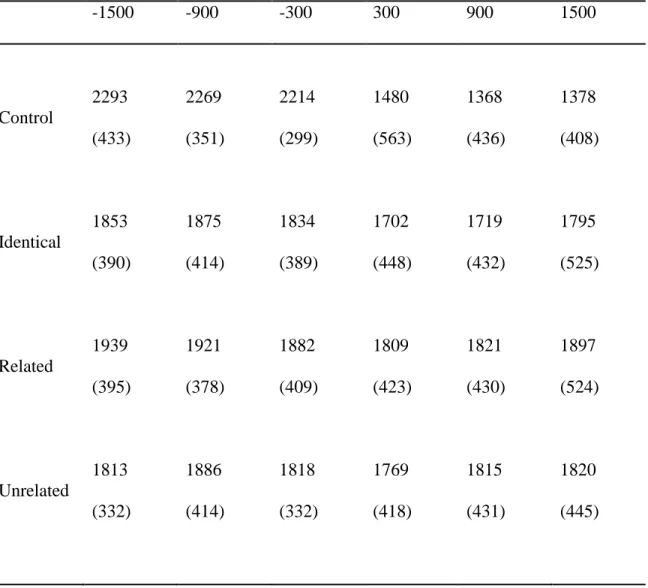
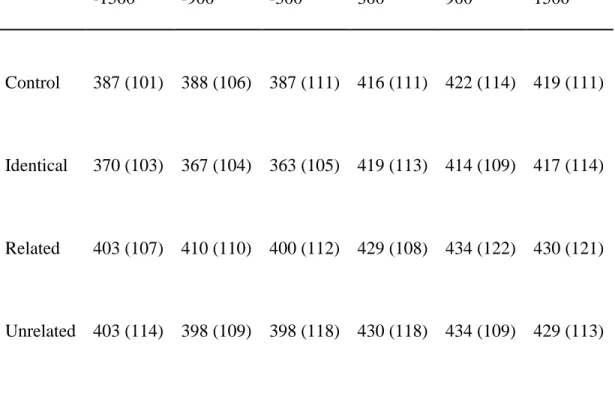
Table 1: An example set of interfering stimuli for the target picture object, airplane. These are actual stimuli used in the experiments. ... 51 Table 2: Onset latencies and standard deviations (in parentheses) for Experiments 1 a&b, broken down by condition and ISI. ... 57 Table 3: Determiner durations and standard deviations (in parentheses) for Experiments 1 a&b,
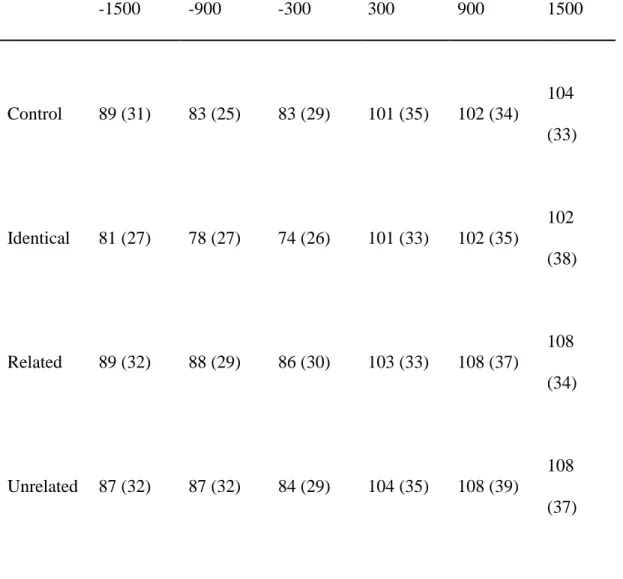
broken down by condition and ISI. ... 58 Table 4: Object word durations and standard deviations (in parentheses) for Experiments 1 a&b,
broken down by condition and ISI. ... 59 Table 5: Action word durations and standard deviations (in parentheses) for Experiments 1 a&b,
broken down by condition and ISI. ... 60 Table 6: Westfall comparisons for Experiment 1a. Dashes indicate non-significant effects
(p>.05) ... 61 Table 7: Westfall comparisons for Experiment 1b. Dashes indicate non-significant effects
(p>.05) ... 62 Table 8: Summary statistics for the onset latency, with standard deviations in parentheses.
Experiment 2a is on the left, and Experiment 2b on the right, broken down by ISI, condition, and then consistency. ... 83 Table 9: Summary statistics for the object word durations, with standard deviations in
parentheses. Experiment 2a is on the left, and Experiment 2b on the right, broken down by ISI, condition, and then consistency. ... 83 Table 10: Summary statistics for the action word durations, with standard deviations in
parentheses. Experiment 2a is on the left, and Experiment 2b on the right, broken down by ISI, condition, and then consistency. ... 84 Table 11: Object word durations and standard deviations (in parentheses) for Experiments 3
a&b, broken down by condition and ISI. ... 100 Table 12: Action word durations and standard deviations (in parentheses) for Experiments 3
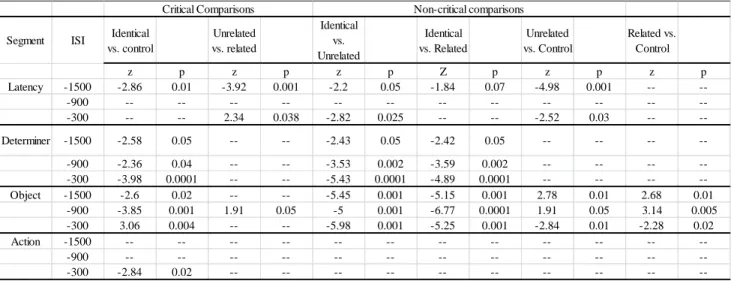
a&b, broken down by condition and ISI. ... 101 Table 13: The collection of parameter estimates, including p-values, for Experiment 3a. Critical
xiii
Table 14: The collection of parameter estimates, including p-values, for Experiment 3b. Critical comparisons are in the leftmost four columns, and non-critical comparisons in all others. Non-significant estimates are indicated with two dashes (--). ... 105 Table 15: Summary statistics for the latency to begin speaking, with standard deviations in
parentheses. Experiment 4a is on the left, and Experiment 4b on the right, broken down by ISI, condition, and then consistency. ... 114 Table 16: Summary statistics for the determiner durations, with standard deviations in
parentheses. Experiment 4a is on the left, and Experiment 4b on the right, broken down by ISI, condition, and then consistency. ... 114 Table 17: Summary statistics for the object word durations, with standard deviations in
parentheses. Experiment 4a is on the left, and Experiment 4b on the right, broken down by ISI, condition, and then consistency. ... 114 Table 18: Summary statistics for the action word durations, with standard deviations in
xiv
LIST OF FIGURES
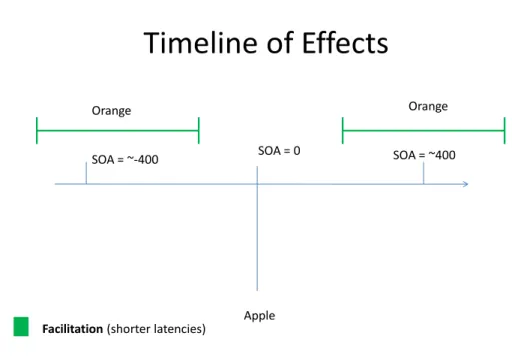
Figure 1: A summary of Picture Word Interference effects, with Schriefers et al., (1990) and Starrveled & La Heij (1996) used as examples. A picture of an apple appears at SOA = 0, with semantic inhibitions effects ranging from approximately -400SOA to 0SOA, and phonological facilitation effects ranging from approximately -200SOA to -200SOA. ... 35 Figure 2: A summary of the effects of the word-naming studies in Balota et al., (1989).
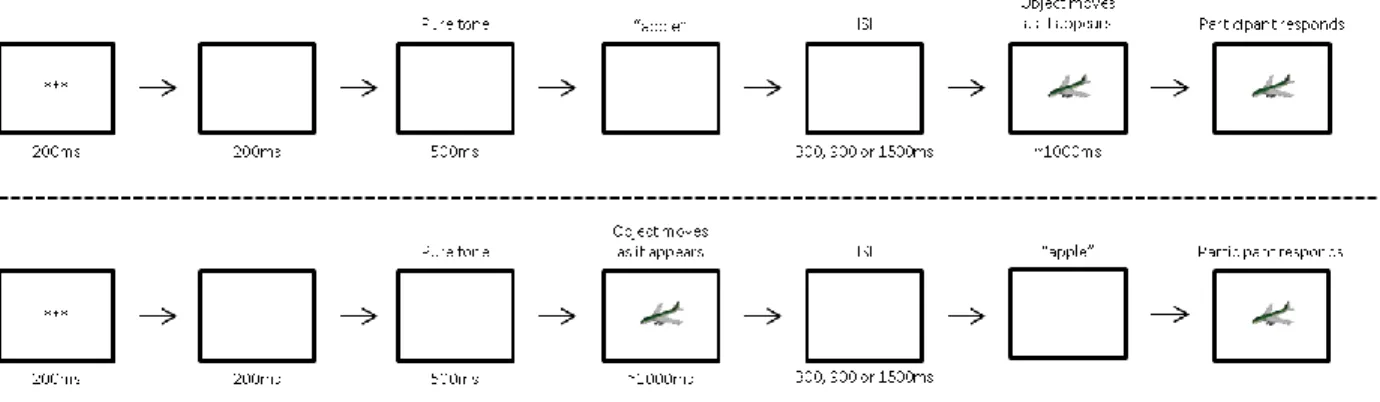
Facilitation of latencies is shown on the left, from -600SOA to -300SOA, and facilitation of durations is shown on the right, from 300SOA to 600SOA... 39 Figure 3: (Top) – Order of presentation of the events in Experiment 1a, with prime before target.
(Bottom) – Order of presentation of the events in Experiment 1b, with target before prime. ... 43 Figure 4: Latencies for the related vs. unrelated comparisons, with yellow stars to indicate
comparisons that were significant (p < .05), and orange stars to indicate
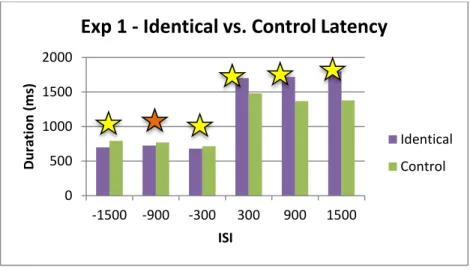
comparisons that were marginally significant (p < .01). ... 63 Figure 5: Latencies for identical vs. control comparisons, with yellow stars to indicate
comparisons that were significant (p < .05), and orange stars to indicate
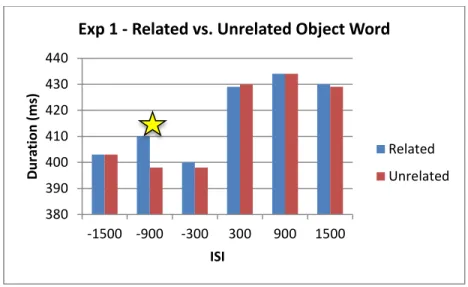
comparisons that were marginally significant (.05 < p < .01). ... 64 Figure 6: Object word durations for the related vs. unrelated comparisons, with yellow stars to
indicate comparisons that were significant (p < .05). ... 65 Figure 7: Object word durations for the identical vs. control comparisons, with yellow stars to
indicate comparisons that were significant (p < .05). ... 65 Figure 8: Graph showing the durations of the latency, broken down by ISI and condition. This
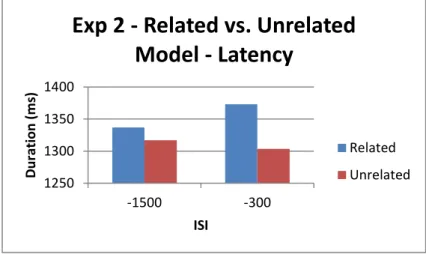
illustrates a main effect of relatedness. ... 76 Figure 9: Graph showing the durations of the latency, broken down by ISI and consistency. This
illustrates a main effect of consistency. ... 77 Figure 10: Graph showing the durations of the object word, broken down by ISI and consistency. This illustrates a main effect of consistency. ... 77 Figure 11: Graph showing the interaction between consistency and condition, with the shortest
xv
Figure 12: Graph showing the durations of the action word, broken down by ISI and consistency. This apparent interaction did not result in a significant simple effect of
consistency at either ISI. ... 78 Figure 13: Graph showing the latency to begin speaking, broken down by ISI and consistency.
This illustrates two main effects of consistency, one in the negative ISI model and one in the positive ISI model. ... 79 Figure 14: Graph showing the latency to begin speaking at -300ISI, broken down by condition.
Here only the difference at -300ISI was significant, as explained in the text. ... 80 Figure 15: Graph showing the durations of the object word, broken down by ISI and condition.
This illustrates a main effect of relatedness (identity). ... 81 Figure 16: Graph showing the durations of the object word, broken down by ISI and consistency.
All of these effects are significant, although not in the same direction. The negative ISIs had shorter duration in consistent than random trials, while 300ISI had longer duration in consistent than random trials. ... 81 Figure 17: Graph showing the durations of the action word, broken down by condition,
consistency, and ISI. The overall effect of consistency is significant, but the effect is mitigated at -1500ISI, as shown by the difference between the green and orange bars. ... 82 Figure 18: Onset latencies for related vs. unrelated comparisons, with yellow stars to indicate
comparisons that were significant (p < .05). ... 102 Figure 19: Onset latencies for identical vs. control comparisons, with yellow stars to indicate
comparisons that were significant (p < .05). ... 102 Figure 20: Object word durations for the related vs. unrelated comparisons, with yellow stars to
indicate comparisons that were significant (p < .05), and orange stars to indicate comparisons that were marginally significant (.05 < p < .01). ... 103 Figure 21: Object word durations for identical vs. control comparisons, with yellow stars to
indicate comparisons that were significant (p < .05), and orange stars to indicate comparisons that were marginally significant (.05 < p < .01). ... 103 Figure 22: Graph showing the durations of latency, broken down by ISI and condition. This
illustrates a main effect of relatedness. ... 116 Figure 23: Graph showing the durations of latency, broken down by ISI and consistency. This
xvi
Figure 24: Graph showing the durations of the object words, broken down by ISI and condition. This illustrates a main effect of relatedness (related longer than unrelated). ... 117 Figure 25: Graph showing the duration of the object words, broken down by ISI and consistency. This illustrates a main effect of consistency. ... 118 Figure 26: Graph showing the duration of the action words, broken down by ISI and consistency. This illustrates two main effects of consistency, one in the negative ISI model and one in the positive. Both results are in the same direction, with consistent shorter than random. ... 118 Figure 27: Graph showing the durations of the latency, broken down by ISI and consistency.
This illustrates a main effect of consistency. ... 119 Figure 28: Graph showing the durations of latency, broken down by ISI and condition. The
negative ISIs show a main effect of relatedness (identity), and the positive ISIs show a simple effect of relatedness (identity) at only 1500ISI, in the opposite direction. ... 120 Figure 29: Graph showing the durations of the action word, broken down by ISI and condition.
1
Chapter 1: General Introduction 1.1 Spoken word duration.
A simple, but often-overlooked, fact about spoken words is that their duration varies rather a lot. Different speakers produce words slightly variably, and even a single speaker will not uniformly say the same word identically among various conversational circumstances. The age, the gender, and other sociolinguistic factors inherent to speakers account for some of this variability, but this project is concerned instead with cognitive psychological factors. It will focus on how variation in the normal processing of words, and thus the time it takes to plan and to articulate them, leads to corresponding variation in word duration. More specifically, it will focus on how the ease of accessing a word – lexical retrieval - and the ease of accessing and sequence sounds – phonological retrieval and sequencing – leads to variation in both the latency to begin an utterance, and the duration of the words in a multi-word utterance.
2
representation of the situation, and rely on this when they produce the word (Brennan & Clark, 1996; Clark, 1996; Gundel et al., 1993; Prince, 1992). In both of these cases, the speaker plans and executes a word differently depending on the context, and this leads to variation in duration.
Simply speaking faster or slower also leads to shorter word durations (Fosler-Lussier & Morgan, 1999; Munson, 2001). Studies that examine the character of databases of running speech, called corpus studies, find that speech rate varies both between speakers and
conversational circumstances (Jurafsky, Bell, Gregory & Raymond, 2001). Some people speak faster than others, and some situations lead to faster speech, such as when a speaker is excited or in a hurry. Overall speech rate thus accounts for a significant amount of variation in word
duration, and appears to arise from some internal state of the speaker; a personality factor, a state of mind, some environmental factor, or some combination of these.
3
All this evidence leads to the general hypothesis that variations in representation and/or processing of one sort or another lead either directly or indirectly to durational variation. That hypothesis, and five more-specific versions of it, guides this investigation. The general form is as follows: speakers’ utterance plans and the duration of some of the words in their utterances should vary (although not necessarily covary) as a function of the ease of activating, retrieving, and ordering (and possibly others) the representations involved in producing the utterance. More specifically, the experiments below investigate three major subquestions, nested under the general hypothesis: 1) difficulty from resolving a semantic competitor should lead to variation in latency and/or duration; 2) ease or difficulty from resolving a phonological competitor should lead to variation in latency and/or duration; 3) reusing an identical stimulus should lead to variation in latency and/or duration, and this variation should be consistent with prior work on repetition; 4) the ease of retrieving and integrating a verb with earlier sentential material should influence not only its duration, but the preceding noun’s duration as well; 5) the precise timing of stimuli that influence the ease each of these processes matters. Each is separate from the others, but part of the guiding question of how the production system specifies the duration of words. The experiments below test these questions using a paradigm which allows for the manipulation of the ease of completing or making use of each process simultaneously with the timing of the stimuli that purportedly modulate that ease. To preview the results, all five hypotheses find some confirmation. The mechanics of the language production system, specifically how the system treats lexical and phonological retrieval and representation, have an influence on latency to begin speaking as well as word duration, albeit only when presented at particular times.
4
common major divisions (Bock, 1982; Clark, 1996; Dell, 1986; Garrett, 1980; Goldrick & Rapp, 2002; Levelt, 1989; Levelt, Roelofs & Meyer, 1999; Schmidt, Meyer & Levelt, 1999). Each level of processing may speed or slow speech production in such a way that it influences or
contributes to determining the duration of a word, and its neighbors. Previous investigations of the chronometrics of semantic and phonological processing (as well as speech errors) have given rise to computational models of language production (Dell, 1986; Garrett, 1980; Levelt et al., 1999). In particular, the Picture-Word Interference paradigm (PWI) has given rise to specific predictions and computational models of how the production system responds to stimuli that interact with (either by interfering with or facilitating) its normal operation (Levelt et al., 1999).
Although a latter section in this chapter will go into more detail, a few words about PWI will be helpful here. The task has participants name a target object (most often a simple line drawing of a common object) while ignoring various other stimuli. The stimuli interact with the normal process of naming, which allows for an examination of how manipulating the
relationship between target and interfering stimulus leads to differences in outcome. The
5
Latency findings in PWI show that if the interfering stimulus exhibits a semantic relationship with the target (e.g. naming a pear while hearing “apple”), speakers take longer to begin speaking (Schriefers, Meyer & Levelt, 1990). This is taken to reflect the difficulty of choosing between the target and the interfering stimulus, either because of the difficulty in selecting the lexical item because of the closely-related conceptual representation(s) (Schriefers et al., 1990), or because of the difficulty involved in excluding irrelevant-but-similar lexical items from further processing (Caramazza, 1997). On the other hand, if the interfering stimulus exhibits a phonological relationship with the target (e.g. naming airplane while hearing “error”), speakers take less time to begin speaking (Schriefers et al., 1990). By the same logic, this reduction in latency reflects the ease of retrieving and/or integrating the phonology of the target with the already-available partial phonological information from the other stimulus.
An analogous argument could reasonably apply to word duration, namely that the ease of completing a variety of processes leads to increased or reduced duration. PWI studies claim that latency variation reflects the amount of time speakers take to formulate an utterance plan. For duration the argument would run variation reflects how speakers execute that plan, or possibly how they execute that plan in parallel with planning latter portions of the utterance. To date, no empirical evidence has established the verity of this analogous argument. PWI studies almost exclusively measure latency, and corpus studies of word duration give only a probabilistic demonstration of the relationships among variables. The experiments below measure not only latency, but also duration, in an attempt to show that some forms of variation in production processing lead to differences in both.
6
processing. This means that any stimulus that influences semantic processing must precede any stimulus that influences phonological processing, given reasonable assumptions about how cognitive processing works (i.e. that some basic processing must be completed before any processes that rely on the output of those basic processes can begin, and that processes terminate after some finite amount of time). The PWI studies sketched above found that semantic
relationships between prime and target display different timecourses of influence than
phonological relationships. Semantic primes’ influence precedes phonological primes’, which reflects theoretical constraints on the course of production processing (Levelt et al., 1999; Schriefers et al., 1990).
7
potentially relevant information for later processing. The manipulations in the studies below account for this possibility.
The goal of this project is to take a step toward understanding the production system and how it specifies duration, to examine the effects of variation in individual processes on how speakers plan and articulate multi-word utterances. The focusing question of the entire project is whether the difficulty associated with retrieving and planning words leads to durational
variation, and if it does, when. The answers to the general question, as well as the specific questions about lexical and phonological retrieval and integration, will be used to further circumscribe existing mechanisms, or, if necessary, suggest alternatives. This project will take the first steps toward this goal in 6 chapters, four of them empirical, with four corresponding pairs of experiments (1a&b, 2a&b, etc.). This chapter will focus on the theoretical background and motivation, and introduce the paradigm. The second will focus on the relationship between lexical retrieval and word duration, and the third will follow up on this question by extending the focus to the utterance’s verb. The fourth and fifth will complete the analogy for phonological retrieval and integration, where the fourth will look at the effect on the object word and the fifth will extend the focus once again to the verb. The sixth will summarize and conclude.
1.2 Word duration in the language production system
8
“thyme” and “time,” for example, lies in the duration of the middle vowel, and is a reliable (although subtle) indicator of the difference between the two (Gahl, 2008). Comprehenders can tell very early in an utterance whether a speaker is producing “ham” or “hamster” – before any disambiguating information is present in the speech sample (Dahan, Tanenhaus & Chambers, 2002; Brown, Salverda & Gunlogson, 2015). This suggests that comprehenders use duration to both make predictions about what the speaker is likely going to say, and to confidently settle on an interpretation of the speech signal.
Duration contributes to what is known as prosodic accenting. An accented word carries a pitch accent (Pierrehumbert & Hirschberg, 1990), but also tends to have longer duration and higher intensity than an unaccented word (Ladd, 1996). Accents mark information that a speaker wishes to emphasize for one reason or another (Gussenhoven, 1984; Schwartzchild, 1999;
Selkirk, 1995). An accent distinguishes, for example, between Did you have FUN? and Did YOU have fun?, where in the first case the speaker wants to focus on the addressee’s emotional state,
and in the second case instead on the addressee as opposed to some other person. Focus-marking like this changes the meaning of the utterance without changing any of the words or structure. Fundamentally, this means that acoustics plays a role in meaning. Comprehenders understand this function of durational emphasis, and modulate their understanding of a speaker’s intention quite rapidly (Dahan et al., 2002). A lengthened “camel,” for example, tends to mark the camel as new to the discourse, and the sheer fact of lengthening allows the comprehender to make that inference almost as soon as the information becomes available.
9
describing a scene filled with objects, for example, longer word duration (as well as disfluency) can signal that the speaker is going to refer to an entity that is not in discourse focus – either something new or something difficult to refer to. Comprehenders use this durational information to make educated (although probabilistic) guesses about the speaker’s referential intent.
This line of evidence highlights the importance of duration for language comprehension, and thus also for production. Effective understanding of an utterance depends in part on making use of durational signals in the speech stream. Unfortunately, reliably interpreting these signals may not be as easy as simply following rules such as “if the word is longer than normal, interpret it as emphasizing the corresponding entity.” Speakers do not seem to employ such rules, at least not infallibly. Even after controlling for a variety of prosodic factors such as sentence position and accenting, paralinguistic factors such as the conditional probability of one word following another affect word duration (Bell et al., 2009). Within an accent category, too, words exhibit acoustic variation, including in duration (Aylett & Turk, 2004; Watson, Arnold & Tanenhaus, 2008). Prosodic accents themselves do not always reliably correspond with the information categories they are thought to convey (i.e. an accented word does not always mark focused information, and an unaccented word does not always mark unfocused information; Sityaev, 2000), with accented words predominating irrespective of information status. Longer duration can mean any of the things mentioned above (novelty, emphasis, etc.), or it may simply mean that the next word in the utterance is infrequent, or otherwise difficult to process. Durational lengthening is not necessarily meaningful, in other words, and may simply reflect fluctuations in the mechanics of the language production system.
10
- and which they can safely relegate to “meaningless” processing artifacts – the difference between “pa” and “p-ha” (the latter has a longer plosive portion, where the speaker continues to exhale slightly between the consonant and the vowel), which is not a meaningful distinction in English, but is in Hindi. Ladd (1996), for example, distinguishes between intonational meaning, an intention-based acoustic factor, from paralinguistic prosody, which arises from unintentional and uninteresting deviations from normal processing. A speaker might say “p-ha” when speaking English because of noise in the processing system, but a comprehender would not treat this as a meaningful action, and would instead interpret the acoustics as “pa.” However, although the difference between “pa” and “p-ha” does not carry meaning in English, the durational difference between “time” and “thyme” does. When it comes to acoustics, comprehenders cannot simply collapse across every example of acoustic variation. They must make informed decisions about which variations contain useful information about the speaker’s intentions, and which they can discard as completely meaningless.
The decision is not as easy as it would be if all variation emerged from intention. Indeed, Arnold and Watson (2013) have argued that fully understanding both language production and comprehension will require understanding the relationship between message-based (i.e.
11
relationships is a key part of understanding the architecture and function of the production system.
Several lines of evidence suggest that “emergent” processing phenomena, such as disfluency, utterance planning, and especially durational variation, have theoretical relevance to how language production proceeds. Disfluencies in running speech, such as “umm,” “uhh,” or stuttering and repetition, frequently indicate that the speaker is experiencing some particular type of processing difficulty. Fox Tree and Clark (2002), for example, found reliable differences between the circumstances where speakers used “uhh” and where they used “umm.” “Uhh” most commonly indicated a short processing hiccup, which was quickly repaired or overcome.
“Umm,” by contrast, typically indicated a deeper difficulty, and was commonly followed by either restarting the utterance entirely, or making other significant changes to where the utterance plan originally led.
Comprehension experiments also show that disfluencies tell listeners when a speaker is having processing difficulty (Arnold & Tanenhaus, 2011). In a simple eye-tracking experiment, listeners had to click on an object in one of four corners of a computer screen according to spoken (pre-recorded) instructions from a speaker. Some of the objects were familiar, such as apples or trees, but some were complex, unfamiliar objects with no readily-available name. The experiment manipulated the fluency of the instructions, introducing natural-sounding
12
operation of the speaker’s production system, they would have thrown out an important cue to the speaker’s intention, despite its formal lack of meaning.
How speakers structure their utterances is another important cue to how production processes operate that does not necessarily convey meaning. A variety of evidence suggests that speakers modulate how much time they spend planning an utterance as a function of the
complexity of its components (Bock, Irwin, Davidson & Levelt, 2003; Gleitman, January, Nappa & Trueswell, 2007; Konopka, 2012). Each of these studies also shows that processing factors, such as ease of access of the objects in a scene, or the availability of a syntactic structure from prior processing (e.g. priming), influences which entities the speaker selects to talk about first. More-available entities tend to appear earlier in the sentence, and primed syntactic forms enhance this effect. The choice of which entity to put first in an utterance is not necessarily meaningful, given that changing from passive to active (e.g., “the mailman was bitten by the dog” to “the dog bit the mailman”) does not substantially change the message conveyed. However, in many cases the sentence structure reveals how the speaker processed the information that went into it. Like disfluency and the durational differences in the following section, processing variation can give rise to differences in the speech signal that do not themselves constitute meaningful alternatives, but which can be useful because of what they imply about how production proceeds.
1.3 Givenness and word duration
13
Prince (1992) defines new entities as those that have gone unmentioned or have not featured recently in the conversation, and defines given entities as those that have recently been mentioned or brought to the attention of the conversational participants. Speakers’
representations of entities in a conversation are thought include information about their status as given or new (Levelt, 1989), which influences other processing variables such as word order (Bock, 1982) and decision to use a pronoun (Gundel et al., 1993). Given entities tend to appear earlier in an utterance than new entities (Arnold, Wasow, Langosco & Gingstrom, 2000; Chafe, 1994), and to appear more often as pronouns than as fully-realized lexical noun phrases (Gundel et al., 1993).
Givenness also appears to correlate with duration, although this is typically mediated by prosodic factors (Gussenhoven, 1984; Pierrehumbert & Hirschberg, 1990; Ladd, 1996).
Referential expressions for given entities often receive deaccenting (Pierrehumbert &
Hirschberg, 1990), and therefore shorter duration, than referential expressions for new entities (Brown, 1983; Fowler & Housum, 1987; Kahn & Arnold, 2012; Lam & Watson, 2010;
Lieberman, 1963). For example, the duration of pants in That man’s pants appear to be missing in action will most likely be shorter after uttering Is he wearing pants? than after Did you see that?!.
14
provide emphasis (Lindblom, 1990). Both of these approaches rely on the concept of givenness, or something very similar. Under these theories, speakers – or, more accurately, the production system – make reference to an explicit representation of information status, and use that as the major or sole determiner of emphasis, and therefore duration.
An alternative explanation, based more narrowly on speaker-internal representations, could focus less on the listener, and more on simple repetition. Any entity a speaker has recently referred to should change the state of the system in such a way that subsequent processing of the same entity (i.e. during repetition) should be easier. This might result from more-available representational information, tighter connections among the necessary mechanisms and representations, closer coordination among the various processes, or any combination of these things. The upshot is a production system that can more easily reach an articulatory goal. Notably, this occurs without making explicit use of a representation of a listener, and instead relying on the regular operation of a cognitive system. Speakers do appear to represent the listener to varying degrees depending on the context, sometimes relying largely on their own internal states (Arnold, Kahn & Pancani, 2012; Bard & Aylett, 2004), and sometimes using an explicit representation to inform either lexical (Brennan & Clark, 1996) or acoustic variation (Galati & Brennan, 2010). Although an important theoretical question in its own right, the listener’s place in determining word duration will take a background role in subsequent
discussion, with the foreground granted to the speaker’s processing. Current theorizing suggests that the most fruitful approach to the question of how speakers deal with listeners lies in detailing when they do and do not appear to consider the listener, as opposed to making categorical
15
Earlier work of mine provided evidence of a relationship among givenness, facilitation of the production system, and spoken word duration, and more specifically that processing
facilitation influences word duration over and above repeated mention (Kahn & Arnold, 2012). The experiments tested the hypothesis that general processing fluency in the production system increases after recently producing identical material (a hypothesis that the current work also tests), with the behavioral consequence of reduced latency to speak and/or duration of spoken words. In particular, the hypothesis was that priming information which differentially activated different levels of processing should also differentially elicit duration variation.
An instruction-giving task asked speakers to give simple descriptions of objects moving on a computer screen (e.g. “the elephant shrinks”). Before issuing instructions, speakers would either hear the names of the target objects spoken out loud (linguistic priming), see the target objects flash (non-linguistic priming), or receive no priming stimulus. The non-linguistic stimuli were intended to activate only high-level representations, such as conceptual organization of the scene and some semantic information (the fact that the elephant, the airplane, and the balloon flashed), whereas the linguistic stimuli were intended to activate those representations as well as lower-level information associated with phonology (“elephant,” “airplane,” “balloon”). The difference between the linguistic and non-linguistic prime lies primarily in which representations in the production system they should target. Both should activate conceptual representations, but the linguistic condition should also activate semantic and phonological representations directly.
16
explanation for this effect is that the prime facilitated the formulation of a conceptual representation. The non-linguistic condition also elicited shorter durations than the control condition on the target word, but more importantly, the linguistic condition elicited even more reduction than the non-linguistic condition, a three-way difference. The most likely explanation for the durational reduction thus resides in the differential effects the primes had on the
processing system. The non-linguistic condition sped planning and reduced target word durations relative to the control condition, indicating that speakers had an easier time generating a plan and executing it. The linguistic condition elicited additional duration on the target object word, as well as shorter durations on the determiner and the action word, suggesting an overall processing fluency effect. Importantly, the reduced word durations emerged without a corresponding
difference in planning time between the linguistic and non-linguistic conditions, suggesting that the plan did not make any contribution, but rather that later processing was responsible.
17
properties that demonstrably affect speech production. Below, “repeated mention” will be used instead of “givenness,” in order to avoid any objection that the primes do not truly make the entities given.
In the context of repeated mention, the central question for this project is the degree to which ease of processing contributes independently of any information status to variation in word duration. Theories and models of production both leave open the question of how exactly duration emerges from the individual processes in the system, and indeed whether ease of processing contributes to duration variation at all. Similar to Kahn and Arnold (2012), the experiments below will attempt to hold prosody and information status constant while
manipulating the difficulty of lexical and phonological retrieval. This will help to circumscribe the role that production processes play in determining duration, which will in turn inform
theoretical and computational models of production. The focus on semantics and phonology, and on their role in multi-word utterances, is intended to give both broad and deep answers to
questions about how the language production system calculates and produces duration as a function of its recent internal states, as well as its anticipatory processing of upcoming material.
Ultimately, any durational variation will have to be explained in terms of the operation of the language production system, in one way or another. This includes both meaning- and
processing-based variation. The most reasonable approach allows each to have their place, and the goal of the current experiments is not to provide an alternative to givenness, but rather to focus on how and when processing influences duration. The next section provides some relevant information about current theories of the organization of the language production system,
18
necessary part of the current study, relying as it does on theoretical assumptions about how semantic and phonological processing operate.
1.4 Models of language production
Models of language production make a distinction between discourse, semantic, phonological, and articulatory types of processing, in this order. Some models include slightly more or fewer levels, but this list is fairly typical. Many production models take the form of information-processing diagrams, and account for a range of empirical evidence in domains such as speech errors (Garrett, 1980), information status (Bock, 1982), and lower-level processes such as coarticulation and resyllabification (the blending of two nearby syllables, as in an apple; Levelt, 1989). More computationally-oriented models (e.g. Dell, 1986; Levelt, Roelofs & Meyer, 1999) make more specific claims about the underlying mechanisms of production, but frequently gain this specificity at the cost of scope. Current computational models (Dell, 1986; Goldrick & Rapp, 2002; Levelt et al., 1999; Starreveld & La Heij, 1996) focus on the production of single words, while non-computational models deal with whole sentences as well as words (Bock, 1982; Garrett, 1980; Levelt, 1989). A more detailed discussion of multi-word processing appears later in the chapter.
19
which best suit the message she wants to convey (Levelt, 1989). Often this involves choosing among alternatives, such as the difference between “cop” and “police.” It may also include a process of deciding whether to include an entity at all – mentioning the murder weapon or not, for example (Brown & Dell, 1987). Still further, she may want to be very precise about her word choice, or may decide to remain vague, for example saying “accomplished” instead of “did.” All of these steps may form part of the message planning portion of language production processing. Some may not occur for every utterance, but the majority of speech acts involve narrowing down the range of possible entities, selecting an appropriate specificity, and finally settling on an appropriate word (Levelt, 1989). Computational models have mechanisms that specify a certain period of time (Dell, 1986) or a requisite level of activation relative to other semantic nodes (Levelt et al., 1999) for selecting a word or words from a set of activated semantic nodes.
Semantic processing comprises the several subprocesses detailed in the paragraph above, including assessing the range of possible entities, accessing the corresponding semantic
20
After semantic processing comes phonological. Many models of language production assume that the lexical information associated with selecting a particular word (e.g. “caldera”) from a semantic set contains a link to the phonological form for that word (Levelt, 1989). The phonological form includes information about the actual phonemes (the smallest units of meaningful sound), their ordering (“cat” has the same phonemes as “tack,” just in a different order), how they are organized into syllables, their prosodic emphasis (i.e. which part of the word gets emphasized, as in the difference between “CONsole” and “conSOLE”), and possibly some basic information about how to combine with other words. Once the lexical item has been selected, as long as nothing goes wrong, all of this phonological information becomes accessible. Each part is important for delivering a fluent utterance.
Once the word form becomes active, all of the information combines to form a set of articulatory routines (Levelt & Wheeldon, 1994), which then feed out to the articulatory motor system. Generally speaking, syllable structure emerges at this level. This includes both
standalone as well as mixed phonemic information both within and between words. What this means is that before delivering phonological information to the articulatory stage of processing, the production system sometimes reorganizes the structure of the phonemes in the utterance. In some cases this means simply modifying how the articulatory system should pronounce a vowel or a consonant given the need to pronounce other nearby vowels or consonants. This is called coarticulation, and like word lengthening, happens more frequently than most speakers realize. A similar phenomenon, termed “resyllabification,” involves the movement and recombination of phonemes in order to respect articulatory constraints and prosodic boundaries. Individual
21
between “an apple” and a napple. Both of these phonemic movement processes happen during phonological processing, and constitute a significant portion of the processing that occurs there.
The field’s current understanding of how language production works comes in large part from catalogs and analyses of speech errors. Both computational and non-computational
production models make use of speech error data (e.g. Dell 1986, Garrett, 1980), because they license inferences about the organization of the system. Error distribution patterns suggest that semantic information is processed separately from phonological. Semantic errors, for example, occur primarily within syntactic categories – nouns exchange with nouns, verbs exchange with verbs. Phonological errors, by contrast, cross syntactic categories but tend to respect typical phonological boundaries – word onsets exchange with word onsets. A similar set of “errors,” tip-of-the-tongue states, suggests that semantic processing comes before phonological. In such a state, the speaker knows the semantics of a word, but cannot access its phonological form.
Recently, computational models have also begun to incorporate chronometric data (Levelt et al., 1999). Similar to error-based model-construction, this process combines
22
Semantic processing occurring earlier and separately from phonology means that any effects on fluency must pass either through or around phonological processing. Increased fluency in semantic processing may, in other words, have downstream effects on phonological
processing. Similarly, increased fluency in phonological processing, such as pre-activated phonological representations, may feed backward to have an influence on semantic processing. The degree to which the stages of processing in production are interactive with each other is hotly debated (see Goldrick and Rapp, (2002), for a recent review). Feedback and discreteness of information transfer between levels in particular are still open questions. Although these
questions are relevant to the interpretation of the data presented below, the experiments do not test between them, and examine the influence of each processing level separately.
This section outlined contemporary theorizing about the production of single words. Success for these theories is typically measured in terms of accuracy, namely whether the model produced an error and of what type, as well as latency, namely how long the model took to produce the correct word or some other. Relying on error and chronometric data allows these models to approximate many of the accuracy and processing difficulties encountered during regular speech, such as perseverations and frequency effects. To date, however, models do not make specific predictions about word duration, even at the single-word level. This is by design, given that existing models focus on explaining speech error patterns and speech onset latencies.
23
This will further increase compatibility between this and prior work, because it will allow for a simultaneous comparison of how the ease of semantic and phonological processing affect latency and how they affect word duration, while still allowing me to ask novel questions.
Like the models described in this section, typical PWI focuses on single-word production. Most speech, however, consists of many words in rapid succession – a standard conversational utterance. An effective investigation of word duration, therefore, should take place in the context of multi-word utterances. Including multiple words in the outcome measurements raises other questions about how speakers produce fluent running speech. 1.5 Multi-word utterances, planning, and incrementality
Making a useful conversational contribution most often entails uttering multiple words in a row. Anything more than a simple affirmative or interjection requires simultaneously planning and then linearly executing several words in order to maintain fluency, and thus hold the
conversational floor (Clark, 1996). To accomplish this, speakers could mentally plan out an entire utterance before beginning to speak. In fact, they do seem to plan up to a syntactic or prosodic phrase in advance (e.g. the green apple rotates; Clark & Wasow, 1998; Jescheniak, Schriefers & Hantsch, 2003, Schnur, Costa & Caramazza, 2006). However, speech does not consist of long pauses punctuated by extremely fluent delivery, even in short sentences. Rather, speakers tend to alternate between relatively short pauses and relatively fluent delivery (Beattie, 1983), which suggests that at least some essential processing occurs simultaneously with the actual articulation of the utterance.
24
the current word. This is no simple task, requiring the speaker to make decisions about syntactic form, word order, lexical items, and prosody, among other things (Levelt, 1989). More goes into creating an utterance than planning and executing a series of unrelated words, like beads on a string. Theoretical and computational models account for this complexity by allowing, and in fact requiring, parallel and simultaneous processing of several different pieces of information at once (Bock, 1982; Dell, Oppenheim & Kittredge, 2008; Eberhard, Cutting & Bock, 2005). For example, information status interacts with the ease of accessing a lexical entry to influence word order choices in some models (Bock, 1982). The important question in the context of word duration is the extent to which the processing of one word’s duration influences the processing of the surrounding words’ durations. The major question guiding the discussion in the previous sections was whether the fluency of semantic and phonological processing of a single word influences that word’s duration. The major question of this section is whether the duration of some target word varies as a function of the fluency of processing the words that surround it.
Theoretically speaking, planning and articulation of some words in a sentence necessarily bears on the planning and articulation of other words, if for no other reason than syntactic
25
inflection) or pro-active long-term retention (noting the number of fox and relying on memory to ensure that jumps gets marked at the time it gets produced). In either case, the system formulates a plan for grammatical constraints, and then proceeds with the rest of the utterance (Eberhard et al., 2005). Any effect of syntactic planning should thus also remain constant.
Multi-word utterance processing necessarily involves interactions between words not only from syntactic dependency, but also because at least some semantic and phonological processing must occur in parallel, and often does. In order to plan a full phrase, speakers must activate each lemma in the phrase, and do so in the proper order. To achieve full syllabification of an utterance, they must also activate at least some phonological information. In a short utterance like the airplane rotates, a speaker might plan the entire utterance before beginning to speak, which would entail activating lemmas for THE, AIRPLANE, and ROTATE, as well as the corresponding phonemes. Within a word, too, especially a long one, speakers must access each phoneme, and make sure that they appear in order in the utterance, or they risk confusing tack with cat.
The possibility of planning an entire utterance in advance raises questions about how much planning speakers actually do in normal situations. One possibility is that they plan an entire utterance, perhaps as much as a whole paragraph, before uttering a single word. In fact, periods of fluent delivery are often punctuated by periods of planning (Beattie, 1983), suggesting that although speakers do not plan entire paragraphs, they do a significant amount of
26
1998). Even phonological information that becomes available early reduces planning time (Abdel Rahman & Melinger, 2008; Jescheniak et al., 2003; Schnur et al., 2006), suggesting that planning can extend to all levels of production.
On the other hand, processing and planning during production also sometimes proceed incrementally. Speakers need not formulate an entire paragraph before beginning an utterance, and can in that case offload some processing until after they begin speaking. In simple two-picture scenes, for example, onset to speak latencies for the first-named object are unaffected by the difficulty of accessing the second-named object (Meyer, Sleiderink & Levelt, 1998). This suggests that not only do speakers begin an utterance before accessing all the necessary
information, they simultaneously plan and execute the latter portion. In other simple scenes, such as ones depicting objects that differ only in color, speakers include color word modifiers only when they have noticed the ambiguity in time (Brown-Schmidt & Tanenhaus, 2008). For example, in the context of a scene with two butterflies, one blue and one orange, the butterfly is an ambiguous reference. When giving an instruction to a listener, however, speakers will include the color modifier only if they fixate on both butterflies sufficiently before they begin speaking. Otherwise, they simply use the butterfly, and repair the utterance post-hoc, as in the butter- uh, the blue butterfly. Speakers appear capable of quickly modifying utterances, and of incorporating relevant information into their plans as necessary. The speed with which they do so suggests that the behavioral output, including factors like word duration, may vary in a time-locked fashion according to the ease of planning or executing individual processing steps.
27
picture of an object with a two-syllable name than an object with a one-syllable name (Griffin, 2003). This suggests that they intentionally begin speaking early in the two-syllable case under that assumption that while speaking the first word they will finish planning the second. More direct evidence of this effect on duration comes from a task where participants named two objects where the second had its frequency manipulated (Christodoulou, 2012). Low-frequency second objects elicited longer durations than high-frequency objects, even after controlling for frequency. More importantly, the latency to begin speaking did not differ between conditions, suggesting that in both cases speakers planned to the same degree and modulated the duration of executing articulation. Once again, the evidence points toward a modulation of duration based on processing fluency.
The incrementality and planning/execution data lead to several unanswered questions about how ease of processing influences word duration. All of these questions follow from the idea that speakers can partly begin or continue processing one component of an utterance (a lexical entry, some phonological information, a word’s place in the ongoing syntactic and prosodic form, etc.) while completing processing of some other component. For example, does the ease of processing word n+1 influence duration the duration of word n, similar to its influence on latency in Schnur et al., (2006), and duration in Christodoulou (2012)? It might if speakers process word n different depending on the production system’s assessment of the difficulty of word n+1. The same applies in reverse – does processing word n influence
28
utterances, and manipulating the ease of processing each of the content words in those utterances.
Up to this point, the discussion has centered around the hypothesis that ease and fluency of processing might have an influence on word duration. The next two sections will instead discuss the experimental evidence that gives reason to think that this might be the case. The following section will focus on word duration in particular, while the one after that will go into detail about PWI, including the evidence for a processing effect on latency to begin speaking. The final section will highlight some questions that the other sections leave unanswered, and show how the current study attempts to answer them.
1.6 Ease and fluency of processing
Ample evidence shows that word duration varies in a fine-grained way in response to a wide range of processing factors. Perhaps the most well-known and robust predictor of word duration in this literature is simply word frequency. Low-frequency words tend to be produced with longer duration than high-frequency words (Zipf, 1929), across a wide range of word types and categories (Bell et al., 2009). In fact, frequency controls significant variance in nearly every study mentioned in this section, and more of it than nearly any other factor (Jaeger, 2010). Conceptually, many of the other measures rely on frequency, as well, such as transitional
29
Most demonstrations of the effect of frequency on word duration take the form of corpus analyses that examine the probabilistic distribution of language, both spoken and written. Several different measures of probabilistic relationships between words show that words which precede high-frequency words generally have shorter durations than those which precede low-frequency words (Bell et al., 2009). The conditional probability of one word given some prior word, for example, is one such measure. This suggests that the production system either tracks these relationships in a vast statistical space, or has some other mechanism for modulating duration based on fluency of processing. Bell et al. propose a mechanism at the interface between semantic and phonological processing to explain the effect of surrounding words on word duration. When ongoing processing is delayed by extended word retrieval, as in the case of a low-frequency word, or having to activate a normally-unrelated word, the production system delays by extending the duration of the current word in order to avoid slipping into disfluency. Word lengthening, on this account, indexes the degree to which the system experiences
processing difficulty, and then smoothes word duration to accommodate fluctuations.
A similar proposal holds that prosodic variables such as phrase-final lengthening and accent placement explain most of the variance in word duration, even after accounting for frequency effects (Aylett & Turk, 2004). Unlike the Bell et al., (2009) study, Aylett and Turk represented prosody explicitly in their model alongside frequency effects. They found that prosodic variables did indeed explain a significant portion of the variance, but that frequency also contributed significantly. This suggests that the fluency of processing plays a role in word duration independently of its contribution to prosody (cf. Arnold & Watson, 2012).
30
by changing, adding, or deleting phonemes from some target word. Cat’s neighbors, for
example, include words like bat, scat, and at. Words with many high-frequency neighbors also tend to have shorter durations than those with few, or low-frequency neighbors (Gahl, Yao & Johnson, 2012). Low-frequency words with high-frequency homophones also tend to have shorter pronunciation durations than those without (Bybee, 1999). Words with low phonotactic probability (the transitional probability between two or more phonemes) tend to have longer durations than those with high probability (Vitevich, Armbrüster & Chu, 2004). Syntactic
regularity (i.e. subcategorization frequency) affects the duration of words that appear at syntactic junctures (Gahl & Garnsey, 2004). All of these effects suggest that language production is sensitive to fluctuations in processing fluency, and in fact tracks several types of probabilistic relationships when determining exactly how long a duration to give a particular word.
Generally speaking, easy processing leads to shorter word durations, and more difficult
processing leads to longer word durations. This could happen for several reasons. Most directly, a speaker may elongate or shorten a word in order to promote or maintain speaking fluency. In a multi-word utterance, some words may be more difficult to process than others, which means that in order to speak fluently, speakers may have to manage the precise duration of each word. One possible explanation is that more difficult-to-process words may lead to increased duration on either themselves or earlier words, depending on how the system manages duration. Although an explanation like this has been offered to explain variation in spoken word duration (Bell et al., 2009), the exact nature of the relationship between ease of processing, multi-word utterances, and word duration remains an open empirical question.
31
system may know approximately how long semantic processing should take for a given word, a simple quantity or range of quantities to track. When selecting some semantic entity, the
production system could easily compare the expected difficulty of processing to the observed, and send this information along as a signal to latter sub-processes that it found a disparity. A lower observed value than expected might lead the system to say, “Hurry up, we’ve got this covered!” Conversely, a higher-than-expected value might cause the system to throw the brakes, slowing things down to prevent disfluency. Simple comparators like this could exist throughout the language production system (and cognition generally), micromanaging subsequent processes in order to achieve a desired level of fluency.
Both the explanation in terms of coordinating between words and the explanation in terms of processing difficulty on a particular word rely on the assumption that speakers desire fluency and work to maintain it. Shannon (1948) characterizes this process as the smoothing of the mathematically-defined amount of information transmission over a noisy channel. The information a word contributes to a conversation is measured in terms of its probability of appearing in a context. In a noisy information channel like speech, maintaining uniform information density over time maximizes communicative efficiency. Speakers do appear to modulate their utterances based on information density, even over and above the other
32
transmission. Modulating word duration, in addition to engaging in some non-negligible amount of pre-planning, is a speaker’s primary means of remaining fluent.
All of the evidence reviewed here points to ease of processing having some influence on word duration. However, the majority of these studies make use of probabilistic methods, without any direct manipulation of variables. This allows for a more targeted look at which variables (e.g. neighborhood density or mutual information) have an influence, but is less conclusive than experimental methods, because a causal relationship is more difficult to establish. The experimental methods employed below take a step further toward establishing a causal relationship between sub-processes like lexical or phonological retrieval and variation in latency and duration. They ask similar questions about the relationships among the variables, but introduce more-direct manipulation. This represents what I consider the most productive union between statistical/corpus-based methods and experimental methods, with one supporting the other.
1.7 The Picture-Word Interference Paradigm
An established method for investigating the time course and ease of processing an utterance is the Picture-Word Interference (PWI) paradigm. The current studies use a variant of this method, which not only permits investigation of fluency questions in general, but also provides a theoretical and empirical baseline for comparison with previous general patterns. The paradigm generalizes on the Stroop paradigm, in which a participant names a patch of color while ignoring a distractor (Glaser & Glaser, 1989). In a PWI task, a participant sits in front of a computer screen and names simple picture targets while ignoring a written or spoken distractor word (e.g. Schriefers et al., 2000). This additional stimulus, typically referred to as the
33
that “interfering stimulus” is a slight misnomer, because it may also facilitate processing, but I will continue to use the label to remain consistent with PWI usage. The two major independent variables in these studies are the information relationship between the IS and the picture (i.e. related, unrelated, identical, control), and the SOA (stimulus onset asynchrony – the time between the presentation of a stimulus and a prime).
Manipulating the information relationship permits a comparison among facilitatory, inhibitory, and neutral effects of the IS. This allows for a general investigation of the range of fluency-of-processing effects. Facilitation appears as decreased latency to name the picture, and inhibition as longer latency. Neutral or control stimuli frequently take the form of silence in spoken distractor studies, or a row of upper-case X’s in written distractor studies, in order to establish a baseline of naming latency in the presence of an otherwise informationally-identical prime. Unsurprisingly, an IS that appears as the name of the target (“airplane” for a picture of an airplane) elicits speeded processing, and thus shorter latencies to begin speaking (Glaser & Glaser, 1989). However, the degree to which this exceeds the facilitation from other stimuli varies according to the task. Unrelated-but-still-linguistic interfering stimuli (such as “plant” for an airplane) tend to elicit longer latencies than a null or control condition. This is taken to stem from the additional interference brought on by having to ignore a potentially-relevant linguistic stimulus.
34
semantic relationship as well. This makes an orange a better candidate for selection than an interfering stimulus like “airplane,” which means the production system has slightly more difficulty selecting the target than in the case where the interfering stimulus has nothing with the target except the sheer fact of being a word. Semantic relatedness between interfering and target stimulus creates even more processing difficulty than mere wordhood, and thus increases latencies even further. The opposite tends to be true for phonological relatedness. Hearing “error” just before seeing an airplane target makes naming the airplane slightly easier. The initial phonemes are the same in “error” and “airplane,” so the production system has activated that phoneme by the time it begins to run through the processes necessary to name the target. Naming the target is easier, and latencies tend to go down in this situation.
Manipulating SOA permits a mapping of the time course of the effects listed above. In principle, external stimuli may influence some processes within a certain time window of their execution (i.e. sometime slightly before and/or during the actual process). Varying SOA either within or between subjects can reveal the time course of processing, or at least place constraints on when it can be influenced. Computational models of language production make use of this property of the PWI paradigm, and introduce or remove temporal processing constraints appropriately (Levelt et al., 1999; Starreveld & La Heij, 1996).
35
This pattern suggests an early lexical competition effect that tapers off or disappears after lexical selection occurs. In the model, semantic activation accrues to the target word from seeing the picture stimulus. In a control condition, with no competing semantic information, lexical selection proceeds as normal. In a condition with a related distractor, however, activation also accrues to sematically-related conceptual representations. The system must decide between the two, and this decision takes time. Corroborating evidence from similar tasks shows that his effect is not readily explained in terms of conceptual conflict or visual confusability (Damian,
Vigliocco & Levelt, 2001), suggesting that the effect is localized within the language production system.
Timeline of Effects
SOA = 0 Semantically-related
(“Orange”)
Phonologically-related (“Applet”)
SOA = ~-400 SOA = ~400
Time…
Inhibition (longer latencies) Facilitation (shorter latencies)