No Need for Lopinavir Dose Adjustment during Pregnancy: a
Population Pharmacokinetic and Exposure-Response Analysis in
Pregnant and Nonpregnant HIV-Infected Subjects
Ahmed Hamed Salem,a,bAksana Kaefer Jones,aMarilia Santini-Oliveira,cGraham P. Taylor,d,eKristine B. Patterson,f Angela M. Nilius,gCheri Enders Kleina
Clinical Pharmacology and Pharmacometrics, AbbVie, North Chicago, Illinois, USAa; Clinical Pharmacy, Faculty of Pharmacy, Ain Shams University, Cairo, Egyptb; Laboratório de Pesquisa Clínica em DST/AIDS, Instituto de Pesquisa Clínica Evandro Chagas, Fundação Oswaldo Cruz, Manguinhos, Rio de Janeiro, Brazilc; Saint Mary’s Hospital, Imperial College Healthcare NHS Trust, London, United Kingdomd; Section of Infectious Diseases, Imperial College London, London, United Kingdome; Department of Medicine, University of North Carolina, Chapel Hill, North Carolina, USAf; Infectious Diseases Development, AbbVie, North Chicago, Illinois, USAg
Lopinavir-ritonavir is frequently prescribed to HIV-1-infected women during pregnancy. Decreased lopinavir exposure has been
reported during pregnancy, but the clinical significance of this reduction is uncertain. This analysis aimed to evaluate the need
for lopinavir dose adjustment during pregnancy. We conducted a population pharmacokinetic analysis of lopinavir and
ritona-vir concentrations collected from 84 pregnant and 595 nonpregnant treatment-naive and -experienced HIV-1-infected subjects
enrolled in six clinical studies. Lopinavir-ritonavir doses in the studies ranged between 400/100 and 600/150 mg twice daily. In
addition, linear mixed-effect analysis was used to compare the area under the concentration-time curve from 0 to 12 h (AUC
0 –12)
and concentration prior to dosing (
C
predose) in pregnant women and nonpregnant subjects. The relationship between lopinavir
exposure and virologic suppression in pregnant women and nonpregnant subjects was evaluated. Population pharmacokinetic
analysis estimated 17% higher lopinavir clearance in pregnant women than in nonpregnant subjects. Lopinavir clearance values
postpartum were 26.4% and 37.1% lower than in nonpregnant subjects and pregnant women, respectively. As the tablet
formu-lation was estimated to be 20% more bioavailable than the capsule formuformu-lation, no statistically significant differences between
lopinavir exposure in pregnant women receiving the tablet formulation and nonpregnant subjects receiving the capsule
formu-lation were identified. In the range of lopinavir AUC
0 –12or
C
predosevalues observed in the third trimester, there was no
correla-tion between lopinavir exposure and viral load or proporcorrela-tion of subjects with virologic suppression. Similar efficacy was
ob-served between pregnant women and nonpregnant subjects receiving lopinavir-ritonavir at 400/100 mg twice daily. The
pharmacokinetic and pharmacodynamic results support the use of a lopinavir-ritonavir 400/100-mg twice-daily dose during
pregnancy.
T
he use of combination antiretroviral therapy (cART) is
recom-mended in all pregnant women with HIV infection for
preven-tion of perinatal transmission as well as for maternal health. Such
use has resulted in a significant reduction of perinatal
transmis-sion from 25% to 0 –3.6% (
1
,
2
). Treatment guidelines include the
use of protease inhibitors in combination with two nucleoside
reverse transcriptase inhibitors (NRTIs) (
3–7
).
Lopinavir (LPV) is a peptidomimetic HIV type 1 (HIV-1)
pro-tease inhibitor. When LPV is coadministered with low-dose
ritonavir (RTV), which acts as a pharmacokinetic enhancer by
blocking the cytochrome P450 3A (CYP3A)-mediated
metabo-lism of LPV, serum levels of LPV are significantly increased, and
half-life is prolonged. The high LPV exposures achieved with
co-formulated lopinavir-ritonavir (LPV/r) have the advantage of
providing a pharmacologic barrier to the emergence of HIV-1
viral resistance in patients with wild-type virus, as well as
en-hanced activity against some forms of drug-resistant HIV-1 (
8
).
Because of the potency of LPV/r, lack of CD4 count-dependent
toxicity, and favorable tolerability profile in general, most
treat-ment guidelines of national, regional, and global organizations
and agencies (e.g., Department of Health and Human Services
perinatal guidelines, WHO, British HIV Association, and the
Eu-ropean AIDS Clinical Society) recommend LPV/r as a protease
inhibitor during pregnancy (
3–7
). Several clinical studies have
demonstrated LPV/r efficacy in achieving virologic suppression in
mothers during pregnancy and preventing HIV transmission to
their children (
9–16
). Reports of higher LPV clearance during
pregnancy have prompted some investigators to propose the use
of a higher dose during the third trimester, while others advocated
no adjustment to the standard 400/100-mg twice-daily (BID)
reg-imen (
17–20
). As an important component of cART given during
pregnancy, further assessment of LPV/r dosing during pregnancy
would support its appropriate use in this population. This analysis
employed a model-based approach to analyze LPV
pharmacoki-netics and pharmacodynamics in pregnant and nonpregnant
HIV-infected subjects to evaluate dosing of LPV/r in pregnant
women utilizing data collected in six studies.
Received21 May 2015Returned for modification12 July 2015
Accepted24 October 2015
Accepted manuscript posted online2 November 2015
CitationSalem AH, Jones AK, Santini-Oliveira M, Taylor GP, Patterson KB, Nilius AM, Klein CE. 2016. No need for lopinavir dose adjustment during pregnancy: a population pharmacokinetic and exposure-response analysis in pregnant and nonpregnant HIV-infected subjects. Antimicrob Agents Chemother 60:400 – 408. doi:10.1128/AAC.01197-15.
Address correspondence to Ahmed Hamed Salem, [email protected].
A.H.S. and A.K.J. contributed equally to this article.
MATERIALS AND METHODS
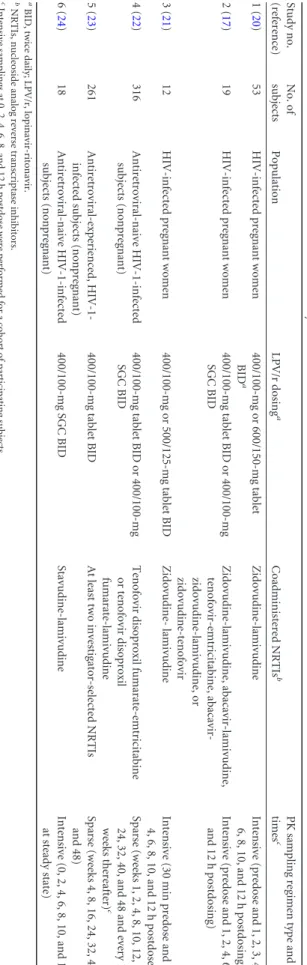
Clinical studies and patient population.Six clinical studies of HIV-in-fected adults were included in the analyses, three of which were conducted with pregnant women and three of which were with nonpregnant sub-jects. For each study, the study protocol was approved by the Institutional Review Board of the individual study site, and written informed consent was obtained from each subject prior to enrollment. All subjects wereⱖ18 years of age and received cART regimens comprising two NRTIs plus LPV/r (Table 1). All studies used validated high-performance liquid chro-matography with tandem mass spectrometric detection (HPLC-MS/MS) or UV detection (HPLC-UV) to quantitate LPV and RTV concentrations.
Table 1summarizes the clinical studies used in this analysis and their dosing and pharmacokinetic sampling schemes. Study 1 was a random-ized, open-label prospective study that enrolled 53 HIV-infected pregnant women between 14 and 30 weeks of gestation (20). Subjects were random-ized in a 1:1 ratio to receive LPV/r tablets either at 400/100 mg BID or 600/150 mg BID during pregnancy; all participants then received LPV/r at 400/100 mg BID for at least 6 weeks postpartum. Pharmacokinetic evalu-ations were performed at least 2 weeks after treatment initiation at the following time points: second trimester (between 20 and 28 weeks of gestation), third trimester (between 30 and 36 weeks of gestation), at delivery, and postpartum (4 to 6 weeks after delivery), depending on the gestational age at study enrollment.
Study 2 was a single-center, open-label study that compared the LPV pharmacokinetics of tablet and soft gelatin capsule (SGC) formulations in 19 HIV-infected pregnant women (17). Throughout the study, subjects received LPV/r at 400/100 mg BID either as an SGC (cohort 1,n⫽8) or as tablets (cohort 2,n⫽11). Pharmacokinetic evaluations were performed in the second and third trimesters as well as 4 to 6 weeks after delivery.
Study 3 was a two-center, open-label study that compared the phar-macokinetics of the LPV/r tablet at 400/100 mg BID and 500/125 mg BID during the third trimester of pregnancy (21). The 500/125-mg dose was achieved by adding a half-strength tablet of LPV/r of 100/25-mg to two 200/50-mg tablets. In this study, 12 HIV-infected pregnant women receiv-ing LPV/r at 400/100 mg BID underwent intensive LPV pharmacokinetic analyses in the second trimester and at 30 weeks of gestation in the third trimester. The LPV/r dose was increased in all women to 500/125 mg BID after the week 30 pharmacokinetic visit, with subsequent pharmacoki-netic sampling at 32 weeks of gestation. Two weeks after delivery, the LPV/r dose was decreased to 400/100 mg BID, and pharmacokinetics were reassessed 8 weeks after delivery.
Study 4 was an open-label, randomized phase 3 study comparing the pharmacokinetics and pharmacodynamics of LPV/r at 800/200 mg once daily (QD) and 400/100 mg BID in 664 treatment-naive HIV-infected male and nonpregnant female subjects receiving the LPV/r tablet and SGC formulations (22) Data from 316 subjects receiving the 400/100-mg BID regimen were included in this analysis.
Study 5 was a randomized, open-label phase 3 study comparing the pharmacokinetics and pharmacodynamics of LPV/r tablets at 800/200 mg QD and 400/100 mg BID in 599 treatment-experienced HIV-infected male and nonpregnant female subjects (23). Data from 261 subjects re-ceiving the 400/100-mg BID regimen were included in this analysis.
Study 6 was a randomized, double-blind, multicenter phase 1/2 study of LPV/r soft gelatin capsules BID in 100 HIV-infected male and nonpreg-nant female subjects without prior antiretroviral therapy (24). Data from 18 subjects receiving 400/100-mg BID doses were included in this analysis.
Population pharmacokinetic analysis. Concentration-time data were pooled across all studies and analyzed using a nonlinear mixed-effects population analysis approach with NONMEM (version 7.3.0) (25,
26). The first-order conditional estimation (FOCE) method with eta-ep-silon (-ε) interaction was employed throughout the model develop-ment. The graphic processing of the NONMEM output was performed with SAS (version 9.4).
Population pharmacokinetic models were built for LPV using total plasma concentrations. After dose proportionality was established, both
one- and two-compartment models with first-order absorption and elim-ination (ADVAN 2 and ADVAN 3 subroutines in NONMEM) were fitted to the data. Both a proportional plus additive-error model and propor-tional residual-error model were assessed. Individual pharmacokinetic parameters were assumed to be log-normally distributed, and the inter-individual variability in pharmacokinetic parameters was modeled using an exponential error model.
Two approaches were attempted to describe the RTV inhibition of LPV clearance. First, RTV inhibition of LPV clearance was modeled using a competitive inhibition model according to the following equa-tion (27): CL⫽TVCL⫻RTVConc/[1⫹(RTVConc/Ki)], where CL is clearance, TVCL is the typical value for LPV clearance in the absence of RTV, RTVConcis the observed RTV concentration, andKiis the
inhi-bition constant.
Second, RTV inhibition of LPV clearance was modeled using a maxi-mum-inhibition model according to the following equation (28): CL⫽ TVCL⫻[1⫺RTVConc/(IC50⫹RTVConc)], where IC50represents the RTV concentration at which a half-maximal inhibition effect on LPV clearance is obtained.
Covariate modeling was performed using the forward-inclusion (P⬍
0.05), backward-elimination (P⬍0.001) approach and was guided by evaluation of the empirical Bayesian pharmacokinetic parameter esti-mates versus covariate plots as well as changes in the estiesti-mates of phar-macokinetic parameter variability and residual variability. Nested models were compared using a likelihood ratio test, while nonnested models were compared using the Akaike information criterion.
Precision of the final model parameter estimates was assessed using the asymptotic standard errors obtained by the covariance routine in NONMEM as well as by the bootstrap confidence intervals. In boot-strapping, subjects were randomly sampled with replacement from the data set that was used in model development to obtain 1,000 data sets that have the same number of subjects as the original data set. The final model was then fitted to each of these data sets, and the parameter estimates were compared to the estimates from the original data set. The final model was qualified by visual predictive check where the final parameter estimates were used to simulate 1,000 replicates of the ob-served data set. The median and 5th and 95th percentile concentra-tions of the simulated data sets were then plotted against the original observations.
Statistical analysis.To establish the pharmacokinetic comparabil-ity of LPV between nonpregnant subjects and pregnant women, the linear mixed-model methodology using PROC MIXED in SAS system software, version 9.4, was used to compare the area under the concen-tration-time curve from 0 to 12 h (AUC0 –12) and concentration prior to dosing (Cpredose) in pregnant women receiving the tablet formula-tion in their second and third trimesters and nonpregnant subjects receiving the SGC formulation. To assess statistical differences be-tween the dose groups across studies, the differences in means were estimated with the corresponding least-squares means obtained from the mixed model on the logarithm of AUC0 –12andCpredose. Corre-spondingPvalues for the comparisons were estimated.
Exposure-virologic response relationship.LPV exposure-response relationships in pregnant women were explored using both scatter plots and quartile plots. In scatter plots, LPV AUC0 –12andCpredosevalues in pregnant women were plotted against HIV-1 viral load collected at the same visit. Furthermore, the percentage of subjects with viral load less than 50 copies per ml (percent responders) was compared across the four quartiles of LPV AUC0 –12andCpredosevalues in both pregnant women and nonpregnant subjects. Bayesianpost hocestimates obtained from the population pharmacokinetic model were used to obtain AUC0 –12and
Cpredosevalues for subjects with sparse pharmacokinetic sampling. For all
other subjects, observed AUC0 –12andCpredosevalues were used in the analysis.
RESULTS
Population pharmacokinetic analysis.
The analysis included
3,079 total LPV plasma concentrations and 3,077 total RTV
plasma concentrations from 84 pregnant women and 595
non-pregnant subjects.
A one-compartment disposition model with first-order
ab-sorption and elimination best described the LPV plasma
concen-tration-time data. A lag time describing a potential absorption
delay was not observed in the majority of subjects and hence was
not added to the model. Both the competitive inhibition and the
maximum effect (
E
max)-type inhibition models for evaluating the
effect of RTV on LPV clearance were supported by the data and led
to similar results. It was decided to move forward with the
E
max-type inhibition model on clearance as the interpretation of the
IC
50term allowed comparison of the estimates to results of other
studies that used the same approach.
The data supported including interindividual variability terms
for apparent clearance and apparent central volume of
distribu-tion, which were estimated with high precision. The correlation
between CL/
F
and
Vc
/
F
(
Vc
is the apparent central volume of
dis-tribution) was estimated to be 0.23 in the base model. Inclusion of
interindividual variability terms for the absorption rate constant
and IC
50was attempted. These terms were associated with high
shrinkage of greater than 50% and hence were not added to the
model. The residual unexplained variability was best
character-ized using a combined-additive and proportional-error model
be-cause both additive and proportional residual-error models
pro-vided inferior fits.
The final model parameter estimates and the precision
associ-ated with their estimations are shown in
Table 2
. Both fixed and
random effects were precisely estimated with percent relative
stan-dard error (RSE) of 16% or less. Accounting for the difference in
bioavailability levels between the tablet and SGC formulations was
found to significantly improve the fit; the bioavailability of the
tablet formulation was estimated to be 20% higher than that of the
SGC formulation in the final model. Pregnancy status was also
found to be a significant predictor of LPV clearance. Both the
second and third trimesters had similar increases of 17% in
clear-ance; postpartum women had a decrease of 26.4% in clearance
compared with that of nonpregnant subjects.
Finally, body weight was found to be a significant covariate on
apparent volume of distribution but not on LPV clearance. The
need for estimating the exponent of the allometric model for body
weight on volume of distribution was tested to ensure model
par-simony. Fixing the exponents to 1 resulted in a nonsignificant
increase in the objective function value (OFV) (
P
value
⫽
0.156),
and hence estimating the exponent was deemed unnecessary and
was kept fixed at 1 in the model, which indicates that an increase in
body weight is predicted to be associated with a proportional
in-crease in volume of distribution.
Lopinavir apparent clearance population estimates were 6.62,
7.75, and 4.87 liters/h in nonpregnant adults, pregnant women,
and postpartum women, respectively. The lopinavir apparent
vol-ume of distribution population estimate was 63.7 liters, with no
differences between nonpregnant adults and pregnant and
post-partum women.
The final equations and typical values of LPV parameters were
as follows. Bioavailability was 1.2 for the tablet and 1 for the
(0.239
⫹
RTV
Conc), where
is 1.17 for the second or third
trimester of pregnancy, 0.736 for the postpartum subjects, and
1 for nonpregnant subjects. The volume of distribution was
calculated as 63.7
⫻
(WTKG/71), where WTKG is weight in
kilograms.
In order to confirm the stability of the model precision of
esti-mated pharmacokinetic parameters, a nonparametric bootstrap
analysis was performed, and 96.4% of the bootstrap replicates
converged successfully. In accordance with the estimated standard
errors of estimates for pharmacokinetic parameters in the LPV
pharmacokinetic model, the bootstrap showed narrow confidence
intervals for all parameters. The medians and 5th and 95th
per-centiles of the parameter estimates from the fit of the final model
to the bootstrap samples are shown in
Table 2
. The asymptotic
estimates obtained from the original data set showed close
agree-ment with the median and were all included within the 2.5th to the
97.5th percentiles of the bootstrapping values, indicating model
stability. None of the 95% confidence intervals for the parameters
from the bootstrap data sets included zero, confirming the
robust-ness of parameters.
For the visual predictive checks, observed plasma
concentra-tion-time data, and 5th, 50th, and 95th percentiles of observed
data and confidence intervals of the 5th, 50th, and 95th percentiles
of simulated data are shown in
Fig. 1
, indicating sufficient
predic-tive ability of the model to describe LPV concentrations.
Statistical analysis.
There were no statistically significant
dif-ferences in mean LPV AUC
0 –12and
C
predosevalues between
preg-nant women in the second trimester receiving the LPV/r tablet
and nonpregnant subjects receiving the SGC formulation at the
400/100-mg BID dose (
P
values of 0.66 and 0.21, respectively).
Furthermore, there were no statistically significant differences in
LPV AUC
0 –12or
C
predosevalues between women in the third
tri-mester receiving 400/100-mg tablets BID and nonpregnant
HIV-infected subjects receiving the LPV/r SGC formulation at the 400/
100-mg BID dose (
P
values of 0.83 and 0.25, respectively). A
comparison of the LPV AUC
0 –12and
C
predosevalues in pregnant
women during second and third trimesters receiving the tablet
formulation at different doses and nonpregnant subjects
re-ceiving the SGC formulation at the 400/100-mg BID dose is
shown in
Fig. 2
.
Exposure-virologic response relationship.
Figure 3
shows the
relationship between individual LPV AUC
0 –12and
C
predosevalues
achieved in the third trimester and HIV-1 virologic response
mea-sured as plasma HIV-1 RNA levels (copies/ml). Substantial
reduc-tions in HIV-1 RNA were achieved by the third trimester for all
doses of LPV/r administered. In the range of LPV AUC
0 –12or
C
predosevalues observed in the third trimester, there does not
ap-pear to be a relationship between observed exposure and plasma
HIV-1 RNA levels.
Of the 84 pregnant women included in this analysis, 21/22
(95.5%) experienced and 57/62 (91.9%)
treatment-naive subjects had plasma HIV-1 RNA levels of less than 50 copies/
ml. Only one treatment-experienced pregnant woman receiving
400/100-mg BID SGC had an observed HIV-1 RNA level greater
than 400 copies/ml during the third trimester. Five
treatment-naive pregnant women had an observed plasma HIV-1 RNA level
between 50 and 400 copies/ml, with three receiving LPV/r SGC
at 400/100 mg BID and two receiving an LPV/r tablet at 400/
100 mg BID.
Quartile plots of the percentage of subjects with viral loads of
less than 50 copies/ml stratified by
C
predoseand AUC
0 –12values are
shown in
Fig. 4
. While a lower response rate was observed in
pregnant women in the lowest quartile, the response rates were
similar between this quartile and those of nonpregnant adults
across all quartiles.
DISCUSSION
We evaluated the pharmacokinetic differences between pregnant
women and nonpregnant subjects using nonlinear mixed-effect
analysis of LPV and RTV plasma concentrations pooled from
studies of both populations. The final model estimates for LPV
clearance and volume of distribution in nonpregnant subjects
were similar to those of previously published pharmacokinetic
studies (
27
,
28
). RTV concentrations increased LPV
concentra-tions, with an IC
50of 0.239
g/ml in this model, which reflects the
potency of the RTV inhibitory effect on LPV clearance and is
consistent with prior estimates (
29
,
30
). The model was qualified
using both bootstrapping and visual predictive checks.
The final population pharmacokinetic model estimated LPV
clearance to be 17% higher in pregnant women during their
sec-ond and third trimesters than in nonpregnant subjects. This
in-crease in clearance is consistent with the induction of hepatic
TABLE 2Population pharmacokinetic parameter estimates obtained after fitting the final model to the original data set and to 1,000 bootstrap samplesaParameter
Model result Bootstrap result
Population estimate (SEE)b
%
RSEc Mean Median 95% confidence interval
Volume of distribution (liters) 63.70 (3.2) 5.0 63.44 63.3 57.50–69.90
Clearance (liters/h) 6.62 (0.26) 3.8 6.70 6.64 5.980–7.770
Absorption rate constant (1/h) 0.712 (0.03) 4.3 0.73 0.721 0.551–0.940
Pregnancy on CL 1.17 (0.03) 2.6 1.19 1.18 1.030–1.390
Postpartum on CL 0.736 (0.02) 2.7 0.74 0.735 0.646–0.837
IC50(g/ml) 0.239 (0.01) 4.3 0.24 0.235 0.131–0.373
Tablet on bioavailability 1.200 (0.05) 4.0 1.19 1.190 1.110–1.290 Interindividual variance of volume of distribution 0.183 (0.03) 16.0 0.19 0.189 0.112–0.280 Interindividual variance of clearance 0.130 (0.01) 6.6 0.13 0.131 0.101–0.166
aBased on 964/1,000 successful runs. b
SEE, standard error of the estimate.
CYP3A and P-glycoprotein (P-gp) activity during pregnancy (
31
,
32
). The model also estimated the tablet formulation to be 20%
more bioavailable than the SGC formulation in both pregnant
women and nonpregnant subjects. The increase in bioavailability
is consistent with that observed in a bioequivalence study of
healthy volunteers, where the LPV/r tablet formulation
demon-strated 18 to 24% higher bioavailability than the SGC formulation
under fed conditions (
33
). This indicates that despite the increase
in clearance during pregnancy, the bioavailability of the tablet
formulation may compensate for the increased clearance, and
thus pregnant women receiving the tablet formulation still
main-tain LPV exposure that is similar to the efficacious exposure in
FIG 1Visual predictive check for the final model. Circles represent the medians, and error bars represent the 5th and 95th percentiles of observations. Shaded areas represent 95% confidence intervals of the 5th, 50th, and 95th percentiles of simulated data.FIG 3HIV-1 RNA response versus LPV AUC0 –12andCpredosevalues in the third trimester of pregnancy. LOQ, limit of quantitation.
nonpregnant subjects receiving the SGC formulation. Statistical
analysis confirmed the similarity in LPV AUC
0 –12and
C
predosevalues between the pregnant and nonpregnant populations.
The results of our population pharmacokinetic analysis
esti-mated LPV clearance postpartum to be 26.4% and 37.1% lower
than the clearance in nonpregnant subjects and pregnant women,
respectively. A recent study estimated a similar magnitude of
higher CYP3A4 activity in pregnant women (35%) than in
post-partum subjects as measured by the urinary ratio of 6-

-hydroxy-cortisol to -hydroxy-cortisol as a marker (
34
). Several other studies
investi-gating the pharmacokinetics of LPV/r tablets in pregnant women
similarly reported LPV exposure during the third trimester with
the 400/100-mg BID tablet dose to be 35% to 45% lower than the
postpartum exposure (
18
,
35–40
). Other clinical studies evaluated
LPV pharmacokinetics for the SGC formulation in pregnant
women (
19
,
41
,
42
). Similar to the results with the LPV/r tablet
formulation, following administration of LPV/r as 400/100-mg
SGC BID, LPV exposure in the third trimester was approximately
30% lower than the exposure observed 2 weeks after delivery.
It is important to note that the LPV
C
predosewas above 1
g/ml
in most of the pregnant women receiving 400/100 mg BID of
either the LPV/r tablet or SGC formulation. This plasma LPV
trough target is approximately 15 times the protein
binding-ad-justed plasma concentration required to obtain 50% of the
maxi-mum effect
in vivo
(EC
50) for the wild-type HIV-1 (
43–46
).
We assessed virologic suppression in pregnant women
receiv-ing LPV/r durreceiv-ing pregnancy. Virologic suppression was
main-tained in the vast majority of the pregnant women included in this
analysis. As most of the subjects in these studies initiated
treat-ment during their pregnancy, it is not unexpected that some
sub-jects would not be fully suppressed with a treatment duration of
less than 26 weeks, even when adequate plasma LPV levels are
achieved. Overall, quartile plots of the percentage of subjects with
virologic suppression versus LPV AUC
0 –12and
C
predosevalues in
pregnant women showed response rates comparable to, if not
higher than, those of nonpregnant subjects with similar or longer
treatment durations.
We also explored the relationship between LPV exposure and
the proportion of subjects with virologic suppression. There was
no correlation between the HIV-1 RNA virologic response and
LPV exposures achieved in pregnant women or nonpregnant
sub-jects, with similar response rates achieved in all four quartiles of
AUC
0 –12and
C
predosevalues. The high response rate leading to a
lack of exposure response correlation limited the ability to model
the relationship between lopinavir concentrations and the viral
load. In addition, a similar HIV-1 RNA virologic response rate was
achieved in both ART-naive and ART-experienced women in
their third trimesters of pregnancy. There are insufficient data to
recommend dosing in pregnant women with any documented
lopinavir-associated resistance substitutions.
LPV is highly protein bound to plasma proteins with higher
affinity to alpha-1 acid glycoprotein (AAG) than to albumin.
Con-flicting reports on the fraction of LPV unbound during pregnancy
have been reported. One study demonstrated no change in the
fraction of LPV unbound, and four studies reported an increase in
the fraction of LPV unbound (
16
,
20
,
28
,
47
,
48
). An increase in
the fraction unbound may potentially offset at least part of the
increase of the LPV clearance during pregnancy. Aweeka et al.
reported an 18% higher LPV unbound fraction in the plasma
dur-ing the third trimester than at postpartum (
n
⫽
28) (
49
). This
higher LPV unbound fraction was associated with 52% and 15%
reductions in AAG and albumin concentrations, respectively.
Kiser et al. reported 40% and 50% higher LPV unbound fractions
in the plasma during the second and third trimesters, respectively,
than at postpartum (
n
⫽
9) (
47
). More recently, Else et al.
re-ported that the LPV unbound fraction was 27% and 17% higher in
the second and third trimesters, respectively, than at postpartum
(
n
⫽
11) (
17
). Lastly, Fayet-Mello et al. reported an increase of 7%
to 29% in the LPV unbound fraction and a decrease in AAG and
albumin during pregnancy (
38
). The increase in the unbound
fraction may be explained by displacement of LPV from binding
sites by steroid and placental hormones and dilutional decreases
in albumin and AAG concentrations (
39
,
48
,
50
,
51
).
A systematic review has recently assessed the effects of LPV/r
on maternal and infant clinical and safety outcomes in
HIV-in-fected pregnant women (
52
). Nine studies were identified,
com-prising 2,675 LPV/r-treated women. The results from this
system-atic review suggested no unique safety or efficacy concerns with
use of the standard dose LPV/r as part of cART in pregnant
women. Furthermore, in 1,333 and 2,371 women exposed to
LPV/r in the first and second/third trimesters, respectively, in the
French perinatal cohort, no association was found between birth
defects and LPV or RTV (
53
). As of January 2013, the
Antiretro-viral Pregnancy Registry has cumulatively received prospective
reports of 3,335 exposures to LPV/r-containing regimens. Birth
defects occurred in 24 of the 1,049 (2.3%) live births with first
trimester exposure and in 67 of the 2,286 (2.9%) live births with
second/third trimester exposure (
54
). The prevalence of
congen-ital birth defects among the offspring of women with first- and
second/third-trimester LPV/r exposures was not significantly
dif-ferent from the prevalence of congenital birth defects in offspring
of pregnant women in the United States reference population,
whose background rate of birth defects is 2.7%. No pattern of
birth defect signal was detected for LPV/r (
54
).
In conclusion, dosing recommendations for antiretroviral
agents in HIV-infected, pregnant women should be based on
the assessment of the pharmacokinetic exposures and virologic
response during pregnancy, rather than from exposure
com-parison with nonpregnant subjects or postpartum
measure-ments (i.e., the initial weeks after delivery). For LPV, nonlinear
mixed-effects modeling as utilized in our analysis is the most
appropriate approach to make this evaluation since it can
ac-count for inter- and intrasubject variability between pregnant
women and nonpregnant subjects. Although the LPV exposure
in the third trimester of pregnancy was lower than that of
non-pregnant subjects receiving the same formulation or in the
postpartum period, the increase in LPV clearance during
preg-nancy is compensated by the higher bioavailability of the LPV/r
tablet formulation than that of the SGC formulation along with
potentially a decrease in protein binding. Over 90% of the
pregnant women in this analysis were virologically suppressed.
Analysis of virologic response in pregnant women receiving
400/100 mg of LPV/r BID demonstrated no association with
LPV exposure and no difference compared with responses of
nonpregnant subjects, which is consistent with demonstration
of LPV plasma trough concentrations above 1
g/ml. The
vi-rologic response is also consistent with the demonstrated
effi-cacy in both treatment-naive and treatment-experienced HIV
subjects of the original SGC formulation of LPV/r (
21
,
55
),
Pregnant women achieved virologic suppression with the 400/
100-mg twice-daily regimen of LPV/r tablets, and there has
been no signal of increased rate of congenital birth defects seen
in their offspring. Based on our pharmacokinetic and
pharma-codynamic evaluation, LPV/r tablets in doses of 400/100 mg
twice daily during pregnancy is appropriate, and no dosage
adjustment for LPV/r is recommended.
ACKNOWLEDGMENTS
AbbVie participated in the design, study conduct, analysis, and interpre-tation of data as well as the writing, review, and approval of the publica-tion. A.H.S., A.K.J., A.M.N., and C.E.K. are employed by AbbVie and may own stock.
FUNDING INFORMATION
M.S.-O. received a grant from the Brazilian National AIDS Program, Min-istry of Health, and clinical drug supply and internal standards for the analytical assay from Abbott/AbbVie for the conduct of one of the studies included in this analysis. K.B.P. and G.P.T. received financial support from Abbott/AbbVie for the conduct of two of the studies included in this analysis. AbbVie provided financial support for the study.
REFERENCES
1.Garcia PM, Kalish LA, Pitt J, Minkoff H, Quinn TC, Burchett SK, Kornegay J, Jackson B, Moye J, Hanson C. 1999. Maternal levels of plasma human immunodeficiency virus type 1 RNA and the risk of peri-natal transmission. N Engl J Med341:394 – 402.http://dx.doi.org/10.1056 /NEJM199908053410602.
2.Cooper ER, Charurat M, Mofenson L, Hanson IC, Pitt J, Diaz C, Hayani K, Handelsman E, Smeriglio V, Hoff R.2002. Combination antiretroviral strategies for the treatment of pregnant HIV-1-infected women and prevention of perinatal HIV-1 transmission. J Acquir Im-mune Defic Syndr 29:484 – 494. http://dx.doi.org/10.1097/00042560 -200204150-00009.
3.Günthard HF, Aberg JA, Eron JJ, Hoy JF, Telenti A, Benson CA, Burger DM, Cahn P, Gallant JE, Glesby MJ.2014. Antiretroviral treatment of adult HIV infection: 2014 recommendations of the International Antiviral Society-USA Panel. JAMA312:410 – 425.http://dx.doi.org/10.1001/jama .2014.8722.
4.Panel on Treatment of HIV-Infected Pregnant Women and Prevention of Perinatal Transmission.2015. Recommendations for use of antiretro-viral drugs in pregnant HIV-1-infected women for maternal health and interventions to reduce perinatal HIV transmission in the United States. Public Health Service Task Force, NIH, Rockville, MD.https://aidsinfo .nih.gov/contentfiles/lvguidelines/PerinatalGL.pdf.
5.European AIDS Clinical Society.2014. Guidelines, version 7.1, Novem-ber 2014. European AIDS Clinical Society, Brussels, Belgium.http://www .eacsociety.org/files/guidelines_english_71_141204.pdf.
6.Taylor G, Clayden P, Dhar J, Gandhi K, Gilleece Y, Harding K, Hay P, Kennedy J, Low-Beer N, Lyall H.2012. British HIV Association guide-lines for the management of HIV infection in pregnant women 2012. HIV Med13:87–157.http://dx.doi.org/10.1111/j.1468-1293.2012.01030.x. 7.World Health Organization.2010. Antiretroviral drugs for treating
preg-nant women and preventing HIV infection in infants: recommendations for a public health approach, 2010 version. World Health Organization, Geneva, Switzerland.
8.Chandwani A, Shuter J.2008. Lopinavir/ritonavir in the treatment of HIV-1 infection: a review. Ther Clin Risk Manag4:1023–1033. 9.de Vincenzi I.2011. Triple antiretroviral compared with zidovudine and
single-dose nevirapine prophylaxis during pregnancy and breastfeeding for prevention of mother-to-child transmission of HIV-1 (Kesho Bora study): a randomised controlled trial. Lancet Infect Dis11:171–180.http: //dx.doi.org/10.1016/S1473-3099(10)70288-7.
10. Shapiro R, Hughes M, Ogwu A, Kitch D, Lockman S, Moffat C, Makhema J, Moyo S, Thior I, McIntosh K.2010. Antiretroviral regimens in pregnancy and breast-feeding in Botswana. N Engl J Med362:2282– 2294.http://dx.doi.org/10.1056/NEJMoa0907736.
11. Floridia M, Ravizza M, Masuelli G, Giacomet V, Martinelli P, Degli Antoni A, Spinillo A, Fiscon M, Francisci D, Liuzzi G.2014. Atazanavir
and lopinavir profile in pregnant women with HIV: tolerability, activity and pregnancy outcomes in an observational national study. J Antimicrob Chemother69:1377–1384.http://dx.doi.org/10.1093/jac/dkt497. 12. Cohan D, Natureeba P, Koss CA, Plenty A, Luwedde F, Mwesigwa J,
Ades V, Charlebois ED, Gandhi M, Clark TD, Nzarubara B, Achan J, Ruel T, Kamya MR, Havlir DV.2015. Efficacy and safety of lopinavir/ ritonavir versus efavirenz-based antiretroviral therapy in HIV-infected pregnant Ugandan women. AIDS29:183–191.http://dx.doi.org/10.1097 /QAD.0000000000000531.
13. Roberts SS, Martinez M, Covington DL, Rode RA, Pasley MV, Woodward WC.2009. Lopinavir/ritonavir in pregnancy. J Acquir Immune Defic Syndr
51:456 – 461.http://dx.doi.org/10.1097/QAI.0b013e3181a2813f.
14. Peixoto MF, Pilotto JH, Stoszek SK, Kreitchmann R, Mussi-Pinhata MM, Melo VH, João EC, Ceriotto M, Souza RDSD, Read J. 2011. Lopinavir/ritonavir dosing during pregnancy in Brazil and maternal/ infant laboratory abnormalities. Braz J Infect Dis15:253–261.http://dx .doi.org/10.1016/S1413-8670(11)70185-4.
15. Azria E, Moutafoff C, Schmitz T, Le Meaux JP, Krivine A, Pannier E, Firtion G, Compagnucci A, Finkielsztejn L, Taulera O.2009. Pregnancy outcomes in women with HIV type-1 receiving a lopinavir/ritonavir-containing regimen. Antivir Ther14:423– 432.
16. Senise J, Cruz R, Palacios R, Bonafé S, Vaz MJR, Lacerda AP.2008. Low-birth weight and pre-term delivery in relation to lopinavir/ritonavir use in pregnancy. Am J Infect Dis4:209 –214.http://dx.doi.org/10.3844 /ajidsp.2008.209.214.
17. Else L, Douglas M, Dickinson L, Back D, Khoo S, Taylor G. 2012. Improved oral bioavailability of lopinavir in melt-extruded tablet formu-lation reduces impact of third trimester on lopinavir plasma concentra-tions. Antimicrob Agents Chemother56:816 – 824.http://dx.doi.org/10 .1128/AAC.05186-11.
18. Best BM, Stek AM, Mirochnick M, Hu C, Li H, Burchett SK, Rossi SS, Smith E, Read JS, Capparelli EV.2010. Lopinavir tablet pharmacokinet-ics with an increased dose during pregnancy. J Acquir Immune Defic Syndr54:381–388.http://dx.doi.org/10.1097/QAI.0b013e3181d6c9ed. 19. Mirochnick M, Best BM, Stek AM, Capparelli E, Hu C, Burchett SK,
Holland DT, Smith E, Gaddipati S, Read JS.2008. Lopinavir expo-sure with an increased dose during pregnancy. J Acquir Immune Defic Syndr49:485– 491.http://dx.doi.org/10.1097/QAI.0b013e318186edd0. 20. Santini-Oliveira M, Estrela RDCE, Veloso VG, Cattani VB, Yanavich C,
Velasque L, Torres TS, Marins LM, Pilotto JH, João EC, Goncalves JC, Grinsztejn B.2014. Randomized clinical trial comparing the pharmaco-kinetics of standard-and increased-dosage lopinavir-ritonavir coformula-tion tablets in HIV-positive pregnant women. Antimicrob Agents Che-mother58:2884 –2893.http://dx.doi.org/10.1128/AAC.02599-13. 21. Patterson KB, Dumond JB, Prince HA, Jenkins AJ, Scarsi KK, Wang R,
Malone S, Hudgens MG, Kashuba AD.2013. Protein binding of lopina-vir and ritonalopina-vir during four phases of pregnancy: implications for treat-ment guidelines. J Acquir Immune Defic Syndr63:51–58.http://dx.doi .org/10.1097/QAI.0b013e31827fd47e.
22. González-García J, Cohen D, Johnson M, Sloan L, Fredrick L, Naylor C, da Silva B, Bernstein B.2010. Short communication: comparable safety and efficacy with once-daily versus twice-daily dosing of lopinavir/ ritonavir tablets with emtricitabine⫹tenofovir DF in antiretroviral-naive, HIV type 1-infected subjects: 96 week final results of the random-ized trial M05-730. AIDS Res Hum Retroviruses26:841– 845.http://dx .doi.org/10.1089/aid.2009.0307.
23. Zajdenverg R, Podsadecki TJ, Badal-Faesen S, Andrade-Villanueva J, Gathe J, Mingrone H, Fredrick LM, Gaultier IA, Woodward WC, Bernstein BM.2010. Similar safety and efficacy of once-and twice-daily lopinavir/ritonavir tablets in treatment-experienced HIV-1-infected sub-jects at 48 weeks. J Acquir Immune Defic Syndr54:143–151.http://dx.doi .org/10.1097/QAI.0b013e3181cbd21e.
24. Murphy RL, Brun S, Hicks C, Eron JJ, Gulick R, King M, White AC, Jr, Benson C, Thompson M, Kessler HA. 2001. ABT-378/ritonavir plus stavudine and lamivudine for the treatment of antiretroviral-naive adults with HIV-1 infection: 48-week results. AIDS15:F1–F9.http://dx.doi.org /10.1097/00002030-200101050-00002.
25. Lindbom L, Pihlgren P, Jonsson N.2005. PsN-Toolkit—a collection of computer intensive statistical methods for non-linear mixed effect mod-eling using NONMEM. Comput Methods Programs Biomed79:241–257.
http://dx.doi.org/10.1016/j.cmpb.2005.04.005.
27. Wang K, D’Argenio DZ, Acosta EP, Sheth AN, Delille C, Lennox JL, Kerstner-Wood C, Ofotokun I.2014. Integrated population pharmaco-kinetic/viral dynamic modelling of lopinavir/ritonavir in HIV-1 treat-ment-naïve patients. Clin Pharmacokinet53:361–371.http://dx.doi.org /10.1007/s40262-013-0122-1.
28. Vezina HE, Park J-G, Wallis CL, Bartlett JA, Kumarasamy N, Stevens WS, Klingman KL, Ribaudo HJ, Katzenstein DA.2013. Lopinavir pop-ulation pharmacokinetics in HIV-infected patients from resource-limited settings receiving second-line treatment with lopinavir/ritonavir mono-therapy in AIDS Clinical Trials Group (ACTG) Study 5230. J Pharmaco-kinet Pharmacodyn 40:S31–S32. http://dx.doi.org/10.1007/s10928-013 -9308-2.
29. Moltó J, Barbanoj MJ, Miranda C, Blanco A, Santos JR, Negredo E, Costa J, Domingo P, Clotet B, Valle M.2008. Simultaneous popula-tion pharmacokinetic model for lopinavir and ritonavir in HIV-infected adults. Clin Pharmacokinet47:681– 692.http://dx.doi.org/10 .2165/00003088-200847100-00005.
30. Crommentuyn K, Kappelhoff B, Mulder J, Mairuhu A, Van Gorp E, Meenhorst P, Huitema A, Beijnen J.2005. Population pharmacokinetics of lopinavir in combination with ritonavir in HIV-1-infected patients. Br J Clin Pharmacol 60:378 –389. http://dx.doi.org/10.1111/j.1365-2125 .2005.02455.x.
31. Hebert M, Easterling T, Kirby B, Carr D, Buchanan M, Rutherford T, Thummel K, Fishbein D, Unadkat J.2008. Effects of pregnancy on CYP3A and P-glycoprotein activities as measured by disposition of mida-zolam and digoxin: a University of Washington specialized center of re-search study. Clin Pharmacol Ther84:248 –253.http://dx.doi.org/10.1038 /clpt.2008.1.
32. Tracy TS, Venkataramanan R, Glover DD, Caritis SN.2005. Temporal changes in drug metabolism (CYP1A2, CYP2D6 and CYP3A activity) dur-ing pregnancy. Am J Obstet Gynecol192:633– 639.http://dx.doi.org/10 .1016/j.ajog.2004.08.030.
33. Klein CE, Chiu Y-L, Awni W, Zhu T, Heuser RS, Doan T, Breitenbach J, Morris JB, Brun SC, Hanna GJ. 2007. The tablet formulation of lopinavir/ritonavir provides similar bioavailability to the soft-gelatin cap-sule formulation with less pharmacokinetic variability and diminished food effect. J Acquir Immune Defic Syndr44:401– 410.http://dx.doi.org /10.1097/QAI.0b013e31803133c5.
34. Aweeka F, Hu C, Huang L, Best B, Stek A, Lizak P, Burchett S, Read J, Watts H, Mirochnick M.2015. Alteration in cytochrome P450 3A4 ac-tivity as measured by a urine cortisol assay in HIV-1-infected pregnant women and relationship to antiretroviral pharmacokinetics. HIV Med
16:176 –183.http://dx.doi.org/10.1111/hiv.12195.
35. Baroncelli S, Villani P, Floridia M, Pirillo MF, Galluzzo CM, Cusato M, Amici R, Pinnetti C, Sabbatini F, Molinari A.2008. Trough concentra-tions of lopinavir, nelfinavir, and nevirapine with standard dosing in hu-man immunodeficiency virus-infected pregnant women receiving 3-drug combination regimens. Ther Drug Monit30:604 – 610.http://dx.doi.org /10.1097/FTD.0b013e3181867a6e.
36. Cressey TR, Jourdain G, Rawangban B, Varadisai S, Kongpanichkul R, Sabsanong P, Yuthavisuthi P, Chirayus S, Ngo-Giang-Huong N, Vora-mongkol N.2010. Pharmacokinetics and virologic response of zidovu-dine/lopinavir/ritonavir initiated during the third trimester of pregnancy. AIDS24:2193–2200.http://dx.doi.org/10.1097/QAD.0b013e32833ce57d. 37. Lambert J, Else L, Jackson V, Breiden J, Gibbons S, Dickinson L, Back D, Brennan M, Connor E, Boyle N.2011. Therapeutic drug monitoring of lopinavir/ritonavir in pregnancy. HIV Med12:166 –173.http://dx.doi .org/10.1111/j.1468-1293.2010.00865.x.
38. Fayet-Mello A, Buclin T, Guignard N, Cruchon S, Cavassini M, Grawe C, Gremlich E, Popp KA, Schmid F, Eap CB.2013. Free and total plasma levels of lopinavir during pregnancy, at delivery and postpartum: impli-cations for dosage adjustments in pregnant women. Antivir Ther18:171– 182.http://dx.doi.org/10.3851/IMP2328.
39. Calza L, Manfredi R, Trapani F, Salvadori C, Colangeli V, Borderi M, Grossi G, Motta R, Viale P.2012. Lopinavir/ritonavir trough concentra-tions with the tablet formulation in HIV-1-infected women during the third trimester of pregnancy. Scand J Infect Dis44:381–387.http://dx.doi .org/10.3109/00365548.2011.642306.
40. Shapiro RL, Rossi S, Ogwu A, Moss M, Leidner J, Moffat C, Lockman S, Moyo S, Makhema J, Essex M.2013. Therapeutic levels of lopinavir in
late pregnancy and abacavir passage into breast milk in the Mma Bana Study, Botswana. Antivir Ther 18:585–590. http://dx.doi.org/10.3851 /IMP2474.
41. Stek AM, Mirochnick M, Capparelli E, Best BM, Hu C, Burchett SK, Elgie C, Holland DT, Smith E, Tuomala R. 2006. Reduced lopinavir exposure during pregnancy. AIDS 20:1931–1939.http://dx.doi.org/10 .1097/01.aids.0000247114.43714.90.
42. Cressey TR, Van Dyke R, Jourdain G, Puthanakit T, Roongpisuthipong A, Achalapong J, Yuthavisuthi P, Prommas S, Chotivanich N, Maupin R.2009. Early postpartum pharmacokinetics of lopinavir initiated intra-partum in Thai women. Antimicrob Agents Chemother53:2189 –2191.
http://dx.doi.org/10.1128/AAC.01091-08.
43. Molla A, Vasavanonda S, Kumar G, Sham HL, Johnson M, Grabowski B, Denissen JF, Kohlbrenner W, Plattner JJ, Leonard JM.1998. Human serum attenuates the activity of protease inhibitors toward wild-type and mutant human immunodeficiency virus. Virology250:255–262.http://dx .doi.org/10.1006/viro.1998.9383.
44. Ananworanich J, Kosalaraksa P, Hill A, Siangphoe U, Bergshoeff A, Pancharoen C, Engchanil C, Ruxrungtham K, Burger D, HIV-NAT 017 Study Team.2005. Pharmacokinetics and 24-week efficacy/safety of dual boosted saquinavir/lopinavir/ritonavir in nucleoside-pretreated children. Pediatr Infect Dis J 24:874 – 879. http://dx.doi.org/10.1097/01.inf .0000180578.38584.da.
45. Kappelhoff BS, Crommentuyn KM, de Maat MM, Mulder JW, Huitema AD, Beijnen JH.2004. Practical guidelines to interpret plasma concen-trations of antiretroviral drugs. Clin Pharmacokinet43:845– 853.http: //dx.doi.org/10.2165/00003088-200443130-00002.
46. La Porte C, Back D, Blaschke T, Boucher C, Fletcher C, Flexner C, Gerber J, Kashuba A, Schapiro J, Burger D.2006. Updated guideline to perform therapeutic drug monitoring for antiretroviral agents. Rev Anti-vir Ther2006:4 –14.
47. Kiser JJ, Mawhinney S, Kinzie K, Barr E, Simons A, Paul S, Hoody D, Fletcher C, Allshouse A, Weinberg AL.2009. Total and unbound lopi-navir/ritonavir (LPV/RTV) pharmacokinetics (PK) in a concentration-guided study of HIV infected women throughout pregnancy and post-partum (PP), abstr 946. Abstr 16th Conf Retrovir Opportunistic Infect, Montreal, Canada, 8 to 11 February 2009.
48. Perucca E, Crema A.1982. Plasma protein binding of drugs in pregnancy. Clin Pharmacokinet 7:336 –352. http://dx.doi.org/10.2165/00003088 -198207040-00004.
49. Aweeka F, Stek A, Best B, Hu C, Holland D, Hermes A, Burchett S, Read J, Mirochnick M, Capparelli E.2010. Lopinavir protein binding in HIV-1-infected pregnant women. HIV Med11:232–238.http://dx.doi.org /10.1111/j.1468-1293.2009.00767.x.
50. Anderson GD.2005. Pregnancy-induced changes in pharmacokinetics. Clin Pharmacokinet 44:989 –1008.http://dx.doi.org/10.2165/00003088 -200544100-00001.
51. Aweeka FT, Rosenkranz SL, Segal Y, Coombs RW, Bardeguez A, The-vanayagam L, Lizak P, Aberg J, Watts DH, NIAID AIDS Clinical Trials Group.2006. The impact of sex and contraceptive therapy on the plasma and intracellular pharmacokinetics of zidovudine. AIDS20:1833–1841.
http://dx.doi.org/10.1097/01.aids.0000244202.18629.36.
52. Pasley MV, Martinez M, Hermes A, d’Amico R, Nilius A.2013. Safety and efficacy of lopinavir/ritonavir during pregnancy: a systematic review. AIDS Rev15:38 – 48.
53. Sibiude J, Mandelbrot L, Blanche S, Le Chenadec J, Boullag-Bonnet N, Faye A, Dollfus C, Tubiana R, Bonnet D, Lelong N.2014. Association between prenatal exposure to antiretroviral therapy and birth defects: an analysis of the French perinatal cohort study (ANRS CO1/CO11). PLoS Med11:e1001635.http://dx.doi.org/10.1371/journal.pmed.1001635. 54. Antiretroviral Pregnancy Registry Steering Committee.2013.
Anti-retroviral Pregnancy Registry international interim report for 1 Janu-ary 1989 through 31 JanuJanu-ary 2013. Antiretroviral Pregnancy Registry, Wilmington, NC.