CONSORT Statement for Randomized Trials of Nonpharmacologic
Treatments: A 2017 Update and a CONSORT Extension for
Nonpharmacologic Trial Abstracts
Isabelle Boutron, MD, PhD; Douglas G. Altman, DSc; David Moher, PhD; Kenneth F. Schulz, PhD, MBA; and
Philippe Ravaud, MD, PhD, for the CONSORT NPT Group*
Incomplete and inadequate reporting is an avoidable waste that
reduces the usefulness of research. The CONSORT
(Consoli-dated Standards of Reporting Trials) Statement is an
evidence-based reporting guideline that aims to improve research
trans-parency and reduce waste. In 2008, the CONSORT Group
developed an extension to the original statement that addressed
methodological issues specific to trials of nonpharmacologic
treatments (NPTs), such as surgery, rehabilitation, or
psychother-apy. This article describes an update of that extension and
pres-ents an extension for reporting abstracts of NPT trials. To
de-velop these materials, the authors reviewed pertinent literature
published up to July 2016; surveyed authors of NPT trials; and
conducted a consensus meeting with editors, trialists, and
methodologists.
Changes to the CONSORT Statement extension for NPT trials
include wording modifications to improve readers'
understand-ing and the addition of 3 new items. These items address
whether and how adherence of participants to interventions is
assessed or enhanced, description of attempts to limit bias if
blinding is not possible, and specification of the delay between
randomization and initiation of the intervention. The CONSORT
extension for abstracts of NPT trials includes 2 new items that
were not specified in the original CONSORT Statement for
ab-stracts. The first addresses reporting of eligibility criteria for
cen-ters where the intervention is performed and for care providers.
The second addresses reporting of important changes to the
intervention versus what was planned. Both the updated
CONSORT extension for NPT trials and the CONSORT extension
for NPT trial abstracts should help authors, editors, and peer
re-viewers improve the transparency of NPT trial reports.
Ann Intern Med.2017;167:40-47. doi:10.7326/M17-0046 Annals.org For author affiliations, see end of text.
This article was published at Annals.org on 20 June 2017.
* For a list of members of the CONSORT NPT Group, seeAppendix 1 (available at Annals.org).
I
ncomplete reporting is responsible for a great deal of
avoidable waste in research (1, 2). The CONSORT
(Consolidated Standards of Reporting Trials) Statement
(3–5), an evidence-based reporting guideline, was
de-veloped to improve research transparency.
Nonpharmacologic treatments (NPTs), such as
sur-gery, rehabilitation, education, psychotherapy, and
de-vices, represent a wide range of interventions.
How-ever, assessing NPTs raises specific methodological
issues related to the complexity of the intervention, the
influence of care providers, the expertise of the center,
and the difficulties of blinding (6 –14). To account for
these issues, the CONSORT Group developed a
CONSORT Statement extension for trials of NPTs
(“CONSORT NPT extension”), which was published in
Annals of Internal Medicine
in 2008 (15, 16).
In 2010, the main CONSORT Statement was
up-dated (5, 17). To account for this update and
method-ological developments since publication of the original
NPT extension, we aimed to update the CONSORT NPT
extension and develop a CONSORT extension for
re-porting abstracts of NPT trials (18, 19).
M
ETHODS
We updated the CONSORT NPT extension in 3
steps. First, we reviewed the literature to identify
up-to-date evidence. The search is detailed in
Appendix 2
(available at Annals.org). Second, we surveyed
corre-sponding authors of published articles citing the 2008
CONSORT NPT extension. Of the 1525 authors invited
by e-mail, 194 (13%) participated. For each item of the
CONSORT NPT extension, participants were asked to
indicate whether they believed the item should be
modified and, if so, why and how. The results of the
survey are reported in
Appendix Tables 1
and
2
(avail-able at Annals.org). From the literature review and the
survey, we synthesized proposals for changes to each
item. Finally, we organized a 2-day consensus meeting
in May 2014 in Paris, France, with 22 participants (9
editors, 6 trialists, and 7 methodologists). During this
meeting, the survey results and proposals for change
were presented and each item was discussed until
con-sensus was reached. After the meeting, we developed
a draft of the current manuscript, which was sent to all
participants for comments. The updated checklist was
not modified at this stage.
Updating the CONSORT NPT Extension
Main Changes to the CONSORT NPT Extension
The revision of the CONSORT NPT extension
checklist consisted of the deletion of items, the
addi-tion of new items, wording changes, and reformatting.
The numbering and content of items were adjusted to
follow the 2010 CONSORT Statement. Some wording
was changed to improve readers' understanding, such
as the use of “care providers” instead of “those
per-forming the intervention” in item 3.
Items 11a and 11b, related to blinding, were
mod-ified because they were incorporated into the 2010
CONSORT Statement. Three new items were added to
account for the difficulties in replicating NPTs, the
fre-quent lack of blinding, and the risk for a differential
R
ESEARCH AND
R
EPORTING
M
ETHODS
Annals of Internal Medicine
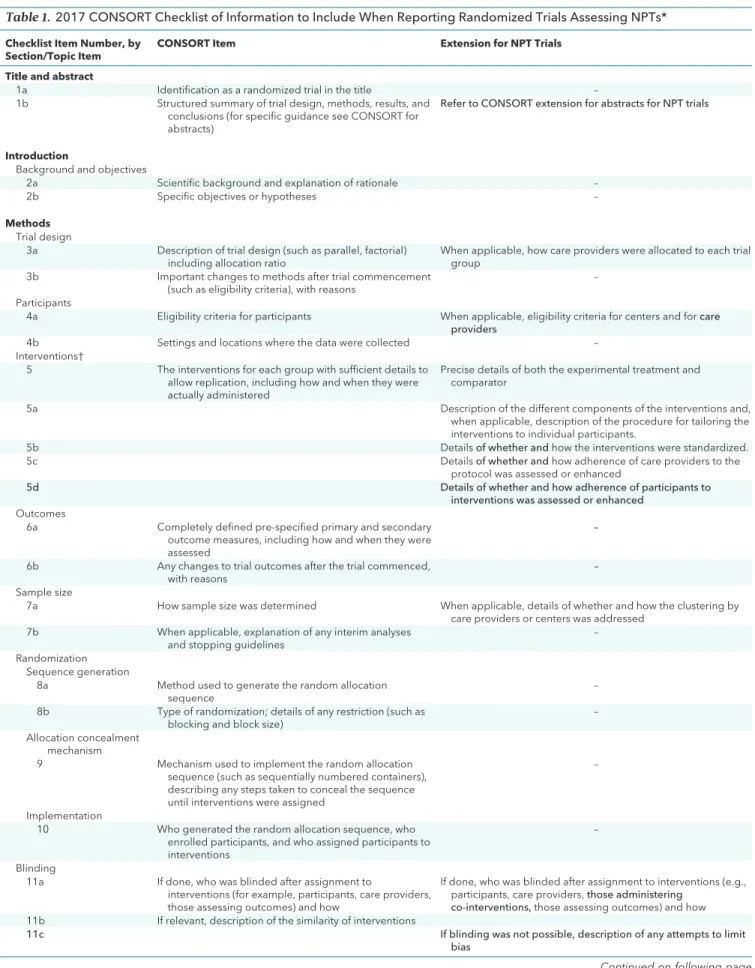
Table 1.
2017 CONSORT Checklist of Information to Include When Reporting Randomized Trials Assessing NPTs*
Checklist Item Number, by Section/Topic Item
CONSORT Item Extension for NPT Trials Title and abstract
1a Identification as a randomized trial in the title –
1b Structured summary of trial design, methods, results, and conclusions (for specific guidance see CONSORT for abstracts)
Refer to CONSORT extension for abstracts for NPT trials
Introduction
Background and objectives
2a Scientific background and explanation of rationale –
2b Specific objectives or hypotheses –
Methods
Trial design
3a Description of trial design (such as parallel, factorial) including allocation ratio
When applicable, how care providers were allocated to each trial group
3b Important changes to methods after trial commencement (such as eligibility criteria), with reasons
–
Participants
4a Eligibility criteria for participants When applicable, eligibility criteria for centers and forcare providers
4b Settings and locations where the data were collected –
Interventions†
5 The interventions for each group with sufficient details to allow replication, including how and when they were actually administered
Precise details of both the experimental treatment and comparator
5a Description of the different components of the interventions and,
when applicable, description of the procedure for tailoring the interventions to individual participants.
5b Detailsof whether andhow the interventions were standardized.
5c Detailsof whether andhow adherence of care providers to the
protocol was assessed or enhanced
5d Details of whether and how adherence of participants to
interventions was assessed or enhanced Outcomes
6a Completely defined pre-specified primary and secondary outcome measures, including how and when they were assessed
–
6b Any changes to trial outcomes after the trial commenced, with reasons
–
Sample size
7a How sample size was determined When applicable, details of whether and how the clustering by care providers or centers was addressed
7b When applicable, explanation of any interim analyses and stopping guidelines
–
Randomization Sequence generation
8a Method used to generate the random allocation sequence
–
8b Type of randomization; details of any restriction (such as blocking and block size)
–
Allocation concealment mechanism
9 Mechanism used to implement the random allocation sequence (such as sequentially numbered containers), describing any steps taken to conceal the sequence until interventions were assigned
–
Implementation
10 Who generated the random allocation sequence, who enrolled participants, and who assigned participants to interventions
–
Blinding
11a If done, who was blinded after assignment to
interventions (for example, participants, care providers, those assessing outcomes) and how
If done, who was blinded after assignment to interventions (e.g., participants, care providers,those administering
co-interventions,those assessing outcomes) and how 11b If relevant, description of the similarity of interventions
11c If blinding was not possible, description of any attempts to limit
bias
Continued on following page
CONSORT Nonpharmacologic Treatments
R
ESEARCH AND
R
EPORTING
M
ETHODS
Table 1—Continued
Checklist Item Number, by Section/Topic Item
CONSORT Item Extension for NPT Trials
Statistical methods
12a Statistical methods used to compare groups for primary and secondary outcomes
When applicable, details of whether and how the clustering by care providers or centers was addressed
12b Methods for additional analyses, such as subgroup analyses and adjusted analyses
–
Results
Participant flow (a diagram is strongly recommended)
13a For each group, the numbers of participants who were randomly assigned, received intended treatment, and were analyzed for the primary outcome
The number of care providers or centers performing the intervention in each group and the number of patients treated by each care provider or in each center
13b For each group, losses and exclusions after randomization, together with reasons
–
13c For each group, the delay between randomization and the
initiation of the intervention
New Details of the experimental treatment and comparator as they
were implemented Recruitment
14a Dates defining the periods of recruitment and follow-up –
14b Why the trial ended or was stopped –
Baseline data
15 A table showing baseline demographic and clinical characteristics for each group
When applicable, a description of care providers (case volume, qualification, expertise, etc.) and centers (volume) in each group
Numbers analyzed
16 For each group, number of participants (denominator) included in each analysis and whether the analysis was by original assigned groups
–
Outcomes and estimation
17a For each primary and secondary outcome, results for each group, and the estimated effect size and its precision (such as 95% confidence interval)
–
17b For binary outcomes, presentation of both absolute and relative effect sizes is recommended
–
Ancillary analyses
18 Results of any other analyses performed, including subgroup analyses and adjusted analyses, distinguishing pre-specified from exploratory
–
Harms
19 All important harms or unintended effects in each group (for specific guidance see CONSORT for harms)
–
Discussion
Limitations
20 Trial limitations, addressing sources of potential bias, imprecision, and, if relevant, multiplicity of analyses
In addition, take into account the choice of the comparator, lack of or partial blinding, and unequal expertise of care providers or centers in each group
Generalizability
21 Generalizability (external validity, applicability) of the trial findings
Generalizability (external validity) of the trial findings according to the intervention, comparators, patients, and care providers and centers involved in the trial
Interpretation
22 Interpretation consistent with results, balancing benefits and harms, and considering other relevant evidence
–
Other information
Registration
23 Registration number and name of trial registry –
Protocol
24 Where the full trial protocol can be accessed, if available –
Funding
25 Sources of funding and other support (such as supply of drugs), role of funders
–
CONSORT = Consolidated Standards of Reporting Trials; NPT = nonpharmacologic treatment.
* Additions or modifications to the 2010 CONSORT checklist. Modifications of the extension are in boldface.
† These items are consistent with the Template for Intervention Description and Replication (TIDieR) checklist.
R
ESEARCH AND
R
EPORTING
M
ETHODS
CONSORT Nonpharmacologic Treatments
delay between randomization and initiation of the
inter-vention. These items are dedicated to whether and how
adherence of participants to interventions is assessed
or enhanced (item 5d), the description of any attempts
to limit bias if blinding is not possible (item 11c), and
the delay between randomization and initiation of the
intervention (item 13c).
The updated NPT checklist is shown in
Table 1
,
with examples of adequate reporting in
Appendix
Table 3
and
Appendix Figures 1
and
2
(available at
Annals.org). The modified participant flow diagram is
presented in the
Figure
.
Development of the CONSORT Extension for
Reporting Abstracts of NPT Trials
The CONSORT extension for abstracts was
pub-lished in 2008 (18). We added 2 new items to this
ex-tension: one for reporting “eligibility criteria for centers
where the intervention is performed and for care
pro-viders”, and one for “any important changes to the
in-tervention delivered from what was planned” (
Table 2
).
Appendix Table 4
(available at Annals.org) provides
ex-amples of published abstracts that we modified to
ad-here to the CONSORT extension for abstracts of NPT
trials.
Specific Methodological Issues Considered in the
Update to the CONSORT NPT Extension
Complexity of NPTs.
Nonpharmacologic
treat-ments frequently involve multicomponent interventions
delivered by multiple care providers, and each
compo-nent or provider may influence the success of the
over-all intervention (20). Nonpharmacologic treatments are
difficult to describe and standardize, and the “active
ingredients” are sometimes difficult to disentangle (21).
Furthermore, the intervention that is actually
adminis-tered may differ substantially from the one that was
planned.
To
account
for
these
issues,
the
updated
CONSORT NPT extension recommends providing a
de-scription of the components of the intervention and,
when applicable, a description of the procedure for
tai-loring the intervention to individual participants (item
5a) in the methods section. We also recommend
de-scribing whether and how the interventions were
stan-dardized (item 5b), whether and how adherence of
care providers to the protocol was assessed or
en-hanced (item 5c), and whether and how adherence of
participants to interventions was assessed or enhanced
(item 5d).
In the results section, authors should report details
of the experimental treatment and comparator as they
were implemented (new item). In the abstract, authors
should report “any important changes to the
interven-tion delivered from what was planned”.
These items are consistent with the Template for
Intervention Description and Replication (TIDieR) checklist
and guidance (22).
Influence of Center and Care Provider Expertise.
For most NPT trials, the volume of the center
provid-ing the intervention and the expertise of the care
pro-viders can greatly affect estimates of treatment effect.
Interventions that are beneficial in one setting may be
less effective or even harmful in another setting (23).
Furthermore, in NPT trials comparing interventions that
could be performed by the same care provider (for
ex-ample, surgical procedures), different methods for
allo-cating care providers to each group are possible— care
providers can deliver the intervention in both groups or
only 1 group. All of these choices can raise specific
methodological and logistical issues (
Appendix Table
5
, available at Annals.org).
The updated CONSORT NPT extension
recom-mends reporting how care providers were allocated to
each trial group (item 3a), eligibility criteria for centers
and care providers (item 4a), the number of care
pro-viders or centers performing each intervention and the
number of patients treated by each care provider or in
each center (item 13a), and a description of care
pro-viders (for example, case volume, qualification, and
ex-pertise) and centers (volume) in each group (item 15).
Furthermore, the flow diagram (item 13a) includes
a supplementary box to report the number of care
pro-viders or centers performing the intervention in each
treatment group and the number of patients treated by
each care provider or in each center (
Figure
). The flow
diagram should report summary statistics, but the
de-tailed description of the number of patients included
and treated in each center and each group could be
reported in an appendix. This information is particularly
important because the interpretation and applicability
of the results vary considerably if, for example, 1
high-volume surgeon in 1 high-high-volume center performs 90%
of the interventions or if the interventions are
well-distributed in all centers and among all surgeons.
Fi-nally, authors should discuss the limitations related to
any differing expertise of care providers or centers in
each group (item 20) and the generalizability according
to the care providers and centers involved in the trial
(item 21). In the abstract, we also recommend reporting
eligibility criteria for care providers and centers where
the intervention is performed.
Clustering.
In individual randomized controlled
tri-als (RCTs), standard sample size calculations and
statis-tical analyses assume that the outcome for each
partic-ipant is independent. However, this may not be true in
individual NPT RCTs in which the outcomes tend to be
more similar for patients treated by the same care
pro-vider than by other care propro-viders (24). Lack of
ac-counting for this type of clustering by care providers
and centers may lead to an underestimation of the
sam-ple size required and result in imprecision (25–27).
Many analysis methods, such as fixed-, random-, or
mixed-effects models and generalized estimating
equations, are available to account for clustering
(28 –30).
The updated CONSORT NPT extension
recom-mends reporting details of whether and how the
clus-tering by care providers or centers was addressed in
the sample size calculation (item 7a) and the statistical
analysis (item 12a).
Difficulties of Blinding.
Blinding of patients and
care providers is frequently impossible in trials
assess-ing NPTs and often relies on complex methods when it
CONSORT Nonpharmacologic Treatments
R
ESEARCH AND
R
EPORTING
M
ETHODS
is possible (9, 31). Some of these methods rely on
blinding other care providers who do not perform the
intervention but who will care for the patients after the
intervention. To account for this, item 11a was modified
slightly.
If blinding is not possible in a trial, the updated
CONSORT NPT extension recommends reporting this
information explicitly and providing a description of
any attempts to limit bias, such as collection of data by
an independent researcher (item 11c). Furthermore,
the authors are advised to discuss the limitations
re-lated to the lack of blinding when relevant (item 20).
Delay Between Randomization and Initiation of the
Intervention.
For most NPT RCTs, a delay may occur
between randomization and delivery of the intervention
(32). This delay is typically related to logistical issues
owing, for example, to scheduling hospitalizations or
visits with the care provider (33). Such a delay could
lead to crossover, loss to follow-up, or nonadherence
to the intervention if the participant's status changes
between randomization and intervention. The delays
can be unequal between trial groups; for example, a
trial comparing chemonucleolysis and manipulation in
patients with lumbar disc herniation had an average
delay of 3 weeks in one group and 13 weeks in the
other group (34). The updated CONSORT NPT
exten-sion recommends reporting “for each group, the delay
between randomization and initiation of the
interven-tion” (item 13c) in the results section.
Adherence to the Original CONSORT NPT
Extension
Several systematic reviews showed poor
adher-ence to the original CONSORT NPT extension. Only
39% of NPT interventions were adequately described in
NPT trial reports (35). A systematic evaluation of
surgi-cal RCTs showed that only 6% and 4% reported how
clustering was addressed in the sample size calculation
and statistical analysis, respectively (36).
D
ISCUSSION
The updated CONSORT NPT extension should
en-able authors to increase the transparency of their
re-ports and facilitate an accurate interpretation of trial
results. Improving transparency is particularly
impor-tant in the context of the replication crisis in science
(37).
Despite the publication of the CONSORT
State-ment extension to NPT trials, the completeness of
re-porting of NPT trials remains insufficient (38 – 40). Space
constraints in published articles has been suggested as
one reason for inadequate reporting of interventions;
however, an online appendix or a link to a Web site that
provides access to videos and manuals can be used to
report this essential information. Open-access
reposito-ries, such as the Open Science Framework (https://osf
.io), should facilitate dissemination of this information.
Figure.
Modified CONSORT flow diagram for individual randomized controlled trials of nonpharmacologic treatments.
Assessed for eligibility
(n = …)
Randomly assigned
(n = …)
Allocated to intervention (n = …)
Received allocated intervention (n = …)
Did not receive allocated intervention
(give reasons) (n = …)
Excluded (n = …)
Did not meet inclusion
criteria (n = …)
Declined to participate
(n = …)
Other reason (n = …)
Lost to follow-up (give reasons) (n = …)
Discontinued intervention (give reasons)
(n = …)
Analyzed (n = …)
Excluded from analysis (give reasons) (n = …)
Enrollment
Allocation: Patients
Follow-up: Patients
Analysis: Patients
Care providers (n = …), teams (n = …), and
centers (n = …) performing the intervention
Number of patients treated by each care provider, team, and center (median = … [IQR, min, max])
Lost to follow-up (give reasons) (n = …)
Discontinued intervention (give reasons)
(n = …)
Analyzed (n = …)
Excluded from analysis (give reasons) (n = …)
Allocation:
Care Providers
Allocated to intervention (n = …)
Received allocated intervention (n = …)
Did not receive allocated intervention
(give reasons) (n = …)
Care providers (n = …), teams (n = …), and
centers (n = …) performing the intervention
Number of patients treated by each care provider, team, and center (median = … [IQR, min, max])
An extra box relating to care providers and centers has been added for each intervention group. CONSORT = Consolidated Standards of Reporting
Trials; IQR = interquartile range; max = maximum; min = minimum.
R
ESEARCH AND
R
EPORTING
M
ETHODS
CONSORT Nonpharmacologic Treatments
Several initiatives to improve adherence to
guide-lines have already been implemented (41), most during
the submission and peer review process. More recently,
use of an online writing aid based on the CONSORT
guidelines has shown promising results (42).
The process for developing these guidelines
fol-lowed recommended practices (43). The updated
checklist resulted from a consensus, and some specific
issues that were discussed during the meeting, such as
difficulties in recruiting in NPT RCTs because of strong
investigator and patient preferences, did not lead to
changes in the checklist.
Some of the issues considered in this extension can
be applied more broadly to the reporting of RCTs
as-sessing such pharmacologic treatments as complex
chemotherapy. Finally, the updated checklist is
consis-tent with reporting guidelines that were developed
af-ter publication of the 2008 CONSORT extension for
NPTs, particularly the TIDieR checklist for better
report-ing of interventions (22).
We hope the 2017 update of the CONSORT NPT
extension improves the reporting of RCTs. The
guide-lines are not intended to deter authors from publishing
imperfect trials—the perfect trial being difficult to
achieve— but to ensure transparency and a coherent
ap-proach to testing and reporting trials of complex
interventions.
From Paris Descartes University, INSERM UMR1153, and
As-sistance Publique des Hoˆpitaux de Paris, Paris, France;
Univer-sity of Oxford, Oxford, United Kingdom; Ottawa Hospital
Re-search Institute and University of Ottawa, Ottawa, Ontario,
Canada; FHI 360, Durham, North Carolina; University of North
Carolina, Chapel Hill, North Carolina; and Columbia
Univer-sity Mailman School of Public Health, New York, New York.
Financial Support:
Funding was provided by the research
funds of the Centre d’Epide´miologie Clinique, Assistance
Publique des Hoˆpitaux de Paris, and the METHODS Team of
the Centre of Research in Epidemiology and Statistics
Sor-bonne Paris Cite´ – CRESS-UMR1153.
Disclosures:
Dr. Ravaud reports that he is a member of the
CONSORT Group, director of EQUATOR France, and a
mem-ber of the EQUATOR steering group. Authors not named here
have disclosed no conflicts of interest. Disclosures can also be
viewed at www.acponline.org/authors/icmje/ConflictOfInterest
Forms.do?msNum=M17-0046.
Requests for Single Reprints:
Isabelle Boutron, MD, PhD,
Equipe METHODS (CRESS-UMR1153), Centre d’e´pide´miologie
clinique, Hoˆpital Hoˆtel-Dieu, 1 place du Parvis Notre-Dame,
75004 Paris, France.
Current author addresses and author contributions are
avail-able at Annals.org.
References
1.
Glasziou P, Altman DG, Bossuyt P, Boutron I, Clarke M, Julious S,
et al.
Reducing waste from incomplete or unusable reports of
bio-medical research. Lancet. 2014;383:267-76. [PMID: 24411647] doi:
10.1016/S0140-6736(13)62228-X
2.
Chalmers I, Glasziou P.
Avoidable waste in the production and
reporting of research evidence. Lancet. 2009;374:86-9. [PMID:
19525005] doi:10.1016/S0140-6736(09)60329-9
3.
Begg C, Cho M, Eastwood S, Horton R, Moher D, Olkin I, et al.
Improving the quality of reporting of randomized controlled trials.
The CONSORT statement. JAMA. 1996;276:637-9. [PMID: 8773637]
4.
Altman DG, Schulz KF, Moher D, Egger M, Davidoff F, Elbourne D,
et al; CONSORT Group (Consolidated Standards of Reporting
Tri-als).
The revised CONSORT statement for reporting randomized
tri-Table 2.
Items to Include When Reporting RCTs Assessing NPTs in a Journal or Conference Abstract*
Item Standard CONSORT Abstract Item Extension for NPT Trials
Title Identification of the study as randomized –
Authors Contact details for the corresponding author –
Trial design Description of the trial design (e.g. parallel, cluster, noninferiority)
–
Methods
Participants Eligibility criteria for participants and the settings where the data were collected
When applicable, report eligibility criteria for centers where the intervention is performed and for care providers
Interventions Interventions intended for each group –
Objective Specific objective or hypothesis –
Outcome Clearly defined primary outcome for this report –
Randomization How participants were allocated to interventions –
Blinding (masking) Whether or not participants, care givers, and those assessing the outcomes were blinded to group assignment
–
Results
Number randomly assigned Number of participants randomized to each group –
Recruitment Trial status –
Report any important changes to the intervention delivered from what was planned
Number analyzed Number of participants analyzed in each group –
Outcome For the primary outcome, a result for each group and the estimated effect size and its precision
–
Harms Important adverse events or side effects –
Conclusions General interpretation of the results –
Trial registration Registration number and name of trial register –
Funding Source of funding –
CONSORT = Consolidated Standards of Reporting Trials; NPT = nonpharmacologic treatment; RCT = randomized controlled trial.
CONSORT Nonpharmacologic Treatments
R
ESEARCH AND
R
EPORTING
M
ETHODS
als: explanation and elaboration. Ann Intern Med. 2001;134:663-94.
[PMID: 11304107] doi:10.7326/0003-4819-134-8-200104170-00012
5.
Moher D, Hopewell S, Schulz KF, Montori V, Gøtzsche PC,
De-vereaux PJ, et al.
CONSORT 2010 explanation and elaboration:
up-dated guidelines for reporting parallel group randomised trials.
BMJ. 2010;340:c869. [PMID: 20332511] doi:10.1136/bmj.c869
6.
Ceelen WP.
Clinical research in surgery: threats and opportunities.
Eur Surg Res. 2014;53:95-107. [PMID: 25247239] doi:10.1159
/000367606
7.
Evrard S, McKelvie-Sebileau P, van de Velde C, Nordlinger B,
Poston G.
What can we learn from oncology surgical trials? Nat Rev
Clin Oncol. 2016;13:55-62. [PMID: 26483296] doi:10.1038/nrclinonc
.2015.176
8.
Boutron I, Tubach F, Giraudeau B, Ravaud P.
Methodological
dif-ferences in clinical trials evaluating nonpharmacological and
phar-macological treatments of hip and knee osteoarthritis. JAMA. 2003;
290:1062-70. [PMID: 12941679]
9.
Boutron I, Guittet L, Estellat C, Moher D, Hro´bjartsson A, Ravaud
P.
Reporting methods of blinding in randomized trials assessing
nonpharmacological treatments. PLoS Med. 2007;4:e61. [PMID:
17311468]
10.
Boutron I, Tubach F, Giraudeau B, Ravaud P.
Blinding was
judged more difficult to achieve and maintain in nonpharmacologic
than pharmacologic trials. J Clin Epidemiol. 2004;57:543-50. [PMID:
15246122]
11.
Pibouleau L, Boutron I, Reeves BC, Nizard R, Ravaud P.
Applica-bility and generalisaApplica-bility of published results of randomised
con-trolled trials and non-randomised studies evaluating four
orthopae-dic procedures: methodological systematic review. BMJ. 2009;339:
b4538. [PMID: 19920015] doi:10.1136/bmj.b4538
12.
Ergina PL, Cook JA, Blazeby JM, Boutron I, Clavien PA, Reeves
BC, et al; Balliol Collaboration.
Challenges in evaluating surgical
in-novation. Lancet. 2009;374:1097-104. [PMID: 19782875] doi:10
.1016/S0140-6736(09)61086-2
13.
Cook JA.
The challenges faced in the design, conduct and
anal-ysis of surgical randomised controlled trials. Trials. 2009;10:9. [PMID:
19200379] doi:10.1186/1745-6215-10-9
14.
McCulloch P, Altman DG, Campbell WB, Flum DR, Glasziou P,
Marshall JC, et al; Balliol Collaboration.
No surgical innovation
with-out evaluation: the IDEAL recommendations. Lancet. 2009;374:
1105-12. [PMID: 19782876] doi:10.1016/S0140-6736(09)61116-8
15.
Boutron I, Moher D, Altman DG, Schulz KF, Ravaud P; CONSORT
Group.
Extending the CONSORT statement to randomized trials of
nonpharmacologic treatment: explanation and elaboration. Ann
In-tern Med. 2008;148:295-309. [PMID: 18283207] doi:10.7326/0003
-4819-148-4-200802190-00008
16.
Boutron I, Moher D, Altman DG, Schulz KF, Ravaud P; CONSORT
Group.
Methods and processes of the CONSORT Group: example of
an extension for trials assessing nonpharmacologic treatments. Ann
Intern Med. 2008;148:W60-6. [PMID: 18283201] doi:10.7326/0003
-4819-148-4-200802190-00008-w1
17.
Schulz KF, Altman DG, Moher D; CONSORT Group.
CONSORT
2010 statement: updated guidelines for reporting parallel group
randomised trials. PLoS Med. 2010;7:e1000251. [PMID: 20352064]
doi:10.1371/journal.pmed.1000251
18.
Hopewell S, Clarke M, Moher D, Wager E, Middleton P, Altman
DG, et al; CONSORT Group.
CONSORT for reporting randomised
trials in journal and conference abstracts. Lancet. 2008;371:281-3.
[PMID: 18221781] doi:10.1016/S0140-6736(07)61835-2
19.
Hopewell S, Clarke M, Moher D, Wager E, Middleton P, Altman
DG, et al; CONSORT Group.
CONSORT for reporting randomized
controlled trials in journal and conference abstracts: explanation and
elaboration. PLoS Med. 2008;5:e20. [PMID: 18215107] doi:10.1371/
journal.pmed.0050020
20.
Moore GF, Audrey S, Barker M, Bond L, Bonell C, Hardeman W,
et al.
Process evaluation of complex interventions: Medical Research
Council guidance. BMJ. 2015;350:h1258. [PMID: 25791983] doi:10
.1136/bmj.h1258
21.
Blencowe NS, Blazeby JM, Donovan JL, Mills N.
Novel ways to
explore surgical interventions in randomised controlled trials:
apply-ing case study methodology in the operatapply-ing theatre. Trials. 2015;
16:589. [PMID: 26710760] doi:10.1186/s13063-015-1127-x
22.
Hoffmann TC, Glasziou PP, Boutron I, Milne R, Perera R, Moher
D, et al.
Better reporting of interventions: Template for Intervention
Description and Replication (TIDieR) checklist and guide. BMJ. 2014;
348:g1687. [PMID: 24609605] doi:10.1136/bmj.g1687
23.
Halm EA, Lee C, Chassin MR.
Is volume related to outcome in
health care? A systematic review and methodologic critique of the
literature. Ann Intern Med. 2002;137:511-20. [PMID: 12230353]
24.
Cook JA, Bruckner T, MacLennan GS, Seiler CM.
Clustering in
surgical trials— database of intracluster correlations. Trials. 2012;13:2.
[PMID: 22217216] doi:10.1186/1745-6215-13-2
25.
Roberts C, Roberts SA.
Design and analysis of clinical trials with
clustering effects due to treatment. Clin Trials. 2005;2:152-62. [PMID:
16279137]
26.
Kahan BC, Morris TP.
Assessing potential sources of clustering in
individually randomised trials. BMC Med Res Methodol. 2013;13:58.
[PMID: 23590245] doi:10.1186/1471-2288-13-58
27.
Lee KJ, Thompson SG.
Clustering by health professional in
indi-vidually randomised trials. BMJ. 2005;330:142-4. [PMID: 15649931]
28.
Roberts C, Walwyn R.
Design and analysis of
non-pharmacological treatment trials with multiple therapists per patient.
Stat Med. 2013;32:81-98. [PMID: 22865729] doi:10.1002/sim.5521
29.
Roberts C.
The implications of variation in outcome between
health professionals for the design and analysis of randomized
con-trolled trials. Stat Med. 1999;18:2605-15. [PMID: 10495459]
30.
Lee KJ, Thompson SG.
The use of random effects models to
allow for clustering in individually randomized trials. Clin Trials. 2005;
2:163-73. [PMID: 16279138]
31.
Wartolowska K, Judge A, Hopewell S, Collins GS, Dean BJ,
Rom-bach I, et al.
Use of placebo controls in the evaluation of surgery:
systematic review. BMJ. 2014;348:g3253. [PMID: 24850821] doi:10
.1136/bmj.g3253
32.
Torgerson D.
Designing Randomised Trials in Health, Education
and the Social Sciences. An Introduction. London: Palgrave
Mac-millan UK; 2008.
33.
Thornton JG, Hornbuckle J, Vail A, Spiegelhalter DJ, Levene M;
GRIT study group.
Infant wellbeing at 2 years of age in the Growth
Restriction Intervention Trial (GRIT): multicentred randomised
con-trolled trial. Lancet. 2004;364:513-20. [PMID: 15302194]
34.
Burton AK, Tillotson KM, Cleary J.
Single-blind randomised
con-trolled trial of chemonucleolysis and manipulation in the treatment of
symptomatic lumbar disc herniation. Eur Spine J. 2000;9:202-7.
[PMID: 10905437]
35.
Hoffmann TC, Erueti C, Glasziou PP.
Poor description of
non-pharmacological interventions: analysis of consecutive sample of
randomised trials. BMJ. 2013;347:f3755. [PMID: 24021722] doi:10
.1136/bmj.f3755
36.
Nagendran M, Harding D, Teo W, Camm C, Maruthappu M,
McCulloch P, et al.
Poor adherence of randomised trials in surgery
to CONSORT guidelines for non-pharmacological treatments
(NPT): a cross-sectional study. BMJ Open. 2013;3:e003898. [PMID:
24353256] doi:10.1136/bmjopen-2013-003898
37.
Baker M.
1,500 scientists lift the lid on reproducibility. Nature.
2016;533:452-4. [PMID: 27225100] doi:10.1038/533452a
38.
Dworkin JD, McKeown A, Farrar JT, Gilron I, Hunsinger M, Kerns
RD, et al.
Deficiencies in reporting of statistical methodology in
recent randomized trials of nonpharmacologic pain treatments:
ACTTION systematic review. J Clin Epidemiol. 2016;72:56-65.
[PMID: 26597977] doi:10.1016/j.jclinepi.2015.10.019
39.
Yu J, Li X, Li Y, Sun X.
Quality of reporting in surgical randomized
clinical trials. Br J Surg. 2017;104:296-303. [PMID: 27918069] doi:10
.1002/bjs.10331
40.
McCleary N, Duncan EM, Stewart F, Francis JJ.
Active
ingredi-ents are reported more often for pharmacologic than
non-pharmacologic interventions: an illustrative review of reporting
prac-tices in titles and abstracts. Trials. 2013;14:146. [PMID: 23688143]
doi:10.1186/1745-6215-14-146
R
ESEARCH AND
R
EPORTING
M
ETHODS
CONSORT Nonpharmacologic Treatments
41.
Chan L, Heinemann AW, Roberts J.
Elevating the quality of
dis-ability and rehabilitation research: mandatory use of the reporting
guidelines [Editorial]. Arch Phys Med Rehabil. 2014;95:415-7. [PMID:
24559651] doi:10.1016/j.apmr.2013.12.010
42.
Barnes C, Boutron I, Giraudeau B, Porcher R, Altman DG, Ravaud
P.
Impact of an online writing aid tool for writing a randomized trial
report: the COBWEB (Consort-based WEB tool) randomized
con-trolled trial. BMC Med. 2015;13:221. [PMID: 26370288] doi:10.1186
/s12916-015-0460-y
43.
Moher D, Schulz KF, Simera I, Altman DG.
Guidance for
devel-opers of health research reporting guidelines. PLoS Med. 2010;7:
e1000217. [PMID: 20169112] doi:10.1371/journal.pmed.1000217
CONSORT Nonpharmacologic Treatments
R
ESEARCH AND
R
EPORTING
M
ETHODS
Current Author Addresses:
Drs. Boutron and Ravaud: Equipe
METHODS (CRESS-UMR1153), Centre d’e´pide´miologie
clin-ique, Hoˆpital Hoˆtel-Dieu, 1 place du Parvis Notre-Dame,
75004 Paris, France.
Dr. Altman: Centre for Statistics in Medicine, Nuffield
Depart-ment of Orthopaedics, Rheumatology and Musculoskeletal
Sciences, University of Oxford, Botnar Research Centre,
Wind-mill Road, Oxford OX3 7LD, United Kingdom.
Dr. Moher: Centre for Journalology, Ottawa Hospital Research
Institute, The Ottawa Hospital, General Campus, 501 Smyth
Road, Room L1288, Ottawa, Ontario K1H 8L6, Canada.
Dr. Schulz: FHI 360, 359 Blackwell Street, Suite 200, Durham,
NC 27701.
Author Contributions:
Conception and design: I. Boutron,
D.G. Altman, D. Moher, K.F. Schulz, P. Ravaud.
Analysis and interpretation of the data: I. Boutron, D.G.
Alt-man, D. Moher, P. Ravaud.
Drafting of the article: I. Boutron, D. Moher, P. Ravaud.
Critical revision of the article for important intellectual
con-tent: I. Boutron, D.G. Altman, D. Moher, K.F. Schulz, P. Ravaud.
Final approval of the article: I. Boutron, D.G. Altman, D.
Mo-her, K.F. Schulz, P. Ravaud.
Statistical expertise: D.G. Altman, K.F. Schulz.
Obtaining of funding: P. Ravaud.
Administrative, technical, or logistic support: P. Ravaud.
Collection and assembly of data: I. Boutron, D. Moher, P.
Ravaud.
A
PPENDIX
1: CONSORT NPT G
ROUP
The following members of the CONSORT NPT
Group contributed to the article but did not author it:
Virginia Barbour (Office of Research Ethics &
Integrity and Division of Research and
Commercialisa-tion, Queensland University of Technology, Brisbane,
Queensland, Australia)
Kamaldeep Bhui (Centre for Psychiatry, Wolfson
In-stitute of Preventive Medicine, Barts and the London
School of Medicine and Dentistry, Queen Mary
Univer-sity of London, London, United Kingdom)
Nancy Chescheir (University of North Carolina at
Chapel Hill Department of Obstetrics and Gynecology,
Chapel Hill, North Carolina)
Pierre Alain Clavien (Department of Surgery, Swiss
HPB and Transplantation Center, Department of
Sur-gery, University Hospital Zu¨rich, Zu¨rich, Switzerland)
Markus K. Diener (Department of General, Visceral,
and Transplantation Surgery; Study Center of the
Ger-man Surgical Society, University of Heidelberg,
Heidel-berg, Germany)
Paul Glasziou (Centre for Research in Evidence
Based Practice, Bond University, Robina, Queensland,
Australia)
Robert M. Golub (
JAMA
)
Jeremy
M.
Grimshaw
(Centre
for
Practice-Changing Research, Ottawa Hospital Research
Insti-tute; Department of Medicine, University of Ottawa,
Ot-tawa, Ontario, Canada)
Trish Groves (
British Medical Journal
)
Sally Hopewell (Centre for Rehabilitation Research
in Oxford, Nuffield Department of Orthopaedics,
Rheu-matology and Musculoskeletal Sciences, University of
Oxford, Oxford, United Kingdom)
Sarah E. Lamb (Centre for Rehabilitation Research
in Oxford, Nuffield Department of Orthopaedics,
Rheu-matology and Musculoskeletal Sciences, University of
Oxford, Oxford, United Kingdom)
Peter McCulloch (Nuffield Department of Surgical
Sciences,
University
of
Oxford,
Oxford,
United
Kingdom)
Cynthia Mulrow (
Annals of Internal Medicine
;
Uni-versity of Texas Health Science Center, San Antonio,
Texas)
Daniel Riddle (Virginia Commonwealth University,
Richmond, Virginia)
Joseph S. Ross (General Internal Medicine, School
of Medicine and Health Policy and Management,
School of Public Health, Yale University, New Haven,
Connecticut)
Paula P. Schnurr (National Center for PTSD, White
River Junction, Vermont; Geisel School of Medicine at
Dartmouth, Hanover, New Hampshire)
David Schriger (University of California, Los
Ange-les, Los AngeAnge-les, California)
Larissa Shamseer (Centre for Practice-Changing
Research, Ottawa Hospital Research Institute; School of
Epidemiology, Public Health and Preventative
Medi-cine, University of Ottawa, Ottawa, Ontario, Canada)
David Torgerson (York Trials Unit, Department of
Health Sciences, University of York, York, United
Kingdom)
A
PPENDIX
2: L
ITERATURE
S
EARCH
We searched for studies evaluating adherence to
the CONSORT NPT extension and methodological
de-velopments that we should consider in the update. We
searched Web of Science (search date, November
2013; update, July 2016) to identify all published
arti-cles citing 1 of the 2 artiarti-cles on the 2008 CONSORT
NPT extension (15, 16). We also searched MEDLINE via
PubMed for studies evaluating the reporting of trials
assessing NPTs since January 2009 (search date,
No-vember 2013; update, July 2016) by using the
follow-ing search strategy: (Reportfollow-ing AND CONSORT)[tiab],
with a limitation to articles that had an abstract and
were published in English. Finally, we used a personal
collection of reports on new developments related to
the specific methodological issues when assessing
NPTs (for example, clustering within individual-patient
RCTs or complexity of the intervention) and other
rele-vant reporting guidelines developed since the
publica-tion of the 2008 CONSORT extension for NPTs, such as
the TIDieR checklist developed to report all types of
interventions (22).
Web-Only References
44.
Frutos MD, Abrisqueta J, Lujan J, Abellan I, Parrilla P.
Random-ized prospective study to compare laparoscopic appendectomy
ver-sus umbilical single-incision appendectomy. Ann Surg. 2013;257:
413-8. [PMID: 23386239] doi:10.1097/SLA.0b013e318278d225
45.
Wyrsch B, McFerran MA, McAndrew M, Limbird TJ, Harper MC,
Johnson KD, et al.
Operative treatment of fractures of the tibial
pla-fond. A randomized, prospective study. J Bone Joint Surg Am. 1996;
78:1646-57. [PMID: 8934478]
46.
Linehan MM, Comtois KA, Murray AM, Brown MZ, Gallop RJ,
Heard HL, et al.
Two-year randomized controlled trial and follow-up
of dialectical behavior therapy vs therapy by experts for suicidal
be-haviors and borderline personality disorder. Arch Gen Psychiatry.
2006;63:757-66. [PMID: 16818865]
47.
Molyneux A, Kerr R, Stratton I, Sandercock P, Clarke M,
Shrimp-ton J, et al; International Subarachnoid Aneurysm Trial (ISAT)
Col-laborative Group.
International Subarachnoid Aneurysm Trial (ISAT)
of neurosurgical clipping versus endovascular coiling in 2143
pa-tients with ruptured intracranial aneurysms: a randomised trial.
Lan-cet. 2002;360:1267-74. [PMID: 12414200]
48.
Bonjer HJ, Deijen CL, Abis GA, Cuesta MA, van der Pas MH, de
Lange-de Klerk ES, et al; COLOR II Study Group.
A randomized trial
of laparoscopic versus open surgery for rectal cancer. N Engl J Med.
2015;372:1324-32. [PMID: 25830422] doi:10.1056/NEJMoa141
4882
49.
Zaidat OO, Fitzsimmons BF, Woodward BK, Wang Z,
Killer-Oberpfalzer M, Wakhloo A, et al; VISSIT Trial Investigators.
Effect of
a balloon-expandable intracranial stent vs medical therapy on risk of
stroke in patients with symptomatic intracranial stenosis: the VISSIT
randomized clinical trial. JAMA. 2015;313:1240-8. [PMID: 25803346]
doi:10.1001/jama.2015.1693
50.
Lamb SE, Williamson EM, Heine PJ, Adams J, Dosanjh S, Dritsaki
M, et al; Strengthening and Stretching for Rheumatoid Arthritis of
the Hand Trial (SARAH) Trial Team.
Exercises to improve function of
the rheumatoid hand (SARAH): a randomised controlled trial. Lancet.
2015;385:421-9. [PMID: 25308290] doi:10.1016/S0140-6736(14)
60998-3
51.
Freedland KE, Carney RM, Rich MW, Steinmeyer BC, Rubin EH.
Cognitive behavior therapy for depression and self-care in heart
fail-ure patients: a randomized clinical trial. JAMA Intern Med. 2015;175:
1773-82. [PMID: 26414759] doi:10.1001/jamainternmed.2015.5220
52.
Willett K, Keene DJ, Mistry D, Nam J, Tutton E, Handley R, et al;
Ankle Injury Management (AIM) Trial Collaborators.
Close contact
casting vs surgery for initial treatment of unstable ankle fractures in
older adults: a randomized clinical trial. JAMA. 2016;316:1455-1463.
[PMID: 27727383] doi:10.1001/jama.2016.14719
53.
Wiegersma M, Panman CM, Kollen BJ, Berger MY, Lisman-Van
Leeuwen Y, Dekker JH.
Effect of pelvic floor muscle training
com-pared with watchful waiting in older women with symptomatic mild
pelvic organ prolapse: randomised controlled trial in primary care.
BMJ. 2014;349:g7378. [PMID: 25533442] doi:10.1136/bmj.g7378
54.
Bronfort G, Hondras MA, Schulz CA, Evans RL, Long CR, Grimm
R.
Spinal manipulation and home exercise with advice for subacute
and chronic back-related leg pain: a trial with adaptive allocation.
Ann Intern Med. 2014;161:381-91. [PMID: 25222385] doi:10.7326
/M14-0006
55.
Friedli K, King MB, Lloyd M, Horder J.
Randomised controlled
assessment of non-directive psychotherapy versus routine
general-practitioner care. Lancet. 1997;350:1662-5. [PMID: 9400510]
56.
Rintoul RC, Ritchie AJ, Edwards JG, Waller DA, Coonar AS,
Ben-nett M, et al; MesoVATS Collaborators.
Efficacy and cost of
video-assisted thoracoscopic partial pleurectomy versus talc pleurodesis in
patients with malignant pleural mesothelioma (MesoVATS): an
open-label, randomised, controlled trial. Lancet. 2014;384:1118-27.
[PMID: 24942631] doi:10.1016/S0140-6736(14)60418-9
57.
Droeser RA, Dell-Kuster S, Kurmann A, Rosenthal R, Zuber M,
Metzger J, et al.
Long-term follow-up of a randomized controlled
trial of Lichtenstein's operation versus mesh plug repair for inguinal
hernia. Ann Surg. 2014;259:966-72. [PMID: 24169195] doi:10.1097
/SLA.0000000000000297
58.
Van Buren G 2nd, Bloomston M, Hughes SJ, Winter J, Behrman
SW, Zyromski NJ, et al.
A randomized prospective multicenter trial of
pancreaticoduodenectomy with and without routine intraperitoneal
drainage. Ann Surg. 2014;259:605-12. [PMID: 24374513] doi:10
.1097/SLA.0000000000000460
59.
Feldon SE, Scherer RW, Hooper FJ, Kelman S, Baker RS,
Grana-dier RJ, et al; Ischemic Optic Neuropathy Decompression Trial
Re-search Group.
Surgical quality assurance in the Ischemic Optic
Neu-ropathy Decompression Trial (IONDT). Control Clin Trials. 2003;24:
294-305. [PMID: 12757995]
60.
Winstein CJ, Wolf SL, Dromerick AW, Lane CJ, Nelsen MA,
Lewthwaite R, et al; Interdisciplinary Comprehensive Arm
Rehabili-tation Evaluation (ICARE) Investigative Team.
Effect of a
task-oriented rehabilitation program on upper extremity recovery
follow-ing motor stroke: the ICARE randomized clinical trial. JAMA. 2016;
315:571-81. [PMID: 26864411] doi:10.1001/jama.2016.0276
61.
Guillou PJ, Quirke P, Thorpe H, Walker J, Jayne DG, Smith AM,
et al; MRC CLASICC trial group.
Short-term endpoints of
conven-tional versus laparoscopic-assisted surgery in patients with colorectal
cancer (MRC CLASICC trial): multicentre, randomised controlled
trial. Lancet. 2005;365:1718-26. [PMID: 15894098]
62.
Weeks JC, Nelson H, Gelber S, Sargent D, Schroeder G; Clinical
Outcomes of Surgical Therapy (COST) Study Group.
Short-term
quality-of-life outcomes following laparoscopic-assisted colectomy
vs open colectomy for colon cancer: a randomized trial. JAMA.
2002;287:321-8. [PMID: 11790211]
63.
Foa EB, McLean CP, Capaldi S, Rosenfield D.
Prolonged
expo-sure vs supportive counseling for sexual abuse-related PTSD in
ado-lescent girls: a randomized clinical trial. JAMA. 2013;310:2650-7.
[PMID: 24368465] doi:10.1001/jama.2013.282829
64.
Schnurr PP, Friedman MJ, Engel CC, Foa EB, Shea MT, Resick
PM, et al.
Issues in the design of multisite clinical trials of
psychother-apy: VA Cooperative Study No. 494 as an example. Contemp Clin
Trials. 2005;26:626-36. [PMID: 16236558]
65.
Rogers CA, Pike K, Campbell H, Reeves BC, Angelini GD, Gray
A, et al; CRISP investigators.
Coronary artery bypass grafting in
high-RISk patients randomised to off- or on-Pump surgery: a randomised
controlled trial (the CRISP trial). Health Technol Assess. 2014;18:v-xx,
1-157. [PMID: 25023641] doi:10.3310/hta18440
66.
Schnurr PP, Chard KM, Ruzek JI, Chow BK, Shih MC, Resick PA,
et al.
Design of VA Cooperative Study #591: CERV-PTSD,
compara-tive effeccompara-tiveness research in veterans with PTSD. Contemp Clin
Tri-als. 2015;41:75-84. [PMID: 25457792] doi:10.1016/j.cct.2014.11.017
67.
Costa ML, Achten J, Parsons NR, Rangan A, Griffin D, Tubeuf S,
et al; DRAFFT Study Group.
Percutaneous fixation with Kirschner
wires versus volar locking plate fixation in adults with dorsally
dis-placed fracture of distal radius: randomised controlled trial. BMJ.
2014;349:g4807. [PMID: 25096595] doi:10.1136/bmj.g4807
68.
Duroy D, Boutron I, Baron G, Ravaud P, Estellat C, Lejoyeux M.
Impact of a computer-assisted Screening, Brief Intervention and
Re-ferral to Treatment on reducing alcohol consumption among
pa-tients with hazardous drinking disorder in hospital emergency
de-partments. The randomized BREVALCO trial. Drug Alcohol Depend.
2016;165:236-44. [PMID: 27370526] doi:10.1016/j.drugalcdep.2016
.06.018
69.
Cohen A, Assyag P, Boyer-Chatenet L, Cohen-Solal A, Perdrix C,
Dalichampt M, et al; Re´seau Insuffisance Cardiaque (RESICARD)
PREVENTION Investigators.
An education program for risk factor
management after an acute coronary syndrome: a randomized
clin-ical trial. JAMA Intern Med. 2014;174:40-8. [PMID: 24126705] doi:10
.1001/jamainternmed.2013.11342
70.
Taggart DP, Altman DG, Gray AM, Lees B, Nugara F, Yu LM,
et al; ART Investigators.
Effects of on-pump and off-pump surgery in
the Arterial Revascularization Trial. Eur J Cardiothorac Surg. 2015;47:
1059-65. [PMID: 25217501] doi:10.1093/ejcts/ezu349
71.
Klaber Moffett JA, Jackson DA, Richmond S, Hahn S, Coulton S,
Farrin A, et al.
Randomised trial of a brief physiotherapy intervention
compared with usual physiotherapy for neck pain patients:
out-comes and patients' preference. BMJ. 2005;330:75. [PMID:
15585539]
72.
SoS Investigators.
Coronary artery bypass surgery versus
percu-taneous coronary intervention with stent implantation in patients with
multivessel coronary artery disease (the Stent or Surgery trial): a
randomised controlled trial. Lancet. 2002;360:965-70. [PMID:
12383664]
73.
Eker HH, Hansson BM, Buunen M, Janssen IM, Pierik RE, Hop
WC, et al.
Laparoscopic vs. open incisional hernia repair: a
random-ized clinical trial. JAMA Surg. 2013;148:259-63. [PMID: 23552714]
doi:10.1001/jamasurg.2013.1466
74.
Delitto A, Piva SR, Moore CG, Fritz JM, Wisniewski SR, Josbeno
DA, et al.
Surgery versus nonsurgical treatment of lumbar spinal
ste-nosis: a randomized trial. Ann Intern Med. 2015;162:465-73. [PMID:
25844995] doi:10.7326/M14-1420
75.
Neumayer LA, Gawande AA, Wang J, Giobbie-Hurder A, Itani
KM, Fitzgibbons RJ Jr, et al; CSP #456 Investigators.
Proficiency of
surgeons in inguinal hernia repair: effect of experience and age. Ann
Surg. 2005;242:344-8. [PMID: 16135920]
76.
Shear K, Frank E, Houck PR, Reynolds CF 3rd.
Treatment of
com-plicated grief: a randomized controlled trial. JAMA. 2005;293:
2601-8. [PMID: 15928281]
77.
Wright JG, Wang EE, Owen JL, Stephens D, Graham HK, Hanlon
M, et al.
Treatments for paediatric femoral fractures: a randomised
trial. Lancet. 2005;365:1153-8. [PMID: 15794970]
78.
Linde K, Streng A, Ju¨rgens S, Hoppe A, Brinkhaus B, Witt C, et al.
Acupuncture for patients with migraine: a randomized controlled
trial. JAMA. 2005;293:2118-25. [PMID: 15870415]
79.
Moseley JB, O’Malley K, Petersen NJ, Menke TJ, Brody BA,
Kuykendall DH, et al.
A controlled trial of arthroscopic surgery for
osteoarthritis of the knee. N Engl J Med. 2002;347:81-8. [PMID:
12110735]
80.
Hupperets MD, Verhagen EA, van Mechelen W.
Effect of
unsu-pervised home based proprioceptive training on recurrences of
an-kle sprain: randomised controlled trial. BMJ. 2009;339:b2684.
[PMID: 19589822] doi:10.1136/bmj.b2684
81.
Kutner JS, Smith MC, Corbin L, Hemphill L, Benton K, Mellis BK,
et al.
Massage therapy versus simple touch to improve pain and
mood in patients with advanced cancer: a randomized trial. Ann
In-tern Med. 2008;149:369-79. [PMID: 18794556]
doi:10.7326/0003-4819-149-6-200809160-00003
82.
Keogh-Brown MR, Bachmann MO, Shepstone L, Hewitt C, Howe
A, Ramsay CR, et al.
Contamination in trials of educational
interven-tions. Health Technol Assess. 2007;11:iii, ix-107. [PMID: 17935683]
83.
Cook JA, Elders A, Boachie C, Bassinga T, Fraser C, Altman DG,
et al.
A systematic review of the use of an expertise-based
ran-domised controlled trial design. Trials. 2015;16:241. [PMID:
26025450] doi:10.1186/s13063-015-0739-5
84.
Devereaux PJ, Bhandari M, Clarke M, Montori VM, Cook DJ,
Yusuf S, et al.
Need for expertise based randomised controlled trials.
BMJ. 2005;330:88. [PMID: 15637373]
85.
Walter SD, Ismaila AS, Devereaux PJ; SPRINT Study
Investiga-tors.
Statistical issues in the design and analysis of expertise-based
randomized clinical trials. Stat Med. 2008;27:6583-96. [PMID:
18837074] doi:10.1002/sim.3448
86.
Pike K, Angelini GD, Reeves BC, Taggart DP, Rogers CA.
Recruit-ment challenges in surgical trials: lessons from the CRISP trial. Trials.
2013;14(Suppl 1):P27. doi:10.1186/1745-6215-14-S1-P27
87.
Menon M, Muhletaler F, Campos M, Peabody JO.
Assessment of
early continence after reconstruction of the periprostatic tissues in
patients undergoing computer assisted (robotic) prostatectomy:
re-sults of a 2 group parallel randomized controlled trial. J Urol. 2008;
180:1018-23. [PMID: 18639300] doi:10.1016/j.juro.2008.05.046
Appendix Table 1.
Characteristics of Corresponding
Authors Surveyed About the CONSORT Statement
Extension for RCTs of NPTs (
n
= 194)*
Characteristic Value
Domain of expertise,%
Surgery 23
Devices 4
Rehabilitation 24
Psychotherapy 8
Behavioral interventions 20
Other 21
Location,%
Europe 54
United States 22
Canada 9
South America 3
Asia 3
Oceania 10
Mean RCTs participants had been involved in (SD),n 9.6 (30.5) Mean reports of RCTs published (SD),n 3.8 (7.0) Mean reports of RCTs evaluating NPTs published (SD),n 2.8 (3.7) Use of CONSORT extension for NPT trials,% 40
CONSORT = Consolidated Standards of Reporting Trials; NPT =
non-pharmacologic treatment; RCT = randomized controlled trial.
* Response rate was 13% (194 of 1525).
Appendix Table 2.
Survey Results
Item Item Number
Original CONSORT NPT Items Participants Who Agreed to Retain the Item Without Modification (nⴝ194),% Trial design 3a How care providers were allocated to each trial group 89
Participants 4a Eligibility criteria for centers and those performing the interventions 88 Interventions 5 Precise details of both the experimental treatment and comparator
5a. Description of the different components of the interventions and, when applicable, descriptions of the procedure for tailoring the interventions to individual participants
5b. Details of how the interventions were standardized
5c. Details of how adherence of care providers with the protocol was assessed or enhanced
72
Sample size 7a Details of whether and how the clustering by care providers or centers was addressed
89
Blinding 11a Whether or not those administering co-interventions were blinded to group assignment
81
Statistical methods 12a Details of whether and how the clustering by care providers or centers was addressed
88
Participant flow 13a The number of care providers or centers performing the intervention in each group and the number of patients treated by each care provider or in each center
84
Implementation of intervention
New item Details of the experimental treatment and comparator as they were implemented
81
Baseline data 15 When applicable, a description of care providers (case volume, qualification, expertise, etc.) and centers (volume) in each group
88
Limitations 20 In addition, take into account the choice of the comparator, lack of or partial blinding, and unequal expertise of care providers or centers in each group
89
Generalizability 21 Generalizability (external validity) of the trial findings according to the intervention, comparators, patients, and care providers and centers involved in the trial
89