NUCLEUS ACCUMBENS NEURONS DIFFERENTIALLY ENCODE INFORMATION ABOUT AVERSIVE CUES THAT PREDICT COCAINE AVAILABILITY AND COCAINE SELF-ADMINISTRATION FOLLOWING
EXTENDED TASTE-DRUG PAIRINGS.
Jennifer Lynn Green
A thesis submitted to the faculty of the University of North Carolina at Chapel Hill in partial fulfillment of the requirements for the degree of Masters in Arts in the Department of Psychology.
Chapel Hill 2012
Approved by:
Regina M. Carelli
Linda Dysktra
iii
ABSTRACT
JENNIFER LYNN GREEN: Nucleus accumbens neurons differentially encode information about aversive cues that predict cocaine availability and cocaine
self-administration following extended taste-drug pairings (Under the direction of Regina M. Carelli)
Nucleus accumbens (NAc) neurons differentially respond to rewarding and
aversive gustatory stimuli: rewarding tastants elicit mostly inhibitions while aversive
stimuli elicit excitations. A switch from inhibitory to excitatory responses occurs when a
natural reward, saccharin, predicts delayed cocaine availability [1]. Changes in the
behavioral response to tastants (termed taste reactivity) track this alteration in NAc
activity. Here, we examined: 1) the dynamics of NAc activity and taste reactivity across 5
and 10 taste-drug pairings, and 2) if NAc cells that are responsive to the ‘aversive’ tastant
are the same cells that process information about lever pressing for cocaine. Results
showed that the switch from inhibitory to excitatory responses (and taste reactivity)
occurred following 5 and 10 taste-drug pairings. Further, neurons responsive to tastant
infusion were generally not the same cells that encode goal-directed behaviors for
cocaine. Thus, distinct subsets of NAc neurons differentially encode cocaine versus
iv
ACKNOWLEDGEMENTS
This research was supported by DA14339 to Regina M. Carelli. I am most
especially grateful to Dr. Robert Wheeler for help with electrophysiological and
v
TABLE OF CONTENTS
LIST OF FIGURES ...vi
Chapter I. INTRODUCTION...1
Delayed cocaine availability induces devaluation of a natural reward: an animal model ……….………….……...3
II. METHODS...7
Subjects……….……...7
Surgeries………...7
Behavioral task……….8
Electrophysiological recordings………...9
Data analysis: behavior………..10
Data analysis: neural activity………...11
Statistical analysis………...12
Histology………13
III. RESULTS ...14
Taste reactivity………14
Aversive taste reactivity predicts drug taking…..….………….14
NAc neurons exhibit patterned cell firing relative to intra-oral saccharin infusions……….……...16
vi
NAc neurons exhibit patterned cell firing relative
to reinforced responding during cocaine self-administration….17
NAc neurons differentially encode information about
saccharin infusion versus cocaine self-administration…….…..17
Histology……….……...18
IV. DISCUSSION...20
The effects of the number of saccharin-cocaine pairings
(5 versus 10) on taste reactivity and NAc activity………….….21
NAc neurons encoded cocaine seeking after 10
saccharin-cocaine pairings……….23
NAc neurons differentially encode information about aversive taste cues that predict cocaine versus
goal-directed behaviors for the drug following extended
taste-drug pairings……….24
Theoretical considerations: implications for addiction………..25
Future directions: role of environmental enrichment…………26
vii
LIST OF FIGURES
Figure
1. Schematic of behavioral task………...29
2. Appetitive and aversive taste reactivity for 5 and 10 taste-drug pairings groups……….30
3. Aversive taste reactivity predicts drug taking………..31
4. NAc neurons exhibit patterned cell firing relative to intra-oral saccharin infusions………...33
5. NAc neural encoding of saccharin infusions
(inhibitory versus excitatory)………....34
6. NAc cell firing profiles relative to reinforced responding during cocaine self-administration………..35
7. NAc neurons differentially encode information about saccharin infusion versus cocaine self-administration following 5 or 10
taste-drug pairings………36
viii
LIST OF ABBREVIATIONS
BLA Basolateral Amygdala
DSPs Digital Signal Processors
FR Fixed Ratio
INT Inter-trial Interval
MAP Multichannel Acquisition Processor
NAc Nucleus Accumbens
NP Nonphasic
PEH Perievent Histogram
PR Pre-response
RFe Reinforcement-excitation
RFi Reinforcement-inhibition
CHAPTER 1
INTRODUCTION
Cocaine is a psychostimulant that directly affects regions of the brain that process
reward related information such as the ventral tegmental area (VTA) and its
dopaminergic projections to the nucleus accumbens (NAc) [2, 3]. Interestingly, these are
the same neural regions that are activated during goal-directed behaviors for natural
rewards such as food and water [3, 4]. As such, numerous studies have focused on this
neural system in their examination of the neurobiological mechanisms underlying drug
(i.e. cocaine) and natural rewards.
The NAc is anatomically situated to process reward-related information and
influence goal-directed behaviors. The NAc receives limbic information from a variety of
cortical and subcortical structures including the basolateral amygdala, prefrontal cortex,
and hippocampus [3, 5]. In turn, the NAc sends efferent projections through the ventral
pallidum to thalamic, brainstem somatomotor, and autonomic effector sites [5]. Given
this anatomy, the NAc has been described as a ‘limbic motor interface’, that integrates
information about memory, drive and emotion and influences goal-directed behavior [6].
The NAc is comprised of two primary subregions that include the Core and Shell that
have slightly different afferent and efferent projections indicating that they contribute
differently to reward related behaviors. For example, the NAc shell receives limbic
2
of the hippocampus) while the NAc core receives similar inputs from the BLA
and parahippocampal regions of the hippocampus [7].
Electrophysiology studies conducted in behaving animals show that NAc neurons
encode information about goal-directed behaviors for cocaine and natural (i.e. food,
water) rewards [8]. In an initial study conducted in the Carelli laboratory, NAc cell firing
was recorded in different animals during lever pressing for either a natural reward (water)
or intravenous infusion of cocaine (self-administration) [4]. NAc neurons exhibited
specific types of patterned discharges within seconds of the reinforced lever press for
cocaine or natural rewards [4, 9, 10]. One group of NAc neurons was activated
immediately before the lever press (termed pre-response or PR cells), believed to
represent ‘anticipation’ of reward. A second group of NAc neurons was activated
immediately after the lever press (exhibiting either an inhibitory or excitatory response,
termed reinforcement-excitation, RFe or reinforcement-inhibition, RFi). Importantly,
RFe and RFi NAc neurons also respond to conditioned stimuli paired with cocaine
infusion during self-administration sessions [11]. Collectively, initial electrophysiology
studies showed that distinct subsets of NAc neurons encode the important features of
reward directed behaviors including response initiation, response completion, and reward
delivery.
Subsequent studies from the Carelli laboratory determined if cocaine ‘taps into’
the same neural circuit that normally processes information about natural rewards. A
series of studies were completed that examined the activity of the same NAc neurons in
rats responding on multiple schedules for either two distinct ‘natural’ reinforcers (water
3
cocaine [12]. Although the same types of NAc cell firing patterns as described above
(types PR, RFe, RFi) were observed in this study, important differences were noted in
firing dynamics in the multiple schedule. Specifically, the majority of neurons tested
exhibited similar, overlapping neuronal firing patterns across the two ‘natural’ reinforcer
conditions. In contrast, the majority of NAc cells exhibited differential, nonoverlapping
firing patterns relative to operant responding for water (or food) vs. cocaine
reinforcement. This finding was observed regardless of which reinforcer (i.e. natural or
cocaine) occurred first in the multiple schedule. Further, the selective encoding of
cocaine and water rewards by NAc cells was not due to repeated cocaine exposure [13].
These findings provided novel insight into the functional organization of the NAc by
indicating that discrete microcircuits exist in this structure that selectively process
information about the distinct features of goal-directed actions for drug versus ‘natural’
reward.
Delayed cocaine availability induces devaluation of a natural reward: an animal model
Importantly, members of the Carelli laboratory noted another interesting feature
of natural versus drug reward-seeking in their early work that incorporated multiple
schedules mentioned above. In those studies, animals were initially trained to press one
lever for water, and a second lever for intravenous cocaine, and only a few sessions
involved both reinforcers in the multiple schedule design. On occasions when the task
was run across several days and the natural reward lever consistently preceded the drug
lever, rats would actually stop pressing the lever for the natural reward (unpublished
4
animals will respond less for a previously palatable natural reward when it comes to
predict an abused drug such as cocaine or amphetamine [14, 15]. Given the potential
clinical relevance of this effect, members of the Carelli lab were eager to explore those
findings further and examine a potential role of the NAc in the development of natural
reward devaluation by cocaine.
For our electrophysiology studies, we needed a behavioral design that
incorporated discrete tastant infusions (trials) in order to generate perievent histograms
(PEHs) of neural activity time-stamped to tastant delivery. To do this, we incorporated
intraoral infusions of the tastants instead of lever pressing for the sweet. Our model was
based on the finding that rats exhibit stereotyped oromotor responses to palatable and
unpalatable taste stimuli when infused directly into the oral cavity that correspond to the
hedonic valence of the stimulus [16]. Importantly, oral facial responses, termed taste
reactivity, reflect not only innate taste preferences but also conditioned changes in affect
[1, 17]. Rats exhibit appetitive taste reactivity (i.e., licks) during infusion of a sweet
tastant such as saccharin, and aversive taste reactivity (i.e., gapes) during intraoral
infusion of a bitter tastant such as quinine. In our initial electrophysiology study using
this approach [1], a sweet taste cue (saccharin) was intraorally delivered in discrete
intervals (i.e., 30, 3.5 s infusions, given every minute across 30 minutes). Immediately
after the tastant infusion phase, a lever was inserted in the chamber and animals could
press it for intravenous cocaine (i.e. during a 2 hr self-administration phase). Thus, the
taste cue signaled impending but delayed cocaine availability. We believe that this ‘‘drug
5
between the taste and delayed drug, and enabled the emergence and expression of a
negative affective state as measured by taste reactivity.
To test this possibility, members of the Carelli laboratory used videotape analysis
to detect and quantify those responses, and examined EMG activity of the anterior
digastric muscle, a muscle coupled to licking [1, 16, 18]. They showed that the repeated
pairing of a sweet tastant with cocaine results in an aversive state that is reflected in
behavior. That is, animals exhibited aversive taste reactivity to the sweet which
corresponded to aversive movements (gapes) evident in EMG recordings. Critically, this
negative affective state increased motivation to consume cocaine. That is, aversive taste
reactivity (gapes) was significantly correlated with cocaine loading responses (presses
during the first 5 min of the session) and latency to the first press during
self-administration. Rats that exhibited the most gapes showed the greatest number of load up
responses and the fastest latency to initiate responding for cocaine once
self-administration was accessible. Importantly, this aversive state was reflected in a shift in
the activity of distinct populations of NAc activity. Specifically, NAc neurons normally
show decreased cell firing during infusions of a sweet and increased activity during
infusion of aversive tastants [18]. However, following repeated taste-drug pairings a
population of NAc neurons shifted from predominately inhibitory activity to
predominately excitatory firing during infusion of the sweet tastant paired with
impending cocaine availability. Collectively, these findings suggest that
cocaine-conditioned taste cues elicit a cocaine-need state that is aversive, is encoded by a distinct
6
The objective of the present study was twofold. First, we sought to determine if
differences in the number of saccharin-cocaine pairings in our model would have varying
results in taste reactivity and NAc activity. Two groups of rats were tested; one group had
five saccharin-cocaine pairings while the other group had ten saccharin-cocaine pairings
in our model. Given prior findings, it is hypothesized that on the first day of
saccharin-cocaine pairings (naïve situation) rats will elicit an appetitive response to saccharin. On
the last day (Days 5 or 10) of saccharin-cocaine pairings, rats will elicit aversive taste
reactivity during infusion of the same concentration of saccharin and that this negative
state will be reflected in shifts in NAc cell firing properties reported by Wheeler et al [1].
Importantly, in Wheeler et.al.[1], NAc cell firing was only recorded during intra-oral
infusions and never during the cocaine self-administration phase. Thus, the second
objective of this experiment was to determine if neurons that are responsive during
intraoral saccharin infusions following 5 or 10 taste-drug pairings, are the same neurons
that are activated during cocaine self-administration (types PR, RFe or RFi cells). The
results of this objective will provide critical insight into how NAc neurons encode
information about aversive cues that predict delayed cocaine availability versus neurons
CHAPTER 2
METHODS
Subjects
Seventeen male Sprague-Dawley rats (300-350g), approximately 8 weeks old at
the time of arrival, were individually housed with ad libitum food and placed on a
12h/12h light/dark cycle (lights on at 7 am). Water was available ad libitum except for 24
hours before the start of the training sessions when the animals were water-deprived
(25ml). All experiments were conducted between 9 am and 3 pm during the light phase.
All procedures were approved by the University of North Carolina at Chapel Hill
Institutional Animal Care and Use Committee.
Surgeries
Rats were anesthetized with a ketamine hydrochloride (100mg/kg) and xylazine
(20mg/kg) mixture and surgically implanted with an intra-oral cannulae, intravenous
catheter and microelectrode arrays in a single surgery. The intra-oral cannulae was
composed of polyethane-100 tubing that was 6 cm in length and attached at one end with
a Teflon washer. Briefly, the catheter was inserted laterally to the first maxillary molar
with the Teflon washer placed against the molar. The other end of the catheter protruded
from an incision at the top of the head and was held in place with dental acrylic. Nine
rats were implanted with bilateral intra-oral catheters while separate group of eight rats
were implanted with unilateral intra-oral catheters. A detailed description of the cannulae
8
Intravenous catheters for self-administration were purchased from a commercial source
(Access Technologies, Skokie, IL). Surgical procedures for catheter implantation have
been described previously [20]. Briefly, the catheter was inserted into the jugular vein
and then subcutaneously routed to the animal’s back where it was attached to a coupling
assembly. The syringe pump (fluid injection assembly) was connected to a swivel system
in the experimental chamber which enabled intravenous infusion of cocaine during
self-administration sessions. In addition, two eight-wire microelectrode arrays (50 µ
diameter; tip separation 0.25-0.50 mm; span 1 x 1 mm) were permanently implanted
bilaterally into the NAc in all rats, using established procedures [11]. Arrays were
custom-designed and obtained from a commercial source (NB Labs, Dallas, TX). One
array in each rat was aimed at the NAc core (coordinates AP: +1.7mm, ML: +/1.3, DV:
-6.3) and the other at the NAc shell (coordinates AP: +1.7mm, ML: +/-0.8, DV: --6.3).
Behavioral task
Training and testing sessions were conducted in a plexiglas chamber (43 x 43 x 53
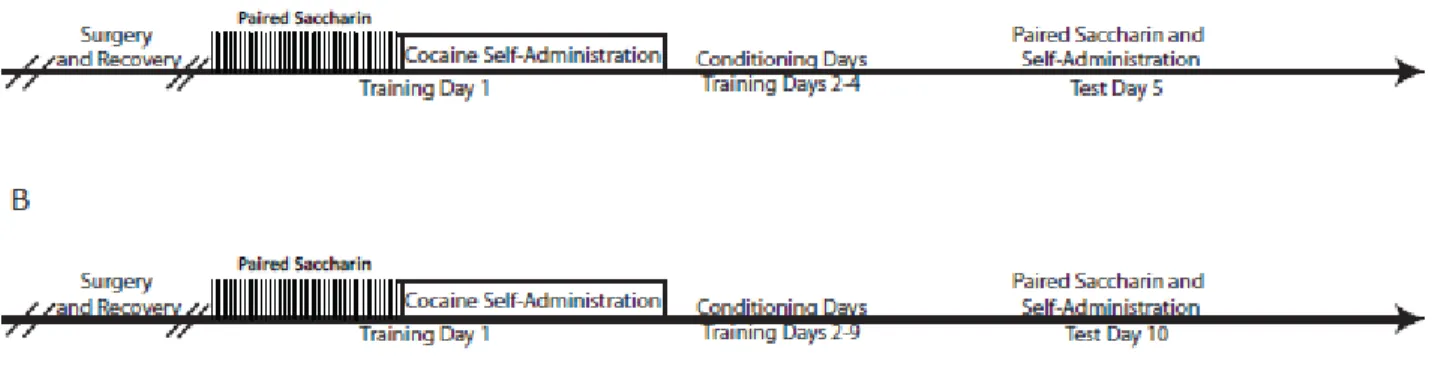
cm3; Med Associates, Inc., St Albans, VT) housed within a commercial sound-attenuated cubicle equipped with two retractable levers. Figure 1 shows a diagram of the
experimental regimen. Initially, mildly water-deprived (25ml/day) rats were trained to
press a lever for water. Once trained, animals were surgically implanted with intra-oral
cannulae, intravenous catheters, and microelectrode arrays as described above. Animals
were given a 1 week recovery period then conditioning sessions began. Before the start of
each session, animals were connected to a flexible cable for extracellular recording.
9
(over 45 min) and 2) cocaine self-administration (2 hrs). In phase 1, infusion lines were
connected to the intraoral cannulae to permit uninhibited movement within the chamber
during the session [19]. Each trial consisted of a 3.5 s delivery of 200µl of a 0.15%
saccharin solution. A total of 45 discrete tastant infusions (trials; approximately 1
trial/min) were given on a variable interval 45 s schedule (VI45). Immediately thereafter
the intravenous catheter line was attached and phase 2 (cocaine self-administration) was
initiated, as described previously [19]. Briefly, rats were trained to self-administer
cocaine on a fixed ratio 1 (FR1) schedule of reinforcement over a 2h period. Each lever
press resulted in intravenous infusion of cocaine (0.33mg/kg/infusion, over 6 s)
termination of the cue light positioned above the lever, and onset of a tone (67db, 1 kHz)
and house light (25W) stimulus. Lever presses during the 20 s post response period had
no programmed consequences. One group of rats underwent 5 days of taste-drug pairings
(5-day group; Fig. 1A) while a second group experienced 10 days of taste-drug pairings
(10-day group; Fig. 1B). Taste reactivity was only recorded and measured during the
saccharin infusion phase on days 1 and 5 for the 5-day group, and on days 1 and 10 for
the 10-day group. Likewise, electrophysiological recordings were completed during the
entire session but only on days 1 (all rats), 5 (5-day group) or 10 (10-day group). For the
10-day group, only a subset of rats (n=3) were used to analyze taste reactivity data due to
video equipment malfunctions.
Electrophysiological recordings
Electrophysiological recording procedures have been described in detail
unity-10
gain field effect transistors connected to the microelectrode arrays. The neuronal activity
was recorded differentially between each active and inactive (i.e. reference) wire. The
reference wire was chosen based on the absence of neuronal activity [1]. Analysis of NAc
neurons was carried out using a commercially available neurophysiological system
(multichannel acquisition processor [MAP] system; Plexon Inc., Dallas TX). Neuronal
activity was sorted using high-speed-analog-to-digital signal processing in combination
with computer software that enabled isolation of neuronal signals on the basis of
waveform analysis. This system utilizes digital signal processors (DSPs) for continuous
spike recognition. Behavioral events were recorded through another system (Med
Associates, Inc) that sent digital outputs for each behavioral event to the MAP box to be
time stamped along with the neural data. Distinguishing between the individual
waveforms corresponding to a single neuron was achieved using template and principle
component procedures supplied by the MAP system. The template procedures required
taking sample waveforms and constructing a template for that extracellular waveform.
After the experiment, cells were differentiated further using principle component analysis
in Offline Sorter (Plexon Inc., Dallas, TX). NAc cell firing was aligned to solenoid
opening onset for the intraoral infusion (phase 1) and to the lever press responses during
cocaine self-administration (phase 2).
Data analysis: behavior
Taste reactivity was analyzed frame-by-frame using digital video-recordings.
Appetitive and aversive taste reactivity was measured using the technique of Grill and
11
interval following the start of the saccharin infusion. When the tongue protruded and
crossed the midline, it was regarded as an appetitive response which was counted and
defined as one lick. Aversive taste reactivity was defined as a facial movement that
matched the “triangle” shape for a duration exceeding 90 ms which was counted and
defined as one gape. For each intra-oral saccharin delivery trial, the number of elicited
responses to each saccharin infusion was counted as either appetitive or aversive.
Behavioral responding during cocaine self-administration was quantified via generation
of cumulative lever press records, calculation of the number of lever press
responses/session, and inter-trial intervals (INT).
Data analysis: neuronal activity
Saccharin Intra-oral Infusions: NAc neurons typically exhibit a change (increase
or decrease) in cell firing during gustatory stimulation that occurs 1 s after the solenoid
opening and then typically resolves within 5 s [19, 21]. Thus, examination of the change
in NAc neuronal activity was confined to the 5 s period after the solenoid opened in
Phase 1. NAc neurons were classified as exhibiting phasic activity (i.e. excitation or
inhibition) if during the saccharin delivery there was a greater increase or decrease in
firing rate relative to the 99.9% confidence interval projected from the baseline period
(i.e. 5 s before solenoid opening) for at least two 250 ms time bins. If there was not a
significant change (increase and/or decrease) in cell firing during the 5 s post infusion
period, neurons were classified as nonphasic (NP).
Cocaine self-administration: Changes in neuronal firing patterns relative to
12
and perievent histograms (bin width, 250 ms) surrounding each response using
commercially available software (Neuroexplorer, Plexon). Cell firing during cocaine
self-administration was visually classified into one of three well-defined types of phasic
neuronal firing patterns that occurred within seconds of the reinforced lever press
response [4, 22-24]. Specifically, cells were classified as “type pre-response” (PR) if they
displayed an increase in activity preceding the lever press. Cells were classified as “type
reinforcement-excitation” (RFe) if they displayed an increase in firing rate immediately
following a reinforced response. Cells were classified as “type reinforcement-inhibition”
(RFi) if they displayed a decrease in firing rate surrounding the reinforced response. Cells
that showed no change in firing rate (increase and/or decrease) relative to the reinforced
response were classified as nonphasic (NP). To confirm visual classification, individual
units were statistically verified as either type PR, RFe, or RFi if the firing rate was greater
than or less than the 99.9% confidence interval projected from the baseline period (i.e. 10
s before lever press) for at least two 250 ms time bins [10, 25]. This confidence interval
was selected such that only robust responses were classified as phasic. Some cells in this
analysis exhibited low baseline firing rates, and the 99.9% confidence interval included
zero. When this was the case, inhibitions were assigned only if the number of consecutive
0 spike/s time bins surrounding the reinforced lever response was more than double the
number of consecutive 0 spike/s time bins in the baseline period. Cells with extremely
low firing rates (<0.1 spikes/s) or relatively high firing rates (>15 spikes/s) were likely
not medium spiny neurons and were excluded from further analysis [26].
13
Paired t-tests were used to determine if there was a significant change in the mean
number of licks, and the mean number of gapes between the first and last days of
conditioning. Chi-Square analyses were conducted on the number of inhibitory versus
excitatory cells for the 5 (on days 1 and 5) and 10 (on days 1 and 10) day groups to
examine if the population of NAc cells exhibited a significant shift from inhibitory to
excitatory activity during saccharin infusion in phase 1. Repeated measures ANOVAs
were used to determine if significant differences were observed in the mean percentage of
cells exhibiting phasic activity across training days 1, 5, and 10 in phase 1 (types
inhibitory or excitatory) or during self-administration (types PR, RFe and RFi) in the two
groups of animals. Statistical data was analyzed using Prizm 4 and Statistica.
Histology
After the completion of experiments, all animals were deeply anesthetized with a
ketamine (100mg/kg) and xylazine (20mg/kg) mixture. To determine electrode
placement, each electrode tip was marked by passing a current (13.5 µA) for 5 s through
the electrodes. Rats were transcardially perfused with saline followed by 10% formalin
and 3% potassium ferracynaide and then the brains were removed and placed in a fixing
agent (10% formalin and 3% potassium ferracynaide). After fixing and freezing, brains
were sliced into 40 µm sections through the NAc. These sections were mounted on slides
and then analyzed for electrode tip placement [1]. Only neurons recorded from wires that
CHAPTER 3
RESULTS
Taste reactivity
An important aspect of the first objective was to determine if aversive taste
reactivity develops in 5 or 10 taste-drug pairings. Across all rats, there was a significant
decrease in the mean number of appetitive licks during the first day compared to the last
(days 5 or 10) day of training (Fig. 2A; t10= 3.53, p < 0.01). This corresponded to a significant increase in the mean number of aversive gapes (Fig. 2B; t10= 4.29, p < 0.01) for all rats on day 1 versus the last conditioning day. Examination of taste reactivity
measurements as a function of number of training days (5 versus 10) revealed a similar
trend. Specifically, there was a significant decrease in appetitive taste reactivity on the
first conditioning day compared to last day in the rats that underwent 5 (t7=2.69, p<0.05) or 10 taste-drug pairings (t2=6.53, p<0.05). There was also a significant increase in aversive taste reactivity (gapes) following 5 taste-drug pairings t7=3.56, p<0.01), and a trend toward a similar finding after 10 taste-drug pairings, although this was not
significant (t2=2.58, p>0.05).
Aversive taste reactivity predicts drug taking
Wheeler et al [1] demonstrated that cocaine-induced devaluation of saccharin was
correlated with an increased motivation to seek cocaine. In the current study, the
15
lever press responses/session, and the inter-trial intervals (INT). Behavioral responding
was measured across training days for the 5 and 10-day groups. On the first day for
cocaine self-administration, all rats exhibited erratic (i.e. not regularly spaced) behavioral
responding. Similar erratic lever pressing behavior was also observed following 5 days
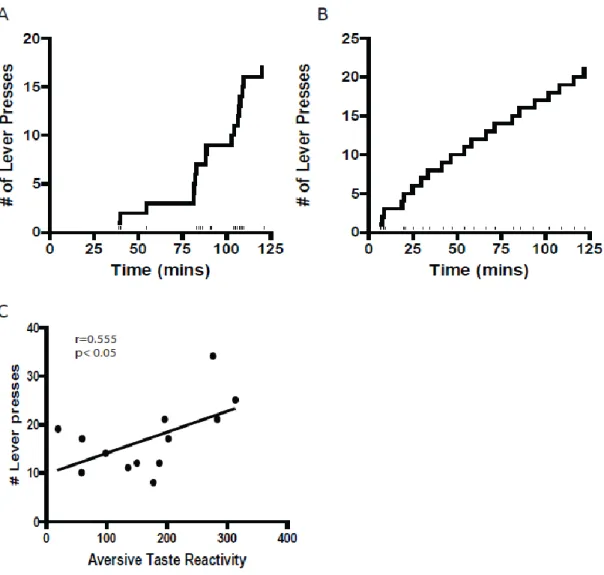
of training. An example of one representative rat’s lever press performance on day 5 is
shown in Figure 3A. Behavioral responding became stabile (i.e. regularly spaced) in the
10-day group by their last day of training (mean responses ± SEM, 17.25 ± 2.16, mean
INT ± SEM, 3.06 ± 1.33 min). Figure 3B shows an example of a representative rat’s lever
pressing performance on day 10.
In previous studies from our lab [1, 12, 13] and others [27, 28] rats typically
exhibit rapid drug intake at the beginning of the session (i.e. called drug loading or
load-up behavior), then transition to more regularly spaced responding with greater INTs for
the remainder of the session.. This ‘load-up’ behavior is illustrated in the first 3 responses
in the session shown in Figure 3B. We previously showed that after repeated
saccharin-cocaine pairings in our model, drug loading was correlated with aversive taste reactivity
[1]. Likewise, latency to first lever press for cocaine was correlated to aversive taste
reactivity. These findings indicated that the more aversive gapes exhibited by rats, the
faster they are to initiate lever press responding and the larger the number of load-up
responses were observed once cocaine was available to self-administer. In the current
study, drug loading was not significantly correlated to aversive taste reactivity (r=0.281,
p>0.05), or latency to first press (r=0.428, p>0.05). However, across all rats we found
there was a positive correlation (r= 0.555, p<0.05) between the total number of lever
16
saccharin solution was to the rat the greater the number of lever presses for cocaine
during the self-administration phase.
NAc neurons exhibit patterned cell firing relative to intra-oral saccharin infusions
NAc neurons exhibited two types of firing patterns relative to intra-oral saccharin
infusions, as previously described (1,4). The perievent histograms (PEH) in Figure 4
show examples of the types of NAc responses during the saccharin intra-oral infusion
session. The PEHs consist of NAc cell firing during a 20 s time interval surrounding the
intra-oral infusions (represented by the dashed line at time I). One type of NAc neuron
exhibited a decrease (i.e., termed ‘inhibitory’ cell) in firing rate immediately after the
start of the saccharin infusion that resolved within 5 s (Figure 4A). Another type of NAc
neuron exhibited an increase (i.e., termed ‘excitatory’ cell) in firing rate 1 s after the
solenoid opening that resolved within approximately 8 s (Figure 4B). The last cell type
exhibited no change in firing rate during saccharin infusion (i.e., termed ‘nonphasic’ cell;
Figure 4C).
NAc neurons track the conditioned shift in palatability
As in our prior report [1], the learned aversion to the taste stimulus was reflected
in the electrophysiological activity of distinct populations of NAc neurons. Similar to
responses in naive rats [1, 19], infusions of the tastant on day 1 elicited a predominantly
inhibitory profile in rats destined for either 5 (n = 30, 73%, Figure 5A, top) or 10 (n = 34,
67%, Figure 5B, top) taste-drug pairings. That is, of all phasically active cells recorded
17
of whether they later experienced 5 or 10 taste-drug pairings. In contrast, primarily
excitatory responses were elicited by infusion of the taste stimulus paired with impending
cocaine availability following both 5 (n = 25, 60%, Figure 5C, bottom) or 10 (n=32, 60%,
Figure 5D, bottom) taste-drug pairings. To confirm if this shift in the population response
was significant, Chi-square analysis was conducted. Using a chi-square 2x2 contingency
table, the shift from predominately inhibitory to predominately excitatory cell firing was
significant for both 5 (χ2
= 9.029, p<0.003, df=1) and 10 (χ2=7.629 , p<0.01, df=1) day groups.
NAc neurons exhibit patterned cell firing relative to reinforced responding during cocaine
self-administration
During the self-administration phase of the session, NAc neurons exhibited three
types of patterned discharges relative to the lever press. The PEHs in Figure 6 show
examples of the activity of representative phasically active neurons recorded during
cocaine self-administration. One neuron (Figure 6A) exhibited an anticipatory increase in
cell firing within seconds before the lever press, classified as a ‘Pre-response’ or PR cell.
A different NAc neuron (Figure 6B) exhibited an increase in firing rate following the
lever press, termed ‘Reinforcement-excitation’, or RFe cell. A third neuron exhibited a
decrease in firing rate immediately after the lever press, termed
‘Reinforcement-inhibition’ or RFi (Figure 6C). Finally, the remaining neurons exhibited no change in
18
NAc neurons differentially encode information about saccharin infusion versus cocaine
self-administration
The second primary objective of the current experiment was to determine if the
same NAc neurons that exhibit phasic cell firing during saccharin intra-oral infusions in
Phase 1 are the same cells that process information about lever press responding for
cocaine during self-administration in Phase 2. Figure 7 shows the distribution of NAc
phasically active neurons during both phases of the session on Days 1, 5, and 10. For
recordings conducted on animals destined for 5 and 10 taste-drug pairings, on day 1, the
majority of neurons differentially encoded information about cocaine self-administration
(6%) and saccharin infusion (41%), or exhibited nonphasic activity (41%). Only a
minority of cells (11%) exhibited phasic cell firing in both phases of the study (i.e.,
during saccharin infusion and cocaine self-administraiton). This distribution of neural
activity remained largely the same following 5 taste-drug pairings (Figure 7B). However,
following 10 taste-drug pairings, more NAc neurons were recruited to encode
goal-directed behaviors for cocaine during the self-administration phase (from 6% and 7% on
days 1 and 5, to 16% on day 10; Figure 7C). Regardless, there remained a low
percentage of cells that were phasically active during both saccharin intraoral infusions in
phase 1, and cocaine self-administration in phase 2 following 10 taste-drug pairings.
Histology
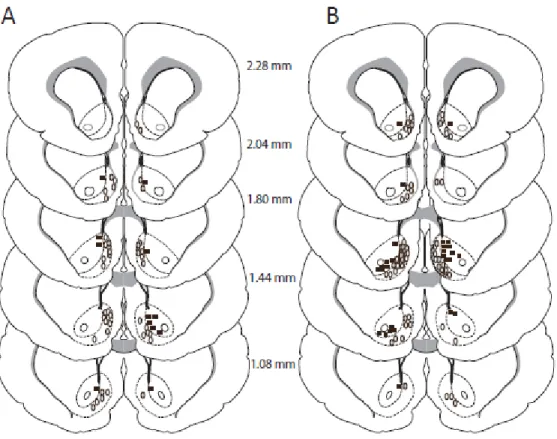
The locations of the microwires from which NAc neurons were recorded are
presented in Figure 8. One hundred and sixteen microwires were implanted in the NAc of
19
implanted in the NAc of rats receiving 10 taste-drug pairings. The majority of the
microwires (5 day: n=96, 83% of microwires, 10 day: n=76, 71% of microwires) were in
the NAc shell for both groups. Forty-nine microwires were implanted outside of the NAc
CHAPTER 4
DISCUSSION
Here, two objectives were examined using a behavioral model developed in the
Carelli lab in which delayed cocaine availability induces devaluation of a natural reward.
First, it was determined if differences in the number of saccharin-cocaine pairings in our
model would have varying results in taste reactivity and NAc activity observed
previously [1]. Two groups of rats were tested; one group had five saccharin-cocaine
pairings while the other group had ten saccharin-cocaine pairings. As expected, all rats
elicited appetitive taste reactivity on the first day of saccharin-cocaine pairings (i.e., naïve
situation). Importantly, on the last day of taste-drug pairings, rats elicited aversive taste
reactivity during infusion of the same concentration of saccharin regardless of the number
of pairings (i.e., 5 or 10). Further, this negative affective state was reflected in shifts in
NAc cell firing, as reported by Wheeler et al [1]. Second, we showed that the majority of
neurons that were responsive during intraoral saccharin infusions following 5 or 10
taste-drug pairings were not the same neurons that were activated during cocaine
self-administration (types PR, RFe or RFi cells). These findings indicate that populations of
NAc neurons differentially encode information about a predictive cue signaling
impending but delayed cocaine availability versus goal-directed behavior for the drug. In
21
The effects of the number of saccharin-cocaine pairings (5 versus 10) on taste reactivity
and NAc activity
As noted above, our first objective was to determine if differences in the number
of saccharin-cocaine pairings in our model would have varying results in taste reactivity
and NAc activity to that observed previously [19]. In a previous study from our lab, the
same reward comparison paradigm was used in which intra-oral saccharin delivery
predicted delayed access to cocaine. In this case, rats were exposed to a total of 5
taste-drug pairing sessions. On test day (i.e. day 5) the investigators measured taste reactivity
and dopamine release (using fast scan cyclic voltammetry, FSCV) during tastant infusion.
FSCV is an electrochemical technique in which rapid (subsecond) dopamine release
events are measured in ‘real time’ during behavior. The authors reported aversive taste
reactivity and a decrease in dopamine release during saccharin infusion on day 5. In
contrast, a saccharin tastant that was paired with access to saline induced appetitive taste
reactivity and an increase in NAc dopamine release after 5 pairings. Therefore, the
decrease in dopamine release after 5 taste-drug pairings reflected an aversive response to
saccharin. The behavioral findings are similar to the results found here; an aversion to
saccharin developed after it was repeatedly paired with the delayed access to cocaine
self-administration. Thus, a negative affective state develops after as little as 5 taste-drug
pairings.
In another study conducted in our lab, a behavioral model incorporating similar
taste-drug pairings was used but involved a within subject design. [1]. In this case, rats
learned to discriminate between intra-oral infusions of an orange or grape flavored 0.15%
22
while the other flavored saccharin was paired to the delayed self-administration of
cocaine. Tastant pairing with saline or cocaine occurred on alternating days. Taste
reactivity and NAc cell firing was examined following 14 sessions (i.e., after 7 taste-drug
pairings that alternated with 7 taste-saline pairings). On the test day, taste reactivity was
measured during 30 intra-oral infusions of the tastant previously paired with saline
followed by 30 intra-oral infusions of the tastant paired with cocaine. The results showed
that animals exhibited appetitive taste reactivity to the flavored saccharin solution paired
to delayed access to self-administer saline. However, the same rats exhibited aversive
taste reactivity to the flavored saccharin solution paired with delayed access to cocaine
self-administration. The emergence of this aversive state was reflected in a shift in NAc
cell firing dynamics, similar to the present study (from primarily inhibitory to excitatory
activity during tastant infusion). Further, aversive taste reactivity was significantly
correlated to both drug loading (i.e. number of lever presses within the first 5 minutes of
the session) and the latency to make the first press [1]. Specifically, aversive taste
reactivity was positively correlated to rapid drug intake (loading) at the beginning of the
session while aversive taste reactivity was negatively correlated to the latency to first
press. These findings indicate that the aversive state lead to a greater motivation to
consume cocaine, once available.
Here, we were able to demonstrate that after repeated taste-drug pairings the rats
elicited an aversive response to saccharin and that populations of NAc neurons shifted
how this information was encoded (i.e. exhibited primarily excitatory as opposed to
primarily inhibitory activity during tastant infusion), similar to the previous study [1].
23
between aversive taste reactivity and drug loading or latency to make the first press. The
previous study compared aversive taste reactivity to drug loading and latency to first
press in well trained rats (i.e. tested after the 14th sessions) [1]. However, in the current study, the 5 day group was not well-trained, reflected in less than stabile responding
(Figure 3A) for intravenous cocaine by their last day of training. This lack of training
may explain why we were not able to replicate the correlational results for this group.
Even though the 10 day group had stabile responding by their last day of training, only a
subset (n=3) of aversive taste reactivity data was measured due to equipment failure.
Thus, a correlation between these variables may have been evident in the 10 day group
but was not measured. However, we did demonstrate a correlation between overall lever
pressing during the 2 hours self-administration phase and aversive taste reactivity (Figure
3C). Thus, the more averse the saccharin solution was the more the rat lever pressed for
cocaine. This result indicates, as in the previous study, that the aversive state reflected in
aversive taste reactivity increases motivation for the drug.
NAc neurons encoded Cocaine seeking after 10 saccharin-cocaine pairings
Although a shift in taste reactivity and NAc neural activity occurred in as little as
5 taste-drug pairings, the emergence of NAc neural activity that encoded goal-directed
behaviors for cocaine (i.e., cell types PR, RFe, RFi) was only evident after 10 taste-drug
pairings. That is, although there were a small portion of NAc neurons that encoded
cocaine seeking on day 5, there were significantly more NAc cells that did so following
10 taste-drug pairings. Why do shifts in taste activity occur long before NAc neurons
24
information about cocaine seeking behavior only begin to do so once the behavior is well
learned. As such, we can hypothesize that NAc encoding of cocaine seeking behavior is
related to the rat’s lever pressing stability during self-administration. As mentioned
earlier, behavioral responding was not regularly spaced during cocaine
self-administration following 5 taste-drug pairings, however responding became regularly
spaced by the 10th taste-drug pairing. The development of stabile lever pressing behavior following 10 sessions parallels the increase in the number of cells encoding cocaine
self-administration.
NAc neurons differentially encode information about aversive taste cues that
predict cocaine versus goal-directed behaviors for the drug following extended taste-drug
pairings
In prior work from the Carelli lab, it was revealed that distinct populations of
NAc neurons differentially encode information about goal-directed behaviors for natural
(food/water) and cocaine rewards [4, 12]. In those studies, a multiple schedule of
reinforcement was used in which rats initially lever pressed for a natural reward (food or
water); this was immediately followed by a self-administration session in which rats lever
pressed for intravenous cocaine. The authors reported that NAc neurons that were
phasically active during goal-directed behaviors for the natural reward were not activated
during cocaine seeking behavior (and vice versa) [12]. These findings were not the results
of repeated cocaine exposure because similar separate neural encoding was observed as
25
findings indicate that separate neural circuits exist in the NAc that differentially encode
information about goal-directed behaviors for cocaine versus natural rewards.
Given these findings, a second objective of the current study was to determine if
the same neurons that are responsive during intraoral saccharin infusions following 5 or
10 taste-drug pairings, are the same neurons that are activated during cocaine
self-administration (types PR, RFe or RFi cells). This issue was not addressed in our prior
papers [1, 19], since NAc cell firing was only recorded during intra-oral infusions and
never during the cocaine self-administration phase. Here, we found that NAc neurons
that were responsive to the non-contingent tastant infusions were generally not the same cells that encode goal-directed behaviors for cocaine. In the current study, few cells were activated during cocaine self-administration on days 1 and 5 so we could not determine if
separate neural circuits are recruited to encode the natural reward versus cocaine.
However, by the 10th taste-drug pairing more NAc cells were activated during cocaine
seeking. Interestingly, these were generally not the same cells that were responsive
during intraoral infusions of the tastant. These findings indicate that populations of NAc
neurons differentially encode information about a predictive cue signaling impending but
delayed cocaine availability versus goal-directed behavior for the drug.
Theoretical considerations: implications for addiction
These findings may be clinically relevant and model an important aspect of
addiction in humans since one of the defining features of drug addiction is the
establishment of a negative affective or emotional state. This negative state is believed to
26
motivational withdrawal when the drug is not available [3, 29]. As such, this often leads
addicts to devalue various natural rewards they once viewed important such as
relationships and employment. Therefore, understanding the neurobiological mechanisms
mediating the emergence of negative affective states and associated devaluation of
natural rewards by cocaine could lead to novel pharmacological treatments that decrease
this state, help refocus the addicts’ interest toward natural reward procurement, and
decrease drug craving.
Koob et. al. [30] proposed the allosteric model for drug addiction which states the
brain changes during the addiction cycle and these neurological changes explain the
susceptibility to relapse long after drug taking ceases. With this model it is believed that
allosteric regulation decreases the hedonic value set for natural rewards by increasing
tolerance to the hedonic value of cocaine [1, 27, 31, 32]. As a result, the negative
emotional state that develops is predicted to be reduced by repeated drug administration.
Thus the more intense the negative emotional state the more drug will be
self-administered. In this study, we created a situation in which rats anticipated the access to
self-administer cocaine by receiving several non-contingent intra-oral infusions of
saccharin solution before they had access to self-administer cocaine. After repeated
taste-drug pairings, a negative emotional state developed during the first phase (i.e. saccharin
intra-oral infusions) of the behavioral task. This development was correlated with higher
drug intake strengthening the concept of the allosteric model.
27
Recently, research has examined the effects of environmental enrichment to
prevent addiction. In enriched environments, animals are exposed to social cohorts and/or
inanimate objects such as toys or a running wheel. This exposure enhances sensory,
cognitive, and motor behaviors [33]. An isolated environment, in which the rat is
individually housed, induces stress, particularly if the rats are water or food restricted
[33]. This enhanced stress can lead to the acquisition of drug-seeking and chronic drug
self-administration. Environmental enrichment produces beneficial effects on several
brain functions and prevents or reverses symptoms of neurodegenerative diseases and
psychiatric disorders as well as reduces drug-seeking and the reinforcing effects of
psychostimulants [33-36]. Thus an enriched environment may provide protection against
neurological changes and drug relapse due to repeated drug exposure. For example, mice
exposed to an enriched environment during adolescence showed molecular changes in the
striatum that resulted in the reduction of the rewarding effects of cocaine [37]. In
addition, housing mice in an enriched environment following repeated cocaine exposure,
eliminated later cocaine-induced sensitization and conditioned place preference (CPP)
[33]. The authors also reported that enrichment prevented reinstatement of cocaine CPP
in mice, suggesting that enrichment may decrease sensitivity to stimulant drugs in
individuals with a previous drug history, thus making an enriched environment
potentially useful for preventing relapse.
Given the reported protective effects of environmental enrichment on drug
addiction behaviors, devaluation of natural rewards by cocaine and the aversive state that
develops may be prevented by environmental enrichment [33, 37, 38]. One approach in
28
if voluntary wheel running would reduce devaluation of a natural reward. It is predicted
that wheel running, an important form of environmental enrichment, would reduce
29
Figure 1. Schematic of behavioral task. All rats were first trained to press a lever for
water reinforcement then surgically implanted with an intravenous cannula, intra-oral
catheter and microelectrode arrays. After recovery (1 week), rats underwent either 5
(Figure 1A) or 10 (Figure 1B) conditioning days during which the behavioral task was
conducted in two phases: 1) intra-oral tastant infusions and 2) cocaine
30
Figure 2. Appetitive and aversive taste reactivity for 5 and 10 taste-drug pairings
groups. (A) On the first day of the taste-drug pairing animals predominately elicited
appetitive taste responses (i.e. licks) in the 5 and 10-day groups. This appetitive taste
reactivity significantly decreased from the first to the last day of the taste-drug pairings.
(B) Those same animals elicited predominately aversive taste responses to the same
saccharin solution after 5 or 10 taste-drug pairings (last day). This was reflected in a
significant increase in aversive taste reactivity from the first to last day of the taste-drug
31
Figure 3. Aversive taste reactivity predicts drug taking. (A) A cumulative record
showing the behavior of a representative animal during the self-administration phase after
5 taste-drug pairings. Behavioral responding was not regularly spaced across the cocaine
self-administration phase. (B) A cumulative record showing the behavior of a
representative animal during the self-administration phase following 10 taste-drug
pairings. Typically behavioral responding was stable across the cocaine
32
Thus the more averse the saccharin solution was to the rat the more the rat lever pressed
33
Figure 4. NAc neurons exhibit patterned cell firing relative to intra-oral saccharin
infusions. (A) The PEH shows an example of one type of NAc neuron that exhibited a
phasic inhibition in cell firing during the saccharin infusion. (B) Another population of
NAc neurons exhibited a phasic excitation in cell firing during saccharin infusion,
illustrated in the representative PEH. (C) Other cells exhibited no change in activity (type
34
Figure 5. NAc neurons encoding of saccharin infusions (inhibitory versus excitatory). Pie
charts show a summary of electrophysiological response profiles of NAc neurons to
tastant infusions on day 1 versus 5 or 10 taste-drug pairings. On day 1, infusions of
saccharin solution elicited primarily inhibitory responses for rats destined to receive 5 (A)
or 10 (B) taste-drug pairings. However, the population response shifted such that
infusions of the same flavored saccharin solution elicited primarily excitatory response
35
Figure 6. NAc cell firing profiles relative to reinforced responding during cocaine
self-administration. PEHs show examples of NAc neurons exhibiting increased firing within
seconds preceding the lever press response (A), increased activating within seconds
following the lever press (B) or decreased activity following response completion (C).
Another subset of cells exhibited no change in firing rate relative to the response for
36
Figure 7. The pie charts illustrate that NAc neurons differentially encode information
about saccharin infusion versus cocaine self-administration following 5 or 10 taste-drug
pairings. Neurons were classified as exhibiting phasic activity only during saccharin
infusions in phase 1 (‘saccharin’), only during cocaine self-administration in phase 2
37
nonphasic activity in both phases (‘nonphasic’). (A) The distribution of activity on the
first day of training for animals destined for 5 or 10 taste-drug pairings (combined). (B)
The distribution of activity after 5 taste-drug pairings. (C) The distribution of activity
38
Figure 8. Histology. Closed squares symbols represent placement in the NAc core while
open oval symbols represent placement in the NAc shell. (A) Microwire placement for
animals that received 5 taste drug pairings. (B) Microwire placement for animals that
39
REFERENCES
1. Wheeler, R.A., et al., Behavioral and electrophysiological indices of negative affect
predict cocaine self-administration. Neuron, 2008. 57(5): p. 774-85.
2. Abuse, N.I.o.D., Cocaine: Abuse and Addiction. NIH Pub Number: 10-4166, 2010: p. 8. 3. Koob, G.F. and N.D. Volkow, Neurocircuitry of Addiction. Neuropsychopharmacology,
2010. 35(1): p. 217-238.
4. Carelli, R.M. and S.A. Deadwyler, A comparison of nucleus accumbens neuronal firing
patterns during cocaine self-administration and water reinforcement in rats. J Neurosci,
1994. 14(12): p. 7735-46.
5. Ghitza, U.E., et al., Differences between accumbens core and shell neurons exhibiting phasic firing patterns related to drug-seeking behavior during a discriminative-stimulus
task. J Neurophysiol, 2004. 92(3): p. 1608-14.
6. Mogenson, G.J., D.L. Jones, and C.Y. Yim, From motivation to action: functional interface
between the limbic system and the motor system. Prog Neurobiol, 1980. 14(2-3): p.
69-97.
7. Ito, R. and A. Hayen, Opposing roles of nucleus accumbens core and shell dopamine in
the modulation of limbic information processing. J Neurosci, 2011. 31(16): p. 6001-7.
8. Carelli, R.M., The nucleus accumbens and reward: neurophysiological investigations in
behaving animals. Behav Cogn Neurosci Rev, 2002. 1(4): p. 281-96.
9. Carelli, R.M., et al., Examination of factors mediating the transition to behaviorally correlated nucleus accumbens cell firing during cocaine self-administration sessions in
rats. Behav Brain Res, 1999. 104(1-2): p. 127-39.
10. Cameron, C.M. and R.M. Carelli, Cocaine abstinence alters nucleus accumbens firing
dynamics during goal-directed behaviors for cocaine and sucrose. Eur J Neurosci, 2012.
35(6): p. 940-51.
11. Day, J.J., J.L. Jones, and R.M. Carelli, Nucleus accumbens neurons encode predicted and
ongoing reward costs in rats. Eur J Neurosci, 2011. 33(2): p. 308-21.
12. Carelli, R.M., S.G. Ijames, and A.J. Crumling, Evidence that separate neural circuits in the
nucleus accumbens encode cocaine versus "natural" (water and food) reward. J
Neurosci, 2000. 20(11): p. 4255-66.
13. Carelli, R.M. and J. Wondolowski, Selective encoding of cocaine versus natural rewards
by nucleus accumbens neurons is not related to chronic drug exposure. J Neurosci, 2003.
40
14. Grigson, P.S. and R.C. Twining, Cocaine-induced suppression of saccharin intake: a model
of drug-induced devaluation of natural rewards. Behav Neurosci, 2002. 116(2): p.
321-33.
15. Wise, R.A., R.A. Yokel, and H. DeWit, Both positive reinforcement and conditioned
aversion from amphetamine and from apomorphine in rats. Science, 1976. 191(4233): p.
1273-5.
16. Roitman, M.F., R.A. Wheeler, and R.M. Carelli, Nucleus accumbens neurons are innately tuned for rewarding and aversive taste stimuli, encode their predictors, and are linked to
motor output. Neuron, 2005. 45(4): p. 587-97.
17. Grill, H.J. and R. Norgren, The taste reactivity test. I. Mimetic responses to gustatory
stimuli in neurologically normal rats. Brain Res, 1978. 143(2): p. 263-79.
18. Roitman, M.F., et al., Hedonic and nucleus accumbens neural responses to a natural
reward are regulated by aversive conditioning. Learn Mem, 2010. 17(11): p. 539-46.
19. Wheeler, R.A., et al., Cocaine cues drive opposing context-dependent shifts in reward
processing and emotional state. Biol Psychiatry, 2011. 69(11): p. 1067-74.
20. Carelli, R.M., et al., Firing patterns of nucleus accumbens neurons during cocaine
self-administration in rats. Brain Res, 1993. 626(1-2): p. 14-22.
21. Roitman, M.F., et al., Real-time chemical responses in the nucleus accumbens
differentiate rewarding and aversive stimuli. Nat Neurosci, 2008. 11(12): p. 1376-7.
22. Carelli, R.M. and S.G. Ijames, Nucleus accumbens cell firing during maintenance,
extinction, and reinstatement of cocaine self-administration behavior in rats. Brain Res,
2000. 866(1-2): p. 44-54.
23. Hollander, J.A. and R.M. Carelli, Abstinence from cocaine self-administration heightens neural encoding of goal-directed behaviors in the accumbens.
Neuropsychopharmacology, 2005. 30(8): p. 1464-74.
24. Jones, J.L., R.A. Wheeler, and R.M. Carelli, Behavioral responding and nucleus accumbens cell firing are unaltered following periods of abstinence from sucrose.
Synapse, 2008. 62(3): p. 219-28.
25. Jones, J.L., et al., The basolateral amygdala differentially regulates conditioned neural
responses within the nucleus accumbens core and shell. Neuroscience, 2010. 169(3): p.
1186-98.
26. Gage, G.J., et al., Selective activation of striatal fast-spiking interneurons during choice
execution. Neuron, 2010. 67(3): p. 466-79.
27. Ahmed, S.H., et al., Neurobiological evidence for hedonic allostasis associated with
41
28. Ahmed, S.H., et al., Escalation of cocaine self-administration does not depend on altered
cocaine-induced nucleus accumbens dopamine levels. J Neurochem, 2003. 86(1): p.
102-13.
29. Wheeler, R.A. and R.M. Carelli, Dissecting motivational circuitry to understand substance
abuse. Neuropharmacology, 2009. 56 Suppl 1: p. 149-59.
30. Koob, G.F. and M. Le Moal, Drug abuse: hedonic homeostatic dysregulation. Science, 1997. 278(5335): p. 52-8.
31. Ahmed, S.H. and G.F. Koob, Transition from moderate to excessive drug intake: change
in hedonic set point. Science, 1998. 282(5387): p. 298-300.
32. Koob, G.F., et al., Neurobiological mechanisms in the transition from drug use to drug
dependence. Neurosci Biobehav Rev, 2004. 27(8): p. 739-49.
33. Solinas, M., et al., Reversal of cocaine addiction by environmental enrichment. Proc Natl Acad Sci U S A, 2008. 105(44): p. 17145-50.
34. Green, T.A., B.J. Gehrke, and M.T. Bardo, Environmental enrichment decreases
intravenous amphetamine self-administration in rats: dose-response functions for fixed-
and progressive-ratio schedules. Psychopharmacology (Berl), 2002. 162(4): p. 373-8.
35. Laviola, G., et al., Effects of enriched environment on animal models of
neurodegenerative diseases and psychiatric disorders. Neurobiol Dis, 2008. 31(2): p.
159-68.
36. Puhl, M.D., et al., Environmental enrichment protects against the acquisition of cocaine self-administration in adult male rats, but does not eliminate avoidance of a
drug-associated saccharin cue. Behav Pharmacol, 2012. 23(1): p. 43-53.
37. Solinas, M., et al., Environmental enrichment during early stages of life reduces the behavioral, neurochemical, and molecular effects of cocaine.
Neuropsychopharmacology, 2009. 34(5): p. 1102-11.
38. Stairs, D.J. and M.T. Bardo, Neurobehavioral effects of environmental enrichment and