Federal Publications Key Workplace Documents
8-3-2016
Workers’ Compensation: Overview and Issues
Workers’ Compensation: Overview and Issues
Scott D. Szymendera
Congressional Research Service
Follow this and additional works at: https://digitalcommons.ilr.cornell.edu/key_workplace Thank you for downloading an article from DigitalCommons@ILR.
Thank you for downloading an article from DigitalCommons@ILR.
Support this valuable resource today! Support this valuable resource today!
This Article is brought to you for free and open access by the Key Workplace Documents at DigitalCommons@ILR. It has been accepted for inclusion in Federal Publications by an authorized administrator of DigitalCommons@ILR. For more information, please contact [email protected].
If you have a disability and are having trouble accessing information on this website or need materials in an alternate format, contact [email protected] for assistance.
Abstract Abstract
[Excerpt] Workers’ compensation provides cash and medical benefits to workers who are injured or become ill in the course of their employment and provides benefits to the survivors of workers killed on the job. Benefits are provided without regard to fault and are the exclusive remedy for workplace injuries, illnesses, and deaths. Nearly all workers in the United States are covered by workers’ compensation. With the exception of federal employees and some small groups of private-sector employees covered by federal law, workers compensation is provided by a network of state programs. In general, employers purchase insurance to provide for workers’ compensation benefits.
Keywords Keywords
workers' compensation, eligibility, benefits, workplace injuries, workplace illness
Comments Comments
Suggested Citation Suggested Citation
Szymendera, S. D. (2016). Workers’ compensation: Overview and issues (CRS Report R44580). Washington, DC: Congressional Research Service.
A more recent version of this report can be found here: http://digitalcommons.ilr.cornell.edu/ key_workplace/1905
Workers’ Compensation: Overview and Issues
Scott D. Szymendera
Analyst in Disability Policy
August 3, 2016
Congressional Research Service
7-5700 www.crs.gov R44580
Summary
Workers’ compensation provides cash and medical benefits to workers who are injured or become ill in the course of their employment and provides benefits to the survivors of workers killed on the job. Benefits are provided without regard to fault and are the exclusive remedy for workplace injuries, illnesses, and deaths. Nearly all workers in the United States are covered by workers’ compensation. With the exception of federal employees and some small groups of private-sector employees covered by federal law, workers compensation is provided by a network of state programs. In general, employers purchase insurance to provide for workers’ compensation benefits.
Workers’ compensation has been called a grand bargain between employers and workers that developed at the beginning of the 20th century in response to dissatisfaction with the tort system
as a method of compensating workers for occupational injuries, illnesses, and deaths. Under this grant bargain, workers’ receive guaranteed, no-fault benefits for injuries, illnesses, and deaths, but forfeit their rights to sue their employers. Employers receive protection from lawsuits but must provide benefits regardless of fault.
Recently, concerns have been raised over what some allege are cuts to state workers’
compensation benefits or policy changes that make it harder for workers to receive the benefits they deserve. These cuts and policy changes may be shifting some of the costs associated with workplace injuries, illnesses, and deaths away from the employer and to the employee or social programs, such as Social Security Disability Insurance (SSDI) and Medicare.
There is no federal requirement that states have workers’ compensation systems and no minimum federal standards for state systems. The decentralized nature of workers’ compensation led to unsuccessful calls for minimum state standards in the early 1970s and has caused concerns over benefit equity among the states today.
In 2013, Oklahoma joined Texas in making its workers’ compensation system noncompulsory. Unlike in Texas, Oklahoma employers may opt-out of workers’ compensation by offering alternative benefits to employees and keep their protection from lawsuits, whereas Texas employers are exposed to legal liability in the event of employee injury when employers opt-out of worker’s compensation. The constitutionality of the Oklahoma system, as well as to what extent the federal Employee Retirement Income Security Act (ERISA) applies to these alternate benefit plans, are currently being adjudicated in the courts.
Contents
Workers’ Compensation in the United States ... 1
The Grand Bargain ... 1
The History of Workers’ Compensation in the United States ... 2
The Era of Litigation ... 2
Establishing Negligence... 2
Employer Defenses ... 3
Consensus and the Grand Bargain ... 3
Workers’ Compensation Legislation ... 4
Federal Workers’ Compensation for the United States Life Saving Service and Other Hazardous Federal Occupations ... 4
State Workers’ Compensation Laws ... 5
Federal Workers’ Compensation Programs ... 6
Elements of Workers’ Compensation ... 8
Exclusive Remedy ... 8
Workers’ Compensation Insurance ... 9
State Funds: Exclusive and Competitive ... 9
Private Insurance ... 9
Self-Insurance ... 10
The Workers’ Compensation Market ... 10
Second Injury Funds ... 10
Workers’ Compensation Benefits ... 11
Medical Benefits ... 12
Cash Benefits ... 14
Vocational Rehabilitation and Return to Work ... 18
Workers’ Compensation Costs ... 19
Worker Costs ... 19
Employer Costs ... 19
Federal Oversight of Workers’ Compensation ... 21
Occupational Safety and Health Act of 1970 ... 21
National Commission on State Workmen’s Compensation Laws ... 22
National Commission Recommendations ... 22
Legislative Response to the National Commission’s Recommendations ... 23
State Responses to the National Commission’s Recommendations ... 24
New Calls for Federal Oversight ... 25
Noncompulsory Worker’s Compensation Systems ... 25
Noncompulsory Workers’ Compensation in Texas ... 26
Noncompulsory Worker’ Compensation in Oklahoma ... 26
Appeals in Alternative Benefit Plans ... 27
ERISA Coverage ... 27
Figures
Figure 1. Cash and Medical Benefits as Percentage of Total Workers’ Compensation
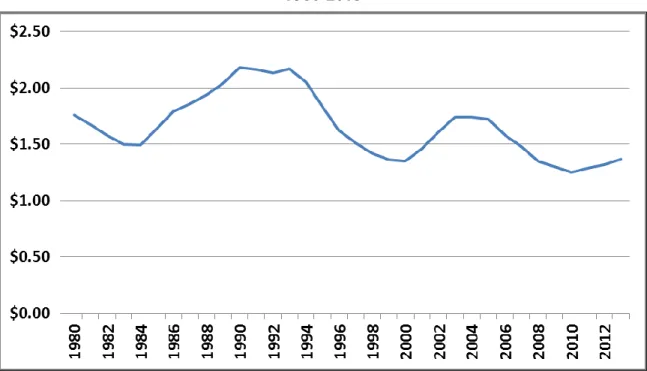
Benefits, 1980-2013 ... 13 Figure 2. Workers’ Compensation Employer Costs Per $100 in Covered Payroll,
1980-2013 ... 20
Tables
Table 1. Workers’ Compensation Benefits and Employer Costs, 2013 ... 1 Table A-1. State Enactments of Workers’ Compensation Laws ... 29 Table A-2. State Workers’ Compensation Insurance Arrangements, 2013 ... 30
Appendixes
Appendix. State Workers’ Compensation Laws and Insurance Arrangements ... 29
Contacts
Workers’ Compensation in the United States
Workers’ compensation provides cash and medical benefits to workers who are injured or become ill in the course of their employment and benefits to the survivors of workers killed on the job. Benefits are provided without regard to fault and are the exclusive remedy for workplace injuries, illnesses, and deaths. Nearly all workers and employers in the United States are covered by workers’ compensation and each state, with the exception of Texas and Oklahoma, has a mandatory workers’ compensation system. In 2013, more than 129 million workers, accounting for nearly $6.5 trillion in wages, were covered by a state or federal workers’ compensation system.1 When a covered worker is injured, becomes sick, or dies as a result of his or her
employment, that worker is entitled to full medical coverage for the injury or illness, cash benefits to replace a portion of wages lost due to inability to work, and benefits for surviving family members in case of death.
Employers are responsible for providing workers’ compensation benefits to their workers and generally purchase insurance to cover these costs. The federal government has only a limited role in the provision of workers’ compensation because most workers are covered by state laws. Although every state has a workers’ compensation system and in all but two states workers’ compensation or an equivalent is mandatory, there is no federal mandate that states must have workers’ compensation, no federal standards for state programs, and no federal oversight of state systems.
Table 1. Workers’ Compensation Benefits and Employer Costs, 2013
Total in Billions of Dollars Per $100 in Covered Payroll
Benefits Paid $63.6 $0.98
Medical Benefits $31.5 $0.49
Cash Benefits $32.0 $0.49
Employer Costs $88.5 $1.37
Source: Ishita Sengupta and Marjorie L. Baldwin, Workers’ Compensation: Benefits, Coverage, and Costs, 2013, National Academy of Social Insurance, August 2015, p. 2, https://www.nasi.org/sites/default/files/research/ NASI_Work_Comp_Year_2015.pdf.
Notes: Benefits and costs are those paid in the calendar year, regardless of when the injury occurred. Costs include cost of insurance, benefits paid before meeting an insurance deductible, and administrative costs associated with self-insurance.
The Grand Bargain
Workers’ compensation is often referred to as a “grand bargain” between workers and employers. Under workers’ compensation, workers receive defined benefits for covered injuries, illnesses, and deaths without regard to fault or liability. In exchange for this coverage, employees are prohibited from suing their employers for workplace injuries, illnesses, and deaths. Workers’ compensation is the exclusive remedy available to employees. Employers are protected from lawsuits but must pay defined benefits in all cases, regardless of fault, liability, or defense.
1
Ishita Sengupta and Marjorie L. Baldwin, Workers’ Compensation: Benefits, Coverage, and Costs, 2013, National Academy of Social Insurance, August 2015, p. 2. https://www.nasi.org/sites/default/files/research/
Employers are able to purchase insurance to mitigate their financial risks and increase cost predictability or, in a majority of systems, can self-insure.
The History of Workers’ Compensation in the
United States
The Era of Litigation
Prior to the establishment of workers’ compensation laws at the beginning of the 20th century, the
civil courts were the only avenue for the adjudication of disputes over responsibility for employment-related injuries, illnesses, and deaths, and the courts could order employers to provide compensation to injured workers or the survivors of workers killed on the job if it was determined that the employer was negligent.
Establishing Negligence
Under the common-law doctrine of negligence, the burden of proof was on the employee, as plaintiff, to prove that the employer was negligent by failing to provide “due care” to prevent the injury and that this negligence was the proximate cause of the injury, illness, or death.An employer demonstrated due care to prevent injury in the workplace by hiring “suitable and sufficient” workers, establishing and enforcing workplace safety rules, providing a safe
workplace and safe equipment, and providing employees with warnings about potential dangers and instructions on how to work in dangerous situations.2
In addition, an employer was generally only required to demonstrate due care to prevent a workplace accident if the costs of such care were less than the expected costs of the accident. The expected costs of the accident were the actual losses to the accident victim multiplied by the probability of the accident occurring.3 This calculus, which came to be referred to as the “Hand
Formula” after the decision of Judge Learned Hand in United States v. Carroll Towing Co.,4
effectively meant that employers did not have an absolute duty to prevent accidents but rather had such a duty only to the extent that the costs of prevention did not exceed the expected costs of the accident.
This common-law standard of care is in contrast with the statutory requirement of the
Occupational Safety Health Act (OSH Act), commonly referred to as the “general duty clause,” which states that every employer has a general duty to provide its employees with a workplace free of recognized hazards that cause or are likely cause death or serious physical harm to the employees, regardless of the costs associated with worker safety.5 In addition, under workers’
2
Price V. Fishback and Shawn Everret Kantor, “The Adoption of Workers’ Compensation in the United States, 1900-1930,” Journal of Law and Economics, vol. 41, no. 2 (October 1998), p. 308. Hereafter cited as Fishback and Kantor (1998).
3 William M. Landes and Richard A. Posner, The Economic Structure of Tort Law (Cambridge: Harvard University
Press, 1987), pp. 85-88. Hereafter cited as Landes and Posner (1987).
4
159 F.2d. (2d. Cir. 1947). While the decision in this case came after the creation of workers’ compensation, Landes and Posner argue that “ ... Hand was purporting only to make explicit what had long been the implicit meaning of negligence.... ” (Landes and Posner (1987), p. 85).
5
compensation, there is no calculation of negligence because the employer is always responsible for providing compensation to the injured worker, regardless of fault or circumstance.
Employer Defenses
In addition to having to prove negligence on the part of the employer, employees seeking
compensation for work injuries also had to overcome three defenses provided to employers under common law:
1. assumption of risk—the worker knew the risks of the job, including risks associated with latent defects in equipment and the employer’s method of conducting business, and accepted those risks by accepting the job;
2. fellow-servant—the accident or injury was actually caused by a coworker and not the employer’s negligence or action; and
3. contributory negligence—the affected employee’s actions or failure to exercise due care resulted in the accident or injury.6
Under workers’ compensation, the employer is responsible for the costs associated with a worker’s injury, illness, or death, even if the worker accepted the known risks of the job or the accident was caused in some way by a coworker, other third party, or the worker.
Consensus and the Grand Bargain
The creation of the workers’ compensation system was driven by a consensus among employers, workers, and insurers, who all stood to gain from the adoption of the grand bargain. For
employers, workers’ compensation reduced the uncertainty associated with the tort system, which, despite the advantages inherent in common law, still left the employer’s ultimate costs for a workplace injury in the hands of a judge or jury. In addition, at the beginning of the 20th century,
states began limiting the common-law defenses available to employers. In 1900, seven states had such laws. By 1911, a year after the enactment of the first state workers’ compensation law, 23 states had laws limiting employer defenses in work-accident cases.7 Through the purchase of
workers’ compensation insurance, employers could predict each year’s costs associated with work injuries and these costs were not subject to the unpredictable nature of accidents themselves or the decisions of judges and juries. In addition, in many cases employers were able to shift some of the costs of workers’ compensation insurance to their employees in the form of lower wages, especially in cases of non-union workforces.8
For employees, the creation of workers’ compensation meant that they no longer had to overcome the burdens of common law to win compensation from their employers for injuries, illnesses, and deaths. In addition, the guaranteed benefits provided by workers’ compensation in case of disability or death provided one of the first social safety nets for workers who were often unable to purchase or afford private disability insurance and who were not yet protected by
unemployment insurance (UI) or Social Security Disability Insurance (SSDI). The first state UI
6
For additional information on these common-law defenses, see Stephen D. Fessenden, “Present Status of Employers’ Liability in the United States,” Bulletin of the Department of Labor, vol. V, no. 31 (November 1900), pp. 1157-1210. Hereafter cited as Fessenden (1900).
7
Fishback and Kantor (1998), p. 317.
8
Price V. Fishback and Shawn Everett Kantor, “Did Workers Pay for the Passage of Workers’ Compensation Laws?,”
Quarterly Journal of Economics, vol. 110, no. 3 (August 1995), pp. 713-742. Hereafter cited as Fishback and Kantor (1995).
law was enacted in 1932 and SSDI was enacted for workers over the age of 50 only in 1956 and for all workers in 1960, fifty years after the first state workers’ compensation law was enacted. Even before workers’ compensation, insurers sold liability policies to employers to cover their costs associated with successful work injury claims. However, these policies became mandatory under workers’ compensation laws, except in the rare cases of self-insurance or exclusive state insurance funds.9 The mandatory nature of workers’ compensation insurance resulted in increased
customers and total premiums for insurers as well as a larger risk pool, which reduced each individual insurer’s exposure to claims.
Workers’ Compensation Legislation
Employers, workers, and insurers recognized that they would all be better off under a system of workers’ compensation than under the tort system. This idea led to the grand bargain of workers’ compensation. This bargain required legislation rather than voluntary contracts between
employers and workers. Prior to workers’ compensation, some employers offered workers ex post contracts in which the worker voluntary accepted benefits from a relief fund jointly financed by the employer and the workers in exchange for forfeiting all future claims against the employer for a work injury. The decision to enter into an ex post contract was made by the worker after the accident occurred. Although such contracts were upheld by the courts, they were not an effective substitute for the tort system because workers retained the right to refuse relief fund payments and thus retain their rights to bring civil litigation against their employers, thus maintaining the uncertainty inherent in the tort system.
Although ex post contracts were legal but ineffective, employers also offered ex ante contracts in which workers agreed to waive their right to file suit against their employers in exchange for work-injury benefits, before any accident, injury, illness, or death occurred. The courts generally held such contracts to be unenforceable under common law because they violated public policy.10
In addition, by 1909, 28 states had enacted laws prohibiting ex ante contracts11 and such contracts
were prohibited by the Wyoming constitution.12 Although states could have adopted laws
allowing ex ante contracts, workers and unions lobbied against such efforts and in favor of workers’ compensation under the belief that workers would have more leverage to negotiate benefits in the state legislature than with individual employers.13
Federal Workers’ Compensation for the United States Life Saving Service and
Other Hazardous Federal Occupations
One of the first workers’ compensation laws in the United States covered only selected federal employees and was enacted in 1882. This law provided up to two years of salary to any member of the federal United States Life Saving Service disabled in the line of duty and two years of salary to his or her survivors in case of a line of duty death.14 In 1908, Congress passed a more
9
There have never been more than seven exclusive state funds.
10
Fessenden (1900), p. 1203.
11
Ibid.; and Lindley D. Clark, “The Legal Liability of Employers for Injuries to their Employees, in the United States,”
Bulletin of the Bureau of Labor, vol. XVI, no. 74 (January 1908), pp. 1-121.
12
Wyo. Const. art. 10 § 4(c).
13
Fishback and Kantor (1998), p. 313.
14
Act of May 4, 1882, ch. 117, 22 Stat. 55 (1882). In 1915 the United States Life Saving Service was merged with the Revenue Cutter Service to form the United States Coast Guard.
comprehensive workers’ compensation law for federal employees engaged in certain hazardous occupations, such as laborers at federal manufacturing facilities and arsenals or working on the construction of the Panama Canal.15 This law provided workers with up to one year of salary,
after a 15-day waiting period, if disabled due to an employment-related injury, and their survivors with up to a year of salary in case of an employment-related death.
The 1882 and 1908 federal workers’ compensation laws did not provide universal coverage for all federal employees. It is estimated that only one-fourth of the federal workforce was covered by the 1908 law and the law was clearly designed only to provide coverage for what were seen to be the most hazardous jobs in the civil service.16 President Theodore Roosevelt recognized this
shortcoming of the law he would eventually sign. Before the 1908 law’s passage, he called on Congress to pass a workers’ compensation bill that would cover “all employees injured in the government service” and stated that the lack of such a comprehensive workers’ compensation law was “a matter of humiliation to the nation.”17
In addition to only covering a small portion of the federal workforce, the 1882 and 1908 laws did not provide for medical benefits for disabled workers, and the 1908 law only applied in cases of disability or death arising from injuries and not illnesses.
State Workers’ Compensation Laws
Maryland enacted the first limited state workers’ compensation law in 1902 that covered only miners, steam and street railway workers, and workers and contractors on municipal public works projects. Montana followed in 1909 with a workers’ compensation law that only covered miners. Both laws were struck down as unconstitutional by their state courts.18
New York enacted the first comprehensive state workers’ compensation laws in 1910 when it created both elective and compulsory workers’ compensation systems for employers in that state. The compulsory system was declared unconstitutional by the New York Court of Appeals in 1911 with the court ruling in Ives v. South Buffalo Ry. Co. that the law deprived an employer of its property rights without due process of law in cases in which the employer would be required to compensate a worker for injuries that were not caused by employer’s negligence.19 New York
responded to the Ives decision with an amendment to the state constitution permitting a compulsory workers’ compensation law20 and the enactment of a compulsory law in 1913.
Ten states enacted workers’ compensation laws in 1911, and no other followed until 1948 when, with the enactment of the Mississippi law, every state had a workers’ compensation system as
15
Act of May 30, 1908, ch. 236, 35 Stat.556 (1908).
16
Willis J. Nordlund, “The Federal Employees’ Compensation Act,” Monthly Labor Review, September 1991, p. 5.
17
U.S. Congress, House Committee on Education and Labor, Subcommittee on Safety and Compensation, Amendments to Federal Employees’ Compensation Act, hearings on H.R. 1196 and other bills to amend the Federal Employees’ Compensation Act, 86th Cong., 2nd sess., February 10, 23, 24 and March 8, 23, 24, 1960 (Washington: GPO, 1960), p. 124.
18
The Maryland law was struck down in 1904 by the Court of Common Pleas of Baltimore City in an unpublished opinion in Franklin v. The United Railway and Electric Company of Baltimore. The Montana law was struck down in 1911 by the Montana Supreme Court in Cunningham v. Northwestern Improvement Co., 44 Mont. 180, 119 p. 554 (1911).
19
209 N.Y. 271, 94 N.E. 431 (1911). For additional information on the Ives decision, see Thomas Reed Powell, “The Workmen’s Compensation Cases,” Political Science Quarterly, vol. 32, no. 4 (December 1917), pp. 542-547.
20
shown in Table A-1 in the Appendix.21 Although early state laws provided for a mix of elective
and compulsory systems, eventually each state, with the exception of Texas and Oklahoma, enacted a compulsory worker’s compensation system.22 Compulsory state workers’ compensation
laws were upheld by the U.S. Supreme court in a series of rulings in 1917.23
Federal Workers’ Compensation Programs
After passing one of the first workers’ compensation laws in the United States in 1882, the federal government has largely ceded jurisdiction over workers’ compensation policy to the states. Today, the federal government administers two comprehensive workers’ compensation programs and two programs that provide limited benefits to workers in selected industries with selected medical conditions.
Federal Employees’ Compensation Act
President Woodrow Wilson signed the Federal Employees’ Compensation Act (FECA) into law on September 7, 1916, and in so doing extended the protections of workers’ compensation systems being developed in the states to nearly all federal employees.24 This original FECA law
remains the basis for the workers’ compensation system for all federal civilian employees in the executive, legislative, and judicial branches of government.
FECA provides workers’ compensation benefits to federal civilian employees, and by extension, to certain other groups, such as federal jurors and state and local law enforcement officers operating in a federal capacity. The Department of Labor (DOL) administers the FECA program, but each beneficiary’s host agency pays benefit costs for their workers. Administrative costs for the FECA program are appropriated to DOL from general revenue, except in case of certain government corporations, such as the U.S. Postal Service, which must pay for its share of the program’s administrative costs.
Longshore and Harbor Workers’ Compensation Act
The Longshore and Harbor Workers’ Compensation Act (LHWCA) was enacted in 1927 to provide a federal system of workers’ compensation for private-sector workers engaged in the loading, unloading, building, or breaking of vessels that operate on the navigable waters of the United States.25 Federal involvement in workers’ compensation for maritime workers was
preceded by the 1917 Supreme Court ruling in Southern Pacific v. Jensen that state workers’
21
Alaska and Hawaii enacted territorial workers’ compensation laws in 1915, which became state laws with statehood in 1959. In 1928, workers’ compensation coverage under the federal Longshore and Harbor Workers’ Compensation Act (LHWCA) was extended to employees in the District of Columbia (District of Columbia Workmen’s
Compensation Act of 1928, P.L. 70-419). This provision was repealed, effective for all injuries occurring on or after July 26, 1982, with the enactment by the District of Columbia government of the District of Columbia Workers’ Compensation Act of 1982 (D.C. Code §§ 36-501 et seq.). Benefits for injuries that occurred prior to July 26, 1982, continue to be paid under the LHWCA.
22
Fishback and Kantor (1998), pp. 313-314.
23
New York Central Railway Co. v. White, 243 U.S. 188 (1917); Hawkins v. Bleakly, 243 U.S. 210 (1917); and Mountain Timber Co. v. Washington, 243 U.S. 219 (1917).
24
P.L 64-267; codified at 5 U.S.C. §§ 8101 et seq. For additional information on FECA, see CRS Report R42107, The Federal Employees’ Compensation Act (FECA): Workers’ Compensation for Federal Employees.
25
P.L. 69-803; codified at 33 U.S.C. §§ 901 et seq. For additional information on the LHWCA, see CRS Report R41506, The Longshore and Harbor Workers’ Compensation Act (LHWCA): Overview of Workers’ Compensation for
compensation coverage of maritime workers was unconstitutional because the Constitution granted the federal government the authority over “matters of admiralty and maritime jurisdiction.”26
The LHWCA has been extended several times to cover other groups of private-sector workers. In 1928, coverage was extended to employees of the District of Columbia. Coverage was extended to overseas military and public works contractors in 1941 with the enactment of the Defense Base Act.27 In 1952, coverage was extended to civilian employees of nonappropriated fund
instrumentalities of the Armed Forces, such as service clubs and post exchanges.28 Coverage was
extended in 1953 to employees working on the Outer Continental Shelf in the exploration and the development of natural resources, such as workers on offshore oil platforms.29
Under the LHWCA, covered employers are required to purchase workers’ compensation
insurance from carriers approved by DOL, or, with DOL’s approval, self-insure, and pay benefits in accordance with the LHWCA statute and regulations.
Black Lung Benefits
DOL administers a limited workers’ compensation program that provides cash and medical benefits to coal miners who are disabled by coal workers’ pneumoconiosis, commonly referred to as Black Lung Disease, and to the survivors of miners who die from the disease. Black lung benefits began in 1969 with the enactment of Title IV of the Federal Coal Mine Health and Safety Act of 1969.30 Claims for benefits filed before 1972 are paid by the federal government whereas
all other claims are either paid by the responsible coal operators or the federal Black Lung Disability Trust Fund, which is financed by an excise tax on domestically produced coal.31 Coal
operators are required to purchase insurance to cover their workers. States may opt out of the black lung program if they provide equivalent black lung benefits under their state workers’ compensation law. In 1973, Maryland, Kentucky, Virginia, and West Virginia submitted their state workers’ compensation laws to DOL for approval, but were denied.32 Currently no state has opted
out of the black lung program.
Energy Employees Occupational Illness Compensation Program Act
The Energy Employees Occupational Illness Compensation Program Act (EEOICPA), enacted in 2000, provides cash and medical benefits to workers who were involved in the development, research, and testing of atomic weapons.33 EEOICPA is administered by DOL with all costs paid
26
244 U.S. 205 (1917). The Court cited article 3, section 2 of the Constitution, which extends the judicial authority of the United States to admiralty and maritime matters, and article 1, section 8 of the Constitution, which grants Congress the power to make all laws necessary and proper to execute the powers of the federal government, as the basis for its decision.
27
P.L. 77-208.
28 Nonappropriated Fund Instrumentalities Act, P.L. 82-397. 29 Outer Continental Shelf Lands Act, P.L. 83-212.
30 P.L. 91-173; codified at 30 U.S.C. §§ 901 et seq.
31 The coal excise tax is charged to the producer at the time of the first sale or use of the coal. Pursuant to the decision
of the U.S. District Court in Ranger Fuel Corporation v. United States, 33 F. Supp. 2d 466 (E.D. Va. 1998), coal for export is not subject to the excise tax as the Constitution prohibits the taxation of exports (U.S. Const. art. I, § 9, cl. 5).
32
Peter S. Barth, The Tragedy of Black Lung: Federal Compensation for Occupational Disease (Kalamazoo, MI: W.E. Upjohn Institute for Employment Research, 1987), p. 196.
33
out of general revenue rather than by employers. Part A of EEOICPA provides lump-sum cash benefits and medical benefits to the following groups of workers:
Department of Energy (DOE) employees or contractors and atomic weapons industry workers with specified types of cancer likely caused by exposure to radiation or chronic silicosis likely caused by the mining of tunnels for atomic weapons testing;
Beryllium workers with chronic beryllium disease; and
Uranium miners, millers, and ore transporters provided benefits under the Radiation Exposure Compensation Act (RECA).
Initially, Part D of EEOICPA authorized DOE to assist former DOE contractor employees with filing state workers’ compensation claims based on exposures to toxic substances at DOE
facilities. In 2004, Part D was replaced by Part E, which is a workers’ compensation program that provides cash benefits based on degree of disability and impairment and medical benefits to former DOE contractor employees with illnesses or deaths caused by occupational exposure to any toxic substance.34
Elements of Workers’ Compensation
The workers’ compensation system in the United States is made up of individual state programs and four federal programs of limited jurisdiction. Caution should be exercised when making generalizations about these systems. However, while each workers’ compensation system is different and operates under its own set of laws, regulations, and legal precedents, there are some common elements to these systems.
Exclusive Remedy
Workers’ compensation is the exclusive remedy available to workers and their families for damages related to covered injuries, illnesses, and deaths. Workers and their families are not permitted to sue their employers to recover any costs, including costs not paid by workers’ compensation or costs related to pain and suffering, or to seek punitive damages for covered injuries, illnesses, and deaths. Employees generally may sue third parties that may be responsible for their injuries, illnesses, or deaths. In such cases, the employer generally has a right of
subrogation and can recover from the award paid by the third party any workers’ compensation benefits already paid.
The exclusive nature of the workers’ compensation remedy does not keep all cases out of the courts. In some cases, decisions of administrative bodies can be appealed to state courts. In addition, some workers sue their employers alleging that their injuries were caused by the
employers’ acts, or inactions, so grievous that they amount to intentional torts subject to litigation and exempt from workers’ compensation.
Workers’ compensation does not cover two groups of workers who are thus entitled to use the tort system to recover damages from occupational injuries, illnesses, and deaths. Railroad workers are exempt from workers’ compensation and are instead covered by the Federal Employers’ Liability
34
Act (FELA).35 Crew members of ships are also exempt from workers’ compensation and are
covered by the liability provision of Merchant Marine Act (also referred to as the Jones Act).36
Workers’ Compensation Insurance
Employers generally finance workers’ compensation through the purchase of insurance, with the employers paying premiums for coverage and the insurers paying the costs of covered benefits. Insurance premiums are regulated by the states. Premiums are generally affected by the risk involved in the specific types of jobs being insured and the experience rating of the employer. The experience rating is based on the employer’s past history of claims and insurance losses.37
Experience rating can serve as an incentive for employers to implement occupational safety and health practices to reduce injuries and illness and, by extension, workers’ compensation claims. Four types of insurance arrangements are used in workers’ compensation:
1. insurance through an exclusive state fund, 2. insurance through a competitive state fund, 3. private insurance, and
4. self-insurance.
State Funds: Exclusive and Competitive
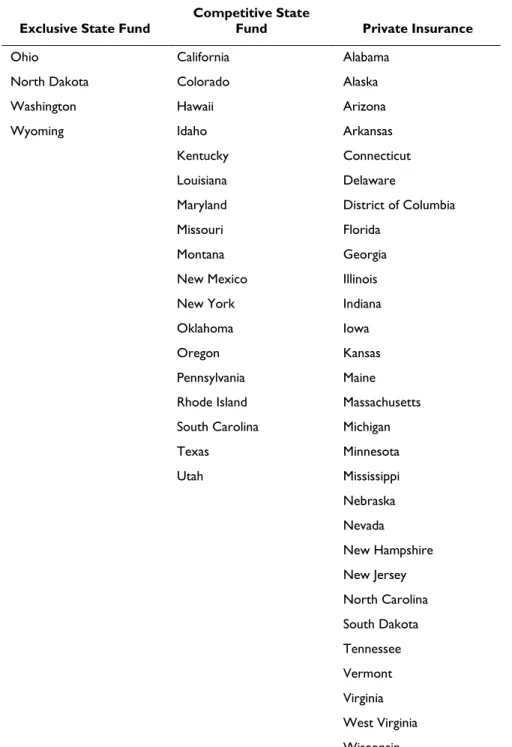
Twenty-two states operate state insurance funds that provide workers’ compensation insurance to public and private employees, as shown in Table A-2 in the Appendix. There are two types of state funds, exclusive and competitive. In the four states with exclusive state funds, the state fund is the only workers’ compensation insurance available for purchase. Employers may not purchase workers’ compensation insurance from private insurers. In the 18 states with competitive state funds, the state funds operate in open markets with private insurers and employers may purchase insurance from either the state funds or private insurers.
Private Insurance
In the majority of states, there are no state funds and workers’ compensation is exclusively offered through private insurers. These insurers are regulated by the states, which limit their ability to set premiums and establish the benefits required by statute that must be paid to covered employees.
Whereas state insurance funds will generally provide insurance to any employer, private insurers are generally not required to provide insurance in all cases. If an insurer believes that an employer is too much of a risk, it can refuse to sell that employer a policy, which can create a situation in which a high-risk employer is unable to purchase coverage in a state. In these cases, states either assign these employers to insurers, often based on the insurer’s market share in the state, or provide insurance through an assigned-risk pool managed by the state.
35 45 U.S.C. §§ 51 et seq. 36
46 U.S.C. § 30104. The Merchant Marine Act (or the Jones Act) does not apply to federal employees who work on ships, such as crew members of Military Sealift Command vessels, because these employees are covered by the Federal Employees’ Compensation Act (FECA).
37
For additional information on experience rating see National Council on Compensation Insurance, ABCs of Experience Rating, Boca Raton, FL, 2015, https://www.ncci.com/Articles/Documents/UW_ABC_Exp_Rating.pdf.
Self-Insurance
All but two states, North Dakota and Wyoming, allow employers with sufficient resources to self-insure for workers’ compensation. Under self-insurance, the employer does not purchase
insurance from a state fund or private insurer, rather, the employer holds sufficient assets in reserve to pay any required benefits. Self-insured employers must be approved by the state and in some cases must post bonds to ensure that future benefits will be paid even if the employer is unable to pay them or becomes insolvent.
The Workers’ Compensation Market
In a truly open market, employers and insurers would be able to come to agreements on optimal levels of premiums, benefits, and other services. However, the market for workers’ compensation, even in states with only private insurers and no state funds, is not truly open. The benefits
provided by insurers are set by the state and are not subject to negotiation and the premiums charged by insurers are regulated by the states as well. This regulation of both benefits and premiums may somewhat blunt the possible cost savings and efficiencies that could otherwise be gained by the private insurance system for workers’ compensation.
In the four states with exclusive state funds, the market is closed and the state fund is in a
monopoly position. Although monopolies are often associated with higher prices, state funds have the potential to offer cost savings over private insurers because of their nonprofit status. In
addition, exclusive state funds do not have the advertising or customer acquisition costs of competitive state funds or private insurers, which can also result in lower costs.
Although workers’ compensation benefits are standardized within each state, employers may still select insurers based on other services they provide. On example of this type of service is an insurer’s worker-safety program designed to help employers lower their claims rates and thus, their premiums.
Second Injury Funds
A second injury fund (SIF) is a state-administered fund that pays the difference between the employers’ responsibility for partial disability benefits and the actual costs of total disability benefits for cases involving workers who were partially disabled before working for the employer. SIFs are funded through assessments on insurers and self-insured employers. A SIF’s goals are to reduce the workers’ compensation risk associated with hiring persons with disabilities and reduce the costs to employers when an injury that would otherwise result in a partial disability results in a total disability due to the previous disability of the worker. During the period after World War II, each state that permitted employers to purchase private workers’ compensation insurance or self-insure operated a SIF as part of its workers’
compensation system. Since then, 20 states have abolished their SIFs with four states, Arkansas, Georgia, New York, and South Carolina, eliminating their funds since 2004 and Missouri, beginning in 2014, significantly limiting what its SIF covers.38
38
Christopher J. Boggs, “Second Injury Funds: Are They Still Necessary or Just a Drain on the System,” Insurance Journal: Academy Journal Blog, March 25, 2015, http://www.insurancejournal.com/blogs/academy-journal/2015/03/ 25/360666.htm; Yue Qiu and Michael Grabell, Workers’ Compensation Reforms by State, ProPublica, March 4, 2015, http://projects.propublica.org/graphics/workers-comp-reform-by-state?; and data provided by the American Insurance Association (AIA).
New York established the first SIF in 1916 and SIFs funds gained national attention in 1925 after the Oklahoma Supreme Court ruled in Nease v. Hughes Stone Co. that Hughes, the employer, was responsible for paying total disability benefits to W. A. Nease, who lost his second eye on the job, even though he had lost his first eye prior to being hired.39 Hughes argued that it should only be
responsible for the partial disability due to the loss of one eye that occurred while Nease was their employee, and not the larger effects of that injury on Nease due to his previous injury. In wake of the Nease decision, there were reports of thousands of Oklahomans with partial disabilities either being laid off or unable to find work because of the potential increased workers’ compensation risk they posed to employers.40 SIFs gained further attention after World War II as a way of
ensuring that employers would not be dissuaded from hiring veterans with disabilities.
Some, including the American Insurance Association (AIA), have argued that SIFs are no longer necessary due to enactment of the Americans with Disabilities Act (ADA), which prohibits discrimination against persons with disabilities in employment and requires employers to provide reasonable accommodations to persons with disabilities on the job. In addition, it is argued that SIFs have not resulted in the intended increased employment of persons with disabilities, have accumulated large unfunded deficits, deviate from the principle that employers should be responsible for the costs of their own workers’ injuries, and result in increased transaction costs and disputes.41
Workers’ Compensation Benefits
In all workers’ compensation systems, covered workers are entitled to medical care for their covered injuries or illnesses, and disability benefits to partially replace lost wages. In addition, the survivors of a worker who dies as a result of a covered injury or illness are provided benefits. In general, any injury, illness, or death that arises out of a person’s employment is covered.
However, there are general exceptions for cases in which the employee is intoxicated or the injury occurs at a workplace but is wholly unrelated to the person’s employment, such as crime that began outside of the workplace but continued into the workplace.
Workers’ compensation systems generally have statutes of limitations on when claims must be filed after an injury, illness, or death. Because of the latent nature of many occupational illnesses, these provisions may complicate workplace illness benefit applications, especially if the statute of limitation begins at the time of exposure, rather than, as is the case in the FECA and LHWCA programs, when the employee first knew or should have known that his or her illness was related to his or her employment.
In 2013, $63.6 billion in workers’ compensation benefits were paid, with these benefits nearly evenly split between medical benefits and cash benefits for disability and survivors.42 Recent
years have seen medical benefits accounting for a larger share of total benefit costs with medical benefits increasing by 10.3% between 2009 and 2013. Total benefits increased by 8.2% during that period. However, as a function of total payroll, total benefits (medical and disability),
39
1925 OK 713.
40
The primary source of these reports was the comments of I. K. Huber of the Empire Companies of Batlesville, Oklahoma at the 1930 meeting of the International Association of Industrial Accident Boards and Commissions and published as part of the proceedings of that meeting in the Bulletin of the Bureau of Labor Statistics (“Proceedings of
the Seventeenth Annual Meeting of the International Association of Industrial Accident Boards and Statistics,”
Bulleting of the United States Bureau of Labor Statistics, no. 536 [April 1931], pp. 268-272).
41
AIA, Second Injury Funds Should be Abolished, Policy Statement, Washington, DC, June 2002.
42Workers’ Compensation: Benefits, Coverage, and Costs, 2013
medical benefits, and cash benefits have all decreased in recent years. Between 2009 and 2013, total benefits decreased by $0.05 per $100 in covered payroll (5.1%), medical benefits decreased by $0.02 (3.9%), and cash benefits decreased by $0.04 per $100 in covered payroll (7.5%) during this period.43
Medical Benefits
Injured workers are entitled to medical benefits under workers’ compensation laws. A worker who is injured or sick due to an employment-related incident or exposure is provided medical
coverage for his or her covered injuries or illnesses. Medical benefits under workers’
compensation are provided without any cost sharing on the part of the workers. Covered workers do not have to use their personal insurance or pay coinsurance or satisfy any deductibles when receiving medical care. Medical benefits are only provided for covered injuries and illnesses and are not provided for general medical coverage for covered workers.
Because workers pay none of the costs associated with their medical care under workers’ compensation, controlling costs and ensuring that only medically necessary care is provided are long-standing challenges for employers and insurers. One strategy to control medical utilization and costs is to allow employers and insurers to exercise greater control over who provides medical care to beneficiaries. Workers’ compensation systems differ in how medical care is provided to covered workers. In some systems, including the federal systems, workers have near-complete control over which medical providers they choose for care. In other systems, employers have a greater role in affecting the choice of medical providers either through selecting providers for patients or limiting patients to selecting providers from an employer-approved list. In
addition, most state workers’ compensation systems permit pharmacy benefit managers (PBMs) to use formularies and utilization reviews to control prescription drug utilization and economies of scale to control prescription drug purchasing costs.44
Workers’ compensation is intended to be the primary payer for medical costs associated with covered injuries or illnesses. Private health insurance, Medicaid, or Medicare, are not authorized payers for work-related medical expenses. In the case of a workers’ compensation compromise and release settlement, a portion of the settled amount attributable to future medical expenses may be required to be set-aside to reimburse the Medicare program for these future medical expenses that the worker may bill to Medicare.
In 1980, medical benefits constituted 29% of total annual workers’ compensation benefits. Steady growth in the medical share of benefits through 2010 has resulted in an even split in medical and cash benefits since 2010.45 This trend is caused, in part, by overall medical costs rising faster than
inflation and thus exceeding growth in cash benefits, even in states with cost of living adjustments.
43
Ibid., pp. 2-3.
44
For example, the trade group CompPharma, which represents seven of the largest pharmacy benefit managers (PBMs) in the United States, reports that its member-PBMs handle approximately 63% of all workers’ compensation prescriptions.
45Workers’ Compensation: Benefits, Coverage, and Costs, 2013
Figure 1. Cash and Medical Benefits as Percentage of Total Workers’ Compensation Benefits, 1980-2013
Source: Ishita Sengupta and Marjorie L. Baldwin, Workers’ Compensation: Benefits, Coverage, and Costs, 2013, National Academy of Social Insurance, August 2015, p. 5.
In recent years, price and utilization of prescription drugs has drawn particular attention as drivers of workers’ compensation medical costs. Marked increases in the average wholesale prices of popular generic drugs in 2014, for example, drove prescription spending in both workers’ compensation and non-occupational medical systems46 and drew the attention of Congress.47
According to the U.S. Postal Service (USPS) Office of the Inspector General, the growth in compound drug use and costs is a major driver of the agency’s costs under the FECA program. In 2011, compound drugs made up 8% of total USPS FECA prescriptions and 6% of prescription costs. In 2015, compound drugs made up 34% of USPS FECA prescriptions and 53% of prescription costs.48
Factors that drive prescription drug utilization include physician dispensing of drugs and the repacking of drugs, the prevalence of opioid painkillers. States have begun controlling utilization
46
Express Scripts, The 2014 Drug Trend Report: Workers’ Compensation, April 2015, p. 5, http://lab.express-scripts.com/~/media/PDFs/Drug%20Trend%20Report/
ExpressScripts_2014WorkersCompensationDrugTrendReport.ashx; Helios, Workers’ Compensation Drug Trends
Report: 2015, 2015, p. 16, http://www.helioscomp.com/docs/default-source/Drug-Trend-Report-Files/dtr-2015-33015-single.pdf?sfvrsn=2; and M.J. Alpern, M.M Stauffer, and M.J. Kesselheim, “High-Cost Generic Drugs—Implications for Patients and Policymakers,” New England Journal of Medicine, vol. 371, no. 20 (November 13, 2014), pp. 1859-1862.
47
U.S. Congress, Senate Committee on Health, Education, Labor, and Pensions, Subcommittee on Primary Health and Aging, Why Are Some Generic Drugs Skyrocketing in Price?, 113th Cong., 2nd sess., November 20, 2014.
48
United States Postal Service (USPS), Office of the Inspector General (OIG), Workers’ Compnesation Compound
Drug Costs, Management Advisory Report Number HR-MA-16-003, March 14, 2016, p. 8, https://www.uspsoig.gov/ sites/default/files/document-library-files/2016/HR-MA-16-003.pdf.
costs by contracting with PBMs; placing regulations and limits on physician dispensing; using formularies that limit the specific drugs that will be covered; requiring pre-authorization or step-therapies in which a less expensive drug must be tried before a more expensive alternative is authorized for certain drugs; and capping total prescriptions reimbursements. These state reforms led to a decrease in workers’ compensation costs attributable to prescription utilization in 2014.49
Cash Benefits
Workers’ compensation pays cash benefits to workers for disabilities as a result of workplace injuries and illnesses and to the survivors of workers who die as a result of their employment. Cash benefits are only intended to replace a portion of the wages lost by the disabled or deceased worker. Partial-wage replacement is a feature of workers’ compensation for two reasons. First, because workers’ compensation benefits are seen as a replacement for untaxed tort awards that would otherwise be received by the worker, benefits are not considered income for the purposes of the federal income tax50 and are often exempt from state and local taxes.51 Second, the partial
nature of these benefits serves a deductible function by reducing the economic incentive of workers to replace work with the receipt of benefits. There is generally a waiting period of several days before cash benefits begin, which serves as both a deductible provision and to keep the most minor injuries out of the workers’ compensation system. Benefits for days during the waiting period are generally retroactively paid once it is determined that the claim is for a long-term or permanent disability.
Disability Benefits
Disability benefits under workers’ compensation are paid when a covered worker is unable to work at his or her full earning capacity because of an employment-related injury or illness. Disability benefits can be either for total or partial disability and can be either temporary or
permanent.
Total disability benefits are generally paid at a level of two-thirds of the employee’s pre-disability wage.52 Benefits are subject to system-specific minimum and maximum levels usually based on
average wages in the state. Thus, workers with high earnings may see their benefits capped at a level below two-thirds of their pre-disability wage.
Partialdisability benefits are paid as a percentage of the total disability rate that corresponds to the partial earning capacity of the worker. For example, if a state’s total disability rate is two-thirds of the pre-disability wage, and a worker is injured and able to work only half-time due to his or her injury, then this worker’s benefit would be equal to one-third of his or her pre-disability wage. The assessment of a worker’s capacity to work is commonly made using the American
49
Express Scripts, The 2014 Drug Trend Report: Workers’ Compensation, April 2015, p. 5, http://lab.express-scripts.com/~/media/PDFs/Drug%20Trend%20Report/
ExpressScripts_2014WorkersCompensationDrugTrendReport.ashx; and Helios, Workers’ Compensation Drug Trends
Report: 2015, 2015, p. 16. http://www.helioscomp.com/docs/default-source/Drug-Trend-Report-Files/dtr-2015-33015-single.pdf?sfvrsn=2
50
Section 104(a)(1) of the Internal Revenue Code (29 U.S.C. § 104(a)(1)).
51
Medical benefits are also not subject to the federal income tax. For additional information on the taxation of workers’ compensation benefits, see U.S. Congress, Senate Committee on the Budget, Tax Expenditures: Compendium of Background Material on Individual Provisions, committee print, prepared by Congressional Research Service, 112th Cong., 2nd sess., December 28, 2012, S.Prt. 112-45 (Washington: GPO, 2012), pp. 845-845 and 925-930.
52
In several states, the total disability rate is different from the two-thirds standard. In the FECA program, the total disability rate is increased to 75% of the pre-disability wage if the worker has a spouse or dependents.
Medical Association (AMA) Guides to the Evaluation of Permanent Impairment, currently in its sixth edition.53
Permanent disability benefits are paid when it is determined that the worker’s medical condition is not going to improve sufficiently to return to worker to full earning capacity. In most cases, temporary disability benefits are first paid until a determination of the permanence of the condition is made.
Scheduled Awards for Permanent Partial Disabilities
In case of certain permanent partial disabilities, such as the loss of a limb, workers’ compensation benefits are paid based on a schedule of benefits established by statute or
regulation that sets the number of weeks that permanent disability benefits are to be paid for each disability. For example, under FECA, benefits for the loss of an arm are paid, by statute, for 312 weeks54 whereas benefits for the loss of a breast are paid, by regulation, for 52 weeks.55
Scheduled benefits for permanent partial disabilities are generally paid even if the beneficiary is able to work at full capacity.
In its 2015 report on workers’ compensation, ProPublica calculated the maximum benefits under scheduled awards in each state and the FECA program and found considerable differences in how much a worker can receive for permanent partial disabilities based on where he or she lives or works.56 These differences are due to different schedules of benefit durations and different
maximum levels of compensation among the states. For example, for the loss of an arm, the national average maximum benefit was $169,878 in 2015. Maximum scheduled benefits for the loss of an arm ranged from $48,840 in Alabama to $859,634 in Nevada. These differences in maximum available benefits and permanent-partial award schedules should not be surprising given the decentralized nature of workers’ compensation systems run by states without any federal mandates or standards as well as differences in average wages in the states, which are the basis for maximum and minimum benefits.
As part of their budget requests for DOL, Presidents George W. Bush and Barack Obama
proposed changing the way permanent-partial benefits are paid under the FECA program.57 These
proposals would have changed the current schedule of benefit durations to a system of lump-sum payments for permanent partial disabilities with all workers’ receiving the same amounts
regardless of pre-disability wages. This proposal, along with other proposed FECA reforms, was not included in the President’s FY2017 budget request.58
53
There has been some controversy over the use of the AMA Guides in workers’ compensation, including whether the current edition should be used. These issues were the focus of a congressional hearing in 2010 (U.S. Congress, House Committee on Education and Labor, Subcommittee on Workforce Protections, Developments in State Workers’
Compensation Systems, 111th Cong., 2nd sess., November 17, 2010, Serial No. 111-76 (Washington: GPO, 2010)). 54 5 U.S.C. § 8107(c).
55 20 C.F.R. § 10.404(a).
56 Lena Groeger and Michael Grabell, Workers’ Compensation Benefits: How Much is a Limb Worth?, ProPublica,
March 5, 2015, http://projects.propublica.org/graphics/workers-compensation-benefits-by-limb.
57
See, for example, Department of Labor (DOL), FY2008 Congressional Budget Justification, February 5, 2007, pp. ESA-43, https://www.dol.gov/dol/budget/2008/PDF/CBJ-2008-V2-03.pdf.
58
DOL, FY2017 Congressional Budget Justification, February 9, 2016, https://www.dol.gov/sites/default/files/ documents/general/budget/CBJ-2017-V2-04.pdf.
Coordination with Social Security
A worker may receive disability benefits under both workers’ compensation and the Social Security Disability Insurance (SSDI) program.59 However, the combined amount of these benefits
cannot exceed 80% of the worker’s pre-disability wage in any month, with either the workers’ compensation or SSDI benefits offset, depending on the state, to get the worker below the 80% threshold. Prior to 1981, states could elect whether to offset workers’ compensation (“reverse offset”) or SSDI benefits to get below the 80% threshold. However, pursuant to the Omnibus Budget Reconciliation Act of 1981, only those states with approved reverse offset plans in place as of February 18, 1981, may offset workers’ compensation benefits to reach the 80% threshold.60
In all other states and the federal programs, SSDI benefits are offset when total benefits exceed 80% of the worker’s pre-disability wage in month.
Because the workers’ compensation-SSDI offset is based on total monthly benefits, any reduction in monthly workers’ compensation benefits could result in an increase in SSDI benefits paid in states that offset SSDI. Thus, a reduction in workers’ compensation benefits would shift some of the costs of providing income replacement for the injury or illness from the workers’
compensation system to the Social Security system. In addition, policy changes that make it more difficult to receive workers’ compensation benefits, such as changing the way disabilities are evaluated, or that make workers’ compensation less attractive for injured workers, such as reducing workers’ choice of treating physicians would likely shift workers away the workers’ compensation system, leaving other social programs, such as Unemployment Insurance (UI), SSDI, Supplemental Security Income (SSI), Medicare, or Medicaid to make up for the income lost to disability.
The Occupational Safety and Health Administration (OSHA) claims that state workers’ compensation policy changes have shifted the costs of workplace injuries away from workers’ compensation.61 OSHA, citing a study published in the Journal of Occupational and
Environmental Medicine, reports that workers’ compensation only pays 21% of the cost of workplace injuries, with federal programs, such as SSDI, paying 11% of the costs.62 The study,
however, only looked at cases over one year (2007) and thus cannot be used to measure the cost-shifting to federal programs that occurs as a result of changes in workers’ compensation benefits and policies. In addition, when estimating costs associated with work injuries, the study cited by OSHA included indirect costs associated with work injuries, such as additional costs associated with home production activities, such as cooking and home modifications. However, workers’ compensation has always been limited to providing partial-wage replacement and medical benefits, and has never paid, nor been intended to pay the indirect costs associated with workplace injuries, illnesses, and deaths.
Benefit Duration
Workers’ compensation systems vary in the maximum duration of permanent disability benefits. In the federal programs, and in 39 state programs, disability benefits are paid for the duration of
59
For additional information on the SSDI program, see CRS Report RL32279, Primer on Disability Benefits: Social Security Disability Insurance (SSDI) and Supplemental Security Income (SSI).
60 P.L. 97-35. The approved reverse offset states are Alaska, California, Colorado, Florida, Louisiana, Minnesota, New
Jersey, New York, North Dakota, Ohio, Oregon, Washington, and Wisconsin.
61
DOL, Occupational Safety and Health Administration, Adding Inequality to Injury: The Costs of Failing to Protect Workers on the Job, June 2015, p. 6, https://www.dol.gov/osha/report/20150304-inequality.pdf.
62
Paul J. Leigh and James P. Marcin, “Workers’ Compensation Benefits and Shifting Costs for Occupational Injury and Illness,: Journal of Occupational and Environmental Medicine, vol. 54, no. 4 (April 2012), pp. 445-450.
disability up to the life of the worker.63 In the remaining state systems, benefits are capped either
by age, duration of receipt, or total amount of benefits received. Proponents of limiting the duration of benefits argue that the workers’ compensation system is intended to replace lost wages and once a person reaches a certain age, it is unlikely that he or she would be working, even if not injured. Thus, there are no wages to be replaced. Others argue that workers sacrifice potentially larger tort awards that they could win in civil court and thus should not have their workers’ compensation benefits arbitrarily limited. In addition, workers injured at young ages may not have sufficient pensions or savings to rely on when they get older and all workers may continue to bear costs associated with their disabilities even after state-mandated duration limits have been reached.
As part of their packages of FECA reforms, Presidents Bush and Obama proposed reducing FECA benefits at retirement age to encourage older beneficiaries to opt to receive their federal pension benefits rather than FECA.64 This proposal was not included in the President’s FY2017
budget request.65
Compromise and Release Settlements
Compromise and release settlements are a key feature of state workers’ compensation systems, but are not permitted under FECA. In a compromise and release settlement, the insurer agrees to provide the beneficiary with a lump-sum payment or structured series of payments in exchange for the worker forfeiting any future claims for medical or cash benefits against the insurer. In some cases, settlements may be limited to cover only future cash benefits or to allow for some future claims, and in others, settlements may be permitted to be reopened if there are material changes in the beneficiary’s condition. However, in most cases, once the settlement has been reached and approved, the worker is no longer entitled to any benefits, regardless of what happens to his or her employment or health condition in the future.
Compromise and release settlements can serve as a mechanism to remove disputed claims from the state’s adjudication process or the courts in much the same way that civil tort cases may be settled out of court. In addition, the insurer gets to clear the case off of its books and remove the uncertainty associated with possible future benefits. The beneficiary receives either a lump-sum payment or structure of payments, which can be used for injury-related expenses not covered or for unrelated expenses and removes the uncertainty associated with claims being disputed by the insurer. Because insurers will likely have more information on the claim’s expected, the insurer may be in an advantaged position over the worker when negotiating the settlement, which may result in the worker being worse off than had he or she continued with the claim through the normal adjudication process.
Administrative difficulties can arise in compromise and release settlements when administering SSDI offsets and Medicare set-asides. The SSDI offset is based on a comparison of monthly workers’ compensation and SSDI benefits with the worker’s monthly pre-disability wage. Because a lump-sum settlement replaces monthly benefits, the SSA must prorate the amount of the settlement attributable to cash benefits using an established proration rate as well as specific
63Workers’ Compensation: Benefits, Coverage, and Costs, 2013
, pp. 64-72.
64
See, for example, DOL, FY2008 Congressional Budget Justification, February 5, 2007, pp. ESA-43, https://www.dol.gov/dol/budget/2008/PDF/CBJ-2008-V2-03.pdf.
65
DOL, FY2017 Congressional Budget Justification, February 9, 2016, https://www.dol.gov/sites/default/files/ documents/general/budget/CBJ-2017-V2-04.pdf.
rules for each individual state, and it can be affected by how the projected life expectancy of the worker is treated in the settlement.66
Medicare is the secondary payer to workers’ compensation for work-related medical expenses, and workers. Because a compromise and release settlement generally releases the workers’ compensation system from paying for any future medical expenses, a worker may improperly use Medicare to pay for these expenses. The Centers for Medicare and Medicaid Services (CMS) recommends, but does not require, that workers’ establish a Workers’ Compensation Medicare Set-aside Arrangement (WCMSA) to dedicate a portion of the settlement to future medical costs so that Medicare is not improperly billed for these expenses.67 Legislation in the 114th Congress,
H.R. 2644 and S. 1514, would eliminate the Medicare secondary payer provision for settlements not exceeding $25,000 or in which the worker is unlikely to become eligible for Medicare in 30 months. For all other settlements, the Medicare secondary payer rules could be satisfied by a qualified WCMSA.68
Survivors Benefits
If a worker dies in the course of employment or as a result of an employment-related injury or illness, his or her survivors are entitled to workers’ compensation benefits. These monthly benefits are generally equivalent to the monthly disability benefit the worker would have received. Because survivors benefits are intended to replace the worker’s lost income used to support his or her dependents, generally, only the spouse and dependent children or other dependent family members, such as a dependent parent, are eligible for these benefits. Benefits generally stop when the spouse remarries or the dependent children reach adulthood. If there is no surviving spouse or dependents, survivors benefits are generally not paid to the estate or any other person.
In general, workers’ compensation systems also provide a separate burial benefit or allowance in the case of covered deaths. This benefit is usually a lump-sum payment designed to partially offset the costs of the funeral or other final expenses related to the worker’s death. Unlike survivors benefits, this benefit is generally paid even if the worker leaves behind no spouse or dependents.
Vocational Rehabilitation and Return to Work
The goal of the employer and insurer in workers’ compensation is to return the worker to
employment thus removing the worker from the cash benefit rolls. Because workers only receive partial wage replacement through workers’ compensation and forfeit any possible career
advancement, they also have an incentive to return to work. To assist beneficiaries’ return to work and departure from the workers’ compensation rolls, vocational rehabilitation services are
provided. Participation in vocational rehabilitation is generally voluntary.
Although participation in vocational rehabilitation is voluntary, returning to work, even at a reduced capacity, is generally required if it is determined that the worker’s condition permits at least a partial return to work. If a worker can only partially return to work, partial disability
66
The SSA’s proration procedures are provided in the agency’s Program Operations Manual System (POMS) at DI52150.060 and DI52150.065 as well as Social Security Rulings 76-34, 87-21, and 97-3.
67
For additional information on the coordination between workers’ compensation and Medicare, see CRS Report RL33587, Medicare Secondary Payer: Coordination of Benefits.
68