Meeting the needs of the aging population:
the Canadian Network on Aging and
Cancer—report on the first Network
meeting, 27 April 2016
M.T.E. Puts
rnphd,* T. Hsu
md,
†E. Szumacher
mdmsc,
‡S. Sattar
rnmn,* S. Toubasi
mn,* C. Rosario
md,
§E. Brain
mdphd,
||W. Duggleby
rnphd,
#C. Mariano
md,** S. Mohile
md,
††H. Muss
md,
‡‡M. Trudeau
md,
‡D. Wan-Chow-Wah
md,
§§C. Wong
md,
||||and S.M.H. Alibhai
mdmsc##ABSTRACT
The aging of the Canadian population represents the major risk factor for a projected increase in cancer incidence in the coming decades. However, the evidence base to guide management of older adults with cancer remains extremely limited. It is thus imperative that we develop a national research agenda and establish a national collaborative net-work to devise joint studies that will help to accelerate the development of high-quality research, education, and clinical care and thus better address the needs of older Canadians with cancer. To begin this process, the inaugural meeting of the Canadian Network on Aging and Cancer was held in Toronto, 27 April 2016. The meeting was attended by 51 invited researchers and clinicians from across Canada, as well as by international leaders in geriatric oncology from the United States and France.
The objectives of the meeting were to
■ review the present landscape of education, clinical care, and research in the area of cancer and aging in Canada.
■ identify issues of high research priority in Canada within the field of cancer and aging.
■ identify current barriers to geriatric oncology research in Canada and develop potential solutions.
■ develop a Canadian collaborative multidisciplinary research network between investigators to improve health outcomes for older adults with cancer.
■ learn from successful international efforts to stimulate the geriatric oncology research agenda in Canada.
In the present report, we describe the education, clinical care, and research priorities that were identified at the meeting.
Key Words
Geriatric oncology, research priorities, meeting reportsCurr Oncol. 2017 Apr;24(2):e163-e170
www.current-oncology.com
INTRODUCTION
The Canadian population is aging. Adults 65 years of age and older will constitute 25% of the Canadian population by the year 20361—a fact that is concerning, because cancer
is a disease associated with aging. Older adults 65 years of age and older are 11 times more likely than younger adults to develop cancer2. Currently, 60% of all new cancer
diag-noses and 70% of all cancer deaths occur in older adults3,4.
It is predicted that the cancer incidence will increase by
79% in the next 15 years, mostly because of the aging of the population4.
Despite the aging of the population and the growing cancer incidence, there is a paucity of research involving older adults with cancer. Older adults, particularly frail older individuals with multiple comorbidities, are con-sistently underrepresented in clinical cancer research, comprising only 22% of patients enrolled in ncic trials5,
despite growing evidence that they are just as likely to accept clinical trial enrolment6. That underrepresentation
leads to knowledge gaps concerning optimal treatment strategies and could contribute to suboptimal care and poorer outcomes in older cancer patients7–9. Moreover,
older adults who are included in a clinical trial tend to be highly selected and are thus not representative of the typi-cal older adult with cancer. It is also important to consider how aging can influence the cancer experience for older adults, in terms of changes in how older adults perceive a diagnosis of cancer and its implications on their health and longevity.
Several countries that play a leading role in geriatric oncology (for example, the United States, France, and Bel-gium) have formed national and international networks and collaborations that have led to improved clinical care, research opportunities, education, and advocacy for older adults with cancer. The U.S. research network has more than 100 members and formal training programs. In France, dedicated geriatric oncology units in each health region are organized into one national network. There is no equivalent network in Canada. The Canadian Network on Aging and Cancer was therefore inaugurated on 27 April 2016 in Toronto, funded by a Canadian Institutes of Health Research meeting and planning grant. Canadian clini-cians, researchers, educators, allied health care providers, and trainees in various disciplines with an interest in geri-atric oncology, together with international experts from key geriatric oncology networks such as the U.S. Cancer and Aging Research Group (carg), the International Society of Geriatric Oncology, and the French geriatric oncology group gerico were invited to attend.
The objectives of the meeting were to
■ review the current landscape of education, clinical care, and research in the area of cancer and aging in Canada.
■ identify issues of high research priority in Canada within the field of cancer and aging.
■ identify current barriers to geriatric oncology research in Canada and develop potential solutions.
■ develop a collaborative multidisciplinary research net-work of investigators across Canada who are interested in fostering research and improving health outcomes for older adults with cancer.
■ learn from successful efforts in other countries to stim-ulate the geriatric oncology research agenda in Canada.
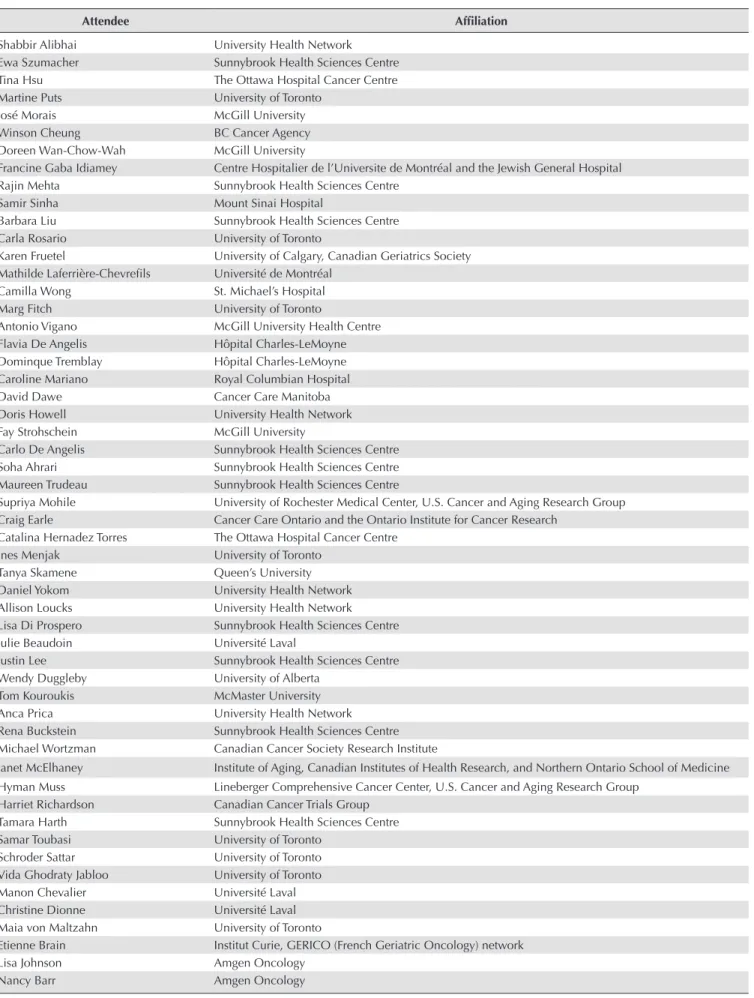
Table I lists the attendees and their affiliations, and Table II sets out the agenda of the meeting day. During the morning and afternoon sessions, small-group discussions about education needs, clinical needs, and research prior-ities in geriatric oncology were held and are summarized later in this article. First, the present state of education, clinical care, and research in Canada is described, together with short- and long-term priorities (Table III presents an overview of all priorities).
SESSION DESCRIPTIONS
Geriatric Oncology Education
The education session was moderated by Drs. Tina Hsu and Ewa Szumacher. Attendees agreed that education in
geriatric oncology for all clinicians and trainees involved in caring for older adults with cancer is imperative to help ad-vance the field and to improve outcomes for older patients. However, it was recognized that most trainees in Canada receive little to no geriatric oncology training. Currently in Canada, geriatric oncology subspecialty training is available in Montreal and Toronto. Few Canadian training programs—whether in geriatrics, oncology, or allied health programs—include formal teaching on geriatric oncology. Attendees identified several challenges in delivering education in geriatric oncology. First, the field of geriatric oncology, and therefore the specific knowledge and skills that are unique to the field, are not currently well-defined. Second, because most experts in geriatric oncology are concentrated in a few centres, many centres do not have teachers with the expertise to deliver educational content in geriatric oncology. Lastly, attendees felt that further devel-opment of the evidence base in geriatric oncology through ongoing research, scholarship, and clinical collaboration was necessary and critical to encourage and reinforce the need for geriatric oncology training.
To address those challenges, attendees identified several short- and long-term goals (Table iii). Defining key geriatric oncology competencies for each discipline was felt to be an essential initial step. Further, sharing available educational material and expertise in geriatric oncology through national collaborations by harnessing technology—in particular, leveraging currently available webinar series within geriatric medicine, oncology, and allied health disciplines—was felt to be a particularly favourable method of both providing education and pro-moting the field of geriatric oncology. That approach could help programs without specific local expertise deliver educational content to their trainees. An important early step in disseminating such materials is a systematic online inventory and quality assessment of existing materials.
In the long term, attendees suggested that a geriatric oncology curriculum for oncologists, geriatricians, and al-lied health professionals should be developed. Integration within the traditional curriculum and uptake of geriatric oncology topics into licensing exams would accelerate the knowledge of the workforce caring for older adults with cancer. Inter-professional workshops and certificate courses should be developed to educate clinicians and recognize those who have attained core geriatric oncology competencies and could be linked to other existing provin-cial and national education venues for various clinicians. Future goals could also include development of a geriatric oncology fellowship, with the potential of applying for an official Royal College of Physicians and Surgeons of Canada designation as an Area of Focused Competence program.
Geriatric Oncology Clinical Care
The morning session to discuss the best model of care was moderated by Drs. Wendy Duggleby and Doreen Wan-Chow-Wah. In the afternoon, a session addressing barriers to the implementation of geriatric oncology in clinical practice was moderated by Drs. Etienne Brain and Camilla Wong.
TABLE I List of attendees
Attendee Affiliation
Shabbir Alibhai University Health Network
Ewa Szumacher Sunnybrook Health Sciences Centre Tina Hsu The Ottawa Hospital Cancer Centre Martine Puts University of Toronto
José Morais McGill University
Winson Cheung BC Cancer Agency
Doreen Wan-Chow-Wah McGill University
Francine Gaba Idiamey Centre Hospitalier de l’Universite de Montréal and the Jewish General Hospital Rajin Mehta Sunnybrook Health Sciences Centre
Samir Sinha Mount Sinai Hospital
Barbara Liu Sunnybrook Health Sciences Centre Carla Rosario University of Toronto
Karen Fruetel University of Calgary, Canadian Geriatrics Society Mathilde Laferrière-Chevrefils Université de Montréal
Camilla Wong St. Michael’s Hospital
Marg Fitch University of Toronto
Antonio Vigano McGill University Health Centre Flavia De Angelis Hôpital Charles-LeMoyne Dominque Tremblay Hôpital Charles-LeMoyne Caroline Mariano Royal Columbian Hospital
David Dawe Cancer Care Manitoba
Doris Howell University Health Network Fay Strohschein McGill University
Carlo De Angelis Sunnybrook Health Sciences Centre Soha Ahrari Sunnybrook Health Sciences Centre Maureen Trudeau Sunnybrook Health Sciences Centre
Supriya Mohile University of Rochester Medical Center, U.S. Cancer and Aging Research Group Craig Earle Cancer Care Ontario and the Ontario Institute for Cancer Research
Catalina Hernadez Torres The Ottawa Hospital Cancer Centre
Ines Menjak University of Toronto
Tanya Skamene Queen’s University
Daniel Yokom University Health Network Allison Loucks University Health Network Lisa Di Prospero Sunnybrook Health Sciences Centre Julie Beaudoin Université Laval
Justin Lee Sunnybrook Health Sciences Centre Wendy Duggleby University of Alberta
Tom Kouroukis McMaster University
Anca Prica University Health Network
Rena Buckstein Sunnybrook Health Sciences Centre Michael Wortzman Canadian Cancer Society Research Institute
Janet McElhaney Institute of Aging, Canadian Institutes of Health Research, and Northern Ontario School of Medicine Hyman Muss Lineberger Comprehensive Cancer Center, U.S. Cancer and Aging Research Group
Harriet Richardson Canadian Cancer Trials Group Tamara Harth Sunnybrook Health Sciences Centre Samar Toubasi University of Toronto
Schroder Sattar University of Toronto Vida Ghodraty Jabloo University of Toronto Manon Chevalier Université Laval Christine Dionne Université Laval Maia von Maltzahn University of Toronto
Etienne Brain Institut Curie, GERICO (French Geriatric Oncology) network
Lisa Johnson Amgen Oncology
Jewish General Hospital’s Segal Cancer Centre in Montreal, which started in 2006, is one of the most established geri-atric oncology clinics in Canada. Its multidisciplinary team includes geriatrics, nursing, physical therapy, occu-pational therapy, social work, pharmacy, neuropsychology, and nutrition. Other geriatric oncology clinics have been established in Quebec City and Toronto. Most attendees, however, reported no formal partnerships between geri-atrics and oncology.
Numerous barriers were identified, including the low referral rate for eligible older adults. A solution identified was to use a geriatric screening tool as a strategy to identify older adults most likely to benefit. Furthermore, staffing of the clinic was challenging—namely, finding staff interested in geriatric oncology, and in smaller centres, lack of access to various health disciplines. Potential solutions identified were to use resources already available in the community to train more nurses and to leverage telemedicine technology to access geriatric expertise not available locally.
Participants felt that it was very important that geriat-ric oncology care be integrated into the oncology clinical
setting, with clinicians working together to share the infor-mation gathered so that older adults need not see two sep-arate services. It was agreed that an interested geriatrician has to partner with someone in oncology to ensure buy-in, support, and shared expertise. Key players in a geriatric oncology service are nurses and nurse navigators, who are essential to help assess older adults and navigate the cancer system and community health services, including palliative and other supportive care services. There is a need to engage key nurses in geriatrics in the development of a clinic. They were identified as key stakeholders because they can share expertise and facilitate removing and over-coming organizational barriers.
An important component of oncologic care is multidis-ciplinary tumour boards. Some existing geriatric oncology services noted that, although tumour boards can enhance visibility and provide a platform for the selection of older cancer patients requiring geriatric oncology expertise, the breadth of site-specific tumour boards that regularly meet makes such changes logistically challenging. A solution identified was to organize tumour boards so that patients TABLE II Program for the day
Time Session description
9h30–9h45 Welcome, opening remarks, goals of meeting (team) 9h45–10h00 Introductions
10h00–10h20 Canada’s aging population—where we are and where we’re going How are aging and cancer connected? (Dr. Morais)
10h20–10h35 Coffee break
10h35–11h40 Current geriatric oncology research in Canada
10h35–10h45 Overview of the current landscape of research in geriatric assessment and management in older adults in Canada (Dr. Alibhai) 10h45–11h00 Survivorship research (Dr. Fitch)
11h00–11h15 Health services research (Dr. Cheung) 11h15–11h30 Clinical trials (Dr. Trudeau)
11h30–11h40 Question-and-answer period
11h40–12h05 The Cancer and Aging Research Group: how it started and lessons learned (Dr. Mohile) 12h05–12h30 The French organization of Geriatric Oncology and Related Research (Dr. Etienne Brain) 12h30–13h15 Lunch
13h15–14h00 Small-group breakouts
Participants attend one small-group discussion of 45 minutes
Best model of education (Discussion leaders: Drs. Hsu and Szumacher) Best model of care (Discussion leaders: Drs. Duggleby and Wan-Chow-Wah) Best model of research (Discussion leaders: Drs. Mariano and Alibhai) 14h00–14h45 Reconvene; review and discussion of issues discussed in small groups 14h45–15h00 Coffee break
15h00–15h45 Small-group breakouts
Participants attend one small group discussion of 45 minutes
Barriers to implementing geriatric oncology in clinical practice (Discussion leaders: Drs. Brain and Wong) Barriers to geriatric oncology research (Discussion leaders: Drs. Trudeau and Muss)
Aims of the Canadian Network on Aging and Cancer and how to move forward (Discussion leaders: Drs. Mohile and Puts 15h45–16h15 Development of a Canadian geriatric collaborative network
potentially requiring geriatric oncology input are grouped, allowing the geriatric oncology consultant to attend at a particular time to enhance efficiency.
Lastly, there was also ambiguity about the roles and responsibilities of the oncologist compared with the family physician in implementing recommendations from the geriatric oncology clinic; however, clear communication is key to addressing that ambiguity.
Another point of discussion was whether geriatric on-cology and palliative care should be integrated or function as separate services. The discussion suggested that overlap exists, but that keeping them separate is important, be-cause some of the issues are very different. Furthermore, the relationship between oncology and palliative care is complex, each having its own set of issues. Attendees considered it important to connect with palliative care in providing the service to older adults so as to enhance well-being while avoiding duplication of services.
Geriatric Oncology Research
Two small-group sessions with respect to research were held. The first was moderated by Drs. Caroline Mariano and Shabbir Alibhai. It focused on the best model of research. The second was moderated by Drs. Maureen Trudeau and Hyman Muss, and it focused on barriers to geriatric oncol-ogy research. Throughout the meeting, it became apparent that many attendees were actively involved in geriatric oncology research, with even more attendees throughout
Canada being interested in engaging in such research. Research interests included the use of existing databases and clinical trial datasets to examine age-related oncologic questions (for example, efficacy, toxicity, access), the value of geriatric assessment in clinical trials, and evaluations of the performance of geriatric screening tools (for example, the Vulnerable Elders Survey, G8) in clinics. There was a lot of positive energy in the room, and there was also a sense that we are at a critical juncture to move ahead with exciting research efforts in this field.
One challenge is the relatively limited and geographi-cally dispersed expertise in geriatric oncology in Canada. The Network meeting was felt to be an important first step in addressing that challenge. Participants agreed that, to promote networking and collaborations, formal identifi-cation and compilation of a list of Canadian researchers currently engaged in geriatric oncology research and their areas of interest should be a priority. The establishment of a national network to facilitate expert input on proposed studies (similar to carg in the United States) and the de-velopment of collaborations with international trial groups were also identified as possible solutions.
One of the most important barriers was lack of ad-equate resources (money and time). Solutions included leveraging all existing funding opportunities and raising awareness through education about the aging imperative to philanthropic, pharmaceutical, and peer-reviewed funders (for example, the Canadian Institutes of Health Research TABLE III Short-term and long-term priorities
Domain Priorities
Short-term (12 months) Long-term (5 years)
Education ■ Increase awareness about geriatric oncology. ■ Create a national professional network with
communication via e-mail or video conferencing (or both) to share educational materials.
■ Define core competencies that trainees should possess in
geriatric oncology.
■ Develop a geriatric oncology curriculum for oncologists and
geriatricians.
■ Incorporate a geriatric oncology curriculum into training
(undergraduate, postgraduate, continuing education).
■ Consider applying for Area of Focused Competence status
through the Royal College of Physicians and Surgeons of Canada.
Clinical ■ Develop a consistent message (or “branding”) of what
geriatric oncology is and why it is important clinically
■ Convey value of geriatric assessment to oncologists. ■ Establish care pathways to guide timing and
appropriateness of referral to geriatric oncology.
■ Implement evidence-based geriatric oncology care.
■ Establish various clinical models based on local availability of
human resources.
■ Identify and develop learning resources to teach geriatric
assessment principles using standardized tools. Research ■ Compile a list of current geriatric oncology research in
Canada.
■ Enter into dialogue with major cancer funding agencies
(Canadian Institutes of Health Research, Canadian Cancer Society Research Institute) to enhance focus on geriatric oncology research through requests for proposals or other mechanisms, and highlight gaps in prior and current research.
■ Identify gaps in existing knowledge concerning drug
safety and toxicity data for older adults that can be targets of secondary analyses of clinical studies or retrospective analyses of large drug databases.
■ Establish a network of experienced mentors and
researchers who can serve as local and national resources to help others who are entering this field.
■ Establish elder-specific clinic trials through the Canadian
Cancer Trials Group
■ Stimulate more randomized controlled trials of interventions
that evaluate their effect on patient-reported outcomes such as functional status and quality of life.
■ Integrate geriatric oncology within existing research
structures.
■ Add geriatric assessment into randomized controlled trials
that are opening soon:
– Establish a geriatric oncology committee to vet trial pro-posals coming through existing groups such as the Canadi-an CCanadi-ancer Trials Group.
– Ensure that new trial protocols include geriatric-specific measures both as predictor variables (geriatric assessment domains, toxicity prediction or frailty screening tools) and outcomes (for example, functional status, cognition). – Disseminate best practices for recruiting older adults into
and the Canadian Cancer Society Research Institute). In relation to those activities, the Network should explore opportunities to work with major peer-reviewed funding agencies to establish targeted calls or specific requests for proposals in the area of geriatric oncology.
A second key barrier was the challenges to participa-tion in studies for older adults, because of dependency on others for transportation, financial barriers, language and literacy barriers, and physical and cognitive impairments. Solutions included maximizing flexibility in enrolment criteria and consulting with individuals having expertise in geriatric oncology or possibly even older adults with cancer themselves during the design phase to ensure studies are “elder friendly.” Another opportunity is to look at post-marketing surveillance or so-called phase iv stud-ies using clinical or administrative databases to provide real-world effectiveness and toxicity data for older adults. A third option is to engage more with pharmaceutical companies and Health Canada to apply various pressures (from moral suasion to regulatory requirements) to ensure that adequate proportions of older adults are enrolled onto relevant registration trials. A central theme was the underrepresentation of older adults with cancer in current research, particularly clinical trials and mechanistic stud-ies. Moreover, most of the existing research has been in medical oncology, and so gaps were even larger in surgical and radiation oncology.
With respect to future progress, four key ideas were put forward. First, the need to incorporate multiple methodolo-gies and to consider a wide range of outcomes to fully study this complex field, incorporating qualitative studies and ensuring a focus on survivorship and other elder-relevant outcomes beyond traditional disease-based oncologic out-comes such as progression-free survival and response rates. Second, several aspects of research with older adults are not particularly clear and should be formally studied. For example, does it cost more to recruit older adults to trials? And what is the best way to make trials more “elder friendly”? Furthermore, how should researchers deal with ethics issues that arise when performing geriatric assess-ments in older cancer patients (for example, the implica-tions of diagnosing new cognitive impairment)?
Third, discussion ensued about the best methods for incorporating a standardized geriatric assessment across centres. The feeling was that, based on other jurisdictions, such standardization is not likely to happen quickly, nor is it a prerequisite to moving forward with incorporating geriatric assessments into trials and observational studies at baseline. Agreeing on common elements and identifying a few of the best tools (for example, the carg tools) is a rea-sonable compromise. The choices should leverage existing datasets and collection methods where possible. For exam-ple, the ways to link geriatric assessments with standardized point-of-care symptom assessment (for example, using the Edmonton Symptom Assessment System as mandated by agencies such as Cancer Care Ontario) should be explored, and various team members should be educated about how to best recruit and retain older adults in studies.
Finally, best practice in research should involve in-terdisciplinary teams and collaborative models of care and research.
Development of a Canadian Geriatric Oncology
Collaborative Network
The final discussion involved the large group and focused on a possible future Canadian collaborative network. This discussion was moderated by Drs. Su-priya Mohile and Martine Puts. Most attendees whole-heartedly agreed that a Canadian Network on Aging and Cancer is needed, because some issues in educa-tion, clinical care, and research are unique to Canada. However, the Network should collaborate closely with existing networks such as carg, gerico, and others to move the geriatric oncology agenda forward worldwide and to build on the efforts of successful initiatives. Most interested centres have at least 1 representative, which is a good starting point and will make the network even more critical.
Logistically, it was felt that using an informal struc-ture and connecting at regular intervals (monthly, for instance) in telephone conference calls or webinars to develop more collaboration across Canada, similar to the carg model, would work best. Interest was expressed in developing a shared Web site for the network, which would serve as a common assembly point where updates and news for all members could be disseminated and members could liaise. It was suggested that the group connect with local funding sources and pharmaceutical companies to obtain some initial funding to support the development of the Web site. Finally, the participants agreed on an initial set of goals and priorities, as sum-marized in Table iv.
MEETING EVALUATION
Evaluation forms were circulated to all meeting attend-ees and were returned by 29 attendattend-ees (57%). Of the respondents, 17% were geriatricians; 20% were medical oncologists; 6% were nurses, clinical nurse specialists, or nurse practitioners; 17% were doctoral researchers; 6% were radiation oncologists; 17% were residents or fellows; and 17% were in allied disciplines. Of the respondents, 69% practiced in an academic teaching hospital, 12% in a comprehensive cancer centre, and 16% in a non-academic hospital; 3% were research administrators.
They also wanted to hear more about specific research projects and how to design evidence-based clinical trials for the elderly. Respondents liked the organization of the meeting; however, they wished that there was more time for discussion and a clearer role for participants. Respon-dents were interested in continuing to be involved in the Network online after the meeting and to participate in future meetings.
SUMMARY
Based on both the returned surveys and the informal feedback from participants, the meeting was successful in reaching its objectives of reviewing the current education, clinical, and research landscape in geriatric oncology in Canada; identifying issues of high priority, current bar-riers, and possible solutions; and developing a network of investigators who are interested in improving health outcomes for older adults with cancer. Our next steps are to establish an informal network and a Web site for the group. In future, we hope to continue these meetings ev-ery 1–2 years to advance the field and practice of geriatric oncology in Canada.
ACKNOWLEDGMENTS
The Canadian Network on Aging and Cancer meeting was sup-ported by a Canadian Institutes of Health Research meeting and planning grant (no. 345246). Unrestricted educational grants were also received from Amgen and AbbVie. MTEP is supported with a Canadian Institutes of Health Research New Investigator Award.
CONFLICT OF INTEREST DISCLOSURES
We have read and understood Current Oncology’s policy on dis-closing conflicts of interest, and we declare that we have none.
AUTHOR AFFILIATIONS
*Lawrence S. Bloomberg Faculty of Nursing, University of Toronto, Toronto, ON; †The Ottawa Hospital Cancer Centre, Ottawa, ON; ‡Odette Cancer Centre, Sunnybrook Health Sciences Centre, Toronto, ON; §Faculty of Medicine, University of Toronto, Toron-to, ON; ||Department of Medical Oncology, Institut Curie, Paris, France; #Faculty of Nursing, University of Alberta, Edmonton, AB; **Department of Medical Oncology, Royal Columbian Hospital, New Westminster, BC; ††University of Rochester Medical Centre, Rochester, NY, U.S.A.; ‡‡School of Medicine, University of North Carolina–Chapel Hill, Chapel Hill, NC, U.S.A.; §§Division of Geriatric Medicine, Department of Medicine, McGill University, Montreal, QC; ||||Department of Geriatric Medicine, Saint Michael’s
TABLE IV Goals of the Canadian Network on Aging and Cancer
Goals
Short term Long term
1. To develop a mission statement 1. To develop ongoing opportunities for networking and to collabo-rate on papers that speak about efforts by this network
2. To develop a national inventory of who is interested in geriatric oncology and what is currently being developed in the areas of education, research, and clinical care
2. To identify education, clinical, and research leaders interested in promoting geriatric oncology across Canada
3. To start monthly 1-hour teleconference calls open to anyone
in-terested 3. To develop mentoring strategies for clinicians, educators, and researchers interested in geriatric oncology 4. To connect with potential sponsors (Canadian Institutes of Health
Research, cancer foundations, specialty groups, patient advocacy groups)
4. To foster collaboration on grants to develop shared projects to facilitate recruitment and develop expertise
5. To establish in-person meetings at other scientific conferences such as the American Society of Clinical Oncology, the Canadian Geriatrics Society, and so on
5. To organize the Canadian Network on Aging and Cancer by re-gion (geographic, subspecialty) to facilitate networking at other meetings throughout the year
6. To connect with other groups such as surgical oncology to
in-crease collaborations and share resources 6. To leverage strengths from various sites through collaboration leading to a greater goal (for example, clinical expertise at one institution could help to inform and review priorities and to sup-port research using help from research infrastructure at other sites) 7. To improve awareness about geriatric oncology by organizing
workshops and sharing data to help develop collaborations and best clinical practice. To raise the profile of the Canadian Net-work on Aging and Cancer by ensuring its involvement in presen-tations at conferences.
8. To promote advocacy—for example, to acquire seats on major regional or national guideline committees (Canadian provincial cancer organizations, Canadian Cancer Research Alliance, for instance) to help as well as to connect with patient advocacy groups to reach out to patients themselves to advocate for geriat-ric oncology
Hospital, Toronto, ON; ##Department of Medicine and Institute of Health Policy, Management, and Evaluation, University Health Network and University of Toronto, Toronto, ON.
REFERENCES
1. Statistics Canada. Population Projections for Canada, Prov-inces and Territories: 2009 to 2036. Ottawa, ON: Statistics Canada; 2010 [Available online at: http://www.statcan.gc.ca/ pub/91-520-x/91-520-x2010001-eng.pdf; cited 28 April 2016] 2. Yancik R, Ries LA. Aging and cancer in America. Demographic
and epidemiologic perspectives. Hematol Oncol Clin North Am 2000;14:17–23.
3. United States, Department of Health and Human Services, Na-tional Institutes of Health, NaNa-tional Cancer Institute (nci). SEER Cancer Statistics Review, 1975–2009 (Vintage 2009 Populations) [Web page]. Bethesda, MD: nci; 2012. [Available online at: http:// seer.cancer.gov/csr/1975_2009_pops09; cited 28 April 2016] 4. Canadian Cancer Society’s Steering Committee on
Can-cer Statistics. Canadian CanCan-cer Statistics 2015. Toronto, ON: Canadian Cancer Society; 2015. [Available online at:
https://www.cancer.ca/~/media/cancer.ca/CW/cancer%20 information/cancer%20101/Canadian%20cancer%20statistics /Canadian -Cancer-Statistics-2015-EN.pdf; cited 28 April 2016] 5. Yee KW, Pater JL, Pho L, Zee B, Siu LL. Enrollment of older
patients in cancer treatment trials in Canada: why is age a barrier? J Clin Oncol 2003;21:1618–23.
6. Townsley CA, Chan KK, Pond GR, Marquez C, Siu LL, Straus SE. Understanding the attitudes of the elderly towards en-rolment into cancer clinical trials. BMC Cancer 2006;6:34. 7. Scher KS, Hurria A. Under-representation of older adults in
cancer registration trials: known problem, little progress. J Clin Oncol 2012;30:2036–8.
8. Talarico L, Chen G, Pazdur R. Enrollment of elderly patients in clinical trials for cancer drug registration: a 7-year experi-ence by the U.S. Food and Drug Administration. J Clin Oncol 2004;22:4626–31.