
The Dutch way
31
0
0
Full text
(2) 28. ARIE VERHAGEN. can never be complete without properties of (some) parts being seen as determined by the development of the system as a whole (hearts and livers, for example, cannot have evolved as independent ‘organs’ and they do not come into existence independently of an organism either, and organisms cannot ‘just’ be explained as assemblies of organs). In this paper, I want to argue that in the case of language such a relatively radical interpretation of the usage-based view is precisely what is necessary in view of the facts. I will try to demonstrate this by looking at a set of phenomena in Dutch which formally involve the use of the word weg (‘way’) and semantically some notion of moving along a path (and spending energy in the process).1 This is a rather limited class of phenomena, but a careful consideration of details of corpus data as well as linguistic (especially semantic) intuitions reveals that even at this level, at least three families of constructions have to be distinguished, on the basis of the fact that each of them exhibits some crucial properties that cannot be characterized in terms of general notions that apply to the set as a whole. The fact that this lack of generalizability is already observable at such a low level of grammatical organization, strongly suggests that (to put it paradoxically but succinctly) specific, small scale regularities are the rule rather than the exception. Such a view does raise the question, of course, how such a system of relatively independent constructions retains its coherence, and I will also make some suggestions in that respect.. 2. How many ways? Consider the following utterances.2. 1. The original reason for me to start looking into these phenomena was a remark by Goldberg (1996), based on personal communication from Annie Zaenen but certainly incorrect, that Dutch did not have an equivalent of the English way construction (see also Verhagen 2002). 2 Unless indicated otherwise, the examples in this paper stem from the 1995 edition of the national newspaper de Volkskrant (available on CD-rom). For readability, I have sometimes changed subordinate clauses into main ones..
(3) THE DUTCH WAY (1). (2). (3) (4). 29. In het gebouw kunnen bezoekers met computers hun weg In the building can visitors with computers their way zoeken. seek ‘In the building, visitors can try to find their way with the help of computers.’ Op de klanken van een tango zoeken eenlingen zich een REFL a On the sounds of a tango seek loners weg door de nacht. way through the night ‘At the sounds of a tango, loners try to find their [themselves a] way through the night.’ De priesters wurmen zich een weg door de gelovigen. The priests squeeze REFL a way through the faithful ‘The priests squeeze their way through the faithful.’ De weg naar de absolute top wordt voor vrouwen nog The way to the absolute top becomes for women yet steeds geblokkeerd door een ‘glazen plafond’. always blocked by a glass-ADJ ceiling ‘For women, the way to the ultimate top is still blocked by a ‘ceiling of glass’.’. At first sight, all of these clauses have a noun phrase with the word weg as its lexical head functioning as a direct object. This noun phrase may be definite, marked with a possessive pronoun as in (1) or a definite article as in (4), or indefinite as in (2) and (3). The sentences apparently allow for a variety of verbs, so basically this also looks like a matter of free choice. Furthermore, there may be an indirect object (beneficiary), optional as usual, either marked with the preposition voor as in (4), or without a preposition (witness the ‘bare’ reflexive pronouns in (2) and (3)). Thus, there seem to be good reasons to consider these sentences simply different instantiations of the same underlying abstract pattern, essentially the basic pattern of transitive clauses, in each case just filled with different lexical material. On a somewhat closer inspection, though, it soon becomes obvious that there are all kinds of ‘in-between’ regularities and constraints in the distribution of the features just mentioned, and that it is not at all a matter of ‘free choice’ of lexical material to be entered into an otherwise abstract formal syntactic pattern. For example, a possessive pronoun with.
(4) 30. ARIE VERHAGEN. weg seems to be in complementary distribution with a reflexive beneficiary: (5)a.. b.. ?? Bezoekers. zoeken zich met computers hun weg door Visitors seek REFL with computers their way through het gebouw. the building Bezoekers zoeken zich met computers een weg door Visitors seek REFL with computers a way through het gebouw. the building ‘Visitors try to find their way through the building with computers.’. And although the verb zoeken (‘to search, to seek’), witness (1) and (2), may be combined with either a reflexive or a possessive marking, the verb wurmen only occurs with reflexive marking: (3)’. ?? De. priesters wurmen hun weg door de gelovigen. The priests squeeze their way through the faithful. In fact, there is a dependency between the type of marking of the beneficiary and (in)definiteness of the ‘direct object’: the presence of a reflexive beneficiary is incompatible with a definite article on weg.3. 3. On the other hand, the presence of a prepositional beneficiary often seems to exclude an indefinite article: (i). De Japanse bezetting maakte de/??een weg vrij voor de The Japanese occupation made the/??a way free for the communistische machtsovername. communist take-over. ‘The occupation by Japan cleared the way for the communist take-over.’. But things may be somewhat less clear-cut here; see also section 3.2 and note 9..
(5) THE DUTCH WAY (2)’. ??. Op de klanken On the sounds de weg door the way through. 31. van een tango zoeken eenlingen zich of a tango seek loners REFL de nacht. the night. And while some verbs, such as wurmen, occur only with a reflexive beneficiary, the verb vinden (‘to find’) occurs only with a possessive marking of the direct object, although it is semantically closely related to zoeken (‘to search, to seek’): (6)a.. Elke kunstenaar moet tussen deze twee polen zijn weg Every artist must between these two poles his way vinden. find ‘Every artist will have to find his way between these two poles.’ b. ?? Elke kunstenaar moet zich tussen deze twee polen een Every artist must REFL between these two poles a weg vinden. way find. Looking at actual usage, it is remarkable how dominant the weak form of the reflexive is. In the Volkskrant corpus, the full form zichzelf does not occur at all as a beneficiary in this type of sentences (i.e. in combinations with weg). A search in Dutch texts on the internet shows that although the strong form does show up sometimes, its frequency in this context is extremely low.4 In fact, speakers often have a problem accepting sentences of this type with zichzelf, such as (3)’:. 4. A search with Google (www.google.com) for the phrase ‘baant zichzelf’ resulted in 1 hit, as opposed to 795 hits for the phrase ‘baant zich’ (see below for the special role of the verb banen). A search for ‘zichzelf een weg’ produced 174 hits as opposed to 5800 hits for ‘zich een weg’, but 33 of these 174 were part of a prepositional phrase (while zich never occurred as such), and 52 were references to the same single line from a popular song (for the Dutch: de eenzame fietser die kromgebogen over zijn stuur zichzelf een weg baant), leaving 89 ‘true’ cases of zichzelf in this context, which is a ratio of about 1:73 (zichzelf accounting for 1.3% of the total). This is very low compared to the.
(6) 32 (3)’. ARIE VERHAGEN ??. De priesters wurmen zichzelf een weg door de The priests squeeze themselves a way through the gelovigen. faithful. What this all suggests is that we do not have to do with different instantiations of the same underlying pattern, but actually with differences, both formal and semantic, in the underlying patterns, which therefore have to be relatively specific. I will now present a proposal as to the character of these different patterns, starting with the specific case characterized by the presence of a (weak) reflexive beneficiary.. 3. The ways of Dutch 3.1. Making oneself a way As the translations already indicate, the reflexive pattern exemplified by (2) and (3) constitutes the obvious Dutch translation equivalent of what is known as the way construction in English (Jackendoff 1990, Goldberg 1996). Examples of this construction are given in (7) and (8). (7) (8). Pat pushed her way out of the room. Volcanic material blasted its way to the surface.. The interesting thing about such sentences is that they share a number of systematic, correlated properties in both form and interpretation which cannot be explained on the basis of the formal and semantic features of the words and the general grammatical structure of the sentences. Specifically, the subject referent creates a (possibly metaphorical) path and/or removes obstacles on it, and travels it, while a verb like push normally neither indicates movement of the subject nor the creation of something. Moreover, the presence of the noun way, marked with a possessive pronoun, is a necessary condition for this interpretation (cf. Jackendoff 1990 and Goldberg 1996, and the references cited there, for more details). Thus, one has to conclude that a syntactic pattern that may average ratio (in web-pages containing the word willekeurig found by Google) of about 1:3 (zichzelf accounting for 24% of the total)..
(7) THE DUTCH WAY. 33. roughly be indicated as ‘to verb one’s way +locational adjunct’ is itself conventionally associated with a specific meaning, and stored in longterm memory of language users; a form-meaning pairing of this type is called a construction. Using a notation taken from Goldberg, the way construction may be represented as follows: (9). Sem: Syn:. creator, create-move, created-way, path | | means | | [V [ SUBJi [ POSSi way ] OBL ] ]. The bottom line (‘Syn’) mentions the obligatory elements of the syntactic pattern that characterizes the construction, and the top line (‘Sem’) mentions the components of its meaning. The connecting vertical lines indicate which components are associated with which elements, and what (if any) features of interpretation are imposed upon certain elements, in this case: the fact that the process mentioned by the verb (such as the pushing in (7)) is interpreted as the means by which the path is created and/or traveled. Consider now the Dutch sentences (2) and (3), and some other similar instances of the same pattern in (10) and (11). (10) (11). Zo blufte zij zich een weg uit Auschwitz. Thus bluffed she REFL a way out-of Auschwitz ‘That was the way she bluffed her way out of Auschwitz.’ Twee bussen boren zich een weg naar het hart van Istanbul. Two buses drill REFL a way to the heart of Istanbul ‘Two buses are drilling their way to the heart of Istanbul.’. The similarities with the English way construction are obvious. There is a constant lexical element weg, a variety of verbs indicating the means by which a path is created, and prepositional phrases specifying the path being traveled. The lexical meanings of the verbs in the construction do not have to contain a component of movement (cf. bluffen and boren in (10) and (11), respectively), but the referents of their subjects all move, clearly because of the meaning of the construction itself; in fact, the transitivity of (10) can clearly only be attributed to the construction (bluffen is not itself a transitive verb). This all provides very good.
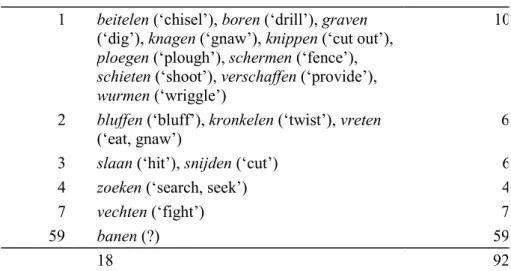
(8) 34. ARIE VERHAGEN. reasons to consider this pattern the Dutch analog of the way construction. However, there are also differences. I will first simply describe the differences; possible theoretical consequences will be discussed in the final section, after we have analyzed more members of the same family. To begin with, there is a noticeable difference in the syntax. Whereas the relationship between the subject and the created way is marked by a possessive determiner in English, it is marked with a weak reflexive (zich) in indirect object position in Dutch. The representation of the Dutch construction may thus be given as in (12): (12). Sem: creator, create-move, for-self, created-way, path | | means | | | Syn: [ SUBJi [V [ REFLi [ een weg ] OBL ] ]. In itself, it may not be immediately clear whether this difference is theoretically significant or not; I will get back to this question in the final section. But in any case, the fact that the ‘choice’ of a reflexive marking does not seem derivable from more general properties of Dutch (since a possessive marking would have been perfectly possible), is yet another argument for the hypothesis that the construction is itself stored in long term memory, as a conventional unit. Another difference concerns the verbs used. Table 1 lists the verbs occurring in the Dutch construction.5. 5. The absolute numbers are different from those in Table 1 in Verhagen (2002: 412). This is due to the possibility of using a more advanced search algorithm for this study, allowing the inclusion of variables between the elements ‘zich’ and ‘een weg’ in the search expression. On the whole, however, the proportions in the frequencies are the same as in the previous study, so the conclusions on this point are not changed..
(9) THE DUTCH WAY Tokens/verb Verbs. 35 Total number. 1. beitelen (‘chisel’), boren (‘drill’), graven (‘dig’), knagen (‘gnaw’), knippen (‘cut out’), ploegen (‘plough’), schermen (‘fence’), schieten (‘shoot’), verschaffen (‘provide’), wurmen (‘wriggle’) 2 bluffen (‘bluff’), kronkelen (‘twist’), vreten (‘eat, gnaw’) 3 slaan (‘hit’), snijden (‘cut’) zoeken (‘search, seek’) 4 7 vechten (‘fight’) 59 banen (?) 18 Table 1. Verbs used in the Dutch (reflexive) ‘way’ construction (Volkskrant 1995). 10. 6 6 4 7 59 92. The pattern is obvious. In a considerable number of instances, a verb is used that contributes its lexical meaning to the interpretation of the sentence, as the means by which the path is created/traveled. But in the majority of cases just a single verb occurs, namely banen. Some examples are: (13). (14). De spermasliertjes trachten zich een weg naar het The sperm-strings-DIM try REFL a way to the eitje te banen. egg-DIM to ‘banen’ ‘The strings of sperm try to make their way to the egg.’ Twee figuren in zwart pak banen zich met grote zwemTwo figures in black suit ‘banen REFL with big flipvliezen aan hun voeten een weg door de menigte. pers on their feet a way through the crowd ‘Two individuals in black suits make their way through the crowd with large flippers on their feet.’. It is immediately clear that this is the default verb for the construction, but it is less obvious what its role in the language is, i.e. what it means. When asked, speakers of Dutch tend to answer: ‘to make, namely a way’..
(10) 36. ARIE VERHAGEN. The real point is that it only occurs in this kind of construction;6 it actually does not have a meaning independently of a combination with weg, so if one tries to describe its meaning, then one essentially ends up with something very similar to the meaning of the entire construction. The role of this verb is to make it possible to actualize the meaning of the construction without adding information about the specific manner in which the path is created or traveled, as is the case when another verb than banen is used. English also has a verb with this function in the way construction, viz. to make. So whereas English has, so to speak, opted for the strategy of using a verb with such a general meaning that it exactly fits the role of the verb slot in the construction (cf. (9)), Dutch employs a verb that is highly specific for the construction for the same purpose. This observation allows us to specify rather precisely to what extent the two languages differ at this point: they share the feature that the constructions have a prototype, the use of which simply realizes the construction without adding anything to its meaning, but they differ in the choice of a general vs. a specific verb in this prototype. An aspect in which English and Dutch appear not to differ at all is the character of the oblique path phrases, specified in the representations (9) and (12). Table 2 contains the path-markers, i.e. prepositions and adverbs, found in the corpus.7. 6. It has not always been like this. See Kramer (2002) and Verhagen (2002) for an overview of the origin and the development of the Dutch way construction. 7 The remark in note 5 also applies to Table 2. There are a few sentences with two (partial) path-phrases (e.g. ‘over and preferably through X’), whence the total number of cases in Table 2 is higher than in Table 1. An example is: (i). Het hete gas had zich een weg weten te banen door The hot gas had REFL a way know to ‘banen’ through de laag kit naar de binnenste van de twee O-ringen. the layer cement to the innermost of the two O-rings ‘The hot gas had managed to make its way through the cement layer to the innermost one of the two O-rings.’.
(11) THE DUTCH WAY Tokens/marker Preposition or adverb 1 3 5 26 55. 37 Total number. Absent in (‘in(to)’), ondergronds, (‘underground’), op (‘on’), tot (‘till’), uit (‘out of’), via langs (2 ‘past’; 1 ‘along’), over (‘over’), terug (‘back’)* tussen (‘(in) between’) naar (‘to’) door (‘through’) 12. 4 6 9 5 26 55 105. *all three cooccurring with the verb vechten (‘to fight’). Table 2. OBL-markers used in the Dutch ‘way’ construction (Volkskrant 1995). The preposition door (‘through’), occurs in about 50% of the cases. While adjunct phrases are in general considered optional, oblique phrases are very frequent here, so they appear to be an integral part of the conventional schema. In fact, a close look at the four instances where a path phrase is missing confirms this; two cases contain phrases marked with in, which, though they do not themselves denote a path, refer to an area containing obstacles to be avoided or removed. In the remaining two, the nature of the path can straightforwardly be inferred from the immediate context; consider (15), for example. (15). Ik zet een hek om mijn veldje. Maar dat konijn I put a fence around my field-DIM. But that rabbit graaft zich een weg en eet door. digs REFL a way and eats through ‘I put a fence around my little field. But this rabbit digs its way and continues to eat.’. The first sentence makes it absolutely clear what the path is that the rabbit creates and travels: from the outside into the little field, the crops of which the speaker is desperately trying to protect. All in all, in view of the use of verbs as well as of path markers in the corpus, there is ample reason to assume that speakers of Dutch have.
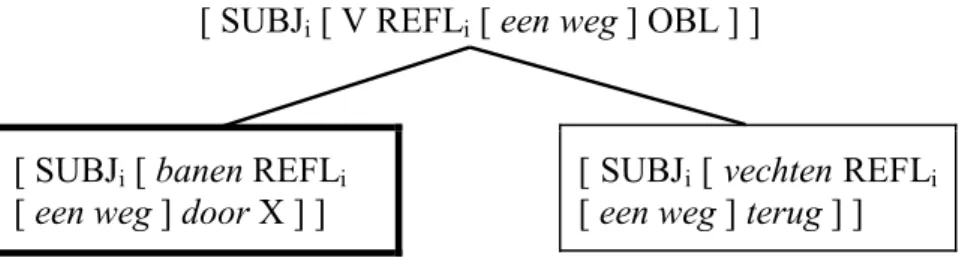
(12) 38. ARIE VERHAGEN. stored in their memory both the highly specific schema zich een weg banen door X (with both the verb and the path-marker lexically specified), as well as the more general, superordinate schema (zich een weg +V + OBL) that we have been considering so far (cf. (12)); the specific schema is, as already suggested above, the prototype of the general one. Other specific schema’s might also be stored independently, albeit with less degree of entrenchment as the prototype; in view of the correlation between the adverb terug (‘back’) and the verb vechten (‘to fight’), the combination zich een weg terug vechten seems a possible candidate. Assuming this to be the case, the relations between the patterns can be represented as in the partial taxonomic network below. [ SUBJi [ V REFLi [ een weg ] OBL ] ]. [ SUBJi [ banen REFLi [ een weg ] door X ] ]. [ SUBJi [ vechten REFLi [ een weg ] terug ] ]. Figure 1. Dutch way construction network (partial) It is an important and intriguing question how this partial network is integrated into the network of constructions in Dutch in general, and how this compares to the situation in English; I will get back to this in the final section. A final point relating to syntax is the following. According to Jackendoff (1990) and Goldberg (1996), as well as others, the verb in the way construction does not always have to be interpreted as indicating the means by which a path was created; instead, it may simply describe some activity accompanying the movement along a path. This usage does not exist at all in Dutch. Thus (16) is OK for (at least some) speakers of English, with no need to impose the reading that the whistling was the instrument for removing obstacles, but (17) in Dutch can only mean that he created a way to the front door by whistling, and hence it is very strange. (16). He whistled his way to the front door..
(13) THE DUTCH WAY (17). ??. 39. zich een weg naar de voordeur. Hij floot He whistled REFL a way to the front-door. This semantic difference seems to be connected rather directly to the difference in syntax. Israel (1996) shows that the modern English construction is a case of a diachronic ‘blending’ of two constructions. The original situation was that on the one hand, there was a construction in which transitive verbs (of creation) occurred with the NP one’s way as direct object (of the type He made/paved his way), and on the other hand a construction in which verbs of movement occurred with the NP one’s way in an adverbial role (of the type He went his way). In both patterns, the sets of verbs that could be used were extended through analogy, until such a degree of overlap between the two classes emerged that many language users interpreted specific cases as instantiations of the same pattern, which allowed for more than one meaning. From the point of view of Dutch, it seems clear that if the parallel linear structure of both patterns (to make one’s way – to go one’s way) has not actually promoted this development, it has in any case not prevented it. There are expressions with weg in Dutch that indicate ‘movement along a path’, but they are structurally more different from the way construction than in English, if only because there is no (pronominal) indirect object: (18) (19). Hij ging zijns weegs. He went his-GEN way-GEN ‘He went his way.’ Zij vervolgde haar weg. She continued her way ‘She continued on her way.’. Thus, the fact that in Dutch the semantic difference is correlated with a clear syntactic difference contributes to understanding why the modern Dutch way construction is not polysemous in the same way as its English counterpart, and lacks the possibility of an ‘accompanying activity’ reading. Some other, arguably more important, instances of possessivemarked expressions with weg will be discussed in section 3.3..
(14) 40. ARIE VERHAGEN. 3.2. Easing and blocking the way In the preceding section, it was established that the Dutch pattern zich een weg +V +OBL, is associated with a specific meaning, which is highly, though not totally, comparable to the meaning of the English way construction, as was in fact suggested by the similarity between the representations (12) and (9). The fact that a detailed analysis shows that the similarity is neither formally nor conceptually perfect, is yet another indication of the conventional, symbolic nature of constructions. Having established that the specific pattern with a reflexive ‘beneficiary’ (zich) and indefinite ‘direct object’ (een weg) has this particular meaning, we can now proceed to ask to what extent the more or less different patterns mentioned in section 2 also have this meaning. The first candidate that should be considered is the one in which the ‘beneficiary’ is not a bare reflexive pronoun, but a nominal marked with the preposition voor, i.e. 8 sentences of the following type: (20) (21). Sex baande voor hem ook de weg naar de roem. Sex ‘banen’-PAST-SG for him also the way to the fame ‘Sex also paved the way to fame for him.’ Dit koor baande de weg voor kleinere ensembles. This choir ‘banen’-PAST-SG the way for smaller ensembles ‘This choir paved the way for smaller ensembles.’. As the examples show, the verb banen also occurs in this pattern, which may reinforce the idea that it would be entirely possible that the only difference between such cases and the ones discussed in section 3.1 is the. 8. The material discussed in this section was collected by means of putting together the results from a number of specific searches through the corpus. While the presence of a reflexive pronoun allowed a relatively specific search for examples of the reflexive pattern, a general search pattern for the non-reflexive pattern could only contain the phrases ‘de weg’ and ‘een weg’, which resulted in too many irrelevant hits. Instead, a number of specific searches were performed, combining these phrases with (instances of) banen, and (in view of the results from the first search) also with one of the prepositions voor and naar. Although this provides a sufficient basis for the claims to be made in the remainder of this paper, this is the reason that I cannot give tables of all verbs and all oblique markings used with the non-reflexive pattern..
(15) THE DUTCH WAY. 41. non-reflexivity of the relation between agent and ‘beneficiary’; in that case, they should actually both be assigned to the same slightly more abstract pattern: +NP [DET weg] +V, hypothetically meaning: ‘to create a/the path for NP and have NP travel it’. However, a first indication that such a reduction to one abstract pattern is unwarranted, is the fact that the ‘direct object’ in the cases of section 3.1 is always indefinite, while it is definite in (typical) examples such as (20) and (21). In fact, no combinations of zich and definite de weg were found in the present corpus, whereas in nearly all non-reflexive clauses weg is marked as indefinite,9 and many speakers actually find indefiniteness obligatory in such cases; this is a problem for the idea of an abstract pattern, as this would in principle predict free variation in this area.10 But even more telling evidence is provided by semantic considerations. These may be demonstrated on the basis of the examples given above and the following ones: (22) (23). 9. Daarmee opent hij de weg naar machtsmisbruik. Therewith opens he the way to power-abuse ‘With that he is opening the way to abuse of power.’ Zijn concessie maakte de weg vrij voor ondertekening van His concession made the way free for signing of het akkoord. the agreement ‘His concession cleared the way for the agreement to be signed.’. Despite the fact that these do occur occasionally: Kramer (2002) found a few examples in her 20th century material. Further research will have to show whether the dependency between definiteness of weg and non-reflexive beneficiaries is really weaker than that between indefiniteness and reflexive ones. 10 This is actually another demonstration of the insight that ‘alternations’ suggested by paraphrase relations (in this case: that zich een weg banen, ‘to make one’s way’, can be paraphrased as een weg voor zichzelf banen, ‘to make a way for oneself’) are in fact very weak generalizations (cf. Goldberg 2002). See also p. 54 in section 4 below..
(16) 42 (24). (25) (26). ARIE VERHAGEN Deze uitspraak effent de weg voor de scheiding van de This decision levels the way for the separation of the carrières van rechters en aanklagers. careers of judges and prosecutors ‘This decision paves the way for the separation of the careers of judges and prosecutors.’ Hij liet de weg voor onderhandelingen open. He let the way for negotiations open ‘He left the way for negotiations open.’ Ze blokkeerden de weg tot de kassa’s voor de rest They blocked the way to the cash-registers for the rest van de menigte. of the crowd ‘They blocked the way to the cash-registers for the rest of the crowd.’. For one thing, it seems doubtful whether the role of ‘beneficiary’ is at all obligatory in this pattern. Recall that I argued above, in connection with examples such as (15), that in reflexive cases, this role was an obligatory part of the interpretation even when it was not expressed. In the nonreflexive pattern, there is also always an oblique phrase, but it is not necessarily marked with the preposition voor (as would have to be the case if the required role was that of beneficiary): there are quite a number of examples in which the only prepositional phrase present is marked with naar (‘to’, ‘towards’) as in (22), i.e. a directional one indicating a part of the relevant path. The ‘beneficiary’ phrases ‘for him’ and ‘for the rest of the crowd’ may also be left out from (20) and (26), respectively, without the sentences becoming unacceptable or changing their general meaning. Moreover, in several of the cases in which the preposition voor is used, the role of the participant involved is arguably not at all that of a beneficiary, but a goal or endpoint, e.g. the signing of the agreement in (23) and the separation of careers in (24); in fact, one might argue that even the roles of the smaller ensembles in (21) and the negotiations in (25) are better characterized as goal than as beneficiary. Thus we have to conclude that what is required in these cases is the presence of some element with a goal-like role, but it does not have to be specifically a beneficiary (notice that the concept ‘goal’ seems to be part of that of beneficiary). Language users may occasionally still want to mark both a specific beneficiary and a specific goal (as in (20) and (26)), but the point.
(17) THE DUTCH WAY. 43. is that the role of beneficiary is not obligatory in the non-reflexive pattern, while it is in the reflexive one. The second, and most revealing semantic observation concerns the verbs and their semantic relationship with the construction as a whole. The verbs occurring in the reflexive pattern may be both transitive and intransitive, and when used in this context, they indicate activities that are instrumental in creating and/or travelling the path involved. But in the present cases, the set of verbs is much more restricted, with a much more specific semantic profile. They are transitive verbs (or verbal compounds) meaning ‘to make open/free’, ‘to leave open/free’ or ‘to block’, notions connected directly to the concept of a barrier (viz. (not) creating or (not) removing it). What we have here is exhaustively characterized as the dimensions of the conceptual domain of Force Dynamics (Talmy 1988), which also plays a crucial role in the semantics of causative constructions (Verhagen & Kemmer 1997; Loewenthal, this volume). The different paradigms of verbs used in the two patterns suggest an important semantic difference. The reflexive one implies that a barrier is removed and the relevant path is actually traveled, but the present one only ‘raises the issue’ of a barrier; it may simply express that travelling the path is permitted (because no barrier is created, as in (25)), without the implication that the endpoint is actually reached.11 It may even express that travelling the path is prevented (a barrier is created, as in examples (4) and (26)). Notice that the verbs vrijlaten (‘to leave free’) and blokkeren (‘to block’) cannot be used in the reflexive construction:. 11. Notice that something similar holds for the English phrase to pave the way (contrary to to make one’s way, with possessively marked way). The following example, from the table of contents of Scientific American vol. 285, number 1 (July 2001), provides a nice illustration: (i). Frozen light Halting photons paves the way for quantum computing and tabletop black holes.. The goals of quantum-computing en tabletop black holes are, of course, not yet realized by the halting of photons..
(18) 44. ARIE VERHAGEN ??. Hij liet zich een weg vrij naar een andere baan. He let REFL a way free to an other job [Supposed reading: ‘He left the way to another job free for himself.’] (28) ?? Zo blokkeer je je een weg naar de top. Thus block you you a way to the top [Supposed reading: ‘In that way, you will block a way to the top for yourself.’]. (27). On the other hand, intransitive verbs that indicate activities instrumental in creating and travelling a path – which can characteristically be used in the reflexive construction – precisely cannot be used with the non-reflexive pattern: (29). ??. Hij vocht/blufte (voor haar) de weg naar de troon. He fought/bluffed (for her) the way to the throne. [Supposed reading: ‘He cleared the way to the throne (for her) by fighting/bluffing.’]. The difference between the roles of the verbs in the two patterns also implies a difference in the roles of the subjects: while this is a volitional agent (who has a goal to reach) in the reflexive construction, it is more of a Source-of-Energy in the cases considered here. In fact, the conventional association of the reflexive pattern with the accomplishment of a goal holds not so much at the level of propositional content, but at the speech act level; the idea of reaching the endpoint of a path is not just evoked, but actually asserted. Thus, instances of the Dutch way construction cannot be negated in a straightforward manner: (30). ?? Zij. baanden zich geen weg door de menigte. They ‘banen’-PAST-PLUR REFL no way through the crowd [Supposed reading: ‘They did not make their way through the crowd.’].
(19) THE DUTCH WAY (31). ??. 45. De bussen boorden zich niet een weg naar het hart van de The buses drilled REFL not a way to the heart of the stad. town [Supposed reading: ‘The buses did not drill their way to the heart of town.’]. The only combinations of this construction with negation actually found involve some notion of modality, specifically issues of ability or desire: (32). Je kunt je geen weg schieten naar het hart van een volk. You can you no way shoot to the heart of a people ‘You can’t shoot your way to the heart of a nation.’. But negation is not odd with unmodified instances of the non-reflexive pattern: (25)’. Hij liet de weg voor onderhandelingen niet open. He let the way for negotiations not open ‘He did not leave the way for negotiations open.’. Although they are not very frequent, the following corpus examples show that this possibility is realized for the non-reflexive pattern (unlike negation of the reflexive construction), both for the ‘clearing’ and the ‘blocking’ type of instances: (33). (34). Een promotie verlicht duidelijk niet de weg naar A getting-Ph.D. eases clearly not the way to het grote geld. the big money ‘Having a doctoral degree clearly does not ease the way to big money.’ Hopelijk verspert dit niet de weg van betere Franse films Hopefully bars this not the way of better French movies tot de Nederlandse bioscopen. to the Dutch cinemas ‘Hopefully, this does not bar the way of better French movies to Dutch cinemas.’.
(20) 46. ARIE VERHAGEN. All in all, we have now established both differences of form as well as of conceptual content between the reflexive and non-reflexive patterns, so that the conclusion should clearly be that each of these constitutes an independent symbolic unit, a conventional link of form and function with internal structure, i.e. a construction. We may represent the second construction as in (35): (35). Sem: source, force dynamics, way, goal | | | | Syn: [ SUBJ [V [ de weg ] OBL ] ]. It is obviously related, both formally and conceptually, to the reflexive Dutch way construction discussed in 3.1; (12) is repeated here for convenience: (12). Sem: creator, create-move, for-self, created-way, path | | means | | | [V Syn: [ SUBJi [ REFLi [ een weg ] OBL ] ]. At the same time, it is clear that neither one is an instance of the other, and that they also cannot be reduced to a single common pattern, as they participate in partly distinct relations of (dis)similarity. In particular, the sets of verbs allowed in the V-slots of each pattern are different, except for the special verb banen which is idiosyncratic in being the default verb for precisely these two constructions. I will discuss the theoretical consequences of this situation in the final section. 3.3 Finding one’s way The independence of the reflexive and non-reflexive way constructions, justified on empirical grounds in the previous sections, explains several of the restrictions and dependencies noted in section 2. One major issue remains, viz. the occurrence of ‘English-like’ possessively marked phrases with weg, as in (1):.
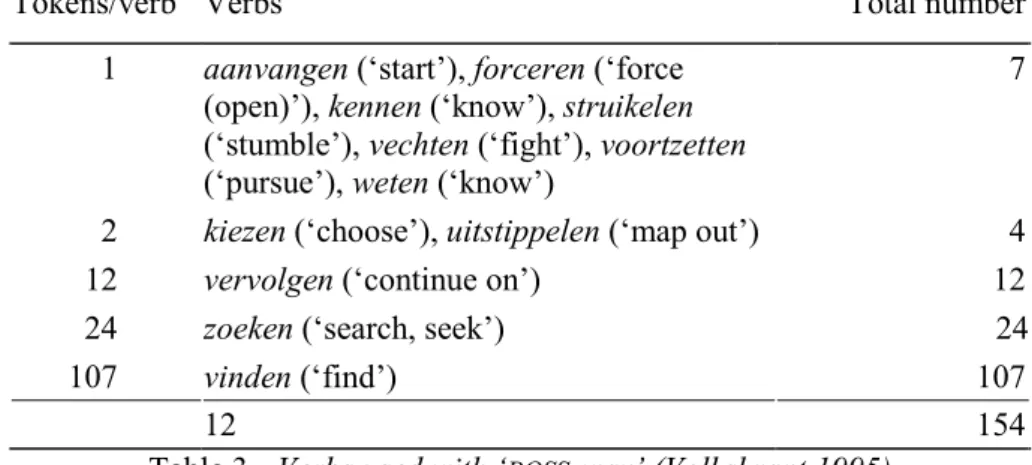
(21) THE DUTCH WAY (1). 47. In het gebouw kunnen bezoekers met computers hun weg In the building can visitors with computers their way zoeken. seek ‘In the building, visitors can try to find their way with the help of computers.’. I will only briefly indicate the main reasons why this is an instance of yet another independent specific, albeit related, pattern. In view of the preceding discussion, it will come as no surprise that the verbs occurring in it and their semantic relation to the pattern as a whole, again constitute the essential clue. Table 3 provides an overview of these verbs. Tokens/verb Verbs 1. 2 12 24 107. Total number. aanvangen (‘start’), forceren (‘force (open)’), kennen (‘know’), struikelen (‘stumble’), vechten (‘fight’), voortzetten (‘pursue’), weten (‘know’) kiezen (‘choose’), uitstippelen (‘map out’) vervolgen (‘continue on’) zoeken (‘search, seek’) vinden (‘find’) 12 Table 3. Verbs used with ‘POSS-way’ (Volkskrant 1995). 7. 4 12 24 107 154. The first thing to be noticed is the absence of banen from this table;12 the prototypical verb here is vinden (‘to find’); its relative frequency in this 12. It cannot be entirely excluded that this is partly due to the corpus used for this study (de Volkskrant). The verb banen did occur rather regularly with possessive-marked weg in older varieties of Dutch, and it still occurs occasionally, as a search (with Google) on the internet for the patterns zijn weg baant/baant zijn weg showed. It is clear, however, that this is at best a small minority pattern: the number of hits for baant zijn weg was about 20, while for vindt zijn weg, zoekt zijn weg and vervolgt zijn weg, it was about 570, 200, and 300, respectively. For comparison: the number of hits for the reflexive baant zich een weg was about 470..
(22) 48. ARIE VERHAGEN. corpus (over 69%) is even higher than that of banen in the reflexive way construction (64%). Two typical examples are (36) and (37). (36) (37). Veel kunst vindt via vlooienmarkten zijn weg naar de kopers. Much art finds via flea-markets his way to the buyers ‘A lot of art finds its way to the buyers via flea markets.’ In dit spanningsveld heb ik getracht mijn weg te vinden. In this field-of-tension have I attempted my way to find ‘In this field of tension, I have tried to find my way.’. In view of the very close semantic relationship between vinden (‘to find’) and zoeken (‘to search, to seek’), one might actually want to include the latter in the prototype. It is worth noting that the ratio of vechten (‘to fight’, the next most frequent verb in the reflexive way construction) to banen is 1 : 8.5, whereas the ratio of zoeken to vinden in the possessive pattern is 1 : 4.5. The two most frequent (semantically related) verbs in the possessive construction account for 85% of all the instances, while the two most frequent (semantically unrelated) verbs in the reflexive construction account for 71%. Clearly, the semantic variation in the verb slots in the possessive pattern is much more restricted than in the reflexive pattern. What appears to be common to the instantiations of this pattern is that there is not really a force creating a path, but some form of motion, ranging from actual movement along the path (in the most typical cases) to the purely mental movement, i.e. scanning, involved in ‘knowing’ and ‘mapping out’ one’s way; in some cases, especially with the verb zoeken, they may be involved simultaneously, as in (1) and in the following example: (38). Nina en Vladimir zoeken hun weg tussen de ruïnes van Nina and Vladimir seek their way among the ruins of hun stad. their city ‘Nina and Vladimir try to find their way among the ruins of their city.’. In view of the fact that the path is not conceptualized as being created, the use of the possessive marking, and hence definiteness of the wegphrase, can be seen as motivated: the path exists independently of the present event. In fact, in many cases the path referred to may be inter-.
(23) THE DUTCH WAY. 49. preted as in some sense ‘inherent’ to the mover, as specifying a ‘teleological’ quality of the mover (the notion of consumer is part of the knowledge of the purpose of goods, etc.). In two cases in this material, a verb is used whose lexical meaning imposes the reading of an activity of attempting to reach a goal, suggesting the creation of a path (forceren, ‘to force (open)’, vechten, ‘to fight’). This number is so low that they could be taken as errors but also as analogical extensions (removing obstacles not being incompatible with movement); in any case, this is clearly not a well-entrenched subpattern. The possessive pattern also requires an oblique phrase, but it does not have to specify (a part of) the path traveled or scanned. Sometimes it does (e.g. (36)), but it may also indicate the region within the boundaries of which the path is located. All in all, I propose the following representation for this third type of way construction in Dutch: (39). Sem: Syn:. mover/ scanner, | [ SUBJi. (mental) way, location motion, | | | [V OBL ]] [ POSSi weg ]. The only verb from Table 3 (besides the two single cases of forceren and vechten mentioned above) that seems fully compatible with both this construction and the reflexive way construction (12), is zoeken: Table 1 shows that it occurs 4 times in that pattern; an example is (2), repeated below. (2). Op de klanken van een tango zoeken eenlingen zich een REFL a On the sounds of a tango seek loners weg door de nacht. way through the night ‘At the sounds of a tango, loners try to find their [themselves a] way through the night.’. The fact that it is this verb and not the prototype vinden which easily occurs in both patterns, should not come as a surprise: unlike vinden, the lexical meaning of zoeken implies effort on the part of the subject referent. It thus fits the semantics of the reflexive way construction rather.
(24) 50. ARIE VERHAGEN. well, and the creation-reading can be imposed on the verb by the construction in many other cases, too. So we have now provided an analysis of the last of the remaining problems from section 2.. 4. Conclusion: the organization of a grammar At a number of points in the preceding sections, I explicitly emphasized that the three constructions discussed are truly independent units that cannot be reduced to each other or to completely general rules of grammar, as they each exhibit specific, irreducible properties. At the same time, it was noted that they do share some properties. Thus the question how such constructions are related to each other in the overall ‘fabric’ of the grammar becomes an urgent one. Trying to derive them by means of general rules is simply out of the question in view of the facts, but just listing the constructions as ‘atoms’ of the grammar does not do justice to the facts either, and would not capture the generalizations that are clearly there. So we will have to find some alternative way of conceiving of relations between grammatical structures. Let us first consider the question how badly needed such an alternative conception actually is. I argued in section 3.1 that the very specific pattern zich een weg banen door X (with both the verb and the path-marker lexically specified), as well as the somewhat more general superordinate schema zich een weg +V + OBL had to be conceived of as stored in long term memory of speakers of Dutch, with the specific schema as the prototype of the general one (cf. Figure 1). At this level of specificity, the grammars of Dutch and of English appear to be organized similarly: in English, the pattern make one’s way through X is the prototype of V one’s way OBL.13 But already at a slightly more abstract level important differences emerge. The English way construction has been characterized as a specific case of resultative constructions (of the type He cried his eyes red, so-called fake-object resultatives; cf. Goldberg 1996:50, and references cited there, for discussion). In any case, it exhibits a transitive pattern, with two argument positions (subject and object). But the Dutch. 13. One difference being that make in the English pattern is also connected to the general activity-verb make, inheriting any relevant properties..
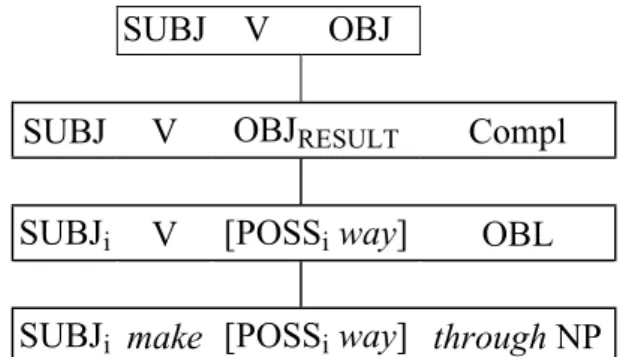
(25) THE DUTCH WAY. 51. way construction, with its characteristic reflexive element zich, exhibits a ditransitive pattern, with three arguments: subject, direct object and indirect object; it actually looks like a kind of benefactive construction. So for Dutch, the partial taxonomic network consisting of the prototype zich een weg banen door X and its superordinate zich een weg +V + OBL must in turn be considered subordinate to a more general ditransitive pattern, as indicated in Figure 2. SUBJ SUBJ. V OBJBENEF. SUBJi. V. V. OBJIND. OBJ. OBJ. (OBL). SUBJ VTNSFR OBJDAT OBJ. REFLi [een weg]. OBL. SUBJi banen REFLi [een weg] door NP Figure 2. The Dutch way construction as a ditransitive construction. In English, the more general pattern to which its network of way constructions should be subordinated is the transitive one, as it is a kind of resultative (cf. Figure 3). SUBJ. V. OBJ. SUBJ. V. OBJRESULT. Compl. SUBJi. V. [POSSi way]. OBL. SUBJi make [POSSi way] through NP Figure 3. The English way construction as a transitive construction. What this suggests is that the position of these constructions in the ‘grammatical space’ of Dutch and English is quite different for each language. However, it should be noticed that the benefactive pattern near.
(26) 52. ARIE VERHAGEN. the top in Figure 2 is not at all a productive pattern in Dutch.14 The language does have a conventional pattern zich een weg +V, which can be glossed as ‘to V oneself a way’ and which (roughly) means ‘create a path/opportunity for oneself (and use it), by means of V-ing’, but not the more general pattern iemand +Y +V, to be glossed as ‘to V someone Y’ and meaning ‘to make Y for someone by V-ing’. Curiously enough, English does have a productive pattern of this sort; while (40) is unacceptable in Dutch (this can only be expressed as in (41)), the English parallel (42) is perfectly acceptable. (40) (41) (42). ??. Jan maakte haar een boterham. Jan maakte een boterham voor haar. John made a sandwich for her ‘John made her a sandwich.’ John made her a sandwich.. The paradox is that English has a rather productive general benefactive construction, but the way construction is not an instance of it, while Dutch does not have a productive benefactive construction, although its way construction does seem to instantiate it. In any case, the consequence is that we have to exclude the way construction from the network of Dutch ditransitive constructions, and replace Figure 2 by Figure 4: the network of more and less specific way constructions actually constitutes a kind of island in the whole of the grammar. SUBJ SUBJi. V. VTRF. OBJDAT OBJ. REFLi [een weg] OBL. SUBJi banen REFLi [een weg]. door NP. Figure 4. The Dutch way construction island. 14. This applies to the standard language. Ditransitive patterns (with more or less specific semantics) exhibit different degrees of productivity in different regions (cf. van Bree 1981)..
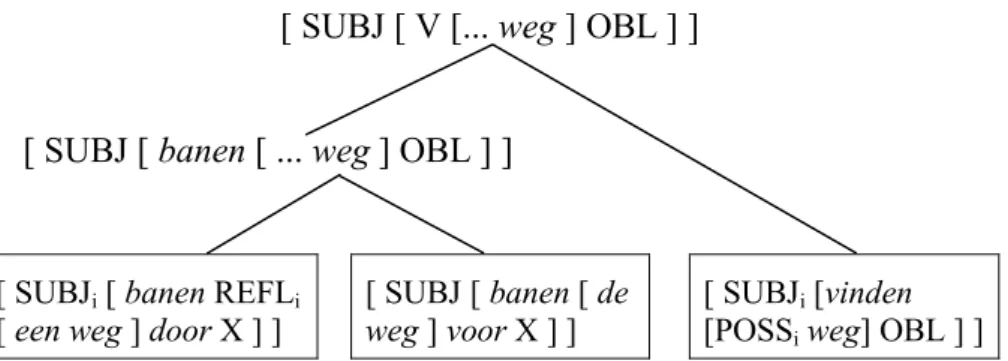
(27) THE DUTCH WAY. 53. However, this once again produces the problem that we can no longer express the similarities that do exist between way constructions and ditransitive clauses. So the issue of an alternative way of conceiving of such relations is really quite urgent. What I want to suggest, at least as a tentative proposal, is to mark similarities between parts of constructions in a manner that can in no way be confused with the categorizing relationships between entire constructions in a taxonomic network. We have already seen in section 3.2 that it would be wrong to posit a template generalizing over the first and second type of way construction in Dutch. The point is that while the top node in the network of Figure 1 is itself a category that can serve as a template licensing new utterances, the top nodes in the hypothetical network of Figure 5 does not play such a role in the language (as shown in sections 3.2 and 3.3), and thus this kind of representation is at least misleading. Instead, I propose to indicate similarity just by means of links between the elements of the pattern participating in the relationship, as in Figure 6 – which has the additional advantage of making the internal structure of the constructions more explicit. [ SUBJ [ V [... weg ] OBL ] ] [ SUBJ [ banen [ ... weg ] OBL ] ]. [ SUBJi [ banen REFLi [ een weg ] door X ] ]. [ SUBJ [ banen [ de weg ] voor X ] ]. [ SUBJi [vinden [POSSi weg] OBL ] ]. Figure 5. Similarity as a categorizing relationship. Xi banen REFLi een weg door X. X. banen de weg. voor Y. Xi vinden POSSi. Figure 6. Similarity as a link between parts. weg OBL.
(28) 54. ARIE VERHAGEN. This idea may be considered reminiscent of the ‘lexical redundancy rules’ in Jackendoff (1975), which were also meant to capture (morphological) relationships between words without deriving one kind of word from another (by transformational processes). However, at least one very important difference is that at the time, this proposal was believed to help keeping syntax separate from lexicon and morphology, thus ‘rescuing’ a modular view of linguistic knowledge, while we now see that this type of phenomena occurs in syntax as much as anywhere else (as noted “in passing” by Langacker 2000:20). The considerations leading to this idea can also be seen as another instance of (a generalized form of) the argument put forward by Goldberg (2002). Goldberg argues against ‘overplaying’ generalizations over distinct surface forms that are to some extent paraphrases of each other (‘alternants’ such as give X to Y/give Y X, or load X with Y/load Y onto X), and especially against the idea (of which transformations are only one extreme implementation) that such a similarity requires a structural account in the grammar, an analysis of partly similar sets of clauses as instantiations of a single more general pattern. Goldberg’s point is that such generalizations are actually not at all as broad as they may seem at first sight, and that they moreover prevent the formulation of other generalizations that in fact hold more widely. As Goldberg recognizes, abolishing a structural account of course does not annul “the question of how the overlap in meaning between alternants is accounted for”, but the answer that does justice to the facts without overgeneralizing refers to just the shared elements themselves: “The shared meaning can be attributed directly to the shared verb involved” (Goldberg 2002:343). Finally, this proposal is also very much in the spirit of the one made for morphology by Bybee (1995, among others), who furthermore links her ideas intimately to usage, in particular frequency (see also Bybee & Hopper 2001): the relations between similar parts of linguistic elements and their strength are, at least to a considerable extent, determined by the number of stored elements, and ultimately usage events, participating in them.15. 15. It cannot be excluded a priori that the technique used by Langacker (1988, 2000, among others) of graphically marking different degrees of entrenchment of categories and degrees of strength of relations in a purely taxonomic network.
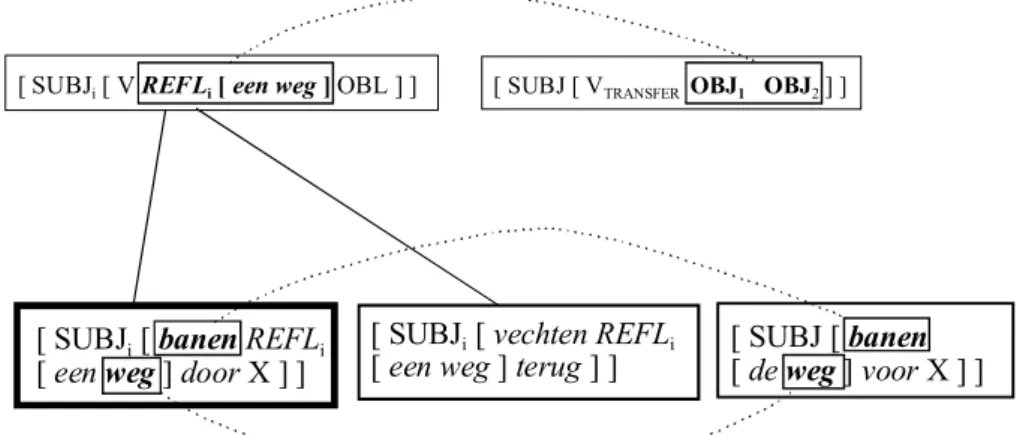
(29) THE DUTCH WAY. 55. Exactly the same mechanism can be used, of course, for representing similarities between structural features of distinct constructions. In Verhagen (2002:422), I gave the representation in Figure 7 for a combination of taxonomic and similarity relations, both lexical and structural, for a subset of the constructions discussed here.. [ SUBJi [ V REFLi [ een weg ] OBL ] ]. [ SUBJi [ banen REFLi [ een weg ] door X ] ]. [ SUBJ [ V TRANSFER OBJ1 OBJ2 ] ]. [ SUBJi [ vechten REFLi [ een weg ] terug ] ]. [ SUBJ [ banen [ de weg ] voor X ] ]. Figure 7. Network with some categorizing and similarity links Even though it does not by far represent all relationships that the elements of the constructions participate in (representing more relations very quickly leads to obscurity of the two-dimensional picture), it suffices to show how constructions may definitely be islands in the grammar of the language, and nevertheless an integral part of the ‘fabric’ of grammar (the similarities providing bridges, so to speak). Even if similarities do not have the status of a rule telling the speaker how to build will ultimately be able to do the same work, so that the distinction between a productive template and a bundle of links between similar elements can be reduced to the mechanism of differential entrenchment. Moreover, schema’s that do have the status of productive rules are, of course, also based on similarities between specific cases, and speakers may vary in what for them are only similarities, and what are conventional productive schema’s. Nevertheless I find it useful, at least for the moment, in view of the considerations presented above, to mark the distinction quite explicitly..
(30) 56. ARIE VERHAGEN. structures in the language, they do contribute to the overall coherence of grammar. Similarities between different stored patterns, especially if they are both formal and semantic (i.e. symbolic), increase the strength (entrenchment) of the memory representation of the patterns involved. Thus they provide constraints on the patterns allowed into the grammar: those that look more like others are more easily ‘admitted’ (as they inherit part of the required degree of entrenchment from memory structures that are already available) than those that have less resemblance to other constructions. On the other hand, the inclusion of non-standard constructions is never prohibited in any absolute sense; constructions with properties they share with others are favored, but by exactly the same token idiosyncratic ones ‘only’ require more specific direct support from actual usage. There is no reason to suppose that different cognitive mechanisms have to be involved in the development and maintenance of general and specific parts of a grammar. Different grammatical constructions in a language do not have completely random overall structures, but the variation is definitely larger than what one might expect on a purely rulebased account; in order to do justice to the facts, the latter requires distinctions (e.g. core/periphery, rule/exception) that actually have no other motivation than preserving the centrality of the role of abstract categories and rules in explanatory accounts of grammatical structure. A usage-based approach is very well capable of capturing regularities where this is appropriate; the point is that it is also very well capable, without additional mechanisms, of avoiding them where they are not appropriate – and they often are not. Acknowledgements I am grateful to the Netherlands Institute for Advanced Study (NIAS) for providing me with the opportunity, as a Fellow-in-Residence, to complete the work for this paper. References Barlow, M. & S. Kemmer (eds.) (2000). Usage-Based Models of Language. CSLI Publications, Stanford, CA. Bree, C. van (1981). Hebben-constructies en datiefconstructies binnen het Nederlandse taalgebied: een taalgeografisch onderzoek. PhD Dissertation, Leiden University. Intercontinental Graphics, Hendrik Ido Ambacht..
(31) THE DUTCH WAY. 57. Bybee, J.L. (1995). Regular morphology and the lexicon. Language and Cognitive Processes 10, 425-455. Bybee, J. & P. Hopper (eds.) (2001). Frequency and the emergence of linguistic structure. John Benjamins, Amsterdam and Philadelphia. Goldberg, A.E. (1996). Making one’s way through the data. In M. Shibatani & S.A Thompson (eds.), Grammatical Constructions. Their Form and Meaning, 29-53. Oxford University Press, Oxford. Goldberg, A.E. (2002). Surface generalizations: An alternative to alternations. Cognitive Linguistics 13, 327-356. Israel, M. (1996). The way constructions grow. In A.E. Goldberg (ed.), Conceptual Structure, Discourse and Language, 217-230. CSLI Publications, Stanford, CA. Jackendoff, R. (1975). Morphological and semantic regularities in the lexicon. Language 51, 639-671. Jackendoff, R. (1990). Semantic Structures. MIT Press, Cambridge, MA. Kramer, A. (2002). De geschiedenis van de Nederlandse weg-constructie. Unpublished MA-thesis, Dept. of Dutch, University of Leiden. Langacker, R.W. (1988). A usage-based model. In B. Rudzka-Ostyn (ed.), Topics in Cognitive Linguistics, 127-161. John Benjamins, Amsterdam and Philadelphia. Langacker, R.W. (2000). A dynamic usage-based model. In M. Barlow & S. Kemmer (eds.), Usage-Based Models of Language, 1-63. CSLI Publications, Stanford, CA. Loewenthal, J. (this volume). Meaning and use of causeeless causative constructions with laten in Dutch. This volume, 97-129. Talmy, L. (1988). Force dynamics in language and cognition. Cognitive Science 12, 49100. Verhagen, A. (2002). From parts to wholes and back again. Cognitive Linguistics 13, 403-439. Verhagen, A. & S. Kemmer (1997). Interaction and causation: Causative constructions in modern standard Dutch. Journal of Pragmatics 27, 61-82..
(32)
Figure
+3
Related documents
Furthermore, while symbolic execution systems often avoid reasoning precisely about symbolic memory accesses (e.g., access- ing a symbolic offset in an array), C OMMUTER ’s test
All stationary perfect equilibria of the intertemporal game approach (as slight stochastic perturbations as in Nash (1953) tend to zero) the same division of surplus as the static
Online community: A group of people using social media tools and sites on the Internet OpenID: Is a single sign-on system that allows Internet users to log on to many different.
As with other rapidly reconfigurable devices, optically reconfigurable gate arrays (ORGAs) have been developed, which combine a holographic memory and an optically programmable
Proprietary Schools are referred to as those classified nonpublic, which sell or offer for sale mostly post- secondary instruction which leads to an occupation..
All of the participants were faculty members, currently working in a higher education setting, teaching adapted physical activity / education courses and, finally, were
Quality: We measure quality (Q in our formal model) by observing the average number of citations received by a scientist for all the papers he or she published in a given
Inclusion of J Elgin Family Trust - Accepted husband's evidence he played little role in the trust, and as such this was excluded as property of the husband and an order made
