Diagnosis of Autism Spectrum Disorders Using Temporally
Distinct Resting-State Functional Connectivity Networks
Chong-Yaw Wee,
1,2Pew-Thian Yap
1& Dinggang Shen
1,31 Image Display, Enhancement, and Analysis (IDEA) Laboratory, Biomedical Research Imaging Center (BRIC) and Department of Radiology, University of North Carolina at Chapel Hill, Chapel Hill, North Carolina, USA.
2 Department of Biomedical Engineering, Faculty of Engineering, National University of Singapore, Singapore 3 Department of Brain and Cognitive Engineering, Korea University, Seoul, Korea
Keywords
Brain Activation Patterns; Resting-State Functional Connectivity; Sparse
Representation; Spatiotemporal Dynamics; Temporal Decomposition.
Correspondence
D. Shen, PhD., Image Display, Enhancement, and Analysis (IDEA) Laboratory, Biomedical Research Imaging Center (BRIC) and Department of Radiology, University of North Carolina at Chapel Hill, Bioinformatics Building 3rd Floor, CB #7513, 130 Mason Farm Road, Chapel Hill, NC 27599-7513, USA.
Tel.: +1 919-843-3535; Fax: +1 919-843-2641; E-mail: [email protected]
Received 21 March 2015; revision 29 October 2015; accepted 25 November 2015
doi: 10.1111/cns.12499
SUMMARY
Introduction:Resting-state functional magnetic resonance imaging (R-fMRI) is dynamic in nature as neural activities constantly change over the time and are dominated by repeat-ing brief activations and deactivations involvrepeat-ing many brain regions. Each region partici-pates in multiple brain functions and is part of various functionally distinct but spatially overlapping networks. Functional connectivity computed as correlations over the entire time series always overlooks interregion interactions that often occur repeatedly and dynamically in time, limiting its application to disease diagnosis.Aims:We develop a novel framework that uses short-time activation patterns of brain connectivity to better detect subtle disease-induced disruptions of brain connectivity. A clustering algorithm is first used to temporally decompose R-fMRI time series into distinct clusters with similar spatial distri-bution of neural activity based on the assumption that functionally distinct networks should be largely temporally distinct as brain states do not simultaneously coexist in general. A Pearson correlation-based functional connectivity network is then constructed for each cluster to allow for better exploration of spatiotemporal dynamics of individual neural activ-ity. To reduce significant intersubject variability and to remove possible spurious connec-tions, we use a group-constrained sparse regression model to construct a backbone sparse network for each cluster and use it to weight the corresponding Pearson correlation net-work. Results: The proposed method outperforms the conventional static, temporally dependent fully connected correlation-based networks by at least 7% on a publicly avail-able autism dataset. We were avail-able to reproduce similar results using data from other centers.
Conclusions:By combining the advantages of temporal independence and group-con-strained sparse regression, our method improves autism diagnosis.
Introduction
Autism spectrum disorders (ASD) is the fastest-growing neurode-velopmental disorder of largely unknown etiology, characterized by social communicative impairments, restricted interests, and repetitive stereotyped behaviors [1–3]. In the latest report released by Centers for Disease Control and Prevention (CDC) in 2014, an estimate of 1 in 68 American children was affected by some forms of ASD, reflecting a nearly 30% rate increase within the last 2 years [4]. Children with ASD usually require continual service and support even when they grow older. Accurate diagnosis allows early intervention for improving the development of a child with ASD and for decreasing the reliance on support services later in childhood [5,6].
Current diagnosis of ASD is solely behavioral-based and relies entirely on the history, symptoms, and signs of the disorder [2,7,8]. Moreover, retrospective accounts of past symptoms rely heavily on an informant being both reliable and available [3], and
also the expertise and experience of physicians and psychologist. This approach to diagnosis is subjective and vulnerable to environ-mental factors. Combining biomedical information with behav-ioral measurements will provide additional objectivity for more efficient ASD diagnosis [9,10]. Evidence from neuroimaging and postmortem studies suggests that ASD is associated with neu-roanatomical abnormalities [1,9,12–14] and functional disrup-tions [6,15–17] in a variety of brain regions. Inspired by these findings, we propose in this article a novel neuroimaging-based framework for ASD diagnosis using machine learning techniques.
Functional MRI (fMRI) holds great promises for exploring the
data [6,15,23]. Despite the relatively high accuracy, the existing resting-state fMRI (R-fMRI)-based ASD diagnosis frameworks have several limitations. First, correlation-based methods, a com-mon approach to functional connectivity analysis, produce a fully connected network structure that is difficult to interpret due to the many spurious connections that exist even after thresholding. Second, functional connectivity is computed over the entire R-fMRI time series, based on an assumption of temporally station-arity [16,24–36], ignoring brain activations that occur within the relatively brief periods. Third, most of the existing diagnosis frameworks [6,15,23] were evaluated either using overly opti-mistic approaches (e.g., leave-one-out cross-validation) or using a small sample size, limiting the reliability and generalizability of the outcomes.
In this study, we aim to develop an ASD diagnosis framework using multiple short-time networks to explicitly model fluctua-tions of large-scale functional connectivity derived from R-fMRI data. The proposed framework is based on two assumptions on resting-state functional connectivity: (1) functionally distinct net-works should be largely temporally distinct as brain states do not simultaneously coexist in general, and (2) brain networks are intrinsically sparse, that is, a brain region is functionally connected to a small number of other regions.
A common approach to determining functional connectivity between a pair of regions is to use correlation-based methods [37], for example, Pearson correlation (PC). Conventionally, functional connectivity is computed as correlations of the entire R-fMRI ser-ies, ignoring co-activations that may occur within the relatively brief periods. Recent research has shown that the constituent regions of a network may exhibit similar but brief traces of spatial coherence at different times [38–40]. To capture this temporally dynamic spatial coherence, we employ a clustering approach to decompose the R-fMRI time series into several clusters with simi-lar spatial activation patterns at a group level. Clustering time ser-ies on the basis of temporal independence is motivated by the rationale that functionally distinct networks should be largely temporally distinct as brain states, products of brief spontaneous interregion interactions, do not simultaneously coexist in general. Also, a region’s activity pattern may reflect one network’s activity some of the time, and another network’s activity at other time, that is, brain regions playing unique roles within different func-tional networks [39]. Therefore, R-fMRI volumes with similar activity patterns can be considered as under the same brain state.
It is noteworthy that the brief interregion interactions of a brain state may last from seconds to minutes and repeat multiple times over the scanning period [37,40]. Hence, the sequential time points (R-fMRI volumes) of the same brain state are normally changing gradually and similar to each other, in which they tend to be grouped together into the same cluster to represent the interactions among regions of that brain state. As the sequence of the R-fMRI volumes are preserved, the functional connectivity computed based on the sequential time-subseries reflects, to some extent, the interactions of brain regions across time at different brain states. Additionally, as a relatively small number of clusters are used in our framework, the time-subseries would not be too short, thus preserving the temporal information of the functional connectivity within a brain state. It has been reported recently that abnormalities in terms of connectivity patterns have been
observed in some transient brain states but not in others in patients with Schizophrenia [41]. Thus, by investigating changes in these spatial correlations, we can detect disruptions of brain functions that are associated with ASD with a greater granularity.
However, the resulting fully connected PC networks can be dif-ficult to interpret due to many spurious or insignificant connec-tions induced by spontaneous fluctuation of R-fMRI signals and physiological noise. Considering the sparse nature of brain con-nectivity, various sparse regression-based approaches have been proposed to obtain sparse, yet biologically more meaningful, net-work. However, simple sparse approaches such as the least abso-lute shrinkage and selection operator (Lasso) [42] unfortunately introduce unnecessary intersubject variability, often resulting in drastically different network topologies across subjects. To miti-gate this problem, several sparse representation-based approaches based on group Lasso have been proposed [43,44]. In our previous work [44], time series of each region-of-interest (ROI) is regarded as a linear combination of the time series of other ROIs, and a multitask learning approach is employed to ensure identical con-nection topology across subjects, generating a backbone sparse network that is robust to spurious intersubject variability. Our current work described in this article is based on this sparse linear regression model. But one important distinction is that this approach is now applied to short-time functional time-subseries, instead of the whole time series.
Materials and Methods
Participants
The ASD cohort used was selected from the publicly available ABIDE database [45]. Specifically, we consider only R-fMRI data acquired from 45 ASD and 47 socio-demographic-matched typi-cally developing (TD) children with ages ranging from 7 to 15 years old from the New York University (NYU) Langone Medi-cal Center. The demographic information is summarized in Table 1. Diagnosis of ASD subjects was based on the autism crite-ria sets in Diagnostic and Statistical Manual of Mental Disorders, 4th Edition, Text Revision (DSM-IV-TR) [46], the standard classi-fication of mental disorders used by mental health professionals. Psychopathology for differential diagnosis and comorbidity with Axis-I disorders were assessed using: (1) parent interview using the Schedule of Affective Disorders and Schizophrenia for Chil-dren-Present and Lifetime Version (KSADS-PL) for children
Table 1Group means (standard deviation) and cohort demographics
ASD (N=45) TD (N=47) P-value
Gender (M/F) 36/9 36/11 0.2135*
Age (yearSD) 11.12.3 11.02.3 0.7773†
FIQ (meanSD) 106.817.4 113.314.1 0.0510
ADI-R (meanSD) 32.214.3‡ – –
ADOS (meanSD) 13.75.0 – –
ASD, Autism Spectrum Disorders; TD, Typically Developing; FIQ, Full Intelligence Quotient; ADI-R, Autism Diagnostic Interview-Revised; ADOS, Autism Diagnostic Observation Schedule). *TheP-value was obtained by chi-squared test.†The P-value was obtained by two-sample two-tailed
(<17.9 years old); (2) participant interview using the Structured Clinical Interview for DSM-IV-TR Axis-I Disorders, Non-patient Edition (SCID-I/NP), and the Adult ADHD Clinical Diagnostic Scale (ACDS) for adults (>18.0 years old). Exclusion of comorbid ADHD was based on meeting all criteria for ADHD except for crite-rion E in the DSM-IV-TR. Inclusion as a TD was based on the absence of any current Axis-I disorders based on KSADS-PL for each child and his/her parent(s), and based on the SCID-I/NP and ACDS interviews for adults.
Data Acquisition and Preprocessing
All subjects were scanned using a 3T Siemens Allegra scanner. During the R-fMRI scan that lasted for 6 min, most participants were asked to relax with their eyes open and stare at a white fixa-tion cross in the middle of the black background screen projected on a screen. Eye status during the MRI scan was monitored via an eye tracker and is detailed for each participant. The images were acquired using TR/TE=2000/15 ms, flip angle=90°, 33 slices, 180 volumes, and voxel thickness of 4.0 mm. Standard data pre-processing was carried out using the statistical parametric map-ping (SPM8) software, including the removal of the first 10 R-fMRI images, normalization to the MNI space with resolution 39393 mm3, regression of nuisance signals (ventricle, white matter, global signals, and head motion with Friston 24-parameter model [47]), signal de-trending, and band-pass filtering (0.01– 0.08 Hz). The brain was parcellated into 116 ROIs according to the automated anatomical labeling (AAL) atlas [48].
Method Overview
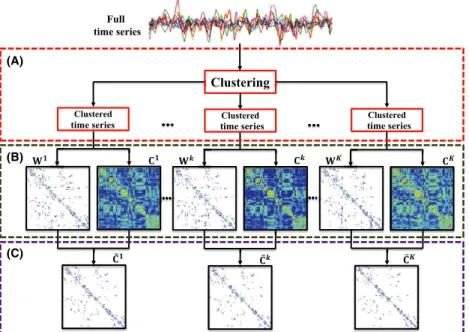
The procedures involved in computing the temporally independent dynamic networks are summarized in Figure 1 and as follows: 1. Cluster, concurrently for all subjects, the time series into
multiple clusters with similar spatial activation patterns.
2. For each subject and for each time-series cluster, construct a PC network that is weighted by the corresponding sparse net-work.
3. For each subject, concatenate the network matrices from all clusters.
Temporal Decomposition of Functional Time
Series
For analysis of short-time interactive between brain regions, we cluster the time series into subseries that exhibit similar spatial patterns (Figure 2). Letf~xd2RMgd¼1;...;D0be the set of R-fMRI time series for a subject (D0= number of time points, andM= number of ROIs). We first concatenate the time series from allNsubjects into a matrix X~¼ ½~x1;. . .;~xM 2RDM whereD = N9D0 and~x
d denotes its d-th row vector. We then use ak-means clustering algorithm to partitionf~xdgd¼1;...;DintoKclusters, each with index
setJk, by minimizing the within-cluster sum of squared errors
arg minXk k¼1
X
d2Jkk~xdlkk
2
2; (1)
wherelkdenotes the center ofk-th cluster.
Connection Strengths Based on Pearson
Correlation and Regression Analysis
After temporal decomposition, the time series from each ROI can be seen as composed of a number of subseries from a number of clusters. For each cluster, we have the data forNsubjects, parcel-lated intoMROIs{xi}i=1,. . .,M, wherexi2RDkwithDkas the length
of the subseries within thek-th cluster. Note thatDkcan vary with subjects and clusters. Thus, the symmetric connectivity matrix
C= {Cij}j=1,. . .,M2RM9M based on Pearson correlation is com-puted as
time series time series time series
(A)
(B)
(C)
Figure 1Method Overview. (A) Temporal decomposition of R-fMRI time series into several clusters based on spatial coherence usingk-means clustering, (B) computation of PC and sparse network matrices for each cluster, and (C) weighting the PC matrix with the corresponding sparse matrix.Cis the PC matrix,Wis the backbone sparse matrix, and ~
Cij¼
covðxi;xjÞ
rirj ; (2)
where cov(.,.) is the regional covariance, andriandrijare the standard deviations ofxiandxj, respectively.
Brain networks are inherently sparse because neurologically a brain region predominantly interacts with only a small number of other regions. However, the PC networks computed using Eq. (2) typically have dense connections, making them difficult to inter-pret especially in the presence of spurious connections. Several studies [43,44,49,50] have suggested that certain constraints can be imposed on the networks to identify true connections from noisy connections. The regional mean time-subseries of thei-th ROI, out ofMROIs,yi, can be regarded as a targeted response vec-tor, and the time-subseries of all other ROIs as predictors:
yi¼Xiwiþi; (3)
wherei is the error vector, yi¼Xi2RDk, Xi¼ ½x1;. . .;xi1;0;
xiþ1;. . .;xM 2RDkMis the data matrix with thei-th column set to zero, andwi=[w
1,. . .,wi-1,0,wi+1,. . .,wM]T2 RM is the weight
coefficient vector that quantifies how related the other ROIs are to thei-th ROI.
Construction of Backbone Sparse Network
To obtain a common backbone network topology across subjects, we impose group sparsity in estimating the connection architecture [44,51]. This is accomplished for thei-th ROI by solving for each cluster a least-squares problem that is penalized byl2,1-norm:
minwið1Þ;...;wiðNÞ
XN n¼1ky
iðnÞ XiðnÞwiðnÞk2 F þkkwið1Þ;. . .;wiðNÞk
2;1; (4)
wheren=1,. . .,Nis the subject index, andk>0 is the sparsity tuning parameter.
This sparse regression model is applied to each ROI separately to produce a sparse coefficient matrix W(n)=[w1(n),. . .,wM(n)]T
2RM9M. The locations of nonzero elements ofWare identical for all subjects, hence giving a backbone network topology. The non-zero elements (i.e.,wij6¼0) indicate that thei-th and thej-th ROIs are functionally connected, whereas the zero elements indicate the absence of connections between ROIs. While sharing a com-mon network topology, subject-specific information is encoded by the actual values of the nonzero elements inW[44]. AsWis not necessarily symmetric, we symmetrize the backbone network as done in our previous work [44].
Sparse Weighted Functional Connectivity
Networks
For each subject and each cluster, a PC network matrixCand a sparse network matrixWare computed. MatrixWdiscards spuri-ous connections and retains prominent connections. For each ROI, each nonzero value in the associated row ofWis an indicator of how well the time series in the ROI can be explained by the time series in each of the other ROIs. Unlike the PC network, con-nections in the sparse network are computed by considering all ROIs concurrently. We useWto weightCso that the degree of coherence of the functional time series as measured by PC can be modulated by the strength of the connections as given by the sparse network:
~
C¼WC; (5)
where○denotes the Hadamard (or element-wise) product oper-ator. Grouping the weighted network matrices for all clusters, we have for each subject a family of connectivity matrices
fC~ðkÞgk¼1;...;K; which can reflect dynamic network change with
greater granularity.
Feature Selection and Classifier Learning
We employ the support vector machine (SVM) implemented using the LIBSVM package [52] as our classifier. The optimal SVM models are learned via a nested cross-validation scheme. Specifi-cally, we randomly partition the subjects in the ASD and TD Figure 2Temporal Decomposition. Temporal
groups into 10 sets with approximately equal size without overlap. One set is first left out as testing set, and the rest are used as the training set to learn a SVM model. Using the training set, sparse weighted functional connectivity networks are constructed. We then compute, for each ROI, the local clustering coefficient [53], a measure of node cliquishness, from the weighted connectivity matrices as a network summary statistic. As AAL atlas with
M=116 ROIs was utilized to parcellate the brain, a feature vector consisting of 116 clustering coefficients, one for each ROI, can be generated from each network matrix. For each subject, the feature vectors from all clusters are concatenated to generate a long fea-ture vector withK9Melements. We then utilize Lasso [42] to select a small subset of features that are discriminative for ASD diagnosis. The optimal tuning parameters for Lasso and SVM are selected via grid search based on the training set. Parameter com-bination that gives the best performance is used to construct the optimal SVM model for performance evaluation using the left out testing set. This procedure is repeated ten times, once for each of the 10 training sets to compute the overall cross-validation classi-fication performance.
Results
Diagnostic Performance
We compared the performance of the proposed method,
short-time sparse regression with Pearson correlation weighting (ST-SR-PC), with the methods based on single- and multi-network methods. The single-network methods are based on the entire time series with connections computed based on (1) Pearson cor-relation (PC), (2) Sparse regression (SR) [44] and (3) Sparse regression with Pearson correlation weighting (SR-PC). The multi-network methods are based on time clusters and (1) short-time PC (ST-PC) and (2) short-short-time sparse regression (ST-SR). For the multiple network-based approach, we evaluated the perfor-mance over K =2,. . .,7. A linear kernel SVM with trade-off parametersC=[5.00,4.25,. . ., 10.00] was used in the compar-ison. The feature selection step was performed by setting the tun-ing parameter of Lassok=[0.05, 0.10,. . .,0.5]. The combination of parameters, that is,K, C, andk, that achieved the best classifica-tion accuracy based on the training sets was applied to the testing set to compute the final cross-validation classification perfor-mance. We evaluated the diagnostic power of the competing methods using several statistical metrics, that is, the predictive
ACCuracy (ACC), SENsitivity (SEN), SPEcificity (SPE), Positive Predictive Value (PPV), and Negative Predictive Value (NPV).
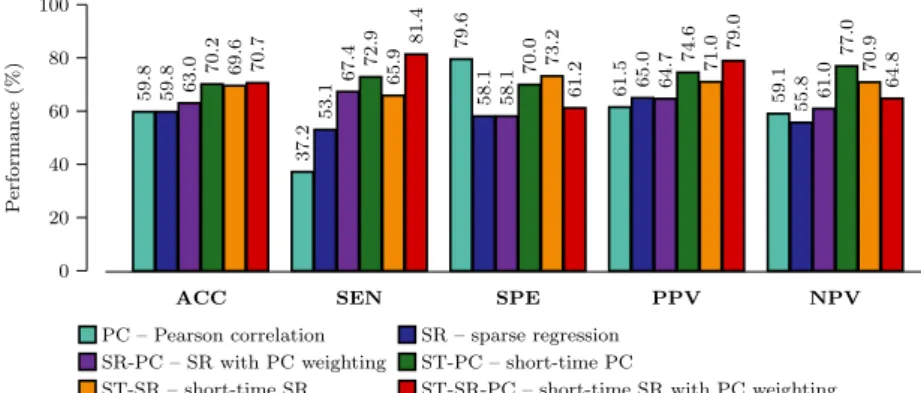
Figure 3 summarizes ASD diagnostic performances of the com-pared methods obtained based on SVM with linear kernel. The proposed method (ST-SR-PC) consistently performs better than the competing methods for most of the evaluation metrics. Specif-ically, the proposed method always achieved the highest ACC, SEN, and PPV values, indicating its superiority over the single-network and multisingle-network approaches.
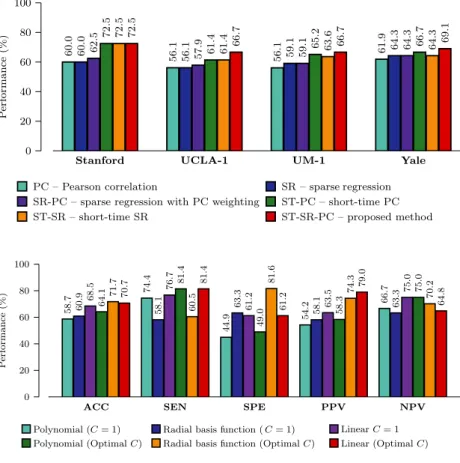
To evaluate the reproducibility and reliability of our proposed framework, we repeated the experiments using data of 4 other centers (namely Stanford, UCLA-1, UM-1, and Yale) from ABIDE that contain a reasonably large number of subjects with ages rang-ing from 7 to 15 years old. The ASD diagnostic performance of the compared methods obtained based on linear SVM was illustrated in Figure 4. Our proposed framework consistently achieved higher diagnostic accuracy than the competing methods for the data from all 4 centers, indicating reproducibility of our frame-work to other similar datasets.
Effects of SVM Kernel Types
We evaluated the performance of the proposed method when dif-ferent SVM kernels (linear, radial basis function (RBF), and poly-nomial) are used. The range for the width parameter of the RBF kernel is c=[1016, 1014,. . .,106]. The range for the degree
parameter of the polynomial kernel isb=[2,. . .,8]. Two different sets of tradeoff parameters were used for the RBF and polynomial kernels: (1) default trade-off parameter, C=1, and (2) optimal parameter determined via grid search usingC=[5.00,4.25,. . ., 10.00]. The latter was used for the linear kernel. The results are summarized in Figure 5. For variedC, the linear and RBF kernels performed similarly whereas the polynomial kernel performed slightly worse. For the defaultC, the linear kernel gives relatively stable results compared with the RBF and polynomial kernels.
The Most Discriminative Regions
We define the most discriminative regions as the regions that were selected with the highest frequencies during the ten-fold cross-validation. Specifically, we first computed the frequency of a fea-ture been selected and used for constructing SVM classifier during training process. We then computed the selection frequency of a region as the summation of selection frequencies of all features
that correspond to the same region. Brain regions with the highest final selection frequencies were regarded as the most discrimina-tive regions in this study. Figure 6 graphically shows the top selected regions, which are located on both brain hemispheres and all four lobes, indicating the spread of functional connectivity disruptions throughout the autistic brain. These regions include the subcortical and limbic structures (amygdala, putamen, middle cingulate gyrus, and parahippocampal), frontal (precentral gyrus, middle, superior, and inferior frontal gyri), parietal (superior
parietal gyrus, inferior parietal lobule, and precuneus), occipital (cenues, lingual gyrus, and superior occipital gyrus), and temporal (superior and middle temporal poles, and middle temporal gyrus) lobes.
Discussion
The human brain is constantly active, even at rest, and neural interactions consistently occur at shorter timescales than an R-fMRI scanning session of 6–12 min [39,54–57]. In conventional stationary temporal correlation analysis, one connectivity net-work is computed per R-fMRI scan, ignoring dynamic and recur-ring brain activation patterns. In this work, we suggest to construct multiple functional connectivity networks based on short-time functional time-subseries. We cluster the functional time series based on spatial activation patterns into different sub-series. A connectivity network is then computed for each cluster to characterize the dynamically varying co-activation and co-deactivation patterns among brain regions, allowing a more fine-grained analysis of brain functional dynamics. On the other hand, fully connected connectivity networks with many spurious connections unable to provide robust and accurate characteriza-tion of brain states due to large amount of noise. We thus suggest to construct a more meaningful functional network by weighting the PC with a backbone sparse network derived using all subjects. By considering both temporal coherence and network sparsity, the proposed method ST-SR-PC outperforms the second best method, SR-PC, by 7% in ACC, 14% in SEN, 14% in PPV, and Figure 5Effects of SVM Kernels. Performance
evaluation using different SVM kernels (ACC=ACCuracy, SEN=SENsitivity, SPE=SPEcificity, PPV=Positive Predictive Value, NPV=Negative Predictive Value). Figure 4Multi-site Performance. Performance comparison for single- and multinetwork approaches using data from multiple centers.
3% in NPV. Although the classification accuracy of 71% by the proposed method is not high, our result was achieved via a more reliable 10-fold nested cross-validation approach, compared to [23], which used the more optimistic leave-one-out approach. A recent study [6], which used the similar NYU dataset, achieved an accuracy of 65% when using thresholded networks and a leave-one-out cross-validation. It is also reported that there is no signifi-cant difference in terms of classification accuracy between using the full time series and motion scrubbed time series (>50% vol-umes remained) for this dataset [6].
To evaluate the reproducibility and generalizability of our pro-posed framework, we have performed ASD diagnosis using the same settings on the data of 4 other centers (namely Stanford, UCLA-1, UM-1, and Yale) from ABIDE. Our proposed framework consistently outperformed the competing methods, based on either single network or multiple networks, in all 4 centers. Large heterogeneities in scanning protocols, imaging sequences, acquisi-tion parameters, and subject populaacquisi-tions will definitely limit the sensitivity for detecting abnormalities induced by ASD and thus the diagnosis accuracy. The relatively good and consistent perfor-mances achieved by the proposed framework on multicenter data, although different classifiers were constructed for different centers, suggest that the multiple network-based dynamic connec-tivity approach is relatively robust in identifying subtle disease-induced neuro-functional wiring disruptions and can potentially be an effective biomarker for brain disease diagnosis.
In our framework, SVM with linear kernel performs the best, followed by RBF kernel and polynomial kernel. Linear kernel gives the best stability with respect to variation of tradeoff parame-terC. With the linear kernel, the classification accuracy varies from 68% to 71%. The nonlinear kernels, on the other hand, experience significant performance drop, that is, more than 5% for the polynomial kernel and more than 10% for the RBF kernel. It has been shown that the linear kernel is more effective than the RBF kernel when the number of features is significantly greater than the number of subjects [58], as in our case. When using the optimalCdetermined via grid search, our method outperforms all competing methods for all kernels.
Encephalic regions that are associated with ASD pathology have already been extensively reported in previous studies, either based on group-level comparison [59–62] or individual-level discrimina-tive analysis [3,6,9,13,16,63,64]. Most of the regions selected by our method have been reported in previous studies to be highly associated with ASD pathologies, particularly the subcortical and limbic structures, which serve as hubs for most connection path-ways. It is interesting to observe that several components in the limbic system have been selected in the proposed framework as important features for ASD classification. This may suggest that our framework is able to extract and reflect the relationships
between behavioral impairments and functional abnormalities occur in ASD.
The limitations of this work are discussed as follows:
1. We used l2,1-norm regularization (group Lasso) to estimate
the group-level backbone sparse connectivity matrix. If highly similar connections exist, the l2,1-norm solution will
be unstable and will tend to retain only one of these connec-tions and discard the others [65]. To overcome this limita-tion, the elastic net, which adds a ridge regression (‖w‖2)
term to the original Lasso, can be used to stabilize the solu-tion. Our future work may include the development and application of ‘group elastic net’ for this purpose.
2. In our current work, the number of clusters, K, needs to be predetermined. To avoid this, a data-driven approach, for example, affinity propagation algorithm [66], can be used to automatically determine the appropriate number of clusters. 3. Recent findings [67] indicate that one obvious source of
heterogeneity in ASD is the gender. As in this work the ratio of male-to-female subjects is approximately 5 to 1, the results may be disproportionately skewed. Future research should take into account this issue to reduce the effects of hetero-geneity for improving classification performance.
Conclusions
We have presented an effective ASD diagnosis framework that harnesses the short-time spatiotemporal coherence of func-tional time series and the sparse nature of brain connectivity. By constructing connectivity networks based on short-time functional time series, we are able to extract network dynamics that are elusive when the time series is treated as an undi-vided whole. Imposing group sparsity on the estimated net-works trims spurious connections that might confound classification. The combination of these strategies results in improved classification performance, as supported by the experimental results.
Acknowledgement
This work was supported in part by NIH grants (EB006733,
EB008374, EB009634, MH100217, AG041721, AG049371,
AG042599).
Conflict of Interest
There are no conflict of interests including any financial, personal, or other relationships with people or organizations for any of the coauthors related to the work described in the article.
References
1. Amaral DG, Schumann CM, Nordahl CW. Neuroanatomy of autism.Trends Neurosci2008;31:137–145. 2. American Psychiatric Association.Diagnostic and statistical
manual of mental disorders (DSM-5). Arlington, VA:
American Psychiatric Publishing (APPI), 2013. 3. Ecker C, Marquand A, Mourao-Miranda J, et al.
Describing the brain in five dimensions - magnetic
resonance imaging-assisted diagnosis of autism spectrum disorder using a multiparameter classification approach.J Neurosci2010;30:10612– 10623.
4. Developmental Disabilities Monitoring Network Surveillance Year. Principal Investigators; Centers for Disease Control and Prevention (CDC). Prevalence of autism spectrum disorder among children aged 8 years -autism and developmental disabilities monitoring
network, 11 sites, United States, 2010.MMWR Surveill Summ2014;63:1–21.
5. Dawson G, Jones EJH, Merkle K, et al. Early behavioral intervention is associated with normalized brain activity in young children with autism.J Am Acad Child Adolesc
Psychiatry2012;51:1150–1159.
7. Gillbeg C. Autism and related behaviors.J Intellect Disabil Res1993;37:343–372.
8. Lord C, Jones RM. Annual research review: Re-thinking the classification of autism spectrum disorders.J Child
Psychol Psychiatry2012;53:490–509.
9. Wee CY, Wang L, Shi F, Yap PT, Shen D. Diagnosis of autism spectrum disorders using regional and interregional morphological features.Hum Brain Mapp
2014;35:3414–3430.
10. Jin Y, Wee CY, Shi F, Thung KH, Ni D, Yap PT, Shen D. Identification of infants at high-risk for autism spectrum disorder using multiparameter multiscale white matter connectivity networks.Hum Brain Mapp2015;36:4880– 4896.
11. Boddaert N, Chabane N, Gervais H, et al. Superior temporal sulcus anatomical abnormalities in childhood autism: A voxel-based morphometry MRI study.
NeuroImage2004;23:364–369.
12. Brambilla P, Hardan A, di Nemi SU, Perez J, Soares JC, Barale F. Brain anatomy and development in autism: Review of structural MRI studies.Brain Res Bull
2003;61:557–569.
13. Ecker C, Rocha-Rego V, Johnston P, et al. Investigating the predictive value of whole-brain structural MR scans in autism: A pattern classification approach.NeuroImage
2010;49:44–56.
14. Lo YC, Soong WT, Gau SSF, et al. The loss of asymmetry and reduced interhemispheric connectivity in adolescents with autism: A study using diffusion spectrum imaging tractography.Psychiatry Res
2011;192:60–66.
15. Allen G, Courchesne E. Differential effects of developmental cerebellar abnormality on cognitive and motor functions in the cerebellum: An fMRI study of autism.Am J Psychiatry2003;160:262–273. 16. Anderson JS, Druzgal TJ, Froehlich A, et al. Decreased
interhemispheric functional connectivity in autism.Cereb
Cortex2011;21:1134–1146.
17. Delmonte S, Gallagher L, O’Hanlon E, McGrath J, Balsters JH. Functional and structural connectivity of frontostriatal circuitry in autism spectrum disorder.Front Hum Neurosci
2013;7:430.
18. Bassett DS, Bullmore ET. Small-world brain networks.
Neuroscientist2006;12:512–523.
19. Bullmore E, Sporns O. Complex brain networks: Graph theoretical analysis of structural and functional systems.
Nat Rev Neurosci2009;10:186–198.
20. He Y, Chen Z, Evans A. Small-world anatomical networks in the human brain revealed by cortical thickness from
MRI.Cereb Cortex2007;17:2407–2419.
21. He Y, Evans A. Graph theoretical modeling of brain connectivity.Curr Opin Neurol2010;23:341–350. 22. He Y, Wang J, Wang L, et al. Uncovering intrinsic
modular organization of spontaneous brain activity in humans.PLoS ONE2009;4:1–17.
23. Anderson JS, Nielsen JA, Froehlich AL, et al. Functional connectivity magnetic resonance imaging classification of autism.Brain2011;134:3742–3754.
24. Achard S, Salvador R, Whitcher B, Suckling J, Bullmore ET. A resilient, low-frequency, small-world human brain functional network with highly connected association cortical hubs.J Neurosci2006;26:63–72.
25. Dosenbach NUF, Fair DA, Miezin FM, et al. Distinct brain networks for adaptive and stable task control in humans.Proc Natl Acad Sci USA2007;104:11073– 11078.
26. Greicius MD, Srivastava G, Reiss AL, Menon V. Default-mode network activity distinguishes Alzheimer’s disease from healthy aging: Evidence from functional MRI.Proc
Natl Acad Sci USA2004;101:4637–4642.
27. Rombouts SARB, Barkhof F, Goekoop R, Stam CJ, Scheltens P. Altered resting state networks in mild cognitive impairment and mild Alzheimer’s disease: An fMRI study.Hum Brain Mapp2005;26:231–239. 28. Supekar K, Menon V, Rubin D, Musen M, Greicius MD.
Network analysis of intrinsic functional brain connectivity in Alzheimer’s disease.PLoS Comput Biol2008;4:e1000100. 29. Tomasi D, Volkow ND. Functional connectivity density
mapping.Proc Natl Acad Sci USA2010;107:9885–9890. 30. Wang J, Zuo X, He Y. Graph-based network analysis of
resting-state functional MRI.Front Syst Neurosci2010;4:16. 31. Wang J, Zuo X, Gohel S, Milham MP, Biswal BB, He Y.
Graph theoretical analysis of functional brain networks: Test-retest evaluation on short- and long-term resting-state functional MRI data.PLoS ONE2011;6:e21976. 32. Wee CY, Yap PT, Zhang D, et al. Identification of MCI
individuals using structural and functional connectivity networks.NeuroImage2012;59:2045–2056. 33. Wee CY, Yap PT, Denny K, et al. Resting-state
multi-spectrum functional connectivity networks for identification of MCI patients.PLoS ONE2012;7:e37828. 34. Jie B, Zhang D, Wee CY, Shen D. Topological graph
kernel on multiple thresholded functional connectivity networks for mild cognitive impairment classification.
Hum Brain Mapp2014;35:2876–2897.
35. Jie B, Zhang D, Gao W, Wang Q, Wee CY, Shen D. Integration of network topological and connectivity properties for neuroimaging classification.IEEE Trans
Biomed Eng2014;61:576–589.
36. Suk HI, Wee CY, Lee SW, Shen D. Supervised discriminative group sparse representation for mild cognitive impairment diagnosis.Neuroinformatics
2014;13:277–295.
37. Van Dijk KRA, Hedden T, Venkataraman A, Evans KC, Lazar SW, Buckner RL. Intrinsic functional connectivity as a tool for human connectomics: Theory, properties, and optimization.J Neurophysiol
2010;103:297–321.
38. Liu X, Duyn JH. Time-varying functional network information extracted from brief instances of spontaneous brain activity.Proc Natl Acad Sci USA2013;110:4392–4397. 39. Smith SM, Miller KL, Moeller S, et al.
Temporally-independent functional modes of spontaneous brain activity.Proc Natl Acad Sci USA2012;109:3131–3136. 40. Tagliazucchi E, Balenzuela P, Fraiman D, Chialvo DR.
Criticality in large-scale brain fMRI dynamics unveiled by a novel point process analysis.Front Physiol2012;3:15. 41. Damaraju E, Allen EA, Belger A, et al. Dynamic
functional connectivity analysis reveals transient states of dysconnectivity in schizophrenia.Neuroimage Clin
2014;5:298–308.
42. Tibshirani R. Regression shrinkage and selection via the LASSO.J Roy Stat Soc1996;58:267–288.
43. Varoquaux G, Gramfort A, Poline JB, Thirion B. Brain covariance selection: Better individual functional connectivity models using population prior.Adv Neural Inf
Process Syst’10 2010;23:2334–2342.
44. Wee CY, Yap PT, Zhang D, Wang L, Shen D. Group-constrained sparse fMRI connectivity modeling for mild cognitive impairment identification.Brain Struct Funct
2014;219:641–656.
45. Di Martino A, Mostofsky S. Autism Brain Imaging Data Exchange.
46. American Psychiatric Association.Diagnostic and statistical manual of mental disorders, fourth edition - text revision
(DSMIV-TR). Arlington, VA: American Psychiatric
Association, 2000.
47. Friston KJ, Williams S, Howard R, Frackowiak RS, Turner R. Movement-related effects in fMRI time-series.Magn
Reson Med1996;35:346–355.
48. Tzourio-Mazoyer N, Landeau B, Papathanassiou D, et al. Automated anatomical labeling of activations in SPM using a macroscopic anatomical parcellation of the MNI MRI single-subject brain.NeuroImage
2002;15:273–289.
49. Huang S, Li J, Sun L, et al. Learning brain connectivity of Alzheimer’s disease by sparse inverse covariance estimation.NeuroImage2010;50:935–949. 50. Lee H, Lee DS, Kang H, Kim BN, Chung MK. Sparse
brain network recovery under compressed sensing.IEEE
Trans Med Imaging2011;30:1154–1165.
51. Zhang D, Shen D; Alzheimer’s Disease Neuroimaging Initiative. Predicting future clinical changes of MCI patients using longitudinal and multimodal biomarkers.
PLoS ONE2012;7:e33182.
52. Chang CC, Lin CJ. LIBSVM: A library for support vector machines.ACM Trans Intell Syst Technol2011;2:27:1-. 53. Rubinov M, Sporns O. Complex networks measures of
brain connectivity: Uses and interpretations.NeuroImage
2010;52:1059–1069.
54. Allen EA, Damaraju E, Plis SM, Erhardt EB, Eichele T, Calhoun VD. Tracking whole-brain connectivity dynamics in the resting state.Cereb Cortex2014;24:663– 676.
55. Chang C, Glover GH. Time-frequency dynamics of resting-state brain connectivity measured with fMRI.
NeuroImage2010;50:81–98.
56. Handwerker DA, Roopchansingh V, Gonzalez-Castillo J, Bandettini PA. Periodic changes in fMRI connectivity.
NeuroImage2012;63:1712–1719.
57. Hutchison RM, Womelsdorf T, Allen EA, et al. Dynamic functional connectivity: Promises, issues, and interpretations.NeuroImage2013;80:360–368. 58. Song S, Zhan Z, Long Z, Zhang J, Yao L. Comparative
study of SVM methods combined with voxel selection for object category classification on fMRI data.PLoS ONE
2011;6:e17191.
59. Hardan AY, Muddasani S, Vemulapalli M, Keshavan MS, Minshew NJ. An MRI study of increased cortical thickness in autism.Am J Psychiatry2006;163:1290– 1292.
60. McAlonan GM, Cheung V, Cheung C, et al. Mapping the brain in autism. A voxel-based MRI study of volumetric differences and intercorrelations in autism.Brain
2005;128:268–276.
61. Nordahl CW, Dierker D, Mostafavi I, et al. Cortical folding abnormalities in autism revealed by surface-based morphometry.J Neurosci2007;27:11725–11735. 62. Redcay E, Courchesne E. Deviant functional magnetic
resonance imaging patterns of brain activity to speech in 2-3-year-old children with autism spectrum disorder.Biol
Psychiatry2008;64:589–598.
63. Uddin LQ, Menon V, Young CB, et al. Multivariate searchlight classification of structural magnetic resonance imaging in children and adolescents with autism.Biol
Psychiatry2011;70:833–841.
64. Wang H, Chen C, Fushing H. Extracting multiscale pattern information of fMRI based functional brain connectivity with application on classification of autism spectrum disorders.PLoS ONE2012;7:e45502. 65. Zou H, Hastie T. Regularization and variable selection via
the elastic net.J R Statist Soc B2005;67:301–320. 66. Frey BJ, Dueck D. Clustering by passing messages
between data points.Science2007;315:972–976. 67. Lai MC, Lombardo MV, Suckling J, et al. Biological sex