Continuous Random Variables
5.1 Continuous Random Variables
15.1.1 Student Learning Objectives
By the end of this chapter, the student should be able to:
• Recognize and understand continuous probability density functions in general. • Recognize the uniform probability distribution and apply it appropriately. • Recognize the exponential probability distribution and apply it appropriately.
5.1.2 Introduction
Continuous random variables have many applications. Baseball batting averages, IQ scores, the length of time a long distance telephone call lasts, the amount of money a person carries, the length of time a computer chip lasts, and SAT scores are just a few. The field of reliability depends on a variety of continuous random variables.
This chapter gives an introduction to continuous random variables and the many continuous distributions. We will be studying these continuous distributions for several chapters.
NOTE: The values of discrete and continuous random variables can be ambiguous. For example, ifXis equal to the number of miles (to the nearest mile) you drive to work, then Xis a discrete random variable. You count the miles. IfXis the distance you drive to work, then you measure values ofXandXis a continuous random variable. How the random variable is defined is very important.
5.1.3 Properties of Continuous Probability Distributions
The graph of a continuous probability distribution is a curve. Probability is represented by area under the curve.
The curve is called the probability density function(abbreviated:pdf). We use the symbol f(x)to rep-resent the curve. f(x)is the function that corresponds to the graph; we use the density function f(x)to draw the graph of the probability distribution.
1This content is available online at <http://http://cnx.org/content/m16808/1.11/>.
Area under the curveis given by a different function called thecumulative distribution function (abbre-viated:cdf). The cumulative distribution function is used to evaluate probability as area.
• The outcomes are measured, not counted.
• The entire area under the curve and above the x-axis is equal to 1.
• Probability is found for intervals of X values rather than for individual X values.
• P(c<X<d)is the probability that the random variable X is in the interval between the values c and d.P(c<X<d)is the area under the curve, above the x-axis, to the right of c and the left of d. • P(X=c) = 0 The probability that X takes on any single individual value is 0. The area below the
curve, above the x-axis, and between X=c and X=c has no width, and therefore no area (area = 0). Since the probability is equal to the area, the probability is also 0.
We will find the area that represents probability by using geometry, formulas, technology, or probability tables. In general, calculus is needed to find the area under the curve for many probability density functions. When we use formulas to find the area in this textbook, the formulas were found by using the techniques of integral calculus. However, because most students taking this course have not studied calculus, we will not be using calculus in this textbook.
There are many continuous probability distributions. When using a continuous probability distribution to model probability, the distribution used is selected to best model and fit the particular situation.
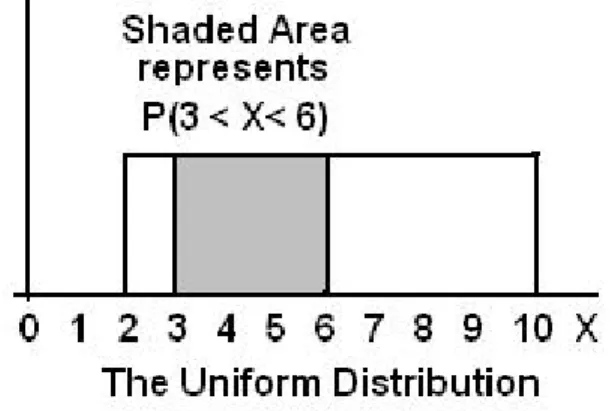
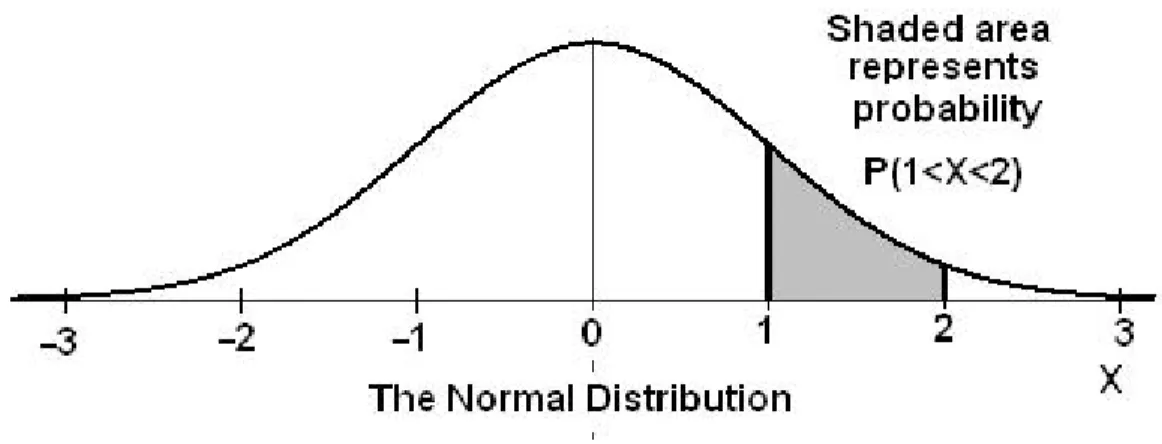
In this chapter and the next chapter, we will study the uniform distribution, the exponential distribution, and the normal distribution. The following graphs illustrate these distributions.
Figure 5.1:The graph shows a Uniform Distribution with the area between X=3 and X=6 shaded to repre-sent the probability that the value of the random variable X is in the interval between 3 and 6.
Figure 5.2: The graph shows an Exponential Distribution with the area between X=2 and X=4 shaded to represent the probability that the value of the random variable X is in the interval between 2 and 4.
Figure 5.3:The graph shows the Standard Normal Distribution with the area between X=1 and X=2 shaded to represent the probability that the value of the random variable X is in the interval between 1 and 2.
**With contributions from Roberta Bloom
5.2 Continuous Probability Functions
2We begin by defining a continuous probability density function. We use the function notation f(X). Inter-mediate algebra may have been your first formal introduction to functions. In the study of probability, the functions we study are special. We define the function f(X)so that the area between it and the x-axis is equal to a probability. Since the maximum probability is one, the maximum area is also one.
For continuous probability distributions, PROBABILITY = AREA.
Example 5.1
Consider the function f(X) = 201 for 0≤X≤20.X= a real number. The graph off(X) =201 is a horizontal line. However, since 0≤X≤20 , f(X)is restricted to the portion betweenX=0 and X=20, inclusive .
f(X) = 201 for0≤X≤20.
The graph of f(X) = 201 is a horizontal line segment when 0≤X≤20.
The area betweenf(X) = 201 where 0≤X≤20. and the x-axis is the area of a rectangle with base = 20 and height =201.
AREA=20·201 =1
This particular function, where we have restricted Xso that the area between the function and the x-axis is 1, is an example of a continuous probability density function. It is used as a tool to calculate probabilities.
Suppose we want to find the area betweenf(X) = 201 and the x-axis where0<X<2.
AREA= (2−0)·201 =0.1
(2−0) =2= base of a rectangle
1
20 = the height.
The area corresponds to a probability. The probability thatXis between 0 and 2 is 0.1, which can be written mathematically as P(0<X<2)= P(X<2)=0.1.
AREA= (15−4)· 1
20 =0.55
(15−4) =11=the base of a rectangle
1
20 = the height.
The area corresponds to the probabilityP(4<X<15) =0.55.
Suppose we want to findP(X = 15).On an x-y graph,X = 15 is a vertical line. A vertical line has no width (or 0 width). Therefore, P(X = 15)=(base)(height)= (0)201=0.
P(X≤x)(can be written asP(X<x)for continuous distributions) is called the cumulative dis-tribution function orCDF. Notice the "less than or equal to" symbol. We can use the CDFto calculateP(X>x). TheCDFgives "area to the left" andP(X>x)gives "area to the right." We calculateP(X>x)for continuous distributions as follows:P(X>x) =1−P(X<x).
Label the graph with f(X)and X. Scale the x and y axes with the maximum x and y values.
f(X) = 201, 0≤X≤20.
5.3 The Uniform Distribution
3Example 5.2
The previous problem is an example of theuniform probability distribution.
Illustrate the uniform distribution.The data that follows are 55 smiling times, in seconds, of an eight-week old baby.
10.4 19.6 18.8 13.9 17.8 16.8 21.6 17.9 12.5 11.1 4.9 12.8 14.8 22.8 20.0 15.9 16.3 13.4 17.1 14.5 19.0 22.8 1.3 0.7 8.9 11.9 10.9 7.3 5.9 3.7 17.9 19.2 9.8 5.8 6.9 2.6 5.8 21.7 11.8 3.4 2.1 4.5 6.3 10.7 8.9 9.4 9.4 7.6 10.0 3.3 6.7 7.8 11.6 13.8 18.6
Table 5.1 sample mean = 11.49 and sample standard deviation = 6.23
We will assume that the smiling times, in seconds, follow a uniform distribution between 0 and 23 seconds, inclusive. This means that any smiling time from 0 to and including 23 seconds isequally likely. The histogram that could be constructed from the sample is an empirical distribution that closely matches the theoretical uniform distribution.
LetX= length, in seconds, of an eight-week old baby’s smile. The notation for the uniform distribution is
X∼U(a,b)wherea= the lowest value ofXandb= the highest value ofX. The probability density function is f(X) = b−1a fora≤X≤b.
For this example,X∼U(0, 23)and f(X) = 231−0for 0≤X≤23. Formulas for the theoretical mean and standard deviation are
µ= a+2b andσ=
q
(b−a)2
12
For this problem, the theoretical mean and standard deviation are
µ= 0+223 =11.50 seconds andσ=
q
(23−0)2
12 =6.64 seconds
Notice that the theoretical mean and standard deviation are close to the sample mean and standard deviation.
Example 5.3 Problem 1
What is the probability that a randomly chosen eight-week old baby smiles between 2 and 18 seconds?
Solution
FindP(2<X<18).
P(2<X<18) = (base) (height) = (18−2)· 1 23 = 1623.
Problem 2
Find the 90th percentile for an eight week old baby’s smiling time.
Solution
Ninety percent of the smiling times fall below the 90th percentile,k, soP(X<k) =0.90
P(X<k) =0.90
(base) (height) =0.90
(k−0)· 1
23 =0.90
k=23·0.90=20.7
Problem 3
Find the probability that a random eight week old baby smiles more than 12 secondsKNOWING
that the baby smilesMORE THAN 8 SECONDS.
Solution
FindP(X>12|X>8)There are two ways to do the problem.For the first way, use the fact that this is aconditionaland changes the sample space. The graph illustrates the new sample space. You already know the baby smiled more than 8 seconds.
Write a new f(X): f(X) = 231−8= 151
for 8<X<23
For the second way, use the conditional formula fromProbability Topicswith the original distri-butionX∼U(0, 23):
P(A|B) = P(APAND(B) B)For this problem,Ais(X>12)andBis(X>8). So,P(X>12|X>8) = (X>12 ANDP(X>8)X>8) = PP((XX>>128)) = 1123
15 23
=0.733
Example 5.4
Uniform: The amount of time, in minutes, that a person must wait for a bus is uniformly dis-tributed between 0 and 15 minutes, inclusive.
Problem 1
What is the probability that a person waits fewer than 12.5 minutes?
Solution
LetX= the number of minutes a person must wait for a bus. a= 0 and b= 15. X ∼ U(0, 15). Write the probability density function. f(X) =151−0 = 151 for 0≤X≤15.
FindP(X<12.5). Draw a graph.
P(X<k) = (base) (height) = (12.5−0)· 1
15 =0.8333
Problem 2
On the average, how long must a person wait? Find the mean,µ, and the standard deviation,σ.
Solution
µ= a+2b = 152+0 =7.5. On the average, a person must wait 7.5 minutes. σ=
q
(b−a)2
12 = q
(15−0)2
12 =4.3. The Standard deviation is 4.3 minutes.
Problem 3
Ninety percent of the time, the time a person must wait falls below what value? NOTE: This asks for the 90th percentile.
Solution
Find the 90th percentile. Draw a graph. Letk= the 90th percentile. P(X<k) = (base) (height) = (k−0)·1
15
0.90=k· 1 15
k = (0.90) (15) = 13.5
kis sometimes called a critical value.
The 90th percentile is 13.5 minutes. Ninety percent of the time, a person must wait at most 13.5 minutes.
Example 5.5
Uniform: The average number of donuts a nine-year old child eats per month is uniformly dis-tributed from 0.5 to 4 donuts, inclusive. LetX= the average number of donuts a nine-year old child eats per month. ThenX∼U(0.5, 4).
Problem 1 (Solution on p. 250.)
The probability that a randomly selected nine-year old child eats an average of more than two donuts is _______.
Problem 2 (Solution on p. 250.)
Find the probability that a different nine-year old child eats an average of more than two donuts given that his or her amount is more than 1.5 donuts.
The second probability question has aconditional(refer to "Probability Topics (Section 3.1)"). You are asked to find the probability that a nine-year old eats an average of more than two donuts given that his/her amount is more than 1.5 donuts. Solve the problem two different ways (see the first example (Example 5.2)). You must reduce the sample space. First way: Since you already know the child eats more than 1.5 donuts, you are no longer starting at a = 0.5 donut. Your starting point is 1.5 donuts.
Write a new f(X):
f(X) = 4−11.5 = 25 for 1.5≤X≤4. FindP(X>2|X>1.5). Draw a graph.
P(X>2|X>1.5) = (base) (new height) = (4−2) (2/5) =?
The probability that a nine-year old child eats an average of more than 2 donuts when he/she has already eaten more than 1.5 donuts is45.
Second way:Draw the original graph forX∼U(0.5, 4). Use the conditional formula
P(X>2|X>1.5) = P(X>P2 AND(X>1.5X)>1.5)= PP((XX>>1.52)) = 3.52 2.5 3.5
=0.8= 45
NOTE: See "Summary of the Uniform and Exponential Probability Distributions (Section 5.5)" for a full summary.
Example 5.6
Uniform: Ace Heating and Air Conditioning Service finds that the amount of time a repairman needs to fix a furnace is uniformly distributed between 1.5 and 4 hours. LetX= the time needed to fix a furnace. ThenX∼U(1.5, 4).
2. Find the probability that a randomly selected furnace repair requires less than 3 hours. 3. Find the 30th percentile of furnace repair times.
4. The longest 25% of repair furnace repairs take at least how long? (In other words: Find the minimum time for the longest 25% of repair times.) What percentile does this represent? 5. Find the mean and standard deviation
Problem 1
Find the probability that a randomly selected furnace repair requires longer than 2 hours.
Solution
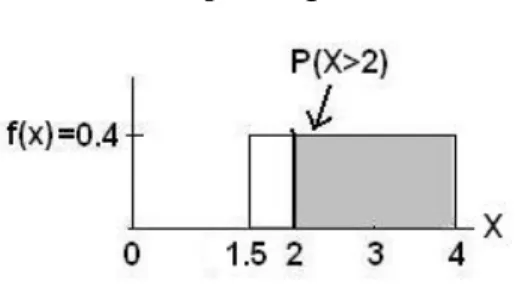
To findf(X): f(X) = 4−11.5 = 2.51 so f(X) =0.4 P(X>2) = (base)(height) = (4−2)(0.4) = 0.8
Example 4 Figure 1
Figure 5.4: Uniform Distribution between 1.5 and 4 with shaded area between 2 and 4 representing the probability that the repair time X is greater than 2
Problem 2
Find the probability that a randomly selected furnace repair requires less than 3 hours. Describe how the graph differs from the graph in the first part of this example.
Solution
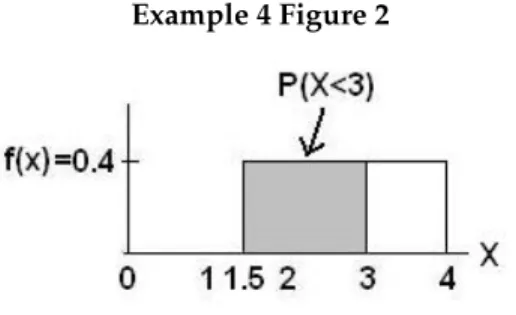
P(X<3)= (base)(height) = (3−1.5)(0.4) = 0.6
The graph of the rectangle showing the entire distribution would remain the same. However the graph should be shaded between X=1.5 and X=3. Note that the shaded area starts at X=1.5 rather than at X=0; since X∼U(1.5,4), X can not be less than 1.5.
Example 4 Figure 2
Figure 5.5:Uniform Distribution between 1.5 and 4 with shaded area between 1.5 and 3 representing the probability that the repair time X is less than 3
Problem 3
Find the 30th percentile of furnace repair times.
Solution
Example 4 Figure 3
Figure 5.6:Uniform Distribution between 1.5 and 4 with an area of 0.30 shaded to the left, representing the shortest 30% of repair times.
P(X<k) =0.30
P(X<k) = (base) (height) = (k−1.5)·(0.4)
0.3 = (k−1.5) (0.4); Solve to find k:
0.75 = k−1.5 , obtained by dividing both sides by 0.4
k = 2.25, obtained by adding 1.5 to both sides
The 30th percentile of repair times is 2.25 hours. 30% of repair times are 2.5 hours or less.
Problem 4
The longest 25% of furnace repair times takeat least how long? (Find the minimum time for the longest 25% of repairs.)
Solution
Example 4 Figure 4
Figure 5.7:Uniform Distribution between 1.5 and 4 with an area of 0.25 shaded to the right representing the longest 25% of repair times.
P(X>k) =0.25
P(X>k) = (base) (height) = (4−k)·(0.4)
0.25 = (4−k)(0.4); Solve for k:
0.625 = 4−k , obtained by dividing both sides by 0.4 −3.375 =−k , obtained by subtracting 4 from both sides
k=3.375
The longest 25% of furnace repairs take at least 3.375 hours (3.375 hours or longer).
Note: Since 25% of repair times are 3.375 hours or longer, that means that 75% of repair times are 3.375 hours or less. 3.375 hours is the75th percentileof furnace repair times.
Problem 5
Find the mean and standard deviation
Solution
µ= a+2b andσ=
q
(b−a)2
12
µ= 1.52+4 =2.75 hours andσ=
q
(4−1.5)2
12 =0.7217 hours
NOTE: See "Summary of the Uniform and Exponential Probability Distributions (Section 5.5)" for a full summary.
5.4 The Exponential Distribution
4Theexponentialdistribution is often concerned with the amount of time until some specific event occurs. For example, the amount of time (beginning now) until an earthquake occurs has an exponential distri-bution. Other examples include the length, in minutes, of long distance business telephone calls, and the amount of time, in months, a car battery lasts. It can be shown, too, that the amount of change that you have in your pocket or purse follows an exponential distribution.
Values for an exponential random variable occur in the following way. There are fewer large values and more small values. For example, the amount of money customers spend in one trip to the supermarket follows an exponential distribution. There are more people that spend less money and fewer people that spend large amounts of money.
The exponential distribution is widely used in the field of reliability. Reliability deals with the amount of time a product lasts.
Example 5.7
Illustrates the exponential distribution: Let X = amount of time (in minutes) a postal clerk spends with his/her customer. The time is known to have an exponential distribution with the average amount of time equal to 4 minutes.
Xis acontinuous random variablesince time is measured. It is given thatµ= 4 minutes. To do any calculations, you must knowm, the decay parameter.
m= 1
µ. Therefore,m= 1 4 =0.25
The standard deviation,σ, is the same as the mean.µ=σ
The distribution notation isX~Exp(m). Therefore,X~Exp(0.25).
The probability density function is f(X) = m·e−m·x The number e = 2.71828182846... It is a number that is used often in mathematics. Scientific calculators have the key "ex." If you enter 1 forx, the calculator will display the valuee.
The curve is:
f(X) =0.25·e−0.25·XwhereXis at least 0 andm= 0.25. For example, f(5) =0.25·e−0.25·5=0.072
The graph is as follows:
Notice the graph is a declining curve. WhenX= 0,
f(X) =0.25·e−0.25·0=0.25·1=0.25=m
Example 5.8 Problem 1
Find the probability that a clerk spends four to five minutes with a randomly selected customer.
Solution
FindP(4<X<5).
Thecumulative distribution function (CDF)gives the area to the left.
P(X<x) =1−e−m·x
P(X<5) =1−e−0.25·5=0.7135 andP(X<4) =1−e−0.25·4=0.6321
NOTE: You can do these calculations easily on a calculator.
The probability that a postal clerk spends four to five minutes with a randomly selected customer is
P(4<X<5) =P(X<5)−P(X<4) =0.7135−0.6321=0.0814
NOTE: TI-83+ and TI-84: On the home screen, enter (1-e^(-.25*5))-(1-e^(-.25*4)) or enter e^(-.25*4)-e^(-.25*5).
Problem 2
Half of all customers are finished within how long? (Find the 50th percentile)
Solution
P(X<k) =0.50,k= 2.8 minutes (calculator or computer) Half of all customers are finished within 2.8 minutes. You can also do the calculation as follows:
P(X<k) =0.50 andP(X<k) =1−e−0.25·k
Therefore, 0.50=1−e−0.25·kande−0.25·k=1−0.50=0.5
Take natural logs:lne−0.25·k=ln(0.50). So,−0.25·k=ln(0.50)
Solve fork:k= ln−(0.25.50) =2.8 minutes
NOTE: A formula for the percentilekisk= LN(1−AreaToTheLe f t−m )where LN is the natural log. NOTE: TI-83+ and TI-84: On the home screen, enter LN(1-.50)/-.25. Press the (-) for the negative.
Problem 3
Which is larger, the mean or the median?
Solution
Is the mean or median larger?
From part b, the median or 50th percentile is 2.8 minutes. The theoretical mean is 4 minutes. The mean is larger.
5.4.1 Optional Collaborative Classroom Activity
Have each class member count the change he/she has in his/her pocket or purse. Your instructor will record the amounts in dollars and cents. Construct a histogram of the data taken by the class. Use 5 intervals. Draw a smooth curve through the bars. The graph should look approximately exponential. Then calculate the mean.
LetX= the amount of money a student in your class has in his/her pocket or purse.
The distribution forXis approximately exponential with mean,µ= _______ andm= _______. The standard deviation,σ= ________.
Draw the appropriate exponential graph. You should label the x and y axes, the decay rate, and the mean. Shade the area that represents the probability that one student has less than $.40 in his/her pocket or purse. (ShadeP(X<0.40)).
Example 5.9
On the average, a certain computer part lasts 10 years. The length of time the computer part lasts is exponentially distributed.
Problem 1
What is the probability that a computer part lasts more than 7 years?
Solution
LetX= the amount of time (in years) a computer part lasts. µ=10 som= µ1 = 101 =0.1
FindP(X>7). Draw a graph.
P(X>7) =1−P(X<7).
SinceP(X<x) =1−e−mxthenP(X>x) =1−(1−e−m·x) =e−m·x
P(X>7) = e−0.1·7 = 0.4966. The probability that a computer part lasts more than 7 years is
0.4966.
NOTE: TI-83+ and TI-84: On the home screen, enter e^(-.1*7).
Problem 2
On the average, how long would 5 computer parts last if they are used one after another?
Solution
On the average, 1 computer part lasts 10 years. Therefore, 5 computer parts, if they are used one right after the other would last, on the average,
Problem 3
Eighty percent of computer parts last at most how long?
Solution
Find the 80th percentile. Draw a graph. Letk= the 80th percentile.
Solve fork:k= ln(−1−0.1.80) =16.1 years
Eighty percent of the computer parts last at most 16.1 years.
NOTE: TI-83+ and TI-84: On the home screen, enter LN(1 - .80)/-.1
Problem 4
What is the probability that a computer part lasts between 9 and 11 years?
Solution
FindP(9<X<11). Draw a graph.
P(9<X<11) = P(X<11)−P(X<9) = 1−e−0.1·11
− 1−e−0.1·9
= 0.6671−0.5934 =
0.0737. (calculator or computer)
The probability that a computer part lasts between 9 and 11 years is 0.0737.
Example 5.10
Suppose that the length of a phone call, in minutes, is an exponential random variable with decay parameter =121. If another person arrives at a public telephone just before you, find the probability that you will have to wait more than 5 minutes. LetX= the length of a phone call, in minutes.
Problem (Solution on p. 250.)
What ism,µ, andσ? The probability that you must wait more than 5 minutes is _______ .
NOTE: A summary for exponential distribution is available in "Summary of The Uniform and Exponential Probability Distributions (Section 5.5)".
5.5 Summary of the Uniform and Exponential Probability Distributions
5Formula 5.1:Uniform
X= a real number between aand b(in some instances,X can take on the valuesaand b). a= smallestX;b= largestX
X∼U(a,b)
The mean isµ= a+2b
The standard deviation isσ=
q
(b−a)2
12
Probability density function: f(X) = b−1a fora≤X≤b
Area to the Left of x:P(X<x) =(base)(height)
Area to the Right of x:P(X>x) =(base)(height)
Area Between c and d:P(c<X<d) = (base) (height) = (d−c) (height).
Formula 5.2:Exponential
X∼Exp(m)
X= a real number, 0 or larger. m= the parameter that controls the rate of decay or decline The mean and standard deviationare the same.
µ=σ= m1 andm= 1µ= 1σ
The probability density function: f(X) =m·e−m·X,X≥0
Area to the Left of x:P(X<x) =1−e−m·x
Area to the Right of x:P(X>x) =e−m·x
Area Between c and d: P(c<X<d) = P(X<d)−P(X<c) =1−e−m·d−(1−e−m·c) = e−m·c−e−m·d
Percentile, k:k= LN(1-AreaToTheLeft)−m