Oregon Framework for
Teacher and Administrator
Evaluation and Support
Systems
Revised for 2014 – 2015
State Guidelines for ESEA Waiver & SB 290
OREGON DEPARTMENT OF EDUCATION
255 Capitol St, NE, Salem, OR 97310
TABLE OF CONTENTS
I.
INTRODUCTION ... 1
II.
BACKGROUND ... 3
III.
PURPOSE AND GOALS OF EVALUATION ... 7
IV.
REQUIRED ELEMENTS OF TEACHER AND ADMINISTRATOR EVALUATION AND
SUPPORT SYSTEMS... .10
(1)
Standards of Professional Practice ... 10
(2)
Differentiated Performance Levels for Teachers and Administrator
Evaluations ... 15
(3)
Multiple Measures for Teacher and Administrator Evaluations ... 16
(4)
Evaluation and Professional Growth Cycle for Teacher and
Administrator Evaluations ... 24
a.
Oregon Matrix for Summative Evaluations ... 26
(5)
Aligned Professional Learning ... 30
V.
BIBLIOGRAPHY ... 31
I.
INTRODUCTION
During 2011-12, the Oregon Department of Education (ODE) and the Educator Effectiveness
Workgroup (see Appendix A), established through the Elementary and Secondary Education Act (ESEA) Flexibility Waiver process, developed state guidelines for local evaluation and support systems in Oregon, referred to as the Oregon Framework for Teacher and Administrator Evaluation and Support Systems (Oregon Framework). The Oregon Framework outlines requirements for local evaluation and support systems aligned to state legislation (Senate Bill290) and the ESEA Waiver criteria.
Oregon’s ESEA Waiver was conditionally approved by the US Department of Education (USED) and endorsed by the Oregon State Board of Education in July 2012. During the 2012-13 school year, ODE conducted a pilot in selected districts to study methods for combing student learning and growth as a significant factor in educator summative evaluations to meet all the conditions of the ESEA Waiver. In October 2015, the U.S. Department of Education approved Oregon’s ESEA Waiver. All districts will use the Oregon Matrix for summative evaluations beginning in the 2014-15 school year to determine educators’ overall performance level and professional growth plan. The Oregon Matrix is described in detail (see page 27).
Based on the standards of professional practice, the Oregon Framework guides the development of local evaluation systems that promote professional growth and improved teaching and leadership practice. Implementation of a sound evaluation system is critical to producing equitable outcomes where student success is no longer predictable based on race, socio-economics, language, and family background. Educator effectiveness is critical for improving learning and achievement for all students. To that end, implementation of educator evaluation systems is aligned with district and school improvement, part of the state’s system of accountability and support to help students, educators, buildings, and districts move toward the state’s 40/40/20 Goal for improving educational attainment.
In the face of increasing evidence that valid and reliable evaluations must include multiple, authentic measures of student learning rather than rely on a single standardized test score, Oregon and its stakeholders, educators, and experts are united in the following commitments:
o No public reporting of individual teacher data
o Not supporting the use of standardized assessment data as the sole measure of student learning
o Not supporting student growth as the sole component on which to base evaluation o Agreement that for an educator evaluation system to drive improvement of student
outcomes, the data and information it provides must be used to improve instructional practices
Overview of the Oregon Framework
The purpose of the Oregon Framework is to provide guidance for implementation of state and federal requirements as districts develop or align their local evaluation and support systems. The framework provides state criteria (required elements) that ensure local evaluation systems are rigorous and designed to support professional growth, accountability and student learning and growth of each student. The five required elements outlined below establish the parameters for all local evaluation and
support systems. Districts align their systems to these elements but have flexibility in their local design and implementation. Local systems must meet or exceed state criteria.
Required Elements in Teacher and Administrator Evaluation and Support Systems:
1. Standards of Professional Practice. The state adopted Model Core Teaching Standards and Educational Leadership/Administrator Standards define what teachers and administrators should know and be able to do to ensure that every student is ready for college, careers and engaged citizenship in today’s world.
2. Differentiated (4) Performance Levels. Teacher and administrator performance on the standards of professional practice are measured on four performance levels.
3. Multiple Measures. Multiple sources of data are used to measure teacher and administrator performance on the standards of professional practice. Evaluators look at evidence from three categories: professional practice, professional responsibilities, and student learning and growth. 4. Evaluation and Professional Growth Cycle. Teachers and administrators are evaluated on a
regular cycle of continuous improvement which includes self-reflection, goal setting,
observations, formative assessment and summative evaluation. TheOregon Matrix is used to combine multiple measures for the summative evaluation to determine an overall performance level and professional growth plan.
5. Aligned Professional Learning. Relevant professional learning opportunities to improve professional practice and impact on student learning are aligned to the teacher’s or administrator’s evaluation and his/her need for professional growth.
School districts are required to develop or modify their evaluation systems in collaboration with
administrators, teachers, and their exclusive bargaining representatives (ORS 342.850(2)(a); SB 290; and OAR 581-022-1723). A collaborative process involving teachers and administrators will result in
meaningful evaluations and a stronger evaluation system.
During the 2013-14 school year, all school districts were required to begin implementing their
evaluation and support systems but did not include the results of student learning and growth goals in their summative evaluations. During the 2014-15 school year, all summative evaluations must include professional practice, professional responsibilities, and student learning and growth.
Professional development and technical support for districts to implement their local evaluation systems is provided through the Network for Quality Teaching and Learning (HB3233) and other resources. Lessons learned from implementation will be used to continuously improve the state criteria and inform local evaluation and support systems.
Resources for implementation of the Oregon Framework are provided in the Educator Effectiveness Toolkit http://www.ode.state.or.us/search/page/?id=3759
II.
BACKGROUND
An effective educator workforce is essential for improving student learning and achieving the state’s 40/40/20 Goal:
Senate Bill 253 establishes the goal in law that, by 2025, every Oregon student should earn a high school diploma – one that represents a high level of knowledge and skills. Eighty percent must continue their education beyond high school – with half of those earning associate’s degrees or professional/technical certificates, and half achieving a bachelor’s degree or higher. This goal, often referred to as the “40/40/20 Goal,” gives Oregon the most ambitious high school and college completion targets of any state in the country.
In 2013, under the leadership of Governor John Kitzhaber, the Oregon Education Investment Board (OEIB) proposed key strategic investments to support Oregon’s attainment of 40/40/20. Key to this work is a revitalization of the education profession and the establishment of a Network for Quality Teaching and Learning. Conceptualized and passed by the Oregon Legislature in HB 3233, the Network provides funding for a comprehensive system of support for educators that creates a culture of leadership, professionalism, continuous improvement and excellence for teachers and leaders across the P-20 system.
The state will not meet the demanding requirements for improving student achievement without effective teachers and leaders. Oregon educational partners and stakeholders are working
collaboratively to create a supportive state policy infrastructure focused on educator effectiveness leading to improved student learning. Oregon’s framework for evaluations has been built on a strong foundation of legislative action and collaborative support, as part of a coherent and comprehensive system of educator effectiveness.
Together, Oregon partners and stakeholders are developing a comprehensive educator effectiveness system spanning the career continuum of teachers and leaders, including preparation, licensing,
induction, mentoring, professional learning, and educator evaluation. The graphic that follows on page 4 is adapted from the CCSSO State Consortium on Educator Effectiveness and illustrates the interrelated components of a comprehensive system designed to improve student outcomes and supported through the Network for Quality Teaching and Learning (HB3233).
Organizations that have played key roles in Oregon’s educator effectiveness efforts include: Oregon Legislature
Office of the Governor
Oregon Department of Education Oregon Education Association
Confederation of Oregon School Administrators Oregon School Boards Association
Teacher Standards and Practices Commission Oregon School Personnel Association
Oregon School Districts
Committee of Practitioners Oregon University System
Oregon Coalition for Quality Teaching and Learning Oregon Association of Colleges for Teacher
Education
Stand for Children Chalkboard Project
Northwest Regional Comprehensive Center Oregon Leadership Network
Educator Effectiveness System
State and Federal Legislation, Rules, and Policy
The Oregon Framework incorporates the requirements of Senate Bill (SB) 290, House Bill (HB) 3474, Senate Bill (SB) 252 enacted during the 2011 legislative session, and requirements for educator evaluation including the Model Core Teaching and Educational Leadership/ Administrator Standards (OAR 581-022-1723; 1724;1725) adopted by the State Board of Education in December 2011 and revision in 2012. It also draws on national research and the experience of Oregon school districts that are already leading the way in developing strong and meaningful evaluation systems.
Significant bills enacted during Oregon’s 2011 and 2013 Legislative sessions have provided a solid policy platform to build an evaluation and support system that is consistent with the ESEA flexibility waiver criteria. This legislation is highlighted below:
Senate Bill (SB) 290
State Board of Education, in consultation with the Teacher Standards and Practices Commission, shall adopt core teaching standards and administrators standards that improve student
academic growth and learning by:
a. Assisting school districts in determining the effectiveness of teachers and administrators b. Improving the professional development and classroom practices of teachers and
administrators
Core teaching standards and administrator standards take into consideration: a. Multiple measures of teacher and administrator effectiveness
INDUCTION MENTORING
b. Evidence of student academic growth and learning based on multiple measures Core teaching standards will attempt to:
a. Strengthen the knowledge, skills, dispositions and classroom and administrative practices of teachers and administrators in public schools;
b. Refine the support, assistance and professional growth opportunities offered to a teacher or an administrator, based on the individual needs of the teacher or administrator and the needs of students, the school and the school district of the teacher or administrator; c. Allow each teacher or administrator to establish a set of classroom or administrative
practices and student learning objectives that are based on the individual circumstances of the teacher or administrator, including the classroom or other assignments of the teacher or administrator;
d. Establish a formative growth process for each teacher and administrator that supports professional learning and collaboration with other teachers and administrators; and
e. Use evaluation methods and professional development, support and other activities that are based on curricular standards and that are targeted to the needs of each teacher and administrator.
By July 1, 2013, school district boards must use the core teaching standards and administrator standards for all evaluations of teachers and administrators. The process shall be based on the collaboration of teachers and administrators and the exclusive bargaining representative of the employees of the school district.
House Bill (HB) 3474
Implements HB 3619 Task Force on Education Career Preparation and Development recommendations for:
a. Teacher preparation and professional development b. Administrator preparation and professional development c. Licensure
Requires creation of a comprehensive leadership development system for administrators. Directs preparation of a plan to encourage National Board Certification for teachers and
administrators.
Creates the Educator Preparation Improvement Fund to improve preparation of teachers and administrators; allocates funds for incentive grants.
Directs the preparation of guidelines for a uniform set of performance evaluation methods for teachers.
Senate Bill (SB) 252
SB 252 (district collaboration grant) provides funding for eligible school districts to improve student learning through the voluntary collaboration of teachers and administrators to implement the integration of performance evaluation systems with new career pathways, research-based professional development, and new compensation models.
Provides the opportunity to support piloting the development of local evaluation systems following the state guidelines during the 2012-13 school year.
District applications must be approved by school district superintendent, chair of the school district board, and the exclusive teacher bargaining representative.
House Bill (HB) 3233
A comprehensive system of support for educators that creates a culture of leadership, professionalism, continuous improvement and excellence for teachers and leaders across the P-20 system. Funded by the 2012 Oregon Legislature in HB 3233 for $45 million, the Network is designed to invest in each stage of an educator’s development from recruitment through teacher leader, including:
Mentoring for new teachers and leaders in the state
Fully implementing, and supporting excellence in, systems of evaluation and support for teachers (SB 290)
Significantly advancing the work of the school district collaboration grant Supporting the implementation of Common Core State Standards statewide
Implementing the state English Learners plan and other efforts aimed at supporting educators to close the achievement gap
Strengthening clinical partnerships in teacher preparation and reporting systems Making progress toward the goals in the Minority Teacher Act
Developing a professional development portal/clearinghouse
Supporting the alignment of professional development systems to support school improvement Support for rural educators’ access to Network resources
Strengthening student centered teaching
Developing formative assessments of essential skills Strengthening the Educational Equity unit at ODE Providing professional development for early educators
ESEA Waiver Criteria for Teacher and Principal Evaluation and Support Systems
Federal requirements
District teacher and principal evaluation and support systems must: o Be used for continual improvement of instruction
o Meaningfully differentiated performance using at least three performance levels
o Use multiple valid measures in determining performance levels, including as a significant factor data on student growth for all students (including English Learners and students with disabilities) and other measures of professional practice (which may be gathered through multiple formats and sources)
o Evaluate teachers and principals on a regular basis
o Provide clear, timely, and useful feedback, including feedback that identifies needs and guides professional development
o Be used to inform personnel decisions
ODE must ensure districts implement teacher and principal evaluation and support systems consistent with state adopted guidelines
III.
PURPOSE and GOALS OF EVALUATION
Effective teaching and leadership matter. Within the school environment, teachers and
administrators have the most impact in creating equity and excellence for each and every student. Teachers and administrators have a challenging task in meeting the needs of an educationally diverse student population, and meaningful evaluations are necessary to provide educators with the support, recognition, and guidance needed to sustain and improve their efforts. Evaluation systems must be designed comprehensively to go beyond the use of personnel decision making to inform the growth process across the system and to measure a full range of performance across different settings. The primary goal of elevating teaching, leading, and learning throughout the systems cannot be accomplished with summative assessment alone.
Undertaking the work of designing, implementing, and monitoring an effective evaluation and support system for educators is both complex and time consuming; however, based upon the powerful correlation between teacher and principal effectiveness to student learning and growth, this work is imperative and of the utmost importance.
The ultimate goal of strengthening teacher and leader evaluation systems in Oregon is to ensure equitable outcomes where all students, regardless of background, are ready for college, careers, and engaged citizenship by ensuring the following outcomes:
Improved student learning at all schools and for all students Effective teachers in every classroom
Effective leaders in every school and district
Reducing achievement gaps between the highest and lowest performing student groups, while increasing achievement and success for every student
Continuous professional growth for teachers and leaders throughout their careers The Oregon Framework for Teacher and Administrator Evaluation and Support Systems creates a fair and equitable system to measure teacher and leader effectiveness. Purposes of the evaluation and support systems are to:
Strengthen the knowledge, dispositions, performances and practices of teachers and administrators to improve student learning
Strengthen support and professional growth opportunities for teachers and administrators based on their individual needs in relation to the needs of students, school, and district Assist school districts in determining effectiveness of teachers and administrators in making
Defining Teacher and Administrator Effectiveness
Development of evaluation and support systems should begin with defining the terms “effective” teacher and “effective” administrator. The Educator Effectiveness Workgroup developed the definitions below which reflect the adopted Model Core Teaching Standards (OAR 581-022-1724) and Educational Leadership/Administrator Standards (OAR 581-022-1725).
Teacher Effectiveness
Effective teachers in the state of Oregon have the essential knowledge, critical dispositions and performances needed to promote the success of every student through high expectations, challenging learning experiences, a deep understanding of the content, effective instructional practice, and professional responsibility.
By demonstrating proficiency in the adopted teaching standards, effective teachers improve student learning and growth by providing instruction that enables all students regardless of their background to meet and exceed ambitious goals and standards for student learning. Effective teachers empower every student to take ownership of his or her own learning and leverage diverse student assets to promote learning for all students.
Through implementation of the Common Core State Standards (CCSS), effective teachers integrate cross-disciplinary skills to help students master content and apply knowledge and skills to explore ideas, propose solutions, develop new understandings, solve problems, and imagine possibilities. They strive to eliminate achievement gaps and to prepare diverse student populations for postsecondary and
workforce success.
Effective teachers use assessment data to monitor each learner’s progress formatively, adjust
instruction as needed, provide feedback to learners, and document learner progress against standards using multiple sources of evidence. They also analyze student learning outcomes to plan meaningful learning opportunities, customize instruction for students with a wide range of individual and cultural differences, and incorporate new technologies to maximize and individualize learning experiences. Effective teachers understand that helping all students succeed cannot happen in isolation; they engage in intensive professional learning, peer and team collaboration, continuous self-reflection, consultation with families, and ongoing study of research and evidence-based practice. Effective teachers
demonstrate leadership by encouraging transparency and contributing to positive changes in practice which advance the profession. They also lead by modeling ethical behavior, taking responsibility for the learning and well-being of all students, and supporting a shared vision and collaborative culture.
Effective teachers communicate high expectations to students and their families, in particular those who have historically been left behind/marginalized, and utilize diverse strategies to engage them in a mutually supportive teaching and learning environment. They perform all duties according to the ethical and competent standards set by the Teacher Standards and Practices Commission.
Administrator Effectiveness
Effective administrators in the state of Oregon integrate principles of cultural competency and equitable practice and promote the success of every student through visionary leadership, instructional
improvement, effective management, inclusive practice, ethical leadership, and the socio-political context of their building and district. By demonstrating proficiency in the adopted educational
leadership/administrator standards, effective administrators improve teacher effectiveness and student learning and growth. They also lead by modeling ethical and competent behavior according to all standards set for administrators by the Teacher Standards and Practices Commission.
As the school’s instructional leader, effective principals enable critical discourse and data-driven reflection and decisions about curriculum, assessment, instruction, and student progress, and create structures to facilitate instructional improvement. Effective administrators ensure their staff receives support, assistance, and professional growth opportunities necessary to strengthen teacher knowledge, skills, dispositions, and instructional practices in mutually-identified areas of need. By creating a
common vision for equity and excellence and articulating shared values, effective administrators lead and manage their schools or district in a manner that promotes collaboration and equity, creates an inclusive and safe, efficient, and effective learning environment, and improves the school or district impact on students, families, and community members.
IV.
REQUIRED ELEMENTS OF TEACHER AND ADMINISTRATOR EVALUATION AND
SUPPORT SYSTEMS
Teacher and administrator evaluation and support systems in all Oregon school districts must include the following five elements:
These five required elements establish the parameters for local evaluation and support systems. The framework describes the state criteria for each of these elements. Districts must align their systems to these elements but have local flexibility in their design and implementation. Local systems must meet or exceed the state criteria for evaluation and support systems.
(1)
Standards of Professional Practice: Model Core Teaching Standards and
Educational Leadership/Administrator Standards
The standards of professional practice are the cornerstone of an evaluation system. The Model Core Teaching Standards and Educational Leadership/Administrator Standards are the foundation of Oregon’s evaluation framework. These professional standards outline what teachers and administrators should know and be able to do to ensure every student is ready for college, careers and engaged citizenship in today’s world. These standards help frame a comprehensive definition of effective teaching and educational leadership.
Oregon legislation (SB 290) called for the adoption of teaching and administrator standards to be included in all evaluations of teachers and administrators in the school district. The State Board of Education adopted the Model Core Teaching Standards (581-022-1724) and Educational Leadership/Administrator Standards 1725) in December 2011 and requirements for district evaluation systems (581-022-1723).
Both the Model Core Teaching Standards and Educational Leadership standards build on national standards, are research based, utilize best practices, and were developed with a wide variety of stakeholders over the course of several years. Districts are required to build their evaluation and support systems using these adopted standards.
Model Core Teaching Standards
The Model Core Teaching Standards outline what teachers should know and be able to do to help all students improve, grow and learn. The standards outline the common principles and foundations of teaching practice necessary to improve student learning that encompass all subject areas and grade
(1) Standards of Professional
Practice
(2) Differentiated
Performance Levels
(3) Multiple Measures
(4) Evaluation
and Professional
Growth Cycle
(5) Aligned Professional
levels. The standards reflect a new vision for teaching and learning critical for preparing all students for success in today’s world and their future.
Key themes for improved student learning run throughout the standards: Personalized learning for diverse learners
Cultural competence
A stronger focus on application of knowledge and skills Improved assessment literacy
A collaborative professional culture
New leadership roles for teachers and administrators
The standards were developed by the Interstate Teacher Assessment and Support Consortium (InTASC) of the Council of Chief State School Officers (CCSSO) and represents the collaborative work of practicing teachers, teacher educators, school leaders, state agency officials, and CCSSO, including Oregon
stakeholders.
The Model Core Teaching Standards are grouped into four domains of teaching: (A) The Learner and Learning, (B) Content, (C) Instructional Practice, and (D) Professional Responsibilities. See link below for accessing the complete Model Core Teaching Standards which delineates “essential knowledge,” “critical dispositions” and “performances.”
http://www.ccsso.org/Documents/2011/InTASC_Stds_MS_Word_version_4_24_11.doc
The Model Core Teaching Standards include:
(A) The Learner and Learning
Standard # 1: Learner Development
The teacher understands how learners grow and develop, recognizing that patterns of learning and development vary individually within and across the cognitive, linguistic, social, emotional, and physical areas, and designs and implements developmentally appropriate and challenging learning experiences.
Standard #2: Learning Differences
The teacher uses understanding of individual differences and diverse cultures and
communities to ensure inclusive learning environments that enable each learner to meet high standards.
Standard #3: Learning Environments
The teacher works with others to create environments that support individual and
collaborative learning, and that encourage positive social interaction, active engagement in learning, and self-motivation.
(B) Content
Standard # 4: Content Knowledge
The teacher understands the central concepts, tools of inquiry, and structures of the
discipline(s) he or she teaches and creates learning experiences that make these aspects of the discipline accessible and meaningful for learners to assure mastery of the content.
Standard # 5: Application of Content
The teacher understands how to connect concepts and use differing perspectives to engage learners in critical thinking, creativity, and collaborative problem solving related to authentic local and global issues.
(C) Instructional Practice
Standard # 6: Assessment
The teacher understands and uses multiple methods of assessment to engage learners in their own growth, to monitor learner progress, and to guide the teacher’s and learner’s decision making.
Standard #7: Planning for Instruction
The teacher plans instruction that supports every student in meeting rigorous learning goals by drawing upon knowledge of content areas, curriculum, cross-disciplinary skills, and pedagogy, as well as knowledge of learners and the community context.
Standard #8: Instructional Strategies
The teacher understands and uses a variety of instructional strategies to encourage learners to develop deep understanding of content areas and their connections, and to build skills to apply knowledge in meaningful ways.
(D) Professional Responsibility
Standard #9: Professional Learning and Ethical Practice
The teacher engages in ongoing professional learning and uses evidence to continually evaluate his/her practice, particularly the effects of his/her choices and actions on others (learners, families, other professionals, and the community), and adapts practice to meet the needs of each learner.
Standard # 10: Leadership and Collaboration
The teacher seeks appropriate leadership roles and opportunities to take responsibility for student learning, to collaborate with learners, families, colleagues, other school professionals, and community members to ensure learner growth, and to advance the profession.
Educational Leadership/Administrator Standards
Oregon’s educational leadership/administrator standards embed cultural competency and equitable practice in each standard. These standards guide administrative preparation, licensure and job
performance. Oregon’s educational leadership/administrator standards align with the Interstate School Leaders Licensure Consortium (ISLLC) and the Educational Leadership Constituents Council (ELCC) 2009 standards for Educational Leadership. Oregon was very explicit and intentional about highlighting the importance of cultural competency and equitable practices in the administrator standards.
See link below for accessing Performance Standards and Indicators for Education Leaders (ISLLC-Based Models): http://www.ccsso.org/Documents/2008/Peformance_Indicators_2008.pdf
The six domains for administrator professional practice: Setting widely shared vision for learning
Developing a school culture and instructional program conducive to student learning and staff professional growth
Ensuring effective management of the organization, operation, and resources for a safe, efficient, and effective learning environment
Collaborating with faculty and community members, responding to diverse community interests and needs, and mobilizing community resources
Acting with integrity, fairness, and in an ethical manner
Understanding, responding to, and influencing the political, social, legal, and cultural context
The Educational Leadership/Administrator Standards include:
Standard #1: Visionary Leadership
An educational leader integrates principles of cultural competency and equitable practice and promotes the success of every student by facilitating the development, articulation, implementation, and
stewardship of a vision of learning that is shared and supported by stakeholders. Educational Leaders:
a) Collaboratively develop and implement a shared vision and mission;
b) Collect and use data to identify goals, assess organizational effectiveness, and promote organizational learning;
c) Create and implement plans to achieve goals;
d) Promote continuous and sustainable improvement; and e) Monitor and evaluate progress and revise plans.
Standard #2: Instructional Improvement
An educational leader integrates principles of cultural competency and equitable practice and promotes the success of every student by sustaining a positive school culture and instructional program conducive to student learning and staff professional growth.
Educational Leaders:
a) Nurture and sustain a culture of collaboration, trust, learning and high expectations; b) Create a comprehensive, rigorous and coherent curricular program;
c) Create a personalized and motivating learning environment for students; d) Supervise and support instruction;
e) Develop assessment and accountability systems to monitor student progress; f) Develop the instructional and leadership capacity of staff;
g) Maximize time spent on quality instruction;
h) Promote the use of the most effective and appropriate technologies to support teaching and learning; and
Standard #3: Effective Management
An educational leader integrates principles of cultural competency and equitable practice and promotes the success of every student by ensuring management of the organization, operation, and resources for a safe, efficient, and effective learning environment.
Educational Leaders:
a) Monitor and evaluate the management and operational systems;
b) Obtain, allocate, align and efficiently use human, fiscal and technological resources; c) Promote and protect the welfare and safety of students and staff;
d) Develop the capacity for adaptive leadership; and
e) Ensure teacher and organizational time is focused to support quality instruction and student learning.
Standard #4: Inclusive Practice
An educational leader integrates principles of cultural competency and equitable practice and promotes the success of every student by collaborating with faculty and community members, responding to diverse community interests and needs, and mobilizing community resources in order to demonstrate and promote ethical standards of democracy, equity, diversity, and excellence, and to promote communication among diverse groups.
Educational Leaders:
a) Collect and analyze data pertinent to equitable outcomes;
b) Understand and integrate the community’s diverse cultural, social and intellectual resources;
c) Build and sustain positive relationships with families and caregivers; and d) Build and sustain productive relationships with community partners.
Standard #5: Ethical Leadership
An educational leader integrates principles of cultural competency and equitable practice and promotes the success of every student by acting with integrity, fairness, and in an ethical manner.
Educational Leaders:
a) Ensure a system of accountability for every student’s academic and social success; b) Model principles of self-awareness, reflective practice, transparency and ethical
behavior;
c) Safeguard the values of democracy, equity and diversity;
d) Evaluate the potential ethical and legal consequences of decision-making; and e) Promote social justice and ensure that individual student needs inform all aspects of
schooling.
Standard #6: Socio-Political Context
An educational leader integrates principles of cultural competency and equitable practice and promotes the success of every student by understanding, responding to, and influencing the larger political, social, economic, legal, and cultural context.
Educational Leaders:
b) Act to influence local, district, state and national decisions affecting student learning; and
c)
Assess, analyze and anticipate emerging trends and initiatives in order to adapt leadership strategies.(2)
Differentiated Performance Levels for Teacher and Administrator Evaluations
Oregon’s framework for evaluation is designed to assess teacher and administrator performance with respect to the Model Core Teaching Standards and Educational Leadership/Administrator Standards (i.e., standards of professional practice). To assess performance, evaluators use a rubric. Rubrics are scoring tools that describe characteristics of practice or artifacts at different performance levels. Rubrics are designed with differentiated performance levels and performance descriptors.Performance descriptors are observable and measurable statements of educator actions and behaviors that serve as the basis for identifying the level of teaching or administrative performance. They contain descriptors at each performance level illustrating the types of performance expected at a given level under a given standard of practice. Research indicates that using a rubric with four levels and clear descriptors will result in a more objective rating of performance. Descriptors can be used to guide individuals toward improving their practice at the next performance level.
Rubrics are designed to help educators and evaluators (1) develop a consistent, shared understanding of what proficient performance looks like in practice, (2) develop a common terminology and structure to organize evidence, and (3) make informed professional judgments about formative and summative performance ratings on each Standard and overall.
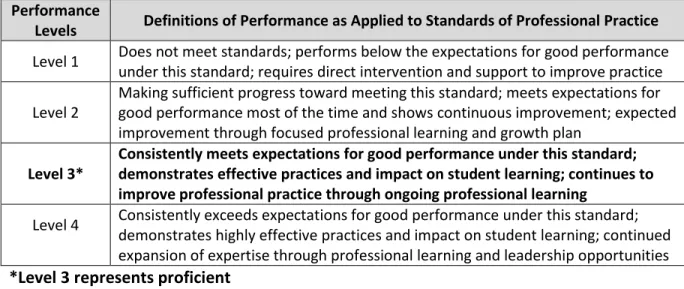
Oregon’s framework uses a rating scale based on four performance levels: Level 1 (lowest) to Level 4 (highest). Definitions of each performance level are described in Table 1 below. Districts must use four levels but they may name the levels as desired (for example ineffective, emerging, effective and highly effective). Regardless of the terms used, they must be aligned to the levels described in the table below.
Table 1. Performance Levels Performance
Levels Definitions of Performance as Applied to Standards of Professional Practice
Level 1 Does not meet standards; performs below the expectations for good performance under this standard; requires direct intervention and support to improve practice Level 2
Making sufficient progress toward meeting this standard; meets expectations for good performance most of the time and shows continuous improvement; expected improvement through focused professional learning and growth plan
Level 3*
Consistently meets expectations for good performance under this standard; demonstrates effective practices and impact on student learning; continues to improve professional practice through ongoing professional learning
Level 4 Consistently exceeds expectations for good performance under this standard; demonstrates highly effective practices and impact on student learning; continued expansion of expertise through professional learning and leadership opportunities
(2)
Multiple Measures for Teacher and Administrator Evaluations
A comprehensive evaluation system must include a variety of evidence-based measures to evaluate teacher and administrator performance and effectiveness, based on standards of professional practice (i.e., INTASC and ISLLC). Multiple measures provide a more comprehensive view of the educator’s practice and contribution to student growth. Multiple measures provide multiple data sources. Due to the complex nature of teaching and administrator practice, a single measure does not provide sufficient evidence to evaluate performance. When combined, multiple measures provide a body of evidence that informs the educator’s evaluation resulting in a more accurate and valid judgment about performance and professional growth needs.
Multiple measures refer to the tools, instruments, protocols, assessments, and processes used to collect evidence on performance and effectiveness.
Oregon’s teacher and administrator evaluation systems must include measures from the following three components: (A) Professional Practice, (B) Professional Responsibilities, and (C) Student Learning and Growth. All teachers and administrators will be evaluated using measures from each of the three categories in combination with one another. These categories are interdependent and provide a three-dimensional view of teacher and administrator practice as illustrated below. Evaluators will look at evidence from all three categories of evidence to holistically rate performance.
Categories of Evidence for Multiple Measures of Effectiveness
Senate Bill 290 and ESEA Waiver criteria require district evaluation systems to incorporate student learning and growth as a significant factor to the overall performance rating of teachers and administrators. Teachers and administrators, in collaboration with their supervisors/ evaluators, annually establish challenging and meaningful student learning and growth (SLG) goals, select evidence from valid and reliable measures, and regularly assess progress. The goal setting process for teachers must reflect most closely the teaching and learning that occurs in the classroom and allow teachers to choose goals based on the needs of their students and select appropriate measures that align with their goals. Administrator goals should be aligned to school and district goals.
Multiple Measures for Teacher Evaluations
The evaluation system must include a variety of evidence-based measures to evaluate teacher performance and effectiveness, based on the Model Core Teaching Standards. To provide a balanced view of teacher performance, evaluations of all licensed teachers must include evidence from the following three components: (A) Professional Practice, (B) Professional Responsibilities, and (C) Student Learning and Growth. Determining multiple measures for the district’s local evaluation system is key; to be accomplished through a collaborative process involving teachers and administrators. Examples included under each category below are not all inclusive.
A. Professional Practice: Evidence of the quality of teachers’ planning, delivery of instruction, and assessment of student learning.
a. Classroom Observation
Evaluator’s observation, documentation and feedback on a teacher’s instructional practices; both formal and informal
b. Examination of Artifacts of Teaching
Examples: Lesson plans, curriculum design, scope and sequence, student assignments, student work
B. Professional Responsibilities: Evidence of teachers’ progress toward their own professional goals and contribution to school-wide goals.
Examples: Teacher reflections, self-reports, data analysis, professional goal setting, student growth goal setting, records of contributions, peer collaboration, teamwork, parent/student surveys, meetings, record keeping, portfolios, building level leadership (committees,
demonstration classrooms)
Peer collaboration is encouraged as an effective practice. Peer evaluation of teachers may be used in the formative process, but under current Oregon law is not an appropriate measure in summative evaluation.
C. Student Learning and Growth: Evidence of teachers’ contribution to student learning and growth.
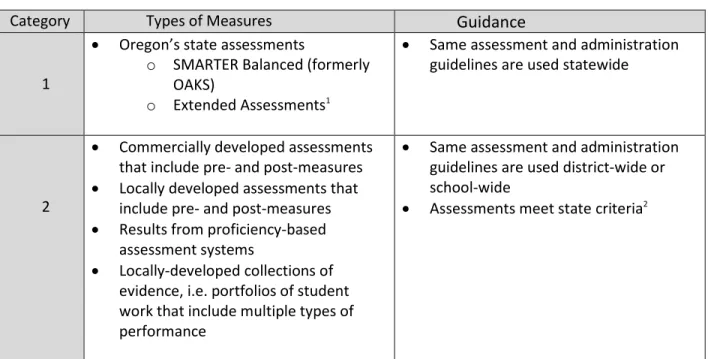
Teachers, in collaboration with their supervisors/evaluators, will establish at least two student learning and growth goals and identify measures that will be used to determine goal attainment (see Table 2 below). They will also specify what evidence will be provided to document progress on each goal. As explained below, appropriate measures of goal attainment depends on teacher
assignment.
Teachers in tested grades and subjects: As a requirement of the ESEA Waiver, teachers who teach in tested grades and subjects (ELA and Math, grades 3-8 and 11) must use a Category 1 state assessment for one of their SLG goals and measures from Category 2 or 1 for their second goal.
Teachers in non-tested grades and subjects: These teachers may use measures from Category 2 for both of their goals. They may also use Category 1 as an option, based on what is most appropriate for the curriculum and students they teach. The district will determine if the assessments that are used need to be comparable across just a school or across all schools within the district.
Note: Districts will not have to use Category 1 state assessments to measure SLG goals during the 2014-15 school year as Oregon transitions from OAKS to SMARTER. Educators will use measures from Category 2 for both SLG goals.
Table 2. Types of Measures for Student Learning and Growth for Educator Evaluations
Category Types of Measures
Guidance
1
Oregon’s state assessments
o SMARTER Balanced (formerly OAKS)
o Extended Assessments1
Same assessment and administration guidelines are used statewide
2
Commercially developed assessments that include pre- and post-measures Locally developed assessments that
include pre- and post-measures Results from proficiency-based
assessment systems
Locally-developed collections of evidence, i.e. portfolios of student work that include multiple types of performance
Same assessment and administration guidelines are used district-wide or school-wide
Assessments meet state criteria2
1
Used by special education teachers who provide instruction in ELA or math for those students who take extended assessments 2
ODE assessment guidance can be found at http://www.ode.state.or.us/search/page/?id=512
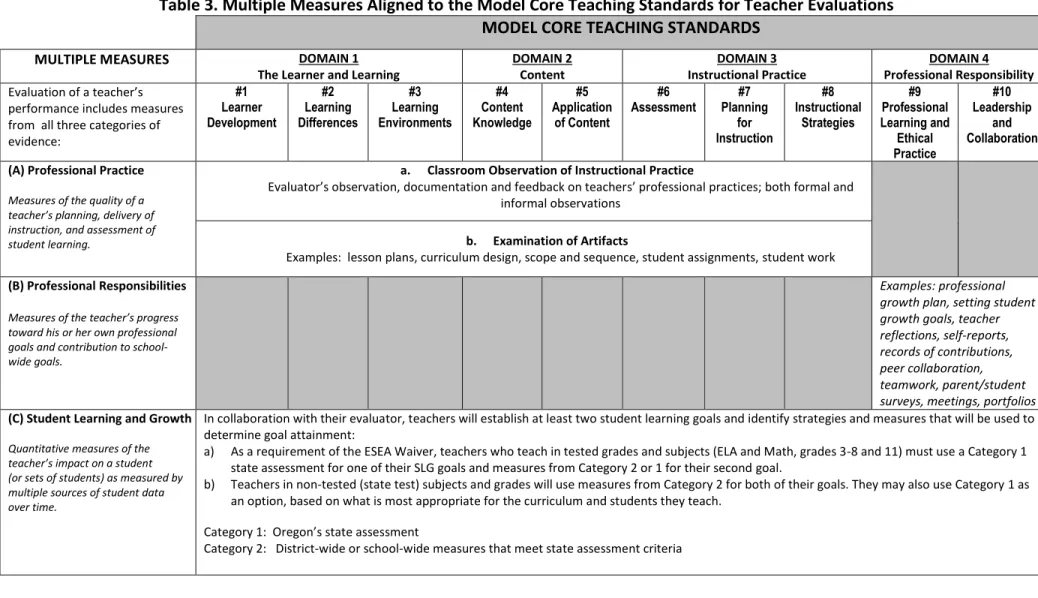
Table 3 illustrates how multiple measures align with the Model Core Teaching Standards for teacher evaluations.
Table 3. Multiple Measures Aligned to the Model Core Teaching Standards for Teacher Evaluations
MODEL CORE TEACHING STANDARDS
MULTIPLE MEASURES DOMAIN 1
The Learner and Learning
DOMAIN 2 Content DOMAIN 3 Instructional Practice DOMAIN 4 Professional Responsibility Evaluation of a teacher’s
performance includes measures from all three categories of evidence: #1 Learner Development #2 Learning Differences #3 Learning Environments #4 Content Knowledge #5 Application of Content #6 Assessment #7 Planning for Instruction #8 Instructional Strategies #9 Professional Learning and Ethical Practice #10 Leadership and Collaboration
(A) Professional Practice Measures of the quality of a teacher’s planning, delivery of instruction, and assessment of student learning.
a. Classroom Observation of Instructional Practice
Evaluator’s observation, documentation and feedback on teachers’ professional practices; both formal and informal observations
b. Examination of Artifacts
Examples: lesson plans, curriculum design, scope and sequence, student assignments, student work (B) Professional Responsibilities
Measures of the teacher’s progress toward his or her own professional goals and contribution to school-wide goals.
Examples: professional growth plan, setting student growth goals, teacher reflections, self-reports, records of contributions, peer collaboration, teamwork, parent/student surveys, meetings, portfolios
(C) Student Learning and Growth Quantitative measures of the teacher’s impact on a student (or sets of students) as measured by multiple sources of student data over time.
In collaboration with their evaluator, teachers will establish at least two student learning goals and identify strategies and measures that will be used to determine goal attainment:
a) As a requirement of the ESEA Waiver, teachers who teach in tested grades and subjects (ELA and Math, grades 3-8 and 11) must use a Category 1 state assessment for one of their SLG goals and measures from Category 2 or 1 for their second goal.
b) Teachers in non-tested (state test) subjects and grades will use measures from Category 2 for both of their goals. They may also use Category 1 as an option, based on what is most appropriate for the curriculum and students they teach.
Category 1: Oregon’s state assessment
Multiple Measures Address the Needs of All Teachers
Using multiple measures of student growth allows for the inclusion of all educators in the evaluation system, including those in non-tested subjects (e.g., the arts, music, CTE) and grades for which
standardized state tests are not administered. Basing the evaluation on multiple measures of student growth and measures of professional practice and professional responsibility allows appropriate customization of evaluations for teachers responsible for and students with disabilities or English Learners. For these educators, rigorous classroom based measures provides another way to show concrete evidence of teachers’ contribution to equitable student growth where standardized tests for their particular subject, grade, or specialization are not available.
While all Oregon teachers are held to the same standards of professional practice, evaluation processes and tools should be differentiated to accommodate the unique skills and responsibilities of special education and EL teachers where applicable.
Specialized skills and responsibilities for teachers who work with students with disabilities may include. Examples:
Knowledge of evidence-based instructional strategies for students with special needs
Appropriate use of instructional strategies and interventions to accommodate individual learning differences and augment achievement
Knowledge of current special education legislation/laws to maintain legal compliance Progress monitoring (specifically with IEP goals)
Effective case management skills to maintain records, prepare reports and correspondence; complete accurate and appropriate IEPs and meet compliance timelines
Knowledge of social and behavioral interventions
Specialized interventions for students with severe cognitive disabilities or other complex impairments
Knowledge of texts, materials, and specialized equipment to support the individual learning needs of students
Considerable knowledge of current literature, trends, and community resources (local, state, national) to provide information or support to parents
Effective collaboration and communication skills with parents, educational personnel, students and other involved parties
Specialized skills and responsibilities for teachers who work with English Learners may include.
Examples:
Increase attention to home language and cultures
Build connections between the students’ school and home
Employ appropriate research-based strategies to ensure students achieve literacy (e.g., developing and using EL literacy strategies, curriculum products, implementation plans and assessment tools) Exhibit theoretical and research-based knowledge of language acquisition and child development Work collaboratively with teachers in recognizing and responding to the multiple needs of the
diverse learners
Use a variety of ongoing, instructionally based assessment approaches to inform and differentiate instruction
Research, teach, and model best practices used to address the needs of those students who struggle with reading and writing
Assist with implementing a balanced approach of direct teaching using authentic, literature based reading and writing opportunities
Assist with district and school-wide literacy initiatives
Keep abreast of technical, legislative, and professional developments and trends affecting EL programs, disseminate information to appropriate district personnel and provide ongoing professional development, and make recommendations for program adjustments
Disaggregate and analyze data to target instruction, enhance student learning, and inform teacher practice
Assist in monitoring the district’s effectiveness and compliance with local, state, federal and court ordered requirements related to EL programs
Multiple Measures for Administrator Evaluation
The evaluation system must include a variety of evidence-based measures to evaluate administrator performance and effectiveness, based on the Educational Leadership/Administrator Standards (i.e., ISLLC). To provide a balanced view of administrator performance, evaluations of all building
administrators (i.e., principals, vice-principals) must include evidence from the following three categories: (A) Professional Practice, (B) Professional Responsibilities, and (C) Student Learning and Growth. Determining multiple measures for the district’s local evaluation system is key; accomplished through a collaborative process involving teachers and administrators. The measures listed under each category are provided as examples.
Professional Practice: Evidence of school leadership practices, teacher effectiveness, and organizational conditions.
Observation and review of artifacts
Examples: 360o feedback, feedback to teachers, surveys developed collaboratively with staff (re: instructional leadership, teacher/student climate), staff communication, teacher development, student/staff handbooks, records of mentoring/coaching, teacher use of data, staff meetings, teacher observations, summative and formative teacher evaluation
Professional Responsibility: Evidence of administrators’ progress toward their own professional goals and contribution to school-wide and district goals.
Examples: administrator reflection, self-report, professional goal setting, school-wide improvement goals, data committee meetings, portfolios, parent and community involvement, decision-making, professional development log, staff retention rate, collaborative leadership, school-wide budget, master schedule, teambuilding, teacher evaluations
Student Learning and Growth: Evidence of administrators’ contribution to school-wide student learning and growth.
Administrators, in collaboration with their supervisors/evaluators, will establish at least two student growth goals from the categories in Table 2. Administrators must use Category 1 state assessments for one SLG goal (e.g., building-level data on proficiency and growth in reading and math, including
all subgroups) and may use measures from Category 1 or 2 for their second goal. As a condition of the ESEA waiver principals must set academic goals.
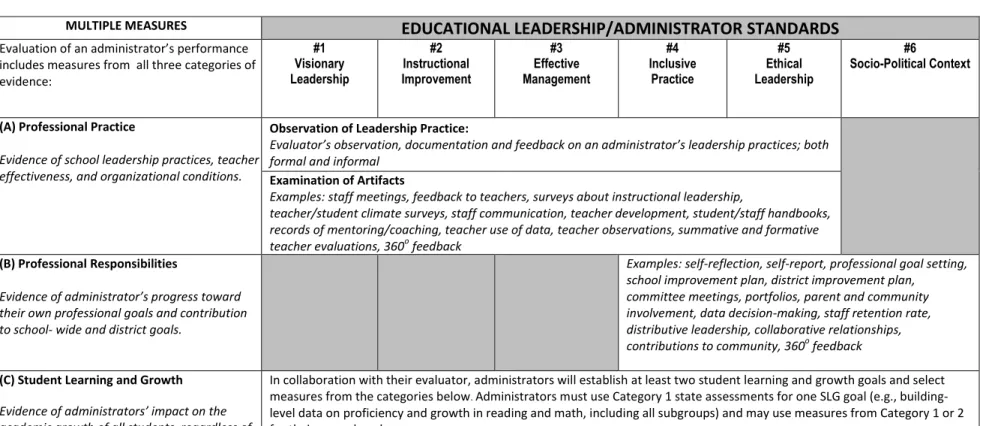
Administrators may limit their goals to one or more grade levels or subjects, if baseline data indicates the need for such a focus. Administrator SLG goals should be aligned with the district’s goals and school improvement process and, and where appropriate, Achievement Compact goals. Table 4 on the following page illustrates how multiple measures align with the Educational Leadership/ Administrator Standards for administrator evaluations.
Table 4. Multiple Measures Aligned to Educational Leadership/Administrator Standards (ISLLC) for Administrator Evaluations
MULTIPLE MEASURES
EDUCATIONAL LEADERSHIP/ADMINISTRATOR STANDARDS
Evaluation of an administrator’s performance includes measures from all three categories of evidence:
#1 Visionary Leadership
#2 Instructional Improvement
#3 Effective Management
#4 Inclusive
Practice
#5 Ethical Leadership
#6
Socio-Political Context
(A) Professional Practice
Evidence of school leadership practices, teacher effectiveness, and organizational conditions.
Observation of Leadership Practice:
Evaluator’s observation, documentation and feedback on an administrator’s leadership practices; both formal and informal
Examination of Artifacts
Examples: staff meetings, feedback to teachers, surveys about instructional leadership,
teacher/student climate surveys, staff communication, teacher development, student/staff handbooks, records of mentoring/coaching, teacher use of data, teacher observations, summative and formative teacher evaluations, 360o feedback
(B) Professional Responsibilities
Evidence of administrator’s progress toward their own professional goals and contribution to school- wide and district goals.
Examples: self-reflection, self-report, professional goal setting, school improvement plan, district improvement plan, committee meetings, portfolios, parent and community involvement, data decision-making, staff retention rate, distributive leadership, collaborative relationships, contributions to community, 360o feedback
(C) Student Learning and Growth
Evidence of administrators’ impact on the academic growth of all students, regardless of socio-economic status, language, and family background, contributing to overall school success.
In collaboration with their evaluator, administrators will establish at least two student learning and growth goals and select measures from the categories below. Administrators must use Category 1 state assessments for one SLG goal (e.g.,
building-level data on proficiency and growth in reading and math, including all subgroups) and may use measures from Category 1 or 2 for their second goal.
Category 1: Oregon’s state assessment
Student Learning and Growth (SLG) Goal Setting Process
Goal setting for student learning and growth is an important process for every Oregon educator. Rigorous, measurable goals provide a clear path for teacher and students to succeed. Setting SLG goals helps ensure that lesson design, instruction and assessment result in learning for all students. ODE has developed guidance on the SLG goal setting process that includes the eight required components, sample templates for both teachers and administrators, as well as the SLG Goal Quality Review Checklist and SLG Goal Scoring Rubric. This guidance can be found online at
http://www.ode.state.or.us/wma/teachlearn/educatoreffectiveness/slgg-guidance.doc
(4) Evaluation and Professional Growth Cycle for Teacher and Administrator
Evaluations
Teacher and administrator evaluation systems are based on a cycle of continuous professional growth and learning. An effective process is collaborative and provides ongoing opportunity for relevant feedback and meaningful professional conversations. The focus is on improving effectiveness.
A common vision, identified professional standards, and a research based performance rubric provide the foundation for common expectations, vocabulary and understanding. The evaluation process based on common language empowers the voice of the educator and observer. The following diagram
illustrates the critical steps in the cycle. This cycle can be adapted to local district processes.
Evaluation and Professional Growth Cycle
Self-Reflection
Goal Setting
Observation/
Collection of
Evidence
Formative
Assessment/
Evaluation
Summative
Evaluation
Oregon Matrix
Frequency of Evaluations
The evaluation and professional growth cycle is an ongoing process throughout an educator’s career. The cycle begins with a self-reflection and culminates in a summative evaluation. Feedback must be provided to the educator throughout the one-year and two-year cycles. The summative evaluation is the springboard that leads into a new cycle. The summative evaluation occurs on a cycle determined by the educator’s contract status:
Probationary teachers – every year
Contract teachers – at least every two years Probationary administrators – every year Administrators – at least every two years
Personnel Decisions
SB 290 and OAR 581-022-1723:
Adopt teaching and administrator standards to improve student academic growth and achievement by assisting school districts in determining the effectiveness of teachers and administrators and in making human resource decisions. School districts must describe in local board policy how their educator evaluation and support system is used to inform personnel decisions (e.g., contract status, contract renewal, plans of assistance, placement, assignment, career advancement, etc.).
Steps in an Evaluation and Professional Growth Cycle
STEP 1: Self-Reflection/Determining NeedsBased on the standards of professional practice, the first step of an evaluation system is self-reflection. The educator reflects on and assesses his/her professional practice and analyzes the learning and growth of his/her students in preparation for goal setting.
STEP 2: Goal Setting (Student growth goals and professional goals)
Based on the self-assessment, the educator identifies goals aligned with the standards of
professional practice that encompass both practice and impact on student learning. The educator sets both professional practice goals and student learning goals. SMART goals and/or learning targets are used as a tool for effective goal setting.
STEP 3: Observation and Collection of Evidence (Multiple measures)
The educator and evaluator collect evidence using multiple measures regarding student learning and growth, professional practice, professional responsibilities, and student learning to inform progress throughout the process of evaluation.
STEP 4: Formative Assessment/Evaluation (Analysis of evidence, Professional conversations, and Professional growth)
The evaluator and educator review the educator’s progress toward goals and/or performance against standards. This step includes three interdependent and critical parts: analysis of evidence, professional conversations, and professional growth. Both the educator and the observer analyze the evidence leading into a collaborative professional conversation. Feedback through
professional conversations promotes awareness of growth that has occurred, and highlights professional growth needs. These conversations help the educator make adjustments in his/her practice and select relevant professional learning opportunities.
STEP 5: Summative Evaluation
This step is the culmination of multiple formative observations, reflections, professional conversations, etc. Evaluator assesses the educator’s performance against the standards of
professional practice, attainment of student learning goals, and attainment of professional practice goals. The summative evaluation combines performance ratings from multiple measures:
professional practice, professional responsibilities, and student learning and growth. Beginning in the 2014-15 school year, all districts will use the Oregon Matrix for teacher and administrator summative evaluations to determine their overall performance level and corresponding professional growth plan.
Overview of the Oregon Matrix for Summative Evaluations
In the Oregon Matrix, Professional Practice (PP) and Professional Responsibilities (PR) intersects with Student Learning and Growth (SLG) culminating in a Professional Growth Plan and summative
performance level. When there is a discrepancy between the PP/PR level and SLG level, further inquiry is triggered to explore and understand the reasons for the discrepancy in order to then determine the Professional Growth Plan and corresponding summative performance level.
Y -A X IS : Pr o fessi o n al Pr ac tice & Pr o fe ssi o n al R e sp o n si b ili ti e s (PP/PR) LEVEL 4 (Highest) COLLEGIAL
*SLG INQUIRY
3
FACILITATIVE or
COLLEGIAL
* SLG INQUIRY
3 or 4
FACILITATIVE
4
FACILITATIVE
4
LEVEL 3
COLLEGIAL or
CONSULTING
*SLG INQUIRY
2 or 3
COLLEGIAL 3 COLLEGIAL 3 COLLEGIAL 3 LEVEL 2 CONSULTING 2 CONSULTING 2 CONSULTING 2
COLLEGIAL or
CONSULTING
* PP/PR INQUIRY
2 or 3
LEVEL 1 (Lowest) DIRECTED 1 DIRECTED 1
CONSULTING or
DIRECTED
* PP/PR INQUIRY
1 or 2
CONSULTING
*PP/PR INQUIRY
2
LEVEL 1 LEVEL 2 LEVEL 3 LEVEL 4
X-AXIS: Rating on Student Learning and Growth
*Ratings in these areas require an inquiry process in order to determine a summative performance level and Professional Growth Plan.
Statewide Components of the Oregon Matrix
How does an evaluator determine level 1-4 on the Y-axis and X-axis of the matrix and a final summative performance level at the end of an educator’s evaluation cycle?
Y-Axis: Professional Practice and Professional Responsibilities (PP/PR)
First, the evaluator will need to determine the combined performance level for PP/PR based on data from the district’s rubric. The evaluator will already have gauged the educator’s performance on each standard/performance indicator on the rubric with four performance levels. For example, in a Danielson rubric, educators will have received a performance level for all 22 components (for Marshall rubrics, 60 components; for LEGENDS 29 components; etc.). The evaluator will then:
1. Add up all component scores to get the total points possible;
2. Divide by the number of components (based on the # of components in the rubric); 3. Get a rating between 1 and 4 for PP/PR;
4. Use the following thresholds to determine PP/PR level: 3.6 - 4.0 = 4 PP/PR
2.81-3.59 =3 PP/PR 1.99 – 2.8 = 2 PP/PR* < 1.99 = 1 PP/PR
5. Find the PP/PR performance level (1-4) on the Y-axis of the matrix.
X-Axis: Student Learning and Growth (SLG)
After the educator’s PP/PR performance level is determined, their Professional Growth Plan and summative performance level is then found by looking at the educator’s rating on SLG goals. All educators will set two SLG goals annually. Educators on a two year evaluation cycle will select two of the four goals collaboratively with their evaluator to be included in their summative evaluation. Math and ELA teachers (grades 3-8 /11) and administrators must use Category 1 for one goal. The level of performance on SLG will be determined by scoring the SLG goals using the Oregon SLG Goal scoring rubric. See Guidance for Setting SLG Goals for templates and tools to set and score SLG goals
http://www.ode.state.or.us/wma/teachlearn/educatoreffectiveness/slgg-guidance.doc
The evaluator will use the following thresholds to determine X-Axis performance level: 1. Score the SLG goals using the SLG Scoring Rubric;
2. Get a rating between 1 and 4 for SLG;
3. Use the thresholds below to determine SLG level;
4. Find the SLG performance level (1-4) on the X-Axis of the matrix.
Level 4 Level 3 Level 2 Level 1
You must score:
4 on both goals
You could score:
3 on both goals, or
3 on one goal & 4 on one goal, or
4 on one goal & 2 on one goal
You could score:
2 on both goals, or
2 on one goal & 3 on one goal, or
3 on one goal & 1 on one goal, or
4 on one goal & 1 on one goal
You could score:
1 on both goals, or
1 on one goal & 2 on one goal
*PP/PR Scoring Rule: If the educator scores two 1’s in any PP/PR component and his/her average score falls between 1.99-2.499, the educator’s performance level cannot be rated above a 1.