ON
LIN
E V
ER
SIO
N
ON
LIN
E V
ER
SIO
N
ON
LIN
E V
ER
SIO
N
Fire safety
The Building Regulations 2000
B
B1
Means of warning and escape
B2
Internal fire spread (linings)
B3
Internal fire spread (structure)
B4
External fire spread
B5
Access and facilities for the fire service
VOLUME 2 – BUILDINGS OTHER
THAN DWELLINGHOUSES
APPROVED DOCUMENT
Building
Regulations 2000
APPROVED
DOCUMENT
B
– VOL 2
Fir
e
safety
2006
edition
2007
Published by NBS, part of RIBA Enterprises Ltd, and available from: RIBA Bookshops Mail Order
15 Bonhill Street London EC2P 2EA
Telephone orders/General enquiries: 020 7256 7222 Fax orders: 020 7374 2737
Email orders: [email protected] Or order online at:
www.thebuildingregs.com
www.thenbs.com
© Crown copyright 2007
The Approved Documents are published by NBS for the Department for Communities and Local Government.
This publication has been approved by Ministers and has official status. Copyright in the contents, the cover, the design and the typographical arrangement of this publication rests with the Crown unless otherwise stated. The contents of this publication may be reproduced free of charge in any format or medium for the purposes of private research and study or for internal circulation within an organisation. This is subject to the contents being reproduced accurately and not in a way that implies official status. Any publisher wishing to reproduce the content of this publication must not use or replicate the CLG logo or replicate the official version’s style and appearance, including the cover design, and must not present their publication as being an official publication as this may confuse the public. The reproduced material must be acknowledged as Crown Copyright and the title of the publication specified. The Department for Communities and Local Government does not accept any responsibility for the accuracy and comprehensiveness of any other versions. Any other use of the contents of this publication would require a copyright licence. Please apply for a licence by writing to the Office of Public Sector Information, Information Policy Team, St Clements House, 2-16 Colegate, Norwich NR3 1BQ. Fax 01603 723000 or email [email protected]. Further information can be obtained from www.opsi.gov.uk.
ISBN-10 1 85946 262 6 ISBN-13 978 1 85946 262 1 Stock code 60511
RIBA Bookshops
66 Portland Place, London W1B 1AD. Telephone 020 7256 7222.
113-115 Portland Street, Manchester M1 6DW. Telephone 0161 236 7691.
Birmingham & Midland Institute, Margaret Street, Birmingham B3 3SP. Telephone 0121 233 2321. RSUA, 2 Mount Charles, Belfast BT7 1NZ. Telephone 028 9032 3760.
Renew Rooms, 82 Wood Street, Liverpool L1 4DQ. Telephone 0151 707 4380.
Coming into effect April 2007
ONLINE
VERSION
ONLINE
VERSION
ONLINE
All references to the Building Regulations 2000 (as amended) should be read as references to the Building Regulations 2010.
All references to the Building (Approved Inspectors etc.) Regulations 2000 should be read as references to the Building (Approved Inspectors etc.) Regulations 2010.
There have been no substantive requirements amendments to either set of regulations, but please note the simplification of the definition of ‘room for residential purposes’ in regulation 2 of the Building Regulations 2010. Please also note that L1(c) has now become regulation 40.
The following tables will help you to find the new regulation number for regulations which have been re-numbered in the 2010 Regulations. For any regulation number not included in the tables below, the number of the regulation has not changed.
Compliance Guides 2010
ONLINE
VERSION
ONLINE
VERSION
ONLINE
number in Building Regulations 2000
number in Building Regulations 2010
number in Building Regulations 2000
number in Building Regulations 2010
number in Building Regulations 2000
number in Building Regulations 2010
2(2A) 2(3) 12(7) 12(8) 20AA 42
2(2B) 2(4) 13(2)(c)(iii) 13(2)(ii) 20B 43
2(2C) 2(5) 13(3) deleted 20C(A1) 44(1)
2(3) deleted 13(5) 13(3) 20C(1) 44(2)
3(1)(g) 3(1)(h) 13(6) 13(4) 20C(2) 44(3)
3(1)(h) 3(1)(g) 13(7) 13(5) 20C(3) 44(4)
4(1A) 4(2) 14(3)(aa) 14(3)(b) 20D 27
4(2) 4(3) 14(3)(b) 14(3)(c) 20E 37
4A 23 14A 15 21(1) 18(1)
4B(1) 22 15 16 21(2) 18(8)
4B(2) deleted 16A 20 21(3) 18(2)
6(1)(cc) 6(1)(d) 16B 38 21(4) 18(3)
6(1)(d) 6(1)(e) 16C 39 21(5) 18(4)
6(1)(e) 6(1)(f) 17A 24 21(6) 18(5)
6(1)(f) 6(1)(g) 17B 25 21(7) 18(6)
6(1)(ff) 6(1)(h) 17C 26 21(8) 18(7)
6(1)(g) 6(1)(i) 17D 28 22 47
9(1A) 9(2) 17E(4) 29(5) 22B(1)(a) 48(1)(a)
9(2) 9(3) 17E(5) 29(4) 22B(1)(b) 48(1)(b)
9(3) 21(1) 17F 30 22B(1)(c) 48(1)(c)
9(4) 21(2) 17G 31 22B(1)(d) 48(1)(g)
9(5) 21(3) 17H 32 22B(1)(e) 48(1)(d)
9(5A) 21(4) 17I 33 22B(1)(f) 48(1)(i)
9(6) 21(5) 17J 35 22B(1)(g) 48(1)(j)
12(2) 12(1) 17K 36 22B(1)(h) 48(1)(l)
12(2A) 12(2) 18 45 22B(1)(ha) 48(1)(m)
12(4A) 12(5) 19 46 22B(1)(i) 48(1)(n)
12(5) 12(6) 20 19 22B(1)(j) 48(1)(o)
12(6) 12(7) 20A 41 22B(1)(k) 48(1)(h)
22B(1)(ka) 48(1)(k) J2A J3 J6 J7
22B(1)(l) 48(1)(e) J3 J4 L1(c) Regulation 40
22B(1)(m) 48(1)(f) J4 J5 Schedule 2A Schedule 3
22B(2) 48(2) J5 J6 Schedule 2B Schedule 4
ONLINE
VERSION
ONLINE
VERSION
ONLINE
number in Building (Approved Inspectors etc.) Regulations 2000
number in Building (Approved Inspectors etc.) Regulations 2010
number in Building (Approved Inspectors etc.) Regulations 2000
number in Building (Approved Inspectors etc.) Regulations 2010
number in Building (Approved Inspectors etc.) Regulations 2000
number in Building (Approved Inspectors etc.) Regulations 2010
1 1 and 38 13(1)(d) 12(6)(c) 25(2) 25(3)
3 4 13(2) 12(1) 25(3) 25(4)
4 3 13(3) 12(2) 31A(a) 32(c)
8 10 13(4) 12(3) 31A(b) 32(c)
9 11 13(5) 12(4) 31A(c) 32(e)
10(1) 9(5) 13(6) 12(5) 31A(d) 32(f)
10(2) 9(1) 13A 13 31A(e) 32(h)
10(3) 9(2) 14 14(1) 31A(ea) 32(i)
10(4) 9(3) 15(1) 14(2) 31A(f) 32(j)
10(5) 9(4) 15(2) 14(3) 31A(g) 32(k)
11(1)(a) 8(1)(a) 15(3) 14(4) 31A(h) 32(d)
11(1)(c) 8(1)(b) 16 15 31A(ha) 32(g)
11(2) 8(2) 17 16 31A(i) 32(a)
11A 20(1) 18(1) 17(1) 31A(j) 32(b)
12 20(1) and (3) 18(2) 17(2) and (3) *Sch 3 7A Sch 2 8
12A 20(1) and (5) 18(3) 17(4) Sch 3 8 Sch 2 9
12AA 20(1) 18(4) 17(5) Sch 3 9 Sch 2 10
12B 20(1) 18(5) 17(6) Sch 4 7A Sch 3 8
12C 20(1) and (6) 18(6) 17(7) Sch 4 8 Sch 3 9
12D 20(1) and (2) 19 18 Sch 6 5A Sch 5 6
12E 20(1) and (4) 20 19 Sch 6 6 Sch 6 7
13(1) 12(6) 23A 24
13(1)(b) 12(6)(a) 24 25(1)
13(1)(c) 12(6)(b) 25(1) 25(2)
Please note that some of the numbering and cross referencing in the forms in Schedule 1 has changed slightly. *Sch =Schedule
ONLINE
VERSION
ONLINE
VERSION
ONLINE
ON
LIN
E V
ER
SIO
N
ON
LIN
E V
ER
SIO
N
ON
LIN
E V
ER
SIO
N
2006 EDITION
This is the second impression of the 2006 Edition of Approved Document B which incorporates the typographical and proofing corrections issued in April 2007.
This edition of Approved Document B, Fire safety, replaces the 2000 edition. The main changes are:
General
a. Approved Document B:The Approved Document has been split into two volumes. Volume 1 deals with dwellinghouses, Volume 2 deals with buildings other than dwellinghouses. b. Fire Safety Information: A new Regulation
(16B) has been introduced to ensure that sufficient information is recorded to assist the eventual owner/occupier/employer to meet their statutory duties under the Regulatory Reform (Fire Safety) Order 2005.
Introduction
c. Management of Premises: New guidance is given on the need to ensure that management regimes are realistic.
d. Certification Schemes: Suitable schemes may be accepted by Building Control Bodies as evidence of compliance.
e. Residential Sprinklers:The use of sprinkler systems in accordance with BS 9251:2005 is recognised.
f. Alternative Approaches
i. HTM 05 “Firecode” should be used for used for the design of hospitals and similar health care premises.
ii. BB100 should be used for the design of schools.
B1
g. Fire Alarms in Flats: The guidance on smoke alarms in flats has been amended such that alarms should be installed in accordance with BS 5839- 6:2004.
Simple guidance has been retained, in the form of a commentary on this standard, so that most users of the Approved Document will necessarily not need to obtain a copy of the standard. i. All smoke alarms should have a standby
power supply.
h. Fire Alarms:The guidance for buildings other than dwellings has been updated to take account of the 2002 edition of BS 5839-1. i. Means of escape:
i. Locks and child resistant safety stays may be provided on escape windows.
ii. New guidance has been provided on the provision of galleries and inner inner rooms. iii. Additional options of providing sprinkler
protection and/or a protected stairway instead
v. The provisions for smoke control in the common areas of flats have been changed. vi. Guidance on means of escape in buildings
with open spatial planning has been included. vii. A method has been provided for calculating
acceptable final exit widths for merging escape routes at ground floor level.
viii. Guidance on the provision of cavity barriers associated with subdivided corridors has been moved to Section 3 and clarified. ix. Guidance applicable to small premises,
previously in BS 5588-11, has been incorporated into the text.
x. New guidance on the design of residential care homes has been given including the use of sprinklers and/or free swing door closing devices. Greater flexibility is also given where sprinkler systems are provided. xi. Guidance on means of escape for disabled
people has been incorporated in the general guidance on means of escape.
xii. In tall building with phased evacuation consideration needs to be given to the interaction of firefighters with people attempting to evacuate the building. xiii. More detailed guidance has been provided
on the protection of ventilation systems.
B3
j. Compartment Walls: The predicted deflection of a floor, in the event of a fire, should be accommodated in the design of compartment walls.
k. Sprinkler protection in flats: Sprinkler systems should be provided in blocks of flats exceeding 30m in height.
l. Warehouses:A maximum compartment size has been introduced for unsprinklered single-storey warehouse buildings.
m. Concealed Spaces: This section has been completely restructured. Table 13 (AD B 2000) has now been incorporated into the text to reduce confusion.
i. Openings:Window and door frames should only be regarded as cavity barriers if they are constructed of steel or timber of an appropriate thickness.
ii. Under Floor Voids:Extensive cavities in floor voids should be subdivided with cavity barriers. n. Fire dampers: Guidance on the specification and installation of fire dampers has been provided. o. Car Parks: Non combustible materials should be used in the construction of a car park for it to be regarded as ‘open sided’ for the purposes of establishing the necessary period of fire resistance. Other car parks should achieve the standard period of fire resistance.
the purpose of providing practical guidance with respect to the requirements of the Building Regulations 2000 (as amended).
Approved Document A: Structure
2004 edition incorporating 2004 amendments Approved Document B: Fire safety
2000 edition incorporating 2000 and 2002 amendments
Approved Document B: Fire safety (volume 1) – Dwellinghouses
2006 edition
Approved Document B: Fire safety (volume 2) – Buildings other than dwellinghouses
2006 edition
Approved Document C: Site preparation and resistance to contaminants and moisture 2004 edition
Approved Document D: Toxic substances 1992 edition incorporating 2002 amendments Approved Document E: Resistance to the passage of sound
2003 edition incorporating 2004 amendments Approved Document F: Ventilation
2006 edition
Approved Document G: Hygiene
1992 edition incorporating 1992 and 2000 amendments
Approved Document H: Drainage and waste disposal
2002 edition
Approved Document J: Combustion appliances and fuel storage systems 2002 edition
Approved Document J: 2002 Edition: Guidance and Supplementary Information on the UK Implementation of European Standards for Chimneys and Flues 2002 edition
Approved Document K: Protection from falling collision and impact
1998 edition incorporating 2000 amendments Approved Document L1A: Conservation of fuel and power
New dwellings 2006 edition
Approved Document L1B: Conservation of fuel and power
Existing dwellings 2006 edition
Approved Document L2A: Conservation of fuel and power
New buildings other than dwellings 2006 edition
Approved Document L2B: Conservation of fuel and power
Existing buildings other than dwellings 2006 edition
Approved Document M: Access to and use of buildings
2004 edition
Approved Document N: Glazing – safety in relation to impact, opening and cleaning 1998 edition incorporating 2000 amendments Approved Document P: Electrical safety – Dwellings
2006 edition
Approved Document to support regulation 7: Materials and workmanship
1992 edition incorporating 2000 amendments
B4
p. Notional Boundaries: Space separation should be considered where more than one building is on the same site but operated by different ‘organisations’.
q. Roof Coverings: The guidance on roof coverings incorporates the new European system of classification set out in BS EN 13501-5:2005.
B5
r. Private Hydrants:A building with a
compartment of 280m2or more, constructed
more than 100m from a highway, should be provided with suitable fire hydrants.
s. Vehicle Access:There should be access for a pump appliance to within 45m of all points within a dwelling or a suitable fire main should be provided
t. Firefighting Shafts: Assembly buildings with a floor exceeding 900m2, with a floor over 7.5m
u. Hose distances:In unsprinklered buildings every part of every storey over 18m in height should be within 45m of a fire main outlet.
Appendix B
v. Self-Closing Devices:Fire doors withinflats need not be provided with self-closing devices.
Appendix C
w. Occupant capacity: The floor space factors table has been updated and moved to this Appendix. x. Door width:The method of measurement for
door width has been changed to align with Approved Document M.
y. Smoke ventilators:Guidance is given on the measurement of free area for smoke ventilators.
Appendix G
z. Fire Safety Information: This new Appendix provides guidance on the new requirement for fire safety information to be recorded and
ONLINE
VERSION
ONLINE
VERSION
ONLINE
VERSION
ON
LIN
E V
ER
SIO
N
ON
LIN
E V
ER
SIO
N
ON
LIN
E V
ER
SIO
N
Use of guidance 5
The Approved Documents 5 Limitation on requirements 5 Materials and workmanship 5 Interaction with other legislation 6
General introduction 9
Scope 9
Arrangement of sections 9 Management of premises 0 Property protection 0 Independent schemes of certification and
accreditation 0
Sprinkler systems Inclusive design 2 Material alteration 2 Alternative approaches 2
B1 Means of warning and escape
– The Requirement 5
B1 Guidance 6
Performance 6
Introduction 6
B1 Section 1: Fire alarm and fire
detection systems 8
Introduction 8
Flats 8
Buildings other than flats 9
B1 Section 2: Means of escape from flats 22
Introduction 22
General provisions 22 Provisions for escape from flats where the floor is not more than 4.5m above ground level 23 Provisions for flats with a floor more
than 4.5m above ground level 23 Means of escape in the common parts of flats 26 Common stairs 30 Live/work units 32
B1 Section 3: Design for horizontal escape
in buildings other than flats 33
Introduction 33
Escape route design 33 Small premises 40 Residential care homes 42
B1 Section 4: Design for vertical escape 44
Introduction 44
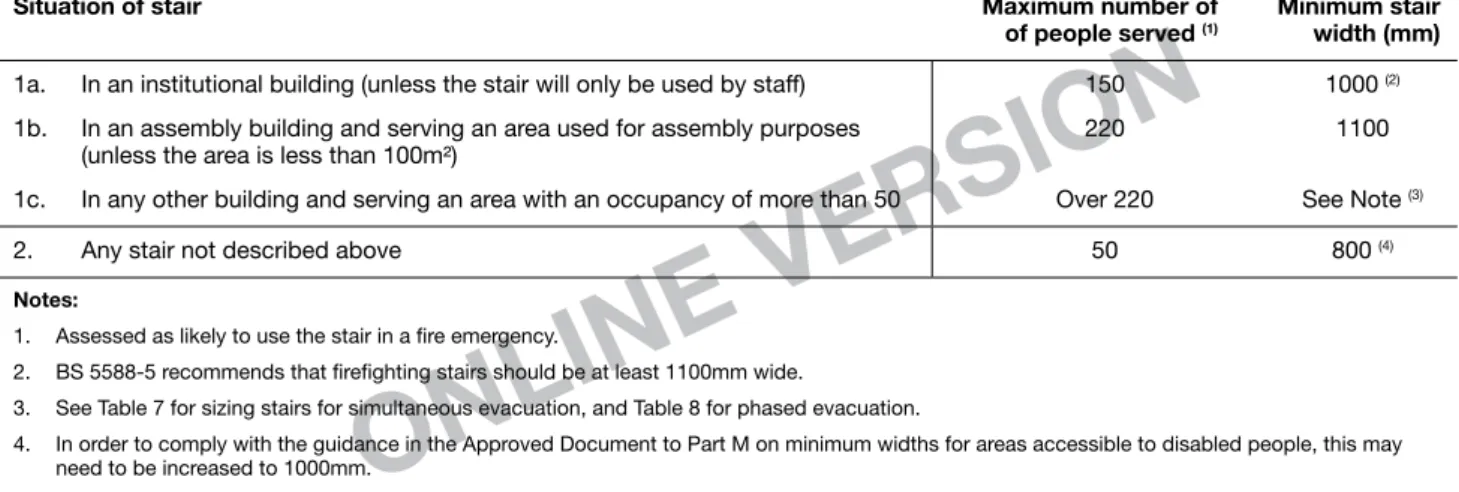
Number of escape stairs 44 Provision of refuges 44 Width of escape stairs 46 Calculation of minimum stair width 46 Protection of escape stairs 50 Basement stairs 52 External escape stairs 53
B1 Section 5: General provisions 54
Introduction 54
Protection of escape routes 54 Doors on escape routes 54
Stairs 55
General 58
Lifts 59
Mechanical ventilation and
air-conditioning systems 60 Refuse chutes and storage 60 Shop storerooms 6
B2 Internal fire spread (linings)
– The Requirement 62
B2 Guidance 63
Performance 63
Introduction 63
B2 Section6: Wall and ceiling linings 64
Classification of linings 64 Variations and special provisions 64 Thermoplastic materials 65
B3 Internal fire spread (structure)
– The Requirement 67
B3 Guidance 68
Performance 68
Introduction 68
B3 Section 7: Loadbearing elements
of structure 69
Introduction 69
Fire resistance standard 69 Raised storage areas 69 Conversion to flats 70
Contents
PAGE PAGE
ONLINE
VERSION
ONLINE
VERSION
ONLINE
ON
LIN
E V
ER
SIO
N
ON
LIN
E V
ER
SIO
N
ON
LIN
E V
ER
SIO
N
B3 Section 8: Compartmentation 7
Introduction 7
Provision of compartmentation 7 Construction of compartment walls and
compartment floors 74 Openings in compartmentation 76 Protected shafts 76
B3 Section 9: Concealed spaces (cavities) 80
Introduction 80
Provision of cavity barriers 80 Pathways around fire separating elements 8 Extensive cavities 8 Construction and fixings for cavity barriers 84
B3 Section 10: Protection of openings
and fire-stopping 85
Introduction 85
Openings for pipes 85 Ventilation ducts, flues, etc. 86 Fire-stopping 87
B3 Section 11: Special provisions for car
parks and shopping complexes 89
lntroduction 89
Car parks 89
Shopping complexes 90
B4 External fire spread
– The Requirement 9
B4 Guidance 92
Performance 92
Introduction 92
B4 Section 12: Construction of
external walls 93
Introduction 93
Fire resistance standard 93 Portal frames 93 External wall construction 93 External surfaces 93
B4 Section 13: Space separation 96
Introduction 96
Boundaries 97
Unprotected areas and fire resistance 98 Methods for calculating acceptable
unprotected area 00
B4 Section 14: Roof coverings 02
Introduction 02
Classification of performance 02 Separation distances 02
B5 Access and facilities for the Fire and Rescue Service
– The Requirement 05
B5 Guidance 06
Performance 06
Introduction 06
B5 Section 15: Fire Mains and hydrants 07
Introduction 07
Provision of fire mains 07 Number and location of fire mains 07 Design and construction of fire mains 07 Provision of private hydrants 07
B5 Section 16: Vehicle access 08
Introduction 08
Buildings not fitted with fire mains 08 Buildings fitted with fire mains Design of access routes and hard-standings
B5 Section 17: Access to buildings for
firefighting personnel 2
Introduction 2
Provision of firefighting shafts 2 Number and location of firefighting shafts 2 Design and construction of firefighting shafts 2 Rolling shutters in compartment walls 4
B5 Section 18: Venting of heat and
smoke from basements 5
Introduction 5
Provision of smoke outlets 5 Construction of outlet ducts or shafts 6 Basement car parks 6
Appendices
Appendix A: Performance of
materials, products and structures 7
Introduction 7
Fire resistance 7
Roofs 8
Reaction to fire 9 Non-combustible materials 9
PAGE PAGE
ONLINE
VERSION
ONLINE
VERSION
ONLINE
ON
LIN
E V
ER
SIO
N
ON
LIN
E V
ER
SIO
N
ON
LIN
E V
ER
SIO
N
Materials of limited combustibility 9 Internal linings 9 Thermoplastic materials 20 Fire test methods 2
Appendix B: Fire doors 32
Appendix C: Methods of measurement 35
Appendix D: Purpose groups 39
Appendix E: Definitions 4
Appendix F: Fire behaviour of insulating
core panels used for internal structures 45
Appendix G: Fire safety information 47
Appendix H: Standards and other
publications referred to 49
Diagrams B1
. Gallery floors with no alternative exit 23 2. Flat where all habitable rooms have
direct access to an entrance hall 24 3. Flat with restricted travel distance
from furthest point to entrance 24 4. Flat with an alternative exit, but
where all habitable rooms have no
direct access to an entrance hall 25 5. Multi-storey flat with alternative exits
from each habitable room, except at entrance level 25 6. Multi-storey flat with protected
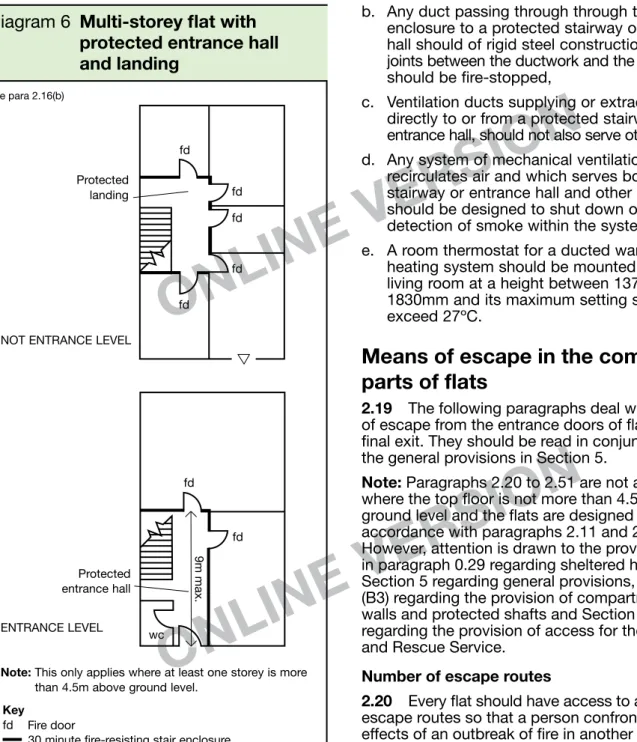
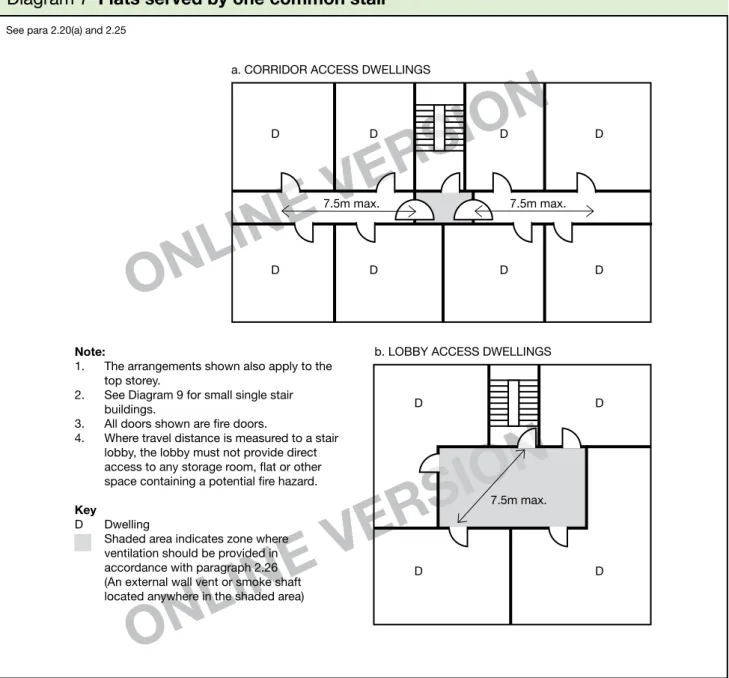
entrance hall and landing 26 7. Flats served by one common stair 27 8. Flats served by more than one
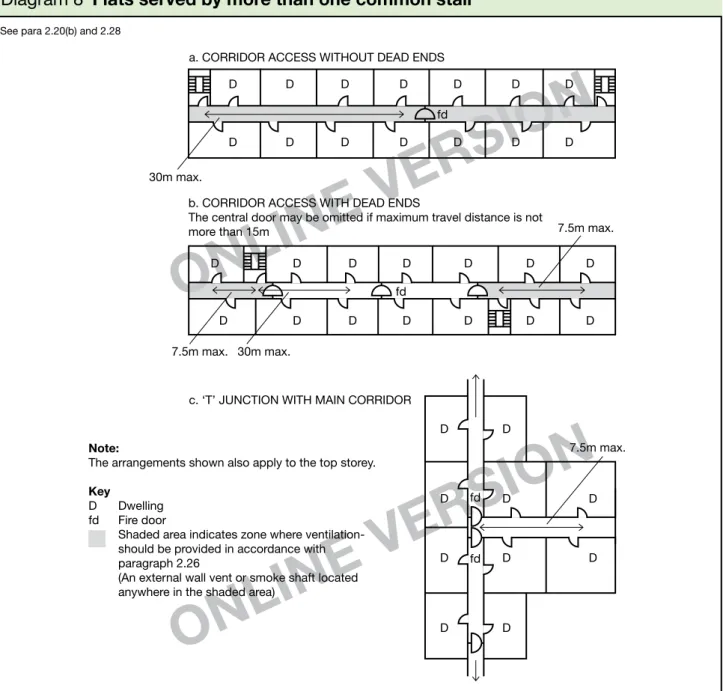
common stair 28 9. Common escape route in small single
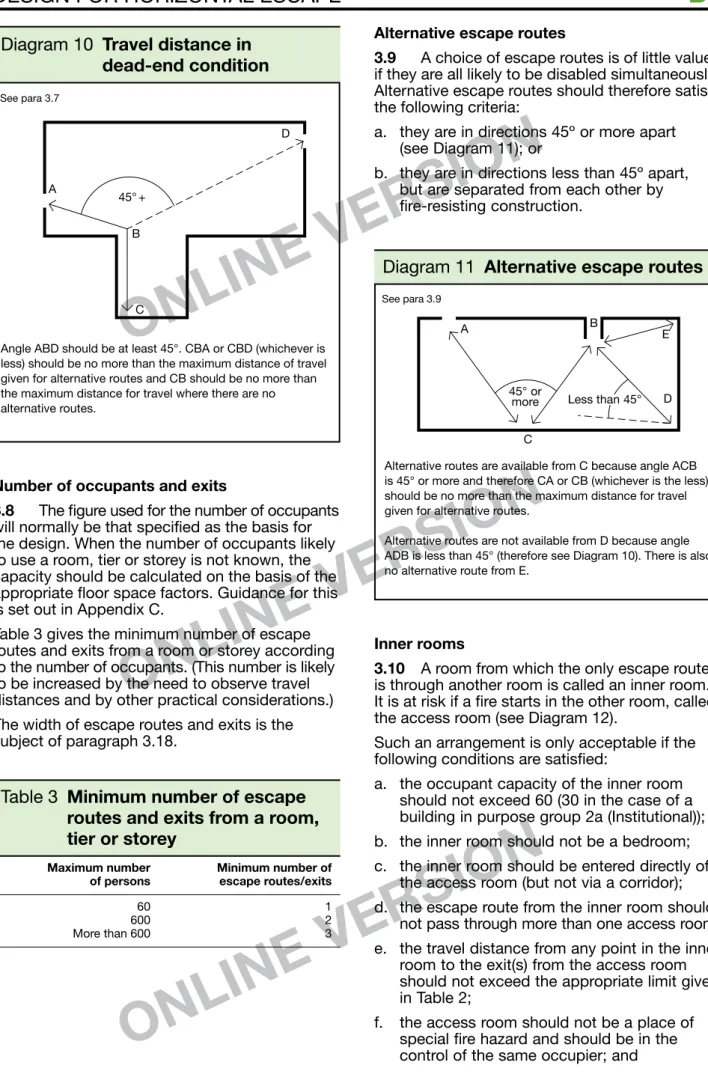
stair building 29 0. Travel distance in dead-end condition 35 . Alternative escape routes 35 2. Inner room and access room 36 3. Exits in a central core 36 4. Open connections 36 5. Merging flows at final exit 38 6. Subdivision of corridors 39 7. Dead-end corridors 40 8. Maximum travel distances in a small two
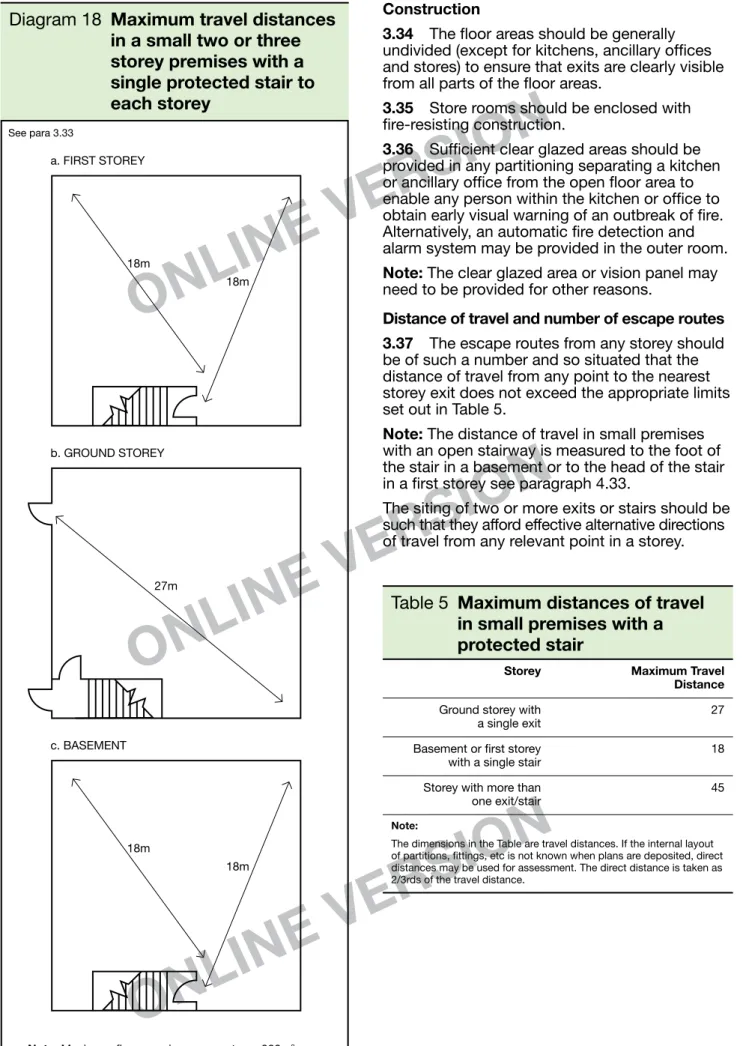
or three storey premises with a single protected stairway to each storey 4
9. Progressive horizontal evacuation
in care homes 42 20. Refuge formed by compartmentation 45 2. Refuge formed in a stairway 45 22. Maximum travel distance in a
two-storey premises with a single
open stair 5
23. Maximum travel distance in a small three-storey premises with
a single stair to each storey 5 24. External protection to protected
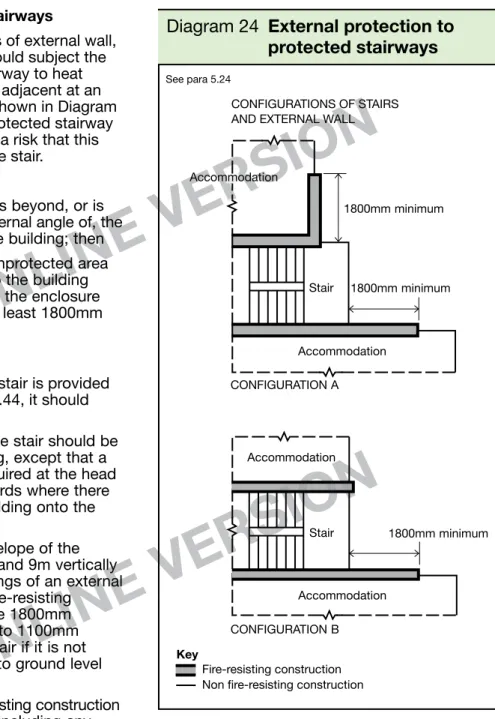
stairways 56
25. Fire resistance of areas adjacent to external stairs 57
B2
26. Lighting diffuser in relation to ceiling 65 27. Layout restrictions on Class 3 plastic
rooflights, TP(b) rooflights and TP(b) lighting diffusers 66
B3
28. Compartment floors: illustration of
guidance in paragraph 8.8 73 29. Compartment walls and compartment
floors with reference to relevant
paragraphs in Section 8 75 30. Junction of compartment wall
with roof 77
3. Protected shafts 78 32. Uninsulated glazed screen separating
protected shaft from lobby or corridor 79 33. Provisions for cavity barriers 80 34. Cavity walls excluded from provisions
for cavity barriers 82 35. Fire-resisting ceiling below
concealed space 83 36. Provisions for cavity barriers in
double-skinned insulated roof sheeting 83 37. Pipes penetrating structure 86 38. Enclosure for drainage or water
supply pipes 87 39. Flues penetrating compartment
walls or floors 88
B4
40. Provisions for external surfaces of walls 95 4. Relevant boundary 96 42. Notional boundary 97 43. Status of combustible surface material
as unprotected area 98
PAGE PAGE
ONLINE
VERSION
ONLINE
VERSION
ONLINE
ON
LIN
E V
ER
SIO
N
ON
LIN
E V
ER
SIO
N
ON
LIN
E V
ER
SIO
N
44. Unprotected areas which may be disregarded in assessing the separation distance from the boundary 99 45. The effect of a canopy on
separation distance 99 46. Permitted unprotected areas in small
residential buildings 0 47. Limitations on spacing and size of plastic
rooflights having a Class 3 (National class) or Class D-s3, d2 (European
class) or TP(b) lower surface 02
B5
48. Example of building footprint and
perimeter 09
49. Relationship between building and hard-standing/access roads for high reach fire appliances 0 50. Turning facilities 5. Provision of firefighting shafts 3 52. Components of a firefighting shaft 4 53. Fire-resisting construction for smoke
outlet shafts 5
Appendices
C. Measurement of door width 36 C2. Cubic capacity 36
C3. Area 37
C4. Height of building 37 C5. Number of storeys 38 C6. Height of top storey in building 38 C7. Free area of smoke ventilators 38 E. Recessed car parking areas 44
Tables B1
. Limitations on distance of travel
in common areas of block of flats 29 2. Limitations on travel distance 34 3. Minimum number of escape routes
and exits from a room, tier or storey 35 4. Widths of escape routes and exits 37 5. Maximum distances of travel in
small premises with a protected stair 4 6. Minimum width of escape stairs 46 7. Capacity of a stair for basements
and for simultaneous evacuation of the building 47 8. Minimum width of stairs designed
for phased evacuation 49 9. Provisions for escape lighting 59
B2
0. Classification of linings 64 . Limitations applied to thermoplastic
rooflights and lighting diffusers in suspended ceilings and Class 3
plastic rooflights 66
B3
2. Maximum dimensions of building or compartment (non-residential
buildings) 74
3. Maximum dimensions of cavities in non-domestic buildings (Purpose
Groups 2-7) 82 4. Maximum nominal internal diameter of
pipes passing through a compartment
wall/floor 85
B4
5. Permitted unprotected areas in small buildings or compartments 0 6. Limitations on roof coverings 03 7. Class 3 (National class) or Class
D-s3,d2 plastic rooflights: limitations on use and boundary distance 04 8. TP(a) and TP(b) plastic rooflights:
limitations on useand boundary
distance 04
B5
9. Fire and rescue service vehicle access to buildings (excluding blocks of flats) not fitted with fire mains 08 20. Typical fire and rescue service vehicle
access route specification
Appendices
A. Specific provisions of test for fire
resistance of elements of structure etc. 22 A2. Minimum periods of fire resistance 24 A3. Limitations on fire-protecting
suspended ceilings 26 A4. Limitations on the use of uninsulated
glazed elements on escape routes 27 A5. Notional designations of roof coverings 28 A6. Use and definitions of non-combustible
materials 29
A7. Use and definitions of materials of
limited combustibility 30 A8. Typical performance ratings of some
generic materials and products 3 B. Provisions for fire doors 34 C. Floor space factors 35 D. Classification of purpose groups 40
PAGE PAGE
ONLINE
VERSION
ONLINE
VERSION
ONLINE
ON
LIN
E V
ER
SIO
N
ON
LIN
E V
ER
SIO
N
ON
LIN
E V
ER
SIO
N
THE APPROVED DOCUMENTS
This document is one of a series that has been approved and issued by the Secretary of State for the purpose of providing practical guidance with respect to the requirements of Schedule to and Regulation 7 of the Building Regulations 2000 (SI 2000/253) for England and Wales.
At the back of this document is a list of all the documents that have been approved and issued by the Secretary of State for this purpose.
The Approved Documents are intended to provide guidance for some of the more common building situations. However, there may well be alternative ways of achieving compliance with the requirements.
Thus there is no obligation to adopt any particular solution contained in an Approved Document if you prefer to meet the relevant requirement in some other way.
Other requirements
The guidance contained in an Approved Document relates only to the particular requirements of the Regulations which that document addresses. The building work will also have to comply with the Requirements of any other relevant paragraphs in Schedule to the Regulations.
There are Approved Documents which give guidance on each of the other requirements in Schedule and on Regulation 7.
LIMITATION ON REQUIREMENTS
In accordance with Regulation 8, the requirements in Parts A to D, F to K, N and P (except for paragraphs H2 and J6) of Schedule to the Building Regulations do not require anything to be done except for the purpose of securing reasonable standards of health and safety for persons in or about buildings (and any others who may be affected by buildings or matters connected with buildings). This is one of the categories of purpose for which Building Regulations may be made.
Paragraphs H2 and J6are excluded from Regulation 8 because they deal directly with prevention of the contamination of water. Parts E and M (which deal, respectively, with resistance to the passage of sound and access to and use of buildings) are excluded from Regulation 8 because they address the welfare and convenience of building users. Part L is excluded from Regulation 8 because it addresses the conservation of fuel and power. All these matters are amongst the purposes other than health and safety that may be addressed by Building Regulations.
MATERIALS AND WORKMANSHIP
Any building work which is subject to the requirements imposed by Schedule of the Building Regulations should, in accordance with Regulation 7, be carried out with proper materials and in a workmanlike manner. You may show that you have complied with Regulation 7 in a number of ways. These include the appropriate use of a product bearing CE marking in accordance with the Construction Products Directive (89/06/EEC), the Low
Voltage Directive (73/23/EEC and amendment 93/68/EEC)2 and the EMC Directive (89/336/
EEC)3, as amended by the CE Marking Directive
(93/68/EEC)4, or a product complying with an
appropriate technical specification (as defined in those Directives), a British Standard, or an alternative national technical specification of a Member State of the European Union or Turkey5,
or of another State signatory to the Agreement on the European Economic Area (EEA) that provides an equivalent level of safety and protection, or a product covered by a national or European certificate issued by a European Technical Approval Issuing body and the conditions of use are in accordance with the terms of the certificate.
You will find further guidance in the Approved Document supporting Regulation 7 on materials and workmanship.
Use of guidance
1 As implemented by the Construction Products Regulations
1991 (SI 1991 No 1620)
2 As implemented by the Electrical Equipment (Safety)
Regulations 1994 (SI 1994 No 3260)
3 As implemented by the Electromagnetic Compatibility
Regulations 1992 (SI 1992 No 2372)
4 As implemented by the Construction Products
(Amendment) Regulations 1994 (SI 1994 No 3051) and the Electromagnetic Compatibility (Amendment) Regulations 1994 (SI 1994 No 3080)
5 Decision No. 1/95 of the EC-Turkey Association Council of
22 December 1995
ONLINE
VERSION
ONLINE
VERSION
ONLINE
ON
LIN
E V
ER
SIO
N
ON
LIN
E V
ER
SIO
N
ON
LIN
E V
ER
SIO
N
Independent certification schemes
There are many UK product certification schemes. Such schemes certify compliance with the requirements of a recognised document which is appropriate to the purpose for which the product is to be used. Products which are not so certified may still conform to a relevant standard.
Many certification bodies which approve such schemes are accredited by the United Kingdom Accreditation Service (UKAS).
Since the fire performance of a product, component or structure is dependent upon satisfactory site installation and maintenance, independent schemes of certification and accreditation of installers and maintenance firms of such will provide confidence in the appropriate standard of workmanship being provided.
Building Control Bodies may accept the certification of products, components, materials or structures under such schemes as evidence of compliance with the relevant standard. Similarly, Building Control Bodies may accept the certification of the installation or maintenance of products, components, materials or structures under such schemes as evidence of compliance with the relevant standard. Nonetheless, a Building Control Body will wish to establish, in advance of the work, that any such scheme is adequate for the purposes of the Building Regulations.
Technical specifications
Building Regulations are made for specific purposes including: health and safety, energy conservation and the welfare and convenience of people. Standards and technical approvals are relevant guidance to the extent that they relate to these considerations. However, they may also address other aspects of performance such as serviceability, or aspects which, although they relate to health and safety, are not covered by the Regulations.
When an Approved Document makes reference to a named standard, the relevant version of the standard is the one listed at the end of the publication. However, if this version of the standard has been revised or updated by the issuing standards body, the new version may be used as a source of guidance provided it continues to address the relevant requirements of the Regulations.
The appropriate use of a product which complies with a European Technical Approval as defined in the Construction Products Directive should meet the relevant requirements.
The Department intends to issue periodic amendments to its Approved Documents to reflect emerging harmonised European Standards. Where a national standard is to be replaced by a European harmonised standard, there will be a co-existence period during which either standard may be referred to. At the end of the co-existence period the national standard will be withdrawn.
INTERACTION WITH OTHER
LEGISLATION
The Regulatory Reform (Fire Safety) Order 2005
The Fire Safety Order reforms the law relating to fire safety in non-domestic premises. Specifically it replaces the Fire Precautions (Workplace) Regulations 997 and the Fire Precautions Act 97. It imposes a general duty to take such fire precautions as may be reasonably required to ensure that premises are safe for the occupants and those in the immediate vicinity.
By virtue of the Order, the responsible person is required to carry out a fire risk assessment of their premises. This must be a suitable and sufficient assessment of the risks to which relevant persons are exposed for the purpose of identifying the general fire precautions they need to take to comply with the requirements under the Order. Although these requirements are applicable to premises whilst in operation, it would be useful for the designers of a building to carry out a preliminary fire risk assessment as part of the design process. If a preliminary risk assessment is produced, it can be used as part of the Building Regulations submission and can assist the fire safety enforcing authority in providing advice at an early stage as to what, if any, additional provisions may be necessary when the building is first occupied.
Article 6 of the Order does exclude some premises such as certain mines, vehicles and land forming part of an agricultural or forestry undertaking. The Order applies to all non-domestic premises, which includes the common parts of block of flats and HMOs.
Guidance on the consultation procedures that should be adopted to ensure that the requirements of all enforcing authorities are addressed at Building Regulation Approval stage is contained in
Building Regulation and Fire Safety – Procedural
Guidance, published jointly by CLG and the
Welsh Assembly Government.
There may be other Statutes enforced by the local authority or the fire and rescue authority that may be applied to premises of specific uses once they are occupied.
Houses in multiple occupation
This guidance may also be applicable to the design and construction of dwellings which are considered to be ‘houses in multiple occupation’ (HMOs), as defined in the Housing Act 2004, providing there are no more than six residents in any self-contained dwelling. The licensing of HMOs is typically overseen by the Local Authority who may require additional precautions over and above this guidance. Technical
guidance on the assessment of hazards from fire and preventive measures for HMOs is contained in the Housing Health and Safety Rating System Operating Guidance issued in February 2006 (ISBN: 978 852 846 4).
ONLINE
VERSION
ONLINE
VERSION
ONLINE
ON
LIN
E V
ER
SIO
N
ON
LIN
E V
ER
SIO
N
ON
LIN
E V
ER
SIO
N
The Workplace (Health, Safety and Welfare) Regulations 1992
The Workplace (Health, Safety and Welfare)
Regulations 1992 contain some requirements which
affect building design. The main requirements are now covered by the Building Regulations, but for further information see: Workplace health, safety and welfare, The Workplace (Health, Safety and Welfare) Regulations 1992, Approved Code of
Practice and Guidance; The Health and Safety
Commission, L24; published by HMSO 992 (ISBN: 0 886 333 9).
The Workplace (Health, Safety and Welfare)
Regulations 1992 apply to the common parts
of flats and similar buildings if people such as cleaners, wardens and caretakers are employed to work in these common parts. Where the requirements of the Building Regulations that are covered by this Part do not apply to dwellings, the provisions may still be required in the situations described above in order to satisfy the Workplace Regulations.
The Construction (Design and Management) Regulations 2006
The purpose of this Approved Document is to provide guidance on the fire safety requirements for the completed building. It does not address the risk of fire during the construction work which is covered by the Construction (Design and Management) Regulations 2006 and the Regulatory Reform (Fire Safety) Order. HSE has issued the following guidance on fire safety in construction: Construction Information Sheet No 5 Construction fire safety; and HSG 68 Fire safety in construction work (ISBN: 0 776 332 ).
When the construction work is being carried out on a building which, apart from the construction site part of the building, is occupied, the Fire and Rescue Authority is responsible for the enforcement of the 2006 Regulations in respect of fire. Where the building is unoccupied, the Health and Safety Executive is responsible for enforcement on the construction site.
The Construction Products Directive
The Construction Products Directive (CPD) is one of the ‘New Approach’ Directives, which seek to remove technical barriers to trade within the European Economic Area (EEA) as part of the move to complete the Single Market. The EEA comprises the European Community and those states in the European Free Trade Association (other than Switzerland).
The intention of the CPD is to replace existing national standards and technical approvals with a single set of European-wide technical specifications for construction products (i.e. harmonised European standards or European Technical Approvals). Any manufacturer whose products have CE marking showing that they are specified according to European technical specifications cannot have these products refused entry to EEA markets on technical
grounds. In the UK, the CPD was implemented by the Construction Products Regulations, which came into force on 27 December 99 and were amended on January 995 by the Construction Products (Amendment) Regulations 994.
This document refers to and utilises within its guidance, a large number of British Standards, in relation to Codes of Practice and fire test methods (typically the BS 476 series of documents). In order to facilitate harmonisation and the use of the new technical specifications and their supporting European test standards, guidance is also given on the classification of products in accordance with those standards.
Guidance is given for the appropriate use and/or specification of a product to which one or more of the following apply:
. a product bearing CE marking in accordance with the Construction Products Directive (89/06/EEC) as amended by the CE marking Directive (93/68/EEC);
2. a product tested and classified in accordance with the European Standards (BS EN) referred to in the Commission Decision 2000/47/EC
and/or Commission Decision 2000/367/EC2;
3. a product complying with an appropriate technical specification (as defined in the Directives 89/06/EC as amended by 93/68/EEC).
The implementation of the CPD will necessitate a time period during which national (British) Standards and European technical specifications will co-exist. This is the so-called period of co-existence. The objective of this period of co-existence is to provide for a gradual adaptation to the requirements of the CPD. It will enable producers, importers and distributors of
construction products to sell stocks of products manufactured in line with the national rules previously in force and have new tests carried out. The duration of the period of co-existence in relation to the European fire tests has not yet been clearly defined.
As new information becomes available and further harmonised European Standards relevant to this document are published, further guidance will be made available.
1 Implementing Council Directive 89/106/EEC as regards
the classification of the reaction to fire (2000/147/EC) performance of construction products.
2 Implementing Council Directive 89/106/EEC as regards
the classification of the resistance to fire (2000/367/EC) performance of construction products, construction works and parts thereof.
ONLINE
VERSION
ONLINE
VERSION
ONLINE
ON
LIN
E V
ER
SIO
N
ON
LIN
E V
ER
SIO
N
ON
LIN
E V
ER
SIO
N
Designation of standards
The designation of ‘xxxx’ is used for the year referred to for standards that are not yet published. The latest version of any standard may be used provided that it continues to address the relevant requirements of the Regulations.
Commission guidance papers and decisions
The following guidance papers and Commission Decisions are directly relevant to fire matters under the Construction Products Directive:
Guidance paper G
The European classification system for the reaction to fire performance of construction products.
Guidance paper J
Transitional arrangements under the Construction Products Directive.
Commission Decision of 8 February 2000 (2000/47/EC) implementing Council Directive 89/06/EEC as regards the classification of the reaction to fire performance of construction products.
Commission Decision of 3 May 2000 (2000/367/ EC) implementing Council Directive 89/06/EEC as regards the classification of the resistance to fire performance of construction products, construction works and parts thereof.
Commission Decision of 26 September 2000 (2000/605/EC) amending Decision 96/603/EC establishing the list of products belonging to Classes A ‘No contribution to fire’ provided for in Decision 94/6/EC implementing Article 20 of Council Directive 89/06/EEC on construction products.
Corrigenda – Corrigendum to Commission Decision 2000/47/EC of 8 February 2000 implementing Council Directive 89/06/EEC as regards the classification of the reaction to fire performance of construction products. The publication and revision of Commission guidance papers and decisions are ongoing and the latest information in this respect can be found by accessing the European Commission’s website via the link on the CLG website at: www.communities.gov.uk/buildingregs.
Environmental Protection
Requirements under Part B of the Building Regulations and the guidance in this Approved Document are made for the purpose of ensuring the health and safety of people in and around buildings.
The Environment Agency publishes guidance on the design and construction of buildings for the purpose of protecting the environment. This includes Pollution Prevention Guidelines (PPG8)
on Managing Fire Water and Major Spillages,
which seeks to minimise the effects of water run-off from fire-fighting. It is aimed at medium to large (and small, high-risk) commercial and industrial sites and sets out requirements for the construction of containment areas for contaminated water and such other measures.
It should be noted that compliance with the Building Regulations does not depend upon compliance with other such guidance.
ONLINE
VERSION
ONLINE
VERSION
ONLINE
ON
LIN
E V
ER
SIO
N
ON
LIN
E V
ER
SIO
N
ON
LIN
E V
ER
SIO
N
FIRE SAFETY VOLUME 2
– BUILDINGS OTHER THAN
DWELLINGHOUSES
Scope
0.1 Approved Document B (Fire safety) has been published in two volumes. Volume deals solely with dwellinghouses (see Appendix E and Building Regulation 2()), while Volume 2 deals with all other types of building covered by the Building Regulations.
Where very large (over 8m in height) or unusual dwellinghouses are proposed, some of the guidance in Volume 2 may be needed to supplement that given by Volume .
ARRANGEMENT OF SECTIONS
0.2 The functional requirements B to B5 of Schedule of the Building Regulations are dealt with separately in one or more Sections. The requirement is reproduced at the start of the relevant Sections, followed by an introduction to the subject.
0.3 The provisions set out in this document deal with different aspects of fire safety, with the following aims.
B1: To ensure satisfactory provision of means of giving an alarm of fire and a satisfactory standard of means of escape for persons in the event of fire in a building.
B2: To ensure fire spread over the internal linings of buildings is inhibited.
B3: To ensure the stability of buildings in the event of fire; to ensure that there is a sufficient degree of fire separation within buildings and between adjoining buildings; to provide automatic fire suppression where necessary; and to inhibit the unseen spread of fire and smoke in concealed spaces in buildings.
B4: To ensure external walls and roofs have adequate resistance to the spread of fire over the external envelope and that spread of fire from one building to another is restricted.
B5: To ensure satisfactory access for fire appliances to buildings and the provision of facilities in buildings to assist firefighters in the saving of life of people in and
around buildings.
0.4 Whilst guidance appropriate to each of these aspects is set out separately in this document, many of the provisions are closely interlinked. For example, there is a close link between the provisions for means of escape (B) and those for the control of fire growth (B2), fire containment (B3) and facilities for the fire and rescue service (B5). Similarly there are links between B3 and the
provisions for controlling external fire spread (B4) and between B3 and B5. Interaction between these different requirements should be recognised where variations in the standard of provision are being considered. A higher standard under one of the requirements may be of benefit in respect of one or more of the other requirements. The guidance in the document as a whole should be considered as a package aimed at achieving an acceptable standard of fire safety.
0.5 In the guidance on B the provisions for flats are separated from those for all other types of building because there are important differences in the approach that has been adopted.
Appendices: provisions common to more than one of Part B’s requirements
0.6 Guidance on matters that refer to more than one of the Sections is in a series of Appendices, covering the following subjects:
Appendix A: Performance of materials, products and structures Appendix B: Fire doors
Appendix C: Methods of measurement Appendix D: Purpose groups
Appendix E: Definitions
Appendix F: Fire behaviour of insulating core panels used for internal structures
Appendix G: Fire safety information Appendix H: Standards and other
publications referred to.
Fire performance of materials, products and structures
0.7 Much of the guidance throughout this document is given in terms of performance in relation to standard fire test methods. Details are drawn together in Appendix A to which reference is made where appropriate. In the case of fire protection systems, reference is made to standards for systems design and installation. Standards referred to are listed in Appendix H.
Fire doors
0.8 Guidance in respect of fire doors is set out in Appendix B.
Methods of measurement
0.9 Some form of measurement is an integral part of much of the guidance in this document and methods are set out in Appendix C.
Purpose groups
0.10 Much of the guidance in this document
is related to the use of the building. The use classifications are termed purpose groups and they are described in Appendix D.
General introduction
ONLINE
VERSION
ONLINE
VERSION
ONLINE
ON
LIN
E V
ER
SIO
N
ON
LIN
E V
ER
SIO
N
ON
LIN
E V
ER
SIO
N
Definitions
0.11 The definitions are given in Appendix E.
Fire safety Information
0.12 Regulation 6B requires that where building work is carried out which affects fire safety, and where the building affected will be covered by the Regulatory Reform (Fire Safety) Order 2005, the person carrying out the work must provide sufficient information for persons to operate and maintain the building in reasonable safety. This information will assist the eventual owner/ occupier/employer to meet their statutory duties under the Regulatory Reform (Fire Safety) Order. The exact amount of information and level of detail necessary will vary depending on the nature and complexity of the building’s design. For small buildings, basic information on the location and nature of fire protection measures may be all that is necessary.
For larger buildings, a more detailed record of the fire safety strategy and procedures for operating and maintaining any fire protection measures of the building will be necessary. Appendix G provides advice on the sort of information that should be provided.
MANAGEMENT OF PREMISES
0.13 This Approved Document has been written
on the assumption that the building concerned will be properly managed.
Building Regulations do not impose any
requirements on the management of a building. However, in developing an appropriate fire safety design for a building it may be necessary to consider the way in which it will be managed. A design which relies on an unrealistic or unsustainable management regime cannot be considered to have met the requirements of the Regulations. Once the building is in use the management regime should be maintained and any variation in that regime should be the subject of a suitable risk assessment. Failure to take proper management responsibility may result in the prosecution of an employer, building owner or occupier under legislation such as the Regulatory Reform (Fire Safety) Order 2005.
PROPERTY PROTECTION
0.14 There are often many stakeholders, including insurers, who have a valid interest in the fire protection measures which are incorporated into a building’s design. To ensure that the most effective fire protection measures are applied which are appropriate to the specific property, early consultation with the main stakeholders is essential. Failure to consult with stakeholders at an early stage could result in additional measures being required after completion, the use of the building being restricted, or insurance premiums and/or deductibles being increased.
Building Regulations are intended to ensure that a reasonable standard of life safety is provided, in case of fire. The protection of property, including the building itself, often requires additional measures and insurers will, in general, seek their own higher standards, before accepting the insurance risk. Many insurers use the Fire Protection Association’s (FPA) Design Guide for the fire protection of buildings as a basis for providing guidance to the building designer on what they require. Insurers’ key objectives for achieving satisfactory standards of property protection are:
a. to limit damage to the fabric of the building caused by heat, smoke and firefighting water. b. to limit damage to the contents of the building
caused by heat, smoke and firefighting water. c. to allow the business to be trading in as
short a time as possible following a fire, thus limiting business interruption.
The FPA Design Guide is a suite of publications which incorporate:
a. An “Essential Principles” document which describes functional requirements.
b. A range of “Design Principles” documents which provide guidance for common building situations.
c. Separate “Core Documents” which expand upon guidance and explain construction detail which will deliver functional requirements. Further information can be obtained from the FPA website: www.thefpa.co.uk.
Guidance on property protection issues for schools is given in Building Bulletin (BB) 00 published by DfES. This gives advice on assessing the financial and social risk of school fires and advocates the use of fire suppression or additional compartmentation where the risk is justified. Guidance for asset protection in the Civil and Defence Estates is given in the Crown Fire Standards published by the Property Advisers to the Civil Estate (PACE).
INDEPENDENT SCHEMES
OF CERTIFICATION AND
ACCREDITATION
0.15 Since the performance of a system, product, component or structure is dependent upon satisfactory site installation, testing and maintenance, independent schemes of certification and accreditation of installers and maintenance firms of such will provide confidence in the appropriate standard of workmanship being provided.
Confidence that the required level of performance can be achieved will be demonstrated by the use of a system, material, product or structure which is provided under the arrangements of a product conformity certification scheme and an accreditation of installers scheme.
ONLINE
VERSION
ONLINE
VERSION
ONLINE
ON
LIN
E V
ER
SIO
N
ON
LIN
E V
ER
SIO
N
ON
LIN
E V
ER
SIO
N
Third party accredited product conformity certification schemes not only provide a means of identifying materials and designs of systems, products or structures which have demonstrated that they have the requisite performance in fire, but additionally provide confidence that the systems, materials, products or structures actually supplied are provided to the same specification or design as that tested/assessed. Third party accreditation of installers of systems, materials, products or structures provides a means of ensuring that installations have been conducted by knowledgeable contractors to appropriate standards, thereby increasing the reliability of the anticipated performance in fire. Building Control Bodies may accept the
certification of products, components, materials or structures under such schemes as evidence of compliance with the relevant standard. Similarly, Building Control Bodies may accept the certification of the installation or maintenance of products, components, materials or structures under such schemes as evidence of compliance with the relevant standard. Nonetheless, a Building Control Body will wish to establish, in advance of the work, that any such scheme is adequate for the purposes of the Building Regulations. Many certification bodies which approve such schemes are accredited by UKAS.
SPRINKLER SYSTEMS
0.16 Sprinkler systems installed in buildings can reduce the risk to life and significantly reduce the degree of damage caused by fire. Sprinkler protection can also sometimes be used as a compensatory feature where the provisions of this Approved Document are varied in some way. Where sprinklers are provided, it is normal practice to provide sprinkler protection throughout a building. However, where the sprinklers are being installed as a compensatory feature to address a specific risk or hazard, it may be acceptable to protect only part of a building. Further guidance can also be found in Sprinklers for Safety: Use and Benefits of Incorporating
Sprinklers in Buildings and Structures, BAFSA
2006 (ISBN: 0 95526 280 ).
There are many alternative or innovative fire suppression systems available. Where these are used, it is necessary to ensure that such systems have been designed and tested for use in buildings and are fit for their intended purpose.
0.17 Where a sprinkler system is specifically recommended within this document it should be provided throughout the building or separated part and be designed and installed in accordance with either:
a. for dwellings and residential buildings,
BS 925:2005 Sprinkler systems for residential and domestic occupancies – Code of practice
and BS DD 252 Components for residential sprinkler systems – Specification and test
methods for residential sprinklers; or
b. for non-residential buildings or dwellings and residential buildings outside the scope of BS 925, either:
i. the requirements of BS 5306-2:990, including the relevant hazard classification together with the additional requirements for life safety; or
ii. the requirements of BS EN 2845:2004, including the relevant hazard classification together with the special requirements for life safety systems.
Note: Any sprinkler system installed to satisfy the requirements of Part B of the Building Regulations should be regarded as a life safety system. However, there may be some circumstances where a particular life safety requirement, specified in BS 5306-2 or BS EN 2845 is inappropriate or unnecessary.
0.18 Water supplies for non-residential sprinkler systems should consist of either:
a. for systems designed and installed to BS 5306-2:
i. two single water supplies complying with BS 5306-2, clause 3..2 where each is independent of the other; or
ii. two stored water supplies, where: . gravity or suction tanks should
be either Type A, Type D or their equivalent, (see BS 5306-2 clause 7.4..6); and
2. any pump arrangements should comply with BS 5306-2 clause 7.4..5; and 3. the capacity of each tank should be
equivalent to at least half the specified minimum water volume of a single full capacity tank, appropriate to the hazard; or
4. one tank should be equivalent to half the specified water volume of a single full capacity tank and the other shall not be less than half the minimum volume of a reduced capacity tank (see BS 5306-2, Table 25), appropriate to the hazard; and
Note: The requirements for inflow should be met. 5. whichever water storage arrangement
is used at (3) or (4) above, the total design capacity of the water supply, including any inflow for a reduced capacity tank should be at least equivalent to a single full holding capacity tank complying with Table 2, 22, 23 or 24, as appropriate to the hazard and pipework design. b. for systems designed and installed to
BS EN 2845:
i. two single water supplies complying with BS EN 2845, clause 9.6. where each is independent of the other; or
ONLINE
VERSION
ONLINE
VERSION
ONLINE
ON
LIN
E V
ER
SIO
N
ON
LIN
E V
ER
SIO
N
ON
LIN
E V
ER
SIO
N
ii. two stored water supplies, where:
. gravity or suction tanks should satisfy all the requirements of BS EN 2845 clause 9.6.2 b) other than capacity; and 2. any pump arrangements should comply
with BS EN 2845 clause 0.2 and 3. the capacity of each tank is equivalent
to half the specified minimum water volume of a single full capacity tank, appropriate to the hazard; or
4. one tank should be at least equivalent to half the specified water volume of a single full capacity tank and the other shall not be less than the minimum volume of a reduced capacity tank BS EN2845 clause 9.3.4, appropriate to the hazard; and
Note: The requirement for inflow should be met. 5. whichever water storage arrangement
is used at (3) or (4) above, the total capacity of the water supply, including any inflow for a reduced capacity tank should be at least equivalent to a single full holding capacity tank complying with BS EN2845, Table 9, 0 or clause 9.3.2.3 as appropriate to the hazard and pipework design. Where pumps are used to draw water from two tanks, then each pump should be arranged to draw water from either tank and arranged so that any one pump or either tank could be isolated. The sprinkler water supplies should generally not be used as connections for other services or other fixed firefighting systems.
INCLUSIVE DESIGN
0.19 The fire safety aspects of the Building Regulations are made for securing reasonable standards of health and safety of persons in and about buildings. This is intended to include all people, including people with disabilities. Part M of the Regulations, Access to and use
of buildings, requires reasonable provision for
access by people to buildings. Regardless of compliance with Building Regulations, there will also be obligations under the Disability Discrimination Act 995 for service providers and employers to consider barriers created by physical features in buildings.
People, regardless of disability, age or gender, should be able to gain access to buildings and use their facilities, both as visitors and as people who live or work in them.
As such the fire safety measures incorporated into a building will need to take account of the needs of all those persons who may have access to the building. It is not appropriate, except in exceptional circumstances, to presume that certain groups of people will be excluded from a building because of its use.
The provisions set out in this Approved Document are considered to be a reasonable standard for most buildings. However, there may be some people whose specific needs are not addressed. In some situations additional measures may be needed to accommodate these needs. This should be done on a case by case basis.
MATERIAL ALTERATION
0.20 Under Regulation 3, the term “material alteration” is defined by reference to a list of “relevant requirements” of Schedule to the Building Regulations. That list includes the requirements of Parts B, B3, B4 and B5. This means that an alteration which, at any stage of the work, results in a building being less satisfactory than it was before in relation to compliance with the requirements of Parts B, B3, B4 or B5 is a material alteration, and is therefore controlled by Regulation 4 as it is classed as “building work”. Regulation 4() requires that any building work carried out in relation to a material alteration complies with the applicable requirements of Schedule to the Regulations, while Regulation 4(2) requires that once that building work has been completed, the building as a whole must comply with the relevant requirements of Schedule or, where it did not comply before, must be no more unsatisfactory than it was before the work was carried out.
ALTERNATIVE APPROACHES
0.21 The fire safety requirements of the Building Regulations should be satisfied by following the relevant guidance given in this Approved Document. However, Approved Documents are intended to provide guidance for some of the more common building situations and there may well be alternative ways of achieving compliance with the requirements. If other codes or guides are adopted, the relevant recommendations concerning fire safety in the particular publication should be followed, rather than a mixture of the publication and provisions in the relevant sections of this Approved Document. However, there may be circumstances where it is necessary to use one publication to supplement another.
Guidance documents intended specifically for assessing fire safety in existing buildings will often include provisions which are less onerous than those set out on this Approved Document or other standards applicable to new buildings. As such, these documents are unlikely to be appropriate for use where building work, controlled by the Regulations, is proposed.
Note: Buildings for some particular industrial and commercial activities presenting a special fire hazard, e.g. those involved with the sale of fuels, may require additional fire precautions to those detailed in this Approved Document.