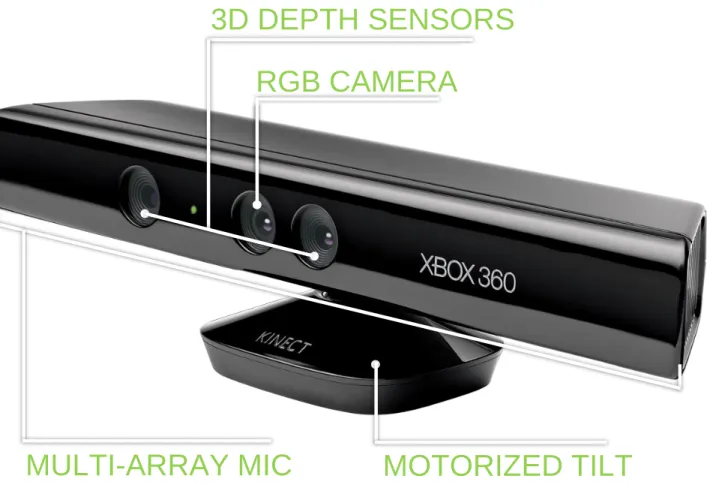
How does the Kinect work?
The Kinect uses
structured light
and
machine learning
• Inferring body position is a two-stage process: first compute a depth map (using structured light), then infer body position (using machine learning)
• The results are great!
• The system uses many college-level math
concepts, and demonstrates the remarkable advances in computer vision in the last 20 years
Inferring body position is a two-stage
process: first compute a depth map,
Inferring body position is a two-stage
process: first compute a depth map,
RGB CAMERA
MULTI-ARRAY MIC MOTORIZED TILT
3D DEPTH SENSORS
Figure copied from Kinect for Windows SDK Quickstarts
Stage 1: The depth map is constructed by
Remarks:
• Microsoft licensed this technology from a company called PrimeSense
• The depth computation is all done by the PrimeSense hardware built into Kinect
• Details are not publicly available; this description is speculative (based mostly on PrimeSense patent applications) and may be wrong
Stage 1: The depth map is constructed by
analyzing a speckle pattern of infrared
The technique of analyzing a known
Structured light general principle:
project a known pattern onto the scene and infer depth from the deformation of that pattern
The Kinect uses infrared laser light,
with a speckle pattern
Shpunt et al, PrimeSense patent application US 2008/0106746
Stage 1: The depth map is constructed
by analyzing a speckle pattern of
infrared laser light
• The Kinect uses an infrared projector and sensor; it does not use its RGB camera for depth computation
• The technique of analyzing a known pattern is called structured light
• The Kinect combines structured light with two classic computer vision techniques: depth
Depth from focus uses the principle
that stuff that is more blurry is further
away
Depth from focus uses the principle
that stuff that is more blurry is further
away
• The Kinect dramatically improves the accuracy of traditional depth from focus
• The Kinect uses a special (“astigmatic”) lens with different focal length in x- and y-
directions
• A projected circle then becomes an ellipse whose orientation depends on depth
The astigmatic lens causes a projected
circle to become an ellipse whose
orientation depends on depth
Freedman et al, PrimeSense patent application US 2010/0290698
Depth from stereo uses
parallax
• If you look at the scene from another angle, stuff that is close gets shifted to the side more than stuff that is far away
• The Kinect analyzes the shift of the speckle pattern by projecting from one location and observing from another
Depth from stereo uses
parallax
Inferring body position is a two-stage
process: first compute a depth map,
then infer body position
• Stage 1: The depth map is constructed by analyzing a speckle pattern of infrared laser light
• Stage 2: Body parts are inferred using a
randomized decision forest, learned from over 1 million training examples
Inferring body position is a two-stage
process: first compute a depth map, then
Stage 2 has 2 substages (use
intermediate “body parts”
representation)
Stage 2.1 starts with 100,000 depth
images with known skeletons (from a
motion capture system)
For each real image, render dozens
more using computer graphics
techniques
• Use computer graphics to render all
sequences for 15 different body types, and vary several other parameters
For each real image, render dozens
more using computer graphics
techniques
Stage 2.1 transforms depth image to
body part image
• Start with 100,000 depth images with known skeleton (from a motion capture system)
• For each real image, render dozens more using computer graphics techniques.
• Learn a randomized decision forest, mapping depth images to body parts
A randomized decision forest is a more
sophisticated version of the classic
A decision tree is like a pre-planned
game of “twenty questions”
What kind of “questions” can the
Kinect ask in its twenty questions?
• Simplified version:
– “is the pixel at that offset in the background?”
• Real version:
– “how does the (normalized) depth at that pixel compare to
this pixel?” [see Shotton et al, equation 1]
To learn a decision tree, you choose as
the next question the one that is most
“useful” on (the relevant part of) the
training data
• E.g. for umbrella tree, is “raining?” or “cloudy?” more useful?
• In practice, “useful” = information gain G
(which is derived from entropy H):
Kinect actually uses a
randomized
decision
forest
• Randomized:
– Too many possible questions, so use a random selection of 2000 questions each time
• Forest:
– learn multiple trees
– to classify, add outputs of the trees
– outputs are actually probability distributions, not single decisions
Shotton et al, CVPR(2011)
Kinect actually uses a
randomized
Learning the Kinect decision forest
requires 24,000 CPU-hours, but takes
only a day using hundreds of
computers simultaneously
“To keep the training times down we employ a distributed implementation. Training 3
trees to depth 20 from 1 million images takes about a day on a 1000 core cluster.”
Learning the Kinect decision forest
requires 24,000 CPU-hours, but takes
only a day using hundreds of
computers simultaneously
“To keep the training times down we employ a distributed implementation. Training 3
trees to depth 20 from 1 million images takes about a day on a 1000 core cluster.”
Stage 2 has 2 substages (use
intermediate “body parts”
representation)
Stage 2.2 transforms the body part
image into a skeleton
• The mean shift algorithm is used to robustly
compute modes of probability distributions
Intuitive Description
Distribution of identical billiard balls
Region of interest Center of mass Mean Shift vector
Objective : Find the densest region
Intuitive Description
Distribution of identical billiard balls
Region of interest Center of mass Mean Shift vector
Objective : Find the densest region
Intuitive Description
Distribution of identical billiard balls
Region of interest Center of mass Mean Shift vector
Objective : Find the densest region
Intuitive Description
Distribution of identical billiard balls
Region of interest Center of mass Mean Shift vector
Objective : Find the densest region
Intuitive Description
Distribution of identical billiard balls
Region of interest Center of mass Mean Shift vector
Objective : Find the densest region
Intuitive Description
Distribution of identical billiard balls
Region of interest Center of mass Mean Shift vector
Objective : Find the densest region
Intuitive Description
Distribution of identical billiard balls
Region of interest Center of
mass
Objective : Find the densest region
The Kinect uses
structured light
and
machine learning
• Inferring body position is a two-stage process: first compute a depth map (using structured light), then infer body position (using machine learning)
• The results are great!
• The system uses many college-level math
concepts, and demonstrates the remarkable advances in computer vision in the last 20 years
The results are great!
How can we make the results even
better?
• Use temporal information
– The Xbox team wrote a tracking algorithm that does this
• Reject “bad” skeletons and accept “good” ones
– This is what I worked on last summer
• Of course there are plenty of other ways (next summer???)
Last summer (2): Use the same
ground truth dataset to infer skeleton
likelihoods
Next summer: ????
• (working with Andrew Fitzgibbon at MSR Cambridge)
The Kinect uses
structured light
and
machine learning
• Inferring body position is a two-stage process: first compute a depth map (using structured light), then infer body position (using machine learning)
• The results are great!
• The system uses many college-level math
concepts, and demonstrates the remarkable advances in computer vision in the last 20 years
What kind of math is used in this stuff?
• PROBABILITY and STATISTICS
• MULTIVARIABLE CALCULUS
• LINEAR ALGEBRA
• Complex analysis, combinatorics, graph
algorithms, geometry, differential equations, topology
Personal reflection: computer vision has
come a long way since I started working on
it in 1996.
• Key enablers of this progress:
– Use of probabilistic and statistical models
– Use of machine learning
– Vastly faster hardware
– Parallel and distributed implementations (clusters, multicore, GPU)
– Cascades of highly flexible, simple features (not detailed models)