
Randomized Trees for Real-Time Keypoint Recognition
Vincent Lepetit
Pascal Lagger
Pascal Fua
Computer Vision Laboratory
´
Ecole Polytechnique F´ed´erale de Lausanne (EPFL) 1015 Lausanne, Switzerland
Email:
{Vincent.Lepetit, Pascal.Lagger, Pascal.Fua}@epfl.ch
Abstract
In earlier work, we proposed treating wide baseline matching of feature points as a classification problem, in which each class corresponds to the set of all possible views of such a point. We used a K-mean plus Nearest Neighbor classifier to validate our approach, mostly because it was simple to implement. It has proved effective but still too slow for real-time use.
In this paper, we advocate instead the use of randomized trees as the classification technique. It is both fast enough for real-time performance and more robust. It also gives us a principled way not only to match keypoints but to select during a training phase those that are the most recogniz-able ones. This results in a real-time system recogniz-able to detect and position in 3D planar, non-planar, and even deformable objects. It is robust to illuminations changes, scale changes and occlusions.
1. Introduction
Wide baseline keypoint matching has proved to be an effec-tive tool for applications ranging from camera registration to object detection. Since the pioneering work by Schmid and Mohr [1], the algorithms have become ever more robust to scale, viewpoint, illumination changes and partial occlu-sions [2, 3, 4, 5, 6, 7].
These wide baseline matching methods, however, are typically designed to match two images but do not take ad-vantage of the fact that, for object detection and pose esti-mation purposes, both a 3D object model and several train-ing images may be available. As shown in Figs 1 and 2, our goal is to incorporate this additional information into a keypoint recognizer that is both robust and fast enough for real-time object detection, whether or not the object is planar.
The key ingredient of our approach is to treat wide base-line matching of feature points as a classification problem, in which each class corresponds to the set of all possible views of such a point. During training, given at least one image of the target object, we synthesize a large number
of views of individual keypoints. If the object can be as-sumed to be locally planar, this is done by simply warp-ing image patches around the points under affine or ho-mographic deformations. Otherwise, given the 3D model, we use standard Computer Graphics texture-mapping tech-niques. This second approach relaxes the planarity assump-tions. At run-time, we can then use a powerful and fast classification technique to decide to which view set, if any, an observed feature belongs. This method is as effective and much faster than the usual way of computing local de-scriptors and comparing their responses. Once potential correspondences have been established between the inter-est points of the input image and those lying on the object, we apply a standard RANSAC-based method to estimate the 3D pose.
In previous work [8], we used a K-mean plus Nearest Neighbor classifier to validate our approach, mostly be-cause it was simple to implement. It has proved effective but still too slow for real-time use. Here, we advocate in-stead the use of randomized trees [9] as the classification technique. It is both faster and more robust, at the possi-ble expense of additional training time. Furthermore, it also gives us a principled way, not only to recognize keypoints, but also to select during the training phase those that yield the best recognition rate. As a result, even though we use a monoscale algorithm for keypoint extraction [10], we can achieve scale-invariance across a range of scales by using training images at different resolutions and retaining only those keypoints that are stable within the range.
In short, the contribution of this paper is not only a faster algorithm but also one that is more robust through the ap-propriate selection of keypoints to be recognized.
In the remainder of the paper, we first discuss related work and recall how wide baseline matching can be stated as a classification problem. We then present the proposed keypoint selection method, detail our new classification method based on randomized trees, and comment the re-sults.
Figure 1. Detection of a book in a video sequence: The book is detected independently and suc-cessfully in all subsequent frames at 25Hz in 640×480 images on a standard PC, in spite of partial occlusion, cluttered background, motion blur, large illumination and pose changes. In the last two frames, we add the inevitable virtual teapot to show we also recover 3D pose. A video sequence is available at http://cvlab.epfl.ch/research/augm/detect.html
Figure 2. The method is just as effective for 3D objects. In this experiment, we detected the teddy tiger using a 3D model reconstructed from several views such as the two first images on the left.
2. Related Work
In the area of automated 3D object detection, we can distin-guish between “Global” and “Local” approaches.
Global ones use statistical classification techniques to compare an input image to several training images of an object of interest and decide whether or not it appears in this input image. The methods used range from relatively simple methods such as Principal Component Analysis and Nearest Neighbor search [11] to more sophisticated ones such as AdaBoost and classifiers cascade to achieve real-time detection of human faces at varying scales [12]. Such approaches, however, are not particularly good at handling occlusions, cluttered backgrounds, or the fact that the pose of the target object may be very different from those in the training set. Furthermore, these global methods cannot pro-vide accurate 3D pose estimation.
By contrast, local approaches use simple 2D features such as corners or edges, which makes them resistant to partial occlusions and cluttered backgrounds: Even if some features are missing, the object can still be detected as long as enough are found and matched. Spurious matches can be removed by enforcing geometric constraints, such as epipolar constraints between different views or full 3D constraints if an object model is available. For local
ap-proaches to be effective, feature point extraction and char-acterization should be insensitive to viewpoint and illumi-nation changes. Scale-invariant feature extraction can be achieved by using Harris detector [13] at several Gaussian derivative scales, or by considering local optima of pyrami-dal difference-of-Gaussian filters in scale-space [7]. Miko-lajczyck et al. [4] have also defined an affine invariant point detector to handle larger viewpoint changes, that has been used for 3D object recognition [14], but it relies on an iter-ative estimation that would be too slow for our purposes.
Given the extracted feature points, various local descrip-tors have been proposed: Schmid and Mohr [1] compute rotation invariant descriptors as functions of relatively high order image derivatives to achieve orientation invariance. Baumberg [3] uses a variant of the Fourier-Mellin transfor-mation to achieve rotation invariance. He also gives an al-gorithm to remove stretch and skew and obtain an affine invariant characterization. Allezard et al. [15] represent the keypoint neighborhood by a hierarchical sampling, and rotation invariance is obtained by starting the circular sam-pling with respect to the gradient direction. Tuytelaars and al. [2] fit an ellipse to the texture around local intensity ex-trema to obtain correspondences remarkably robust to view-point changes. Lowe [7] introduces a descriptor called SIFT based on several orientation histograms, that is not fully
affine invariant but tolerates significant local deformations. Most of these methods are too slow for real-time processing, except for [5] that introduces Maximally Stable Extremal Regions to achieve near frame rate matching of stable re-gions. By contrast, our classification-based method runs easily at frame rate, because it shifts much of the compu-tational burden to a training phase and, as a result, reduces the cost of online matching while increasing its robustness. Classification as a technique for wide baseline matching has also been explored by [16] in parallel to our previous work. In this approach, the training set is iteratively built from incoming frames, and kernel PCA is used for classi-fication. While this is interesting for applications when a training stage is not possible, our own method allows to de-tect the object under unseen positions since we synthesize new views. The classification method described in this pa-per also has a lower complexity than their approach.
3. Keypoint Matching as Classification
Let us first recall how matching keypoints found in an in-put image against keypoints on a target objectO can be naturally formulated as a classification problem [8]. Dur-ing trainDur-ing, we construct a set K = {k1. . .kN}ofN
prominent keypoints lying on the object. At runtime, given an input patch p(kinput) centered at a keypoint kinput
ex-tracted in the input image, we want to decide whether or not it can be an view of one of theNkeypointski. In other
words, we want to assign topa class labelY(p) ∈ C =
{−1,1,2, . . . , N}, where the−1label denotes all the points that do not belong to the object. Y cannot be directly ob-served and we aim at constructing a classifier Yˆ such as
P(Y 6= ˆY)is small.
In other recognition tasks, such as face or character recognition, large training sets of labeled data are usually available. However, for automated pose estimation, it would be impractical to require a very large number of sample im-ages. Instead, to achieve robustness with respect to pose and complex illumination changes, we use a small number of images and synthesize many new views of the object us-ing simple renderus-ing techniques to train our classifier: This approach gives us a virtually infinite training set to perform the classification.
For each keypoint, we can then constitute a sampling of its view set, that is the set of all its possible appearances under different viewing conditions. This sampling allows us to use statistical classification techniques to learn them during an offline stage, and, finally, to perform the actual classification at run-time. This gives us a set of matches that lets us estimate the pose.
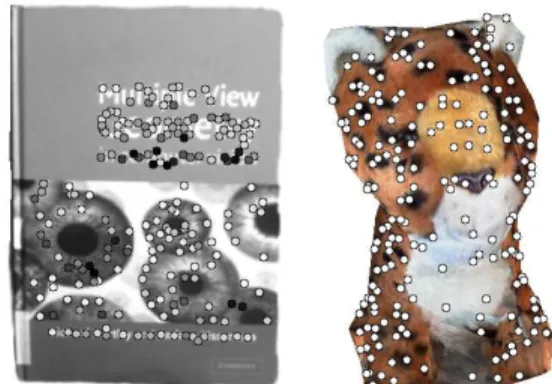
Figure 3. The most stable keypoints selected by our method on the book cover and the teddy tiger.
Figure 4. An example of generated views for the book cover and the teddy tiger, and the extracted keypoints for these views.
4. Building the Training Set
In [8], we built the view sets by first extracting the keypoints
kiin the given original images then generating new views
of each keypoint independently. As depicted in Fig.4, it is more effective to generate new views of the whole object, and extract keypoints in these views. This approach allows us to solve in a simple way several fundamental problems at no additional computation cost at run-time: We can eas-ily determine stable keypoints under noise and perspective distortion, which helps making the matching robust to noise and cluttered background.
4.1. Local Planarity Assumptions
If the object can be assumed to be locally planar, a new view can be synthesized by warping a training image of the object using an affine transformation that approximates the actual homography. The affine transformations can be de-composed as: A = RθR−1φ SRφ, whereRθ andRφ are
two rotation matrices respectively parameterized by the an-glesθandφ, andS=diag[λ1, λ2]is a scaling matrix. In
this paper, we use a random sampling of the affine trans-formations space, the anglesθandφvarying in the range
[−π; +π], and the scales λ1 andλ2 varying in the range [0.2; 1.8]. Those ranges are much larger than the ones used in our earlier work, and can be handled because we now de-termine the most stable points and thanks to our new classi-fication method.
4.2. Relaxing the Planarity Assumptions
One advantage of our approach is that we can exploit the knowledge of a 3D model if available. Such a model is very useful to capture complex appearance changes due to changes in the pose of a non convex 3D object, including occlusions and non-affine warping. Given the 3D model, we use standard Computer Graphics texture-mapping tech-niques to generate new views under perspective transforma-tions.
In the case of the teddy tiger of Fig.2, we used Image Modeler1to reconstruct its 3D model. An automated
recon-struction method could also have been used, another alter-native would have been to use image-based rendering tech-niques to generate the new views.
4.3. Keypoint Selection
We are looking for a set of keypointsK = {ki}lying on
the object to detect, and expressed in a reference system related to this object. We should retain the keypoints with a good probabilityP(k)to be extracted in the input views at run-time.
4.3.1. Finding Stable Keypoints
LetT denote the geometric transformation used to generate a new view, andeka keypoint extracted in this view. T is an affine transformation, or a projection if the 3D model is available. By applyingT−1toke, we can recover its
corre-sponding keypointkin the reference system. Thus,P(k)
can be estimated for keypoints lying on the objects from several generated views. The setKis then constructed by retaining keypoints ki with a high P(ki). In our
experi-ments, we retain the 200 first keypoints according to this measure. Fig. 3 shows the keypoints selected on the book cover and the teddy tiger.
The training set for keypointkiis then built by collecting
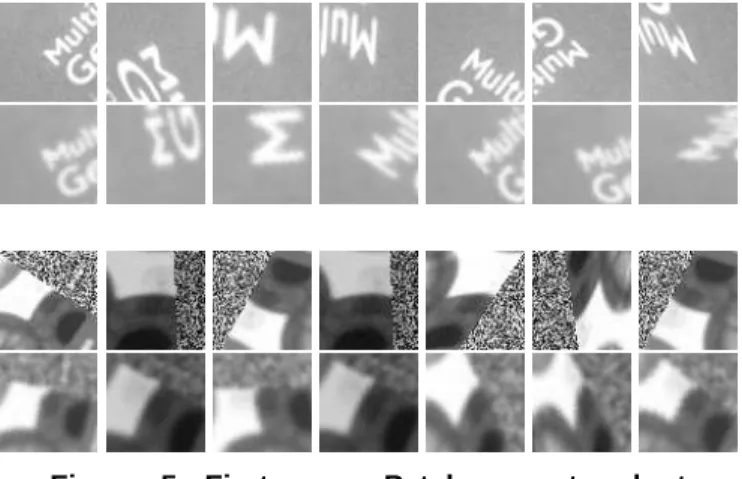
the neighborhoodpof the correspondingekin the generated images, as shown in Figs. 5 and 6.
4.3.2. Robustness to Image Noise
When a keypoint is detected in two different images, its pre-cise location may shift a bit due to image noise or viewpoint changes. In practice, such a positional shift results in large errors of direct cross-correlation measures. One solution is to iteratively refine the point localization [4], which can be costly.
In our method, this problem is directly handled by the fact that we extract the keypointskein the synthesized views: These images should be as close as possible to actual im-ages captured from a camera, and we add white noise to the
1ImageModeler is a commercial product from Realviz(tm)that allows
3D reconstruction from several views with manual intervention.
Figure 5. First row: Patches centered at a keypoint extracted in several new views, synthesized using random affine transfor-mations and white noise addition. Second row: Same patches after orientation correc-tion and Gaussian smoothing. These prepro-cessed patches are used to train the keypoint classifier. Third and fourth rows: Same as be-fore for another keypoint located on the bor-der of the book.
Figure 6. In the case of the teddy tiger, we restricted the range of acceptable poses and the orientation correction was not used.
generated views. To simulate a cluttered background, the new object view is rendered over a complex random back-ground. That way, the system is trained with images similar to those at run-time.
5. Keypoint Recognition
In [8], we used a K-mean plus Nearest Neighbor classifier to validate our approach, because it is simple to implement and it gives good results. Nevertheless, such classifier is known to be one of the less efficient classification meth-ods. We show in this section that randomized trees are bet-ter suited to our keypoint recognition problem, because they allow very fast recognition and they naturally handle multi-class problems.
5.1. Randomized Trees
Randomized trees are simple but powerful tools for clas-sification, introduced and applied to recognition of hand-written digits in [9]. [17] also applied them to recognition
of 3–D objects. We quickly recall here the principles of randomized trees for the unfamiliar reader. As depicted by Fig. 7, each non-terminal node of a tree contains a simple test that splits the image space. In our experiments, we use tests of the type: “Is this pixel brighter than this one ?”. Each leaf contains an estimate based on training data of the conditional distribution over the classes given that an image reaches that leaf. A new image is classified by dropping it down the tree, and, in the one tree case, attributing it the class with the maximal conditional probability stored in the leaf it reaches.
We construct the trees in the classical, top-down man-ner, where the tests are chosen by a greedy algorithm to best separate the given examples, according to the expected gain of information. The process of selecting a test is re-peated for each non-terminal descendant node, using only the training examples falling in that node. The recursion is stopped when the node receives too few examples, or when it reaches a given depth.
Since the numbers of classes, training examples and pos-sible tests are large in our case, building the optimal tree be-comes quickly intractable. Instead we grow multiple, ran-domized trees: For each tree, we retain a small random sub-set of training examples and only a limited random sample of tests at each node, to obtain weak dependency between the trees. More details about the trees construction can be found in [10].
5.2. Preprocessing
In order to make the classification task easier, the patchesp
of the training set or at run-time are preprocessed to remove some variations within the classes attributable to perspec-tive and noise.
The generated views are first smoothed using a Gaussian filter. We also use the method of [7] to attribute a 2D ori-entation to the keypoints and achieve some normalization. The orientation is estimated from the histogram of gradient directions in a patch centered at the keypoint. Note that we do not require a particularly stable method, since the same method is used for training and run-time recognition. We just want it to be reliable enough to reduce the variability within the same class. Once the orientation of an extracted keypoint is estimated, its neighborhood is rectified as shown Fig. 5.
Illumination changes are usually handled by normaliz-ing the views intensities in some way, for example by nor-malizing by the L2 norm of the intensities. We show be-low that our randomized trees albe-low to skip this step. The classification indeed relies on tests comparing intensities of pixels. This avoids the use of an arbitrary normalization method and makes the classification very robust to illumi-nation changes.
m
m m m
~
> <
Figure 7. Type of tree used for keypoint recog-nition. The nodes contain tests comparing two pixels in the keypoint neighborhood; the leaves contain thedlposterior distributions.
5.3. Node Tests
In practice, we use ternary tests based on the difference of intensities of two pixels taken in the neighborhood of the keypoint:
IfI(p,m1)−I(p,m2) <−τ go to child 1; If|I(p,m1)−I(p,m2)| ≤+τ go to child 2; IfI(p,m1)−I(p,m2) >+τ go to child 3.
I(p,m)is the intensity of patchpafter the preprocessing step described in Section 5.2, at pixel locationm. m1and
m2are two pixel locations chosen to optimize the expected gain of information as described above.τ is a threshold de-ciding in which range two intensities should be considered as similar. In the results presented in this paper, we takeτ
to be equal to 10.
This test is very simple and requires only pixel intensi-ties comparisons. Nevertheless, because of the efficiency of randomized trees, it yields reliable classification results. We tried other tests based on weighted sums of intensities
a la Adaboost, on gradients or on Haar wavelets without
significant improvements on the classification rate.
5.4. Run Time Keypoint Recognition
Once the randomized treesT1, . . . , TL are built, the
pos-terior distributionsP(Y = c|T = Tl, reached leaf = η)
can be estimated for each terminal nodeη from the train-ing set. At runtime, the patchespcentered at the keypoints extracted in the input image are preprocessed and dropped down the trees. Following [9], ifdl(p)denotes the posterior
distribution in the node of treeTlreached by a patchp,pis
classified considering the average of the distributionsdl(p):
ˆ
Y(p) =argmax
c
dc(p) =argmax
c
1 L
X
l=1...L
dl(p)
dc(p)is the average of the posterior probabilities of class
0 20 40 60 80 100
0 5 10 15 20 25 30
Inlier percentage
Tree Number
inliers %age using tree depth = 5 inliers %age using tree depth = 10 inliers %age using tree depth = 15
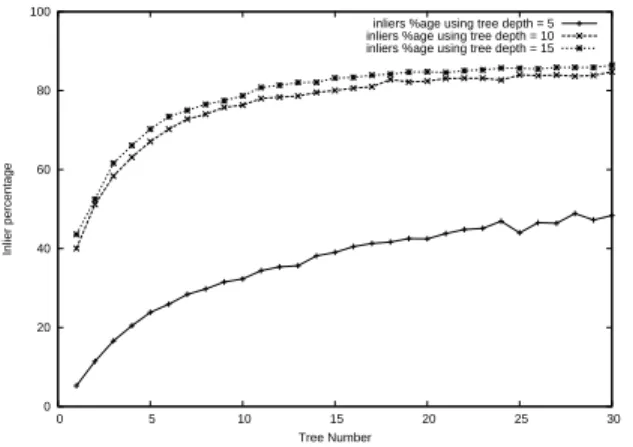
Figure 8. Percentage of correctly classified views with respect to the number of trees, using trees of depth 5, 10, and 15.
We can estimate during training a thresholdDcto decide if
the match is correct or not with a given confidences:
P(Y(p) =c|Yˆ(p) =c, dc(p)> Dc)> s
In practice we takes = 90%. Keypoints givingdc(p)
lower thanDc are considered as keypoints detected on the
background, or misclassified keypoints, and are therefore rejected. It leaves a small number of outlier matches, and the pose of the object is found by RANSAC after few itera-tions.
5.5. Performance
The correct classification rate P( ˆY(p) = c|Y(p) = c)
of our classifier can then be measured using new random views. The graph of Fig. 8 represents the percentage of keypoints correctly classified, with respect to the number of trees, for several maximal depths for the trees. The graph shows no real differences between taking trees of depth 10 or 15, so we can use trees with limited depth. It also shows that 20 trees are enough to reach a recognition rate of 80%. Growing 20 trees of depth 10 takes about 15 minutes on a standard PC.
Since the classifier works by combining the responses of sub-optimal trees, we tried to re-use trees grown for a first object for another object, as shown Fig. 9: We updated the posterior probabilities in the terminal nodes, but kept the same tests in the non-terminal nodes. We experienced a slight drop of performance, but not enough to prevent the system from recognizing the new object. In this case, the time required for training drops to less than one minute.
6. Results
6.1. Planar Objects
We first tried our algorithm on planar objects. Fig. 11 shows matches between the training image and input images
estab-Figure 9. Re-usability of the set of trees: A new object is presented to the system, and the posterior probabilities are updated. The new object can then be detected.
Figure 10. Comparison with SIFT. When too much perspective distorts the object image, the SIFT approach gives only few matches (left), while our approach is not perturbed (right).
lished in real-time. The estimated pose is then accurate and stable enough for Augmented Reality as shown Fig. 1.
We compared our results with those obtained using the executable that implements the SIFT method [7] kindly pro-vided by David Lowe. As shown in Fig. 10, when too much perspective distorts the object view, this method gives only few matches, while ours is not perturbed. Ours is also much faster. For a fair comparison, remember that we take advan-tage of a training sadvan-tage possible in object detection applica-tions, while the SIFT method can also be used to match two given images. Another difference is that we cannot handle
Figure 11. Detection of the book: Inlier matches established in real-time under sev-eral poses.
Figure 12. Deformable objects: the object is detected and its deformation estimated, us-ing the method described in [18].
as much scale changes as SIFT because we do not use (yet) a multi-scale keypoint detection.
6.2. Detecting a 3D Object
Fig. 2 shows results of the detection of a teddy tiger. As mentioned above, its 3D textured model was reconstructed from several views with the help of ImageModeler. It can be detected from different sides, and front and up views.
6.3. Detecting Deformable Objects
Our method is also used in [18] to detect deformable objects and estimate their deformation in real-time. The matches are used not only to detect but also to compute a precise mapping from a model image to the input image as shown Fig. 12.
7. Conclusion and Perspectives
We proposed an approach to keypoint matching for object pose estimation based on classification. We showed that using randomized trees yields a powerful matching method well adapted to object detection.
Our current approach to keypoint recognition relies on comparing pixel values in small neighborhoods around these keypoints. It works very well for textured objects, but loses its effectiveness in the absence of texture. To in-crease the range of applicability of our approach, we will investigate the use of other additional image features, such as spread gradient [19]. We believe our randomized tree ap-proach to keypoint matching to be ideal to find out those that are most informative in any given situation and, thus, to allow us to mix different image features in a natural way.
Acknowledgements
The authors would like to thank Franc¸ois Fleuret for sug-gesting to use randomized trees and for his insightful com-ments.
References
[1] C. Schmid and R. Mohr, “Local Grayvalue Invariants for Image Re-trieval,” IEEE Transactions on Pattern Analysis and Machine Intel-ligence, vol. 19, no. 5, pp. 530–534, May 1997.
[2] T. Tuytelaars and L. VanGool, “Wide Baseline Stereo Matching
based on Local, Affinely Invariant Regions,” in British Machine Vi-sion Conference, 2000, pp. 412–422.
[3] A. Baumberg, “Reliable Feature Matching across Widely Separated Views,” in Conference on Computer Vision and Pattern Recognition, 2000, pp. 774–781.
[4] K. Mikolajczyk and C. Schmid, “An Affine Invariant Interest Point Detector,” in European Conference on Computer Vision. 2002, pp. 128–142, Springer, Copenhagen.
[5] J. Matas, O. Chum, U. Martin, and T. Pajdla, “Robust Wide Base-line Stereo from Maximally Stable Extremal Regions,” in British Machine Vision Conference, London, UK, September 2002, pp. 384– 393.
[6] F. Schaffalitzky and A. Zisserman, “Multi-View Matching for Un-ordered Image Sets, or ”How Do I Organize My holiday Snaps?”,” in Proceedings of European Conference on Computer Vision, 2002, pp. 414–431.
[7] D.G. Lowe, “Distinctive Image Features from Scale-Invariant Key-points,” International Journal of Computer Vision, vol. 20, no. 2, pp. 91–110, 2004.
[8] V. Lepetit, J. Pilet, and P. Fua, “Point Matching as a Classification Problem for Fast and Robust Object Pose Estimation,” in Conference on Computer Vision and Pattern Recognition, Washington, DC, June 2004.
[9] Y. Amit and D. Geman, “Shape Quantization and Recognition with Randomized Trees,” Neural Computation, vol. 9, no. 7, pp. 1545– 1588, 1997.
[10] V. Lepetit and P. Fua, “Towards Recognizing Feature Points using Classification Trees ,” Technical Report IC/2004/74, EPFL, 2004. [11] S. K. Nayar, S. A. Nene, and H. Murase, “Real-Time 100 Object
Recognition System,” IEEE Transactions on Pattern Analysis and Machine Intelligence, vol. 18, no. 12, pp. 1186–1198, 1996. [12] P. Viola and M. Jones, “Rapid Object Detection using a Boosted
Cascade of Simple Features,” in Conference on Computer Vision and Pattern Recognition, 2001, pp. 511–518.
[13] C.G. Harris and M.J. Stephens, “A Combined Corner and Edge De-tector,” in Fourth Alvey Vision Conference, Manchester, 1988. [14] F. Rothganger, S. Lazebnik, C. Schmid, and J. Ponce, “3D Object
Modeling and Recognition using Affine-Invariant Patches and Multi-View Spatial Constraints,” in Conference on Computer Vision and Pattern Recognition, June 2003.
[15] N. Allezard, M. Dhome, and F. Jurie, “Recognition of 3D Textured Objects by Mixing View-Based and Model-Based Representations,” in International Conference on Pattern Recognition, Barcelona, Spain, Sep 2000, pp. 960–963.
[16] J. Meltzer, M.-H. Yang, R. Gupta, and S. Soatto, “Multiple View Fea-ture Descriptors from Image Sequences via Kernel Principal ponent Analysis,” in Proceedings of European Conference on Com-puter Vision, may 2004, pp. 215–227.
[17] B. Jedynak and F. Fleuret, “Reconnaissance d’objets 3D `a l’aide d’arbres de classification,” in Proceedings of Image’Com, 1996. [18] J. Pilet, V. Lepetit, and P. Fua, “Real-Time Non-Rigid Surface
Detec-tion,” in Conference on Computer Vision and Pattern Recognition, San Diego, CA, June 2005.
[19] Y. Amit, D. Geman, and X. Fan, “A coarse-to-fine strategy for multi-class shape detection,” IEEE Transactions on Pattern Analysis and Machine Intelligence, 2004.


![Figure 12. Deformable objects: the object is detected and its deformation estimated, us-ing the method described in [18].](https://thumb-us.123doks.com/thumbv2/123dok_us/8427713.2241782/7.918.110.416.106.234/figure-deformable-objects-object-detected-deformation-estimated-described.webp)
