The Viavi Solutions T-BERD/MTS-4000 equipped with
the Triple-Play Software option delivers comprehensive
Internet Protocol (IP) service-level testing in a rugged,
handheld, battery-operated platform that is ideal for
access and home network turn-up, troubleshooting, and
maintenance.
Triple-play services growth has changed the landscape of the telecommunications industry by creating new opportunities, while also introducing significant challenges for service providers. To remain competitive, providers must efficiently deploy bundled voice, video, and data to the exacting demands of customers—delivering on both quality of service (QoS) and experience (QoE), while reducing operating expenses. The T-BERD/MTS-4000 meets these challenges and more as the first multi-application platform with fully integrated copper and fiber functionality that addresses the complete set of requirements for triple-play, such as turn-up, troubleshooting, and maintenance. The T-BERD/MTS-4000 Triple-Play Services Software gives field service technicians who install and maintain triple-play service over leading-edge fiber- and copper-based digital subscriber line (DSL) access networks a complete suite of essential testing tools in one unit.
Flexible connectivity, including universal serial bus (USB), high-speed 10/100/Gigabit
Key Features
y Video service (IPTV) testing
– IP Multicast test (broadcast video service): Generate IGMP Join and Leave requests to verify stream flow, channel change, and multi-cast communication functionality
– IP Unicast test (video on demand [VoD] service): Generate RTSP client requests for access to VoD media server to verify the of program stream flow and uni-cast communication functionality
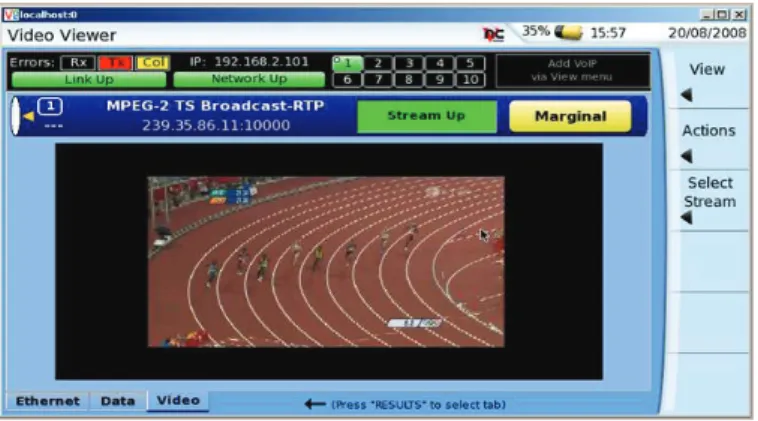
– Decode and display I-Frame
y Voice service (VoIP) testing
– Emulate a VoIP phone for service turn-up and troubleshooting
– Supports Cisco SCCP, SIP, MGCP, H.323, and Nortel Unistim signaling protocols
y Data services testing
– Provides a fully integrated Web browser – Offers Throughput testing (FTP, HTTP)
y Class of Service
– Provides control and results for multiple services (data, VoIP, IPTV) over multiple VLANs Applications
y Tests IPTV video quality, including analysis of
T-BERD
®
/MTS-4000
Multiple Services
Test Platform
Architecture
Figure 1. Viavi Quality Layer Model
The T-BERD/MTS-4000 is designed for skilled field technicians who install and maintain various next-generation fiber (FTTx) networks delivering triple-play services that often require advanced troubleshooting, including in-depth physical layer tests on copper or fiber—or increasingly both.
Layered Graphical User Interface
Figure 1 shows the Viavi Quality Layer Model integrated into the T-BERD/MTS-4000 graphical user interface (GUI) to enhance root-cause analysis. Technicians can use it to locate IP service problems more easily and quickly.
Picture: Blurring, Edge Distortion, Visual Noise Audio: Lip Sync, Drop Outs
Content Quality Video Stream Quality Transport Quality Transaction Quality
Video QoS Video Quality Layers
Video QoE Indicators
Error Indicator Count
Pixelation, Tiling, Frame Freezes, Blue Screen Continuity Error
PCR Jitter RTP Packet Jitter RTSP Latency (VOD) IGMP Latency (BC-TV) PSI Table Data (Error) RTP Packet Loss
Service Accessibility, Channel Change Latency, Pause, Play Latency, Service Latency
The Triple-Play Software Option for the T-BERD/MTS-4000 installed on the base unit can be used with the resident Ethernet (10/100/Gig E) port. It is compatible with field-swappable T-BERD/MTS-4000 xDSL interface modules. NID NID POTS Splitter Splice Case ATU-R POTS VDSL MDF Pedestal DSLAM POTS Switch Data Network POTS VDSL ATM ATU-Cs POTS Splitter NID DLC Cross Box Cross Box
Network Last Mile
VDSL,
Data, IPTV CopperCopper, VDSL,Data, IPTV CopperCopper, VDSL,Data, IPTV
Home
Applications
The T-BERD/MTS-4000 provides the full range of capabilities needed to test today’s leading-edge FTTx and copper access networks plus the expandability needed to test next-generation networks. The wide range of testing technologies offered by the T-BERD/MTS-4000 provide all of the testing functions that technicians need at every stage of the network lifecycle, from the physical layer to the application layer, in a single handheld and rugged unit.
The T-BERD/MTS-4000 delivers an integrated approach to field testing with test support for specific application use cases. Field-swappable modules are available for multi-service testing and two modules can run simultaneously.
IP Video Testing
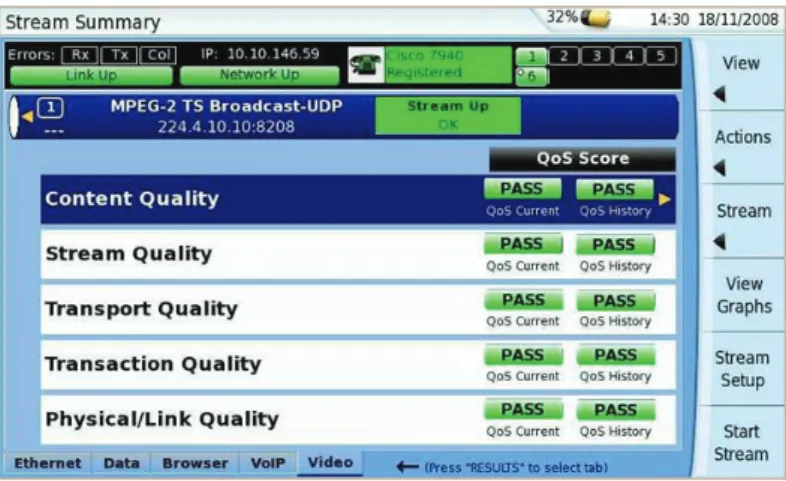
The T-BERD/MTS-4000 enables analysis of the video service (IPTV) stream anywhere in the Access network using a DSL or Ethernet interface. With its advanced performance monitoring features, the T-BERD/MTS-4000 accurately measures video QoS and QoE using built-in tests for content, transport, transaction, and physical link quality.
Figure 5. Example of IPTV Summary test screen Figure 4. Example of IPTV Video Stream test
VoIP Testing
Technicians can use the T-BERD/MTS-4000 to turn up and
troubleshoot voice service (voice over IP [VoIP]) connectivity, feature availability, and voice quality. They can also conduct IP ping, packet statistic, and trace route analysis to identify, diagnose, and sectionalize VoIP network and equipment problems.
IP Data Testing
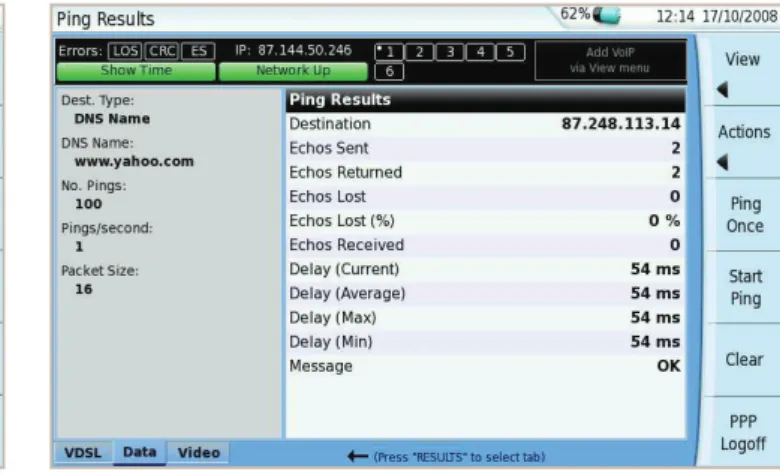
The T-BERD/MTS-4000 enables Internet connectivity testing using an integrated Web browser and also performs required IP data tests (such as IP ping delay) to verify bandwidth requirements for real-time applications and services (such as online gaming and streaming video).
CoS Testing
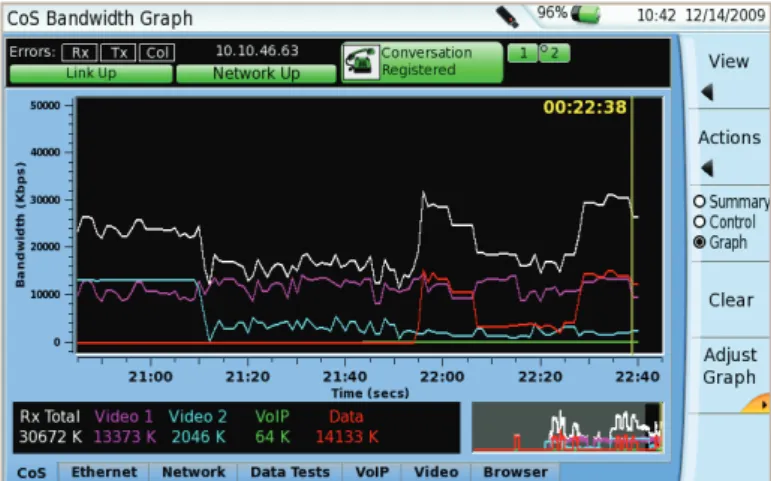
With its advanced test capabilities that address each triple-play application QoS metric, the T-BERD/MTS-4000 let carriers focus on effective Class of Service (CoS) testing to ensure priority mapping for IP services. All three applications can be run at the same time simulating mixed traffic flows. Interactions that violate CoS rules can be identified quickly.
Figure 9. COS Summary Figure 8. COS Bandwidth Graph
The Right Tool for Today’s Triple-Play Tests
The lightweight, rugged, and battery-operated T-BERD/MTS-4000 cost-effectively scales to provide an all-in-one solution for field installation, maintenance, and troubleshooting across a wide range of test applications for copper, fiber, and triple-play services. With automation features, such as auto tests, custom scripts, work flow ticket support, and flexible connectivity that improve workforce efficiency, the T-BERD/MTS-4000 is ideally suited to optimize even the most complex and advanced FTTx networks.
Specifications
Test Ports/Interface
Support 10/100/1GigE (configurable—half/full duplex auto detect), RJ45 Optional ADSL1/2/2+, VDSL1/2 (modem port 8-pin modular—line on center pins, Tip-Ring connections)
Cable Test CAT 3/5
TDR Results Fault type open/short Distance to fault GigE Results Polarity
Skew
Ethernet Data
Media Type Auto, 10/100/1000 Mbps full, half duplex Data Modes IPoE, PPoE, IPv6oE, Multiple VLANS, data off IP Mode DHCP, static
MAC Setting Factory default, user-defined
VLAN Tag on/off
ID selection 0–4095 Priority selection 0–7 Web Browser On/Off
Reported Results—Ethernet TE
Ethernet Statistics Link status, link speed, link duplex detection TX collisions, TX/RX (bytes, frames, errors, dropped frames)
LAN/WAN Results IP address, Net mask, gateway, DNS, MAC address
PING Echoes sent/received, PING delay (Cur/Avg/Max/ Min), lost count/percentage
Supports IP address or DNS name destination Trace Route ICMP
and UDP Statistics Hop count, name lookup, and IP address of hops Supports IP address and DNS address destination FTP/HTTP Upload/download rate, transfer count, time VLAN scan VLAN, priority, frame count, last seen
VoIP
Modes Terminate, Monitor Supported
Signaling Protocols H.323 ITU-T H.323 version 3 Fast Connect H.323 ITU-T H.323 version 3 Full Connect (MSD, CAPSET, OLC exchange)
Skinny Cisco Client Protocol (SCCP) SIP RFC 3621
Nortel Unistim MGCP Supported Codec
Configuration ITU-T G.711 u-law/A-law (PCM/64 kb/s) ITU-T G.723.1 (ACELP/5.3, 6.3 kb/s) ITU-T G.726 (ADPCM/32 kb/s) ITU-T G.729a (GS-ACELP/8 kb/s) ITU-T G.722 64K
Gatekeeper
Settings User-selectable static/auto discovery, or no gatekeeper direct connect mode
Supports inbound and outbound calls with or without
gatekeeper support
Reported Results—VoIP
Call Stats Full incoming call statistics, including IP address, far-end alias, far-end name, RTCP availability/ ports, codec and rate, call signaling support, silence suppression enabled, and call duration Throughput Audio/
Video Sent/received in bytes and packets, out-of-sequence packets, remote packets Transaction Quality Transaction Log
Voice Stream
Timeline Packet delay, packet jitter, packet loss, overall QoS Incoming Delay Network, encoding, packetization, buffering, and
total delay Content Quality Call quality R-Factor Current/Min/Max/Average Line quality R-Factor Current/Min/Max/Average R-Factor G.107 Current/Min/Max/Average R-Factor burst Current/Min/Max/Average R-Factor gap Current/Min/Max/Average CQ MOS Current/Min/Max/Average LQ MOS Current/Min/Max/Average PQ MOS Current/Min/Max/Average
Transport Quality
Audio jitter Current/Min/Max/QoS History Audio packets lost Current/Min/Max/QoS History Audio overall QoS Current/Min/Max/QoS History
Voice and video quality rating based on packet metrics thresholds set by user MOS rating, R-Factor, and voice degradation factors support packet capture and filtering (save internally or to USB mass memory storage)
IP Video
Modes Terminate, Monitor, Through Set Top Box
Emulation IGMPv2 and v3 emulation clientIGMP message status/decode status/error message
RTSP emulation client Service Selection Auto
Specifications (Continued)
IP Video (continued)IP Packet Analysis Total packets RX count Jitter current/max RTP packets lost, count RTP OOS, count RTP errors, count PID Analysis (each
stream) PID numberPID type (video, audio, data, unknown) PID description
Summary Statistics Terminate active stream count 1-6 Monitor active
stream count 1-10 Data rates
combined Current/Ave/Min/Max QoS Error indicator count
Continuity error
event count Current/Max Continuity error
event percentage Current/Max PCR jitter Current/Max IGMP latency ms
RSTP latency ms QoS score
(Pass/Fail threshold selections)
Graphs Packet loss
QoS timeline Jitter
Content Quality PID, class, description Error indicator count Service name Program name Video MOS R-Factor
Degradation (loss, discard, codec) Stream Quality Sync errors Count
Continuity errors Current/Average/Min/Max Continuity errors % Current/Average/Min/Max PCR jitter Count
PID timeouts Count PAT errors Count PMT errors Count Video Stream Data
Rates Total Current/Average/Min/Max IP Video Audio Data
Transport Quality MDI delay factor Current/Average/Max MDI MLR Current/Average/Max/Total MDI buffer size Current/Average/Max RTP jitter Current/Max Lost packets Current/Average/Max RTP packet loss Distance Errors Threshold/
Current/Max/Total Period Errors Threshold/ Current/Max/Total Transaction Quality Latency ms
Error Logging Timestamp for error events
QoS state changes Pass to Fail, Fail to Pass Signaling Protocol
Message Decode IGMP MessagesRTSP Messages
500 Message FIFO Buffer Storage—File Export
Standards RFC2236, IGMP RFC2326, RTSP
ISO (IEC 13818),
Video Transport ETSI TR 10-290 V2.1, Steam and Analysis Video Measurements TFC-1483; 2684,
ATM AAL5 RFC2364, PPPoAAL5
RFC4445, Media Delivery Index (MDI)
Class of Service Summary Results
Control 3 Video, 1 VoIP, 1 Data, up to 6 VLANS
Graphs Bandwidth kbps
Ordering Information
Description Part Number
Triple-Play Software Options
Standard VOIP C4000-VOIP
Cisco Call Manager C4000-VOIP-CISCO
Nortel Unistim Call Manager C4000-VOIP-UNISTIM
Standard IPTV C4000-IPTV