Master Data Management Projects in
Practice
An Information Difference Research Study
December 2009Sponsored by
TABLE OF CONTENTS
EXECUTIVE SUMMARY ... 5
BACKGROUND TO THE SURVEY ... 7
THE APPROACH... 8
ABOUT THE RESPONDENTS ... 9
THE END-‐USER SURVEY ... 10
ALREADY IMPLEMENTING MDM ... 11
MDM IMPLEMENTATIONS... 11
SYSTEMS INTEGRATORS... 14
BENEFITS AND BARRIERS... 17
PLANNING TO IMPLEMENT MDM... 21
PLANNED MDM IMPLEMENTATIONS... 21
SYSTEMS INTEGRATORS... 24
BENEFITS AND BARRIERS... 25
OPEN SOURCE TECHNOLOGIES ... 26
THE VIEW FROM THE SYSTEMS INTEGRATORS... 27
VENDOR TECHNOLOGIES... 27
MDM ARCHITECTURES... 28
SIZE AND STAFFING OF MDM IMPLEMENTATIONS... 28
RANGE OF DATA TYPES... 29
BENEFITS... 30
TIPS FOR SUCCESSFUL MDM IMPLEMENTATION... 31
CHALLENGES... 31
CASE STUDIES... 32 BASELINE CONSULTING... 33
EVAXYX... 34
INFOSYS... 34
MINDTREE... 35
PLATON... 36
CONCLUSIONS... 38 ENTERPRISES... 38
SYSTEMS INTEGRATORS... 40
ABOUT THE INFORMATION DIFFERENCE ... 41
QUESTIONNAIRE ... 42
SURVEY 1: END-‐USER SURVEY... 42
SURVEY 2: SYSTEMS INTEGRATORS SURVEY... 52
Media Sponsors
LIST OF FIGURES
Figure 1 - Respondents by Company Revenue ... 9
Figure 2 - Respondents by Job Function ... 9
Figure 3 - Respondents by Industry Sector...10
Figure 4 - Involvement of SI in MDM Implementation...11
Figure 5 - Geographies for MDM Implementations...12
Figure 6 - Time to Complete MDM Implementation ...12
Figure 7 - Scope of Master Data Domains ...13
Figure 8 - Technology and Licensing Model ...14
Figure 9 - How did you select your SI? ...14
Figure 10 - Methodology Used...15
Figure 11 - Which SI did you use? ...15
Figure 12 - How happy were you with your SI? ...16
Figure 13 - Assessment of level of experience of SI ...16
Figure 14 - Ranking of MDM Technologies Implemented ...17
Figure 15 - Did you produce a Business Case?...20
Figure 16 - Did you establish Data Governance?...20
Figure 17 - Did you do a post-implementation review? ...21
Figure 18 - Planned scope of MDM Implementation ...22
Figure 19 - Geographies where MDM implementations are planned...22
Figure 20 - Plans for Technology and Licensing Model...23
Figure 21 - How do you plan to select your SI? ...24
Figure 22 - Which methodology will you use? ...24
Figure 23 - Are you planning to produce a Business Case?...25
Figure 24 - Will you carry out a post-implementation review?...26
Figure 25 - Adoption of Open Source Technologies...26
Figure 26 - Ranking of MDM Technologies Implemented ...27
Figure 27 - Range of master data types being addressed...29
EXECUTIVE SUMMARY
Master Data Management (MDM) has received growing attention recently as an essential
component of information management alongside data governance and data quality. Alongside this growth in interest in master data management, the provision of services for the implementation of master data management is featuring with increasing prominence in the portfolio of services offered by many Systems Integrators (SIs).
While many SIs currently claim or suggest they have extensive implementation expertise in master data management, there is little concrete information available regarding the use of systems integrators by end-‐user organizations for implementing master data management programs in business. We have therefore conducted a survey of both end-‐user organizations and systems integrators aimed at gaining deeper insight into the levels of expertise, experience and usage of systems integrators specifically related to undertaking MDM implementations.
Some 131 respondents completed the survey from all around the world, the majority from North America (47%) and Europe (30%). A high proportion (42%) of the respondents came from companies having annual revenues greater than US $ 1 billion. The respondents represented a wide spectrum of industries.
The key findings from the survey are summarized below:
Those organizations that have undertaken implementations indicated that they manage a median of 3 million master data records (the maximum reported was 990 million), have taken 6 months to implement and involved an 8-‐person project team. The membership of the team was 25%
business, 40% own IT and 35% SI staff.
“Customer” and “Product” still remain the main data domains for MDM implementations,
although the wide spread of domains reported indicate that end-‐user organizations are extending the range and focus of their master data management.
Despite the claims of the SIs in terms of their ability to implement MDM, most have not undertaken very many projects—the median they reported was nine projects with the median value for 2009 being five.
Around one-‐third of end-‐user organizations have undertaken more than two MDM
implementations, which suggests that MDM is now coming of age and moving beyond the pilot stage.
The majority of implementations, as reported by the SIs, used the Consolidation model (38%) of MDM. However, they reported that roughly one–third of implementations focused on the Transaction model.
Those who had already implemented reported a median maintenance cost as 20% of the initial project costs.
Data quality is a key component of any MDM implementation and the time and effort (cost) required to achieve data of acceptable quality is frequently severely underestimated. The median reported was 30% of the overall initial project costs.
The median costs of software expressed as a percentage of the initial project costs was 25%; in other words, a company spending $X on an MDM software license can expect to spend 4X in total. There was a broad preference for traditional proprietary MDM, data quality and data integration
solutions. However, there appeared to be a clear willingness to explore further open source options alongside a significant group (18%) already deploying open source solutions in business critical areas
60% of those who have already implemented had prepared a business case for their MDM project; of those planning to implement MDM, two-‐thirds planned to produce a business case for this. This means that at least a third of MDM projects have no business case.
Both those already implementing (80%) and those planning to implement recognize the pivotal importance of establishing data governance.
40% of those already implementing MDM did a post implementation review (PIR) and a further 40% intend to do so upon completion.
SIs and end-‐user organizations alike identify poor data quality as a key roadblock implementing MDM initiatives.
Among the main recommendations from the respondents for successful delivery of MDM implementations were: (a) A successful MDM project is a business-‐driven project, (b) Up-‐front planning, and (c) Do not use a waterfall methodology.
About one-‐fifth of end-‐user organizations have opted for “custom build”.
Most organizations chose competitive tender as the route to selecting an SI partner.
Most organizations (57%) that had implemented MDM as well as those planning implementations chose to use their own methodologies.
67% were at least satisfied with the performance of their chosen SI against 33% who were unhappy. 59% considered that their SI had “adequate” expertise and experience with MDM while 41% felt them to be “not very experienced”. Given that SIs are supposed to be providing expertise in the subject, this is somewhat disappointing.
BACKGROUND TO THE SURVEY
Master Data Management (MDM) has received growing attention in recent years as an essential component of information management alongside data governance and data quality. More and more, organizations are turning to master data management as a key enabler in improving the quality, timeliness and reliability of business intelligence with the ultimate goal of improving business performance. Increasing regulatory requirements and the recent financial crisis have ensured that master data management is increasingly finding its way onto the business agenda.
Against the backdrop of this growth in interest in master data management, the provision of services for the implementation of master data management is featuring with growing prominence in the portfolio of services offered by many Systems Integrators (SIs). There is some indication that organizations are turning to these SIs to help them architect and implement master data management initiatives.
While many SIs currently claim or suggest they have extensive implementation expertise in master data management, there is little concrete information available regarding the use of systems integrators by end-‐user organizations for implementing master data management programs in business. We believe it important for end-‐user organizations, systems integrators and MDM
software vendors to understand the current position and the degree of satisfaction, confidence and success which systems integrators deliver.
We have therefore conducted a survey of both end-‐user organizations and systems integrators aimed at gaining deeper insight into the levels of expertise, experience and usage of systems integrators specifically related to undertaking MDM implementations.
We wanted especially to gain deeper insight into the following questions:
To what extent are SIs being used to assist organizations in implementing MDM initiatives? Which vendor technologies are they implementing?
Which MDM styles and architectures are being (or plan to be) implemented? What is the level of satisfaction with SIs?
What is the view of their actual level of experience and expertise? What is the median length of the MDM implementations?
What data domains are covered?
Do SIs offer added value in the form of standard industry models?
For those organizations that have not yet implemented MDM, do they plan to use an SI to assist in the future?
What benefits have SIs found when their clients have implemented MDM? What roadblocks have they identified to successful MDM implementation?
THE APPROACH
The survey was undertaken over the Internet in October and November 2009 and the participants were selected by e-‐mail invitations directly from The Information Difference and also from media sponsors BeyeNetwork, Information Management (formerly DM Review), ObisOmni and TechTarget. Additionally, participation was also possible from a link on The Information Difference website. The survey was targeted mainly at the senior business level worldwide substantially from large
organizations (with revenues greater than US $ 1 billion annually).
The participants were provided with the following information prior to completing the survey:
“As part of our research into the master data management (MDM) market we would be grateful if you could tell us a little about your experiences with using (or planning to use) a systems integrator (SI) with master data management software and implementations. As you will see, the survey is short and should take just a few minutes to complete.
There is surprisingly little concrete information available regarding the use of systems integrators in implementing MDM programs in businesses. At The Information Difference we believe it important to both enterprises and vendors to understand the current position and the degree of satisfaction, confidence and success which systems integrators deliver. This is the purpose of this survey.
All information provided will be used in aggregate form only and will be kept strictly confidential. The survey has only 20 questions on the topic and should not take more than 10 minutes to complete. In return for a fully completed survey, you will receive a free summary of the analysis of the survey results.”
The full questionnaire is appended in the section headed Questionnaire as Survey 1: End-‐User Survey.
In a further attempt to gain insight into the both factual and anecdotal experience of systems integrators with implementation of MDM, we invited some 55 systems integrators to participate in a survey specifically targeted to their experience and expertise. The full survey is provided as Survey 2: Systems Integrators Survey under the main heading Questionnaire. All these SIs had been identified as having an MDM practice.
Finally, to glean more detailed insight into the experience of systems integrators with their client MDM implementations, we undertook a number of in-‐depth interviews. Interviews lasted approximately one hour and these were written up and are included (with the permission of the systems integrators). They proved a valuable source of input for the conclusions and
recommendations.
ABOUT THE RESPONDENTS
Altogether, 131 respondents completed the survey worldwide. 47% came from North America (including Canada), 30% from Europe and the remainder from the rest of the world.
A substantial number of the respondents were drawn from larger organizations having annual revenues greater than US $ 1 billion (42%). A detailed breakdown is shown in Figure 1.
Figure 1 -‐ Respondents by Company Revenue
The range of job functions from which the respondents were drawn was broad, with some 32% from a business background and 68% from an IT background. 36% had job titles at the VP, Director or General Manager level and 34% had either the title of Enterprise Architect or similar. The detailed results are presented in Figure 2.
Figure 2 -‐ Respondents by Job Function
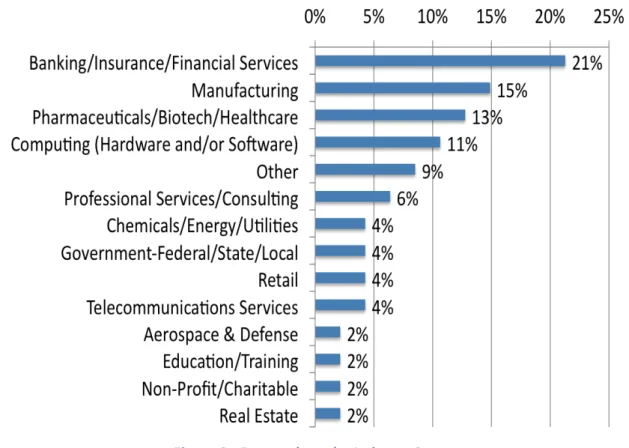
A wide spectrum of industries was represented with the largest participation (21%) drawn from the banking and financial services sector. Around 15% came from the manufacturing sector, which underlines the current high level of interest in MDM in the manufacturing industry.
Figure 3 -‐ Respondents by Industry Sector
The results were analyzed to ascertain whether there were any statistically significant differences discernable when comparing the results split by region (North America and Europe) with the overall results. No such differences were found, the patterns for North America being close to those for Europe.
THE END-‐USER SURVEY
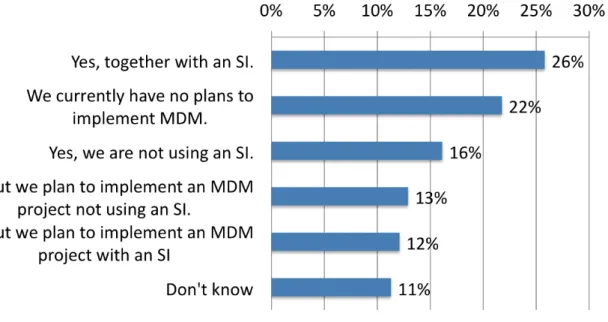
We were first of all eager to understand who was using or planning to use a systems integrator to assist them with their MDM implementation. Accordingly, we asked respondents [Q1, see Survey 1: End-‐User Survey] to tell us if they were undertaking (or had completed), had used or planned to use an SI to help them implement MDM. The full results are shown in Figure 4.
Figure 4 -‐ Involvement of SI in MDM Implementation
42% of respondents’ organizations were already implementing or had implemented MDM. A further 26% told us they planned to implement. More than a fifth (22%) currently had no plans to
implement MDM and some 10% didn’t know at this juncture. Interestingly, 38% were either using or planned to use an SI to help them with implementation, compared to 29% who were implementing or planned to implement not using an SI. Given the complexity of implementing even a smaller MDM program, it is surprising that almost a third already decided to or in future plan to go it alone without engaging an SI. This is underpinned by the observation from a least one respondent that “we felt that there was no SI in the UK with the required experience”. This does however suggest that SIs with relevant experience and a good track record may well be missing out on opportunities and failing to market effectively their expertise. Indeed, our analysis of the SI market leads us to conclude that SIs, in contrast to software vendors, tend to make scant use of marketing.
To facilitate analysis of the findings from the survey, we have split the results into two major sections addressing those organizations that have already implemented or are currently implementing MDM and those who plan to do so.
ALREADY IMPLEMENTING MDM
Responses have been grouped under three broad headings: MDM Implementations – focusing on the size, scope and costs of the MDM implementations; Systems Integrators – addressing the selection process for the SI, technologies deployed and end users evaluation; and Benefits and Barriers – describing the benefits, road blocks and factors leading to successful implementation.
MDM Implementations
First, we wanted to understand the nature of the organizations’ MDM implementations in terms of their size (number of projects, size of the team, number of master records, duration of the
implementation, geographies covered, etc.) together with the costs.
Organizations reported [Q4] that they had undertaken between 1 and 25 MDM implementations with a median of 2. Most organizations (43%) had undertaken only a single implementation of MDM,
although some 25% reported they had undertaken two. 11% told us that they had done three implementations and two noted that they had done 10. Encouragingly, around one-‐third have done more than two implementations, which clearly indicates that MDM has moved beyond the pilot stage to serious business projects.
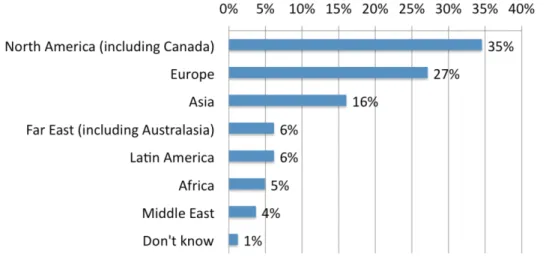
When asked about the geographies covered [Q5], respondents reported a wide range of regions, with the main focus, as might be expected, on North America and Europe. The results are shown in Figure 5. Encouragingly, Asia figures third in the ranking showing that some businesses are taking a global view of master data management.
Figure 5 -‐ Geographies for MDM Implementations
How many people are required on average for a project team to implement MDM? We asked respondents to tell us about the size of their team [Q9]. The numbers ranged from 2 to 100 with a median of 8. We then asked about the composition of the implementation team [Q10]. What proportion was drawn from the business compared to their internal IT department or hired in SI consultants? Encouragingly, respondents told us that generally a quarter of the team came directly from the business, 40% from the internal/own IT department and 35% were provided by the SI. Possibly a slightly higher representation from the business side would be desirable, but in any event it is very encouraging to see that there is significant business input—MDM implementations are doomed to fail without this!
The time required to complete MDM implementations [Q11] varied in the range of three months to three years. Unsurprisingly, given the level of complexity of MDM implementations they can take some time. The overall results are shown in Figure 6.
Figure 6 -‐ Time to Complete MDM Implementation
Most respondents reported that their implementation had taken 6 months. In our experience, this suggests that the majority of implementations were relatively small. This is supported by the
responses to our question about the total number of records managed [Q17]. Respondents reported numbers of records managed by their MDM systems ranging from 1 to 990 million records with a median of 3 million. Around one-‐third had MDM implementations managing 1 million records.
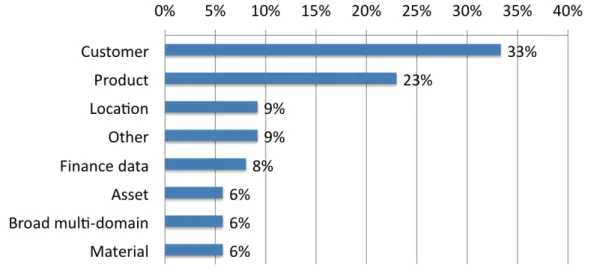
We were interested to understand the scope in terms of master data domains covered by their MDM implementations [Q16]. The results are summarized in Figure 7. Note that it was possible to select more than one option here so the figures are indicative of the ranking.
Figure 7 -‐ Scope of Master Data Domains
Interestingly, the focus would still appear to be the traditional domains “Customer” and “Product”; however, it is encouraging to note that there is a clear spread, indicating that organizations are looking beyond these two domains to managing a wider field of master data. This is supported by results from an earlier survey we conducted where 81% clearly felt that data quality is not all about name and address.
Aside from the once-‐off project costs, it is important for MDM implementations to allocate budget for maintenance on an annual basis. We asked those organizations with live implementations to tell us what they found to be the level of maintenance expressed as a percentage of the original project cost [Q18]. The results reported varied from 5 to 40% with a median of 20%. Thus, a useful guide for those about to embark on an MDM implementation is to make provisions for an ongoing
maintenance cost of around one-‐fifth to one-‐quarter of the estimated project costs.
Key to a successful MDM implementation is to invest in improving data quality. We asked respondents what proportion (%) of the total project cost had been devoted to improving data quality [Q19]. The values reported varied from 3 to 75% of the initial project costs with a median of 30%. Based on this, it is clear that dealing with data quality requires significant investment and this needs to be taken into account when budgeting for your MDM implementation.
We were interested to understand what proportion of the total project cost was spent on acquiring the necessary software. We asked end-‐user organizations what they had found to be the costs of software expressed as a percentage of the total project costs [Q22]. The results they reported varied over a wide range—from 5 to 80% with a median of 25%. This falls roughly in line with the usual “rule of thumb” in project budget estimation that the cost of services is around three to four times the cost of software. The survey result is even higher than the rule of thumb typically used by the SIs (three times the cost of software).
Next, we wanted to understand more about the technology and software-‐licensing model used in the MDM implementation [Q8]. The results (corrected for multiple selection) are shown in Figure 8.
Figure 8 -‐ Technology and Licensing Model
There is a clear choice for traditional MDM, data integration and data quality software over open source alternatives. What is surprising is the relatively high rank accorded to “Custom development” suggesting that organizations cannot find vendor technologies that encompass all their specific requirements. Possibly this represent an opportunity, especially for the open source vendors, to develop tools which are more easily configured to meet end-‐user requirements without the need for low-‐level coding.
Systems Integrators
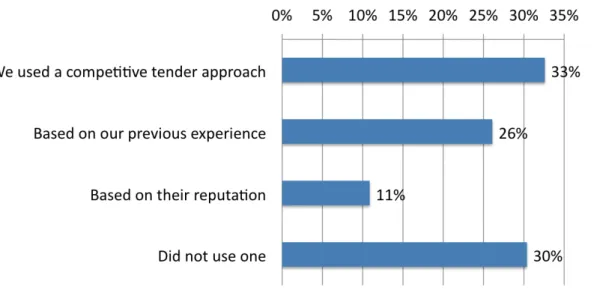
First, we wanted to understand how end-‐user organizations had set about selecting an SI [Q3]. The results are summarized in Figure 9.
The respondents once again indicated that roughly a third did not use an SI. The most popular approach was to go out to competitive tender. Interestingly, only 11% based their choice on the reputation of the SI. This suggests that SIs probably should be doing more to market their experience and expertise.
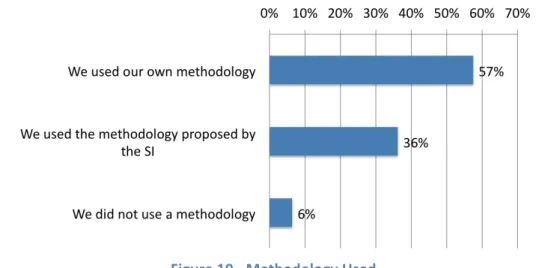
One way in which SIs can bring added value to an MDM implementation is by being able to use a “tried and tested” methodology for implementation which is specific to MDM initiatives. We asked respondents whether they used a methodology provided by their SI [Q2]. The results are presented in Figure 10.
Figure 10 -‐ Methodology Used
Surprisingly, only a third reported that they had used the methodology provided by their chosen SI, with 57% opting to use their own methodology. This is clearly an area where SIs could bring added value for potential end-‐user organizations.
We asked organizations to tell us which SIs they had used (they had the option to select more than one if they had done several MDM implementations) [Q6]. The results are summarized in Figure 11 for the “top 5” ranked highest and it is unsurprising that “none” is given a high ranking considering that fully one-‐third did not make use of an SI.
Most of the remainder were afforded about equal ranking based on broadly similar citation levels. It is not really surprising that two global players feature high in the ranking: IBM GBS and Accenture. What is perhaps surprising is that other major players (such as CSC, Capgemini, Deloitte, Atos Origin, etc.) did not make it into the top five. Careful analysis of the individual results leads us to wonder whether the claims of experience with MDM implementation made by a number of those SIs contacted are somewhat exaggerated.
This, in turn, led us inevitably to explore the level of satisfaction with the SIs among the end-‐user organizations alongside their opinion as to the levels of competency, experience and expertise they found from their chosen SIs [Q14 and 15].
Their responses to the question “How happy were you with your SI?” yielded the following results set out in Figure 12.
Figure 12 -‐ How happy were you with your SI?
Half the respondents expressed themselves broadly satisfied with the performance of their SI while only 16% were Very satisfied or better. Disturbingly, fully a third were quite dissatisfied and
unhappy. This clearly suggests considerable room for improvement on the part of many SIs.
This conclusion is clearly linked to the respondents’ answers to the question relating to their assessment of the experience of the SI. The responses are summarized in Figure 13.
Figure 13 -‐ Assessment of level of experience of SI
59% considered their chosen SI to be adequately experienced or better, while 41% found them to be not very experienced or worse. This is a serious concern for end-‐user organizations that in general pay large sums for the assistance provided by SIs. This result further fuels the concern that there are many SIs out there who claim experience in MDM implementation which in practice they do not have. Only 16% were considered to be very experienced, which is worryingly low.
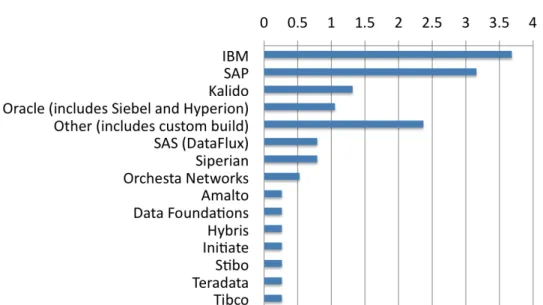
Which vendor technologies for MDM are being implemented by end-‐user organizations [Q7] with or without the support of the SIs? We asked respondents to tell us about their implementations and chosen technologies. The results are summarized in Figure 14. The scale is based on a ranking of the number of citations since respondents were asked to select more than one technology if they had implemented a number of MDM programs (the scale represents relative ranking).
Figure 14 -‐ Ranking of MDM Technologies Implemented
It is unsurprising that IBM and SAP MDM solutions dominate given the size of the two companies and their installed base. In general, there is a wide spread of technologies being implemented. What is perhaps surprising is the high ranking afforded to the category “Other” which includes mostly “custom build” solutions. Given the wide range of technologies currently available, it is interesting that many organizations apparently cannot find adequate solutions among them. Clearly this indicates gaps and missed opportunities for the technology vendors.
Benefits and Barriers
We asked respondents to share with us what, in their organizations, were the main benefits which they had experienced resulting from their MDM implementations [Q20]. Their responses included:
Better quality of data, higher level of understanding of the process impact of bad data. Standardization of data context, content, standard values and business rules – trusted data
leveraged across a disparate application landscape – consolidated business process. Huge improvement in quality (accuracy, analysis capabilities) of reporting. Much easier to
automate processes and integrate systems, because all systems use the same data and have the same data definitions. Big reduction in system maintenance workload, it's no longer necessary to maintain users/customers/accounts etc., in a number of different systems, as all systems are integrated now and master data is synchronized automatically.
Single view of customer.
Single source of truth for customer and product data gives confidence and trustworthiness to data when used by consuming systems.
Product data is now owned and managed by Data Stewards, and not by IT Stewards. MDM helps promote proper Data Governance policies and master data management and sign-‐off (The Business Rule Book) by the Business Stewards.
Better understanding of who our customers are and how many customers we have. Reduce the number of enterprise applications needed.
Faster execution of subsequent projects, improved ease of data use.
Single (source of) customer with a consistent management of the customer data life-‐cycle. Reduction of 3rd party processing costs and single place for all new applications to get data.
Also, this helped kick start a much needed governance project.
We have been able to consolidate our vendor master data from over 10 ERP systems into a single system, enrich this data with data from Dun & Bradstreet, and feed the enriched data to our data warehouse to support spend analytics.
Single Customer Hub Single multi-‐entity hub (excluding customer). Vast efficiencies in master data management costs enabling specific business processes or business units to perform maintenance of dimensions for transactional or analytical purposes.
We also asked respondents to share what they believed to have been the single biggest barrier or problem that they faced during their MDM initiative [Q12]. The main and most frequently recurring problems cited included:
Conversion of data from source system to target system and cleaning of the data.
Good integration with application team and understanding from their side on why and how we do this.
Information indifference.
Business rules, validation logic and detailed understanding of business work process (work flow).
Being on the edge regarding technologies implemented needs a lot of commitment with the software vendor.
Both business and technical knowledge are required for implementing MDM; few people have both so there's always a learning curve involved.
Quality of the data.
Lack of qualified MDM Product personnel.
Identifying the key information upon which to base the customer record.
Identify an architecture adapted to a small organization (lightweight). Just starting the project.
Integration with front-‐end transactional systems and ERP (SAP ECC). Governance.
Politics.
Consistency among various teams. Slow response from people. Data quality.
Unclear business requirement. Shortage of relevant skill sets.
Business glossary of terms and metadata. Clear direction.
Not being able to convince everyone that MDM projects are not ERP and standard approach projects. Lack of commitment and involvement by business associates. While the business (procurement) seemed to buy into, and be committed to, using MDM to address issues with vendor master data, they did not stay the course. Business resources were moved to other projects and not promptly replaced. Over time, the project became more and more of an IT
project with IT forced to explain why we needed an MDM solution and why we were even doing the project.
Customizing “out of the box” MDM to our environment. Data quality and how to improve it.
Data harmonization.
Respondents were also asked to share with us their one tip for ensuring success in an MDM project [Q13]. The key suggestions received included:
The requirements and scope of the project should be well defined. Continuously changing scope gives a lot of problems.
Involve the application group from the start because all changes around MDM will require process changes. Additionally, make sure to agree on who is responsible for what
Focus on understanding business rules, validation logic across data life cycle (create through archive). The technology is the least of the issues to address.
It is important that Business and IT Top management are both committed to the project. Strong communication to find sponsors/first clients.
For each type of master data, determine the best (most motivated, most incentivized) business owner. Everything else follows from that.
Proper MDM design and data quality.
Develop a clear roadmap of incremental steps.
Create an MDM Center of Excellence involving IT and Business owners of data, and users of data.
Make sure you have identified all of the stakeholders to the MDM area you are impacting. [We are] just starting the project. Start from "Reference Data" modeling (business point of
view).
Make sure the MDM project is NOT owned and/or managed by the IT department (or IT Steward). Must be owned and managed by the Data Steward (Enterprise Data Mgmt. Dept.), according to typical Data Governance flow.
Business involvement. Data quality.
Use a single canonical model and make each project relate back to that single model even if they choose different models for their own needs.
Goal-‐oriented project work.
Data synchronization is very important. Keep it simple.
Engage a very experienced architect that has done it before.
Address solutions to the glossary of business terms and ontology early in the MDM project or even before it has begun.
Up-‐front planning.
Interview the SI. Do not go for the lowest; you'll get what you pay for. Do not use a waterfall project methodology. It is too complex to be able to determine costs and all requirements so early in the process.
A successful MDM project is a business-‐driven project. It cannot be seen as an IT project. Get to understand your business processes and people governance upfront; don’t focus on
the technology alone!
Use iterative design and ensure that you are clearly addressing realistic and valuable business processes.
Analysis of both the barriers and tips reported by respondents revealed five main conclusions:
Getting clear and unequivocal sponsorship at the senior business level in the organization (CxO level) is essential for success. Don’t start without it. Ensure that the senior sponsors really understand what their commitment means.
Ensure establishing data governance parallels the MDM implementation. Data quality is key and will take more time and effort than you think. Do not use a waterfall methodology.
From the feedback provided by the respondents, these are the most frequently reiterated themes.
Key to ensuring acceptance of your MDM initiative and to understanding potential benefits is to develop a quantified business case. Development of an effective business case was often cited as a “must have” for successful MDM implementation. We asked organizations to tell us whether they had produced a business case including quantified return on investment [Q21]. The results are shown as Figure 15.
Figure 15 -‐ Did you produce a Business Case?
Almost two–thirds of respondents told us that they had produced a quantified (including return on investment, e.g., net present value) business case. Previous surveys on the topic of implementation of MDM have resulted in much lower figures, so it is encouraging that so many organizations have taken this important first step. Clearly, you cannot assess the benefits (especially in qualitative terms) of your MDM implementation without first having a business case. Even so, fully a third failed to produce a business case.
It is becoming generally accepted that establishment of a data governance program goes hand in hand with implementation of MDM. We were interested to understand how far organizations had taken steps to set up data governance alongside or as part of their MDM implementation [Q23]. Experience shows that MDM implementations often fail due to the lack of a clear data governance initiative. The results are shown in Figure 16.
It is very encouraging to note that 86% of those currently implementing MDM have an established data governance program. Clearly, the messages about the importance of data governance (and data quality) to a successful MDM implementation are being heeded.
A final area of interest to us was to understand whether organizations had undertaken a post-‐ implementation review [Q24] of their MDM implementations in order to better understand the benefits and to learn from the roadblocks and pitfalls encountered. The outcome is presented in Figure 17.
Figure 17 -‐ Did you do a post-‐implementation review?
Encouragingly, 40% told us that they have already done a post-‐implementation review and a further 40% plan to do so. This is indeed encouraging given that an Aberdeen Group study some years ago showed that in general only 5% of organizations actually did one (this study was, however, not specific to MDM).
PLANNING TO IMPLEMENT MDM
We then turned our attention to those who have not yet implemented an MDM initiative but plan to do so in the near future.
Planned MDM Implementations
We asked those planning MDM implementations about the size and scope of their planned MDM systems. We firstly wanted to understand the scope in terms of master data domains [Q29]. The results are shown in Figure 18.
Figure 18 -‐ Planned scope of MDM Implementation
Mirroring the scope of those already implemented, those planning implementations told us they planned to focus on “Customer” and “Product”. Here again, however, there is a clear indication that a wider range of master data domains is under consideration.
In which regions is this group planning to implement MDM [Q27]? Figure 19 gives a summary of the results.
Figure 19 -‐ Geographies where MDM implementations are planned
Interestingly, in the case of this group planning implementations, the main focus is clearly on Europe in contrast to the group that had already implemented, which focused more towards North America. Potentially, this reflects to some degree that organizations that have initially implemented in North America are turning their attention to their European businesses.
What is the size of the planned MDM implementations [Q31] in terms of the total number of records managed? The sizes quoted range from 1 to 1000 million records with a median of 5, so probably
not really significantly larger than those already implemented. This may well be indicative of adoption of a frequently recommended stepwise approach to MDM implementation.
What do those planning MDM implementations envisage to be the relative proportions of staff in their project teams [Q28]? Their view is that 37% will be from business, 38% drawn from their internal IT organization and supported by 25% external staff from the SI. This implies that they believe they will have a greater proportion of business staff involved than has been the case with the existing implementations. This is encouraging since in our experience a proportion of 33% from each area is likely to be about right.
What do those planning MDM implementations envisage as the technologies and licensing model they plan to use [Q30]? The results are summarized in Figure 20.
Figure 20 -‐ Plans for Technology and Licensing Model
Again, the general pattern seems to be to opt for traditional approaches with a predominance of “Custom build”. This again prompts the question: why is it that organizations feel compelled to opt for custom-‐built solutions when there is a broad range of software on the market? Vendors need to seek further to identify gaps and develop collateral to help convince end users of the benefits of adopting a packaged solution. They should also explore more the option to make their “standard” solutions more easily configurable to meet end-‐user requirements without the need to resort to programming.
We asked those with plans for MDM implementations to estimate what in their view would be the level of maintenance effort they planned to budget for as a percentage of the total estimated project costs [Q32]. The median was 15% with a range of 1 to 50%. This is clearly less than the amount that those who have already implemented have encountered in practice (20%).
Systems Integrators
We asked how those planning MDM implementations were going to select their SI [Q26]. The results are shown in Figure 21.
Figure 21 -‐ How do you plan to select your SI?
42% told us they plan to use competitive tender and only 8% based upon the reputation of the SI. Around one-‐fifth plan to base their decision on past experience. A higher proportion of those planning MDM implementations propose using competitive tender for selection compared to those who had already implemented (33%).
We then asked which project methodology they planned to use [Q25]. The feedback they provided is summarized in Figure 22.
Figure 22 -‐ Which methodology will you use?
Fully half of those planning implementations told us they intended to use their own methodology rather than that offered by the selected SI. This compares with those who have already
the use of own methodology suggests that SIs appear not to have convincing alternatives in this area. This is surprising given that a tried and tested methodology is one of the added value benefits that an SI should bring to an MDM implementation. Again, this leads us to wonder whether the majority of SIs currently in the market really have extensive experience in implementing MDM.
Benefits and Barriers
Initially, we asked this group to tell us whether they had prepared, or were planning to prepare, a business case with quantified return on investment [Q33]. The results are shown in the chart in Figure 23.
Figure 23 -‐ Are you planning to produce a Business Case?
Almost two-‐thirds confirmed that they planned to develop a business case. This is encouraging given the importance of this highlighted by those who have already implemented MDM. What is
somewhat surprising is that one-‐third have yet to make a decision on this despite being partway along the planning cycle.
Next, we asked end-‐user respondents to tell us what they believe to be the biggest problem they expect to face in terms of getting the project justified and its budget approved [Q34]. The responses included:
Business case and value of implementation.
Belief that there will be quantifiable business benefits in an outsourced environment. Battle for budget against other directly related operational changes.
Consensus about where to start.
The challenge of getting a direct business benefit for the MDM initiative, as it impacts funding as well as degree of business involvement.
Customer approval.
Undocumented in-‐house developed applications. Business Process Benefits.
Getting upper management to understand its use.
Understanding the approach, the implementation path and the return on investment. Getting high priority when there are many other projects that are also needed.
Showing how important this job is to our organization. Some people do not understand what MDM is and the benefits it can give to us.
Agreeing assumptions and time frame and also getting buy-‐in from management/users. Political challenges of moving from a silo-‐centric organization to an entity/data-‐centric
business.
Finally, we were interested in learning what proportion of those planning MDM implementations intended to undertake a post-‐implementation review [Q35]. The results are shown in the chart in Figure 24.
Figure 24 -‐ Will you carry out a post-‐implementation review?
Fully two-‐thirds confirmed that they plan to carry out a post-‐implementation review at the end of the MDM implementation. This contrasts with those who have already implemented where 40% had done a review and 40% still intended to carry out such a review.
OPEN SOURCE TECHNOLOGIES
Recently, there has been increasing interest in the adoption of open source software by
organizations. Although the main focus of this survey centers on SIs and MDM implementations, we wanted to understand to what extent organizations were looking to adopt open source software, such as that for data integration or data quality, for mission critical applications such as MDM. We therefore asked organizations to inform us about their current position on the use of open source [Q39]. The results are summarized in Figure 25.
Figure 25 -‐ Adoption of Open Source Technologies
The results confirm the growing interest from organizations in open source as an alternative to traditional solutions. 35% indicated that they would consider using open source while some 38% are already running it in either pilot or operational stages.
THE VIEW FROM THE SYSTEMS INTEGRATORS
As a second component of the survey, we asked some 55 systems integrators, all of whom claimed MDM expertise, to complete a questionnaire (see Survey 2: Systems Integrator Survey). In this, we elicited some basic factual information such as the number and size of projects that they had been involved with but also asked them to indicate the benefits and roadblocks found during these implementations. About half of them responded, the majority from Europe with North America a close second.
We firstly [Q1] asked them to tell us how many staff they had trained in MDM technology in order to gain an impression of the level of expertise available currently. The median was 13 staff with one company claiming 700 and another 250. In response to the question [Q3] about the total number of MDM projects they had conducted, the median answer from Sis was 9 (again with one company reporting 750!). When we asked how many projects [Q4] they were involved in during 2009 the median was 5. It’s interesting to note that the two companies who claimed large numbers of projects had only a small number in 2009. These relatively low numbers suggest that despite the currently high profile and levels of interest in MDM, relatively few companies are implementing (at least assisted by an SI).
We were also interested in understanding whether they used a specific methodology [Q2]. The majority (55%) reported using an interactive methodology which is now becoming generally accepted as best practice. Only three reported that they still used a waterfall approach.
Where (in which geographies) are SIs implementing MDM [Q5]? Europe topped the list with North America a close second. This may well be a reflection of the high merger and acquisition activity especially in Europe over the past few years.
Vendor Technologies
A key question was [Q6] regarding which MDM vendor technologies the SIs had implemented. The majority listed Oracle at top of the list with, surprisingly, “custom build” as second. The “top ten” are shown in Figure 26 (the scale represents relative ranking).