Chapter 11
Educational Offerings
The institution’s educational offerings display academic content, rigor, and coherence that are appropriate to its higher education mission. The institution identifies student learning goals and objectives, including knowledge and skills, for its educational offerings. MSCHE.
__________________________________________________________________________________________
Educational Offerings Congruent with the College’s Mission and Vision
The credit and continuing education programs at Prince George’s Community College embody the college’s vision and mission by addressing “the educational, employment, and enrichment needs of the community it serves through high quality programs for university transfer, general education, workforce development, cultural enhancement, and continuing education.”
The college offers transfer and career degree programs, and a variety of community-based continuing education courses are listed in the college catalog (Exhibit 6). Each
transfer, career, and continuing education program satisfies the requirements of the Maryland Higher Education Commission (MHEC) for content and rigor.
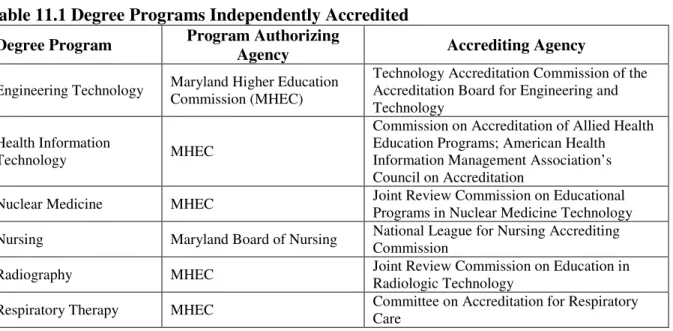
Table 11.1Degree Programs Independently Accredited
Degree Program Program Authorizing Agency Accrediting Agency
Engineering Technology Maryland Higher Education Commission (MHEC) Technology Accreditation Commission of the Accreditation Board for Engineering and Technology
Health Information
Technology MHEC
Commission on Accreditation of Allied Health Education Programs; American Health Information Management Association’s Council on Accreditation
Nuclear Medicine MHEC Joint Review Commission on Educational Programs in Nuclear Medicine Technology Nursing Maryland Board of Nursing National League for Nursing Accrediting Commission Radiography MHEC Joint Review Commission on Education in Radiologic Technology Respiratory Therapy MHEC Committee on Accreditation for Respiratory Care Source: http://nces.ed.gov/ipeds/cool/Accreditation.asp?UNITID=163657, and 2004-2005 College Catalog, pp. 47, 58.
The college’s programs have consistently met accreditation requirements. Several programs also are independently accredited as shown on Table 11.1 above.
Degrees Have Appropriate Content, Breadth, Length, and Rigor
The college’s ability to meet the educational, employment, and enrichment needs of the community is measured, in part, by the success of students who complete a transfer program or earn an associate of arts (A.A.) degree, an associate of science (A.S.) degree, or an associate of arts in teaching (A.A.T.) degree and then transfer to a four-year college or university. For example, transfer of the secondary associate of arts in teaching (A.A.T.) in chemistry, physics, mathematics, or Spanish is based on disciplinary outcomes, successful completion of the PRAXIS I exam, and a 2.75 or higher grade point average (2004-2005 College Catalog, p. 68). According to the Office of Planning and Institutional Research (OPIR), Prince George’s Community College graduates who transfer perform academically nearly as well as “native” students (Exhibit 70).
Students who complete career programs and earn an associate of applied science (A.A.S.) degree are well prepared for entry-level careers. Employers’ satisfaction with the college’s graduates is evidenced by the 100 or more employers who participate in the college’s job fairs each spring and fall.
Workforce Development and Continuing Education certificate programs provide entry-level and upgrade training to the business and government communities through certificate programs that offer three to ten related courses. A student must successfully complete all core and elective courses in the series to receive a certificate. Approval by the Maryland Higher Education Commission (MHEC) is dependent on the purpose of the course, its target audience, instructional delivery format, length, description, and learning objectives.
Continuing education courses must be reviewed and revised or deleted every two years (Exhibit 71).
Learning Coherency and Promoting Synthesis of Learning
All degree program courses are listed numerically in an order that implies a sequential progression, beginning with 100 level or freshman courses and moving to 200 level or sophomore courses. Most degree programs require that concentration courses be taken sequentially to achieve coherency of learning. A few degree programs (e.g., Business Management A.A.S., Criminal Justice Technology A.A.S., Criminal Justice Transfer Option A.A., Police Science Option A.A.S., and Women’s Studies Option A.A.) have justified a nonsequential progression.
The courses required for all degree programs are designed to enhance both learning coherency and learning synthesis. Achieving these dual goals, however, is challenging. A common lament among faculty is that students have difficulty transferring knowledge and skills from one course to another. The college is addressing this challenge in four ways:
1. Introducing multidisciplinary courses, which require the synthesis and transfer of information from several disciplines (2004-2005 College Catalog, pp. 115-116). 2. Establishing five discipline-based Collegian Centers to provide co-curricular
activities for students outside of the classroom that reinforce classroom learning (Exhibit 45).
3. Developing thematic modules that can be introduced across the curriculum (Exhibit 72).
4. Focusing on students’ critical thinking skills, launched in “The Year of Critical Thinking 2004-2005” (Exhibit 73).
Although the results of these efforts will not be available for at least another year, the college is confident that they will improve the coherency of student learning and promote the
synthesis of learning.
Program Goals Stated in Terms of Student Learning Outcomes
The foundation for program outcomes is the composition of courses that comprise it. Since 2000, academic departments have been required to write master syllabi course
objectives in measurable student learning outcomes. As of 2003, master syllabi for all 425 regularly taught courses have been also written in measurable student learning outcomes. The master syllabi of all new courses are written in measurable outcomes which are included in faculty syllabi. The typical preamble to the learning outcomes reads: “Upon successful completion, a student will be able to….”
The Task Force’s analysis of program descriptions in the 2004-2005 College Catalog, Chapter 4, showed that half (13 out of 26) either imply student learning outcomes or omit them. The program descriptions that imply learning outcomes may indicate the skills necessary for certain levels of employment, abilities such as, “…effective oral and written communication and human relations skills,” (2004-2005 College Catalog, p. 34), but the descriptions do not set forth learning. This oversight will be remedied in the next catalog.
Evaluation of Curricular, Co-Curricular, and Extra-Curricular Programs
The Office of Instruction requires evaluations of curricular and co-curricular programs. The Office of Planning and Institutional Research (OPIR), Academic Outcome Assessment Committee (AOAC), Curriculum Committee, General Education Committee, and each academic department are involved with curricular evaluations of programs. The evaluation results guide planning for the following year. AOAC guides academic
departments in the evaluation of courses, the building blocks of programs. Since FY02, a total of 75 courses either have been assessed or are in the process of being assessed for rigor and student learning.
Evaluations of co-curricular programs are based on the information submitted by the program directors in year-end reports. These reports usually include quantitative data (e.g., the number of students participating, the number of events held, activity costs) and
qualitative data (e.g., student responses to the event, interest in repeating the event). The coordinators of co-curricular programs use both types of data to plan for the following year.
In addition to year-end evaluation, most co-curricular programs are evaluated formally or informally on an event-by-event basis. Informally, debriefing sessions evaluate the success of an event and discuss ways to improve it. Formally, participants are asked to complete evaluation forms. Instruction area co-curriculum programs that are subject to evaluations include the Faculty Professional Development Program, Academic Outcomes Assessment Committee, Collegian Centers, Honors Program, Honors Academy, International Center, Writing Center, and Tutoring Center.
As explained in Chapter 9, Student Services is incorporating assessment components in all extra-curricular activities. Student Services has developed a plan that requires annual assessments and program reviews every five years.
Library Resources, Learning Resources, Instructional Equipment, and Facilities
The college’s library resources and learning resources provide strong support for its educational program. The availability of instructional equipment is more than adequate and, when the college’s renovations and new construction is completed, the facilities will be outstanding.
Library Resources and Learning Resources
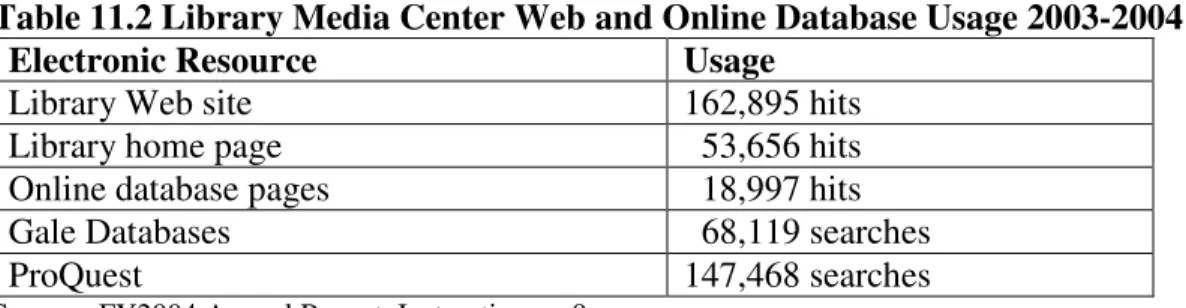
The library’s resources include the largest electronic data collection of the 16 Maryland community colleges. The services of the library staff are used effectively to support the student body’s academic needs. The library’s collection and services are built around the requirements of the curriculum and classroom assignments. Ongoing faculty involvement has assured that the collection and services are tailored to contribute to the students’ learning objectives. Students prefer to use electronic resources, accordingly, as noted in Chapter 3, the library has established an extensive electronic database collection. The addition of four new databases in 2004 brough the total to 28. The library’s electronic resources are heavily used as shown in Table 11.2. At the same time, the number of on-site reference inquiries has declined slightly from 17,653 in 2002-2003 to 16,783 in 2003-2004 (Exhibit 5).
Table 11.2 Library Media Center Web and Online Database Usage 2003-2004
Electronic Resource Usage
Library Web site 162,895 hits
Library home page 53,656 hits
Online database pages 18,997 hits
Gale Databases 68,119 searches
ProQuest 147,468 searches
Source: FY2004 Annual Report–Instruction, p. 9
Students have remote access to the library’s subscription databases, but access to complete academic library services at off-campus sites is still needed. According to a senior librarian, students attending classes at a location other than Largo (main campus) rely on public library services, which do not equal the college’s library services. Department chairs agree. To improve off-campus library resources, in July 2004, a memorandum of
understanding between the college library and the Prince George’s Memorial Library System was signed (Exhibit 74). The agreement provides more college-level library services to
students attending one of the college’s additional locations, particularly University Town Center.
Library resources represent one example of the need for long-term, systematic planning and funding, so that comparable support services can be delivered to all students regardless of location. Descriptions of the college’s array of learning resources and the services they provide are in Chapter 9.
Instructional Equipment
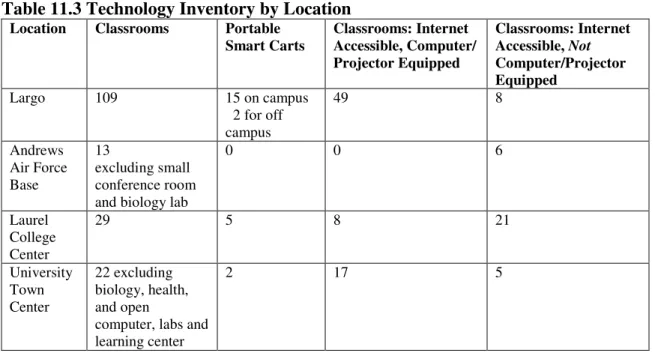
The number of computers and open computer lab space on and off campus has grown significantly in the last 10 years and is sufficient, except during peak times in the middle and end of semesters. The college wants to replace academic computers on a three-year cycle as part of the college’s technology plan which will be phased in over the next five years if the funds become available. Pending the availability of resources, more “smart classrooms” or “smart carts” are planned to accommodate the increased use of technology in the classrooms. Table 11.3 provides a location-specific inventory of smart carts and classrooms that are internet accessible and equipped with computer/projectors. (Each classroom has 18-26 computers.)
Table 11.3 Technology Inventory by Location
Location Classrooms Portable
Smart Carts Classrooms: Internet Accessible, Computer/ Projector Equipped Classrooms: Internet Accessible, Not Computer/Projector Equipped Largo 109 15 on campus 2 for off campus 49 8 Andrews Air Force Base 13 excluding small conference room and biology lab
0 0 6 Laurel College Center 29 5 8 21 University Town Center 22 excluding biology, health, and open
computer, labs and learning center
2 17 5
Source: Largo Media Director, Coordinators of Andrews Air Force Base, Laurel College Center, and University Town Center.
Thanks to external support from federal, state, and private agencies, the college has state-of-the-art forensic equipment, two developmental mathematics computer labs, a new math technology center and is in the process of establishing a new health simulation lab for health technology students. These advances in technology provide students with state-of-the-art learning experiences.
All faculty members have access to the Blackboard Learning System, an online course management system, to complement and supplement traditional learning.
Additionally, the Technology Resource Center, located in the library, is available to support the technology needs of faculty.
Facilities
The college community is excited and energized by the extensive renovations of several facilities. However, the renovations have required creative teaching adjustments, in addition to temporary relocations. With a shortage of classrooms because some were closed
for renovation, faculty developed hybrid courses, a combination of online and face-to-face instruction. Hybrid courses are taught in a classroom one day a week and via Blackboard on other days.
Part of the library is being used for surge space during the renovations, which reduces the amount of space available to students. Library study areas frequently are overcrowded, and the group study rooms on the second floor have been temporarily reassigned as
administrative office space for another program. The library does not meet Association of College & Research Libraries’ (ACRL) desired standard of three assignable square feet per full-time equivalent (FTE) credits for community colleges with more than 9,000 FTEs per year. Currently, the college library only has one assignable square foot per FTE. Fortunately, library space limitations will be resolved when the renovations are complete, which will include the renovation of the library. Other space limitations also will be eased when the technology building is completed in 2007. (See the Capital Improvement Schedule, Appendix A.)
Comparable Quality of Education
The college provides comparable quality of teaching/instruction, academic rigor, and educational effectiveness of its courses and programs at all of its sites. Full-time and adjunct faculty members are hired using the same qualification criteria. Measurable outcomes are standardized for each course, and full-time and adjunct faculty are required to include the outcomes on their syllabi, regardless of where the course is taught or how it is delivered, e.g., online, face-to-face, etc. Students use the same evaluation form to evaluate full-time and adjunct faculty (Exhibit 75).
In addition, full-time faculty members are observed in the classroom by their
immediate supervisor and dean. Faculty members may choose whether or not to be observed by a peer. Adjunct faculty members are observed by the department chairperson or another full-time faculty member. Some department chairs note difficulty getting to all of the
college’s locations to observe faculty, particularly given that some adjunct faculty only teach at one of the three off-campus sites.
Beginning in fall 2003, student evaluations of instructors have been conducted for online courses. The evaluation process, forms and frequency for online instructors are the same as those for face-to-face classes.Through a statewide consortium Fund for the
Improvement of Postsecondary Education (FIPSE) grant, “Quality Matters,” the director of Distance Learning is collaborating with other community colleges to develop and implement statewide evaluation standards for online courses.
Transfer Credit Policy and Procedure
As indicated in Chapter 8, the Maryland Higher Education Commission General Education and Transfer Policy is published in the college catalog. A transfer evaluator assesses incoming courses according to their applicability to students’ programs of study. Course content and a college’s accreditation will determine transferability of course work. The transfer evaluator and appropriate department chair check course learning outcomes only if a course description from another institution is questionable.
Accelerated Programs
The college has accelerated courses, but no accelerated programs. Accelerated
Meeting the Needs of the Adult Learner
Given that the average age of credit-seeking students is 29 the college is highly responsive to adult learners’ needs. Credit and noncredit courses are offered at various times and in various formats to accommodate the schedules of adult learners. Enrollment increases in classes scheduled at extension centers, on weekends, and through distance learning
provide evidence that adult learners’ scheduling needs are being met.
The college offers an array of distance learning opportunities including interactive video, telecredit, and online courses. Online courses are the most popular. Of the students enrolled in any distance learning course in fall 2004, 1,847 took at least one online course, 68 took at least one telecredit course, and 22 took at least one interactive course (OPIR Factbook 1 Fall 2004, p.10 Exhibit 34). The number of online courses has expanded from 18 in fall 2000 to 137 in fall 2004.
Since 2000, two additional degree center locations, University Town Center and Laurel College Center, have opened to the benefit of both adult and traditional students. Enrollment at University Town Center has risen from 276 five years ago to 1,331 in fall 2004, and at Laurel College Center from 203 in 2002 to 356 in fall 2004 (OPIR Fact Book-Fall 2004, p.9).
The college has been offering classes located at Andrews Air Force Base for more than 30 years. However, after 9/11, the base was closed to outside programs. It was reopened a year later and the college is rebuilding the program. Since the beginning of the war in Iraq, many of the students in the military have been deployed. The college has developed a variety of ways to help them complete courses. When possible, deployed students are switched to online courses or, if necessary, given incompletes.
Students are taking advantage of various scheduling options such as day, evening, weekend, online, telecredit, and accelerated . In fall 2004, 29% of the students reported a “split schedule” utilizing a variety of options including classes at the Largo campus during the day, evening or weekend; classes at extension centers; and classes utilizing distance learning technology (OPIR Factbook, Fall 2004).
The Prior Learning Assessment Network (PLAN) enables adult learners to earn credit for college-level learning acquired through employment, volunteer work, and other life experiences. Prior work/life experiences may be evaluated through portfolio assessment, standardized exams, and American Council of Education (ACE) evaluations of
business/industry and military training. A student may earn up to 15 credits through portfolio assessment alone. All prospective PLAN students are required to attend a one-hour
information session, meet with a PLAN advisor, and be eligible for EGL 100 through
placement testing. Since the summer of 2000, 93.3 percent of course narratives submitted by students have been awarded college credit (questionnaire completed by the PLAN
coordinator).
The Workforce Development and Continuing Education (WDCE) division is the third largest in the state with approximately 20,000 students, 47,000 enrollments, 2,700 FTE, and $4.6 million in tuition/fees/FTE revenue. All of WDCE’s courses are designed to meet the workforce training and personal enrichment needs of adult learners. Courses are offered primarily in the evenings and on weekends at all four college locations and at other sites in the county. In addition to noncredit courses in basic skills, general education, and personal enrichment, WDCE also provides customized training (credit or noncredit) and business services for businesses, government, and special populations as well as therapeutic and
educational programs for senior adults (60+) at 52 senior centers and nursing homes around the county, serving more than 5,000 senior adults.
Assessment to Improve Student Learning and Effectiveness
Instruction has engaged in assessment since 1999. As discussed in Chapters 7, 12, and 14, several levels of assessment are used: course, department self-study, discipline, program and general education. Using the results of course assessments, departments have made course and teaching modifications such as revising the order of content presentation,
changing the areas of emphasis in a course, and developing common final exams. As part of the process, departments need to assess the efficacy of changes after they have been in place for a semester or more.
Following disappointing results from the Academic Profile assessment of graduating students’ critical thinking skills, a major college-wide program was established to strengthen instruction in this area. As discussed earlier, the multifaceted “Year of Critical Thinking 2004-2005” is the direct result of assessment.
Recommendations
1. Rewrite catalog program descriptions in terms of student learning outcomes.
2. Provide for the implementation and replacement of instructional technology to meet curriculum needs.
3. Reassess courses to determine if assessment-based course changes improved learning outcomes.
4. Implement statewide standards for the evaluation of online courses as soon as possible.