Washington University in St. Louis
Washington University Open Scholarship
Engineering and Applied Science Theses &
Dissertations
McKelvey School of Engineering
Summer 8-15-2017
Efficiently and Transparently Maintaining High
SIMD Occupancy in the Presence of Wavefront
Irregularity
Stephen V. Cole
Washington University in St. Louis
Follow this and additional works at:
https://openscholarship.wustl.edu/eng_etds
Part of the
Computer Engineering Commons
This Dissertation is brought to you for free and open access by the McKelvey School of Engineering at Washington University Open Scholarship. It has been accepted for inclusion in Engineering and Applied Science Theses & Dissertations by an authorized administrator of Washington University Open
Recommended Citation
Cole, Stephen V., "Efficiently and Transparently Maintaining High SIMD Occupancy in the Presence of Wavefront Irregularity" (2017).Engineering and Applied Science Theses & Dissertations. 301.
WASHINGTON UNIVERSITY IN ST. LOUIS School of Engineering and Applied Science Department of Computer Science and Engineering
Dissertation Examination Committee: Jeremy Buhler, Chair
James Buckley Roger Chamberlain
Chris Gill I-Ting Angelina Lee
Efficiently and Transparently Maintaining High SIMD Occupancy in the Presence of Wavefront Irregularity
by Stephen V. Cole
A dissertation presented to The Graduate School of Washington University in
partial fulfillment of the requirements for the degree
of Doctor of Philosophy
August 2017 Saint Louis, Missouri
Table of Contents
List of Figures . . . v
List of Tables . . . ix
Acknowledgments . . . x
Abstract . . . xv
Chapter 1: Background and Context . . . 1
1.1 Motivation . . . 1
1.2 Research Questions and Direction . . . 9
1.2.1 The Streaming Paradigm . . . 9
1.3 Related Work . . . 13
1.3.1 Non-streaming Approaches to Parallelism . . . 13
1.3.2 Context Within the Streaming Paradigm . . . 17
1.3.3 Level of Developer Abstraction . . . 18
1.3.4 Road Map and Contributions . . . 21
Chapter 2: Wavefront Irregularity Case Study: Woodstocc . . . 24
2.1 Overview . . . 25 2.2 Background . . . 26 2.2.1 Problem Definition . . . 26 2.2.2 Related Work . . . 26 2.3 Alignment Strategy . . . 28 2.3.1 Core Algorithm . . . 28 2.3.2 Read Batching . . . 30 2.4 GPU Implementation . . . 34
2.4.1 Application Mapping to GPU . . . 34
2.4.2 Kernel Organization to Maximize Occupancy . . . 34
2.4.3 Decoupling Traversal from DP . . . 38
2.4.4 Boosting Block Occupancy via Kernel Slicing . . . 38
2.5 Results . . . 40
2.5.1 Impact of Worklist and Dynamic Mapping . . . 40
2.5.2 Kernel Stage Decoupling . . . 41
2.5.3 Overall Performance and Limitations . . . 42
Chapter 3: Mercator Overview and Results . . . 46
3.1 Mercator Application Model . . . 47
3.1.1 Topologies and Deadlock Avoidance . . . 49
3.2 Parallelization on a SIMD Platform . . . 51
3.2.1 Parallel Semantics and Remapping Support . . . 52
3.2.2 Efficient Support for Runtime Remapping . . . 53
3.3 System Implementation . . . 59
3.3.1 Developer Interface . . . 59
3.3.2 Infrastructure . . . 61
3.4 Experimental Evaluation . . . 65
3.4.1 Design of Performance Experiments . . . 65
3.4.2 Results and Discussion . . . 69
3.5 Conclusion . . . 74
Chapter 4: Mercator Dataflow Model and Scheduler . . . 77
4.1 Model Introduction / Background . . . 78
4.1.1 Example Target Platform: GPUs . . . 78
4.1.2 Related Work . . . 78
4.2 Function-Centric (FC) Model . . . 81
4.2.1 Structure . . . 81
4.2.2 Execution . . . 82
4.2.3 Example Applications . . . 83
4.3 Mercator and the FC Model . . . 85
4.3.1 Merged DFGs and Deadlock Potential in the FC Model . . . 85
4.3.2 Deadlock Avoidance with Mercator Queues . . . 86
4.4 Mercator Scheduler: Efficient Internal Execution . . . 88
4.4.1 Feasible Fireability Requirements . . . 88
4.4.2 Feasible Fireability Calculation . . . 91
4.5 Mercator Scheduler: Firing Strategy . . . 91
4.5.1 MercatorScheduler: Results . . . 95
4.6 Conclusion . . . 101
Chapter 5: Conclusion and Future Work . . . 103
5.1 Optimization Opportunities . . . 104
5.1.1 Variable Thread-to-Work Module Mappings . . . 105
5.1.2 Module Fusion/Fission . . . 105
5.2 Extensions to New Application Classes . . . 107
5.2.1 Applications with “join” Semantics . . . 108
5.2.2 Iterative Applications . . . 109
5.2.3 Bulk Synchronous Parallel (BSP) Applications . . . 110
5.2.4 Case study: Loopy Belief Propagation for Stereo Image Depth Inference . . 114
5.2.5 Graph Processing Applications . . . 119
5.2.6 Applications with Dynamic Dataflow . . . 120
5.2.7 Applications with Multiple Granularities of Operation . . . 121
Appendix A Mercator User Manual . . . 129
A.1 Introduction . . . 129
A.1.1 Intended Use Case: Modular Irregular Streaming Applications . . . 129
A.1.2 MercatorApplication Terminology . . . 130
A.1.3 System Overview and Basic Workflow . . . 132
A.2 Mercator System Documentation . . . 133
A.2.1 Initial Input . . . 133
A.2.2 System Feedback . . . 147
A.2.3 Full Program . . . 148
A.2.4 Example Application Code . . . 157
List of Figures
Figure 1.1: NCBI SRA growth. . . 2
Figure 1.2: Processor categories from Flynn’s taxonomy, including SIMD. . . 2
Figure 1.3: Irregular-wavefront work assignment challenge. . . 8
Figure 1.4: Example of streaming pipeline: VaR simulation. . . 10
Figure 1.5: Comparison between monolithic application structure and modularized stream-ing structure for rectification of wavefront irregularity. . . 11
Figure 1.6: Spectrum of parallelism granularity targeted by various systems. . . 15
Figure 1.7: Spectrum of developer abstraction from implementation of parallelism. . . . 21
Figure 2.1: Example alignment of a short read to a longer reference sequence. . . 26
Figure 2.2: Example suffix trie for a string. . . 27
Figure 2.3: Snapshot of suffix tree alignment using dynamic programming. . . 29
Figure 2.4: Snapshot of batched traversal method for dynamic programming suffix tree alignment. . . 31
Figure 2.5: Multiple-granulairty SIMD work assignment challenge for batched traversal. 32 Figure 2.6: Idle reads SIMD work assignment challenge for batched traversal. . . 33
Figure 2.7: Stages of theWoodstoccGPU kernel main loop. . . 36
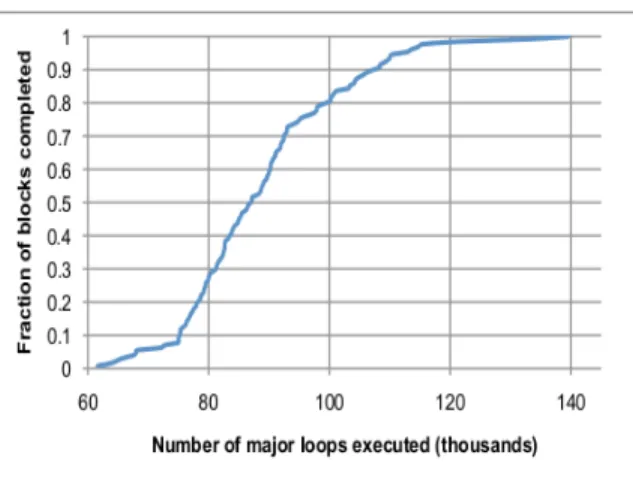
Figure 2.8: CDF of loop iterations by block forWoodstocc. . . 40
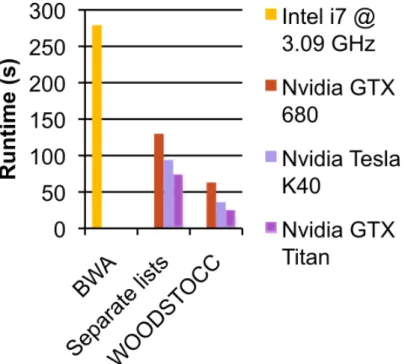
Figure 2.9: MajorWoodstocc performance result: Woodstocc vs. BWA. . . 43
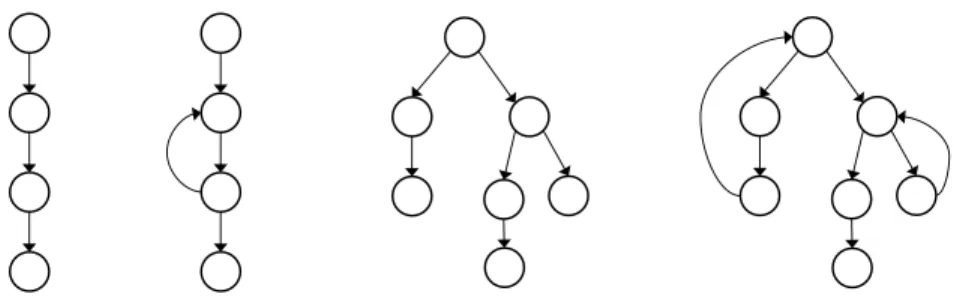
Figure 3.1: Example application topologies, including pipelines and trees with or without back edges. . . 47
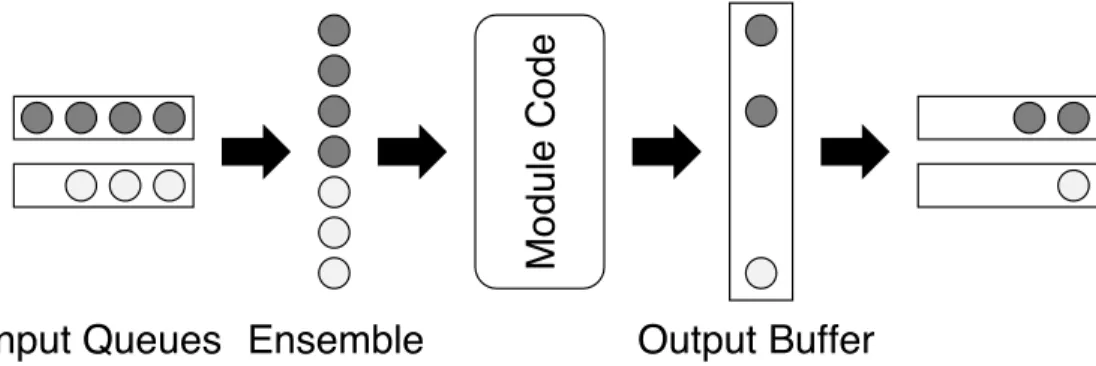
Figure 3.2: Schematic of steps involved in firing aMercator module. . . 54
Figure 3.3: Dataflow graph for an exampleMercatorapplication. . . 55
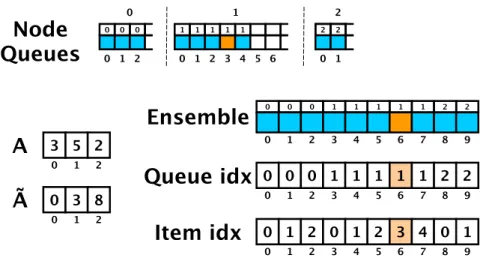
Figure 3.4: Snapshot of an ensemble gather calculation on a set of three node queues. . 57
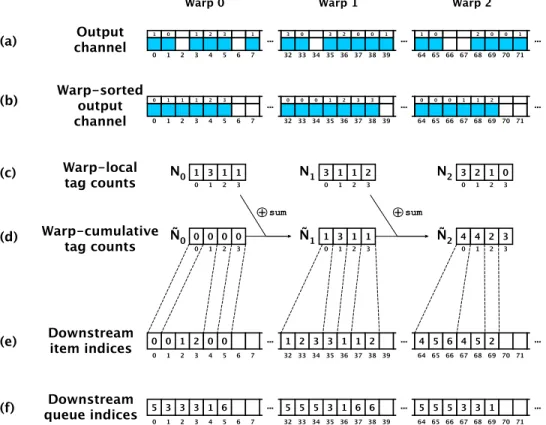
Figure 3.5: Snapshot of a scatter calculation for an output channel of a module with four nodes. . . 58
Figure 3.6: Major components of theMercator framework. . . 59
Figure 3.7: Workflow for writing a program incorporating aMercatorapplication. . 60
Figure 3.8: Pseudocode of application graph traversal to mark cycle components. . . . 62
Figure 3.9: Pseudocode of postorder graph traversal to verify cycle validity. . . 63
Figure 3.10: Topologies of single-pipeline synthetic benchmarks. . . 66
Figure 3.11: Topologies of multi-pipeline synthetic benchmarks. . . 67
Figure 3.12: Framework validation: speedup ofDiffTypeoverMergedtopology for varying filtering rates and workloads. . . 70
Figure 3.13: Performance results for replicated-pipeline benchmarks. . . 72
Figure 3.14: Average thread occupancy per firing of modules at different pipeline stages for Stagedvs.Diff. . . 73
Figure 3.15: Framework validation: performance results for BLASTN, Mercator vs. Mergedtopologies. . . 74
Figure 3.16: Average thread occupancy at all pipeline stages of BLASTN forMercator and Mergedimplementations. . . 75
Figure 4.1: Dataflow graph for a streaming application and associated work queueing strategies under three streaming PXMs. . . 79
Figure 4.2: Dataflow graphs of example applications. . . 84
Figure 4.3: Example DFG and execution trace leading to deadlock. . . 85
Figure 4.4: Merged and original dataflow graphs of sample applications. . . 86
Figure 4.5: Merged DFG for the application shown in Figure 4.3. . . 86
Figure 4.7: Pseudocode for sequential version of scheduler scan to calculate the number of feasibly fireable elements per instance of each module. . . 90 Figure 4.8: Diagram of scheduler scans to calculate the number of feasibly fireable
ele-ments for each instance of each module and total per module for an example topology. . . 90 Figure 4.9: Firing statistics for selected synthetic benchmarks and BLASTN. . . 96 Figure 4.10: Timing results for applications highlighted in Figure 4.9b. . . 97 Figure 4.11: Firing counts and execution times for five applications under two local
schedul-ing policies. . . 98 Figure 4.12: Total execution time and time taken by variousMercatorapplication
com-ponents for the DiffType and BLASTN benchmarks under the naive and lazy-firing scheduling policies. . . 99 Figure 4.13: Execution time of the three main runtime components from Figure 4.12,
normalized by the number of module firings for each application run. . . . 100 Figure 5.1: DFG of an example application requiring join semantics. . . 108 Figure 5.2: Processing steps for a single round in the Bulk Synchronous Parallel (BSP)
model. . . 110 Figure 5.3: Representation of a generic BSP application inMercator. . . 112 Figure 5.4: Representation of the generic BSP application from Figure 5.3 modified to
be fully feasible in the Mercator framework. . . 113 Figure 5.5: Sample stereo input images and depth-map output image produced by a
Mercator implementation of Loopy Belief Propagation (LBP) vs. ground truth output. . . 115 Figure 5.6: DFG of algorithm for stereo depth inference using LBP. . . 118 Figure 5.7: Merged DFG of a general tail-recursive application inMercator. . . 121 Figure 5.8: Example dataflow between three application module instances, one of which
operates at a different granularity from the others. . . 122 Figure 5.9: Dataflow between the three application module instances from Figure 5.8,
with special infrastructure module instances inserted between them to imple-ment item explosion and repacking. . . 124
Figure 5.10: Infrastructure module instances isolated from Figure 5.9. . . 124 Figure 5.11: Dataflow graph for an example streaming application composed of three
mod-ules, each multiply instantiated. . . 125 Figure 5.12: Dataflow graph from Figure 5.11 augmented with explode and collect nodes. 126 Figure A.1: Example Data Flow Graph of an application with two filtering nodes that
each accept integers and output integers. . . 130 Figure A.2: Examples of validMercatorapplication topologies, including pipelines and
trees with or without limited back edges. . . 131 Figure A.3: Example DFGs illustrating Mercatortopology elements. . . 132 Figure A.4: Workflow for writing a program incorporating aMercatorapplication. . 134 Figure A.5: Diagram showing the DFG of the Mercator filtering application named
LinearPipedescribed in the text. . . 146 Figure A.6: Diagram showing theLinearPipeDFG as well as its data interface with the
host via input and output buffers. . . 153 Figure A.7: Diagram showing theLinearPipeDFG and its interface with host-side code
List of Tables
Table 2.1: Alignment performance of Woodstoccvs. BWA . . . 30 Table 2.2: Fraction of live reads at shallow traversal depths in batched implementation
of dynamic programming suffix tree alignment. . . 33 Table 2.3: Thread occupancy and relative contribution of each main stage of the
Wood-stocc kernel to overall runtime. . . 41 Table 2.4: Stage execution count and thread occupancy during thirdWoodstocc
ker-nel stage for two threshold factors. . . 42 Table 4.1: Characteristic features of different PXMs. . . 82
Acknowledgments
I owe a debt of gratitude to many persons for making this work possible through their investment in my personal and professional formation. I will try to acknowledge the most relevant sources of this formation here, going roughly in chronological order.
First in influence as well as time, I am grateful to God: not only for creating me and orchestrating circumstances of my life beyond my control to provide me every opportunity and capacity for education imaginable, but for being a faithful friend throughout my dissertation work process. We kept vigil together on many a late night, which helped me appreciate His constancy as He “never slumbers or sleeps (Psalm 121:4)” while constantly watching over us.
I’m grateful to my parents for modeling the value of hard work while maintaining a sense of humor, the joy of natural curiosity, the satisfaction of acquiring knowledge for its own sake, and the integrity of working for personal standards based on objective reality rather than common beliefs about what is “good enough.” I’m grateful to them for not modeling math-o-phobia, devotion to career over family, or attachment to things over people. My siblings Jean, Tim, Mary, Caroline, Matt, and Laura have also been extremely supportive of me throughout my life and certainly throughout my grad school work.
Many thanks and boomba heys to Frank Corley for teaching an outstanding class on infinity at Missouri Scholars Academy (MSA) in 2000 that planted the seeds of university culture in me by
twisting my mind up in all sorts of stimulating ways that wouldn’t happen again for several years, and doing it within a group of people who all enjoyed it as much as I did.
I’m grateful to my professors and fellow students at Benedictine College for a college experience that made teaching at the college level seem attractive. Sr. Linda Herndon, O.S.B., taught me almost everything I learned about CS as an undergrad and always ran fair and well-structured courses while still leaving a little space for our small-classroom antics. Matt Hoeing, Brett Hermann, Andy Gardner, Rosemary Kasten, Chad Johnson, Kristen (Mersinger) Schmitt, Nathan Engert, Mike Carrington, and the rest of the gang provided good late-night lab fellowship. I owe a special shout-out to Matt Hoeing for convincing me to add CS as a second major, which obviously led to bigger things.
I’m grateful to the NSF REU program at the U. of South Carolina, especially John Bowles, Caroline Eastman, Michael Huhns, and Matthew Royal, for my first taste of authentic computer science research.
I’m grateful for my time at the University of California at Riverside, where I learned what grad school is all about and enjoyed it enough to pursue a Ph.D. afterwards. My adviser Neal Young showed me that it’s possible to be both a tenacious researcher and a devoted teacher, that it’s good to have hobbies outside of work, and that openness and generosity are the best foundation for collaboration both on and off campus. I couldn’t have asked for better friends both in and out of the department to enjoy those two years with: Dino Buenviaje was a faithful and supportive friend from Day 1; Edward Fernandez and Casey Czechowski were the first people I met in the CS department and always kept me looking on the bright side of life; Monik Khare was always up for doing something new and challenging as a frequent class-project partner, roommate, and academic
sibling; Peter Lonjers challenged my thinking from the ground up in many ways; Nathan Diep modeled the integration of faith and professional life; Viabhov Parulkar, Akshay Morye, Pradyumna Goli, and many others made Friday BBQs well worth the effort; Trini, Jelena, Lorenzo, Diana, Fr. George, and the rest of the Grad Group at the Newman Center provided some perspective on grad school through the eyes of other departments besides CS.
When I decided to pursue a Ph.D., I chose Washington University in part because of its personal, collaborative atmosphere, and I am grateful to have earned my degree in a department that has that kind of culture. Many thanks to my lab group predecessors Arpith Jacob, Joe Lancaster, Michael Hall, Peng Li, Lin Ma, and Jonathan Beard for their support and confidence that I would soon follow in their successful footsteps; to David Lu!!, Zeke Maier, and Justin Wilson for proving that perseverance pays off; to Dan Lazewatsky, Austin Abrams, Kylia Miskell, David Ferry, and the rest of the GSA crew for a good couple of years of working on something productive together besides research; to Dan, David, and James Orr for keeping me sane during the final push with our weekly lunches; to Anthony Cabrera, Clayton Faber, Michael, Peng, Lin, and the rest of the lab meeting group over the years for teaching me interesting things every week and providing extremely helpful feedback on my own research; to Jake Gardner, Stephen Timcheck, Kim Orlando, Edgar Fernandez, and Theron Howe for enjoyable as well as productive summers of REU research; and to many, many other students for good happy hour conversations and friendly hallway hellos. The CS department staff (Myrna Harbison, Kelli Eckman, Sharon Matlock, Monét Demming, Cheryl Newman, Jayme Moehle, Lauren Huffman, Madeline Hawkins) have not only made the logistics of degree progress and student life go smoothly by keeping us above the surface of the iceberg of paperwork and scheduling involved with those things, but have always done so cheerfully and made us feel at home
in the department. In my off-campus time, my friends at South Side Youth Ministry, my Emmaus Group, my roommates, and my morning-coffee team of Tim Hunn and Adam Reinagel have been instrumental in my personal formation and valuable reminders of life outside of grad school. Many thanks to my committee for their time and diligence in guiding my project through the dissertation proposal and defense. Special thanks to Roger Chamberlain for being an almost-co-adviser for several years and for always being willing to quickly distill for me the vast literature on scheduling, performance modeling, or whatever else I needed to understand about distributed processing.
Most importantly for this work, of course, I am grateful to Jeremy for guiding me through my professional formation as my adviser. Jeremy leads first by example, and he is the kind of researcher I would aspire to be: motivated by curiosity, attentive to detail, articulate in writing, concise in coding, and devoted to his family as well as his work. I hope that some of these qualities have rubbed off on me as I now become qualified to mentor others.
I met my wonderful wife Jeannine near the end of my journey at Wash U., and when she married me she knew she was inheriting a sizeable debt of time to my project. She has been exceptionally supportive and encouraging as she has helped me pay this debt by sacrificing evenings and weekends of time together, and our relationship has been a great reminder of what’s worth working hard for.
Finally, I am grateful to my research benefactors for funding this work. Woodstoccwas developed under National Science Foundation grant CNS-0905368, andMercatorwas developed under NSF CISE-1500173 and support from Exegy, Inc.
Stephen V. Cole Washington University in Saint Louis
ABSTRACT OF THE DISSERTATION
Efficiently and Transparently Maintaining High SIMD Occupancy in the Presence of Wavefront Irregularity
by Stephen V. Cole
Doctor of Philosophy in Computer Science Washington University in St. Louis, 2017
Professor Jeremy Buhler, Chair
Demand is increasing for high throughput processing of irregular streaming applications; examples of such applications from scientific and engineering domains include biological sequence alignment, network packet filtering, automated face detection, and big graph algorithms. With wide SIMD, lightweight threads, and low-cost thread-context switching, wide-SIMD architectures such as GPUs allow considerable flexibility in the way application work is assigned to threads. However, irregular applications are challenging to map efficiently onto wide SIMD because data-dependent filtering or replication of items creates an unpredictable data wavefront of items ready for further processing. Straightforward implementations of irregular applications on a wide-SIMD architecture are prone to load imbalance and reduced occupancy, while more sophisticated implementations require advanced use of parallel GPU operations to redistribute work efficiently among threads.
This dissertation will present strategies for addressing the performance challenges of wavefront-irregular applications on wide-SIMD architectures. These strategies are embodied in a developer framework calledMercatorthat (1) allows developers to map irregular applications onto GPUs ac-cording to thestreaming paradigm while abstracting from low-level data movement and (2) includes
wavefront-irregular applications on a GPU. Mercator forms the centerpiece of this dissertation, and we present its motivation, performance model, implementation, and extensions in this work.
Chapter 1
Background and Context
1.1 Motivation
With the exponential increase of available data across all disciplines in the last two decades has come a corresponding need to process that data, leading to increasing demand for high-throughput archi-tectures and algorithms. Over the same time frame, Graphics Processing Units (GPUs) and other wide-SIMD architectures have grown in popularity for large-scale general-purpose data processing. Although many of the applications requiring high data throughput have “regular” execution pat-terns, many do not, and these “irregular” applications are particularly detrimental to wide-SIMD performance. This dissertation will present strategies for addressing the performance challenges of irregular applications on wide-SIMD architectures.
Why high-throughput applications? The growth of dataset sizes across diverse domains such as genomics (see Figure 1.1), health care [100], retail [118], and social media (e.g. [50]) in recent years is widely known. In aggregate, the International Data Corporation estimates that the total amount of digital data created and copied annually has been doubling every two years since 2013 and will reach 44 zettabytes by 2020 [49]. This data is a rich target for analysis, yet current hardware and software is having a hard time keeping up: according to one estimate, only 0.5% of generated data is ever analyzed [101]. A great demand therefore exists for large-scale data processing.
0 2000 4000 6000 8000 10000 12000 14000 11/ 2 9/ 2006 11/ 1 4/ 2007 10/ 2 9/ 2008 10/ 1 4/ 2009 9/ 29 /2010 9/ 14 /2011 8/ 29 /2012 8/ 14 /2013 7/ 30 /2014 7/ 15 /2015 6/ 29 /2016 6/ 14 /2017 Te rab as es
NCBI Sequence Read Archive (SRA)
size, 2006 -2017
2006 2007 2008 2009 2010 2011 2012 2013 2014 2015 2016 2017
Figure 1.1: Number of DNA bases stored in the NCBI Sequence Read Archive (SRA) database [80], which is a common source of data for bioinformatics applications.
Large datasets may be processed with different optimization targets according to their usage. For example, an application such as a search engine that processes data in real time may optimize for single-input (i.e. single-query) latency, while an application such as retail data analysis that processes data offline may optimize for total throughput. In this dissertation we focus on applications in the latter category, which we refer to as high-throughput applications.
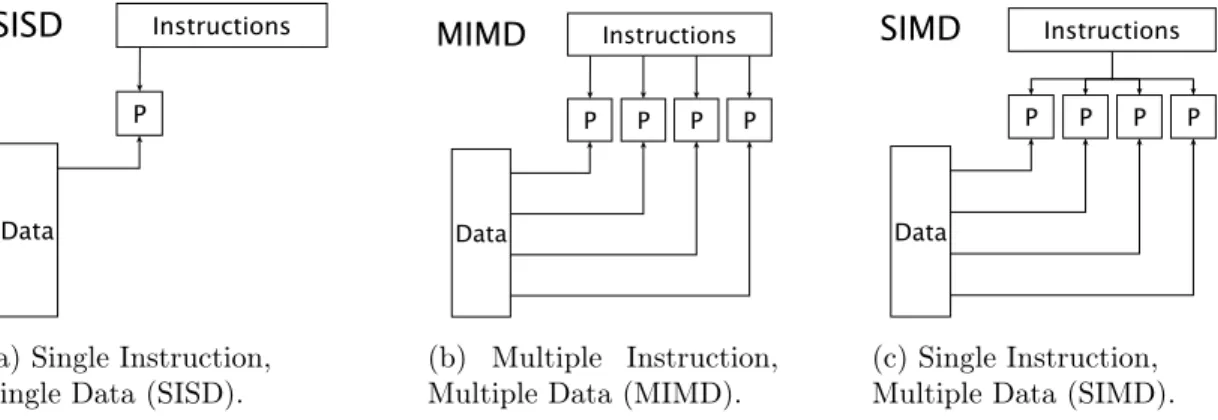
(a) Single Instruction,
Single Data (SISD). (b) Multiple Instruction,Multiple Data (MIMD). (c) Single Instruction,Multiple Data (SIMD).
Figure 1.2: Common processor categories from Flynn’s taxonomy, with “P” representing a processing unit and independent edges representing independent streams. SISD models standard von Neumann serial processing, MIMD models independent multicore processing, and SIMD models vector processing.
Why SIMD?The SIMD (Single Instruction, Multiple Data) category in Flynn’s classic taxonomy of computer architectures [40], illustrated in Figure 1.2, describes systems that operate on multiple data inputs simultaneously using a single instruction stream. Since these inputs may be thought of as occupying a vector on which instructions operate, SIMD processing is also known as vector processing and specialized SIMD instructions are sometimes called vector instructions.1 Each slot
in the vector is known as a SIMD lane, and the number of lanes– i.e., the number of inputs that can be simultaneously processed– is the SIMD width.
This dissertation presents techniques that specifically target SIMD architectures for two reasons. First, SIMD execution is ideally suited to throughput-oriented applications with many independent inputs: at each execution step, each SIMD lane may contain a separate input, exploiting data parallelism to yield a theoretical speedup equal to the SIMD width over a serial processor.
Second, SIMD support has become nearly ubiquitous in processors and coprocessors, making our contributions widely applicable. Specialized SIMD-capable processors were originally incorporated into supercomputers made by companies such as Cray and Thinking Machines decades ago [6,107]. However, the rise in demand for throughput-oriented processing of data-parallel applications from domains such as computer graphics as well as advances in processor technology have led to both the widespread integration of SIMD capabilities into commodity chips and the development of wide-SIMD coprocessors. Intel processors and compilers have supported wide-SIMD instructions since the introduction of MMX intrinsics in 1996 [96], and current-generation Intel chips support AVX intrin-sics for SIMD widths of 256 bits and growing [71]. Hardware coprocessors designed to accelerate high-throughput applications natively support SIMD widths of 512 bits or more, either through vec-tor instructions as in Intel’s Many Integrated Core (MIC) architecture instantiated in the Xeon Phi card [29,51] or through a multithreaded lockstep-execution model as in GPUs [81]. With this growth in popularity, high-throughput processing using wide-SIMD execution is no longer restricted to the realm of supercomputing and SIMD-friendly approaches to data parallelism are widely applicable.
1Technically vector processing is one specific hardware implementation of SIMD, of which others such as array processing exist [89]. However, we follow popular convention in taking vector processing as the nominal representative of such implementations and use it interchangeably with SIMD.
Why GPUs? Out of all SIMD-capable architectures, we target GPUs (Graphics Processing Units) running NVIDIA’s CUDA/C++ toolkit [86] as the implementation platform for the techniques given in this dissertation. We note, however, that since our contributions rely only on the wide SIMD capability of the target architecture rather than on GPU-specific characteristics, the techniques described here could be applied equally well to other popular wide-SIMD architectures such as AMD graphics cards running OpenCL [34] or Intel’s Xeon Phi coprocessors [29].
GPUs were chosen as the implementation platform for this work because they have emerged as a quintessential example of a wide-SIMD architecture due to their support for general-purpose, cost-efficient, developer-friendly, very wide data-parallel execution.
GPUs provide support for general-purpose parallel programming. Graphics processing using re-sources that augment a main CPU gradually evolved over the course of decades until the entire 3D graphics pipeline was offloaded to a separate card called a Graphics Processing Unit (GPU) by NVIDIA in 1999 [30]. The first GPUs were optimized and hard-wired for highly parallel graphics operations such as pixel shading, ray tracing, and physics calculations, and they had a “fixed func-tion” graphics pipeline that remained opaque to developers. In 2001 NVIDIA exposed to developers its new “programmable” graphics pipeline, though operations still needed to be framed in terms of traditional graphics pipeline stages such as vertex and pixel shading [111]. In 2007 NVIDIA in-troduced the CUDA C programming language, which allowed for General-Purpose GPU (GPGPU) programs to be written entirely abstracted from the graphics pipeline [7]. Since then GPGPU ap-plications have proliferated, allowing the benefits of the GPU architecture to be applied to many domains outside of graphics [44]. For a summary of the genesis and development of GPUs see [30]. With their architectural support forwide SIMD-parallel execution, GPUs are an ideal candidate for high-throughput processing. GPUs can execute thousands of lightweight threads simultaneously, organized hierarchically into groups having a minimum SIMD width of 32 inputs [84].
With the economies of scale realized on their production for the gaming industry, GPUs provide a cost-efficient means of high-throughput processing. Although FPGAs consume significantly less
power than GPUs due to the customizability of their circuits, the initial purchase cost of an FPGA currently outweighs the power savings even over a span of several years assuming FPGA dynamic power usage of 10W and GPU usage of 100W per application run [78]. GPU performance per watt also continues to increase with each generation of card [12].
As GPU development toolchains such as CUDA and OpenCL have matured, the barrier to entry for programming applications for GPUs has decreased sharply, making them more developer-friendly. Unlike FPGAs, which require development in a hardware description language for optimal perfor-mance, CUDA and OpenCL are based on C++ and therefore have syntax and semantics familiar to most application programmers.
GPUs’ wide parallelism, low cost, and ease of programming have helped them quickly become a commodity solution for high-throughput processing. As noted at the GPU Technology Conference in 2015, the popularity of CUDA increased by at least a factor of ten between 2008 and 2015 across multiple metrics: toolkit downloads (to 3 million), universities teaching CUDA (to 800), academic papers citing CUDA (to 60,000), and Tesla GPGPU cards shipped (to 450,000) [52].
With their ability to easily integrate into existing systems as peripheral accelerators (GPUs connect to CPUs via PCI-e bus), GPUs also scale. Just as Google achieved massive search and stor-age throughput by scaling up cheap commodity hardware, many current supercomputing systems achieve their impressive throughput by integrating many GPUs into dedicated clusters rather than investing in additional expensive specialized supercomputers. In 2016, 64 of the supercomputers on the Top500 list used GPUs, with another 35 using other manycore accelerators such as the Xeon Phi [120]. GPUs are also now available as a standard hardware option for cloud processing services such as Amazon EC2 [4] and Google Cloud [43].
Two recent developments indicate that FPGAs may soon gain ground on GPUs in terms of economies of scale and development cost. First, the release of a system by Intel that combines an FPGA and a CPU [82], with an expected future release having both on the same die, will provide FPGAs with the manufacturing momentum of Intel. Second, hardware support and high-level synthesis tools
for OpenCL that target FPGAs [131] allow programmers to write FPGA applications in OpenCL rather than hardware description languages. Although OpenCL is not the first software language to gain this support, its architecture-agnostic style enables its code to target both GPUs and FPGAs, thus allowing developers to test high-level code on both architectures with minimal intervention. The impact of these developments is unknown, but they may drive the further evolution of GPU computing by competitive necessity.
Since GPUs will be used as a representative wide-SIMD architecture throughout this dissertation, we now review the relevant aspects of a GPU’s architecture and execution.
Processor/core structure: GPUs contain several (8-25) independentstreaming multiprocessors (SMs). Fixed-sized groups (warps) ofwthreads are bound to a particular SM for scheduling and execution. An SM can be thought of as aw-lane SIMD execution unit, with threads corresponding to individual SIMD lanes. All current NVIDIA GPUs set w= 32. A single SM may dynamically context-switch
among several active warps.
Execution: GPU code is exposed for execution as one or more kernels that are launched from CPU code. The division of work across SMs is specified at launch time in the form of a desired number ofblocks of work and of compute threads (hence, warps) per block. The warps of a single block are executed by a single SM for the duration of the kernel.
Execution constraints: To distill the salient features of GPU execution behavior and maintain generalization to wide-SIMD platforms, we will constrain an application’s mapping to the GPU in the following ways:
• Each application runs within a single kernel call, keeping the GPU block configuration and the assignment of blocks to SMs fixed throughout execution.
• Every thread within a GPU block executes the same code.
• GPU blocks operate on disjoint sets of input items and use independent working memory sets. Hence, no synchronization among blocks is required.
Under these constraints, each block may be viewed as an independent instance of the full application running on its own input data set.
What is an irregular application? GPUs have traditionally been best at processing applica-tions with regular execution and memory patterns since their architecture was designed specifically to exploit these characteristics in graphics applications. NVIDIA provides CUDA libraries with highly optimized implementations of these applications from areas such as linear algebra, signal processing, FFT calculation, and random number generation [85]. NVIDIA also provides libraries for newer high-impact applications that require large-scale repetitive computation such as deep neural network training, and its forthcoming Volta-architecture cards are specifically designed to provide high throughput for very regular common machine learning calculations such as strings of fused multiply-adds [87].
However, not all high-impact applications have a regular structure that is naturally amenable to ac-celeration on a GPU. Many GPU applications exhibit irregularity in various ways: divergent control flow, unbalanced workloads, unpredictable memory accesses, input-dependent dataflow, complicated data structure requirements [20,97,134]. Although all of these sources of irregularity are important optimization targets, the kind of irregularity we address in this dissertation iswavefront irregularity; that is, irregularity in the computational wavefront of an algorithm as it proceeds. This irregularity (in various forms) is intrinsic to many applications and is particularly detrimental to performance on a GPU because the GPU is a wide-SIMD machine whose lanes must be fully utilized to achieve optimal throughput.
Figure 1.3 shows an example of how wavefront irregularity may arise in a sample application. The application is represented as a Data Flow Graph (DFG), with nodes representing computational work to be performed on input items and edges representing data paths between nodes. If arbitrary filtering (i.e. dropping) of data inputs is possible in the nodes, efficiently mapping data inputs to SIMD lanes for execution becomes nontrivial as the computational wavefront of pending data inputs
Figure 1.3: Dataflow execution graph showing groups of valid data items (vertical bars) and filtered items (horizontal dashes) during the first few execution steps of an irregular application. All nodes are assumed to execute the same code, so that inputs from any node may execute in SIMD together. The assignment of items to SIMD lanes shown here highlights the irregular-wavefront work assignment challenge; items must be densely gathered from their sparse storage at nodes B, C, and D in order to fill the SIMD lanes.
is unpredictable. Section 1.2.1 lists many applications from diverse domains such as scientific com-puting [121], modeling and calculation [57,75,112], computer vision [128], and machine learning [16] that exhibit this type of wavefront irregularity.
In addition to the arbitrary filtering of data inputs, another application characteristic that gives rise to wavefront irregularity is having a variable amount of work to do for each data input at each processing step. A variety of big data applications construed as vertex-centric graph processing problems exhibit this characteristic, such as those found in the GraphLab framework [72], the Pannotia benchmark suite [22], and the LonestarGPU suite [20]. In these applications, rounds of computational work are done for each vertex proportional to the number of its incident edges that are ‘live’ in a given round; since the number of live edges can vary for each round for each vertex, the amount of work to be done in a given round is an irregular wavefront that can lead to low SIMD utilization if not managed efficiently. Chapter 2 will explore in detail a DNA sequence alignment application that also exhibits variable work per data input, though in a slightly different way. In light of our discussion so far, efficiently mapping wavefront-irregular applications onto GPUs would yield a big payoff: low-cost high-throughput processing of high-impact applications. There is therefore strong incentive to overcome the obstacles to efficient mappings of these applications onto GPUs, and our contributions seek to do just that.
1.2 Research Questions and Direction
The preceding motivation for wavefront irregularity suggests the following research questions, which this dissertation addresses:
1. Is there an execution paradigm that can be used to represent the running of wavefront-irregular applications on a wide-SIMD architecture?
2. Can general techniques be identified for efficiently mapping wavefront-irregular applications onto these architectures?
3. If so, can these techniques be automated so that they are transparent to application developers across many domains?
We answer all these questions in the affirmative. As evidence of our answers this dissertation presents a developer framework called Mercator that (1) allows developers to map irregular applications onto GPUs according to thestreaming paradigm while abstracting from low-level data movement and (2) includes generalized techniques for transparently overcoming the obstacles to high throughput presented by wavefront-irregular applications on a GPU.
In the remainder of this chapter, we first present the streaming paradigm and argue that it is appropriate and advantageous for modeling the execution of irregular applications on wide-SIMD architectures, then outline our strategies for efficient transparent handling of irregularity on a GPU within the streaming paradigm. We conclude the chapter by putting this dissertation in the context of previous work and outlining the remainder of the dissertation.
1.2.1 The Streaming Paradigm
Intuitively, the streaming paradigm models the execution of applications represented as Data Flow Graphs (DFGs) such as the one in Figure 1.3 that a large dataset of identical inputs must traverse.
More specifically, we use the term “streaming computing” broadly to indicate a method of processing data that has the following characteristics:
• The input data set is assumed to be of unbounded size, either because it is finite but huge or because new inputs are continuously produced (e.g., when processing a live video stream in real time).
• Each input item must be processed, usually by performing fixed computations on the item’s data.
• Each item may generate zero or more output items when processed.
• Desired performance comes from optimizing totalthroughput as opposed to latency of a single item. Here throughput is defined as the number of input data items consumed per unit time. The size and type of a “data item” are application-specific and therefore programmer-defined. The computations to be performed on data inputs are grouped intomodules that are instantiated in one or more nodes of a computation graph, each of which is executed on a physical processor. Data processing consists of “streaming” the data through the pipeline of computation nodes. Streaming computing is often associated with digital signal processing (DSP) applications such as audio/video filters [119], coders/decoders [35], and telescope data filtering [121], though it may also be applied to a variety of other high-throughput applications such as data encryption/decryption [42] and financial simulations [112].
The pipeline of a streaming Monte Carlo simulation of Value At Risk (VaR) for a financial applica-tion is shown in Figure 1.4 as an example.
Figure 1.4: Pipeline of a streaming VaR simulation application, taken from Figure 1 in [21]. Stage 1 generates a random number stream, and other stages perform various operations on chunks of data from the stream: transforming their distributions (Stages 2-3), calculating profit/loss values (Stage 4), and sorting results (Stage 5).
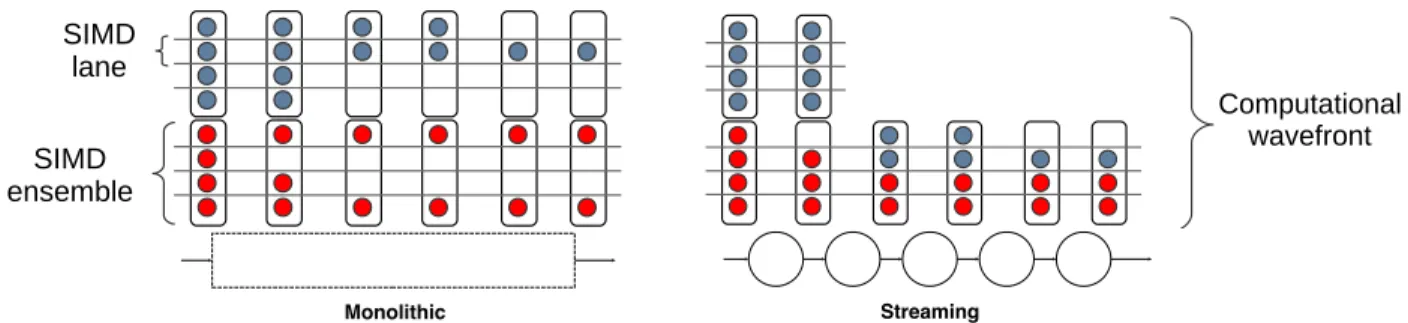
Figure 1.5: Comparison between monolithic application structure and modularized streaming structure for rectification of wavefront irregularity. The streaming paradigm’s decomposition of an application into nodes provides convenient checkpoints at which to reorganize data into an efficient execution wavefront of SIMD-width ensembles, thusisolating irregularity to the node in which it arises. Meanwhile, a monolithic application may suffer performance degradation due to an early manifestation of irregularity for the remainder of its execution.
Beyond this general description of the streaming paradigm, more specific models of streaming com-puting may be employed based on assumed characteristics of the input data such as rate and variability of dataflow. We consider only stateless streaming applications; i.e., those for which an input’s computation does not depend on results from previously processed inputs. Our stream-ing model of computation (MoC) should reflect these constraints. Chapter 4 will present a new dataflow execution model that captures the instantiation of the stateless streaming paradigm on a GPU architecture as one of our contributions.
Why use the streaming paradigm? With its support for data parallelism, the streaming paradigm naturally facilitates efficient SIMD execution of regular streaming applications: since multiple inputs are queued at each node and each node represents code to be applied to its inputs, the contents of a node’s queue may be packed into SIMD lanes, and the node’s code applied to them in parallel.
However, the streaming paradigm is also advantageous to use for modeling the execution ofirregular
streaming applications for two reasons. First, the streaming paradigmsurfaces irregularity through its highly regularized execution model. As Figure 1.3 illustrates, inputs in SIMD lanes that get filtered out during a node’s computation create obvious gaps in the input stream when passed downstream for further processing.
Second, the streaming paradigmisolates irregularity through the modularity of its execution model. Because applications are decomposed into modules, any irregularity that arises during a node’s execution– e.g., filtering or replication of inputs– may be rectified directly following the node’s execution at the time its outputs are passed downstream, rather than persisting throughout the re-mainder of the application’s execution. The rectification points, then, are the edges of the streaming DFG: if data movement is well-managed, then any input filtered out by a node will not be passed downstream and the input queue at each node will contain only the still-live items to be processed by that node. These inputs can then be mapped directly to SIMD lanes. Figure 1.5 illustrates this advantage. Our contributions in this dissertation help to accomplish efficient data movement between nodes, leveraging the edges of streaming DFGs to maintain high SIMD utilization in the presence of irregularity.
How must the streaming paradigm be implemented? In order to cover a diverse set of applications with different dataflow paths, our implementation of the streaming paradigm must support a rich set of DFG topologies that include branching and feedback loops. In Chapter 3 we will show how our Mercator developer framework efficiently supports such topologies.
In order to realize the potential performance gains of the data parallelism exposed by the streaming paradigm, the overheads of data movement and DFG execution must not outweigh the benefits of modularization. To achieve this, the following opportunities for SIMD parallelism must be exploited with implementations that are efficient for all supported DFG topologies:
• Node execution: SIMD lanes must be packed for high occupancy when executing each DFG node.
• Data movement: Irregularities in dataflow such as filtered or replicated items must be handled along dataflow edges to allow efficient downstream processing.
• Scheduler operations: scheduling and other centralized operations must have minimal runtime overhead.
Our work exploits these opportunities with efficient generalized CUDA implementations of the above operations that remain transparent to developers. Chapter 3 describes these implementations in more detail.
1.3 Related Work
We now place this dissertation in the context of previous work relevant to our three main research questions. Pertinent to our first research question, we first discuss parallel processing that conforms to paradigms other than streaming, then discuss our work’s relation to other streaming systems. Pertinent to our second and third research questions, we discuss generalization and automation in conjunction with each approach to parallelism where appropriate, then place our work on the spectrum of parallel code abstraction afterwards.
1.3.1 Non-streaming Approaches to Parallelism
Differing execution paradigms supporting parallelism reflect the distinct characteristics of the data on which they operate. The streaming paradigm is suited to processing an unbounded number of independent data items once each and then discarding them; other paradigms are suited to different execution models. While parallelization strategies associated with these other paradigms are not fully applicable to the streaming context, some of their intuitions and techniques do transfer between paradigms. We present the most relevant of these here.
Work stealing for task DAGs Task-graph applications are represented as Directed Acyclic Graphs (DAGs) whose nodes are individual coarse-grained tasks and whose edges are dependen-cies between tasks. Rather than processing an arbitrary number of inputs as in the streaming paradigm, a task graph is designed to execute a single application run efficiently, with edges imple-menting fork-join semantics in the application code and parallelism coming from executing distinct tasks simultaneously.
Since its introduction in 1999, the work stealing strategy developed by Blumofe and Leiserson [15] has gained wide popularity for efficiently executing task-graph applications on multicore processors and distributed systems. Several production-level systems exist for transparently providing work-stealing functionality, including Intel’s Cilk Plus [23], based on Blumofe and Leisersons’s Cilk [14] and Cilk++ [64], and Intel’s Threaded Building Blocks (TBB) [102]. These systems primarily target task parallelism but provide some support for data parallelism via CPU vector instructions. Recent efforts have also produced GPU runtime systems that implement work-stealing techniques (e.g. [11, 122, 123]).
In terms of expressivity, systems that realize the task-graph paradigm support more applications with DAG topologies than our Mercator streaming framework because our framework does not currently support ‘join’ semantics. However, one version of such semantics suitable for the irregular streaming context is provided by Li et al. in [19] and may be incorporated into Mercator in the future. At a more fundamental level, the streaming paradigm (and our implementation of it) supports a richer set of application topologies than task-graph execution since it permits cycles in its dataflow graphs rather than restricting them to DAGs.
In terms of support for irregularity, work stealing does support a type of irregularity in that it dy-namically load-balances the execution of variable-work tasks across processors at runtime. However, this technique is not transferrable to our framework since it pertains to irregularity at the level of coarse-grained tasks rather than at the level of fine-grained data wavefronts executing in SIMD. One technique we do adopt from the GPU work-stealing systems is the idea of a scheduling framework that runs entirely on the GPU according to the persistent threads model [1], allowing blocks to repeatedly pull/push and execute work with no CPU intervention until all work is complete. Our
Mercator framework provides such a scheduler transparently to developers, allowing individual GPU blocks to repeatedly pull streaming inputs from a common buffer and execute them until the input buffer is empty and the application completes.
Polyhedral analysisAt the opposite end of the granularity spectrum from work stealing is poly-hedral analysis, which is extremely fine-grained but restricted in its application. Polypoly-hedral analysis
Coarse (task-level) Fine (data-level) Work stealing Our work (MERCATOR) Polyhedral methods Intel Cilk Plus, Intel TBB, StreamIt
Granularity of parallelism
Figure 1.6: Spectrum of parallelism granularity targeted by various systems. The spectrum is represented with overlap between coarse-grained task parallelism and fine-grained data parallelism since many systems support some mix of both. Pure work stealing is designed for coarse task-level parallelism, while polyhedral methods are designed for fine data-level parallelism. Intel Cilk Plus [23], TBB [117], and StreamIt [119] primarily target task-based parallelism but provide some vectorization. Our work targets data-level paral-lelism that is coarser than polyhedral methods because we seek to parallelize entire functions rather than just tightly nested loops.
identifies dependencies in nested loop structures, and polyhedral techniques re-organize the execu-tion of these loop structures in a way that exposes maximal parallelism. Polyhedral techniques have achieved significant speedups on many parallel architectures, including GPUs [5,83,127]. However, polyhedral techniques are designed exclusively for nested loop structures rather than general-purpose programs and do not account for the kinds of irregular filtering and replication our work aims to support.
By conforming to the streaming paradigm, we target parallelism at a level of granularity between that of work stealing and polyhedral techniques. Figure 1.6 illustrates this context.
Graph-based processing The graph-processing paradigm of execution is designed for iteratively processing inputs representing graph elements. Many high-throughput applications of recent interest and the datasets they operate on are naturally represented using a (large) graph structure; examples include analysis of social network connections [125] and ranking of website relevance [93]. To make analyzing these graphs tractable, paradigms of graph processing typically operate locally on each graph element, proceeding for a fixed number of rounds or until convergence. The elements processed during each round may be vertices, in which case the paradigm is called vertex-centric
paradigm is callededge-centricgraph processing [105]. The TLAV paradigm in particular has proven useful as an execution model for high-impact applications, inspiring systems such as Pregel [74], which Google uses to compute its PageRank algorithm; Apache Giraph [8], which Facebook uses to analyze its network; and GraphLab [73], which directly supports many parallel machine learning algorithms.
Closely related to the graph processing paradigm in practice is the operator formulation paradigm [97] instantiated in the LonestarGPU system [20]. This system characterizes algorithms by the data structures they require and the operations they perform on them. Although this theoretically allows higher expressivity than a pure graph processing approach, in practice the data structures analyzed are usually sparse graphs, trees, and sets, and the system processes them in a vertex-centric way. Unlike task graph execution and polyhedral analysis, the graph processing paradigm does not nec-essarily parallelize at a different native granularity than our streaming-paradigm system. Indeed, graph processing systems have been developed that incorporate both coarse-grained task-level par-allelism and fine-grained SIMD data parpar-allelism [54]. However, these paradigms are designed to operate on input sets with fundamentally different characteristics: the graph processing paradigm operates on a fixed set of inputs iteratively, while the streaming paradigm operates on a dynamic set of inputs once each. These paradigms have hitherto been non-overlapping in their application coverage. Although we are not aware of any graph-based systems that support traditional streaming applications, we believe that with an appropriate topology and vertex data storage strategy, the streaming paradigm as realized in our Mercator framework shows promise for supporting some graph-based applications. We explore this possibility in Chapter 5.
Application- or paradigm-specific techniques To conclude our discussion of alternative ap-proaches to parallelism, we briefly mention existing apap-proaches to optimizing irregular applications on wide-SIMD architectures. These approaches share common successful elements but are either application-specific in their implementations or are designed for execution paradigms other than streaming. For example, in [103], Ren et al. introduce astream compaction step for a tree-traversal application on the CPU that allows for efficient storage and execution of yet-to-be-traversed tree
nodes in the presence of arbitrary, non-uniform path cutoffs. Our Woodstocc DNA sequence alignment application [25, 28] uses parallel reduction techniques on a GPU similar to Ren’s stream compaction to maintain dense work queues of candidate DNA reads. Our work seeks to generalize these enhancements into a development framework for diverse applications. Khorasani et al. [54] provide this type of GPU framework, but for applications conforming to the graph-based execution paradigm. We seek to develop a generalized framework for streaming applications instead.
1.3.2 Context Within the Streaming Paradigm
Past work in streaming computing has focused primarily on exploiting task-level parallelism by executing independent heavyweight threads on distributed systems. Many Models of Computation (MoCs), beginning with Kahn process networks [53] and continuing with models that place various restrictions on data flow rates and node execution characteristics, have been designed to model task parallelism, with tasks represented as the compute nodes of a dataflow graph.
One of the most restrictive yet best-studied MoCs for streaming computation is the Synchronous Data Flow (SDF) model [62], in which the number of data items produced and consumed by each node’s firing is known a priori for each application. SDF models many digital signal processing applications, such as audio filters, video encoders/decoders, and software-defined radios. SDF appli-cations can be optimally scheduled at compile time for a uniprocessor or multiprocessor system [61]. As the quintessential SDF framework, different implementations of the StreamIt system allow pro-grammers to transparently apply SDF scheduling for streaming applications on a CPU [119] or GPU [46,124]. In contrast to SDF applications, the irregular applications we seek to support allow
data-dependent production and consumption rates at each computation stage, making compile-time load balancing impossible.
Less restrictive MoCs for task-based streaming computing, such as Boolean Data Flow [18], Dy-namic Data Flow [94], and Scenario-Aware Data Flow [114], can express applications composed of
modules with different running times and work-to-thread mappings, at the cost of weaker schedul-ing and space requirement guarantees. The Ptolemy Project [36] maintains a framework supportschedul-ing applications conforming to these MoCs, though they only target CPUs. However, since we explic-itly target wide-SIMD architectures, we seek to enable expression of irregular applications in a way that naturally exposes not only coarse-grained task parallelism due to modularization but also the fine-grained data parallelism enabled by these architectures.
The Auto-Pipe execution system [41] directly supports modular streaming applications and ab-stracts data movement from developers with an interface that was influential in Mercator’s own design. However, Auto-Pipe was designed to target heterogeneous architectures and optimize work-load distribution and communication among heavyweight processors, so its infrastructure is not suitable for optimizing irregular applications targeting self-contained wide-SIMD machines as we seek to do.
One recent work [9] presents a methodology that supports SIMD execution of applications requiring stateful actors but leaves important application-specific components of the methodology to devel-opers. In contrast, we do not require the complexity of supporting stateful actors, and we seek to supply all expert-level parallel algorithms required for the efficient execution of streaming applica-tions.
1.3.3 Level of Developer Abstraction
We conclude our discussion of related work by placing our Mercator framework in the context of other parallel systems regarding the level of abstraction they provide developers from details of implementing their parallelism strategies. Parallel code is notoriously challenging to write and debug, and its efficiency is architecture-dependent. Much work has therefore been done to automate the process of parallel code development and abstract the developer from low-level implementation details. This leads to a tradeoff for programmers between ease of development and control over semantics and optimization for parallel code.
At one end of the spectrum, languages such as CUDA and OpenCL and language features such as vector intrinsics give the developer maximum control over the mapping of their application onto parallel hardware, at the cost of acquiring expert-level knowledge to master the language. Scores of efficient GPU implementations of applications testify to the effectiveness of low-level development in a language such as CUDA, but the proliferation of publications presenting clever GPU application mappings testifies to difficulty of developing these implementations (for a sample of such implementations see [48]). At the other end of the spectrum, directive-based programming allows novice developers to target parallel hardware such as GPUs with minimal code change, at the cost of control over mapping details. We now discuss directive-based programming and related techniques in more detail, then place Mercator on the ease-control spectrum.
Directive-based programming In directive-based programming, a developer provides explicit hints to a compiler about how to parallelize specific code sections via special pragma statements and the compiler translates the hints into architecture-specific optimizations when it generates its output. The preeminent framework for directive-based programming for multicore CPU processing is OpenMP [32], which allows a developer to suggest optimizations such as loop unrolling. OpenMP also allows more complex specifications of parallelism, such as differentiation between fine-grained data parallelism and coarse-grained task parallelism, that facilitate processing across SIMD lanes as well as across CPU cores. OpenACC [91] has emerged as an analogue to OpenMP in the hardware accelerator domain and is currently compatible with NVIDIA and AMD GPUs as well as the Intel Xeon Phi. OpenACC directives may be used to mark code that should be launched on a GPU as a kernel in addition to suggesting similar optimizations to OpenMP.
Directive-based frameworks such as OpenACC successfully insulate the developer from low-level im-plementation details of their parallel code; indeed, all developer code is written in Fortran/C/C++ rather than an accelerator language such as CUDA or OpenCL, and the only interaction the devel-oper has with the hardware accelerator is via the OpenACC API. However, this extreme abstraction comes at the cost of support for complex parallelism. Directive-based frameworks are designed to
optimize regular computations such as nested loops rather than general tasks, and their data move-ment strategies are designed to optimize data transfers for these tightly structured code blocks. In contrast, the strategies we present in this dissertation address the challenges of wavefront-irregular computation, which may occur in arbitrary code structures across large blocks. In addition, our strategies maximize the amount of application logic packed into a single kernel, which obviates repeated kernel calls and data transfers that may be necessary in a host-controlled directive-based framework. Overall, then, directive-based frameworks such as OpenACC provide greater portability than our Mercator framework whileMercator supports more nuanced parallelism.
Parallel libraries In addition to directive-based frameworks, many architecture-specific libraries have been written to optimize common computations and expose them to a developer via an API in CPU code. For example, the Thrust template library [47] for CUDA allows host-side API calls to create and manipulate data structures on the GPU with operations such as sorting and reduction. Like directive-based frameworks, libraries such as Thrust primarily target a specific type of parallelism over a short code span and lack strategies for mitigating wavefront irregularity and GPU-persistent applications.
Mercator On the spectrum of ease of programming vs. implementation control, our Merca-tor framework lies between directive-based programming and systems such as Cilk Plus on the ease-of-programming end. Unlike directive-based programming, Mercator expects programmers to parallelize entire functions and requires them to explicitly interact with framework components directly in their application code rather than in compiler hints. However, unlike the other frame-works discussed in this section such as Cilk Plus, Intel TBB, and StreamIt, Mercator abstracts programmers from all semantics of parallelism, allowing them to write code as though for a single SIMD lane and managing the parallelism transparently. Figure 1.7 shows Mercator’s place on the ease vs. control spectrum of parallelism support.
Ease of use
Amount of control
Directives (e.g. OpenACC) Our work
(MERCATOR)
CUDA, OpenCL Intel Cilk Plus, Intel TBB, StreamIt
Code abstraction from parallelism
Figure 1.7: Spectrum of developer abstraction from implementation of parallelism. The spectrum is repre-sented with overlap between ease of programming and implementation control since a tradeoffexists between these components. Directive-based tools such as OpenACC [90] require no direct code changes but provide no access to implementation details, while full languages such as CUDA [31] and OpenCL [45] allow fully customized parallel implementations but require significant programmer intervention. Cilk Plus, TBB, and StreamIt allow some programmer control over parallelism with added language keywords while hiding im-plementation details of those keywords. We seek to abstract programmers from parallelism entirely, but our
Mercatorsystem does come with its own API with which programmers must interact.
1.3.4 Road Map and Contributions
To address our main research questions, this dissertation makes the following contributions: a. A novel Model of Computation (MoC) for streaming computing called the Function-Centric
Model that more fittingly expresses the parallel data movement and execution capabilities of a wide-SIMD machine than previous models;
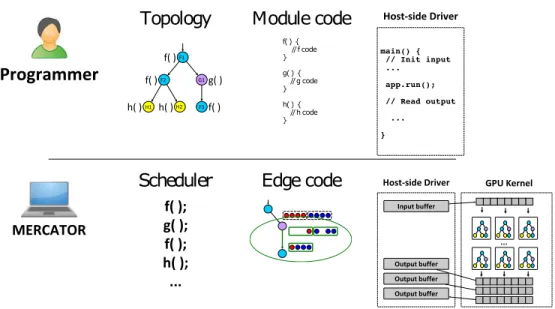
b. A developer framework called Mercator that transparently instantiates the FC Model, al-lowing developers to write module function code and automatically generating all other code for data movement and execution of the application on a GPU, employing remapping between node executions to maintain high SIMD occupancy;
c. A scheduling strategy for Mercator that guides applications toward high throughput by maximizing SIMD occupancy during execution.
The remainder of this dissertation is organized as follows: we discuss in Chapter 2 typical application characteristics that can generate an irregular SIMD computation wavefront. We use DNA sequence
alignment as a motivating application and present our strategies for mitigating the irregularity of the DNA sequence alignment application. These strategies are implemented in our Woodstocc
tool [25, 28] and were the inspiration for creating theMercator framework. We end that chapter with a discussion of the salient features of the tool and the algorithm’s irregularity that are relevant to a generalized framework for executing other irregular streaming applications.
We then introduce our Mercator framework, which provides developers with transparent imple-mentations of our strategies. We first discuss Mercator’s user interface, basic execution model, and performance results in Chapter 3, drawing material from [26]. We then discuss its queueing model and scheduling strategy implementation details, including the operation of its scheduler, in Chapter 4.
We conclude with a discussion of future work in Chapter 5, highlighting extensions of Mercator
to support synchronization and input reductions for graph-processing applications.
Orthogonal concerns Optimizing programs for efficient GPU execution is a complex problem with many facets beyond the scope of this work. In this dissertation, we focus on optimization challenges inherent inany wide-SIMD architecture, and we therefore do not study optimizations in the following areas:
• Other kinds of irregularity besides wavefront irregularity, e.g., irregular memory accesses and code divergence. We attempt to minimize these kinds of irregularity in our system implemen-tations, but we make no attempt to do so automatically nor to explore general strategies for doing so.
• GPU memory layout. GPUs have a complex memory hierarchy, and clever use of it can significantly reduce memory access costs. For simplicity and portability to other architectures, we store all application-specific data in the GPU’s global memory, which is accessible to all threads on the device.
• Performance-optimal but sub-maximal SIMD occupancy. Although previous work has shown that maximum SIMD occupancy does not necessarily yield maximal throughput [129], the abil-ity to execute with maximal occupancy is an important input to any throughput optimization problem. We therefore pursue techniques to achieve high occupancy without proving that the achieved occupancy is optimal.
Chapter 2
Wavefront Irregularity Case Study:
Woodstocc
We now describe a DNA sequence alignment tool for GPUs called Woodstocc, which addresses multiple sources of wavefront irregularity inherent in a straightforward SIMD execution of its under-lying algorithm. We present the context and contributions of Woodstoccto give a comprehensive view of an irregular application “in the wild” and to show the benefits of a GPU implementation that deliberately mitigates irregularity to achieve high SIMD utilization. This implementation conforms to the streaming paradigm of execution and exploits its separation of modules to eliminate the gaps in its computational wavefront caused by input-dependent filtering inside the modules as inputs flow downstream. In so doing, it employs techniques to address the three challenges mentioned at the end of Chapter 1: efficient execution of module code, efficient data movement, and a scheduler capable of throughput-optimizing module execution decisions.
In addition to wavefront irregularity from filtering, Woodstocc also addresses irregularity that arises as a result of alternating granularities of operation and load imbalance between GPU blocks. Although its implementation is application-specific, the techniques it employs to mitigate irregular-ity generalize to a wider class of streaming applications. Following our presentation ofWoodstocc, we will discuss these generalizations, a subset of which form the core of theMercator system to be presented in Chapter 3.
Woodstocc was originally published and presented at the International Symposium for Parallel and Distributed Computing (ISPDC) [25], and a follow-up version of the conference paper with the more extensive performance optimizations and results included in this chapter was published as a technical report [28].
2.1 Overview
Short-read DNA sequence alignment is a compute-intensive application of strong interest to the biological community. In this application, a large number of short DNA strings (“reads”) are matched against an index generated from a long DNA reference string to locate areas of correspondence. Although all reads are processed with the same algorithm, each one requires a different amount of computation to compare against the reference. This input-dependent processing behavior is a hallmark of algorithms that exhibit wavefront irregularity.
The Woodstocc (“Woodstocc Offers Optimal Dynamic programming - Suffix Trie alignment while optimizing OCCupancy”) tool seeks to ameliorate the fundamental irregularity of short-read alignment in order to extract SIMD parallelism suited to a GPU. We first describe algorithmic transformations of short-read alignment, applicable to any architecture, that partly regularize it and expose SIMD parallelism. We then present our CUDA implementation of Woodstocc for NVIDIA GPUs, which exploits several techniques to maximize occupancy and minimize wavefront irregularity. Finally, we empirically study the performance of Woodstocc, showing that it indeed boosts occupancy and suggesting generalizations of its techniques for other irregular streaming applications.
Figure 2.1: Alignment of a readGCCGAto a longer reference sequence with three differences.
2.2 Background
2.2.1 Problem Definition
Woodstocc focuses on a variant of DNA sequence alignment known as the short-read alignment problem, which is motivated by the development over the last decade of experimental techniques for sampling a very large number of short substrings, or reads, from a long DNA sequence such as a genome [110]. This inexact matching problem is as follows:
Given a single DNA reference sequence of lengthn, and many DNA reads of common lengthm⌧n,
find for each read all starting positions in the reference where the entire read matches with no more than k differences.
Allowable differences include substitution, insertion, or deletion of individual characters. Figure 2.1 shows a read alignment to part of a reference with three differences. Typically, the reference length nis tens of millions to billions of characters, while the read lengthmranges from a few tens to 200 characters. A sequencing experiment generates tens to hundreds of millions of reads that must be aligned to the reference.
2.2.2 Related Work
The computational demands of short-read alignment have led to several algorithmic strategies for rapidly matching many reads against a common reference. Methods using a hash-based index of the reference [66,106] have largely been superseded by tools that construct a tree-based index, such as asuffix trie (see Figure 2.2). Due to the high storage cost to represent such tries explicitly, they