Institutional Knowledge at Singapore Management University
Research Collection School Of Information Systems
School of Information Systems
8-2016
Revocable and decentralized attribute-based
encryption
Hui CUI
Singapore Management University, [email protected]
DENG, Robert H.
Singapore Management University, [email protected]
DOI:
https://doi.org/10.1093/comjnl/bxw007
Follow this and additional works at:
https://ink.library.smu.edu.sg/sis_research
Part of the
Information Security Commons
This Journal Article is brought to you for free and open access by the School of Information Systems at Institutional Knowledge at Singapore Management University. It has been accepted for inclusion in Research Collection School Of Information Systems by an authorized administrator of Institutional Knowledge at Singapore Management University. For more information, please [email protected].
Citation
CUI, Hui and DENG, Robert H.. Revocable and decentralized attribute-based encryption. (2016).Computer Journal. 59, (8), 1220-1235. Research Collection School Of Information Systems.
For Permissions, please email: [email protected] doi:10.1093/comjnl/bxw007
Revocable and Decentralized
Attribute-Based Encryption
Hui Cui
∗and Robert H. Deng
Secure Mobile Centre, Singapore Management University, 71 Stamford Road, Singapore 178902, Singapore
∗Corresponding author: [email protected]
In this paper, we propose a revocable and decentralized attribute-based encryption (ABE) system that splits the task of decryption key generation across multiple attribute authorities (AAs) without requiring any central party such that it achieves attribute revocation by simply stopping updating of the corresponding private key. In our system, a party can easily behave as an AA by creating a public and private key pair without any global communication except the creation for the common system parameters, under which it can periodically issue/update private key components for users that reflect their attributes, and an AA can freely leave the system once its corresponding attribute is revoked without communication with other AAs. In addition, to revoke a user, those AAs that have issued private keys to this user easily cease the key updating process for the user without affecting other AAs’ execution. For the construction of our system, the technical barrier is to make private keys collusion resistant. Since in our system each component of a user’s private key at a time period may come from different AAs and there is no coordination between these AAs, traditional technique of binding together different components (issued by different AAs) of a private key by randomization cannot be employed. To overcome this, we tie the key components together and prevent collusion attacks between different users by embedding distinct identifiers and a commonly shared time attribute in
these components.
Keywords: revocation; decentralization; ABE Received 9 July 2015; revised 9 December 2015
Handling editor: Yi Mu
1. INTRODUCTION
Public-key encryption can be viewed as a method for a user to share data to a targeted user or device while protecting the confidentiality of the transmitted information from other curi-ous users. This is useful in scenarios where the data provider knows exactly which user it wants to share data with, but this is not realistic in applications where people are identified by their attributes, and the data provider wants to convey data according to some policy based on the privileged user’s attributes. Sahai and Waters [1] proposed the notion of attribute-based encryp-tion (ABE) to solve the above problem, where each user is issued an attribute-based private key from an attribute authority (AA) or key generation authority that reflects their attributes, and a data provider can specify access policies to the data over a set of attributes. A user will be able to decrypt a ciphertext if the attributes under its private key satisfy the access policy associated with the ciphertext. One drawback of the origi-nal Sahai–Waters approach is that every user must prove its
ownership of a set of attributes to a trusted party to obtain the corresponding attribute-based private key for decryption, which implies the existence of a single trusted party who moni-tors attributes and issues private keys for all users. To overcome this limitation, the concept of multi-authority ABE [2,3] was introduced, where multiple AAs operate simultaneously, and each distributes private key components corresponding to dif-ferent sets of attributes. Since a trusted central authority (CA) is still required in the multi-authority ABE schemes in [2,3], decentralized multi-authority ABE [4–6] was proposed to avert the single security bottleneck incurred by counting on a central AA.
The appearance of ABE affirmatively solves the problem arising in the situations where different users with different attributes are given access to different levels of the encrypted data, but it fails to address the problem that the attributes of a user may change with time. This problem initiated the study of revocation [7] where a periodic key update would only
Advance Access publication on 12 February 2016
allow non-revoked users to update their keys to decrypt the newly encrypted data. Considering the ABE setting, there are two main ways to realize revocability: (i) indirect revocation [7, 8] where a sender encrypts with an attribute set and a time attribute, and the AA, with the current revocation list, period-ically provides key update information at each time period so that only the non-revoked users can update their keys and thus decrypt the ciphertexts encrypted at the current time period; (ii) direct revocation [8, 9] where a sender specifies the revo-cation list directly when running the encrypting algorithm (i.e. the sender is required to possess the current revocation list), such that the revocation can be done instantly and does not require the key update phase as in the indirect method. Even though direct revocation can be done immediately without the key update process which asks for the communication from the AA to all the non-revoked users over all the time periods, it requires all the data providers to keep the current revocation list, which makes the system be impurely attribute-based, since data providers in the attribute-based setting create ciphertext based only on attributes without caring revocation. On the con-trary, indirect revocation does not require the data providers to own the revocation list, but its key update phase is a bottle-neck since it requires communication from the AA to all the unrevoked users at all the time periods. In this paper, we focus on the design of efficaciously and indirectly revocable ABE schemes.
Motivated by the fact that decentralization essentially reduces the trust on a central AA, we consider making use of it to allevi-ate both communication cost and security bottleneck in the sin-gle AA setting. That is, we would like the task of a sinsin-gle AA to be split across multiple AAs to reduce the computation over-head. We accomplish this by putting forward a notion of revoca-ble and decentralized ABE with the goal of efficiently achieving revocability in the decentralized ABE systems.
1.1. Our contributions
Based on the scheme given in [6], we present a decentralized ciphertext-policy ABE (CP-ABE) system supporting indirect revocation, which can be regarded as a CP-ABE scheme with two properties: (i) decentralization—any party can become an AA without the requirement of any global coordination except the initialization of the common reference parameters created during the setup phase and (ii) revocability—the AAs period-ically update components of attribute-based private keys such that only the non-revoked users can obtain their private keys to decrypt the newly encrypted data in the current time period. Thanks to the decentralization property, in our system, revoca-tion of an attribute, i.e. completely removing an attribute from the system, can be done by simply stopping issuing key update by the corresponding AA. In addition, when an attribute of a user is revoked, the corresponding AA can simply stop updat-ing for this user with no influence on the update for this user from other AAs. In our inial construction, each AA needs to
issue each user a new private key at different time slots, which is convenient to be applied in the practice, and we found this methodology under the decentralizing setting can reduce a sin-gle AA’s workload. However, it would be desirable to reduce the key update size of each AA from linear to logarithmic as in [7]. Therefore, using the binary tree structure [7, 8], we extend our original construction to a new scheme in which the amount of work each AA has to do for key updates is mitigated and the total size of key updates is reduced to logarithmic in the number of users.
In a revocable and decentralized CP-ABE scheme, a party can simply behave as an AA by creating a public and private key pair, with which it can extract and periodically update compo-nents of attribute-based private keys for different users. When the attribute of an AA is revoked, this AA can freely terminates its role as an AA by being inactive. Since different AAs oper-ate entirely independently, the failure or corruption of some AAs will not affect the functionality of the uncorrupted AAs. In our system, the concept of global identifier [2, 6] is subtly applied to link together the private key components issued to the same user by multiple AAs, such that any data provider can encrypt data in terms of any time period and any access policy over the attributes issued from any set of AAs.
Our security model for the proposed scheme takes into account all the adversarial capabilities in the standard ABE security notion. First, the adversary should be able to learn the private keys associated with the attribute sets of its choice. Sec-ondly, the adversary should not be able to learn any information about the message encrypted for the challenge set of attributes. In addition, we assume that the adversary is given access to the periodical key updates, which asks the adversary to be unable to learn any information about the message encrypted for any users with attributes containing the time period past the revocation time, i.e. the ciphertext is created after the time of revocation.
Challenges and solutions. Regarding the construction of a revocable and decentralized ABE system, the key challenge is to make it secure against collusion attacks.
Traditionally, to achieve collusion resistance in ABE, the single AA combines different components (corresponding to different attributes) of a user’s private key together by random-izing the key. Such randomization makes different key elements for one user compatible with each other, but not work with the components of a key belonging to another user. However, this technique of key randomization does not work in the setting of decentralization, because there is no central party to tie all the pieces together, and each part of a key may come from different AAs who have no coordination and are possibly not aware the existence of each other. To shun this obstacle, we resort to the approach of tying a user’s key components together and pre-venting collusion attacks between different users with different global identities [6]. At a high level, this method, instead of relying on one key generation to bind all the key components together, uses a hash function on the user’s global identity GID
to preserve collusion resistance across multiple key generations from different AAs.
On the other hand, when encrypting a message, in our system, a data provider, besides the usual attribute set inputA, is also required to specify the current time period Time. In this case, in order to decrypt a ciphertext encrypted for a set of attributesA
and a time period Time, a user must possess the key components for alli∈Aunder Time from different AAs which periodically update key components at the start of each time period. Since the time attribute is the same for all users, in case of compromising the security, it is imperative to prevent collusion attacks. This requires that revoked users cannot combine their keys with the update information for the non-revoked users to decrypt a newly created ciphertext which they are not able to decrypt with their old keys. To achieve this, our approach is to bind the time period and the global identifier together during key generation while keeping the global identifier away during the encryption (i.e. the system is still attribute-based).
Our system is proved secure using the recent dual sys-tem encryption methodology [10], where the security proof works by first converting the challenge ciphertexts and pri-vate keys to a semi-functional form and then arguing the security. Following the variant of the dual system proof tech-nique in [11], we build our scheme using the bilinear groups of composite order on the basis of the decentralization ABE scheme in [6].
1.2. Related work
After Sahai and Waters [1]introduced the notion of ABE, Goyal
et al.formulated two complimentary forms of ABE [12], CP-ABE [13]and key-policy ABE (KP-ABE) [12]. In a CP-ABE system, the keys are associated with the sets of the attributes and the ciphertexts are associated with the access policies, while in a KP-ABE system, the situation is reversed that the keys are associated with the access policies and the ciphertexts are asso-ciated with the sets of the attributes. Since then, various kinds of ABE systems have been proposed [2, 4–6, 8–10, 12, 14–19], including multi-authority ABE [2, 4–6], ABE with full security [10, 17], revocable ABE [7–9, 18]etc.
Multi-authority ABE was proposed by Chase [2]to construct an ABE scheme where the decryption key is created by different AAs. However, the solution presented in [2]need the presence of a single trusted ‘CA’ to issue each AA a unique key. Chase and Chow [4]tried to remove the CA using a distributed PRF, but the scheme in [4]is achieved under an AND policy and a determined set of AAs. Linet al. [5]gave a threshold-based scheme that is somewhat decentralized, but the set of AAs is fixed ahead of time, and the system is only secure up to collu-sion ofmusers. Lewko and Waters [6]presented the first fully decentralized CP-ABE scheme, where any party can become an AA (i.e. the system does not require any CA), and there is no requirement for any global coordination other than the generation of an initial set of common reference parameters.
Boldyrevaet al.[7]proposed a revocable KP-ABE scheme using an approach of indirect revocation where the AA indi-rectly enables the revocation by forcing revoked users to be unable to update their keys. In order to eliminate the impedi-ent key update phase in the indirect revocation, Attrapadung and Imai [9]put forth an ABE system with direct revocation, which allows the senders to specify the revocation list directly when encrypting by requiring the senders to keep the current revocation list. Also, Attrapadung and Imai [8]raised a hybrid revocable KP-ABE system under selective security model which allows a sender to select whether to use either direct or indirect revocation mode when encrypting a message. Sahai
et al.[18]provided the first revocable ABE scheme in a generic way that deals with the problem of efficiently revoking stored data, where the database can periodically update the cipher-texts using only publicly available information stored on the system.
1.3. Organization
The remainder of this paper is organized as follows. In Section2,
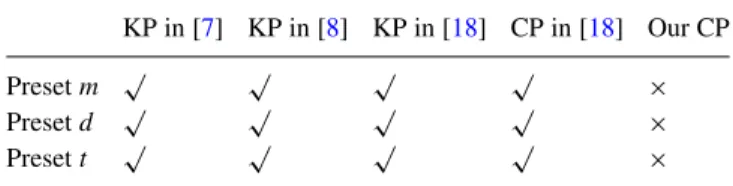
we briefly review the definitions associated with this work. In Section3, after the description of the system framework, we elaborate the security model of revocable and decentralized CP-ABE. In Section 4,we present a specific construction of revocable and decentralized CP-ABE, and analyze its secu-rity. In Section 5, we compare our construction with some prior revocable ABE schemes, and then extend our revocable and decentralized ABE system to improve its efficiency. We conclude this paper in Section6.
2. PRELIMINARIES
In this section, we review some basic cryptographic conceptions and definitions that are related to this work.
2.1. Access structures and linear secret sharing
We review the notions of access structures and linear secret shar-ing schemes in [6, 16]as follows.
Definition 2.1 (Access Structure). Let {P1,. . .,Pn} be a set of parties. A collection A⊆2{P1,...,Pn} is monotone if ∀B,C: if B∈A and B⊆C, then C⊆A. An access struc-ture(respectively,monotone access structure)is a collection
(respectively, monotone collection) A of non-empty subsets of {P1,. . .,Pn}, i.e. A⊆2{P1,...,Pn}\{∅}. The sets in A are called the authorized sets,and the sets not inAare called the unauthorized sets.
In this paper, attributes will play the role of the parties and only the monotone access structures will be consid-ered. Observe that more general access structures [6] can be
(inefficiently) realized with the techniques by letting the nega-tion of an attribute be a separate attribute (this doubles the total number of attributes).
Definition 2.2 (Linear Secret Sharing Schemes (LSSS)).
Let P be a set of parties. Let A be a matrix of size l×n. Let
ρ:{1,. . .,l} →P be a function that maps a row to a party for labeling. A secret sharing schemeover a set of parties P is a linear secret-sharing scheme over Zpif
(1) The shares for each party form a vector over Zp.
(2) There exists a matrix A which has l rows and n columns called the share-generating matrix for . For x=1,. . .,l,the xth row of matrix A is labeled by a partyρ(x),whereρ:{1,. . .,l} →P is a function that maps a row to a party for labeling. Considering that the column vector −→v =(s,r2,. . .,rn), where s∈Zp is the secret to be shared and r2,. . .,rn∈Zpare ran-domly chosen,then Av is the vector of l shares of the secret s according to. The share (Av)x belongs to partyρ(x).
It is shown in [6, 16] that every linear secret sharing scheme consistent with the above definition meets the following lin-ear reconstruction property. Suppose that is an LSSS for an access structure A. Let S∈A be an authorized set, and define I⊆ {1,. . .,l} as I= {x|ρ(x)∈S}. Then the vector
(1, 0,. . ., 0)is in the span of the rows of matrix A indexed byI, and there exist constants{wx∈Zp}such that if{λx}are
valid shares of a secretsaccording to, thenx∈Iwxλx=s.
According to [6, 16], these constants {wx} can be found in
polynomial time in terms of the size of share-generating matrixA.
For the construction under composite order group, the LSSS matrices can be considered overZN, whereN =p1p2p3 is a
product of three distinct primes. A set S is authorized if the rows of matrix A labeled by elements in S have the vector
(1, 0,. . ., 0)in their span moduloN. Regarding the security proof, it will be further assumed that for an unauthorized set, the corresponding rows of matrix A do not have the vector
(1, 0,. . ., 0)in their span modulo the individual prime factors ofN. This is because if an adversary can produce a matrixA
over ZN and an unauthorized set over ZN that is authorized
over Zpi for i∈ {1, 2, 3}, then this can be used to produce a
non-trivial factor of the group orderN, which contradicts with the complexity assumptions.
Boolean formulas[6].Access policies can also be described in terms of monotonic boolean formulas. LSSS access structures are more general, and can be derived from representations as boolean formulas. There are standard techniques to convert any monotonic boolean formula into a corresponding LSSS matrix. The boolean formula can be represented as an access tree, where the interior nodes are AND and OR gates, and the leaf nodes cor-respond to attributes. The number of rows in the corcor-responding
LSSS matrix will be same as the number of leaf nodes in the access tree.
2.2. Composite-order bilinear groups and complexity assumptions
LetG be a group generator algorithm which takes a security parameterλ as the input and outputs (p1,p2, p3, G,GT,eˆ),
wherep1,p2,p3are distinct primes,GandGTare cyclic groups
of orderN =p1p2p3, andeˆ:G×G→GT is a map with the
following properties [20]:
(1) Bilinear.∀g,h∈G,a,b∈ZN,eˆ(ga,hb)= ˆe(g,h)ab.
(2) Non-degenerate.∃g∈Gsuch thateˆ(g,g)has orderN
inGT.
Assume that the group operations inGandGT as well as the
bilinear mapeˆare computable in polynomial time with respect toλand that the group descriptions ofGandGT include the
generators of the respective cyclic groups. LetGp1,Gp2andGp3
be the subgroups of orderp1,p2andp3inG, respectively. It is
observed in [6] whenhi∈Gpiandhj∈Gpj fori=j,eˆ(hi,hj)is
the identity element inGT. This orthogonality property ofGp1,
Gp2,Gp3will be used to implement the semi-functionality in the
constructions.
LetGp1p2 denote the subgroup of orderp1p2inG. Letg1←
Gp1 denote thatg1is chosen to be a random generator ofGp1
(so it is not the identity element), andT1←Gdenote thatT1
is chosen to be a random generator ofG(this is not quite the same as a uniformly random element, but the distributions are negligibly close).
Given a group generatorG, the assumptions used in this paper are defined in Fig.1.The advantage of algorithmAin breaking Assumptionifori∈ {1, 2, 3, 4}is defined to be
AdvAmpi
G,A (λ)= |Pr[A(D,T1)=1]−Pr[A(D,T2)=1]|.
We say thatGsatisfies AssumptioniifAdvAmpi
G,A(λ)is a
neg-ligible function of the security parameterλfor any polynomial time algorithmA.
Note that in Assumption 1,T1can be written (uniquely) as the
product of an element ofGp1, an element ofGp2and an element
ofGp3. In this paper, these elements will be referred to as the
‘Gp1 part ofT1’, the ‘Gp2 part ofT1’ and the ‘Gp3 part ofT1’,
respectively (Fig.1).
3. FRAMEWORK AND SECURITY MODEL
In this section, we present the formal definition of revocable and decentralized ABE, after depicting the architecture of our ABE system.
Assumptions Distributions forG=(N=p1p2p3,G,GT,ˆe)←G 1 g1←Gp1, D=(G,g1), T1←G,T2←Gp1. 2 g1,X1←Gp1,X2←Gp2,g3←Gp3, D=(G,g1,g3,X1X2), T1←Gp1,T2←Gp1p2. 3 g1,X1←Gp1,Y2←Gp2,X3,Y3←Gp3, D=(G,g1,X1X3,Y2Y3), T1←Gp1p2,T2←Gp1p3. 4 g1←Gp1,g2←Gp2,g3←Gp3,a,b,c,d←ZN D=(G,g1,g2,g3,g1a,g1bg3b,g1c,g1acg3d), T1← ˆe(g1,g1)abc,T2←GT. FIGURE 1. Assumptions 1–4. 3.1. Framework
A revocable and decentralized CP-ABE system is comprised of the following algorithms: global setup algorithm GSetup, AA setup algorithm ASetup, attribute-based private key generation & update algorithm KeyGen & KeyUpdate, encryption algo-rithm Encrypt and decryption algoalgo-rithm Decrypt. Assume that the attribute-based private keys of the non-revoked users will be renewed periodically (e.g. every month), and the senders encrypt using the receivers’ attributes and the current time period, e.g. ‘June of 2015’. Also, there exists a revocation list for each attribute in the system, which stores the identities of all the revoked users associated with the attribute, and is held by the corresponding AA.
(i) GSetup(1λ)→GP. Taking the security parameterλas the input, this global setup algorithm outputs the global parameter GP for the system.
(ii) ASetup(GP)→(apk,ask). Taking the global parame-ter GP as the input, each AA creates its own masparame-ter pub-lic and private key pair(apk,ask).
(iii) KeyGen & KeyUpdate (GP, GID, Time,rli,i,ask)→ skiTime,GID. Taking the global parameter GP, a time period Time, a revocation listrli, an identity GID, an attribute ibelonging to some AA and a master private keyask
for this AA as the input, this key generation and update algorithm produces the update key skiTime,GID for this attribute, identity and time tuple.
(iv) Encrypt(GP,M, Time,(A,ρ),{apk})→C. Taking the global parameter GP, a messageM, a time period Time, an access matrix(A,ρ)and a set of the master public keys for the relevant AAs as the input, this encryption algorithm outputs a ciphertextC.
(v) Decrypt(GP,C,{skiTime,GID})→M. Taking the global parameter GP, the ciphertext C and a collection of update keys corresponding to the attribute, identity and time tuples with the same identity GID and time period Time as the input, this decryption algorithm
outputs either the messageM when the collection of attributesisatisfies the access matrix corresponding to the ciphertextC, or a symbol ⊥indicating the failure of the decryption.
We require that a revocable and decentralized CP-ABE sys-tem is correct, meaning that if GP is generated from the global setup algorithm,Cis generated from the encryption algorithm on a messageM and a time period Time, and{skTimei,GID}is a set of private keys obtained from the key generation algorithm for the same identity GID at the time period Time over a set of attributes satisfying the access structure of the ciphertext, then Decrypt(GP,C,{skiTime,GID})=M.
3.2. Security definition
Assuming that the adversary corrupts the AAs statically [2,4,6] and make the key generation & update queries adaptively, we define the security for revocable and decentralized CP-ABE encryption systems by the following game between a challenger algorithmCand an adversary algorithmA.
Let S be the set of all the AAs, and U be the universe of attributes. Suppose that each AA can control multiple attributes, but each attribute is assigned to only one AA. To match the practice, it can be considered as an attribute being the concatenation of an AA’s public key and an attribute string, such that if multiple AAs choose the same attribute, these will still correspond to distinct attributes in the system.
(i) Setup. Algorithm C runs the global setup algorithm. Algorithm Adefines a set of S⊆S of corrupt AAs.
For these non-compromised AAs S−S, algorithm
C obtains the public and private key pairs by running the AA setup algorithm, and gives the public keys to algorithmA.
(ii) Phase 1. Algorithm A makes the key generation & update query to algorithmC. AlgorithmAsends tuples
(i, Time, GID)to algorithm C, where iis an attribute
belonging to an non-corrupted AA, Time is a time period, GID is an identity. Algorithm C responds by returning the corresponding updated key skiTime,GID to algorithmA.
(iii) Challenge. Algorithm A chooses two messages M0
and M1, a time period Time∗ and an access matrix
(A, ρ) with the constraint that the key generation & update queries {skTimei,GID∗} in Phase 1 do not satisfy the access matrix(A,ρ). Let V denote the subset of the rows of A labeled by the attributes controlled by the corrupt AAs. Let VGID denote the subset of the
rows ofAlabeled by attributes ifor which algorithm
Ahas queried (i, GID, Time∗)for each global identi-fier GID. For each GID, to prevent algorithmAfrom asking for a set of keys that allow decryption, in com-bination with any keys that can obtained from the corrupt AAs, we require that the subspace spanned by
V∪VGID must not include (1, 0,. . ., 0). In addition,
algorithmAmust give algorithmCthe public keys for any corrupt AAs whose attributes appear in the label-ing ρ. AlgorithmC chooses a random bit β∈ {0, 1}, and sends algorithmA a challenge ciphertextC∗, an encryption ofMβ under access matrix(A,ρ)and time period Time∗.
(iv) Phase 2. AlgorithmAcontinues issuing the key genera-tion & update queries(i, Time, GID)with the constraint as follows. If algorithm A makes key generation & update queries skiTime,GID∗, they must not violate the constraint on the challenge matrix (A,ρ) as in the Challenge phase.
(v) Guess. AlgorithmAmakes a guessβforβ, and it wins the game ifβ=β.
Algorithm A’s advantage in this game is defined as
Pr[β =β]−1/2. We say that a revocable and decentral-ized ABE scheme is secure if all the probabilistic polynomial time (PPT) adversaries have at most a negligible advantage in the security parameterλ.
Remarks. Note that our security definition is a little different from that presented in [8, 18]. First, the definition in [8] consid-ers selective security, where the advconsid-ersary is required to specify the target time period and attribute set before having access to the public parameter, while ours focuses on full security without such limitation. Secondly, the definition in [18] puts the time in a sequential order, which requires that the adversary, after seeing the target time period, is not allowed to issue key update queries for time period equal to or greater than the target one when the adversary makes private key queries with sufficient attributes to decrypt the target ciphertext, whereas in our model the time period is out of order, and thus the adversary is restricted to make key generation & update queries for time period equal to the tar-get one under the same condition.
4. A REVOCABLE AND ONE-USE
MULTI-AUTHORITY CP-ABE SYSTEM
In this section, we describe a revocable and one-use multi-authority CP-ABE scheme, and then prove its security in the random oracle model using the dual system encryption technique [10].
4.1. Construction
The one-use decentralized ABE with revocability system is composed of the following algorithms, of which some are the same as that in [6].
(i) GSetup. The system chooses a composite order bilinear groupGof which the group order is a product of three primes asN=p1p2p3, a generatorg1ofGp1, two hash
function H0:{0, 1}∗→ZN, H1:{0, 1}∗→G. The
global public parameter is GP=(N,g1,H0,H1).
(ii) ASetup. For every attributeibelonging to the AA (these indicesiare not reused between different AAs), the AA randomly choosesαi,yi∈ZNas the private keyaskand
computesapk= ˆe(g1,g1)αi,g1yi)as the public key.
(iii) KeyGen & KeyUpdate. To generate an attributed-based private key for GID∈/ rlifor attributeiat time period
Time, the AA computes
skiTime,GID=g1αiH0(Time)H1(GID||Time)yi.
The attribute-based private key for user GID at time period Time is{skiTime,GID}.
(iv) Encrypt. LetvxbeAx· −→v,wxbeAx· −→w, whereAxis row xof access matrixA. It is required that the row labeling
ρof an access matrix to be injective, i.e. each attribute is used at most once. To encrypt a messageMunder an
n×laccess matrixAwithρ mapping the rows to the attributes, the data provider randomly choosess∈ZN,
− →v ∈Zl
Nwithsas its first entry, respectively,−→w ∈ZNl
with 0 as its first entry,rx∈ZNfor each rowAxofA, and
computes
C0=M · ˆe(g1,g1)s,
∀x C1,x= ˆe(g1,g1)vxeˆ(g1,g1)αρ(x)H0(Time)rx,
C2,x=g1rx,
C3,x=g1yρ(x)rxg1wx.
The data provider outputs the ciphertext C=(C0,
{C1,x},{C2,x},{C3,x}).
(v) Decrypt. Assume that the ciphertext is encrypted under an access matrix(A,ρ). To decrypt a ciphertextC, the receiver first computesH1(GID||Time). If the receiver
has the private keys{skρ(Timex),GID}for a subset of rowsAx
of access matrixAsuch that(1, 0,. . ., 0)is in the span of these rows, the receiver proceeds as follows. For each
suchx, the receiver computes
C1,x· ˆe(H1(GID||Time),C3,x)
ˆ
e(skρ(Timex),GID,C2,x)
= ˆe(g1,g1)vxeˆ(H1(GID||Time),g1)wx.
The receiver then chooses cx∈ZN such that
xcxAx=(1, 0,. . ., 0), and computes x (eˆ(g1,g1)vxeˆ(H1(GID||Time),g1)wx)cx = ˆe(g1,g1)s, M = C0 ˆ e(g1,g1)s . where vx=Ax· −→v,wx=Ax· −→w for−→v ·(1, 0,. . ., 0) =s,−→w ·(1, 0,. . ., 0)=0,
Multi-use multi-authority CP-ABE.The construction we pre-sented will be proved secure under the restriction that attributes are used only once. It has been showed in [6] how to construct a secure multi-use multi-authority CP-ABE system where attributes can be used multiple times in an access matrix from a secure multi-authority CP-ABE scheme where attributes are used only once with a simple encoding technique. Since our revocable and decentralized CP-ABE scheme is built upon the scheme in [6], this encoding approach can be applied to our construction as well.
Removing secure channels.In our system, each available AA (whose attribute has not been revoked) needs to update users’ private keys at a regular basis. This means that all the users have to regularly contact each AA, prove their attributes and get new private keys, which implies that all the available AAs must be online for all such communications, and a secure channel must be established between each AA and each user to transmit the private key. This becomes extremely annoying for a very large number of users. In order to avoid the need for frequent inter-action and a secure channel, we can ask each AA to encrypt the new keys of non-revoked users under their global identities and the previous time period [7], and forward the ciphertexts to these users. With this approach, for every non-revoked user, each AA is required to perform one key generation and one encryption per key update.
4.2. Security
In order to reduce the security of our revocable and decen-tralized attribute-based encryption system, the dual system encryption technique [10] is applied, in which the keys and the ciphertexts are divided as normal and semi-functional: the normal keys can decrypt the semi-functional ciphertexts, the semi-functional keys can decrypt the normal ciphertexts, but the semi-functional keys cannot decrypt the semi-functional ciphertexts. The proof is proceeded over a sequence of games, where firstly the challenge ciphertext is changed to be semi-functional, and then the keys are changed to be semi-functional
one by one. These games are indistinguishable from each other, which can be proved from the fact that the simulator itself cannot tell the form of the key being turned from normal to semi-functional by decrypting a semi-functional ciphertext.
Since the construction of our system is very similar to that in [6], we begin with the definitions of the semi-functional cipher-texts and keys based on that in [6], which are not used in the real system but will be used in the proof. The semi-functional ciphertexts will include elements from subgroupsGp2 andGp3,
and the semi-functional keys will be Types 1 and 2, containing elements inGp2 andGp3, respectively. When a semi-functional
key of Type 1 is used to decrypt a semi-functional ciphertext, the extra elements fromGp2in the key will be tied with the extra
Gp2elements in the ciphertext, which will cause the decryption
to fail. When a semi-functional key of Type 2 is used to decrypt a semi-functional ciphertext, the extra elements fromGp3in the
key will be tied with the extraGp3 elements in the ciphertext,
which will cause the failure of the decryption. Specifically, each attribute i is assigned with two random elements zi,ti∈ZN,
and they will be common to the semi-functional ciphertexts and keys. Note thatzi,tiare fixed for each attributei, and will
not be changed for different users.
(i) Semi-functional ciphertexts.To create a semi-functional ciphertext, the encryption algorithm is run to obtain a normal ciphertext (C0,C1,x,C2,x,C3,x∀x). Let g2, g3
be the generators ofGp2 andGp3, respectively. Let−→u2,
− →u
3∈ZNl be two randomly chooses vectors. For each
row Ax of the access matrix A, define δx=Ax· −→u2,
σx=Ax· −→u3. LetB be the subset of the rows of the
access matrixAwhose corresponding attributes belong to the corrupt AAs. LetB¯be the subset of the rows of the access matrixAwhose corresponding attributes are con-trolled by the uncorrupt AAs. Thus, the semi-functional ciphertext is formed asC0=C0, ∀x,Ax∈ ¯B C1,x=C1,x, C2,x=C2,xg2γxg3ψx, C3,x=C3,xg2δx+γxzρ(x)g3σx+ψxtρ(x), ∀x,Ax∈B C1,x=C1,x, C2,x=C2,x, C3,x=C3,xg2δxg3σx,
where γx, ψx∈ZN are randomly chosen fromZN. A
ciphertext is said to be notionally semi-functional when all the valuesδxare the shares of 0.
(ii) Semi-functional keys.The attribute-based private key for identity GID and time period Time is defined to be the collection ofH1(GID||Time) and all the keys
skiTime,GID for attributesibelonging to the uncorrupt AAs queried by the adversary throughout the game. The semi-functional keys for an identity GID and a time period Time will be of Type 1 or Type 2.
Let H1(GID||Time) be a random element of Gp1.
To create a semi-functional key of Type 1, the random oracle’s outputs on GID||Time is defined to be
H1(GID||Time)=H1(GID||Time)g2c1,
wherec1∈ZN. Thus, a semi-functional keyskiTime,GIDfor
an attribute i controlled by an uncorrupt AA can be generated by producing a normal keyskiTime,GID and then setting
skiTime,GID=skiTime,GIDg2c1zi.
To create a semi-functional key of Type 2, the random oracle’s outputs on GID||Time is defined to be
H1(GID||Time)=H1(GID||Time)g3c1,
wherec1∈ZN. Thus, a semi-functional keyskiTime,GIDfor
an attributeibelonging to an uncorrupt AA can be gener-ated by producing a normal keyskTimei,GIDand then setting
skTimei,GID=skiTime,GIDg3c1ti.
Note that when a semi-functional key of Type 1 is used to decrypt a semi-functional ciphertext, the addi-tional elements eˆ(g2,g2)c1δx prevent the decryption
from succeeding, except when the valuesδxare shares
of 0 (i.e. it is a notionally semi-functional ciphertext). Likewise, when a semi-functional key of Type 2 is used to decrypt a semi-functional ciphertext, the additional elementseˆ(g3,g3)c1δxmake the decryption fail.
Taking the one-use restriction on attributes throughout the proof into consideration, which means that the row labelingρ of the challenge ciphertext access matrix(A,ρ)must be injec-tive, we formally define the sequence of the games on the basis of that in [6].
The first game, GameReal, is the real security game. The next
game, GameReal, is similar to the real security game, except that the random oracle maps identities GID and time periods Time to the random elements ofGp1 instead ofG.
Game0 is similar to GameReal, except that the ciphertext
given to the adversary is semi-functional. Letqbe the number of identities GID and time periods Time for which the adver-sary makes the key queriesskiTime,GID. Gamej,1 and Gamej,2for
j∈[1,q] are defined as follows:
(i) Gamej,1. This is similar to Game0, except that for the
firstj−1 queried pairs of identity and time period, the received keys are semi-functional of Type 2, and the received key for thejth queried pair of identity and time period is semi-functional of Type 1. The remaining keys are normal.
(ii) Gamej,2. This is similar to Game0, except that for
the first j queried pairs of identity and time period, the received keys are semi-functional of Type 2. The remaining keys are normal. Note that in Gameq,2, all
the keys are semi-functional of Type 2.
(iii) GameFinal. In this game, all the attribute-based private
keys are semi-functional of Type 2, and the ciphertext is a semi-functional encryption of a random message. Note that the adversary has advantage 0 in this game. These games are indistinguishable according to the follow-ing lemmas. Recall that the proof of security is considered under the restriction that each attribute is used at most one time in the access matrix, i.e.ρis injective. Note that some contents of the proofs exactly follow that in [6].
Lemma 4.1. Assuming that there exists a polynomial time algorithm A such that AdvGameReal
A −Adv
GameReal
A =, then there exists construct a polynomial time algorithm B with advantagein breaking Assumption1.
Proof. Given N, g1, T, algorithm B chooses a hash
func-tionH0:{0, 1}∗→ZN, and will simulate either GameReal or
GameReal with algorithm A, depending on the value of T.
AlgorithmBoutputsg1as the public generator of Gp1 andN
as the group order. AlgorithmAspecifies a setS⊆S of the corrupt AAs forSbeing the set of all the AAs in the system. For each attributeibelonging to an uncorrupt AA, algorithm
B randomly chooses αi,yi∈ZN, and sends algorithm A the
public parametereˆ(g1,g1)αi,g1yi.
For the queries to the random oracle for H1(GID||Time)
issued by algorithm A, algorithm B randomly chooses
hGID,Time∈ZNand sets
H1(GID||Time)=ThGID,Time.
AlgorithmBstores this value so that it can respond consis-tently whenH1(GID||Time)is queried again. IfTis a generator
ofGp1, this value will be a random element ofGp1. IfTis a
gen-erator ofG, this value will be a random element ofG.
For the queries(GID, Time,i)to the key generation & update oracle from algorithmA, algorithmBextracts the correspond-ing private key by uscorrespond-ing the key generation & update algorithm with the known valuesαi andyi. Note that if GID||Time has
not been issued to the random oracle yet, algorithm B sets
H1(GID||Time)as above.
When it comes to the challenge phase, algorithm A gives algorithmBtwo messagesM0,M1, a time period Time∗ and
an access matrix(A,ρ), as well as the public parameter for the corrupted AAs appearing in the matrix. To create the challenge ciphertext forMβ whereβ∈ {0, 1}is a random bit chosen by algorithmB, algorithmBruns the encryption algorithm.
IfTis a generator ofG, then algorithmBhas correctly simu-lated GameReal. IfTis a generator ofGp1, then algorithmBhas
correctly simulated GameReal. Thus, algorithmBcan use
algo-rithmAto attain advantagein breaking Assumption 1. This completes the proof of Lemma4.1.
Lemma 4.2. Assuming that there exists a polynomial time algorithmAsuch thatAdvGameReal
A −AdvGameA 0 =,then there
exists a polynomial time algorithmBwith advantage negligibly close toin breaking Assumption1.
Proof. GivenN,g1,T, algorithmBchooses a hash functionH0:
{0, 1}∗→ZN, and will simulate either GameRealor Game0with
algorithmA, depending on the value ofT. AlgorithmBoutputs
g1as the public generator ofGp1andNas the group order.
Algo-rithmAspecifies a setS⊆Sof the corrupt AAs forSbeing the set of all the AAs in the system. For each attributeibelonging to an uncorrupt AA, algorithmBrandomly choosesαi,yi∈ZN,
and gives algorithmAthe public parameterˆe(g1,g1)αi,g1yi.
For the queries to the random oracle forH1(GID||Time)from
algorithmA, algorithm B randomly chooses hGID,Time∈ZN,
and sets
H1(GID||Time)=g hGID,Time
1 .
AlgorithmBstores this value so that it can respond consis-tently whenH1(GID||Time)is queried again.
For the queries(GID, Time,i)to the key generation & update oracle from algorithmA, algorithmBextracts the correspond-ing private key by runncorrespond-ing the key generation & update algo-rithm withαiandyiwhich are known to algorithmB. Again, if
GID||Time has not been queried to the random oracle yet, algo-rithmBsetsH1(GID||Time)as above.
For the challenge phase, algorithm A gives algorithm B two messages M0, M1, a time period Time∗ and an access
matrix(A,ρ), as well as the public parametergyi,eˆ(g
1,g1)αi
for attributesibelonging to the corrupt AAs that are included in the access matrix (A,ρ). Algorithm B chooses a random bit β ∈ {0, 1}, and encrypts Mβ as follows. First, algorithm
B randomly chooses s∈ZN, and sets C0=Mβ· ˆe(g1,g1)s.
Algorithm B then chooses two vectors, −→v =(s,v2,. . .,vl),
−
→w =(0,w
2,. . .,wl), where v2,. . .,vl, w2,. . .,wl are
ran-domly chosen fromZN.
Letvx=Ax· −→v andwx=Ax· −→w. LetBdenote the subset of
the rows ofAwhose corresponding attributes belong to the cor-rupted AAs. LetB¯ be the subset of the rows ofAwhose corre-sponding attributes belong to the uncorrupt AAs. For each row
Ax∈B, algorithmBrandomly choosesrx∈ZN, and computes
the ciphertext as C1,x= ˆe(g1,g1)vx(eˆ(g1H0(Time ∗) ,g1)αρ(x))rx, C2,x=g1rx, C3,x=(g1yρ(x))rxTwx.
For each rowAx∈ ¯B, algorithmBrandomly choosesrx ∈ZN,
implicitly setsrx=rrxsuch thatg1ris theGp1 part ofT(Twill
be embedded into the calculation with shareswx), and computes
the ciphertext as C1,x= ˆe(g1,g1)vx(eˆ(g1H0(Time ∗) ,T)αρ(x)rx), C2,x=Tr x, C3,x=Tyρ(x)r xTwx.
Note that theGp1part ofT
wxisg
1Ax·r−→w, wherer−→w is a
ran-dom vector with the first coordinate equal to 0. Thus, ifT ∈Gp1,
this is a correctly distributed normal ciphertext. IfT ∈G, then this is a semi-functional ciphertext withδx=Ax·c−→w modulo p2 where g2c is theGp2 part ofT,σx=Ax·d−→w modulop3
whereg3dis theGp3 part ofT,g2γxequals theGp2part ofT
rx, g3ψx equals theGp3 part ofT
rx,z
ρ(x)=yρ(x)modulop2, and
tρ(x)=yρ(x)modulop3.
This is correctly computed. Since rx, yρ(x) are randomly
chosen inZN, their values modulop1, modulop2and modulo
p3 are uncorrelated by the Chinese Remainder Theorem [6].
This means that γx, ψx,zρ(x), tρ(x) are randomly distributed, w2,. . .,wlof→−w are also randomly distributed modulop2,p3,
but bothδxandσxare the shares of 0 from algorithmB’s point
of view. Hence, it remains to be argued that these appear to be the shares of a random exponent in the view of algorithmA.
Note that the shares δx, σx for the rows Ax∈B are
information-theoretically revealed to algorithm A, but the
space R spanned by these rows cannot include the vector
(1, 0,. . ., 0)(assume that this holds modulop2). This means
that there exists a vector −→u such that−→u is orthogonal to R
modulop2, but−→u is not orthogonal to(1, 0,. . ., 0). Fix a basis
including the vector−→u, and writec−→w =−→w+a−→u for some
a modulop2 and
− →
w in the span of the other basis elements. Note that −→w is uniformly distributed in this space (modulo
p2) and reveals no information abouta(modulop2). Now, the
first coordinate ofc−→w modulop2depends on the value ofa,
and the shares δx for Ax∈B contain no information abouta
(since−→u is orthogonal toR). The only information algorithm
Areceives about the value ofaappears in the exponents of the formδx+γxzρ(x), where thezρ(x)is a new random value each
time that appears nowhere else (recall thatρ is constrained to be injective). As long asγxdoes not equal 0 modulop2(γx=0
with only negligible probability), this means that any value of δx can be explained byzρ(x) taking on a particular value.
Sincezρ(x) is uniformly random, this means that no
informa-tion about the value of ais revealed. Hence, the value being shared is information-theoretically hidden, and the shares δx
(and similarlyσx) are well distributed in algorithmA’s view.
Thus, when T ∈ Gp1, algorithm B correctly simulates
GameReal. When T ∈G, algorithm B properly simulates
Game0with probability negligibly close to 1. Therefore,
algo-rithm B can use algorithm Ato obtain advantage negligibly close toin breaking Assumption 1.
This completes the proof of Lemma4.2.
Lemma 4.3. Assuming that there exists a polynomial time algorithm A such that AdvGameA j−1,2−AdvGameA j,1=, then there exists construct a polynomial time algorithm B with advantage negligibly close toin breaking Assumption2. Proof. Giveng1,g3,X1X2,T, algorithmBchooses a hash
func-tionH0:{0, 1}∗→ZN, and will simulate either Gamej−1,2or
Gamej,1with algorithmA, depending on the value ofT.
Algo-rithmBoutputsg1as the public generator ofGp1 andNas the
group order. AlgorithmAspecifies a setS⊆S of the corrupt AAs forSbeing the set of all the AAs in the system. For each attributeibelonging to an uncorrupt AA, algorithmBrandomly choosesαi,yi∈ZN, and gives algorithmAthe public parameter
ˆ
e(g1,g1)αi,g1yi.
Let GIDk, Timek denote the kth identity and time period
queried by algorithmA. For the queries issued to the random oracle for H1(GIDk||Timek) from algorithm A, algorithmB
responds as follows:
(i) If k>j, then algorithm B randomly chooses
hGIDk,Timek ∈ZN, and sets
H1(GIDk||Timek)=g1hGIDk,Timek.
(ii) If k<j, then algorithm B randomly chooses
hGIDk,Timek ∈ZN, and sets
H1(GIDk||Timek)=(g1g3)hGIDk,Timek.
Note that these are random elements of Gp1p3 since
the values ofhGIDk,Timek modulop1and modulop3are
uncorrelated).
(iii) Ifk=j, then algorithmBrandomly chooseshGIDj,Timej ∈ZN, and then sets
H1(GIDj||Timej)=ThGIDj,Timej.
In all the three cases, algorithmBstores the corresponding values in order to respond consistently whenH1(GIDk||Timek)
is queried again.
For the queries (i, GIDk, Timek) to the key generation &
update oracle from algorithm A, algorithm B responds as
follows. If H1(GIDk||Timek) has already been fixed, then
algorithmBturns to the stored value. Otherwise, algorithmB createsH1(GIDk||Timek)according tokas above. Algorithm Bforms the key as
skTimek i,GIDk =g1
H0(Timek)αiH
1(GIDk||Timek)yi.
Notice that when k<j, algorithm B generates the semi-functional keys of Type 2 withtibeing congruent toyimodulo p3 (these are uncorrelated from the values of yi modulo p1
which appear in the public parameter). Also, recall that the valuesti are fixed for every attribute, and do not vary across
different keys. When k>j, algorithm B generates the nor-mal keys. Whenk=j, algorithmBgenerates a normal key if
T ∈Gp1 and a semi-functional key of Type 1 ifT∈Gp1p2.
For the challenge phase, algorithm A gives algorithm B two messages M0, M1, a time period Time∗ and an access
matrix (A,ρ). In addition, algorithm A sends algorithm B the public parametergyi,eˆ(g
1,g1)αi for attributesibelonging
to the corrupt AAs which are included in the access matrix
(A,ρ). In order to generate a challenge ciphertext, algorithmB chooses a random bitβ ∈ {0, 1}, and encryptsMβ as follows. Note that algorithmBwill output a notionally semi-functional ciphertext, but this will be hidden from the perspective of algorithm A. First, algorithm B randomly chooses s∈ZN,
and sets C0=Mβ·e(g1,g1)s. Then algorithm B chooses
three vectors, −→v =(s,v2,. . .,vl), −→w =(0,w2,. . .,wl) and
− →u =(u
1,. . .,ul), wherev2,. . .,vl,w2,. . .,wl,u1,. . .,ul are
randomly chosen fromZN.
Letvx=Ax· −→v,wx=Ax· −→w, andσx=Ax· −→u. Let
algo-rithmBbe the subset of the rows of Awhose corresponding attributes belong to the corrupted AAs. LetB¯ be the subset of the rows of A whose corresponding attributes belong to the uncorrupt AAs. For each rowAx∈B, algorithmB randomly
choosesrx∈ZN, and computes the ciphertext as C1,x= ˆe(g1,g1)vx(eˆ(g1,g1)αρ(x))H0(Time
∗)r x, C2,x=g1rx,
C3,x=(g1yρ(x))rx(X1X2)wxg3σx.
For each rowAx∈ ¯B, algorithmBrandomly choosesψx,rx∈ ZN, implicitly setsrx=rrxsuch thatg1risX1, and computes the
ciphertext as C1,x= ˆe(g1,g1)vxeˆ(g1,X1X2)αρ(x)H0(Time ∗)r x, C2,x=X1X2r xg3ψx, C3,x=X1X2yρ(x)r xg 3yρ(x)ψx(X1X2)wxg3σx. Note thatX1wx isg1Ax·r − →w
, andr−→w is a random vector with first coordinate equal to 0. This is a semi-functional ciphertext withδx=Ax·c−→w modulop2whereg2cisX2,g2γxequalsX2r
x, zρ(x)=yρ(x)modulop2, andtρ(x) =yρ(x)modulop3.
This is a correctly generated. Note that sincerx,yρ(x)are
ran-domly chosen inZN, their values modulop1and modulop2are
uncorrelated. This means thatγx,ψx,zρ(x),tρ(x)are randomly
distributed. It is clear thatσxis properly distributed, since it is a
share of a random vector. The entriesw2,. . .,wlof−→w are also
randomly distributed modulop2, but the values ofδx are the
shares of 0 from the perspective of algorithmB. It remains to be argued that these appear to be the shares of a random exponent in the view of algorithmA.
Let the space R denote the span of the rows of A whose attributes are in B and the rows whose attributes ρ(x) are queried by algorithmA with identity and time period GIDj,
Timej. This space cannot include the vector (1, 0,. . ., 0)
(assume that this modulop2), so there is some vector
− →
u which is orthogonal toRmodulop2and not orthogonal to(1, 0,. . ., 0).
Writec−→w =−→w+a−→u for somea modulop2 and
− → w in the span of the other basis vectors. Note that−→w is uniformly dis-tributed in this space, and reveals no information abouta. The value of the first coordinate ofc−→w modulop2depends on the
value ofa, but the sharesδxforAx∈Bcontain no information
abouta. The information algorithmAreceives about the value ofaemerges in the exponents of the formδx+γxzρ(x), where zρ(x) is a new random value each time that has not appeared
anywhere else (recall thatρis constrained to be injective). Note that thesezρ(x) values modulop2do not occur in any keys for
identities and time periods not equal to GIDj, Timej, since these
keys are either normal or semi-functional of Type 2, they do not have components inGp2. As long asγxdoes not equal 0 (γx=0
with only negligible probability), this means that any value of
δxcan be explained byzρ(x)taking on a particular value. Since zρ(x)is uniformly random, this means that no information about
the value ofa modulop2is revealed. Hence, the value being
shared is information-theoretically hidden, and the values ofδx
are properly distributed in the view of algorithmA.
Though it is hidden from algorithmA, the fact thatδxcan only
be made to be the shares of 0 is crucial here (i.e. algorithmBcan only make a notionally semi-functional ciphertext). If algorithm
Battempts to test the semi-functionality of thejth key for itself by making a ciphertext the key could decrypt, decryption would succeed regardless of the presence ofGp2components, since the δx’s are shares of 0. Hence algorithmBwould not be able to tell
whether thejth key is semi-functional of Type 1 or normal. In summary, whenT ∈Gp1, algorithmBproperly simulates
Gamej−1,2. WhenT ∈Gp1p2, algorithmB properly simulates
Gamej,1 with probability negligibly close to 1. Hence,
algo-rithm Bcan use algorithm Ato obtain advantage negligibly close toin breaking Assumption 2.
This completes the proof of Lemma 4.3.
Lemma 4.4. Assuming that there exists a polynomial time algorithmAsuch thatAdvGameA j,1−AdvGameA j,2 =,then there exists a polynomial time algorithm B with advantage in breaking Assumption3.
Proof. GivenN,g1,X1X3,Y2Y3,T, algorithmBchooses a hash
functionH0:{0, 1}∗→ZN, and will simulate either Gamej,1or
Gamej,2with algorithmA, depending on the value ofT.
Algo-rithmBoutputsg1as the public generator ofGp1 andN as the
group order. AlgorithmAspecifies a setS⊆Sof the corrupt AAs forSbeing the set of all the AAs in the system. For each attributeibelonging to an uncorrupt AA, algorithmBchooses random exponentsαi,yi∈ZN, and gives algorithmAthe public
parametereˆ(g1,g1)αi,g1yi.
Let GIDk, Timek denote the kth identity and time period
queried by algorithmA. For the queries to the random oracle for
H1(GIDk||Timek)from algorithmA, respectively, algorithmB
responds as follows:
(i) If k>j, then algorithm B randomly chooses
hGIDk,Timek ∈ZN, and sets
H1(GIDk||Timek)=g1hGIDk,Timek.
(ii) If k<j, then algorithm B randomly chooses
hGIDk,Timek ∈ZN, and sets
H1(GIDk||Timek)=(X1X3)hGIDk,Timek.
Note that these are the random elements ofGp1p3 since
the values of hGIDk,Timek and hTimek modulo p1 and
modulop3are uncorrelated).
(iii) If k=j, then algorithm B randomly chooses
hGIDk,Timek ∈ZN, and sets
H1(GIDk||Timek)=ThGIDk,Timek.
In all the three cases, algorithm B stores the correspond-ing values to respond consistently whenH1(GIDk||Timek)is
queried again.
For the queries (i, GIDk, Timek) to the key generation &
update oracle from algorithm A, algorithm B responds as
follows. IfH1(GIDk||Timek)has already been fixed, then
algo-rithmBuses the stored value. Otherwise, algorithmBcreates
H1(GIDk||Timek)according tokas above. AlgorithmBforms
the key as skTimek i,GIDk =g H0(Timek)αi 1 H1(GIDk||Timek) yi.
Note that when k<j, algorithm B simulates the semi-functional keys of Type 2 forti being congruent toyimodulo p3 (these are uncorrelated from the values of yi modulo p1
which appear in the public parameter). When k>j, algo-rithmBsimulates the normal keys. Whenk=j, algorithmB simulates a semi-functional key of Type 1 ifT ∈Gp1p2 and a
semi-functional key of Type 2 ifT ∈Gp1p3.
For the challenge phase, algorithmAgives algorithmAtwo messages M0,M1, a time period Time∗ and an access matrix
(A,ρ). Additionally, algorithmAsends algorithmBthe pub-lic parameter gyi,eˆ(g
1,g1)αi for attributes i belonging to the
corrupt AAs which are included in the access matrix(A,ρ). AlgorithmBchooses a random bitβ ∈ {0, 1}, and encryptsMβ
as follows to generate a challenge ciphertext. First, algorithm
B randomly chooses s∈ZN, and sets C0=Mβ· ˆe(g1,g1)s.
Then, algorithmBchooses three vectors,−→v =(s,v2,. . .,vl),
−
→w =(0,w
2,. . .,wl), −→u =(u1,. . .,ul), where v2,. . .,vl, w2,. . .,wl,u2,. . .,ulare randomly chosen fromZN.
Let x=Ax· −→v, wx=Ax· −→w and δx=Ax· −→u. Let B
denote the subset of the rows of A whose corresponding
attributes belong to the corrupt AAs. LetB¯ be the subset of the rows ofAwhose corresponding attributes belong to the uncor-rupt AAs. For each rowAx, algorithmBrandomly choosesrx∈ ZN. If rowAx∈B, the ciphertext is computed as
C1,x= ˆe(g1,g1)vx(eˆ(g1,g1)αρ(x))H0(Time
∗)r x, C2,x=g1rx,
C3,x=(g1yρ(x))rx(g1)wx(Y2Y3)δx.