Theses
11-2020
Analyzing the Impact of Negative Sampling on Fact-Prediction
Analyzing the Impact of Negative Sampling on Fact-Prediction
Algorithms
Algorithms
Iti BansalFollow this and additional works at: https://scholarworks.rit.edu/theses
Recommended Citation Recommended Citation
Bansal, Iti, "Analyzing the Impact of Negative Sampling on Fact-Prediction Algorithms" (2020). Thesis. Rochester Institute of Technology. Accessed from
This Thesis is brought to you for free and open access by RIT Scholar Works. It has been accepted for inclusion in Theses by an authorized administrator of RIT Scholar Works. For more information, please contact
Sampling on
Fact-Prediction Algorithms
by
Iti Bansal
A Thesis Submitted
in
Partial Fulfillment of the
Requirements for the Degree of
Master of Science
in
Computer Science
Supervised by
Dr. Carlos R. Rivero
Department of Computer Science
B. Thomas Golisano College of Computing and Information Sciences
Rochester Institute of Technology
Rochester, New York
November 2020
The thesis “Analyzing the Impact of Negative Sampling on
Fact-Prediction Algorithms” by Iti Bansal has been examined and approved by the follow-ing Examination Committee:
Dr. Carlos R. Rivero Assistant Professor Thesis Committee Chair
Dr. Zack Butler Professor
Dr. Ifeoma Nwogu Assistant Professor
Acknowledgments
I would like to express my sincere gratitude towards my advisor Dr. Carlos R. Rivero for his guidance throughout this work. I am grateful to him for giving me an opportunity to collaborate on his research work. His teachings have been very critical to me to build a strong foundation in the area of knowledge graphs. I am thankful to Dr. Zack Butler and Dr. Ifeoma Nwogu for serving on my committee and giving me constructive feedback on my work.
I would like to give my regards to my parents Rajendra K. Bansal and Seema Bansal for constantly encouraging me to pursue challenging work. Finally, I would like to thank my siblings Mansi Bansal and Sarvagya Bansal, and my friends who have been a great support throughout this work.
Abstract
Analyzing the Impact of Negative Sampling on
Fact-Prediction Algorithms
Iti Bansal
Superviser: Dr. Carlos R. Rivero
Knowledge graphs are useful for many applications like product recommendations and web search query engines. However, knowledge graphs are marked by incompleteness. Fact-prediction algorithms aim to expand knowledge graphs by predicting missing facts. Fact-prediction algorithms train models using positive facts present and creating negative facts not present in the knowledge graph at hand. Negative facts are obtained by corrupt-ing information in the positive facts present in the knowledge graph at hand. Although it is generally assumed that negative facts drive the accuracy of fact-prediction algorithms, this concept has not been thoroughly examined yet. In this work, we investigate whether negative facts indeed drive fact-prediction accuracy by employing different negative fact generation strategies in translation-based algorithms, a popular branch of fact-prediction algorithms. We propose a new negative fact generation strategy that utilizes knowledge from immediate neighbors to corrupt a fact. Our extensive experiments using well-known benchmarking datasets show that negative facts indeed drive the accuracy of fact-prediction models, and that this accuracy dramatically changes depending on the negative fact eration strategy used for training and testing models. Assuming that the strategies gen-erate negative facts with different levels of semantic plausibility, we observe that models
trained using certain strategies are not able to distinguish missing facts from nonsensical or semantically-related facts. Additionally, our results show that the accuracy of models trained using the local-closed world assumption, the most common negative fact genera-tion strategy, can be achieved with a combinagenera-tion of neighborhood-based and nonsensical strategies. This implies that fact-prediction algorithms can be trained using individual sub-graphs instead of the whole knowledge graph, opening new research avenues.
Contents
Acknowledgments . . . iii Abstract . . . iv 1 Introduction. . . 1 1.1 Problem Statement . . . 2 1.2 Plan of work . . . 2 1.3 Summary of Results . . . 3 2 Background . . . 5 2.1 Knowledge Graphs . . . 52.2 Machine Learning in Knowledge Graphs . . . 7
2.3 Knowledge Graph Refinement . . . 8
2.3.1 Knowledge Graph Embedding . . . 9
2.3.2 Translation-Based Models . . . 10
3 Generating Negative Facts . . . 15
3.1 Na¨ıve . . . 16
3.2 Local-Closed World Assumption (LCWA) . . . 17
3.3 Typed Local-Closed World Assumption (TLCWA) . . . 17
3.4 Neighborhood-based Local-Closed World Assumption (NLCWA) . . . 19
4 Fact-prediction implementation . . . 21 4.1 Fact-prediction workflow . . . 21 4.2 OpenKE . . . 23 5 Experiments. . . 26 5.1 Experiment Setup . . . 26 5.2 Anomalies . . . 27 5.3 Datasets . . . 28
5.4 Evaluation metrics . . . 30 5.5 Results . . . 33 6 Conclusions . . . 37 6.1 Conclusion . . . 37 6.2 Future Work . . . 37 Bibliography . . . 39 A Code Listing . . . 44
List of Tables
5.1 Knowledge graphs under evaluation . . . 29
5.2 Example of ranking Criterion . . . 32
5.3 Training with na¨ıve . . . 34
5.4 Training with LCWA . . . 34
5.5 Training with TLCWA . . . 35
5.6 Training with NLCWA . . . 35
List of Figures
2.1 Soccer players with their country of birth, team and country of team . . . . 6
2.2 Vector representation of a positive fact learned by TransE [6] . . . 11
2.3 Vector representation of a negative fact learned by TransE . . . 11
2.4 Vector representation of a fact in TransH (adpated from [34]) . . . 12
2.5 Vector representation of a fact in TransR (adapted from [21]) . . . 13
Chapter 1
Introduction
Knowledge graphs are an important source for information retrieval applications like web search engines and social network analysis [15]. In a knowledge graph, nodes and edges are stored in the form of triples (h, r, t), where h and t are the head and tail entities, and r is a relation. For example, a fact about New York state’s capital can be represented as (New York, HasCapital, Albany) where New York and Albany are entities and HasCap-ital is a relation. Knowledge graphs are often drawn from open data sources like Wiki-data and DBpedia [2, 31] and refined using methods like natural language processing [35]. Knowledge graphs are generally constructed with minimal or no human supervision [5]. Even though there have been many advances in their unsupervised construction, there are vast amounts of knowledge that is difficult to acquire [5]. This leads to incompleteness in knowledge graphs, i.e., there are missing facts or edges [36]. To overcome this is-sue, fact-prediction algorithms determine missing relations between existing entities in the knowledge graph [24].
In this study, we focus on translation-based models, a branch of fact-prediction models that measures the plausibility of a missing fact. Translation-based models utilize negative facts to train and test a fact-prediction model [6, 34, 17]. For each positive fact in the training set, TransE, one of the most popular algorithms in this context, corrupts either the head or the tail (one at a time) by replacing it with a random entity, such that the resulting fact is not present in the knowledge graph [6]. However, under the open-world assumption in which a missing fact is not negative but unknown, it is challenging to generate negative facts that are truly incorrect since they may be correct but missing. To generate negative
facts, the most popular strategy is the local-closed world assumption (LCWA) [], in which, for a given relation, if there exists at least one value for the related entities, then it contains all possible values for those entities for that relation [16, 9, 12]. Recently, other strategies have been proposed that use prior knowledge in the form of type constraints to generate semantically-related negative facts [16, 19]. However, knowledge graphs often suffer from type incompleteness, so it is difficult to employ such strategies for fact-prediction [7].
1.1
Problem Statement
Translation-based models require a set of negative facts for the prediction of new facts. In the training phase, one negative fact is created per positive fact; in the test phase, all possible negative facts are created per positive fact. The accuracy of fact-checking algorithms is assumed to be driven by the negative facts used during training [6]. However, this idea has not been thoroughly examined yet. In this research, we are trying to answer the following questions:
1. Will the accuracy of fact-prediction algorithms vary with strategies other than the local-closed world assumption?
2. Will the accuracy of fact-prediction algorithms differ with the expected semantic plausibility of negative facts generated by each strategy?
1.2
Plan of work
We propose to study the impact of negative sampling by experimenting with different neg-ative fact generation strategies on a variety of datasets like Freebase [4], Wordnet [11], Yet Another Great Ontology (YAGO) [22], and Never-Ending Language Learning (NELL) [23]. These strategies differ in the way candidates are selected from the knowledge graph for corruption. Unlike local-closed world assumption, we strictly select entities associated with the input relation of the triple at hand for corruption, which is supposed to give more
semantically plausible negative facts. We further extend this strategy to look into the neigh-borhood for possible candidates for corruption. For evaluating the model, the facts in the test set are ranked against their negative counterparts. An accurate model ranks positive facts higher than their negative counterparts.
1.3
Summary of Results
We evaluate translation-based models: TransE [6], TransH [34], and TransD [17] with four different negative fact generation strategies: na¨ıve [18], local-closed world assumption (LCWA) [18], typed local-closed world assumption (TLCWA) [18], and neighborhood-based local-closed world assumption (NLCWA). NLCWA is a new strategy developed by us in extension to TLCWA. While na¨ıve is expected to generate mainly nonsensical facts, LCWA, TLCWA, and NLCWA generate a combination of nonsensical facts and semanti-cally plausible facts. LCWA utilizes the entire knowledge graph to generate negative facts, therefore it is expected to generate more nonsensical facts than semantically plausible. Due to the more restrictive nature of TLCWA, it is bound to generate essentially semantically plausible facts. On the other hand, NLCWA produces additional negative facts not cov-ered by TLCWA that are expected to be semantically plausible. Let NL, NT, and NN
denote the true negative facts generated by LCWA, TLCWA, and NLCWA respectively, thenNT ⊆NN ⊆NL.
Our results show that the accuracy of the models varies with different strategies used. To make this impact explicit, we fix one strategy at a time for training and test using all the four strategies. When a model is trained and tested using the na¨ıve strategy, the accuracy of the model is high. However, the accuracy drops when trained using na¨ıve and tested with the other three strategies. We believe this is because na¨ıve is expected to generate more of nonsensical facts and, hence, cannot recognize semantically plausible facts examined by other strategies.
A model trained with LCWA has lower accuracy when tested with na¨ıve and better accuracy when tested with TLCWA and NLCWA. This is because LCWA generates all
possible facts, including nonsensical and semantically plausible. A model trained with TLCWA has the worst accuracy when tested with na¨ıve and LCWA as it is too restrictive since TLCWA generates the most semantically plausible facts. However, a model trained using TLCWA but tested with TLCWA and NLCWA shows a fair accuracy as the negative facts are semantically plausible. A model trained with NLCWA has comparable accuracy to the model trained with LCWA except when tested with the naive strategy, where we observe a lower accuracy. We further investigate the behavior of NLCWA such that we train a model with a combination of na¨ıve and NLCWA to benefit from both strategies. This model outperforms the accuracy of all models except in the case of one dataset.
We observe that the accuracy of the model fluctuates w.r.t. to the strategy used for training and testing. If a model is trained with a strategy that generates largely nonsensi-cal negative facts, the model fails to recognize semantinonsensi-cally plausible facts. Whereas, if a model is trained with a strategy that generates mainly semantically plausible facts, the model cannot distinguish the nonsensical facts. A model trained with a strategy that gener-ates a combination of nonsensical and semantically plausible negative facts performs fairly with all types of facts.
Chapter 2
Background
In this chapter, we give an introduction about knowledge graphs and knowledge graph re-finement techniques. Section 2.1 explains the representation of the knowledge graph with the help of an example, knowledge graph creation techniques using external sources, and the use of graph databases to store knowledge graphs. Section 2.2 discusses how to apply machine learning algorithms particularly stochastic gradient descent on knowledge graphs. Section 2.3 presents knowledge graph refinement techniques using knowledge graph em-beddings. We particularly focus our attention on translational-based models [6, 34].
2.1
Knowledge Graphs
A knowledge graph is a network of data represented by a graph, where entities are nodes in the graph and relations are edges between the entities [15]. Figure 2.1 depicts an ex-ample of a graph representing information about soccer players extracted from DBpedia, a popular knowledge graph based on Wikipedia [2]. The soccer players (Juan Olave, Juan Pablo Carrizo, Leo France, William Peterson, Dario Sala, Emiliano Martinez), teams (Club Bolivar, Real Zaragoza, Club Altetico Independiente), and countries (Argentina, Bolivia, Spain, United Kingdom) are entities, and the team of a player (team), country of birth (countryOfBirth), and country of the team (countryOfTeam) are the relations in the graph. The relations in the graph are shown as directed, black-solid arrows.
Knowledge graphs are built from multiple sources of data covering human contribu-tions, text corpus on websites, CSV files, and relational databases within organizations
[5]. Semi-supervised or unsupervised methods are used to extract information from these sources as it is very expensive to have a completely supervised method. The constructed knowledge graph may have discrepancies due to errors in the extraction process, ambi-guity, or noise in the data [5]. Hence, knowledge graphs are marked by incompleteness and inconsistencies. In Figure 2.1, red-dotted arrows represent the missing relations in the knowledge graph.
Knowledge graphs are stored in graph databases that have several advantages over rela-tional and non-relarela-tional databases [15, 26]. Graph databases do not require the existence of a well-defined schema, giving it the flexibility to handle missing information. Along with relational operators like joins, unions, and projections, navigational operators pro-vide a way to reach entities that are connected through an unpredictable number of edges. Graph databases give the flexibility to store, maintain, and model data in many domains like social, biological, and web networks [26].
2.2
Machine Learning in Knowledge Graphs
Machine learning is used to detect and extrapolate meaningful patterns in data [3]. Knowl-edge graphs utilize machine learning algorithms to infer new facts from the existing facts [3]. The traditional machine learning model extracts features from the data and maps pa-rameters to the desired output. For example, in an image classification problem, a convo-lution neural network (CNN) receives images as input to determine the class of image, i.e., the output. The weights of the CNN are the parameters that can be learned from the data and used to make prediction.
Machine learning applied to knowledge graphs takes facts as input, where each fact is represented by an edge (relation) between two nodes (entities) in a knowledge graph, and learns embeddings of entities and relations. The embeddings are analogous to the weights of CNN in image classification problem and are thus the parameters of the fact-prediction model. The embeddings are useful for various machine learning tasks like predicting miss-ing edges, predictmiss-ing the property of nodes, and clustermiss-ing nodes based on similarity [32]. Gradient descent is one of the most popular machine learning algorithm used to learn em-beddings in knowledge graphs.
Algorithm 1:Stochastic Gradient Descent
Input: training set, maxepochs, batch size , loss function, params, learning rate
1 fori in range(maxepochs)do
2 mini batch←sample random batch(training set, batch size) ;
3 params grad←evaluate gradient(loss function, mini batch , params) ; 4 params←params - learning rate * params grad
5 end
The objective of gradient descent is to learn model parameters (embeddings in the case of knowledge graphs) by minimizing a cost function that evaluates the performance of the model. Vanilla gradient descent or batch gradient descent [27] uses the whole training set
to compute the gradient of the cost function with respect to the model parameters until convergence. When the training set is large, batch gradient descent is computationally expensive since it uses the whole set. To improve performance, stochastic gradient descent [27] picks one random training example per iteration to update model parameters based on gradients. The frequent updates of parameters cause the cost function to fluctuate from one local minimum to another. While stochastic gradient descent runs faster than vanilla gradient descent, it leads to unstable convergence.
Mini-batch gradient descent is a variant of stochastic gradient descent in which, instead of a computing gradient on a single sample, it is computed over a mini-batch sampled from the training set. This stabilizes the fluctuations in stochastic gradient descent and leads to stable convergence. Most of the fact-prediction algorithms use stochastic gradient descent in mini-batch mode to train a model [32], which we present in Algorithm 1. For a predetermined number of epochs, a random batch of fixed size is sampled from the training set. For each parameter, the gradient of the loss function is computed for the sampled batch. Parameters are updated w.r.t a learning rate, i.e., a hyperparameter to decide how large the update should be [27].
2.3
Knowledge Graph Refinement
Knowledge graphs are created by collating information from various sources such as hu-man editors, text sources, and structured sources [15]. Information from huhu-man editors is collected through crowd-sourcing platforms, customer feedback forms, and open-source editing tools like Wikipedia. While incurring direct contributions from humans can be ex-pensive, it can be inaccurate due to human error, and differences in opinion. Text present in news articles, social media posts, and scientific publications are extracted using an un-supervised technique like Natural Language Processing (NLP) [15]. NLP decides which words to include in the facts, sometimes eliminating crucial information from the relation phrase [5]. Thus, it is not possible to have fully complete or correct knowledge graphs due to the limitations of the information-extraction methods. To address this issue, various
knowledge graph completion and correctness methods have been proposed [24].
A knowledge graph is completed by finding missing entities, missing relations or facts, or missing types [24]. Knowledge graph refinement refers to the use of existing facts to add missing facts or remove erroneous facts from the knowledge graph [24]. Whereas comple-tion may involve the use of external sources to find the missing entities and types [24]. We focus our analysis on fact-prediction algorithms that refine knowledge graphs by iden-tifying missing facts. A fact-prediction algorithm predicts the probability of correctness of missing facts [6, 34]. For example, in Figure 2.1, the information about the country of birth for the players Leo France and Emiliano Martinez is missing, which is represented by red-dotted arrows. To check if Leo France and Emiliano Martinez are born in Argentina, we rank the facts (Leo France countryOfBirth Argentina) and (Emiliano Martinez country-OfBirth Argentina) against the corresponding negative facts derived from them. The ranks are determined based on the plausibility scores assigned to the facts that are drawn based on the connections of entities involved in the facts with surrounding entities.
A knowledge graph is corrected by identifying and removing incorrect facts using fact-validation. Fact-validation refers to assigning a plausibility score to the existing facts and subsequently ranking them in the decreasing order of the scores [6, 34]. For example, in Figure 2.1, most of the players have their country of birth different from the country of their teams. Although these are true facts, correctness of these facts can be verified by using fact-validation. Fact-prediction and fact-validation are related as both depend on estimating the probability of facts to refine a knowledge graph. In the following sections, we discuss knowledge graph embeddings and fact-prediction algorithms based on translation-based embeddings [6].
2.3.1
Knowledge Graph Embedding
Knowledge graphs are stored in the form of triples representing edges as (h, r, t), where h is a head entity, r is a relation and t is a tail entity. To capture dependency between entities, entities and relations are embedded into continuous vector spaces [32]. The embeddings
are randomly initialized at the beginning and are manipulated based on the requirement of specific machine learning algorithm. Several algorithms just utilize facts present in the knowledge graph at hand, i.e., the relations among entities for learning the embeddings [6, 34], while others take additional information like entity types [13, 37], relation paths [20, 30], and textual descriptions [33, 38] into account.
2.3.2
Translation-Based Models
A translation-based model represents relations as transformations between entities in a knowledge graph. The entities and relations are represented in the form of continuous vector embeddings which are learned using distance-based functions. The distance-based function measures the probability of a relation between two entities in a fact which can be based on the L1-norm (Manhattan distance) or the L2-norm (Euclidean distance) given by:
d(~h, ~r,~t) = − k~h+~r−~tkL1/L2
where ~x represents the vector embedding of an entity or relation. The majority of the algorithms in this domain use a margin-based loss function to learn the embeddings given by: L= X (~h,~r,~t)∈T X (h~0,~r,~t0)∈T0 [γ+d(~h+~r, ~t)−d(h~0+~r, ~t0)] +
whereT is the training set of positive facts present in the knowledge graph at hand, T0 is the set of negative facts not present in the graph, γ > 0 is a margin hyperparameter, and [x]+denotes the positive part ofx.
TransE [6], one of the most popular algorithms in this context, aims to approximate the tail embedding of each positive fact to be nearly equal to the addition of head and relation embeddings, i.e.,~h+~r≈~t. A sample vector representation of a positive fact, i.e., existing in the knowledge graph at hand, is shown in Figure 2.2. The model is trained using positive facts present in the knowledge graph along with negative facts. Each positive fact is corrupted by randomly replacing either the head or the tail to generate a negative fact. A
sample vector representation of a negative fact derived from a positive fact with corrupted tail is shown in Figure 2.3.
Figure 2.2: Vector representation of a positive fact learned by TransE [6]
Figure 2.3: Vector representation of a negative fact learned by TransE
Algorithm 2:TransE
Input:Training setT, entity setE, relation set R, marginγ, embeddings dimensionk
1 ~e←vector ofk×1for eache∈E ; 2 ~r←vector ofk×1for eachr∈R; 3 ~r←~r/k~r kfor eachr∈R; 4 Loop
5 ~e←~e/k~ekfor eache∈E; 6 S←sample a subset from T ; 7 B ← {};
8 for(h, r, t)∈Sdo
9 (h0, r, t0)←corrupt((h, r, t)); 10 B ←B∪ {(h, r, t),(h0, r, t0)} 11 end
12 update the embeddings w.r.t.
L =P
(h,r,t),(h0,r,t0)∈B[γ+d(~h+~r, ~t)−d(h~0 +~r, ~t0)]+
Algorithm 2 describes the method for training the model. The model receives a training setT such that(h, r, t) ∈T and provides learned embeddings for each entity and relation in T. Entity set E and Relation set R are derived from T such that h, t ∈ E andr ∈ R. The margin hyperparameterγ to compute the loss function and embedding dimension k is provided by the user. For eache ∈E andr∈ R, the embeddings are initialized randomly and are represented the same irrespective of their appearance as head or tail in a fact.
In every iteration, the embeddings are normalized and a random subset S of fixed size is sampled from the training set T. For every fact (h, r, t) in the set S, a single negative fact is generated by replacing either the head or the tail of the fact by a random entity h’ or t’ such thath0, t0 ∈E. The loss functionLis computed between the positive and derived negative facts over the set S. The embeddings are updated w.r.t to the gradient of the computed loss function. This process is repeated unless the loss converges on a validation set.
Figure 2.4: Vector representation of a fact in TransH (adpated from [34])
TransE has the same representation for an entity associated with different relations. Wang et al. [34] observed that this approach works well for one-to-one relations, i.e., relations that have a single mapping for each entity in the knowledge graph but it may be problematic for many-to-one, one-to-many, and many-to-many relations. Many-to-one relations map multiple entities to a single entity, one-to-many relations map a single entity to multiple entities, and many-to-many relation multiple entities to multiple entities. In this study, we consider all types of relations while generating negative facts. Considering a
many-to-one relation like countryOfBirth in Figure 2.1, a TransE model may learn similar embeddings for all players born in one country. Thus, the scores of all the facts where countryOfBirth is Argentina will be similar. Similarly, there can be one-to-many relations present in the knowledge graph like the team. For example, Leo France started his career with the Club Altetico Independiente and then moved to Real Zaragoza. This might lead to similar embeddings for Club Altetico Independiente and Real Zaragoza. To overcome this issue, TransH [34] represents an entity differently for each relation it is involved in by projecting the entity on the relation-specific hyperplane. Each relation is constituted by two vectors in TransH, norm vector (wr) of the hyperplane, and translation vector (dr) of
the hyperplane. The projections of entities h and t are denoted by h⊥ andt⊥respectively which are given by:
h⊥ =h−wr>hwr, t⊥=t−w>rtwr (2.1)
h⊥andt⊥are connected by the translation vectordr as shown in Figure 2.4. Therefore, if
a fact (h, r, t) is true then, h⊥ +dr ≈ t⊥. The projections of entities on relation-specific hyperplane ensures different roles of entities with different relations.
Figure 2.5: Vector representation of a fact in TransR (adapted from [21])
TransR [21] is another variant of TransE in which the entities are projected on relation-specific spaces instead of hyperplanes. For a fact (h, r, t), TransR projects the entities h and t on the relation-specific space given by:
h⊥=Mrh, t⊥=Mrt (2.2)
where Mr is the projection matrix which maps the entities on relation specific space.
TransD [17] further extends this idea and decomposes the projection matrix into a product of two vectors. It embeds both entities and relations into two vectors, the first one repre-sents the meaning of an entity or relation, and the second one is the additional mapping vector. The projection matrices are given below:
Mrh =wrw>h +I, Mrt=wrw>t +I (2.3)
where wh and wt are the additional mapping vector of entity h and t, respectively. The
projection vector of entities in TransH is based only on relations whereas in TransD is based on both entities and relations given by:
Chapter 3
Generating Negative Facts
Negative sampling is a critical step in the training of a fact-prediction model. The dis-tance between the positive and negative facts is utilized to compute loss for training a fact-prediction model. For evaluation, a positive fact is ranked against all its possible neg-ative counterparts. While positive facts are present in the knowledge graph, negneg-ative facts are derived from the positive facts by corrupting them. To corrupt a fact, the head or tail is replaced with a random entity from the knowledge graph, such that the resulting fact is not in the knowledge graph. We define entity set E of a knowledge graph which we will be using to formalize the generation of negative facts throughout this chapter as follows:
E ={x|(x, y, z)∈KG} ∪ {z|(x, y, z)∈KG}
whereKGis a knowledge graph and(x, y, z)is a fact present inKGwith headx, relation
y and tailz. The general way to corrupt a fact(h, r, t)in a knowledge graph KG is given by:
corrupth((h, r, t)) ={(h0, r, t)|h0 ∈H0}
corruptt((h, r, t)) ={(h, r, t0)|t0 ∈T0}
where H0 andT0 are the corrupted head and tail sets produced by different strategies for generating negative facts, respectively. In this chapter, we discuss various strategies that vary in the way the candidates are selected from the knowledge graph for corruption. For each strategy, we useH0andT0to define the corrupted head and tail sets respectively. First, we introduce the na¨ıve way of corruption in section 3.1. Then we discuss local-closed world
assumption that is frequently used in translation-based models [9, 12] in section 3.2. Next, we discuss two strategies that extend the local-closed world assumption in section 3.3 and 3.4.
3.1
Na¨ıve
The na¨ıve strategy corrupts a given fact by replacing its head with a random entity that never appears as head of any fact in the knowledge graph. Similarly, we corrupt the tail by replacing it with a random entity that never appears as tail of any fact in the knowledge graph. The corrupted head and tail setsH0 andT0for a fact(h, r, t)are defined as follows:
H0 =E− {x|(x, y, z)∈KG}, T0 =E− {z|(x, y, z)∈KG}
Example 3.1.1 In Figure 2.1, the fact (Juan Olave, countryOfBirth, Argentina) can be corrupted as ( Juan Olave, countryOfBirth, Leo France) since Leo France never appears as tail, or (Bolivia, countryOfBirth, Argentina) since Bolivia never appears as head of any fact in the knowledge graph.
We observe that the negative facts generated by na¨ıve are nonsensical in all cases in Fig-ure 2.1. A fact is nonsensical if it does not imply correct meaning semantically. Example 3.1.1 produces two nonsensical facts (Juan Olave, countryOfBirth, Leo France) and (Bo-livia, countryOfBirth, Argentina). These facts are nonsensical because Leo France cannot be the countryOfBirth of Juan Olave as it is a person, not a country and Bolivia cannot have a countryOfBirth as it is a country, not a person. Assume that we extend the knowledge graph in Figure 2.1 with facts about the spouse of players like (Juan Olave, spouse, Ariana Chiatti) and (Dario Sala, spouse, Margot Sala), then we can use Ariana Chiatti and Margot Sala to corrupt the fact (Juan Olave, countryOfBirth, Argentina). This would generate (Ar-iana Chiatti, countryOfBirth, Argentina) and (Margot Sala, countryOfBirth, Argentina) as Ariana Chiatti and Margot Sala have never been used as head in any of the facts.
3.2
Local-Closed World Assumption (LCWA)
Under the open-world assumption [10], any fact that is not present in the knowledge graph can be either false or missing. Exploiting the local-closed world assumption, we assume that, if a head and a relation are present in at least one fact, then the knowledge graph contains all possible facts for that head and relation. Hence, we subtract all tails associated with that head and relation from the whole entity set of the knowledge graph to obtain the set of corrupted tails. Similarly, we corrupt the head. We use H(r, t)to denote the heads associated to a given relation r and tail t. Similarly,T(h, r)refers to the tails associated to a given head h and relation r. H(r, t)andT(h, r)are defined as follows:
H(r, t) = {x|(x, r, t)∈KG}, T(h, r) ={z|(h, r, z)∈KG} The corrupted head and tail setsH0 andT0 for a fact(h, r, t)are defined as follows:
H0 =E−H(r, t), T0 =E−T(h, r)
Example 3.2.1 n Figure 2.1, the fact (Juan Olave, countryOfBirth, Argentina) can be corrupted as (Juan Olave, countryOfBirth, Spain) and (Leo France, countryOfBirth, Ar-gentina). If we corrupt the fact (Juan Olave, countryOfBirth, Argentina) in Figure 2.1 adopting the above strategy, the heads associated with countryOfBirth and Argentina are {Juan Olave, Juan Pablo Carrizo, Leo France, Emiliano Martinez, Dario Sala}. So, we use all the entities from the knowledge graph excluding this set to corrupt the head of the
fact. The possible candidates for corruption are{William Peterson, Bolivia, Spain, United
Kingdom, Club Bolivar, Real Zaragoza, Club Altetico Independiente}.
Along with producing facts like (Juan Olave, countryOfBirth, Spain) in example 3.2.1, it can produce negative facts like (Bolivia, countryOfBirth, Argentina), which are not se-mantically meaningful.
3.3
Typed Local-Closed World Assumption (TLCWA)
In this strategy, type information of entities is incorporated to generate negative facts [18]. Types are the semantic categories assigned to each entity in knowledge graphs. To generate
a negative fact, we can restrict to choose entities belonging to the same type as that of the entities in the original, positive fact. For instance, in Figure 2.1, if we wish to corrupt the head of the fact (Dario Sala, countryBirth, Argentina) then we choose entities that have the same type as Dario Sala.
Type information is often represented as an edge between the entity and type or as rdfs:domain and rdfs:range property in the RDF schema. However, knowledge graphs suf-fer from type incompleteness or incorrectness [25]. Moreover, an entity can have multiple types like in Figure 2.1 Juan Olave can have types person, player, and footballer. Also, entities are often associated with a complex hierarchy of types which can be inferred using reasoners [7]. However, the use of reasoners for resolving types is not promising when the knowledge graph has incorrect information. Consequently, it is not appealing to depend on the types present in the knowledge graph to generate candidates for corruption.
Instead, we propose to model type information based on the computed domains and ranges of the relations, i.e., the entities that appear as heads (domain) or tails (range). As a result, to corrupt the head of a fact (h, r, t), we only use the entities present in the domain of r. Similarly, we use the range of r to corrupt the tail of the fact. The domain and range of a relation r are defined as follows:
Domain(r) ={x|(x, r, z)∈KG}, Range(r) ={z |(x, r, z)∈KG} We generate the corrupted head and tail setsH0andT0 for a fact(h, r, t)as follows:
H0(r, t) = Domain(r)−H(r, t), T0(r, t) =Range(r)−T(r, t)
Example 3.3.1 In Figure 2.1, to corrupt the head of the fact (Juan Olave, countryOf-Birth, Argentina), we subtract heads related to countryOfBirth and Argentina from the
Domain(countryOfBirth) = {Juan Olave, Juan Pablo Carrizo, Dario Sala, William
Pe-terson}. This gives us William Peterson as a possible candidate for corrupting the head.
Similary, we subtract tails related to Juan Olave and countryOfBirth, i.e.,{Argentina}from
Range(countryOfBirth) = {Argentina, United Kingdom} which gives us United Kingdom
as the only candidate to corrupt the tail.
For the knowledge graph in Figure 2.1, this strategy generates semantically plausible negative facts.
3.4
Neighborhood-based Local-Closed World
Assump-tion (NLCWA)
The typed local-closed world assumption (TLCWA) strategy generates candidates for cor-ruption from the entities present in the domain and range of input relation. While there are additional entities available for corruption in the neighborhood that may have semantically-related types, these are undiscovered by TLCWA. For example, in Figure 2.1 Leo France and Emiliano Martinez are two entities not used for corrupting (Juan Olave, countryOf-Birth, Argentina) by TLCWA. This is because we do not have the information about coun-tryOfBirth of these two entities. Hence, we introduce neighborhood-based local-closed world assumption that considers other relations by checking if overlap occurs between the domains and ranges of relations since the type information is insufficient. The extended domain of a relation r, denoted as Domain’(r), is defined as follows:
Domain0(r) = Domain(r)S
Domain(r0)S
Range(r00)
ifOverlap(Domain(r), Domain(r0))> θandOverlap(Domain(r), Range(r00))> θ
whereθ is a threshold given by the user, r’ and r” are relations such thatr 6= r0 6=r00 and overlap coefficient is given by:
Overlap(X, Y) = |X∩Y|
M in{|X|,|Y|}
where X and Y are sets. Similarly, the extended range of a relation r, denoted as Range’(r), is defined as follows:
Range0(r) = Range(r)S
Range(r0)S
Domain(r00)
ifOverlap(Range(r), Range(r0))> θandOverlap(Range(r), Domain(r00))> θ
We generate the corrupted head and tail setsH0andT0 for a fact(h, r, t)as follows:
Example 3.4.1 In Figure 2.1, the fact (Juan Olave, countryOfBirth, Argentina) can be corrupted as (Leo France, countryOfBirth, Argentina) and (Emiliano Martinez,
coun-tryOfBirth, Argentina). The relations countryOfBirth and team are neighbors since
Overlap(Domain(countryOf Birth), Domain(team)) = 1. Thus, we can corrupt the head of (Juan Olave, countryOfBirth, Argentina) in example 1 with Leo France and Emil-iano Martinez. The generated negative facts are semantically plausible but not true neg-ative facts. Here countryOfBirth and countryOfTeam does not overlap as the name of countries are different in the range of respective relations.
Chapter 4
Fact-prediction implementation
In this Chapter, we explain the various steps involved in development of a fact-prediction model (section 4.1). Next, we present OpenKE [14], an opensource framework to imple-ment fact-prediction models and how we merged different negative fact generation strate-gies into the existing framework (section 4.2).
4.1
Fact-prediction workflow
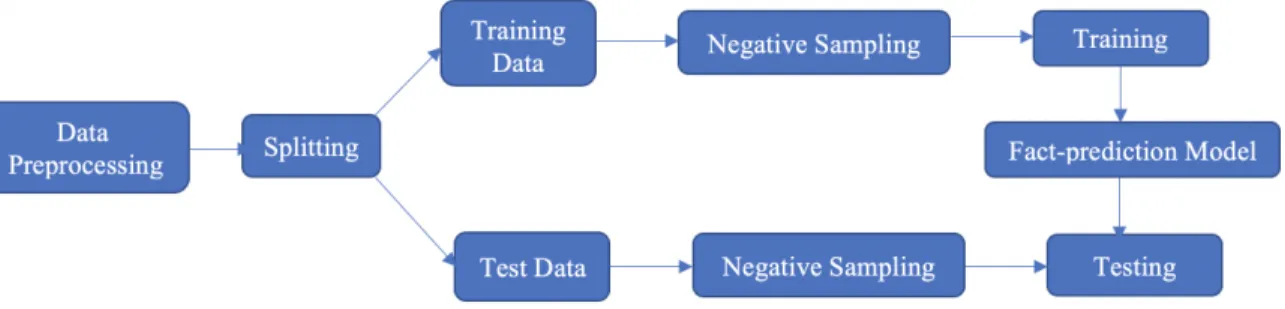
In this section, we describe the general workflow to train and test a fact-prediction model. Fact-prediction models follow a similar workflow as traditional machine learning algo-rithms except there is an intermediate step of computing negative facts while training and testing the data. Figure 4.1 represents the workflow of training and testing a fact-prediction model. The various steps involved are discussed below.
Data preprocessing: Knowledge graphs are generally very large and dynamic, i.e., they grow in size. Thus, it is difficult to use all the facts for training a fact-prediction model due to limited resources. Hence, researchers prefer to split facts into subsets by filtering the most frequently occurring entities or relations, removing data redundancies beyond a threshold, or sticking to a particular domain of facts, such asPeople,Sports, andLocation. The preprocessing is slightly different depending on the nature of the entities and relations in the knowledge graph at hand. Sometimes, the knowledge graphs are imbalanced, i.e., few relations are present in much lesser or much higher number of facts as compared to other relations. Such relations are usually removed to avoid underfitting or overfitting of the model.
Splitting: The facts present in a knowledge graph are divided into training, validation, and test sets. Usually, the splitting is done randomly but it can be done by keeping a fixed percentage for each set. The training set consists of the existing facts in the knowledge graph. The validation set consists of a smaller fraction of existing facts in the knowledge graph as compared to the training set. It is optional to have a validation set as we have different stopping criteria that are not based on the performance on the validation set. The test set consists of true missing facts of the graph that are known to the user. It is necessary to have the same set of entities and relations present in each test to avoid random predictions from the model in the end.
Negative sampling: Negative facts are used during the training as well as testing of fact-prediction models. In TransE, negative facts are created from the positive facts by randomly replacing the head or tail with a random entity from the knowledge graph [6]. This can lead to false negatives as the resulting fact after corruption can still be part of the original graph. To reduce false negatives, TransH imposes different probabilities for corrupting head and tail based on the mapping of the relation [34]. Moreover, it is hard to know what is a true negative fact because of the open-world assumption. Thus, we introduce additional strategies in extension to the local-world assumption in Chapter 3.
Training: The objective of the training step is to learn the embedding representations for the entities and relations in the knowledge graph. The embeddings capture the semantic relation between the entities. The embeddings are similar to the weights of a traditional machine model and are inputs to the training step along with the facts. In each iteration, the embeddings are updated based on a loss function. A margin-based loss function captures the distance between positive and negative facts. Training is stopped when the loss function reaches a minimum threshold or a specified number of iterations. Translation-based models use stochastic gradient descent to optimize the loss function and learn the embeddings.
Testing: Fact-prediction models are tested by evaluating the positive facts against their negative counterparts. Mean reciprocal rank and Hits@X are the two most common metrics used for evaluation. All facts in the test set are ranked against their negative counterparts by comparing the scores of facts. A scoring function calculates the distance of a fact. TransE, TransH, and TransD differ in the way scoring functions are calculated. The mean of the reciprocal rank of all the facts in the test set is reported for analysis. A mean reciprocal rank closer to 1 represents a good prediction model. Similarly, Hits@X captures the percentage of test facts that rank above X in the test set. The algorithms to compute the metrics are discussed in more detail in Chapter 5.
4.2
OpenKE
OpenKE [14] is an open-source framework for fact-prediction models based on knowledge graph embeddings. The framework has separate modules for data preprocessing, negative sampling, fact-prediction models, training, and testing. Independent modules ensure that the framework can be reconfigured in the future for integrating new features. The prelimi-nary tasks like data preprocessing and negative sampling are implemented in C++ to enable multithreading acceleration. Fact-prediction models are implemented in PyTorch to exploit the hardware optimization using tensors, automated gradient descent, and GPU compati-bility. This reduces the manual work of calculating gradients and back-propagation. The
model parameters and functionalities are encapsulated into a base class. Each model de-fines its version of scoring and loss functions by inheriting the base class. Finally, the preprocessed data and the configured models are loaded into the Python environment for training and testing.
Additionally, the framework also provides benchmarking datasets for 8 knowledge graphs. All entities and relations are encoded into ids and the mappings are stored in text files. The splits for training, validation, and test sets are provided for each dataset as separate text files. Each set contains facts in the form of (e1, e2, r), where e1 and e2 are ids of two different entities and r is the id of a relation. Originally, the framework uses offset-based negative sampling for corrupting facts. In offset-offset-based negative sampling, an offset is added to the original id of the entity that needs to be corrupted. The user can either use Bernouilli distribution or randomly choose to corrupt either the head or the tail of a fact. Ideally, only one negative fact is generated per positive fact. In OpenKE, users can provide a negative rate to generate more than one negative fact per positive fact. We used Python for integrating different negative fact generation strategies with the existing framework.
To enable a simpler integration of new negative fact generation strategies, we converted the original C++ code to Python to preprocess the data and construct negative facts. Dur-ing trainDur-ing, only the entities from the trainDur-ing set are used to generate corrupted entities. Whereas during testing, all entities from the training, validation, and test set are used to corrupt the facts. To implement Na¨ıve strategy we maintain three sets as we read facts from the data files: entity set to store all the entities, head set to store all entities that have appeared as head in any fact, and test set to store all entities that have appeared as tail in any fact. To compute the corrupted head and tail sets respectively, we subtract the head set from the entity set and tail set from the entity set. Additionally, we maintain dictionaries to compute entities associated with a specific relation and a specific entity. For corrupt-ing a fact uscorrupt-ing local-closed world assumption, we use the dictionary to obtain the entities associated with the input relation and head/tail and subtract it from the entity set.
each relation in two dictionaries. To corrupt the head of a fact, we subtract the entities associated with the input relation and head/tail from the domain/range of the relation. For corrupting entities using neighborhood-based local-closed world assumption, we prepute the compatible relations using a threshold for overlapping heads and tails. We com-bine the domains and ranges of compatible relations to obtain candidates for corruption in the neighborhood. Lastly, we subtract the entities associated with the input relation and head/tail from the new domain/range of the relation. Sometimes typed local-closed world assumption and neighborhood-based local-closed world assumption does not produce any candidates for corruption, we resort on local-closed world assumption in such cases.
Chapter 5
Experiments
This chapter covers the experiment setup, anomalies, datasets, evaluation protocol, and results of our analysis. We discuss the preparation of the experimental setup for the translation-based models and various thresholds for computing negative facts in Section 5.1. Section 5.2 discuss about various data redundancies present in knowledge graphs. In Section 5.3, we present the development of different subsets of data by past researchers based on four knowledge graphs: Freebase [4], Wordnet [11], YAGO [22], and NELL [23]. Section 5.4 discusses the evaluation protocol covering the ranking criterion and the Hits@X in detail. Lastly, the models are trained and tested with different negative fact generation strategies and the results are presented in Section 5.5.
5.1
Experiment Setup
All experiments are conducted on the resources available at the Rochester Institute of Tech-nology’s research computing center: https://www.rit.edu/researchcomputing/. The center provides a High-Performance Computing cluster that has 2304 cores (IntelR XeonR Gold 6150 CPU @ 2.70GHz), 24 TB RAM, 100 Gbit/sec RoCEv2 interconnect, 16 Nvidia V100 cards, and 96 Nvidia P4 cards. The hyperparameters for the stochastic gradient descent are kept as follows: marginγ = 5, learning rateα = 1, dimension of embeddings = 200, and maximum number of epochs = 1500. We use theL1 norm (Manhattan distance) for
per epoch, i.e., the batch size is |GT E|/100. OpenKE does not have a validation step
im-plemented and we do not use the validation set to stop the training process. Hence, we stop the training process when either the loss is less than 0.01 or the loss remained below 0.1 for the last 50 iterations. While generating negative facts during training, the size of corrupted entities generated per fact is very large, so we sample 7500 corrupted entities in advance. For computing compatible predicates in neighborhood-based local closed-world assumption, the threshold to decide the overlapping between heads and tails is set as 0.75. The negative rates used to generate a number of negative facts per positive fact are set as2i
wherei∈[0,4].
5.2
Anomalies
Anomalies are data redundancies present in a split of a knowledge graph known to ab-normally increase a fact prediction models’ accuracy [1]. Akrami et al. [1] found that in some datasets, anomalies are naturally present but in some, they were artificially created. Akrami et al. [1] observed that anomalies are known to cause overfitting due to the presence of excessive information. Anomalies like near-reverse, near-same, and Cartesian product relations make fact-prediction tasks much easier leading to high accuracy [1]. To compute near-reverse and near-same relations, we define the pairs of head-tail and the inverse pairs of tail-head for a relation r as follows:
P airs(r) = {(h, t)|(h, r, t)∈KG}, P airs−1(r) ={(t, h)|(h, r, t)∈KG}
Relationsrandr0 are near-reverse if
Overlap(P airs(KG, r), P airs−1(KG, r0))> θ
where KG is a knowledge graph, θ is a threshold and Overlap is the overlap coefficient defined in section 3.4. Relationsrandr0are near-same if
For example,part of andhas partare two near-reverse relations in Wordnet [11], and
isAf-filiatedToandplaysForare two near-same relations in YAGO [22]. A relation is Cartesian
product relation if every head in the domain of relation is related to every tail in the range of that relation. Relation r is a Cartesian product relation if the following condition is satisfied:
|(h, r, t)|(h, r, t)∈KG| |Domain(r)||Range(r)| > θ
where Domain(r) and Range(r) are the domain and range of relation r as defined in section 3.3. An example of such a cartesian product relation is thepositionof players on the field in a football game. Since all teams have the same set of positions, fact-prediction for such a relation is not meaningful.
5.3
Datasets
All datasets used in this work are derived from open knowledge graphs. The statistics of the datasets used in the evaluation are shown in Table 5.1. |E|and|R|denote the total number of entities and relations in each of the datasets. |GT R|,|GV A|, and|GT E|denote the number
of facts in training, validation and test sets, respectively. We removed the anomalies using the threshold θ discussed in Section 5.2 along with entities that were present in the test set but not present in the training set, as the model makes random predictions for such entities. |CP|, |N S|, and|N R| denote the number of facts containing Cartesian product, near-same, and near-reverse relations. |EN T|denote the number of entities that are present
in the test set but not in the training set. |G0T E| denote the number of facts after filtering out the anomalies. Our benchmarking datasets are based on the following four knowledge graphs:
Freebase: Freebase is a knowledge graph consisting of 1.9 billion facts majorly con-tributed by human editors. Google migrated most of its content to Wikidata in 2015. There are two datasets based on Freebase: FB13 and FB15K237. FB13 (Socher et al. [28]) is generated by extracting facts from thePeopledomain. The data set consists of 13 relations,
Table 5.1: Knowledge graphs under evaluation |E| |R| |GT R| |GV A| |GT E| |CP| |N S| |N R| |EN T| |G0T E| FB13 75,043 13 316,232 5,908 23,733 0 0 2 0 23,733 FB15K237 14,541 237 272,115 17,535 20,466 17 24 22 29 18,891 NELL-995 75,492 200 149,678 543 3,992 1 2 0 964 2,833 WN18RR 40,943 11 86,835 3,034 3,134 0 0 0 209 2,924 YAGO3-10 123,182 37 1,079,040 5,000 5,000 0 2 0 18 1,818
such asplace lived,place of birth,place of death,profession,spouse, andparents. FB15K (Bordes et al. [6]) is another subset filtered to contain only those entities which have 100 mentions in Freebase and are also present in the Wikilinks: https:
//code.google.com/archive/p/wiki-links/database. It has facts from
mul-tiple domains, such asSports,People, Locations, andFilms. The dataset is randomly split into training, validation, and test splits. FB15K was further refined to the frequent 401 relations with 97% of facts having near-reverse and near-same counterparts. Thus, the re-maining triples are filtered to remove near-reverse and near-same relation resulting in 237 relations (Toutanova et al [29]). The resulting dataset is called FB15K237.
Wordnet: Wordnet [11] is a dataset of English words that are linked based on lexical relations. The words with similar meanings are grouped into unordered sets that are in-terchangeable in some context called synsets. The Wordnet database consists of 117000 synsets that are related via hyponymy, hypernymy, synonymy, and antonymy. Among the synsets, the word with more specific meaning is the hyponym to the word with more gen-eral meaning. For example, chairis the hyponym tofurniture. Hypernymy is the opposite of hyponymy, i.e the general word is the hypernym to the more specific word. For ex-ample, furniture is the hypernym tochair. Synonyms are the set of words that are closer in meaning to each other. Antonyms are the set of words that are opposite in meaning to each other. WN18 [6] is a subset of Wordnet which consists of 18 relations, such as
sim-ilar to, hypernym, member holonym, instance hypernym, member of domain usage,
hy-ponym, has part, verb group, and part of. WN18 suffers from data redundancy through
set. For instance, hypernym andhyponym are two near-reverse relations that are present in large proportion. Thus, Minervini et al. [8] created WN18RR to filter out near-reverse relations in WN18 resulting in 11 relations.
Yet Another Great Ontology (YAGO): YAGO [22] is a knowledge graph derived from Wikipedia, WordNet, and GeoNames. It has more than 120 million facts about nearly 10 million entities. It collates data from 10 sources of Wikipedia in different languages. The dataset consists of 37 relations containing information about people, such as isCitizenOf,
hasGender,hasWonPrize, andisKnownFor.
Never-Ending Language Learning (NELL): NELL [23] is another knowledge graph created by reading the web and extracting structured data from unstructured web pages. NELL has 2810379 facts with 1186 relations. In NELL-995, the facts with relations
gener-alizationsandhaswikipediaurlwere removed because these relations occurred more than 2
million times in the dataset but did not have any significance. Near-reverse relations were artificially created in this dataset by the authors for a specific task.
5.4
Evaluation metrics
In this Section, we explain different metrics used in the evaluation of the translation-based models [6]. Algorithm 3 describes the ranking criterion in which the test facts are ranked against the negative facts generated w.r.t. the corrupted head and tail sets H0 and T0 ob-tained with either of the strategies mentioned in Chapter 3. For each fact (h, r, t) in the test set, the head is replaced with each of the entities inH0. The rankrh is determined by
comparing the scores of the original fact and the derived negative facts from corrupting the head. Similarly,rtis computed by corrupting the tail of the fact with all entities inT0,
cal-culating their scores, and comparing them with the score of original fact. If the score of the corrupted fact is less than the score of original fact, the rank of original fact is incremented by 1. Ideally, the score of the original fact should be less than the score of all its negative
counterparts, so that it is ranked highest among them.
Table 5.2 shows an example of ranking criterion for a test fact (Leo France, countryOf-Birth, Argentina) in Figure 2.1. We use the LCWA strategy to generate corrupted tail setT0
which consists of all entities from the knowledge graph except the ones directly related to Leo France and countryOfBirth. Thus,T0 consists of all entities from the knowledge graph except Argentina, i.e.,{Bolivia, Spain, United Kingdom, Club Bolivar, Real Zaragoza. . . .}. The scores of the original fact and the negative facts generated by corrupting the tail with entities in T0 are calculated. The ranks of the facts are determined by sorting the facts in the ascending order of scores.
We discuss how to computehits@X, where X is a arbitrary number greater of equal than 1. For each fact (h, r, t) in the test set, rank rh andrt is computed as described in
Algorithm 3. hits@Xh is incremented by 1 whenrh of is less than X. Similarly,hits@Xt
is computed and an average of both hits@Xh and hits@Xt is taken over the whole test
set. Algorithm 4 illustrates the method to calculate hits@X. hits@X measures the pro-portion of correct facts ranked in top X by the fact-prediction model. hits@X is a simple metric to understand and, therefore, it is good to explain the behavior of a fact-prediction model. However, comparing hits@X is challenging as it aggregates many individual rank-ings. Also, any facts ranked below X are considered equally, which does not allow to make precise distinctions. As a result, we report significant differences between hits@X values, that is, more than 5% or so.
Table 5.2: Example of ranking Criterion
Fact Score Rank
(Leo France, countryOfBirth, Argentina) 64 1
(Leo France, countryOfBirth, Spain) 112 2
(Leo France, countryOfBirth, Bolivia) 145 3
(Leo France, countryOfBirth, United Kingdom) 159 4 (Leo France, countryOfBirth, Club Bolivar) 165 5 (Leo France, countryOfBirth, Real Zaragoza) 180 6
Algorithm 3:RankingCriterion
Input:Test setGT E, corrupted head setH0, corrupted tail setT0, negative fact
generation strategy S, trained model M
Output:rank of (h, r, t) when head is corruptedrh, rank of (h, r, t) when tail is
corruptedrt
1 for(h, r, t)∈GT E do
2 Th =corrupth(S,(h, r, t)); 3 Tt=corruptt(S,(h, r, t));
4 rh ←1rt←1for(h0, r, t)∈Thdo
5 ifscore(M,(h0, r, t))< score(M,(h, r, t))then 6 rh ←rh+ 1
7 end
8 end
9 for(h, r, t0)∈Ttdo
10 ifscore(M,(h, r, t0))< score(M,(h, r, t))then 11 rt ←rt+ 1
12 end
13 end 14 end
Algorithm 4:ComputeHits@X
Input:Test setGT E, arbitrary numberX, corrupted head setH0, corrupted tail set
T0, negative fact generation strategy S, trained model M Output:hits@X 1 for(h, r, t)∈GT E do 2 rh, rt ←RankingCriterion(GT E, X, H0, T0, S, M); 3 hits@Xh ←0; 4 hits@Xt←0; 5 ifrh ≤Xthen 6 hits@Xh ←hits@Xh + 1 7 end 8 ifrt≤X then 9 hits@Xt←hits@Xt+ 1 10 end 11 end
12 hits@X = 2|1T|(hits@Xh+hits@Xt)
5.5
Results
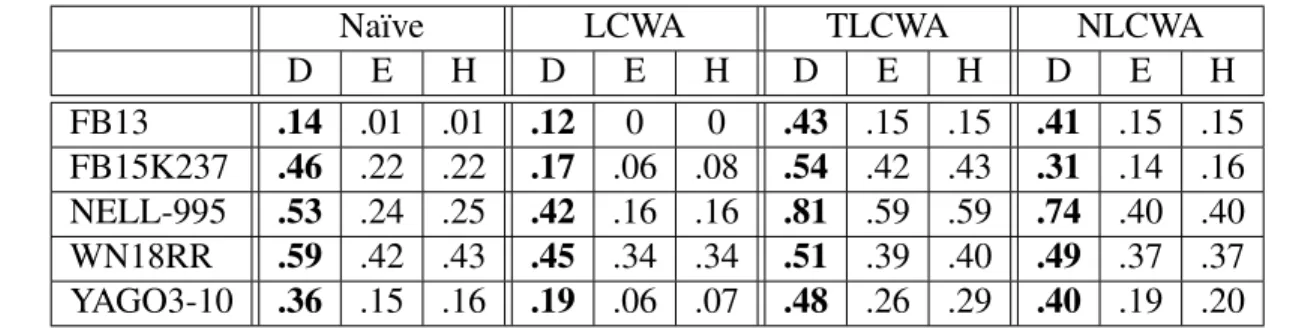
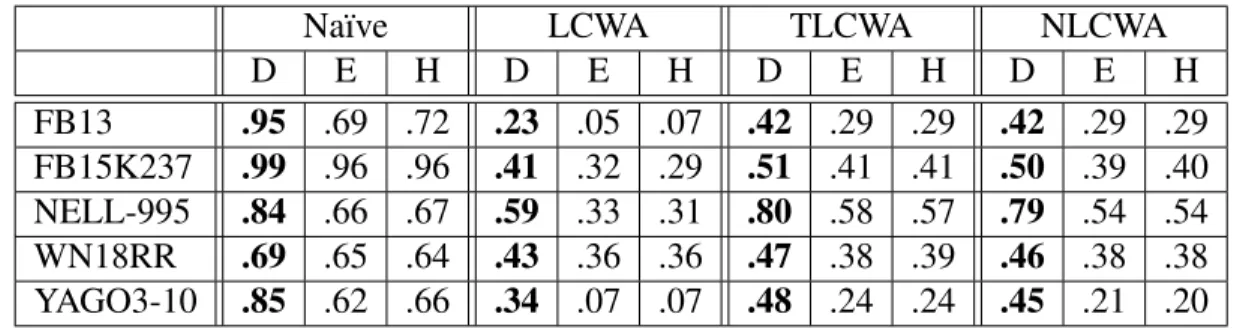
We evaluated TransE (E), TransD (D), and TransH (H) using naive, LCWA, TLCWA, and NLCWA and reportedhits@10, i.e., the percentage of facts ranked 10th or above inGT E
for the datasets listed in Table 5.1. Since each negative fact generation strategy is expected to produce a different number of negative facts with different levels of semantic plausibility, the model is trained using one strategy at a time and tested using all strategies. A robust model can discard the maximum percentage of negative facts produced by each testing strategy.
Table 5.3: Training with na¨ıve
Na¨ıve LCWA TLCWA NLCWA
D E H D E H D E H D E H FB13 1 .78 .76 .26 .18 .18 .27 .29 .29 .27 .29 .29 FB15K237 1 .99 .99 .19 .14 .13 .27 .25 .25 .23 .20 .19 NELL-995 .95 .85 .85 .43 .27 .26 .54 .28 .29 .53 .28 .28 WN18RR .84 .80 .79 .01 .02 .02 .03 .03 .03 .01 .02 .02 YAGO3-10 .95 .70 .69 .12 .05 .05 .14 .13 .13 .13 .13 .13
Table 5.4: Training with LCWA
Na¨ıve LCWA TLCWA NLCWA
D E H D E H D E H D E H FB13 .72 .51 .56 .39 .20 .23 .39 .30 .33 .39 .30 .33 FB15K237 .98 .96 .96 .45 .35 .36 .48 .37 .39 .47 .36 .37 NELL-995 .84 .54 .57 .55 .27 .27 .62 .29 .29 .61 .28 .29 WN18RR .68 .60 .60 .45 .37 .37 .46 .38 .39 .45 .38 .38 YAGO3-10 .83 .51 .49 .38 .08 .08 .40 .17 .18 .39 .17 .18
Training with na¨ıve: When the model is trained using na¨ıve, it achieves high accuracy when tested with na¨ıve itself (Table 5.3). The model’s accuracy drops significantly on testing with LCWA, TLCWA, and NLCWA. In the case of WN18RR, the accuracy is close to zero. We believe such a vast difference in accuracy is because the model can recognize more of nonsensical facts produced by na¨ıve rather than challenging, semantically plausible facts produced by other strategies. The variation in the accuracy by testing strategy is evident across all translation-based models.
Training with LCWA: Contrasting to the model trained with na¨ıve (Table 5.3), the model trained with LCWA (Table 5.4) has lower accuracy when tested with na¨ıve. For all datasets, the difference is more than 10-30% except for FB15K237. The accuracy in-creases significantly when tested with other strategies. However, the accuracy appears to be similar when tested with either LCWA, TLCWA, or NLCWA except for NELL.
Table 5.5: Training with TLCWA
Na¨ıve LCWA TLCWA NLCWA
D E H D E H D E H D E H FB13 .14 .01 .01 .12 0 0 .43 .15 .15 .41 .15 .15 FB15K237 .46 .22 .22 .17 .06 .08 .54 .42 .43 .31 .14 .16 NELL-995 .53 .24 .25 .42 .16 .16 .81 .59 .59 .74 .40 .40 WN18RR .59 .42 .43 .45 .34 .34 .51 .39 .40 .49 .37 .37 YAGO3-10 .36 .15 .16 .19 .06 .07 .48 .26 .29 .40 .19 .20
Table 5.6: Training with NLCWA
Na¨ıve LCWA TLCWA NLCWA
D E H D E H D E H D E H FB13 .22 .06 .04 .10 .01 0 .43 .16 .16 .42 .16 .16 FB15K237 .85 .79 .71 .37 .26 .26 .51 .41 .40 .49 .37 .38 NELL-995 .68 .45 .46 .56 .33 .33 .79 .57 .60 .78 .56 .56 WN18RR .59 .48 .48 .45 .36 .36 .49 .39 .39 .48 .38 .38 YAGO3-10 .52 .26 .23 .26 .07 .06 .49 .24 .25 .46 .20 .20
Training with TLCWA: Compared to the models trained with na¨ıve (Table 5.3) and LCWA (Table 5.4), the model trained with TLCWA (Table 5.5) achieves lower accuracy when tested with na¨ıve and LCWA. Since TLCWA takes into account more restrictive neg-ative facts for training, the model fails to recognize most of the negneg-ative facts generated by na¨ıve and LCWA. The accuracy increases consistently on testing with TLCWA and NLCWA for all datasets except when FB13 is tested with TransE and TransH.
Training with NLCWA: The model trained with NLCWA (Table 5.6) performs slightly better on testing with na¨ıve and LCWA as compared to the model trained with TLCWA (Table 5.5). However, we do not observe major differences in the accuracy on testing with TLCWA and NLCWA. NLCWA considers additional entities for corruption based on the compatibility of relations in the neighborhood. Seldom compatible relations are not found in the neighborhood and the model simply relies on entities generated with TLCWA. Hence, the accuracy of the model trained with TLCWA and NLCWA does not lie far from each other.
Table 5.7: Training with na¨ıve + NLCWA
Na¨ıve LCWA TLCWA NLCWA
D E H D E H D E H D E H FB13 .95 .69 .72 .23 .05 .07 .42 .29 .29 .42 .29 .29 FB15K237 .99 .96 .96 .41 .32 .29 .51 .41 .41 .50 .39 .40 NELL-995 .84 .66 .67 .59 .33 .31 .80 .58 .57 .79 .54 .54 WN18RR .69 .65 .64 .43 .36 .36 .47 .38 .39 .46 .38 .38 YAGO3-10 .85 .62 .66 .34 .07 .07 .48 .24 .24 .45 .21 .20
Comparison across translation-based models: It is evident from the results that TransE and TransH have similar accuracies for each strategy utilized to train the model. TransD outperforms TransE and TransH in maximum cases with a difference of more than 10% in the accuracy. The change in the accuracy is proportional for TransE, TransH, and TransD w.r.t the models trained with different strategies.
Training with na¨ıve and NLCWA: The models trained with NLCWA (Table 5.6) have better accuracy than other models when tested with TLCWA and NLCWA. However, the model’s accuracy drops when tested with naive and LCWA. We believe this is because NLCWA is expected to recognize less nonsensical facts as compared to naive and LCWA. The advantage of using NLCWA over LCWA is that only immediate neighbors are used for corruption instead of the whole graph. NLCWA also adds flexibility over TLCWA by adding new candidates that are not available in the domain and range of input relation. To add more robustness to NLCWA, we trained a model with a combination of na¨ıve and NLCWA (Table 5.7). To corrupt a fact using the new strategy, we select randomly between na¨ıve and NLCWA with a probability of 25% and 75% respectively. The accuracy of the model trained with this method outperforms the accuracy of all other models presented before when tested with either of the four strategies.
Chapter 6
Conclusions
6.1
Conclusion
Negative facts produced with na¨ıve and LCWA strategies are expected to be nonsensical rather than semantically plausible. NLCWA and TLCWA are expected to produce fewer nonsensical and more semantically plausible negative facts. We observed that the accuracy of the model varies w.r.t the different strategies used. When models are trained with na¨ıve and LCWA strategies, they recognize better nonsensical facts than semantically plausible facts. Models trained with NLCWA and TLCWA are good at recognizing semantically plausible facts but struggle to recognize nonsensical facts. A model trained with a combi-nation of NLCWA and na¨ıve performs similar to LCWA, i.e., NLCWA+ na¨ıve ≈LCWA. This suggests that models can be trained using subgraphs based on neighboring facts in-stead of whole graphs.
6.2
Future Work
The local-closed world assumption uses the entire knowledge graph to generate negative facts which are expensive. Therefore, utilizing neighborhood-based strategies we can train individual models based on subgraphs. Different negative fact generation strategies should be reevaluated based on individual models.
Currently, the datasets are randomly split that alters the topology of the knowledge graph and the training split does not resemble the original graph. Thus, new ways of split-ting can be incorporated in further analysis. Current metrics are calculated based on only
the ranks of facts that do not consider the number of negative facts generated per positive fact. Designing a new metric that weighs the number of negative equivalents could be useful for further study.
In NLCWA, we consider the immediate neighbors of relations for generating possible candidates for corruption. Although this gives us additional candidates as compared to that in TLCWA, it does not give us the complete set of entities for corruption. Instead of depending on the immediate neighbors, we can extend the search to k-neighbors and reassess the model accuracy.
Bibliography
[1] Farahnaz Akrami, Mohammed Saeef, Qingheng Zhang, Wei Hu, and Chengkai Li. Realistic re-evaluation of knowledge graph completion methods: An experimental study, 03 2020.
[2] S¨oren Auer, Christian Bizer, Georgi Kobilarov, Jens Lehmann, Richard Cyganiak, and Zachary Ives. Dbpedia: A nucleus for a web of open data. InProceedings of the 6th International The Semantic Web and 2nd Asian Conference on Asian Semantic Web
Conference, ISWC’07/ASWC’07, page 722–735, Berlin, Heidelberg, 2007.
Springer-Verlag.
[3] Laure Berti-Equille. Ml-based knowledge graph curation: Current solutions and chal-lenges. InCompanion Proceedings of The 2019 World Wide Web Conference, WWW ’19, page 938–939, New York, NY, USA, 2019. Association for Computing Machin-ery.
[4] Kurt Bollacker, Colin Evans, Praveen Paritosh, Tim Sturge, and Jamie Taylor. Free-base: a collaboratively created graph database for structuring human knowledge. In Proceedings of the 2008 ACM SIGMOD international conference on Management of data, pages 1247–1250, 2008.
[5] Antoine Bordes and Evgeniy Gabrilovich. Constructing and mining web-scale knowl-edge graphs: Kdd 2014 tutorial. InProceedings of the 20th ACM SIGKDD
Interna-tional Conference on Knowledge Discovery and Data Mining, KDD ’14, page 1967,
New York, NY, USA, 2014. Association for Computing Machinery.
[6] Antoine Bordes, Nicolas Usunier, Alberto Garcia-Dur´an, Jason Weston, and Oksana Yakhnenko. Translating embeddings for modeling multi-relational data. In Proceedings of the 26th International Conference on Neural Information Processing Systems
-Volume 2, NIPS’13, page 2787–2795, Red Hook, NY, USA, 2013. Curran Associates

![Figure 2.2: Vector representation of a positive fact learned by TransE [6]](https://thumb-us.123doks.com/thumbv2/123dok_us/9356351.2814000/21.918.134.798.222.1080/figure-vector-representation-positive-fact-learned-transe.webp)
![Figure 2.4: Vector representation of a fact in TransH (adpated from [34])](https://thumb-us.123doks.com/thumbv2/123dok_us/9356351.2814000/22.918.357.562.606.767/figure-vector-representation-fact-transh-adpated.webp)
![Figure 2.5: Vector representation of a fact in TransR (adapted from [21])](https://thumb-us.123doks.com/thumbv2/123dok_us/9356351.2814000/23.918.295.637.687.871/figure-vector-representation-fact-transr-adapted.webp)