r1 Copyright Statement This copy of the thesis/dissertation has been supplied on condition that anyone who consults it is understood to recognize that its copyright rests with its author and that information derived from it may not be published without attribution. Copyright ownership of theses and dissertations is retained by the author, but the student must grant to TWU royalty‐free permission to reproduce and publicly distribute copies of the thesis or dissertation. In circumstances where the research for the thesis or dissertation has been done in conjunction with other policies discussed in The Texas Woman’s University Policy on Intellectual Property, those policies will apply with regard to the author. No further reproduction or distribution of this copy is permitted by electronic transmission or any other means. The user should review the copyright notice on the following scanned image(s) contained in the original work from which this electronic copy was made. Section 108: United States Copyright Law The copyright law of the United States [Title 17, of the United States Code] governs the making of photocopies or other reproductions of copyrighted materials. Under certain conditions specified in the law, libraries and archives are authorized to furnish a photocopy or other reproduction. One of these specified conditions is that the reproduction is not to be used for any purpose other than private study, scholarship, or research. If a user makes a request for, or later uses, a photocopy or reproduction for purposes in excess of “fair use,” that use may be liable for copyright infringement. No further reproduction and distribution of this copy is permitted by transmission or any other means. Texas Woman’s University ©2013. www.twu.edu
UNDERSTANDING THE BATTERERS‘ PERSPECTIVE THROUGH THE APPLICATION OF AFFECT CONTROL THEORY
A DISSERTATION
SUBMITTED IN PARTIAL FULFILLMENT OF THE REQUIREMENTS FOR THE DEGREE OF DOCTOR OF PHILOSOPHY
IN THE GRADUATE SCHOOL OF THE TEXAS WOMAN‘S UNIVERSITY
DEPARTMENT OF SOCIOLOGY AND SOCIAL WORK COLLEGE OF ARTS AND SCIENCES
BY
CARLETTE P. LOCKETT, B.A., M.A., M.S.ED
DENTON, TEXAS MAY 2013
iii DEDICATION
I would like to dedicate this work to my grandparents: Nancy Gomez; Tom and Lenora Lockett, who all believed and knew the importance of education and dreamed that their children and grandchildren would strive for excellence through education.
iv
ACKNOWLEDGEMENTS
First and foremost, I want to thank my Lord and Savior Jesus Christ for his blessing, his grace, and his mercy.
Thanks to the chair of my committee, Dr. James Williams for his patience, encouragement, and for introducing me to Social Psychology. To those who served on my committee for their guidance, direction, knowledge and
encouragement: Dr. Linda Marshall and Dr. Lisa Zottarelli.
I am forever indebted to those participants of the batterers‘ intervention and prevention program. It was through their sharing of their feelings and giving of their time that I was able to complete my dissertation. Thanks to the agencies who allowed me to recruit from their orientations. I would like to send a special ―shout out‖ to a young man who helped me to view batterers in totally different light. I would also like to thank my previous employer Houston Area Women‘s Center (HAWC), particularly the HAWC‘s shelter employees and clients.
Thanks to my mentor and dear friend Dr. Angela Parham, for her guidance, encouragement, and your friendship. Thanks to Dr. Gayle Sulik, Dr. Abigail Tilton, and Mark Sandel for your encouragement and guidance. Thanks to: Erin, Eddy, Pakeithe, and Bev, for being such great friends and colleagues. I will always remember the many late nights in CFO on the 3rd floor. Kavi, thanks for being there and allowing me to bounce ideas with you. Soni,
v
thanks for being so kind and also giving me the comfort knowing that I was not the only person in the department at 3 am. Ali, thanks for helping me with the statistics and for your patience. Kathleen, you will always be such a special and dear friend, thanks for helping me through one of the most difficult times in my life. Jeanee and Kamilah thanks for your laughs, smiles, and I guess the workouts and juice. I am not too sure about the juice. Christopher, LaShanda, and
Christina, I am so glad we met on this journey; I will cherish the good times. God has blessed me with the best parents in the world, Patricia and Carl Lockett, thank you so much for your support, encouragement, patience, and knowing that I could do this, when I begin to have doubts, I Love You. To Carl Patrick, my Brother, my best friend, thanks for your encouragement, your positive attitude, and I Love You!! To my cousin Trevina Willis, thanks for taking me under your wing when I moved to Denton. You often provided the spark I needed to relax and take care of myself and thanks for going with me to any New Edition concert. Finally, James Kumeh, thank you for your patience and understanding, I Love You. If there is anyone I forgot please charge it to my head and not my heart, thank you.
vi ABSTRACT
CARLETTE PATRICE LOCKETT
UNDERSTANDING THE BATTERERS‘ PERSPECTIVE THROUGH THE APPLICATION OF AFFECT CONTROL THEORY
MAY 2013
The purpose of this study was to determine if participants in batterers‘ intervention and prevention programs (BIPPs) experience a change in affect by applying the theoretical framework of affect control theory. The study also examined how participants who attending BIPPs self-identified, in particular if they self-chose a stigmatized identity as a batterer or abusive. Data were
collected at two different time points using an instrument designed for this study. At Time 1 participants had attended between zero to nine weeks of BIPP group sessions and at Time 2, participants had attended 18 weeks or more of BIPP group sessions. A total of 43 male BIPP‘s participants attending the programs at three different locations in the southwest United States participated in the study at Time 1 and Time 2. The study used quantitative and qualitative research methods. The quantitative analysis used affect control theory‘s INTERACT software program. Participants completed the instrument about their perspectives on intimate partner violence.
vii
Participants did not experience a statistically significant change in affect while attending the BIPPs. However, the participants‘ open-ended responses appeared to illustrate a change in the participants‘ sentiments towards their partners from Time 1 to Time 2. Participants also appeared to maintain their self-chosen identities from Time 1 to Time 2.
Affect control theory‘s software program, INTERACT, provided mixed results in predicting participants‘ emotions and behaviors from Time 1 to Time 2. INTERACT was able to predict emotions consistently at Time 1, however at Time 2, INTERACT did not accurately predict emotions. INTERACT also had some trouble in predicting behaviors at both Time 1 and Time 2. Despite the mixed findings using INTERACT, affect control theory did provide the means to measure an affective change among the participants, to measure if they identified with a stigmatized identity, and the means to numerically quantify the results of the qualitative analyses.
viii TABLE OF CONTENTS Page DEDICATION ... iii ACKNOWLEDGEMENTS ... iv ABSTRACT ... vi LIST OF TABLES ... xi
LIST OF FIGURES ... xii
Chapter I. INTRODUCTION ... 1
Research Problem ... 5
Setting ... 6
Significance of the Study ... 8
Plan of Work ... 9
II. REVIEW OF THE LITERATURE ... 10
Battering Intervention Programs ... 10
Theoretical Perspectives on Intimate Partner Violence ... 17
Batterers‘ Perspectives ... 22
Emotional Changes Among Batterers ... 30
Affect Control Theory... 33
Affect Control Theory Research ... 41
III. METHODS AND DATA ... 52
Data ... 52 Sample... 52 Participant Recruitment ... 53 Instrument ... 54 Data Collection ... 55
ix
Participant Protection ... 57
Research Questions/Hypotheses ... 58
Definition of Terms and Concepts ... 62
Data Analysis ... 65
Quantitative Analysis ... 65
Qualitative Analysis ... 66
IV. QUANTITATIVE RESEARCH FINDINGS ... 69
Introduction ... 69 Characteristics of Participants... 69 Research Questions/Hypotheses ... 72 Research Question 1 ... 72 Hypothesis 1... 73 Hypothesis 2... 77 Hypothesis 3... 78 Hypothesis 4... 79 Research Question 2 ... 80 Hypothesis 5... 81 Research Question 3 ... 82 Hypothesis 6... 89 Research Question 4 ... 90 Hypothesis 7... 90 Discussion ... 91 V. QUALITATIVE RESEARCH FINDINGS ... 94
Question 1 - Time 1 ... 94 Question 1 - Time 2 ... 103 Question 2 –Time 1 ... 106 Question 2 –Time 2 ... 109 Question 3 –Time 1 ... 113 Question 3 –Time 2 ... 115 Core Themes ... 123
Blaming the Victim ... 124
Minimization of Violence ... 125
Criminal Justice System Unfair Treatment ... 127
No Mandated Group Attendance by Partners ... 129
Discussion ... 129
x
Summary and Discussion ... 133
Quantitative and Qualitative Findings ... 133
Core Themes ... 136
Implications... 139
Implications for Batterers‘ Intervention and Prevention Programs ... 139
Implications for Affect Control Theory ... 139
Limitations ... 140
Future Research ... 141
REFERENCES ... 144
APPENDICES A. IRB Approval Letter Consent Form... 160
B. Consent Form ... 162
C. Recruitment Script... 166
D. Batterers‘ Intervention and Prevention Program Questionnaire ... 168
E. Power and Control Wheel ... 187
F. Deflection Formula ... 189
G. INTERACT ... 191
H. Test Values for Each Statements at Time 1 and Time 2 ... 193
I. Participants‘ Self-Reported Identities at Time 1 and Time 2 ... 195
J. Qualitative Findings for Ratings for Participants Predicted Emotions and Behaviors for Time 1 and Time 2 ... 208
xi
LIST OF TABLES
Table Page
1. Descriptive Statistics of Participants at Time 1(N=43) and Time 2 (N=28) ... 71 2. Time 1 and Time 2 Participants‘ Transient Impressions Statement
Deflection Scores Comparison ... 73 3a. Comparison of Participants‘ Transient Impressions Deflection Scores
(TIDS) to Established Fundamental Sentiments ... 76 3b. Time 1 Participants‘ Transient Impressions Statement Deflection
Scores and Established Fundamental Sentiments Comparison ... 78 3c. Time 2 Participants‘ Transient Impressions Statement Deflection
Scores and Established Fundamental Sentiments Comparison ... 79 3d. Participants‘ Means Difference Comparison of Established
Fundamental Sentiments from Time 1 and Time 2 ... 80 4a. Time 1 Highest EPA Profile Component Rating From Statements ... 85 4b. Time 2 Highest EPA Profile Component Rating From Statements ... 86
xii
LIST OF FIGURES
Figure Page
1. The Process of Event ... 38 2. Affect Control Theory ... 39
1 CHAPTER I INTRODUCTION
Intimate partner violence (IPV) is a significant problem within the United States. Although IPV has been classified as a social problem for more than forty years, the research surrounding this issue consistently concentrates on female victims/survivors. In order to understand the extent of this issue both the abuser and the victim/survivor need to be studied.
Ending violence against women has been a major concern since the women‘s movement and the battered women‘s movement brought this social problem to light during the late 1960s and early 1970s. According to Tjaden and Thoenes (2000), it is estimated that 1.3 million women are physically assaulted by their intimate partners annually in the United States. Intimate partner violence has been defined as intimate relationships involving current or former spouses, boyfriends, or girlfriends, persons who are cohabiting, and individuals in same-sex relationships (Rennison and Welchans 2000). Intimate partner violence can occur as a onetime incident; however, research indicates that IPV is often a systematic pattern of abuse (Adams and Cayouette 2002; National Center for Injury Prevention and Control 2003). Research from the National Violence Against Women Survey suggest that nearly 25 percent of women who are 18
2
years and older will experience some type of IPV during their lifetime (Tjaden and Thoennes 2000).
The idea that IPV is someone else‘s problem and a private issue still prevails despite numerous campaigns informing the public about the ills of IPV. Various studies illustrate the impact of IPV at societal level. According to the Allstate Foundation National Poll on Domestic Violence (2006), three out of four Americans knew of someone who is or has been a victim of domestic violence. The Centers for Disease Control and Prevention estimated that the health-related (direct medical care and mental health services) cost of IPV exceeds $5.8 billion per year and the loss of productivity (wages and household chores) was $1.8 billion per year (Max, Rice, Finkelstein, Bardwell, Leadbetter 2004; National Center for Injury and Prevention and Control 2003). This clearly illustrates that IPV is not a private issue but affects the whole of society either directly or indirectly.
It has been estimated there are at least 1,500 battering intervention programs in the United States (Adams 2003) and this number continues to grow. Battering intervention programs have been designed to educate abusers about the effects of abuse and to teach them to be accountable for their abuse. It is
estimated that 80 percent of participants in the battering intervention programs are referred by probation officers or are court mandated to attend the battering
3
battering intervention programs have been in existence for over 25 years and the numbers of new programs continue to increase, the research surrounding these programs tends to focus on recidivism rates, as opposed to understanding the abuser‘s perspective.
Researchers examining the effectiveness of battering intervention
programs have come to a consensus that there is no widespread agreement about the efficacy of the battering intervention programs as completion and recidivism rates vary greatly (Adams and Cayouette 2002; Lindsey, McBride, and Platt 1993). In addition, methodological problems exist with previous research studies. The methodological problems include issues such as how completers and non-completers attending the battering intervention programs are defined, operational issues with the way violence has been defined, a significant focus on participants who fall within the lower socioeconomic status, which battering intervention program curriculum is being measured,how recidivism rates are being measured, and adjustments to the way data were being collected during the studies
(Buchbinder and Zvi 2008; Carden 1994; Carney, Buttell, and Muldoon 2006; Cissner and Puffett 2006; Enosh 2008; Gondolf 2000, 2002; Labriola, Rempel and Davis 2008; MPD 2008). In addition, studies have often neglected to include any theoretical framework(s) when measuring effectiveness and recidivism rates (Babcock, Canady, Graham, and Schart 2004; Denzin 1984; Schmidt,
4
Kolodinsky, Carsten, Schmidt, Larson, MacLachlan 2007; Smith 2007; Stuart, Temple, and Moore 2007).
The lack of a theoretical framework for analyzing a battering intervention program is a significant concern. Affect control theory (ACT) can provide a theoretical framework for an analysis of the batterers‘ perspective which allows researchers to predict the emotions, the behaviors of the batterer, and determine whether there is a change in affect in the batterer during interactions with their partner. Affect control theory is a social psychological theory which proposes that people will guide themselves in social interactions so that their immediate feelings about people, settings, and behaviors continue to represent long standing sentiments. If their actions are not ―working‖ within the situation then their interpretation of the situation will change (Heise 2002, 2007). Applying ACT to a battering intervention program may allow researchers to measure the discrepancy that occurs between the expectations actors have about the way interactions with their partners should occur and the way their interactions are actually occurring. This would be beneficial because it could potentially lead to the development of an assessment tool that, among other things, may help determine which battering intervention program is more beneficial for the batterer.
5
Research Problem
Battering intervention programs continue to increase in number (Adams 2003) despite the lack of research from the perspective of the participants in the program. The use of recidivism rates as a way to measure the effectiveness of battering intervention programs do not effectively explain whether or not there is a change in the participants attending the program. The purpose of this
dissertation is to examine the batterers‘ perspective on battering intervention program by applying the theoretical framework of ACT. This will be
accomplished by administering instruments to a sample of participants at two points while they are attending a battering intervention program. Affect control theory will be used to determine whether an affective shift occurs within
participants while they are attending the program. The research will measure the discrepancy between the expectations abusers have about how their interactions should occur with their intimate partners versus the way abusers perceive their actual interactions with their intimate partners. In addition, this study will examine how participants self-identify within battering intervention programs, within their intimate relationships, and within their social interactions of non-intimates.
The researcher understands that females may also be abusers. However, for the purpose of this dissertation abusers/batterers will be considered males unless otherwise stated. Also for the purpose of this dissertation, the words
6
abuser and batterer will be used inter-changeably, as this is a common approach throughout the literature.
Setting
Data used in this study were collected from three domestic violence agencies locations two located in North Texas and one located in South Texas. These agencies were selected due to availability, time, and financial constraints. Each Batterer Intervention and Prevention Program (BIPP) chosen is an
accredited program through the Texas Department of Criminal Justice-Criminal Justice Assistance Division (TDCJ-CJAD). The domestic violence agencies currently use a cognitive-behavioral battering intervention program based upon the Duluth model. The specific purpose of the BIPP is to protect the victim. Thus, participants in the BIPP are given tools to develop empathy towards their partners and are held accountable for their abusive actions.
The BIPP consists of a group orientation which takes place twice a month, an individual initial intake, depending on the program, group sessions ranging from 24 weeks to 27 weeks the State of Texas requires that battering intervention programs are a minimum of 18 weeks in length (Texas Council on Family
Violence 2009), and an individual exit interview. Depending on the BIPP group, participants are charged $35.00 to $50.00 to attend orientation. The charge for the intake session, each group session (one group session for two hours), and exit interview range from $30.00- $40.00. The BIPP for this study covers nine topics
7
(non-violence, non-threatening behavior, respect, trust and support, accountability, sexual respect, partnership, negotiation and fairness, and parenting). Participants are referred to these BIPPs through several different channels: 65 percent are referred from probation, 10 percent to 15 percent are referred from child protective services; 15 percent are referred from parole and 5 percent voluntarily attend the program (Howard 2010; Vinson-O‘Neal 2011). The BIPP group sessions are open; therefore, participants are able to enter the group at any time. Each group can hold a maximum of twelve to fifteen
participants. Eighty-five percent of the BIPP‘s participants complete the program successfully (Howard 2010; Vinson-O‘Neal 2011). A completer is a participant who has attended orientation, had an intake, completed all 24 or 27 group sessions (depending on the BIPP), and had an exit interview (Howard 2010;
Vinson-O‘Neal 2011; Williams 2012).
A participant who has completed nine weeks of the required 24 or 27 weeks of group sessions is considered to be in the beginning stages of their group sessions. Participants who are ten to twelve weeks into the program typically start to view themselves as group members (Howard 2010; Vinson-O‘Neal 2011; Williams 2012). Therefore, participants who are ten to nineteen weeks into the program are considered mid-way through the program. Participants who are twenty weeks and further are viewed as close to ending the program.
8
Significance of the Study
This research may contribute to the social psychological literature on ACT in two ways. First, this study may expand the use of ACT in predicting behaviors and emotions by providing empirical evidence from batterers who participate in the battering intervention programs. Second, this may study expand our
understanding of the way persons with stigmatized identities self-identify. This research may contribute to the literature on battering intervention programs in three ways. First, this study expands the literature on battering intervention programs by providing empirical evidence of batterers‘ perceptions concerning the battering intervention programs and IPV. Second, this study will address the lack of theoretical frameworks by applying ACT to analyze the batterers‘ perspective about the battering intervention programs and IPV. Third, this study can provide another tool to use to measure the effectiveness of the battering intervention programs and potentially provide a preliminary assessment tool that may assist in assigning batterers to the appropriate battering intervention programs. The assessment would be based on the discrepancies between the established fundamental sentiments, which is the established stable component of feelings, and the transient impressions which is the actually feelings at a given moment (Heise 1987). The implication is that shorter programs may be more successful for batterers who have smaller discrepancies versus those batterers who have large discrepancies.
9 Plan of Work
This dissertation is arranged into six chapters. The first chapter provides a brief introduction to ACT, BIPP, the research problem, setting, significance of the study, and plan of work. Chapter two provides a review of the literature for both ACT and BIPP. Chapter three describes the methodology for this dissertation. Chapter four provides details of the quantitative analyses and the study‘s findings. Chapter five provides detail findings of the qualitative analyses. Chapter 6
concludes the study with a discussion of the study‘s findings, implications for ACT, BIPPs, and future research.
10 CHAPTER II
REVIEW OF THE LITERATURE
This chapter contains six sections. The first section provides an overview of battering intervention programs. This is followed by a review of theoretical perspectives on intimate partner violence. The third section reviews studies that focus on batterers. The fourth section reviews literature on emotional changes. The fifth section presents an overview of affect control theory. The chapter concludes with a review of research on affect control theory.
Battering Intervention Programs
Domestic violence advocates‘ primary goal is the elimination of violence toward women and children while maintaining safety for the victims of IPV. The safety issues for women and children were addressed through the creation of safe houses/shelters to provide a safe place for the victims to stay while often
providing them with resources and education about IPV. However, this is only focusing on one side of the issue—the victim/survivor. In order to eliminate violence the perpetrators of these crimes must be confronted about the violence toward their partners and re-educated on how to interact non-violently with their intimate partners. The first battering intervention programs were created in the
11
late 1970s/early 1980s with the goals of safety for the victim and re-education for the batterer.
A handful of early battering intervention programs have served as models designed to help stop violence against women: EMERGE, AMEND (Abusive Men Exploring New Directions), RAVEN (Rape and Violence End Now), and the Domestic Abuse Intervention Project‘s (DAIP) Duluth Model. These programs may differ in several areas but they have one main common priority which is the safety for victims and for abusers to take accountability and responsibility for their violent actions.
EMERGE was established as one of the first male group counseling programs in 1977 (Adams and Cayouette 2002; Bullock 1997). One of EMERGE‘s philosophical principles is that battering is not limited to physical violence only but includes sexual, psychological, and economic maltreatment (Adams and Cayouette 2002). EMERGE believes that battering behavior is learned through societal messages about gender roles and how violence is used to resolve conflict. The main premise for EMERGE is that batterers/abusers must accept and take full responsibility for their violent behaviors. In order for batterers to begin this process of change, there must be internal motivation in order to change. Thus, through this idea of ―internal motivation‖ EMERGE‘s intervention program is based on collaboration between group facilitators and clients. In working together they are able to establish goals and to illustrate to
12
abusers that they must take accountability and responsibility for their abusive and violent actions. It is through a minimum of 40 group sessions where abusers learn about the dynamics surrounding IPV and different techniques to help change their abusive and violent behavior. EMERGE advocates for longer term intervention programs and believes that it is a long-term process to eliminate IPV.
AMEND was also created in 1977 with the goal ―To end men‘s violence against women and eventually, all violence‖ (Lindsey et al. 1993: vii). AMEND believes there are two societal factors that contribute to men‘s violence: (1) the belief that men have the right to use aggression or violence in order to prevent conflict and to protect family, self, and property, and (2) that most men have not been given the tools to resolve conflict without resorting to coercion and/or
violence. AMEND‘s group therapy sessions allow men to explore other emotional feelings besides anger. Often anger is not the real emotion they are feeling but because they have not been taught to express sadness, hurt, shame, etc. the emotion comes out as anger (Lindsey et al. 1993).
AMEND takes a multi-modal approach towards their battering intervention programs. This multi-modal approach uses behavioral and therapeutic components in order to help batters recognize and change their violent and abusive actions. The behavioral component provides new tools for batterers to interact with their partners using non-violent behaviors. In order to reinforce this non-violent behavior,
13
AMEND‘s other component is the incorporation of group, individual, couples therapy, or family therapy, and alcohol/drug abuse therapy. Group therapy culture provides the abuser with a sense of understanding the impact of violence and abuse within society and provides an environment where men not only practice new behavioral techniques but challenge each other about their abusive actions (Lindsey et al. 1993). Individual therapy within AMEND‘s program has been designed to assess whether or not an abuser is appropriate for group therapy. AMEND‘s therapists recognize that individual therapy may provide an opportunity for the abuser to continue to deny and minimize their violence (Lindsey et al. 1993); however, therapists take the necessary time and steps in order to get the abuser ready for the group therapy. Couples and family therapy are very controversial areas within domestic violence. AMEND does practice couples and/or family therapy; however, it does not begin until abusers understand the dynamics surrounding IPV, accept and take responsibility for their abusive actions, and
practice non-violent behaviors. Therefore, couple/family therapy may not start until well after five to six months of the initial group therapy sessions, as this is usually the time it takes for an abuser to accept responsibility for their actions (Lindsey et al. 1993). As with Emerge, AMEND views longer term group sessions for
battering intervention programs to be successful for the maintenance of non-violent behaviors for batterers.
14
AMEND also advocates for a coordinated community effort in eliminating IPV. The coordinated community effort consists of the criminal justice system as well as domestic violence agencies. The inclusion of the
criminal justice system is to ensure that from the police officers to the prosecutors to the judges to the probation officers, the proper sentencing and monitoring of abusers take place in order to protect victims (Lindsey et al. 1993). Domestic violence agencies ensure that victims receive services and the proper resources in order for them to find safety. AMEND believes that empowerment and
containment can involve the whole community and it is through this liaison-building among agencies that preventing IPV can occur (Lindsey et al. 1993).
RAVEN was created in the mid-1970s, with the premise ―. . . that if men were to stop being violent it would be because men were stopping it.‖ (RAVEN STL). RAVEN is based on the Duluth Model and firmly believes in the feminist premise that males have been allowed to continue their violence due to being raised in a patriarchal society. RAVEN‘s battering intervention program is 48 weeks and follows a group session format. In the groups, men are practice non-violent interactions during the group sessions (RAVEN STL). The program covers the following topics throughout the 48 weeks: denial, gender, non-violence planning, recognizing feelings, and non-violent parenting (RAVEN STL).
RAVEN also believes that in order to eliminate IPV it takes a coordinated community effort, which also involves the criminal justice system and domestic
15
violence agencies. The program also believes in order to alleviate IPV battering intervention programs must be long term.
The most widely used and most recognizable battering intervention program model is the Duluth Model. The Duluth model was developed by the Domestic Abuse Intervention Project (DAIP) in Duluth, Minnesota in 1981 (Pence and Shepard 1999; Pence and Paymar 1993). The DAIP developed an educational-cognitive behavioral therapy curriculum, which like EMERGE, AMEND, and RAVEN, educates abusers to understand domestic violence and to take responsibility and accept accountability for their abusive actions/interactions with their partners. Along with the development of the educational curriculum, another essential part of DAIP is a coordinated community response which
consists of coordinated efforts from local legal agencies, local police departments, and local domestic violence agencies to provide a societal effort to tackle the problem of IPV. DAIP is the umbrella agency that works with other agencies and police departments to coordinate services for victims (i.e., safety, protection) and abusers (i.e., probation, battering intervention programs).
The Duluth Model is based on the feminist theory premise that males raised in a patriarchal society have the belief that they have legitimate control over their female partners (Pence and Shepard 1999). In its feminist approach, DAIP created its educational curriculum by focusing on the viewpoints and validating the experiences of women and children who have been exposed to IPV
16
(Pence and Paymar 1993). The Duluth Model focuses on the issue of power and control, how abusive and violent behaviors are harmful to their victims, and how to change perpetrators‘ behavior, while ensuring that they take responsibility and accountability for their abusive actions.
The curriculum for the Duluth Model utilizes the Power and Control Wheel in order to illustrate (see Appendix D) the tactics which batterers use in order to maintain control of their partners (Pence and Paymar 1993). The model has eight themes it addresses during the 24 weeks of group sessions: nonviolence, nonthreatening behavior, respect, trust and support, honesty and accountability, sexual respect, partnership, and negotiation and fairness. The group is structured so that participants create an action plan to help them change their controlling and abusive behaviors (Pence and Paymar 1993). The action plan consists of concrete and achievable goals and the specific steps they can take in order to achieve their goals (Pence and Paymar 1993). At the core of the curriculum is the process whereby all the participants are encouraged to reflect on their past and current behaviors and the changes they have made and continue to make (Pence and Paymar 1993). The basic framework of the model has been kept over time but the implementation of the application is subject to change depending on the
circumstances and as the curriculum is updated.
Although these battering intervention programs may differ on the basis of their theories, mandated length of time of attendance, and group/individual
17
session formats, all of these programs do believe that batterers can change their violent and abusive behaviors.
Theoretical Perspectives on Intimate Partner Violence
There are five theoretical perspectives which are typically used when explaining why individuals are abusive towards their intimate partners. These theoretical perspectives have been divided into two areas—Individualistic and Structural. The individualistic perspectives include psychological theories and Social Learning. The Structural perspectives include sociological theories, Family Systems Theory, and the feminist perspective.
Psychological theories frame IPV as biological, psychological, intra-psychic, and individual abnormalities which cause men to be violent towards their partners (Barnett, Miller-Perrin, and Perrin 2005; Stordeur and Stille 1989). In using this framework, many psychological problems have been cited as reasons for IPV: anger, hostility, personality disorder, lack of empathy, low self-esteem, trauma, addiction, and other psychiatric disorders (Barnett, Miller-Perrin, Perrin 2005; Stordeur and Stille 1989). Theories using individual psychopathology suggest that violence is beyond the individual‘s control. A criticism of utilizing psychological theories in explaining IPV is the tendency to reinforce batterers‘ own defenses and denial of the abuse, while at the same time allowing them to minimize or deny personal responsibility for the abuse (Barnett et al. 2005).
18
Social learning theory argues that behavior is learned. Bandura (1977) emphasizes that one aspect of social learning theory is modeling, in which an individual models the behavior of another person. Individuals are able to learn complex behavior and the consequences and/or results from observing and modeling the behaviors of others (Bandura 1977). The observation and modeling of behavior provides a guide for future interactions. Thus, children who observe violent interactions between intimate partners understand that violence can be used in order to reduce stress and to get results. Children began to model this behavior, either taking on the role of the perpetrator or the victim. This reinforces the idea that IPV is a learned behavior and a method to elicited responses wanted by the batterer. Stordeur and Stille (1989) state ―This sudden transition from unpleasant tension to relaxation and a sense of physical well-being reinforces the tendency to use violence in the future as a tension-reduction mechanism‖ (p. 29). Many battering intervention programs have been created using social learning theory, on the rationale that since violence is a learned behavior the behavior can be unlearned. Social learning theory has been criticized for being too narrow in its perspective about abusive behavior and not recognizing the function of power and control men have over women as individuals but also as a class (Adams and Cayouette 2002; Pence and Shepard 1999). This critique applies structural ideas towards an individualistic perspective; it is the influence of the society which affects the actions of the individual. The values which are embedded in social
19
institutions are also transferred to the individual. Therefore, males growing up in a patriarchal society understand that they have power within the social institutions which trickles down to the micro-level.
Sociological theories approach IPV from a structural perspective. Social institutions are based on hierarchical principles, gaining power and control is crucial within this hierarchy, which is the structure of patriarchal societies. Since society is constructed of social institutions, these hierarchal principles are seen as a natural process even within intimate relationships. Thus, persons within
hierarchal societies have been socialized to believe that dominance over others is natural, to place value on power and accept that control, abuse, and violence are acceptable in order to gain power (Pence and Paymar 1993). Intimate partner violence occurs because of the hierarchal nature of social structures, in which men are viewed as the dominant group and women are viewed as subordinate to men. It is not only this hierarchal structure within society that contributes to IPV but also the stressors of societal norms, values, and morés; in addition to the way individuals have been socialized (Barnett et al. 2005; Stordeur and Stille 1989; Shupe, Stacey, and Hazelwood 1987; Gelles and Straus 1998). Sociological theories have been criticized in explaining IPV for their focus on societal structure, the ―culture of violence,‖ and socialization. While these perspectives may provide an explanation for violence these perspectives have been criticized
20
for not accounting for why some persons are violent and others are not and for removing the individual from their individual responsibility for IPV.
Family system theory takes the approach that partner violence occurs due to the dysfunction of the family. Violence within these dysfunctional
relationships is only one aspect of the dysfunction. The family is viewed as a system and each member of the family works together in order to create a
homeostatic mechanism maintaining the equilibrium within the family even if the operation of the system is dysfunctional (Stordeur and Stille 1989; Whitchurch and Constantine 1993; Bograd 1984). Therefore, IPV is not viewed as the sole responsibility of the abuser but all persons within the family contribute to the IPV. Family system theory has been criticized for blaming the victim for the abuse and suggesting that the victim has the same role as the batterer and is able to control their partners‘ actions (Whitchurch and Constantine 1993; Bograd 1984).
Therefore, if the victim is able to change their behavior then the abuse would stop, thus excusing the abusive partner‘s behavior. Systems theories also fail to take into account the issue of power and control within the family and how men, the dominant group in society, have significant access to resources (Bograd 1984). The ability to have access to resources has allowed males to continue the control of the family. This critique is at odds with one of the core assumptions of general systems theory, that the system is based on the whole system and not the
21
(Whitchurch and Constantine 1993). There are two schools of thought within general systems theory. The school of thought that upholds this assumption would disagree with critiquing individual components of the family system. It is seen as an epistemic error because the family system would need to be examined as a whole system and the focus would be on the role violence plays in order to maintain the equilibrium of this family system. The second school of thought would agree with examining individual components of the family system. The rationale is that due to the increasing importance of the individual component, the individual component‘s behavior now affects the system as a whole and the question becomes how does this importance become integrated into the family system (Whitchurch and Constantine 1993). Consequently, the importance placed on males within a patriarchal society would lead to understanding that the male role within a family experiencing domestic violence would affect the family system as a whole.
General systems theory emphasizes and observes the interconnectedness of systems, how each of these systems affects each other, the hierarchy within the systems, and that the systems must be observed within the environments in which they are found (Whitchurch and Constantine 1993). Therefore, the family system is situated within a patriarchal and hierarchal society and thus the family system would need to be studied that way. Consequently, understanding that males are located at the apex in a patriarchal society contributes to the magnitude of power
22
and control they have within the systems. This is reflected in the way the family system is also structured.
Feminist theory‘s premise is that males raised in a patriarchal society have the belief that they have legitimate control over their female partners (Pence and Shepard 1999). In a larger context feminist theory examines the methods men use in order to oppress and subjugate women. Thus, the patriarchal social structure not only condones and reinforces violence against women but provides an avenue in which men can continue their violence against women due to few or no
consequences for this behavior. Feminist theory believes that IPV will not end until societies who privilege men over women have dismantled the ideology of patriarchy. A criticism of this theory is its focus on sociocultural factors such as patriarchal societies (Healey et al. 1998). This focus on patriarchal societies would suggest that all males growing up in this type of society would become an abuser and does not account for the violence that men perpetrate against other males.
Batterers’ Perspectives
Although, battering intervention programs have been in existence for over 25 years, limited research has been conducted on the perspective of participants in these programs. Studies of perpetrators of IPV tend to utilize recidivism rates to measure the effectiveness of these programs.
23
Research on the batterers‘ perspectives about the BIPPs and IPV tend to focus on the following themes: lack of accountability and responsibility, denial and/or minimization of violence, victim blaming, how batterers have changed since taking the classes, and which techniques they typically use in order to maintain violent-free partner interactions (Hamberger 1997; Craig, Robyak, Torosian and Hammer 2006; Rosenberg 2003; Scott and Wolfe 2000; Chovanec 2008; Buchbinder and Eisikovits 2008; Stamp and Sabourin 1995; Denzin 1984; Reitz 1999; Smith 2007; Gondolf and Hanneken 1987; Silvergleid and
Mankowski 2006; Holtzworth-Munroe 2000; Goodrum, Umberson, Anderson 2001). A majority of these studies indicated that participants often denied or minimized their abusive behavior and stated that the victim was also at fault (Hamberger 1997; Craig et al. 2006; Rosenberg 2003; Scott and Wolfe 2000; Chovanec 2008; Buchbinder and Eisikovits 2008; Stamp and Sabourin 1995; Denzin 1984; Reitz 1999; Smith 2007, Goodrum et al. 2001). Participants indicated that after attending BIPPs their attitudes toward their female partners changed, their sexist attitudes toward women started to diminish, and they no longer viewed their female partners as objects (Hamberger 1997; Craig et al. 2006; Gondolf and Hanneken 1987; Schmidt et al. 2007). Other studies have found that past BIPP participants began to accept accountability and responsibility for their abusive actions and recognized that their partners were not at fault for the abuse perpetrated against them (Gondolf and Hanneken 1987; Craig et al. 2006;
24
Scott and Wolfe 2000; Rosenberg 2003; Scott 2004; Stamp and Sabourin 1995; Silvergleid and Mankowski 2006; Schmidt et al. 2007). Abusers noted that in order to maintain non-violent behavior they practiced specific techniques such as time-outs, the ability to empathize with partners, which helped them to focus on non-violent interactions, and reported that a support group of former batterers helped them to continue to practice non-violent interactions (Rosenberg 2003; Scott 2004; Gondolf and Hanneken 1987; Craig et al. 2006; Silvergleid and Mankowski 2006). Analyzing batterers‘ perspectives can provide a deeper insight into which specific techniques learned in the BIPPs are working to help change abusive behaviors and help batterers to maintain non-violent interactions.
Studies which have addressed the batterers‘ perspective have been criticized for their failure to apply theoretical frameworks in understanding the process of attitudinal and behavioral changes among batterers (Stuart et al. 2007; Babcock et al. 2004; Smith 2007; Denzin 1984). Researchers have acknowledged the strong need for theoretical frameworks in determining the effectiveness of the BIPPs and the need to use theory to analyze IPV from the batterers‘ perspective (Stuart et al. 2007; Denzin 1984).
Phenomenology, social learning theory, and symbolic interaction have been applied to understanding IPV. Phenomenology has been applied toward understanding batterers‘ perspectives through exploratory studies and allowing the batterers‘ language to develop themes (Denzin 1984; Reitz 1999; Stamp and
25
Sabourin 1995). Denzin‘s (1984) exploratory study used phenomenology to ground batterers‘ perception of IPV within the self. Denzin (1984) analyzed narratives from batterers who had previously been exposed to family violence while placing the self at the center of the violence. The findings indicated that attaching these negative experiences to the family can contribute to family violence. Reitz (1999) used phenomenology to allow the batterers‘ voices to construct thematic discourse within their narratives. Reitz‘s (1999) study was able to identify two types of themes: contextual, in which batterers described themselves in relation to others and focal, which described the violence itself. In the contextual theme, batterers viewed themselves in relation to others as good or bad, winning or losing, and big or little (Reitz 1999). There were four themes which emerged from the focal theme: being in control, being out of control, experiencing a sense of pressure, and exploding (Reitz 1999). Stamp and
Sabourin (1995) pointed out that batterers‘ narratives can be utilized by therapists in order to examine belief systems and to help facilitate change during the
treatment process.
Stith and Farley (1993) applied social learning theory in trying to predict male abusive behavior toward their female spouses. The study hypothesized that persons who experienced and observed IPV in their childhood would likely experience violence in adult relationships. The researchers‘ findings indicated
26
that the strongest predictors of using IPV during marriage were upholding traditional gender roles and attitudes of approval for IPV in marriage.
Symbolic interactionism was applied in Goodrum et al.'s (2001) study on batterers to better understand how batterers viewed themselves and others within IPV. The study used in-depth interviews in order to compare batterers and non-batterers‘ responses concerning IPV. The findings suggest that batterers did not accept the term ―batterer‖ nor ―abusive‖ because they did not view themselves as batterers or as abusive (Goodrum et al. 2001). Batterers consistently minimize the violence by stating that they only hit their partner once or by blaming their partner for the violence (Goodrum et al. 2001). The non-batterers on the other hand were more willing to accept a critical view of themselves from their partners and to re-evaluate their actions to deem whether or not they thought their actions had been appropriate (Goodrum et al. 2001). In understanding the view of others, the non-batterers recognized and understood that their partners did not have the same viewpoint as them; this differed when it came to batterers who had limited amount of empathy or lacked empathy all together towards their partners (Goodrum et al. 2001).
Minimization of the violence could be attributed to the batterers not seeing the consequences of their violence. In the interviews batterers acknowledged that shortly after the abuse occurred they would leave the house (either on their own or due to being arrested) and would not return for several days; therefore, they would
27
not see the effects of the violence. This contributed to batterers not having a connection to the emotional distress their partners were experiencing (Goodrum et al. 2001). The non-batterers were able to use a wide range of understanding and empathy towards their partners (Goodrum et al. 2001).
An area that has been neglected when analyzing batterers‘ perspectives is the actual process of change that occurs in order for them to diminish and
eventually stop their abusive behavior. The trans-theoretical model of change from the field of health psychology, typically used with substance abusers and to promote health, proposes that there are five stages of change: precontemplation, contemplation, preparation, action, and maintenance (Daniels and Murphy 1997). This model maintains that individuals who are trying to change unwanted
behaviors go through these stages, sometimes multiple times, until they no longer practice the unwanted behavior. Scott and Wolfe (2000) examined how abusers maintained their non-violent interactions with their intimate partners. The researchers conducted a longitudinal study with abusers that were attending a battering intervention program. They observed that abusers went through the five stages of change; however, in order to achieve maintenance, there needed to be a point where the abusers recognized their violent actions and lack of empathy for their partners. Four variables were identified as contributing to maintenance of change: responsibility for past behavior, empathy, reduced dependency, and communication. Scott and Wolfe (2000) concluded in order for battering
28
intervention programs to promote change, there needs to be research to determine which aspect of the programs are more likely to promote change.
Another factor which contributes to batterers changing their behavior is internal motivation. This was mentioned by the EMERGE program, that batterers must have some type of internal motivation in order to change. Research by Schmidt et al. (2007) indicated that batterers changed their abusive behavior due to several internal motivational factors; batterers recognized the effect the abuse had on their partner and their children, they wanted a better relationship with their partner, they understood that abusive behavior is not right, and they no longer wanted to feel bad themselves. Their study also examined the batterers‘ belief system. Schmidt et al. (2007) findings indicated that before attending the BIPP groups, batterers agreed abuse was acceptable, and they also had sexist ideas about women and stereotypical views about gender roles. However, after
attending the BIPP groups, the batterers‘ attitudes about these areas changed and they also started to take responsibility and accountability for their abusive actions.
Silvergleid and Mankowski‘s (2006) study on understanding the process of change from the batterers‘ and group facilitators‘ perspective concurs with Scott and Wolfe (2000) that programs need to discover what is working to
promote change among batterers. Silvergleid and Mankowski (2006) also studied what key components of battering intervention programs helped batterers to maintain non-violent relationships. They interviewed both batterers and group
29
facilitators to understand what accounted for the maintenance of change among batterers. The researchers studied three levels of analysis: individual level, group level, and community level. The individual level analysis indicated that batterers and group facilitators both acknowledged that acquiring new skills helped
batterers to take the steps to process and maintain change (Silvergleid and Mankowski 2006). Silvergleid and Mankowski stated, ―Interviewees discussed the positive impact that program activities such as journaling, engaging in positive self-talk, and writing letters for accountability had on men‘s desistence from violence‖ (2006: 156). Group facilitators and batterers also agreed that
confrontation about their violent behaviors combined with support helped with maintaining non-violent interactions (Silvergleid and Mankowski 2006).
Group facilitators and batterers both indicated that group-level dynamics were the most significant in promoting change (Silvergleid and Mankowski 2006). Batterers signified that the group facilitators contributed considerably to their process of change. Specifically, group facilitators provided a balance between confrontation and positive support (Silvergleid and Mankowski 2006). According to several of the batterers interviewed, the group facilitators were able to create a safe zone for the participants to share their stories and express their feelings, while at the same receiving feedback (Silvergleid and Mankowski 2006).
The community level of analysis provided an interesting finding. The research indicated that many of the batterers reported that the criminal justice
30
system also helped to promote changes in their violent behaviors (Silvergleid and Mankowski 2006). The batterers‘ involvement in the criminal justice system brought ―. . . a much needed ‗wake-up call‘ for men . . . ‖ (Silvergleid and
Mankowski 2006:155), in order for them to understand that their actions were not acceptable. Silvergleid and Mankowski‘s (2006) study indicates there are several levels such as individual, group, and community, each of which have different factors that aid in promoting the process and maintenance of change among abusers.
Emotional ChangesAmong Batterers
There are significant gaps in the literature on how batterers experience emotional changes while attending battering intervention programs. At this time there is no research about emotional changes among batterers; however, there are studies on emotional changes among other populations. This section will provide a limited overview of research on emotional changes among adolescents who witness domestic violence, intimate couples, persons in therapy, and stigmatized populations.
Parker, Stewart, and Gantt‘s (2006) study measured emotional changes among adolescents who were exposed to domestic violence. The study consisted of a control group and an experimental group. All participants were part of the Write On intervention program. The experimental group was part of the Write On and Positive Points intervention program. The Write On intervention program
31
provides an opportunity for adolescents to write expressively about their emotions during distress situations such as witnessing domestic violence. The Positive Points program ― . . . was intended to be an aid for increasing personal positive emotional and cognitive insight by learning to recognize positive characteristics in oneself, even in the face of personal trauma‖ (Parker et al. 2006: 48).
Participants‘ emotions were assessed before and after the Write On intervention. The findings indicated there was an increase in positive emotions among both groups after participating in the Write On intervention program. The findings for the Positive Points program indicated that cognitive insight did slightly increase for the experimental group, however, positive word use decreased (Parker et al. 2006: 50). Thus, overall, positive emotions did increase for adolescents exposed to domestic violence after participating in the Write On intervention program.
Studies of child molesters have been conducted to determine whether or not they develop empathy towards their victims over time as a result of treatment and have also been used in order to develop a tool to better measure empathy (Fernandez, Marshall, Lightbody, and O‘Sullivan 1999; Wilson 1999). The findings of these studies both suggest that sex offenders do not develop empathy for their victims and tend to reflect a high immaturity level, which is reflected by perpetrators wanting to interact with children as if they were children themselves (Fernandez, et. al 1999; Wilson 1999).
32
Researchers in other disciplines such as marriage and family therapy and psychotherapy have also commented on the limited amount of studies which measure, track, and understand emotional changes among their patients
(Umberson, Williams, and Anderson 2002; Thompson and Bolger 1999; Gumz, Lucklum, Hermann, Geyer, and Brähler 2011; Larson and Almeida 1999). In early studies, methodological issues were one of the problems in trying to measure emotions; however new methodologies are creating innovative ways to study emotional changes.
Several studies have explored the effects of stress and how it affects intimate partner relationships. These studies suggest that stress does have a significant effect on emotions within relationships and traditional ways of measuring emotions may lead to underestimating psychological distress (Umberson et al. 2002; Thompson and Bolger 1999). Thompson and Bolger (1999) suggest that when one partner within the relationship is under stress the emotional feelings can potentially be transmitted to the other partner. This transmission of feelings causes the other partner to experience similar feelings during a stressful event.
Gumz et al. (2011) conducted a longitudinal case study analyzing 120 therapy sessions in order to determine whether verbalized emotions, proportion of positive emotions, and variability of emotions would increase throughout the course of therapy. The findings indicated that verbalized emotions and variability
33
of emotions did increase throughout therapy sessions but the proportion of positive emotions did not increase (Gumz et al. 2011). Gumz et al. (2011) noted that the patient mentioned anger at the start of therapy and this emotion continued throughout the therapeutic sessions (Gumz et al. 2011). The researchers were able to observe distinct stages of emotional change throughout the analysis of the therapy sessions (Gumz et al. 2011). The observation of distinct stages in
changes of emotions is an important finding in understanding the process of change in affect that individuals may experience while participating in therapy. The ability to track changes in affect can indicate critical points within the therapy and potentially in intervention programs when individuals‘ affect began to shift from negative to positive or vice-versa.
These researchers have reflected on the lack of studies conducted to understand the change of emotions that participants may experience, whether it is emotions being transferred from one partner to another, or if there is an emotional change after attending therapy sessions or educational group sessions. Although these studies examined other populations outside of batterers, this illustrates the need to explore the affective changes among participants attending battering intervention programs.
Affect Control Theory
Social psychological theories center on the interconnectedness between behaviors, affect, and identities, while recognizing the mutual link between macro
34
structures and micro processes. Affect control theory threads macro-level concepts such as ideology, value, norms, and institutional systems to micro-level actions which help actors to maintain their social and individual identities during social interactions (Smith-Lovin 1991). Thus, applying ACT to participants‘ perspectives in the battering intervention programs can illustrate how macro structures can influence individual processes in determining how sentiments structure the way social interaction takes place between individual actors.
Although IPV has been recognized as a social problem it is still often times viewed as a private matter between partners. Mills (1959) clearly illustrates the connection between ―personal troubles‖ and ―public issues.‖ One way in which IPV illustrates the connection between personal troubles and public issues is through the expense of medical treatment and loss of productivity. The medical costs due to IPV are higher than $5.8 billion per year in addition to the $1.8 billion loss of productivity inside and outside of the household per year (National Center for Injury Prevention and Control 2003; Max et al. 2004). IPV may appear to be a private issue; however, the cost of medical bills and loss of productivity clearly shows how IPV can affect us all.
35
Affect control theory (ACT) has seen a tremendous growth since its inception. Affect control theory utilizes the basic principles of symbolic interactionism:
The first premise is that human beings act toward things on the basis of the meanings that the things have for them. . . . The second premise is that the meaning of such things is derived from, or arises out of, the social interaction that one has with one‘s fellow. . . . The third premise is that these meanings are handled in, and modified through, an interpretative process used by the person in dealing with the things he (sic) encounters.
(Blumer 1969:2).
Utilizing these basic principles ACT has created the means with which to predict emotional reactions, associate behaviors to specific events during social
interactions with other individuals and/or groups, and recognize the cultural meanings which the individual actor has assigned to each component in the event/situation. Cultural meanings serve as a type of blueprint for how individual actors conduct interactions among each other. Predicting how individual actors cognitively process emotions during situations can be useful, particularly when the individual actor is trying to make sense out a situation.
Affect control theory proposes that people will guide themselves in social interactions so that their immediate feelings about people, settings, and behaviors continue to represent long standing sentiments. If their actions are not working within a situation then their interpretation of the situation must change (Heise 2002, 2007; Smith-Lovin 1990; MacKinnon 1994). In order to apply ACT, three
36
specific conditions must be met: (1) there must be directed social behavior, (2) there must be at least one observer who shares the same cultural language, and (3) only the observed behavior can be applied to ACT (Robinson and Smith-Lovin 2006). The observer can be the following: the actor, the object, and/or a third party and it is from the observer‘s perspective that predictions are made about the reaction to the social interaction (Robinson and Smith-Lovin 2006; Smith-Lovin 1990).
A significant aspect of ACT is how individuals‘ affect directs them in their responses to identities, objects, and settings within particular situations.
Individuals attach affect to identities, objects, and settings, and it is this attachment of affect which guides the actor during social interactions. The attachment of affect helps individual actors to confirm their fundamental sentiments about identities, objects, and settings.
Osgood and colleagues identified three constructs that individuals use to judge concepts: evaluation (i.e. goodness v. badness), potency (i.e. powerfulness v. powerless), and activity (quiet/still v. noisy/lively) (Osgood, Suci, and
Tannenbaum 1957). MacKinnon (1994) illustrates that the constructs identified by Osgood and colleagues represent sociological concepts. The sociological concept of status is represented by the evaluation dimension, the power concept is represented by potency dimension, and social expressivity is represented by the activity dimension (MacKinnon 1994; Kemper 1978). Heise (1979) incorporated
37
the three constructs identified by Osgood and colleagues and argued that sentiments are comprised of the three aspects: evaluation, potency and activity (EPA). Sentiments are enduring affective responses individuals employ toward symbols that are widely shared within the culture (Robinson and Smith-Lovin 2006; Smith-Lovin 1989). Thus, established fundamental sentiments are stable affective meanings that serve as a reference point for assessing transient
impressions. The transient impression is not necessarily stable, as this impression occurs only during the immediate interaction. The transient impression produces affective meanings due to the immediate action.
Individual actors unconsciously try to maintain congruency between the established fundamental sentiments and transient impressions (MacKinnon 1994). Typically, there is a discrepancy between these two. Affect control theory defines this discrepancy as a deflection, which is considered the core of ACT (Owens 2003). A deflection, in a social interaction, is very similar to Goffman‘s (1959) description of a disruption in a performance. The goal for the actors during a performance is to maintain certain impressions. When there is a disruption in the performance it is imperative for the players to recover quickly and continue the maintenance of the impression (Goffman 1959). A discrepancy occurs when the components of the event (Actor-Behavior-Object) produce feelings during the transient impression which differ from the fundamental sentiments actors have for identities and behaviors. A basic event consists of the following components: an
38
actor, a behavior and an object (A-B-O) and a more complex event will include a setting (A-B-O-S) (Robinson and Lovin 2006; Lovin 1987; Smith-Lovin 1990; Heise 1999; Heise 1978; Heise 1989). The actor creates the behavior which is directed towards an object/person. Figure 1 illustrates this process.
EVENT
Figure 1: The Process of Event
Nelson (2006) presents the deflection mathematical equation, created by Lynn Smith-Lovin (1979): D= (A'e – Ae)2
+ (A'p – Ap)2 + (A'a – Aa)2 + (B'e – Be)2 + (B'p - Bp)2 + (B'a – Ba)2 + (O'e – Oe)2 +(O'p – Op)2 + (O'a – Oa)2 .
Thus, each component within the event (A-B-O) has its own evaluation, potency, and activity (EPA) profile rating. This formula produces the deflection to
illustrate the distance of the discrepancy between the established fundamental sentiment and the transient impression. A large deflection makes it less likely that one can predict the event (Wiggins and Heise 1987; Smith-Lovin 1987; Heise 1987; Heise and MacKinnon 1987; Heise 1999, 2007; MacKinnon 1994;
Actor--Mother
Behavior--Hugs
Object--Child
39
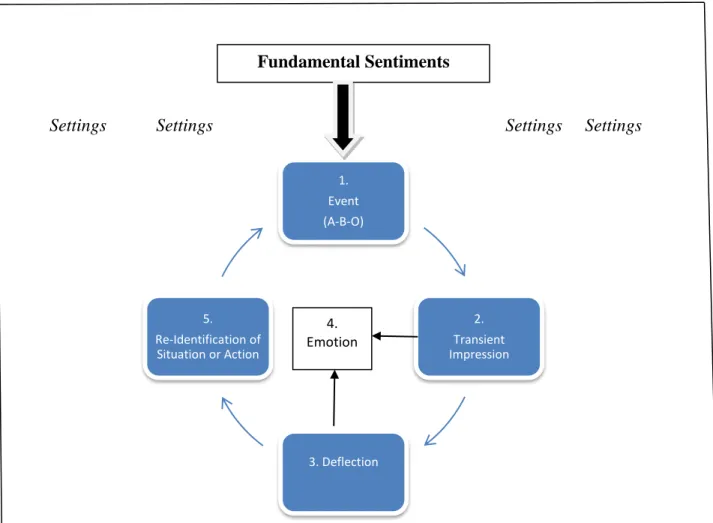
Robinson and Smith-Lovin 2006). Thus, a large deflection score indicates that there is disruption between established fundamental sentiments (established affective meanings) for the A-B-O and the transient impression (immediate affective meaning) of the A-B-O within the event, which signifies that the individual needs to redefine the event (see Figure 2).
Settings Settings Settings Settings
Figure 2: Affect Control Theory (adapted from Clark-Miller 2005) 1. Event (A-B-O) 2. Transient Impression 3. Deflection 5. Re-Identification of Situation or Action 4. Emotion Fundamental Sentiments
40
There are several ways in which the individual actor tries to reconcile the event when there is a large deflection. Individual actors define,
re-conceptualize, and/or re-label elements within the event in an attempt to align the transient impression closely to the fundamental sentiments (Luke 1997; Nelson 2006). Re-identification of events/situations allows the individual to maintain the continuity of the transient impressions to the fundamental sentiments, in order for the individual actor to comprehend the social interaction. It is the process of minimizing the deflection and confirming the situated identities (the role identities of the actor and object/person within the event) which directs social interaction.
Unexpected affect and behavior from the actor and/or object/person can produce a stigmatized identity. Identities which are negatively evaluated on the E (evaluation) dimension are labeled as deviant identities and are stigmatized identities or negative identities (Heise 2007). Stigmatized identities can cause large deflections during the interaction, particularly when the actor does not recognize the stigmatized identity and continues the interaction based on fundamental sentiments. Studies by Nelson (2008) and Kroska and Harkness (2007) indicate that once an individual has been labeled by society with a stigmatized identity it is often difficult for the society to remove the stigma. These studies also indicate that individuals who do not recognize their stigmatized identity also fail to self- identify with a negative identity (Nelson 2008; Kroska and Harkness 2007). Thus, incongruence between the fundamental sentiments