c
CONTEXTUAL TEXT MINING
BY
QIAOZHU MEI
DISSERTATION
Submitted in partial fulfillment of the requirements
for the degree of Doctor of Philosophy in Computer Science
in the Graduate College of the
University of Illinois at Urbana-Champaign, 2009
Urbana, Illinois
Doctoral Committee:
Associate Professor ChengXiang Zhai, Chair
Professor Jiawei Han
Professor Bruce R. Schatz
Abstract
With the dramatic growth of text information, there is an increasing need for powerful text mining systems that can automatically discover useful knowledge from text. Text is generally associated with all kinds of contextual information. Those contexts can be explicit, such as the time and the location where a blog article is written, and the author(s) of a biomedical publication, or implicit, such as the positive or negative sentiment that an author had when she wrote a product review; there may also be complex context such as the social network of the authors. Many applications require analysis of topic patterns over different contexts. For instance, analysis of search logs in the context of the user can reveal how we can improve the quality of a search engine by optimizing the search results according to particular users; analysis of customer reviews in the context of positive and negative sentiments can help the user summarize public opinions about a product; analysis of blogs or scientific publications in the context of a social network can facilitate discovery of more meaningful topical communities. Since context information significantly affects the choices of topics and language made by authors, in general, it is very important to incorporate it into analyzing and mining text data. In general, modeling the context in text, discovering contextual patterns of language units and topics from text, a general task which we refer to as Contextual Text Mining, has widespread applications in text mining.
In this thesis, we provide a novel and systematic study of contextual text mining, which is a new paradigm of text mining treating context information as the “first-class citizen.” We formally define the problem of contextual text mining and its basic tasks, and propose a general framework for contextual text mining based on generative modeling of text. This conceptual framework provides general guidance on text mining problems with context information and can be instantiated into many real tasks, including the general problem of contextual topic analysis. We formally present a functional framework for contextual topic analysis, with a general contextual topic model and its various versions, which can effectively solve the text mining problems in a lot of real world applications.
We further introduce general components of contextual topic analysis, by adding priors to contextual topic models to incorporate prior knowledge, regularizing contextual topic models with dependency structure of
context, and postprocessing contextual patterns to extract refined patterns. The refinements on the general contextual topic model naturally lead to a variety of probabilistic models which incorporate different types of context and various assumptions and constraints. These special versions of the contextual topic model are proved effective in a variety of real applications involving topics and explicit contexts, implicit contexts, and complex contexts.
We then introduce a postprocessing procedure for contextual patterns, by generating meaningful labels for multinomial context models. This method provides a general way to interpret text mining results for real users.
By applying contextual text mining in the “context” of other text information management tasks, in-cluding ad hoc text retrieval and web search, we further prove the effectiveness of contextual text mining techniques in a quantitative way with large scale datasets.
The framework of contextual text mining not only unifies many explorations of text analysis with context information, but also opens up many new possibilities for future research directions in text mining.
To Yanhua; to my parents.
Acknowledgments
First of all, I wish to express my deepest gratitude to my advisor, Dr. ChengXiang Zhai. Without Cheng’s continuous guidance and help throughout my PhD study, this thesis wouldn’t have been completed. Cheng showed me how to identify and formulate interesting research problems, how to develop elegant and practical solutions, and how to evaluate a technique with comprehensive experiments. Cheng is the one who has helped me grow from an infant into someone who can walk by himself in research. In the past five years, I have learned so much from Cheng - the great passion, the broad vision, the high standard, and the serious attitude in research. From the very beginning, he has been treating me as a peer and a friend, and I am deeply grateful to him not only for his constructive technical guidance, but also for his continuous encouragement and the freedom he has given me in my research. Working with him has been a great joy to me. Cheng’s guidance and personality has deeply influenced both my research philosophy and my career choice. I hope I will be a great advisor like him for my own students.
I wish to express my thanks to the other members of my committee, Dr. Ken Church, Dr. Jiawei Han, and Dr. Bruce Schatz for their critical suggestions about the thesis.
I have many reasons to thank Dr. Ken Church. I worked with Ken for two summers at Microsoft Research. Ken is much more than a mentor to me. His unique perspective and vision of research has brought me to a realm I’ve never been to. His special sense in large scale data mining and Shannon’s entropy has a large impact on my research. I am specifically thankful for his tremendous help on this thesis, especially on the problem of personalized search, and his continuous support on my study and career.
Dr. Jiawei Han has given me so many suggestions and support all through my study in UIUC. In his course I built up my data mining knowledge basis, and from the discussion and collaboration with him I learned how to explore in the mysterious frontier of data mining.
I am deeply grateful to Dr. Bruce R. Schatz. I worked as a research assistant of Bruce for two years in the BeeSpace project, through which I acquired the skills to make theoretical methods practical in real world applications. Bruce has given me a lot of encouragements and great advice. His vision in bridging state-of-the-art techniques with real applications has influenced me a lot.
I would like to express my thanks to my mentors at Yahoo! Research, Dr. Andrew Tomkins and Dr. Ravi Kumar, and my colleague Dr. Dengyong Zhou at Microsoft. With them I had many valuable discussions and from them I learned a lot of methodology and attitude of doing research. I’d like to give my special thanks to Dr. Yi Zhang, for her continuous encouragement and help during my study.
In all the past five years, I have received help from many collaborators, colleagues, and friends at UIUC. I would like to express my thanks to the members of the TIMan Group for the their valuable discussions and help: Tao Tao, Hui Fang, Xuehua Shen, Jing Jiang, Azadeh Shakery, Bin Tan, Xu Ling, Xuanhui Wang, Xin He, Younhee Ko, Yue Lu, Maryam Karimzadehgan, Alex Kotov, Duo Zhang, Yuanhua Lv, and V.G.Vinod Vydiswaran. I would also like to thank many of my fiends in the DAIS Group and the computer science department, especially Xifeng Yan, Dong Xin, Chao Liu, Deng Cai, Tianyi Wu, Tao Cheng, Zhijun Yin, Rui Li, Yunliang Jiang, and Bran Chee. We had many fruitful discussions and spent a joyful time together in UIUC which I will never forget.
I want to express my great thanks to Yahoo! Inc. and Roy J. Carver Charitable Trust for granting me the Yahoo! PhD Fellowship and the Roy J. Carver Fellowship to support my graduate study.
Finally, I would like to thank my dear wife Yanhua and my parents for their love and strong support for my study and career. Without their encouragement and help I couldn’t have reached this far. This thesis is dedicated to them.
Table of Contents
List of Tables . . . xi
List of Figures . . . xiii
Chapter 1 Introduction . . . 1
Chapter 2 A Review of Language Models in Text Mining . . . 8
2.1 Corpus Language Models . . . 8
2.2 Document Language Models . . . 9
2.3 Mixture Language Models . . . 10
2.4 Probabilistic Topic Models . . . 11
2.4.1 Probabilistic Latent Semantic Analysis . . . 11
2.4.2 Latent Dirichlet Allocation . . . 12
2.5 Topic Models with Context Information . . . 12
2.6 Summary . . . 13
Chapter 3 A Conceptual Framework of Contextual Text Mining . . . 15
3.1 A Generative View of Text Mining . . . 15
3.2 Context Dependent Generative Process . . . 16
3.3 A Formal Definition of Contextual Text Mining . . . 17
3.3.1 Definitions of Basic Concepts . . . 17
3.3.2 A Taxonomy of Context . . . 19
3.3.3 Tasks of Contextual Text Mining . . . 20
3.4 Basic Principles of Contextual Text Modeling . . . 21
3.5 The Framework . . . 23
3.5.1 The Contextual Language Model . . . 24
3.5.2 Regularization and Constraints . . . 25
3.5.3 Extraction of Contextual Patterns . . . 27
3.5.4 Postprocessing of Contextual Patterns . . . 29
3.6 Summary . . . 30
Chapter 4 Contextual Topic Analysis: A Functional Framework . . . 32
4.1 Overview . . . 32
4.2 Contextual Topic Analysis . . . 34
4.3 Contextual Topic Models . . . 36
4.3.1 The CPLSA Model . . . 37
4.3.2 Special Cases of CPLSA . . . 39
4.4 Adding Priors to the Contextual Topic Model . . . 41
4.5 Regularizing the Contextual Topic Model . . . 42
Chapter 5 Contextual Topic Analysis with Explicit Context . . . 44
5.1 Spatiotemporal Topic Analysis . . . 44
5.1.1 Overview . . . 44
5.1.2 The Problem . . . 46
5.1.3 Methods . . . 47
5.1.4 Experiments . . . 51
5.2 Temporal-Author-Topic Analysis . . . 59
5.3 Event Impact Analysis . . . 61
5.4 Related Work . . . 62
5.5 Summary . . . 65
Chapter 6 Contextual Topic Analysis with Implicit Context . . . 66
6.1 Overview . . . 66
6.2 Problem Formulation . . . 69
6.3 A Mixture Model for Theme and Sentiment Analysis . . . 70
6.3.1 The Generation Process . . . 70
6.3.2 The Topic-Sentiment Mixture Model . . . 72
6.3.3 Defining Model Priors . . . 74
6.3.4 Maximum A Posterior Estimation . . . 75
6.3.5 Utilizing the Model . . . 75
6.4 Sentiment Dynamics Analysis . . . 76
6.5 Experiments and Results . . . 78
6.5.1 Data Sets . . . 78
6.5.2 Sentiment Model Extraction . . . 79
6.5.3 Topic Model Extraction . . . 80
6.5.4 Topic Life Cycle and Sentiment Dynamics . . . 82
6.6 Related Work . . . 84
6.7 Summary . . . 85
Chapter 7 Contextual Topic Analysis with Complex Context . . . 87
7.1 Overview . . . 87
7.2 Problem Formulation . . . 90
7.3 Regularizing Topic Models with Network Structure . . . 91
7.3.1 Contextual Topic Models . . . 91
7.3.2 The Regularization Framework . . . 92
7.3.3 Parameter Estimation . . . 94
7.3.4 An Efficient Algorithm . . . 96
7.4 Applications of NetSTM . . . 97
7.4.1 Author-Topic Analysis and Community Discovery . . . 97
7.4.2 Spatial Topic Analysis . . . 98
7.5 Experiments . . . 99
7.5.1 DBLP Author-Topic Analysis . . . 99
7.5.2 Geographic Topic Analysis . . . 104
7.6 Related Work . . . 107
7.7 Summary . . . 108
Chapter 8 Postprocessing - Discovering Evolutionary Theme Patterns . . . 110
8.1 Overview . . . 110
8.2 Problem Definition . . . 113
8.3 Methods . . . 115
8.3.1 Evolutionary Theme Graphs . . . 115
8.3.2 Theme Life Cycles . . . 117
8.4.2 Experiments on Asia Tsunami . . . 120
8.4.3 Experiments on KDD Abstracts . . . 124
8.4.4 Parameter Tuning . . . 126
8.5 Related Work . . . 127
8.6 Summary . . . 128
Chapter 9 Postprocessing - Automatic Labeling of Topic Models . . . 130
9.1 Overview . . . 130
9.2 Problem Formulation . . . 133
9.3 Probabilistic Topic Labeling . . . 134
9.3.1 Candidate Label Generation . . . 135
9.3.2 Semantic Relevance Scoring . . . 135
9.3.3 High Coverage Labels . . . 139
9.3.4 Discriminative Labels . . . 140
9.4 Variations of Topic Labeling . . . 141
9.4.1 Labeling Document Clusters . . . 141
9.4.2 Context Sensitive Labeling . . . 142
9.5 Experiments and Results . . . 143
9.5.1 Experiment Setup . . . 143
9.5.2 Effectiveness of Topic Labeling . . . 144
9.5.3 Labeling Document Clusters . . . 148
9.5.4 Context-Sensitive Labeling . . . 149
9.6 Related Work . . . 150
9.7 Summary . . . 150
Chapter 10 Application: Contextual Text Mining in Ad Hoc Retrieval . . . 152
10.1 Overview . . . 153
10.2 Smoothing Language Models with Graph Structure . . . 155
10.2.1 Intuitions . . . 155
10.2.2 A General Framework . . . 157
10.2.3 Connection to NetPLSA . . . 159
10.2.4 The Smoothing Procedure . . . 159
10.3 Instantiations on Document and Term Graphs . . . 160
10.3.1 Smoothing with a Document Graph . . . 160
10.3.2 Smoothing with a Word Graph . . . 161
10.4 Discussion of the Framework . . . 162
10.4.1 Connection with Existing Models . . . 162
10.4.2 Selection of Graphs . . . 163
10.5 Experiments . . . 164
10.5.1 Experiment Setup . . . 164
10.5.2 Basic Results . . . 165
10.5.3 Tuning Parameters . . . 166
10.5.4 Comparison with Existing Methods . . . 167
10.5.5 Combination with Pseudo-feedback . . . 168
10.6 Related Work . . . 168
10.7 Summary . . . 169
Chapter 11 Application: Contextual Text Mining in Web Search . . . 171
11.1 Overview . . . 171
11.2 Entropy Estimation . . . 174
11.2.1 Notation . . . 174
11.2.2 Entropy (H) . . . 175
11.2.3 Cross Entropy . . . 176
11.3.1 How Large is the Web? . . . 177
11.3.2 How Hard is Search? . . . 178
11.3.3 How Much Does Personalization Help? . . . 178
11.3.4 How Hard are Query Suggestions? . . . 179
11.4 Personalization with Backoff . . . 180
11.4.1 User Modeling with Backoff . . . 180
11.4.2 Nested Classes Based on IP Addresses . . . 181
11.4.3 Connection to the CPLSA Model . . . 183
11.4.4 Evaluation of the Backoff Model . . . 184
11.5 The Potential of Other Context Variables . . . 185
11.6 Related Work . . . 190 11.7 Summary . . . 191 Chapter 12 Conclusions . . . 193 12.1 Summary . . . 193 12.2 Future Directions . . . 196 References . . . 199 Author’s Biography . . . 209
List of Tables
5.1 Selected topics extracted from Hurricane Katrina data set . . . 52
5.2 Selected topics extracted from Hurricane Rita data set . . . 52
5.3 Basic information of three data sets . . . 52
5.4 Selected topics from iPod Nano data set . . . 58
5.5 Possible Views in Author-Topic Analysis . . . 59
5.6 Comparison of the content of topic “Frequent Pattern Mining” over different views . . . 59
5.7 Comparison of topic content over different views in SIGIR collection . . . 62
6.1 Basic statistics of the OPIN data sets . . . 78
6.2 Basic statistics of the TEST data sets . . . 78
6.3 Sentiment models learnt from a mixture of topics are more general . . . 79
6.4 Example topic models with TSM: iPod . . . 81
6.5 Example topic models: Da Vinci Code . . . 81
6.6 Topic-sentiment summarization: Da Vinci Code . . . 82
6.7 Topic-sentiment summarization: iPod . . . 82
7.1 Topics extracted from 4-CONF with PLSA . . . 101
7.2 NetPLSA extracts cleaner topics . . . 101
7.3 Quantitative Comparison of PLSA, NetPLSA, and Normalized Cut in Community Finding . 102 7.4 The basic statistics of blog datasets . . . 105
7.5 Topic models: the Weather dataset . . . 106
8.1 News sources of Asia Tsunami data set . . . 119
8.2 Basic information of data sets . . . 120
8.3 Theme spans extracted from Asia Tsunami data . . . 120
8.4 Trans-collection themes extracted from CNN and Xinhua News . . . 121
8.5 Theme spans extracted from KDD Abstract Data . . . 124
8.6 Trans-collection themes extracted from KDD Abstract Data . . . 125
9.1 Variant possible labels for a topic model . . . 131
9.2 Sample candidate labels . . . 143
9.3 Sample topics and system-generated labels . . . 144
9.4 Systems Compared in Human Evaluation . . . 145
9.5 Effectiveness of topic labeling . . . 145
9.6 Ngrams vs. noun phrases as labels . . . 146
9.7 Uniform vs. background normailzation for 0-order relevance (5 labels) . . . 146
9.8 Labeling LDA topics: 1st-order relevance is most robust . . . 147
9.9 Comparison with human generated labels . . . 148
9.10 Labeling document clusters: K-Medoids . . . 148
9.11 Labeling database topics with different contexts . . . 149
10.2 Basic Results: Graph-based smoothing outperforms non-structural smoothing . . . 165
10.3 Performance (MAP) comparison with existing smoothing methods . . . 167
10.4 Performance (MAP) of combination of word graph and pseudo feedback . . . 168
11.1 The search space of the web is surprisingly small; 22 bits of entropy corresponds to a perplexity of millions, not billions. . . 177
List of Figures
1.1 Rich context information in Twitter. . . 2
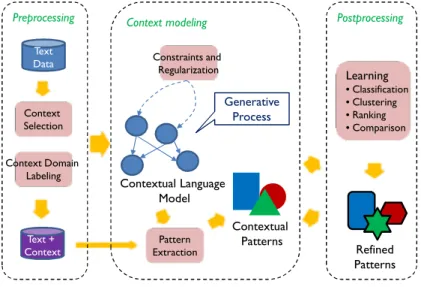
3.1 A Framework for Contextual Text Mining. . . 23
3.2 The generative process of the general mixture model (Equation 3.3). . . 26
3.3 The generative process with document-level constraint (Equation 3.5). . . 27
4.1 The topic-view-coverage structure in a text collection . . . 35
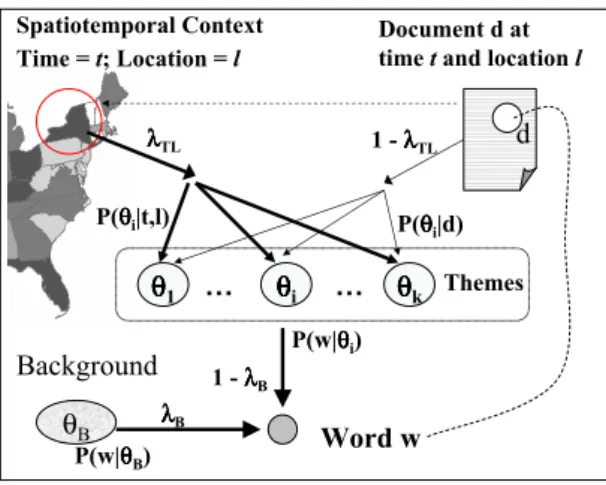
5.1 The generation process of a word in the spatiotemporal topic model . . . 48
5.2 EM updating formulas for the spatiotemporal topic model . . . 51
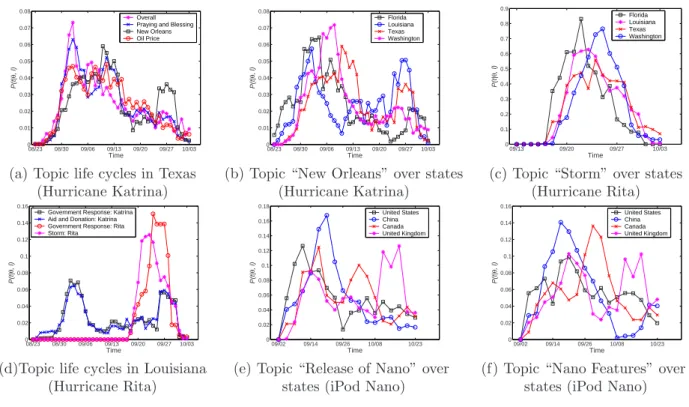
5.3 Topic life cycle patterns from three data sets . . . 55
5.4 Snapshots for topic “Government Response” over the first five weeks of Hurricane Katrina . . 56
5.5 Snapshots for topic “Oil Price” of the first two weeks of Hurricane Rita . . . 57
6.1 A possible application of topic-sentiment analysis . . . 68
6.2 The generation process of the topic-sentiment mixture model . . . 71
6.3 EM updating formulas for the topic-sentiment mixture model . . . 73
6.4 The Hidden Markov Model to extract topic life cycles and sentiment dynamics . . . 77
6.5 Sentiment model leant from diversified topics better fits unseen topics . . . 80
6.6 Topic life cycles and sentiment dynamics . . . 83
7.1 A sample network structure with text . . . 88
7.2 Coauthor network in DBLP dataset . . . 100
7.3 Topical Communities in 4-CONF dataset . . . 102
7.4 Topic Map of “information retrieval” in 4-CONF dataset . . . 104
7.5 Geographic Topic Distributions . . . 106
7.6 Geographic distribution of topics in Weather . . . 106
8.1 An example of theme thread structure . . . 111
8.2 An example of theme strength in IR . . . 112
8.3 An example of a theme evolution graph . . . 114
8.4 A 3-theme transition HMM structure . . . 118
8.5 Decoding the collection . . . 118
8.6 Theme evolution graph for Asia tsunami . . . 121
8.7 Theme life cycles in CNN data (W = 10) . . . 123
8.8 Theme life cycles in Xinhua News (W = 10) . . . 123
8.9 Theme evolution graph in KDD Abstract Data . . . 125
8.10 Life cycle patterns of normalized strength of trans-collection themes in KDD data . . . 126
9.1 Illustration of zero-order relevance . . . 136
9.2 Illustration of first order relevance . . . 137
10.1 Illustration of smoothing language models on a graph structure. Left figure: unsmoothed
model; Right figure: smoothed model . . . 156
10.2 The sensitivity of parameters (k,λ, and iteration) . . . 166
11.1 Entropy of logs grows much more slowly than its upperbound . . . 177
11.2 A little bit of personalization is better than too much or too little. Note that λ2 andλ3 are larger than the otherλ’s. Too much personalization (λ4) runs into sparse data, whereas too little (λ0 andλ1) misses the opportunity. The EM algorithm assigns more weight to classes of users that share a few bytes of their IP address than to classes that share more (100% personalization) or less (0% personalization). . . 183
11.3 In 4 of the 5 test subsets, our proposal, personalization with backoff (dashed lines), has better (lower) cross entropy, Hc(U RL|IP, Q), than two baselines: too much personalization (triangles) and too little personalization (solid lines with squares). . . 184
11.4 Day-of-week patterns could be used to segment the search market into businesses and con-sumers. Note that click volumes are out of phase with click entropies. . . 185
11.5 Weekends are harder (more entropy) than business days. Cross entropy peaks both when the weekend is used for training and/or testing. . . 186
11.6 Query volumes and entropies show a clear dependence on hour of day, at least for weekdays. . 187
11.7 Search is simpler at work hours and more difficult at television hours . . . 187
11.8 Cross validation of the predictive ability of hours in a day . . . 188
11.9 Business queries are issued on business days. . . 189
11.10Unlike business queries, consumer queries do not select for business days. . . 189
Chapter 1
Introduction
In the novel “Gulliver’s Travels,” when Gulliver was on his first voyage to the land Lilliput, he appeared as a giant who could easily dominate a battle; when he was on his second voyage to the land Brobdingnag, however, he appeared as small as a rat who could only be exhibited as a curiosity. If Don Quijote were born in the time of King Arthur, he might have made a real famous knight. However, at his own time when the era of chivalry was long gone, all his dreams turned into nothing but laughters of others. The conversion and mismatch of context account for the dramatic difference in their experiences.
The impact of context not only exists in fictional stories, but also in our everyday activities of reading and digesting text information. In our daily lives, we observe that today’s newspaper talks about totally different topics from one week ago. We find out that a Republican senator has opposite opinion to a Democratic senator on the same event. We read a report about “football” onBBC, and realize that it is all about soccer instead of American football. A researcher summarizes topics in literature, and tries to identify the topics that are getting hot overrecent years. A user types a query “moving service” in the search box, bypasses the top-ranked results, and selects a moving company on the second page which is in hercity. A computer scientist searches for “msr” and clicks on Microsoft research instead of Mountain Safety Research. A tourist reads restaurant reviews, and visits a restaurant withpositivecomments. A little boy tries to guess the meaning of an unknown word by looking at the wordsadjacent to that word. In all these scenarios, we rely much on the understanding ofcontext in the process of understanding a piece oftext.
Text data is associated with rich context information, which refers to the situations in which the text was originally produced. Some of the situations can be easily inferred from the metadata, such as the time at which an article was written, the source at which an article was published, the author, the audience, and the sentence preceding the current sentence. Some of the situations are implicit and thus require more effort to infer them from the data, such as the sentiment of the author when she was writing a review and the topics she wanted to elaborate in a research paper. Some contexts are global, where a whole document belongs to the same context; some contexts appear at a finer granularity, such as a sentence, a phrase, or a window of adjacent words. Various contexts can be dependent on each other and thus form a complex system, such as
a social network of authors.
There are different taxonomies of context from different disciplines. For example, the linguistic context, or the verbal context is commonly used in linguistics which refers to the local surrounding text of a linguistic unit that is useful for inferring the meaning of the linguistic unit [168]. Social context, on the other hand, is a key concept used in sociology which refers to the social variables that influence the use of language of a social identity (e.g., an author). A more general notion of context is known as the situational context, or context of situation, which is first proposed by the Polish anthropologist Bronislaw Malinowski and then formalized with linguistic theory by J. R. Firth [43, 44]. It is concerned with the evaluable conditions or situations in which the text content is produced, including the situations that are either environmental or personal.
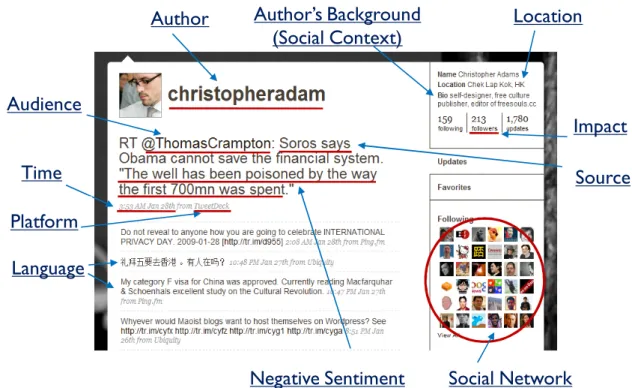
Author
Location
Time
Author’s Background
(Social Context)
Social Network
Platform
Negative Sentiment
Impact
Language
Source
Audience
Figure 1.1: Rich context information in Twitter.
Figure 1.1 is a random snapshot from social microblogging site Twitter1. It is interesting to see how
many types of context information exist in such a short piece of text. From the metadata, we can easily observe who wrote this article (authorship), where the author lived (location), what his occupation was (social context), when the article was written (time), from whichplatform the article was submitted, and in which language the article was written, etc. When reading through the text, we can further observe contexts that are implicit - the sentiment that the author implied in the article, thesource of a statement
in the article, and theimpact of the article (based on the followers and comments). We can even observe a complex system of contexts - asocial network including the author, his followers, and the users he follows. All such contextual information is valuable for analyzing the content of the Tweets (i.e., posts on Twitter), understanding why the author wrote about these topics, inferring the meaning of the text (e.g., the metaphor carried by the word “well”), and revealing other interesting topic patterns.
Understanding the effects of context is becoming even more important along with theinformation over-load [177] in recent years. Various types of text information, such as web pages, news articles, scientific literature, emails, blogs, and instant messages, are continuously produced everywhere. According to Ra-makrishnan and Tomkins [145], everyday there are 3-4 Gigabytes of published content, up to 2 Gigabytes of professional web content, 8-10 Gigabytes of user-generated content, and as large as 3 Terabytes of private text content produced. The scale of text information is no longer manageable by individuals. Instead, there is an urgent need for powerful text information management systems to combat the information overload, to facilitate the filtering, storage, and retrieval of relevant text information. There is a notably increasing need for going beyond finding text information - by discovering novel knowledge from the text data, also known as text mining. Now not only we ourselves should understand the importance of context, but also the text mining tools.
Indeed, in many real world applications of text mining, we can see that various context information can serve as an important guidance for understanding, analyzing, and mining the text data. For example, temporal patterns of book discussions in blogs (e.g., spikes of discussions) have shown to be useful to predict books sales [52]. Author-topic patterns can facilitate the finding of experts and the understanding of the research communities [162]. Analyzing contextual patterns in search logs can help a search engine company to better serve its customers by re-organizing the search results according to the contexts of a new query [108]. Analyzing the bursts and decays of topics in scientific literature would enable researchers to better organize, summarize, and digest the historical literature and to discover and envision new research trends [72]. Analyzing the sentiments in customer reviews is helpful in summarizing public opinions about products and social events [110].
Unfortunately, although researchers have long revealed that context of text is important, the exploration of context in text mining doesn’t reflect this importance. In most existing text information management systems, the importance of context is neglected. For example, search engines are by far the most useful tools to help users find and access text information. However, none of the major search engines returns a webpage about “information retrieval” on the first page when the query “IR” is sent by a researcher from the SIGIR conference. University of Michigan football is not among the top results when one searches for
“wolverine” from Ann Arbor, Michigan. The results of the query “Wii fit review” don’t distinguish positive reviews from negative reviews. If we know who the user is, where she is, and what task she is carrying on, we should be able to provide much better service for her by adapting the results to the context.
Among the particular types of context, linguistic context is utilized in natural language processing (NLP) to extend the feature space for supervised learning tasks such as tagging and parsing [30, 18], entity extraction [131], and semantic role labeling [48, 91]. It is also used directly to solve problems such as word sense disambiguation [136] and word clustering [92, 93], in a way that the meaning of language units are compared through the comparison of their local linguistic context. The exploration of the more general context, context of situation, is quite limited in existing text mining work. In this thesis, we focus on this more general notion of context, context of situation, in the “context” of text mining.
A common approach for text mining relies on generative models of text, the key idea of which is to construct a probabilistic model which explains how the observed text data is generated. Such a probabilistic model of text, also known as a language model, is then used to characterize the patterns (e.g., topics) in text or to facilitate tasks like retrieval [138, 182], classification, clustering, and summarization of text. In the traditional exploration of text mining, people assume that there is a unitary, homogenous language model for the collection of text data, thus the contextual variation is neglected. Early exploration of context in text mining dates back to the 60s, where Mosteller and Wallace used statistical methodology to solve one of the most famous questions in America’s history: the disputed authorship of the Federalist Papers [125]. The basic assumption was that text written by different authors have different characteristics (thereby each author makes a different context). Later on, the construction of the Brown Corpus [45] revealed important statistics showing that the content of text (e.g., the word rate) differs from document to document and from genre to genre. Motivated by this observation, [27] makes a visionary claim that a good model for a text collection should capture the mixture of the heterogeneous contextual factors. They concluded that a mixture Poisson distribution fits text data better than standard Poisson models. However, this early exploration halted at collection-level modeling of text data as a black box. They did not drill down to understand what the contexts are and how to model particular contexts. How to define and characterize the contexts in text, how to capture the effect of these contexts, and how to utilize context information to solve various tasks of text mining still remained mysterious.
A notable advancement of modeling the mixture of contexts is the recent exploration on probabilistic topic models (e.g., [61, 10]). The basic assumption is that text data usually covers a set of multiple topics, and can thus be modeled by a mixture of probabilistic models, each of which corresponds to a topic. On the other hand, one can characterize a topic based on the corresponding component model. This exploration
advanced beyond the Poisson mixture in a way that we can now characterize concrete topics in text, where each topic is an implicit context. However, the topic models lack the ability to model the much richer context information other than topics. We also don’t know how to integrate our prior understanding about contexts into a topic model and how the topics themselves are affected by various contexts.
Some recent work tries to integrate specific context information into topic models, such as authorship [162] and time [171]. These specific types of context information are integrated in an ad hoc way. The proposed models are difficult to be extended to handle other context information.
In general, the major barrier in utilizing context information in text mining is that there is no general way of defining context, modeling context, comparing content across contexts, and discovering contextual patterns from text. Without such a general framework, text mining tasks with context information involved have to be solved in a case-by-case manner.
In this thesis, we provide a formal study of modeling context information in text mining. We propose a general problem, contextual text mining, which is a new paradigm of text mining that treats context information as the “first class citizen.” We provide a general conceptual framework of contextual text mining, in which we formally define a context as an evaluable situation in which the text data is generated, define contextual patterns as a variety of conditional distributions of language units and contexts, and define the core tasks of contextual text mining as the construction of a contextualized language model of text and the extraction of contextual patterns. The modeling of context is then realized by constructing a mixture of contextualized language models of text. This conceptual framework is very general, which unifies many existing explorations of contextual text mining and many existing language models as special cases.
Based on this general conceptual framework, we introduce a functional framework of contextual text mining called contextual topic analysis, the main idea is to integrate context variables into a probabilistic topic model in order to construct a contextual topic model (i.e., the contextual probabilistic latent semantic analysis (CPLSA)), such that both the content variation of topics and the strength variation of topics across different contexts are captured by the conditional distributions of topics and contexts. This functional framework is instantiated from the conceptual framework, and still general enough to cover many different contexts and different special cases. On the other hand, the contextual topic model and its special versions are fully functional that can support a wide range of real applications.
In some scenarios, we have rich prior knowledge about what contexts are useful, and what the model of those contexts should look like. In other scenarios we don’t have any guidance on the contexts. In our framework, we propose a general component to integrate prior knowledge of contexts into the contextual topic models, so that if we have prior knowledge about a context, we can integrate such knowledge into the
model as a guidance; if we don’t have such prior knowledge, the model will fully listen to the data.
Distinct from existing work which considers different contexts as independent, in the proposed framework, we provide a general component to model the dependency among various contexts as a complex system. The modeling of context dependency is realized with a graph-based regularization component to the contextual probabilistic models, with which we can flexibly incorporate important constraints. To reveal the depen-dency of contexts, we also present a postprocessing method for contextual topic models by constructing an evolutionary theme graph.
A limitation of topic modeling, or language modeling of text in general is that the probabilistic models can not be easily understood by the real users. We present a postprocessing component of contextual text mining to interpret the characteristics of various contexts by the automatic generation of meaningful labels for the corresponding contextual models.
Both the conceptual framework of contextual text mining and the functional framework of contextual topic analysis are quite general and cover many specific models as special cases. Through the framework of contextual topic analysis, we can model heterogeneous contexts in a unified way. We can characterize each context with the contextualized topic component corresponding to this context and also extract various types of contextual patterns by comparing the conditional distributions involving topics and various contexts. By instantiating the contextual topic model, we can effectively model explicit contexts such as time, location, and authorship, implicit contexts such as sentiments, as well as complex contexts such as social networks. These instantiations naturally lead to the solution for a wide range of real applications of contextual text mining. In this thesis, we present how to use specific instantiations of the framework to solve real world text mining problems such as the detection of evolutionary theme patterns, the detection of spatiotemporal topic patterns, event-impact analysis, personalized search, faceted opinion summarization, the extraction of topical communities from scientific literature, and smoothing language models in information retrieval.
The thesis provides a novel and general perspective of utilizing context information in text mining. The proposed frameworks not only unify existing models with particular types of context in text mining, but also provide a way to design solutions for new contextual text mining tasks with other interesting context information involved. The functional framework of contextual topic analysis provides a general way to guide probabilistic models with prior knowledge of users, thus enables the interaction between the user and the text mining process. It also bridges the gap between probabilistic modeling of text and graph-based regularization, through which various constraints and objectives can be easily added into the text mining process. Furthermore, this thesis provides a novel method to generate meaningful labels to interpret topic models in the text mining results. We also introduce how to utilize the contextual patterns extracted in
contextual text mining to facilitate other text information management tasks including ad hoc retrieval and web search. The framework opens up many possibilities for developing principled approaches to mining text data with context information, by designing different instantiations of the general contextual probabilistic model, designing interesting priors for contexts, and designing regularization components with reflects various constraints and assumptions about the dependency of contexts.
The rest of this thesis is organized as follows. We begin with a brief review of existing language models in text mining in Chapter 2. In Chapter 3, we formally define the problem of contextual text mining, discuss the basic principles of contextual text modeling, and introduce a very general conceptual framework of contextual text mining. To bridge the general conceptual framework with real world applications, in Chapter 4, we propose a functional framework of contextual text mining called contextual topic analysis, a general contextual topic model called CPLSA, and some special versions of CPLSA under certain constraints. The conceptual framework of contextual text mining and the functional framework of contextual topic analysis serve as the theoretical guideline of any contextual text mining task. We then illustrate the power of the general framework and the CPLSA model with real world applications and different types of contexts. In Chapter 5, we show the performance of CPLSA and its special versions with explicit contexts besides topics. In Chapter 6, we illustrate the power of contextual topic analysis on implicit contexts (e.g., sentiments) besides topics, with a special version of CPLSA called Topic-Sentiment Mixture. We also elaborate the component of adding priors to contextual topic models in details. In Chapter 7, we further introduce how to instantiate the framework of contextual topic analysis to model complex context, such as social networks. We elaborate how to regularize a contextual topic model with a graph-based regularizer to incorporate the dependency structure of contexts.
After this, two ways of postprocessing the contextual patterns extracted in the mining process are in-troduced in Chapter 8 and Chapter 9. We then introduce two particular applications of contextual text mining to facilitate other text information management tasks - smoothing language models in text retrieval (Chapter 10) and providing personalization in web search (Chapter 11). These two applications not only illustrate the power of contextual text mining in a broader scope, but also provide quantitative evaluation of the effectiveness of the contextual text mining techniques with large scale data sets.
Chapter 2
A Review of Language Models in Text
Mining
Text mining is concerned with the discovery of novel knowledge from text data. A common approach to text mining is through the modeling of the generative process of text data, or the generative modeling of text. The basic idea is to construct a probabilistic model which explains how the language units in text are generated. Such a probabilistic model is also known as astatistic language model, or simply alanguage model. A typical text mining system first learns such a probabilistic model based on the observations of the text data, and then utilizes the probabilistic model learnt to accomplish particular tasks, such as text retrieval, text classification, text clustering, and text summarization. Alternative to generative models in text mining are discriminative models.
Different generative models of text differ in their assumptions about the generative process of text. In this thesis, we follow the line of work on generative modeling of text. Context information is incorporated into the generative process of text as dependent variables in the language models. We begin with a brief review of some commonly used language models in text mining.
2.1
Corpus Language Models
The simplest language model assumes that the text corpus is generated word by word from a unified dis-tribution of words. The two most common disdis-tributions used in literature are the Poisson disdis-tribution and multinomial distribution. Generally, let us usewto denote a word token in the text collection,Mto denote the language model, and c(w) to denote the number of occurrences of word w in a piece of text (e.g., a document), a Poisson language model [35, 110] scan be written as
P(c(w) =k|M) = e−λλk
k! , (2.1)
whereλis a model parameter andk! is the factorial of the number of occurrences of the wordw.
ap-pearance of a word instead of the number of occurrences. We have
P(c(w) =k)∝P(w|M)k, (2.2)
where the model parameters areP(w|M) (for every unique wordw), usually abbreviated asθ.
There are two important assumptions in a corpus language model in text mining. First, the generation of different words in a piece of text are independent with each other. This is also known as the “bag-of-words” assumption, where the structure of the piece of text is ignored. In the context of speech recognition and machine translation, this assumption is relaxed and corpus language models are represented by “ngram” models such that the generation of a word depends on the previous word(s) [15, 63]. In the text mining “context,” however, this simplification assumption is a commonly accepted even though it is too strong. Another assumption is that all the words in the corpus are generated based on the same model. We can see that this assumption brings in apparent limitations to text mining where different documents are not distinguished, not to mention the contexts.
2.2
Document Language Models
The need of text retrieval has triggered the emergence of document language models, a probabilistic model of text at document level. The basic idea is that there is a different language model for each document in the corpus, which explains the generation of words in that document. People usually assume that the document language models are the same type of distribution (e.g., multinomial distribution), but the model parameters vary in different documents. The earliest document language model used in information retrieval is introduced by Ponte and Croft [138], where each document is generated from a multi-variant Bernoulli distribution. The most commonly used distribution for a document language model is multinomial [176, 83, 183]. UsingDto denote the document collection,θd to denote a document language model, and c(w, d) to denote the number of occurrences of the wordwin document d, the likelihood of a document is given by
P(D|M)∝ Y
d∈D Y
w∈d
P(w|θd)c(w,d). (2.3)
Some recent work also introduced document language models based on Poisson distribution [109]. In this thesis, we follow the multinomial assumption and model the individual appearances of each word in text using the bag-of-word representation of documents.
the parameter estimation of language models is maximum likelihood. The basic idea is to find the set of parameters that maximize the likelihood of the data collection to be generated from the language model. A good review of document language models can be found in [35].
2.3
Mixture Language Models
The assumption that every word in a corpus/a document is generated from the same language model is apparently too strong. There are many factors that affect the generation of words, such as genres, authors, time, and topics. Indeed, in the early work of Mosteller and Wallace [125], they concluded that text written by different authors differs from each other. Later on, the construction of the Brown Corpus [45] revealed important statistics showing that the content of text (e.g., the word rate) differs from document to document and from genre to genre. Motivated by this observation, [27] makes a visionary claim that a good model for a text collection should capture the mixture of the heterogeneous contextual factors. They concludes that a mixture Poisson distribution fits text data better than standard Poisson models. A variety of mixture Poisson models are proposed, including Two-poisson [11, 147], Katz’s K-mixture [27], and negative binomial [125]. The basic idea of a mixture language model like these is that a word can be generated by flexibly selecting from one of the mixture component models, and thus leads to a new likelihood function:
P(x|M) =
Z
φ(θ)P(x|θ)dθ, (2.4)
wherexcan either be the appearance of wordw(as in multinomial) or the number of occurrences of the word
w,c(w) (as in Poisson). Every unitary distributionθis a mixture component in this mixture language model andφ(θ) is the distribution based on whichθis selected. SoR φ(θ) = 1. There is a flexibility in selecting the number of mixture components. In models like Two-Poisson, there is a finite number of component Poisson distributions, soφ(θ) is positive for a finite number of possibleθsand zero for all others (thus called a finite mixture model) [103]. In some other cases, there are infinite number of mixture components.
Mixture language models are widely applied in text retrieval. The variation of the Two-Poisson model leads to the popular BM25 (Okapi) retrieval function, one of the most robust and effective retrieval functions [147, 148]. In the context of language modeling based retrieval, a mixture of multinomial distributions is commonly used to construct a new query model with the query language model and the feedback model [181], or to integrate a document language model with a cluster language model [97]. Zhai and Lafferty uses a 2-mixture of multinomial distributions to filter the background noise from a pseudo-feedback model [181]. Using a mixture component of the background model to absorb the noise also appears in [184, 113, 111]. In
these models,φ(θ) are global variables in the collection, which are usually pre-specified instead of estimated. These mixture language models utilized the intuition that there are latent contexts in text. However, they did not drill down to understand what the contexts are, and how to model particular contexts.
2.4
Probabilistic Topic Models
Recently, there is a new family of generative models of text emerging in literature with the focus on the modeling of latent topics in text. These models are known asprobabilistic topic models, also calledstatistical topic models, or simplytopic models[61, 10, 184, 162, 111, 114, 90], which use a multinomial word distribution to represent a topic, and explain the generation of the text collection with a mixture of such topics. We can see that the topic models advance beyond the mixture language models such as the Poisson mixtures in a way that we can now characterize every particular mixture component as a topic (a latent context).
2.4.1
Probabilistic Latent Semantic Analysis
The earliest probabilistic topic model is known as probabilistic latent semantic analysis (PLSA) [59]. In the context of information retrieval, the model is also called probabilistic latent semantic indexing (PLSI) [60]. The basic assumption of a topic model is that there areklatent topics in the text collection, each of which is represented by a multinomial distribution of words. We use θj to denote the multinomial distribution for the j-th topic, over all w ∈ V. We introduce a new parameter p(θj|d) to denote the distribution of selecting a particular topic from the mixture model by a document. {p(θj|d)}j=1...kthus makes a multinomial distribution of topics given a particular document. Please note that this distribution is sensitive to individual documents. The log likelihood function ofDcan then be rewritten as
logp(D|M)∝X d∈D X w∈d log k X j=1 p(θj|d)p(w|θj), (2.5)
The parameters in Equation 2.4.1 are Ψ ={p(θj|d), p(w|θj)}w,j,d. By maximizing the log likelihood, we can estimate the parameters of PLSA. Please note that there is no closed form solution for the parameters, the estimation of which is usually done through the Expectation-Maximization algorithm [36]. Please note that the distribution of topics are now estimated from the data instead of pre-specified.
One simply extension to PLSA is to mix the topics with a global background B. This will give us a modified PLSA model as
logp(D|M)∝X d∈D X w∈d log[(1−λB)· k X j=1 p(θj|d)p(w|θj) +λBp(w|B)], (2.6)
The advantage of this model is that the common words in English, such as stop words and syntactic words, will be explained by the background contextB. Therefore, the words with highp(w|θj) in each topic model will be meaningful content words through which we can interpret the semantics of the topic. This modified PLSA model has been proven to perform well in text mining tasks like [184] and [113].
2.4.2
Latent Dirichlet Allocation
PLSA is widely used in the context of text mining and information retrieval [59, 184, 113]. One criticism of PLSA is that it still has quite a lot of free parameters, so the model is likely to be overfit the data. An approach proposed to solve this is to introduce an additional regularization to the mixture coefficients, so that each multinomial vector~ad is sampled from the same Dirichlet distribution.
The new likelihood function of the collection can thus be written as:
logp(D|M)∝X d∈D Z ~ad p(~ad|α)[ X w∈V log k X j=1 adj·p(w|θj)]d~ad. (2.7)
Such a model is known as the latent Dirichlet allocation (LDA) in the machine learning literature [10]. Please note that because of the integral, the parameter estimation for LDA cannot be handled by a standard EM algorithm. A more complicated estimation method is needed, such as variational inference [10], Gibbs sampling [51], or expectation propagation [121].
There are many other topic models, either extending PLSA or extending LDA. A good review of proba-bilistic topic models can be found in [161].
2.5
Topic Models with Context Information
Note that both PLSA and LDA just deal with topics, which are one type of the implicit contexts. The topic models still lack the ability to model the much richer context information other than topics. We still don’t know how to integrate situational contexts into a topic model and how the topics themselves are affected by various contexts. Some recent work tries to integrate specific context information into topic models in a case-by-case manner. There are basically two approaches to handle context information in topic models.
One of them is to model context as additional observations in the text, and the other integrates context as dependent variables into the topic model.
One approach of handling context information in text is to treat the context information simply as additional observations besides the words. In this way, one can construct a probabilistic model that not only generates the content (i.e., words) in text, but also the context information.
For example, Li et al. proposed a probabilistic model to detect retrospective news events by explaining the generation of “four Ws1” from each news article [91]. Wang et al. proposed a model called “Topic
over Time,” which generates the time stamps of the time stamps of each document using a mixture of beta distributions [171]. [169] presented a similar model that models the generation of geographic locations. In these approaches, the generation of contexts are conditionally independent with the generation of contents. Therefore, it is difficult to infer the influence of context on content. Different context information are also modeled in a case-by-case manner. A model for one type of context is not extendable to handle other types of context.
An alternative approach is to explicitly integrate context variables into topic models, so that the gener-ative process of topics are now dependent on the context. This is a more natural approach since it explains the influence of context on the generation of content. Among the few examples, the Author-Topic model is proposed in [162], which extends LDA to model the association between authors and topics. [159] extends this work to model the senders and receivers in a collection of emails. Wang et al. [172] added time variable to PLSA so that the model could discover correlated bursty topic patterns. Although this work better cap-tures the influence of different types of context on the content of text, the techniques are tuned for specific contexts and specific tasks and thus cannot be directly applied to deal with other types of context.
2.6
Summary
Statistic language models has been widely used in text mining (e.g., [125, 138, 59, 183, 105, 10, 115]). Early language models assume that all the words in the text collection are generated from the same probabilistic model. Later on, people realized that the generative process of text depends on a lot of hidden factors (i.e., contexts). Mixture language models and probabilistic topic models are proposed to capture these hidden factors in a primitive way.
There is some exploration on incorporating context information into topic models. Some treats context information as additional observations generated by the topic model, and some integrates context variables into the generative process. However, we can see that all these models are trying to integrate specific types
of context information in an ad hoc way. The proposed models are difficult to be extended to handle other context information. To deal with a new context, one needs to design a new topic model from the scratch.
The discussion in this thesis advances beyond all the previous work, by modeling different types of context in a general way. The framework we propose not only unifies many existing models with context, but also provides a way to design solutions for text mining tasks with new types of context information.
Chapter 3
A Conceptual Framework of
Contextual Text Mining
In this chapter, we formally define the problem of contextual text mining, including a formal definition of related concepts, a taxonomy of contexts, and a discussion of basic principles of contextual text modeling, followed by a general conceptual framework of contextual text mining. This general framework serves as a guideline for all the instantiations of contextual text mining.
3.1
A Generative View of Text Mining
In many text mining and machine learning problems, a generative view of text mining is taken. In other words, we make a basic assumption that the observed text data is generated from an underlining probabilistic model, which is either known or uncertain [27, 61, 10]. Such a model could either be as simple as a standard distribution of words, such as a unigram language model [138, 183], or as complicated as a multi-component mixture model which follows a complex dependency structure [27, 10].
In general, such a generative model consists of a set of basic events, which usually corresponds to the observations of language units such as words occurring in the text, and a probabilistic distribution that explains how such observations are sampled from a stochastic process. To the best, such a generative process would be consistent with the process that the text data was originally produced (e.g., the process that an article is written by its author).
A primary task of text mining is then to induct such a generative model based on the observed text data. Usually, we assume that we already know the structure of such a model (e.g., a multinomial distribution, or a hidden Markov model), but do not know the parameters of the model. The induction of the model is then equivalent to estimating the parameters of the model. A common approach is to cast the model induction as an optimization problem, in which the values of the parameters are found to maximize the likelihood that the observed data is generated from the model. This approach is calledmaximized likelihood estimation (MLE). In Chapter 2, we have introduced a variety of generative models of text in literature. In this thesis work, we take the view of generative models as our general methodology for text mining.
3.2
Context Dependent Generative Process
The choice of generative models of text usually corresponds to the understanding that how a textual docu-ment is produced, in other words, how the author selects one word versus another. Consider a practice that we want to guess the next word that an author would write. If the author writes with a language that we know nothing but the vocabulary, without any prior knowledge, the best we can do is uniformly select one word from the vocabulary. In other words, we could only assume that all the words in the text document are generated from a uniform distribution. It takes as much as log|V|bits to guess the next word, where
|V|is the size of the vocabulary. If it is a language that we don’t even know the vocabulary, it is impossible to guess the next word, or it takes infinite bits to guess the next word [25].
Once we know some prior information about the document, however, we can do a much better job by incorporating stronger assumptions. If we know the author writes the article in English, it is much less difficult to guess the next word, because we know that some English words appear much more frequently than other English words. According to Shannon’s claim, it takes as few as 1.3 bits to guess the next character [154]. This is because we know one context of the language - English, so we have much more to say about the selection of words, or formally, the generative process of text. The selection of words may also depend on the author’s personal vocabulary/preferences. A physicist and a poet may use very different words to describe the same object, for example, the moon.
Similarly, the content that an author writes is also related to when he is writing this article, what location he is at, what words he has already written, what goal he is writing for, what topic he is writing about, what mood he has, and so on. In other words, our understanding of the model of the text is now much deeper - the content of a document highly depends on all kinds of situations in which the author was written this document. This is to say, we assume that the generation of text data highly depends on the context in which the text was written. An article written in the 18th century may have nothing about computer; the word “soccer” may not appear in a report about a soccer match in Europe. We can see that the notion of context here covers both linguistic context, such as the other words in the same sentence, and situational context, such as time, location, and sentiment.
Context affects the generation of text content. It is thus desirable to represent the corresponding as-sumption in the generative model of text once we have such context information. A better generative model should take into consideration of the dependency between the generative process of text and the context information. In other words, a good generative model should represent the structure that each text unit is generated based on the context that the unit belongs to. How to incorporate various context information
3.3
A Formal Definition of Contextual Text Mining
In this section, we give a more formal discussion of context modeling in text data, by formally define the important concepts.
3.3.1
Definitions of Basic Concepts
Let us introduce a few important notations and definitions that will be frequently referred to in the rest of this thesis. We start with the definition of a few core concept of contextual text mining.
We first introduce D as a notation for the collection of text data. Since the content of text data is commonly formatted with natural language, we first define the language units in text.
Definition 3.1 (Language Unit): We use w to denote a basic language unit in text. Such a language unit could be a word, a concept, a phrase, a ngram, an entity, or any other units that carries semantic meaning. We refer to the smallest language units that carries semantic meaning as basic units. The most common basic units in text are words (orterms in the context of information retrieval). So we usewto denote a word, or a textual term in the rest of this thesis unless specified. We define a vocabulary,
V, as a set of allwin D.
Please note that in some scenarios, there are symbolic tokens that are not in natural language, but also carry semantic meanings, such as the label of a product, the symbol of a gene in biology literature, and the URL of a web page in query logs, etc. In these cases, we relax the definition of language units so that they also cover those symbolic tokens with semantic meanings. We then define a document in the text collection. Definition 3.2 (Document): A text document, d, in a text collection D is a sequence of words
w1w2...w|d|, where wi is a word from a fixed vocabulary V . Following a common simplification in most work in text mining [61, 10], we can represent a document with a bag of words, i.e., d={w1, w2, ..., w|d|}.
We usec(w, d) to denote the occurrences of word wind.
Definition 3.3 (Context Feature): Acontext featureof text, or acontext variable,X, is an attribute of the text the values of which could define a partition of the text collection D. Such an attribute could either be intrinsic to the content, such as the appearance of a term, or a topic; it could also be an extrinsic feature of text, such as time, location, and authorship. Please note that the value of X could either be discrete, such asXAuthor = “JimGray00, or continuous, such as “Xyear <2006.” We use uppercaseX to denote the variable of a context feature, and lowercasexto denote the value of the feature.
Definition 3.4 (Context): A context of text, c is a meaningful condition of text data that reflects the situation at which the text is produced. Formally, a contextccorresponds to a condition defined by the value of a set of context features, i.e., {X1 =x1, X2 =x2, ..., XN =xN}. We use C to denote the set of
all meaningful contexts. Following this definition, each context defines a subspace of the text collectionD, which consists of all language units that satisfy this condition.
We further define this set of language unites,Dc, as thedomainof a contextc. We require thatDc6=φ. We say thatc1andc2overlap with each other, ifDc1∩ Dc2 6=φ. From the definition of context, we can
also see that the smallest context covers a single language unitw, and the largest context coversDitself. A documentdalso corresponds to a special type of context. In a particular problem of contextual text mining, we only select the meaningful contexts that we are interested in. It is also worth noticing that the various values of a particular context feature can define a set of contexts (e.g., the time context).
Please note that the aforementioned definitions are general enough to capture different approaches to contextual text mining. When a generative view of text mining is taken, we also need a few key definitions related to generative models of text.
Let us first introduce agenerative modelMforD, which is a probability distribution of the observation of language units inD. Mcorresponds to the random process that how the language units inDare generated. When we assume that the basic language unitsware generated independently,Mcan be characterized with the distribution{p(w|M)}w∈V. The likelihood of generating Dwith the probabilistic model Mis written as p(D|M). Mis usually used as a representation of D. M is also called alanguage model. When M
models context information as well as content, we call it acontextual language model. Similarly, we introduce the following definitions related to contextual language models:
Definition 3.5 (Context Model): For a contextc, a context modelMcis a probabilistic model which explains the generative process of language units inDc. Similarly,Mc is usually used as a representation of the contextc, and can be characterized with{p(w|Mc)}w∈V.
Definition 3.6 (Topic/Theme): A topic or a theme, T, is a semantically coherent subject of a discourse in a text collection. In this thesis, we formally define a topic as a latent context in D. We use
T to denote the context feature for topics. If a language unit satisfies the condition T =t, we say that it belongs to the latent context of topict. The context model which represents a topic is called atopic model, denoted asθt, which is characterized by a probabilistic distribution of words{p(w|θt)}w∈V. Clearly, we have
P
w∈V p(w|θt) = 1. We assume that there are all togetherktopics inD.
Definition 3.7 (Contextual Pattern): A contextual pattern in text is defined as a pattern that could be derived based on conditional distributions involving language units and various contexts. In par-ticular, the conditional distributions include the context model p(w|c), the distribution of context given a language unit, p(c|w), and the distribution of one type of context given another type of context, p(c0|c).
We refer to the interesting conditional distributions asbasic contextual patterns, and patterns derived from postprocessing the basic contextual patterns asrefined contextual patterns.
We can see that this definition of contextual pattern covers a wide range of mining products of contextual text mining tasks as instantiations. For example, topic modeling [59, 10] aims at the discovery of conditional distributions of words given topics as a representation of the topics in text; temporal text mining attempts to extract topic life cycles [113], which can be represented by, or can be extracted by refining the conditional distributions of topics given time context and of time given topics; author-topic analysis targets at discovering conditional distributions of topics given a particular author and conditional distributions of words given different authors and topics [162, 114]. We will discuss specific instantiations of contextual patterns in Chapter 4 and in the concrete contextual text mining applications later in this thesis.
When contexts do not overlap, it is clear that all the words in the domain of c are generated based on
Mc. However, when w is in the domain of multiple contexts, it may be generated based on any of those contexts. We define c to be the active context for w, if w is generated using Mc. Clearly, the context distributionp(c|w) defines how likelyc is the active context of w. We define all the language units which are actually generated byMc as theactive domain ofc.
We can also define other useful concepts for contextual text mining. We leave other definitions to specific chapters in the rest of this thesis.
3.3.2
A Taxonomy of Context
The definition of context is quite broad. We can see that the definition unifies many different notions of context, including both the linguistic context and the situational context, as long as it corresponds to an evaluable condition and defines a subspace of the text. Following the definitions, we can give a more in-depth discussion about different ways to categorize contexts.
Explicit Context and Implicit Context
We can divide contexts into explicit context and implicit context. Recall that every context corresponds to a condition with particular values of context variables. Every language unit which satisfies this condition belongs to the domain of this context. In most cases, whether a language unit satisfies the condition is deterministic. For example, whether a document is produced at some time, published at some location, or written by some author are deterministic. The context corresponding to such a condition is called anexplicit context, such as time, location, and authorship. Some conditions, however, are not deterministic for some language units. For example, whether a word is about a topic, carries a sentiment, or has a high impact