Air Force Institute of Technology Air Force Institute of Technology
AFIT Scholar
AFIT Scholar
Theses and Dissertations Student Graduate Works
6-2008
Analyzing Individual Decision Making Versus Group Decision
Analyzing Individual Decision Making Versus Group Decision
Making for Alternative Selection
Making for Alternative Selection
Alper Gezeravci
Follow this and additional works at: https://scholar.afit.edu/etd
Part of the Operational Research Commons
Recommended Citation Recommended Citation
Gezeravci, Alper, "Analyzing Individual Decision Making Versus Group Decision Making for Alternative Selection" (2008). Theses and Dissertations. 2808.
https://scholar.afit.edu/etd/2808
ANALYZING INDIVIDUAL DECISION MAKING VERSUS GROUP DECISION MAKING FOR ALTERNATIVE SELECTION
THESIS
Alper GEZERAVCI, 1st Lieutenant, TUAF
AFIT/GOR/ENS/08-05
DEPARTMENT OF THE AIR FORCE AIR UNIVERSITY
AIR FORCE INSTITUTE OF TECHNOLOGY
Wright-Patterson Air Force Base, Ohio
The views expressed in this document are those of the author(s) and do not re-flect the official policy or position of the United States Air Force, Department of Defense, United States Government, the corresponding agencies of any other govern-ment, NATO, or any other defense organization.
AFIT/GOR/ENS/08-05
ANALYZING INDIVIDUAL DECISION MAKING VERSUS
GROUP DECISION MAKING FOR ALTERNATIVE
SELECTION
THESIS
Presented to the Faculty Department of Operational Sciences
Graduate School of Engineering and Management Air Force Institute of Technology
Air University
Air Education and Training Command In Partial Fulfillment of the Requirements for the Degree of Master of Science in Operations Research
Alper GEZERAVCI, B.S.E.E. 1st Lieutenant, TUAF
June 2008
AFIT/GOR/ENS/08-05
ANALYZING INDIVIDUAL DECISION MAKING VERSUS GROUP DECISION MAKING FOR ALTERNATIVE
SELECTION
Alper GEZERAVCI, B.S.E.E. 1st Lieutenant, TUAF
Approved:
________//SIGNED//________________________ 6 June 2008__
Maj Shane A. Knighton, PhD (Chairman) Date
________//SIGNED//________________________ 6 June 2010__
AFIT/GOR/ENS/08-05
Abstract
Many ”real world” decisions are made by groups. It is rare that the responsi-bility for a very important decision is given to a single decision maker with complete authority. Group decision making adds both advantages to the process as well as disadvantages. This research examines the question: ”Are decisions made by groups really that much different from the decisions made by individuals in the group?”
A specific case study involving the selection of the best primary training aircraft type for military pilot training is used to examine this question. Fifteen military pilots with various backgrounds and experience levels participate as decision makers in the study. The decision analysis method of Value Focused Thinking is used to facilitate both individual and group decision making sessions. Value hierarchies are created for all sessions, and a set of alternatives is generated and scored. Kendall’s Coefficient of Concordance is used to determine the level of agreement between decisions made by the group and individual decision makers.
Acknowledgements
I would like to thank to my father, my mother, and my brother for their endless and deepest love, support and understanding during these two years when we missed each other so much. You are the source of my inspiration for any success.
I would like to thank the members of my committee for their guidance and my sponsor family for their editing in this thesis effort. I want to give a special thank you to my closest friend and companion for your support from the beginning to the very end.
I would like to express my gratitude to my nation and The Turkish Air Force who have given me the chance and honor to complete my Master’s of Science degree at The United States Air Force Institute of Technology.
Table of Contents
Page Abstract . . . iv Acknowledgements . . . vi List of Figures . . . ix List of Tables . . . xiList of Abbreviations . . . xiv
I. Introduction . . . 1
1.1 Background . . . 1
1.2 Problem Statement . . . 2
1.3 Research Focus & Methodology . . . 4
II. Literature Review . . . 7
2.1 Overview . . . 7
2.2 Group Decision Making . . . 7
2.3 Advantages and Disadvantages of Group Decision Making 11 2.4 Individual Versus Group Decision Making . . . 14
2.5 Case Study : Best Primary Training Aircraft . . . 17
2.6 Decision Analysis . . . 21
2.7 Value Focused Thinking . . . 25
III. Methodology . . . 31
3.1 Overview . . . 31
3.2 Problem Identification . . . 32
3.3 Step-2: Create the Value Hierarchy . . . 33
3.4 Step-3: Develop Evaluation Measures . . . 41
3.5 Step-4: Create Value Functions . . . 44
3.6 Step-5: Weight the Value Hierarchy . . . 49
3.7 Step-6: Alternative Generation . . . 51
3.8 Step-7: Alternative Scoring . . . 52
Page
IV. Results and Analysis . . . 56
4.1 Overview . . . 56
4.2 Step 8: Deterministic Analysis . . . 56
4.2.1 Nonparametric Statistical Methods . . . 60
4.2.2 Additional Analysis . . . 71
4.2.3 Conclusions for the Deterministic Analysis . . . 78
4.3 Step 9: Sensitivity Analysis . . . 83
V. Conclusions . . . 85
5.1 Research . . . 85
5.2 Contributions . . . 86
5.3 Recommendations for Future Work . . . 88
5.4 Summary . . . 89
Appendix A. Figures & Tables . . . 90
Appendix B. Aircraft Systems Terminology . . . 135
Appendix C. The Decision Makers’ Criteria . . . 137
Appendix D. Sensitivity Analysis . . . 162
D.1 Step 9: Sensitivity Analysis . . . 162
List of Figures
Figure Page
2.1. Value Focused Thinking Process . . . 29
3.1. DM-3 Value Hierarcy . . . 37
3.2. SDVF for Throttle Star Value . . . 47
4.1. Group Rankings based on Top Value (Best Primary Training Aircraft) . . . 84
A.1. Group Value Hierarchy . . . 116
A.2. DM-1 Value Hierarcy . . . 117
A.3. DM-2 Value Hierarcy . . . 118
A.4. DM-4 Value Hierarcy . . . 119
A.5. DM-5 Value Hierarcy . . . 120
A.6. DM-6 Value Hierarcy . . . 121
A.7. DM-7 Value Hierarcy . . . 122
A.8. DM-8 Value Hierarcy . . . 123
A.9. DM-9 Value Hierarcy . . . 124
A.10. DM-10 Value Hierarcy . . . 125
A.11. DM-11 Value Hierarcy . . . 126
A.12. DM-12 Value Hierarcy . . . 127
A.13. DM-13 Value Hierarcy . . . 128
A.14. DM-14 Value Hierarcy . . . 129
A.15. DM-15 Value Hierarcy . . . 130
A.16. DM-3 SDVF for Avionics Scale . . . 131
A.17. DM-3 SDVF for Avionics Scale . . . 131
A.18. DM-3 SDVF for Endurance in Minutes . . . 132
A.19. DM-3 SDVF for MTBF in Hours . . . 132
Figure Page
A.21. DM-3 SDVF for TBO in Hours . . . 133
A.22. DM-3 SDVF for Total Number of Safety Incidents (Class A & B & C) . . . 134
A.23. DM-3 SDVF for Degree of Stability Incidents (Class A & B & C) 134 1. Global Sensitivity of Flying Quality for the Group . . . 164
2. Global Sensitivity of Training Quality for the Group . . . 165
3. Global Sensitivity of Design for the Group . . . 165
4. Global Sensitivity of Performance for the Group . . . 166
5. Global Sensitivity of Safety for the Group . . . 167
6. Global Sensitivity of Maintainability for the Group . . . 168
7. Global Sensitivity of Supporting Systems for the Group . . . . 169
8. Global Sensitivity of Cost for the Group . . . 169
List of Tables
Table Page
3.1. Entire List of Values . . . 36
3.2. Subtier Values-Evaluation Measures List . . . 43
3.3. Design-Evaluation Measures & Scores List . . . 45
3.4. T-6A Texan II Values-Measures-Scales List . . . 53
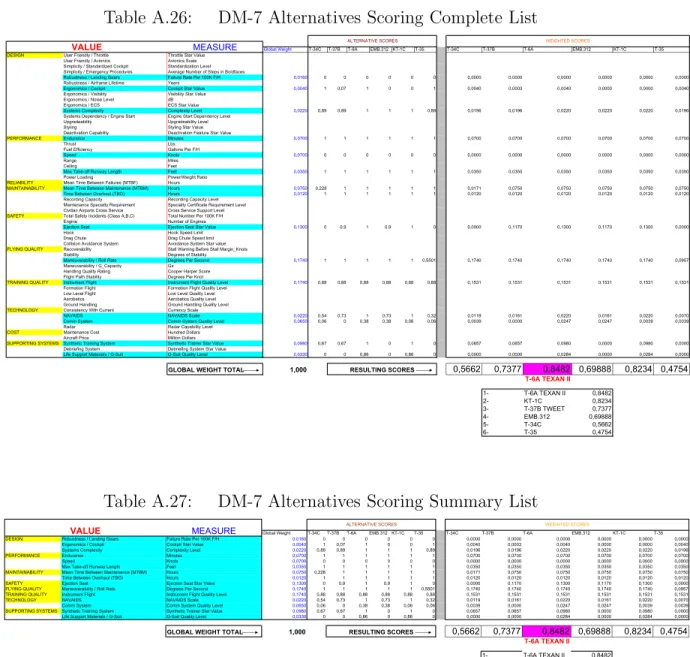
3.5. DM-3 Alternatives Scoring Complete List . . . 54
3.6. DM-3 Alternatives Scoring Summary List . . . 54
4.1. Group Alternatives Scoring Complete List . . . 57
4.2. Group Alternatives Scoring Summary List . . . 58
4.3. Group & Individual DMs Alternative Scores . . . 59
4.4. Group & Individual DMs Alternative Ranks . . . 60
4.5. Testing the Significance of Kendall’s Coefficient of Concordance with the Table of Critical Values for S - Results . . . 71
4.6. Testing the Significance of Kendall’s Coefficient of Concordance with the Chi-Square Approximation Test of the Sampling Distri-bution - Results . . . 71
4.7. Group Ranking . . . 72
4.8. All DMs’ Resulting Ranking . . . 72
4.9. Group versus All DMs Ranking - Rearranged . . . 73
4.10. Group versus USAF DMs Ranking . . . 76
4.11. Group versus USN & USMC DMs Ranking . . . 76
4.12. Group versus TUAF DMs Ranking . . . 76
4.13. Group versus Instructor DMs Ranking . . . 76
4.14. Group versus Non-Instructor DMs Ranking . . . 76
4.15. Kendall’s Tau Test of Significance Results . . . 77
Table Page A.3. Reliability & Maintainability-Evaluation Measures & Scores List 91
A.4. Safety-Evaluation Measures & Scores List . . . 91
A.5. Flying Quality-Evaluation Measures & Scores List . . . 92
A.6. Training Quality-Evaluation Measures & Scores List . . . 92
A.7. Technology Quality-Evaluation Measures & Scores List . . . . 93
A.8. Cost-Evaluation Measures & Scores List . . . 93
A.9. Supporting Systems-Evaluation Measures & Scores List . . . . 93
A.10. Data Source for T-34C, T-37B, T-6A (Pg-1/3) . . . 94
A.11. Data Source for T-34C, T-37B, T-6A (Pg-2/3) . . . 95
A.12. Data Source for T-34C, T-37B, T-6A (Pg-3/3) . . . 96
A.13. Data Source for EMB.312, KT-1C, T-35 (Pg-1/3) . . . 97
A.14. Data Source for EMB.312, KT-1C, T-35 (Pg-2/3) . . . 98
A.15. Data Source for EMB.312, KT-1C, T-35 (Pg-3/3) . . . 99
A.16. DM-1 Alternatives Scoring Complete List . . . 100
A.17. DM-1 Alternatives Scoring Summary List . . . 100
A.18. DM-2 Alternatives Scoring Complete List . . . 101
A.19. DM-2 Alternatives Scoring Summary List . . . 101
A.20. DM-4 Alternatives Scoring Complete List . . . 102
A.21. DM-4 Alternatives Scoring Summary List . . . 102
A.22. DM-5 Alternatives Scoring Complete List . . . 103
A.23. DM-5 Alternatives Scoring Summary List . . . 103
A.24. DM-6 Alternatives Scoring Complete List . . . 104
A.25. DM-6 Alternatives Scoring Summary List . . . 104
A.26. DM-7 Alternatives Scoring Complete List . . . 105
A.27. DM-7 Alternatives Scoring Summary List . . . 105
A.28. DM-8 Alternatives Scoring Complete List . . . 106
A.29. DM-8 Alternatives Scoring Summary List . . . 106
Table Page
A.31. DM-9 Alternatives Scoring Summary List . . . 107
A.32. DM-10 Alternatives Scoring Complete List . . . 108
A.33. DM-10 Alternatives Scoring Summary List . . . 108
A.34. DM-11 Alternatives Scoring Complete List . . . 109
A.35. DM-11 Alternatives Scoring Summary List . . . 109
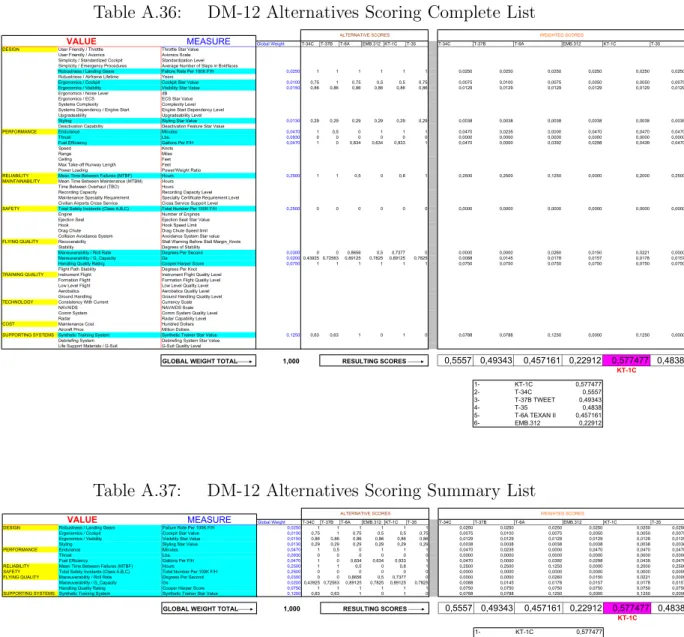
A.36. DM-12 Alternatives Scoring Complete List . . . 110
A.37. DM-12 Alternatives Scoring Summary List . . . 110
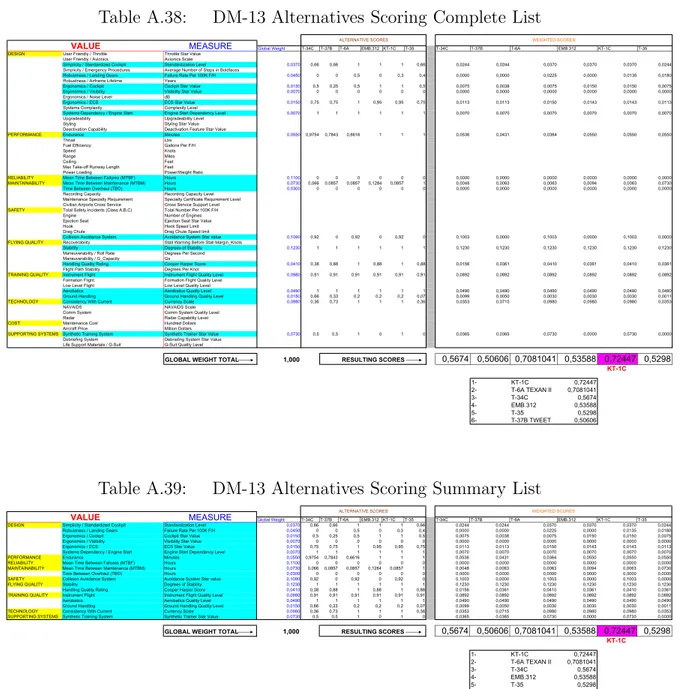
A.38. DM-13 Alternatives Scoring Complete List . . . 111
A.39. DM-13 Alternatives Scoring Summary List . . . 111
A.40. DM-14 Alternatives Scoring Complete List . . . 112
A.41. DM-14 Alternatives Scoring Summary List . . . 112
A.42. DM-15 Alternatives Scoring Complete List . . . 113
A.43. DM-15 Alternatives Scoring Summary List . . . 113
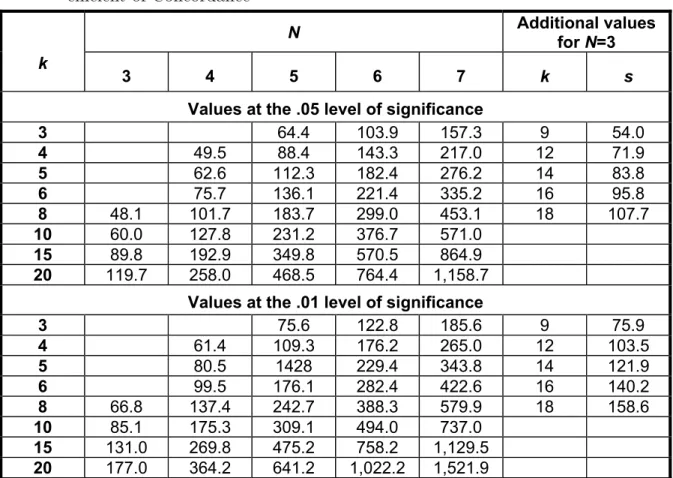
A.44. Table of Critical Values of S in the Kendall Coefficient of Con-cordance . . . 114
List of Abbreviations
Abbreviation Page
DMs Decision Makers . . . 4
SME Subject Matter Expert . . . 4
LCDR Lieutenant Commander . . . 4
FAS Federation of American Scientists . . . 17
UPT Undergraduate Pilot Training . . . 17
SUPT Specialized Undergraduate Pilot Training . . . 17
AFB Air Force Base . . . 17
AFT Alternative Focused Thinking . . . 26
USAF United States Air Force . . . 33
USMC United States Marine Corps . . . 33
USN United States Navy . . . 33
TUAF Turkish Air Force . . . 33
BAE British Aerospace Systems . . . 35
SDVF Single Dimensional Value Function . . . 44
ENAER Empresa Nacional de Aeronautica . . . 51
KAI Korea Aerospace Industries . . . 52
IFR Instrument Flight Rules . . . 135
FAR Federal Aviation Regulations . . . 135
ECS Environmental Control System . . . 136
MTBF Mean Time Between Failures . . . 137
MTBM Mean Time Between Maintenance . . . 140
TBO Time Between Overhaul . . . 140
FDR Flight Data Recorder . . . 143
CVR Cockpit Voice Recorder . . . 143
Abbreviation Page
TCAS Traffic Collision Avoidance System . . . 145
GCAS Ground Collision Avoidance System . . . 145
FPM Flight Path Marker . . . 150
FAA Federal Aviation Administration . . . 150
SID Standard Instrument Departure . . . 151
VOR VHF Omni-directional Radio Range . . . 151
TACAN Tactical Air Navigation . . . 151
DME Distance Measuring Equipment . . . 151
ILS Instrument Landing System . . . 151
WMO World Meteorological Organization . . . 153
UNEP United Nations Environment Programme . . . 153
TTS Temporary Threshold Shift . . . 155
dBA DeciBels Adjusted . . . 155
RTO NATO Research and Technology Organization . . . 156
TR Technical Report . . . 156
IST Information Systems Technology . . . 156
MLEC Multi-Lever Engine Control System . . . 157
SLPC Single-Lever Power Control . . . 157
LRU Line-Replaceable Unit . . . 157
WX Weather-(Telegraph abbreviation) . . . 157
MOSA Modular Open Systems Approach . . . 158
OSJTF Open Systems Joint Task Force . . . 158
MFD Multi-Function Display . . . 158
NAVAIDS Navigational Aid System . . . 158
PTT Part-Task Trainers . . . 159
FNPT Flight and Navigation Procedures Trainer . . . 159
Abbreviation Page
VFR Visual Flight Rules . . . 159
ACMI Air Combat Maneuvering Instrumentation . . . 160
DVDS Digital Video Debriefing System . . . 160
ANALYZING INDIVIDUAL DECISION MAKING VERSUS
GROUP DECISION MAKING FOR ALTERNATIVE
SELECTION
I. Introduction
1.1 Background
Many decisions in the real world are made by groups rather than individuals, such as families, committees or legislatures. (Legislators make the laws, some business decisions are made collectively, monetary policy decisions are made by committee rather than by a single individual.) Households and firms are typically not individuals, but groups of people with a joint interest in economic decisions. Similarly, political or military decisions, as well as, decisions on monetary policy are often taken by groups rather than individuals. On the other hand, there are also decisions which are almost always made by individuals: A consumer trying to make a purchase decision with a limited budget; a realtor deciding to maximize his/her profit; a banker trying to decide an optimal interest rate in the free market.
In the field of psychology, there is significant research for comparing individual and group behavior and decision making . The results found in psychological research can be divided into two main effects. First, groups are often assumed to make better decisions than individuals. This is based on that simple idea, which is two (or more)
individuals. From an individual’s point of view, it can be simply assumed that an individual acts according to his/her own preferences. On a group level, the choices depend not only on how the individual preferences of the group members are combined into a group decision, but also how they depend on individual preferences.
Do group decisions really differ a lot from the decisions of the individuals who form the group? Most of the opinions agree that groups make decisions more slowly than individuals. Then why are so many important decisions made by groups? It is because of some belief in common sense: It may be advantageous to bring more than one person into consider a question a complicated situation where no one knows the ”true” way to make a decision, or where data may be hard to process or interpret, and where individual values may influence decisions.
1.2 Problem Statement
Group decision making is an important and controversial part of life. Both in business and day-to-day life, by definition, group decisions are being made by a number of individuals coming together. A portion of the research asserts that there are advantages in having many minds focused on the same problem, and that provides this grouping with increased morale. Another portion complains about the slowness of the group decision process, the conservatism and excessive caution of groups, and the difficulties of determining who is ”really” responsible for a decision made by a group.
The widely held belief that groups reach more rational or better decisions than individuals is far from being confirmed by psychological literature. Davis stated that ”in the idealized form of the group superiority argument, groups are, considered to balance biases, catch errors and stimulate thoughtful work” [8]. The conventional wisdom of group superiority has been challenged by numerous experiments, leading to the conclusion that ”group discussion can decrease, amplify, or simply reproduce the judgmental bias of individuals” as indicated by Holloman and Hendrick [5].
Although many studies have been performed in the area of individual decision making, the studies do not thoroughly explain the relative relation between groups and individuals. The general social psychological literature does not offer an unambiguous line of reasoning which would help to predict the relationship of individuals and groups.
Group decision making involves different characteristics in which bad decisions are likely to be made. Some decision makers may avoid expressing their true opinion on the matter at hand for fear of stepping outside the comfort zone of the group. Some members of the group may feel reluctant to share their opinions and fear a loss of respect or job title for speaking the wrong words. Johnson and Libecap state that ”group pressures, biases, and other behaviors reduce the quality of the decision” [31]. In the stressful and pressure-filled atmosphere of group decision making, if many group members are likely to hesitate in expressing their real values, ideas and prefer-ences, is it absolutely necessary and efficient to gather a number of people together?
If the individuals can already make the same decisions with the same or maybe even higher efficiency, why would the valuable time of many participants be consumed in a group decision making environment?
The case study will be proceeded with a simple question rather than a complex hypothesis. The problem to be explored is: ”Are decisions made by groups really that different from the decisions made by individuals?” A slightly different focus can also be employed. It asks the question: ”Do individuals really conduct themselves differently when they make decisions a member of a group or when they reach decisions by themselves?”
1.3 Research Focus & Methodology
A specific case study regarding what is important to a pilot in a primary train-ing aircraft was used to examine whether the decisions made by groups are really that much different from the decisions made by individuals. This case study was performed by questioning fifteen decision makers (DMs), who also contributed as subject matter experts (SME) from a wide variety of sources (Air Force, Navy, Marine Corps, In-ternational Pilots), on what is valued in a primary training aircraft. Specifically, the pilots were selected as DMs since they are the ”experts” and know best in deciding what is important in a primary training aircraft in which they either have flown or are still flying. The group of DMs consisted of US Air Force pilots ( 2 Lt.Col., 5 Maj.), US Navy pilots ( 3 LCDR) , US Marine Corps pilot ( 1 Maj.) and Turkish Air Force pilots (4 First Lt.s). The experience levels, ranks, ages, and proficiency in
aircraft of the DMs varied tremendously. The military forces of the DMs were also scattered. This wide variety group of DMs provided the study with a decision at the end. After creating value-focused thinking (VFT) hierarchies for each DM and the group, a list of alternatives has been scored based on each hierarchy. This score provided the means to examine and explore the differences, if any, among the fifteen DMs and group. No difference would verify that individual decision making would be at least the same efficient or more efficient than bringing the group together to make the decision.
Whether there is an association among the decision makers were determined in the final result section. The DMs have been grouped under different sample forms , such as all DMS & group, USAF DMs & group, USN & USMC DMs & group, TUAF DMs & group, instructor DMs & group, non-instructor DMs & group and null hypothesis: ”m sets of rankings are independent” have been tested to see if there is an agreement among the DMs for the statistical analysis. The result of the study helps allay the stress of group meetings, the time a decision takes to be met, and the perceived influence DM’s have on one another.
The goal of the research is to determine if there is really a difference between an individual and group decision on the same topic.
Value Focused Thinking (VFT) technique has been applied as the methodology. VFT focuses on the values of the decision maker rather than the alternatives that are already available.
All value hierarchies were created and VFT process has been implemented by using Lt. Col. Jeffrey D. Weir’s ”Hierarchy Builder” software program.
The remainder of this document is consisting of four chapters and 4 appendices. Chapter-2 reviews literature covering group decision making, advantages & disad-vantages, individual versus group decision making, case study, decision analysis and VFT. Chapter-3 provides detailed information on the methodology, step-by-step, as the research is conducted and develops value models. Chapter-4 runs the value mod-els to evaluate and displays the results of the analysis done with the process outlined in Chapter-3. Chapter-5 presents the results of the study and the limitations of the work, provides discussion on recommendations based on the results, as well as future research that can be done to further explore the issue.
II. Literature Review
2.1 Overview
This chapter discusses group decision making, individual versus group decision making, the case study question, decision analysis, and value focused thinking. Deci-sion analysis is discussed, and an in-depth discusDeci-sion is provided on the VFT approach to decision making.
2.2 Group Decision Making
Many people come together everyday to make decisions concerning some topic of interest for the group or a group of people that share common characteristics or interests. Group decision making is a process that has a very wide range of ideas and events. It is a type of participation process in which multiple individuals act as a group, analyze problems or situations, consider and evaluate alternative courses of action, and select from among the alternatives a solution or solutions. The nature of the decision can be a high ranking political issue, or it can also be a public jury deciding whether someone is guilty or not. But it can equally be unofficial with some decision on the room setting. Deciding whether someone is guilty or not and the deci-sion for the setting of a room are of a totally different nature. The number of people involved in group decision making varies greatly. The individuals in a group may be demographically similar or quite diverse. The character and composition of groups, their size, and demographic structure all affect their performance to some degree. In addition to these, the external pressure faced by groups such as time demands and
conflicting goals may also impact the progress and effectiveness of decision making groups.
Groups are nothing more than a gathering of people who are working toward the same goals, in the same place, at a given time. However, when people meet in this way, surprising changes in the behavior of individuals emerge. As explained by Latane in his Social Impact Theory, the total impact of other people in an individual is related to the the number, strength, and directness of other observers. When observers have a higher level of power (determined by status, age, relationship), or are greater in number, there will be a greater effect on the individual’s behavior [27].
The domain of decision making is vast. The structure of the group has diverse effects on group decision making as well. It is still open whether group decision making produces worthwhile results for a decision. This can depend on many different factors such as each person’s personality, the state-of-mind at the moment of the decision, the structure of the group, and the ideas behind groupthink. Brahm and Kleiner express that ”often, members do not feel comfortable expressing themselves verbally, even in groups structured to be smaller” [3]. This can cause some members to sit in a group meeting and never voice their own opinions on the decision making process, therefore, decreasing the need for them to be present. They also stated that ”the decision makers of the group must be assertive and participate enough to contribute to the group” [3]. The presence of a supervisor can have very negative effects on the process because they have the final say on whether the proposed decision is acceptable. They either
accept the idea or reject it, and thereby that result in demoralization of the group members. An unhappy group ends up to be an unproductive group.
Individual influences are reflected in group decisions. The evidence on whether groups or individuals make better decisions is mixed. Kerr, Kramer, MacCoun empha-sized that ”the details of the group-judgment process are an important determinant of the quality of the group versus individual decisions” [30]. Wallach, Kogan, and Bem have found that ”group decisions can lead to excessive risk taking (so-called risky shift)”. Bornstein and Yaniv studied individual versus team choices in ultima-tum games and found that ”teams are more game-theoretically rational players than are individuals” [11] . In contrast, Cox and Hayne found that ”groups tend to de-viate further from balanced strategies than do individuals” [16]. Kocher and Sutter compared decisions by individuals and groups in beauty contest games [29]. They found no difference in the depth of reasoning between individuals and groups, but found that groups learn faster than individuals. Michaelsen, Watson, and Black de-termined that there have been no studies on individual versus group decision making that provided any significant outcome, positive or negative, for either individual or group performance [26]. It is a big question if the decisions made by groups differ from the decisions of the individuals.
A strong personal identity in a group could lead to different results. In some cases personal identity is lost and replaced by an identification with the goals and ac-tions of the group which is called the ”deindividuation” described by Gustave LeBon in his Crowd Theory (1896) [28]. He developed a theory that ”in the right situations,
the emotions of one person spread through the group like a cold through a building”. According to the theory, during the time shared in a group environment, control mechanisms such as values, principles, and learned social rules are broken down and forgotten. Forsyth defines ”the complete feeling of anonymity and being less account-able” as the key to people’s actions [10]. Many other theorists (Zimbardo, 1970; Diener, Fraser, Beamen, and Kelem, 1976) have done experiments showing that when the sense of responsibility for our actions is lost, the participants will behave in more extreme ways then when each member feels responsibility for the decision. [40] [9].
Agreeing with the beliefs of a group may affect personal decisions. Groups make decisions that are often riskier than what would be expected given the views held by individual members before the decision. People have a tendency to compare themselves socially to the opinions of others in the group. If the group tends to be leaning to a more radical idea, many others will also shift their views in that direction. Group decision making is found in many different areas of the workforce. People take different sides on the issue of the effectiveness of group decision making. Watson, Sharp, and Michaelsen have debated that group decision making is effective and an-nounced that ”decisions made will reflect those higher qualities than the group’s most knowledgeable member” [38]. This coincides with the notion that different values or alternatives may come about in a group.
2.3 Advantages and Disadvantages of Group Decision Making
The effectiveness of decision making groups can be affected by a variety of fac-tors. Therefore, it is not possible to suggest that group decision making is always better or group decision making is always worse than individual decision making. For example, due to the increased demographic diversity in the workforce, a considerable amount of research has focused on diversity’s impact on the effectiveness of group performance. In general, demographic diversity can sometimes have positive or nega-tive effects, depending on the specific situation. Some research indicates that diverse groups tend to generate a wider variety and higher quality of decision alternatives than demographically homogeneous groups.
In the ideal, group decision making takes advantage of the varied strengths and expert opinions of its members. It is possible that the group can generate a greater number of alternatives that are of higher quality than the individual. If a greater number of higher quality alternatives are generated, then it is likely that the group will eventually reach a better and greater problem solution than the individual. Since it is possible that many of the group members are affected by the decision at the end, they actually might have input into the decision which results in a group decision of greater combined understanding of the eventual course of action chosen.
There are also many potential disadvantages to group decision making. Groups are generally slower to arrive at decisions than individuals, so sometimes it is diffi-cult to put them to practical use in situations where decisions must be made very
quickly. One of the most common problems is ”groupthink”. Irving Janis defined the phenomenon as ”the decline of mental efficiency, reality testing, and moral judgment resulting from group pressure” in his book ”Victims of Groupthink” [18].
Groupthink is a characteristic of group decision making in which bad decisions are likely to be made. Groupthink can be thought of as a mode of thinking that people engage in when they are deeply involved in a well-united group. Groupthink occurs when individuals in a group feel pressure to comply with what seems to be the dominant view in the group. Opposing views of the majority opinion are suppressed, and alternative courses of action are not fully explored. Some decision makers avoid raising their true opinion on the matter at hand for fear of stepping outside the comfort zone of the group. Members of the group may feel inferior to others and fear a loss of respect for speaking the wrong words. Johnson indicates that those group pressures, biases, and other behaviors reduce the quality of the decision. He also states that ”the decision context and available alternatives will determine the effect of groupthink on a situation” [21]. Although groupthink in different situations can be difficult to detect or measure, it offers insight into understanding how various factors and conditions combine to affect decision outcomes. To prevent groupthink and enhance the effectiveness of group decision making, the leader of the group may encourage the group members to express objections, or he or she may also remain unbiased to ideas as they are presented.
Some research suggests that certain characteristics of groups contribute to group-think. In the first place, if the group does not have an agreed upon process for
devel-oping and evaluating alternatives, it is possible that an incomplete set of alternatives will be considered and that different courses of action will not be fully explored. Many of the formal decision making processes, for instance ”nominal group technique” and ”brain-storming”, are designed to reduce the potential for groupthink by ensuring that group members offer and consider a large number of decision alternatives. Sec-ondly, if a powerful leader dominates the group, other group members may quickly comply with the dominant view. Additionally, if the group is under stress and/or time pressure, groupthink may occur. Finally, studies suggest that well-adjusted groups are more susceptible to groupthink.
Another potential disadvantage of group decision making is group polarization. The group my tend to focus on more extreme solutions to a problem. An example of polarization is the risky shift phenomenon. When the group decision is a riskier one than any of the group members would have made individually, it results in risky shift. Members of the groups sometimes may not feel as much responsibility for the actions of the group as they would, if they were making the decision alone.
Decision making in groups is a fact of life in organizations for many individuals. Because so many individuals spend at least some of their work time in decision making groups, hundreds of research studies are carried out on such groups each year. There is still much to learn about the development and performance of groups. However, it is more likely that research studies will continue to focus on identifying course of actions that will make group decision making more efficient and effective. It is also
likely that the effect of internal characteristics of groups (e.g demographic, age, status, rank etc.) will be researched more in depth.
2.4 Individual Versus Group Decision Making
Individual decision making occurs happens a lot on a daily basis (financial in-vestments, residential location, insurance etc.). But decisions are often taken by a group rather than by a single individual. Even when these decisions are formally taken by only one of the members of the group, they may affect (and/or be affected by) the way the group shares other decisions. Almost every important decision involves risk and individuals include risk into their decisions.
It can’t be simply assumed that groups make the same decisions as individuals. There is a significant amount of research in psychology comparing individual and group behavior and decision making. The psychological findings can be very roughly divided into two main effects. First, groups are often assumed to make better decisions than individuals. This is based on the simple idea that two (or more) people know more than one. This effect depends on the decision at hand; there has to be a provable right solution. Secondly, groups often make different decisions than individuals. On an individual level, a particular individual acts according to his/her preferences (if someone prefers X over Y, he/she will choose X). On a group level, choices not only depend on how the individual preferences of the group members are combined into a group decision, but individual preferences can change because an individual is a member of a particular group.
A growing amount of literature has concentrated on the impact of different characteristics of the decision maker, among which the differences between male and female decision makers have been most thoroughly studied (e.g., Eckel and Grossman,1998 [4]; Andreoni and Vesterlund,2001 [15]; Gneezy, Niederle and Rus-tichini,2003 [37]).
Bornstein and Yaniv have studied individual versus group behaviour in a stan-dard, ”one-shot ultimatum game”, where a fixed amount of money is split between a proposer and a responder [11] . Bornstein and Yaniv compared two treatments, one with individuals playing against individuals and one with groups (of three subjects each) playing against groups. Their main result was that ”groups are more rational players than individuals by demanding more than individuals in the role of proposer and by accepting relatively lower offers in the role of responder”.
Cox and Hayne have explored decision making of groups and individuals in common value auctions, characterized by ”risky outcomes” [17]. ”Although both groups and individuals deviate from rational bidding when they have more informa-tion, groups are more affected by the disadvantage of informainforma-tion, leading to the conclusion that groups are less rational decision makers than individuals”. The stud-ies of Bone, Hey and Suckling [20] and Rockenbach, Sadrieh and Mathauschek [2] are somewhat related to the paper by Cox and Hayne in that they investigated group decision making under risk.
Blinder and Morgan studied group versus individual decision making in an urn problem and in a monetary policy experiment [1]. Blinder and Morgan were partic-ularly interested in whether groups are slower in decision making than individuals. Measuring the speed of decision making by the amount of information needed before reaching a decision, they found no support for the widely held belief that it takes longer for groups to reach a decision.
Gillet explored the view that ”groups are better than individuals at solving an inter-temporal choice problem”, which he saw as confirmation for the hypothesis that groups are smarter than individuals, by designing and running a number of sepa-rate experiments combining different attributes to compare the differences between decisions made by groups and individuals [12].
Finally, Kocher and Sutter contributed to this growing literature availability by addressing the influence of the type of decision maker on the rationality of decision making [29]. They focused on two main research questions. First, ”are groups of more rational decision makers in the sense that their decisions are closer or converge faster to the balanced prediction of the strategic situation?” Second, ”do groups outper-form individuals in terms of payoff when competing against individuals?” They used an experimental beauty-contest game. Their first research question was related to a growing number of economic literature examining whether groups behave and decide differently than individuals. An interesting general result was the fact that ”differ-ences in decision making between groups and individuals can neither be explained by simple collection of individual preferences or choices nor by simple theories of group
decision making”. They came up with the conclusion that ”it seems reasonable that many important and recurrent decisions in societies are entrusted to groups”. It may be beneficial to use groups as decision makers instead of individuals. However, they also stated that they still know too little on such important questions as, for instance, which tasks should actually be entrusted to small groups as decision makers or which internal structure of small groups contributes best to reaching optimal decisions and preventing adverse effects like groupthink or overconfidence biases.
2.5 Case Study : Best Primary Training Aircraft
Pilot training aircraft are used to take officers through flight training programs to provide rated military aviators to fly their respective services’ fixed-and rotary-wing aircraft. According to Federation of American Scientists’ (FAS) military analysis [14], the flight training process has been shaped and conducted through the years as summarized below:
”The Air Force has transitioned from undergraduate pilot training (UPT) to specialized undergraduate pilot training (SUPT) in order to better prepare pilots for the entire spectrum of aircraft and flying missions. Specialized undergraduate pilot training began at Reese Air Force Base, Texas, in July 1992, following the arrival of the T-1A aircraft. Undergraduate pilot training, which universally trained all students in the T-37 and T-38 trainer aircraft, continued at each base at the same time until all required T-1A aircraft arrived at that base. Transition to SUPT was completed in early 1997 when the last UPT class graduated at Columbus AFB, Miss.
Specialized undergraduate pilot training differs from generalized training pri-marily in the advanced phase. After primary training in the T-37 Tweet, or the U.S. Navy’s T-34 Mentor, students select, by order of merit, advanced training in the bomber-fighter, airlift-tanker, helicopter, or turboprop tracks.
The preflight phase of SUPT takes three weeks and consists of academics and physiology training to prepare students for flight. The second phase, primary training, is conducted in the twin-engine, subsonic T-37 Tweet, a rugged aircraft equal in maneuverability to most of the fighters of World War II. Students learn aircraft flight characteristics, emergency procedures, takeoff and landing procedures, aerobatics, and formation flying. Students also practice night, instrument, and cross-country navigation flying. Primary training takes approximately 23 weeks and includes about 250 hours of ground training, 25 hours in the flight simulator, and 90 flying hours in the T-37.
Advanced training for the bomber-fighter track is accomplished using the T-38 Talon and prepares pilots for transition to fighter and bomber aircraft. The T-38 is a tandem-seat, twin-engine, supersonic jet. There is increased emphasis on formation, navigation, and low level navigation flying. Training takes approximately 26 weeks and includes about 380 hours of ground training, 30 hours in the flight simulator and 120 flying hours in the T-38.
The airlift tanker track uses the T-1A Jayhawk, the military version of a multi-place business jet, facilitating the transition to crew positions in airlift and tanker
aircraft. Instruction centers on crew coordination and cockpit management duties in a multi-place crew aircraft. Flight training includes visual and instrument transition, radar cell formation, and simulated refueling and airdrop missions. Training takes approximately 26 weeks and includes about 185 hours of ground training, 45 hours in the flight simulator and 100 flying hours in the T-1A.
The helicopter track trains in the UH-1 Huey utility helicopter for follow-on assignments in special operations, rescue, missile site support, and distinguished per-sonnel support missions. The helicopter track transitions students from fixed wing to rotary-winged flight. The initial phase consists of basic helicopter flying including takeoff and landing, hovering, and emergency procedures. Advanced training consists of instruments, day tactics, and night tactics including night vision goggle training. Training takes approximately 24 weeks and includes 25 hours in a simulator and 110 hours of flying time.”
The decision of choosing a primary training aircraft to train new military pilots to the standard at which they can go to their next training phase (advanced training) and then to operational level units has always been a challenging and important process for the military forces throughout the world. The case study focuses on this problem. What are the characteristics of an ideal primary training aircraft? This question has been asked this way ”What is important to you in a primary training aircraft?”, to the Air Force, Navy and Marine Corps pilots, who come from different backgrounds, different ranks, different experience levels, different ages and different perspectives.
Primary training includes general handling, stalling, spinning, solo flight, for-mation flying, aerobatics, and navigation at high and low levels, and various levels of instrument training. One desirable characteristic of a primary training aircraft for relatively inexperienced students is that it must be easy to fly safely, and to fly solo, in clear air and in clouds, in turbulent and smooth air, in good and bad weather, at low level and at high altitude. However, it should not be too easy to fly well enabling students to be easily assessed for ability and potential. The aircraft must react safely to typical student mistakes such as flying slightly out-of-trim or flying with less than perfect accuracy such as on the downwind leg of the traffic pattern, in the critical final turn before landing, in night flying or flying at low level. Also, when making predictably large errors, such as in aerobatics students can make incredibly creative mistakes. In such an aircraft, natural aerodynamic stability and ease of trimming are requirements rather than having a training aircraft that flies like a neutrally stable fighter and therefore difficult for student pilots to fly.
The priority in choosing the characteristics of any training aircraft is always how students will fly it, not how instructors and senior officers will enjoy it. The second part is important for instructor motivation, but teaching the student is the primary aim. Although this is perhaps obvious, it is often forgotten because the pilots who assess training aircraft before purchase (senior officers who like playing with the aircraft around the sky, which is a great relief compared to their desk work for sure) will naturally be very experienced. It is sometimes difficult for an experienced pilot to
put himself back instead of an inexperienced student unless he is a current instructor with a real feeling for the failings of the student pilots.
The study includes many terms relating to the aircraft systems. All those terms are explained in Appendix-B: Aircraft Systems Terminology.
The pilots (decision makers) participating in this case study have mentioned several criteria which forms their values, such as reliability, performance, maintain-ability, technology, safety, flying quality, training quality, design, supporting systems and cost, which a primary training aircraft should possess in order to guarantee im-provement in the skills of the trainees. These values also branch out to the sub-tier values. In order to familiarize individuals with the terms and expressions, these cri-teria were explained in detail in Appendix-C: The Decision Makers’ Cricri-teria.
2.6 Decision Analysis
Clemen states that ”the obvious reason for studying decision analysis is that carefully applying its techniques can lead to better decisions” [6]. Each individual decision has its own defining frame. The decision analysis process helps the decision maker pick the best alternatives within the decision frame. ”A decision is considered difficult due to its complexity, uncertainty in the situation, multiple objectives, differ-ent perspectives and differdiffer-ent conclusions” [6]. Decision analysis provides structure and guidance for systematic thinking in difficult situations [6]. Decision analysis in-cludes many procedures, methods, and tools. It helps recognizing, clearly depicting, and formally estimating the important aspects of a decision situation for addressing
the recommended course. However, decision analysis is not designed to make the decision for the decision maker.
The Webster Dictionary defines analysis as ”separation of a whole into its com-ponent parts”. Decision analysis is the process of separating a complex decision into its component parts. It is a method of helping decision makers make simple and fa-miliar choices. It is using a mathematical model to conclude from these choices what would the decision maker would have preferred to do in a complex, inflexible decision. Any real world decision has many different effects which are important dimensions that should be considered during the analysis and in any assessment performed after-ward.
In the decision analysis literature, there are many methodologies to help one make logical decisions. In most methodologies, there is a repeating topic of breaking down or decomposing the problem to better understand the situation and to simplify the problem. Each process includes some form of the following steps: define the problem, identify objectives, develop alternatives, evaluate consequences, and evaluate tradeoffs. The problem is the challenge that must be solved, the objectives are the desired goals for achievement, the alternatives are possible solutions, the consequences are the undesirable side effects of alternatives, and tradeoffs are values that can be exchanged. Models are developed in various stages in the process, frequently involving numerical expressions to allow experts to acknowledge what is known and not known.
Decisions are hard to make and complex because of uncertainty about the out-come of the decisions and confusion about the value of various outout-comes. The purpose of analysis is not to capture decisions in all their complexity. The goal of analysis is to simplify the decision enough to meet the decision maker’s needs. An important challenge then is to determine how to simplify an analysis without diminishing its usefulness and accuracy.
A useful simplification is to ignore some uncertainties, so the value of an action is assumed to be more certain than it really is. In other words, the chance of an event is either near zero or one. For instance, in deciding which schools need additional funds, the decision maker might choose to assess current levels of needs and ignore the uncertainty about future needs. Of course, such simplifications are only appropriate when using them will make little difference in the results of the analysis. Alternatively, the analyst may assume that uncertainty is the only issue and that the other values and actions can be addressed without the help of analysis.
Good analysis is about the process not the numbers. One way to analyze a decision is for the analyst to conduct an independent analysis and present the results to the decision maker in a brief paper. This is usually not very helpful and emphasizes the findings as opposed to the process. Decision makers are more likely to accept an analysis in which they have actively participated.
The preferred method is to conduct decision analysis as a series of increasingly more sophisticated communications with the decision maker. At each communication,
the analyst listens and summarizes the decision maker’s statements. In each step, the problem is structured, and an analytical model is created. Through these cycles, the decision maker comes to certain determinations, and the analyst documents his/her conclusions.
It is difficult to evaluate the effectiveness of decision analysis because, often no information is available on what might have happened if decision makers had not followed the course of action recommended by the analysis. One way to improve the accuracy of analysis is to make sure that the process of analysis is followed accurately. Rouse and Owen suggest asking the following questions about decision analysis to determine if it was done accurately [7]:
1. ”Were all realistic strategies included?”
2. ”Was the appropriate type of model employed?” 3. ”Were all important outcomes considered?”
4. ”Was an explicit and sensible process used to identify, select and combine the evidence into probabilities?”
5. ”Were utilities assigned to outcomes conceivable, and were they obtained in a methodologically acceptable manner?”
6. ”Was the potential impact of any uncertainty in the probability and utility estimates thoroughly and systematically evaluated?”
These authors also point out four serious limitations to decision analysis which are important to keep in mind:
1. ”Decision analysis may oversimplify problems to the point that they do not reflect the real concerns and accurately represent the perspective from which the analysis is being conducted.”
2. ”Available data simply may be inadequate to support the analysis.”
3. ”Utility assessment, in particular assessment of quality of life, may be problem-atic.”
4. ”Outcomes of decision analysis are not agreeable to traditional statistical anal-ysis. Strictly by the principles of decision analysis, the preferred strategy or treatment is the one that yields the greatest utility (or maximizes the occurrence of favorable outcomes) no matter how narrow the margin of improvement.” In the end, the value of decision analysis (with all of its limitations) is in the eye of the one who regards. If the decision maker can understand and have new insights into a problem, and if the problem and suggested course of action can be documented and communicated to others more easily, a decision maker may judge decision analysis, even imperfect analysis, as useful.
2.7 Value Focused Thinking
The methodology for this research is a decision analysis technique called value focused thinking (VFT). Traditional decision making concentrates on the alternatives and their potential outcomes. However, the VFT process focuses on the values of the decision maker rather than the alternatives that are already available at hand.
are the fundamental objectives that the decision seeks to achieve, so they should be the focus of analysis” [22]. ”This is considered a proactive rather than reactive method of examining the problem” [23].
Fundamental objectives refer to the objectives underlying the essential reasons for the problem being under consideration while means objectives are regarded as those whose fulfillment will help achieve the fundamental objectives. To perform this step, Keeney’s ”Why is this important?” test is done. Each objective is evaluated against this question, and if an objective is found to be important because it helps achieve another objective, it is categorized as a means objective. Otherwise it is a fundamental objective.
There are two primary methods of thinking about decisions: alternative focused thinking and value focused thinking. The difference between the two is simple. Alter-native focused thinking (AFT) considers the available alterAlter-natives and subsequently compares them to each other, while value-focused thinking (VFT) compares alter-natives to organizational values. As expressed by Keeney, ”value focused thinking implies that one determines what is important and subsequently figures out how to get it” [22]. While making decisions based only on available alternatives gets the job done, it constrains the ability of an individual or organization to achieve their true values. Keeney summarizes the fundamental difference between alternatives and values as ”the values that are fundamentally important in any decision situation. Al-ternatives are relevant only because they are the means to achieve the values.” [22].
He continues to indicate that ”consequences are the result of decisions, and the de-sirability of consequences is a concept based on values” [22].
Kirkwood explains clearly the four primary uses of the VFT process as an im-portant tool. First, ”it assists organizations in collecting appropriate information”. That is, it highlights what is important, by means of allowing an organization to focus on collecting relevant information that is outside the decision maker’s concern. Sec-ond, ”when there are no previously present alternatives, the VFT process facilitates focused brainstorming that leads to the development of alternatives which address values important to a decision”. Third, ”the VFT process provides clear communi-cation”. It demonstrates to the ones who hold a share or interest what the decision makers consider important. It facilitates the objective defense of specific alternative selections. Finally, ”the VFT process provides the model for evaluating, and subse-quently ranking, the alternatives with respect to the value added to an organization (or individual)” [25].
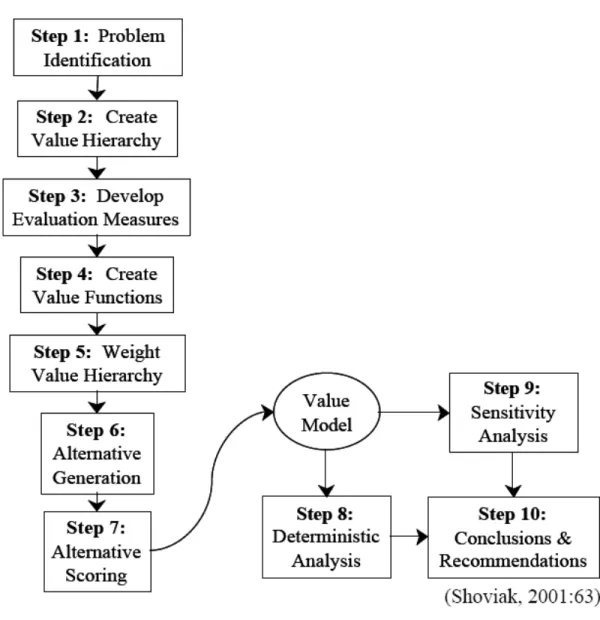
The process used in this research was the ten step process shown in Figure 2.1. In the first step, the fundamental problem is identified. This helps to focus the anal-ysis on exactly what the decision maker is trying to achieve. The value hierarchy is created in the second step. All of the decision maker’s values are identified and then organized into a hierarchy. The tiers of a value hierarchy show the relative importance of the evaluation considerations. The most important values should be in the first tier; these values are further decomposed into various tiers of sub-values. Kirkwood emphasizes that ”the value hierarchies should be complete, non-redundant,
decom-posable, operable and relatively small” [25]. A value hierarchy contains evaluation considerations, objectives, and evaluation measures. In the third step, the means to measure the lowest tier values are determined. The scale used to score an evalua-tion measure can be natural or constructed and direct or proxy. Kirkwood says that ”profit in dollars is a natural scale and gross national product as a measure of eco-nomic well-being is a proxy scale” [25]. In the fourth step, the decision maker creates value functions for each measure. The y-axis will have a range of zero to one, and the x-axis will be the potential range of each measure. This step not only normalizes the measures, but also encourages the decision maker to realistically think about the measures and determine what quantities are desirable. In the fifth step, the decision maker determines weights for each value and measure in the hierarchy. In this step, they are identifying how important a value is relative to the other values in the hier-archy. In the sixth step, alternatives are generated. In the seventh step, the scoring of the alternatives by evaluating each alternative is done against the measures.
After creating the hierarchy and scoring the alternatives, analysis can begin as outlined by Keeney. In the eighth step, deterministic analysis is performed for each alternative by adding the weighted value of the measure score to produce an overall score. The alternatives with higher values are preferred over those with lower values. In the ninth step, a sensitivity analysis is performed to determine how sensitive the alternatives are to changes in the weights of the hierarchy. For each value and measure, the weight is varied to see how the ranking of alternatives changes. Finally in the tenth step, recommendations for the most preferred alternatives are made [22]. The
Figure 2.1: Value Focused Thinking Process
result of this process is identification of alternatives that reflect and fulfill the decision maker’s values.
Kirkwood states that ”the value focused thinking helps to create better alterna-tives for decision problems” [25]. Alternative focused thinking is a reactive approach. ”A decision problem arises, and alternatives are generated to solve that problem which result in a limited pool of alternatives” as stated by Keeney [23]. Conversely,
for VFT, the fundamental values of the decision maker are identified first, so actions can be taken to achieve those values. In Step 6 of the ten step process, alternatives are generated based on the value hierarchy. The result is a pool of more creative alternatives that better reflect the decision maker’s values. Keeney expresses that ”the value focused thinking helps to develop an enduring set of guiding principles for an organization” [23]. Whether there is a decision opportunity or not, it is useful for an organization to list and organize its fundamental objectives. ”For many, simply listing their values allows for more focused actions to achieve those values” as stated by Kirkwood [25].
VFT allows the decision maker or the analyst the ability to focus his/her efforts on assembling the right information for the problem according to what was identified as being important. VFT process is also helpful in creating the suitable alternatives in situations where previously existing alternatives are not readily available. By using VFT, all the important considerations are taken into account for all involved. This is especially important when the decision problem is large enough to have many people involved in the outcome. To end with, VFT concentrates on determining the values at the core of the decision.
III. Methodology
3.1 Overview
This chapter describes how the topics and methods from Chapter 2 were applied to the value-focused thinking based individual versus group decision problem on the case study. The value-focused thinking process is detailed in creating the individual and group hierarchies for the case study question. While creation of the individual hierarchies was not a complicated process, there was difficulty in the group session in coming up with consensus over scoring the measures which was already the main observation purpose of the research topic. Group and individual decision processes have been discussed on an interesting topic which every country’s Air Force faces: What is the best primary training aircraft for pilot training? The decision makers were all seasoned military pilots who are from different ranks, ages, experience levels, forces and countries. The best primary training aircraft hierarchies for the individuals and the group are constructed throughout the chapter as the process steps are described. After following the steps dictated in VFT method through chapter-3, evaluating the individual decisions versus group decision, will be analyzed in step-8: Deterministic Analysis in chapter-4. The discussion will be made on whether the individual decisions differ from the group decision on the same topic together with the resulting decision and the suggestions will be presented on the case study topic: the best primary training aircraft by the end of chapter-4.
3.2 Problem Identification
Problem identification is very important to clearly establishing the focus of the decision making process; it is often the most difficult, and always the most important step. Primary flight training is the most significant part of the flight training program. Some considerations for choosing a primary training aircraft might be that it is safe enough for relatively inexperienced students to fly solo in clear air and in clouds, in turbulence and in smooth air, in good and bad weather, at low level and at altitude. The aircraft must react safely to typical student mistakes such as flying slightly out of trim or flying with less than perfect accuracy, such as on the downwind leg in the circuit, in the critical final turn before landing, in night flying or in flying at low altitude. Due to the importance of choosing the best primary trainer for primary flight training, decision makers were asked: ”What is important to you in a primary training aircraft in order to choose the best primary trainer?” The decision makers play a key role in this process since they are typically the ones faced with the requirement to solve the problem. For this research, however, a problem was initially identified through the literature review presented in the previous chapter. This made it very important to ensure that the problem initially identified was identified correctly. This step was further complicated by the fact that making such a decision for any military force is not realistic with a single decision maker. To address this decision maker problem, 15 decision makers, who can expectedly become a potential member of any procurement phase for the forces they serve, were used the values obtained from these DMs are assumed to represent the essential values held by operational users of that primary
training aircraft. The decision makers (DMs) participating in this research were 2 Lieutenant Colonels from the USAF, 5 Majors from USAF, 1 Major from USMC, 3 LCDRs from USN and 4 First Lieutenants from TUAF (Turkish Air Force) with different service years and experience levels (from both academic and operational perspective).
3.3 Step-2: Create the Value Hierarchy
Generating the values related to the overall objective and then organizing them into a value hierarchy is the next step after clearly identifying the problem. The sil-ver standard was the initial method used for identifying the values from the decision makers, who are also subject matter experts. Parnell et al. [13] define three standards for developing multiple-objective value models: platinum, gold, and silver standard. A platinum standard process uses interviews with senior stakeholders and decision makers to determine the objectives. A gold standard process determines the objec-tives from policy or strategic planning documents approved by the decision makers. The silver standard uses interviews with subject-matter experts and stakeholder rep-resentatives. This project used the silver standard method. As the decision makers did not consist of the top level military officials with the authority and budget to acquire the new primary trainer, the desired end result of the decision process was an identification of the values and preferences at the user level that could give a robust beginning point for the future acquisition process.
Decision: An allocation of resources whose change would be costly.
Decision Analysis: Discipline for evaluating complex alternatives by systematically
examining decisions, uncertain variables and preferences (value, risk and time).
Purpose of DA: Provides insight to decision makers faced with hard problems.
Structure of Strategic Decisions: Composes of values (What do we want?),
in-formation (What do we know?) and alternatives (What can we do?). The key idea is using our strategic values to create decision opportunities.
Change to Thinking: The classical thinking process (Alternative Focused
Think-ing) starts with the present alternatives and implements and evaluation among those whereas Value Focused Thinking adds new alternatives to the eixsting at hand in order to cover all the values of the decision maker and then implements the evaluation among those. It doesn’t focus on the alternatives. It does focus on the values.
Value Focused Thinking (VFT) Approach: Guides to strategic thinking,
facili-tates involvement in multiple-stakeholder decisions and uncovers hidden objec-tives.
DA Applications: Private (automotive; General Motors, Ford, oil & gas; Chevron,
Phillips Petroleum, pharmaceutical; Eli Lilly, R & D portfolios, etc.), public ( DOD; Army, Air Force, Navy, Intel Agencies, DOE; nuclear waste, hazardous chemicals, NASA, public utilities, etc.)
After they had a clear idea of VFT, the DMs were asked the question: ”If you had no limitation at all, what would your objectives be in a primary training aircraft?”. They were asked to answer the question, under the circumstances that they had no limitations. If they could have anything they wanted, what would they desire in a primary training aircraft? Also some alternative questions were created, such as ”What are some problems or missing parts in the current training aircraft that they would want corrected in future trainers?”, to help the brainstorming. Each DM provided his wish list in a primary training aircraft (Typically capable of high subsonic speeds, high-energy maneuvers, and equipped with systems that simulate modern weapons and surveillance or more advanced training. Examples of such trainer aircraft include the T-38 Talon (actually capable of supersonic speeds), the BAE Hawk, the Alpha Jet and the Aero L-39, which are used to develop piloting, navigational or weapon-aiming skills in military pilots who progress to training for ”fast jet” flying and will then progress to a jet trainer.) Thus, a wish list has been created for every individual decision maker. An individual value hierarchy was constructed for each DM.
The entire list of the values given by the decision makers are listed below in Table 3.1.
Table 3.1: Entire List of Values
TOP TIER VALUE SUBTIER VALUE
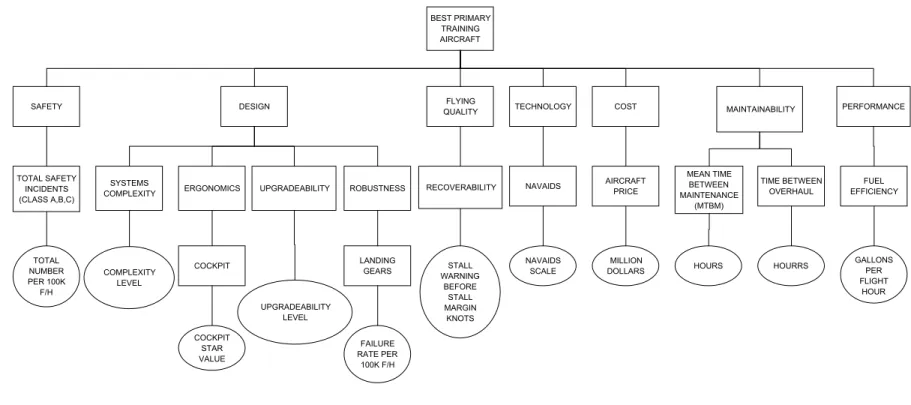
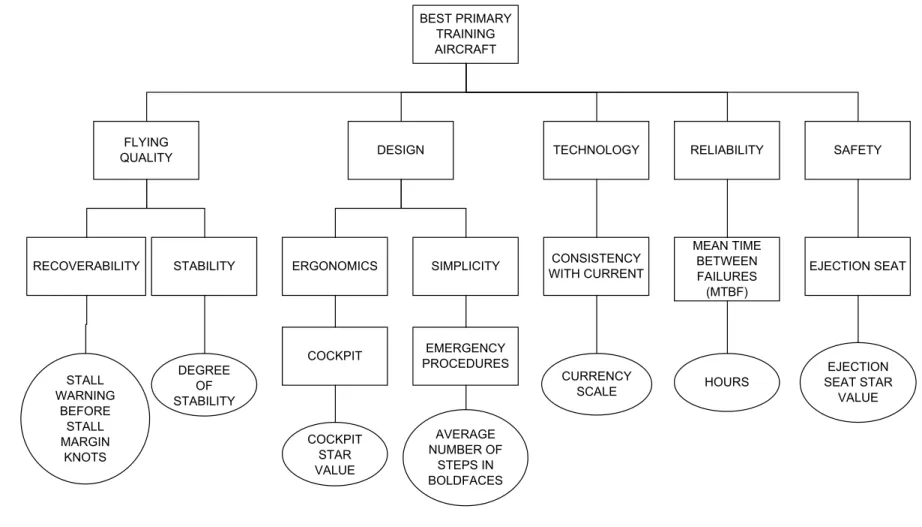
DESIGN User Friendly / Throttle User Friendly / Avionics Simplicity / Standardized Cockpit Simplicity / Emergency Procedures Robustness / Landing Gears Robustness / Airframe Lifetime Ergonomics / Cockpit Ergonomics / Visibility Ergonomics / Noise Level Ergonomics / ECS Systems Complexity
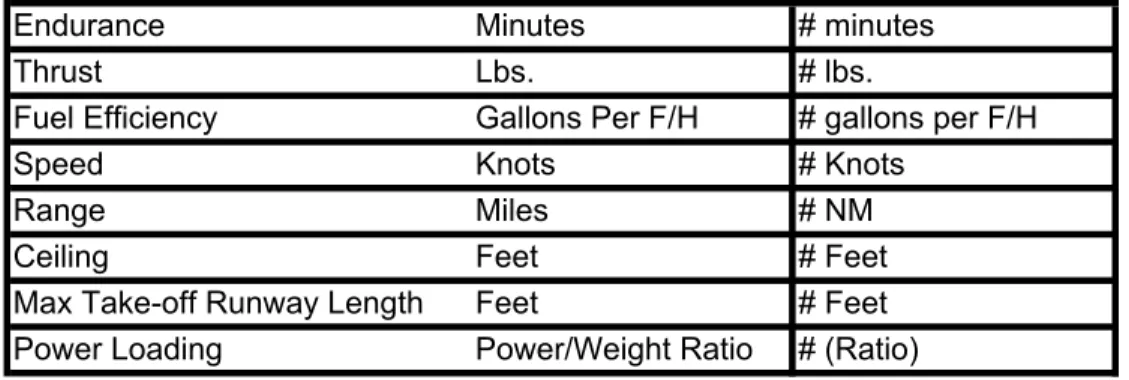
Systems Dependency / Engine Start Upgradeability Styling Deactivation Capability PERFORMANCE Endurance Thrust Fuel Efficiency Speed Range Ceiling
Max Take-off Runway Length Power Loading
RELIABILITY Mean Time Between Failures (MTBF)
MAINTAINABILITY Mean Time Between Maintenance (MTBM) Time Between Overhaul (TBO)
Recording Capacity
Maintenance Specialty Requirement Civilian Airports Cross Service
SAFETY Total Safety Incidents (Class A,B,C) Engine
Ejection Seat Hook Drag Chute
Collision Avoidance System
FLYING QUALITY Recoverability Stability
Maneuverability / Roll Rate Maneuverability / G_Capacity Handling Quality Rating Flight Path Stability
TRAINING QUALITY Instrument Flight Formation Flight Low Level Flight Aerobatics Ground Handling
TECHNOLOGY Consistency With Current NAVAIDS
Comm System Radar
COST Maintenance Cost
Aircraft Price
SUPPORTING SYSTEMS Synthetic Training System Debriefing System
The initial layout of the decision makers’ hierarchies was developed with the use of the silver standard and submitted to the decision makers for their approval. The first interviewed DM: DM-3 (DMs are listed in alphabetical order based on their last names), has given his wish list, which included a user friendly aircraft with easy-to-use throttle and avionics, the ability to forgive inexperienced pilots with its stability, low maintenance, high reliability, safety and enough endurance to provide adequate sortie time to be able to teach the student all the sortie requirements. His values were organized in the value hierarchy below in Figure 3.1.
BEST PRIMARY TRAINING AIRCRAFT
DESIGN PERFORMANCE RELIABILITY MAINTAINABILITY SAFETY
ENDURANCE TIME BETWEEN
OVERHAUL HOURSS FLYING QUALITY STABILITY DEGREE OF STABILITY USER FRIENDLY
THROTTLE AVIONICS MINUTES
TOTAL SAFETY INCIDENTS (CLASS A,B,C) TOTAL NUMBER PER 100K_F/H THROTTLE STAR VALUE AVIONICS SCALE MEAN TIME BETWEEN FAILURES (MTBF) HOURS MEAN TIME BETWEEN MAINTENANCE (MTBM) HOURRS
Figure 3.1: DM-3 Value Hierarcy
From this hierarchy, some of the values (i.e. user-friendly, stability) were placed under some other values. Even though the ”User Friendly” is one of his main values, it is placed under ”Design” in order to make it look more understandable for someone who is not familiar with those terms. ”Stability” is placed under ”Flying Quality”.