Requirement and
possibility analysis:
for future work in possible national
or regionally available laboratory
environments for researchers,
industries and others at KTH
Text: Anna Svensson, M.Sc. Industrial Design Engineering
Responsible for the report: Ulrika Ljungman, Head of Department, KTH Business
SAMMANFATTNING
Detta kapitel innehåller en sammanfattning av hela projektet från bakgrund, metoder, resultat analys samt slutsats.
Laboratoriemiljöerna inom KTH är idag beroende av extern finansiering, men finansieringen processen är under utveckling. Enligt Vetenskapsrådet, VR, behöver investeringar i forskningsinfrastruktur samordnas för att uppnå effektivitet i styrning och nyttjande. Processer för uppföljning, utvärdering och prioritering bör utvecklas för befintliga och nya infrastrukturer (Vetenskapsrådet, s. 8). I takt med att forskningsinfrastruktur blir mer omfattande och kostnadskrävande är det viktigt att utveckla infrastrukturer tillsammans i större samarbeten (Vetenskapsrådet, s. 7). VR har i uppdrag att finansiera nationell forskning, medan lärosätena ska själva finansiera lokal infrastruktur och utrustning.
Knut och Alice Wallenbergs stiftelse, KAW, har tidigare varit den dominerande finansiären av utrustning och infrastruktur men har i likhet med VR meddelat att de efter 2015 ej längre avser att finansiera basutrustning eller ge bidrag till enskilda forskare (Vetenskapsrådet, s. 22).
Chalmers Tekniska högskola i Göteborg har redan börjat arbetet med VR:s krav på nationell forskning vilket innebär att miljön ska vara öppen och enkelt tillgänglig för forskare, industri samt andra aktörer (Vetenskapsrådet, s. 14).
Kungliga Tekniska Högskolan i Stockholm, KTH, har också inlett arbete för att öka tillgängligheten. Laboratoriemiljöer har kartlagts genom intervjustudie i form av en semi-strukturerad kontextuell intervju. Intervjuunderlaget har tagits fram genom att skapa en domänkunskap kring respektive laboratorium, genom undersökande av forsknings infrastrukturernas respektive hemsidor. Intervjustudien utfördes av Anna Svensson, civilingenjör i Teknisk Design och Ulrika Ljungman, chef på KTH Näringslivssamverkan som besökte samtliga laboratorieföreståndare på de 15 av de 16 laboratorier som anses vara nationellt eller regional tillgänglig forskningsinfrastruktur enligt Arne Johansson, vice rektor för forskning på KTH.
Forskningsinfrastrukturernas gemensamma situation och behov analyserades och åtgärder föreslogs. Resultaten från intervjuerna kategoriserades inom organisation, finansiering, användare och samarbete. För att utveckla samarbetet med laboratorieföreståndare hölls en workshop av KTH Näringslivssamverkan i samarbete med RISE, Research Institute of Sweden. Workshopen riktade sig till den regionala forskningsinfrastrukturen där bland annat VR medverkade. Även laboratorieföreståndare från Stockholms Universitet, SU, och Karolinska institutet, KI, bjöds in.
Samarbete har inletts mellan laboratorieföreståndarna på regional nivå, genom workshop i samarbete med de största lärosätena i Stockholmsregionen och RISE. För framtida samarbete finns förslag på öppna-hus där respektive forskningsinfrastruktur agerar värdar inom olika teman inom den specifika forskningsmiljöns expertis inom ramen för de gemensamma behoven för forskningsinfrastrukturerna. KTH:s laboratoriemiljöer som anses regionalt och nationellt tillgängliga finns idag listade på en gemensam plattform på kth.se med länk till respektive laboratoriers hemsida. Kartläggningen av forskningsinfrastrukturerna har bidragit till utvecklingsarbete som kan ligga till grund för forskningsinfrastrukturernas fortsatta arbete.
ABSTRACT
This section contains a summary of the entire project, including background, methods, result and analysis.
Laboratory environments within KTH, The Royal Institute of Technology, Stockholm, currently depend on external funding, but the funding process is under development. According to the Swedish Research Council, investments in research infrastructure require coordination to achieve efficient steering and utilisation. Processes for monitoring, evaluation and prioritising should be developed for existing and new infrastructures (Vetenskapsrådet, p. 8). As the research infrastructure will be more extensive and costly it is important to develop infrastructures together in larger collaborations (Vetenskapsrådet, p. 7). VR is mandated to fund national research, while the universities themselves will finance local infrastructure and equipment.
The Knut and Alice Wallenberg Foundation, KAW, was formerly the dominant financier of equipment and infrastructure but, in common with VR, it announced that after 2015 it no longer intends to finance the basic equipment or provide grants to individual researchers (Vetenskapsrådet, p. 22). Chalmers University of Technology in Gothenburg has already begun working with VR’s demands on national research, which means that the laboratory environment should be open and easily accessible to researchers, industry and other users (Vetenskapsrådet, p. 14).
KTH has also initiated the process of increasing accessibility. Laboratory environments have been identified through an interview study in the form of a semi-structured contextual interview. The interview material has been produced by acquired domain knowledge, through examining research infrastructure websites. The interview study was conducted by Anna Svensson, Master of Science in Industrial Design Engineering and Ulrika Ljungman, Head of Department at KTH Business Liaisons, who visited all the laboratory directors in 15 of the 16 laboratories that are considered to be national or regional research-available infrastructure, according to Arne Johansson, Vice President for Research at KTH.
Research infrastructures’ mutual situations and needs were analysed and possibilities were proposed. The results of the interviews were categorised within the areas of the organisation, financing, users and collaboration. To initiate collaboration between the laboratory directors, a workshop was held by KTH Business Liaisons in cooperation with RISE, Research Institute of Sweden. The workshop was aimed at the regional research infrastructure where, among others, VR participated. Laboratory directors from Stockholm University and Karolinska Institutet were also invited.
For future collaboration, open-house is one suggestion, where each research environment hosts a subject within the mutual requirements of research infrastructure. KTH laboratory environments that are considered to be regionally and nationally available are now listed on a common platform on kth.se with a link to each laboratory’s website. The mapping of research infrastructures has contributed to the development work that can form the basis for research infrastructures’ continued work.
NOMENCLATURE
This section includes a dictionary to define words and a summary of software that been used during the process. There are also collections of abbreviations to ease the readability of the report.
Dictionary
Research infrastructure According to the Swedish Research Council definition: “research infrastructure can be central or distributed research facilities, databases or large-scale computation, analysis and modelling resources.” (Vetenskapsrådet, s. 7)
KTH research infrastructure KTH research infrastructure is not an official name, but used in this report as a collective name for 16 laboratory environments at KTH that could possibly be nationally or regionally available for
researchers, industries or other users.
LIMS LIMS, Laboratory Information Management System, is a software-based system for managing information in laboratory environments. It can be specialised for a specific laboratory. As the laboratories often evolve, LIMS has to be adaptable for change where new features can be changed or added.
Abbreviations
WS Workshop
VR The Swedish Research Council, (Vetenskapsrådet) KTH Royal Institute of Technology, Stockholm
RISE Research Institute of Sweden
SU Stockholm University
KI Karolinska Institutet
INNEHÅLL
SAMMANFATTNING ... 2 ABSTRACT ... 3 NOMENCLATURE ... 1 Dictionary ... 1 Abbreviations ... 1 1 INTRODUCTION ... 3 1.1 Background ... 3 1.2 Objectives ... 3 1.3 Purpose ... 3 2 METHODS ... 42.1 The design process ... 4
2.2 Benchmarking ... 4
2.3 Semi-structured contextual interview ... 4
2.4 Direct observation ... 5 2.5 Workshop ... 5 3 IMPLEMENTATION ... 6 3.1 Information retrieval ... 6 3.2 Interview study ... 6 3.2.1 Preparations ... 7 3.2.2 Performance ... 8 3.3 Workshop ... 8 3.3.1 Preparations ... 8 3.3.2 Performance ... 9 4 RESULT ... 10 4.1 Information retrieval ... 10
4.1.1 Different actions at three levels ... 10
4.1.2 Investigation of each laboratory’s website ... 11
4.2 Benchmarking ... 11
4.2.1 KTH research infrastructure... 11
4.2.2 Chalmers University of Technology in Gothenburg ... 12
4.2.3 Current availability of KTH's laboratory environments ... 12
4.2.4 A visualisation example of available laboratories. ... 13
4.3 Interview study ... 13
4.3.1 Capacity... 14
4.3.2 Collaboration ... 14
4.4 Workshop ... 16
5 ANALYSIS ... 18
5.1 Mutual requirements of the laboratory environments... 18
5.2 Suggestions for future work ... 18
6 CONCLUSION ... 26
1
INTRODUCTION
The introduction describes the background of the analysis project, goals, purpose and delimitations.
1.1 Background
Most laboratory environments today depend on external funding, but this funding has changed during recent years, according to Alf-Erik Almstedt, Vice Principal of Research at Chalmers Technical University (Wallquist, (CIS), & Ullberg, 2014, p. 3). The Swedish Research Council is assigned to fund national research, and universities are responsible for local infrastructure and equipment (Vetenskapsrådet, p. 7). One demand from the Council is that the national research needs to be open and easy to access for researchers, industries and other users. The research infrastructure should also have a plan for availability (Vetenskapsrådet, p. 14). The Research Council believes that investment in research infrastructure needs to be coordinated to achieve management and user efficiency and a processes for monitoring, evaluation and prioritisation should be developed for existing and new infrastructures (Vetenskapsrådet, p. 8). As the research infrastructure will be more extensive and costly, the council believes it is important to develop infrastructures together into larger collaborations, regionally, nationally or internationally (Vetenskapsrådet, p. 7).
The Knut and Alice Wallenberg Foundation, KAW, has been the dominant financer of advanced equipment and research infrastructure. Similar to VR, KAW has announced that after 2015 it will no longer fund basic equipment or provide grants to individual researchers (Vetenskapsrådet, p. 22). In early 2014, 16 laboratories at KTH were identified as being regionally or nationally available laboratories. This project works within the context of the Stockholm innovation strategy. Stockholm’s innovation strategy is a broad regional cooperation, where the aim is to gather and coordinate initiatives affecting the Stockholm region’s ability to innovate and gather the region’s key users. The strategy contains five action plans; the action plan for research and innovation infrastructure is managed by KTH which currently also involves KI, SU and RISE.
1.2 Objectives
The objectives of this project can be divided into three categories: 1. Initiate collaboration between KTH research infrastructures.
2. Identify relevant requirements in order to increase the availability at KTH research infrastructures.
3. Analyse the requirements and suggest future work.
1.3 Purpose
The main purpose is to support KTH laboratory environments to be sustainable after changes in funding have been implemented by increasing the availability of KTH laboratory environments to researchers, industries and other users.
2
METHODS
This chapter describes the methods used, from planning, information retrieval and interview study and to initially create a collaboration between the laboratory environments.
2.1 The design process
A modification of the mechanical design process by David G. Ullman was undertaken in order to optimise the design process (Ullman, 2010, p. 81). An overview of the modification can be viewed in Figure 1.
Figure 1. Modification of Ullman’s design process.
The project discovery was initiated by KTH Business Liaison with directive from the Stockholm innovation strategy. The next phase involves project planning. According to Maylor’s method, the project was broken down into activities, a so-called work breakdown structure, where all the deliveries and decisions were included in a network plan to find a critical path in order to define a risk log. A Gantt chart was made to express the project plan (Maylor, 2010).
In the following phase the project is defined and research is made to gain a greater understanding: for example, investigating similar work at other universities and investigating internal work within KTH. During this phase, information was also gathered from each laboratory website in order to create a questionnaire for the interview study. This phase ends with an identification of the mutual requirements of the laboratory directors.
The next phase of Ullman’s design process consists of conceptual designing. Suggested ideas were created from the information gathered.
During these phases the result is documented, which will be presented as a report at KTH in March 2015.
2.2 Benchmarking
Benchmarking is often explained as a learning method from existing solutions, regardless of branch and geographic location. This can be done both externally by looking at other universities or businesses, and internally by investigating KTH’s existing solutions. The purpose of this method is to gain knowledge in order to develop an improvement of the existing solution (Johansson & Abrahamsson, 2010, p. 104).
2.3 Semi-structured contextual interview
A semi-structured contextual interview lies between a structured and an unstructured interview where the interview takes place at the location of the interviewee and in the context of the subject concerned. The interviewer is free to choose the order of questions and has the opportunity to ask follow-up
Project discovery Project
planning Project definition Conceptual design Further development
questions. This interview method contains both specific and open questions. This method can obtain both qualitative and quantitative responses (Osvalder, Rose, & Stig, 2010, p. 487). It is both subjective and flexible which gives the interviewer insights into how the interviewee thinks, and asking follow-up questions when needed reduces the risk of misinterpretation.
It is possible for the interviewer to affect the interviewee and the interviewee may change their answers to suit the interviewer. Is it preferable to complement this method with observation (Osvalder, Rose, & Stig, 2010, p. 487).
2.4 Direct observation
Observation is an objective method to gather information about how people act in different situations (Osvalder, Rose, & Stig, 2010, p. 484). This method is used as a complement to a semi-structured contextual interview. The people performing the observation are present and will observe with their own eyes, ears and other senses. It is important to be as unobtrusive as possible, to not affect the people who are observed (Osvalder, Rose, & Stig, 2010, p. 484). Since it is a subjective method, it is preferable if there are two observers. Then the result can be discussed to see if the observers received similar impressions.
2.5 Workshop
Within science and research a workshop is often defined as an interactive meeting about a pre-decided subject with a limited number of participants. In this case laboratory directors are invited to discuss requirements and possibilities to attract new users to the laboratory environments. Within projects, workshops can be used to gather competence to solve a specific problem.
3
IMPLEMENTATION
This chapter describes how the interviews were performed, from information retrieval, interview preparations to performance of the interviews and the purpose and goals of the workshop.
3.1 Information retrieval
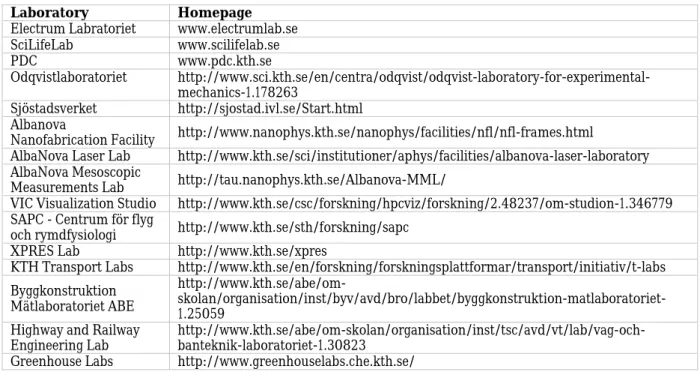
Domain knowledge was obtained by investigating the laboratory environments’ websites to create the material for the interviews, see Table 1.
Table 1. A collection of investigated laboratory homepages.
Laboratory Homepage
Electrum Labratoriet www.electrumlab.se SciLifeLab www.scilifelab.se PDC www.pdc.kth.se Odqvistlaboratoriet http://www.sci.kth.se/en/centra/odqvist/odqvist-laboratory-for-experimental-mechanics-1.178263 Sjöstadsverket http://sjostad.ivl.se/Start.html Albanova
Nanofabrication Facility http://www.nanophys.kth.se/nanophys/facilities/nfl/nfl-frames.html
AlbaNova Laser Lab http://www.kth.se/sci/institutioner/aphys/facilities/albanova-laser-laboratory AlbaNova Mesoscopic
Measurements Lab http://tau.nanophys.kth.se/Albanova-MML/
VIC Visualization Studio http://www.kth.se/csc/forskning/hpcviz/forskning/2.48237/om-studion-1.346779 SAPC - Centrum för flyg
och rymdfysiologi http://www.kth.se/sth/forskning/sapc XPRES Lab http://www.kth.se/xpres
KTH Transport Labs http://www.kth.se/en/forskning/forskningsplattformar/transport/initiativ/t-labs Byggkonstruktion
Mätlaboratoriet ABE
http://www.kth.se/abe/om- skolan/organisation/inst/byv/avd/bro/labbet/byggkonstruktion-matlaboratoriet-1.25059
Highway and Railway
Engineering Lab http://www.kth.se/abe/om-skolan/organisation/inst/tsc/avd/vt/lab/vag-och-banteknik-laboratoriet-1.30823 Greenhouse Labs http://www.greenhouselabs.che.kth.se/
The following information was identified from each website from a user-friendly perspective. The mapping is subjective and is only from the author’s perspective. The result can be viewed in Appendix B.
• Does the website contain structure?
• Does the homepage have explanatory texts and/or pictures?
• Does the website cater to industries?
• Is the laboratory’s equipment stated?
• Are the personnel stated?
• Is it mentioned what service they provide?
• Is it easy for industries to apply or contact them?
• Language? Swedish and/or English?
• Are the costs of the services mentioned?
3.2 Interview study
The interview has been created from (Osvalder, Rose, & Stig, 2010) Metoder - The preparations for the interviews include: purpose of the interview, relevant information about the participants, material, the information the participants will receive, what kind of data will be collected and how it will be analysed.
3.2.1 Preparations
Purpose and aims of the interviews:
To collect and map information from laboratories: how they work with external users and business contacts today, their potential overcapacity and their need to make their services and lab / instrument / equipment available for new external users / clients.
Users and information that will participate in the interview:
The equipment used is a recorder, about which the interviewees are informed. Each interviewee is responsible for the laboratory and the interviews were held at 15 different laboratories at KTH. The laboratories are considered to be nationally or regionally available for researchers, industries or other users.
The interviews were held at:
Each individual laboratory.
Data collected:
Recording of the interview such as notes and photos taken by the interviewer. There was also a clarification of ideas with the interviewees so the answers were well documented and easy to understand in a later stage of the project. Questions and reflections were collected from the participants after the test for further improvement for future interviews.
Implementation by the interviewer:
Good domain knowledge is required by the interviewer to formulate questions beforehand. The interviewer should be familiar with the topic and have a clear picture of which areas should be investigated. This is done by investigating and mapping each laboratory homepage, such as a basic knowledge about LIMS. It is important that the questions are formulated univocally, to avoid
misinterpretation. The interviewer should listen to all ideas and ask questions so she fully understands the ideas. The interviewer has full responsibility for documentation.
Analysis:
3.2.2 Performance
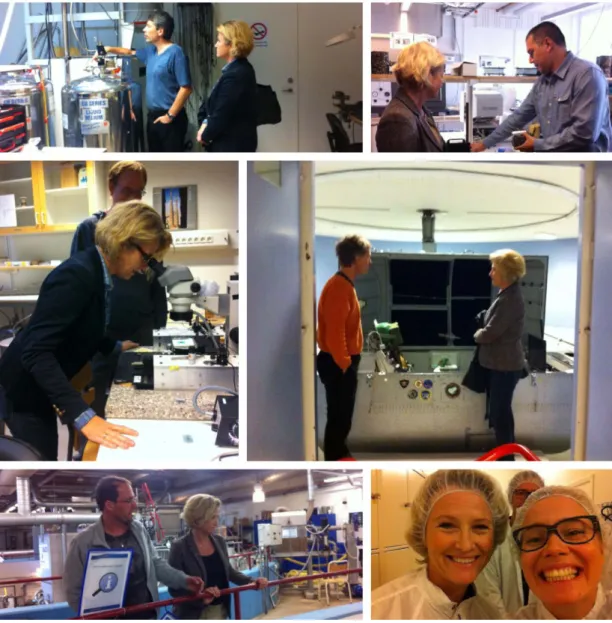
The same questions were asked to each laboratory director by the same people, Anna Svensson and Ulrika Ljungman, to obtain an equivalent result. A collection of images from the interview visits can be viewed in Figure 2.
Figure 2. Collection of images from laboratory environment visits.
3.3 Workshop
The preparations included purpose of the WS, relevant information about the participants, different material to be used, the information the participants would receive, what kind of data would be collected and how it would be analysed.
3.3.1 Preparations
To create the WS an event group was formed. It consisted of Ulrika Ljungman (Head of Department at KTH Business Liaison), Emma Ny (Communication Manager at KTH Business Liaison), Olof Sandberg (Chief Strategist at RISE Holding AB) and Anna Svensson (M.Sc. in Industrial Design Engineering). Their responsibility was to host the event, invite and gather together the laboratory directors and Anna would then present the result of the interview study and her analysis of future work. The information
about this event was given to the directors at KTH through an invitation during the interview and an e-mail was sent to all directors.
Purpose and aims of the WS:
The purpose of the WS was to initially create collaboration between the laboratory directors. The WS was created as an event to lift the subject: how to attract new users to the laboratory environment.
Materials used and participants in the WS:
The material used was PowerPoint presentations, Post-its, pens and two A3 papers. The majority of the invitations were sent to laboratory directors from KTH, SU and KI. A list of participants can be viewed in Appendix C.
The interviews were held at:
RISE Research Institutes of Sweden AB, Mäster Samuelsgatan 60, Stockholm.
Data collected:
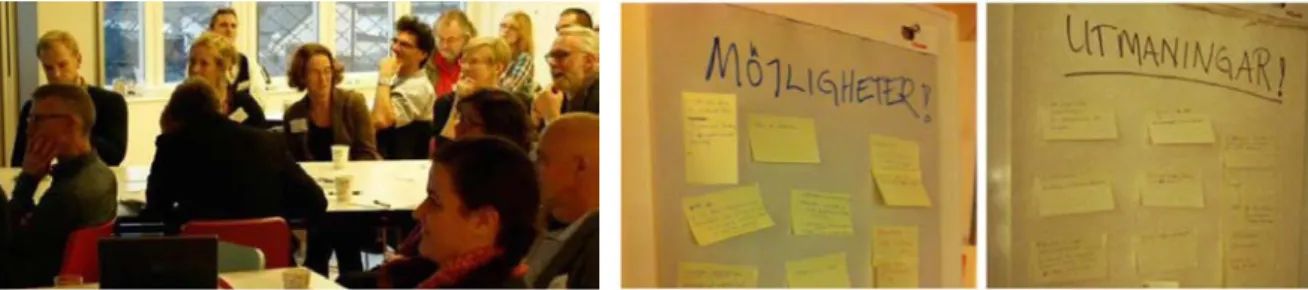
Notes by Anna Svensson and photos taken by Magnus Atterfors, editor at RISE and Anna Svensson. The participants were asked to state challenges and possibilities about how to attract new users to the laboratory environments on Post-its. Questions and reflections were also collected from the
participants.
Analysis
The possibilities and challenges as stated by the participants.
3.3.2 Performance
Olof Sandberg began the WS by welcoming everyone to the event then Ulrika Ljungman talked briefly about the purpose of the WS and about the project regarding availability of research infrastructure in Stockholm. Elin Swedenborg, Research Secretary at VR, informed everyone about VR’s plans for research infrastructure funding. Olof Sandberg mentioned how RISE makes its test beds available. This was followed by a group discussion, led by Ulrika Ljungman, where the participants were asked to state the challenges of how to attract new users to the laboratories. Anna Svensson then presented the interview study at the laboratory environments at KTH and briefly mentioned some results and analysis of suggestions of future possibilities. Björn Thuresson, Laboratory Director at VIC, explained how they make their laboratory environment available to new users. Ulrika continued with the group discussion, where the participants were asked to state the possibilities of how to attract new users to the laboratory environments. The discussion was summarised and a first WS schedule can be found in Appendix E. Figure 3 shows a picture from the WS.
4
RESULT
This chapter contains the results from information retrieval, benchmarking and the laboratories’ mutual requirements obtained from the interview study.
4.1 Information retrieval
The information retrieval was made in order to gather useful information for an overview of the different actions at each level – from national level to the laboratory level – and to construct a questionnaire for the interview study.
4.1.1 Different actions at three levels
The organisation, from national level to the laboratory level, was mapped in order to understand the different levels’ actions regarding research infrastructure.
Figure 4. Overview of three levels from The Swedish Research Council to Laboratories.
The three levels are:
National level: The Swedish Research Council is assigned to fund national research
(Vetenskapsrådet, p. 7).
Regional level: is defined as Stockholm’s County Board. Stockholm’s innovation strategy is a broad regional cooperation, where the aim is to gather and coordinate initiatives affecting Stockholm region’s ability to facilitate innovation and to identify the region’s key users of research infrastructure. The strategy contains five action plans. The action plan for research and innovation infrastructure is
managed by KTH. The action plan currently also involves KI, SU, RISE and Stockholm’s County Board.
Local level: represents both the universities in the Stockholm region and its laboratories that could
possibly be available for researchers, industries or other users.
1. Universities are responsible for their own infrastructure and equipment (Vetenskapsrådet, s. 7). They are also responsible for making the research infrastructure available regionally, nationally and internationally.
2. Laboratories: One demand from the Swedish Research Council is that the laboratories need to be
nationally and regionally open and available for researchers, industries and other users to receive funding form the Swedish Research Council (Vetenskapsrådet, p. 14). This means that the laboratories need to work with their visibility and “marketing” to new users.
National level
• The Swedish
Research
Council
Regional level
• Stockholm’s
County
Board
Local level
• Universities
• Laboratories
4.1.2 Investigation of each laboratory’s website
To construct the interviews, domain knowledge had to be received and an investigation of every laboratory website was made to construct the questionnaire for the interview study. The result of the investigation can be seen in Appendix B.
4.2 Benchmarking
Existing markets were examined to get an idea about how other institutions have proceeded to increase their laboratory availability and how the research infrastructure is currently available at KTH.
4.2.1 KTH research infrastructure
KTH research infrastructure is not an official name, but is used in this report as a collective name for 16 laboratory environments at KTH that could possibly be nationally or regionally available for researchers, industries or other users.
The following criteria have been used to form the first list of 16 laboratories at KTH. There is no current official name of the list. Arne Johansson (Vice Principal of Research at KTH), Ulf Karlsson (Professor at KTH) and Susanna Pehrson (Research Administrator at KTH) made these criteria. Each school dean connected to laboratory environments had the opportunity to give feedback and their opinions have been taken under consideration when the principal group at KTH constructed the latest list.
Criteria at different levels:
- National interests (existing) – to be of national interest the laboratories should be unique in that they are used by researchers or industries all from Sweden. They should also be open for use for non-KTH researchers.
- National interests (planned) – these are, according to the principal group, efforts that KTH can possibly do, but are not yet decided.
- National interest (possible) – this involves national interest of investments by KTH.
- Regional interests – laboratories that are used by external users but are not regarded to be unique in Sweden. The users are within the region.
- KTH laboratories – other research infrastructures that are large and/or collective infrastructures. Users are external users. The laboratories are not unique within the region. The list includes every large laboratory environment at KTH. The laboratory environments are not on the list because they have been pointed out by the KTH principal group as prioritised laboratories; rather the laboratories are stated on the list since the KTH principal group regards these laboratory environments to be of possible national or regional interest if there are interests from other actors (e.g. financially). A similar list has been requested from each university in Sweden by the VR’s
infrastructure council. The list will form VR’s future infrastructure system.
A general plan for development of these laboratories at KTH does not exist. Each laboratory environment is responsible for a plan, where the school dean is responsible. This plan is
4.2.2 Chalmers University of Technology in Gothenburg
Alf-Erik Almstedt, Vice President of Research at Chalmers University in Gothenburg, has drawn attention to the possibility of obtaining external grants for research infrastructure having changed in recent years, with focus on major infrastructures with a clear national need and interest (Wallquist, (CIS), & Ullberg, 2014, p. 3). Chalmers has therefore constructed a roadmap that contains both a short-term plan with objectives within a year and a long-term plan for five years (Wallquist, (CIS), & Ullberg, 2014). Chalmers has formed criteria for its laboratory environments at Chalmers, where they can obtain and sustain the status as a Chalmers research infrastructure. Chalmers’ criteria are (Wallquist, (CIS), & Ullberg, 2014, p. 4):
• Have a broad user base: be of interest and used by several research groups, from different divisions, at Chalmers.
• Be owned or controlled, fully or partly, by Chalmers, and organisationally and economically decoupled from research divisions.
• Provide access to all Chalmers researchers. All researchers at Chalmers must be treated equally with respect to user fees and conditions.
• Provide user support in terms of training on how to use the infrastructure.
• Have a clear vision and purpose, with focus and limitation.
• Have long-term planning concerning financing, use, upgrades, evaluation and decommissioning.
• Have a clear and efficient management and organisation.
• Be followed up annually, within Chalmers’ yearly planning process, with respect to the above criteria.
4.2.3 Current availability of KTH's laboratory environments
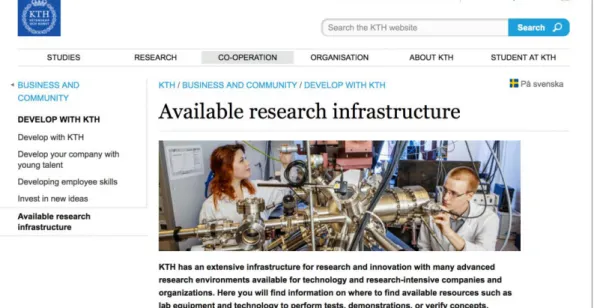
Each laboratory has a website, with very different user information. KTH Business Liaison has constructed a page at kth.se to increase the availably of research infrastructure. The laboratories are ranked with their website link. The layout of the page can be seen in Figure 5 or visited at kth.se.
4.2.4 A visualisation example of available laboratories.
A visualisation example of how KTH can get an overview of available laboratories is taken from ri.se. In order to get an overview, RISE, Research Institute of Sweden laboratories has mapped its
laboratories at its webpage, ri.se. The tiles are made by Stamen Design and Open Source, see Figure 6. Notes and comments are added to each laboratory. The information consists of the name of the laboratory, address and website.
4.3 Interview study
This chapter presents only the results used for the analysis of the mutual requirements of the laboratory environments, from the interview study. The interview study consists of four categories: capacity, cooperation, organisation and marketing.
4.3.1 Capacity
Comments: 13 of 15 laboratory directors feel that the laboratory has excess capacity and is in need of
more users. Several directors pointed out that more users would be beneficial for both the research within the area but also from an economic perspective. However, a few laboratory directors pointed out that the laboratory does not have the resources to assist new users with guidance to use the equipment.
4.3.2 Collaboration
Comments: 9 of 15 laboratory directors find it difficult to manage payment from different users: e.g. external researchers and industry. The laboratory environments handle payment in different ways and it often depends on the individual case. Most laboratory directors wish there was more help available, because of legal uncertainty and lack of knowledge. Some laboratory environments have a common LIMS-system, where three different levels of payment are constructed for internal research, external researchers and industry. Some laboratory managers have formed minor clusters with other laboratory directors in the areas they frequent and share their equipment and knowledge amongst themselves
87%
13%
Number of laboratory directors who consider their laboratory to have excess capacity
Yes No
60% 40%
Laboratory directors who consider collaboration between academia and industry to be difficult
Yes No
within the cluster. Sometimes there is equipment in other laboratories the laboratory director does not know about; therefore better collaboration between all laboratory environments in Stockholm is desired along with an easy way to share knowledge and equipment among the laboratory directors. 4.3.3 Organisation
Comments: The majority of laboratory directors feel stressed and the organisation is perceived as
being “heavy”. Making a decision can take a long time, because sometimes several steps and several people are involved. Another factor which contributes to slow organisation is that laboratory directors do not feel there is the enough support. Several laboratory directors feel they do not get enough time for their research, if they have one.
4.3.4 Marketing
80%
20%
Number of laboratory directors who think the laboratory organisation should be improved
Yes
No
100%
Laboratory directors who regard that their laboratory can be more available
Yes No
Comments: Every laboratory director considers that their laboratory can be more available. The
needs are different for the various laboratories. Some need support with social media and some need to update information on their website: e.g. visiting address, some laboratories were hard to locate and in some cases e-mail and/or a phone call had to be made to find out where the visiting address was. Most directors do not have the knowledge or the time to manage the availability of the laboratory. Every director wants support, in the shape of some kind of marketing of the availability of the laboratory. Today, the laboratories themselves are in charge of marketing. Most directors have a website and direct contact with users, while some directors arrange different kinds of events and are more visible in different social media. The majority of directors believe that appearance on a mutual platform is a good idea to increase the availability of the laboratories. Some laboratory managers prefer direct contact when initiating projects, while others prefer to use different booking systems. Some laboratories use LIMS to access their equipment, personnel and services which they offer, while some use other booking systems, which are connected to their e-mail. Most of the laboratories are accessed by direct contact.
4.4 Workshop
There were approximately 40 participants at the workshop and most of them were laboratory
directors. This means an initial meeting for laboratory directors at KTH, SU and KI has been created, see Appendix C for participant lists. The subject of the workshop was: How to attract new users to the laboratory environments. The workshop included insights from the Research Council, represented by Elin Swedenborg, Research Secretary, who presented the Council’s plans for external funding of research infrastructure. A brief summary of the result and analysis of the requirement analysis of KTH laboratory environments was presented by Anna Svensson. This probably affected the participants’ stated challenges and possibilities regarding how to attract new users to their laboratory environment but also confirmed that Anna’s analysis was received as the basis for the possibility of future work by the laboratory directors. A case of how to attract users was presented by Björn Thuresson, Laboratory Director at VIC, which probably also affected the result of the participants’ answers.
The following challenges and possibilities about how to attract new users to their laboratory
environment were stated by the participants. The answers were collected by Ulrika Ljungman, Head of Department at KTH Business Liaison.
Challenges
• Dare to let the infrastructures become available to others
• Operating costs
• Pricing to obtain economic sustainability
• Usage costs and costs to train users
• To customise offers requires individuals who can create the offer
• All lab instruments should be centralised, for all users
• No resources to increase the laboratory usage
• How to market towards SME
• Who will perform the selling process?
• How to set user fees to allow hiring more staff
• How to optimise the usage of equipment
• How can companies present themselves to an institution?
• Large facilities:
o find the research questions, then we will solve the task o find long-term financing
o visibility, to show where we are and what we can
• Receive knowledge about existing resources / infrastructures available
• High costs, payment opportunities?
• SME – costs too much, too much work – for example, applications
• Laws
• How to describe the knowledge and the value of knowledge to use the offer
Possibilities
• Use Facebook
• Increase awareness of the capabilities of the equipment on web pages and show examples of projects, etc.
• Make the equipment available on homepages with project examples
• The companies want to collaborate more today
• The power to meet and find complementary strengths together
• Collaborating in the EU creates better chances
• Clean up and organise efforts
• Education as a service
• Collaboration with industry
• Match making – SME -> large companies
• Developed technique should be available for use for SME
• Use the users’ network
• Use our name, universities’ and institutions’ names for credibility
• We should teach/involve and demonstrate more scientific knowledge, so they get inspired
• We need a base for increased staff. Experience leading to competence and stability
• Available capacity should be found through the web
• Arrange open houses for other laboratory environments to create a forum
• Concrete offer to new partners / users for effective technology transfer to business
• First test environment with customised level per customer
5
ANALYSIS
This chapter contains the analysis from the information retrieval and interview study. The analysis consists of mutual requirements and proposals for future work for laboratory environments. The analysis is concentrated on qualities for the 15 laboratory environments that were visited during the interview study at KTH and that can possibly be nationally or regionally available to researchers, industries or other users.
5.1 Mutual requirements of the laboratory environments
Mutual requirements of the laboratory environments concerns:
1.
Organisation
2.
Financing
3.
Users
4.
Collaboration
5.2 Suggestions for future work
The suggestions for future work are made from the mutual requirements and interview study with 15 laboratory directors at KTH. The suggestions are categorised by the mutual requirements which concerns: organisation, financing, users and collaboration.
Organisation
The Research Council believes that processes for monitoring, evaluation and prioritisation should be developed for existing and new infrastructures (Vetenskapsrådet, p. 8). And, according to Alf-Erik Almstedt, Vice President for Research at Chalmers University, a well-functioning organisation is of great importance to a successful operation and development of research infrastructure (Wallquist, (CIS), & Ullberg, 2014, p. 4). KTH’s research infrastructure organisations have been investigated and suggestions are made in order to accomplish an organisation which is adaptable for the Research Council’s and KAW’s development of external grants.
At KTH, 16 laboratory environments have been listed because KTH’s presidential group regards them to possibly be nationally or regionally available to researchers, industries or other users. A suggestion would be that the laboratory environments instead have to apply to become a KTH research
infrastructure by fulfilling clearly defined criteria, in order to obtain and sustain the status as a KTH research infrastructure. This could increase the engagement of the laboratory environments, perhaps by presenting a more clear budget plan on how the finance support will be used.
KTH’s criteria do not involve organisations’ demands on the laboratories. A suggestion would be to form criteria of the organisation since some laboratory directors feel stressed and in some cases do not regard the organisation as well-functioning.
Clearly define responsibilities: Many laboratory directors at KTH feel stressed and have too much
responsibility. A suggestion is that administrative, economical and scientific responsibilities are clearly defined. And these factors should not only be the responsibility of the directors.
Examples of support: The laboratory director at Greenhouse Labs has, in consultation with the
dean at the School of Chemical Science, set up an advisory committee including the laboratory director, the dean at the School of Chemical Science and representatives from, for example, KTH Innovation and STING to obtain a strong connection with commercial advisory expertise. This board will support the director and provide advice on business plan and strategy.
Besides the advisory committee, a management team is recommended, much like the Greenhouse organisation. It includes representatives for the research, students, director and school dean. The main task should be to develop tools for realising the vision and objectives within the laboratory
environment.
Financing
Several laboratories today fully depend on external financing. Alf-Erik Almstedt, Vice President for Research at Chalmers, has drawn attention to the fact that external financing will be changed (Wallquist, (CIS), & Ullberg, 2014, p. 3). KTH should, similarly to Chalmers, be adapted to the development.
Cooperation and alternative ways of external grant application are considered a key to a sustainable financing. Figure 7 illustrates an overview of suggestions on how to obtain sustainable finance.
Figure 7. An overview of how to obtain and sustain sustainable finance.
Collaboration of grant applications: For example, grant applications could be strengthened
through collaboration between laboratories. Such an application of many laboratory environments would probably increase the chance to receive external funding from the Research Council.
Collaboration with industries: Some laboratory directors find different types of funding through
collaboration with industries. The visualisation studio at KTH has handled exchange with industries: industries provide students and researchers with hardware in the form of beta versions which are not yet on the market and the researchers provide the industry with new ideas and techniques in return.
Service: Some laboratories provide users with training in the laboratory equipment. Some
laboratories arrange pubs where they organise seminars where one can appreciate the work of others. Perhaps increased training in the equipment for industry might be appropriate. It would need
suggestions on various courses and staff, and administration to perform the education. Perhaps if this was coordinated when courses are held for students it would not require extra time from the leader and provide industry input to the students.
Equipment, facilities and knowledge: Each laboratory with overcapacity could lease its
resources. They can also provide users with training in use of the laboratory equipment. An example of where a laboratory succeeded in doing so is the Electrum Laboratory, through LIMS.
Users
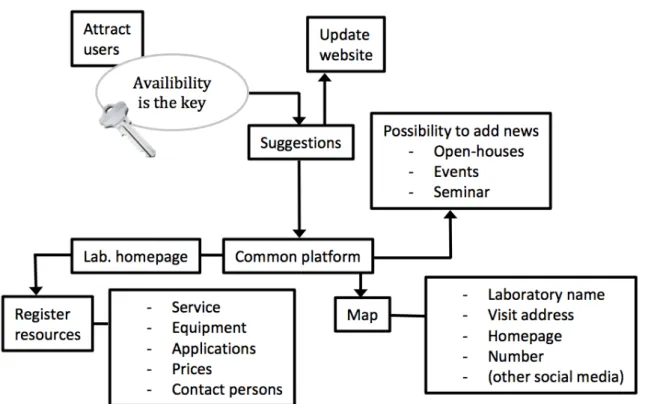
Several laboratories have excess capacity and are in need of more users. The key to attracting users is considered to be the availability to inform different users. An overview of suggestions to attract more users can be visualised in Figure 8.
Figure 8. Overview of suggestions to attract more users.
Common platform: kth.se contains a link to each laboratory website. To add user value each
website could register resources of service, laboratory equipment, prices, applications and contact information. It would be of great use if the laboratory directors could add news to the common platform.
The news: This could be open-house, events or seminars which could contribute to increased
Register resources: All laboratories have a visiting address and a website. In some cases, the
visiting address is hard to find and the location of the laboratory is not obvious and should be clarified. Key elements to include on each website are:
• Which equipment is available?
• What service can be provided?
• Laboratory applications
• Prices. Are they different for different users? Price of renting the equipment. Does the equipment demand specific knowledge or can it be used by the user by themselves? What would the price be with service support?
• E-mail and phone number to the contact person/persons
Update: Laboratory information updates could increase the availability and therefore add user-value.
The people in charge of each website should make a clear navigation to the laboratory, and clearly indicate on the website who is the contact person and laboratory director. A suggestion for each individual laboratory is to look at how users perceive the availability. It is then easier to understand the users’ perspective and to make sure the important factors to increase user-value are added.
Booking system: Some laboratory directors find LIMS to be a great tool for booking and others
prefer booking by e-mail. Most laboratory directors would prefer to be connected to a system and make their equipment bookable.
The map: The platform could contain a map of all laboratories for availability. The map would
provide an overview of Stockholm’s laboratory environment and thereby knowledge of the
laboratories’ existence. The map should contain laboratory name, visiting address, homepage, phone number and information on any social media. In order to increase accessibility and quickly illustrate available laboratory environments at KTH, maps have been proposed. The initial state was to identify each visiting address for each laboratory, see Table 2.
Table 2. Identification of each laboratory visiting address.
Laboratory Visit address
Electrum Labratoriet Isafjordsgatan 22
SciLifeLab Tomtebodavägen 23A
PDC Teknikringen 14
Odqvistlaboratoriet Teknikringen 8
Sjöstadsverket Henriksdalsringen 58
Albanova Nanofabrication Facility Roslagstullsbacken 21
AlbaNova Laser Lab Roslagstullsbacken 21
AlbaNova Mesoscopic Measurements Lab Roslagstullsbacken 21 VIC Visualization Studio Lindstedtsvägen 5 SAPC - Centrum för flyg och rymdfysiologi Berzelius väg 13
XPRES Lab Brinellvägen 68
KTH Transport Labs Drottning Kristinas Väg 48 Byggkonstruktion Mätlaboratoriet ABE Brinellvägen 23
Highway and Railway Engineering Lab Brinellvägen 23
Greenhouse Labs Teknikringen 38A
Figure 9. Snapshot from Google maps 2014-10-22.
The vision of the map was to add customer value by contributing an illustrative expression. A decision was made to update each laboratory’s (Johansson & Abrahamsson, 2010) environment to Google Maps, because it was considered to be both cost effective and a fast way of getting the information out there. Google Maps is also used by many people. For future work Google Maps will be added to kth.se to increase availability.
This availability is very local, but more work is underway to reach a national and international level. KTH Business Liaison has created a platform for KTH research infrastructures, with a link to the 16 laboratory environments at KTH that are regarded to be possibly available on a national and a regional level to researchers, industries and other users.
There are similar ways to handle the availability on a regional and EU level. On a regional level there are suggestions to use the existing platform Tools for Science and Science Link, on an EU level, see Figure 10 and Figure 11.
Collaboration
Several laboratory environments require support when initiating collaboration. How can laboratory environments receive support when initiating collaboration with the industry or other laboratory environments? What is needed?
Mutual issues have been investigated:
• Confidentiality
• Difficulties initialising collaboration with industries
• Insecure about payment from different users
An overview of the mutual issues and suggestions is illustrated in Figure 12.
Figure 12. Illustration of mutual issues and solutions regarding collaboration.
Template: A template is suggested for common ways to initially start collaborating with industry.
Lots of laboratory directors find it hard to start collaboration with industry, depending on rules of confidentiality and rules of payment. This template can be individualised to each case, but a template could be of great use for the directors in an initial collaboration.
3 level payment is used by the Electrum Laboratory where they have three different payments
depending on which user it is, internal researchers, external researchers and industry. Internal students use the resources for free.
L2L (Lab to lab) is a collaboration suggestion where the laboratory individual or a group invites other
laboratories where they can share laboratory knowledge. In this way can they easily learn from each other and organise periodic meetings to retain a close collaboration. Some suggestions for different themes can be viewed in Table 3.
Table 3. Some suggestions for different themes.
Laboratory Theme
Electrum Laboratory LIMS. How can LIMS be modified to a specific laboratory? e.g. Greenhouse Labs. SciLifeLab Homepage. How to reach users with the website.
PDC How laboratories can collaborate with external grant applications. Odqvist laboratory Odqvist laboratory consists of different laboratory environments. How does this cluster function? Advantages
and disadvantages.
Sjöstadsverket How to initiate collaboration with industries. Albanova Nanofabrication
Facility Theme suggestion is not decided. AlbaNova Laser Lab How to market the laboratory. AlbaNova Mesoscopic
Measurements Lab Theme suggestion is not decided.
VIC Visualization Studio How to initiate collaboration with industries. SAPC - Centrum för flyg och
rymdfysiologi How to adapt from being owned by FOI to being an academic environment. XPRES Lab How to run the laboratory by using different services. Attractive environment for meetings. How can this location
be used for alternative purposes? KTH Transport Labs How to attract students.
Byggkonstruktion
Mätlaboratoriet ABE Theme suggestion is not decided, Highway and Railway
Engineering Lab Theme suggestion is not decided.
6
CONCLUSION
This chapter contains the conclusion. The conclusion should answer the stated goals of the project. Initiate collaboration between KTH research infrastructures as well to industries.
Anna Svensson and Head of Department at KTH Business Liaison, Ulrika Ljungman, have visited each laboratory director/ manager and Ulrika Ljungman has been the direct contact to the laboratory directors, which has generated a first step for a future collaboration between the infrastructures. Collaboration has been initiated between laboratory directors on a regional level through a workshop in cooperation between KTH, SU, KI and RISE. From identifications of mutual requirements of KTH research infrastructures, suggestions for future collaboration have been developed. A short
introduction of the analysis was presented at a workshop. Lots of these ideas were then stated by the participants at the workshop, which shows that lots of the things mentioned from the analysis influenced their answers but also confirms that it is of interest for future work.
Identify relevant requirements in order to increase the availability at KTH research infrastructures.
16 of the KTH research infrastructures have been identified as being possibly nationally or regionally available for researchers, industries and other users. The infrastructures’ mutual requirements have been categorised within organisation, finance, users and collaboration.
Analyse the requirements and suggest improvements for future work.
The identification and analysis of KTH research infrastructures’ mutual requirements have led to suggestions for increased availability for future work. The suggestions are long or short term with focus on activities of the investigated laboratory environments at KTH. The suggestions can be found in Chapter 5, Analysis.
7
REFERENCES
Ullman, D. G. (2010). The mechanical design process (4 ed.). New York: McGraw Hill International. Wallquist, M., (CIS), & Ullberg, A.-L. (2014). Riktlinjer för Chalmers forskningsinfrastrukturer. Forskning. Göteborg: Chalmers.
Vetenskapsrådet. Vetenskapsrådets guide till infrastrukturen 2012.
Johansson, J., & Abrahamsson, L. (2010). Produktions- och arbetsorganisation. In M. Bohgard, S. Karlsson, E. Lovén, L.-Å. Mikaelsson, L. Mårtensson, A.-L. Osvalder, et al., Arbete och teknik på människans villkor. Stockholm: Prevent.
Maylor, H. (2010). Project Management, fourth edition. Harlow: Pearson Education Limited. Osvalder, A.-L., Rose, L., & Stig, K. (2010). Metoder. In L. Abrahamsson, R. Akselsson, M. Albin, M. Bohgard, J. Eklund, M. Ericson, et al., M. Bohgard, S. Larsson, E. Lovén, L.-Å. Mikaelsson, L. Mårtensson, A.-L. Osvalder, et al. (Eds.), Arbete och teknik på männsikans villkor (2:1 ed.). Stockholm, Sverige: Prevent.
Interviews
Nils Nordell Electrum Lab 17-Sep-14
Fredrik Sterky SciLifeLab 13-Oct-14
Erwin Laure PDC Parallelldatorcentrum 08-Sep-14
Daniel Söderberg Odqvistlabratoriet 26-Sep-14
Christian Baresel Sjöstadsverket 17-Sep-14
Anders Liljeborg AlbaNova Nanofabrication facility / Myfab 24-Sep-14
Peter Unsbo AlbaNova Laser Laboratory 26-Sep-14
Vladislav Korenivski AlbaNova Mesoscopic Measurements Lab 26-Sep-14
Björn Thuresson VIC Visualization Studio 15-Sep-14
Ola Eiken SAPC - Centrum för flyg och rymdfysioloig / Swedish
Aerospace Physology Center 24-Sep-14
Bengt Lindberg XPRES Lab 30-Sep-14
Peter Georén KTH Transport Labs 08-Sep-14
Stefan Trillkott Byggkonstruktion Mätlaboratoriet ABE 03-Oct-14 Alvaro Guarin Highway and Railway Engineering Laboratory (Väg- och
bantekniklaboratoriet) 01-Oct-14
0 (42)
1
Appendix A
2
Appendix B
3
Appendix C
Workshop participants.
Nya användare till test- och demoanläggningar
Seminarium 27 november 2014 kl 14-16.30
Plats: RISE Research Institutes of Sweden AB, Mäster Samulesgatan 60, 9 tr
Deltagarlista
Deltagare
Organisation
e-post
Alvaro Guarin
KTH
[email protected]
Anders Liljeborg
Albanova Novofab. Fac.
[email protected]
Anki Nordqvist
Karolinska Sjukh.
AKM/KERIC
[email protected]
Anna Svensson
Anna Svensson Consulting/
KTH Näringslivssamverkan
[email protected]
Anneli Önsten
KTH
[email protected]
Annika Kihlstedt
Innventia
[email protected]
Arne Johansson
KTH
[email protected]
Björn Rozell
Karolinska institutet
[email protected]
Björn-Erik Erlandsson KTH
[email protected]
Daniel Söderberg
KTH
[email protected]
Daniel von Sydow
Karolinska sjukh.
[email protected]
Emelie Johansson
KTH
[email protected]
Erwin Laure
PDC/KTH
[email protected]
Filip Kjellgren
Vinnova
[email protected]
Francesca Chiodi
Karolinska institutet
[email protected]
Gunnar Svensson
MMK, SU
[email protected]
Helena Berglund
Karolinska institutet
[email protected]
Hjalmar Brismar
KTH, SciLifeLab
[email protected]
Jan Andersson
Acreo Swedish ICT
[email protected]
Jan-Erik Nowacki
Nowab, KTH, SKVP
[email protected]
Sperens
Jens Fridh
KTH
[email protected]
Joakim Hedegård
Swerea
[email protected]
Johanna Tollbäck
SU
[email protected]
Jonas Gurell
Swerea KIMAB
[email protected]
Karin Athley
Innventia
[email protected]
Kjell Jansson
MMK, SU
[email protected]
Leif Nordlund
KTH
[email protected]
Lena Brynne
SLL
[email protected]
Lilit Axner
KTH-PDC
[email protected]
Magnus Larsson
SP Process Development
[email protected]
Maria Johansson
KI
[email protected]
Maria Lindqvist
Länsstyrelsen Sthlm
[email protected]
Mark Divers
Karolinska institutet
[email protected]
Mattias Öhr
Länsstyrelsen Sthlm
[email protected]
Mohsin Saleemi
MMK, SU
[email protected]
Nils Nordell
KTH Electrum
[email protected]
Olle Vogel
KK-stiftelsen
[email protected]
Olof Sandberg
RISE AB
[email protected]
Raoul Kuiper
Karolinska Institutet
[email protected]
Susanna Pehrson
KTH
[email protected]
Sylvie Leguyader
KI
[email protected]
Teresita Qvarnström
Acreo Swedish ICT
[email protected]
Tessie Borg
KTH, Greenhouse Labs
[email protected]
Tove
Rylander-Rudqvist
Karolinska institutet
Ulrich Haussermann
SU
[email protected]
Ulrika Ljungman
KTH
[email protected]
Vladislav Korenivsky
KTH
[email protected]
4
Appendix D
Workshop invitation.
Hur gör man för att attrahera nya användare till sitt lab/ test- o demoanläggning?
Innovationskraft Stockholm, Stockholms innovationsstrategi, har identifierat tillgången till
forskningsinfrastruktur som en nyckelfråga för att attrahera investeringar i forskning och innovation. Det handlar både om investeringar i ny infrastruktur men också om att bättre och effektivare utnyttja den befintliga. Vetenskapsrådet har också tagit fram riktlinjer för den framtida finansieringen av forskningsinfrastruktur vilka leder till ökat behov av samverkan. Vinnova genomför tillsammans med RISE Research Institutes of Sweden en strategi för att öka tillgängligheten av testbäddar, särskilt för lärosäten och små och medelstora företag.
Därför vill Stockholms Universitet, KTH, Karolinska institutet och RISE bjuda in dig som är
verksamhetschef, lab-chef eller motsvarande för att diskutera hur vi i samverkan bättre kan utnyttja och marknadsföra den forskningsinfrastruktur som finns i regionen. Vid seminariet kommer det att finnas goda möjligheter till att träffa kollegor som arbetar inom samma teknikområde.
Tid: 27 november kl 14.00-16.30
Plats: RISE Research Institutes of Sweden AB, Mäster Samuelsgatan 60, plan 9 Program
Innovationskraft Stockholm Handlingsplan för tillgängliggörande av forskningsinfrastrukturen i regionen
Vetenskapsrådet VR:s planer och framtid för finansiering av forskningsinfrastruktur
Vinnova Betydelsen av testbäddar i
innovationsprocessen
RISE Så jobbar RISE för att tillgängliggöra sina testbäddar, särskilt för lärosäten och till små och medelstora företag. Projekt och exempel
KTH Så synliggör KTH sin forskningsinfrastruktur. Projekt och exempel
Gruppmöten Möjligheter att möta kollegor inom Stockholm-regionens styrkeområden, bl a Life Science, material, IT
Länk till anmälan senast 24 november:
https://www.netigate.se/a/s.aspx?s=183895X1013
Välkommen!
Ulrika Ljungman, KTH Olof Sandberg, RISE Mats Andersson KI Johanna Tollbäck, SU
5
Appendix E
SCHEMA för workshop 27 nov 2014 14.00-16.30 på RISE
14,00-14.05Välkomna! Olof Sandberg, RISE 5 min
14.05-14.10
Inledning! Ulrika Ljungman, KTH Näringslivssamverkan, 5 min
Varför är vi här? Vad är Innovationskraft Stockholm och vad är uppdraget? - Handlingsplan för tillgängliggörande av forskningsinfrastrukturen i regionen
14.10 -14.25
Vetenskapsrådet Elin Swedenborg, Forskningssekreterare Infrastruktur 15 min
- VR:s planer och framtid för finansiering av forskningsinfrastruktur. (+ frågor 5min)
14.30-14.45
Vinnova Filip Kjellgren 15 min
- Betydelsen av testbäddar i innovationsprocessen
14.45-14.55 Olof Sandberg
RISE Projekt för tillgängliggörande 10 min
- Så jobbar RISE för att tillgängliggöra sina testbäddar, särskilt för lärosäten och till små och medelstora företag.
14.55-15.05 Olof Sandberg
RISE Exempel på test/demoanläggning 10 min
15.05-15.20 Ulrika Ljungman
Rundabordssamtal/Gruppdiskussion 15 min
Möt kollegor inom Stockholm-regionens styrkeområden, bl a Life Science, material, IT
15.20-15.30
Feedback från gruppsamtalen och diskussion i helgrupp 10 min 15.30-15.40
KTH Projekt Anna Svensson
- Så synliggör KTH sin forskningsinfrastruktur.
10 min
15.40-15.55 Björn Thuresson
KTH Exempel på tillgänglig miljö: VIC –Visualiseringsstudions tillgänglighet. 15 min
15.55-16.10 Ulrika Ljungman
Rundabordssamtal/Gruppdiskussion 15 min
Möt kollegor inom Stockholm-regionens styrkeområden, bl a Life Science, material, IT
16.10-16.20
Feedback från gruppsamtalen och diskussion i helgrupp 10 min
16.25-16.30 Olof Sandberg