Slovak University of Technology in Bratislava
FACULTY OF INFORMATICS AND INFORMATION TECHNOLOGIES
FIIT-5220-64357
Bc. Tomáš Jendek
Intelligent identity information
processing
Diploma thesis
Degree course: Software Engineering
Study field: 9.2.5. Software Engineering
Department: Institute of informatics and software engineering, FIIT STU Bratislava Supervisor: Ing. Radovan Semančík, PhD.
Education supervisor: Ing. Anna Považanová
Anotácia
Slovenská technická univerzita v Bratislave
FAKULTA INFORMATIKY A INFORMAČNÝCH TECHNOLÓGIÍ Študijný program: Softvérové inžinierstvo
Autor: Bc. Tomáš Jendek
Diplomový projekt: Inteligentné spracovanie údajov o identitách Vedenie diplomového projektu: Ing. Radovan Semančík, PhD. Pedagogický vedúci: Ing. Anna Považanová
Máj, 2014
Správa identít je oblasť, ktorá sa zaoberá získavaním a spravovaním informácií o používateľoch v informačných systémoch, ich právach a prístupových účtoch. Práve informácie o prístupových účtoch a právach používateľov sú mnohokrát umiestnené v rôznych databázach a úložiskách údajov ktoré sú často heterogénne. V súčasnosti existujú systémy na správu identít, ktoré integrujú informácie z desiatok až stoviek podsystémov. Tieto podsystémy môžu v podnikovej sfére a v reálnom nasadení obsahovať tisícky záznamov o používateľských identitách. Čím viac podsystémov je integrovaných, tým je väčšia šanca vznikaní nekonzistentnosti.
Hlavným problémom integrácie je nedostatočná korelácia medzi záznamami o identitách. Existuje niekoľko prístupov ku tomuto problému, avšak ani jeden nie je dostatočne efektívny. Niektoré z týchto prístupov zahŕňajú korelačné výrazy a potvrdzovacie pravidlá, ktoré sú príliš jednoduché pre zložitejšie prípady nasadenia. Rovnako existuje mnoho prác o prepájaní záznamov a algoritmov pre hľadanie podobnosti znakov slov, avšak žiadny z prístupov neposkytuje verejne dostupné riešenie. Nedostatok automatických riešení má za následok manuálnu koreláciu identít, ktorá je síce najpresnejšia, avšak pre veľké organizácie časovo náročná.
V našej práci analyzujeme existujúce prístupy v oblasi správy identít, podobnosti záznamov o používateľoch a korelácie používateľov s využitím algoritmov strojového učenia. Predstavujeme návrh metódy na automatickú koreláciu údajov o identitách z rôznych systémov. Hlavný prínos našej metódy spočíva v automatizovaní procesu korelácie s využitím čo najmenej manuálnej práce. Naša metóda pomocou algoritmov na podobnosť reťazcov a algoritmov strojového učenia poskytuje možnosť spájať záznami o identitách z viacerých zdrojov. Implementáciu navrhnutej metódy realizujeme pomocou webovej aplikácie a overujeme pomocou experimentou s údajmi o zamestnancoch Slovenskej techniskej univerzity v Bratislave.
ANNOTATION
Slovak University of Technology Bratislava
FACULTY OF INFORMATICS AND INFORMATION TECHNOLOGIES Degree Course: Software Engineering
Author: Bc. Tomáš Jendek
Diploma project: Intelligent identity information processing Supervisor: Ing. Radovan Semančík, PhD.
Educational supervisor: Ing. Anna Považanová 2014, May
Identity management systems manage various identity sources, integrate them and provide identities access to various heterogeneous systems. These identity sources often consist of records with various inconsistent attributes and thus integration can be difficult. Nowadays there are identity management solutions which integrate information from various stores, from tenths to hundreds of subsystems. Subsystems used in corporate sphere can include thousands of records with identity information. The more subsystems are integrated the more likely occurrence of inconsistent identity data is.
Main problem with integration is the proper correlation of identity records from various heterogeneous identity sources. Some correlating mechanisms were proposed, but neither of them is sufficient. For example correlation expressions and confirmation expressions are too simplistic to handle complicated scenarios. There are also many literature sources describing record linkage processes and string matching algorithms. However there is lack of open solutions for this problem. The lack of available automated solutions result in manual correlation, which is probably the safest way to correlate identities. But it is too time-consuming for larger identity management deployments.
In our work we analyze existing approaches in field of identity management systems, record matching, data deduplication and correlation of user records with using string similarity algorithms and machine learning approaches. We propose method for automatic correlation of identity records from various sources. Main asset of our work is automation of correlation process and saving manual work. Our method uses string similarity algorithms and machine learning algorithms for correlating identity records. Implementation is realized as web application and verification is done by experimenting with dataset from Slovak university of technology in Bratislava.
Table of Contents
1 Introduction ... 1
2 Identity Management ... 3
2.0.1 Basic Principles in Identity Management ... 4
2.1 Identity Stores ... 5
2.2 Access Management... 5
2.3 Provisioning ... 7
2.4 Role-Based Access Control ... 8
2.5 Reconciliation ... 9
3 Identity Correlation ... 11
3.1 Record Linkage ... 12
3.2 Typical Errors in Matching Variables ... 14
3.3 String Normalization ... 14
3.4 String Comparison Methods ... 15
3.5 Machine Learning Data Correlation ... 17
3.6 K nearest neighbor ... 18
3.7 Support vector machines SVM ... 18
3.8 Neural networks ... 19
3.9 Decision trees ... 20
4 Account Correlation in Identity Management Systems ... 21
4.1 Oracle Identity Manager ... 21
4.2 Open IAM... 21
4.3 OpenIDM ... 22
4.4 midPoint ... 24
5 Correlation method proposal ... 27
5.1 Data preparation and normalization ... 27
5.2 Attribute extraction ... 28
5.2.2 Last name extractor ... 28
5.2.3 Title extractor ... 28
5.2.4 Email address extractor ... 29
5.3 Partitioning ... 29
5.4 Similarity algorithms ... 30
5.5 Machine learning algorithms ... 32
6 Correlation framework ... 33
6.1 Dataset ... 35
6.2 Implementation ... 36
7 Experiments ... 37
7.1 String similarity metrics and attribute weights ... 38
7.2 Machine learning algorithms comparison ... 40
7.3. Experiment summary ... 44
8 Conclusion ... 45
References ... 47
Appendix content ... 51
Appendix A –Use case diagram ... 51
Appendix B –Class diagrams ... 51
Appendix C –Component diagram ... 51
Appendix D - User manual ... 51
Appendix E – Experiment examples ... 51
Appendix F – Content of digital medium ... 51
1
1
Introduction
Identity management systems manage various identity sources, integrate them and provide identities access to various heterogeneous systems. These identity sources often consist of records with various inconsistent attributes and thus integration can be difficult. Nowadays there are identity management solutions which integrate information from various stores, from tenths to hundreds of subsystems. Subsystems used in corporate sphere can include thousands of records with identity information. The more subsystems are integrated the more likely occurrence of inconsistent identity data is.
Main problem with integration is the proper correlation of identity records from various heterogeneous identity sources. Some correlating mechanisms were proposed, but neither of them is sufficient. For example correlation expressions and confirmation expressions are too simplistic to handle complicated scenarios. There are also many literature sources describing record linkage processes and string matching algorithms. However there is lack of open solutions for this problem. The lack of available automated solutions result in manual correlation, which is probably the safest way to correlate identities. But it is too time-consuming for larger identity management deployments. Our aim is to design and develop effective method for user correlation with emphasis on the automation of matching process. This thesis is divided into sections. Section 2 describes principles in identity management especially identity stores, access management, provisioning, reconciliation. Section 3 describes identity correlation mechanisms like record linkage, string similarity algorithms etc. Section 4 presents analyzes of existing identity management solutions with focus on identity correlation. Section 5 presents correlation method proposal with data preparation process, normalization and detection methods. In section 6 we describe implementation of our correlation framework and dataset. In section 7 we describe experiments and results of our method.
We conclude with evaluation of our project and possibilities for further development.
3
2
Identity Management
Identity management manages identities in cyberspace. [5] It is also defined as combination of technologies and practices for representing and recognizing entities as digital entities in cyberspace. Identity management systems are not same for every organization, because of specific requirements of each organization. Main purpose of identity management system is integration of identity data, process and handle their life cycle including creation of new identities, modification and deletion.
[4] Person in digital world can be described as set of attributes which can be managed by technical means which is called digital identity (Figure 1). Digital identity uses personal data which can be stored and automatically processed by computer application. Term virtual identity is used as synonym to digital identity.
Identity in general is exclusive reception of life integrated into social group, which is bound to body and is constantly shaped by society around this identity. Identity is also any subset of attributes which identifies individual within set of individuals. “I” represents individual self as instance of liberty and initiative. “Me” represents social attributes which define human identity.
[21] Role is a set of connected actions taken by identity in specific social situations which is basically expected behavior. Technical description of identity is digital identity, which consists of attribute identifiers of individuality.
Partial identity is subset of person attributes both in real and digital world which represents person in specific situation or context. Usually person uses more than one partial identity e.g. for work, school or other activities. Partial identities contain information on person, which can be static (birthplace) or dynamic (phone number). Person may use different names – nicknames or pseudonyms.
User account stores all information about person in cyberspace. It can be also called user record, user identity or simply account. User account stores information about real world person for example surname or age. It also stores technical information in context of system, in which account was created for example account permissions or system resource settings.
4 Figure 1. Person in cyberspace
Growth of Internet and distributed systems forced field of identity management to change from manual processes to fully automated processes. [6] There are three main environments with their specific problems within identity management: enterprise, internet and government. There are three areas of identity management technologies dealing with each environment:
Enterprise identity management which takes place in enterprise environment and automate user management, authentication and authorization
User-centric digital identity management take care about user’s data in Internet environment
Government digital identity management focus on data managed by government and has serious legal aspects of person’s lives
Identity management is important for organizations which need to provide access to different subsystems for their employees or contractors. It is also need to manage life cycle of hiring new people by creating new accounts, modify them, or disabling accounts for fired employees. Every employee in organization has his own role, which need to be represented by technical means by providing access rights to resources. These roles and rights can change in time, so there is need to capture changes in system. Large organizations need to integrate numerous systems and subsystems and identity management systems reduce complexity and difficulty of integration process.
Identity management contains various technologies and we can define three main technology groups:
Identity stores
Access management
Provisioning
2.0.1 Basic Principles in Identity Management
Anonymity and pseudonymity are core concepts preserved in identity management systems. [1] Anonymity is state of being unidentifiable or not uniquely characterized within anonymity set – set of subjects. Subject is acting entity i.e. human or computer. Subject anonymity can be enabled only if there is an appropriate set of subjects with same attributes. Anonymity ensures that user can use service without exposing his identity.
Pseudonymity uses pseudonyms as identifiers. Being pseudonymous is state of using a pseudonym. Pseudonyms are identifiers of subjects and he holder of pseudonym is subject which the pseudonym refers to. Pseudonyms are another kind of attributes widely used in IT systems because pseudonymity ensures that user can use resource or service without exposing his identity, but still can be able to use it. Digital pseudonyms are strings, which
5 has to be meaningful in certain context. It also must be unique as an identifier and must be able to authenticate the holder’s actions.
2.1 Identity Stores
Identity stores hold information about user’s accounts and are often shared with other application within organization trough network. Identity stores use various technologies, especially Directory Services which provide storing user and accounts in tree structure for example LDAP (Lightweight Directory Access Protocol). Active directory is directory service which provides authentication and authorization users and computers within Windows domain type networks.
Directory services often use [27] LDAP protocol, which is application protocol for accessing distributed directory information services over network. Directory information services can provide structured records such as organizational email directory. LDAP protocol is very popular because of his scalability.
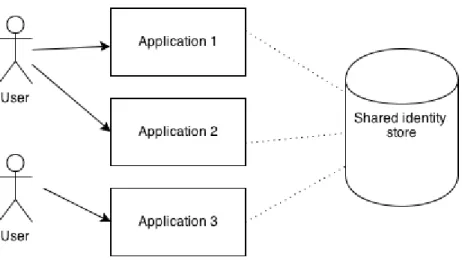
Identity store can be part of one application, or it can be shared with more than one application (Figure 2).
Figure 2. Shared identity store
2.2 Access Management
Access management manages user authentication and authorization and unifies security processes. In many systems the importance of resource security is paramount, especially in identity management which deals with sensitive personal data.
Authentication is part of access management which provides verification of users. It is the process of establishing who a person is and creating trust relationship between system and consumer of services. There are many options for authentication for example using matching process between public identifier (user name) and private identifier (password) or digital certificates.
6 Authorization takes place when user is successfully authenticated and need access to system resources. Authenticated identity has certain set of permissions and authorization deals with determining which permissions will be granted to identity.
[8] Single sign-on (SSO) is concept that provides user to authenticate once and gain access to all systems without logging again. Single sign-on concept is part of access management. User has to remember only one password to get access to many different systems and resources. [7] There are four types of SSO:
Enterprise SSO connects systems within same enterprise
Multi domain SSO connect multiple systems across multiple enterprises
Web SSO connects applications and services across the web
Federated SSO connect systems based on federated identities by combining identity attributes from multiple IDM systems
There is a variety of architectures which can be used for SSO implementation:
Broker-based SSO
Agent-based SSO
Token-based SSO
[10] In Broker-based SSO solution there is one server for central authentication and broker gives electronic identity that can be used for requesting access to various systems. [28] Kerberos is an authentication protocol for TCP/IP networks and it is basic model for a broker-based Single Sign-on architecture. It uses trusted Kerberos server which is actually broker. Kerberos server centrally authenticates users and give them electronic identity based on the credentials given. After the user was authenticated on server, he gets ticket for different services and applications.
Agent-based SSO solution is based on agent program placed on server side acting as interpreter between authentication system and authentication method used by client. The SSH is an example of agent-based solution.
[9] Token-based SSO uses physical token that generates time dependent one-time passwords for user authentication. When user logs on system, a centralized authentication server will authenticate user and generates user token including session key and time stamp. User can use token to access various application servers. These servers send users request to centralized authentication server for token validation. SecurID is one of implementations of this token and is based on synchronized clock on hardware token and network server. Generated password is accepted only within certain time window.
7 Figure 3. Single sign-on schema
2.3 Provisioning
Provisioning part of identity management systems take care of managing and integrating many identity stores. Provisioning systems synchronizes various data and models from many sources by replicating changes to the different resources. Provisioning includes complex rules and expressions mechanisms to match models of connected systems and stores.
For example hiring new employee starts with creating record about person in human resource system. Provisioning system then automatically detects new record and assign role to user. Based on role provisioning system creates accounts in the external systems.
Another example can be when work position of an employee changes and new role must be activated. Provisioning system detects change made in the human resource system , changes the role and creates new accounts.
[14] Identity management systems provide alternatives to provision resources to authorized users on request-based, role-based and hybrid approach. In request-based approach, users request access to special applications and resources with certain privilege levels within system. Requests are validated by workflow driven approvals. Administrators are alerted to new or unused accounts and have an option to activate, modify or delete such accounts.
Role-based provisioning approach automates process of granting access to resources. Users are assigned to roles and get specific set of accounts and access rights based on their role. User can be removed from role and entire set of corresponding accounts and rights are removed.
Hybrid approach combines request and role-based approach. Automated role-based assignment access rights and accounts can be enriched by providing options to manage accounts manually.
8 Figure 4. Identity management system
2.4 Role-Based Access Control
Large organizations has to deal with unauthorized access to organizational resources, applications or external systems. Role-based access control (RBAC) is one of the most known access control standards. It simplifies access control policies by grouping users in roles, which are ordered in a role hierarchy. [12] There are overlapping responsibilities and privileges that users can have within organization and users with different roles may need to do common operations. A role hierarchy defines roles that can contain other roles which mean that one role can use operations from another role. Role is abstraction that contains set of responsibilities with corresponding allowed operations. Privileges are assigned to role which means that certain role has predefined set of operations within system. As shown on figure 5, user cardiologist has role Cardiologist which contains privileges of doctor role and intern role.
[11] RBAC abstraction provides security administration at business enterprise level rather than at the user identity level. Functional roles in organizations are captured as role with defined permissions and role, or set of roles are assigned to user.
9 Figure 5. Role hierarchy
2.5 Reconciliation
Reconciliation is process of synchronization user account from various resources and purpose is to create user-centric identity system that holds single profile with links to accounts in other systems. For determination of an ownership reconciliation compares account information between information from user accounts. [22] There are multiple options for reconciliation for example automatic matching accounts with consistent unique identifiers, matching other attributes or using mapping tables if they are available in organizations. Reconciliation process is based on following steps:
Reading relevant information from the source system
Match the information from the source system to existing information in the identity store using a correlation function (correlation rule)
Read relevant information from identity store
Compare the information retrieved from the source system with the information in the identity store and calculate differences
Perform defined actions based on calculated differences
Information represents user attributes and permissions or roles. Actions to be performed are for example modification of user when account is linked, delete or unlink account, resolve collision etc.
11
3
Identity Correlation
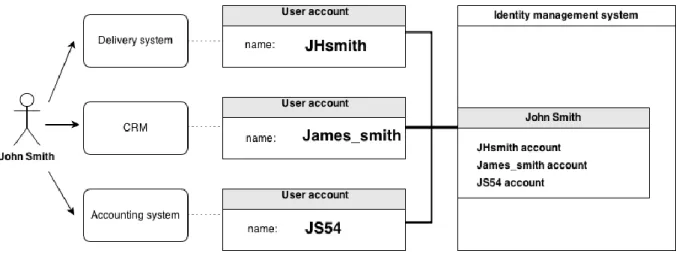
Identity can operate under various accounts in different systems with different names (Jhsmith, James_smith, JS54), addresses etc. as shown on figure 6. Identity management systems need to keep user accounts linked, so that multiple user accounts from various systems can be easily changed. For example if the surname of employee changes after marriage, identity management system changes this name in all subsystem accounts. Or in case of firing employee, all accounts must be disabled or destroyed which is called de-provisioning. Identity correlation is process of reconciliation and validation of multiple user accounts which are linked by individual ownership. Identity matching is usually done by comparing user attributes using expression languages. Identity correlation is part of account linking process. Links are usually created automatically, but there is need to manually verify results of linking. Manual linking does not scale and is not efficient.
Identity management systems provide integration of various identity stores containing heterogeneous data. Usually there is no single authoritative source, so integration can be very difficult. Main goal of integration is to map identities or user accounts from various sources using for example rule engines, or expression languages. Integration is used by synchronization mechanisms which checks correctness of user account state - consistency.
Figure 6. Identity correlation
Existing provisioning systems usually use simple correlation expressions to match the identities as shown on figure 7. These expressions get information from the account and build search query for finding owner of an account. Correlation expression is usually parametric search query, i.e. a search query with some parts determined by a dynamic expression. When correlation expressions match two or more accounts, confirmation expressions take place. Confirmation expression provides comparison of potential users accounts.
12 Figure 7. Correlation and confirmation expression schema
3.1 Record Linkage
Organizations often need to identify and match records within large databases. Especially in systems which are dealing with personal data integration.
User account records in databases consist of attributes for example name, address, date of birth etc. These attributes often contain typographical errors (misspelling, missing letters, incomplete words, incorrect or missing punctuation, abbreviations and fused or split words), data representation across sources may differ or change in time, which make duplicate identification very difficult.
[15] Record linkage is methodology of matching corresponding records from two or more sources or finding duplicates in files. Identity management deals with situations where several account records from various identity sources may refer to the same real world entity while not being syntactically equivalent. Set of records which refer to the same real world entity can be in general interpreted in two ways. First is to take one of the records as correct and the other records as duplicates containing errors. There is need to clean error duplicates. Other way is to merge matching records as partial sources of information to create one complete record. This is common with identity management systems, where is need to map records but not necessarily change them.
Record linkage involves bringing potential matches together for comparison including duplicate detection. It also involves comparison of potential record pairs whether they belong to the same real world entity. There are two approaches:
Probabilistic linkage
Deterministic linkage
Deterministic linkage is also called exact due to exact one to one matching character within linkage variables with one high quality identifier. Probabilistic linkage uses combination of the partial identifiers for example first name, email or address to compute weights for each potential match based on probabilities.
[17] Duplicate detection in record linkage is straightforward method for revealing exactly same records – real world entities. Records are sorted in a table and then
13 neighboring tuples are checked. This approach could be also used to detect approximate duplicates. Sorting is based on application-specific key for example first name and last name so that likely records appear near each other. There are duplicate detection algorithms using sliding window of fixed size for sorted records. The size of window is W
and i is record, i is compared with record i-W+1trough i-1 if i > W, and otherwise with records 1 trough i-1. Repetitions and combining results of sliding window matching with small window size lead to better results as one repetition with large size of window.
[16] Traditional approaches to duplicate detection are on approximate string matching criteria. It can be enriched with domain specific rules. Recently there have been new adaptive approaches which use attributes and labeled data. Persons similarity is enriched with additional attributes for instance if two accounts refers to same location, or same workgroup, it is highly probable that these accounts belongs to same person.
Record linkage matching results are dependent on attribute value having errors and inconsistencies. Different attributes need different metrics when comparing values.
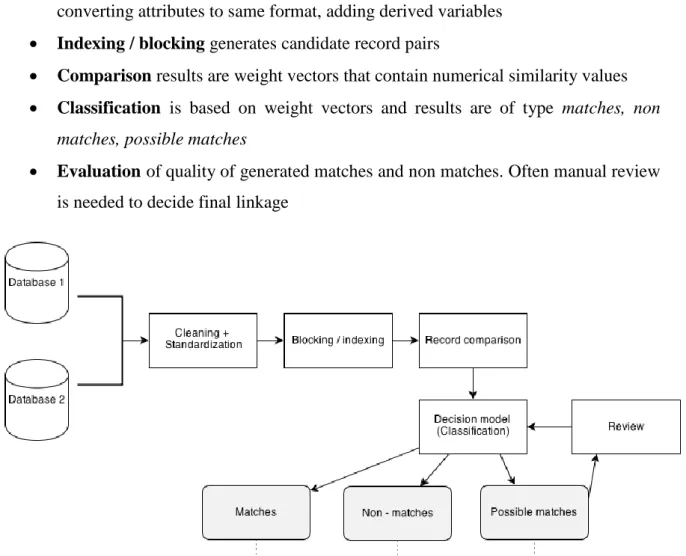
[20] Record linkage process consists of five steps (figure 8):
Cleaning and standardization deals with data errors and inconsistencies by converting attributes to same format, adding derived variables
Indexing / blocking generates candidate record pairs
Comparison results are weight vectors that contain numerical similarity values
Classification is based on weight vectors and results are of type matches, non matches, possible matches
Evaluation of quality of generated matches and non matches. Often manual review is needed to decide final linkage
14
3.2 Typical Errors in Matching Variables
[23] Sources of errors in matching personal records are for example misspellings, using phonetic name, use of synonyms or nicknames, lack of initials, compound names etc. Most common errors are:
Present surname can change due to marriage or divorce. There are also compound surnames where birth surname and marriage surname are mixed.
First forename brings errors with variations of forenames due to transcription or modifying forenames caused by fashion trends (popular persons). People often use nicknames instead of forename.
Address can change during person’s life quite often. There are also problems with using mailing addresses and physical addresses.
Date of birth is variable used to verify age of person, but there are also problems in format of date (European, US).
Swapping names and surnames is frequent error caused by transcriptions.
Titles in name variable are for example marital status, academic title, academic degree, church, family order, concatenated names etc. Titles cause problems with name matching due to difficulties with parsing name to forename and surname.
3.3 String Normalization
Preprocessing of record information or attributes is most suitable before using string comparison methods. Normalization can make string comparison easier, sometimes even basic string matching is enough. Normalization can be considered at cleaning and standardization level if it does not spoil information value in attribute. Basic normalization methods are:
Transformation of all characters to lowercase
Removing whitespaces before and after string
Removing punctuation characters or replacing them
Special normalization techniques can be applied in addition to type of information or attributes in identity records. For example if attribute is name of person, then we can extract academic or other titles into new attribute and then we can user or process these information later. Another example is address attribute, which can contain compound address information (part of the town) and this can be extracted to new attribute and used later.
15
3.4 String Comparison Methods
There are several methods for record linkage i.e. entity name clustering and matching, edit distance, vector space cosine similarity. Some recent works combine multiple standard methods and metrics.
Similarity estimation can vary depending on the domain. For string similarity improvement there is need for adapting string similarity metrics for each field corresponding to the particular domain.
[3] Methods for string similarity can be divided into two groups:
Character based techniques
Vector space based techniques
Character based techniques rely on character edit operations such as deletions, substitutions, insertions, comparison of subsequences. Such technique is Levenshtein distance which is defined as minimum number of insertions, deletions or substitutions necessary to transform one string into another string. Character based techniques work well for estimating distance between strings with typographical errors or abbreviations, but these metrics are computationally expensive and also less accurate for larger strings.
Vector space techniques deals with this problem better, because such techniques are based on viewing strings as bags of tokens. The order of tokens is unimportant. Strings in tokens are represented as sparse n-dimensional vectors of real numbers where every component corresponds to a token present in string. TF-IDF is probably most known method and useful for larger strings and text documents.
Records can be composed of multiple attributes and distance between these records must combine similarity estimates for each attribute. Each attribute can have different informative value and thus is necessary to weight attributes properly.
In [2] the authors propose object identification system based on domain independent string transformations to compare objects shared attributes. They use candidate generator which use set of domain independent transformation to judge similarity between objects. Candidate generator produces an initial set of candidates. The authors propose unary transformations which are used to determine candidates:
Equality for testing if a token contains same character in the same order
Stemming converts a token into its stem or root
Soundex converts token into a soundex code. Tokens that sounds similar have same
code
Abbreviation looks up token and replaces with abbreviation
N-ary transformations:
Initial computes if one token is equal to the first character of other token
Prefix determines if one token is equal to a continuous subset of the other starting
16
Suffix determines if one token is equal to a continuous subset of the other starting at
last character
Substring computes if one token is equal to a continuous subset of the other but not
include first or last character
Acronym computes if all characters of one token are initial letters of all tokens from
other objects
Drop determines if a token does not match any other token
Tokenization is process of lowercasing all characters in text and removing punctuation characters. Transformations are used after tokenization.
Matching variables in records contain string values. There are several solutions for string comparison for example:
Levenshtein distance (edit distance), [29] which is defined as smallest number of insertions, deletions or substitutions of characters needed to change one string to another. Levenshtein distance can be modified to provide different edit costs – weights for edit operations in special situations depending on domain in which Levenshtein method is used. It can be effectively used in some situations i.e. “I” and “L” can be mechanically scanned as same letter and we need to give lower edit cost to operations witch these characters.
Damerau-Levenshtein distance [30] is variation of Levenshtein distance. Transposition is new operation and it costs just one edit instead of deletion and insertion. It is often used when error rate in string is low (misspellings).
Brute force string comparison is simplest algorithm to use. Algorithm try to match all possible pattern positions in string and verifies that pattern at exactly same position. If one string contains x characters and second string contains y characters, then in worst case there are x.y comparisons.
Knuth-Morris-Pratt (KMP) [31] algorithm is faster than brute force algorithm because of using sliding window over the strings in text. It does not try all positions as brute force, but it reuses information from previous check.
Boyer-Moore algorithm works similar to KMP, but check inside the window can proceed backwards and forwards.
Bag distance is cheap approximation to edit distance. A bag is defined as a multiset of the characters in a string (for example, multiset ms(‘peter’) = {‘e’, ‘e’, ‘p’, ‘r’, ‘t’}, and the bag distance between two strings is calculated as
distbag(s1, s2) = max(|x − y|,|y − x|), with x = ms(s1), y = ms(s2) and |·| denoting the number of elements in a multiset.
Smith-Waterman is algorithm suitable for names with initials and compound names. It is based on a dynamic programming approach similar to edit distance, but allows gaps
17 Longest common sub-string (LCS) repeatedly finds and removes the longest common sub-string in the two strings compared, up to a minimum lengths. This algorithm is recommended for compound names and names where first name and surname are swapped.
Q-grams are sometimes called n-grams are substrings of length (q,n). If q = 2, then name “Thomas” is split to bigrams “Th”, “om”, “as”. Similarity is calculated between splited n-grams so that similarity counts grams which are common.
Positional q-grams is extension to q-grams and add positional information and match only grams within certain distance.
The Jaro distance algorithm is used for name matching in data linkage systems. It counts for insertions, deletions and transpositions. The number of common characters and number of transpositions are used in this algorithm.
Results in [18] shows that for names parsed into separate fields, Jaro algorithm performs well with given and surnames. They also recommend knowing data, types of names and separators before choosing matching algorithm.
In paper [19] the authors present novel person name matching model. They formalize name variations in English language, introduce name transformation paths. Subsequently supervised techniques are used to learn a similarity function and decision rules. Transformation paths are weighted to give reasonable results and similarity function counts with these weights to improve estimations. They use support vector machine to (SVM) to learn a decision rule.
3.5 Machine Learning Data Correlation
Machine learning provides algorithms that automatically improve their performance based on gaining experience. Generating predictions is core functionality of machine learning algorithms. Algorithm can learn - improve predictions based on example data inputs. Recent research shows that there is no generic learning approach for all cases and in fact, different algorithms can produce similar results. The nature of data used to characterize task influence success of a learning algorithm. Data must be statistically regular and that is condition for learning algorithm to provide reasonable results.
Machine learning discovers regularities and classifies data, which must be preprocessed (removing redundant or irrelevant data) in order to provide less time consuming computations. Classification task in machine learning is based on generalization from the training objects to provide new object to be identified as belonging to one of predefined classes. [24] Predefined classes with specific example objects (training objects) are labeled and this is called supervised learning. In unsupervised learning, there are no predefined objects labeled with appropriate classes. Supervised learning is dependent on quality of data provided for training. Authors used Levenshtein distance with affine gaps, where affine gaps are sequence of non-matching characters. This method provides better results with abbreviations and can be modified using parameters for
18 penalization certain affine gaps in special cases. For example various characters has different meanings within attributes – numbers in address are more important than number in person’s name. Authors use support vector machine (SVM) for classification.
Case-based learning algorithms (CBL) is presented in [25], where authors present CBL algorithms as good choice for supervised learning tasks and are describing framework for CBL algorithms. They focus on learning issues and do not perform case adaption and smart indexing schemes. There are various CBL algorithms, for example Protos and MBRtalk, which were applied to a large range of tasks with considerable success. Overall experience shows that algorithm which work with one application, does not ensure that it will work for other.
3.6 K nearest neighbor
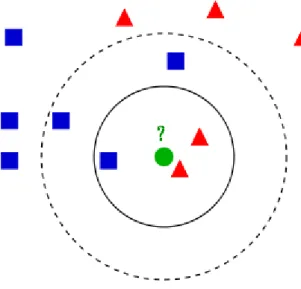
[32] K nearest neighbor algorithm is one of the simplest decision procedure. It classifies samples in addition to the category of nearest neighbors. K nearest neighbour algorithm assigns to a test pattern the class label of its k-closest neighbour(s) by using majority vote. The value of k is the most important, beacause the right value can improve accuracy. There are modifications of this algorithm for example modified k nearest neighbor algorithm, where nearest neighbors are weighted according to their distance from test node. Instead of using majority vote for classification, a weighted majority rule is applied. As seen on figure 9, testing point (green) will be classified as red triangle if k = 1, 2, 3. If k = 5, class is blue square.
Figure 9. K nearest neighbor example
3.7 Support vector machines SVM
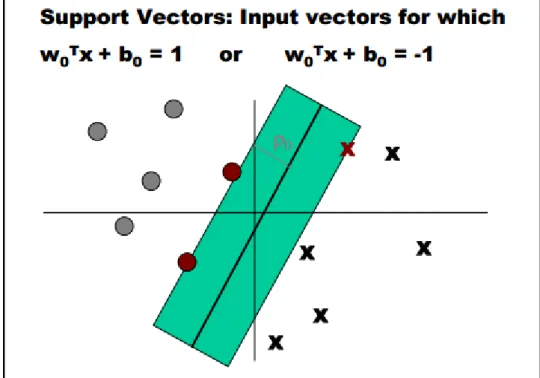
The support vector machine is binary classifier. It creates a decision boundary in multi-dimensional space by using sub-set of training set vectors. [32] The elements of sub set are support vectors. Support vectors are geometrically those training patterns, that are closest
19 to the decision boundary. For determination of classes, the linear discriminant functions can be used. In general decision boundary is obtained as hyper-plane for separation of testing nodes. An SVM model is representation of the example nodes as points in space which are mapped so that the examples of different categories are divided by a clear gap which is as wide as possible. New examples will be mapped into the same space and predicted to belong to a category in order to position in gaps. SVM can maximize the margin around the separating hyper-plane.
Figure 10. SVM hyper-plane example
Support vector machine classifier is used in text categorization, images recognition, medical science and hand written characters recognition.
3.8 Neural networks
[32] Artificial neural network was based on observing how human brain works. The output of neural network depends on inputs and weights in the network. The training of neural network consists of making the network give the correct output for every training input. Every link in the network gets random weight and if the output is correct, weights are not changed. Otherwise new random weights are created. This procedure is repeating until all inputs have correct output. Neural network consist of artificial neurons that are modeled as neurons in human brain. The input in the neuron is weighted and summed up. If aggregation exceeds a threshold, neuron outputs signal. Neural network models are
20 mathematical models that define functions. Network functions are made of other predefined functions such as hyperbolic tangent. Neural networks are used in robotics, data processing, clustering etc.
3.9 Decision trees
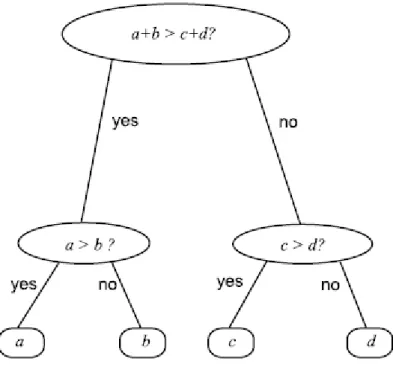
[32] Decision trees are commonly used data structures in pattern classification because of high transparency. A decision tree is a tree where non-leaf nodes are associated with a decision and the leaf nodes are associated with class label. Each internal node test one or more attribute values and links to another node. Decision trees are good for choosing between several courses of action.
Figure 11. Simple decision tree example
For patterns classification using decision trees, the nodes represents status of the problem after making decision. The leaf nodes are labels of the classification rule based on the path from the root node to leaf node. In decision trees both numerical and categorical features can be used. The tree can be binary or non-binary, so that we can decide between many options. The rules are simple and easy to understand. Cons of decision trees are time difficulty for construction of the tree. There are many construction algorithms for example ID3, C4.5 etc.
21
4
Account Correlation in Identity Management
Systems
There are existing solutions in field of account correlation in identity management systems. There are open-source projects such as OpenIAM or OpenIDM and commercial solutions like Oracle Identity Manager. We present short overview on these systems with focus on provisioning and reconciliation part of these systems which partly deals with account correlation.
4.1 Oracle Identity Manager
Oracle Identity Manager is an enterprise identity management system that automatically manages user’s access privileges within enterprise resources. System provides secure access management for applications, data, web services and cloud-based services. It also provides single sign-on, authorization, mobile and social sign-on etc. Oracle Identity manager provides identity governance user self service, which simplifies account administration. Identity governance provides user registration, access requesting, role lifecycle management, provisioning, access certification etc. Oracle Identity Manager uses correlation and confirmation rules for finding user account owners and mapping accounts. Correlation rules consist of object attributes – account representation used for attribute based search and list of attribute conditions which determine list of potentially matching users.
After deploying Oracle Identity Manager infrastructure definitions of security polices take place which determine what data users or applications can access. These polices are stored in access control lists in Oracle Internet Directory. User identities are provisioned in Oracle Internet Directory. Identities come from multiple sources for example human resources applications or user administration tools. These identities, groups and roles are synchronized with other directories. User identities, groups and roles are associated trough provisioning process which can be performed manually or automatically trough provisioning integration.
4.2 Open IAM
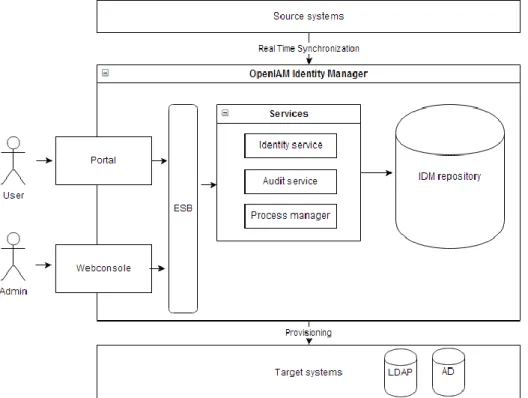
Open IAM is open source identity management system based on Service Oriented Architecture. It is one of the oldest open source provisioning systems. Services like identity service or audit service are exposed to users and administrators by Enterprise Service Bus (ESB). Open IAM provides identity management functionality like identity life cycle managing, provisioning, synchronization etc. Provisioning manages accounts based on rules or roles. Audit logging and reports are part of provisioning module. Synchronization functionality allows to synchronize information from several authoritative sources. OpenIAM synchronization is based on:
22
Events which allows real time synchronization by sending message to Identity Manager Bus and then synchronization starts
Scheduled intervals are precisely configured time intervals in which synchronization can be done.
Reconciliation detects changes in managed systems for example if Active Directory make change, reconciliation mechanism based on rules take place and synchronize this change with OpenIAM directory.
Figure 12. OpenIAM architecture overview
Figure 12 shows OpenIAM architecture overview where Enterprise Service BUS (ESB) is a central component acting as transit system for carrying data between applications. The heart of system is message bus which routes messages between endpoints. Services provide identity management functionalities such as authentication, authorization, password management, provisioning etc. Services are scalable and extensible for example by ability to plug new methods of authentication.
4.3 OpenIDM
OpenIDM is an open source identity management system written in Java programming language. OpenIDM is flexible, modular and provides RESTful interfaces to satisfy business needs and requirements. System provides password management for defining password policies and also synchronization of passwords from Microsoft Active Directory
23 (AD) and ForgeRock OpenDJ. OpenIDM offers scalable method for discovering new, changed or deleted accounts.
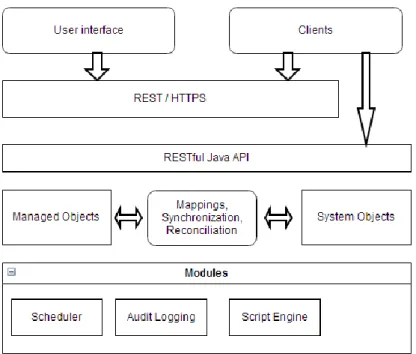
Architecture is focused on modularity by providing components that can be composed together according to special needs. Component architecture allows to easily add new components or remove existing components. Following figure 13 shows architecture overview on system.
Figure 13. OpenIDM architecture
Core services are for example scheduler that takes care about regular synchronization and reconciliation by using Quartz library. Script engine provides triggers and plugin points for OpenIDM. Audit logging logs all relevant system activity to log stores. It also stores data from reconciliation for reporting. Managed objects represent identity related data managed by OpenIDM. These objects can be configured as user, group or role. System objects are representation of object in external systems. External object for example user entry in external LDAP directory is represented as system object. Mappings define policies between target objects and source objects. Mapping can define triggers for validation, filtering and transformation of source and target objects. Synchronization provides creating, updating and deleting resources from a source to a target system. Reconciliation provides resource comparisons between OpenIDM managed objects and source objects from external systems. Comparisons can result with proper actions depending on defined mapping between systems.
Access layer consist of RESTful interfaces for CRUD operations. User interfaces provide password management, registration and workflow services.
Provisioning system in OpenIDM manages accounts, groups and roles. Provisioning subsystem is connected to other resources systems for example human
24 resource servers, directory servers, provide communication between these systems and take care about managing changes. Changes are propagated by synchronization process that propagates changes from OpenIDM to other external resources or vice versa. There is a chance that inconsistencies arise due to maintenance one of external systems and reconciliation is needed. Reconciliation manages changes by comparing information from external resources and OpenIDM information.
4.4 midPoint
midPoint is an open-source provisioning system providing user provisioning, de-provisioning, synchronization of identities and automated identity management processes. It also supports security and reporting. [26] midPoint solution focuses on efficiency and practical usage. For example provisioning scenarios are easy to setup and use because there is no need to code, instead configuration and simple expressions are needed. midPoint is designed to be modular and extensible by providing open iterfaces and plugins. System core consist of repository component, provisioning and model components (figure 14). Repository is storing authoritative identity data and links to identity objects in other systems, roles and access rights. Provisioning component deal with other systems, read data from them and modifies them if needed. Core components are configurable, but also customizable in special cases (adding new attribute expression or redefinition of a role). Highly customizable component is for example user interface.
midPoint uses hybrid Role-based Access Control model which use rules to extend role definitions so that less roles can handle more situations. midPoint also unifies identity data models from integrated systems providing unified model to reduce integration overhead, but also provides customatizations and exceptions if needed.
Synchronization mechanism of midPoint uses account linking based on correlation and confirmation expressions.
25 Figure 14. midPoint component overview
27
5
Correlation method proposal
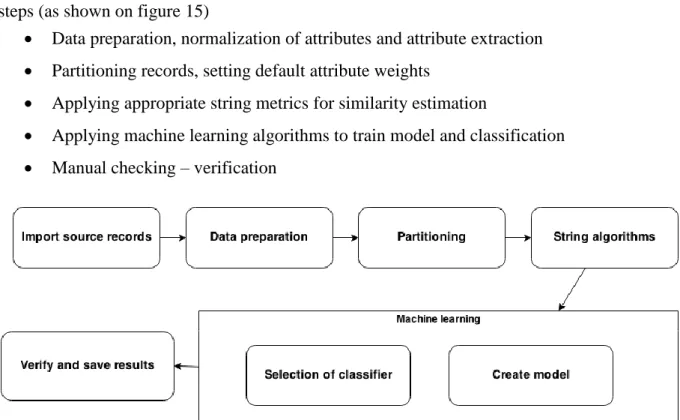
In this section we would like to present our method proposal for automatic correlation of user records. Our method is based on string similarity metrics detecting similarity of user records and machine learning algorithms for automatic correlation. Method includes these steps (as shown on figure 15)
Data preparation, normalization of attributes and attribute extraction
Partitioning records, setting default attribute weights
Applying appropriate string metrics for similarity estimation
Applying machine learning algorithms to train model and classification
Manual checking – verification
Figure 15. Correlation method overview
5.1 Data preparation and normalization
Data preparation phase is first step to user correlation detection. Input data must be stored uniformly in the database so it is easy to work with them. The problem is that data are stored in heterogeneous structures and so we need to define common structures to work with many data sources. Data preparation deals with parsing input data, transforming and standardize (normalize) them.
Parsing of input data depends on input format for example (xml, csv, database schema, plain text). We designed parser for structure of coma-separated format where records looks like “id: first_attribute_value; second_attribute_value”. Transformation of attribute data type is important because we often need to transform for example numbers (integers) to string data type for later processing.
Input data with user account information contain various attributes. For proper matching and correlation detection we must estimate similarities based on attribute values from many sources so there is need to have normalized and standardized attributes. Some of the normalized attributes are suitable for simple string comparison without any other techniques because normalized form is adequate. In most cases, there is need to more
28 sophisticated matching algorithms. The quality of normalized data do not differ from original data so we normalize before insertion into database. There are various methods for data normalization. We apply these basic methods:
Changing all characters to lower case
Removing punctuation
Replacing multiple white space characters with one space character
Removing white spaces at the beginning of string and in the end of string
For numerical attributes like phone number we remove non numerical characters. For example telephone number “+420 987 343 (2)” is modified to “4209873432”.
5.2 Attribute extraction
Attributes may be too general and represent mixed user attributes for example attribute “name = “Ivan Torna” reflects given name and last name of person. We want to split this attribute and create more specific attributes – given name, last name for more precise string (attribute) matching. For this purpose we propose detection methods which process and detect attributes for Slovak language.
5.2.1 Given name extractor
Given name/first name detector is based on list of given names for specific country or domain (Slovak in our case). It can be modified in order to detect special subset of users (organization has external employees in different country). There is also separate list of male names and female names because of need to detect gender of user. For Slovak users there is another option to detect potential female by finding last name suffix “ová, ova”. The problem with first name is, that when there is misspelling error, we can not find appropriate name from list, so we need to apply string similarity algorithms for approximate estimating of first name.
5.2.2 Last name extractor
Last name detector takes name attribute, remove already detected given name and result is set of potential last names. In most cases, there is only one last name detected, but there is a chance to have woman user with two last names – born last name and marriage last name.
5.2.3 Title extractor
Titles usually take place at the beginning and in the end of full name. As far as we determine given name and last name, we can assume, which strings in name can contain titles. For title detection we use list of honorific titles.
29
5.2.4 Email address extractor
Email address attribute can be divided into prefix part which usually contains given name, surname or abbreviations of name. Suffix part mostly reflects webmail service (google mail, yahoo mail etc.) or organization domain name (@organization_name.com).
5.3 Partitioning
Finding correlation on large datasets may be too ineffective due to comparing and matching large number of user record objects. In worst scenario, comparing includes Cartesian product. Thus we propose partitioning mechanism, which can make this task more effective (Figure 16). We have user objects with attribute frequencies stored in database sorted by combination of last name attribute frequency and given name attribute frequency. Same approach is applied to source input data, so that we have two sorted list of user objects. Then we choose partitioning strategy of choosing N partitions – experimentally determined
In partitioning we choose sorting attribute with most distinguishing ability. Estimating most distinguishing attribute is based on counting number of attribute values for certain attribute. The more unique attribute values are present within attribute, the more distinguishing ability attribute has. Partitioning algorithm sort two data sources and create data partitions for example data source containing 6000 user records is divided into three partitions of 2000 records. These partitions are used in correlation process where only certain partitions are processed which saves time. Partitioning can be optional when time of correlation process is not critical and then results can be improved.
30 Figure 16. Partitioning of user records
Our method use string metrics and similarity between records to estimate user correlation. The core of the user correlation problem is that we have one user object, which is compared to other user objects in order to find correlation. We assume set of user objects which are compared to new user objects from other data sources – which are actually duplicates. Then we can use multiplicity of attribute value in set of users to improve similarity metrics and estimations. For example we have 100 users but only one of them has attribute last name set to “Astaloš” and given name to “Jan”. This user has unique last name within user set and when estimating new correlation, this attribute have higher distinguishing ability than given name “Jan” which is more often occurring in given set of users. For this purpose we estimate attribute importance for all attributes and choose attribute with highest distinguishing ability to set default weights for string similarity algorithms.
In real life deployment correlations must be verified and so we propose verification tool which summarizes results of correlation and give ability to manually correlate users, or change bad user correlations. Besides overall verification, we want to apply recommendation of potential user matches for manual check in order to improve correlation framework. For example in organization, human resources employee wants to correlate two sources and our system propose him potential correlation during process and he manually approves or rejects our recommendations. We keep this information to improve our correlation model. If there is certain amount of approves without rejects, there will be less correlation proposals. On the other hand, if there are too many rejects, our correlation framework need to apply these facts and change attribute weights, partitioning strategy or string similarity metrics.
5.4 Similarity algorithms
User correlation is based on attribute similarity. We propose basic similarity function
sima(attr1, attr2), where each similarity is computed within attribute and between two user
objects (UserX, UserY). All similarities are stored in similarity vector [sima, simb, simc …]
and these vectors are used for match estimation. 1 represents match and 0 dissimilarity of compared attributes.
(7.1) In general for name attributes we use these distance metrics:
Jaro distance
Jaro-Winkler distance
Hamming distance
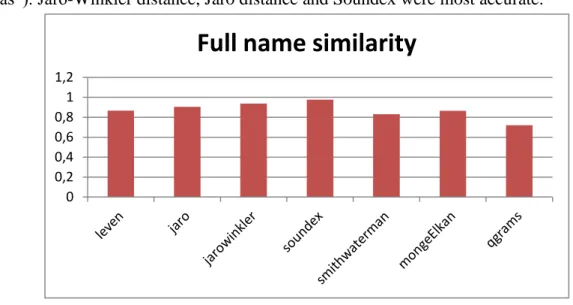
31 We have analyzed multiple string similarity metrics for attributes in our method. Figure 17 shows metrics results for experimental records containing full name attribute, where similarity was estimated between manually modified records (“Marcel Abbas”, “Marcel Abas”). Jaro-Winkler distance, Jaro distance and Soundex were most accurate.
Figure 17. Full name similarity results
We have also analyzed all other attributes (given name, last name, email, organization unit etc.) from our dataset for most efficient and accurate string similarity metric.
For given name attribute we use Jaro-Winkler distance, where first characters of string are more important which makes given name comparison more effective because of low number of misspellings at the beginning of given name. More misspellings occur in the middle of strings.
For last name attribute we use Jaro distance, which is suitable for short strings. Jaro distance count with length of string so that misspelling in longer word is less important than in shorter word. Jaro distance and Jaro-Winkler distance are quite similar, so we want to experiment combinations of attributes and different distance metrics. Misspellings in names occur in the middle of string and so we can use Hamming distance in case of same length of compared strings. Distance counts number of different characters which is suitable for strings of same length. N-gram similarity split string into n-grams for example N=3 (“tomas” = “tom”, “oma”, “mas”). Jaccard coefficient is applied to results of n-gram similarity. There is problem with estimating suitable value of N, so that the substrings are not too short or too long.
Honorific titles and titles are compared by using Hamming distance and Damerau-Levenshtein distance which is similar to Damerau-Levenshtein distance but there is extra operation – transposition (swapping characters). This distance is good for short strings and strings with misspellings, which can easily occur in titles and honorific titles.
E-mail attributes are compared by Hamming distance for e-mail suffixes and Jaro and Jaro-Winkler distance for email e-mail prefixes.
0 0,2 0,4 0,6 0,8 1 1,2
32 Organization unit attributes are usually longer strings or abbreviations. Therefore we need to combine Levenshtein distance, N-gram distance and Damerau-Levenshtein distance.
Numeric similarity metrics are usually based on simple string conversion and primitive comparison. We propose cosine similarity for numerical attributes like age etc.
5.5 Machine learning algorithms
Our method prepares source data for supervised machine learning phase, which can automatically classify records. The training data consists of training examples vectors containing similarities between each record attributes and label (if records are duplicates or not). Machine learning algorithms analyzes these training data and creates inferred function – model for mapping new examples (Figure 18). The main advantage of supervised machine learning is that once the model is trained, we can apply it to various datasets. Our method:
1. Partition source data
2. Creates similarity vectors between records 3. Creates training set
4. Apply learned model to example set
Figure 18. Machine learning process overview We analyzed and applied these machine learning algorithms:
1. Support vector machine (SVM) 2. K-nearest neighbour (KNN) 3. Logistic regression (LR) 4. Neural network (NN) 5. Decision trees
33
6
Correlation framework
We propose complex framework for correlation process of user identities from many heterogeneous sources. Our goal is to make process as automatic as possible in order to save time with manual correlation. We deal with data preparation, normalization and we are proposing detection methods for attribute enrichment. Our correlation method is based on similarity metrics and machine learning algorithms. The scenario of usage correlation framework (Figure 19):
User choose data source
User imports data source in CSV format (comma separated values) and choose either automatic attribute weights or manually set attribute weights
User records are automatically sorted and split into partitions
User starts automatic correlation process
User see results of correlation process and verify matches
Model is adjusted if results are incorrect
Figure 19. Correlation framework schema
Input data are pre-processed and normalized. Then creating user objects takes place. For every record in database there is user metadata object with default weights and attribute frequencies stored in user metadata object. User metadata object may also contain multiple attribute values for certain attributes from preceding source correlation detection. User objects are partitioned and for each user in partition, matching vectors are created:
Attribute vector = [attr1, attr2…attrn]
Default weights vector (DW) = [dw1, dw2…dwn]
Similarity between same attribute i of two user objects is defined as:
34 Di represent distance between attributei valuescomputed by using similarity algorithms
between two user objects. DWi is experimentally predefined value (Formula 6.2). Overall
similarity between two user objects a,b is:
(6.3) Where N represents number of attributes in user object (Formula 6.3). Result of similarity estimation is classified by using K-nearest neighbor algorithm, logistic regression, decision tree and Support Vector Machine (SVM) classifiers.
Result data are split into training set and testing set. Training set contains manually pre-labeled tuples which are used to train classifier. Testing set is used to validate learned classifier.
Trained classifiers can be applied on real datasets and user sources. Adding single source of data and integration with existing database need to implement updating mechanism for database records and user metadata objects. When new record is inserted, frequencies must be re-calculated. If user match was detected, we need to store attribute values in metadata object, so that some of the attributes may differ, or can be enriched by new record. For example when user A has e-mail “[email protected]” and is correlated to user A’ which has e-mail “[email protected]”, we want to keep this information for future matching. Here is overall schema of our framework (also shown on figure 20):
Create source object and import data (comma separated format)
Pre-processing transforms and normalize input data by using detection methods for attributes
User objects are created (When database is empty, attribute frequencies must be computed)
Order data by attribute (most distinguishing)
Partitioning data (Only same partitions are compared with their estimated similarities )
Similarities between records are computed
Creation of training and testing set
Classifier is trained
Model is applied to example set