
University of Southampton Research Repository
ePrints Soton
Copyright © and Moral Rights for this thesis are retained by the author and/or other
copyright owners. A copy can be downloaded for personal non-commercial
research or study, without prior permission or charge. This thesis cannot be
reproduced or quoted extensively from without first obtaining permission in writing
from the copyright holder/s. The content must not be changed in any way or sold
commercially in any format or medium without the formal permission of the
copyright holders.
When referring to this work, full bibliographic details including the author, title,
awarding institution and date of the thesis must be given e.g.
AUTHOR (year of submission) "Full thesis title", University of Southampton, name
of the University School or Department, PhD Thesis, pagination
Faculty of Business and Law
Southampton Management School
Essays in Statistical Arbitrage
by
Hamad Alsayed
THESIS FOR THE DEGREE OF DOCTOR OF PHILOSOPHY February 2014
4
UNIVERSITY OF SOUTHAMPTON
ABSTRACT
FACULTY OF BUSINESS AND LAW Financial Economics
Doctor of Philosophy
ESSAYS IN STATISTICAL ARBITRAGE
By Hamad AlsayedThis three-paper thesis explores the important relationship between arbitrage and price efficiency. Chapter 3 investigates the risk-bearing capacity of arbitrageurs under varying degrees and types of risk. A novel stochastic process is introduced to the literature that is capable of jointly capturing fundamental risk factors which are absent from extant specifications. Using stochastic optimal control theory, the degree to which arbitrageurs’ investment behaviour is affected by aversion to these risks is analytically characterized, as well as conditions under which arbitrageurs cut losses, effectively exacerbating pricing disequilibria. Chapter 4 explores the role of arbitrage in enforcing price parity between cross-listed securities. This work employs an overlooked mechanism by which arbitrage can maintain parity, namely pairs-trading, which is cheaper to implement than the mechanism most commonly employed in the literature on cross-listed securities. This work shows that arbitrage is successful at enforcing parity between cross-listed securities, and also documents the main limits to arbitrage in this market setting. Chapter 5 examines the extent to which arbitrage contributes to the flow of information across markets. It is shown that microscopic lead/lag relationships of the order of a few hundred milliseconds exist across three major international index futures. Importantly, these delays last long enough, and induce pricing anomalies large enough, to compensate arbitrageurs for appropriating pricing disequilibria. These results accord with the view that temporary disequilibria incentivise arbitrageurs to correct pricing anomalies.
6
Abstract ... 5 List of Figures ... 11 List of Tables ... 13 Declaration of Authorship ... 15 Acknowledgements ... 17 Chapter 1 – Introduction ... 19
1.1.Arbitrage and Statistical Arbitrage ...19
1.2.Scope ...20
1.3.Motivation ...22
1.4.Thesis Overview ...23
1.5.Relevance of this Thesis ...25
Chapter 2 – Literature Review ... 27
2.1. Arbitrage and Statistical Arbitrage ...27
2.2.On the Existence of Pricing Inefficiencies ...27
2.2.1. Deviations from the Law of One Priece ...29
2.2.2. Depository Receipts ...33
2.2.3. Lead/Lag Relationships ...35
2.3.The Limits of Arbitrage ...36
2.3.1. Horizon Risk ...37
2.3.2. Divergence Risk...38
2.3.3. Fundamental Risk ...39
2.4.Theoretical Models of Arbitrage ...41
2.4.1. The Ornstein-Uhlenbeck Process...41
2.4.2. The Brownian Bridge Process ...42
2.5.The Gaps in the Literature ...42
2.5.1. Gaps in the Theoretical Literature ...43
Chapter 3 – Optimal Portfolio Selection in Nonlinear Arbitrage Spreads ... 47
Abstract ... 47
3.1. Introduction ... 48
3.2. Related Literature ... 51
3.3. The Model ... 54
3.3.1. The Investment Opportunity ... 54
3.3.2. Contrasting the Nonlinear Dynamics with OU ... 55
3.3.3. Modelling Risk-Preferences... 57
3.3.4. The Optimal Portfolio Strategy ... 58
3.3.5. Do Arbitrageurs Always Exploit a Mispricing? ... 61
3.3.6. Robustness to Parameter Uncertainty ... 62
3.4. Empirical Application ... 68
3.4.1. Data, Historical Period, and Methodology ... 69
3.4.2. Application to FTSE 100 data... 70
3.5. Conclusion ... 71
3.6. Technical Appendix ... 74
Chapter 4 – Arbitrage and the Law of One Price in the Market for American Depository Receipts ... 85
Abstract ... 85
4.1. Introduction ... 86
4.2. Related Literature ... 89
4.3. Data and Methodology ... 92
4.3.1. UK Stock and ADR Data ... 92
4.3.2 Constructing the Mispricing Process ... 95
4.3.3. Direct Arbitrage vs. Pairs-Trading: Costs and Risks ... 97
4.3.4. Transaction Costs ... 99
4.3.5. Different Investors = Different Costs ... 102
4.3.6. The Pairs-Trading Strategy ... 102
4.4. Results ... 106
4.4.1. Individual Returns (The $0.12 / $0.01 case) ... 107
4.4.2. Robustness to Varying the Entry/Exit Levels ... 109
4.4.3. The Dynamics of Mean-Reversion ... 111
Chapter 5 – Ultra High Frequency Statistical Arbitrage Across International
Index Futures ... 119
Abstract ...119
5.1. Introduction ...120
5.2. Related Literature ...123
5.3. Data and Methodology ...126
5.3.1. Futures Contracts Data ...127
5.3.2 Trading Costs and the Representative Investor ...129
5.3.3. The Hayashi-Yoshida Estimator ...130
5.3.4. Robustness to Spurious Lead/Lag Relations ...134
5.3.5. The Trading Strategy ...137
5.4. Empirical Results ...142
5.4.1. The Lead/Lag Relationship Between Futures Contracts ...142
5.4.2. The Intraday Profile of Lead/Lag Relationships ...145
5.4.3. Trading Results: Exploiting Temporal Disequilibria ...148
5.4.4. Varying the Number of Contracts per Trade ...152
5.4.5. Varying the Signal Threshold ...152
5.4.6. On the Limits of Arbitrage ...156
5.5. Conclusion ...159
Chapter 6 – Conclusion ... 161
6.1. The Gaps in the Extant Literature ...161
6.2. Contributions to the Literature ...163
6.3. Implications of the Findings in this Thesis ...165
6.4. Limitations of this Work ...166
6.5. Avenues for Further Research...167
10
List of Figures
Chapter 3:
Figure 3.1 Illustration of position size in the mispricing . . . 60
Figure 3.2 Effect of parameter misspecification assuming OU dynamics . . . 65
Figure 3.3 Effect of parameter misspecification assuming Wong dynamics . . . . 65
Figure 3.4 HSBC - Barclays: Poor mean reversion . . . 80
Figure 3.5 RBS - Lloyds: Regime break . . . 81
Figure 3.6 Legal&General - Prudential: Poor mean reversion . . . 82
Figure 3.7 Royal Dutch Shell B - BP: Good mean reversion . . . 83
Chapter 4:
Figure 4.1 The Mispricing Process . . . 96Figure 4.2 Cumulative Portfolio Wealth . . . 109
Figure 4.3 Incidence of Mispricings . . . 110
Chapter 5:
Figure 5.1 Time Intervals . . . 131Figure 5.2 HY Curve on Synthetic Data . . . 136
Figure 5.3 PT Curve on Synthetic Data . . . 138
Figure 5.4 Quote Clusters . . . 139
Figure 5.5 Lead/Lag Relationships . . . 144
Figure 5.6 Lead/Lag Intraday Profile . . . 147
Figure 5.7 Cumulative Profits . . . 149
Figure 5.8 Intraday Arbitrage Profile . . . 151
List of Tables
Chapter 3:
(no Tables)Chapter 4:
Table 4.1 List of UK ADRs . . . 93
Table 4.2 Bid-ask spreads . . . 100
Table 4.3 Institutional frictions . . . 101
Table 4.4 Trading results . . . 108
Table 4.5 Returns for Different Investors . . . 111
Table 4.6 Dynamics of mean-reversion . . . 114
Chapter 5:
Table 5.1 Futures Data . . . 128Table 5.2 Exchange Costs . . . 129
Table 5.3 Lead/Lag Relationships . . . 145
Table 5.4 Number of Contracts per Trade . . . 153
Declaration of Authorship
I, Hamad Alsayed, declare that the thesis entitled “Essays in Statistical Arbitrage” and the work presented in the thesis are both my own, and have been generated by me as the result of my own original research. I confirm that:
• this work was done wholly or mainly while in candidature for a research degree at this University;
• where any part of this thesis has previously been submitted for a degree or any other qualification at this University or any other institution, this has been clearly stated;
• where I have consulted the published work of others, this is always clearly attributed;
• where I have quoted from the work of others, the source is always given. With the exception of such quotations, this thesis is entirely my own work;
• I have acknowledged all main sources of help;
• where the thesis is based on work done by myself jointly with others, I have made clear exactly what was done by others and what I have contributed myself;
• Papers 1 and 2 have been published, respectively, as:
Alsayed, Hamad and Frank McGroarty (2013). Optimal Portfolio Selection in Nonlinear Arbitrage Spreads. European Journal of Finance 19(3), pp. 206-227.
Alsayed, Hamad and Frank McGroarty (2012). Arbitrage and the Law of One Price in the Market for American Depository Receipts. Journal of International Financial Markets, Institutions and Money 22(5), pp. 1258-1276.
Signed:
Acknowledgements
Thank you to Dr. Frank McGroarty for his invaluable guidance and support throughout my time at the University of Southampton.
Chapter 1
Introduction
1.1 Arbitrage and Statistical Arbitrage
Arbitrage is defined by Shleifer and Vishny (1997) as “the simultaneous purchase and sale of the same, or essentially similar, security in two different markets for advantageously different prices”.
The basic concept of arbitrage is simple: In perfectly efficient markets, if two assets command identical cash flows, then the two should be identically priced. Specifically, any discrepancy between the two prices which exceeds the transaction costs associated with executing the trades will immediately be arbitraged away. Arbitrage has the effect of enforcing price parity and of bringing prices back to fundamental values. It is therefore extremely important to the field of Financial Economics to understand the role played by arbitrageurs (those who engage in arbitrage activities) in financial markets.
The idea of statistical arbitrage is a generalization of its traditional “riskless” interpretation. Unlike the traditional interpretation, statistical arbitrage identifies mispricings based on deviations from common stochastic trends, and relies on a predictive modelling framework that attempts to exploit consistent regularities in the movements of asset prices. Because the assets involved in a statistical arbitrage trade are often not perfect substitutes, arbitrage of this type will necessarily entail a degree of risk.
In a frequently-cited paper, Gatev et al. (2006) examine the risk and return characteristics of a popular statistical arbitrage strategy with at least a 30-year
20
history on Wall Street, namely pairs trading. The authors define pairs trading as finding “two stocks whose prices have moved together historically. When the spread between them widens, short the winner and buy the loser. If history repeats itself, prices will converge and the arbitrageur will profit”. Other examples of statistical arbitrage strategies are volatility arbitrage, convertible arbitrage, and trading based on lead-lag effects.
In this thesis, the wider concept of statistical arbitrage as it is defined above is referred to as either arbitrage or statistical arbitrage, whereas the traditional riskless interpretation is referred to as pure arbitrage or direct arbitrage.
1.2 Scope
This thesis answers three main questions surrounding the role of arbitrageurs in enforcing pricing efficiency: First, to what extent does aversion to fundamental risk diminish the extent to which arbitrageurs are willing to correct pricing disequilibria? Second, in the absence of fundamental risk, how effective is arbitrage at exploiting pricing anomalies? Third, to what extent does arbitrage appropriate geographical informational delays between exchanges?
This thesis contributes to the state of the art by focussing on the incentives and disincentives faced by arbitrageurs in a diverse range of market settings. The work presented here adopts a bottom-up perspective from the point of view of arbitrageurs, principally by way of trading exercises in a range of different markets. It is therefore quantitative in nature.
Chapter 3 provides a theoretical contribution to the literature by introducing a novel stochastic model of mispricing time-series aimed at exploring an important aspect of arbitrage trading, namely fundamental risk. Fundamental risk denotes the risk of a breakdown in the pricing relationship between two or more assets which are the subject of a statistical arbitrage trade. This risk is an important
consideration for arbitrageurs, but has only been represented qualitatively in the extant literature. The work presented here offers the first quantitative incorporation of this risk into an explicit trading strategy, and in so doing yields new insights into the behaviour of arbitrageurs: First, arbitrageurs who are averse to fundamental risk approach increasingly large mispricings with increased scepticism - a fact which explains why sometimes a number of “obvious” arbitrage trades go underexploited. Second, an arbitrageur who is averse to fundamental risk will unwind losing positions far sooner than an arbitrageur who is only averse to the uncertainty of the lifetime of the trade but who has complete confidence in the fundamental pricing relationship between the assets being traded.
Chapter 4 provides an empirical contribution to the literature by way of a pairs-trading exercise aimed at exploiting deviations from the Law of One Price in the market for American Depository Receipts. By focussing on this market, the analysis presented in chapter 4 explores the capacity of arbitrage to enforce price efficiency in a setting with virtually no fundamental risk - a setting which intuitively should constitute fertile ground for arbitrageurs. Interestingly, it is found that even when arbitrageurs face no fundamental risk, they are averse to the uncertainty surrounding the duration of arbitrage trades. Furthermore, in settings where the main impediments to arbitrage are the costs associated with establishing the arbitrage position, profitable trading opportunities are limited to market participants who can execute trades quickly and cheaply, such as large hedge funds and proprietary trading desks at investment banks. On the whole, the work presented in this chapter finds, in contrast to the prior literature, that arbitrage is highly successful at appropriating pricing disequilibria, and hence is an important component of the price-correction mechanism related to deviations from the Law of One Price.
Chapter 5 contributes to the literature by applying an existing statistical methodology of measuring lead-lag relationships to a new empirical setting
22
namely the futures markets. The methodology applied has its roots in Hayashi and Yoshida (2005), but the precise implementation is based on a recent advance by Hoffman et al (2010). The analysis draws inspiration from a body of literature documenting an increase in geographical correlation in global markets. However, the question of whether informational delays across international markets give rise to arbitrage opportunities is relatively under-explored. This chapter addresses this gap by way of a trading exercise across international index futures. It is found that such temporal disequilibria occur mainly in the sub-second space, and moreover, arbitrage is successful at appropriating these disequilibria across markets. Hence, arbitrage is an important mechanism in the transmission of information across global markets.
This thesis borrows ideas from a variety of academic disciplines, ranging from Optimal Control Theory, Statistics, and Empirical Finance; and presents a synthesis of these fields to facilitate a reflection on the research questions which it tackles.
1.3 Motivation
This thesis is driven by the need for a deeper understanding of the role that arbitrageurs play in financial markets, and how that role relates to pricing efficiency.
The emphasis on arbitrage trading exercises from a profitability point of view is underrepresented in the literature, and yet is crucial to achieving deeper understanding of the role of arbitrage for four main reasons: First, understanding the conditions under which arbitrageurs are incentivised to exploit pricing inefficiencies from a quantitative perspective is fundamental to understanding the extent to which pricing efficiency can be restored by their actions. Second, while it is widely reported in a deep body of literature documenting the “limits
to arbitrage” that factors such as risks and costs can deter arbitrageurs from exploiting inefficiencies, the philosophy espoused in this thesis is that the precise nature of how these factors act as limits to arbitrage is best understood by way of a quantitative treatment of the subject. Third, placing emphasis on arbitrageurs trading behaviour necessitates a careful treatment of the trading costs faced in undertaking a real-world exploitation of pricing inefficiencies. Such a careful treatment of trading costs is absent from much of the relevant literature, and the work presented here illustrates the importance of incorporating realistic trading costs to drawing accurate conclusions which link arbitrage with market efficiency. Fourth, undertaking a trading exercise necessitates the utilization of high-quality market data in drawing robust conclusions. The view adopted in this thesis is that advances in computational technology have enhanced the ability of arbitrageurs to explore and exploit regularities in prices. Yet it is relatively uncommon for works written before the early 2000’s to employ intraday data at all, or intraday data that is granular enough to illustrate the competitive and short-lived nature of arbitrage opportunities.
1.4 Thesis Overview
The principal aim of this thesis is to provide a deeper understanding of the role that arbitrageurs play in enforcing price efficiency. To this end, each chapter examines the role of arbitrage within a different market setting.
Chapter 3 analytically solves the portfolio optimization problem of an investor faced with a risky arbitrage opportunity (e.g. relative mispricing in equity pairs). This chapter introduces a nonlinear generalization of the commonly-employed Ornstein-Uhlenbeck (OU) process as a way to explicitly incorporate fundamental risk into the mispricing time-series a feature absent from the extant literature. Fundamental risk is the risk that mispricings can exhibit long and persistent
24
departures from economic fundamentals. Incorporating fundamental risk yields several novel insights regarding the investment behaviour of arbitrageurs: First, arbitrageurs who are averse to fundamental risk exhibit a diminishing propensity to exploit increasingly large mispricings. Second, investment behaviour in light of these additional risk factors precipitates the gradual unwinding of losing trades far sooner than is suggested by current models. In practice, the nonlinear generalization yields superior risk-management capabilities relative to OU, when applied empirically to FTSE 100 stock data.
Chapter 4 investigates the mechanism by which the Law of One Price is enforced between UK shares and their American Depository Receipt (ADR) counterparts: the two are virtually the same asset. This work is motivated by observations in the empirical literature that markets for cross-listed securities are less than fully integrated. In theory, environments such as this should constitute fertile ground for arbitrageurs, who are compensated for exploiting these disequilibria. However, the existing literature on stock-ADR arbitrage overwhelmingly concludes in favour of market efficiency, precluding the possibility of arbitrage. The reason for this is that the literature examining stock-ADR arbitrage typically relies on a trading strategy whereby stocks are physically converted into ADRs, and vice versa. This chapter explores the efficacy of pairs trading, a strategy that is under-represented in the literature within the context of ADRs, in enforcing price parity. It is found that pairs trading yields statistically significant returns after adjusting for taxes and costs. This chapter concludes that arbitrage is an important component of restoring stock-ADR parity, contrasting previous assertions that trading in either the US or domestic market alone results in efficient ADR pricing.
Chapter 5 employs a recent advance in the statistical estimation of correlation and uncovers the existence of sub-second lead/lag relationships across international index futures. The methodology is based on work by Hayashi and Yoshida
(2005) and Hoffman et al (2010), and is chosen for its ability to handle the nonsynchronous nature of price observations which is typical of sub-second data. It is found that lead-lag effects across futures contracts last long enough, and induce pricing anomalies large enough, to compensate arbitrageurs for exploiting pricing disequilibria. This chapter concludes that arbitrage is an important mechanism in the transmission of information across international markets.
1.5 Relevance of this Thesis
This thesis focusses on the explicit incentives and deterrents to arbitrage directly from the point of view of arbitrageurs. In so doing, it offers a fuller understanding of the relation between arbitrage and price efficiency. This work may be useful to researchers who wish to quantitatively explore arbitrage within other contexts - for example the role of arbitrage trading in market contagion (an example of which is the collapse of hedge fund Long Term Capital Management in 1998) or agent-based models of arbitrageurs with heterogeneous characteristics. It would be important in the latter context to incorporate one of the central insights of this thesis, which is that arbitrageurs’ behaviour is substantially affected not only by the extent, but also by the types of risk to which they are averse.
Further, this work highlights the important role arbitrage plays within market settings in which it was previously concluded that arbitrage played little part in the parity enforcement mechanism. Arbitrage is successful at eliminating cross-border deviations from the Law of One Price and at appropriating informational delays across geographies. These observations are relevant to the regulatory debate surrounding the role of arbitrageurs in financial markets. Finally, because the concepts presented in this thesis are illustrated via the development of explicit trading rules, these parts of the thesis may be useful to market practitioners who engage in arbitrage trading. In particular, the
26
ideas presented could be useful to the development of novel quantitative trading strategies and to the choice of markets on which they are deployed.
Chapter 2
A Review of the Relevant Literature
2.1 - Introduction
The overall aim of this chapter is to summarize our current understanding of the important relationship between arbitrage and pricing efficiency, with the intention of exposing gaps in this understanding. This chapter is split into four subsequent sections, which combine together to achieve the overall aim. Section 2.2 presents a history of the debate between arbitrage and market efficiency, then presents examples from empirical works which document the existence of deviations from price parity in financial markets. Section 2.3 complements this discussion by summarizing the body of literature that documents various impediments that act to preclude arbitrageurs from enforcing price efficiency the so-called “limits to arbitrage”. Section 2.4 reviews the theoretical literature on the quantification of arbitrage risks and the establishment of arbitrageurs optimal trading rules from a quantitative perspective. Section 2.5 summarizes the emergent gaps in the literature that this thesis addresses. In all, this chapter provides the framework upon which the contributions of this thesis are based.
2.2 - On the Existence of Pricing Inefficiencies
Friedman (1953) was the first to argue against the plausible existence of prolonged mispricings away from fundamental values. Such deviations from price parity amount to free money left on the table - a reward to those who subsequently bring prices back into line. Though the origins of the relationship between price and fundamental value are evident in writings as early as Hume (1741), it was
28
Friedman (1953) who characterized the basic mechanism by which arbitrage acts to correct prices within the context of capital asset markets. The author splits the universe of investors into two groups: irrational traders who trade based on measures other than fundamental values (e.g. mistaken beliefs about future utility, chartists); and rational traders who act to exploit differences between prices and fundamental values. In this setting, irrational traders cannot have a substantial effect on prices for two main reasons: First, any mispricing caused by the actions of irrational traders will be immediately exploited by rational arbitrageurs who profit from appropriating this mispricing. Second, the failure of rational agents to correct mispricings is nevertheless tantamount to market participants “buying high and selling low”, an environment in which irrational traders would eventually die out.
Closely related to the above concept is the assertion that past prices cannot contain information about future prices, an idea termed “The Random-Walk Hypothesis”, which was first modelled by French mathematician Louis Bachelier (Bachelier, 1900) in his PhD Thesis “The Theory of Speculation”. In a seminal paper that has become the cornerstone for proponents of this theory, Fama (1965) carries out the first examination of the validity of this model, and finds strong empirical support for the Random-Walk Hypothesis. This result is the basis of what is known as the Efficient Markets Hypothesis; and asserts that one cannot consistently achieve returns in excess of average market returns on a risk-adjusted basis (except through luck), given the information available at the time the investment is made. In other words, the Efficient Markets Hypothesis states that the market is “informationally efficient”, such that prices properly reflect all available information and are equal to fundamental values. Further work that supports the implications of the Efficient Markets Hypothesis is Fama (1991), Fama and French (1992), Fama (1995).
The Efficient Markets Hypothesis may appear to be inconsistent with the existence of arbitrage opportunities asserted by Friedman (1953), but the two stipulations are reconcilable in an environment where arbitrageurs react instantaneously to any mispricing caused by irrational investors.
Despite the intuitive nature of these early market models, there is a paradox underlying their assertions. Grossman and Stiglitz (1976, 1980) take exception to validity of the Efficient Markets Hypothesis, and base their counter-arguments on the notion that arbitrage is costly since resources must be expended on the collection of (private) information. If prices fully reflect all available information, then all arbitrage profits are necessarily eliminated. Therefore, there is no incentive for arbitrageurs (who the authors equate to “rational investors”) to remain in the market. This creates a paradox whereby on the one hand, arbitrageurs profit from instantaneously exploiting disequilibria caused by irrational traders, but on the other hand, arbitrageurs make no profits. Indeed, if the payoff to the costly activity of collecting information is less than the value of the costs, then there is no incentive to trade. Grossman and Stiglitz (1976, 1980) conclude that the only solution to this paradox is for financial markets to exhibit “an equilibrium level of disequilibrium” that incentivises arbitrageurs to restore price parity.
There is a wide body of empirical literature which supports the view that prices can significantly diverge from fundamental values. The remainder of this section presents several real-world examples of this phenomenon in a range of market settings relevant to this thesis. In the subsequent section, a discussion is presented as to why such mispricings exist, and how they might reconcile with the Efficient Markets Hypothesis.
30
2.2.1 Deviations from the Law of One Price
Fundamental to the notion of efficient markets is the concept of the Law of One Price, which conveys the intuitive idea that identical goods (in separate markets) should command identical prices. Arbitrage is a key driver of the Law of One Price (De Long et al (1990), Gromb and Vayanos (2010)).
In a hypothetical example wherein (identical) coffee beans are sold on two different continents, any price differential between the two markets which exceeds the cost of physically transporting the coffee represents price inefficiency. In this situation, arbitrageurs are financially incentivised to purchase the coffee in the cheaper location, transport it to, and sell onto the dearer market. This arbitrage trade has the effect of creating excess demand in the cheaper market, and of creating excess supply in the dearer market, which in turn forces prices in each of the two markets to converge. But despite the logical intuitiveness of the above theoretical example, there are instances in real financial markets where the Law of One Price is violated for extended periods of time.
Lamont and Thaler (2003b) present a case-study of the Palm-3Com equity carve-out (spin off). In March 2000, 3Com sold 5% of its stake in Palm through an IPO, and further announced that its remaining stake would be spun off to 3Com shareholders by the end of the year 2000. 3Com shareholders would receive 1.525 Palm shares for each share of 3Com they owned.
From the perspective of the Law of One Price, the price of 3Com shares should have had a minimum bound of 1.525 times the price of Palm. This is because each 3Com share was equivalent to 1.525 Palm shares plus a claim on 3Com’s non-Palm future cash flows. Because of limited liability, this cash flow claim is non-negative. However, on the date of the IPO, Palm closed at $95.06 per share, implying a minimum price of $144.97 per 3Com share. However, 3Com closed at $81.81, having dropped from $104.13 on the previous day. In all, 3Com went
from a 28% discount to a 41% discount in a clear violation of the Law of One Price.
Rosenthal and Young (1990), Froot and Dabora (1999), and De Jong et al. (2009) show that significant mispricings can exist in dual-listed companies (DLCs). DLCs are companies which issue shares on two or more exchanges in separate countries. These shares have either identical cashflows, or arrangements that set out clearly the cashflow terms that investors in each market are entitled to. Either way, a clear pricing relationship exists between the different classes of shares for these companies. Examples of such companies are Royal Dutch Shell, Unilever, and BHP Billiton.
Both Rosenthal and Young (1990) and Froot and Dabora (1999) find that significant mispricings in three DLCs (Royal Dutch Shell, Unilever, and Smithkline Beecham) have existed over a long period of time. Both studies conclude that factors such as currency risk, legal structures, and taxation) do not adequately explain the magnitude of the price deviations. Froot and Dabora (1999) show that the relative prices of the twin stocks are correlated with the stock indices of the markets on which each of the twins has its main listing. For example, if the UK market rises relative to Amsterdam, then the stock price of Reed International PLC would tend to rise relative to Elsevier NV (the two names refer to the same company). De Jong et al. (2009) study a sample of 12 dual listed companies. The authors find that, after adjusting for costs, margin requirements, and taxes, returns to a simple arbitrage strategy yields 10% per annum.
Shleifer (1986) and Chen (2004) investigate the effect on stock prices on the stocks inclusion or exclusion from an index. Chen (2004) studies the period 1989-2000, and finds that on average, a stocks price would rise by 5.5% on the day of the announcement that it would be added to the S&P index. Furthermore, the price of that same stock would rise a further 3.5% from the date of the announcement
32
until the day it is actually added. On the other hand, a stocks price would fall by an average of 14% from the day it is announced that it would be removed from an index, to the actual date of removal. It is clear that these effects are economically significant.
A similar concept to a stock index is a closed-end fund. One type of closed-end fund is a country fund. Country funds are exchange-traded closed-end investment companies that hold portfolios of equities of particular foreign countries. They do not attempt to time the market or achieve returns superior to the market for their investors. Rather, they allow investors the opportunity to gain exposure to the countries that the funds represent, while offering investors the convenience of trading in their local market. Most country funds are denominated in dollars, and trade on the New York Stock Exchange (NYSE). Klibanoff et al. (1998) highlight the growing popularity of this kind of investment vehicle. The authors state that in 1984, only four US-listed country funds existed, whereas by 1995, this number had grown to 54, each specializing in one of 30 countries.
Like most closed-end funds that trade on an exchange, country funds do exhibit premiums or discounts relative to the equities that constitute the fund portfolio. Managers of closed-end funds maintain pricing parity with the underlying basket by constantly tuning the supply of “units” of the fund in the market against the demand shocks generated in its constituent equities. For example, if the fund is trading at a premium, the fund manager issues and sells additional shares in the fund, and vice versa. Nevertheless, discounts and premia on closed-end funds contradict the notion of market efficiency. Klibanoff et al. (1998) study a sample of 39 single-country funds and find evidence of significant mispricings. For example, in 1990, the premium on the German country fund traded in New York reached in excess of 100 percent. The authors make a further finding: during periods where unexpected news permeates through markets, the prices of country funds react much more quickly and fully in incorporating the news informational
content; whereas during periods of relative calm, country funds exhibit greater (temporary) mispricings. There are further examples of works which document premia and discounts in closed-end funds. Hardouvelis et al. (1994) also find evidence of mispricings in country funds, while Malkiel (1977) and Lee et al. (1991) document evidence of mispricings in the general class of closed-end funds beyond just country funds.
Futures contracts are derivative instruments which speculate on the future price of a particular stock index or commodity. Figlewski (1984), Stoll and Whaley (1990), and Brennan and Schwartz (1990) are the earliest works which study the pricing efficiency of futures contracts relative to their underlying index. Brennan and Schwartz (1990) study a sample of 16 index futures contracts over a period of four years during 1983-1987, and document evidence of violations from the spot-futures relationship. The spot futures relationship is a pricing relationship between a futures contract, and the index or commodity on which it is based. In Cummings and Frino (2011), the authors examine mispricings between the Australian Stock Index (ASX) and its associated futures contract. The authors find, in contrast to the earlier studies, that futures contracts are efficiently priced relative to the ASX. Brooks et al. (2001) study the pricing relationship between the futures contract and index in the UK market, and find evidence that the futures contract leads the stock market index. However, their results accord with Cummings and Frino (2011), in the sense that this lead/lag relationship is not exploitable, and does not present a violation of efficient pricing.
2.2.2 Depository Receipts
Introduced by the investment bank JP Morgan in 1927 as a way for US investors to diversify their holdings internationally, American Depository Receipts (ADRs) are a dollar-denominated representation of ownership in a non-US company. They
34
trade as conventional shares on US exchanges, and provide identical cashflows as their corresponding underlying shares.
From the point of view of arbitrage, ADRs represent a very interesting market. Because ADRs and their underlying stocks are virtually the same instrument, one would expect that arbitrageurs would be very active in this market. Furthermore, ADRs are two-way convertible, or “fungible”, into their underlying stocks. This eliminates a significant portion of risk from an arbitrage trade.
Several works exist which document the returns to arbitrage in this setting. Suarez (2005) analyses 10 French stocks that also trade as American Depository Receipts (ADRs) in New York. The author employs a direct arbitrage technique, wherein upon observing a mispricing (let us suppose the stocks are underpriced), the arbitrageur will buy the stocks, which are converted to ADRs through the depository custodian bank. The ADRs are then sold onto the US market to realize the profit stemming from the initial price differential. The largest banks that offer DR conversion services are JP Morgan and Bank of New York Mellon. Suarez (2005) finds that in a period of 11 months, an arbitrageur can extract USD 70,000 from the given sample of stock-ADR pairs. The author compares this profit to the opportunity cost of hiring a financial expert to monitor this market.
The above result shows that although arbitrage opportunities do exist in this market, they yield a relatively modest level of profit. Moreover, Suarez (2005) is a rare example in the literature that documents any profitability from stock-ADR arbitrage. The seminal work of Maldonado and Saunders (1983) and Rosenthal (1983) find that costs are too prohibitive for arbitrage to be a worthwhile pursuit in this market. Miller and Morey (1996) analyse 3 months of high-frequency intraday data for Glaxo-Wellcome, a UK company which is now known as GlaxoSmithKline. The authors find that the mispricing time-series between the Glaxo-Wellcome stock and its ADR lies within the transaction cost bound of
executing a successful arbitrage trade at all times throughout their sample. The authors conclude that the market for cross-listed stocks is efficient.
The above results are surprising: If this market in theory provides such fertile ground for arbitrageurs, why is it that arbitrage is unprofitable? One plausible explanation is that both domestic and US markets on which the ADRs trade are fully integrated. However, evidence from the works of Werner and Kleidon (1996) and Chen et al. (2009) suggest otherwise. By observing distinct U-shaped volatility patterns in the prices of UK stocks and their ADRs, these works conclude that investors in each of the two markets are segmented, which implied that investors do not base their trading decisions solely on the cheaper location to trade.
The works of Hong and Susmel (2003) and Broumandi and Reuber (2012) apply a pairs-trading strategy to the market for ADRs. Hong and Susmel (2003) find significant profitability in the market for Asian ADRs. However, the authors do not consider the transaction costs associated with executing the trades. Furthermore, the authors use daily data, whereas the Asian and US stock markets do not share any overlap. Gagnon and Karloyi (2010) point out that illusory mispricings in this setting are inevitable, due to the inevitable variation in price between the close of each market.
2.2.3 Lead/Lag Relationships
Lead/Lag relationships are induced when the prices of highly correlated securities do not move in perfect contemporaneity. The seminal research of Zeckhauser and Niederhoffer (1983) was the first to document the possibility of lead/lag relationships between stock indices and futures contracts. Kawaller (1987) provides evidence that US futures prices tend to lead stock indices with a lag time of around 45 mins. The work of Herbst et al. (1987) and Stoll and Whaley (1990) documents that futures prices lead stock indices by around 8 mins.
36
The notion that futures prices lead stock indices is intuitive: Futures contracts tend to be highly liquid, much more so than any of the constituent stocks that comprise the index on which the futures contract is based. Information arriving into the market can reasonably be expected to affect the futures price first. As Brooks et al. (2001) point out, stock indices can only reflect information when every single constituent of the index observes a price change. Interestingly, the authors in Brooks et al. (2001) show a sharp decrease in the duration of the lag in the spot/futures relationship. This is likely due to the advent of algorithmic trading and technological infrastructure since the seminal works were written.
Although one would expect that the lead/lag relationship between futures and indices would induce arbitrageurs to be active in this setting, there is little evidence in the extant literature of any profitable disequilibria. Brooks et al. (2001) achieve a 65% forecasting accuracy of futures contracts over stock indices in the UK market, but find no evidence of exploitable temporal mispricings once transaction costs are taken into account. Wahab and Lashgari (1993), Abhyankar (1998), Brooks and Garrett (2002) analyse the UK market; Tse (1995) studies the Japanese spot-futures lead/lag relation; Andreou and Pierides (2008) and Kenourgios (2004) analyse the Greek market. Further, works such as Eun and Shim (1989), Hamao et al. (1990), Antoniou et al. (2003), and Innocenti et al. (2011) extend the lead/lag study to indices across different geographies. Each of these works concludes that the temporal disequilibria that almost universally exists in these studies admit no arbitrage opportunities.
2.3 - The Limits of Arbitrage
Section 2.2 presented examples from several market settings of prices diverging from fundamental values, as well as examples of works which have documented these phenomena. This section complements these empirical observations by
documenting the various impediments that act to preclude arbitrageurs from enforcing pricing efficiency, the so-called “limits of arbitrage”.
The concept of limited arbitrage is relatively new to the literature on pricing efficiency, but is a powerful reconciliatory tool between the resolute belief in efficient prices on the one hand, and the view that irrational investment creates exploitable mispricing opportunities on the other. Black (1986) and De Long et al. (1990) were the first to consider the implications on the relationship between prices and fundamental values of arbitrageurs competing against irrational investors - each inflicting negative externalities on the other through the effect of their trading behaviour on prices. Even in a simple setting where the fundamental value of an asset is knowna priori, disagreement between arbitrageurs and irrational investors means that arbitrageurs are unable to bring prices back to fundamental values.
With regards to the work presented in this thesis, the factors which act as limits to arbitrage can be split into three broad categories: horizon risk, divergence risk, and fundamental risk. This section presents a description of each of these types of risk.
2.3.1 Horizon Risk
Horizon risk is the risk that a mispricing can take so long to correct itself, that it is not worth exploiting from an arbitrageurs point of view. The risk to the arbitrageur in this situation stems from considerations toward reporting frequencies. Firms such as hedge funds must report their results to investors at least annually, and if the arbitrageur has not yet realised the return from an arbitrage position, investors might view this as indicative of poor skill. Shleifer and Vishny (1997) and Jurek and Yang (2007) point out that fund flows chase performance. Jurek and Yang (2007) provide the first analytical characterization
38
of arbitrageurs behaviour when arbitrageurs are mindful of this fact. In their work, the authors show that arbitrageurs restrict their investment activity in mispriced assets which they to contain horizon risk.
Black (1986) is the first work to assert that irrational investors (Friedman (1956)) contribute to arbitrageurs horizon risk. Simply stated, irrational investors can keep the fundamental relationship between mispricing securities from restoring itself to parity, due to their erroneous beliefs about the individual securities future utility. Abreu and Brunnermeier (2002) suggest that delayed synchronization in the actions of arbitrageurs exploiting the same mispricing opportunity may cause this mispricing to persist.
Gatev et al. (2006) study the returns to arbitrage of exploiting temporary mispricings across correlated pairs of stocks, while De Jong et al. (2009) perform the same exercise for DLCs. In each of these studies, horizon risk is an important impediment to arbitrage. In De Jong et al. (2009), some trading positions are left open for 9 years before observing a price convergence sufficient to cover the cost of executing the trades.
2.3.2 Divergence Risk
Divergence risk, or “noise trader risk” is the risk that after an arbitrage position is established, the actions of irrational investors can exacerbate the mispricing between the securities which are the subject of the arbitrage trade. De Long et al. (1990) and Shleifer and Vishny (1997) were the first to emphasize that this risk acts as an important impediment to arbitrage. Brunnermeier and Pedersen (2005) highlight the fact that besides irrational investors, predatory trading can contribute to noise trader risk in financial markets. To see this, consider a situation in which an arbitrageur reveals their trading position. In this case, predatory trading involves trading to deliberately drive the mispricing further,
creating a capital loss for the arbitrageur. The arbitrageur is then forced to liquidate the position at a highly unfavourable point in time (for the arbitrageur), while benefitting the predatory traders.
Edwards (1999) provides an excellent description of the fate of Long Term Capital Management, a hedge fund which in 1998, which suffered from predatory trading as described by Brunnermeier and Pedersen (2005). After suffering significant losses in DLCs and fixed-income arbitrage, John Meriweather, the Fund Manager, revealed his trading positions in an open letter to their investors, hoping that other arbitrageurs would see the financial opportunities of these mispricings. Lee et al. (1991) find that noise trader risk, as explored in De Long et al. (1990) accords with stylized facts about closed-end fund premia/discounts. Gatev et al. (2006) find that noise trader risk is a significant source of volatility in arbitrage returns across correlated pairs of stocks. However, the same is not true for the study in De Jong et al. (2009), Hong and Susmel (2003), and Suarez (2005). Noise trader risk in these settings is not prevalent, since the securities being traded are fundamentally the same. In the case of ADRs, the two-way convertibility between stocks and ADRs acts as a natural risk-management tool against divergence risk.
2.3.3 Fundamental Risk
Fundamental risk denotes the risk of a deterioration in the fundamental relationship between two or more securities which are the subject of a statistical arbitrage trade. For example, consider two financial institutions X and Y that operate the same markets and are domiciled in the same country. A price deviation from historical norms between X and Y would induce arbitrageurs to short the expensive stock while buying the cheap one. Suppose now that only one of these institutions is found to be conducting fraudulent activities. This news event would have the effect of breaking down the fundamental pricing relationship which has up to then existed between X and Y.
40
The prevalence of fundamental risk is well-documented in the literature. Shleifer and Vishny (1997), and Klibanoff et al. (1998) characterize this risk as unique to noise trader risk, as the latter implies only a temporary divergence from fundamental value.
While the way in which arbitrageurs trading behaviour is affected by aversion to divergence and horizon risk is clearly documented, what remains unclear is the precise nature of, and to what extent, aversion to fundamental risk dissuades arbitrageurs from enforcing price parity. If arbitrageurs were to exploit a mispricing opportunity based on some predictive model that spots a deviation between two securities from common stochastic trends, then the existing theoretical framework necessarily entails complete confidence in the specification of the model. In other words, the arbitrageur will, with probability 1, realize the profit of the investment in the long term. Lamont and Thaler (2003a) characterize the effect of fundamental risk by saying “An arbitrageur who shorts technology companies and buys oil companies runs the risk that peace breaks out in the Middle East, causing the price of oil to plummet”. Note that in this case, it is irrelevant to the arbitrageur’s profitability whether the original judgement that oil appeared cheap was correct. The authors continue, “in contrast, if A and B have identical cash flows but different prices, the arbitrageur eliminates fundamental risk.” To that end, the market studied in Gatev et al. (2006) carries inherent fundamental risk, whereas the DLC and ADR markets studied in De Jong et al. (2009) and Suarez (2005), respectively, do not.
The intuitive effect of fundamental risk would be to dissuade arbitrageurs from investing fully in exploitable opportunities, a point that runs parallel to considerations of leverage and margin constraints (Liu and Longstaff (2004), Kondor (2009)). In the absence of fundamental risk, or at least the aversion to it, arbitrageurs are most aggressive when prices are furthest away from fundamentals. This point relates to Friedman’s (1953) famous assertion that
“to say that arbitrage is destabilizing is equivalent to saying that arbitrageurs lose money on average,” which is implausible.
2.4 - Theoretical Models of Arbitrage
This section presents a summary of the theoretical models of arbitrage employed in the extant literature. For each model, a mathematical formulation is presented, as well as a discussion about how the model captures the various impediments to arbitrage discussed in section 2.3.
2.4.1 The Ornstein-Uhlenbeck Process
The Ornstein-Uhlenbeck (OU) process has widespread applications in academic Finance other than the specific context of arbitrage. It has been applied to mean-reverting returns in stock portfolios (Merton (1971), Wachter (2002)) and interest rate modelling (Vasicek (1977)).
In Xiong (2001), Kargin (2003), Boguslavsky and Boguslavskaya (2004) and Jurek and Yang (2007), the authors make use of the OU process for modelling a time-series of mean-reverting mispricings, akin to the spread between equity pairs (Gatev et al. (2006)).
The OU process is simple in nature, and can be characterized as follows: Given a finite horizon of time t∈[0, T], a mispricing processXt follows the process:
(1) dXt=−µXtdt+σdWt,
where µ is a parameter indicating the strength of mean-reversion, σ indicates the volatility, and dWt indicates innovations of a Geometric Brownian Motion (GBM).
42
The appeal of using this specification, as the authors show, is in that it admits closed-form solutions to the arbitrageur’s portfolio optimization problem. Furthermore, because the dynamics in equation (1) do not pre-specify a period at which the process Xt would necessarily return to zero, this model captures the notion of horizon risk. Divergence risk is also captures because the magnitude of Xt is unbounded. However, because the reversion term is linear in Xt, this model does not capture the notion of fundamental risk. Specifically, the OU model exhibits a constant half-life in the mispricing, which in turn implies that arbitrageurs who are faithful to this model have complete confidence in an eventual price convergence.
2.4.2 The Brownian Bridge Process
The Brownian Bridge (BB) process is utilized by Liu and Longstaff (2004) to model deviations from put-call option parity relationships. Using the same parametrization as section 2.4.1, the BB process is specified as:
(2) dXt=
−µXt
T −t +σdWt.
Like OU, this model captures the notion of divergence risk; but nlike OU, this model specifies a time in the future wherein the processXtis guaranteed to return to its mean. Therefore, the BB process does not capture horizon risk.
2.5 The Gaps in the Extant Literature
This section looks back on the rest of this chapter and outlines the gaps present in the extant literature that this thesis aims to address.
2.5.1 Gaps in the Theoretical Literature
The work of Xiong (2001, Kargin (2003), Liu and Longstaff (2004), Boguslavsky and Boguslavskaya (2004), and Jurek and Yang (2007) presents a gap in the theoretical literature which this thesis aims to address. Specifically, while the models presented in these papers adequately capture the notions of divergence risk and horizon risk, they do not capture the important notion of fundamental risk. Fundamental risk is an important component of the propensity of arbitrage to correct pricing disequilibria, and denotes the risk of deterioration in the fundamental relationship between prices of stocks which are the subject of an arbitrage trade. While there are many empirical works documenting the prevalence of this risk as a deterrent to arbitrage (Shleifer and Vishny (1997), Brennan and Schwartz (1990) among many others presented in this chapter), this risk has not yet been quantitatively captured into an arbitrage trading model. Doing so can potentially yield significant insights into the important relationship between arbitrage and price efficiency, by examining the extent to which arbitrageurs behaviour is affected by aversion to fundamental risk. Clearly, the intuitive effect of this aversion would be for arbitrageurs to trade more sceptically, but the exact mechanics of this are not fully understood.
2.5.2 Gaps in the Empirical Literature
In the works of Rosenthal (1983), Maldonado and Saunders (1983), Kato et al. (1991), Wahab and Lashgari (1992), Park and Tavakkol (1994), Miller and Morey (1996), Eun and Sabherwal (2003), Suarez (2005), and Gagnon and Karloyi (2010), it is found that the pricing relationship in the market for cross-listed securities (stocks versus their ADRs) exhibits deviations from parity. This is particularly striking, given that stocks and ADRs are virtually the same security. In theory, environments such as this should constitute fertile ground for
44
arbitrageurs, who are compensated for appropriating these pricing disequilibria. However, the same body of literature suggests that arbitrage is unprofitable in this market setting, primarily due to the costs associated with executing the arbitrage trades. Furthermore, Werner and Kleidon (1996) and Chen et al. (2009) show that investors in both the domestic and US markets are segmented, which implies that investors in each of the two separate markets do not base their investment decisions solely on the cheaper location to trade. This in turn implies that an efficient pricing relationship between stocks and ADRs cannot be maintained by investors in each of the two markets alone. The gap in the literature stems from the fact that the extant literature has not considered that pairs trading is an alternative mechanism by which arbitrage can enforce price parity in this setting. Though the works of Hong and Susmel (2003) and Broumandi and Reuber (2012) have applied a pairs trading strategy in the context of ADRs, these works use daily data, which Suarez (2005) argues cannot yield significant insight into the prevalence of arbitrage in maintaining the stock-ADR pricing relationship, since opportunities in this market are fast and fleeting. A study with realistic transaction costs and employing high-frequency intraday data has not yet been undertaken.
While the seminal research of Zeckerhauser and Niederhoffer (1983), along with the works of Kawaller et al. (1987), Stoll and Whaley (1990), Wang and Wang (2001) find that futures prices can lead stock prices, the same works, along with Brooks et al. (2001) find that this relationship cannot be exploited by arbitrageurs, primarily due to the costs associated with trading all of the constituents that comprise the portfolio upon which the futures contract is based. A parallel strand of research in Eun and Shin (1989), Abhyankar et al. (1997), Antoniou et al. (2003), and Innocenti et al. (2011) document the existence of lead/lag relationships across international markets. This is inspired by works such as Ayuso and Bianco (2001) and Kearney and Lucey (2004) which document
evidence of increasing global market correlations in recent years. A natural question to ask is whether the increase in global market correlations give rise to stable lead/lag patterns across market indices in different countries, and whether these lead/lag patterns can be exploited by arbitrageurs. An investigation into the profitability of arbitrage using futures contracts has not yet been done. Examining this concept with futures contracts circumvents the costs associated with trading all the constituents of a stock index.
Chapter 3
Optimal Portfolio Selection in Nonlinear
Arbitrage Spreads
Abstract
This chapter analytically solves the portfolio optimization problem of an investor faced with a risky arbitrage opportunity (e.g. relative mispricing in equity pairs). Unlike the extant literature, which typically models mispricings through the Ornstein-Uhlenbeck (OU) process, this work introduces a nonlinear generalization of OU which jointly captures several important risk factors inherent in arbitrage trading. While these factors are absent from the standard OU, it is shown that considering them yields several new insights into the behaviour of rational arbitrageurs: Firstly, arbitrageurs recognizing these risk factors exhibit a diminishing propensity to exploit large mispricings. Secondly, optimal investment behaviour in light of these risk factors precipitates the gradual unwinding of losing trades far sooner than is entailed in existing approaches including OU. Finally, an empirical application to daily FTSE100 pairs data shows that incorporating these risks renders the presented model’s risk-management capabilities superior to both OU and a simple threshold strategy popular in the literature. These observations are useful in understanding the role of arbitrageurs in enforcing price efficiency.
Keywords: Pairs trading, Hamilton-Jacobi-Bellman equation, Statistical Arbitrage, Stochastic optimal control, Stability bounds.
48
3.1 - Introduction
In the pricing of related securities (for example shares with either identical or similar characteristics), market efficiency is enforced by the presence of rational arbitrageurs (Shleifer and Vishny (1997), and Mitchell et al. (2002)). Friedman (1953) argues that if the actions of noise traders cause such a price relation to be violated, arbitrageurs seek to profit from this by betting on the elimination of this violation. By demanding the cheap security and supplying the expensive security, the actions of arbitrageurs exert forces on the mispricing to revert back to its mean ornatural level,1 which in turn generates a profit for the arbitrageurs and enforces price efficiency. However, unlike “textbook arbitrage” opportunities (Bjork (2004)) which lock in a riskless profit and require no capital commitments, these types of investments present risks to those who seek to engage in them. To see this, note that if arbitrageurs position themselves to benefit from the convergence of a mispricing, it is possible for this mispricing to diverge further before converging, or not converge at all, resulting in substantial losses for arbitrageurs. In 1998, the near-collapse of the hedge fund Long Term Capital Management is frequently cited as an example of this phenomenon (Kondor (2009), Edwards (1999), and MacKenzie (2003)).
Several works have sought to examine the role of arbitrageurs in markets by modelling arbitrage opportunities and deriving corresponding portfolio strategies in light of these inherent risks. Theoretical works favor the Ornstein-Uhlenbeck2 process (henceforth “OU”) or the Brownian Bridge process as candidates to
1If a mispricing is between two identical shares quoted on different markets, then economic arguments suggest a natural level of zero (Froot and Dabora (1999)). A mispricing between any two cointegrated assets (Engle and Granger (1987)), can have its natural level take any constant value.
2It is well-known that the Ornstein-Uhlenbeck process has widespread applications in finance, e.g. Wachter’s (2002) and Merton’s (1971) application to mean-reverting returns in stock portfolios, applications to stochastic interest rates (Korn and Kraft (2002), Vasicek (1977)), and applications to arbitrage opportunities in Xiong (2001), Boguslavsky and Boguslavskaya (2004), Jurek and Yang (2007), and Lv and Meister (2009).
model the evolution of the mispricing (e.g. Jurek and Yang (2007), Xiong (2001), and Liu and Longstaff (2004)), while empirical works examine profitability in statistical arbitrage trading based on simple threshold trading rules (e.g. Gatev et al. (2006)). A major commonality in the existing works lies in the assumptions regarding the correction of mispricings: the larger the mispricings are, the more dramatically they tend to be corrected. This assumption has clear implications regarding the behaviour of arbitrageurs toward mispricings: the greater the magnitude, the greater the investible opportunity. But this notion seems inconsistent with economic arguments that mispricings can exhibit large and long-lasting departures from fundamentals (e.g. Abreu and Brunnermeier (2003), Brunnermeier and Pedersen (2005), De Long et al. (1990)), or that the fundamentals themselves can change (Lamont and Thaler (2003b)). While these risk factors are largely ignored by existing models, considering them is essential to fully examining the role of arbitrageurs in enforcing price efficiency. To what extent do these additional risk factors influence the behaviour of arbitrageurs towards mispricings? How do they affect what arbitrageurs interpret as attractive investible opportunities?
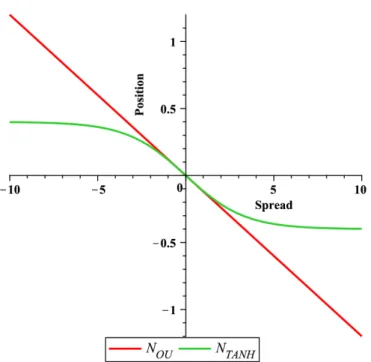
This chapter develops a theoretical model to provide answers to these questions. Its main contribution lies in the introduction of a novel stochastic process, whose dynamics are aimed specifically at capturing the fundamental risk factors ignored by existing models of arbitrage. This process is a nonlinear generalization of OU, and builds on Wong’s (1964) physics-based repulsive Wong process. By considering the problem under a partial equilibrium setting, this chapter is able to fully characterize a representative arbitrageur’s optimal portfolio policy. The closed-form availability of the optimal portfolio policy considering these additional risk factors allows us to make a number of interesting and novel observations. Firstly, arbitrageurs recognizing the possibility of persistently large mispricings exhibit a diminishing incremental propensity to exploit them,
50
as they develop an aversion to fundamental risk factors and lose confidence in the model’s ability to predict mean-reversion. Interestingly, this behaviour is counter-intuitive from the point of view of OU, which ignores fundamental risk factors and translates large mispricings into attractive opportunities and hence portfolio allocations linearly. Secondly, since widening mispricings imply both an improvement in the investment set and a capital loss on a current position, this work explicitly shows that beyond certain bounds in the magnitude of mispricing, a further widening of the mispricing prompts a reduction in the capital allocated to exploiting it. This chapter refers to these bounds as stability bounds. This artifact of the presented model complements the corresponding OU-specific result in Boguslavsky and Boguslavskaya (2004) and Jurek and Yang (2007). It is shown that the stability bounds in the nonlinear model are always tighter than those implied by OU. More importantly, this result suggests that when considering fundamental risk factors ignored by OU and other existing models, arbitrageurs seek to unwind losing trades sooner. Each of these observations is useful for researchers examining the capacity and role of arbitrageurs in enforcing price efficiency.
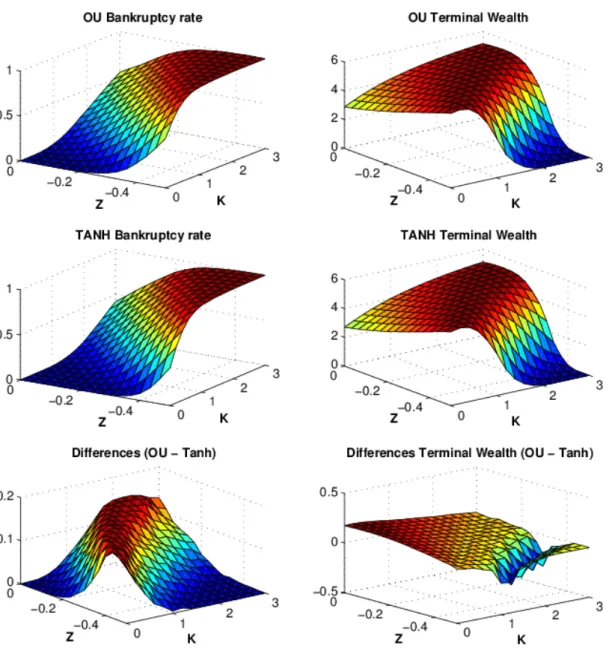
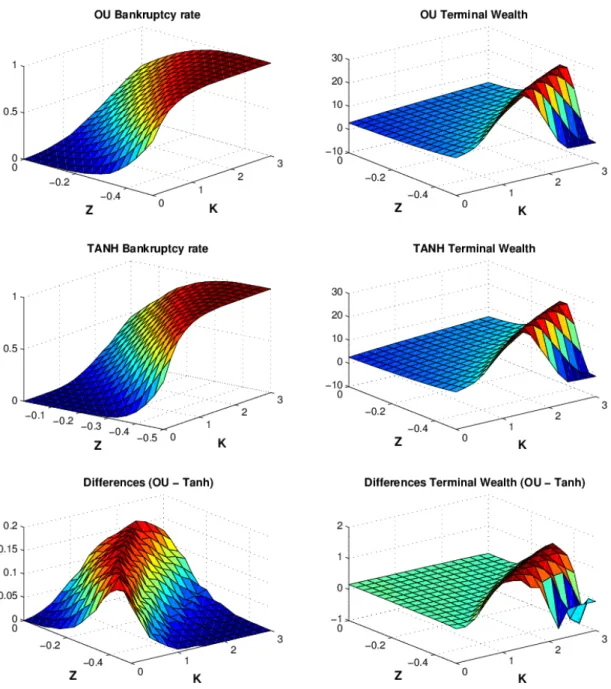
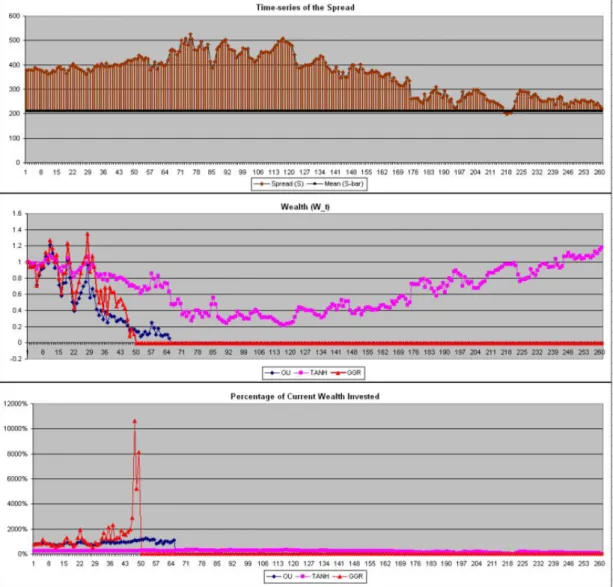
By way of a pairs-trading exercise, this chapter examines the effect of incorporating these fundamental risk factors on the nonlinear model’s empirical performance. This model is tested against OU and a “2-sigma” strategy common in the literature (Gatev et al. (2006)), on daily FTSE100 pairs data obtained from DataStream. The results are in favor of the nonlinear model, whereas OU and the “2-sigma” strategy which frequently go bankrupt. These results are interpreted as evidence that fundamental risk factors are significant to the capacity of arbitrageurs to enforce price efficiency. Interestingly, since model parameters are typically estimated from historical data, it is also found that the nonlinear model is more robust to the adverse effects of parameter misspecification than OU.
The rest of this chapter is organized as follows: Section 3.2 provides a review of the related literature, further motivating approach taken in this chapter. Section 3.3 derives the optimal portfolio strategy and stability bounds in the model presented in this work, then compares these with the corresponding results assuming OU. This section also presents a test to determine the effect of parameter misspecification on the optimal portfolio strategy. Section 3.4 presents a FTSE100 pairs-trading exercise. Section 3.5 concludes.
3.2 - Related Literature
There is considerable evidence that prices can diverge from fundamental values and similarly, that relative prices can diverge from their natural levels. Shleifer and Summers (1990) and Black (1986) highlight the effect of noise traders’ irrational trading behaviour on the formation of prices. Noise traders react disproportionately to news in the belief that they have insider information regarding the future direction of prices, creating a mispricing. On the one hand, Friedman (1953) argues that such mispricings cannot exist for long, as rational arbitrageurs will trade against noise traders, hence pushing prices toward fundamental values. On the other hand, Lamont and Thaler (2003a) find examples of persistent deviations from the law of one price, Froot and Dabora (1999) find mispricings betweenSiamese twin shares, Malkiel (1977) finds mispricings in the valuation of closed-end funds, and Lamont and Thaler (2003b) find mispricings in tech stock carve-outs. Consistent with the latter view, the nonlinear model presented in this chapter is based on the notion that mispricings can persist for significant periods of time. But why in general does capital not materialize to eliminate such mispricings?
The persistence of mispricings can be attributed to many factors. Abreu and Brunnermeier (2002, 2003) show that when individual arbitrageurs attempt to
52
“time the market”, informational asymmetries can cause coordination problems that consequently allow mispricings to persist. Brunnermeier and Pedersen (2005) highlight the role of predatory trading behaviour in the persistence of mispricings. Shleifer and Vishny (1997), Xiong (2001), and De Long et al. (1990) show that impediments to arbitrage can arise endogenously. When arbitrageurs allocate capital aimed at exploiting a mispricing, further divergences may cause them to unwind positions at a loss to preserve capital, a phenomenon described by Friedman (1953) as “buying high and selling low”. This creates a price feedback mechanism which exacerbates the mispricing. Lamont and Thaler (2003b), Liu and Longstaff (2004), Gromb and Vayanos (2002), and Basak and Croitoru (2000) suggest that portfolio constraints can allow mispricings to persist. Moreover, Kondor (2009) shows that arbitrageurs do not necessarily act to eliminate a mispricing even when portfolio constraints do not bind, because “opportunities might get better tomorrow”.
The partial equilibrium model is aimed at capturing these intuitions into an exogenously defined mispricing process. This is motivated in part by the need for more robust quantitative risk management models in the wake of the recent financial crisis (see Shaw and Schofield (2012)). The need for more robust risk-management ties with arbitrageurs’ profit-seeking behaviour. In the empirical section of this chapter, it is shown that commonly-employed arbitrage strategies which are not robust to fundamental risk frequently go bankrupt. After specifying the model, this chapter develops an optimal portfolio policy for a representative arbitrageur to adopt. This relates the model presented here to Boguslavsky and Boguslavskaya (2004), Jurek and Yang (2007), Liu and Longstaff (2004), and more generally to the portfolio optimization methodology pioneered by Merton (1969, 1971).3
3Similar works exploring optimal portfolio selection in arbitrage include Mudchanatongsuk et al. (2008), Kim et al. (2008), Lv and Meister (2009), and Elliott et al. (2005).

![1 (2 Oxoindolin 3 ylidene) 4 [2 (trifluoromethoxy)phenyl]thiosemicarbazide](data:image/gif;base64,R0lGODlhAQABAIAAAP///wAAACH5BAEAAAAALAAAAAABAAEAAAICRAEAOw==)