Journal of Mobile Technologies, Knowledge and Society http://www.ibimapublishing.com/journals/JMTKS/jmtks.html Vol. 2009, Article ID 107113, 7 pages
Copyright © 2009 Mohammed Samaka, Abdulaziz Fakhroo, Noha Al-Omari, Zohreh Moeinzadeh, Saada Al-Kubaisi, and Hanan Fakhri .This is an open access article distributed under the Creative Commons Attribution License unported 3.0, which permits unrestricted use, distribution, and reproduction in any medium, provided that original work is properly cited. Author contact: Mohammed Samaka , email: [email protected]
Wireless Application Deploying Cell
Broadcast, and Bulk SMS/MMS
Mohammed Samaka
1, Abdulaziz Fakhroo
2, Noha Al-Omari
1, Zohreh Moeinzadeh
1,
Saada Al-Kubaisi
1, and Hanan Fakhri
1 1Qatar University, College of eng., Qatar
2
Qatar Telecommunication (Qtel)
______________________________________________________________________________________________________________________________ Abstract
Cell broadcast is a mobile technology that allows messages to be broadcast to all mobile handsets and similar devices within a designated geographical area. The broadcast range can be varied, from a single cell to the entire network. This technology is used in deploying location-based subscriber services, such as advertising, regional auctions, local weather, traffic conditions, 'nearest' services (like requesting the nearest service station or restaurant), and Public Alerts (used for emergency and awareness situations). The project described in this paper involves designing and developing a wireless application, called SMS-CBS that runs over the terrestrial cellular network and supports several means of content delivery, mainly Bulk Short Message Service (SMS), and Cell Broadcast Service (CBS). This application assists both, the content and the service providers offering various essential services that require information delivery. The system architecture for this application comprises two main components: the SMS-CBS platform for information delivery over the wireless network and the Wireless Web Interface (WWI). The latter component is a multi-tier client server which has several elements, including Graphical User Interfaces (GUIs) that cover almost all the functional requirements for both ends, the contents provider, and network service provider. During the design and development phases, several features are considered and implemented that add more enrichment and strength to the system, including scalability, and customizability.
Keyword: Cell Broadcast, bulk SMS, wireless services.
_________________________________________________________________________________________________________________________
1. Introduction
Wireless communication is the fastest growing field in the telecommunication industry. Wireless services were integrated in the first generation to handle only voice communication. This was due to the low data transfer rate of around 4.8 Kbps. With the advent of the second generation and then GPRS (2.5 generation) the data rates reached 115 Kbps [1, 2]. However, those rates were still insufficient for extensive data transmission applications. Today, transfer rate limitations are solved with UMTS enhancements like HSDPA and HSUPA (uplink). In addition, with the upcoming flat fees for UMTS and GPRS based Internet access, communication costs will be no longer an important issue.
The huge improvement of wireless services and the growth of web applications have drawn the attention of the advertising market. Business firms, producers, and service providers have continually sought to reach consumers in the community through advertising. Organizations and governmental institutions have also sought for effective ways to broadcast essential information to the public concerning emergencies, natural or man-made disasters, and for public awareness. Television and newspapers have become a very slow and old-fashioned media. Alongside the communication revolution there has arisen a need for an application that delivers instant information and advertising messages.
Mobile technologies have emerged as possible effective solutions to instantaneously delivered contents, such as advertising messages, warning notifications, or emergency alert information. Determining which technology to utilize depends essentially on the capabilities of the service providers and the type of information to be delivered. It may also depend on limitations of currently used mobile handsets. Perhaps the two most feasible technologies to fulfill requirements are the common Short Message Service (SMS) and the Cell Broadcast Service (CBS). Both technologies are able to operate with almost all mobile devices available today. A brief introduction of the two technologies and their characteristics are presented, in the next two sections.
1.1 Short Message Service (SMS)
SMS is a popular protocol of asynchronous communication. It is used normally to transmit a limited size of text messages to one or a group of mobile stations. SMS offers a reliable message delivery. In case of system failure, lack of network coverage, or if the handset is engaged the message is stored in the Short Message Service Centre (SMSC) and delivered when the destination handset becomes available [3]. One disadvantage of SMS is that the network might become overloaded if a large number of SMS messages are sent simultaneously. Also, SMS does not normally offer any geo-specific location services by itself. However, SMS does have the potential to be used in location-based services if the wireless service provider uses other resources that provide information of geo-specific location. For instance, bulk SMS messages can be transmitted to specific mobile numbers when they have been identified to exist in designated area(s).
Furthermore, it is important to mention that other technologies such as Enhanced Messaging Service (EMS), Multimedia Messaging Service (MMS), and the new 3G standard Multimedia Broadcast Multicast Service (MBMS) might be potentially used to deliver geo-specific messages. The MBMS can broadcast information with rich multimedia content such as voice instructions and evacuation maps [4]. However, all the cases that have been surveyed in the literature were deployed by using either SMS or CBS.
1.2 Cell Broadcast Service (CBS)
Cell broadcasting is a technology that enables a wireless service provider to broadcast the
content message to all mobile stations in a specific geographic area. The area can be a single cell, a group of cells, or the whole region (all cells) covered by the service provider. Unlike SMS, the CBS does not provide two-way interactive communication. Although there are few proprietary solutions that exist today, they lack the back-end content management systems [5, 6, and 7]. One example is found in the literature where television and radio stations in rural states arrange to have messages broadcast to mobile users in circumstances like bad weather in the hope of attracting users to their channels [8]. CBS does not require the foreknowledge of mobile phone numbers. The handset however, has to be switched on to start receiving messages. A message will not be received if the handset is switched on after broadcasting. CBS is conveyed on dedicated channels by using a fraction of the bandwidth that is normally used for mobile phone calls and SMS text messages. Therefore, it does not place additional demand on carrier resources or suffer any degradation when the network becomes highly congested during emergency incidents or calamity events [9].
2. Project Overview
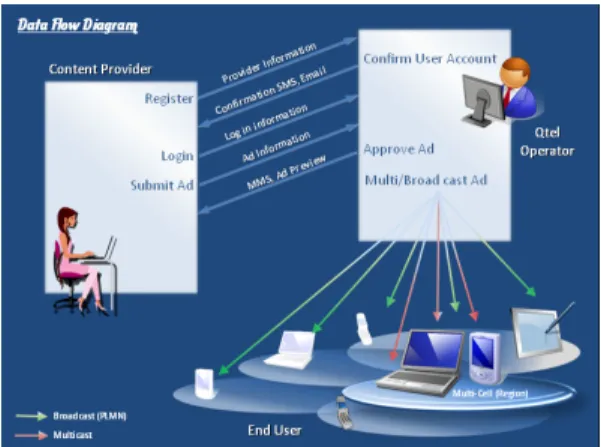
The project described in this paper involves the design and development of a wireless application called SMS-CBS. This application enables the content provider to deliver the content via either bulk SMS, or CBS over the terrestrial cellular network. The process of using the SMS-CBS is shown in Figure 1, and described briefly in the following scenario:
Fig 1. The SMS-CBS in action
a) Every client that requires his/her content to be broadcast over the wireless network has to register on-line through the GUI at the provider end. During the registration process, the potential client enters many details, as shown in the Figure
2. These user-specific data are then stored on the database connected to the server of the wireless provider. The server then sends back to the client (content provider) an e-mail message, and an SMS message (via the GSM/GPRS modem attached to the server) confirming the registration. Both messages also include unique log-in information.
Fig 2. Web form used for on-line registration
b) The registered client can use the form shown in Figure 3 to upload the content into the server of the service provider. The SMS-CBS allows the client to deliver the content to the intended subscribers using either bulk SMS, or CBS provided by the wireless service provider. As shown in Figure 3, the client can also preview his/her content (either advertisement or public information) on a mobile emulator.
Fig 3. Web form used by the content provider (client) for uploading content
c) The operator at the service provider’s end can examine the client’s content stored earlier in the database. The approved content can then be broadcast to the mobile devices of the intended
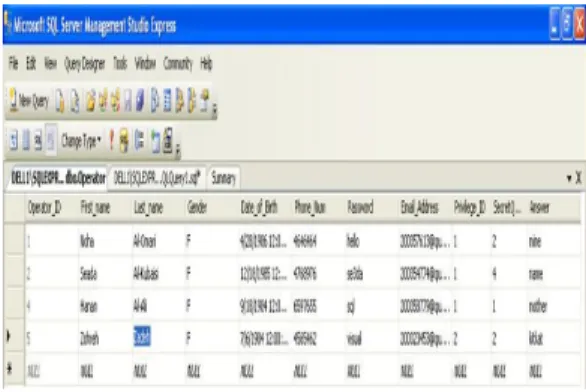
subscribers, based upon the provider’s preference. At the service provider’s end, the application provides the operator many tools to manage the clients’ accounts, and their contents (refer to Figure 4). The application also allows two different types of operator accounts to be created, the primary, and the secondary, each with a different set of access privileges.
This application is scalable in the sense that it allows the operator to upgrade the service by adding more regions, and more site types to each region.
Fig 4. Clients’ records at the WSP end
3. SMS-CBS System Design and Architecture The system architecture of the SMS-CBS comprises two subsystems: the Wireless Web Interface (WWI) and the SMS-CBS enabling platform. The WWI subsystem encompasses an efficient and scalable web service through which both the content provider (potential client), and the wireless service provider (in this case Qtel) can interact. The SMS-CBS enabling platform is the technology provided by the wireless service provider that allows the content to be delivered via either bulk SMS messages or CBS. The descriptions of the two subsystems for the SMS-CBS architecture are briefly given in the following sections.
3.1 Wireless Web Interface (WWI)
The software module that implements the WWI subsystem is a multi-tier client/server that is distributed into three components; one component is at the end of the content provider. The other two components are located at the end of the wireless service provider (Qtel). They are: the Qtel-Operator, and the Qtel-Server. The interaction between the system components is shown in Figure 5.
Both, the content provider and the Qtel-Operator can access the Qtel-Server via the GUIs at their ends that are connected to the server interface. They should first be successfully authenticated by the server. In this configuration, the SQL commands are conveyed to the database through the server interface in order to fetch data or to update the database with new changes. For example, when a content provider completes an online registration form (via the client GUI), the account table in the database is then updated with a new account record. On the other hand, the operator can also access the server for many other functions. For instance, it can activate the new account created for the content provider. For this function, the server will then update the new account status from being “Pending” to “Active”.
Fig. 5: SMS-CBS System Components
The WWI subsystem was developed using the C# programming language and the Microsoft Visual Studio. It is also connected to the Microsoft SQL Server that stores and manages the client’s registration data.
3.2 SMS-CBS Enabling Platform
This platform enables the service provider to deliver information via two different wireless technologies: Bulk SMS, or CBS. Both technologies are described earlier in sections 1.1 and 1.2.
The broadcast range can be as small as a single cell or as large as the whole Public Land Mobile Network (PLMN). A Mobile Station (MS) can receive a number of messages which can then be selected by the subscriber. The subscriber can also search through the different messages to find information that is of interest.
Normally, a short message is stored in the Base Station Controller (BSC) by an operator command. The message is then broadcast to one
or numerous cells. All the MSes, in the intended cell(s), can decode the message. The implementation of the MS defines how the user accesses the message. The transmission of each message can be scheduled; the start and end time as well as the period between transmissions of each message can be specified.
Transmission of the messages takes place on the Cell Broadcast Channel (CBCH) [2]. Therefore, cell broadcast has only marginal influence on cell channel dimensioning and no impact on traffic dimensioning. One message contains up to 93 7-bit characters, 82 8-7-bit characters or 40 UCS2 16-bit characters. Up to 96 message pages in total can be broadcasted in one cell at the same time. The CBCH is supported by using one Stand Alone Dedicated Control Channel (SDCCH/8) or by using one of the combined BCCH/SDCCH channels (SDCCH/4).
The cell broadcasting spectrum has the capacity of 64000 different channels. Each channel could be used for a different type of information, e.g. weather warnings, traffic reports, advertising, etc [8]. Certain channels are assigned for broadcasting specific-purpose information. For example, the “cell/area info display” service allows a cell to broadcast its geo-specific information (Name or ID) directly to its handsets by utilizing channel 050.
4. SMS-CBS Implementation
For the SMS-CBS application GUIs were designed for both the content provider and the operator of the wireless service provider with consideration to consistency and flexibility. The theme of the website and the colors were inspired by the Qtel logo. The interfaces are totally customizable to enable the user a satisfying experience. They are built using Microsoft Visual Studio along with cascading style sheet (CSS), and written in HTML and XHTML.
To implement a GUI of the SMS-CBS application, three master pages were created: “Operator Master Page”, “Provider Master Page” and “Default Master Page”. All operator pages inherit from the “Operator Master Page”, and all content provider pages inherit from the “Provider Master Page”. Pages that do not belong specifically to a provider or an operator such as, “Home Page”, “Sign up Page” and” Password Recovery Page” inherit from the “Default Master”.
4.1 Provider Functionalities
In the SMS-CBS system, many functions have been designed and implemented that allow the content
provider to interact effectively with the wireless service provider. Some of these functions are:
Request an account
Each content provider should have an account on the service provider. The account is
requested when the content provider completes an online registration form. The provider’s information is then held in the “Provider” table of the Qtel database. Each provider row in this table has a field “status” which indicates whether the provider request for an account is approved or not.
Add and Delete Subscribers
The content provider is given the ability to create a list of names and mobile numbers of the intended customers to whom the content will be broadcast via CBS, or sent via bulk SMS. Furthermore, the content provider can also update the list of customers by adding or removing customers.
Add, Edit, View Content
One function achieved through the GUI is when the content provider creates the content. On the page “Create New Content”, the provider is given three options: CBS, bulk SMS, and bulk MMS. These options are further explained in the following sections:
CBS: If the option CBS is chosen then the provider is requested to enter the cell ID to which the content is to be broadcasted. The provider also has the option to select a region (a set of cells), or the PLMN (all the cells). Further, the provider is also given the option to choose the frequency of broadcasting. It can be on daily, weekly or monthly basis. In addition, he/she can determine how many times during this period the broadcast is carried. This information is needed by the CBS hardware platform of the wireless service provider Qtel in order to broadcast the contents.
Bulk SMS: When the content provider chooses the “bulk SMS” option, he/she will then be requested to enter the text message to be sent and the list of intended recipients. The list of recipients is retrieved from the database on the server and then loaded into an XML file. This XML file is created according to Qtel syntax requirements. At the Qtel end, the SMS message is sent to the recipients’ mobile handsets, and an XML report is sent back to the content provider. The report shows the mobile phone numbers of
all the recipients. Part of the code used in implementing this function is given as follows:
//Creating the XML file to send it to Qtel
SMS_Text = Text_Msg_Box.Text.Trim(); Link = "http://www.smsbusiness.net.qa/QtelXML/Proce ssBulkSMS.asp?Msg=<?xml%20version='1.0'%20 encoding='UTF-8'?><request><bulk_msg><user_id>VASTeam</u ser_id><password>jelnmoafaamdiokippne</pass word><validity_period%20status=" + '"' + "y" + '"' + "><day>2</day><hours>3</hours><mins>10</ mins></validity_period><delivery_report>0</del ivery_report><message><title>VASTeam</title>< lang_id>0</lang_id><body><![CDATA[Dear%20~ 1~,%20" + SMS_Text + "]]></body><values><msg_id>1</msg_id><mobil e_no>974" + (ds_Pro.Tables[0].Rows[0].ItemArray[1].ToString ().Trim()) + "</mobile_no><param%20id=" + '"' + "1" + '"' + "><![CDATA[" + (ds_Pro.Tables[0].Rows[0].ItemArray[0].ToString ().Trim()) + "]]></param></values>";
for (int i = 0; i < ds.Tables[0].Rows.Count; i++) { info = "<values><msg_id>" + (i + 2) + "</msg_id><mobile_no>974" + (ds.Tables[0].Rows[i].ItemArray[1].ToString().Tri m()) + "</mobile_no><param%20id=" + '"' + "1" + '"' + "><![CDATA[" + (ds.Tables[0].Rows[i].ItemArray[0].ToString().Tri m()) + "]]></param></values>"; Link += info; } Link += "</message></bulk_msg></request>";
Bulk MMS: The option “bulk MMS” is similar to “bulk SMS” except that the MMS content should not exceed 300kb, considering the memory limitation of a mobile device.
4.2 Operator Functionalities
Operators are the personnel controlling the traffic of provider accounts and contents at the wireless service provider. They are divided into three levels based on the accessibility privileges they have on the provider’s network and server. The levels are: primary operator, secondary operator and content operator. In the SMS-CBS several functions are assigned to the operators, including the following:
Create, Modify and Deactivate Operator Accounts
Creation, deactivation and modification of operator accounts are restricted depending on the privilege levels of the operators. For instance, the primary operator is able to create other secondary operator, and content operator accounts. The secondary operator however, is only able to create content operator accounts. View the Submitted Contents
All contents submitted by the content providers are listed in a grid view on the “Content” page. The operator can view individual content by selecting it and then clicking on the “Review” button. The ID of the selected content is saved in a cookie and the operator is redirected to the review page. On this page, using the saved ID in the cookie, the content information is retrieved from the database and displayed on the operator screen. The system enables the operator to review the content but not to edit or modify anything. The feature of approving the content before broadcasting/sending has also been added to the system.
Confirm Provider Accounts
Accounts for the content providers are divided in two groups: pending accounts and approved accounts. Approved accounts are authorized to submit content and access the system, whereas pending accounts are still waiting to be authorized. To approve a provider account the operator selects the account from the list of pending accounts on the “Provider Accounts” page, then clicks on the “Review” button to save the account’s ID in a cookie. The operator is then redirected to the “Confirm Provider Account” page where the provider’s information is retrieved from the database. This information is then displayed to the operator for reviewing. After reviewing, this account can either be rejected or confirmed.
Add / View Regions and Cells
Operators are able to view and add new regions and cells to the system (whenever, the wireless provider is expanding to cover more regions, such as, states, or suburbs, etc). On the “Regions” page all the current regions are listed in a table with detailed information about each region. Also, from the list of regions, the operator can view the cells for a specific region. Furthermore, the system allows the operator to add a new region or new cell to the existing ones.
5. Conclusion
This paper describes a project that involves designing and developing an application called SMS-CBS, intended for Qatar Telecommunication (Qtel). The SMS-CBS runs over the terrestrial cellular network through which it provides different services for instantaneous content delivery, mainly bulk SMS, and the CBS. The intended content for delivery can be of different types, including advertisements, warning notifications, and emergency alert information. In this project several other technologies for content delivery were also investigated. In this regard, the literature shows that, all the proprietary solutions that exist today have been deployed by using either SMS or CBS. However, these solutions, lack the back-end content management systems, and they require overhead specific hardware.
The architecture of SMS-CBS is designed to support the unique capabilities of achieving a high quality mobile solution that meets the needs of almost any business or public service activity that involves information broadcasting over cellular networks. The system architecture for SMS-CBS comprises two subsystems. One is the Qtel platform supporting both technologies of content delivery: bulk SMS and CBS. The other subsystem encompasses a web service used by both the content provider and the wireless service provider (Qtel) for content management and effective interaction. During the design and development phases, several features were considered and implemented that add more enrichment and strength to the system, including scalability and customizability. For instance, more regions or cells can be added to the application whenever the area covered by the wireless provider is extended.
The application also provides the content provider with the option of using the Multimedia Broadcast Multicast Service (MBMS) that can be implemented whenever the technology supporting this service is integrated to the Qtel network.
In the SMS-CBS application, only bulk SMS was deployed and tested at Qtel. All the messages sent via bulk SMS were received by the intended recipients (specified earlier and stored in the Qtel server). Unfortunately, at the time this paper was written, the technology supporting CBS was not available. When this technology is provided and integrated to the SMS-CBS application, the content provider will then be able to broadcast
geo-specific content to those cells specified earlier and stored in the Qtel server.
Furthermore, few other potential enablement were also investigated that might be added in the future to the SMS-CBS application. It’s mainly about having the content appearance on devices’ screens consistent and uniformed across different device platforms and configurations. This would require a content delivery platform that performs device identification, device profiling and content rendering. It will ensure that every page of content suits each device capabilities, as well as handling devices differences to display the design intent correctly.
6. Acknowledgement:
we would like to express our gratitude to the following organizations; Qatar National Research Fund for funding this project after the initial proposal was being evaluated and accepted and Qatar telecommunication (Qtel) for offering the technical assistance, and providing the network resources.
7. References
Samaka, M., and Khan, K. Wireless Networks, A chapter published in John Wiley Encyclopedia of Computer Science and Engineering, John Wiley & Sons, Inc., USA, February 2009, ISBN: 978-0-471-38393-2.
Schiller, J. Mobile Communications. Addison Wesley, 2003.
EUROPEAN TELECOMMUNICATIONS
STANDARDS INSTITUTE. Analysis of the Short Message Service and Cell Broadcast Service for Emergency Messaging applications.
Retrieved May 7, 2008:
http://pda.etsi.org/pda/home.asp?wki_id=jhPg
AkxRGQ2455A550@55
ERICSSON.COM. Mobile networks go broadcast with Ericsson.
Retrieved May 10, 2008:
http://www.ericsson.com/ericsson/press/relea
ses/20060405-1043320.shtml
CELLTICK. Cell broadcast: New interactive services could finally unlock CB revenue potential.
Retrieved March 2, 2009:
http://www.celltick.com/technology.asp?id=W
hitePapers&cid=14
Hai Q, Uchida, US Patent 7397773 - GSM cell broadcast SMS message transmission in CDMA
communication systems. July 8, 2008. Retrieved March 2, 2009:
http://www.patentstorm.us/patents/7397773.ht ml
Wood, M. CELL BROADCAST IN IS95 CDMA, FOR
LOW COST WARN ACT COMPLIANCE, CellCast Technologies, Feb 2009.
Retrieved March 2, 2009:
http://www.cellcastcorp.com/WhitePapers.aspx
Aloudat, A., Michael, and K. Yan, J. “ Location-Based Services in Emergency Management- from Government to Citizens: Global Case Studies”, University of Wollongong, 2007.
Retrieved January 3, 2009:
http://ro.uow.edu.au/cgi/viewcontent.cgi?article
=1564&context=infopapers
CELLCAST COMMUNICATIONS, 2006. First
U.S. Emergency Alerts on Cell Phones By CellCast Communications and Einstein Wireless Prove Viable in Disasters or Terrorist Acts. PR Newswire (U.S.), 16 August, 2006. Retrieved January 5, 2009: