GRADUAL TYPING FOR PYTHON, UNGUARDED
Michael M. Vitousek
Submitted to the faculty of the University Graduate School in partial fulfillment of the requirements
for the degree Doctor of Philosophy
in the School of Informatics, Computing, and Engineering Indiana University
Accepted by the Graduate Faculty, Indiana University, in partial fulfillment of the requirements for the degree of Doctor of Philosophy.
Doctoral Committee Jeremy G. Siek, Ph.D. Sam Tobin-Hochstadt, Ph.D. Amr Sabry, Ph.D. Lawrence S. Moss, Ph.D. September 5, 2018
Copyright © 2019 Michael M. Vitousek
Acknowledgements
In some sense I’m acknowledging the people who have made me who I am today—that’s the kind of dominant role that grad school has in life, or at least in mine. This dissertation is a story about gradual typing, but it’s also an artifact of me growing up: of the transition from young adulthood to… well, whatever it is that comes next. As such, there’s a lot of emotions instilled in this document, and pro-ducing it took the support—intellectual, social, emotional—of so many other people. Mentioning them all is, of course, impossible. But I’m gonna try and thank a few.
The most important professional mentor I’ve had is of course my advisor, the inimitable Jeremy G. Siek. Starting from when I emailed him my undergrad senior thesis and asked him if he was looking for stu-dents (he replied with thoughtful suggestions on how to improve my thesis and an invitation to come meet with him), to my first couple years of training and instruction at the University of Colorado, and through my more independent research at Indiana, Jeremy has consistently supported me and helped me succeed. His “evil hat” has driven many thoughtful critiques of my work that have vastly strength-ened the end result, and his patience and warmth have made his office a comfortable place to express my thoughts and ideas. Maybe most importantly, he’s adapted his style for every stage of my career with him: spending a ton of time getting me up to speed when I started out, to working closely together on new ideas as I began to stretch my wings in research, to providing hands-off support as I developed my own ideas and my own program. I’ve never felt seriously neglected nor have I felt that my freedom to explore was limited, and that balance has been deeply important to my development as a scientist. I’m looking forward to having Jeremy as a colleague and as a friend in the future.
Of course, Jeremy isn’t alone in shaping my career. Similarly important have been my outstanding re-search committee as well as many other faculty members who I’ve worked with. Sam Tobin-Hochstadt has been a thoughtful, detailed, and enjoyable mentor to have, and his perspective has always improved
my work and clarified my thinking. Beyond gradual typing, Amr Sabry’s comments and questions over the years have made me a better researcher, and Larry Moss has helped me shape and target this disser-tation to be as effective as I can make it. Back at University of Colorado, Evan Chang played a critical role in my first years in graduate school, and is a lot of why, even as my research has focused on lan-guage design, I still approach a lot of problems through the lens of static analysis. Finally, Liz Bradley’s Intro to the PhD Programclass at Colorado played a crucial role in helping me navigate the challenges of graduate school, and I’m grateful for how she helped me grow a foundation of research skills that I’ve built upon.
A few other mentors in my academic life come to mind, who I can thank (or, perhaps, blame?) for putting me on this path. Willamette University’s computer science department was a formative place for me— and how could I not end up as a programming languages researcher after I went to a department with a total of four faculty, two of whom were PL folks? John Lasseter was the first professor with whom I had a real rapport for research, and working with him on undergraduate research solidified my interest in the study of programming languages. He is also one of the kindest people I know, and working with him was always rewarding. Fritz Ruehr further guided me as I approached graduate school and helped me navigate through my senior thesis, graduate school applications, and health complications. My other undergraduate advisor from my history degree also shaped who I am as a researcher: this thesis doesn’t often touch on, say, Cold War politics or political transformations in the Eastern Bloc, but Bill Smaldone helped develop my critical thinking and writing skills more than almost anyone else. Finally, I have to mention my first computer science instructor, Gunn High School’s Josh Paley. His wit and genuine kindness made him as fantastic of a teacher as I can imagine, and I was probably cursed to be a programming language researcher from the beginning, given that his first classes covered both Scheme and Java and encouraged us to think about the differences between them.
Of course, it isn’t just teachers, professors, and advisers that form the groundwork for success in a grad-uate program. Equally important to me have been my friends and colleagues in my programs, both at Indiana and Colorado, who have both been excellent professional colleagues and have formed a per-sonal support system that I’ve always been able to rely on. There are, of course, too many folks to mention, but I’ll try to call out a few. At Colorado, I owe a lot to friends like Mario (BRADDAH); Daniel and Angela (thanks for turning me on to homebrewing, a hobby that also probably is responsible for me surviving graduate school); Anshul and Mariah (and now Liara!); Hal, Andy, and the rest of the sadly defunct Distinguished Cooking Series crew; and Shashank and Jonathan, my first lab-mates in the program. At Indiana, I want to mention Chris (a fellow CU ex-pat whose clever ideas are even bigger than his dog), Mike and Tori, Andre and Laura, Matthew, Kyle, Jaime, Spenser, Rajan, and many other fantastic drinking buddies; and the outstanding gradual typing crew, equal parts friends and research colleagues, Matteo, Andrew, Sarah, David, Caner, and Ambrose (among others mentioned elsewhere). I especially have to mention though my dude Cameron Swords, who has been as close of a friend and as outstanding of a colleague as anyone could ask for. He and his wife Rebecca—a similarly awesome person—have been some of my closest friends in Bloomington ever since the day Cam cold-emailed me after a homotopy type theory class and demanded we get a drink together sometime. We’ve been coau-thors on a top tier paper, a bunch of delicious fermented beverages, and a bizarre role-playing game or two, and when we work together on anything the result is always over-the-top and awesome.
Naturally, funding support has been essential in completing this work, and there are several institutions and organizations that have helped me significantly along the way. Fellowships from the University of Colorado made my funding situation for my first two years very straightforward, and I’m honored and grateful for the support they granted me. The National Science Foundation funded most of the latter part of my degree, as did funds from Indiana University itself. Google’s Lime Scholarship provided me with important travel funding throughout my degree, and a generous grant from Facebook enabled me
to finish this dissertation by funding my last year in the program. I’m grateful for and humbled by the support from each of these institutions.
The last and most important people I want to mention are my family.
The best thing that graduate school did for me, and the reason I’m so grateful that I moved to Indiana with Jeremy, was giving me the opportunity to meet “my person,” my fiancée Amanda. She’s been the kind of friend and partner that I wonder how I ever did without. Whether we’re discovering an awesome new brewery, hiking in Brown County or the California Coast Range, playing video games on a snowy day, or just spending time with each other, she makes me a better person, and it’s with her that I first really started to think about the future. I’m so excited for the rest of our lives, and I’m so grateful to have had her love and support as I completed this work.
During graduate school I’ve watched my sister Liana startandfinish college and a graduate program of her own, and I’ve watched her grow into an amazing woman. She’s forging a path for herself with deep strength and enthusiasm, and I’m really happy to be a part of it. I’m so proud to be her brother. Finally, the love and support of my parents, Pam and Peter, has made me who I am, and is behind everything I’ve done. Thank you, Mom and Dad, and I love you.
Michael M. Vitousek
GRADUAL TYPING FOR PYTHON, UNGUARDED
Gradual typing integrates static and dynamic typing with the guarantee that statically typed regions of a program will never have their types violated even if they interact with dynamically typed regions. Traditionally, this guarantee has been achieved by using proxies to mediate when values flow between statically and dynamically typed code. However, languages such as Python cannot support these prox-ies, and so a different approach is needed to adapt gradual typing to Python. In my dissertation, I show that the guarded approach is a poor match for Python, but also that sound and efficient gradual typing for Python can be achieved with enforcement strategies that do not use proxies.
I show two approaches for achieving soundness without proxies. The first, themonotonicapproach for mutable references, uses runtime type information to ensure that data corresponds to all types at which it has been referenced, removing the need for proxies. However, the need to track this information is a serious challenge.
Alternatively, lightweighttransientchecks may be inserted throughout the statically typed regions of the compiled program, which ensure that all values shallowly correspond to the static types they are expected to have. I implemented this strategy in a gradually typed version of Python, and found that the transient strategy is a good match with Python: transient checks can be straightforwardly imple-mented and are efficient. In order to improve the runtime performance of transient gradual typing, I developed a type-inference-based approach to erase transient checks when they can be statically shown to be redundant. I studied a number of benchmarks in Python with this implementation and found that the performance impact of transient gradual typing is minimal in most cases, especially when used in combination with PyPy, a JIT-based Python runtime.
Contents
Chapter 1. Introduction 1
1. Overview 1
2. Designing Gradually Typed Python 7
3. Gradual Typing with Monotonic References 8
4. Transient Gradual Typing 10
5. Conclusions 18
Chapter 2. Background 20
1. Understanding Gradual Typing 20
2. Further Research in Gradual Typing 36
3. Gradual and Optional Typing in Practice 39
Chapter 3. Monotonic References for Efficient Gradual Typing 44
1. Introduction 44
2. Background and Problem Statement 47
3. Monotonic References Without Blame 53
4. Type Safety for Monotonic References 62
5. Monotonic References with Blame 64
6. The Blame-Subtyping Theorem 70
7. Implementation Concerns for Strong Updates 73
8. Related Work 74
9. Conclusions 74
Chapter 4. Design and Evaluation of Gradual Typing for Python 75
2. The Reticulated Python Designs 78
3. Case Studies and Evaluation 91
4. Implementation 103
5. Conclusions 106
Chapter 5. “Big Types in Little Runtime:” Open-World Soundness and Collaborative Blame 108
1. Introduction 108
2. Open-World Soundness and Gradual Typing 110
3. Collaborative Blame 117
4. The Transient Gradual Lambda Calculus
λ
⋆→ 121
5. Blame, Soundness, and the Gradual Guarantee 131
6. Implementation and Evaluation 140
7. Related Work 143
8. Conclusions 145
Chapter 6. Optimizing and Evaluating Transient Gradual Typing 146
1. Introduction 146
2. Performance of Transient Gradual Typing 151
3. Optimizing Transient Gradual Typing 158
4. Performance of Optimized Transient Gradual Typing 174
5. Performance on PyPy, a Tracing JIT 176
6. Discussion and Future Work 180
7. Related Work 185
8. Conclusions 187
Bibliography 189
Appendix A. Appendices to Chapter 5 199
1. Appendix: Additional semantics 199
2. Appendix: Proofs 199
1. Appendix: Semantics 245
2. Appendix: Proofs 245
CHAPTER 1
Introduction
1. Overview
Static and dynamic typing are well-suited to different programming tasks [59]. Static typing excels at documenting and enforcing constraints, enabling IDE support such as auto-completion, and helping compilers generate more efficient code. Dynamic typing, on the other hand, supports rapid prototyp-ing and is suited to metaprogrammprototyp-ing and reflection. Because of these tradeoffs, different parts of a program may be better served by one typing discipline or the other. Further, the same project may be best suited to different type systems at different points in time—a system may start out in an amor-phous state with quickly-changing structures and design goals, but then evolve into a larger system with precise specifications that benefit from the automatic verification provided by static type systems. For this reason, combining static and dynamic typing within a single language and type system has been a popular goal, especially in the last decade. Early approaches include those of Abadi et al. [3], Thatte [91], and Bracha and Griswold [22]. Siek and Taha [75] introducedgradual typingas an approach to merging static and dynamic typing using a notion of consistency between (partially dynamic) types, together with higher-order casts. Over the last decade, gradual typing has been of great interest to both the research community [67, 88, 86, 84, 70, 10, 5], and to industry developers, who have introduced several languages with elements of gradual typing, such as TypeScript [61], Flow [31, 25], and Hack [30]. Vitousek and Siek [98] draw a distinction between two approaches to combining static and dynamic typing: optional typingandgradual typing. These approaches share a common approach to static type-checking: both approaches include a static type system that detects incompatibilities between statically typed regions of code, just as a traditional typechecker would. Both gradually and optionally typed lan-guages include a “dynamic type” (often written as
⋆
,?
, dyn, or any; in this dissertation the symbol⋆
denotes the dynamic type) that represents that the static typechecker should be optimistic: an expres-sion of any type may be passed into the dynamic type and vice versa without the typechecker raising a static type error. This gives programmers an “escape hatch” when they do not want to, or cannot, precisely specify the types of their programs, while allowing them to gradually transition towards full static typing if desired.
The distinction between optional and gradual typed languages is centered in their dynamic semantics. Programs in an optionally typed language are usually translated to an existing dynamically-typed lan-guage by erasing type annotations. For example, TypeScript and Flow translate to JavaScript, Typed Clojure [20] to Clojure, Hack [30] to PHP, and Typed Lua [58] to Lua. The resulting programs are then executed on existing runtimes for their target languages. Because of the existence of the dynamic type in the optionally typed language’s static type system, it is possible for these programs to have values flow from dynamically typed to statically typed regions of code, and for those values to not correspond to the static types they are expected to have. In an optionally typed language, nothing at runtime en-forces that values correspond to their expected static types, and so no errors result in such situations (although the semantics of the target language may cause such programs to reach an error state, for example if a number is called as if it were a function). Optionally typed languages are thereforeunsound with respect to their type annotations—they may not be unsafe in the sense of lacking memory safety or eliciting undefined behavior (unless the target language is itself unsafe), but the type specifications given by the programmer are not necessarily respected at runtime.
By contrast, agradually typedlanguage is defined as beingsoundwith respect to its type annotations. This is a property that gradual typing shares with traditional statically typed languages. Like optionally typed languages, gradually typed languages usually translate their programs into a target language, but this translation enforces sound interaction between static and dynamic code at runtime by inserting runtime type checks, which inspect values at runtime. Runtime type checks are used to prevent values from inhabiting variables of the wrong type where static types are expected. Soundness with respect to type annotations is a desirable property because it improves the debugging experience for program-mers by allowing them to trust their type annotations, but the need to perform runtime type checking degrades performance at runtime.
The traditional approach used for runtime type checks in gradually typed languages is for the transla-tion to the target language to insert casts at the site of implicit conversions between static and dynamic code [75, 48, 103, 93]. Casts on first-order types are constant-time operations that either succeed or fail immediately, but higher-order casts create wrappers orproxies. These proxies then mediate further in-teraction between the proxied value and the code it is embedded in, and will perform its own additional runtime checks to ensure that static types are never invalidated. Proxies can also be used to perform blame-tracking[103], which allows runtime type errors to be traced back to the boundary crossing site that eventually led to the error, helping debugging. I refer to this design as theguardedsemantics for gradual typing.
Unfortunately, guarded has issues with both efficiency and practicality in many circumstances. Not all dynamic languages support robust proxies, and the pervasive use of proxies has been found to degrade performance in existing gradually typed languages. The designer of a gradually or optionally typed lan-guage may not be able to alter the target lanlan-guage to fix these problems: the designers of TypeScript, for example, cannot unilaterally alter JavaScript to better suit their designs without losing compatibil-ity with existing JavaScript codebases. These factors interfere with the desirable goal of transitioning unsound optionally typed languages into gradually typed ones that are sound with respect to their an-notations. However, new techniques that avoid dependence on proxies may smoothen the path for optionally typed languages to become gradually typed ones, and I will examine this space in this disser-tation. I will do so in the context of a gradually typed language that translates to Python, a dynamically typed language that does not support robust proxies. Modifying Python itself is outside the scope of this work in order to maintain compatibility with existing Python programs and lower the barrier to entry for programmers already using Python.
In this dissertation, I will explore the following thesis:
The guarded approach is a poor match for a gradually typed variant of Python implemented as a source-to-source translation to Python, but I develop alternate enforcement strategies and achieve sound and efficient gradual typing for Python without relying on proxies.
I will discuss two alternate enforcement strategies which I have developed, as well as the system that I use to evaluate them in practice. Chapter 3 of this dissertation will discuss a system for efficient gradual typing for mutable references. Chapter 4 will present the Reticulated Python programming language, a gradually-typed version of Python that I use as a testbed. It also informally introduces the approach to sound gradual typing that relies on pervasive lightweight checks: thetransientsemantics for grad-ual typing. Chapter 5 will dive deeper into the transient semantics, proving several key theorems that show its practicality. Chapter 6 will evaluate the performance of the transient semantics in Reticu-lated Python. The remainder of this chapter will discuss and summarize the key contributions of this dissertation.
1.1. Reticulated Python: Gradual Typing for Python. I developed the Reticulated Python program-ming language to explore the challenges of gradual typing. Reticulated Python is a testbed for gradual typing for the Python 3 programming language which typechecks type-annotated Python code using a gradual type system, and then translates this code into standard Python 3. Because Reticulated Python is a gradually typed language, it inserts code during translation that perform runtime checks.1
Initially, Reticulated Python used the guarded semantics for these checks, but I encountered signifi-cant problems with this approach. In particular, Python’s support for proxies is limited: proxies ought to behave indistinguishably from the proxied object except for raising runtime type errors when type guarantees are violated, but Python’s proxies are easily distinguishable from their underlying objects in ways that cause programs to fail unexpectedly. For example, the type()function (for inspecting the class of runtime values) returns the class of the proxy rather than the proxied value, and a prox-ied value is not pointer-identical to the proxprox-ied value, which is revealed by using Python’sisoperator [100]. Most significantly, proxies are unable to interact with the compiled C++ code that implements the Python runtime itself, so when proxied objects are passed into built-in language functions, unexpected errors arise [101]. I refer to languages like Python, with limited proxy support, asspartan hosts, and without modifying the Python language, proxies powerful enough to implement the guarded approach are impossible.
In addition, even if proxies were possible in Reticulated Python, their use necessarily demands sig-nificant performance overhead. For example, when a proxied mutable reference is dereferenced even within statically typed code a cast will have to occur at runtime—the proxied value will first have to be dereferenced, and then the resulting value casted to ensure that it corresponds to its expected static type.
Furthermore, Takikawa et al. [90] showed via practical experiments that Typed Racket, a prominent gradually typed language that uses the guarded design [93, 85], exhibits severe overhead (in some cases, over 100
×
!) in certain combinations of static and dynamic typing when compared to either wholly typed or wholly untyped versions of the same program.1.2. Alternative Strategies for Sound Gradual Typing. I initially experimented with a solution to these problems with themonotonicsemantics for gradual typing, which allows mutable data to be type-safe at runtime without proxying. This approach works by causing mutable values to keep track of their own types at runtime, and as a value passes into contexts where it is expected to have a static type, it be-comes monotonically more precise (i.e. less use of the dynamic type). This allows statically typed uses of the value to be efficient, and in theory allows for compiler optimizations to leverage type information. I implemented this approach in Reticulated [100] and it was proved sound in a calculus [83]. However, I found that this approach, while promising in some contexts, was not appropriate for Python: functions still require proxies, Python does not robustly support the mechanisms needed to enforce monotonicity, and requiring that types become monotonically more precise during execution could cause unexpected type errors that would not occur with the guarded semantics. Additionally, the most significant opti-mization that monotonic supports, removing the need for dispatching at statically-typed dereferences, is unavailable in Reticulated Python, because it is a source-to-source translator that uses the standard Python runtime. As such, while the monotonic semantics remains a subject of interest in gradual typing and may be appropriate for other languages (or a specialized implementation of the Python language itself), I have ceased developing it for Reticulated Python.
Instead, my recent work has been focused on thetransientsemantics. This approach uses no proxies, and instead inserts lightweight runtime checks pervasively throughout the statically typed portion of the
program. These checks ensure that valuesshallowlycorrespond with their expected types: for example, a function that takes an argument
f
of type int→
int will have a check at its entry point to ensure thatf
is a function. Then iff
is called, another check will ensure that the result has type int. This approach avoids many pitfalls of other techniques because no wrappers or reflection are used anywhere—the only language features required is the ability to inspect the shallow runtime type (or type tag) of a value, which Python fully supports, allowing Reticulated Python to use the transient approach without errors [100].I proved that this approach is sound in a calculus, and further that it obeys the property ofopen-world soundness[101]. This requires that a gradually typed program can be translated to a dynamic target language and can then interact soundly with code native to that target language. This ensures that translated code can serve as a library to be used by target-language clients, and that it can be embedded in code (like the Python runtime) that does not respect its expected types, without any errors arising other than ones raised by transient type checks or from the code native to the target language.
I also showed that this approach avoids the efficiency problems discovered by Takikawa et al. [90] by analyzing Reticulated programs with various combinations of type annotations. To further improve performance, I combined transient with static type inference to discover which runtime checks are un-necessary and remove them [102]. This resulted in an average slowdown of just 6% compared to the performance of Python on an untyped program. When combined with a tracing JIT implementation of Python, which can further remove checks via a dynamic analysis, the overhead of gradual typing was reduced further.
In this dissertation I will discuss my work in gradual typing for Python and my approaches to preserving soundness while avoiding the use of proxies. While my work has been guided by Python and its limita-tions, and the traditional approaches may work for other languages, by developing the design space of gradual typing outside of proxy-based approaches I hope to help expand the space of its useful appli-cations. In particular, I aim to smoothen the path for optionally typed languages to become gradually typed ones. In Section 2 of this chapter I discuss the Reticulated Python programming language, the platform I use to explore these issues. In Section 3 I describe themonotonicsemantics for gradual typ-ing, which ensures soundness of mutable data and displays no overhead from heap lookups in statically
typed code, but which I found to not be suitable for Reticulated Python. Section 4 explores thetransient semantics, which inserts lightweight typechecks pervasively throughout statically typed code. Section 5 concludes this chapter.
2. Designing Gradually Typed Python
With the goal of adapting gradual typing to the Python programming language, I initially worked on the Jython programming language with Jeremy G. Siek, Shashank Bharadwaj, and Jim Baker. Jython is a compiler for Python that produces bytecode for the Java virtual machine [51], and in this context we first studied alternatives to the standard semantics for gradual typing such as the monotonic approach, described below [99]. However, Jython is a very heavyweight piece of software and using it as a testbed for experimentation quickly proved to be impractical.
As an alternative, I developed the Reticulated Python programming language2 [100], which I will dis-cuss in Chapter 4 (and further develop in Chapters 5 and 6). Zeina Migeed, Benjamin Greenman, and Andrew Kent also contributed to Reticulated Python’s development. Rather than a new implementation of Python, Reticulated is a source-to-source translator that accepts syntactically valid Python 3 code with type annotations, typechecks this code, and generates Python 3 code, which it then executes using an off-the-shelf Python runtime. The dynamic semantics of Reticulated programs differ from Python 3 programs in that Reticulated’s translation process may insert run-time checks to mediate between static and dynamically typed code, which will raise runtime errors if static types are violated at runtime. The run-time checks are implemented as calls into Python libraries which are distributed with Reticulated, and Reticulated’s source-to-source translator is intended to be somewhat agnostic with regards to the details of these libraries. This approach enabled fast experimentation with the design of the runtime libraries without much need for altering the translator (although, as discussed below in Section 4, some approaches require the translation to insert more calls to the runtime library than others).
While I experimented with varying approaches to Reticulated Python’s dynamic semantics, all share a common static type system [100]. This type system supports first-class functions, object and class types, 2Reticulated Python is named forPython reticulatus, the largest species of snake in the python genus. I refer to it as “Reticulated” for short.
and accounts for Python’s approach to method binding. Reticulated gives nominal types to objects and classes, but also supports structural types when desired. Also supported are many of the basic data structures provided by Python, such as lists, sets, and dictionaries. Also included is the dynamic type, which can be explicitly written by the programmer using the keywordAny, or which is assumed in the absence of an annotation.
Since this type system is suited to Python programs, and since Python itself provides libraries that model much of its own functionality, Reticulated leverages these libraries in implementing a type system for Python programs. For example, the specification of a Python function’s parameters can be very com-plex: parameters can have default values or be keyword-only (meaning they can only be called if the caller explicitly maps an argument to the parameter by name), and both positional and keyword-only rest arguments are supported. Similarly, function call sites can be complex. Therefore, rather than building a type specification for function arguments that accounts for this complexity, Reticulated rep-resents function types using Python’s reflective
Signature
object, which contains a full specification of a function’s arguments. When typechecking a call site, theSignature.bind
method, which imple-ments Python’s argument-parameter binding algorithm, is used to bind argument types to parameter types, after which they are compared to determine if the call site was well-typed.As of version 3.5, Python does not provide syntax for giving type annotations to local variables. Instead, Reticulated uses local type inference to determine the static type of locals. This inference is conserva-tive, and results in the dynamic type if a single type cannot be inferred.
3. Gradual Typing with Monotonic References
With Jeremy Siek, I developed the monotonic design for gradual typing by observing a fundamental is-sue for implementing sound gradual typing with mutable references (and by extension, other forms of mutable data) using guarded. In general, it is impossible to statically determine whether any derefer-ence site is dereferencing a proxied value or a bare referderefer-ence. This means that a compiler for a gradually typed language with references would need to emit code that dispatches on the form of the dereferenced value, degrading performance foralldereferences, including those that do not involve proxies. This es-sentially what Python and other dynamic languages always do—list lookups, for example, always check
that the value being looked into is definitely a list (or some other value that supports lookup) before allowing the operation to proceed.
The monotonic design attempts to recover performance in these cases. It does not use proxies to me-diate between static and dynamic. Instead, the runtime maintains the invariant that the contents of a reference always have a type that is more or equally precise than every static type that the reference inhabits. Here, “precision” is how static a type is: int
→
int is more precise than int→
⋆
and⋆
→
int, which are both more precise than⋆
→
⋆
, which is itself more precise than⋆
. The runtime also maintains this most-precise-type as part of the reference itself. When a reference flows through a cast between static and dynamic code (which are inserted at implicit conversion sites during translation to a target language), if the target of the cast is more precise than the reference’s internal type, the internal type is updated with this new type and the referenced value is downcasted to it.Since references are never proxied, there is no need to check whether a dereference is of a proxy or a bare reference—the system can optimize with the assumption that the target of the dereference is always a bare reference. After the dereference happens, however, the result may be of a more precise type than is expected for the context: for example, if a reference with type ref
⋆
is dereferenced, but the reference value has flowed into code where it has type ref int, then the result of the dereference would have type int rather than⋆
, which is relevant if values with type⋆
are boxed but typed values are not. In such cases, after the dereference occurs, the result needs to be casted from its precise type to the less-precise type that it is expected to have at the dereference site.However, if the reference has afully-statictype, with no appearances of
⋆
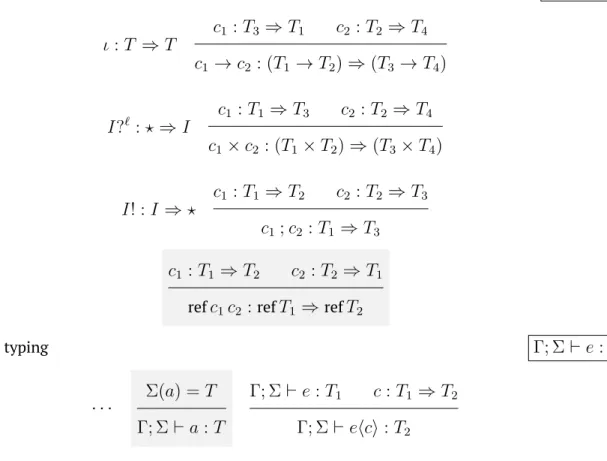
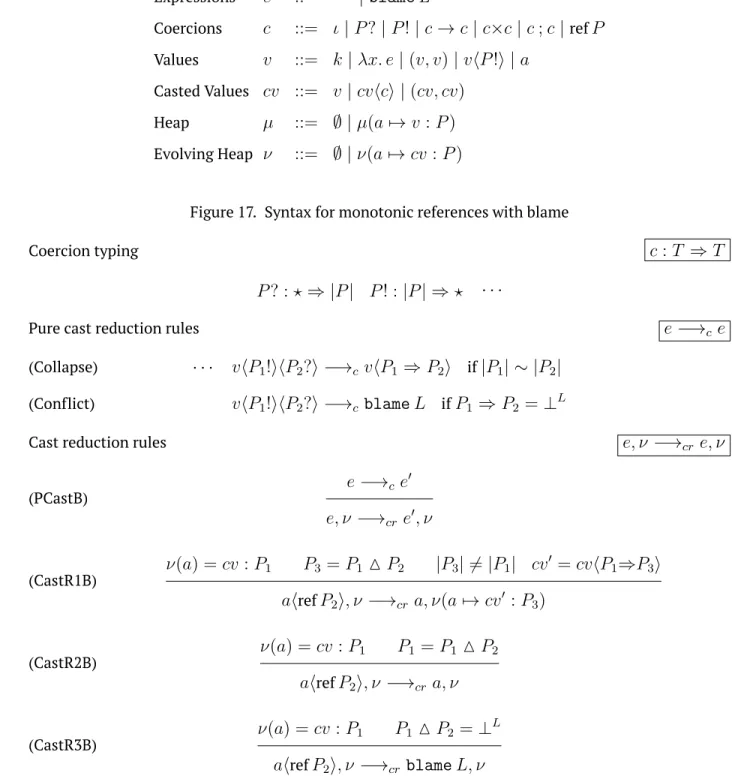
, then no cast needs to occur because the value must already have this type, since no type is strictly more precise than any fully-static types. The overall result is that fully-static code can be made efficient, at the cost of some additional overhead at cast sites.With Jeremy Siek, Matteo Cimini, Sam Tobin-Hochstadt, and Ronald Garcia, I developed a gradually-typed lambda calculus for the monotonic approach. We proved it sound and showed that it obeyed the blame-subtyping theorem, which allows runtime type errors to be traced back to the cast (or casts) that potentially caused the error.
In Chapter 4 I will discuss an experimental implementation of the monotonic approach in Reticulated Python. Several problems arose that prevent monotonic from being an ideal solution for this context. First, it still uses proxies in some situations, such as for functions, and proxies cause significant prob-lems for Python, even beyond performance overhead, as discussed below in Section 4.1. Additionally, the key benefits of the monotonic approach to gradual typing are unavailable in Reticulated Python under its current approach. In order to use type information to optimize dereferences, as monotonic is theoretically capable of doing, the actual runtime or compiler has to be able to efficiently perform dereferences without dispatching on the form of the reference value. Reticulated Python, however, is simply a source-to-source translator—applying monotonic to Python would require significant mod-ification of the Python runtime itself, which is beyond the scope of this work. Other researchers are currently investigating the monotonic approach in a compiler for a gradually typed language, which may bear more fruit [56]-, but for Reticulated Python the monotonic approach does not appear to be ideal at the moment.
4. Transient Gradual Typing
The most successful approach used by Reticulated Python is thetransientapproach. This approach, like monotonic, attempts to solve some of the underlying problems of the guarded semantics, including performance issues and limitations of Python.
4.1. Python Supports Proxies Poorly. As discussed above, the use of proxies incurs serious perfor-mance costs, and it does so even beyond the overhead inherent in dynamically-typed languages which don’t leverage static types for efficiency (the kinds of overhead that monotonic is designed to min-imize). This is due to the need to instantiate proxy values at runtime and the indirection that they cause. Takikawa et al. [90] found that in some combinations of static and dynamically typed code, pro-grams performed as much as
100
×
worse than either the fully typed or the fully untyped version of the program. While the underlying language for Typed Racket is Racket rather than Python, Python would likely performworse because Typed Racket has proxies as a core language feature [85] while Python proxies are implemented using general-purpose (and slow) reflection.In addition, the guarded approach failed to cope well with significant real-world Python programs be-cause Python does not have powerful enough support for proxies. To fully implement the guarded ap-proach, a proxy for a value must be indistinguishable from that value, except if it detects a violation of the expected static types and raises a runtime error. In Python, however, this is impossible, as I dis-cuss in Chapter 4: proxies are implemented as instances of a special proxy class, and using the builtin
type()function on a proxy (which returns the class value that its argument is an instance of) will re-veal that the proxy is an instance of the proxy class, not of the proxied value’s class. Similarly, a proxied value can be distinguished from its underlying value with theisoperator, which implements pointer equality. I found that this behavior caused problems in practice in case studies.
While this problem could be avoided by rewriting all uses oftype(), is, and other operations that reveal proxies, in Chapter 5 I will discuss an even more severe problem with proxies in Python: proxies cannot interact with parts of the basic Python runtime without causing errors. This issue is shown in the following program:
1 def append42(y:List[int]):
2 list.append(y, 42) 3 4 def pass_to_append(z:⋆): 5 append42(z) 6 7 x = [1,2,3] 8 pass_to_append(x)
Here, the dynamically-typedpass_to_appendfunction passes its argument toappend42, which ex-pects a list of integers. With guarded, a cast will be inserted at this call site to ensure that the dynam-ically typed value behaves as a list of integers. This cast will install a proxy aroundz, and the proxy is passed intoappend42. Then, insideappend42, this proxy is passed intolist.append(), which is the Python class method for lists that appends the second argument onto the first.3 The expected result of
running this program is that the listxwill now contain42. However, in reality (when using the guarded 3Typically this code would be written asy.append(42), and ifywere an unproxied list the result would be identical.
semantics), either an error will occur becauselist.appendwas passed a proxy value rather than a list, or the program will run to completion but will fail to actually mutatexto contain42. Which problem occurs depends on choices made in implementing guarded proxies and involve other tradeoffs; regard-less both results occur because thelist.appendfunction is implemented in compiled code that does not respect the mechanisms that I use to implement Python proxies (overriding the__getattribute__
method). Instead this code will attempt to directly alter the internal structure of the list in memory, and since the value passed intolist.appendis not the original list but is instead a proxy, this mutation fails.
Because Python’s proxies are not robust enough to allow for proxied code to interact with foreign func-tions and because they cannot successfully imitate their underlying values, Python is aspartan host. By contrast, the language that most successfully implements the guarded approach (though with perfor-mance caveats) is Typed Racket, and its target language Racket is not a spartan host: its chaperones and impersonators are specifically designed to implement proxies and are core language features [85]. However, making it a non-spartan host took dedicated engineering work, as chaperones and proxies were implemented in Racket specifically as an aid to supporting guarded gradual typing; systems where the target language is out of the control of the designer of the gradually typed language face similar challenges.
4.2. Gradual Typing through Transient Checks. Chapter 4 will discuss how I developed thetransient approach to gradual typing in an effort to solve this problem in Reticulated Python. This approach does not use proxies at all—instead, the translation process inserts lightweightchecksinto programs. These checks inspect runtime values to ensure that theyshallowlycorrespond to the static types they are expected to have. For example, if a functionfoohas a parameterbarthat is expected to have type int
→
int, then at the entry tofoo, a check will ensure thatbaris a function. Then, whenbaris called, another check will ensure that the result of the call is an integer, sincebaris expected to return values of type int. Each of these checks is “transient” in its effect—it simply examines a runtime value and compares its runtime type information to a type tag [13]. If the comparison holds, then the value is returned without being wrapped or mutated in any way; if it fails the result is an error. This approach issound despite the limited nature of transient checks because the checks are inserted pervasively (though see Section 4.6 below). As an example, consider the following program, written in Reticulated Python: 1 def f(x:⋆):
2 x[0] = 'hello world'
3
4 def g(y:List[int]): 5 f(y)
6 y[0] 7
8 g([0])
In this program,gpasses its argumenty, expected to be a list of integers, tofand then looks upy’s zeroth element. Inf, the dynamically typed argument is treated as a list and updated to have its zeroth elements be a string. This program contains a runtime type error, because the lookup at line 6 will return a string when it is expected to be an integer. In order to detect this and raise a runtime error, the transient approach inserts a check at the site of the list lookup:
1 def f(x): 2 x[0] = 'hello world' 3 4 def g(y): 5 y⇓List 6 f(y) 7 y[0]⇓int 8 9 g([0])
The check at line 5 (writteny⇓List) checks thatyis a list, which it is, so the program proceeds with an unaltered, unproxied list. Then at line 7, the check inspects the result of the list lookup to ensure that it is an integer. When it sees that the value is a string instead, an error is raised.
4.3. Properties of Transient Gradual Typing. In Chapter 5 I will develop a formal analysis of the transient semantics in a calculus and prove several key properties. Transient gradual typing is designed very differently than guarded. It offloads the responsibility of ensuring soundness to the user of values, rather than the values themselves, and since all checks are inserted statically, all dereferences and call sites in statically typed code will be checked—even if, at runtime, the check cannot fail. However, this pessimism means that transient is sound with respect to type annotations, even in the presence of unmoderated interaction with foreign functions and the “open world:” programs native to the target language that interact with translated code.
In order to study the soundness of transient gradual typing as an approach, I developed the
λ
⋆→calculus,
which is a gradually-typed lambda calculus with mutable references that uses the transient design. It is translated to another calculus, the
λ
⇓ℓ calculus, which is dynamically typed and which models Python. I model the embedding of translated Reticulated Python code within standard Python by usingprogram contextsC
, which are essentiallyλ
⋆→programs with holes in them into which other programs can be
embedded. With this system, I proved the followingopen-world soundnessproperty:
Theorem 1.1 (Open-World Soundness). Suppose
t
is aλ
⋆→expression of typeT
that translates to the terme
inλ
⇓ℓ. Then, for any program contextC
, either:• C
[
e
]
reduces to a value in zero or more steps, or• C
[
e
]
diverges, or• C
[
e
]
reduces to a runtime check failure, or• C
[
e
]
causes an uncaught type error while evaluating inC
.This definition has the flavor of type soundness (defined for gradually typed languages in Section 1.2.2 of Chapter 2) with one fundamental difference: instead of prohibiting (in isolation) translated
λ
⋆→
pro-grams from misbehaving, it allows interaction with code native to
λ
⇓ℓ, and guarantees that any incorrect behavior is due to the program contextC
, which may represent a client program interacting with the translated code or the translated code interacting with an untyped library.Because
λ
⋆→admits open-world soundness, a program written in
λ
⋆→can be used by nativeλ
⇓ℓ clients. For example, anλ
⋆→library may put type annotations on its API boundaries, preventing ill-typed termsfrom raising difficult-to-diagnose errors deep within the library—even if the library interacts with code which has no concept of static types.
Furthermore, the
λ
⋆→code is protected from errors arising due to mutation: while foreign functions are
not modeled directly in the
λ
⋆→and
λ
⇓ℓ calculi, the distinction between untranslated target-language programs and foreign, compiled C code is only relevant in guarded because of the presence of proxies. The transient design lacks proxies, and thus this distinction is irrelevant—foreign functions may be modeled as nativeλ
⇓ℓ code.Finally, I also proved that thegradual guaranteeholds for
λ
⋆→. The gradual guarantee is a promise to the
programmer that their programs can be moved from static to dynamic and vice versa without being hin-dered by the semantics of the program changing. This theorem, defined by Siek et al. [82] and discussed in further depth in Section 1.2.4 of Chapter 2 ensures that changing the static type annotations in a pro-gram does not alter either the static or dynamic semantics of the propro-gram, except by raising a static type error or causing blame at runtime if the type annotations are strengthened [82]. This property allows programmers to be confident in gradually adding types to their program: they know that a program will never produce an entirely different result because of a change to the type annotations. They are also guaranteed that if a program raises a new error after a type annotation is added or strengthened, it is because the new annotation was “wrong”: it did not correspond to other types in the program (if the error is static) or to the program’s values at runtime (if it is a runtime blame error).
4.4. Blame Tracking with Transient. With the guarded approach, proxies served as the mechanism for tracking and propagating blame information [35, 104, 93]. The runtime system uses this information when a runtime type error is encountered to report the source of the error—not just the location where the error was discovered and the error was raised, but also which boundary-crossing site between static and dynamic was violated. This information helps the programmer debug the issue more efficiently. Transient, lacking proxies, does not have the basic mechanism used for blame tracking, but in Chapter 5 I will show a solution to this problem by tracking blame information in a globalblame map, updating the relevant blame information at every implicit conversion. The system tracks when values are passed between different static types by statically inserting casts into the program as in guarded; rather than
serving as a type enforcement mechanism, these casts only update the blame map—checks are still the main mechanism for detecting type errors. When a check fails, this blame map is used in conjunction with the type information at the failure site to construct the full error account to the programmer. Furthermore, this construction process provides ablame history, indicating the conflicting assumptions that different pieces of the program made to produce this error.
Through use of the blame map, casts and checks collaborate to reconstruct the chains of responsibility that guarded proxies provide. Even so, the transient blame behavior differs from guarded: the algorithm may blame multiple casts if each of them is reachable in the blame map andmaybe responsible for the check failure occurring, and if a sequence of incompatible casts are applied to a value but the value is never used (e.g., a function that is never applied), then no error occurs.
Despite the difference, I proved that this approach, when implemented in the
λ
⋆→/
λ
⇓ℓ system, preserves theblame-subtyping theoremof Wadler and Findler [104]. This property, described in depth in Section 1.2.3 of Chapter 2, guarantees that casts (or other boundary crossings from one type to another) can only beblamedfor a runtime error if they are unsafe. This result ensures that programs whose implicit type conversions are safe will never be blamed for cast failures.4.5. Implementation and Efficiency in Reticulated Python. The runtime checks required for sound gradual typing inevitably impose some degree of runtime overhead no matter what approach is used. Since gradual typing is designed to allow programmers to gradually vary their programs between static and dynamic [82], it is also important that adding or removing individual annotations does not dra-matically degrade the program’s performance. Takikawa et al. [90] examine the performance of Typed Racket’s guarded gradual typing with this criterion in mind by studying programs through the lens of atyping latticemade up of differently-typedconfigurationsof the same program. The top of the lattice is a fully typed configuration of the program and the bottom is unannotated, and incrementally adding types moves up the lattice.
Takikawa et al. show that in Typed Racket, certain configurations result in catastrophic slowdown com-pared to either the top or bottom configurations. This indicates that the guarded semantics incurs a
substantial cost when interaction between static and dynamic code is frequent. Many of their bench-marks show mean overheads of over 30
×
and worst cases of over 100×
, which “projects an extremely negative image ofsoundgradual typing” [90].In Chapter 6 I will discuss how I determined whether Reticulated Python and the transient semantics face the same problem. I analyzed the performance of several benchmarks across their typing lattices, and found that the cost of transient gradual typing increases as the number of type annotations grows. As a program evolves from dynamic to static, its performance linearly degrades, with the worst perfor-mance in the most static configurations. This is because each static type annotation induces checks to ensure that values correspond to that type. This is, of course, counter to one hypothetical benefit of static typing—ideally, static types should aid performance, or at least not degrade it. On the other hand, the linear degradation of performance to a worst-case of less than 6
×
overhead means that the cata-strophic configurations encountered in Typed Racket never occur and the cost of adding an individual type annotation to a program is predictable.4.6. Optimizing Transient with Type Inference. The transient approach inserts checks throughout the program, but not all checks are necessary for the program to be sound because some checks may be redundant and always succeed. In Chapter 6 I will discuss how, in order to remove unnecessary checks, I modified Reticulated Python to perform type inference on the program after checks have been inserted. This inference algorithm is based on those of Aiken and Fähndrich [6] and Rastogi et al. [67] and uses subtyping constraints as well as specialcheck constraints, generated by transient checks. I proved that this algorithm can soundly remove unnecessary checks in a transient calculus similar to the
λ
⋆→/
λ
⇓ℓ system:Theorem 1.2 (Optimization Correctness). Suppose that an expression
t
evaluates to a valuev. If the type
inference system finds thatt
has typeT
andT
corresponds to the type tagS, then a transient check that
v
has tagS
will always succeed.Since such checks are proven to always succeed, they can be removed without altering the semantics of the program.
After modifying Reticulated Python with this algorithm, I measured its performance, again sampling at all points of the typing lattices. With redundant checks removed, the linear increase in execution times disappears, resulting in the fully-typed configurations displaying negligible overhead and a 6% average overhead over all sampled configurations. I will discuss this work in Chapter 6 as well.
5. Conclusions
Gradual typing is a promising approach in programming language design, and Python is a language that appears well-suited to it. Python is commonly used in a multitude of different applications, from scientific computing to web backends, and in many cases static typechecking would be highly valuable— I found several potential bugs in Python programs by adding typechecking [100]. Other Python projects, such as MyPy [57], are also interested in adding types to Python (though they are optional, not gradual, type systems) and the Python syntax itself has been extended with function parameter annotations (which are Python expressions that are evaluated at runtime).
Reticulated Python is designed as a testbed for studying gradual typing in Python. With it, I discovered that there are several major obstacles to implementing sound gradual typing in Python. Python is a spartan host for gradual typing—it does not support the kind of proxies that the traditional approach to gradual typing requires. Python proxies can be easily distinguished from their underlying values, causing surprising errors, and they cannot soundly interact with the compiled C code that makes up much of the Python runtime.
I explored these challenges in the context of Python, and developed two designs that depart from the traditional proxy-based semantics. One of these, the monotonic approach, does not appear to be an appropriate solution for Python, but it may turn out to be a powerful technique in other contexts. The transient approach, on the other hand, is well-suited to Reticulated Python—Python supports inspec-tion of runtime type informainspec-tion, which is all that the transient design needs. Furthermore, transient supports open-world soundness, allowing Reticulated Python programs to work soundly with compiled Python runtime functions, standard Python libraries, and even standard Python clients if the translated Reticulated program is distributed as a library.
The transient approach introduces its own set of challenges: blame tracking requires a more complex approach than with guarded, and there is substantial overhead involved in pervasively performing run-time checks. However, I studied and experimentally implemented solutions to both problems: blame tracking is possible by using a global map that tracks the flow of values between static and dynamic, and the performance overhead can be vastly reduced by using type inference to remove unnecessary checks.
As a result, Reticulated Python with the transient approach appears to be a promising way forwards for gradual typing in the Python programming language. Furthermore, the problems that we encountered in this work are not unique to Python, and our solutions are likely to be translatable to other contexts. As such, the transient design may lower the barrier to entry for converting optionally typed languages to gradually typing, allowing programmers to reap the benefits of being able to truly trust their type annotations.
CHAPTER 2
Background
In this chapter I will review the necessary background for the research that will be presented in later chapters, focusing especially on the state of the art in runtime enforcement for gradually typed lan-guages, as well as the background of gradual typing itself.
1. Understanding Gradual Typing
Gradual typing was introduced by Siek and Taha [75] in order toseamlesslyblend static and dynamic typing within the same language, without requiring the programmer specially handle either paradigm. Gradually typed languages use the dynamic type
⋆
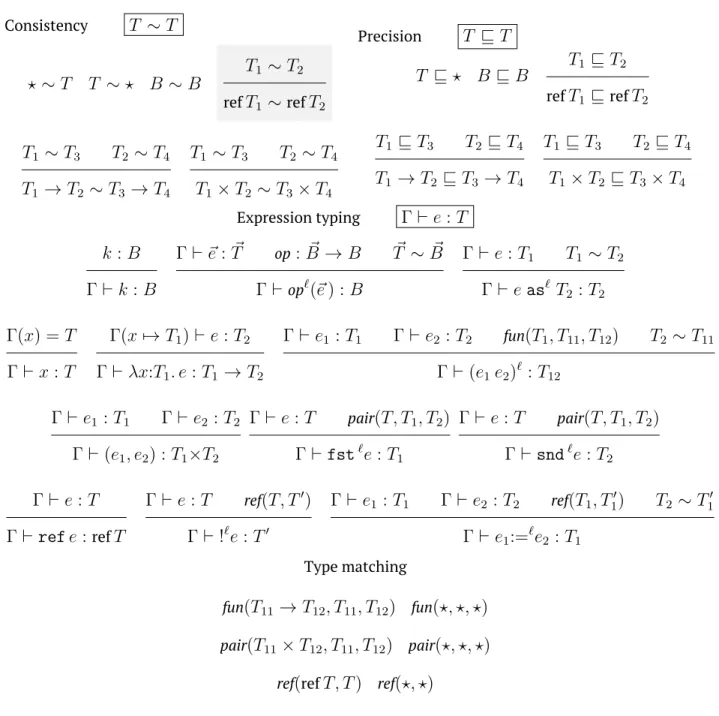
and aconsistency relation on types to govern how statically typed and untyped code interacts: the consistency relation plays the role that type equality usually does in the type system. Types are consistent if they are equal up to the presence of⋆
. For example, astaticallytyped lambda calculus might include a rule for function application as follows:Γ
⊢
e
1:
T
1→
T
2Γ
⊢
e
2:
T
3T
1=
T
3Γ
⊢
e
1e
2:
T
2This rule requires that
e
1 is a function type, and that its source typeT
1 is equal to the type of theargument
e
2. In a gradually typed language, this same rule must holdifthe types ofe
1ande
2are static.The presence of the dynamic type, however, must serve as an “opt-out” from the static type system: it must not reject any programs due to the presence of the dynamic type, while still rejecting ill-typed code where the dynamic type is not used. The traditional rules for achieving this are two-fold: first, the above rule is modified to useconsistencyin place of equality:
Γ
⊢
e
1:
T
1→
T
2Γ
⊢
e
2:
T
3T
1∼
T
3Γ
⊢
e
1e
2:
T
2Here, the requirement that
T
1∼
T
3 (pronounced “T
1 is consistent withT
3”) means thatT
1 andT
3are identicalup tothe presence of the dynamic type. Consistency is defined, for a language with the dynamic type
⋆
, base typesB
, and function typesT
1→
T
2, as follows:T
∼
T
⋆
∼
T
T
∼
⋆
B
∼
B
T
1∼
T
3T
2∼
T
4T
1→
T
2∼
T
3→
T
4The definition of the consistency relation, and the way that it is used in the above typing judgment, means that arguments of dynamic type can be passed into any function and that functions whose source type is
⋆
can accept any argument, but it is still illegal to pass a string into a function that accepts integers.This rule is on its own insufficient for a gradually typed language, however: it still requires that
e
1bestatically typable as a function. In order to allow dynamically typed values to be called, the approach of Siek and Taha [75] is to add a second function call judgment to the system:
Γ
⊢
e
1:
⋆
Γ
⊢
e
2:
T
Γ
⊢
e
1e
2:
⋆
That is, if a callee is dynamically typed, then calling it is well-typed at type
⋆
as long as the argument is well-typed. Later authors such as Rastogi et al. [67] and Cimini and Siek [26] have collapsed these two rules down to one:Γ
⊢
e
1:
T
1Γ
⊢
e
2:
T
4T
1▷
T
2→
T
3T
2∼
T
4Γ
⊢
e
1e
2:
T
3T
▷
T
⋆
▷
⋆
→
⋆
T
1→
T
2▷
T
1→
T
2· · ·
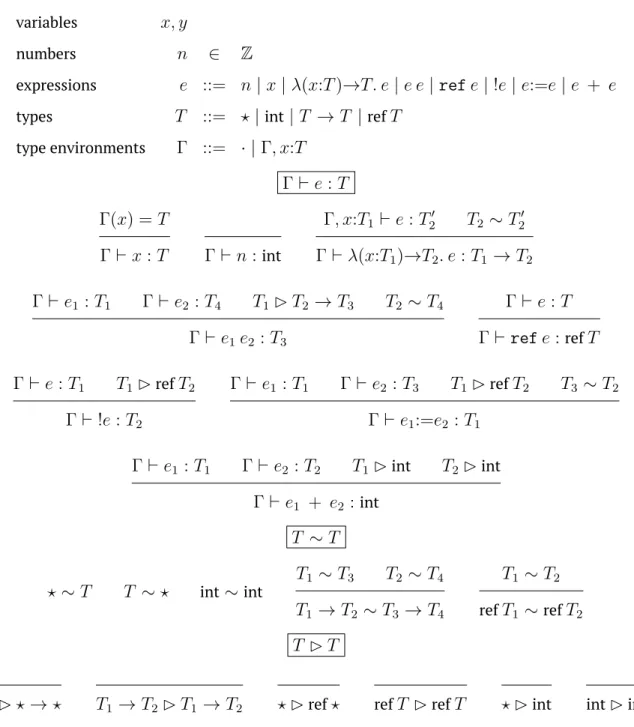
1.1. A Gradually Typed Lambda Calculus. I use this approach in the type system of agradually typed lambda calculus(GTLC), the syntax and static type system of which is given in Figure 1. This calculus includes references (with creation
ref
e
, dereferencing!
e
, and mutatione
1:=
e
2), which are treatedsimilarly to functions with respect to consistency, following Herman et al. [48]: a departure from Siek and Taha [75], whose references are invariant with respect to consistency. Most of the interesting rules in this calculus are discussed above; one unusual feature is that functions in this calculus include return type annotations in addition to parameter types:
λ
(
x
:
T
1)
→
T
2. e
is a function with typeT
1→
T
2, andits typing judgment requires that its body
e
has a type consistent withT
2. I make this choice to remainconsistent with many of the other approaches described in this dissertation, in particular the key calculi of Chapters 5 and 6, but it is not an essential feature of gradually typed languages.
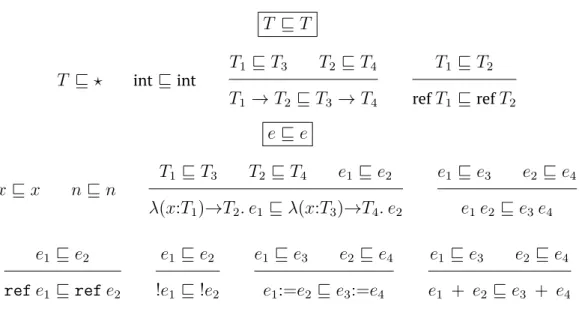
1.2. Properties of Gradually Typed Languages. I will use this calculus to explore the properties that I use to guide development of gradually typed languages. Several properties were initially proposed by Siek and Taha [75], but Siek et al. [82] developed a more robust program of ideal properties for gradually typed languages, all of which hold for the GTLC (in some cases, depending on its dynamic semantics). Note that these properties were developed by myself and others in the course of the research described in this dissertation: this work helped inform the development of these properties as well as vice versa. The criteria in this section are claims about both the static and dynamic behavior of the GTLC, and while claims about the static behavior can be verified against the type system for the GTLC shown in Figure 1, properties about the GTLC’s dynamic semantics will guide its development below in Section 1.3, as well as guide the development of the various languages and calculi discussed in the remainder of this dissertation.
1.2.1. Gradual typing is a superset of static and dynamic. Since gradual typing is intended to allow static and dynamic typing to intermingle seamlessly, a basic requirement is that it can admit static typing and dynamic typing directly. Let
e
⇓
v
denote some evaluation function for a GTLC expressionvariables
x, y
numbers
n
∈
Z
expressions
e
::=
n
|
x
|
λ
(
x
:
T
)
→
T. e
|
e e
|
ref
e
|
!
e
|
e
:=
e
|
e
+
e
types
T
::=
⋆
|
int|
T
→
T
|
refT
type environments
Γ ::=
· |
Γ
, x
:
T
Γ
⊢
e
:
T
Γ(
x
) =
T
Γ
⊢
x
:
T
Γ
⊢
n
:
intΓ
, x
:
T
1⊢
e
:
T
2′T
2∼
T
2′Γ
⊢
λ
(
x
:
T
1)
→
T
2. e
:
T
1→
T
2Γ
⊢
e
1:
T
1Γ
⊢
e
2:
T
4T
1▷
T
2→
T
3T
2∼
T
4Γ
⊢
e
1e
2:
T
3Γ
⊢
e
:
T
Γ
⊢
ref
e
:
refT
Γ
⊢
e
:
T
1T
1▷
refT
2Γ
⊢
!
e
:
T
2Γ
⊢
e
1:
T
1Γ
⊢
e
2:
T
3T
1▷
refT
2T
3∼
T
2Γ
⊢
e
1:=
e
2:
T
1Γ
⊢
e
1:
T
1Γ
⊢
e
2:
T
2T
1▷
intT
2▷
intΓ
⊢
e
1+
e
2:
intT
∼
T
⋆
∼
T
T
∼
⋆
int∼
intT
1∼
T
3T
2∼
T
4T
1→
T
2∼
T
3→
T
4T
1∼
T
2 refT
1∼
refT
2T
▷
T
⋆
▷
⋆
→
⋆
T
1→
T
2▷
T
1→
T
2⋆
▷
ref⋆
refT
▷
refT
⋆
▷
int int▷
intFigure 1. Syntax and static type system for the GTLC.
e
that produces a valuev
, and lete
⇓
Sv
denote the same evaluation except without any rules dealing specifically with dynamically typed code or with the interaction of static and dynamic. Let also⊢
S bethe typing judgment for the statically typed lambda calculus (obtained by replacing
▷
and∼
with=
in Figure 1).Criterion 2.1 (Gradual typing subsumes static typing). Let
e
be a GTLC term whose type annotations do not contain⋆. Then:
• ∅ ⊢
e
:
T
if and only if∅ ⊢
Se
:
T
.•
e
⇓
v
if and only ife
⇓
Sv.
Likewise, a gradually typed language must admit dynamic typing. This is somewhat more challenging to represent, given that using the rules in Figure 1, some expressions always have non-dynamic types: an integer will always have type int and a function will always have an arrow type. To show that dy-namic typing can be represented in gradual typing, I therefore use an embedding function
⌊
e
⌋
, whichη
-expands all expressions ine
by wrapping them with a dynamically-typed identity function. For ex-ample,n
becomes(
λ
(
x
:
⋆
)
→
⋆ . x
)
n
, a term whose type is⋆
. Let alsoe
⇓
Dv
be the evaluation function obtained by removing any evaluation rules that deal with specifically statically typed code, or the interaction between static and dynamic.Criterion 2.2 (Gradual typing subsumes dynamic typing). Let
e
be a GTLC term where all annotations are⋆. Then:
• ∅ ⊢ ⌊
e
⌋
:
⋆.
•
e
⇓
v
if and only if⌊
e
⌋ ⇓
Dv.
Similar criteria are given by Siek and Taha [75], and they are explored in greater depth by Siek et al. [82].
1.2.2. Gradual typing is sound. Gradually typed languages also display a soundness property analo-gous to that of statically typed languages. Let
e
⇑
denote thate
diverges when evaluated.Criterion 2.3 (Type soundness). If