Optimization Models for Joint Airline Pricing and
Seat Inventory Control: Multiple Products,
Multiple Periods
byClaire Cizaire
S.M. Aeronautics and Astronautics, Massachusetts Institute of Technology (2007) S.M. Engineering, Supelec (2006)
Submitted to the Department of Aeronautics and Astronautics in partial fulfillment of the requirements for the degree of
Doctor of Philosophy in Aeronautics and Astronautics at the
MASSACHUSETTS INSTITUTE OF TECHNOLOGY
June 2011
@ Massachusetts Institute of Technology 2011. All rights reserved.
ARCHIVES
MASSACHUSETTS INST E OF TECHNOLOGYAPR 27 2012
LIBRARIES
A u th o r ... ... ...of Aeronautics and Astronautics June 3, 2011 Certified by...
Principal Research Scientist of
'
flO
Certified by...
Assistant Professor of
. . .. . . .. . . . ..
Peter P. Belobaba Aeronautics and Astronautics
i I // Thesis Supervisor
Hamsa Balakrishnan Aeronautics and Astronautics Doctral QOmmittee Member Certified by...
I Nancy L. Rose
Professor of Economics / / Doctoral. Committee Member A ccepted by ...
/soEytan
H. ModianoAssociate Prfessor of Aeronautics and Astronautics Chair, Graduate Program Committee
Optimization Models for Joint Airline Pricing and Seat
Inventory Control: Multiple Products, Multiple Periods
by
Claire Cizaire
Submitted to the Department of Aeronautics and Astronautics on June 3, 2011, in partial fulfillment of the
requirements for the degree of
Doctor of Philosophy in Aeronautics and Astronautics
Abstract
Pricing and revenue management are two essential levers to optimize the sales of an airline's seat inventory and maximize revenues. Over the past few decades, they have generated a great deal of research but have typically been studied and optimized sep-arately. On the one hand, the pricing process focused on demand segmentation and optimal fares, regardless of any capacity constraints. On the other hand, researchers in revenue management developed algorithms to set booking limits by fare product, given a set of fares and capacity constraints.
This thesis develops several approaches to solve for the optimal fares and book-ing limits jointly and simultaneously. The underlybook-ing demand volume in an airline market is modeled as a function of the fares. We propose an initial approach to the two-product, two-period revenue optimization problem by first assuming that the de-mand is deterministic. We show that the booking limit on sales of the lower-priced product is unnecessary in this case, allowing us to simplify the optimization problem. We then develop a stochastic optimization model and analyze the combined im-pacts of fares and booking limits on the total number of accepted bookings when the underlying demand is uncertain. We demonstrate that this joint optimization ap-proach can provide a 3-4% increase in revenues from a traditional pricing and revenue management practices.
The stochastic model is then extended to the joint pricing and seat inventory control optimization problem for booking horizons involving more than two booking periods, as is the case in reality. A generalized methodology for optimization is pre-sented, and we show that the complexity of the joint optimization problem increases substantially with the number of booking periods. We thus develop three heuristics. Simulations for a three-period problem show that all heuristics outperform the deter-ministic optimization model. In addition, two of the heuristics can provide revenues
This thesis provides a basis for the integration of pricing and revenue management. The combined effects of fares and booking limits on the number of accepted bookings, and thus on the revenues, are explicitly taken into account in our joint optimization
models. We showed that the proposed approaches can further enhance revenues.
Thesis Supervisor: Peter P. Belobaba
Title: Principal Research Scientist of Aeronautics and Astronautics
Acknowledgments
First of all, I would like to express my gratitude to my advisor, Peter Belobaba, for encouraging me from the very beginning to take ownership of my own ideas and projects, while always providing feedback and support when solicited. He shared his deep understanding of revenue management and gave insightful advice on many other topics.
My committee members have provided invaluable advice as well. I thank Profes-sor Nancy Rose for her tremendous support and time and the insights she brought through her perspective as an economist. I also am also grateful to my third com-mittee member Professor Hamsa Balakrishnan.
I would also like to express my gratitude to my two readers. Many thanks to Bill Brunger for his continuous support. He encouraged me to present my ideas and findings to airlines and invited me to visit Continental on several occasions. Gerard Kindervater has spent a considerable amount of time on my doctoral work and made many suggestions.
I also thank the PODS Consortium members for their interest in my research. In particular, I would like to thank airline representatives from LAN airlines, Air Canada, and Continental. My discussions with the revenue management and pricing analysts were very helpful. Many thanks to Craig Hopperstad as well, for his patience and for programming a version of PODS allowing me to test my heuristics.
Finally, I would like to thank all my friends from ICAT, for the incredible atmo-sphere and the help throughout the program.
Contents
1 Introduction
1.1 Background . . . . 1.2 The Evolution of Pricing and Seat Allocation Practices 1.3 Research Motivation and Objectives . . . . 1.4 Thesis Outline . . . . 2 Literature Review 2.1 Pricing . . . . 2.2 Revenue Management . . . . 2.2.1 Forecasting . . . . 2.2.2 Seat Allocation . . . . 2.3 Joint Pricing and Seat Allocation . . . .
3 Deterministic Approach to Joint Pricing and mization
3.1 Scope of the Problem ...
3.2 Notations . . . . 3.3 Modeling the Demand for Two Fare Products 3.4 Objective Function . . . . 3.5 Numerical Results . . . . 3.6 Simulations . . . . 3.6.1 Simulations with no booking limit . . .
Seat Allocation Opti-41 42 45 45 51 55 57 57 17 19 22 27 29 31 31 33 33 33 35
3.6.3 Simulations with booking limits on Fare Product 2 . . . . 3.6.4 Simulations with a traditional revenue management approach 3.7 Sum m ary . . . .
4 Stochastic Approach to Joint Pricing and Seat Allocation Optimiza-tion 4.1 4.2 4.3 4.4 4.5 4.6 4.7 4.8
Scope of the Problem . . . . Model Assumptions . . . . Objective Function . . . . Numerical Results . . . . Simulations . . . . 4.5.1 Simulations with the stochastic optimal set of fares and booking
lim it . . . . 4.5.2 Simulations with re-optimized TF2 fares . . . . 4.5.3 Simulations with booking limits on Fare Product 2 . . . . 4.5.4 Simulations with a traditional revenue management approach
Sensitivity to Forecasting Errors . . . . Performance Analysis . . . . Summary . . . . 63 65 69 71 72 72 74 86 90 90 92 95 97 100 106 108
5 Heuristics for the multiple-period problem
5.1 Notations and assumptions . . . . 5.2 Expected total revenues and the expected censored demands 5.3 Heuristics for Cases with more than Two Time Frames . . . 5.4 Performance Analysis . . . . 5.5 Summ ary . . . . 113 .114 . . . . . 116 .121 .128 .141 6 Conclusions
6.1 Research findings and contributions . . . . 6.2 Implementation challenges . . . . 6.3 Future research directions . . . .
8
143 143 148 150
List of Figures
1-1 Airline planning, a sequential approach . . . . 20
1-2 Overview of the current approach to pricing and revenue management 21 2-1 Gap in the joint pricing and seat allocation literature . . . . 40
3-1 Example of the two fare products, their restrictions, fares and booking lim it . . . . 44
3-2 Demand curves for the two fare products . . . . 47
3-3 Combined demand curve and its approximation . . . . 48
3-4 Example of demand curve for Fare Product 1 . . . . 50
3-5 Example of demand curve for Fare Product 2 . . . . 50
3-6 Example of the revenue as a function of the two fares, without a book-ing lim it . . . . 54
3-7 Overview of the simulation process . . . . 58
3-8 Cumulative distribution functions of the revenues when no booking lim it is enforced . . . . 59
3-9 Impact of the flight capacity on the accepted demands . . . . 61
3-10 Impacts of the booking limit on the accepted bookings in both time fram es . . . . 62
3-11 Impacts of the booking limit on the type of accepted bookings . . . . 65 3-12 Fares and demands for the traditional revenue management method . 67 3-13 Cumulative distribution functions of the revenues, for Gaussian demands 68
4-2 Underlying and constrained, also called censored, demands in TF1 . . 78
4-3 Constraints on the bookings in the two time frames . . . . 80
4-4 Divide and conquer . . . . 81
4-5 The expected censored demand in TF2 as a function of the TF1 de-mand and booking limit . . . . 84
4-6 Difference between the two time frames' underlying and censored demand 88 4-7 Impact of fares and booking limit on the revenues . . . . 89
4-8 Revenue histogram for the uniform demand distribution . . . . 93
4-9 Revenue histogram for the uniform distribution when TF2 fares are adjusted . . . . 95
4-10 Decrease in revenues due to the implementation of Fare Product2's booking lim its . . . . 98
4-11 Fares and demands for the traditional revenue management method . 99 4-12 Cumulative distribution functions of the revenues, for Gaussian demands 100 4-13 Changes in the optimal solution, given uncertainty in the first time frame103 4-14 Changes in the optimal solution, given uncertainty in the second time frame . . . . . . . . 104
4-15 Changes in revenues due to uncertainty forecasting errors 5-1 Constraints on the bookings in the two time frames . . . 5-2 Possible bookings ignored by the first heuristic . . . . 5-3 Possible bookings ignored by the first heuristic . . . . 5-4 Change in the probability density function . . . . 5-5 Dichotomy . . . . 5-6 First steps of the heuristic . . . . 5-7 Accepted demand by time frame . . . . 5-8 Revenue by time frame . . . . . . .. ... 104 . . . . . 119 . . . . . 124 . . . . . 125 . . . . . 126 . . . . . 127 . . . . . 128 . . . . . 136 . . . . . 137 5-9 Differences between the stochastic model and the heuristics - uniform
distribution . . . .
10
5-10 Differences between the stochastic model and the heuristics - Gaussian distribution . . . 139 6-1 Divide and conquer . . . . 146
List of Tables
1.1 Example of a fare structure . . . . 20
1.2 Example of booking limits for a fare structure (capacity = 100 seats) 22 3.1 Parameters for the demand functions . . . . 56
3.2 Optimal solution to the deterministic joint pricing and seat allocation problem . . . . 56
3.3 Deterministic demand and revenues . . . . 56
3.4 Simulation results when no booking limit is enforced - uniform distri-bution . . . . 59
3.5 Simulation results when no booking limit is enforced - Gaussian distri-bution . . . . 60
3.6 Impacts of the booking limit on the expected revenues . . . . 63
3.7 Simulation results with the booking limit enforced - uniform distribution 63 3.8 Simulation results with the booking limit enforced -Gaussian distribution 64 3.9 Impacts of booking limits on the expected revenues and the accepted bookings . . . . 66
3.10 Comparison between joint optimization and a traditional revenue man-agement approach . . . . 67
4.1 Underlying demands in Regions I and II . . . . 82
4.2 Censored demands in Regions I and II . . . . 83
4.5 Stochastic optimal solution to the joint pricing and seat allocation
problem . . . . 87
4.6 Implied censored demand and revenues . . . . 88
4.7 Average censored demands and revenues . . . . 91
4.8 Impacts of the re-optimization on the expected revenues . . . . 94
4.9 Changes in revenues due to the implementation of Fare Product2's booking lim its . . . . 97
4.10 Comparison between stochastic joint optimization and a traditional revenue management approach . . . . 99
4.11 Sensitivity analysis to uncertainty in the first time frame . . . . 102
4.12 Sensitivity analysis to uncertainty in the second time frame . . . . 103
4.13 Sensitivity analysis to the demand input parameters . . . . 106
4.14 Sensitivity analysis to the probability input parameters . . . . 107
4.15 Revenue comparison with a forecasting error in the first time's standard deviation . . . . 108
4.16 Revenue comparison with a forecasting error in the second time's stan-dard deviation . . . . 108
4.17 Revenue comparison with a forecasting error in the demand parameter 109 4.18 Revenue comparison with a forecasting error in the probability parameter 110 4.19 Levels of demand and flight capacity . . . . 110
4.20 Increase in revenue between stochastic and deterministic joint opti-mization (%) . . . ..111
4.21 Increase in revenue between stochastic joint optimization and the tra-ditional revenue management approach (%) . . . .111
4.22 Increase in revenue between stochastic and deterministic joint opti-mization (%) . . . .. . .111
4.23 Increase in revenue between stochastic joint optimization and the tra-ditional revenue management approach (%) . . . .111
4.24 Increase in revenue between stochastic and deterministic joint opti-m ization (% ) . . . . 112
4.25 Increase in revenue between stochastic joint optimization and the tra-ditional revenue management approach
(%)
. . . . 1125.1 Parameters for the demand functions . . . . 129 5.2 Optimal solution for the deterministic model . . . . 130 5.3 Fares and demand implied by the deterministic model's output . . . . 130 5.4 Optimal solution for the stochastic model . . . . 131 5.5 Fares and demands implied by the stochastic model's output . . . . . 131 5.6 Optimal solution for the non-nested heuristic . . . . 132 5.7 Fares and demands implied by the non-nested heuristic's output . . . 132 5.8 Optimal solution for the second heuristic . . . . 132 5.9 Fares and demands implied by the second heuristic's output . . . . . 132 5.10 Optimal solution for the dichotomy heuristic . . . . 133 5.11 Fares and demands implied by the dichotomy heuristic's output . . . 133 5.12 Average censored demands and revenues, for a uniform demand
distri-bution . . . . 135 5.13 Average censored demands and revenues, for a Gaussian demand
Chapter 1
Introduction
Pricing and revenue management are essential for an airline to maximize its rev-enues. The goal of pricing is to improve revenues by designing an appropriate set of fare products. A fare product is a combination of a price, also called a fare, and an assortment of travel constraints and service amenities. Each fare product is designed for and targeted toward a specific group of travellers. The probably most well-known two groups are the business travellers on one side and the leisure travellers on the other. By offering various fare products, the airline intends to force some passengers with travel constraints and a high willingness-to-pay to buy high revenue products, without deterring all other passengers from booking seats.
Revenue management, on the other hand, improves the airline's revenues by set-ting limits on the maximum number of seats to be sold for each fare product, especially the low revenue ones. The airline can only offer a fixed, predetermined, number of seats. Some booking requests will generally have to be rejected due to a lack of ca-pacity, and it is therefore important for the airline to ensure that as few high-revenue requests are rejected as possible. To do so, limits on the number of low-revenue products that should be sold are set. This ensures that a minimum number of seats is saved for the high willingness-to-pay passengers arriving late in the booking process.
great deal of research but have typically been studied and optimized separately. Nev-ertheless, the two processes are interrelated and should ideally be considered and solved for as a single optimization problem. Both pricing and revenue management are based on an analysis of the booking patterns. Bookings are an indicator of the underlying demand characteristics, such as demand elasticity, and are used for market segmentation for example. On the other hand, the analysis of the demand volume per fare product or group of fare products is the basis for setting booking limits. In turn, both pricing and revenue management processes affect the choice set available to a potential passenger during the booking procedure. By setting fares and travel constraints, pricing defines the global set of options that could be available to a pas-senger. However, booking limits may render one or more of these options unavailable at the time of booking and therefore restrict the actual choice set of a passenger.
We could gain much insight on revenue maximization from a better understanding of the interactions between pricing and revenue management methods. The analysis of the combined impacts of fares and booking limits on a passenger's choice set, and thus on the final number of accepted bookings, would enable us to further improve the optimization process. This thesis investigates ways of analysing these two com-ponents' combined effects on the demand, with the objective of ultimately solving for the optimal fares and booking limits jointly and simultaneously. In our model, the underlying demand volume is modelled as a function of fares and we focus on determining how booking limits define the percentage of underlying demand that will finally be accepted. Based on this insight, we formulate a revenue maximization problem in which fares and booking limits are the decision variables.
This dissertation is divided into six chapters. We shall first detail the current pricing and seat allocation practices and describe our research objectives. In Chapter 2, we present the literature review and explain how this dissertation complements the existing body of work in joint pricing and seat allocation optimization. A two-product, two-period joint pricing and seat allocation problem is then formulated in
Chapter 3. We first propose a deterministic model and then introduce a stochastic approach. Finally, in Chapter 5, we suggest heuristics to tackle the multiple-time frame optimization problem. Chapter 6 summarizes the findings and presents possible directions for future work.
1.1
Background
Pricing and revenue management are part of airline planning, a lengthy and complex process. Nowadays, airline planning is usually broken down into five smaller and interdependent planning problems that are solved separately one after the other, as shown in Figure 1-1. Fleet planning, route evaluation and schedule development are the first steps. They focus on developing the airline's operations. These three steps determine the air transportation service to be offered by the airline and establish the capacity constraints. The inherent characteristics of the transportation service, e.g. the origin and destination airports, the departure time, the total travel time, the number of connections or the aircraft types, are all determined by the first three steps. The goal of the last two steps, pricing and revenue management, is to then generate and maximize revenues from the sale of the airline's seat inventory.
Pricing consists of the design of the different fare products that will be available to each origin-destination market served by the airline. Air travel demand is defined for an origin-destination (OD) market, consisting of a passenger's original departure city and his final trip destination. Several itineraries, with different connecting flights, may be possible for one OD market. During the pricing process, the total demand for each origin-destination market is analysed and segmented. A fare product is then designed for each identified segment. A fare product is associated with a combina-tion of travel restriccombina-tions and service amenities, and a price. The product's fare is set according to the estimated willingness-to-pay of the segment's passengers. Dif-ferent restrictions and services amenities are then used as fences to deter passengers
1 - Fleet Plnning 2 -Route Evaluation 3 - Schedule Development 4-Pricing
Determine fare levels, con diferent service amenities an for a set of fare products in al
Figure 1-1: Airline planning, a sequential approach
Product differentiation or differential pricing enables the airline to extract additional consumer surplus from passengers. An example of a simple set of fare products, a
fare structure, is shown in Table 1.1.
Restrictions Fare Product 1 2 3 Saturday-night stay required No No Yes Purchase 21-day
before departure Fare
($)
No 700
Yes 450
Yes 300
Table 1.1: Example of a fare structure
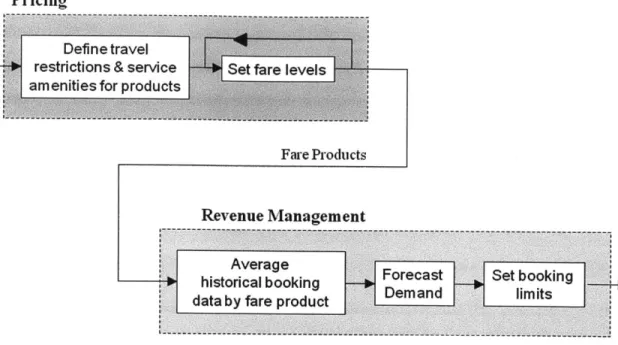
Once the complete set of fare products is defined, the revenue management pro-cess determines the maximum number of bookings to accept for each fare product in
Pricing
Define travel mfi!l #
Irrestrictions & service Set fare levels am eniti es for p rod ucts
Fare Products
Revenue Management
--- --- I
Average
Forecast Set booking historical booking Demndliit
data by fare product
L ---
---Figure 1-2: Overview of the current approach to pricing and revenue management
order to maximize the airline's expected revenues, as shown in Figure 1-2. Revenue management systems can forecast the demand for each fare product and compute the different booking limits. Several optimization techniques have been developed to calculate the appropriate levels of protection.
One aspect of revenue management is overbooking. It was first developed in the 1960's and enabled airlines to account for the no-show behaviour of a proportion of passengers. With overbooking, more bookings than can physically be accommodated are accepted, in an attempt the reduce the impacts of the very few passengers that may decide not to travel at the very last minute. Another aspect of revenue manage-ment is seat allocation. If too many seats are sold at a discounted fare and the plane fills up, passengers with the willingness to pay the traditional full fare can be de-nied their booking request, which represents a revenue loss for the airline. The need to protect seats for later booking but higher revenue passengers triggered research on seat allocation. The latest research developments in the field concern demand forecasting and seat allocation, the main focus of this study. An example of a set
Product 3 booking is accepted, the product becomes unavailable. Similarly, only 40 bookings can be accepted for Fare Product 2. On the other hand, Fare Product 1 remains available throughout the entire selling period, unless the plane fills up.
Restrictions
Saturday-night Purchase 21-day
Fare Product stay required before departure Fare
($)
1 No No 700 2 No Yes 450 3 Yes Yes 300 Nested Booking Limits 100 60 20
Table 1.2: Example of booking limits for a fare structure (capacity = 100 seats)
Pricing and revenue management have traditionally been considered separately, both from a theoretical and practical point of view. These two fields have indeed gen-erated much interest from the research community over the years but few researchers have considered the two fields jointly. At the same time, the pricing department and the revenue management department of an airline are usually two distinct depart-ments. Although many airlines have tried to integrate these two departments, most still have two distinct systems in place.
1.2
The Evolution of Pricing and Seat Allocation
Practices
Before the deregulation of the industry in the United States in 1978, airlines were not able to freely set their own prices. The US Civil Aeronautics Board (CAB) was the entity setting the fares of the interstate airlines. To do so, the CAB used a simple cost-based approach: prices were computed in order to cover the operating cost of the airlines and ensure a profit margin. Fares for the different origin-destination markets were based on distance. Only one fare product was offered for a given flight in the
economy class.
In 1977, shortly before deregulation, American Airlines was allowed by the CAB to introduce an additional fare product, the Super Saver Fare. The new fare prod-uct was first tested on flights between New York and both San Francisco and Los Angeles, but it soon became available on most domestic routes. This product was substantially cheaper than the normal economy fare but came with a 30-day advance purchase requirement and a minimum stay of at least seven days (Bailey et al., 1985). The average load factor of the industry in the 1970's was low, around 50% (Ben-Yosef, 2005), and legacy carriers were facing a competitive threat from charters. The expec-tation was that cheaper fares would increase the load factor and enable the airline to compete with lower-priced alternatives.
However, cheaper fares could also affect the revenues adversely. Indeed, discount-ing has two effects: stimulation and diversion (Krajewski and Ritzman, 1990). Lower prices will stimulate a previously unmet demand from price-sensitive customers. How-ever, lower prices are also attractive to the non-price-sensitive customers who would have flown with the airline at the non-discounted fare anyway. In order words, with the introduction of cheaper fares, passengers can book seats at a fare level lower than the one they would have been prepared to pay. They are thus diverted from the original product, creating a loss in revenue (McGill and Ryzin, 1999).
The advance purchase restriction and minimum stay requirement were a first at-tempt at lessening the impact of diversion. The restrictions created two market segments. People who can book their flight tickets more than a month in advance and stay at their destination for more than a week are likely to be leisure travellers with a lower willingness-to-pay than last-minute passengers. With the restrictions enforced by American Airlines, late booking passengers had no choice but to buy the full fare. The new fare product enabled the airline to sell seats that would have
not fulfil all the restrictions.
Nevertheless, this pricing strategy of implementing restrictions cannot, alone, en-sure an increase in revenue. The demand for the discounted fare could potentially fill up a flight long before departure, leaving no seats to late booking higher-fare pas-sengers. Some seats should therefore be protected for full fare passengers who book later and generate more revenues. There were no simple rules to determine the right number of seats to save for full-fare passengers. The introduction of this second fare product marked the beginning of the development of seat allocation models.
Yet, despite the fact that the effectiveness of a fare structure depends partly on the ability to set good booking limits, the progress made in the revenue management field was never the driver for change and innovation in the airlines' pricing strategies.
In 1985, American Airlines announced the introduction of a new fare product, the "Ultimate Supersaver Fare". The ultimate supersaver fare offered up to a 74% discount from the regular coach fare, an unprecedented discount. The new fares were subject to a new restriction, on top of the then usual 30-day advance purchase require-ment and a Saturday-night minimum stay. 50% of the ultimate supersaver fare was non-refundable. This latter restriction enabled the legacy carrier to further segment the domestic market. American Airlines was facing the rapid and successful growth of the low cost carrier People Express. The introduction of the ultimate supersaver fare was the traditional airline's response to the threat of the low cost competitor (Ben-Yosef, 2005).
In the following years, the complexity of the fare structures put in place by the airlines kept increasing. This trend was hastened by the development of computer reservation systems, enhancing airlines' ability to record and analyse booking data.
Different types of restrictions were implemented as fences to prevent high-revenue passengers from buying lower fares. Advance purchase requirements were combined
with minimum stay restrictions, cancellation policies and non-refundable conditions. The pricing strategy of the legacy carriers grew more and more complex in an attempt to refine the demand segmentation.
This trend was interrupted by the rapid growth of a new generation of low-cost carriers. These new entrants challenged the pricing practices imposed by the legacy carriers over the years. While the low-cost carriers still offered a large number of fares, they significantly reduced their price range. In addition, they entered the market with simplified fare structures. While most tickets on low-cost carriers were non-refundable and had rescheduling fees, they did not require a Saturday-night stay. In fact, most of the low-cost airlines removed the minimum stay requirement altogether, effectively offering one-way tickets only. The new entrants chose to base their customer segmen-tation strategy mainly on the advance purchase requirement, an easy to understand rule for the travellers.
Faced with the rapid and threatening expansion of the low-cost carriers, some legacy airlines reviewed their strategy. In 2005, Delta Air Lines announced the re-moval of the minimum stay requirement on all its US domestic markets altogether. The legacy carrier was struggling and the removal of the restriction was an attempt at recapturing passengers (Shaw, 2007).
A new trend was initiated in 2007 with the emergence of the fare structure now called "Fare Families". A few airlines chose to reduce the number of fare products they offered altogether. A handful of products with clearly differentiated restrictions and service amenities were identified and then branded. The branded products are the same across the markets. However, their prices can vary over time and by markets.
Over the years, the airlines have applied marketing principles and segmented the demand as much as possible by combining various types of restrictions and amenities.
Revenue management was most likely another factor of success, even if progress in the seat allocation field was never the driver for pricing changes. Pricing evolved irrespective of, and usually more quickly than, revenue management. Similarly, rev-enue management was unaffected by the changes in the fare structures offered by the airlines. As airlines implemented fare families, for example, very few new revenue management models were developed.
The objective of revenue management is to maximize the revenues of an airline by making some seats available at a lower fare to passengers who would not have trav-elled otherwise, while protecting seats for passengers with a higher willingness-to-pay but a later time arrival in the booking system. Revenue management is required only if there are at least two fare products competing for the same resource, a finite number of seats.
From the outset, technology did not permit to assess each request separately, one at a time. Durham (1995) reported that a computer reservations system may have to handle more than five thousand booking requests per second at certain peak times. The individual real time assessment of each request was infeasible and revenue man-agement focused on recommending booking limits by fare product for periods of a few hours to a few days. The status of each fare product was updated on a periodic basis.
The initial revenue management systems focused on optimizing the revenues for each flight leg independently. The systems computed the booking limits for each fare product on a leg. They were developed for the first type of fare structures of the airline industry: a limited number of fare products with clearly differentiated restric-tions. In these revenue management systems, the demand for each fare product was modelled by a Gaussian distributed random variable and the demands were assumed to be independent. The possible diversion of a passenger from the full fare product to
a lower fare product was not considered. The assumptions were intended for math-ematical and programming convenience, but nonetheless led to impressive revenue gains for the airlines.
The success of airline revenue management was widely reported. American Air-lines estimated the benefit of such techniques at $1.4 billion over a period of three years (Smith et al., 1992), further stimulating the development and implementation of revenue management methods. More advanced systems were designed to address the broader issue of network revenue optimization.
As airlines developed hubs and expanded their network, the number of connect-ing passengers increased tremendously. The origin-destination fare product sold to a connecting passenger depends on the availability of seats on each of the connecting flights. This creates an interdependence among flights. Considering the capacity of different flight legs independently to optimize the airline's total revenue becomes sub-optimal. Flight leg heuristics were extended to origin-destination control mechanisms to account for some network effects.
Later on, researchers suggested modifications to take into account the possible diversion of passengers to a lower fare product when determining the booking limits. However, despite the tremendous evolution of the pricing strategies over the years, the research on seat allocation optimization models remained heavily based on the initial fully restricted fare structures.
1.3
Research Motivation and Objectives
The need for seat allocation controls materialized as soon as the airlines started of-fering more than one fare product to their passengers and the possibility that the demand may exceed capacity arose. As the airlines kept widening their array of fare
challenge and drew the attention of the research community.
The first revenue management approaches suggested by researchers were designed for the contemporary restricted fare structure. This fare structure relied on many different types of travel restrictions, such as the advance purchase requirement, the minimum length of stay restriction or the Saturday night stay requirement, combined with different fare levels. The demands for each fare product was assumed to be independent.
When the minimum stay requirement was temporarily removed in 2005 by Delta Air Lines, the inherent characteristics of the fare structure changed. The choice of fare products for the potential passengers was not restricted by the length of stay anymore and this change affected the consumers' booking patterns. Most passengers who used not to be able to meet the length of stay requirement and thus used to have to buy less restricted more expensive fare products were suddenly able to book much lower fare products. A large part of the demand for the higher fare products was diverted to the lower ones, dramatically changing the booking patterns which are the basis for the revenue management analysis. The revenue management pro-cess incorporated the updated average fares and some adjustments were implemented to take into account the possible passenger diversion between fare products. Nev-ertheless, the underlying models remained mainly unchanged. Similarly, as airlines implemented fare families, very few new revenue management models were developed.
The following question is then raised: can the pricing and revenue management processes be addressed jointly to further maximize revenues? While fares do consti-tute an important input for seat allocation optimizers, they are determined during the pricing process. Fare levels are frequently updated, but are changed irrespective of the work done downstream to set the booking limits. On the other hand, the fares are used as fixed inputs by the seat allocation systems. The booking limit for each fare product is determined and implemented assuming fixed, averaged, fares.
ducing fares as an additional decision variable in revenue management and solving jointly for fares and booking limits could further increase revenues. The goal of this research is to develop a method to jointly optimize pricing and seat allocation.
1.4
Thesis Outline
The remainder of this thesis is organised as follows: Chapter 2 presents a literature review of pricing and revenue management methods. We shall first start with the description of the evolution of pricing techniques. We will then turn to the develop-ments in the revenue management field, by focusing first on forecasting methodologies and then seat allocation mechanisms. The third part of the chapter is dedicated to the recent work on joint pricing and seat allocation optimization.
In Chapter 3, we formulate the two-product, two-period joint pricing and seat allocation problem. We propose a first approach to solving this problem by first as-suming that the demand is deterministic. The deterministic model is discussed and its performance analysed through a numerical example.
Chapter 4 presents a stochastic approach to the joint optimization problem. The demand is assumed to be a uniformly distributed random variable and a geometrical analogy is used to express the objective revenue function. The stochastic approach simultaneously computes the fares and the booking limit that maximize the total rev-enues. Simulations show that the proposed approach performs well when compared to a traditional revenue management approach.
We then extend the approach to the multiple-time frame joint pricing and seat allocation optimization problem. A generalized methodology is presented in Chapter 5. In light of the complexity of the objective function arising from the consideration
problem.
Chapter 6 summarizes the findings and draws conclusions from them. We will also discuss practical applications and possible future research directions.
Chapter 2
Literature Review
A considerable body of work exists on airline pricing and seat allocation optimiza-tion. Whitin published a single period pricing model in 1955 and Littlewood first considered the two-class, single leg, seat allocation problem in 1972. Nevertheless, it is only in the mid nineties that the problem of joint pricing and seat allocation for perishable goods raised the attention of researchers.
In this chapter, we first review the pricing literature. An overview of the revenue management research on forecasting and seat allocation is then provided. Finally, we discuss the recent developments in joint pricing and seat allocation.
2.1
Pricing
Research on airline pricing has been undertaken from many different perspectives. Economists, marketing scientists and operations researchers have all studied the sub-ject.
The existing body of work from an economic point of view is very large. Schmalensee (1981) studied the impact of an airline's pricing strategy on social welfare. Borenstein (1985) used spatial models to analyse price discrimination in oligopolistic markets.
crimination in the US airline industry.
Studies of pricing strategies in the context of revenue optimization stemmed from research on production-pricing problems. The airline pricing problem was first con-sidered as a special case of the classical newsvendor problem where the production cost was fixed and the product was perishable with no penalty cost or salvage value. Whitin (1955),Mills (1959, 1962), Karlin and Carr (1962), Zabel (1970) and Hempe-nius (1970) worked on single-period newsvendor models that included both the price and the inventory level as a decision variable. Their studies only concerned the single-product case. Petruzzi and Dada (1999) presented an overview of the research on this field.
Karlin and Carr (1962), Nevins (1966), Zabel (1972), Thomas (1974), Thowsen (1975), Petruzzi and Dada (1999), Federgruen and Heching (1999) extended the scope of the research to a multi-period stocking and pricing problem. The planning period was segmented and the unsold products at the end of a time period were available to meet the demand of the subsequent time periods. Each time period was associated with a pricing and stocking decision. The studies remained focus on the single-product case.
Gallego and van Ryzin (1994) and Zhao and Zheng (2000) addressed the problem of dynamically pricing a given inventory of a single product. The demand was price sensitive and stochastic and the objective was to maximize the expected revenues. Optimal prices were functions of the inventory level and the length of the planning period. Chatwin (2000) and Feng and Gallego (2000) restricted the number of allow-able prices to a finite set. Gallego and van Ryzin (1997), Paschalidis and Tsitsiklis (2000) suggested to extend the dynamic pricing models to the multi-product case. The various products shared the same supply of resources. The two groups of re-searchers proposed heuristics based on deterministic models.
2.2
Revenue Management
Revenue management commonly encompasses overbooking, forecasting and seat al-location. The focus of this dissertation is forecasting and seat alal-location.
2.2.1
Forecasting
Work on airline forecasting for revenue management dates back to the 1960's. The first efforts focused on modelling the demand distribution and the passenger arrival processes. Beckmann and Bobkoski (1958), Beckmann (1958), Lyle, Belobaba (1987a) discussed the reasonable fit of the Poisson, negative binomial, gamma or normal prob-ability distributions.
Later on, researchers proposed remedial measures to the truncation of the observed historical demand due to booking limits and capacity constraints in the airline indus-try. The distinction between aggregate and disaggregate forecasting emerged. Taneja (1978) and Sa (1987) provided an overview of aggregate forecasting techniques. Lee (1990) discussed issues in disaggregate forecasting. Later work by Weatherford et al. (1993) took into account the possible diversion of a passenger in the two-product case. Some passengers might indeed be willing to pay the higher fare product but will always buy the lower available fare product. There was diversion when those passengers ended up buying the higher fare product because the other one was not available.
2.2.2
Seat Allocation
Littlewood (1972) first studied the seat allocation problem for the two-class, single flight leg case and proposed a simple rule to accept or reject bookings. A discount fare booking should only be accepted if the revenue it generates exceeds the expected revenue of a future request for the full fare. Belobaba (1987b, 1989, 2002) extended the principle to the multiple-fare products problem with the expected marginal seat
booking limits, except in the two-class problem, but provided reasonable approxima-tions in typical situaapproxima-tions. However, the heuristic could realistically be implemented and was therefore widely adopted by airlines. Other approaches to derive the optimal booking limits for single-leg flights were developed by Curry (1990), Wollmer (1992), Brumelle and McGill (1993) and Robinson (1995). These methods were referred to as leg-based approaches in the literature. They aimed at optimizing the expected revenue from seat allocation for each flight leg independently.
In the 1980's, airlines rapidly expanded their use of the hub-and-spoke network model and it soon supplanted the point-to-point service model. The number of con-necting passengers increased significantly, creating network effects: each flight leg carried a mix of local and connecting passengers. The yield of a connecting passenger might on a particular flight leg be lower than that of the passenger sitting next to him and yet the total itinerary contribution to the airline might be greater. On the other hand, a connecting passenger may displace two local passengers who could have generated more total revenue for the airline. The conventional leg-based approach to revenue management failed to address these two fundamental network issues.
Researchers worked on developing origin-destination control mechanisms for net-works. The first approaches were based on conventional leg-based methods. Instead of setting booking limits for fare products, controls were set for "value classes". All the itineraries that comprised the same particular flight leg were ranked, and the fare products of these itineraries were then mapped to buckets according to their value to the network. Each bucket was a value class. The leg-based heuristics were then used to compute the booking limits of each value class. American Airlines called the clustering process "virtual nesting". Belobaba (1989), Smith and Penn (1988) and Williamson (1992) presented different mapping techniques. Virtual nesting addressed the first network issue by taking into account the possibility that a low yield connect-ing passenger on a flight leg may in fact be generatconnect-ing more revenue overall than a local passenger.
More advanced network optimization techniques were then developed to tackle the second network issue mentioned previously, which is the displacement of two local passengers by a connecting passenger. Glover et al. (1982) and Curry (1990) provided mathematical programming formulations for network flow models. These results were used to estimate the displacement cost of an itinerary. Smith and Penn (1988), Simpson (1989) and Williamson (1992) developed bid-price methods in which a booking is accepted only if its total net contribution is greater than the estimated displacement costs, also called the bid-price.
2.3
Joint Pricing and Seat Allocation
To our knowledge, the literature on joint pricing and seat allocation for perishable assets is very sparse.
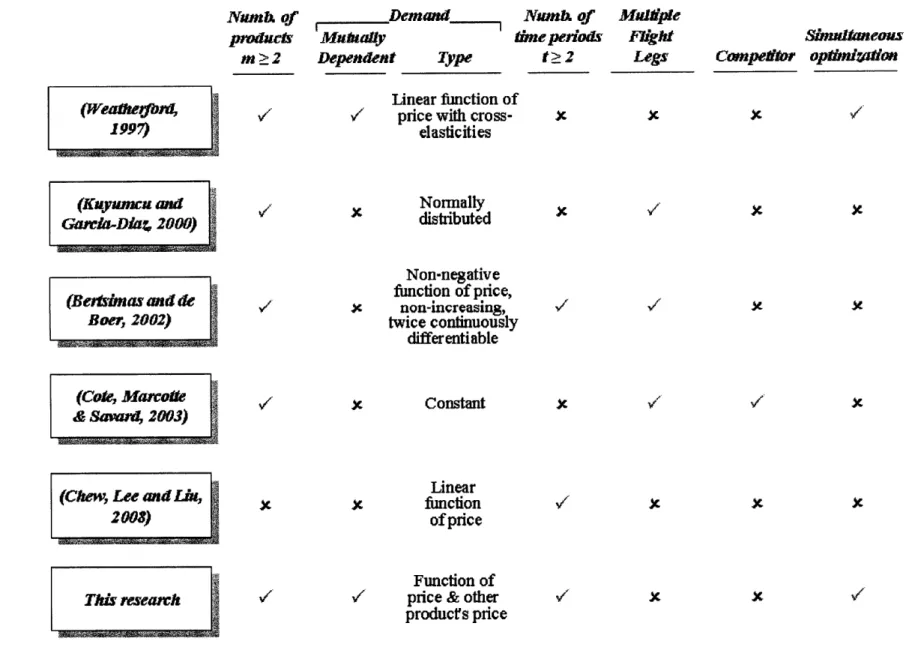
Weatherford (1997) emphasized the importance of considering prices as part of the overall optimization problem and suggests including them as decision variables in the seat allocation problem. The study focused on the case of a single flight leg with at least two fare products. The demand for each product was assumed to be normally distributed, with a mean a linear function of the product's own fare as well as the next higher and lower fares. The selling period was not divided into subintervals which greatly reduced the complexity of the problem. For example, there were only three decision variables in the case of the two fare product problem: two prices and one booking limit.
The analysis was divided into three parts. First, Weatherford assumed that the inventory was partitioned and that there were no diversion: passengers with the willingness-to-pay the higher fare do not consider the lower fare product. These two assumptions are released, one after the other, in the two subsequent parts of the
analy-could be derived. In the last part, the more realistic behavior of a high willingness-to-pay passenger buying a lower fare product if it is available was taken into account. However, it was assumed that the demand for the different products follows a strict arrival order, with the lowest fare product demand arriving first. Numerical methods were used to find the optimal solutions and the analysis was restricted to two and three fare products, due to the increased complexity of the problem.
Kuyumcu and Garcia-Diaz (2000) tackled the joint pricing and seat allocation problem with the objective of broadening the scope of the problem by taking into account the entire airline network in the decision making process. The analysis was not focused on the revenues generated by one single flight leg, but by all the airline's origin-destination (OD) itineraries that constituted the network.
The demands for each OD and fare class combinations were assumed to be mu-tually independent and normally distributed. There were no explicit hypothesis re-garding the relationship between the demands and fares, or any other fare product characteristics. The demands were known, through the analysis of historical data, and the objective function was the system-wide expected marginal seat revenue. A graph theoretical approach was proposed to determine the subgroup of fare products that would maximize the revenues, given an initial set of fare products. The seat allocation technique used was the standard leg-based revenue management method EMSR, even if the focus was the network.
The fares remained exogenous variables to the decision process in this study. The approach simplified the optimization problem by reducing the number of fare prod-ucts available, and then relied on standard EMSR to set booking limits for each OD itinerary.
Bertsimas and de Boer (2002) also analyzed the joint pricing and seat allocation optimization problem in a network. In this study too, it was assumed that the
mand for each fare product was uncertain and that its expectation only depended on its own price. In the first part of the paper, the selling time period was not divided into subintervals. The analysis was first reduced to the case of a single fare prod-uct. It was shown that the objective function could be concave with respect to the production level for a certain set of probability distributions, including the uniform and normal distributions. The authors proposed an iterative non-linear optimization algorithm to determine the optimal fares and allocation policies for all fare products.
The second part of the analysis focused on the multi-period optimization prob-lem. Three heuristics were presented. In the first one, the demand for a product was first aggregated over all the periods considered, which reduced the problem to the single time period problem. In the second heuristic, the inventory was partitioned, which also reduced the problem to a larger single time period problem. In the third heuristic, the allocation policy was set first and the optimization then only concerned pricing.
Cote et al. (2003) proposed a model with the capability of jointly solving the pricing and seat allocation problem in a network with a competitor. The approach was based on bilevel programming: the airline was assumed to know how its com-petitor would react and integrate this behavior in its decision process. The main objective of the study was to propose an approach to determine the optimal fares across the network, knowing how the competitor would react. The main variables of interest were the fares, not the booking limits. The demand for each fare product and origin-destination itinerary combination was assumed to be fully known: there was no randomness or hypothesis regarding the relationship between the fare products' char-acteristics. The inventory was partitioned and the model does not allow for diversion. The booking limits are obtained a posteriori. Indeed, once the two airlines pricing policy was known, the booking limits were simply set equal to difference between the flight's capacity and the higher fare products' demands.
Chew et al. (2009) developed a joint optimization approach for a single product with a two period lifetime. The demand for the product was assumed to be uncertain, and its expectation was a linear function of its fare. Based on the concave proper-ties of the objective revenue function, the authors suggested an iterative procedure to compute the optimal fare and booking limit. The extension to the multiple time period problem was then considered. As the concavity of the expected revenue func-tion did not always hold, three heuristics were suggested. In the first heuristic, the inventory was no longer nested but partitioned. In the other two heuristics, the time intervals were grouped into two time periods. The two-period procedure was then applied.
Figure 2-1 summarizes the main aspects of joint pricing and seat allocation opti-mization privileged by each one of the mentioned studies and thus provides a visual help to identify the gaps in the literature. Weatherford (1997) was the only one to consider the demands for different fare products to be mutually dependent and to solve for the optimal fares and booking limits simultaneously. Kuyumcu and Garcia-Diaz (2000), Whitin (1955), and Cote et al. (2003) chose to approach the optimization at the network level instead and the focus of Cote et al. (2003) was mostly the com-petitive effect. None of these three studies extended the work of Weatherford (1997) by introducing dependent demands. For Chew et al. (2009), the emphasized aspect is the ability to update the fare of a product several times over the booking process.
Figure 2-1 also shows how this dissertation complements the existing body of work on joint pricing and seat allocation optimization. Our intent is not to directly analyze the impacts of fares and booking limits on the demand at a network level or in a competitive environment. Instead, we revert to the base case, the single-flight leg case, but assume that the demands for the fare products considered are dependent. Furthermore, we divide the selling period into sub-intervals to model the fact that airlines can increase their revenues by changing their fares several times over the booking period. Our study combines the joint pricing and seat allocation aspects that were the focus of Weatherford (1997) and Chew et al. (2009). This dissertation could
then be the starting point for more comprehensive research encompassing network or competitive effects.
Demand NumM of Muldpie
Muha ay ime periods Fight
Dependent Type
Linear function of price with
cross-elasticities Normally distributed Non-negative function of price, 'C non-increasing, twice continuously differentiable t ! 2 Legs Sinudtaneous Compedtior optimization Yx 'C V V/ Y. V Y. I/ (Kuyumcu and Garcla-Diar, 200) (Berfsimas and de Boer 2002) (Cote, Marcote & Samn, 2003) This rsearch
'77
~ ~~~ 7 .1 ;,VI V price & otherFunction of products price
Figure 2-1: Gap in the joint pricing and seat allocation literature
Numh of pmduct m :2 / V Y/ 0 / JC Constant x V, V/ VI/ Linear function of price Y. x / x' C v
Chapter 3
Deterministic Approach to Joint
Pricing and Seat Allocation
Optimization
In this chapter, we develop a deterministic model of joint pricing and seat allocation optimization. In this approach, the prices of different fare products offered by the airline are no longer considered as exogenous variables to the seat inventory problem. Instead, the demand for fare products is modelled as a function of the fare products' prices, which thus become decision variables, as booking limits are.
This newly formulated optimization problem involves a large number of variables. We initially facilitate an analysis by assuming that the demand is deterministic. This highly simplifying assumption, which is relaxed later, allows us to gain insight into the optimization problem. We will show that without demand uncertainty, the fares can be used as the sole lever to match inventory and demand. The deterministic assumption will therefore allow us to set aside the booking limit in a first time and find a simple solution to the optimization problem. This shall constitute a starting point to observe, thanks to a numerical example, the impact of the flight capacity on the observed demand and pave the way for the following chapter.
We open up the chapter with a description of the problem's scope. The fare products and their characteristics are defined. The underlying selling mechanism used by the airline is explained. The notations used are then decrypted in Section 3.2, which allows us to then introduce the model chosen for the demand functions. In Section 3.4, we give a detailed analysis of the resulting objective function. Finally, we illustrate the approach with three sets of numerical simulations.
3.1
Scope of the Problem
Traditional revenue management techniques focus exclusively on booking limits for each fare class. The objective of these techniques is to improve the total expected revenues by determining the best booking limit for each product. In the formulation of the traditional revenue management optimization problem, the prices of different fare products are known and fixed and are considered as input to the problem. The booking limits are determined given the demand estimated at those price points.
In reality, however, prices do affect the demand and thus the revenues. We believe that the airline's revenues could be further improved by modifying the formulation of the seat inventory optimization problem and including prices as decision variables.
To do so, we place ourselves in a single carrier, single flight, single origin-destination (OD) market environment. The flight has a fixed capacity of C seats. This simple context enables us to reduce the complexity of the analysis by removing competitive or network effects.
In the OD market considered, two fare products, Fare Product 1 and Fare Prod-uct 2, are offered by the airline. The two products provide exactly the same in-flight service; nevertheless, these products are associated with two distinct sets of purchase restrictions and rules, and are therefore priced differently. In our notations, Fare Product 1 represents the more expensive, less restricted product. The other product,
Fare Product 2, is priced lower, but in return, has additional restrictions and rules.
Since the very beginning of revenue management, both researchers and airline managers have acknowledged that passengers booking first exhibit different behaviors from those booking last. They have different trip purposes, different willingness-to-pay and different tolerance regarding fare products' rules. The implementation of restrictions, such as advance purchase requirements, was an attempt at segmenting the demand based on those changing characteristics. A few days or weeks before the flight departure date, the lower discounted fare would no longer be available as most of the passengers arriving later have a willingness-to-pay closer to the higher price.
Our fare structure does not include advance purchase requirements. The two fare products remain available throughout the entire selling period unless the flight sells out. Instead, to take into account the changing characteristics of the passengers, we divide the selling horizon into subintervals which allows the prices to change from one period to the other, while keeping the restrictions unchanged. We start by dividing the booking period into just two time frames. Increasing the number of subintervals would result in additional decision variables and would greatly increase the complex-ity of the problem. We will explore the multiple-time period optimization problem in Chapter 5.
Bookings start to be accepted at the beginning of the first time frame, TF1. The flight departs at the end of the second and last time frame, TF2. The prices of the two products can be modified at the start of each new time period. In the notation, xt and yt represent, for each TFt, the prices of Fare Product 1 and Fare Product 2, re-spectively. These price points are decision variables. The set of restrictions and rules associated with each fare product are set by the airline. These restrictions remain the same throughout the entire booking period: they are constant characteristics of the two fare products.
Restrictions /Rules Fare Product 1 Refundability Refundable Pout 2 Non-refundable Miles Changingfee accunlalted No changing fee,
but fare difference 125%
Changingff e 100% + fare difference 10 Prices & Booking Limits TF1 TF2 x X2 Y1 Yz C
Figure 3-1: Example of the two fare products, their restrictions, fares and booking limit
In addition, the airline can limit the total number of seats to be sold in the first time frame. This should enable the airline to protect a minimum number of seats for TF2 passengers, which are usually less price sensitive and therefore more likely to accept to pay a higher fare. We assume that the total capacity is nested between the two time frames: unsold seats from the first time frame are available for booking in the second time frame. The flight capacity caps the total number of bookings that can be accepted over the course of the two time frames. The booking limit imposed by the airline on the two products in the first time frame is noted zi and is the fifth decision variable of our optimization problem. The flight capacity C is, on the other hand, fixed.
An example of the two fare products and their possible restrictions is provided in Figure 3-1.
The joint pricing and seat allocation problem modeled here consists of maximizing the total revenues generated by the sale of the two fare products during the two time periods by optimizing the four price points and the first time frame's booking limit.