Efficient Network Selection Schemes for an
Operator Deployed Cellular-WLAN
Heterogeneous Networks
Shobanraj Navaratnarajah
Submitted for the Degree of Doctor of Philosophy
from the University of Surrey
Institute for Communication Systems Faculty of Engineering and Physical Sciences
University of Surrey Guildford, Surrey GU2 7XH,
United Kingdom. January 2017 c
Abstract
The HetNet architecture is considered to be one of the promising solutions for the problem of capacity crunch and increasing energy consumption of wireless communication networks. Hence, it is expected to be one of the key aspects in the realisation of the future wireless communication networks. Moreover, future wireless communication networks are characterised by the co-existence of multiple radio access technologies called multi-RAT HetNets. In this context, the integrated cellular-WLAN HetNet attracts considerable interest among the mobile network operators. One of the major challenges of such HetNet is the optimal selection of serving network. In this regard, this thesis focuses on the efficient network selection schemes for an operator deployed cellular-WLAN HetNet.
Firstly, a novel load balancing scheme is proposed for an operator deployed cellular-WLAN HetNet, where the user association is controlled by employing cell-breathing technique for the WLAN network. In this scheme, the coverage of each WiFi AP is dynamically optimised to achieve desired load balancing. Since this is a network controlled traffic steering scheme, users can simply associate to the available strongest WiFi AP, without making any complex network selection decisions. Thus, can be easily implemented in an existing cellular-WLAN HetNet. Subsequently, performance analysis of cellular-WLAN HetNet is carried out for a saturated downlink scenario, in order to investigate the effect of deploying CRE technique for WLAN network in the cellular-WLAN HetNet. In addition, a cellular-WLAN interworking architecture and detailed signalling procedures are proposed for implementing CRE scheme in an operator deployed cellular-WLAN HetNet.
Finally, a novel Adaptive Stochastic Radio Access Selection scheme is proposed for an operator deployed cellular-WLAN HetNet. This scheme implements a stochastic network selection policy that assigns certain probability for selecting WLAN according to the status of the network in terms of load and signal quality. The proposed scheme helps to improve the system performance in terms of network throughput, energy efficiency, and call blocking probability.
Key words: Heterogeneous Networks, Multi-RAT, Cellular, WLAN, Network Selection, Energy Efficiency.
Acknowledgements
I would like to give my sincere gratitude to my two supervisors, Dr Mehrdad Dianati and Dr Muhammad Ali Imran, for providing me with useful direction and feedback, and their continuous support and help toward improving my research work.
I would like to thank all my friends, colleagues and all the staffs in ICS for their continuous support during my studies.
Last, my most tender and sincere thanks go to my loving parents for standing by me through the period of my studies. Without their love, care and encouragement, I would not have been able to complete my studies.
Contents
vii
xi
1 Introduction 1
1.1 Motivations and Objectives . . . 3
1.2 Structure of Thesis . . . 5
1.3 Overview of Contributions . . . 8
1.4 List of Publications . . . 9
2 Technical Background and State of the Art 11 2.1 Heterogeneous Networks . . . 11
2.2 Multi-RAT Heterogeneous Networks . . . 13
2.3 Network Selection and Vertical Handover . . . 15
2.4 Coordination and Cooperation of Multi-RAT Heterogeneous Networks . 17 2.5 Resource Management of Heterogeneous Networks . . . 19
2.6 Energy Consumption Models and Energy Efficiency Metrics . . . 21
2.7 Energy Efficiency Aspect of Multi-RAT Heterogeneous Networks . . . . 25
2.7.1 Deployment Strategy . . . 26
2.7.2 Operation Strategy . . . 28
2.8 Summary . . . 29
Contents ii
3 A Novel Load Balancing Scheme for Cellular-WLAN Heterogeneous Networks with Cell Breathing Technique 30
3.1 Background . . . 31
3.2 System Model . . . 33
3.2.1 User Association . . . 35
3.2.2 User Throughput . . . 36
3.3 Problem Formulation . . . 40
3.4 Sub-optimal Heuristic Approach . . . 42
3.5 Performance Evaluation . . . 44
3.5.1 System Throughput . . . 44
3.5.2 Fairness of User Throughput . . . 48
3.5.3 Load Distribution Between Cellular and WiFi . . . 52
3.5.4 Analysis of Computational Complexity . . . 55
3.6 Summary . . . 55
4 Analysis of Energy Efficiency on the Cell Range Expansion for Cellular-WLAN Heterogeneous Network 57 4.1 Background . . . 58
4.2 System Model and User Association . . . 59
4.2.1 User Association . . . 60
4.3 CRE Optimisation . . . 60
4.4 Results and Analysis . . . 61
4.5 Practical Implementation Scenario . . . 63
4.5.1 Existing Cellular-WLAN Interworking Solutions . . . 64
4.5.2 Proposed Cellular-WLAN Interworking Architecture . . . 66
4.5.3 Signaling Procedure for the Proposed Interworking Architecture 67 4.6 Summary . . . 68
5 An Adaptive Stochastic Radio Access Selection Scheme for Cellular-WLAN Heterogeneous Networks 71 5.1 Background . . . 72
5.2 System Model . . . 74
Contents iii
5.4 Analytical Model . . . 77
5.4.1 System Throughput . . . 83
5.4.2 Network Energy Efficiency . . . 83
5.4.3 Call Blocking Probability . . . 84
5.4.4 User Equipment Energy Efficiency . . . 84
5.4.5 Complexity of the Proposed Scheme . . . 85
5.5 Performance Evaluation . . . 87
5.5.1 System Throughput . . . 88
5.5.2 Network Energy Efficiency . . . 90
5.5.3 Call Blocking Probability . . . 90
5.5.4 User Equipment Energy Efficiency . . . 91
5.6 Summary . . . 93
6 Epilogue 95 6.1 Summary of Insights and Conclusion . . . 95
6.2 Future Direction . . . 97
6.2.1 Non-saturated Traffic Scenario . . . 98
6.2.2 Multiple Association . . . 99
6.2.3 CBR Traffic and Mobility . . . 99
A A Simulation Study on the Energy Efficiency of LTE-WiFi HetNet 100 A.1 Considered System Model . . . 100
A.2 Results and Discussion . . . 102
A.3 Summary . . . 104
List of Figures
2.1 Multi-RAT heterogeneous network . . . 14
2.2 Categories of network based on deployment . . . 15
3.1 Considered system model . . . 33
3.2 System throughput vs. Number of users . . . 46
3.3 System throughput vs. Hot-spot user density ratio . . . 46
3.4 System throughput vs. Number of WiFi AP per BS . . . 47
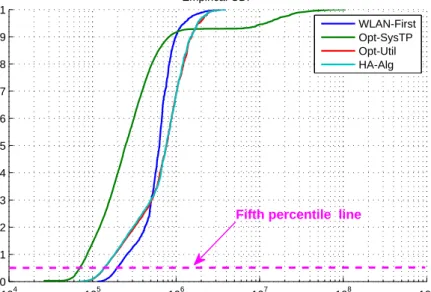
3.5 CDF of user’s throughput with default system parameters (i.e.,λu = 100, λa= 3, and α= 10). . . 49
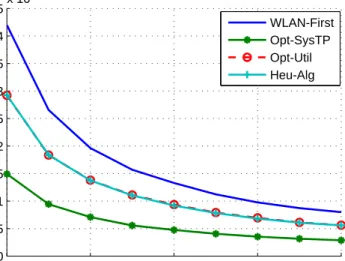
3.6 Fifth percentile user throughput vs. Number of users . . . 50
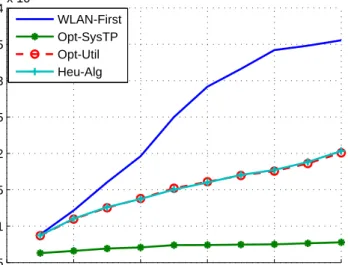
3.7 Fifth percentile user throughput vs. Hot-spot user density ratio . . . 51
3.8 Fifth percentile user throughput vs. Number of WiFi AP per BS . . . . 51
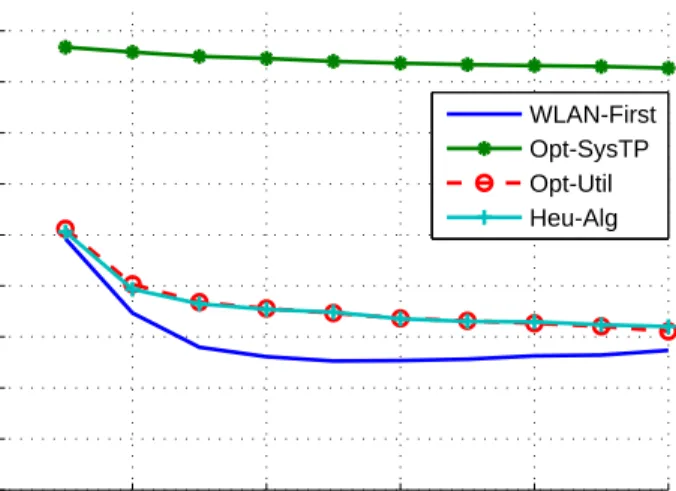
3.9 GINI coefficient of user throughput vs. Number of users . . . 52
3.10 GINI coefficient of user throughput vs. Hot-spot user density ratio . . . 52
3.11 GINI coefficient of user throughput vs. Number of WiFi AP per BS . . 53
3.12 Percentage of users served by WiFi vs. Number of users . . . 53
3.13 Percentage of users served by WiFi vs. Hot-spot user density ratio . . . 54
3.14 Percentage of users served by WiFi vs. Number of WiFi AP per BS . . 54
3.15 Computational complexity in terms of number of iterations vs. Number of WiFi AP per BS . . . 56
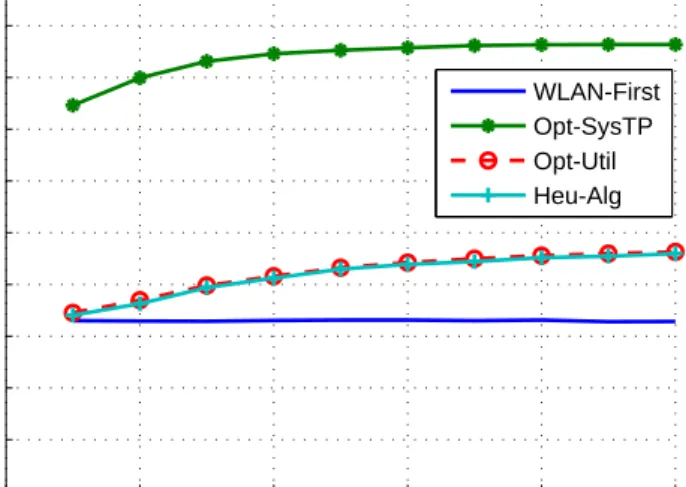
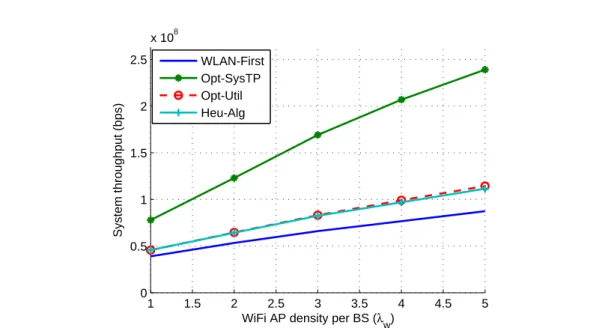
4.1 System throughput vs. WiFi AP densityλw. . . 62
4.2 GINI coefficient vs. WiFi AP density λw. . . 64
4.3 Cellular-WLAN Interworking Architecture . . . 66 iv
List of Figures v
4.4 Signaling Procedure for new Service Arrival at WLAN, and Handover
from Cellular to WLAN . . . 69
5.1 System model. . . 74
5.2 Proposed ASRAS scheme. . . 76
5.3 Ring based model of Cellular-WLAN HetNet. . . 78
5.4 State transition diagram of CTM. . . 80
5.5 System throughput vs. Arrival rate (λ) . . . 89
5.6 System throughput vs. User density ratio (α) . . . 89
5.7 System EE vs. Arrival rate (λ) . . . 90
5.8 System EE vs. User density ratio (α) . . . 91
5.9 Call blocking probability vs. Arrival rate (λ) . . . 92
5.10 Call blocking probability vs. User density ratio (α) . . . 92
5.11 Average UE EE vs. Arrival rate (λ). . . 93
A.1 Considered LTE-WiFi HetNet . . . 101
A.2 Effective coverage of WiFi AP with and without CAC with the load threshold of 4 users (top shows low load condition and the bottom shows high load condition) . . . 102
A.3 Hidden node scenario . . . 103
A.4 Average per user throughput in a LTE-WLAN HetNet with and without a CAC policy. . . 105
A.5 Total network EE in a LTE-WLAN HetNet with and without a CAC policy. . . 105
List of Tables
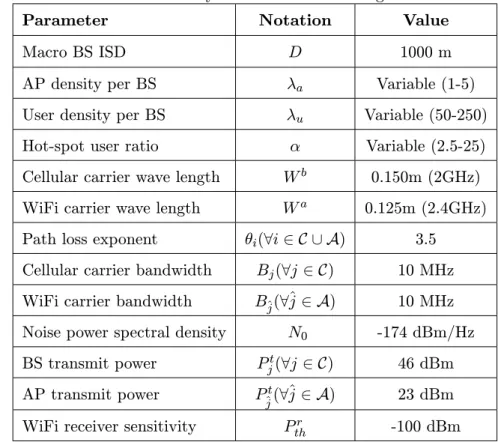
3.1 System Parameter Settings . . . 45
4.1 System Parameter Settings . . . 62
5.1 System Parameter Settings . . . 88
A.1 System Parameters . . . 103
List of Acronyms
3GPP 3rd Generation Partnership Project
AAA Authentication, Authorisation and Accounting AAGW Alien Access Gateway
ABC Always Best Connected
AE Area Efficiency
ANDSF Access Network Discovery and Selection Function
AP Access Point
ASRAS Adaptive Stochastic Radio Access Selection
BS Base Station
CAC Call Admission Control
CBR Constant Bit-Rate
CAGR Compound Annual Growth Rate CAPEX Capital Expenditure
CDF Cumulative Distribution Function CDMA Code Division Multiple Access
CRE Cell Range Expansion
CRRM Common Radio Resource Management CSI Channel State Information
CSMA/CA Carrier Sense Multiple Access with Collision Avoidance CTMC Continuous Time Markov Chain
D2D Device to Device
DBA Dynamic Bandwidth Adaptation DCF Distributed Coordination Function
viii
EC Energy Consumption
EE Energy Efficiency
EMM Enhanced Mobility Management
EPC Evolved Packet Core
FDD Frequency Division Duplex
GSM Global System for Mobile Communications
HBS Home Base Stations
HeNB Home eNodeB
HetNet Heterogeneous Network
HSDPA High-Speed Downlink Packet Access HSS Home Subscriber Server
ICI Inter Cell Interference IFOM IP Flow Mobility ISD Inter Site Distance
JCAC Joint Call Admission Control JRRM Joint Radio Resource Management KPI Key Performance Indicator
LTE Long Term Evolution
LTE-A LTE-Advanced
MAC Medium Access Control
MCS Modulation and Coding Schemes MDP Markov Decision Processes MIH Media Independent Handover
MIIS Media Independent Information Service MME Mobility Management Entity
MPTCP Multi-Path TCP
NS3 Network Simulator 3
OFDM Orthogonal Frequency-Division Multiplexing OFDMA Orthogonal Frequency-Division Multiple Access OPEX Operating Expenses
ix
QoS Quality Of Service
OWA Open Wireless Architecture
PA Power Amplifier
PDN Packet Data Network
PGW PDN Gateway
PHY Physical Layer
POA Point of Attachment
RAN Radio Access Network
RAT Radio Access Technologies
RF Radio Frequency
RRM Radio Resource Management
RSP Received Signal Power
RSRP Received Signal Reference Power RSS Received Signal Strength
SCTP Stream Control Transmission Protocol
SE Spectral Efficiency
SGW Serving Gateway
SINR Signal to Interference plus Noise Ratio SIR Signal to Interference Ratio
SNR Signal to Noise Ratio SON Self Organising Networks SOR Successive Over Relaxation TCP Transmission Control Protocol
TDD Time Division Duplex
TDMA Time Division Multiple Access
UE User Equipment
UMTS Universal Mobile Telecommunications System VBR Variable Bit-Rate
VHO Vertical Handover
VoIP Voice over Internet Protocol VPN Virtual Private Network
x
WAG WLAN Gateway
WiMAX Worldwide inter-operability for Microwave Access WLAN Wireless Local Area Network
List of Symbols
A Total coverage area
Aq (Aaqˆ ) The ring area that support MCS q of cellular BS (ˆq of WiFi AP)
Abq Cellular only coverage area that support MCS q of cellular BS
Aa
qqˆ Intersecting area with MCS q of cellular BS and ˆq of WiFi AP
B Cellular system bandwidth
Bj System bandwidth of macro-cell j
Bˆj System bandwidth of WiFi AP ˆj
bj,k The portion of the bandwidth allocated to the user kfrom macro-cell j
C System throughput
cu
a(s) Average throughput of user served by WiFi AP
cb(s) (ca(s)) Cellular BS (WiFi AP) throughput at system state s cu
q(s) Average throughput of user served by cellular BS with MCS q
ck Throughput of user k
cˆj Total throughput of WiFi AP ˆj
cˆj,k Throughput of a user k associated with the AP ˆj
D Inter-site distance of cellular macro BSs
dj,ˆj Distance of AP ˆj from BS j
di,k Distance from POA (BS or AP) ito user k
dq (dqˆ) Max distance from BS (AP) that supports MCS q (ˆq)
ECa
u Average UE energy consumption in WiFi mode
ECub Average UE energy consumption in cellular mode
EE System energy efficiency
gi,k Channel power gain from the POA ito user k xi
xii
Ii,k Total interference power of user k attached to the POAi
i Index of POAs (BS or AP)
j Index of BS
ˆ
j Index of AP
K Total number of users
k Index of user
L Data frame length in bits
L0 Path loss at the reference distance d0
M Total number of macro BSs
N Total number of APs
N0 Noise power spectral density
nb
max (namax) Max users that can be served by cellular BS (WiFi AP)
nq (naqˆ) Number of users served by BS (AP) in area Aq (Aaqˆ)
P System power consumption
PIb Idle power consumption of cellular BS
Pb
0 Static power consumption of cellular BS
Ptb Transmit power of cellular BS
Pa
I Idle state power consumptions of WiFi AP
PAa Active state power consumptions of WiFi AP
Pu UE power consumption
Pua UE power consumption when served by WiFi AP
Pb
u UE power consumption when served by cellular BS
Pi,kr Received power of user kfrom POA i Pr
th Minimum required received power threshold (i.e., receiver sensitivity)
Pit Transmit power of POA i pb
q (paqqˆ) Probability of a user being in area Abq (Aaqqˆ)
pb System blocking probability
pb
b (pab ) Blocking probability at cellular BS (WiFi AP)
Q( ˆQ) Number of supported MCS in cellular (WiFi)
R A uniform random value∈[0,1]
xiii
S State space
s System state
t Iteration number
Uk(.) Utility function
W Wavelength of the signal
wid Weight associated to the AP location relative to BS location
wil Weight associated to the current load of the AP relative to the BS load
X0b (X0a) State spaces with no cellular (WiFi) users
Xmaxb (Xmaxa ) State spaces with maximum cellular (WiFi) users
xi,k Binary user association indicator
yi Power reduction factor that is used to reduce the beacon power of AP i
ymax Maximum power reduction factor
zi Bias-factor for POA i
A Set of APs
C Set of cellular macro BSs
U Set of users
α User density ratio between hot-spot and non-hot-spot areas
βˆj,k Instantaneous achievable rate of the user kassociated with AP ˆj
βq Spectral efficiency of cellular system at MCS q
βa ˆ
q PHY rate of WiFi at MCS ˆq
γi,k Perceived SINR of the user k associated with the POAi Δ Linear coefficient of dynamic power consumption of BS
δ Step size of power reduction per iteration
ε Average amount of data download per user
ηb (ηa) System efficiency of cellular BS (WiFi AP)
ηb
phy (ηaphy) System efficiency of cellular BS (WiFi AP) at PHY layer
ηbmac (ηamac) System efficiency of cellular BS (WiFi AP) at MAC layer
θi Pathloss exponent of POA i
λa Density of APs per macro-cell
λu Density of users per macro-cell
xiv
λbq (λaqqˆ ) Service request arrival rate in area Abq (Aaqqˆ)
μq Service completion rate in area Aq of cellular coverage
μa Service completion rate in WiFi coverage
π(s) Steady state probability
σ2k Noise power of user k
τˆj,k Time duration of user kto receive a data frame from AP ˆj
φaqˆ Rate of state transition (naqˆ→naqˆ−1)
φq Rate of state transition (nq →nq−1)
Ψd Weighting constant that are used to adjust the importance of wli
Ψl Weighting constant that are used to adjust the importance of wl i
ψq Rate of state transition (nq →nq+ 1)
ψa ˆ
q Rate of state transition (naqˆ→naqˆ+ 1)
Chapter
1
Introduction
Recent evolution of wireless communication devices such as Smart-Phones and Tablet-Computers continues to explode the traffic demand in wireless communication systems. It is expected that the global mobile traffic will increase nearly eightfold by 2020 with respect to 2015, at a CAGR of 53%, reaching over 30.6 exabytes per month by 2020 [1]. This explosive growth of wireless data-traffic causes huge challenges for the wireless net-work operators to significantly increase the netnet-work capacity. However, it is expected that the mobile network connection speeds will increase just above twofold by 2020 [1]. Since improvements in SE at link level approaches its theoretical limits, the next gen-eration of technologies should focus on improving SE per unit area, which is referred to as AE, in order to cope with the increasing traffic demand on mobile networks [2]. One of the most promising solution for this challenge is the HetNet architecture [3]. A HetNet may consist of different size of cells with or without overleaping coverage. In HetNets, small cells bring down the distance between transmitter and receiver, which results in low pathloss. This leads to an increased RSP, SNR and better SE. Therefore, the AE can be significantly improved [4]. However, there is a concern that increased densification of small cells could increase the SINR, and thus could deteriorate the sys-tem performance [5]. To this end, mitigating interference while increase the network capacity, is considered as a major challenge in HetNet. As a result, there are numerous ICI mitigation techniques, such as interference cancellation, interference randomisation and interference avoidance techniques, were developed to overcome the challenge of
2
interference in HetNet [6]. The major advantage of such HetNet is that the low power small cells can increase the capacity of the network multi-fold, while introducing min-imal deployment cost compared to the traditional macro-cells [7]. Hence, HetNets are expected to be one of the key aspects in the realisation of future wireless communication networks.
In addition, the future wireless communication network is characterised by the co-existence of multiple RAT called multi-RAT HetNet [8]. In multi-RAT HetNet, different RATs can be integrated to provide service to same coverage area in a complimentary manner. Therefore, the resources can be better exploited in multi-RAT HetNet to provide service to different users with different service requirements (e.g. throughput, delay, mobility etc). In particular, the integrated cellular and WLAN attracts consid-erable interests in the mobile communication industry. This is due to the fact that the utilisation of unlicensed spectrum in WiFi brings additional bandwidth resources in-stead of sharing the much scared and costly cellular frequency spectrum for small cells. Moreover, most of the current and future mobile communication terminals support both cellular and WiFi networks. It has been reported that 51% of mobile traffic was off-loaded to WiFi networks in 2015, and it is expected to increase to 55% by 2020 [1]. Apart from the capacity demand, energy consumption of mobile terminals becomes an increasing concern due to the increased network usage of latest advanced wireless communication devices (e.g., smart phones). Therefore, there is a significant threat that the future mobile users will be searching for power outlets rather than network access, and once again binding them to a single location. This problem is sometimes described as theenergy-trap of future mobile communication systems [9]. On the other hand, recently, there has been an increasing interest in reducing energy consumption of the communication network in the wireless communication industry, since the OPEX of the network is dominated by the cost of energy [7,10]. Moreover, the rapid growth of mobile traffic will result in increased network energy consumption, as a consequence, the OPEX will raise. In addition to the increase in OPEX, the rise in energy consumption has also some environmental impacts in terms of increased CO2emission. It is expected
that the carbon footprint of mobile communication industry will be about 235 Mega tons in 2020, which is a threefold increase compared to that of 2007 [11]. Therefore,
1.1. Motivations and Objectives 3
improving the EE of mobile communication networks is becoming an important aspect of the wireless communication systems. Hence, apart from the coverage, capacity and QoS, the EE also becomes a KPI from the component design to the network operation of the future wireless communication networks.
Studies show that major part of the energy (50-80%) is consumed in the wireless access part of the mobile communication networks [12]. Hence, improvement in EE of access networks, will have considerable impact on the total network EE. In this regard, the HetNet architecture can also be considered as a promising solution to improve the network EE. In HetNets, particularly in small cells, the required transmit power is very low compared to macro-cells, due to the short distance between transmitter and receiver [4]. This enables the BS or AP to be made with less complexity and improved power efficiency. For example, such low power small BS or AP does not require any cooling systems, which usually consume considerable amount of power in a typical macro BS cell site. Moreover, the reduction in transmit power requirement, due to close proximity, can improve the battery life of mobile devices. Traditionally, there is a trade-off between SE and EE at link level. However, with the HetNet architecture, it is possible to improve EE of the network while improving AE. Therefore, HetNets attract considerable interest from the mobile communication industry. Particularly, deployment of WiFi hot spots attract significant interest, due to the fact that apart from the aforementioned advantages, they can considerably reduce the deployment and operational costs.
Although, multi-RAT HetNet can improve the service quality by exploiting different types of available resources, there are many challenges related to the efficient operation of multi-RAT HetNet. This is mainly due to the deferent technological and architec-tural aspects, and lack of direct coordination and cooperation between different RATs (especially between the RATs developed under 3GPP and IEEE standards).
1.1
Motivations and Objectives
One of the major challenge in multi-RAT HetNets is the optimal selection of the serving network [13]. It is evident that the adopted network selection strategy can have a
1.1. Motivations and Objectives 4
considerable effect on the overall network performance [14]. However, due to lack of direct coordination and different access mechanisms between different RATs, the task of intelligently selecting the optimal network to achieve the best overall network performance, has always been a difficult challenge. Thus, in order to facilitate intelligent network selection and VHO in a multi-RAT environment, the 3GPP standard ANDSF, and the IEEE standard MIH were developed [15,16]. Although, the standards facilitate a framework for intelligent network selection, they do not specify how the network selection decision should be made. The decision making is left to the mobile devices. However, in general, the network related policies are not considered by most of the devices. The devices make the network selection decision based on their local knowledge and the user preference. For instance, in the mainstream network selection scheme known as WLAN-first, the UE always tries to connect to WiFi, if there is a WiFi coverage available, regardless of the status of the WiFi network [17]. This kind of simple scheme can be beneficial for legacy cellular networks (e.g., 2G and 3G networks), which have relatively low system capacity compared to WiFi. However, the capacity of latest cellular network (e.g., LTE) is relatively higher and more efficient in terms of the SE. Therefore, off-loading all data traffic to WiFi in the dual coverage area may not always be advantageous; especially, when the user density is much higher under the WiFi coverage.
Although, there are many network selection solutions available for multi-RAT HetNet in the literature [18–20], most of them focus on the user perceived performance, such as QoS, mobility, and battery life of the mobile terminals. However, in the operator deployed multi-RAT HetNet, especially, in cellular-WLAN HetNet, the operator’s in-terest lies in the total network performance, such as system throughput, call blocking probability, collective user fairness, and network EE. Moreover, studies that focus on network selection in cellular-WLAN HetNet, typically assume either a fixed system throughput regardless of channel condition [21], or theoretical achievable throughput based on perceived SINR [22]. However, these assumptions are questionable, especially when investigating the performance of a multi-RAT HetNet. This is due to the fact that in reality, different RATs employ different multiple access schemes at MAC level, even though they may employ same PHY technique (e.g., OFDM-PHY in LTE and
1.2. Structure of Thesis 5
WiFi). The difference in MAC layer techniques in cellular and WLAN has a consider-able impact on the users’ perceived throughput as well as on the system performance of each RAT. Therefore, it is important to consider the practical aspects of different RATs in order to make any network selection decisions.
Thus, the main aim of this thesis is to investigate and design optimal network selec-tion strategies in order to improve various system performance such as load balancing, fairness, system throughput and system EE of an operator deployed cellular-WLAN HetNet by:
• Developing practical solutions to off-load the cellular data traffic to WLAN net-work in an operator deployed cellular-WLAN HetNet, where the off-loading (i.e., traffic steering) decisions are made on the network side (i.e., BS), and thus, there is no (or minimum) change required at the UE.
• Developing analytical model for performance evaluation of cellular-WLAN Het-Nets that considers practical aspects of each network, such as centralised resource allocation for cellular, random access for WLAN, and higher traffic density under WLAN coverage areas.
• Limiting the decision making process of any solution to the network side; and therefore, the network operator can influence the network selection according to their objectives, such as load-balancing, user fairness, and network EE, and reduce the signalling overhead over the air interfaces.
• Proposing architectural enhancements and signalling procedures in order to im-plement the proposed schemes in a practical network that require minimal changes in the network and the UE.
1.2
Structure of Thesis
1.2. Structure of Thesis 6
• Chapter 2: This chapter presents the concept of multi-RAT HetNets. Firstly, a brief discussion on the development of HetNet is given. Then, the technical back-ground of multi-RAT HetNet is discussed, including categorisation of networks based on deployment. Hereafter, the major challenges related to the operation of multi-RAT HetNet, especially, the challenges related to coordination and cooper-ation of different RATs, network selection and vertical handovers, and combined radio resource management are outlined, together with the solutions available to overcome these challenges in the literature. Subsequently, EE aspect of multi-RAT HetNet is investigated, including commonly used EE metrics and state of the art power consumption models. Especially, the deployment strategies and operation strategies that aim to improve the EE of multi-RAT HetNet are dis-cussed.
• Chapter 3: This chapter proposes a novel load balancing scheme for an opera-tor deployed cellular-WLAN HetNet, where the user association is controlled by employing cell breathing technique for the WLAN network (i.e., the coverage of the WiFi APs are optimally adjusted to achieve desired load balancing between cellular and WLAN). The chapter firstly provides the background of the proposed scheme, which explains the motivation behind this scheme. Subsequently, the con-sidered system model is explained in detail, including the user association schemes and the user throughput models. Hereafter, formulation of optimisation problem is given followed by a practical suboptimal algorithm. Finally, the performance of the proposed scheme is evaluated and compared with mainstream schemes in terms of system throughput, user fairness and load distribution between cellular and WLAN networks.
• Chapter 4: Apart from the cell breathing technique, there is another technique used to control the user association in HetNets , which is called CRE. Although, this technique is designed for single-RAT HetNet (i.e., LTE macro-femto Het-Net), recently, there are some effort in implementing CRE in multi-RAT HetNet. Thus, in this chapter we analyses affect of employing CRE technique to control the user association in an operator deployed cellular-WLAN HetNet. Moreover,
1.2. Structure of Thesis 7
this chapter proposes a practical implementation scenario for employing CRE technique for cellular-WLAN HetNet, specifically, LTE-WiFi HetNet, including architectural enhancements and signalling procedures. The proposed architecture and signalling procedures can also be utilised to implement the scheme proposed in Chapters 3. This chapter firstly provides the background of this chapter includ-ing a sort review of the CRE technique is presented, followed by the considered system model including the user association method for this analysis. Then, the performance evaluation model is given in detail. Subsequently, the performances of the CRE scheme is analysed. Finally, the practical implementation scenario for CRE in LTE-WiFi NetNet is presented.
• Chapter 5: Although, the load balancing and CRE schemes proposed in Chapter 3 and Chapter 4 provide practical solutions for balancing the load between cellular and WLAN networks, while ensuring certain level of fairness in terms of user throughput, they do not consider the EE of neither the network nor the UEs. Thus, this chapter proposes a novel network selection scheme called ASRAS for mobile users in cellular-WLAN HetNet, which aims to improve the total network EE. In this scheme, a mobile user located in dual coverage area randomly selects WLAN with probability ofωwhen there is a need for downloading a chunk of data. The value of ω is optimised according to the status of both networks in terms of network load and signal quality of both cellular and WLAN networks. The chapter firstly presents the background of this chapter, followed by the considered system model for the proposed scheme. Subsequently, the detail description of the proposed ASRAS scheme is given. Hereafter, an analytical model is developed to find the optimal value of ω for the proposed scheme. Finally, the performance of the proposed scheme is evaluated and compared with two mainstream schemes namely, WLAN-first and Load Balancing, in terms of EE, throughput, and call blocking probability.
• Chapter 6: This chapter provides a conclusive summary and puts into per-spectives the numerous insights and findings that have been obtained from the previous chapters. Furthermore, a number of open issues on the network
selec-1.3. Overview of Contributions 8
tion of an operator deployed cellular-WLAN HetNet are discussed and future work directions on this topic are proposed.
1.3
Overview of Contributions
The main contribution of this thesis can be summarised as follows:
• A novel load balancing scheme for an operator deployed cellular-WLAN HetNet, where the user association is controlled by employing cell breathing technique for the WLAN network. In this scheme, the users can simply associate with available strongest WiFi AP without making any complex association decision, since the computational complexity is limited to the network only. Thus, the proposed scheme can be easily adopted to the current and future cellular-WLAN HetNet without any changes in the user side, which makes this scheme more practical in terms of implementation.
• Analysis of CRE for an operator deployed cellular-WLAN HetNet. This is to investigate the effect of deploying CRE technique for the WLAN network in a cellular-WLAN HetNet. Considering the practical aspects of each type of access technology, this analysis reveals that applying positive biasing towards WLAN network deteriorates the system performance. Moreover, the results form this analysis demonstrate that there is a trade-off between fairness and system throughput, which can be optimised by optimally adjusting the bias-factor for each AP individually, with appropriate utility function.
• An interworking architecture with detailed signalling procedures for implementing CRE technique for cellular-WLAN HetNets, specifically, for LTE-WIFi HetNet. The proposed architecture can also be utilised to implement other traffic steering and network section schemes, such as cell breathing, which require close coordi-nation at the RAN side of the multi-RAT HetNet.
• A novel ASRAS scheme for an operator deployed cellular-WLAN HetNet. This scheme implements a stochastic network selection policy that assigns certain prob-ability for selecting WLAN according to the status of the network in terms of load
1.4. List of Publications 9
and signal quality. This approach helps to improve the system performance in terms of network throughput, EE or call blocking probability. One of the main advantages in this scheme is that it does not require complex computation on the UE side, since the computational complexity is limited to the network. At the same time, it allows the operators to influence the network selection decision by setting the appropriate probability for selecting the WLAN according to different objectives.
• An analytical model for performance evaluation of cellular-WLAN HetNets based on CTMC for VBR data services that considers system specific overhead and limi-tations (i.e., limited MCS), as well as state based total power consumption models for each network. The proposed model can be used to evaluate system perfor-mance metrics such as system throughput, EE, and call blocking probability. In addition, this model can be used to optimise the load distribution between cel-lular and WLAN networks to optimise the system performance based on various objectives.
1.4
List of Publications
The research carried out during the course of this PhD has resulted in the following publications:
1. S. Navaratnarajah, A. Saeed, M. Dianati, and M.A. Imran, Energy Efficiency in Heterogeneous Wireless Access Networks, Wireless Communications, IEEE, vol.20, no. 5, pp. 3743, October 2013.
2. S. Navaratnarajah, M. Dianati, and M.A. Imran, Analysis of Energy Efficiency on the Cell Range Expansion for Cellular-WLAN Heterogeneous Network, in Wireless Communications and Mobile Computing Conference (IWCMC), 2015 International, August 2015.
3. S. Navaratnarajah, M. Dianati, and M.A. Imran, Performance Analysis of Cellular-WLAN Heterogeneous Network Based on Continuous Time Markov Chain, in
1.4. List of Publications 10
Computer Aided Modeling and Design of Communication Links and Networks (CAMAD), 2015 IEEE 20th International Workshop on, September 2015.
4. S. Navaratnarajah, C. Han, M. Dianati, and M.A. Imran, An Adaptive Stochastic Radio Access Selection Scheme for Cellular-WLAN Heterogeneous Communica-tion System, IET Communications, vol. 10, no. 15, pp. 1986-1994, October 2016.
5. S. Navaratnarajah, M. Dianati, and M.A. Imran, A Novel Load Balancing Scheme for Cellular-WLAN Heterogeneous Networks with Cell Breathing Technique, Sub-mitted to IEEE Systems Journal [Under 2nd review].
Chapter
2
Technical Background and State of the
Art
This chapter presents the concept of multi-RAT HetNets. First, the technical back-ground of multi-RAT HetNet is discussed, including the categorisation of networks bested on the deployment of network. Hereafter, the major challenges related to the operation of multi-RAT HetNet, especially, the challenges related to coordination and cooperation of different RATs, network selection and vertical handovers, and combined radio resource management are outlined, together with the solutions available to over-come those challenges in the literature. Subsequently, EE aspect of multi-RAT HetNet was investigated, including commonly used EE metrics and state of the art power con-sumption models. Especially, the deployment strategies and operation strategies that aim to improve the EE of multi-RAT HetNet are discussed.
2.1
Heterogeneous Networks
Traditional wireless cellular networks are typically deployed as homogeneous networks using a relatively large coverage macro BSs in a planned layout. In a homogeneous cel-lular system, all the BSs have similar transmit power levels, antenna patterns, receiver noise floors, and similar backhaul connectivity to the core network. The locations of
2.1. Heterogeneous Networks 12
the BSs are carefully chosen by network planning, and the BS settings are properly configured to maximize the coverage and control the interference between BS [23]. As the traffic demand grows, the network relies on cell splitting or additional carriers to overcome capacity demand. However, this deployment process is complex and iterative. Moreover, site acquisition for macro BS with towers becomes more difficult in dense urban areas.
Apart from the increased traffic demand, operators are facing flattening revenue per bit due to largely flat-rate data-centric service plans. Thus, it is not cost effective to add more macro BSs to increase the network capacity [24]. Hence, operators are looking for a cost effective solutions to increase their network capacity. To this end, deploying small cells such as micro and pico cells in a hierarchical or layered architecture seen as a promising solution for the growing capacity demand. This kind of network architecture is referred to as heterogeneous networks or HetNets [4, 24]. Due to the short distance between transmitter and receiver in small cells, the required transmit power is very low compared to the macro-cells [3,23]. This enables the small cell BSs to be made with less complexity and low cost. In addition, the low power small BSs do not require any cooling system (which usually consumes considerable amount of additional power in a typical macro BS), and thus consumes much less power, and require only a small footprint, hence reduced CAPEX and OPEX. Moreover, the multi-tier structure enhances capacity and coverage via enabling dense reuse of the spectrum and improving link quality due to shorter distance between the BS and UE.
The aforementioned advantages of HetNet deployment lead to more attention on the development of femto-cells also known as HBSs or HeNBs in LTE and LTE-A systems [3, 4, 23–28]. Femto-cell is a low-power short-range BS (same as WiFi AP), which operates in licensed spectrum. Unlike the macro, micro and pico cells, the femto-cells can be installed by the customer (i.e., subscriber), and it can be connected to the mobile core network using the excising internet connection as a backhaul link [29]. However, there are many challenges related to the deployment of such HeNBs. For example, in most cases, femto-cells will use same frequency spectrum as the macro-cell. This kind of dense reuse of spectrum in a multi-tier network, will increase the so called Cross-Tier Interference. Hence, the SINR and SE will be reduced [30–32].
2.2. Multi-RAT Heterogeneous Networks 13
Apart from the multi-tier aspect of HetNets, the other interesting aspect is the usage of multiple RATs. In a multi-RAT HetNet, the added advantage is that different RATs utilise different spectrum including the unlicensed spectrum (e.g., WiFi). Therefore, multi-RAT HetNet does not suffer from cross-tier interference. The following section describes the multi-RAT aspect of HetNet in detail.
2.2
Multi-RAT Heterogeneous Networks
Due to the technological improvements and innovations, various kinds of wireless access technologies were developed and deployed over the past decades. Among them, GSM, UMTS, LTE, WLANs, WiMAX and Bluetooth are some major examples. During the initially development of each RAT, the available technology, design objectives, service requirements, and the regulations lead to different access technologies. For example, the cellular technologies (e.g., GSM) were developed primarily for voice service with the objective of providing large coverage and service continuity on the move (i.e., mobility), while the WLAN technologies were developed for providing high bandwidth, short range, and low cost solution for data services. As a consequence, currently there are many access technologies available to serve the user depending on the user’s service requirements. However, each RAT has its own benefits and limitations based on the service it can provide to the user (e.g., coverage, bandwidth, and monetary cost, etc). Therefore, one of the main objectives of 4G (also sometimes referred to as beyond 3G systems) was to integrate all these different access technologies into a common network, sometime referred to as OWA that provide ABC services to the users, where the users are able to choose the best available access networks in a way that best suits their needs [33].
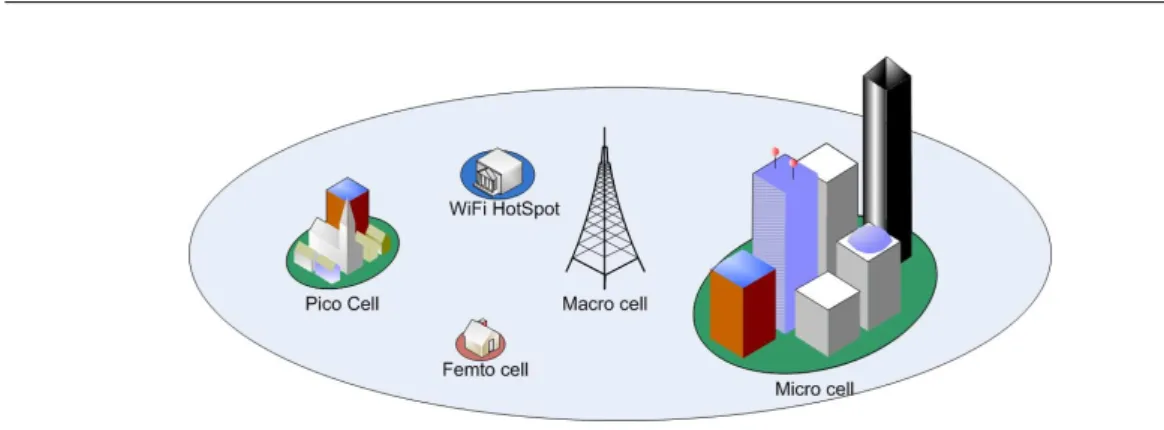
Figure 2.1 shows an example of multi-RAT heterogeneous wireless access network. Such integrated (or coordinated) networks are sometimes referred to as HetNets in the literature. However, the term “HetNet” sometimes means the network consists different sizes of cells (macro, micro and femto), different RATs, different services or all together. Therefore, in order to avoid the ambiguity, in this thesis the term “heterogeneous” is only used in order to refer the existence of different cell sizes (i.e., the coverage area
2.2. Multi-RAT Heterogeneous Networks 14
Figure 2.1: Multi-RAT heterogeneous network
of base station or access point). Hence, the wireless access network can be categorised into four different categories based on the deployment of network as follows (see Figure 2.2):
1. Single-RAT Homogeneous network; where the network is deployed homogeneously (i.e., macro-cells only) with a single access technology (e.g., traditional cellular network such as 2G).
2. Single-RAT Heterogeneous network; where the network consists of different size of cells (i.e., macro, micro, pico and femto-cells) that provide service to users through single access technology.
3. Multi-RAT Homogeneous networks; where the network consists of more than one RAT in order to provide the service, with homogeneously deployed access networks (e.g., 2G and 3G macro-cells provide the service to same coverage area). 4. Multi-RAT Heterogeneous network; where there are different access technologies with different cell sizes provide the service to the user in the same coverage area, such as integrated cellular and WLAN networks.
Among the aforementioned categories, the multi-RAT HetNet has been identified as the future architecture of wireless communication systems [8]. The major advantage multi-RAT HetNet is the availability of additional spectrum. Moreover, in general, each RAT (e.g., cellular and WLAN) will utilise different frequency spectrum, which are orthogonal to each other. This will avoid the interference between network tiers.
2.3. Network Selection and Vertical Handover 15
Figure 2.2: Categories of network based on deployment
However, there are many challenges related to efficient operation multi-RAT HetNets, such as optimal network selection, coordination and cooperation (i.e., inter-operability), handover (i.e., mobility), efficient resource management, and security. The following subsections discuss some of these challenges and the recent related studies, which are trying to address these challenges.
2.3
Network Selection and Vertical Handover
It has always been a challenge to make an optimised cell selection or handover decision in a multi-RAT HetNet environment, mainly due to different technological and archi-tectural aspects of each RAT, as well as lack of direct coordination between different RATs (especially between the RATs developed under IEEE and 3GPP standards). The handover between different RATs is referred to as VHO in the literature [34]. There are many studies related to network selection and VHO in literature, most of them mainly focus on seamless mobility, system performance (i.e., system throughput), load balancing and UE’s EE (i.e., prolonging the battery life of UE). The works presented in [35–38] looking into seamless mobility in a multi-RAT HetNet environment. In [35], the authors propose a new method to facilitate seamless VHO between the wide-area cellular data networks such as UMTS, and the WLAN, using the SCTP. However, in their study they consider that the bandwidths for UMTS and WiFi links are fixed at
2.3. Network Selection and Vertical Handover 16
384 kb/s and 2 Mb/s respectively, which is not realistic since the data rates can vary de-pend on the channel condition. In [36], the authors propose an intelligent context-aware solution that considers both users’ and services’ requirements to make a seamless VHO decision. A fuzzy logic based VHO algorithm for mobile terminal is proposed in [37], which aims to provide an efficient seamless VHO between LTE and WLAN, on the basis of multiple system parameters. The study in [38] investigates the use of a cost-function to perform an optimal network selection in a multi-RAT environment, and it has been shown that the proposed solution increases the overall network connectivity, while optimising energy consumption of multi-radio devices (i.e., UEs). However,the VHO and network selection solutions presented in [36–38] are UE-centric, and thus they add additional computational complexity to the limited hardware on UEs. In addition, they introduce additional signalling overheads between network and UEs to realise such distributed (i.e., UE-centric) solutions.
The studies in [39, 40] aim to preserve the battery life of the UE while making op-timised VHO decisions. In [39], the authors describe a context-awareness framework capable of supporting energy-centric VHO decision making to improve EE of the UE. However, this is also a UE centric scheme. On the other hand, a network centric VHO decision algorithm is presented in [40], which maximises the collective battery lifetime of the mobile nodes, and balances the overall load among all attachment points in a multi-RAT HetNets. However, the proposed solution requires an additional hardware entities called VHD controllers, to be added to the network to implement the pro-posed solution. Meanwhile, studies in [41, 42] examine and provide network selection and VHO solutions to improve system performance in terms of system throughput, QoS and continuity. In [41], the authors introduce a measurement-based network se-lection technique that provides a way to acquire QoS information in order to improve the overall QoS and system capacity, and also to reduce the unnecessary handovers in multi-RAT HetNet. In [42], the authors propose a MDP based VHO decision algorithm for a multi-RAT HetNet in order to improve system performance. However, both of the above studies assume that the system capacity of WiFi is fixed regardless of the user location. In addition, both of the solutions are UE-centric, which adds additional signalling overheads to scared air-interface, and computational complexity to UE.
2.4. Coordination and Cooperation of Multi-RAT Heterogeneous Networks 17
Recently, in [43] the authors propose an adaptive network selection algorithm in the delayed off-loading scenario for cellular-WLAN HetNet, where they introduce a bio-logical inspired method, attractor selection, to adaptively control the optimal network selection for the off-loading users. They show that the proposed algorithm achieves a more efficient data off-loading while guarantee the quality of services (QoS). However, they also assume that the capacity of WiFi is fixed. In addition, in order to implement the proposed scheme, a sperate network has to be added to the network, which add extra cost and complexity. In [44] a UE preference-aware network selection algorithm is proposed for a multi-RAT HetNet that consists of LTE, WiFi and integrated LTE femto-WiFi nodes. It has been argued that the proposed algorithm is superiority in terms of user fairness, throughput maximisation and energy saving, compared to non preference-aware algorithms. However, it has been assumed that the WiFi capacity is similar to the LTE, based on the perceived SINR.
2.4
Coordination and Cooperation of Multi-RAT
Hetero-geneous Networks
Since each RAT has been developed with different architecture and operation protocols, the integration of different RATs has been a major challenge in a multi-RAT environ-ment. Especially, access technologies developed based on 3GPP and IEEE 802.x spec-ifications were developed independently at the beginning of their development process, without considering any cooperation between these two systems. However, in order to harvest the advantages of multi-RAT HetNet, and optimise the operation of such HetNets in terms of service continuity, mobility, security and other performance en-hancements (e.g., throughput, battery life and EE), the cooperation of different RATs is essential. Therefore, the coordination and cooperation problem between RATs has been addressed by some studies and standards. In this regard, the IEEE standard 802.21, called MIH Services, defines an extensible media access independent mechanism in order to enable the optimisation of handovers between heterogeneous IEEE 802.x systems (such as WiMAX and WiFi) [45]. Moreover, it facilitates handovers between IEEE 802.x systems and cellular systems. Similarly, the 3GPP standard ANDSF is
de-2.4. Coordination and Cooperation of Multi-RAT Heterogeneous Networks 18
veloped to facilitate intelligent network selection and vertical handover in a multi-RAT environment. Further, the 3GPP specification TS 23.234 specifies the system descrip-tion for interworking between 3GPP systems and WLANs [46]. Moreover, TS 23.327 also defines a technical solution with necessary enhancement of the 3GPP-WLAN In-terworkin architecture in order to support mobility and roaming between I-WLAN systems and 3GPP systems [47].
Apart from the above standards, there are many studies focus on the implementation of such standards in the practical network. The studies in [48–50] presents solution for practical implementation of the MIH service standard. In [48], the authors propose and demonstrated an EMM entity with support for HetNet environments using the IEEE802.21 framework. In addition, they show that the EMM in this framework can be used to optimise the handover procedures by facilitating the exchange of messages between multi technology devices and specific network entities. In [49] and [50], the authors propose a general method of implementing the MIIS entity, as a crucial part of a system which is fully capable of performing vertical handover according to IEEE 802.21 standard. Moreover, they present the general architecture of the component, its functionality, some considerations on data formatting and a typical usage scenario of the system. The above coordination and cooperation solutions mainly focus on the integration of the core network to enable seamless multi-RAT operation. However, to harvest full potential of a multi-RAT HetNet, close coordination at the RAN is also essential. In this regard, recently, the studies in [51, 52] investigate and propose network architectures to enable very tight coordinations at the RAN side of multi-RAT HetNet. However, they introduce additional network entities that add extra cost and complexity the network. Although, the aforementioned solutions can be enable coordination at the core and RAN sides of the network, the additional cost of such solution has to be considered carefully. For example, if such solutions can be utilised to optimise the energy efficiency of the network, the additional energy cost of of such cooperation mechanisms also need to be considered.
2.5. Resource Management of Heterogeneous Networks 19
2.5
Resource Management of Heterogeneous Networks
Another major challenge in HetNets is the resource management. Due to the complex architecture of such networks, it is difficult to manage the resources of HetNets from the network point of view. For example, the user deployed WiFi APs and femto-cell BSs are deployed in an unplanned manner by end users in most cases, which makes the centralised resource management a difficult task. The resource management techniques such as RRM and CAC in homogeneous networks are very well studied in the literature compared to the multi-RAT HetNets. In multi-RAT network environment, these techniques referred to as JRRM [53] or CRRM [54], and JCAC [55], respectively. The studies in [56–58] are focusing on the RRM in HetNet to improve the system performance of the network. In [56], the authors propose a distributed joint resource allocation algorithm to maximize total system capacity. Especially, they investigate the advantages of multiple simultaneous transmissions by multiple RATs over a single transmission by a single RAT, which can be interpreted as network diversity. However, they assume centralised resource allocation for both RATs. This assumption is not valid for cellular-WLAN HetNet, since the resources are randomly accessed in WLAN. In [58], the authors investigate a max-min fairness based RRM strategy in the cellular-WLAN HetNet to improve the system performance. Although, they consider rate adaptation (i.e., the transmission rate is depend on the perceived SINR) for WLAN network, they assume that the access technique of WiFi is similar to the TDMA. However, the actual random access method of WiFi scheme is considerably different to the centralised TDMA scheme.
The works in [59–62] aim to improve the load balancing in a multi-RAT HetNte through resource management. In [59], the authors investigate a user-centric QoE based resource allocation problem with heterogeneous network operators, user types, and classes of services. A load balancing architecture is discussed in [61], and a load balancing al-gorithm is proposed to improve the utilization of radio resources, and to reduce call blocking probability. A load balancing scheme, based on fuzzy logic algorithm is pro-posed in [60] for a 3G and WLAN HetNet, which focus on the utilization fairness. A policy based resource management framework is presented in [62] for cellular-WLAN
2.5. Resource Management of Heterogeneous Networks 20
integrated network, which aims to improve the network utilization by dynamically bal-ancing the offered traffic load via admission control and vertical handoff. However, all of the aforementioned studies in [59–62] assume that the network capacity of cellular and WLAN are fixed regardless of the channel condition and traffic type. In addition, the data rate of users assumed to be fixed regardless of the traffic type (e.g., voice or data), and thus the proposed load balancing schemes may not produce the same result when considering adaptive data rates and network capacity that depends on the channel quality.
The works in [63, 64] propose CAC approaches for a multi-RAT HetNet in order to improve the system performance and balance the load of the network. In [63], the authors propose a JCAC, and DBA scheme for a multi-RAT HetNet in order to improve the system performance and balance the load of the network. They show that their scheme can maximise the overall system utilization, while keeping the call blocking and dropping rates at an acceptable low levels, and satisfying the QoS demands of the diverse services. However, this work only focus on cellular based HetNet, particularly, LTE and HSDPA networks. In [64], the authors propose a CAC scheme for LTE-WLAN HetNet. In this work, they consider rate adaptation of LTE network by modelling the system with multiple rings, where the user located at the closest ring to the BS require less radio resources compared to the user located at the outer ring to achieve same data rate. However, they only consider the rate adaptation for LTE network, and the WiFi network assumed to have fixed capacity. Moreover, they only consider fixed data rate for user traffic. In [65], the authors infer that by using CAC and overload prevention at WLAN, off-loading algorithms can be implemented to achieve load balancing and throughput maximisation, which improves the overall network performance of an LTE-WLAN HetNet. To prevent the overloading of LTE-WLAN network, they introduce SNR threshold for network association. It is mention that the choice of SNR threshold plays a significant role in controlling throughput profile of the WLAN-connected users and achieve user throughput fairness. However , the presented scheme is a heuristic scheme, and has been evaluated through simulations only.
2.6. Energy Consumption Models and Energy Efficiency Metrics 21
2.6
Energy Consumption Models and Energy Efficiency
Metrics
The global mobile communication industry is growing rapidly, which is accompanied by increased energy consumption of mobile networks. Thus, the objective of recent studies moves towards EE rather than just SE, in order to reduce energy costs and CO2 emissions [66]. In order to evaluate EE of any system, the energy consumption of
such system has to be evaluated as accurately as possible. Hence, in studies that focus on network EE, it is essential to consider the total power consumption of the network. Especially, for numerical and simulation evaluations, accurately modelling the energy consumption is vital, since the viability of results obtained by such evaluations are heavily depend on the power or energy consumption model used for the evaluation. In this regard, power consumption models for different BS types in HetNet are analysed in [67, 68]. In those studies, the power consumption models of macro, micro pico and femto BSs are considered. In order to accurately model the power consumption of BSs, the authors analyse the power consumption of sub components of the BS such as PAs, RF transceivers, baseband processors, power converters (e.g., AC-DC and DC-DC converters), and cooling systems. It has been shown that the relation between the RF power output and the total power consumption of a BS is nearly linear, and therefore, for studies which are not dealing with component development of BS, a linear approximation of the power consumption model is sufficient [68]. Such linear power consumption model can be expressed as follows:
P =P0+ ΔPt, (2.1)
whereP represents the total power consumption of BS, P0 is the power consumed at
the BS regardless of the transmit power also referred to as “static” power consumption,
Pt is the transmit power of the BS, and Δ is the linear coefficient of transmit power. The later part of the linear power consumption model (i.e., ΔPt) also referred to as “dynamic” power consumption of the BS [66].
Due to the low complexity of a linearly approximated power consumption model, most of the studies in literature that are looking into improve the EE of the network, adopt
2.6. Energy Consumption Models and Energy Efficiency Metrics 22
a linear power consumption model in their studies. When considering the power con-sumption of different BS types, the dominant part of the power concon-sumption moves from dynamic to static, as the size of the BS changes from bigger to smaller, respec-tively. For example, in a macro BS the dominant part of the power consumption is the dynamic power consumption, whereas in a femto BS the dominant part is the static power consumption [67].
Although, the linearly approximated power consumption model has an acceptable ac-curacy, the values used forP0 and Δ must be as accurate as possible for each types of
BSs under consideration. Since these parameters define the characteristics of different types BSs energy consumption, incorrect selections of these parameters will result in an unfair comparison; especially, in multi-RAT environment. Moreover, apart from the BSs there is another part of the network that is always associated with the access network, is the backhaul links. Since each BS needs to have a backhaul link to commu-nicate with the core network, the backhaul which is associated to the BS also has to be considered as part of access network. Hence, the energy consumed by the backhaul link has to be included in the evaluation of EE of network in order to get better accuracy of the energy consumption of the wireless access networks.
In [69], the authors have evaluated the power consumption of different mobile access networks, namely; WiMAX, HSDPA and LTE networks. In that study, they have in-cluded the backhaul power consumption in their power consumption model, but they have not considered the variation of the transmit power (i.e., dynamic power consump-tion) and assumed that the transmit power is fixed. The power consumption models discussed so far are obtained for cellular wireless communication systems. However, one of the important candidate in multi-RAT HetNet is the IEEE 802.11 system, specifi-cally, WiFi. Generally, it is difficult to model a simple power consumption model for WiFi network, due to the complexity introduced by the IEEE 802.11 access protocol. Specifically, in DCF mechanism of IEEE 802.11 access protocol, the packets or frames are not continuously transmitted, and it is difficult to predict the transmission of frames due to the random access nature of DCF. In [70] the authors try to measure the energy consumption of WiFi devices and they conclude that energy consumption of an IEEE 802.11 wireless interface has a complex range of behaviours, and the energy
consump-2.6. Energy Consumption Models and Energy Efficiency Metrics 23
tion is not synonymous with bandwidth utilisation. In [71] the authors tried to model the energy consumption of WiFi devices by modelling the system as Markov chain, and assuming that each WiFi station faces a constant conditional collision probability. However, this model is only valid for single PHY transmission rate.
Apart from the energy consumption models, the EE metric used to evaluate system performance in order to improve the EE also plays an important role in such studies. The most fundamental and widely used EE metric in literature for wireless commu-nication is the bits-per-joule (bits/Joule) metric. This metric is simply expresses the system wide EE of a considered network in terms of number of bits transmitted per consumed unit energy. Due to the simplicity of this metric, it is easy to compute the value of this metric as follows:
EE = C
P, (2.2)
whereCis the system throughput, andPis the total power consumption. Note that the individual ‘user throughput’ is defined as the number of information bits successfully delivered to the user per unit time, and the ‘system throughput’ is defined as the sum of the individual user throughputs in the system, which are measured in bits/s [72]. Thus, simply dividing the system throughput by total power consumption will result in network EE in bits-per-joule value. However, in reality the power consumption and the system throughput will vary over time, hence the simple division of system throughput by consumed power will only show the instantaneous EE. In such cases, the integration of throughput and consumed power over certain period of timeT will provide total bits transmitted and total energy consumption for that period of network operation. From these values, more accurate estimation of the bits-per-joule metric can be obtained as follows: EE= RT 0 C RT 0 P . (2.3)
In addition, when considering the system throughput or the number of bits transmitted over certain period of time, only the number of useful information bits have to be taken into account. In many existing studies, the link level or physical layer throughput, which is evaluated using fundamental information theory is considered as the throughput to evaluate the EE of the considered system. This evaluation may be valid when
2.6. Energy Consumption Models and Energy Efficiency Metrics 24
comparison done over a single type of RAT, since the effect of other protocol layers can be assumed same. However, when evaluating the EE of a multi-RAT system, considering the physical layer throughput as system throughput would lead to an unfair comparison between RATs. This is due to the fact that at least the physical and MAC layers have different technical aspects in different RATs. In fact, mainly these two particular layer techniques define the radio access methods in wireless communication system, as a result there are different RATs in wireless communication. Moreover, each RAT has its own type of control message overheads which cannot be considered as useful information bits. Therefore, when measuring the throughput in a multi-RAT environment it is important to consider the useful information bits that are delivered at least above the MAC layer, in other words, the information bits that are delivered to the IP layer has to be considered in order to evaluate the bits-per-joule metric. Apart from the bits-per-joule metric, the other common energy efficiency metric used in the literature is the bits-per-hertz-per-joule (bits/Hz/Joule), where it reflects the achieved spectral efficiency (i.e., bits-per-second-per-hertz) per unit power consumption (i.e., Watts), which is obtained as follows:
EE= C
BP, (2.4)
where B is the system bandwidth. In this metric, the unfairness due to different bandwidth used by different systems is eliminated. From the information theory, it is obvious that usage of higher bandwidth will have higher throughput for the same transmit power. Therefore, evaluating the energy efficiency of different system by bits-per-joule metric may result in an unfair comparison between systems, which are utilising different bandwidths; especially, in a multi-RAT environment, since typically, different RATs have different bandwidth usage.
In addition to the energy efficiency metrics, some times, the energy consumption metrics are used in literature to compare the energy efficiency of some systems or solutions, which are trying to improve the energy efficiency of wireless communications. The simple difference between the EE and the energy consumption metrics is that they are inversely related to each other (i.e., in energy consumption metric the better or higher value means poor EE). However, in some cases evaluating the performance based
2.7. Energy Efficiency Aspect of Multi-RAT Heterogeneous Networks 25
on energy consumption metric makes more sense than energy efficiency metric. For example, the “area power consumption” (some time referred to as area efficiency), which is expressed in “Watts-per-square meter” (W m−2) or “Watts-pre-square kilometre”
(W km−2), and “per user power consumption” expressed in “Watts-per-user” (W/user) are some of such energy consumption metrics used to evaluate the performance of wireless communication systems for EE [68, 73]. The area power consumption and per user power consumption can be obtained as follows:
EC= P
A, (2.5)
EC = P
K, (2.6)
respectively, whereA is the total coverage area and K is the total number of users.
2.7
Energy Efficiency Aspect of Multi-RAT Heterogeneous
Networks
Recently, the potential of energy savings in multi-RAT HetNet has been identified by the research community. However, in the recent past more attentions were given to throughput enhancement, seamless mobility, and network load balancing in a multi-RAT environment. When it is comes to EE in a multi-multi-RAT HetNet, EE of the mo-bile terminal has attracted more attentions, since it has limited source of energy, and prolonging the battery life of mobile terminal has always been one of the important considerations of many system design perspectives. However, there are some research activities in the literature that are related to the EE of single-RAT HetNets from the network point of view. EE of a network can be improved from two different perspec-tives in a HetNet environment. One is efficient deployment (i.e., deployment strategy) of the network form EE point of view. The other one is efficient network operation (i.e., operation strategy), where the existing HetNet is efficiently operated considering traffic demand variation, interference management and RRM. The related work in the literature on these two strategies are discussed in the following subsections.
2.7. Energy Efficiency Aspect of Multi-RAT Heterogeneous Networks 26
2.7.1 Deployment Strategy
In [73], the authors investigate the impact of micro-cell deployment under the coverage of macro-cell on the power consumption of the network with different cell loads. They introduce the area power consumption metric, which is measured in watts-per-square kilometre (W/km2) as the performance metric and they used linear power consumption
model to evaluate the energy consumption. In addition, they conclude that the energy savings from the deployment of micro base stations are moderate in full load scenarios and it is strongly depends on the circuit power consumption of the base stations, which is independent from the transmit power. Further, they extended their work in [74] and [75], where they show that during higher traffic demand, deploying micro BSs is beneficial in terms of area EE. Similarly, in [76], the authors investigate the impact of random micro-cell deployment with varying cell density on the EE of cellular radio networks. They show that there is an optimal deployment density of micro-cells per macro-cell at certain traffic demand in terms of network EE, which is evaluated in bit-per-joule metric. In addition, they show that by deploying micro-cells, the macro-cells transmit power can be reduced; hence, some energy savings can be obtained, since, generally, macro-cells consume much more energy compared to micro-cells.
In [77], the authors investigate the EE of a two tier HetNet of macro and pico-cells for a downlink scenario. In this work, they show that there exists an optimal pico-macro density ratio that maximizes the overall EE of the considered network. Similarly, in [78], the authors investigate the EE of HetNet, where pico-cells are deployed within the coverage of macro-cell. In this work the authors evaluate the cell EE and area EE in bits-per-joule and bits-per-joule-per-square kilometre metrics, respectively. They show that in both cases, the network EE can be improved by deploying low power pico BSs combined with reduction of macro BS transmission power. In a similar study in [79], the authors show that up to 60% of energy can be saved by the deployment of publicly accessible residential pico-cells overlaid with macro-cell coverage. However, in that study, the power consumption of both macro and pico-cells are assumed to be fixed irrespective of the transmit power.