The Security of Triple Encryption and a
Framework for Code-Based Game-Playing Proofs
Mihir Bellare1and Phillip Rogaway2
1 Dept. of Computer Science & Engineering University of California at San Diego,
9500 Gilman Drive, La Jolla, California 92093 USA.
2 Dept. of Computer Science, University of California, Davis, California 95616, USA
Abstract. We show that, in the ideal-cipher model, triple encryption (the cascade of three independently-keyed blockciphers) is more secure than single or double encryption, thereby resolving a long-standing open problem. Our result demonstrates that for DES parameters (56-bit keys and 64-bit plaintexts) an adversary’s maximal advantage against triple encryption is small until it asks about 278queries. Our proof uses code-based game-playing in an integral way, and is facilitated by a framework for such proofs that we provide.
1
Introduction
Triple encryption.Given a blockcipherE: {0,1}k× {0,1}n → {0,1}n with inverseDconsider blockciphersCascadeeeeE (K0K1K2, X) =EK2(EK1(EK0(X)))
and CascadeedeE (K0K1K2, X) =EK2(DK1(EK0(X))). Our results are the same
for both constructions. Following [14, 6, 9], we model E as a family of random permutations, one for each key, and we provide the adversary with oracle access to the blockcipherE(·,·) and its inverseE−1(·,·). Given such oracles, the adver-sary is asked to distinguish between (a)CascadeeeeE (K0K1K2, ·) and its inverse, for a random key K0K1K2, and (b) a random permutation on n bits and its inverse. We show that the adversary’s advantage in making this determination,
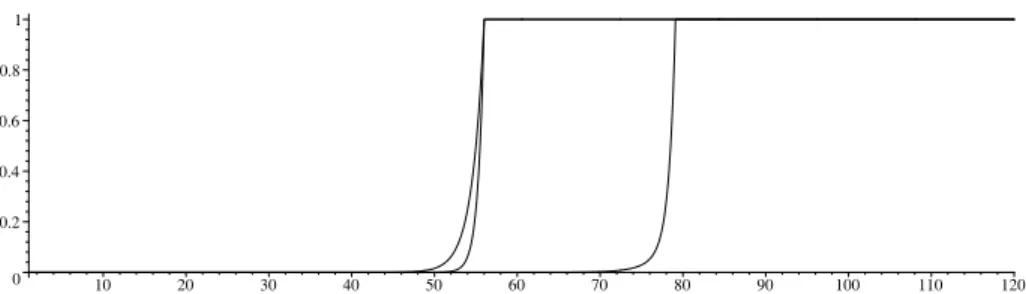
Adveeek,n(q), remains small until it asks aboutq= 2k+0.5 min{k,n} queries (the ac-tual expression is more complex). The bound we get is plotted as the rightmost curve of Fig. 1 for DES parameters k= 56 and n= 64. In this case an adver-sary must ask more than 278.5 queries to get advantage 0.5. Also plotted are the security curves for single and double encryption, where the adversary must ask 255 and 255.5 queries to get advantage 0.5. For a blockcipher withk =n= 64, the adversary must ask more than 289 queries to get advantage 0.5. As there are matching attacks and security bounds for single and double encryption [4, 1] our result proves that, in the ideal-cipher model, triple encryption is much more secure than single or double encryption.
As background for the above, note that the security of the cascade construc-tion, where two or more independently keyed blockciphers are composed with one another, is a long-standing open problem [4, 12]. Even and Goldreich refer to it as a “critical question” in cryptography [5, p. 109]. They showed that the
0 0.2 0.4 0.6 0.8 1 10 20 30 40 50 60 70 80 90 100 110 120
Fig. 1.Upper bound on adversarial advantage (proven security) verses log2q (where
q=number of queries) for the cascade construction, assuming key length k= 56 and block lengthn= 64. Single encryption is the leftmost curve, double encryption is the middle curve [1], and triple encryption in the rightmost curve, as given by Theorem 1.
cascade of ciphers is at least as strong as the weakest cipher in the chain [5], while Maurer and Massey showed that, in a weaker attack model, it is at least as strong as thefirst cipher in the chain [11]. Aiello, Bellare, Di Crescenzo, and Venkatesan [1] prove the security of double-encryption (the two-stage cascade) in the same model as we use in this paper, showing that the maximal adversary advantage inqqueries isq2/22k. The meet-in-the-middle attack [4] implies that this is the best possible. So the adversary’s advantage for double-encryption is only small until q ≈ 2k, just as for single encryption (although it grows as a slower rate). Thus triple encryption is the shortest potentially “good” cascade. And, indeed, triple DES is the cascade that is widely standardized and used [13]. The best published attack on three-key triple-encryption is due to Lucks [10]. He does not work out an explicit lower bound forAdveeek,n(q), but in the case of triple-DES, the adversary’s advantage becomes large at aroundq= 290 queries (using enormous time and memory, too). We prove security to about 278queries, so there is no contradiction.
As for the cascade of≥4 blockciphers, the maximal advantage in our attack model is no worse than it is for triple encryption, so our result proves that cascade “works” for all≥3. It is open if security increases with increasing.
Game-playing framework.Our proof for triple-encryption uses game-playing in an integral way, first to recast the advantage we wish to bound via a simpler game, and later to analyze that game via others. Ultimately one is left with a game where conventional probabilistic reasoning can be applied.
What constitutes a game-playing proof is a matter of perspective. To some, a game-playing proof in cryptography is any proof where one conceptualizes the adversary’s interaction with its environment as a kind of game, the proof proceeding by constructing a “chain” of such games. Viewed in this way, game-playing proofs have their origin in the earliest hybrid arguments, which began with Goldwasser and Micali [7] and Yao [16]. Bellare and Goldwasser [2] provide an early example of the use of a game-chain to prove security of a construction that uses multiple different cryptographic primitives.
In our treatment, games are code (ie, programs), not abstract environments; as we develop it, game-playing centers around making disciplined
transforma-tions to code. This approach begins with Kilian and Rogaway [9], and was used by Rogaway in many subsequent works. The framework of Section 2 develops this approach, and in particular our Fundamental Lemma (Lemma 1) is about the probability that an adversary can distinguish between games (programs) that differ in a certain syntactic way.
Shoup has independently and contemporaneously prepared a manuscript on game playing [15], advocating the use of game chains to make proofs more ac-cessible. Shoup has often used game-playing over the years. His approach is not code-based. Shoup’s [15, Lemma 1] functions like our Fundamental Lemma, but the former is cast in terms of conditional probabilities while the latter talks of programs that differ only after the setting of a flag bad.
Following the web distribution of this paper, Halevi argues for the creation of an automated tool to help write and verify game-based proofs [8]. We agree. The possibility for such tools has always been one of our motivations, and one of the reasons we focus on code-based games.
Our broader paper [3] contains further illustrations of game-based proofs (the PRP/PRF Switching Lemma, the CBC MAC, and OAEP) and a discussion of general techniques for code-based game-playing.
2
The Game-Playing Framework
Games are programs, written in pseudocode or in some formalized programming language. We describe some elements of the language we use. The semantics of a boolean variable, which we will also call a flag, is that once true it stays true. A random-assignment statement has the forms←$ S where S is a finite set. This is the only source of randomness in programs. A game consists of an initialization procedure (Initialize), a finalization procedure (Finalize), and namedoracles(each a procedure). The adversary, which we also regard as code, makes calls to the oracles, passing in values from some finite domain associated to each oracle. The initialization or finalization procedures may be absent, and often are, and there may be any number of oracles, including none. All variables in a game are global, and they are not visible to the adversary.
We can run a game G with an adversary A. To begin, variables are given initial values. Integer variables are initialized to 0; boolean variables are initial-ized to false; string variables are initialized to the empty string ε; set variables are initialized to the empty set∅; and array variables hold the valueundefinedat every point. These conventions often enable omitting explicit initialization code. When used in a boolean expression, undefined values are regarded asfalse.
The Initialize procedure is the first to execute, possibly producing an output inp. This is provided as input to the Adversary procedureA, which now runs. The adversary code can make oracle queries via statements of the form y←P(· · ·) for any oraclePthat has been defined in the game. The result is to assign toythe value returned by the procedure call. We assume that the game and adversary match syntactically, meaning that all the oracle calls made by the adversary are to oracles specified in the game, and with arguments that match in quantity
and type. The semantics of a call is call-by-value; the only way for an oracle to return a value to the adversary is via a return statement. When adversary A halts, possibly with someadversary output, we call Finalize, providing it any such output. The Finalize procedure returns a string that we call the game output. If we omit specifying Initialize or Finalize, or their return-statements, it means that the procedure returns its input. The game output and adversary output are often the same, because Finalize (or a return-statement for it) is unspecified.
The adversary and game outputs can be regarded as random variables. We write Pr[AG⇒1] for the probability that the adversary output is 1 when we run game G with adversary A, and Pr[GA⇒1] for the probability that the game output is 1 when we run gameGwith adversaryA.
Advantages.IfGandHare games andAis an adversary, letAdv(AG, AH) = Pr[AG⇒1]−Pr[AH⇒1] andAdv(GA, HA) = Pr[GA⇒1]−Pr[HA⇒1]. These represent the advantage of the adversary in distinguishing the games, the first measured via adversary output and the second via game output. We refer to the first as theadversarial advantageand the second as thegame advantage. We say thatG, Hareadversarially indistinguishableif for any adversaryAit is the case thatAdv(AG, AH) = 0, andequivalent if for any adversaryAit is the case that
Adv(GA, HA) = 0. We will often use the fact that
Adv(AG, AI) =Adv(AG, AH) +Adv(AH, AI) (1)
Adv(GA, IA) =Adv(GA, HA) +Adv(HA, IA) (2) for any games G, H, I and any adversary A. These follow simply from the fact that (a−b) + (b−c) =a−c. These will be referred to as thetriangle equalities. The fundamental lemma. Let G and H be games and let bad be a flag that occurs in both of them. Then we say thatGandH areidentical-until-bad if their code is the same except that there might be places whereGhas a statement bad ←true,S while game H has a corresponding statement bad ←true,T for some T that may be different fromS. (One could also say that G and H are are identical-until-bad if one has the statement ifbad thenS where the other has the empty statement, for this can be rewritten in the form above.) The identical-until-bad predicate is an equivalence relation.
We write Pr[AG setsbad] or Pr[GA setsbad] to refer to the probability that the flagbad istrueat the end of the execution of the adversaryAwith gameG (that is, when Finalize terminates). The fundamental lemma says that the advan-tage that an adversary can obtain in distinguishing a pair of identical-until-bad games is at most the probability that its execution setsbad in one of them.
Lemma 1. [Fundamental lemma of game-playing] Let G and H be identical-until-bad games and let Abe an adversary. Then
Adv(AG, AH)≤Pr[AG sets bad] andAdv(GA, HA)≤Pr[GA setsbad]. More generally, ifG,H, andI are identical-until-bad games then
One of the most common manipulations of games along a game chain is to change what happens afterbad gets set totrue. Any modification following the setting ofbad leaves unchanged the probability of settingbad.
Proposition 1. [After bad is set, nothing matters] Let G and H be identical-until-bad , andA an adversary. ThenPr[GA setsbad] = Pr[HA setsbad].
3
The Security of Three-Key Triple-Encryption
Definitions. Let E: {0,1}k × {0,1}n → {0,1}n be a blockcipher with key length k and block lengthn. For K ∈ {0,1}k and X ∈ {0,1}n let EK(X) =
E(K, X). Let E−1: {0,1}k × {0,1}n → {0,1}n be the blockcipher that is the inverse of E. We associate to E two blockciphers formed by composition; de-noted CascadeeeeE ,CascadeedeE : {0,1}3k × {0,1}n → {0,1}n, these were defined in Section 1. These blockciphers have key length 3kand block lengthnand are sometimes referred to as the three-key forms of triple encryption. We will call the two methods EEE and EDE, respectively. There is also a two-key variant of triple encryption, obtained by settingK0=K2, but we do not investigate it since the method admits comparatively efficient attacks [12].
We will be working in the ideal-blockcipher model, as in works like [6, 9, 1]. Let Bloc(k, n) be the set of all blockciphersE: {0,1}k×{0,1}n→ {0,1}n. Thus
E←$
Bloc(k, n) means thatEK: {0,1}n→ {0,1}n is a random permutation on
n-bit strings for each K∈ {0,1}k. We consider an adversary A that can make four types of oracle queries: T(X), T−1(Y),E(K, X), and E−1(K, Y), where
X, Y ∈ {0,1}n and K ∈ {0,1}k. (As for our syntax, T, T−1, E, E−1 are formal symbols, not specific functions.) The advantage of A against EEE and themaximal advantage against EEE obtainable usingq queries are defined as
Adveeek,n(A) = Adv(AC0, AR0) and Adveee
k,n(q) = maxA
Adveeek,n(A) where the games C0, R0 are shown in Fig. 2 and the maximum is over all ad-versaries A that make at most q oracle queries (that is, a total of q across all four oracles). The advantage of Ameasures its ability to tell whether T(·) is a random permutation or isCascadeeeeE (K0K1K2, ·) forK0K1K2 chosen indepen-dently at random from{0,1}3k and whereErealizes a random blockcipher and
T−1,E−1 realize inverses ofT,E, respectively.
Define the query threshold QTheee1/2(k, n) as the largest integer q for which
Adveeek,n(q) ≤ 1/2. We will regard EEE as being secure up to QTheee1/2(k, n) queries. LetAdvedek,n(A),Advedek,n(q), andQThede1/2(k, n) be defined in the analo-gous way.
Results. We are now ready to state our result about the security of triple encryption.
Theorem 1. [Security of triple-encryption]Let k, n≥2. Letα= max(2e2k−n, 2n+k). Then Adveeek,n(q) ≤ 4α q 2 23k + 10.7 q 2k+n/2 2/3 + 12 2k . (3)
We display the result graphically in Fig. 1 for DES parametersk= 56 andn= 64. Our bound implies thatQTheee1/2(k, n) is, very roughly, about 2k+min(k,n)/2, meaning that EEE is secure up to this many queries.
For EDE the result is the same, meaning that Advedek,n(q) is also bounded by the quantity on the right-hand-side of (3). This can be shown by mostly-notational modifications to the proof of Theorem 1.
4
Proof of Theorem 1
Overview. The first step in our proof reduces the problem of bounding the advantage of an adversary A against EEE to bounding certain quantities that relate to a different,simplified adversaryB. By a simplified adversary we mean one that makes noT(·),T−1(·) queries, meaning it only has oraclesE(·,·) and
E−1(·,·). We will consider two games, both involving random, distinct keys
K0, K1, K2. In one game (R3) EK2 is random, while in the other (DS), it is
correlated to EK0, EK1. The quantities we will need to bound are the ability
of our simplified adversary to either distinguish these games without extending a 2-chain, or to extend a 2-chain in one of the games, where what it means to extend a 2-chain is explained below. We will be able to provide these two bounds via two lemmas. The first considers a simplified game in which an adversary has only three permutation oracles, either all random or one correlated to the rest, and has to distinguish them without extending a 2-chain. The second bounds the probability that the adversary can extend a 2-chain inR3.
Conventions. We begin with some conventions. An adversaryA against EEE can make oracle queriesT(X),T−1(Y),E(K, X), orE−1(K, Y) for anyX, Y ∈ {0,1}n and K ∈ {0,1}k. We will assume that any adversary against EEE is deterministic and never makes aredundant query. A query is redundant if it has been made before; a queryT−1(Y) is redundant ifAhas previously receivedY in answer to a query T(X); a query T(X) is redundant if A has previously received X in answer to a query T−1(Y); a query E−1(K, Y) is redundant ifAhas previously receivedY in answer to a queryE(K, X); a queryE(K, X) is redundant if A has previously received X in answer to a query E−1(K, Y). Assuming A to be deterministic and not to ask redundant queries is without loss of generality in the sense that for anyA that asksq queries there is anA asking at mostqqueries that satisfies these assumptions and achieves the same advantage asA. Our general conventions about games imply thatAnever asks a query with arguments outside of the intended domain, meaning{0,1}k for keys and{0,1}n for messages.
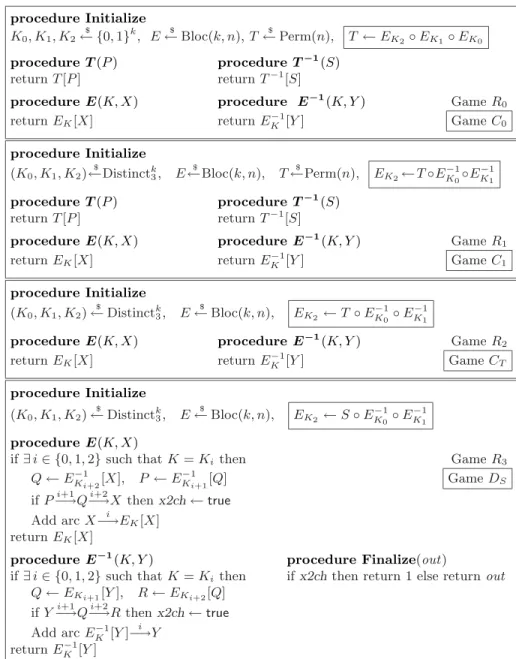
procedure Initialize
K0, K1, K2← {$ 0,1}k, E←$ Bloc(k, n),T←$ Perm(n), T ←EK2◦EK1◦EK0
procedureT(P) procedureT−1(S)
returnT[P] returnT−1[S]
procedureE(K, X) procedure E−1(K, Y) GameR0
returnEK[X] returnEK−1[Y] GameC0
procedure Initialize
(K0, K1, K2)←$Distinctk3, E←$Bloc(k, n), T←$Perm(n), EK2←T◦E−K10◦E −1 K1
procedureT(P) procedureT−1(S)
returnT[P] returnT−1[S]
procedureE(K, X) procedureE−1(K, Y) GameR1
returnEK[X] returnEK−1[Y] GameC1 procedure Initialize
(K0, K1, K2)←$ Distinctk3, E←$ Bloc(k, n), EK2 ←T◦E−K1 0◦E
−1 K1
procedureE(K, X) procedureE−1(K, Y) GameR2
returnEK[X] returnEK−1[Y] GameCT procedure Initialize (K0, K1, K2)←$ Distinctk3, E←$ Bloc(k, n), EK2 ←S◦EK−1 0◦E −1 K1 procedureE(K, X)
if∃i∈ {0,1,2}such thatK=Ki then GameR3
Q←E−1 Ki+2[X], P ←E −1 Ki+1[Q] GameDS ifP−→i+1Q−→i+2X thenx2ch←true Add arcX−→i EK[X] returnEK[X]
procedureE−1(K, Y) procedure Finalize(out)
if∃i∈ {0,1,2}such thatK=Ki then ifx2chthen return 1 else returnout
Q←EKi+1[Y], R←EKi+2[Q] ifY−→i+1Q−→i+2Rthenx2ch←true Add arcEK−1[Y]−→i Y
returnEK−1[Y]
Fig. 2.TheCX orDXgames include the boxed statements while theRigames do not.
4.1 Reduction to simplified adversary
Consider the games in Fig. 2. TheR-games (whereR stands for random) omit the boxed assignment statements while theC-games andD-game include them. Distinctk3 denotes the set of all triples (K0, K1, K2) ∈ ({0,1}k)3 such that
with an adversary against EEE. The rest of the games will be run with a sim-plified adversary. Game CT is parameterized by a permutation T ∈ Perm(n), meaning we are effectively defining one such game for every T, and similarly
DS is parameterized by a permutationS ∈ Perm(n). Game DS grows an (ini-tially without edges) edge-labeled directed graph with vertex set{0,1}n. An arc
X−→i Y is created when a queryEKi(X) returns the valueY or a queryEKi−1(Y) returns the value X. The boolean flag x2ch is set if the adversary extends a 2-chain, meaning that a pathP−→i+1Q−→i+2Rexists in the graph and the adversary asks eitherEKi(R) orEKi−1(P), where the indicated addition is modulo 3. Note that DS has an explicit Finalize procedure, indicating we will be interested in the game output rather than the adversary output.
Lemma 2. Let A be an adversary that makes at most q queries. Then there is a permutation S ∈Perm(n) and a simplified adversary B making at most q queries such that Adveeek,n(A)is at most
Adv(DBS, RB3) + PrDBS setsx2ch+ PrRB3 setsx2ch+ 6 2k .
Proof (Lemma 2). Game C0 defines T as E2◦E1◦E0 for randomE0, E1, E2, while game C1 defines E2 asT ◦EK−10◦EK−11 for random T, EK0, EK1. However,
these processes are identical. With this factored out, the difference between C1 and C0 is that the former draws the keysK0, K1, K2 from Distinctk3 while the latter draws them from ({0,1}k)3. Games R
1 and R0 differ in only the latter way. So using (1) we have
Adveeek,n(A) =Adv(AC0, AR0)≤Adv(AC1, AR1) + 6
2k .
Game CT is parameterized by a permutation T ∈ Perm(n). For any such T we consider an adversary AT that has T hardwired in its code and is simpli-fied, meaning can make queries E(K, X) andE−1(K, Y) only. This adversary runs A, answering the latter’sE(K, X) andE−1(K, Y) queries via its own or-acles, and answeringT(X) and T−1(Y) queries using T. Note that AT makes at mostq oracle queries. ChooseS∈Perm(n) such thatAdv(ACSS , AR2
S ) is the maximum over all T ∈ Perm(n) of Adv(ACTT , AR2
T ) and let B =AS. We now have Adv(AC1, AR1)≤Adv(BCS, BR2). Now by (2) we have
Adv(BCS, BR2)≤Adv(CB
S, DSB) +Adv(DBS, R3B) +Adv(RB3, RB2). GameCS(resp. gameR2) can be easily transformed into an equivalent game such that this game and gameDS(resp.R3) are identical-until-x2ch, so by the Funda-mental Lemma we haveAdv(CSB, DSB)≤Pr[DSB setsx2ch] andAdv(RB3, RB2)≤ Pr[RB3 setsx2ch]. Putting all this together completes the lemma’s proof. Lettingp= PrRB3 setsx2ch, we now need to bound
We will be able to bound the first two terms by bounding the advantages of a pair B1, B2 of adversaries, related to B, in distinguishing between a pair of games that involve only three permutation oracles, the first two random, and the third either random or correlated to the first two. We will boundp separately via a combinatorial argument. We now state the lemmas we need, conclude the proof of Theorem 1 using them in Section 4.4, and then return to provide the proofs of the two lemmas.
4.2 Pseudorandomness of three correlated permutations
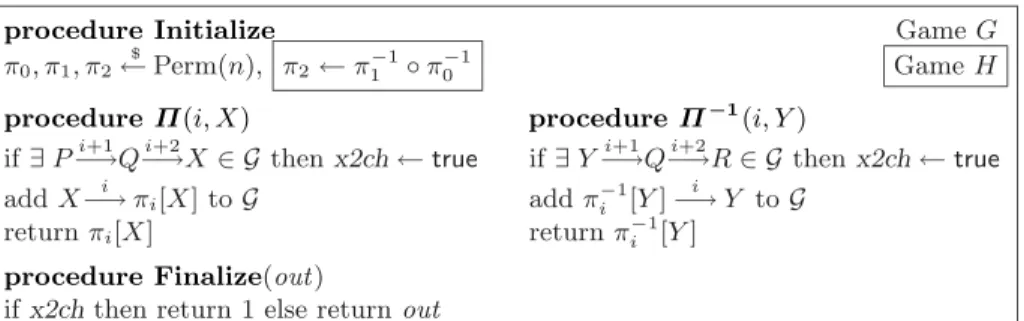
We posit a new problem. Consider games G and H defined in Fig. 3. GameG grows an edge-labeled graph, which we shall describe shortly. An adversary may make queriesΠ(i, X) orΠ−1(i, Y) wherei∈ {0,1,2}andX, Y ∈ {0,1}n. The oracles realize three permutations and their inverses, the function realized by
Π−1(i,·) being the inverse of that realized by Π(i,·). In both games permu-tationsπ0, π1 underlying Π(0,·) and Π(1,·) are uniform and independent. In gameGthe permutationπ2underlyingΠ(2,·) is also uniform and independent ofπ0andπ1, but in gameH it is equal toπ1−1◦π0−1.
Notice that it is easy for an adversary to distinguish between gamesGandH by making queries that form a “chain” of length three: for any P ∈ {0,1}n, let the adversary ask and be givenQ←π0(P), thenR←π1(Q), thenP←π2(R), and then have the adversary output 1 if P =P (a “triangle” has been found) or 0 ifP =P(the “three-chain” is not in fact a triangle). What we will establish is that, apart from such behavior—extending a known “2-chain”—the adversary is not able to gain much advantage. To capture this, as the adversaryAmakes its queries and gets replies, the games grow an (initially without edges) edge-labeled directed graphGwith vertex set. An arcX−→i Y is created when a queryΠ(i, X) returns the valueY or a queryΠ−1(i, Y) returns the valueX. The boolean flag x2ch is set in the games if the adversary extends a 2-chain, meaning that a pathP−→i+1Q−→i+2R exists in the graph and the adversary asks eitherΠ(i, R) or
Π−1(i, P), where the indicated addition is modulo 3. We will be interested in the game outputs rather than the adversary outputs. Again using a game-based proof, we prove the following in Section 4.5:
Lemma 3. If PrBG makes≥horacle queries≤δ then Adv(HB, GB) ≤ 2.5h2/2n+δ.
We remark that the lemma makes no (explicit) assumption about the probability that BH makeshor more oracle queries.
4.3 The improbability of forming a 3-chain
Consider an adversaryBthat can makeE(K, X) orE−1(K, Y) queries. GameL of Fig. 3 implements the oracles as a random blockcipher and its inverse, re-spectively, but samples these lazily, defining points as they are needed. Write
procedure Initialize GameG
π0, π1, π2←$ Perm(n), π2←π−11◦π−01 GameH procedureΠ(i, X) procedureΠ−1(i, Y)
if∃P−→i+1Q−→i+2X∈ G thenx2ch←true if∃Y−→i+1Q−→i+2R∈ G thenx2ch←true addX−→i πi[X] toG addπi−1[Y]−→i Y toG
returnπi[X] returnπ−i1[Y]
procedure Finalize(out)
ifx2chthen return 1 else returnout
Fig. 3.GameH includes the boxed statement, gameGdoes not.
procedureE(K, X) procedureE−1(K, Y) GameL
returnEK[X]←$ image(EK) E−K1[Y]←$ domain(EK)
procedure Finalize
K0, K1, K2← {$ 0,1}k
if (∃P) [EK2[EK1[EK0[P]]]] thenbad←true
Fig. 4.GameLcaptures improbability of making three chains.
X−→K Y to mean that thatB has made queryE(K, X) and obtainedY as a re-sult, or made queryE−1(K, Y) and obtainedX as a result, forK∈ {0,1}k and
X, Y ∈ {0,1}n. The Finalize procedure picks keys K0, K1, K2 at random, and setsbad if the adversary’s queries have formed a three chain, meaning that there exist points P, Q, R, S ∈ {0,1}n such that P−→K0Q−→K1R−→K2S: the conditional which is the last line of Finalize means that there is a P for which EK0[P] is defined andEK1[EK0[P]] is defined andEK2[EK1[EK0[P]]] is defined. Our next lemma bounds the probability of this happening. The proof is in Section 4.6.
Lemma 4. Letk, n≥1. LetB be an adversary that asks at mostqqueries. Let
α= max(2e2k−n,2n+k). ThenPr[BL sets bad]<2α q2/23k.
4.4 Putting together the pieces to conclude Theorem 1
LetB be a simplified adversary and S∈Perm(n) a permutation. We associate to B, S a pair of adversariesBS,1 and BS,2 that make Π(i, X) or Π−1(i, Y) queries, wherei∈ {0,1,2} andX, Y ∈ {0,1}n, as follows. Forb∈ {1,2}, adver-sary BS,b picks (K0, K1, K2) at random from Distinctk3 and picksE at random from Bloc(k, n). It then runs B, replying to its oracle queries as follows. If B makes a query E(K, X), adversaryBS,b returns EK(X) if K ∈ {K0, K1, K2}; returnsΠ(i, X) if K =Ki fori∈ {0,1}; and returnsS◦Π(2, X) if K =K2. Similarly, if B makes a query E−1(K, Y), adversary BS,b returns EK−1(Y) if
K ∈ {K0, K1, K2}; returns Π−1(i, Y) if K = Ki for i ∈ {0,1}; and returns
Π−1(2, Y)◦S−1 ifK=K
2. AdversariesBS,1, BS,2 differ only in their output, the first always returning 0 and the second returning the outputout ofB.
Lemma 5. LetB be a simplified adversary that makes at mostqoracle queries, and let S∈Perm(n). Let BS,1, BS,2 be defined as above. Let K = 2k. Then for
b∈ {1,2} and anyc >0,Pr[BS,bG makes≥3cq/K oracle queries]≤1/c. Proof (Lemma 5).The oraclesBsees when it is run byBS,bare exactly a random block cipher and its inverse. (A random permutation composed with a fixed one is still random so the composition byS does not change anything.) Now letX be the random variable that is the number of queries by B that involve keys
K0,K1, or K2 in the experiment where we first run B with oracles E, E−1 for
E←$
Bloc(k, n) and then pick (K0, K1, K2)←$ Distinctk3. Then the probability that BS,bG makes ≥ 3cq/K oracle queries is exactly the probability that X ≥ 3cq/K. Now assume wlog thatB always makes exactlyqdistinct oracle queries rather than at mostq. Then
E[X] =q· 1− 1− 1 K 1− 1 K−1 1− 1 K−2 =q· 1−K−1 K K−2 K−1 K−3 K−2 = q· 1−K−3 K = 3q K .
We can conclude via Markov’s inequality.
Proof (Theorem 1). LetA be an adversary against EEE that makes at most q oracle queries. Let B be the simplified adversary, andSthe permutation, given by Lemma 2, and letp= PrRB3 setsx2ch. LetBS,1, BS,2 be the adversaries associated to B as described above. Note that
Pr[DSB setsx2ch]=Pr[HBS,1⇒1] and Pr[RB
3 setsx2ch]=Pr[GBS,1⇒1] Pr[DBS ⇒1]=Pr[HBS,2⇒1] and Pr[RB
3 ⇒1]=Pr[GBS,2⇒1]. (5) Combining (4) and (5) we have:
Adveeek,n(A)≤2p+Adv(HBS,1, GBS,1) +Adv(HBS,2, GBS,2) + 6
2k . (6) Let α= max(2e2k−n,2n+k) and letc be any positive real number. Since the probability thatRB3 extends a 2-chain is at most the probability thatLB forms a 3-chain we have p≤3·2−k+ Pr[BLsets bad]. (The extra term is becauseL picks the keysK0, K1, K2 independently at random while R3 picks them from Distinctk3.) Applying Lemma 4 we getp≤3·2−k+2α q2·2−3k. Applying Lemma 3 in conjunction with Lemma 5 we have
Adv(HBS,b, GBS,b)≤ 2.5 2n 3cq 2k 2 +1 c
for bothb= 1 andb= 2. Putting everything together we have
Adveeek,n(A)≤2 3 2k + 2α q2 23k + 5 2n 3cq 2k 2 +2 c + 6 2k .
Now, since the above is true for anyc > 0, we pick a particular one that min-imizes the function f(c) = 45c2q22−n−2k + 2c−1. The derivative is f(c) = 90cq22−n−2k−2c−2, and the only real root of the equation f(c) = 0 is c = (2n+2k/45q2)1/3, for which we havef(c) = 3(45q2/2n+2k)1/3. Plugging this into the above yields (3) and concludes the proof of Theorem 1.
4.5 Proof of Lemma 3
We prove Lemma 3 as a corollary of:
Lemma 6. If Aasks at mostq queries thenAdv(GA, HA)≤2.5q2/2n. Proof (Lemma 3).We construct an adversaryAthat has the same oracles asB. Adversary A runs B, answering B’s oracle queries via its own oracles. It also keeps track of the number of oracle queries thatBmakes. If this number hitsh, it stops and outputs 1; else it outputs whateverB outputs. Then we note that Pr[HB⇒1]≤Pr[HA⇒1] and Pr[GA⇒1]≤Pr[GB⇒1] +δ. Thus we have
Adv(HB, GB) = Pr[HB⇒1]−Pr[GB⇒1]
≤Pr[HA⇒1]−Pr[GA⇒1]−δ = Adv(HA, GA) +δ . AsAmakes≤hqueries, conclude by applying Lemma 6 toA withq=h. Proof (Lemma 6).We assume that the adversaryAnever repeats a query, never asks a queryΠ−1(i, Y) having asked someΠ(i, X) that returnedY, and never asks a query Π(i, X) having asked some Π−1(i, Y) that returned X. Call an adversaryvalid if it never extends a two-chain.
We begin by noting that to boundA’s advantage in distinguishing gamesG andH we may assume thatAis valid. Why? Because for any adversaryA∗ mak-ing at mostq0queries there exists a validAthat makes at mostq0queries and the advantage ofAis at least that ofA∗. AdversaryArunsA∗, answeringA∗’s oracle queries via its own oracles, but at any point thatA∗ would extend a two chain, adversaryAsimply halts and outputs 1. So now assumingA’s validity, our task is to show that|Adv(AG1, AH1)| ≤2.5q2/2nwhere the gamesG
1, H1are shown in Fig. 5. We show that gamesG1andH1are close by showing that both are close to gameG3(defined in the same figure). First, we claim thatAdv(AG1, AG3)≤ 0.5q2/N where, here and in the rest of this proof, N = 2n. Rewrite gameG
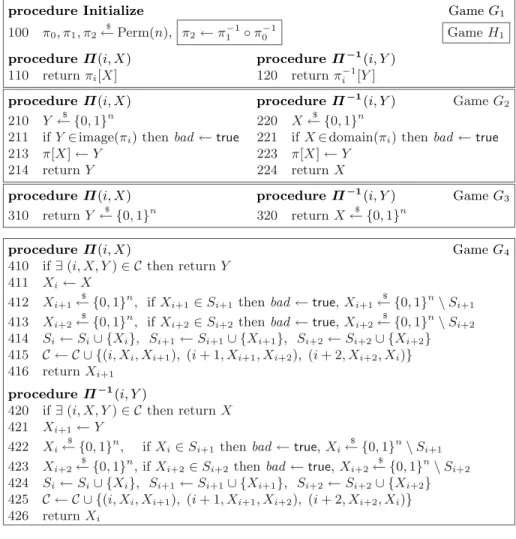
1 to game G1.5 (not shown) by lazily growing π0, π1, π2, setting the flag bad whenever there is a collision; that is, game G1.5 is identical to game G2 ex-cept, after setting bad at line 211, set Y ←$ image(πi), and after setting bad at line 221, set X←$ domain(πi). Then modify game G1.5 to not re-sample after settingbad, obtaining gameG2. NowAdv(AG1, AG3)=Adv(AG1.5, AG3)= Adv(AG1.5, AG2) ≤ Pr[AG2 setsbad]. Then note that on the ith query the probability that bad will be set in game G2 is at most (i−1)/N since the size of domain(πj) and image(πj) will be at most i−1 for each j ∈ {0,1,2}. So
procedure Initialize GameG1
100 π0, π1, π2←$ Perm(n), π2←π1−1◦π−01 GameH1 procedureΠ(i, X) procedureΠ−1(i, Y)
110 returnπi[X] 120 returnπi−1[Y]
procedureΠ(i, X) procedureΠ−1(i, Y) GameG2
210 Y ← {0$ ,1}n 220 X← {0$ ,1}n
211 ifY∈image(πi) thenbad←true 221 ifX∈domain(πi) thenbad←true 213 π[X]←Y 223 π[X]←Y
214 returnY 224 returnX
procedureΠ(i, X) procedureΠ−1(i, Y) GameG3
310 returnY ← {$ 0,1}n 320 returnX← {$ 0,1}n
procedureΠ(i, X) GameG4
410 if∃(i, X, Y)∈ C then returnY 411 Xi←X
412 Xi+1← {$ 0,1}n, ifXi+1∈Si+1thenbad←true,Xi+1← {$ 0,1}n\Si+1 413 Xi+2← {$ 0,1}n, ifXi+2∈Si+2thenbad←true,Xi+2← {$ 0,1}n\Si+2
414 Si←Si∪ {Xi}, Si+1←Si+1∪ {Xi+1}, Si+2←Si+2∪ {Xi+2} 415 C ← C ∪ {(i, Xi, Xi+1), (i+ 1, Xi+1, Xi+2), (i+ 2, Xi+2, Xi)} 416 returnXi+1 procedureΠ−1(i, Y) 420 if∃(i, X, Y)∈ C then returnX 421 Xi+1←Y
422 Xi← {$ 0,1}n, ifXi∈Si+1thenbad←true,Xi← {$ 0,1}n\Si+1 423 Xi+2← {$ 0,1}n, ifXi+2∈Si+2thenbad←true,Xi+2← {$ 0,1}n\Si+2 424 Si←Si∪ {Xi}, Si+1←Si+1∪ {Xi+1}, Si+2←Si+2∪ {Xi+2}
425 C ← C ∪ {(i, Xi, Xi+1), (i+ 1, Xi+1, Xi+2), (i+ 2, Xi+2, Xi)} 426 returnXi
Fig. 5. Games for bounding the probability of distinguishing (π0, π1, π2) and (π0, π1, π−11◦π0−1) by an adversary that never extends a two-chain.
over all qqueries, the probability that bad ever gets set in gameG2 is at most 0.5q(q−1)/N≤0.5q2/N. To establish Lemma 6 we now claim that
Adv(AH1, AG3)≤2q2/N . (7) First rewrite gameH1 as gameG4 (again in Fig. 5). Addition (+1 and +2) is again understood to be modulo 3. Game G4 uses a form of lazy sampling, but it is not maximally lazy; on each query, not only is its answer chosen, but answers for some related queries are chosen and stored. In particular, the game maintains a setCofcommitments. Initially there are no commitments, but every time a query Π(i, X) or Π−1(i, Y) is asked, one of two things happens: if a commitment has already been made specifying how to answer this query, we answer according to that commitment; else we not only answer the query asked,
but commit ourselves to all of the queries in a “triangle” containing the queried point. In greater detail, (i, X, Y)∈ C(fori∈ {0,1,2}andX, Y ∈ {0,1}n) means that it has already been decided thatπi(X) =Y, so a forward query Π(i, X) will need to be answered byY and a backward queryΠ−1(i, Y) will need to be answered byX. In effect, we grow permutationsπ0,π1, and π2 but store their values inC and their domains inS0, S1, and S2.
We claim that gamesH1andG4 are adversarially indistinguishable even by an adversary that isnotvalid and asks all 6Npossible queries. From this we know that Pr[AG4⇒1] = Pr[AH1⇒1]. To show this equivalence we claim that whether
the queries are answered by gameG4or by gameH1the adversary gets the same view: any of (N!)2possible outcomes, each with probability 1/(N!)2, the answers correspond to a pair of permutationsπ0,π1along with π2=π−11 ◦π−10 . This is obviously the case when playing game H1; we must show it is so for gameG4. Note that sets S0, S1, S2, andC begin with no points in them, then they grow to 1, 1, 1, and 3 points; then to 2, 2, 2, and 6 points; and so forth, until they have N, N, N, and 3N points. Not every query changes the sizes of these sets; it either leaves the sets unaltered or changes them as indicated. The first query that augmentsCextends the partial functions (π0, π1, π2) in any ofN2different ways, each with the same probability; the second query that augmentsCextends (π0, π1, π2) in any of (N −1)2 different ways, each with the same probability; and so forth, until we have extended (π0, π1, π2) in any of (N!)2different ways, each with the same probability. This establishes the claim.
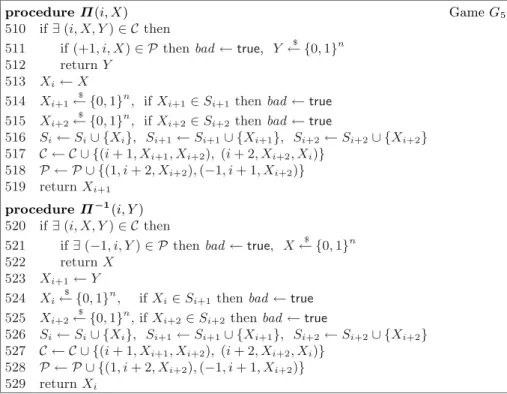
Now let us go back to assuming that the adversary is valid. We make a change to game G4 to arrive at gameG5, shown in Fig. 6. In the transition, we drop the first commitment from each group of three, since our assumptions about the adversary’s behavior mean that these queries cannot be asked. We also drop the sequels tobad getting set at lines 412, 413, 422, and 423. More interestingly, in gameG5we maintain a set of “poisoned” queriesP. As with gameG4, when the adversary asksΠ(i, Xi) we return a randomXi+1, and when the adversary asks
Π−1(i, Xi
+1) we return a random Xi, and in either case we choose a random
Xi+2and “complete the triangle” using this point. We don’t expect the adversary to ask about Xi+2, and, what is more, his asking will cause problems. So we record the unlikely but problematic queries involvingXi2 inP. If the adversary makes a poisoned query then we set bad. The changes we have made can only increase the probability thatbad gets set: Pr[AG4 setsbad]≤Pr[AG5 setsbad].
We claim that game G5 is adversarially indistinguishable from game G3. Remember that our adversary is valid: it does not ask queries whose answers are trivially known and it does not ask to extend any 2-chain. Suppose first that the adversary asks a query whose answer has not been memoized in a commitment. Then for a forward query, we choose a uniform value Xi+1 at line 514 and return it at line 519. Likewise for a backward query, we choose a uniform valueXiat line 524 and return it at line 529. So consider instead a query for which a commitment has been memoized. The code executes at lines 511– 512 or lines 521–522. If the memoized query was poisoned—added to set P by an earlier execution of lines 518 or 528—then we return a random string (at
procedureΠ(i, X) GameG5
510 if∃(i, X, Y)∈ C then
511 if (+1, i, X)∈ P thenbad←true, Y ← {$ 0,1}n 512 returnY
513 Xi←X
514 Xi+1← {0$ ,1}n, ifXi+1∈Si+1thenbad←true 515 Xi+2← {$ 0,1}n, ifXi+2∈Si+2thenbad←true
516 Si←Si∪ {Xi}, Si+1←Si+1∪ {Xi+1}, Si+2←Si+2∪ {Xi+2} 517 C ← C ∪ {(i+ 1, Xi+1, Xi+2), (i+ 2, Xi+2, Xi)} 518 P ← P ∪ {(1, i+ 2, Xi+2),(−1, i+ 1, Xi+2)} 519 returnXi+1 procedureΠ−1(i, Y) 520 if∃(i, X, Y)∈ C then
521 if∃(−1, i, Y)∈ Pthenbad←true, X← {$ 0,1}n 522 returnX
523 Xi+1←Y
524 Xi← {0$ ,1}n, ifXi∈Si+1thenbad←true 525 Xi+2← {$ 0,1}n, ifXi+2∈Si+2thenbad←true
526 Si←Si∪ {Xi}, Si+1←Si+1∪ {Xi+1}, Si+2←Si+2∪ {Xi+2}
527 C ← C ∪ {(i+ 1, Xi+1, Xi+2), (i+ 2, Xi+2, Xi)} 528 P ← P ∪ {(1, i+ 2, Xi+2),(−1, i+ 1, Xi+2)}
529 returnXi
Fig. 6.GameG5.
line 511 or 521). If the memoized query was not poisoned, then we are extending a 1-chain, providing a valueXi+2 that was selected uniformly from{0,1}n at an earlier execution of line 515 or 525, with this value not yet having influenced the run. Thus we return a uniform random value, independent of all oracle responses so far, and Pr[AG5⇒1] = Pr[AG3⇒1].
Finally, we must bound the probability thatbad gets set in game G5. The probability that bad ever gets set at any of lines 514, 515, 524, or 525 is at most 2(1 + 2 +· · ·+ (q−1))/N ≤ q2/N. The probability that it gets set at lines 511 or 521 is at most 2(1 + 2 +· · ·+ (q−1))/N because no information about the poisoned query is surfaced to the adversary. Overall we have that Pr[AG5 sets bad] ≤ 2q2/N. Putting everything together we have (7) and the proof of the lemma is complete.
4.6 Proof of Lemma 4
To prove this lemma we can assume without loss of generality that B is deter-ministic. For any particular blockcipher E ∈ Bloc(k, n) we consider the game in which B is executed with oracles E, E−1, which it queries, adaptively, un-til it halts. Note that there is no randomness involved in this game, sinceE is fixed andB is deterministic. Recall thatX →K Y means thatBhas either made
queryE(K, X) and obtainedY as a result, or it has made queryE−1(K, Y) and obtained X as a result, for K∈ {0,1}k and X, Y ∈ {0,1}n. Now we let
ChE,B3 ={(K0, K1, K2, P) : ∃Q, R, S[P K→0QK→1R→K2S]} .
This is the number of3-chains created byB’s queries. HereK0, K1, K2∈ {0,1}k are keys, andP, Q, R, S∈ {0,1}n. As the notation indicates,ChE,B3 is a number that depends on E and B. Regarding it as a random variable over the choice ofE we have the following lemma, from which Lemma 4 will follow.
Lemma 7. Let α= max(2e2k−n,2n+k). ThenE[ChE,B3 ]<2α·q2, the expec-tation over E←$ Bloc(k, n).
Proof (Lemma 4).Consider the following gameLE parameterized by a blockci-pherE∈Bloc(k, n): adversaryB is executed with oraclesE, E−1until it halts, thenK0, K1, K2 are chosen at random from {0,1}k, and flag bad is set if there exist P, Q, R, S such that P K→0 Q K→1 R →K2 S. Let pE,B = Pr[LEB setsbad], the probability being over the random choices of K0, K1, K2. Then for any
E∈Bloc(k, n) we have pE,B = Pr∃P, Q, R, S : P K→0QK→1RK→2S =|{(K0, K1, K2) : ∃P, Q, R, S : P K→0QK→1RK→2S}| 23k ≤ P|{(K0, K1, K2) : ∃Q, R, S : P K→0QK→1RK→2S}| 23k = ChE,B3 23k . By Lemma 7 we have Pr[BL setsbad] =E[pE,B]≤E[ChE,B3 ]·2−3k <2α q22−3k whereα= max(2e2k−n,2n+k) and the expectation is overE←$ Bloc(k, n).
Towards the proof of Lemma 7, forE∈Bloc(k, n) andQ, R∈ {0,1}n we let KeysE(Q, R) = |{K : E(K, Q) =R}| and KeysE = max
Q,R{Keys
E(Q, R)}.
The first is the number of keys for whichQmaps toRunderE, and the second is the maximum value of KeysE(Q, R) over all Q, R ∈ {0,1}n. No adversary is involved in this definition; KeysE is simply a number associated to a given blockcipher. Viewing it as a random variable over the choice of blockcipher we have the following.
Lemma 8. Supposeβ≥2e2k−n. ThenPr
KeysE≥β
< 22n+1−β,where the probability is overE←$ Bloc(k, n).
Proof (Lemma 8).We claim that for anyQ, R∈ {0,1}n Pr KeysE(Q, R)≥β < 21−β. (8)
The lemma follows via the union bound. We prove (8) using an occupancy-problem approach. Let b=β. Then
Pr KeysE(Q, R)≥β =2i=kb 2k i 1 2n i 1− 1 2n 2k−i ≤2k i=b 2ke i i 1 2n i ≤ 2k i=b 2ke 2nb i .
Letx= (e/b)2k−n. The assumptionβ ≥2e2k−n givesx≤1/2. So the above is = 2i=kbxi < xb·∞i=0xi = x b 1−x ≤ 2−b 1−1/2 = 2 1−b ≤ 21−β as desired.
Proof (Lemma 7).For anyQ, R∈ {0,1}n we let
ChE,B2 (R) =|{(K0, K1, P) : ∃Q[P K→0QK→1R]}| ChE,B1 (Q) =|{(K0, P) : PK→0Q}|
ChE,B0 (R) =|{K2 : ∃S[RK→2S]}|. Then for anyE∈Bloc(k, n) we have
ChE,B3 =RChE,B2 (R)·ChE,B0 (R)
≤RQChE,B1 (Q)·KeysE(Q, R) ·ChE,B0 (R) ≤RQChE,B1 (Q)·KeysE ·ChE,B0 (R) =KeysE·QChE,B1 (Q) ·RChE,B0 (R) ≤KeysE·q·q = q2·KeysE.
Using the above and Lemma 8, we have the following, where the probability and expectation are both overE←$ Bloc(k, n):
E[ChE,B3 ]<E ChE,B3 | KeysE < α +E ChE,B3 | KeysE≥α ·22n+1−α ≤q2·α+q2·2k·22n+1−α.
The last inequality above used the fact that KeysE is always at most 2k. Since
α = max(2e2k−n,2n+k) > 2 we get E[ChE,B3 ] < q2α+q2·2 < 2α·q2 as desired.
Acknowledgments
We thank the Eurocrypt 2006 PC for their comments. Mihir Bellare was ported by NSF grants CCR-0208842 and CNS-0524765. Phil Rogaway was sup-ported by NSF 0208842 and a gift from Intel Corp. Much of the work on this paper was carried out while Phil was hosted by Chiang Mai University, Thailand.
References
1. W. Aiello, M. Bellare, G. Di Crescenzo, and R. Venkatesan. Security amplification by composition: the case of doubly-iterated, ideal ciphers.Advances in Cryptol-ogy — CRYPTO ’98, Lecture Notes in Computer Science, vol 1462, Springer, pp. 390–407, 1998.
2. M. Bellare and S. Goldwasser. New paradigms for digital signatures and message authentication based on non-interactive zero knowledge proofs.Advances in Cryp-tology — CRYPTO ’89, Lecture Notes in Computer Science, vol. 435, Springer, pp. 194–211, 1990.
3. M. Bellare and P. Rogaway. Code-based game-playing proofs and the security of triple encryption. Cryptology ePrint archive report 2004/331, 2006.
4. W. Diffie and M. Hellman. Exhaustive cryptanalysis of the data encryption stan-dard.Computer, vol. 10, pp. 74–84, 1977.
5. S. Even and O. Goldreich. On the power of cascade ciphers.ACM Transactions on Computer Systems, vol. 3, no. 2, pp. 108–116, 1985.
6. S. Even and Y. Mansour. A construction of a cipher from a single pseudoran-dom permutation.Advances in Cryptology — ASIACRYPT ’91, Lecture Notes in Computer Science, vol.739, Springer, pp. 210–224, 1993.
7. S. Goldwasser and S. Micali. Probabilistic encryption. J. Comput. Syst. Sci., vol. 28, no. 2, pp. 270–299, 1984. Earlier version inSTOC ’82.
8. S. Halevi. A plausible approach to computer-aided cryptographic proofs. Cryptol-ogy ePrint archive report 2005/181, 2005.
9. J. Kilian and P. Rogaway. How to protect DES against exhaustive key search (an analysis of DESX).J. of Cryptology, vol. 14, no. 1, pp. 17–35, 2001. Earlier version inCrypto ’96.
10. S. Lucks. Attacking triple encryption.Fast Software Encryption (FSE ’98), Lecture Notes in Computer Science, vol. 1372, Springer, pp. 239–253, 1998.
11. U. Maurer and J. Massey. Cascade ciphers: the importance of being first. J. of Cryptology, vol. 6, no. 1, pp. 55–61, 1993.
12. R. Merkle and M. Hellman. On the security of multiple encryption. Communica-tions of the ACM, vol. 24, pp. 465–467, 1981.
13. National Institute of Standards and Technology. FIPS PUB 46-3, Data Encryp-tion Standard (DES), 1999. Also ANSI X9.52, Triple Data EncrypEncryp-tion Algorithm modes of operation, 1998, and other standards.
14. C. Shannon. Communication theory of secrecy systems. Bell Systems Technical Journal, vol. 28, no. 4, pp. 656–715, 1949.
15. V. Shoup. Sequences of games: a tool for taming complexity in security proofs. Cryptology ePrint archive report 2004/332, 2006.
16. A. Yao. Theory and applications of trapdoor functions.IEEE Symposium on the Foundations of Computer Science (FOCS 1982), IEEE Press, pp. 80–91, 1982.