In Proceedings First International Workshop on Multimedia Intelligent Storage and Retrieval Management (MISRM), Orlando, Florida, October 30th, 1999
Architecture of a DataBlade Module for the Integrated
Management of Multimedia Assets
Utz Westermann, Wolfgang Klas
Databases and Information Systems (DBIS), Computer Science Department Oberer Eselsberg, University of Ulm
James-Franck-Ring, 89069 Ulm, Germany Tel: +49-731-50-24131, Fax:+49-731-50-24134
fwestermann, [email protected]
Abstract
Advanced multimedia applications require adequate support by database technology for the integrated, uni-form management, retrieval, and delivery of media data of different types. While there has been substantial effort to provide database support for multimedia data and for its content-based retrieval, research has mostly focused on support for single media types, usually videos or images. However, this has led to a variety of isolated solutions of database support optimized for the respective media data types which are difficult to integrate — a uniform view is lacking. In this paper, we describe the design and the architecture of the Media Integration Blade, a DataBlade module for the object-relational DBMS Informix Dynamic Server/ Universal Data Option. Building upon existing media type-specific DataBlade modules, the Media Integration Blade establishes an integration layer which offers uniform, homogeneous access to the different types of media data. It allows for the uniform re-trieval of media data of different type by technical characteristics and content while maintaining the functionality of the underlying media type-specific DataBlade modules. Hereby, the Media Integration Blade forms a generic core component that can be employed for the uniform management and access to media data of different types in any database-driven multimedia information system.
1
Introduction
The advantages of building multimedia information systems on top of database systems have long been recognized [KA97, RNL95, AN97]. The nature of multimedia data, however, imposes specific requirements on database systems. In general, media data have high volume and, in case of continuous media data types, are time-dependent. To provide for the management and content-based retrieval of media data, support for media data types must be seamlessly integrated with the database management system (DBMS) [KA97].
So far, research in the area of multimedia database systems has focused on database support for specific single media data types, mostly video and image. This results in a variety of available prototypes. For example, the MARS system [ORC+
98] and the QBIC system [F+
95] are image database prototypes which allow to query their contents by example images using sophisticated similarity search algorithms. The STARCH database [BG99] facilitates querying for images with the help of an ontology specified by description logics while the DISIMA system [OOL+
97] allows for the querying of images by both similarity search algorithms and concepts taken from an ontology. As an example of a video database, the OVID system [OT93] allows to define sets of consecutive frames as video objects that can be queried by the VideoSQL query language. Jiang and Elmagarmid [JE98] introduce a prototype of a video database based on the Logical Hypervideo Data Model that allows to define video objects inside video frames which can be indexed by free text and connected to other video objects via hyperlinks. In literature, one can also find some few examples of databases concerned with the management of audio data and speech [LR95, WS98]. On the commercial market, database technology is evolving that supports different media data types. For instance, the object-relational DBMS Informix Dynamic Server/ Universal Data Option (IDS/UD) can be extended by DataBlade modules for support of media data like image, text, and video.
As the prototype systems and database extensions focus on just one particular media data type, their imple-mentations vary in the location where media data is stored, in the way technical metadata is available, and in the way content-based retrieval of media data is performed. Considering the storage location of media data, variants range from storage of media data in binary large objects inside a database, in a file system, on a web server, or even on a full-fledged media server allowing for the streaming delivery of continuous media data. Handling of technical
metadata is focused on each specific media data type. In consequence, for some media data types the support for technical metadata is not necessarily comprehensive. For instance, the Informix Video Foundation DataBlade offers no support for color depth at all, though color depth is desirable for videos. Additionally, technical metadata applicable to different media data types, e.g., the size of image and video, may be handled and named differently. Content-based retrieval of media data ranges from similarity search based on automatically extractable features like the color distribution of an image to search based on content-descriptive semantic annotations.
As long as an application is concerned with only a single media data type, these variations cause no problems. There are, however, applications that need to manage media data of different types in a uniform and integrated fashion. To overcome the variations, such an application itself has to cope with the heterogeneity of the media data type-specific concepts. For instance, depending on the storage location of a medium and its particular media data type, the application has to employ different mechanisms to access media data of different type. Moreover, content-based retrieval of media data spanning several different media types is difficult to achieve by the application, as it must map a given query imposed on the information system to several media type-dependent facilities for content-based retrieval. Thus, means for content-content-based retrieval applicable to different media data types is a necessity. Finally, it is difficult for the application to limit the search for media data using technical characteristics applicable to different media data types such as the size in bytes since media data type-specific prototype systems and database extensions manage technical metadata differently. Here, an integrated view on media data would be helpful.
With the project “Gallery of Cardiac Surgery” (Cardio-OP1)[KGF99], that aims at the development of an Internet-based and database-driven multimedia information system in the domain of cardiac surgery, we find such an application that explicitly requires uniform management and uniform content-based retrieval of multimedia ma-terial of different types ranging from videos, images, and texts, to full-fledged multimedia presentations. Based on a multimedia repository, the system is going to serve as a common information and education base for its different types of users, physicians, medical lecturers, students, and patients, who are provided with multimedia data accord-ing to their user specific request to the multimedia information system, their different understandaccord-ing of the selected subject, their location and technical infrastructure. The underlying database technology of the repository is given by the object-relational DBMS IDS/UD which has been chosen for reasons of flexibility, profound extensibility, and industrial strength [BKW99a].
In this paper, we describe the design and the architecture of the Media Integration Blade (MIB) DataBlade module for IDS/UD which establishes an integration layer upon media data type-specific DataBlade modules to overcome the heterogeneity of the media data type-specific concepts and to offer applications transparent and uniform access to media data of different media data types. Based on commercial DataBlade modules for text, image, and video data, the MIB provides transparent access to media data of different type by encapsulating the storage location in an abstract data type. The MIB builds an information layer that offers a homogeneous view on the technical metadata of the different media data type. To support uniform, media data type-independent content-based retrieval, the MIB allows for the semantic annotation of media data of different type with concepts taken from a common ontology and by offering query operators for these annotations. However, media data type-specific functionality for content-based retrieval based on automatically extractable features offered by the underlying DataBlade modules remains accessible. The concepts illustrated in this paper and implemented by the MIB are generic to the extent that the overall approach can be applied to other database technologies as well.
The paper is organized as follows: Section 2 shows how to achieve transparent media access. Section 3 de-scribes the organization of the media data to accomplish a homogeneous, integrated view to the technical metadata. Section 4 introduces the annotation and content-based querying facilities of the MIB. Section 5 illustrates the ap-plication of the MIB module. Section 6 concludes the paper and gives an outlook to ongoing and future work.
2
Transparent media access
As mentioned in the introduction, the locations where media data is stored and accessed often differs with media data type-specific database extensions. Among others, media data may be stored on a media server, on a web server, in a file system, or in binary large objects of a database. Each storage location comes with its own access methods. For instance, access to files is done with the help of operating system routines while a media server might define a specific network protocol to access media data. This heterogeneity of access to media data hinders applications requiring a uniform model of media access. A known solution to this problem is the employment of
1Cardio-OP - Gallery of Cardiac Surgery - is partially funded by the German Ministry of Research and Education, grant number 08C58456.
Our project partners are the University Hospital of Ulm, Dept. of Cardiac Surgery and Dept. of Cardiology, the University Hospital of Heidelberg, Dept. of Cardiac Surgery, an associated Rehabilitation Hospital, the publishers Barth-Verlag and dpunkt-Verlag, Heidelberg, FAW Ulm, and ENTEC GmbH, St. Augustin. For details see also URL www.informatik.uni-ulm.de/dbis/Cardio-OP/
locators. A locator is a data type which abstracts from the way media data is stored by encapsulating its storage
location. A locator comes with a set of access routines. Depending on the particular storage location encapsulated in an instance of the locator, the access routines use the access methods appropriate for that storage location. Thus, it is hidden from an application where media data is stored and by which method exactly it is accessed as an application always calls the same access routines.
Ideally, the problem of offering transparent access to a variety of storage locations could be solved by employ-ing one comprehensive locator data type. As a matter of fact, different locator types have evolved that, unfortu-nately, not only support different storage locations but also come with different access routines. For this reason, it is difficult to decide for one of these variants. To illustrate this point, consider the locator variants provided with the Excalibur Text DataBlade, Excalibur Image DataBlade, and the Informix Video Foundation DataBlade modules for the IDS/UD. The Excalibur Text DataBlade module makes use of theLLD Locatordata type. This locator allows for the transparent access to media data stored in the file system of the IDS/UD server or in a binary large object of a database. The Excalibur Image DataBlade module references media data by the use of theIfdLocatorwhich is essentially similar toLLD Locatorbut can store additional application-specific in-formation. While the differences betweenLLD LocatorandIfdLocatorare mainly structural, the locator
MedLocintroduced by the Video Foundation DataBlade supports other storage locations. TheMedLoclocator serves to reference media data stored on a media server with the help of the Virtual Storage Interface (VSI), an interface provided by Informix for accessing data on media servers.
For the design of the MIB which intends the integration of the DataBlade modules mentioned above, a suitable concept for a uniform locator has to be developed. This design must take into consideration that the functionality of the underlying media data type-specific DataBlade modules should remain usable for applications. For instance, one would still like to use the functions and index structures of the Excalibur Image DataBlade responsible for the similarity search among images which expect the media data type-specific locatorIfdLocatornot necessarily applicable to functions of other media data type-specific DataBlade modules. Therefore, the MIB defines a uniform locator nameduniLocatorthat abstracts from the different variants. It is able to encapsulate an instance of one of the various locator variants. Depending on the encapsulated locator variant, an instance of uniLocator
accommodates a suitable structure to represent the type and the data of the encapsulated variant. In order to obtain instances ofuniLocator, typecasts from the different locator variants touniLocatorare defined. Typecasts are also defined vice versa to allow for the access of media data type-specific functionality of the underlying DataBlade modules. However, not all instances of uniLocatorcan be casted to all locator variants. This depends on the locator variant from which theuniLocatorinstance was constructed. In fact, the locator variant used for the construction of theuniLocatorinstance might refer to a storage location not supported by the locator variant to which the instance ofuniLocatoris to be casted.
The uniform locatoruniLocatorhas associated access routines that facilitate the uniform, transparent ac-cess to media data. For this purpose, the MIB implements several user-defined routines. The acac-cess routine
uniLocatorToClientcopies the media data to the file system of the client calling this routine. For access at a finer granularity, the MIB implements routines likeopen,close,read, andseekwith the usual file access semantics which in turn make use of the appropriate access methods provided with the specific locator variant encapsulated by the instance ofuniLocator.
The locator mechanism of the MIB as described above can be extended to cover additional storage locations for media data with relatively little effort. For this purpose, the typeuniLocatormust be extended to accommodate a suitable structure to reference media data in the new storage location. Furthermore, the user-defined routines for uniform media access must be extended to integrate the access to the new storage location. So far, we have provided
medLocatorwith support for the locator variantsLLD Locator,IfdLocator, andMedLocthereby being able to transparently access media data on the filesystem of the database server, in binary large objects in a database, and on media servers supporting VSI. We plan to extend the locator mechanism with the capability to access media data stored on a web server using HTTP.
3
Media organization
In the previous section, we have introduced the concepts provided by the MIB to transparently access media data stored in various locations. In addition to transparent access to the actual media data, an organization of media data that allows a user to find and select relevant material efficiently is of importance. Regarding Cardio-OP, this on the one hand applies to users looking for information; if they cannot find the information they want quickly, the acceptance of the system will diminish. On the other hand, efficient retrieval and selection of media is also important during a multimedia authoring process; if it is more difficult for an author of multimedia content to
find existing media data and to reuse it than to reproduce it, the degree of reuse will be very low which is not cost-effective. Hence, a multimedia repository should support sophisticated, fine-grained retrieval of media data according to media type, the associated technical metadata, and content. For instance, it should be possible to limit a search for media data to those images coded in JPEG format not exceeding a width of 500 pixels and a height of 250 pixels. Additionally, the multimedia repository should support the selection of media data by the information content, or even better, the mixed retrieval of media data by technical metadata and content. This section concentrates on the organization of media data according to media data type and technical metadata while the support for content-based retrieval is presented in Section 4.
The underlying DataBlade modules, on which the MIB is based, provide technical metadata for the media data types they manage. However, this metadata is spread over the various modules and, as mentioned before, cannot be accessed in an integrated fashion by applications. Metadata applicable to several media data types might be named differently, might follow different units of measurement, or might not be even managed at all by the respective DataBlade modules. What is needed for applications is an integrated view on media data and the associated technical characteristics. Such a view should not restrict itself on technical metadata applicable to all supported media data types. The lowest common denominator would not be very helpful for applications as, apart from the size of media data in bytes and its coding format, there would not be much technical metadata applicable to all media data types.
The approach taken by the MIB is to create a new layer of information that provides a homogeneous and uni-form model of media data and the associated technical meta data. Depending on the applications to be supported, a comprehensive subset is selected from all technical characteristics available with the different media data types and integrated in this layer. Each technical characteristic of this set is associated with all the media data types it applies to. To support sophisticated cross-media type queries, a further organization of this set is reasonable. A user might be interested in media data which can be viewed but does not care whether it is of type image or video. Another user might not be interested in a limitation to certain media types at all. To tackle this problem, the se-lected technical characteristics are organized in a specialization hierarchy (see Figure 1). The top of the hierarchy models those technical characteristics applicable to all media data types, i.e., the lowest common denominator. The leaves of the specialization hierarchy represent the technical metadata that are applicable to specific media data types. The inner nodes of the specialization hierarchy group technical media data of closely interrelated media data types. For example, Viewablesubsumes technical metadata common to all media data types that can be viewed by humans like width and height. This specialization hierarchy is based on the assumption that the inner nodes reflect distinctions between media data types that are likely to be important for user queries.
Image Video Audio
Readable Audible Viewable Medium Text Specialization
Figure 1: Media organization
00000000000000000000000000000 00000000000000000000000000000 00000000000000000000000000000 00000000000000000000000000000 11111111111111111111111111111 11111111111111111111111111111 11111111111111111111111111111 11111111111111111111111111111 Video v Continuous Annotations 0000000000000 1111111111111 cardiovascular drugs infusion time axis Annotations Discrete thorac interval b, weight 0.8 interval a, weight 1 interval c, weight 0.2 operation weight 1 emergency weight 0.8
Figure 2: Video
v
with discrete and continuous annota-tionsEmploying this organization, an application is able to search for media data with regard to certain technical characteristics without necessarily limiting the search on one particular media data type. The organization of media data is not limited to the specialization hierarchy as depicted in Figure 1. New media data types can be included in this organization by placing them into the specialization hierarchy under the most suitable inner node. Hereby, the set of technical metadata is extended by additional technical characteristics applicable only to the new media data type. New types of queries can be supported by the reorganization and/or more fine-grained specialization of the hierarchy.
The specialization hierarchy of Figure 1 is realized by the MIB with a table hierarchy, with each table repre-senting a node. Hereby, the MIB utilizes primitives of the object-relational DBMS IDS/UD which allow to define specialization relationships between tables. The columns of these tables model the technical metadata associated with the respective node. An additional column is provided with the root table that references the actual media data with the help of theuniLocator. This establishes the link between technical metadata and media data.
4
Content-based retrieval
In the previous section, we have explained how the MIB organizes media data according to technical metadata. Furthermore, support for content-based retrieval of media data in a uniform fashion, independent of the particular media data type is necessary. However, the facilities for content-based retrieval offered by the media data type-specific database extensions are coined to the respective media data types. Thus, uniform and integrated cross-media type content-based retrieval is difficult to achieve. For the integrated, uniform content-based access to media data of different types, a uniform layer of content-descriptive information is established on which uniform content-based queries can be executed. Therefore, we first introduce the notion of annotations which relate media data of different types to concepts organized in a hierarchy. Based on this annotation scheme, we informally introduce the different semantics of the content-based retrieval to be supported by the MIB. Following this query semantics, we define a set of query operators for content-based retrieval that implement the introduced semantics.
4.1
Media annotation
Media annotations relate media data to concepts from an application domain with a given confidence in order to semantically describe media data’s content. A concept is an abstract idea of an entity important for a particular application domain. An example of a concept taken from the application domain of Cardio-OP is “chest of the human body”. Each concept is associated with one or more not possibly ambiguous terms called captions in some language. For instance, the captions “thorac” and “chest” are two terms for the concept “chest of the human body”. Concepts are organized in a specialization hierarchy. This means that if media data is related to a concept
c
1 which is a subconcept ofc
2then the media data related toc
1is considered to be related toc
2 as well. Theconcept hierarchy reflects the knowledge of the application domain. We distinguish between discrete annotations and continuous annotations. Discrete annotations relate complete media data to concepts. However, in case of continuous media data types, it might be of interest to relate concepts only to temporal intervals of the media data. Thereby, a more fine-grained description of content can be achieved.
The confidence of an annotation, either continuous or discrete, is given by a weight
w
2 01]specifying howstrongly the content of a medium is related to a concept . This paves the way for “fuzzy” content-based retrieval by which media may qualify with a given confidence for a query. Qualifying media can then be presented to the user ordered by confidence. It is widely accepted that for content-based retrieval a simple boolean model in which media either qualify or not is too restrictive for practical use [BYRN99].
Note that we do not make any assumptions on the way annotations are created. They might be created manually. Also, they might be (semi-)automatically extracted from metadata facilities provided with the underlying media data type-specific database extensions.
The symbols introduced in Definition 1 are used in the formal definitions to follow. In Definition 2 we then introduce the notions of discrete annotation and continuous annotation formally.
Definition 1 — Symbols:
M
,CM
,DM
,C
,T
,duration
,I
m
Let
M
denote the set of all media data.Let
CM
M
denote the set of all media data of continuous media data type.Let
DM
M
denote the set of all media data of discrete media data type.Let
C
denote the set of concepts organized in the concept hierarchy. LetT
denote the set of all captions associated with the conceptsC
.The function
duration
returns the duration of a continuous mediumm
2CM
.For all
m
2CM
, letI
m
denote the set of all valid time intervalsi
ofm
,i
=se
], withs
e
,s
0, ande
duration
(m
).Definition 2 — Annotation
The quadruple
a
m
=(mciw
),m
2M
,c
2C
,i
2I
m
f"
g,w
2 01]is called an annotation ofm
withweight
w
. Ifi
="
thena
m
is called a discrete annotation. Otherwise,a
m
is called a continuous annotation.The following condition must hold for
a
m
:m
2DM
)i
="
.The annotation
a
m
= (mciw
)is called suiting to captiont
2T
ifft
is a caption associated withc
or asubconcept of
c
.Definition 2 ensures that only continuous media data can be annotated continuously. With the notion of suiting, we provide means to find those concepts corresponding to a given caption.
For the management of the concept hierarchy, the MIB relies on the commercially available COCOON Data-Blade module by dimedis[dim98]. The MIB models annotations by providing a table calledAnnotations, each row representing an annotation. This table features one column for referencing the media data, one column which contains the id of the concept with which the media data is annotated, a column specifying the weight of the an-notation, and a column describing the time interval in which the annotation is valid. This latter column isNULLin case of a discrete annotation. The tableAnnotationrealizes the association of concepts with media data.
4.2
Semantics of content-based retrieval
The annotations introduced in the previous subsection offer a means to describe the content of media data inde-pendent of the respective media data type. In order to exploit these annotations for content-based retrieval, we distinguish between continuous and discrete query semantics.
In the discrete query semantics, annotations of both discrete and continuous media data are apprehended as related to the entire media data. Continuous annotations are treated as if they were discrete, i.e.,
a
m
=(mciw
),i
6="
is considered equivalent toa
0m
=(mc"w
). The results of queries with discrete semantics are alwaysweighted references to entire media. Consider, for example, the annotated video
v
shown in Figure 2. With discrete semantics, a query for media data referring to concepts “thorac” and “infusion” would return a weighted reference to the entire videov
, even though these concepts have been annotated only to intervalsa
andb
ofv
, respectively.The granularity of the results of queries with discrete semantics is very coarse-grained especially if continuous media data are involved. It is not very helpful for a user to retrieve a video clip with a duration of one hour that at some point in time relates to certain concepts. A user would rather like to know when the content refers to the desired concepts. For this kind of queries, we provide continuous query semantics which respect the time intervals of continuous annotations.
In case of discrete media data, the continuous query semantics return weighted references to entire media data just as with discrete semantics. In the case of continuous media data, however, the continuous query semantics return weighted references to time intervals of continuous media data. These are the time intervals of continuous media data that are relevant with regard to the query. Discrete annotations of continuous media data are treated as continuous annotations that apply to the entire media data, i.e., the discrete annotation
a
m
= (mc"w
)is considered equivalent to the continuous annotation
a
0m
= (mc
0duration
(m
)]w
). Consider a query formedia data referring to the concepts “thorac” and “infusion” with continuous semantics. Regarding the example given in Figure 2, it is the question whether the depicted video
v
would strongly qualify or not as a result for this query. If it was sufficient that at least two intervals exist inv
each associated with one of the concepts,v
would be a highly weighted part of the query result. However, if the qualifying condition additionally demands that the intervals which bear relevant annotations for the query must overlap,v
is not very relevant to the query.In order to exactly define the query semantics, operators for the retrieval, conjunction, and disjunction of concepts are introduced and formally defined in the following section.
4.3
Query operators
For the two different query semantics, we now formally define the query operators to realize these semantics. These query operators are
retrieve
,and
, andor
. One variant ofretrieve
is provided for both discrete and continuous query semantics each whileand
andor
can be applied to both query semantics. The query operators return sets of weighted references to media data as a result with the weight specifying the confidence with which a reference to media data is relevant for a query. The result of a query can thus be sorted by the weights in order to present the user the most relevant media first. Like annotations, a reference may be discrete, in case the whole media data is referenced, or continuous, in case only a time interval of media data of a continuous media data type is referenced. Definition 3 formally introduces the notion of references.Definition 3 — Reference
The triple
r
m
=(miw
),m
2M
,i
2I
m
f"
g,w
2 01]is called a reference tom
with weightw
. Ifi
="
then
r
m
is called a discrete reference. Otherwise,r
m
is called a continuous reference. The following condition must hold forr
m
:m
2DM
)i
="
.Given the notion of reference, we now can introduce the first of the query operators,
retrieve
, in Definition 5. The operator allows to select the media data referring to concepts described by a given captiont
2T
. Thisopera-tor is the cornerstone of the content-based retrieval facilities. The variant for discrete query semantics,
retrieve
d
, returns only discrete references to media data while the variant for continuous query semantics,retrieve
c
, re-turns fine-grained continuous references whereever possible. The continuous variantretrieve
c
ensures that onlycontinuous references to continuous media data are returned in the result set by converting discrete references on continuous media data
m
to the equivalent continuous reference on interval 0duration
(m
)]. This is done tosimplify the following formal definitions of query operators for continuous semantics. Additional symbols used in the ensuing definitions are given by Definition 4.
Definition 4 — Symbols:
R
,A
Let
R
denote the set of all possible references. LetA
denote the set of annotations.Definition 5 — Query operator
retrieve
The query operator for discrete query semantics
retrieve
d
:T
!2R
is defined as follows:r
m
=(m"w
)2retrieve
d
(t
)iff9a
m
=(mciw
)2A
witha
m
suiting tot
.The query operator for continuous semantics
retrieve
c
:T
!2R
is defined as follows:8
a
m
=(mciw
)2A
:ifi
="
andm
2CM
anda
m
is suiting tot
thenr
m
=(m
0duration
(m
)]w
)2retrieve
c
(t
). Otherwise, ifc
is suiting tot
thenr
m
=(miw
)2retrieve
c
(t
).Considering the video
v
in Figure 2, the queryretrieve
d
(”thorac”) returns the weighted discreterefer-ence (
v"
0:
8)among its results. In contrast, the queryretrieve
c
(“thorac”) returns the continuous reference (vb
0:
8)among its results. The query result forretrieve
c
(“operation”)would encompass the weighted reference (v
0duration
(v
)]1). This is due to the handling of discrete references on continuous media data mentionedabove.
It is not very satisfying to be able to query for the content of media data according to one caption only. Rather, a user might want to use a conjunction of several concepts to query media data. For this purpose, the query operator
and
is provided which is formally described in Definition 6. This operator basically calculates some sort of intersection between two sets of weighted references to media data2. However, the formal definition is complicated by the fact that the operator considers weights and, in case of continuous references, temporal intervals.Definition 6 — Query operator
and
Let
w
a
: 01] 01];! 01]withw
a
(w
1w
2 )=1; q (1;w
1 ) 2 +(1;w
2 ) 2 2denote the weight-merge function for
and
3. The query operatorand
:2
R
2R
!2R
is then defined as follows: 8r
m
=(miw
)2R
:r
m
2and
(R
1
R
2)iff one of the ensuing conditions holds:
1. 9
r
0m
=(mi
1w
1 )2R
1withi
1 6="
and9r
00m
=(mi
2w
2 )2R
2withi
2 6="
,i
1temporally overlapsi
2andi
=i
1 \i
2such thatw
=w
a
(w
1w
2 ). 2. 9r
0m
=(miw
1 )2R
1withi
6="
andw
=w
a
(w
1 0)such that:9r
00m
=(mi
2w
2 )2R
2withi
2 6="
and
i
2temporally overlapsi
and :9r
00m
=(m"w
2 )2R
2. 3. 9r
00m
=(miw
2 )2R
2withi
6="
andw
=w
a
(0w
2 )such that:9r
0m
=(mi
1w
1 )2R
1withi
1 6="
and
i
1temporally overlapsi
and :9r
0m
=(m"w
1 )2R
1. 4. 9r
0m
=(m"w
1 )2R
1and 9r
00m
=(miw
2 )2R
2such thatw
=w
a
(w
1w
2 ). 5. 9r
00m
=(m"w
2 )2R
2and 9r
0m
=(miw
1 )2R
1such thatw
=w
a
(w
1w
2 ). 6. 9r
0m
=(miw
1 )2R
1withi
="
andw
=w
a
(w
1 0)such that:9r
00m
=(mi
2w
2 )2R
2. 7. 9r
00m
=(miw
2 )2R
2withi
="
andw
=w
a
(0w
2 )such that:9r
0m
=(mi
1w
1 )2R
1.Condition 1 states that should two continuous references to the same media data
m
exist in the setsR
1 andR
2and should the time intervals of these references overlap then a continuous reference to the intersection ofthe intervals on
m
is inserted into the result set with merged weight. Condition 2 and Condition 3 ensure that2It is an objective of our design, that the query operators
and
andor
can be arbitrarily nested. This allows for the flexible composition ofcomplex queries. To achieve this goal, the operators
and
andor
do not take captions as arguments like theretrieve
operator, but rather sets of weighted references. These sets may, of course, be obtained as a result of aretrieve
operator. For instance, in order to achieve a conjunction between two concepts, theand
operator is employed on tworetrieve
operators which in turn deliver the references to the media data referring to the desired concepts.3The choice of the weight-merge function
w
ais motivated by the fact thatand
intends to have semantics similar to the booleanand
b. Asthe boolean
and
b(b
1b
2)yields1for
b
1=
b
2=1, the optimal situation for
and
is having two referencesr
0 m =(mi
1w
1 )2R
1andr
00 m=(mi
2w
2 )2R
2to the same media data
m
with weightsw
1=
w
2=1. Thus following [SFW83], we use the complement of the
normalized Euclidean distance of the point(
w
1w
2)from the desirable position(1
1)as a measure of similarityw
ato the optimal situationif a continuous reference
r
m
to media datam
exists in only one set or there are only continuous references tom
in the other set which do not temporally overlap withr
m
thenr
m
is present in the result set with reduced weight. Conditions 4 and 5 deal with occurances of discrete and continuous references to the same media datam
in both sets. In this case, the continuous reference is included with the result set with merged weight since discrete references on continuous media data are treated like continous references spanning the whole duration of the media data. Conditions 4 and 5 also deal with discrete references to the same media datam
in both sets in the way that one of these references is inserted into the result set with merged weight. Condition 6 and Condition 7 are the equivalents to Condition 2 and Condition 3 for discrete references.Let us give some examples of the
and
query operator. Regarding the videov
shown in Figure 2, the query using continuous query semanticsand
(retrieve
c
(”cardiovascular drugs”)retrieve
c
(”thorac”)) returns thereference(
va
\b
0:
86)among its results by Condition 1. In contrast to that, the query using continuous querysemantics
and
(retrieve
c
(”cardiovascular drugs”)retrieve
c
(”infusion”)) returns the references (va
0:
29)and(
vc
0:
09)as results by Conditions 2 and 3. Considering a query with discrete semantics,and
(retrieve
d
(”cardiovascular drugs”)retrieve
d
(”operation”))yields the reference(v"
1)as a result by applyingCondi-tions 4 and 5.
Similar to the
and
query operator that allows for the conjunction of several captions in a query, theor
query operator has been provided to support the disjunction of several captions as well. The operator basically calculates some sort of union between two sets of weighted references to media data. Definition 7 formally introduces theor
query operator.Definition 7 — Query operator
or
Let
w
o
: 01] 01];! 01]withw
o
(w
1w
2 )= qw
2 1 +w
2 2 2denote the weight-merge function for
or
4. The query operatoror
:2R
2R
!2R
is defined as follows:8
r
m
=(miw
)2R
:r
m
2or
(R
1R
2)iff one of the ensuing conditions holds:
1. 9
r
0m
=(miw
1 )2R
1and 9r
00m
=(mi
2w
2 )2R
2such thatw
=w
o
(w
1w
2 ). 2. 9r
0m
=(mi
1w
1 )2R
1and 9r
00m
=(miw
2 )2R
2such thatw
=w
o
(w
1w
2 ). 3. 9r
0m
=(miw
1 )2R
1withw
=w
o
(w
1 0)such that:9r
00m
=(mi
2w
2 )2R
2. 4. 9r
00m
=(miw
2 )2R
2withw
=w
o
(0w
2 )such that:9r
0m
=(mi
1w
1 )2R
1.Condition 1 and Condition 2 state that references, either continuous or discrete, to the same media data
m
in both setsR
1andR
2appear in the result set with merged weight. Conditions 3 and 4 deal with references tomedia data
m
that are made only in one of the setsR
1andR
2. Such references are inserted into the result set withreduced weight.
Giving again some examples regarding video
v
of Figure 2, the queryor
(retrieve
d
(”thorac”)retrieve
d
(”infusion”))returns among the result set the discrete reference (v"
0:
68)by Condition 1 and Condition 2.The query
or
(retrieve
c
(”thorac”)retrieve
c
(”nurse”))returns the continuous reference(vb
0:
46)among itsresults, since
v
is not annotated with the concept “nurse” (Condition 3).The operators we have introduced so far can be arbitrarily nested and, therefore, provide a powerful means of uniform, content-based retrieval of media data. For instance, the nested query
and
(or
(retrieve
c
(“thorac”)retrieve
c
(“medicament”))retrieve
c
(“complication”))returns weighted references to all media data of any typewith contents dealing with the concepts “thorac” or “medicament” and with any complications occurring at the same time.
The MIB implements the query operators of both semantics introduced above as user-defined routines. These are based on the primitives for content-based retrieval offered by the COCOON DataBlade module. These primi-tives allow to retrieve all database rows that contain references to a given concept of the concept hierarchy managed by COCOON. Moreover, a user-defined routine namedmedToTempTablehas been provided which copies the results of a query to a temporary table. This table can then be simply joined with a table of the organization hierar-chy of Section 3, thereby allowing for the mixed retrieval of media data according to technical characteristics and content.
4For the choice of the weight-merge function
w
o, an argument similar to the choice ofw
aapplies. As the boolean operatoror
b(
b
1b
2)
yields0only for
b
1=
b
2=0, the least optimal situation for
or
is having two referencesr
0 m=(mi
1w
1 )2R
1andr
00 m=(mi
2w
2 )2R
2to the same media datam
with weightsw
1,w
2close to0. Hence, we use the normalized Euclidean distance of the point(
w
1w
2)from
5
Application of the Media Integration DataBlade Module
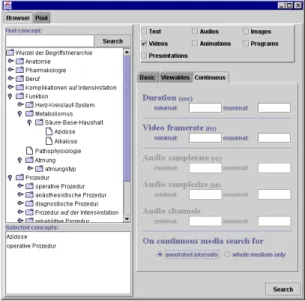
The MIB has been successfully implemented and employed by our group for the management of the media data in the context of the Cardio-OP project. Recently, we have developed a graphical media browser which can be employed for the retrieval of media data managed by the MIB according to content and technical metadata in an intuitive manner. This browser exploits the features of the MIB with regard to the organization of technical metadata and the sophisticated content-based retrieval. Figure 3 shows a screenshot of the media browser. The left part of the browser shows the concept hierarchy (with German captions) managed by the MIB (see Section 4.1) out of which a user can select the desired set of concepts. The top right part of the browser allows to limit the search to specific media data types. According to this selection, the browser offers means to further narrow down the search by specifying constraints for those technical metadata applicable to the selected media data types. To the bottom right, the query semantics for the content-based retrieval as presented in Section 4.2 can be chosen. The query operators as presented in Section 4.3 implicitly are used by the browser when is comes to formulate the query to the DBMS. Finally, the search button activates the retrieval process and returns references to all qualifying media data using the uniform locator mechanism presented in Section 2. The returned locators can be transferred into a result pool (see the tab named “Pool” to the top left) that persists several queries and later be used to access the media data transparently.
Figure 3: Screenshot of the media browser component
The media browser has been developed as a Java Bean for reuse in further applications that need media man-agement and media browsing facilities. This component is currently reused for the development of a graphical annotation editor and an authoring tool for multimedia presentations. The graphical annotation editor aims at the comfortable creation and manipulation of annotations to discrete and continuous media data. Here, the media browser component is used to select media data for annotation and to browse the annotations. The authoring tool allows to build multimedia presentations using the ZYX document model [BK99] which has been developed in the context of the Cardio-OP project since standard models like SMIL, MHEG-5, and HyTime do not meet the project’s specific requirements for adaptation, reuse, and presentation neutrality of multimedia content [BKW99b]. The authoring tool utilizes the media browser component, and hereby the MIB, to browse and select media data for use in the multimedia composition. These tools show the application of the MIB for the integrated, uniform management and retrieval of media data of different types. Other applications exploiting the MIB for the intelligent management of media data can be imagined. Our group, for instance, plans to employ the MIB with a modified media organization scheme for the management of publications that have been downloaded from the internet.
6
Conclusion and Outlook
Starting out from the need of multimedia information systems for the integrated and uniform management and access to media data of different media data types, we introduced the Media Integration DataBlade module as
a generic component which unites media data type-specific database extensions under a common roof. We in-troduced the locator mechanism of the MIB allowing for the transparent, uniform access to media data stored in various locations. We then explained how the media data is organized to support sophisticated search and re-trieval according to technical characteristics effectively. We illustrated the facilities for content-based rere-trieval and showed that the MIB powerfully allows for the mixed retrieval of media data of various type by content and by technical metadata. We demonstrated how the MIB can be employed in applications requiring sophisticated, uniform, intelligent management of media data of different type: browsing and content-based retrieval media data, management of annotations to media data, and multimedia authoring. We plan to extend the MIB with support for further media data types. For this purpose, we evaluate database extensions for the management of audio data, MPEG streams, and animations. In addition to that, there is ongoing work on a streaming server placed on top of the MIB following the architecture of [BKL96] supporting the delivery of continuous media data over a network.
Acknowledgments: We would like to thank Susanne Boll for her valuable comments and her great efforts to
prepare and improve this version of the paper.
References
[AN97] D. A. Adjeroh and K. C. Nwosu. Multimedia Database Management – Requirements and Issues. IEEE Multimedia, 4(3), 1997.
[BG99] S. Bechhofer and C. Goble. Classification Based Navigation and Retrieval for Picture Archives. In Proceedings 8th
IFIP Conference on Data Semantics (DS-8), Rotorua, New Zealand, January 1999. Kluwer Academic Publishers.
[BK99] S. Boll and W. Klas. ZYX — A Semantic Model for Multimedia Documents and Presentations. In Proceedings
of the 8th IFIP Conference on Data Semantics (DS-8): “Semantic Issues in Multimedia Systems”, Rotorua, New
Zealand, January 1999.
[BKL96] S. Boll, W. Klas, and M. L¨ohr. Integrated Database Services for Multimedia Presentations. In S. M. Chung, editor,
Multimedia Information Storage and Management. Kluwer Academic Publishers, Dordrecht, 1996.
[BKW99a] S. Boll, W. Klas, and U. Westermann. Exploiting OR-DBMS Technology to Implement the ZYX Data Model for Multimedia Documents and Presentations. In Proceedings Datenbanksysteme in B¨uro, Technik und Wissenschaft
(BTW), Freiburg, Germany, March 1999.
[BKW99b] S. Boll, W. Klas, and U. Westermann. Multimedia Document Formats — Sealed Fate or Setting Out for New Shores? In Proceedings IEEE International Conference on Multimedia Computing and Systems (ICMCS), Flo-rence, Italy, June 1999.
[BYRN99] R. Baeza-Yates and B. Ribiero-Neto. Modern Information Retrieval. Addison Wesley, Harlow, England, 1999. [dim98] dimedis. The COCOON DataBlade Module Users Guide. dimedis GmbH, Cologne, Germany, 1998.
[F+
95] M. Flickner et al. Query by Image and Video Content: The QBIC System. IEEE Multimedia, 28(9), 1995. [JE98] H. Jiang and A. K. Elmagarmid. Spatial and Temporal Content-Based Access to Hypervideo Databases. VLDB
Journal, 7(4), 1998.
[KA97] W. Klas and K. Aberer. Multimedia and its Impact on Database System Architectures. In P.M.G. Apers, H.M. Blanken, and M.A.W. Houtsma, editors, Multimedia Databases in Perspective. Springer, London, 1997.
[KGF99] W. Klas, C. Greiner, and R. Friedl. Cardio-OP — Gallery of Cardiac Surgery. In Proceedings IEEE International
Conference on Multimedia Computing and Systems (ICMCS), Florence, Italy, June 1999.
[LR95] M. L¨ohr and T. C. Rakow. Audio Support for an Object-Oriented Database Management System. Multimedia
Systems Journal, 3(5-6), 1995.
[OOL+
97] V. Oria, M. T. ¨Ozsu, L. Liu, et al. Modeling Images for Content-Based Queries: The DISIMA Approach. In
Proceedings 2nd International Conference on Visual Information Systems, San Diego, California, December 1997.
[ORC+
98] M. Ortega, Y. Rui, K Chakrabarti, et al. Supporting Ranked Boolean Similarity Queries in MARS. IEEE
Transac-tions on Knowledge and Data Engineering, 10(6), 1998.
[OT93] E. Oomoto and K. Tanaka. OVID: Design and Implementation of a Video-Object Database System. IEEE
Trans-actions on Knowledge and Data Engineering, 5(4), 1993.
[RNL95] T. C. Rakow, E. J. Neuhold, and M. L¨ohr. Multimedia Database Systems – The Notions and the Issues. In
Proceedings Datenbanksysteme in B¨uro, Technik und Wissenschaft (BTW), Dresden, 1995. Springer.
[SFW83] G. Salton, E. A. Fox, and H. Wu. Extended Boolean Information Retrieval. Communications of the ACM, 26(11), 1983.
[WS98] M. Wechsler and P. Sch¨auble. Metadata for Content-Based Retrieval of Speech. In A. Sheth and W. Klas, editors,