Mitigating Network-Based Denial-of-Service Attacks with Client Puzzles
Timothy John McNevinThesis submitted to the faculty of the Virginia Polytechnic Institute and State University in partial fulfillment of the requirements for the degree of
Master of Science In
Computer Engineering
Dr. Jung-Min Park, Committee Chair Dr. Scott F. Midkiff
Mr. Randolph C. Marchany
April 15, 2005 Blacksburg, VA
Keywords: of-Service Attacks, Distributed of-Service Attacks, Denial-of-Service countermeasures, Client puzzles.
Timothy John McNevin Dr. Jung-Min Park, Committee Chair
Bradley Department of Electrical and Computer Engineering
ABSTRACT
Over the past few years, denial-of-service (DoS) and distributed denial-of-service (DDoS) attacks have become more of a threat than ever. These attacks are aimed at denying or degrading service for a legitimate user by any means necessary. The need to propose and research novel methods to mitigate them has become a critical research issue in network security. Recently, client puzzle protocols have received attention as a method for combating DoS and DDoS attacks. In a client puzzle protocol, the client is forced to solve a cryptographic puzzle before it can request any operation from a remote server or host. This thesis presents the framework and design of two different client puzzle protocols: Puzzle TCP and Chained Puzzles.
Puzzle TCP, or pTCP, is a modification to the Transmission Control Protocol (TCP) that supports the use of client puzzles at the transport layer and is designed to help combat various DoS attacks that target TCP. In this protocol, when a server is under attack, each client is required to solve a cryptographic puzzle before the connection can be established. This thesis presents the design and implementation of pTCP, which was embedded into the Linux kernel, and demonstrates how effective it can be at defending against specific attacks on the transport layer.
Chained Puzzles is an extension to the Internet Protocol (IP) that utilizes client puzzles to mitigate the crippling effects of a large-scale DDoS flooding attack by forcing each client to solve a cryptographic problem before allowing them to send packets into the network.
This thesis also presents the design of Chained Puzzles and verifies its effectiveness with simulation results during large-scale DDoS flooding attacks.
ACKNOWLEDGEMENTS
I would like to thank my advisor, Dr. Park, for his guidance, support, and patience for allowing me to pursue and research such challenging topics in network security.
I would also like to thank Mr. Randy Marchany for allowing me to use his computer lab, reviewing some of my work, the letters of recommendation, and for serving on my committee.
I would also like to thank Dr. Midkiff for his support, the letters of recommendation, and for also serving on my committee.
I’d like to thank the members of the Advanced Research in Information Assurance and Security (ARIAS) Lab for their support and for their patience for working with me during the last two years. I’d also like to thank Vinit Joshi for working with OPNET to help improve some of the simulations for this thesis. Also, I’d like to thank many of you that I have shared an office with and worked with in Torgersen Hall for the last year and a half. I would also like to thank the CEL TAs that I have worked with over the past two years as well.
I also want to thank all of the people that have lived in, stopped by, or hung out in 303G during the last five years.
Last but not least, I’d like to thank my Mom, Dad, Brother Tony, all of my aunts, uncles, cousins, and to both of my grandmothers for all of their love, support, and encouragement. Thank you all.
CONTENTS
CONTENTS... v
LIST OF FIGURES ... vii
LIST OF TABLES... viii
CHAPTER 1 ... 1
1. Introduction... 1
1.1. Denial-of-Service Attacks... 2
1.2. An Introduction to DoS Countermeasures... 5
1.2.1 Prevention ... 6
1.2.2 Detection ... 6
1.2.3 Mitigation... 7
1.2.4 Traceback... 7
1.3. Motivation for Researching Mitigation Techniques ... 9
1.4. Contributions... 9
1.5. Organization of Thesis... 10
CHAPTER 2 ... 12
2. Related Work ... 12
2.1. Transport Layer Attacks and Defenses ... 12
2.2. Network Layer Attacks and Defenses... 14
2.2.1 End-Host-Based Protection Mechanisms ... 14
2.2.2 Network-Based Protection Mechanisms... 16
2.3. Client Puzzles as a Mitigation Technique... 18
2.3.1 Client Puzzles at the Transport Layer... 19
2.3.2 Client Puzzles at the Application Layer... 24
2.3.3 Client Puzzles at the Network Layer ... 25
CHAPTER 3 ... 28
3. TCP Client Puzzles ... 28
3.2. The Client Puzzle for pTCP... 31
3.3. Implementation of pTCP... 33
3.3.1 Overview of the Implementation ... 33
3.3.2 pTCP Implementation Details... 38
3.4. Experiments with pTCP... 41
3.4.1 The Puzzle Algorithm ... 41
3.4.2 Modulation of the Puzzle Difficulty Level ... 43
3.4.3 Performance of pTCP during a synflood Attack ... 44
3.4.4 Performance of pTCP in CPU-Exhaustion Attacks... 46
3.5. Deployment Scheme for pTCP ... 48
3.6. Shortcomings of pTCP... 49
CHAPTER 4 ... 50
4. IP Client Puzzles... 50
4.1. Technical Challenges in an IP Puzzle Scheme ... 50
4.2. The Client Puzzle for Chained Puzzles... 51
4.3. Chained Puzzles ... 52
4.3.1 Overview of Chained Puzzles... 52
4.3.2 The Details of Chained Puzzles ... 55
4.4. The Effectiveness of Chained Puzzles... 59
4.5. Security Concerns of Chained Puzzles ... 61
4.6. Implementation Details of Chained Puzzles ... 64
4.7. Simulation Results ... 66
4.8. Deployment Scheme for Chained Puzzles... 71
CHAPTER 5 ... 72
5. Conclusions and Future Work ... 72
5.1. Future Work with pTCP... 73
5.2. Future Work with Chained Puzzles ... 74
5.3. Future Work with Client Puzzles... 75
5.4. Conclusions... 76
REFERENCES ... 77
LIST OF FIGURES
Figure 1-1: A DDoS attack scenario... 4
Figure 1-2: Components of a DoS Countermeasure ... 5
Figure 2-1: A server-generated puzzle... 21
Figure 2-2: A client-generated puzzle... 22
Figure 3-1: Client-Server interaction in pTCP... 30
Figure 3-2: XTEA6 client puzzle... 34
Figure 3-3: MD5 client puzzle... 35
Figure 3-4: Puzzle request packet ... 36
Figure 3-5: Puzzle challenge packet ... 37
Figure 3-6: Pseudocode for puzzle solving algorithm ... 37
Figure 3-7: Puzzle solution packet... 38
Figure 3-8: pTCP state transition diagram... 42
Figure 3-9: Puzzle verification times for pTCP... 43
Figure 3-10: pTCP connection time versus puzzle difficulty ... 44
Figure 3-11: Percentage of connections completed versus connection times for pTCP, syncookies, and TCP... 46
Figure 3-12: Percentage of connections completed versus connection times during a CPU Exhaustion attack ... 48
Figure 4-1: Client puzzle for Chained Puzzles ... 52
Figure 4-2: Initial client-router interaction ... 56
Figure 4-3: The forwarding process for incoming packets at a Puzzle Router... 58
Figure 4-4: NS-2 node ... 65
Figure 4-5: Normal Packet Survival Ratio for legitimate clients ... 68
Figure 4-6: Total number of legitimate packets generated ... 68
Figure 4-7: Normal Packet Survival Ratio for legitimate clients (Larger Network) ... 70
LIST OF TABLES
Table 3-1: Assumptions in pTCP…….……….28
Table 4-1: Assumptions in Chained Puzzles….………50
Table 4-2: Overview of Chained Puzzles……….……….54
CHAPTER 1
1.
Introduction
As the Internet becomes an integral part in many people’s lives, the need to keep servers protected, online, and available has become increasingly important. In recent years, denial-of-service (DoS) attacks and distributed DoS (DDoS) attacks have become more sophisticated and effective at obstructing this availability. In 2000, several online companies such as eBay, Amazon.com, CNN.com, and Yahoo were all affected by a large scale DDoS attack [1]. During this attack, their websites were rendered virtually unreachable to many Internet users, resulting in severe financial losses, in addition to the many unsatisfied customers. In 2002, several root Domain Name System (DNS) servers were brought down by yet another DDoS attack [2]. This attack demonstrated that attackers were becoming more intelligent because critical systems were now being attacked. The general trend in DoS attacks implies that future attacks are likely to become much worse and more disruptive, affecting a larger number of Internet users. In addition to these highly publicized attacks, there have been countless other smaller scale DoS attacks that have targeted various companies or corporations. Regardless of their scale, DoS attacks have become a serious threat and nuisance throughout the Internet because they can directly be used to destabilize the Internet. Despite the knowledge of their existence, an effective defense solution that is both practical to implement and easy to deploy has yet to be developed. This thesis presents a discussion about the current research in this area and presents two different novel mitigation techniques that minimize the crippling effects of a network-based DoS attack.
1.1.
Denial-of-Service Attacks
There are many different types of DoS attacks and the number of them only increases with the release of newer protocols and network applications. In order to gain a better understanding of the most common DoS attacks, it is best to separate these attacks into two different categories: local and remote (or network-based). These attacks can be further separated into two more subcategories that describe the overall goal of the attack: stopping critical services and exhausting system resources [3].
A local DoS attack is typically a form of malicious software that resides on the local machine that intends to disrupt the normal operation of the computer’s programs, processes, or services. These attacks have the ability to stop these processes from executing and cause problems for the current user and possibly other remote users that are depending upon that computer’s service. Besides stopping critical processes on a local computer, local DoS attacks can also exhaust system resources such as memory, clock cycles, disk space, and even network resources. Exhausting resources on a local system is an effective means to conduct a DoS attack because when the required system resources are not available on the local machine, new applications or data can neither be executed nor processed. In this case the attack causes more damage because it does not target a specific application or weakness; it prohibits or limits the capabilities of that system and prevents users from further and continued use of that machine. Examples of these resource exhaustion attacks are a fork bomb or an application that intentionally causes errors to fill up an error log, thus exhausting disk space [3].
Remote DoS attacks, or network-based DoS attacks, is an attack where the attacker attempts to deny, disrupt, or degrade a client’s access to a network service by any means necessary via a remote computer. Network-based DoS attacks can both stop current processes and exhaust system resources. Thus, when an attack is underway, the end host or server will be virtually unavailable to other clients. Examples of a remote attack that stops services are the Land attack and the Teardrop attack [3]. Examples of network-based resource-exhaustion attacks are synflood attacks, Smurf attacks, and Distributed DoS flooding attacks [3]. With the increased usage of the Internet and broadband
Internet access, network-based resource-exhaustion attacks are becoming more common and popular because they are among the easiest to launch and one of the most effective forms of a DoS attack. Unfortunately, these attacks are becoming the most difficult to defend against.
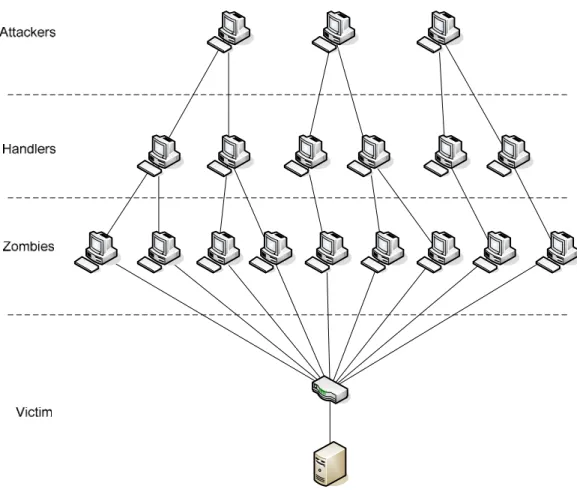
A DDoS is similar to a DoS attack, except that it involves the use of several attacking computers. In other words, in a DoS attack there is a single stream of attack traffic, but in a DDoS attack there are multiple streams of attack traffic [4]. Sometimes a single attacking is computer (i.e. synflood, Land attack). These attacks are commonly referred to as DoS attacks. Although, when the goal of the attack is primarily to consume resources of a victim, the attack will always be more effective with the use of multiple attacking computers. In this case, these attacks are referred to as DDoS attacks. The primary goal of a DDoS attack is to overwhelm the victim server and its secondary goal is to consume bandwidth of the network surrounding the victim. A DDoS attack typically consists of an attacker (or multiple attackers), several handler computers, and many attack zombies. During the DDoS attack setup phase, the attacker(s) will relentlessly probe many computers looking for various weaknesses in their systems and then make attempts to infiltrate them and convert them to handlers or zombies. If users do not properly defend and patch their systems, an attacker has the ability gain access to the computer with full privileges, to install tools or programs on their systems so they can later be used in an attack. When an attacker gains control of the computer, it has the ability to communicate back with itself and other zombies. Recent attacks have shown that attackers are becoming more sophisticated recruiting zombies and how they are commanded following their conversion. It is conceivable that an attacker could recruit zombies over a period of several years, and then when they have accumulated a large number, begin flooding packets in the direction of the victim.
When the attack begins, the attackers notify the handlers to invoke the zombies to begin flooding useless data towards the victim. It should be noted that the traffic is not always useless data; an attacker may disguise their traffic to resemble legitimate traffic to avoid any filtering mechanism that is designed to detect attack packets. For example, for an
attack on a popular website, it may be best for an attacker to flood the server with false HTTP requests. These requests are disguised and are practically indistinguishable from the normal HTTP requests from legitimate clients. Thus, the attacker can manipulate the attack in many ways to bypass any known security mechanism that is already in place. In Figure 1-1, there is an image of a typical DDoS attack scenario. The victim is the end host or the routers that are adjacent to the end host. Depending on the intensity of the attack, the end host may become overwhelmed with incoming traffic, or the adjacent routers will become overwhelmed with traffic. Nonetheless, the victim in the attack is the server in addition to the countless number of users that are no longer able to communicate with that server due to the severe congestion. Due to the nature of the attack, this attack is commonly referred to as a flooding attack.
1.2.
An Introduction to DoS Countermeasures
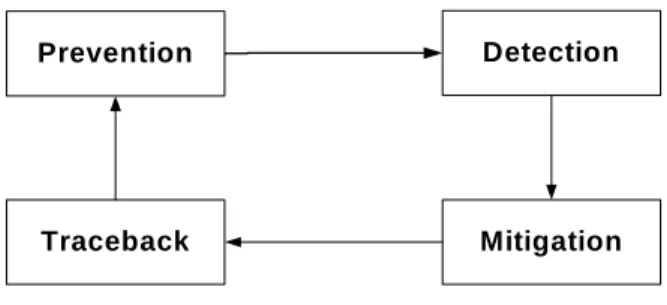
A comprehensive countermeasure for DoS attacks has four distinct elements: prevention, detection, mitigation, and traceback, shown together in Figure 1-2. Before an attack occurs, there should be existing prevention mechanisms that are capable of eliminating the threat of the attack. When the attack does occur, only a successful and timely detection of the attack will allow the appropriate mitigation mechanism to be deployed. During or following the attack, a method called traceback can be used to determine the source of the attack. In addition, traceback can also help improve future methods for detecting and preventing a DoS attack. The dependence upon all four of these items is crucial for a successful DoS countermeasure.
Prevention Detection
Mitigation Traceback
Figure 1-2: Components of a DoS Countermeasure
In addition to these four items, a DoS countermeasure should be designed to defend against attacks on various layers of the Internet stack. Among the five layers of the Internet protocol stack [5], a network-based DoS attack is associated with three of the five layers: the application, transport, and network layer. In order to design the most effective countermeasure against DoS attacks, we must address the security vulnerabilities at each layer and introduce defense mechanisms that are capable of mitigating specific threats at the appropriate layer. In computer security, there is no “magical panacea” for all potential threats. The only way to defend a computer from attacks is to design and employ a number of protection mechanisms that are designed to combat a specific threat. The combined use of all of these mechanisms will provide the greatest protection against a wide range of attacks. The most important aspect to the design of a DoS countermeasure is to prevent the countermeasure from becoming the
target of a new and unique DoS attack. All DoS attacks target some kind of vulnerability and if the vulnerability exists within the DoS countermeasure, then it needs to be redesigned.
1.2.1.
Prevention
Prevention is the first step towards defending a machine from a DoS/DDoS attack. The key to prevention is awareness and vigilance. System patches and updates are very important to protection but they only fix known problems. Thus, systems are always vulnerable to unknown attacks and undiscovered weaknesses. Therefore, it is necessary for many to understand how attacks occur and to always remain aware and watching for new potential threats.
Prevention is especially important with DDoS attacks. Referring back to Figure 1-1, many of the machines used in the attack do not physically belong to the attacker. They belong to anyone who has not taken the proper steps to secure and protect their computer. Thus, informing users about the security risks and the precautions they should take with their computer is one of the key elements to prevention.
1.2.2.
Detection
One of the most important components in designing a DoS countermeasure is to determine and establish the optimal methodology to detect an ongoing attack. Most detection mechanisms rely on some form of an application or software that resides on a host system or within the network that can observe traffic patterns or resource usage. These programs typically are configured to detect anomalies or deviations from normal behavior. When anomalies are detected, alerts are created so that either a system administrator or an automated program can quickly determine the type of the attack and decide which actions to take to safely minimize the effects of the attack and return the system back to its original state.
Most attacks are detected by an end host or server. However, in many cases a DDoS can affect the routers within the network. In the case of a large-scale DDoS flooding attack, detecting the attack should be done throughout the network. To combat a DDoS attack, a distributed defense is essential. In general, the further downstream the detection process is implemented, the easier it will be to determine if there is an ongoing attack [6]. The study of detecting a DoS attack is a very important area for network security research. However, it is beyond the scope of the work for this thesis. Despite its importance, we assume that throughout the remainder of this thesis that there exists a simple and basic detection mechanism that will activate the appropriate mitigation mechanism.
1.2.3.
Mitigation
Mitigation is the process of minimizing the effects of an ongoing attack. The simplest and easiest form of mitigation is to simply drop packets that belong to an attacker and allow packets that belong to a client to reach their destination. This method is also by far the most effective way to mitigate the effects of a DoS attack. However, the main obstacle with this method is how to accurately determine if a packet belongs to an attacker or to a legitimate client. Attackers have shown great sophistication in their ability to disguise themselves as legitimate clients, making it virtually impossible to determine if a packet belongs to a legitimate client or an attacker. In this thesis, the mitigation techniques that are researched do not necessarily deal with making this distinction. Instead, the techniques presented in this thesis allow each client to prove itself as being legitimate before being granted access.
1.2.4.
Traceback
The process of traceback involves the methods used to determine the source of the attack. This technique is commonly referred to as IP traceback. In many previous DoS/DDoS attacks, the attackers have demonstrated the ability to spoof the identity of the attack packets by selecting a different source IP address than the IP address of the computer that
is actually sending the packet. This technique is referred to as IP spoofing. In the past few years, there have been several attempts to prevent IP spoofing have been considered, such as ingress or egress filtering, which is performed by an Internet Service Provider (ISP) [7]. Before a router forwards a packet, it verifies that the source IP address of the packet is valid. A router inside an ISP will know the IP addresses or the IP address range of its clients and will be able to filter packets that do not have valid IP addresses. However, attackers have also been able to subvert this method by spoofing the IP address with an IP address that is valid. In other words, an attacker uses an IP address that belongs to another client on the local subnet. Thus, despite filtering at the routers, this issue still remains a difficult problem to solve.
Common traceback methods involve packet marking, a technique where routers place a unique mark within the header of each packet that it forwards. When a packet traverses all the way to the server, each router will have already marked the packet in such a way that the combination of all of the marks creates a unique signature that is used to identify a client. Thus, when the end host receives a packet, the total mark will be used to differentiate between a client and an attacker. Therefore, with an effective packet marking scheme and the assumption that packets can not be modified between the client and the server, a server can identify a client correctly without relying on the correct source IP address.
A serious challenge that is facing many researchers in IP traceback is how to determine the real attacker, rather than the attack handlers or zombies. From Figure 1-1, one can see that the real attacker hides its identity behind multiple levels of handlers and zombies. Current IP traceback methods can determine the point of origin for the attack traffic at the zombies, but they do not accurately reveal the identity of the real attacker behind the zombie. Thus, developing methods to trace the attack to the real attacker is a challenging topic in network security.
1.3.
Motivation for Researching Mitigation Techniques
As recent events have indicated, DoS and DDoS attacks remain to be a severe threat to the stability of the Internet. This research topic has received much attention in the last several years because many people believe that these attacks will be a persistent threat in the Internet and could undermine the stability and usability of the Internet. Despite methods that are in existence today, the threat of an attack still lingers and future attacks will likely be more powerful and the aftermath could be considerably worse.
Successfully mitigating a DoS attack is a very challenging problem that has not yet been completely solved. The Internet itself is such a complex world and designing a perfect countermeasure to thwart these attacks has become difficult. The need to develop an effective, scalable, and resilient countermeasure has become one of the biggest challenges facing current researchers in network security.
1.4.
Contributions
The main focus and contribution of this thesis is the design and analysis of a specific mitigation technique called client puzzles. Since distinguishing between an attacker and a client has been proven to be difficult, client puzzles is a technique that is used to help determine this characteristic for us. In essence, a client puzzle is a method for a client, whether it is a legitimate client or an attacker, to prove its legitimacy by solving a moderately hard computational problem that involves the utilization of both the client’s system resources and time. Generally, when referring to client puzzles, the client is considered either an attacker (a zombie) or a legitimate client. The server is considered the victim that is being attacked. Client puzzles do not make a distinction between clients and attackers and consider both of them to be the same. However, all client puzzle schemes must make the same important assumption: that attackers exhibit their attacker-like behavior by making more requests or sending greater amounts of data than any legitimate client.
In a client puzzle scheme, the difficult problem presented to the client is solved by that client before it has access to a remote service or access to a remote server. Thus, before an attacker can send a large number of requests to a server, it has to solve a corresponding large number of puzzles. The exchange of puzzle information (the puzzle challenge and the puzzle solution) that is completed before a request can be made is commonly referred to as a client puzzle protocol because it describes the actions taken by both sides to complete a request. One of the main contributions in this thesis is the design and implementation of Puzzle TCP (pTCP): a client puzzle protocol that is embedded into the Transmission Control Protocol (TCP). As this thesis shows in later chapters, pTCP is capable of safeguarding the available resources of a server in the event of a DoS attack.
When the attack becomes larger, such as a DDoS flooding attack, the transport layer is not the appropriate location to deploy a mitigation scheme. In this attack the network layer is responsible for forwarding packets towards the destination. Thus, in order to combat such an attack, client puzzles must be deployed on the network layer. This thesis also presents a novel framework for a client puzzle protocol embedded into the network layer called Chained Puzzles (CP). In Chained Puzzles, any client, whether it is a zombie or legitimate client, is forced to solve a puzzle before sending a packet into the network. By doing so, this throttles every user and degrades performance for those wishing to send a large amount of data, behavior that is consistent with that of an attacker or a zombie involved in a DDoS flooding attack. A legitimate client will typically not have a relatively large number of puzzles to solve and will have slightly limited access to a server that would otherwise be unavailable.
1.5.
Organization of Thesis
The remainder of this thesis is organized in the following way: Chapter 2 presents a discussion about the related work in the mitigation of DoS/DDoS attacks. Specific attacks and their respective mitigation techniques are discussed. In Chapter 3 there is a
discussion on the design and implementation details of pTCP. A performance analysis and a summary of the experimental results for pTCP are also presented in Chapter 3. In Chapter 4, the framework for a client puzzle protocol that is embedded into the network layer, called Chained Puzzles, is presented. Chapter 4 presents the design of Chained Puzzles, as well as a performance analysis and a discussion of simulation results. In Chapter 5, the work and contributions of this thesis are summarized; the future work for both pTCP and CP is presented along with improvements that could be made to each protocol.
CHAPTER 2
2.
Related Work
During the last few years, there has been a sharp increase in the number of network-based computer attacks. This has lead many researchers to study this field in great depth in order to develop novel methods that are capable of eliminating this threat from today’s computer networks. This chapter presents a summary of some of the most recent work on the mitigation techniques of common DoS and DDoS attacks. The work that is summarized in this chapter deals primarily with attacks on the transport layer, attacks on the network layer, and a thorough introduction to the concept of the mitigation technique known as client puzzles.
2.1.
Transport Layer Attacks and Defenses
Several approaches have been proposed to prevent transport layer resource-exhaustion attacks on systems. Occasionally, these attacks are referred to as connection-depletion attacks because they consume resources on the server and prevent future clients from establishing connections or communicating further with a server. In these attacks, the victim has enough processing resources to handle each incoming packet; the attack typically targets a vulnerability that is unique to the transport layer protocol. There have been several attempts to counter these attacks such as syncache, syncookies, and client puzzles.
TCP is an end-to-end transport layer protocol that provides reliable data transmission in a connection-oriented fashion [8]. One of the most common attacks on the transport layer is the synflood attack [9, 10]. A synflood is accomplished when an attacker sends a large number of SYN packets to the victim, thus creating a large number of half-open connections that are stored on the server. The server has limited storage in terms of the number of half-open connections it can store. An attacker can effectively exhaust the server’s resources by filling the queue of half-open connections, which denies service to future clients wishing to make a connection. After a timeout period, the server will remove the half-open connection from its queue, but as long as the attacker can send SYN packets at a high enough rate, the queue for half-open connections will always be full.
Syncache [11] was designed to replace the linear chain of pending and incomplete connections. Syncache implements a global hash table that protects a server from resource depletion by limiting the size of the table and the amount of time spent searching for a pending connection. Despite this modification, syncache can still suffer from connection depletion or synflood attacks because a syncache bucket, or a hash chain in the hash table, can still overflow. Lemon [11] suggests that the syncookies mechanism should be used when this occurs.
Syncookies [11, 12] focuses on defending a server solely against a synflood attack. It accomplishes this by removing state information after sending the SYN-ACK packet to the potential client. The sequence number in the SYN-ACK packet is created by applying a hash algorithm on the client’s information (destination port, source port, IP address, etc.) and a secret key maintained by the server that changes every minute. The client increments this sequence number and sends an acknowledgement back to the server. When the server receives this, it decrements the number (which should yield the output of the hash function) and then reapplies the same hash function and compares the two values. If they are the same, the connection is established. The advantage to this scheme is that it requires no modification to the client’s operating system. The
syncookies scheme has a potential vulnerability if an attacker actually completes the TCP handshaking procedure. Such an attack can be carried out by zombies controlled by an attacker in a DDoS attack. The zombies would execute an extremely large number of TCP handshaking procedures with the server or maintain a large number of connections to exhaust resources of the server or of a particular application.
Client puzzles have also been proposed to combat the synflood attack and other resource-exhaustion attacks that may exist on the transport and application layers. Due to client puzzles being a major theme throughout the work of this thesis, a lengthy discussion on client puzzles can be seen in Section 2.3.
2.2.
Network Layer Attacks and Defenses
The resources at the server are not always the only target of an attack. In most DDoS attacks, the victim of the attack can exist in possibly two places: the server and the network. In a DDoS flooding attack, the attackers relentlessly flood the network with packets which can overwhelm either the routers in the network near the victim or the actual processing resources of the victim itself. Most current mitigation techniques involve filtering the attacker’s packets or rate-limiting the traffic that is suspected to belong to an attacker. Because the effects of the attack may exist in several places, researchers have developed several methods to diminish the effects of these attacks that reside both at the server and in the network.
2.2.1.
End-Host-Based Protection Mechanisms
Many approaches to defend against DoS attacks have included a filtering mechanism at the end host or server. This location is usually suitable for detecting the attack, but in the event of a flooding attack, it is not the ideal place to begin defending against the attack. However, when it comes to deployment, these schemes are among the easiest to deploy because only the end-host needs to be modified and not the rest of the network. Recently,
a scheme was introduced to filter packets based on the hop-count or the Time to Live (TTL) value located within the IP header. This scheme is called Hop-Count Filtering (HCF) [13]. Essentially, in this scheme a server first undergoes a learning phase, where it stores a database of mapping of IP addresses to TTL values. This process creates a baseline for this particular system. During an attack, if the system determines or detects anomalies by examining the IP address and the TTL value, it can drop the packet. The idea behind this scheme is that during an attack, packets will often contain spoofed IP addresses and when the server receives them it can quickly determine if the IP address does not have the corresponding observed TTL value. Since the database was created earlier, the server can drop incoming packets that do not coincide with entries in the database. This scheme suffers when zombies use their correct source IP addresses. In a large-scale DDoS attack with zombies, an attacker does not always need to spoof the IP address of the zombie. As long as the attacker can separate itself from the zombie system and cover its tracks so that they are not revealed afterwards, the zombie would be able to use its real source IP address.
Many of the current filtering mechanisms rely on the use of IP traceback, which was briefly discussed in the first chapter. Since IP traceback creates a unique signature or path identification mark, each packet can be identified and determined if it belongs to the source of an attack [14]. In these schemes, each router marks a small unique stamp into the packet. After all routers forward the packet to its destination, the packet has accumulated multiple marks from the different routers, and it forms a path identification mark or signature. During a learning phase, and when the system is not under attack, these marks are stored in a database. Following the learning phase, and during an attack, the server can identify packet anomalies by examining the mark inside each packet and decide if it needs to be discarded. This scheme, along with other packet marking schemes, requires significant changes to routers throughout the Internet for its implementation and successful deployment.
2.2.2.
Network-Based Protection Mechanisms
As discussed in first chapter, the most effective way to mitigate a DoS attack is to filter packets that belong to an attacker. In recent attacks, the attack programs running on the zombies have employed IP spoofing to avoid revealing their identity. Ingress and egress filtering is a technique used to combat IP spoofing [7]. Both of the filtering mechanisms rely on routers filtering packets by examining the source IP address of each packet and then determine if the IP address was spoofed. For instance, if a packet that was leaving the subnet and had a source IP address that is not in the correct range, the router can detect this and drop the packet. Likewise, a router can drop incoming packets if the source IP address matches a client within that subnet.
The disadvantage to both ingress and egress filtering is that they rely on widespread deployment. If certain ISPs do not implement it, attackers are more likely to recruit zombies from within that network. In addition, this technique only filters zombies that spoof their IP address with one from another subnet. It does not prevent a zombie from spoofing its IP address with that of one belonging to a client within the same subnet. Also, since the attacker hides its identity through several levels of handlers and zombies, it may be feasible for the zombies not to employ IP spoofing, since it does not reveal the identity of the real attacker. Despite these issues, ingress and egress filtering can still help mitigate the attack because it limits the options of the attacker.
One of the most prominent methods to prevent a DDoS attack was proposed recently called Aggregate Congestion Control (ACC) with Pushback [15, 16]. In this scheme, an attack is detected by observing the number of dropped packets at a given router. If the number of dropped packets exceeds a given threshold, the router will identify (typically by the destination address) the packets that are consuming a large amount of the bandwidth, which are referred to as high-bandwidth aggregates. The router will perform rate-limiting on these packets. The rate-limiting feature is called the ACC mechanism. If the rate-limiting at the current router does not solve the congestion problem, a pushback message can be sent to a router upstream. The message is sent to the routers that are
forwarding the traffic that is supposedly from the attacker. The purpose of this message is to invoke the ACC mechanism at the router upstream. Ideally, these pushback messages should propagate as far upstream as possible to the point where the traffic enters the network. Thus, rate-limiting can be performed without affecting the rest of the traffic in the network.
The authors of these papers admit that the combination of ACC and Pushback can mistakenly diagnose or identify a normal client as an attacker. Since the decision to rate-limit a flow of traffic is typically based on the destination IP address. Thus, traffic from a legitimate client destined for that same address will also be rate-limited. The authors identified this as poor traffic; they identify the attack traffic as bad traffic, and the traffic belonging to legitimate clients not affected by ACC mechanism as good traffic. The combination of ACC and Pushback is a very promising scheme that has been one of more effective methods to defend against DDoS attacks. However, it requires changes to many routers throughout the Internet and the scheme itself is not always perfect in correctly identifying attackers.
Overlay networks have recently been proposed as a proactive approach to defend against DoS attacks [17, 18]. Overlay networks introduce a system with a protected internal network that only allows approved traffic to enter. To protect the resources of the victim, it is placed inside this protected internal network. Filtering is performed at the edge of the protected network so malicious users cannot enter. When a packet reaches the protected network, it is routed through a series of routers until it reaches its final destination. This process is referred to as overlay routing. The identities of some of the routers within the network are hidden so they cannot be targeted unless they enter at the network edge. To enter the network edge, decisions are made based on the credibility of the client. Lakshminarayan et al. identified weaknesses of overlay networks by stating that they assume that the list of clients are known in advance and that it does not scale very well to the current Internet setting [19]. This certainly holds true, because it is very difficult to determine if the client in question is malicious.
2.3.
Client Puzzles as a Mitigation Technique
Before discussing client puzzles, it is necessary to define a cryptographic puzzle. The concept of a cryptographic puzzle was first proposed by Merkle in [20]. In this paper, a public key cryptosystem is introduced that uses the difficult problem of cryptographic puzzles rather than the discrete logarithmic problem used in the Diffie-Hellman cryptosystem [21].
In essence, a cryptographic puzzle is defined by Merkle as a cryptogram that is meant to be broken. In Merkle’s scheme, the cryptogram is encrypted with a strong encryption function and a part of the solution is revealed to the solver. Thus, in this scheme a puzzle would consist of a plaintext, a ciphertext, and a part of the key. The remaining unknown bits of the key would be the solution to the puzzle. In order for the solver to find the solution to the puzzle, a brute-force approach must be applied that tries random values for the remaining bits of the key and then checks the value of the ciphertext to determine if the correct key has been found.
To apply this strategy to a public-key cryptosystem as Merkle did, one person (Bob) would create a large number of puzzles. Each puzzle solution would consist of an ID and a key, both of which are random variables. When a particular person (Alice) wishes to communicate with Bob, then Bob would send Alice a large number of previously created puzzles. Alice would solve only one puzzle at random to retrieve the ID and the key. This key would be the private key, or shared key, that is stored by both Alice and Bob. After having solved one puzzle, Alice sends the ID back to the server. Since Bob created the puzzles beforehand, it has a table of ID values and private key values. Thus, a key agreement can be established without sending the actual value of the private key. An attacker in between these two would only know the ID value and the N puzzles. Thus, in order to find the private key shared between Alice and Bob; the attacker would have to solve N puzzles. Thus, solving this many puzzles is the difficult problem used for this
cryptosystem. Although this scheme is not widely used in practice, it was one of the first attempts to introduce a novel method for public-key cryptography.
2.3.1.
Client Puzzles at the Transport Layer
Juels and Brainard first introduced client puzzles to prevent connection-depletion attacks at the transport layer [22]. In addition, client puzzles have been devised to help prevent DoS attacks on authentication protocols [23]. Over the past few years, there have been a number of variations of client puzzle schemes that have also been proposed [24, 25, 26, 27, 28, 29, 30]. The basic idea of a client puzzle is that when a server is under attack, it sends out a cryptographic puzzle for the client to solve before allocating resources or performing an operation for that client. A cryptographic puzzle is created by taking a difficult problem from an appropriate cryptosystem and making it “feasible” by providing helpful information that will aid in finding the solution. This information reduces the solution search space so that the puzzle solver can simply apply brute-force techniques to find the correct solution. Therefore, as the name implies, puzzles are solvable problems that require both the solvers time and effort.
Since an attacker typically generates a large number of requests, it will have to solve a correspondingly large number of puzzles. In contrast, the legitimate client typically has only a small number of puzzles to solve. This method is effective in separating the attackers from the legitimate clients, and also gives the legitimate clients a better chance to have its requests completed. In order for a client to prove that it is legitimate, it must use its own resources and time to show that it is not an attacker (by solving a puzzle). The ideal characteristics of a client puzzle protocol are summarized below [14, 15, 16]:
First, a puzzle should be easy for the server to create and verify, and should be much more difficult for the client to solve. The level of difficulty can be parameterized, and can be changed if needed. However, if the server is not under an attack, it should be possible that a puzzle would not be generated at all, allowing the client access without solving a puzzle.
Second, it should not be possible for an attacker to keep a table of known puzzles and solutions.
Third, the client should know that it has the correct answer before submitting it to the server. The puzzle solving process involves a repetitive brute-force task. The client should know when to terminate this process when it has the correct solution.
Fourth, the server should know what puzzles it has generated and which ones to verify. There must be some type of mechanism in place that prevents an attacker from fabricating its own puzzle and sending its own solution to the server. The server needs to store a small amount of information so that it can determine which responses from the clients are solutions to valid puzzles.
The common problem among all of the client puzzle schemes that have been proposed is the puzzle verification, which involves the execution of a hash function or an encryption function to verify the client’s answer. As mentioned in the first chapter, when creating a DoS resilient protocol, it is imperative that the defense mechanism itself does not become the source for another DoS attack. An attacker can easily attempt to exhaust the computing power of a server by forcing it to verify a large number of incorrectly solved puzzles. In this scenario, the attacker does not bother solving the puzzles; it simply intends to force the server to waste its resources. Optimizing the puzzle verification mechanism is critical and doing so will undoubtedly improve the server’s performance.
In the vast majority of client puzzles that have been proposed, solving a puzzle involves reversing a one-way hash function by brute force. Depending on how the difficulty of the puzzle is set, the puzzle can be trivial or impossible to solve1. The puzzles presented in the related literature use different algorithms but they all require the client to solve the puzzle by brute-force [14, 15]. The entire reversal of a one-way hash function is considered computationally infeasible, but by revealing a portion of the answer to the client, the server creates a puzzle that is solvable. In hash-based puzzle algorithms, the
client has knowledge of an output value and a part of the corresponding input value to a hash function. Instead of attempting to reverse the hash function, the client solves the puzzle by using a brute-force method to find the rest of the input value. In a server-generated puzzle, the server generates the partial hash input and hash output, and transmits both pieces of information to the client. An example of a server-generated puzzle can be seen below in Figure 2-1. The solution to the puzzle is the value S. The server provides X,Y, and the hash function h() to the client.
( || )
h X S Y
X puzzle parameter provided by server
Y puzzle parameter provided by server
S puzzle solution
= − − −
Figure 2-1: A server-generated puzzle
The difficulty of this puzzle is defined by the size of S in bits. The greater S is in size, the more difficult the puzzle is to solve. Also, the larger S is the smaller X will be and when the puzzle is at the highest difficulty level, there will be no value for X. The client will be responsible for fully reversing the hash function h(), which is considered computationally infeasible.
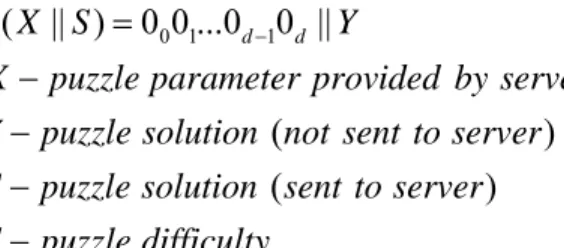
There is another method for creating hash-based puzzles. In this method, the client is only given the partial hash input, and it needs to solve for both the rest of the hash input and the hash output [15]. We refer to this type of a puzzle as a client-generated puzzle. The difficulty level is set by forcing the first d bits of the output to be zero. Thus, the server only needs to distribute a random number and the client will be responsible for creating the puzzle. In a client-generated puzzle, the server needs to keep only two local variables (a nonce and the difficulty level), and respond with these values when a client makes a connection request. An example of a client-generated puzzle can be seen below in Figure 2-2. The server provides the value X and the hash function h() to the client. When the server verifies the puzzle solution, it simply concatenates X and S to form the input of the
hash function, executes the hash function, and verifies the output satisfies the current difficulty level requirement.
0 1 1 ( || ) 0 0 ...0 0 || ( ) ( ) d d h X S Y
X puzzle parameter provided by server Y puzzle solution not sent to server
S puzzle solution sent to server d puzzle difficulty − = − − − −
Figure 2-2: A client-generated puzzle
In [24], Wang and Reiter present a client puzzle protocol called a puzzle auction that was implemented and embedded into the TCP stack in Linux. The puzzle auction was designed to allow clients, with a modified kernel, to bid for a connection. The puzzle difficulty is the bid, and a higher bid implies a more difficult puzzle to be solved by the bidder. In their incremental bidding scheme, the client bids for a connection by solving a puzzle at a certain difficulty and can re-bid for a connection by solving another puzzle of a higher difficulty level and retransmit the request. At the end of bidding, the server grants connections to those who have the highest bid, or those who have solved the most difficult puzzle. Allowing a client to set the difficulty level may permit an attacker to control a zombie to purposely raise the difficulty level and to outbid other clients. The authors claim that most DDoS tools that execute on zombies are designed to operate quietly so that users will not notice their existence. They assume that solving puzzles repeatedly and of incremental difficulty will signal a user that their computer has been comprised. This is not always true, especially if the attack is launched during non-active times or using zombies where there is little human interaction with the computer. Another assumption relevant to this issue is that the user of the zombie computer is a knowledgeable computer user and would take the appropriate actions when he/she realizes that his/her computer is being used as a zombie. Again, this is not always true. For the reasons stated above, the difficulty level of a puzzle scheme should always be controlled by the server, or the end host distributing the puzzles.
For backwards compatibility, the puzzle auction scheme has a method for allowing a client with an unmodified kernel to complete a connection during an attack. Unfortunately, this implementation has potential vulnerabilities. In the implementation, a client with an unmodified kernel does not solve a puzzle. Instead, when the server receives a connection request, it is the server who computes the hash of a nonce, the source IP address, the source port, the destination IP address, the destination port, the initial sequence number, and another random value. If the output from the hash function meets the difficulty level, the connection is completed. A client can only establish a connection by repeatedly making attempts, and hope that the server can grant it. They call this scheme “Bid and Query”. This scheme clearly violates the first characteristic of an ideal client puzzle protocol mentioned above, because the client and server are both required to perform a similar amount of work to complete the connection. This vulnerability can be taken advantage of by a malicious client.
Waters et al. [27] propose a new method to outsource client puzzles at the transport layer and briefly describe how their implementation could be modified for puzzles at the network layer. In their scheme, they claim that most clients do not wish to wait for a puzzle to be solved in order to complete a connection request. Instead, they introduce a complex method to solve puzzles before connection requests are actually made, thereby eliminating the time spent waiting for a puzzle to be solved. In their scheme, puzzles are solved in a certain time period, and then the puzzle answers are used in the following time period. The problem is that when a client first connects online it has to wait until the next time period to begin in order to use the answers it has computed from the last time period. The authors suggest that this time period be on the order of minutes and even use a time period of 20 minutes in their experiments. This means that a client, who had recently just connected online, would need to wait for 20 minutes before making a connection with a remote server. In their paper, one of their main contributions is decreasing the puzzle verification time. Since puzzles are solved in a specific time period, the puzzle solutions are stored during that time period and the next time period.
During the next time period, verification of a puzzle can simply be done with a table look-up. In terms of verification time, this is the fastest method to verify a puzzle. However, storage and complexity are sacrificed at the expense of the puzzle verification time.
2.3.2.
Client Puzzles at the Application Layer
Client puzzles have also been proposed to combat attacks that may occur at the application layer. In [26], the authors have modified a webserver to support client puzzles. In TLS, a DoS attack can occur when the attacker targets the CPU of the server. When a secure connection is established, the server is required to perform CPU intensive RSA decryptions. If malicious users repeatedly force the server to perform these operations, the server’s CPU will be exhausted and the server will not be able to service other clients. The authors in this paper propose a client puzzle scheme, where the client solves a puzzle before the server performs any work. Thus, the client puzzle protocol is able to shift the cost of the connection to the client, rather than the server. This client puzzle protocol is application specific and was designed to fix an exploit that allowed an attacker to exhaust the server’s resources. By utilizing a client puzzle protocol, it was more difficult for the attacker to successfully exhaust those resources.
One of the more promising uses of client puzzles at the application layer is deploying them to combat junk e-mail or spam. The authors of [31] were the first to propose a scheme where a user solves a difficult problem before an e-mail is sent. Since spammers, on average, send more mail than legitimate mail users, they argue that forcing each e-mail sender to solve a cryptographic puzzle for each piece of e-e-mail, it would throttle the malicious users. In their future work, they have also proposed using a memory-bound problem rather than a computational-based problem [32]. Memory-bound problems were originally presented in [33]. In their paper, their idea was to develop an improved puzzle that forces the client to devote its memory resources to solve moderately difficult problems. Despite the concept of memory-bound problems, very few client puzzle
protocols have been proposed that use this kind of problem because they are difficult to create.
In addition to researching a proof-of-work protocol like client puzzles within the transport layer, Back has considered the possibilities of utilizing such a protocol within various applications [34]. The author has proposed a scheme called Hashcash, which can be deployed within an application to throttle spam, service requests in a cryptographic file system, or USENET flooding. There are many possibilities for using a proof-of-work protocol to prevent a malicious user from undermining the service and possibly denying it to legitimate users.
2.3.3.
Client Puzzles at the Network Layer
Recently, there have been two papers [28, 29] published that address the need for IP-layer client puzzles. The basic idea for IP client puzzles is to have each client solve a puzzle before they can send traffic into the network. Thus, IP client puzzles are designed to rate-limit clients that send large amounts of data to help prevent large-scale DDoS flooding attacks.
In Congestion Puzzles by Wang and Reiter [29], each client is responsible for solving a number of puzzles before their packets can be forwarded from a congested router. When the clients begin to send packets towards a particular IP address it continuously sends separate probe packets, along with the data in normal packets it is sending. When a router downstream detects congestion, it relays the probe packets off the destination by changing the ICMP code number to resemble a ping when it reaches the victim. This packet will be modified to contain the puzzle information: a nonce and a difficulty level. When the client receives the challenge it begins to continuously solve puzzles and embed the solutions in separate ICMP packets. It takes the nonce it received from the router, creates its own nonce and uses those two items to create a hash-based puzzle. Therefore, the client does not need to contact the congested router to get a new puzzle. Solutions are
sent in ICMP packets sent to the destination but are intercepted by the router for puzzle verification. After correct verification of the puzzle, tokens are added into a token bucket at the congested router. When a data packet arrives, tokens are removed from the bucket. Therefore, this acts as a rate limiter and only allows the client to send more packets if they in turn solve more puzzles. Periodically, the puzzle information (i.e. a nonce and the difficulty level) is refreshed by sending back a puzzle solution with the updated information. Thus, in this scheme, twice as many packets are being sent to a congested router. This can create a potential problem, because an IP-layer puzzle protocol should limit the amount of traffic sent to the victim. Recall that one of the goals of a DDoS attack is to consume the bandwidth near the victim. Another concern in this protocol is that an attacker can take advantage of the token bucket design by flooding the network with packets (without solving puzzles) and hoping that it removes tokens that were supplied earlier by legitimate clients. The authors are aware of this problem and call it the “free-riding” problem. The authors attempt to fix this problem by introducing an IP-caching algorithm that allocates a separate token bucket for clients that are sending more data than others or for those with a common IP prefix. However, this adds much complexity to their scheme and increases the memory storage overhead at the router. The protocol presented by Feng et al., called Network Puzzles [28], requires the client and congested router to constantly exchange puzzle information for each puzzle. Unlike Congestion Puzzles, each client can only solve a puzzle when it has been presented with the puzzle information from the congested router. During a severe attack, each client needs to be rate-limited by solving more puzzles. If a client needed to solve a puzzle per packet, it would repeatedly need to request the puzzle information from that congested router before it can send its packet. This scheme does not allow a seamless integration of the puzzle protocol into IP because it does not allow the client to create its own puzzles.
In all client puzzle protocols it should be clearly stated that puzzles should only used during an ongoing attack. We realize that there are many applications that rely on the speed of certain protocols for performance. However, the performance of these network applications suffers immensely in the presence of a DoS attack. The additional delays
associated with solving puzzles might hinder some applications, but it will be an improvement over the side effects that are observed during a DoS attack when puzzles are not deployed. The idea of implementing client puzzles into the transport layer and network layer is still relatively new in the research community, as there have been very few conceptual designs of such a protocol.
CHAPTER 3
3.
TCP Client Puzzles
In recent years, TCP client puzzles have been proposed to mitigate attacks on the transport and application layers. In this chapter, the design, implementation details, and simulation results of Puzzle TCP, pTCP, are presented. However, before an introduction to pTCP is given, it is necessary to define the assumptions that are made. These assumptions are shown in Table 3-1.
Table 3-1: Assumptions in pTCP
Assumption 1: Attackers are generally more aggressive and send more requests than the average legitimate client.
Assumption 2: The server under attack can process every incoming packet and send responses to each client.
Assumption 3: If a stateful firewall is protecting the victim server, the puzzle mechanism can be embedded into the firewall, or rules can be added to the firewall (to allow ACK packets without state information to pass through) if the puzzle mechanism is chosen to be implemented at the server.
3.1.
Overview of pTCP
In order for client puzzles to be truly effective, they must be placed below the application layer. Feng [30] documented the need to place client puzzles in the TCP or IP-layer. In the following section, we show how client puzzles can be integrated within the TCP stack
to prevent resource-exhaustion DoS attacks. This section also gives a detailed description on how the client and server interact in pTCP.
The current three-way handshake implemented in TCP has lead to security problems, mainly because the server can allocate resources before clients are authenticated. To prevent a client from depleting a server’s resources, it is necessary to modify TCP. pTCP is a modification to TCP that allows the server to issue a challenge to a potential client. Based on the number of pending active connections, the server should be able to determine if newer clients are required to solve a puzzle before establishing a connection. By placing the client puzzle protocol at the transport layer, we force a client to prove its legitimacy by solving a puzzle before a connection is granted.
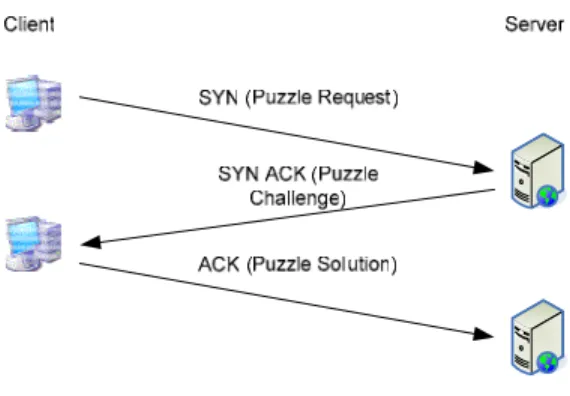
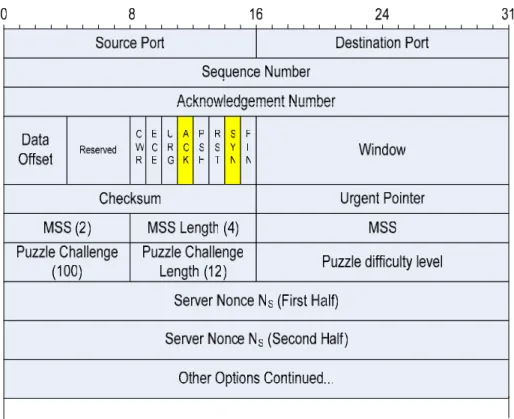
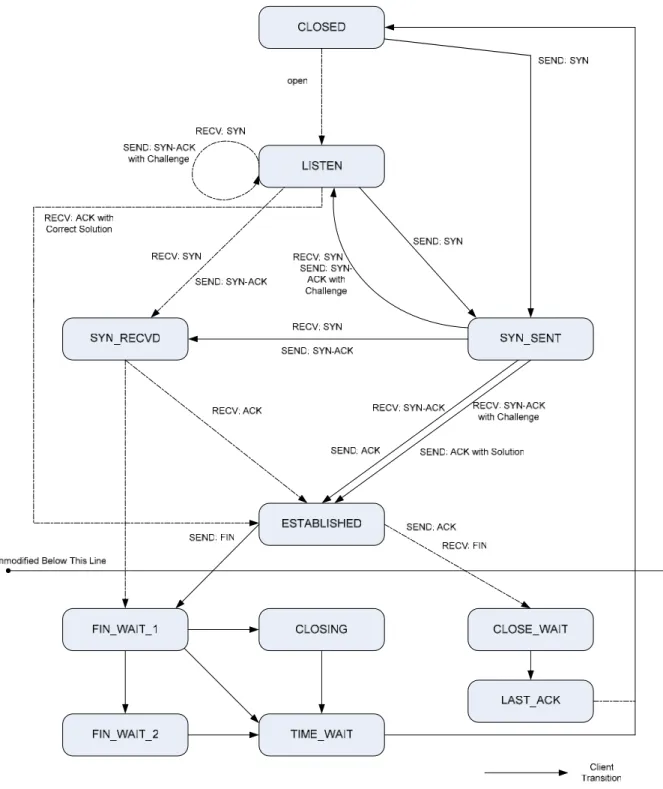
pTCP implements a similar three-way handshake to establish a connection. When a server receives a packet with the SYN code bit set, it normally replies with a packet with the SYN and ACK code bits set (SYN-ACK packet). However, if the server is experiencing heavy traffic (e.g., flash crowd or DoS attack), then it replies with a challenge to the client which includes a server nonce and difficulty level embedded into the SYN-ACK packet. A server can determine when this is necessary by examining the SYN queue. When the queue reaches near its maximum capacity, puzzles can be turned on. When it is necessary for a server to issue a challenge to a client, the server removes the state information for that client. Thus, for pending connections there are no resources allocated on the server other than the server nonce and current difficulty level, which is common to all potential clients. Therefore, the server is not susceptible to half-open attacks designed to consume server resources. The server nonce is the same for all clients during a 60 second time period. If a client solves a puzzle in the previous time epoch and submits the answer in the following time epoch, the answer is considered incorrect. The client’s connection will be reset and the client will need to make another attempt to complete the connection. Since most puzzles take less than a few seconds to solve, the 60 second server nonce period should be adequate.
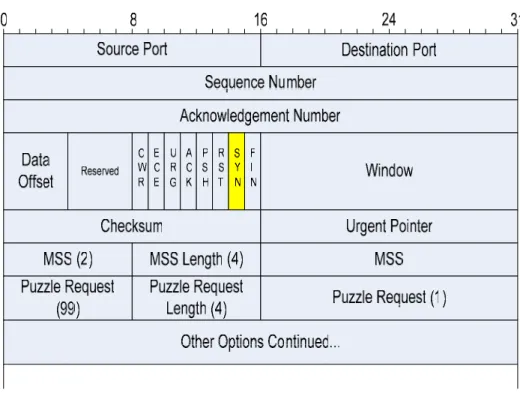
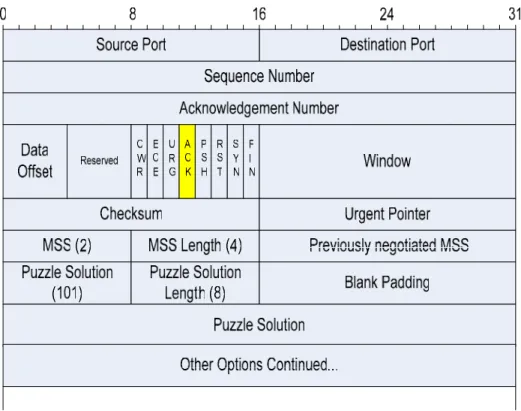
Creating puzzles in pTCP is very fast for the server because server only needs to send the server nonce and difficulty level embedded in a SYN-ACK packet. When the server issues this challenge to the client, the client parses the SYN-ACK packet for the server nonce and difficulty level, solves the puzzle, and replies with a solution in an ACK packet. The server then verifies the correct solution and changes the state of the connection to “established”. Figure 3-1 illustrates how a client and a server communicate in pTCP.
Figure 3-1: Client-Server interaction in pTCP
In pTCP, the server does not issue puzzle challenges during normal traffic conditions (which is indicated by the vacancies in the SYN queue). In this case, the server sends an acknowledgement (i.e., a normal SYN-ACK packet) to the client instead of a puzzle challenge. The client replies with an acknowledgement (i.e., a normal ACK packet). This flexibility of pTCP will allow clients with unmodified versions of TCP (i.e., TCP without puzzle challenge capability) to establish connections with servers using pTCP when the SYN queue level is sufficiently low. This feature facilitates backward compatibility with puzzle incapable clients and also helps to support the gradual deployment of client puzzles in the Internet. In practice, the backward compatibility is very important because the implementation of client puzzle protocols require changes in the clients’ software. A smooth migration from standard TCP to puzzle capable TCP will require the protocol’s backward compatibility.
A problem common to both pTCP and syncookies is the inability of the server to retransmit the SYN-ACK packet when this packet is lost en route to the client. Since all
state information is removed on the server following the transmission of this packet, retransmissions are not possible in either scheme.
3.2.
The Client Puzzle for pTCP
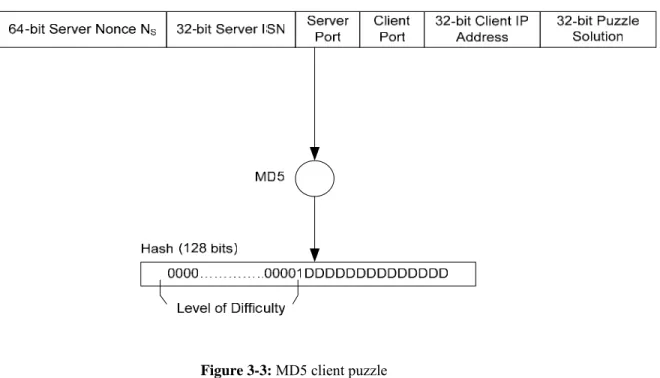
In pTCP, we propose an entirely different puzzle algorithm. Our puzzle algorithm is based on a lightweight block cipher. The solution to a given puzzle is found by finding the appropriate key given the plaintext that produces a particular pattern in the ciphertext; the solution is verified by executing the encryption algorithm using the plaintext and key. Our simulation results have shown that our technique enables faster verification of puzzle solutions compared to conventional hash-based puzzle algorithms. The efficiency of the puzzle verification procedure is vital to the overall effectiveness of the client puzzle protocol. In a conventional puzzle algorithm, a server executes a hash function to verify the client’s answer. When creating a DoS resilient protocol, it is imperative that the defense mechanism itself does not become the basis for another DoS attack. An attacker can easily attempt to exhaust the computing power of a server by forcing it to verify a large number of incorrectly solved puzzles. In this scenario, the attacker does not bother solving the puzzles; it simply intends to force the server to waste its resources. The computation load of verifying a puzzle solution must be multiple orders of magnitude smaller than that required to solve the puzzle. The proposed puzzle algorithm is designed to minimize the verification time and enables a server to verify a large volume of puzzles rapidly while still maintaining its intended DoS resiliency.
The Tiny Encryption algorithm (TEA) is a block-cipher encryption algorithm that was proposed in 1994 by Wheeler and Needham [35, 36]. Both the encryption and decryption algorithms are Feistel routines that encrypt or decrypt data by several rounds of addition, subtraction, bit-shifting, and exclusive-OR operations. The goal of the encryption algorithm is to create as much diffusion2 as possible by incorporating many rounds or iterations of these operations. After TEA was released, certain minor weaknesses were discovered in the encryption algorithm [37]. In response, Wheeler and Needham
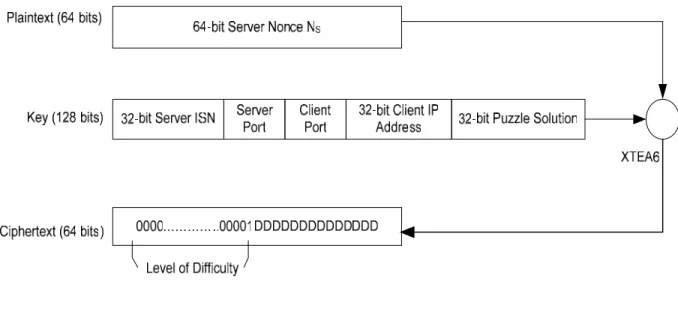
developed an extension to TEA, called XTEA [38]. For our client puzzle algorithm, we use a variation of XTEA which uses 6 iterations. We call this variation XTEA6. In this encryption scheme, the plaintext is 64 bits long, the key is 128 bits long, and the ciphertext is 64 bits long. The encryption routine allows a parameter to be passed that indicates the number of iterations to execute. We have selected six iterations because complete diffusion can be observed with that many rounds. Moreover, the level of security provided by six rounds is more than sufficient for a puzzle [38]. Note that in a puzzle algorithm, speed and efficiency are more important than robust security. It should be easier to solve the puzzle correctly than perform an extensive cryptanalysis of the encryption algorithm to retrieve the puzzle solution.
To the best of our knowledge, TEA was first suggested as a puzzle algorithm by Abadi et al. [33], although an implementation of a client puzzle protocol using TEA was not attempted. As a client puzzle, XTEA6 has several advantages over most hash-based functions. As our simulation results will later show, XTEA6 is a much faster algorithm than most hash-based functions. This will allow a server to handle connections faster and will decrease the amount of waiting time on connections to complete for legitimate clients.
The client puzzle that we have developed is a client-generated puzzle, similar to the client-generated hash-based puzzle mentioned in Chapter 2. When the client requests a connection, the server responds with a server nonce, NS, and the level of difficulty for the
current puzzle. The server nonce is a 64-bit random number, generated with the Linux kernel random number generator. The server nonce is the same for every potential client and is changed for all clients every 60 seconds. The client uses the server nonce as a part of the puzzle that it must create. When the client receives the server nonce, it uses it as the plaintext in the XTEA6 encryption algorithm. The client must then find part of a 128-bit key value that will produce a particular ciphertext. More precisely, to solve a puzzle, the client needs to solve for the least significant 32 bits of the key. The rest of the key is comprised of the server’s initial sequence number (ISN), the server port, the client’s local port, and the client’s IP address. By using the client’s port and the server