Citrus Growing
and Processing
Inquiry Report
Report No. 20 30 April 2002
Commonwealth of Australia 2002
ISBN 1 74037 080 5
This work is subject to copyright. Apart from any use as permitted under the
Copyright Act 1968, the work may be reproduced in whole or in part for study or
training purposes, subject to the inclusion of an acknowledgment of the source. Reproduction for commercial use or sale requires prior written permission from Info Products. Requests and inquiries concerning reproduction and rights should be addressed to the Manager, Legislative Services, Info Products, Department of Finance and Administration, GPO Box 1920, Canberra, ACT, 2601.
Publications Inquiries:
Media and Publications Productivity Commission
Locked Bag 2 Collins Street East Melbourne VIC 8003 Tel: (03) 9653 2244 Fax: (03) 9653 2303 Email: [email protected] General Inquiries: Tel: (03) 9653 2100 or (02) 6240 3200
An appropriate citation for this paper is:
Productivity Commission 2002, Citrus Growing and Processing, Report no. 20, AusInfo, Canberra.
The Productivity Commission
The Productivity Commission, an independent Commonwealth agency, is the Government’s principal review and advisory body on microeconomic policy and regulation. It conducts public inquiries and research into a broad range of economic and social issues affecting the welfare of Australians.
The Commission’s independence is underpinned by an Act of Parliament. Its processes and outputs are open to public scrutiny and are driven by concern for the wellbeing of the community as a whole.
Information on the Productivity Commission, its publications and its current work program can be found on the World Wide Web at www.pc.gov.au or by contacting Media and Publications on (03) 9653 2244.
IV TERMS OF REFERENCE
Terms of reference
I, Peter Costello, under Parts 2 and 3 of the Productivity Commission Act 1998, hereby:
1. refer for inquiry and report the competitive situation and outlook for the citrus growing and processing industry, taking into account:
(a) the financial conditions, including profitability, of the industry; (b) trends in relation to demand and supply factors, including imports
such as frozen concentrate orange juice;
(c) the competitiveness of the industry, including efforts taken by the industry to enhance competitiveness; and
(d) the impact and effectiveness of existing and recent Commonwealth/State policies and programs. 2. specify that:
(a) the Commission report on whether the circumstances are such that measures are necessary to enhance the competitiveness of the industry; and
(b) if so, what measures would be necessary and appropriate, including whether a formal safeguards investigation is warranted.
3. The Commission is to report within 6 months of receipt of this reference and is to hold hearings for the purposes of the inquiry.
4. The Government will consider the Commission’s recommendations and the Government’s response will be announced after the receipt of the
Commission’s report.
PETER COSTELLO
CONTENTS V
Contents
Terms of reference IV
Contents V
Abbreviations and explanations XI
Glossary XIII
Key messages XVI
Overview XVII Recommendations XXXVII
Findings XXXIX
1 Introduction 1
1.1 Background to this inquiry 1
1.2 Conduct of the inquiry 2
1.3 Report structure 3
2 Citrus markets 5
2.1 Introduction 5
2.2 Recent trends in production and prices 8
2.3 Fresh fruit markets 19
2.4 Juice markets 25
2.5 Market links 32
3 Growing sector 39
3.1 Characteristics of citrus growing in Australia 39
3.2 Financial performance 45
VI CONTENTS
4 Other sectors of the citrus industry 61
4.1 Overview of the citrus supply chain 61
4.2 Citrus packing 62
4.3 Processing and converting sector 70
4.4 Export agents 76
5 Factors affecting the outlook for the citrus industry 77
5.1 Changing consumer preferences 77
5.2 Competitive advantage of overseas producers of FCOJ 81 5.3 Australia’s competitive advantage in fresh fruit and fresh juice 82
5.4 Macroeconomic developments 86
5.5 Innovation 88
5.6 Diversity and risk management 90
5.7 Cost and availability of key inputs 95
5.8 Outlook 101
6 Government policies and programs 103
6.1 The Commission’s approach 103
6.2 Rationale for government involvement 104
6.3 Impact and effectiveness of programs to improve
competitiveness and economic efficiency 111
6.4 Impact and effectiveness of programs to facilitate adjustment to
economic change 119
7 Potential impediments to international trade 137
7.1 Market access 137
7.2 Export control powers 148
8 Potential impediments in domestic markets 177
8.1 Labelling laws 177
8.2 Cost and availability of inputs 188
8.3 Market power of supermarkets and processors 197
9 Are further measures needed? 205
9.1 Assessment 208
9.2 Impediments to industry performance 217
CONTENTS VII
A Conduct of the inquiry 219
A.1 List of submissions 220
A.2 Visits 222
A.3 Public hearings 224
B Productivity Commission estimates of local (farmgate) unit values 227
B.1 Estimation of value added in packing fresh fruit 227 B.2 Estimation of transport cost to processors 229
B.3 Adjustment to local value 230
C Cost of production estimates 233
C.1 NSW Agriculture 233
C.2 Primary Industries and Resources South Australia 239
D Supplementary information on government policies and programs 243
D.1 Citrus boards 243
D.2 Horticulture Australia Limited 245
D.3 Effective rates of assistance 249
D.4 Citrus Market Diversification Program 250
D.5 Rural Partnership Program 251
D.6 Export Market Development Grant scheme 254
E Technical discussions on quarantine barriers 257
E.1 General process 257
E.2 Case studies 260
References 263
BOXES
2.1 Farmgate average unit values using ABS data 17
4.1 Major citrus processors and convertors 72
7.1 Exporting citrus to the US market 150
7.2 Performance assessment and review arrangements 168 7.3 Export control powers — effects on exporters and growers 170 8.1 Consumer preferences and consumption choices 187 9.1 Citrus in the Griffith and Mildura regions 214
VIII CONTENTS FIGURES
2.1 Real gross value of citrus production and exports, 1988-89 to
2000-01 6 2.2 Australian production of valencias, navels and mandarins 9
2.3 Annual per capita fresh citrus consumption trend in Australia,
1989-90 to 1999-2000 20
2.4 Imports and exports of fresh citrus 22
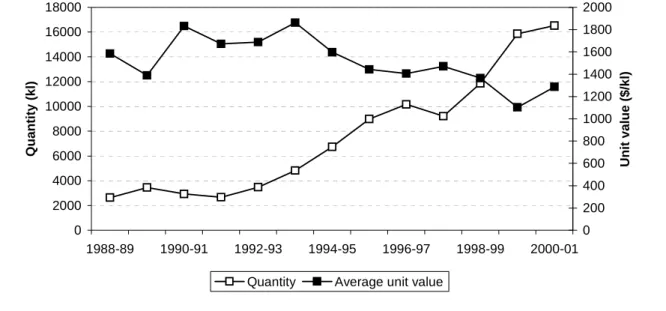
2.5 Export quantity and real average unit values of fresh orange juice,
1988-89 to 2000-01 28
2.6 Quantity of imported FCOJ and domestic production of oranges,
1990-91 to 2000-01 29
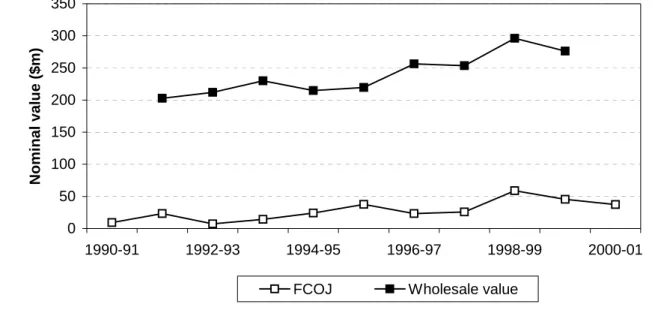
2.7 Nominal value of imported FCOJ and wholesale oranges, 1990-91 to
2000-01 30 2.8 Nominal average unit value of imported FCOJ, January 1991 to
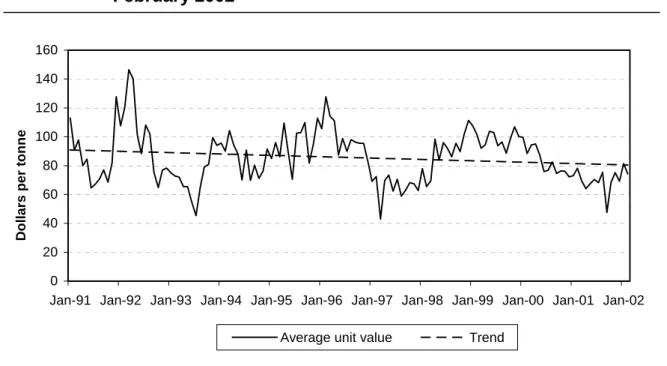
February 2002 31
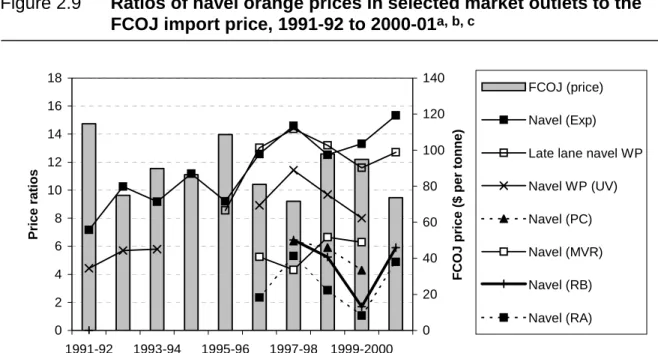
2.9 Ratios of navel orange prices in selected market outlets to the FCOJ
import price, 1991-92 to 2000-01 34
2.10 Ratios of valencia orange prices in selected market outlets to the
FCOJ import price, 1991-92 to 2000-01 35
3.1 Total number of citrus establishments, 1993-94 to 1999-2000 40 3.2 Number of non-bearing trees, Australia, 1983-84 to 1999-2000 56 3.3 Ratio of non-bearing to total citrus trees, 1983-84 to 1999-2000 57 4.1 Domestic supply chain for citrus in Australia 62 7.1 Australian exports to the United States (fob), 1993–2001 151 7.2 US imports of fresh oranges from southern hemisphere countries
between June and October (cif), 1993–2001 153
7.3 Unit values for Australian orange exports to the United States,
1993–2001 171 D.1 Effective rates of assistance for the citrus industry and various
agricultural ANZSIC divisions, 1980-81 to 1999-2000 249
TABLES
2.1 Citrus production and value, 1999-2000 7
2.2 Orange market distribution, 1997-98 to 2000-01 10 2.3 Nominal unit value and price of selected citrus products in export,
CONTENTS IX 2.4 Nominal farmgate average unit values, 1996-97 to 1999-2000 18 2.5 Export volumes and nominal values of Australian fresh citrus, by
country, 1997-98 to 2000-01 23
3.1 Size of citrus orchards in the Murray Valley, Riverland and
Riverina, 2001 41
3.2 Decile of citrus production per establishment, 1997 42 3.3 Decile of citrus production per establishment, by State, 1997 43 3.4 Other agricultural activities undertaken by citrus establishments, by
decile of citrus production, 1997 44
3.5 Proportion of citrus establishments undertaking non-citrus
agricultural activities, by decile of citrus production and State, 1997 45 3.6 Profitability of the citrus part of the business in the Murray Valley,
1995-96 to 2000-01 47
3.7 Financial performance of citrus growers applying for
MIA PowerPACT program, 2000-01 49
3.8 Estimated annual returns from growing citrus in New South Wales
and South Australia 50
3.9 Profitability of the entire citrus enterprise in the Murray Valley,
1994-95 to 1998-99 52
3.10 Distribution of total farm and total farm plus off-farm income per
farm household, Murray Valley, 1994-95 to 1998-99 52 3.11 Total number of citrus establishments by decile for production and
EVAO per establishment, 1997 53
3.12 Land values of specialist citrus farms, 1996–2001 55 3.13 Estimated indebtedness in the Murray Valley, 1999-2000 58 3.14 Average growing costs for navel and valencia oranges, 1995 58 3.15 Growers’ returns from navel and valencia oranges, 1995 59 4.1 Number of packers in the major orange growing regions, 1991–2001 64
4.2 Packing costs for navel oranges, 1995 65
4.3 Citrus processing enterprises, 1991–2001 71
5.1 Average exchange rates, 1990 and 2001 87
5.2 Average costs of production of citrus establishments in the MIA and
Murray Valley, 2000-01 96
6.1 Use of RPP measures by citrus growers 125
6.2 Assessing the programs to facilitate adjustment to economic change in the citrus industry against design and evaluation criteria — AAA
X CONTENTS
6.3 Assessing the programs to facilitate adjustment to economic change in the citrus industry against design and evaluation criteria — Rural
Partnership Program 134
7.1 Applied tariff rates for imports of Australian citrus, 1996 and 2001 139
8.1 Fees and charges for product registration 193
8.2 Estimated share of retail price accruing at each stage of the supply chain for fresh valencia oranges sold on a per kilogram basis,
2000-01 200 8.3 Estimated share of retail price accruing at each stage of the supply
chain for valencia oranges in 3 kilogram bags, 2000-01 200 8.4 Estimated share of retail price accruing at each stage of the supply
chain for fresh juice, 2000-01 200
A.1 List of submissions 220
A.2 Public hearings 224
B.1 Adjustment to packing value added, 1997-98 228 B.2 Estimates of transport cost from growers to processors 229 B.3 PC adjusted estimates of local (farmgate) value, navels and
valencias, 1997-98 230
C.1 Draft cash flow budget for washington navels planted in the MIA
region 234 C.2 Draft cash flow budget for washington navels planted in the
Sunraysia region 235
C.3 Draft cash flow budget for mandarins planted in the MIA region 236 C.4 Draft cash flow budget for mandarins planted in the Sunraysia
region 237 C.5 Unit cost of producing citrus in MIA and Sunraysia 239
C.6 Cash flow budget for navels planted in South Australia 240 C.7 Cash flow budget for valencias planted in South Australia 241
D.1 HAL’s citrus R&D funding, 1994–2001 246
D.2 Export control conditions, citrus products 248 D.3 Citrus industry Export Market Development Grant recipients,
1995-96 to 2000-01 255
E.1 Steps in technical discussions in access for mandarins to Japan 261 E.2 Steps in technical discussions in access for citrus to Korea 262
ABBREVIATIONS AND EXPLANATIONS
XI
Abbreviations and explanations
Abbreviations
ABARE Australian Bureau of Agricultural and Resource Economics ABS Australian Bureau of Statistics
ACCC Australian Competition and Consumer Commission ACG Australian Citrus Growers Inc.
ACT Australian Capital Territory
AFFA Department of Agriculture, Fisheries and Forestry — Australia
AHC Australian Horticultural Corporation
AHEA Australian Horticultural Exporters Association Inc. ANZFA Australia New Zealand Food Authority
AQIS Australian Quarantine and Inspection Service
AUD Australian dollar
BA Biosecurity Australia
CBSA Citrus Board of South Australia
CPI Consumer price index
DFAT Department of Foreign Affairs and Trade EFIC Export Finance and Insurance Corporation EVAO Estimated value of agricultural output FCOJ Frozen concentrate orange juice GST Goods and Services Tax
HACCP Hazard Analysis and Critical Control Point
HAL Horticulture Australia Limited
HMAC Horticultural Industry Market Access Committee IRA Import Risk Analysis
MAFF Ministry of Agriculture, Forestry and Fisheries (Japan) Medfly Mediterranean fruit fly
MFC Mildura Fruit Company
XII ABBREVIATIONS AND EXPLANATIONS
MVCMB Murray Valley Citrus Marketing Board NFC Not from concentrate
NPPO National Plant Protection Organisation NPQS National Plant Quarantine Service (Korea)
NRA National Registration Authority
PIRSA Primary Industries and Resources South Australia Qfly Queensland fruit fly
QFVG Queensland Fruit and Vegetable Growers R&D Research and development
RC Riverina Citrus
RIS Regulation Impact Statement
SPS agreement WTO’s Agreement on the Application of Sanitary and Phytosanitary Measures
TSS Total soluble solids
WTO World Trade Organization
Explanations
Billion The convention used for a billion is a thousand million (109). Findings Findings in the body of the report are paragraphs
highlighted using italics, as this is.
Recommendations Recommendations in the body of the report are highlighted using bold italics, as this is.
GLOSSARY XIII
Glossary
Apparent consumption
An estimate of domestic consumption, calculated as the sum of the measured level of domestic production and imports less the amount of exports and changes in stocks.
Bearing trees Trees that are aged six years and over.
Bound rate tariff The tariff rate that is the maximum allowed under World Trade Organization rules.
Citrus industry For the purpose of this report, the citrus industry includes citrus growers, packers and processors. It does not include enterprises related to the industry such as convertors (bottlers), exporters, importers and retailers of citrus fruit.
Cold disinfestation A process to eliminate pests, such as fruit fly, from citrus
fruit through storage at very low temperatures for a given period.
Convertors Enterprises in the citrus supply chain that take processed products such as fresh juice, concentrate, dried products and oils then produce bottled/packaged products such as packed juices, fruit drinks and cordial.
Cost insurance and freight (cif) price
The price of a commodity that includes, in addition to the fob price (see below), the cost of insurance and freight.
Economies of size A reduction in the unit costs of production with increasing size of operations.
Estimated value of agricultural output (EVAO)
An estimate of the value of agricultural production. It is an indicator of the extent of agricultural activity rather than an indicator of the value of receipts of individual farms.
Export control powers
Conditions placed on the export of citrus products into specific overseas markets. This may include assigning sole importer status to a particular enterprise in a certain export destination.
XIV GLOSSARY
Farmgate price The price of an agricultural commodity at the farm level point of sale. A range of different interpretations of farmgate price are discussed in chapter 2.
Free-on-board (fob) price
The price of a commodity derived up to the point of shipment. It includes usual production and processing costs of the goods and the costs of preparing the goods for shipment, including loading the goods onto the vessel.
Fresh fruit equivalent
A measure of the amount of fresh fruit that would have been required to make a given quantity of FCOJ.
Fresh juice This term is used interchangeably in the report with the term NFC. (See NFC for definition.)
Frozen concentrate orange juice
(FCOJ)
A processed commodity that is prepared by dehydrating orange juice so that it is in a concentrated form. The concentrate is then frozen and can be stored for up to 24 months. To obtain orange juice from FCOJ, the product is thawed and reconstituted with water.
Import risk analysis
A process to determine the quarantine risks that are associated with importing plant and animal products. This process includes taking into account all available scientific evidence regarding the product in question to determine any necessary phytosanitary measures.
Imputed owner labour cost
An estimated value of the citrus establishment owner’s own labour, which is used when it has not been included as an accounting cost. This concept is included to calculate the ‘true’ cost of production for a citrus establishment.
Integrated pest management
An approach to pest management that incorporates a number of techniques including: using chemical and biological sprays; changing the environment so that it is more favourable to predators and parasites; releasing natural and introduced predators and parasites.
Non-bearing trees Trees that are less than six years of age. (See also bearing trees.)
GLOSSARY XV
Not from
concentrate (NFC)
A description of fruit juice products not derived from FCOJ. This includes fresh juice without any preservatives, frozen fresh juice, fresh juice with preservatives and pasteurised fresh juice.
Over-run Citrus that is not suitable for fresh-fruit domestic or export markets. This fruit may then be used for the production of products such as fresh juice or concentrate, or as stock feed or dumped/destroyed.
Phytosanitary measures
Measures taken to ensure that imported plant matter is safe for consumption according to the health standards considered ‘safe’ by the importing country.
Spillover benefits Additional benefits that arise from an activity or production of a good or service that flow to those who are not directly involved in, or contributing to the costs of, the activity or production process.
Total soluble solids (TSS)
A measure of the sugar content of juice that indicates its quality and flavour.
Vertical linkages Vertical linkages are agreements or understandings between enterprises at different stages in the production chain. They are developed to ensure adequate supply of competitively priced upstream product at different points on the supply chain. Linkages between enterprises may range from contracts through to common ownership of enterprises engaged in each stage of production (vertical integration).
CITRUS GROWING AND PROCESSING
XVI
Key messages
• The citrus growing and processing industry has been expanding while experiencing significant change.
– Demand for fresh fruit and fresh juice has increased strongly. These products absorb 85 per cent of total orange production.
– The industry has become more export-oriented, with exports now representing one-quarter of total citrus production and almost half of the total value of production.
• At the same time, a substantial increase in low cost, high quality frozen concentrate orange juice from Brazil has resulted in reduced returns and financial problems for some local growers.
• Financial performance and competitiveness within the industry varies.
– Growers who have adapted well to market developments have had the foresight and ability to invest in varieties of citrus or other horticultural products which are in demand.
– Those who have found it more difficult to adapt have typically been those with significant proportions of oranges processed into concentrate. Many have small orchards and limited resources.
• Like many other agricultural enterprises, citrus growers face a number of risks — in particular, fluctuations in their income and lengthy pay-back periods on investment. – Certain characteristics of the industry, including the prevalence of non-citrus
production on many farms, off-farm income and the increasing use of medium-term supply contracts, provide scope to manage many of these risks.
• The citrus industry’s growth is impeded by some regulatory factors — such as high trade barriers in some overseas markets and costly labour market arrangements.
• The benefits of the sole importer arrangement in the United States tend to be overstated, because of the influence of other factors on returns from that market. – It is important that reviews of this and similar export control arrangements be
conducted in a genuinely independent and transparent manner.
• The citrus industry has access to a range of general government support programs to improve its performance and facilitate adjustment to economic change.
• The Commission considers that additional industry-specific assistance is not justified:
– much of the industry is already adapting successfully to change; and
– the diverse nature and performance of farm households which grow citrus mean that such assistance would not target low-income problems efficiently or equitably.
• For these reasons and because a tariff increase would not provide much assistance to growers in difficulty, the Commission also considers that a safeguards investigation is not warranted.
OVERVIEW XVII
Overview
This inquiry arose out of concerns about the commercial outlook for the Australian citrus growing and processing industry. The concerns are that some sectors of the industry are vulnerable to strong competition from imports, particularly of frozen concentrate orange juice (FCOJ), and that many growers have recently experienced low returns.
The Commission has been asked to examine the current situation and outlook for the citrus growing and processing industry. It also has been asked to examine whether any measures are necessary to enhance the industry’s competitiveness and whether a formal safeguards investigation is warranted. In undertaking the inquiry, the Commission is required to take into account the financial conditions of the industry, trends in demand and supply, the competitiveness of the industry, efforts taken by the industry to enhance competitiveness, and the impact and effectiveness of existing and recent Commonwealth/State policies and programs. The general policy guidelines set out in the Productivity Commission Act 1998 require the Commission to have regard to the overall interest of the Australian community. This means that the Commission has taken a broader view of the terms of reference for this inquiry than that advocated by some participants.
Australia’s citrus industry
The citrus industry in Australia encompasses growers, packers and processors of citrus fruit.
In 1999-2000, Australia produced 641 000 tonnes of citrus fruit, which had a nominal gross value of production of just over $400 million. This represented 14.6 per cent of the total value of fruit produced and 1.3 per cent of the total value of agricultural production in Australia. The citrus industry is the second largest horticultural industry after the wine grape industry.
Australia grows a range of citrus fruit including oranges, mandarins, lemons, limes and grapefruit. The main markets for citrus are fresh fruit (domestic and export), fresh juice (domestic and export), and juice drinks manufactured from frozen concentrate juice.
CITRUS GROWING AND PROCESSING
XVIII
Two dominant varieties of orange are grown — navel and valencia. The navel variety is largely consumed as fresh fruit in domestic and export markets (80 per cent), with the lower quality fruit mostly processed for FCOJ. Valencias are consumed as fresh fruit in domestic and export markets (around 35 per cent) and as fresh juice (55 per cent), with the remainder (10 per cent) processed into FCOJ. Mandarins are predominantly consumed as fresh fruit in domestic and export markets, with a small proportion processed into juice. Navels and mandarins attract higher prices than valencias because of their superior eating qualities.
Citrus production, 1999-2000 Kilotonnes By fruit By State Orange: valencia 311 Orange: navel 196 Orange: other 3 Mandarin 85 Lemon and limes 32 Grapefruit 13 SA 190 Qld 85 Vic 100 NSW 257 WA 9 Source: Table 2.1.
Almost all of Australia’s citrus is grown in the irrigation areas in South Australia around Berri and Renmark (Riverland), the Murrumbidgee Irrigation Area (MIA) of New South Wales around Griffith (Riverina), along the Murray River in southern New South Wales and northern Victoria (Sunraysia and Mid-Murray), and the Central-Burnett and Emerald regions of Queensland.
Adjustment to change
Like other sectors of the economy, the citrus industry has been going through significant structural change. Adaptation has been required in response to shifts in consumer tastes, increased opportunities to export fresh fruit and substantial growth in imported FCOJ — principally from Brazil, the world’s most efficient producer — following reductions in government assistance.
OVERVIEW XIX Between 1989 and 1996, the tariff on imported FCOJ was reduced from 35 per cent to 5 per cent (its current level). This is the principal reason why the effective rate of assistance to the industry has declined from 22 per cent in 1989 to 2 per cent in 2000.
The available evidence indicates that many of the larger growers in the citrus industry have adjusted to the changes and remained financially viable by changing the mix of the varieties of citrus and of other crops that are grown and adopting improved horticultural practices.
The result has been that the real value of gross production has been increasing by just over 4 per cent per year between 1991-92 and 1999-2000, more or less in line with the growth of the national economy. The growth in the real value of exports has been even more impressive, at around 14 per cent per year between 1988-89 and 2000-01 — faster than the growth in Australia’s total exports of goods and services. These increases occurred at the same time as the number of establishments growing citrus declined by 8 per cent, to 3450, while the number of citrus trees increased from around 10.2 million to 11.1 million.
Production and exports, and the effective rate of assistance
0 5 10 15 20 25 1988-89 1990-91 1992-93 1994-95 1996-97 1998-99 2000-01 Effective r a te (%) 0 50 100 150 200 250 300 350 400 450 500 R eal value ($m)
Effective rate of assistance (LHS) Gross production (RHS) Exports (RHS)
Source: Figures 2.1 and D.1.
The market focus of the industry also has evolved over time, driven by Australia’s competitive advantage in fresh fruit and fresh juice, and competitive disadvantage in the concentrate market (due to climatic factors and the small scale of the industry). Local producers of fresh juice have natural insulation from imports because of the seasonality of citrus fruit and the high cost of transporting these
CITRUS GROWING AND PROCESSING
XX
products. Australia can export high quality fresh navel oranges and mandarins when they are out of season in the northern hemisphere, including to Asian markets where it has the advantage of proximity. Exports now represent around one-quarter of total citrus production and nearly half of the total value of production.
Participants had differing views, however, on the capacity of the industry to continue to adjust. Some examples are presented below.
Participants’ views on adjustment The Australian Citrus Growers Inc. stated:
… the capacity of the growing industry to keep on investing in better varieties, more efficient production techniques and larger scale operations to ensure ongoing financial viability is reaching its limit. Without significant policy initiatives from government, the industry’s continued contribution to regional and national income is at risk. (sub. 72, p. vii)
Leeton Shire Council said:
Obviously individual growers have made other initiatives and implemented other actions to improve their efficiencies … the industry has been progressively making significant changes … to improve its productivity, but they are still finding that even this is not enough. (sub. 23, p. 2)
Warren Muirhead, from Griffith, stated:
The plight of the citrus industry in the Riverina is of concern to the local community and Griffith can ill afford to lose this industry.
My concern is that the industry is unlikely to survive as it has in the past as a commodity focusing on the concentrate market. The hope for the future is that it will change to one that, through value adding, will create a new range of products sought after by consumers. We are told that the next generation will spend 85 per cent of their money on products that are yet to be developed.
… The Griffith community may well have a new vibrant industry if citrus growers encourage their representatives to spend more time talking to people knowledgable in agribusiness, food technology and product innovation than politicians. (sub. 2, p. 1)
BGP International, an exporter of citrus, said:
The major difficulty facing some Australian citrus growers is their unwillingness or inability to focus production on the fresh fruit market. There is no prospect that Australian growers can ever compete with dedicated juice areas such as Brazil, whereas there is a world shortage of southern hemisphere navels and an expectation that this will become more acute in the future.
Protection of the citrus industry is not only unnecessary but over the past 20 years has been counter-productive in that it has delayed essential adjustment. (sub. 40, p. 1)
OVERVIEW XXI
Impact of imported FCOJ on Australian citrus prices
The price of FCOJ has been fluctuating considerably around a declining trend, driven principally by supply conditions in Brazil, which accounts for around 80 per cent of international trade in this product.
Unit value of imported FCOJ
Fresh fruit equivalent
0 20 40 60 80 100 120 140 160
Jan-91 Jan-92 Jan-93 Jan-94 Jan-95 Jan-96 Jan-97 Jan-98 Jan-99 Jan-00 Jan-01 Jan-02
Dollars per tonne
Average unit value Trend
Source: Figure 2.8.
Although concerns have been expressed that the price of imported FCOJ determines prices received by Australian orange growers, the available evidence indicates that this is not the case. There is, however, some correlation in the price movements because of substitution at the margin between fruit supplied to the different markets. The average farmgate price received by growers of oranges appears to be significantly higher than the price of imported FCOJ. Based on the Commission’s estimates of prices, the prices of fresh navel oranges are substantially above that for imported FCOJ, principally because around 80 per cent of the crop is sold as fresh fruit in the domestic and export markets. Even for valencia oranges, the average farmgate price is at least twice that of the FCOJ price. There are, however, differences in the average prices between regions. The Riverina appears to have a greater share of its production being supplied for processing into fresh juice (based on the valencia orange), resulting in lower average prices than in the other regions. As the Australian industry has reduced its dependence on the concentrate market, the impact of the imported FCOJ price on the prices received by growers has been
CITRUS GROWING AND PROCESSING
XXII
declining. Nevertheless, growers may still receive low prices for oranges supplied for processing into FCOJ. This is especially the case in years of high production.
Indicative farmgate prices for navels and valencias and imported FCOJ price
Dollars per tonne
1996-97 1997-98 1998-99 1999-2000 2000-01 2001-02
Import (cif)
FCOJ (fresh fruit equivalent) 81.1 71.6 97.8 94.8 73.6
Farmgate (average unit value) PC estimates
Navel orange 455.5 577.6 407.7 Valencia orange 159.0 303.1 218.8
Murray Valley region sample
Navel orange 425.0 309.0 650.0 596.0 Valencia orange 143.0 130.0 278.0 205.0
Riverina region, packer A
Navel orange 190.0 380.0 280.0 100.0 360.0
Valencia orange 110.0 115.0 260.0 120.0 95.0 192.0
Riverina region, packer B
Navel orange 462.0 512.0 160.0 435.0 Valencia orange 95.0 238.0 141.0 135.0
Source: Tables 2.3 and 2.4.
2000-01 was an unusual year
The market conditions experienced by growers in 2000-01 were unusual due to a coincidence of factors, which saw increased supplies of domestic navels and valencias and of Brazilian FCOJ.
The world price of FCOJ was at a low point in the commodity cycle in 2000-01 because a bumper crop in Brazil led to high inventories and intensified competition between Brazilian suppliers of FCOJ. Australian users of FCOJ, who are becoming more reliant on imports, took advantage of the favourable buying conditions to lock in forward supplies of imported FCOJ at the unusually low prices.
Moreover, in 2000-01, the Australian valencia crop was unusually large. At the same time, a sizeable proportion of the Australian navel crop was unsuitable for export due to its poor quality and the small size of fruit. Consequently, over-supply occurred in the domestic fresh fruit market which meant that a larger proportion than normal of the total crop was diverted to the FCOJ market. Growers accordingly were paid the low spot price prevailing in the FCOJ market at that time.
OVERVIEW XXIII The most recent information available indicates that the world price of FCOJ has risen again. In addition, the supply of valencias in the latest Australian season was lower, leading to a decrease in the proportion of the crop sold for processing into FCOJ. Further, the volume of fresh fruit exports is increasing. These developments are already leading to an improvement in the average prices received by growers in 2001-02, as indicated by higher unit values for valencias in the Griffith region compared with those achieved in the two preceding years.
Financial performance of growers
Information about the financial performance of establishments engaged in citrus growing, as well as on the cost of growing citrus, is very limited. In the time available for this inquiry, it was not possible to undertake a survey of citrus growers, packers and processors to obtain such information. Instead, the Commission has had to rely on available data from the MIA and Murray Valley regions, ABS data and other evidence provided by participants.
In assessing the financial performance of growers and of the industry as a whole, it is important to note that the great bulk of citrus production is undertaken by a relatively small proportion of growers. In 1997, 30 per cent of growers accounted for almost 90 per cent of the production of citrus, while 50 per cent of growers accounted for only 2 per cent of the industry’s production.
Distribution of citrus production, 1997
Decile Production Proportion of total production Cumulative proportion of total production tonnes % % Lowest 27 0 0 2nd 394 0.1 0.1 3rd 1 507 0.2 0.3 4th 3 766 0.6 0.9 5th 9 026 1.4 2.3 6th 18 987 2.9 5.2 7th 36 918 5.7 10.9 8th 63 929 9.9 20.8 9th 114 647 17.8 38.6 Highest 396 363 61.4 100 Source: Table 3.2.
Another important characteristic of the citrus growing sector is that many of those engaged in it are not solely or even largely dependent on citrus. Most establishments also produce a wide range of other products, such as vegetables,
CITRUS GROWING AND PROCESSING
XXIV
pears and apples, grapes, beef and nuts. Many households also earn off-farm income.
Furthermore, many small citrus growers appear to be more dependent on these other activities than they are on citrus. For example, the 50 per cent of growers with the lowest production of citrus in 1997 produced significantly greater quantities of apples, pears and stone fruit than of citrus. They also earned a larger proportion of their farm income from non-citrus products.
More than two-thirds of citrus establishments undertake agricultural activities other than citrus. For smaller citrus establishments, the proportion of growers engaged in non-citrus production is higher than is the case for larger establishments.
Pattern of production of citrus establishments, 1997
0 10 20 30 40 50 60 70 80 90 100 Lowest 2nd 3rd 4th 5th 6th 7th 8th 9th Highest
Citrus production decile
Per cen
t
Citrus only growers Citrus growers undertaking non-citrus agricultural activites
Source: Table 3.5.
More than a third of citrus establishments also have a total of around 15 000 hectares of grapes; almost 30 per cent of establishments also produced 34 000 tonnes of stone fruit; and 13 per cent also had 40 000 cattle.
Little evidence is available on the distribution of financial performance among businesses growing citrus. Some individual growers have provided the Commission with useful examples of their performance, but more comprehensive information would be necessary to assess the overall financial performance of the growing sector. Some information is available from small samples of growers in the Murray Valley and the MIA (although figures for the citrus and total farm businesses are not strictly comparable).
OVERVIEW XXV Profitability of citrus enterprises in the Murray Valley, 1995-96 to 2000-01
Dollars per hectare
Citrus part of business Total farm business
Lowest quartile Mean Highest quartile Lowest quartile Median Highest quartile 1995-96 na -2 501 na -228 1 440 7 272 1996-97 na -820 na -1 325 1 014 6 995 1997-98 -6 062 -1 867 277 -2 891 456 4 951 1998-99 -3 785 123 2 708 -1 725 1 658 7 071 1999-2000 -3 470 1 157 4 805 na na na 2000-01 -6 076 -903 2 653 na na na
Source: Tables 3.6 and 3.9.
Several observations can be made about the profitability of citrus enterprises on the basis of these results.
First, on average, the sample of citrus businesses experienced losses in four of the most recent six years.
Second, there is variability in profit, both over time and between businesses, for the citrus part and the total farm business. Some businesses did well in recent years, as indicated by the average profitability of the highest quartile. Others did not (lowest quartile). This divergent performance indicates that market conditions are not the only factor affecting grower profitability. Consequently, there appears to be scope for less profitable growers to do better. Because of the increasingly information-intensive nature of citrus production and marketing, good management and a close orientation to markets are key ingredients for success.
Third, for many, the profit of the entire enterprise and therefore the income of the household it supports, are not solely dependent on the profitability of the citrus component because the business grows crops other than citrus; as noted, many households also earn off-farm income, which raises the overall level of income. For example, when off-farm income is taken into account, the proportion of households earning below $30 000 per year in 1998-99 declined from 34 per cent to 20 per cent and the proportion earning above $60 000 per year increased from 40 per cent to 63 per cent.
More broadly, the indications are that most of the larger businesses in the citrus industry are profitable. Some smaller citrus growers appear to be reliant on off-farm income to finance expansion or, in some cases, merely to cover living expenses. Most of them, however, are also engaged in non-citrus agricultural activities, which are often a more important source of income. Such diversity of production is common in Australian agriculture.
CITRUS GROWING AND PROCESSING
XXVI
Distribution of farm household income in the Murray Valley, 1998-99
0 10 20 30 40 50 60 70 Below $30 000 $30 000 to $60 000 Above $60 000 Income category
Per cent of farms
Farm income Farm plus off farm income
Source: Table 3.10.
Another potential source of wealth for owners of citrus farms arises from changes in land value. There is evidence that land values for a typical citrus property in Griffith increased at an average annual rate of 10 per cent between 1996 and 2001. Rises in land values of 5 per cent per annum between 1995-96 and 2000-01 were also reported in the surveys of citrus farms in the Murray Valley. Property values in the mandarin-growing region of Mundubbera and Gayndah in Queensland have also been increasing.
Is citrus-specific adjustment assistance appropriate?
Structural change is a feature of all sectors of the economy. It reflects adjustments made by firms in response to continual changes in market conditions — such as movements in input costs and output prices, the development of new products and new technologies, the behaviour of competitors, shifts in consumer tastes and social attitudes — and changes in government policies. Such adjustments are essential if the community is to capitalise fully on its resource base and provide higher living standards.
In most industries, there are both expanding and contracting firms. Simultaneous entry and exit of firms in a single industry is also normal. The citrus industry is no exception. The available evidence indicates that the industry is adjusting by increasing its focus on the higher value markets for fresh fruit and fresh juice, in which Australia has a competitive advantage. At the same time, it is decreasing the proportion of oranges processed into FCOJ, where Australia is uncompetitive. This
OVERVIEW XXVII has meant difficult adjustment for some growers, including departures from the industry.
A number of participants stated that an industry-specific adjustment assistance package is essential to ensure the industry’s capacity to compete in a highly distorted trading environment. The adjustment package proposed by the Australian Citrus Growers Inc. included a safeguard investigation (under World Trade Organization (WTO) rules on international trade) into imported FCOJ, and grants and low interest loans for:
• reworking and replanting of citrus trees;
• adopting innovative technologies relating to cultural practices and harvesting;
• acquiring land to increase farm size; and
• paying farmers to exit citrus growing (and agriculture) or to remove their citrus trees.
The view was also put that many establishments growing citrus have areas of citrus that are too small to be viable in the long term, and therefore would be unable to continue to rely wholly on citrus for their household income.
The Commission considers that the case for specific adjustment assistance of the kind sought by the industry is likely to be strongest where changes in the economic environment:
• impose a clear and sizeable burden on a specific group (particularly if the affected group is relatively disadvantaged);
• deliver benefits mainly to relatively advantaged groups in the community; and/or
• are largely unanticipated (they occur with limited notice) and involve material changes to a well defined and defensible ‘property right’.
Some implementation issues
One difficulty posed by a proposal for specific adjustment assistance stems from the fact that the majority of citrus growers are not specialist producers solely dependent on citrus for their household income. This diversity of sources of income complicates the task of focussing support on those genuinely in need.
Another potential difficulty arises from the variations in grower performance. The evidence suggests that many growers have adapted well to market developments and are profitable. Typically they understand better the changing requirements of
CITRUS GROWING AND PROCESSING
XXVIII
their customers and have the capacity to invest in varieties of citrus or other horticultural products which are in greatest demand.
The available evidence also suggests that those who have found it more difficult to adapt tend to be those who have a higher proportion of their production processed into FCOJ. It appears to be the case that the least profitable growers have small orchards and limited resources.
In this context, the role of government is not to ensure that every farm (or non-farm) business provides adequate income for its household or to ensure that an adequate income can be earned from growing a specific commodity, such as citrus. This would diminish incentives for good performance by transferring the inherent business risks from the owners of the businesses to taxpayers.
Like many other agricultural enterprises, citrus growers face a number of risks — in particular, fluctuations in their prices and crop yields and lengthy pay-back periods on investment in trees. The industry argued that assistance is needed to deal with these risks.
Certain characteristics of the industry, however, including the prevalence of non-citrus production on many farms (especially those that are small producers of citrus) and the increasing use of contract labour and medium-term supply contracts, provide scope to manage many of these risks.
The relatively large size of the regional economies in and around the main citrus growing regions of Griffith and Mildura also facilitates access to other sources of income. Many other industries, both agricultural and non-agricultural, are important in these regions.
It is important also to distinguish between persistent and temporary income problems. A farm that is unprofitable in a bad year may do well in a good year. Short-term fluctuations in profit and income are a normal feature of Australia’s agricultural sector, and periods of relatively low income are to be expected. Movements in cash incomes in particular years can be a misleading indicator of longer-term financial viability.
A broader problem is that assistance that focuses narrowly on specific commodities, such as citrus, can distort farm business decisions, with possible adverse effects on the efficiency of the sector. For example, such assistance has the potential to influence decisions about competing investments (such as citrus in preference to other horticulture). It can also result in inequities between similarly placed farms in different industries, and delay inevitable adjustment. The cost of administering such assistance can be relatively high. Where possible, it is preferable to implement
OVERVIEW XXIX programs that are generally available to those who meet the eligibility criteria regardless of the sector.
Generally available assistance
The general agricultural assistance programs available across the agricultural sector, including to citrus growers, are intended to facilitate adjustment and ease transitional pressures. They address a number of problems that are similar to those faced by farmers generally. Specifically, the programs:
• provide support to farmers to help them make informed decisions about their business prospects (for example, FarmBis, Rural Partnership Program, and the Rural Financial Counselling Service provide support for professional advice in three areas: the financial viability of farms, identifying ways to improve viability, and career choices);
• provide assistance for unviable businesses to leave agriculture before farm assets are depleted, giving owners greater control over their future (for example, Farm Help and the Rural Partnership Program); and
• provide support to deal with the tax implications of variability of farm income (tax averaging and the Farm Management Deposit scheme).
It is the Commission’s view that these programs have facilitated necessary adjustment in the citrus industry.
The Commission has not been provided with evidence to suggest that those citrus growers who meet the eligibility requirements of the assistance programs have been unable to gain access to the programs. If such evidence were to become available, the Government would need to reconsider the level of funding provided to these programs.
The generally available measures, such as the social security and labour market assistance programs, and the general agricultural assistance measures, are preferable to industry or commodity-specific schemes because they are more likely to:
• treat individuals in similar circumstances equally;
• target assistance to those in genuine need whatever the cause;
• address the net effects of varying influences; and
• support individuals and families rather than a particular industry or activity. After due consideration of the evidence presented to the inquiry, the Commission is unable to conclude that the citrus growing industry is experiencing circumstances
CITRUS GROWING AND PROCESSING
XXX
sufficiently different from those of other agricultural industries to warrant an industry-specific adjustment package.
For all of the foregoing reasons, and in view of the diverse nature and performance of agricultural activities in the citrus growing regions, the Commission considers that the generally available assistance measures are a more efficient and equitable means of achieving the Government’s economic and social goals in these regions than an industry-specific program would be.
Is a formal safeguards investigation appropriate?
The terms of reference direct the Commission to report on whether a formal safeguards study under the rules of the WTO is warranted for the citrus industry. Such a study is required before a WTO member country can impose temporary tariffs (above bound levels) or import quotas in order to alleviate serious injury to a domestic industry arising from an increase in imports.
In addressing the terms of reference, the Commission has not evaluated whether a safeguard inquiry would be likely to find that grounds exist for safeguard action. That could prejudice the findings of such an inquiry. Rather, the Commission has examined whether an increase in barriers to imports of FCOJ, which could be recommended by a safeguards inquiry, would be an effective policy response to the challenges facing sections of the citrus industry.
The Commission is of the view that an increase in the barriers to imports of FCOJ would not serve this purpose.
For the declining number of growers more dependent on income from fruit supplied for processing into FCOJ, a very high tariff (or a very restrictive import quota) would be required to have any significant effect on farm income. This is partly because the price-raising effect of a tariff would be diluted by overseas transport costs, since tariffs are applied on the free-on-board price of goods. More importantly, however, given the reported size of the gap between Australian production costs and the import price of FCOJ, a very large rise in the domestic price of FCOJ would be needed to make producing citrus for FCOJ profitable.
Moreover, an increase in the tariff on FCOJ would be a very blunt way of providing assistance to the needier sections of the citrus industry because it would assist any growers who supplied citrus for processing into FCOJ, regardless of the profitability of their total citrus enterprise. A tariff would also have the effect of reducing the incentive for growers to focus on supplying the fresh fruit and fresh juice markets and delay the inevitable further restructuring of the industry.
OVERVIEW XXXI Many farmers specialising in citrus obtain most of their income from sales of fruit to the fresh fruit and fresh juice markets in Australia and overseas, where import competition is not great. A higher tariff on FCOJ would be unlikely to have much effect on the prices of fruit supplied for these purposes. Likewise, the income derived by many citrus growers from non-citrus crops and off-farm income would be unaffected by an increase in barriers to imports.
A substantial increase in the tariff on imported FCOJ also would run the risk of invoking a reaction from Brazil. The value of Australia’s total exports to Brazil is significantly higher than the value of its imports of Brazilian FCOJ. As acknowledged by the main grower representative bodies and others in the industry, such a tariff increase could also jeopardise Australia’s broader objectives in the current WTO round of multilateral trade negotiations.
Impediments to industry performance
Although the citrus industry has been growing, its performance is hampered by a number of impediments. Among those cited by participants were:
• government-related impediments to international trade (including market access restrictions and export controls) that make it difficult to export citrus products;
• labelling practices of some producers that mislead consumers about the content of some products, especially fruit juices;
• under-investment in research and development and in marketing activities;
• limited availability and increasing cost of some key inputs (notably labour); and
• perceived imbalances in negotiating power along the supply chain, favouring large processors and the large retail chains at the expense of growers.
Many of these potential impediments are not unique to citrus growing and processing. For example, difficulties in negotiations with buyers could occur in other sectors of the horticultural industry, which is often characterised by a large number of small growers and a small number of large buyers. Upward pressure on input costs is also common, not only in other horticulture industries, but across the economy.
Existing institutional regimes and arrangements provide effective ways to deal with most of these issues. For example, in terms of potentially misleading labelling, producers of citrus products are subject to government regulation and legislation, industry self-regulation and market scrutiny. As regards potential buying power issues, growers may be able to utilise the recently developed Retail Grocery Code that aims to assist primary producers in the supply chain relationship. Alternatively,
CITRUS GROWING AND PROCESSING
XXXII
growers could seek authorisation under existing trade practices legislation to bargain collectively over farmgate prices in negotiations with large buyers if they see a need for greater balance in negotiations. In any event, the increasing opportunities in export markets would serve to diminish any market power held by large buyers in domestic markets.
Under existing arrangements, there is also some scope to undertake additional activities if the benefits exceed the costs. For example, voluntary codes of practice exist, and have been used successfully for labelling of juice products. The Commonwealth Government matches compulsory industry levies and voluntary contributions for research and development up to a certain level. The industry could fund increased research and development (by increasing the levy or through additional voluntary contributions) if it expected it to yield a net benefit.
Impediments to international trade
The citrus industry continues to face a challenging environment in some export markets for fresh fruit and fresh juice with respect to high tariffs, quarantine barriers and government subsidies. These impediments to international trade may limit the ability of Australian producers to exploit opportunities in export markets. Although progress is being made in reducing these barriers, tariffs and quarantine requirements remain a concern in some overseas markets.
The Government should use the opportunity provided by the current multilateral trade negotiations in the World Trade Organization to seek further reductions in overseas trade barriers faced by citrus producers.
Biosecurity Australia is responsible for technical discussions on quarantine barriers to international trade. The citrus industry has raised concerns about Biosecurity Australia’s performance, including the way it proceeds with technical discussions, the time taken and the outcomes. The industry’s perceptions of delays in the processing of requests for market access may in part be based on overly optimistic expectations, as technical discussions and the associated scientific trials and consultation can be time-consuming.
However, it appears that there are deficiencies in the processes established for setting priorities for market access and in conveying information to growers on the status of technical discussions and their expected completion dates. The Horticultural Industry Market Access Committee and Biosecurity Australia could address these issues by clarifying their roles and responsibilities and reviewing the effectiveness of priority-setting processes to ensure that they reflect commercial
OVERVIEW XXXIII opportunities. The current review of the Horticultural Industry Market Access Committee provides an opportunity to address these matters.
RECOMMENDATION 7.2
Biosecurity Australia and the Horticultural Industry Market Access Committee should review the effectiveness of the current processes for setting priorities for market access discussions, in order to ensure that the identified priorities reflect commercial opportunities.
RECOMMENDATION 7.3
Biosecurity Australia and the Horticultural Industry Market Access Committee should clarify their roles and responsibilities for conveying information to interested parties on the status of current market access discussions, including their anticipated completion dates.
Participants made extensive comments on the effectiveness of existing export controls — in particular, on the conditions placed on citrus exports to the United States, which require the use of a single designated importer. The great majority, but not all, disagreed with the Commission’s reservations about the effectiveness of the arrangements for exports to the United States presented in the position paper. The citrus industry generally believes that these arrangements have brought substantial benefits and are crucial to its future. Export control arrangements are also applied in three other markets.
Export control powers
Export control powers apply to the marketing of citrus in four countries — the United States, Taiwan, Thailand and the Republic of Korea. These arrangements were introduced in June 1992 in respect of the US market.
Export control arrangements vary according to the country concerned. In the case of the United States, citrus exporters must use a single importer. In the other three countries, the number of licensed importers with which Australian exporters must deal varies from three to 14.
According to the citrus industry, these controls have been in place, inter alia, in order to maintain Australia’s reputation as a supplier of premium quality fruit and to achieve higher prices.
The Commission notes that export licensing may be appropriate in certain, narrowly-defined circumstances. For example, by restricting quantities exported, Australian growers may capture premiums in export markets where Australia has market power. However, there are likely to be very few, if any, citrus markets
CITRUS GROWING AND PROCESSING
XXXIV
around the world where Australia has any significant power — particularly in view of the real threat of competition from other southern hemisphere suppliers. For example, South Africa is beginning to make inroads into markets, such as the United States, where Australia until recently had a near monopoly supply of navel oranges in the northern hemisphere off-season. This competition will make it more difficult to sustain high export prices, which could make it sensible for Australian exporters to increase the volume of exports to the United States.
Many of the benefits often attributed to the use of the sole importer arrangement for the United States (such as managing supply logistics, reducing marketing and distribution costs or product branding) can also be achieved through other means. These include regulated arrangements within Australia of quality standards and export volumes (as in the case for exports of several other agricultural industries) and possibly voluntary arrangements. Furthermore, the present arrangements could impose costs on the industry, primarily through the loss of market opportunities and/or the loss of flexibility in responding to change. Mandatory regulation requiring use of a single importer in the United States is likely to mean that any market premiums would be shared with the importer rather than being obtained fully by Australian exporters.
Moreover, some of the benefits attributed to the export control arrangements are not directly related to its use. In particular, the entire increase in prices received by growers for sales in the US market since 1996 reflects the decline in the value of the Australian dollar.
For the above reasons, it is not clear that existing export control arrangements for citrus products into the United States are in the interests of the Australian citrus industry, or of the community more broadly. This reinforces the need for periodic independent and transparent reviews. Reviews of these arrangements have been foreshadowed. For example, there is to be a three year review conducted by Horticulture Australia Limited and the Department of Agriculture, Fisheries and Forestry — Australia, in consultation with key industry groups. The focus of the review is to be on the need to retain the power in order to provide net public benefits.
The Commission notes, however, that Horticulture Australia Limited is the agency responsible for administering the export control powers and has the peak citrus grower body as one of its shareholders. Accordingly, it should not be regarded as a suitably independent body to conduct such reviews. It is a well established principle that those who develop policy should be different from those who administer it. This does not mean that citrus growers, their representatives and Horticulture Australia Limited should have no input to reviews. They would be able, like others
OVERVIEW XXXV with an interest in the arrangements, to present evidence and opinions to the independent review panel.
RECOMMENDATION 7.4 Export controls should only be used in those markets where independent reviews can demonstrate, on the basis of clear criteria, that such powers generate benefits which exceed the costs and which cannot be achieved without the powers.
RECOMMENDATION 7.5 Future reviews of export control arrangements should be conducted in an independent and transparent manner, including effective consultation with all interested parties. Assessment criteria and the results of the review should be publicly available, together with the reasons for recommendations.
Cost and availability of labour
The increasing cost of, and the industry’s difficulty in attracting, labour clearly affect the citrus industry. However, it is difficult to see how these effects are different from those faced by other labour-intensive parts of the agricultural sector. Cost inflation generally in Australia is now much lower than it has been for several decades. In addition, the degree to which increasing labour or other input costs result in increases in unit costs of production depends on the productivity offsets that are achieved.
Nevertheless, government policies in areas such as immigration, workers’ compensation and superannuation can place an increasing compliance cost burden on farmers. The seasonal nature of much of the labour used in the citrus industry, together with the high rate of labour turnover, are relevant in this context. However, the impact of these policies also extends well beyond the citrus industry.
In making and reviewing superannuation, workers’ compensation and immigration policies, Commonwealth, State and Territory Governments should take into account the potential compliance costs for citrus and other horticultural producers. For example, periodic increases in the Superannuation Guarantee threshold (below which payments to employees are exempt) in line with wage rises would maintain the real value of the threshold while easing compliance costs for citrus growers.
CITRUS GROWING AND PROCESSING
XXXVI
Outlook for the industry
The outlook for citrus growers and processors engaged in the markets for fresh fruit and fresh juice (both domestic and export) is generally perceived to be favourable. Australia appears not to have a competitive edge in the supply of fruit for processing into FCOJ because of the lower price and better quality of imports from Brazil. Some Australian fruit may be supplied for processing into FCOJ, but this is likely to be the fruit unsuitable for, or excess to the requirements of, fresh juice and fresh fruit markets.
In order to compete successfully in the fresh fruit and fresh juice markets, it is generally accepted that growers need to continue to adopt production methods which raise the overall quality of fruit grown. Growers need to be well in touch with the requirements of consumers and many farms may need to be larger in size and more productive to prosper in the more competitive environment.
It is likely that the processing sector will continue to look to new ways of securing the necessary quantity and quality of fruit for fresh juice — such as the use of contracts with growers covering both quantity and price, and direct ownership of orchards. The need for this is likely to arise from growers switching away from valencia oranges (the preferred juicing variety) to navels and mandarins (the preferred fresh fruit varieties), as they focus increasingly on supplying fresh fruit markets. This may lead to higher average prices for juicing oranges. These developments highlight the dynamic nature of market conditions and the need for growers and processors to be conscious of the likelihood of changes in demand and supply.
The future of the industry appears to be in fresh fruit and fresh juice. Competition from other suppliers (such as South Africa) in those markets, however, is likely to emerge as production by other countries rises and technological developments occur which lower transport costs and extend the life of ‘fresh’ juice. Exchange rate movements will also have important effects on exporters.
Overall, the Australian industry has clear potential to continue to expand by further exploitation of opportunities in domestic and export markets. With adjustment to changed market circumstances proceeding, there is reason to be optimistic about the industry’s future.
RECOMMENDATIONS XXXVII
Recommendations
Chapter 7 Potential impediments to international trade
RECOMMENDATION 7.1 The Government should use the opportunity provided by the current multilateral trade negotiations in the World Trade Organization to seek further reductions in overseas trade barriers faced by citrus producers.
RECOMMENDATION 7.2 Biosecurity Australia and the Horticultural Industry Market Access Committee should review the effectiveness of the current processes for setting priorities for market access discussions, in order to ensure that the identified priorities reflect commercial opportunities.
RECOMMENDATION 7.3 Biosecurity Australia and the Horticultural Industry Market Access Committee should clarify their roles and responsibilities for conveying information to interested parties on the status of current market access discussions, including their anticipated completion dates.
RECOMMENDATION 7.4 Export controls should only be used in those markets where independent reviews can demonstrate, on the basis of clear criteria, that such powers generate benefits which exceed the costs and which cannot be achieved without the powers.
RECOMMENDATION 7.5 Future reviews of export control arrangements should be conducted in an independent and transparent manner, including effective consultation with all interested parties. Assessment criteria and the results of the review should be publicly available, together with the reasons for recommendations.
CITRUS GROWING AND PROCESSING
XXXVIII
Chapter 8 Potential impediments in domestic markets
RECOMMENDATION 8.1
In making and reviewing superannuation, workers’ compensation and immigration policies, Commonwealth, State and Territory Governments should take into account the potential compliance costs for citrus and other horticultural producers. For example, periodic increases in the Superannuation Guarantee threshold (below which payments to employees are exempt) in line with wage rises would maintain the real value of the threshold while easing compliance costs for citrus growers.