Improving Web Application Testing Using Testability Measures
Nadia Alshahwan
1,Mark Harman
1,Alessandro Marchetto
2and
Paolo Tonella
21
Kings College London–CREST Centre,Strand, London, UK
2Fondazione Bruno Kessler–IRST, Trento, Italy
{
Nadia.Alshahwan,Mark.Harman
}
@kcl.ac.uk,
{
Marchetto,Tonella
}
@fbk.eu
Abstract
One of the challenges of testing web applications de-rives from their dynamic content and structure. As we test a website, we may discover more about its structure and behaviour. This paper proposes a framework for collection of testability measures during the automated testing pro-cess (termed ‘in-testing’ measure collection). The measures gathered in this way can take account of dynamic and con-tent driven aspects of web applications, such as form struc-ture, client-side scripting and server-side code. Their goal is to capture measurements related to on-going testing ac-tivity, indicating where additional testing can best lead to higher overall coverage. They denote a form of ‘web testa-bility’ measures. The paper reports on the implementation of a prototype Web Application Testing Tool, WATT, illus-trating the in-testing measure collection approach on 34 forms taken from 14 real world web applications.
Keywords: Web Testing, Page Coverage, Testability Measures, Automated Testing, Crawlers.
1. Introduction
As web systems evolve there is a need to test the revi-sions made to the web site. The available test cases need to evolve as the website evolves in order to provide robust mechanisms for quality assurance and trust. However, un-like more traditional systems, in the evolution of web sys-tems and their test cases, the task of generating test cases to cover the existing and new functionality and the explo-ration of the web system’s structure are closely interwoven activities.
That is, the process of understanding the structure of a website (through, for instance, spidering the system) is closely related to the task of seeking to cover the system for achieving test coverage. Furthermore, the task of achieving coverage while testing web based systems presents many important challenges not found in the testing of conven-tional systems [2, 18]. Web systems are highly dynamic; testing must take account of coverage of form structure, client-side scripting and server-side code, all of which have
a bearing on the behaviour of the web system under test. Previous work on testing web based systems, has fo-cused on the task of generating test cases to achieve cov-erage [8, 15]. While this is important, the special features of web based systems tend to suggest that the coverage to be expected from automated testing will not be complete; it can be expected to be no better than (and perhaps somewhat worse than) those levels of coverage obtainable for more conventional systems. Indeed, there is recent evidence that, even state–of–the–art test data generation systems for con-ventional3rdgeneration code are only capable of achieving
relatively modest levels of coverage at the interprocedural level [12].
Therefore, this paper takes as a starting point, the as-sumption that automated test data generation for web sys-tems, though it will be a useful tool in the overall toolbox, will not provide a complete solution to the testing of web based systems. As a result, there will be a need for on– going testing activity after an initial automated phase of test data generation has ‘done the best it can’. This underlying assumption motivates our ‘in–testing’ approach, in which we seek to measure the system as we perform test data gen-eration. We call this approach an ‘in testing’ measure col-lection approach.
The ‘in testing’ approach collects a set of facts concern-ing the properties of the web based system as it attempts to cover it using automated test data generation. These facts are stored to a database, forming the building blocks for the computation of measurements concerning the system under test. We term the approach ‘in testing’ because the measure-ments are computed during the progress of testing, rather than before the testing starts (as with predictive measure-ments of conventional systems) or as a measurement of the effectiveness of the completed testing process.
We set out a framework for collection of facts, on which metrics can be built (strictly speaking the values we com-pute in this paper are measurements, not metrics, since they are not normalized). The collection of these facts can be used to support the computation of a wide range of met-rics, not merely those associated with testing. However, in
this paper we focus on testability and test–related measure-ments.
We report on a tool WATT, which provides an initial im-plementation of the proposed ‘in testing’ approach. WATT spiders a website, collecting facts as it goes, storing them to a database. The spidering process uses random test data generation to fill in the forms it encounters. The database also provides default values that can be used as entries to web forms to assist the spidering process in maximizing coverage.
However, like any automated coverage based web testing tool, WATT cannot be expected to cover the entire structure of the website. Where WATT differs from previous web testing approaches [4, 15, 16] is in the collection of facts which can be used to compute metrics to guide additional testing towards those parts of the website that may have re-mained uncovered. In this paper we define five simple mea-surements that can be computed from these facts to illustrate the way in which WATT supports in-testing measurement of testability.
We configured WATT to compute these 5 measures and applied it to 34 forms drawn both from currently popu-lar websites, such as Facebook, Google, YouTube and also from commercial downloadable web applications such as osCommerce, softslate and Open Project Manager. As a preliminary study of these measurements, a human tester (one of the four authors, who was least closely involved with the measures’ definition) categorized the web sys-tems’ forms according to whether they were easy or hard to test. The human categorization was based purely on ex-pert judgement and was not informed in any way by the measures. We used the combination of automatically com-puted in-testing measurements and this human judgement to pinpoint some interesting observations concerning the po-tential application of the WATT tool and the in-testing ap-proach.
The primary contributions of the paper are as follows: 1. We introduce the in-testing approach to integrating and
interweaving the process of test data generation and the computation of testability measurements for web application testing.
2. We introduce a preliminary prototype tool, WATT that implements this approach. Currently WATT is imple-mented only for client side testing. We are in the pro-cess of extending it to handle server side testing and testability assessment.
3. We introduce five simple client side testability mea-surements and report on our experience in applying WATT to compute these measurements on several widely used websites and web applications. Though the results are preliminary at this stage, they provide some evidence to suggest that the in-testing approach can collect useful information during automated web
testing that can be used to define measurements that can inform the on-going testing process.
The rest of the paper is organized as follows: Sections 2 and 3 present the proposed testing framework and the as-pects we want to measure. Section 4 defines the testability measures, whilst Section 5 presents our experimentations with the measures together with a discussion of the results. Section 6 presents related work and Section 7 concludes.
2. Proposed Testing Framework
In dynamic web applications, the content is generated and formed based on user choices and input values mainly provided by means of HTML forms. To explore larger parts of the application and to achieve more coverage during test-ing, each form is provided with a set of input values that aim to generate pages from which user interaction can proceed. As a consequence, meaningful input values are important to produce during testing.
Testing tools that aim at page coverage are typically based on web crawling. Given a base URL, they automat-ically navigate links starting from that URL and use auto-mated input generation techniques (e.g. predefined database of inputs) to process forms. The primary three problems with these tools are that: (i) not all forms can be automat-ically filled by such tools; and (ii) after running them we do not precisely know how much application coverage has been achieved; (iii) it is not clear which application inputs should be changed in order to increase such a coverage. Moreover, during testing the test tool in certain areas of the application makes decisions that could affect page cover-age. Directing the user to these areas could be useful for improving the quality of testing and achieving higher cov-erage while saving time and resources.
We propose a framework that provides the tester with this kind of information. The framework points the tester to certain areas (pages and forms) of the application that could possibly lead to new unexplored pages. Furthermore, it guides the user by better focusing and limiting the man-ual effort spent during the testing activity. This informa-tion consists of a set of proposed testability indicators that measure specific aspects of each application form that could impact application coverage and testing effort.
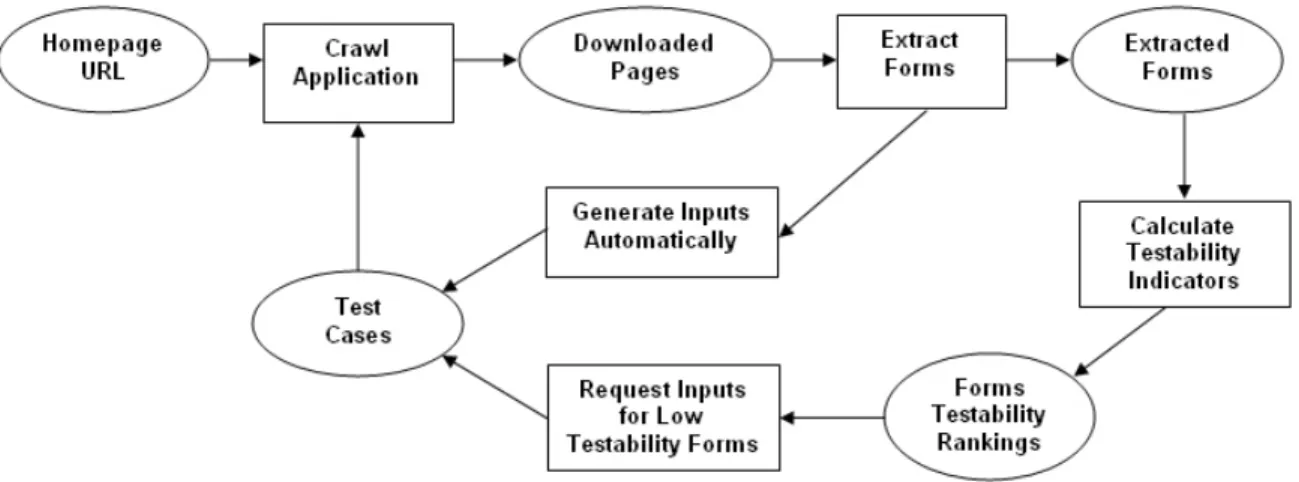
Figure 1 summarizes the most relevant activities of the proposed framework. The URL for the starting page of the web application under test is provided by the user and crawling starts from that point. The crawler will download the web page and identify any forms it contains. Input val-ues are automatically generated (by mixing random valval-ues and input taken from a predefined database, when available) for these forms and test cases are created. The crawler then resumes crawling using those created test cases and the pro-cess is repeated for each encountered page.
The identified forms are analyzed and testability indica-tors are calculated for each form. A ranking of forms is
Figure 1. The proposed framework showing the sequence of testing steps taken by the tester
Figure 2. A simple demonstration of how measures can help achieve more coverage
then generated and displayed to the user. Some indicators might prove to be more accurate than others in a given ap-plication. This could depend for example on the languages used to implement the application (JavaScript/AJAX rather than JSP/Java Servlet). However, this ranking approach is assumed to give an initial idea of which forms are more suitable candidates for further/manual investigation.
The user is supported in choosing which forms to con-centrate on that can lead to higher page and application coverage. Testability measures could indicate that more ac-curate analysis may be required. The measures also pro-vide some insight into which aspects of these forms need more care. For example, a testability indicator related to a high number of client side validation functions may lead the user to provide more input values for fields that trigger these functions.
The input values provided by the user are then used to generate additional test cases that could lead to new target pages being covered. These pages are processed in the same way returning control to the user when more manual
inter-vention is needed. The process can continue until the user is satisfied or no new pages are encountered.
Figure 2 is a simple demonstration of the result of the approach. Nodes represent pages in the application and edges represent dependencies (due to links and forms) be-tween these pages. A testability measureMiis calculated
for pages with forms such as nodes 4 and5 in the figure. When this measure indicates low testability (node 4), the tester’s attention is directed to this part of the application leading to new pages as indicated by the dashed lines.
3. Aspects Affecting Testability in Web
Appli-cations
3.1. Forms
Form inputs affect the generation of dynamic content and sometimes the target pages that can be navigated, thus af-fecting page coverage. Though a form could have several types of input fields, we can divide those types into two cat-egories: enumerable and unbounded.
Enumerable fields are those fields that in the form def-inition itself have a list of all possible input values from which the user can choose. Examples of such fields are drop down lists, radio buttons and check boxes. Other types that are slightly different but can be included in this category are buttons and hidden fields since the choices of inputs are limited as well.
A form with enumerable fields has a number of possible input combinations. Different combinations can lead to dif-ferent target pages and thus if all possible combinations are explored more page coverage could be reached. However, even a simple form with a few enumerable fields could have a large number of possible combinations of inputs. Figure 3 shows a simple form taken from Facebook. Although it has only two inputs, the number of possible choices for the
countryfield are251and forestimated budgetare4, making the number of possible combinations1,004.
Figure 3. Facebook Form: there are 1,004 possible input combinations for this simple form
It is hard to determine which input combinations lead to new pages that have not been covered. Covering all combi-nations in forms that have millions of possible combicombi-nations could be time consuming. Therefore, a form with a higher number of input combinations could be considered to have lower testability.
Unbounded fields are text based fields that the user has to enter. The possible values are unbounded and therefore are more challenging to automatically generate. Examples of these types are text and password fields and search boxes. A form with a larger number of unbounded fields could be considered to have lower testability, because generating meaningful values for these fields may be quite hard.
Moreover, these fields could be dependent upon each other. In this case values need to be generated that are both meaningful and properly related. Examples of such hard– to–fill forms are login and credit card details forms.
Clearly, unbounded fields could be sometimes easy to fill such as description or comment fields. Therefore, ad-ditional measures about server side validations, database queries and client side validations performed on fields should be defined. These measures could help to better characterize the difficulty of finding meaningful values for unbounded fields. However, the raw number of unbounded fields is itself a testability indicator that we will consider.
3.2. Client Side Validation
Forms or form fields can have a client side script such as JavaScript functions attached to them. These scripts are triggered by certain events such as changing the value of the field or moving the cursor over it.
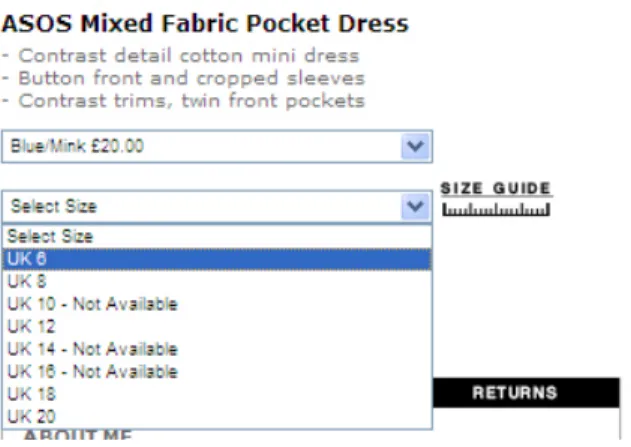
These scripts could display text to help the user fill out the field or highlight a field to show an invalid input. Other scripts could automatically fill a dependent field when a cer-tain field is filled or can change the possible choices for an enumerable field. Figure 4 shows an example of such a form taken from the ASOS website where changing the selected colour triggers a JavaScript function that changes available sizes for that colour. Dynamic modification of DOM is a more advanced type of client side scripts which may affect also the forms in the page. This happens for instance in AJAX applications, where form elements can be added or removed or new forms can be created based on user actions.
Figure 4. ASOS Form: changing the colour triggers a JavaScript function that changes available sizes
Forms with a higher number of each of these script types can be considered harder to test. We will consider each of these JavaScript function types separately when measuring a form’s testability. However, in this work we do not ana-lyze plug-ins and extensions such as applets, flash and Ac-tiveX controls, which are indeed quite hard to test.
3.3. Server Side Manipulation
Inputs Affecting Execution Paths: Server side code generates dynamic pages based on choices made by the user. Input fields can be directly or transitively used in page generation statements. This can be along a high number of different paths in the server code which indicates that pages can be generated in a number of different ways. Each of these paths may need separate test inputs to satisfy.
Inputs Used in Queries: Inputs that are used to query the database need meaningful values imbued with domain knowledge, so that valid results can be returned. Hence, the presence of dependencies between form inputs and database queries is also an indicator of hard to test forms.
Non–User Inputs:Some inputs used on the server side are not directly entered by the user, such as date or location. These parameters can be used to display different pages at different times or customize pages based on the user’s loca-tion, hence affecting the web application’s testability.
In this paper we do not define server side measures more formally, as we do with client side measures. Further in-vestigation of server side testability measurements remains a topic for future work.
4. Defining Testability Measures
In order to define the proposed testability measures un-ambiguously, we first introduce a web application model, structured into components and relationships between them.
Figure 5. Model of typical web application structure
Measures will refer to these entities. We also introduce aux-iliary functions defined upon the model entities, which sim-plify successive measures definition.
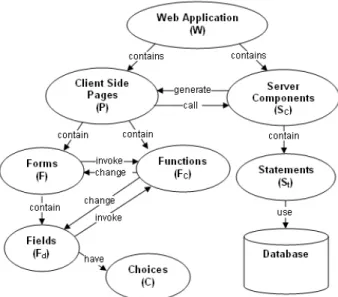
Figure 5 shows a generic web application model. In this model, a web application (W) can be looked at from 2 dif-ferent perspectives: client side and server side. Client side pages (P) are those that the browser displays to the user navigating the application. Server side components (Sc)
are the software components that the web server invokes to generate the client pages. They are also responsible for retrieving persistent data from the database. A server com-ponent is made of statements (St), these statements in our
context can have different types: HTML generating state-ments, database access statestate-ments, control statements and other statements. Client side pages consist of forms (F) and client side scripts such as JavaScript functions (Fc). Forms
consist of input fields (Fd). Each field of enumerated type
has a finite number of possible input choices drawn from a setC. Both forms and fields can invoke JavaScript func-tions, which may in turn change existing fields and forms or create new fields or forms, due to the possibility of DOM manipulation available to JavaScript functions.
To improve readability, we use uppercase letters to rep-resent sets and lowercase to reprep-resent instances. We first define a web application as a set of client side pages and server components:
W :< P, Sc >
We define a functionforms, that retrieves all forms in a client side page:
forms:P →2F
We define a functionfields, which maps forms to the set of fields that occur in the form:
fields:F→2Fd
We define a functionchoicesthat returns the set of pos-sible input values defined in the HTML code for a field or⊥
if the field is unbounded. The function is defined as follows:
choices:Fd →2C∪ {⊥}
choices(fd) =
(
{c1, . . . , cn}, iffdis enumerable ⊥, iffdis unbounded
Where{c1, . . . , cn}is the set of possible choices forfd.
We define a functionunboundedto return those fields which have an unbounded number of possible input values (i.e. free text inputs such as password, text fields and search boxes):
unbounded:F→2Fd
unbounded(f) ={fd∈fields(f)|choices(fd) =⊥}
We define a functionenumerableto return those fields Fdwhich are enumerable (i.e. not unbounded):
enumerable:F →2Fd
enumerable(f) =|fields(f)| − |unbounded(f)|
We definefunctionsto be a function that returns the set of JavaScript event handler functions, associated with a re-stricted set of relevant events, which are attached to form elements (e.g. input fields, buttons, etc.), excluding special cases, such as handlers performing unchecked form submis-sion in response to mouse click:
functions:F →2Fc
4.1. Testability Measures
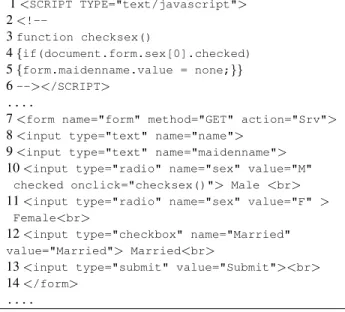
We now introduce the proposed testability measures, to be calculated for each form in the application. We shall define each measure by giving it a name, an acronym, a short description, a formula and a usage example. Table 1 is a simple form example that we will use to illustrate our measures. The code represents a simple form that allows the user to enter his/her name and allows him/her to provide information about their sex and marital status. Selecting
Maleas sex will reset (by a JavaScript function) the maiden name text box tonone.
4.1.1 Field values
Unbounded fields can be more challenging for automated input generation. We define a function N UF (Number of Unbounded Fields) that returns the number of unbounded fields in a form as follows:
N UF :F →N
1<SCRIPT TYPE="text/javascript"> 2< !--3function checksex() 4{if(document.form.sex[0].checked) 5{form.maidenname.value = none;}} 6--></SCRIPT> ....
7<form name="form" method="GET" action="Srv">
8<input type="text" name="name">
9<input type="text" name="maidenname">
10<input type="radio" name="sex" value="M" checked onclick="checksex()"> Male <br>
11<input type="radio" name="sex" value="F" >
Female<br>
12<input type="checkbox" name="Married" value="Married"> Married<br>
13<input type="submit" value="Submit"><br>
14</form>
....
Table 1. Simple form used to demonstrate testability measures
For our example the number of unbounded fields is2, so the value forN UFwould be calculated as follows:
N UF(f orm) =|unbounded(f orm)|= 2
A form with a larger number of possible combinations of inputs is harder to test exhaustively or in a way that would ensure high coverage oft-way combinations. We define a functionEF C (Enumerable Field Combinations) that cal-culates the number of combinations of choices for enumer-able fields. We define the function as follows:
EF C:F →N
EF C(f) = Y
fd∈enumerable(f)
|choices(fd)|
In our example there are two enumerable fields,Sexand
Married. The number of possible choices forSex is 2 (M
andF) and forMarriedis also 2 (checkedandunchecked). EF Cfor this form will be calculated as follows:
EF C(f orm) = Y
fd∈enumerable(f orm)
|choices(fd)|
= 2×2 = 4 4.1.2 Client Side Validation
Forms and form fields that invoke JavaScript functions that change the interface need more attention in input genera-tion, to fully test these functions. We differentiate between the following types of JavaScript functions:
• Type 1JavaScript functions that modify only elements related to text and display.
• Type 2 JavaScript that modifies existing fields in ex-isting forms and possibly elements related to text and display.
• Type 3JavaScript that modifies the structure of forms by adding or changing fields or forms and possibly el-ements related to text and display and existing fields. JavaScript functions that do not manipulate the interface such as logging a request are not considered.
We define a functionCSS(Client Side Scripts) that mea-sures the testability in terms of JavaScript functions. We define the function as follows:
CSS:F →N
More specifically, we define this measure for each type of JavaScript code mentioned above as follows:
CSS1(f) =|{fn∈functions(f)|fn of type1}|
CSS2(f) =|{fn∈functions(f)|fn of type2}|
CSS3(f) =|{fn∈functions(f)|fn of type3}|
In our example we only have one JavaScript function of
Type 2 where functionchecksex() changes the value of an existing fieldmaidenName. Therefore the value of the three measures will be as follows:
CSS1(f orm) =|{fn∈functions(f orm)|fnof type1}|= 0
CSS2(f orm) =|{fn∈functions(f orm)|fnof type2}|= 1
CSS3(f orm) =|{fn∈functions(f orm)|fnof type3}|= 0
5. Experimentation with the Approach
With the aim of conducting a preliminary framework evaluation and refinement, we performed the following steps:
1. Selected applications and forms to be evaluated. 2. Applied WATT to those forms to collect the presented
measures: number of unbounded fields (N UF), num-ber of possible combinations (EF C), and the number of each of the three types of JavaScript functions at-tached to form elements (CSS1,CSS2andCSS3).
3. An expert tester (a different author not involved in the framework definition) tested and evaluated each form as ‘hard’ or ‘easy’ to test (see below).
4. Observed and compared the obtained measures to the expert evaluation.
5.1. WATT Tool
We developed a prototype of the Web Application Testa-bility Tool (WATT). The tool supports our framework by crawling an application automatically, collecting data about the application’s client-side structure, and calculating testa-bility measures.
The tool has the ability to automatically fill and submit forms using a mixture of random input values and user pro-vided values. The tool also parses JavaScript and extracts links. It also manages cookies and user sessions. While crawling the site, the tool generates a parse tree of the down-loaded HTML files and extracts different components and their structure such as forms and JavaScript and stores them to the database. The structure of the application and how its pages are connected is also stored and can be used for fur-ther analysis later. The tool can also determine which en-countered links/forms failed by capturing the response code generated by the server. While crawling, JavaScript func-tions attached to form elements are parsed for keywords to determine their type. The result is then manually reviewed to insure accuracy. A filter can be provided to limit the crawler to a certain path and sub directory.
The tool was developed and tested based on the com-pleteness criteria and the categorization of Hypertext links proposed by Girardi et al. [7].
In this experiment we limit the WATT tool to the appli-cation pages that contain the selected forms.
5.2. Form Selection and Classification
To apply the tool, we selected 34 forms taken from 14 real world web applications. The forms were taken from a number of well known sites such as Facebook, Yahoo and YouTube and commercial downloadable applications such as Softslate, osCommerce and Zen Cart. These forms have been selected to cover different types of forms such as lo-gin, registration, search and order forms. They were also selected to have different structural sizes and complexity.
An expert tester has been asked to classify these forms as ‘easy’ or ‘hard’ to test. The tester analyzed and tested each form then annotated the main activities applied during this task as follows:
• Analysis of the possible combinations of the form fields; each form has been exercised by using ad-hoc coverage criteria for field combinations with the pur-pose of discovering new application parts/behaviours.
• Inspection and evaluation of field-attached actions, in both client and server-side code (e.g. JavaScript checks related to fields, links to server components). Application components that impact the form/page have been manually inspected. This was done to un-derstand whether their behaviour on the form impacts the application exploration.
• Evaluation of the random exploration of the form and the required manual intervention. In this case, each form has been exercised by using only random inputs with the aim of evaluating how much the form can be automatically explored.
• Analysis of documentation, help, and information con-tained in the page about how to fill and activate the form.
• Evaluation of the overall time required to study the form fields with the aim of selecting an adequate set of inputs required to exercise the form during testing. According to this evaluation each form has been classified as ‘easy to test’ when it requires little testing effort to be ‘reasonably’ tested and ‘hard to test’ if a lot of effort has been required. This classification is made entirely by human intuition, based on the above guidelines.
5.3. Results
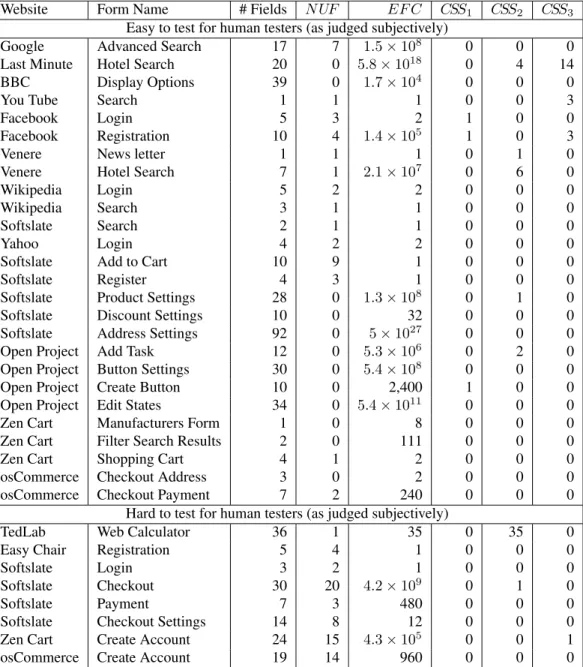
We ran the tool on our selected forms and collected the results presented in Table 2. The results show a somewhat consistent relation between the number of unbounded fields and human classification of the forms. One exception is Web Calculator, where the form was classified as hard while it only contains one unbounded field. This is because the form has a large number of buttons that operate on this field. However, this is captured in the number of JavaScript func-tions attached to this form which is 35 (CSS2). Most of the
forms rated easy to test have a low number of unbounded fields.Google’s Advanced Searchform is an exception. For a human tester it is easy to classify this form as easy to test since any random data could be used to submit the form successfully. However, this observation requires additional domain knowledge that can not be available to a measure-ment.
The Venere Hotel Searchform has a number of events that perform client side JavaScript validations on fields. One example is to check if the selected ‘From Date’ is less than or equal to the selected ‘To Date’. This was captured by theCSS2measure.
The possible number of input combinations seems to have not affected the human rater’s judgement of ‘subjec-tive testability’. For instance, Softslate’s Address Settings
form has the largest number of possible combinations in the set. However, the input fields consist of 92 check boxes and this is what causes the possible number of combina-tions to be high. Choosing combinacombina-tions that represent the typical application behaviour we can encounter is sufficient to achieve high coverage in this case. However, this is not always an easy task especially when testers have no special knowledge about the application under testing. Therefore, this measurement could indicate to the tester that due to the large number of possible combinations, the form needs to be examined to determine which combinations need to be tested. This leads us to conclude that this measure needs to be combined with other measures to be a better indicator of testability. One way to refine this measure could be analy-sis of the server side code to determine how many different combinations lead to different behaviour.
We observe in Table 2 that JavaScript is not as frequently attached to the form fields as we expected. This could be caused by the fact that JavaScript is a client side scripting language. Checks on input values in forms on the client side
Website Form Name # Fields N UF EF C CSS1 CSS2 CSS3
Easy to test for human testers (as judged subjectively)
Google Advanced Search 17 7 1.5×10⁸ 0 0 0
Last Minute Hotel Search 20 0 5.8×10¹⁸ 0 4 14
BBC Display Options 39 0 1.7×10⁴ 0 0 0
You Tube Search 1 1 1 0 0 3
Facebook Login 5 3 2 1 0 0
Facebook Registration 10 4 1.4×10⁵ 1 0 3
Venere News letter 1 1 1 0 1 0
Venere Hotel Search 7 1 2.1×10⁷ 0 6 0
Wikipedia Login 5 2 2 0 0 0
Wikipedia Search 3 1 1 0 0 0
Softslate Search 2 1 1 0 0 0
Yahoo Login 4 2 2 0 0 0
Softslate Add to Cart 10 9 1 0 0 0
Softslate Register 4 3 1 0 0 0
Softslate Product Settings 28 0 1.3×10⁸ 0 1 0
Softslate Discount Settings 10 0 32 0 0 0
Softslate Address Settings 92 0 5×1027 0 0 0
Open Project Add Task 12 0 5.3×10⁶ 0 2 0
Open Project Button Settings 30 0 5.4×10⁸ 0 0 0
Open Project Create Button 10 0 2,400 1 0 0
Open Project Edit States 34 0 5.4×10¹¹ 0 0 0
Zen Cart Manufacturers Form 1 0 8 0 0 0
Zen Cart Filter Search Results 2 0 111 0 0 0
Zen Cart Shopping Cart 4 1 2 0 0 0
osCommerce Checkout Address 3 0 2 0 0 0
osCommerce Checkout Payment 7 2 240 0 0 0
Hard to test for human testers (as judged subjectively)
TedLab Web Calculator 36 1 35 0 35 0
Easy Chair Registration 5 4 1 0 0 0
Softslate Login 3 2 1 0 0 0
Softslate Checkout 30 20 4.2×10⁹ 0 1 0
Softslate Payment 7 3 480 0 0 0
Softslate Checkout Settings 14 8 12 0 0 0
Zen Cart Create Account 24 15 4.3×10⁵ 0 0 1
osCommerce Create Account 19 14 960 0 0 0
can be easily bypassed causing a security threat. This could cause developers to prefer server side input validation while using JavaScript to enrich the application GUI.
We also notice that the form size and complexity is only partially tied with the judgement of the human tester. For instance, we can considerFacebook Registrationand Softs-late Payment. They are similar in terms of number of fields and JavaScript but differently classified as easy (Facebook Registration) and hard (Softslate Payment) to test. This is primarily because of different input validation checks ap-plied to their fields. In fact, in the Facebook Registration
form there are a few simple checks (e.g. email format) while inSoftslate Paymentstrong checks related to credit card val-idation are performed (in both client and server side).
Another example isSoftslate Checkoutcompared to Soft-slate Payment. In this case, we see that both forms were classified as hard to test by the human while they are dif-ferent in terms of number of fields and their combinations. In particular, Checkout has30 fields and 4.2×10⁹
com-binations while Payment only has 7 fields and 480 com-binations. The difference lies in the validation checks ap-plied to each field of these forms. ForCheckout, there are a few checks (e.g. email format, ZIP code format) while in
Paymentthere are some more complicated checks related to credit card validation.
Furthermore, we can compare Softslate Register and
Easy Chair Registration. Although their measures are com-parable, they were classified as easy and hard to test by the human rater respectively. The main reason is that inEasy Chair Registrationthere is a ‘CAPTCHA’ field that must be manually transcribed by the tester.
Of course, the obtained results are preliminary in nature and cannot be generalized. However, they are encouraging and indicate that with more refinement, measures could be proved to be helpful in testing. In future work, a larger scale more developed evaluation of the approach and analysis of server side related measures will be conducted.
6. Related Work
Several testing web techniques and tools have been pro-posed as a result of the increased pervasiveness of web applications. This increased pervasiveness demands high quality applications with low defectiveness.
Functional testing is the most widely applied testing ap-proach. Existing tools for web applications (e.g. LogiTest, Maxq, Badboy), are based on capture/replay facilities: they record the interactions that a user has with the graphical in-terface and repeat them during regression testing. An alter-native is based on tools such as HttpUnit. HttpUnit is a Java API that provides the building blocks required to emulate the browser’s behaviour. When combined with a framework such as JUnit, HttpUnit allows testers to create test cases to verify Web Application behaviour [10].
Model-based testing of web applications was initially
proposed by Ricca and Tonella [15] and then refined by oth-ers. This testing approach performs a preliminary analysis of the application under test with the aim of describing it by means of a model (often, it describes web pages, links and forms). Coverage criteria are applied to the model to extract test case suites. Recently, model-based testing approaches have been applied to web 2.0 applications [13, 14]. These approaches extract test cases by studying the client-side be-haviour of the application.
Elbaum et al. [8] propose a web testing a web testing ap-proach that uses data captured in user sessions to create test cases automatically. Alshahwan and Harman [1] proposed a session data repair approach to be used in regression testing. A test case for a web application can be viewed as a se-quence of web pages, enriched by inputs and user actions performed through the GUI. The goal of a test case is to emulate an execution in which the expected and real appli-cation behaviour are compared. One of the most relevant difficulties in web testing is that a lot of manual interven-tion is often required to fully test the applicainterven-tion. In fact by applying only automatic testing criteria there is no way to guarantee that a web application is ‘completely’ covered (e.g. all links, pages and forms).
Testability metrics have been used and defined for tra-ditional software such as Object Oriented software for pre-dicting testing effort. For instance, Bruntink and Deursen [5, 6] evaluated and defined a set of testability metrics for Object Oriented programs and analyzed the relation be-tween classes and their JUnit test cases. Jungmayr [11] sug-gests that testability metrics can be used to identify parts of the application causing a lower testability level by analysing test critical dependencies.
In web applications, metrics have been used especially for maintainability and evolution. Emad Ghosheh et al. [9] compare a number of papers that define and use web main-tainability metrics. These are mostly source code metrics that predict maintainability of web applications. Warren et al. [17] created a tool to collect a number of metrics to mea-sure web application evolution over an interval of time. In the context of using metrics to aid testing, Bellettini et al. [3] created a tool TestUML that combines a number of tech-niques to semi-automatically test a web application. Met-rics such as number of pages or number of objects were used to define coverage level and then be used for stopping the testing process based on user criteria.
The framework we propose combines the existing web testing approaches with testability measures. This would help to prioritize parts of the application with low testa-bility during the testing process. Combining testing with testability measures would help the tester identify areas of the application that need more attention thereby decreasing the testing effort.
on in this paper is that measures are used during the testing process to guide the tester to areas where efforts could be most effective.
7. Conclusion and Future Work
In this paper we have introduced an approach to testing web based systems that is integrated and interwoven with the process of computing measurements of the system under test. The approach collects facts about the system under test as it spiders over the site, entering data for forms and seeking to cover structure. These facts are used to compute measurements. While the measurements collected during testing can report on any aspect of the system, it is natural to focus on testability, especially since web based systems pose particular challenges for testing.
We report on an implementation, WATT, a system that implements the ‘in testing’ computation of testability mea-sures that we advocate. We present results from initial experiments with five simple measurements, computed us-ing WATT for 14 web based systems, comprisus-ing of well-known web sites and downloadable web applications. Al-though the results are preliminary, they highlight some in-teresting features of the systems under test and the way in which measures can be used to draw the tester’s attention to them.
Much remains to be done to develop this research agenda. Future work will focus on the development of addi-tional measurements at the server side to complement those presented for client side testing in this paper. More work is also required to evaluate testability transformation mea-surements for web based testing. This work will explore the correlation between testability measurements and the behaviour of and effort required by test data generation ap-proaches. We plan to further develop the WATT testing tool to achieve these goals for future work and to release it for wider research use.
References
[1] N. Alshahwan and M. Harman. Automated session data re-pair for web application regression testing. InICST ’08: Proceedings of the 2008 International Conference on Soft-ware Testing, Verification, and Validation, pages 298–307, Washington, DC, USA, 2008. IEEE Computer Society. [2] J. O. Anneliese A. Andrews and R. T. Alexander. Testing
web applications by modeling with fsms.Software and Sys-tems Modeling, 4:326–345, 2005.
[3] C. Bellettini, A. Marchetto, and A. Trentini. TestUml: user-metrics driven web applications testing. InSAC ’05: Pro-ceedings of the 2005 ACM symposium on Applied comput-ing, pages 1694–1698, New York, NY, USA, 2005. ACM. [4] M. Benedikt, J. Freire, and P. Godefroid. Veriweb:
Au-tomatically testing dynamic web sites. InProceedings of 11th International World Wide Web Conference, Honolulu, Hawaii,USA, 2002.
[5] M. Bruntink and A. van Deursen. Predicting class testability using object-oriented metrics. InSCAM ’04: Proceedings of the Source Code Analysis and Manipulation, Fourth IEEE International Workshop, pages 136–145, Washington, DC, USA, 2004. IEEE Computer Society.
[6] M. Bruntink and A. van Deursen. An empirical study into class testability.J. Syst. Softw., 79(9):1219–1232, 2006. [7] F. R. Christian Girardi and P. Tonella. Web crawlers
com-pared. International Journal of Web Information Systems, 2:85–94, 2006.
[8] S. Elbaum, S. Karre, and G. Rothermel. Improving Web application testing with user session data. InProceedings of the 25th International Conference on Software Engineer-ing (ICSE), pages 49–59, Portland, USA, May 2003. IEEE Computer Society.
[9] E. Ghosheh, J. Qaddour, M. Kuofie, and S. Black. A com-parative analysis of maintainability approaches for web ap-plications. InAICCSA ’06: Proceedings of the IEEE In-ternational Conference on Computer Systems and Applica-tions, pages 1155–1158, Washington, DC, USA, 2006. IEEE Computer Society.
[10] E. Hieatt, R. Mee, and G. Faster. Testing the web appli-cation engineering internet. IEEE Software, 19(2):60–65, March/April 2002.
[11] S. Jungmayr. Testability measurement and software depen-dencies. InProceedings of the 12th International Workshop on Software Measurement, pages 179–202, Aachen, 2002. Magdeburg,Shaker Publ.
[12] K. Lakhotia, P. McMinn, and M. Harman. Automated test data generation for coverage: Haven’t we solved this prob-lem yet? In 4thTesting Academia and Industry Confer-ence — Practice And Research Techniques (TAIC PART’09), Windsor, UK, 4th–6th September 2009. To appear. [13] A. Marchetto, P. Tonella, and F. Ricca. State-based testing
of ajax web applications. InInternational Conference on Software Testing Verification and Validation (ICST), Lille-hammer, Norway, April 2008. IEEE Computer Society. [14] A. Mesbah, , and A. van Deursen. Invariant-based automatic
testing of ajax user interfaces. In31st International Confer-ence on Software Engineering (ICSE). IEEE Computer So-ciety, May 2009.
[15] F. Ricca and P. Tonella. Analysis and testing of web appli-cations. InICSE ’01: Proceedings of the 23rd International Conference on Software Engineering, pages 25–34, Wash-ington, DC, USA, 2001. IEEE Computer Society.
[16] F. Ricca and P. Tonella. Building a tool for the analysis and testing of web applications: Problems and solutions. InTACAS 2001: Proceedings of the 7th International Con-ference on Tools and Algorithms for the Construction and Analysis of Systems, pages 373–388, London, UK, 2001. Springer-Verlag.
[17] P. Warren, C. Boldyreff, and M. Munro. The evolution of websites. InIWPC ’99: Proceedings of the 7th International Workshop on Program Comprehension, page 178, Washing-ton, DC, USA, 1999. IEEE Computer Society.
[18] Y. Wu and J. Offutt. Modeling and testing web-based appli-cations. Technical report, George Mason University, 2002.