Design of a Social Messaging System
Using Stateful Multicast
Gabor X Toth
University of Amsterdam Faculty of Science
System and Network Engineering Master thesis
Supervisor: Christian Grothoff, TU München
Abstract
This work presents the design of a social messaging service for the GNUnet peer-to-peer framework that offers scalability, extensibility, and end-to-end encrypted communication. The scalability property is achieved through mul-ticast message delivery, while extensibility is made possible by using PSYC (Protocol for SYnchronous Communication), which provides an extensible RPC (Remote Procedure Call) syntax that can evolve over time without hav-ing to upgrade the software on all nodes in the network. Another key feature provided by the PSYC layer are stateful multicast channels, which are used to store e.g. user profiles. End-to-end encrypted communication is provided by the mesh service of GNUnet, upon which the multicast channels are built. Pseudonymous users and social places in the system have cryptographical identities — identified by their public key — these are mapped to human memorable names using GNS (GNU Name System), where each pseudonym has a zone pointing to its places.
Acknowledgements
I would like to thank Christian Grothoff for the advice and discussions related to the design of the system presented here. I also thank Carlo v. Loesch for comments about the use of PSYC in the system.
Contents
1 Introduction 1
1.1 Public Key Infrastructure . . . 2
1.2 Identity management with GNS . . . 3
2 Overview of the system 5 3 Multicast service 9 3.1 Multicast API overview . . . 10
3.1.1 Origin . . . 10
3.1.2 Member . . . 10
3.1.3 Group . . . 11
3.2 Starting the origin . . . 11
3.3 Stopping the origin . . . 12
3.4 Joining a group . . . 12
3.4.1 Requesting join . . . 12
3.4.2 Receiving the join request . . . 14
3.4.3 Responding with a join decision . . . 14
3.5 Parting a group . . . 15
3.6 Multicast messages . . . 15
3.7 Testing membership . . . 17
3.8 Replaying multicast messages . . . 18
3.9 Unicast requests . . . 21
4 PSYC service 23 4.1 PSYC API overview . . . 24
4.1.1 Channel master . . . 25
4.1.2 Channel slave . . . 25
4.1.3 Channel . . . 25
4.2 Starting the channel master . . . 26
4.3 Stopping the channel master. . . 27
4.4 Joining a channel . . . 27
4.4.1 Requesting join . . . 27
4.4.2 Responding to a join request . . . 28
4.4.3 Notifying the channel about the new slave . . . 29
4.4.4 Informing the requester about the decision . . . 30
4.4.5 State synchronization . . . 30
4.5 Parting a channel . . . 31
4.6 Messages from the master . . . 32
4.6.1 Sending messages . . . 32
4.6.2 Receiving messages . . . 33
4.7 Requests from slaves . . . 34
4.8 History and state requests by applications . . . 35
4.8.1 Requests for historic messages . . . 35
4.8.2 State variable requests . . . 36
5 PSYCstore service 37 5.1 PSYCstore API overview . . . 37
5.2 Message store . . . 37
5.2.1 Storing message fragments . . . 38
5.2.2 Retrieving messages . . . 39
5.3 Channel state store . . . 40
5.3.1 Applying state modifiers . . . 40
5.3.2 State hash updates . . . 41
5.3.3 Retrieving state variables . . . 42
5.4 Membership store . . . 42
5.4.1 Storing membership . . . 42
5.4.2 Testing membership . . . 44
6 Social service 45 6.1 Social network model . . . 45
6.2 Messaging in places . . . 45
6.3 Applications . . . 47
6.4 Social API overview . . . 48
6.4.1 Home . . . 48
6.4.2 Place. . . 48
6.5 Using the social API . . . 49
6.6 Entering a home . . . 49
6.7 Advertising a home in GNS . . . 50
6.8 Entering a place . . . 51
6.8.1 Guest requests entry . . . 51
6.8.2 Host answers the door . . . 52
6.9 Leaving a place or home . . . 53
6.10 Messages. . . 54
6.10.1 Sending messages . . . 54
6.10.2 Receiving messages . . . 55
6.11 Learn the history of a place . . . 57
Contents ix
7 Summary 59
Bibliography 61
A Sequence diagrams 63
A.1 History and replay . . . 64
A.1.1 Learning the history of a place . . . 64
A.1.2 Replaying multicast messages . . . 64
A.2 Sending and receiving messages . . . 66
A.2.1 Sending a message to a home . . . 66
A.2.2 Receiving a message to a place . . . 66
A.3 Entering a home . . . 68
A.4 Entering a place . . . 68
A.4.1 Guest requests entry . . . 68
A.4.2 Host receives entry request . . . 70
A.4.3 Other guests receive entry notice . . . 72
A.5 Leaving a place . . . 74
A.5.1 Guest sends leave request . . . 74
A.5.2 Host receives leave request. . . 74
1. Introduction
Messaging and social networking services used today are in most cases centralized and operated by large companies, which do not give adequate privacy guarantees to users. Often, federated systems are suggested as an alternative, but as argued in [1], federated systems are not better from centralized ones from a privacy perspective: they still require server operators who have access to all user data stored on their systems. Additionally, in case of federated systems users even have to trust a larger set of server operators with their personal data and communications. With centralized services, trust is at least limited to a single entity.
[1] describes the high-level design of Secure Share, an alternative social messaging system. It proposes an alternative, peer-to-peer approach, where messages are end-to-end encrypted while they traverse the network and reach their destination, and suggests combining GNUnet1, a modular peer-to-peer framework, with PSYC2, a messaging protocol, to achieve this.
In this document, we present an evolution of the Secure Share design, provid-ing more details about the protocol and implementation strategy and detailprovid-ing how these extensions will be integrated with the rest of the GNUnet frame-work. In this revised design, the system is separated into several GNUnet services for each layer, enabling the re-use of components by other P2P applications. The role of the PSYC protocol has changed as well: it is now only used as the messaging protocol between peers, but not for local client connections. For user interfaces, the service model of GNUnet is followed instead.
Recently, two components have been implemented in GNUnet that play a key role in the new design. One is the mesh service, which can establish tunnels between two peers in the network through multiple hops, and is used as a building block for the multicast message delivery service. The other is the GNU Name System3 [2], which is used as a public key infrastructure in the
1
https://gnunet.org/ 2
https://about.psyc.eu/ 3
Formerly called the GNU Alternative Domain System (GADS)
Secure
Global Hierarchical Registration Memorable
Cryptogr aphic Iden tifiers Petnam e Systems mnemon ic URLs certificat es GNS
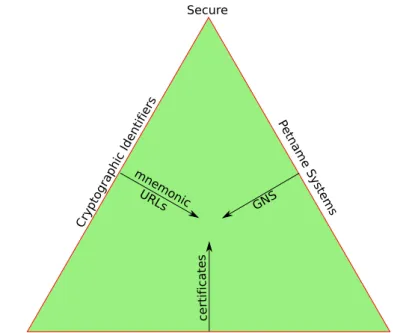
Figure 1.1.1: Zooko’s triangle showing the relationship of cryptographically secure, globally unique and human memorable names. Examples of systems satisfying pairs of these properties are shown on the edges. This figure is from [2], p. 7.
system.
1.1
Public Key Infrastructure
The GNU Name System (GNS) is a secure, decentralized name system using memorable, but not globally unique names. According to the hypothesis of Zooko’s Triangle [3, 4], achieving all three properties at the same time is not possible, Figure1.1.1illustrates this. Tor’s .onion addresses are cryptograph-ically secure, but not memorable. The Domain Name System (DNS) is a centralized system, where names are globally unique and memorable, but not secure. GNS offers an alternative to this, while maintaining backwards compatibility with DNS. It uses zones that can have DNS resource records (RR) in addition to RR types defined by GNS.
The GNS design uses cryptographical identifiers: each zone has an elliptic curve (ECC) private-public key pair, and it is identified by its public key. Resource records are signed with the private key of the zone. This allows users to manage their own zone in the system, which is used to implement a decentralized public key infrastructure (PKI). While GNS does not have globally unique names, it provides transitivity instead to make the system
1.2. Identity management with GNS 3
more usable: users can delegate a subdomain to another zone.
1.2
Identity management with GNS
Each entity in the proposed system will be identified by its elliptic curve public-private key pair, which is typically compactly represented using the hash of its public key.
GNS is used to provide memorable names for both pseudonymous users and social spaces for interactions, which we call places. As pseudonyms are identified by their ECC key, each pseudonym has implicitly also a GNS zone associated with it. A zone can contain pointers to various places operated or used by the owner of the pseudonym. For this purpose, we define a new record type called “PLACE” in GNS, which points to the public key of a place, and one or more peers that can be used to join the place. A GNS zone is published in the DHT, and its records are publicly accessible. A password can be used to encrypt certain records — including its label, type, and data — to ensure that knowledge about places is limited to authorized users.
The “PLACE” record of the empty label (+) has special significance: it points to a place which has no guests and is only used for sending requests to the pseudonym. It is used to establish an initial contact; after an entry request to this special place, the guest is typically be redirected to a place of the host’s choice. This way, a host can have several places for hosting different group of guests at the same time.
Table1.2.1 shows an example of the zone of a pseudonym. If Alice publishes this zone, then Bob — who knows Alice — can use music.alice.gnu to enter one of Alice’s places, while Carol — who only knows Bob, but not Alice — would need to usemusic.alice.bob.gnuto enter the same place.
Readers familiar with earlier designs based on PSYC might want to note that in contrast to earlier designs using PSYC, this use of GNS eliminates the need for place names on the PSYC layer. As each place is purely identified by its public key, a memorable name is assigned to it using a GNS zone entry of a pseudonym.
Label Type Data
+ PLACE P laceApub, H(P eerXpub)
tech PLACE P laceBpub, H(P eerXpub), H(P eerYpub)
music PLACE P laceCpub, H(P eerZpub)
2. Overview of the system
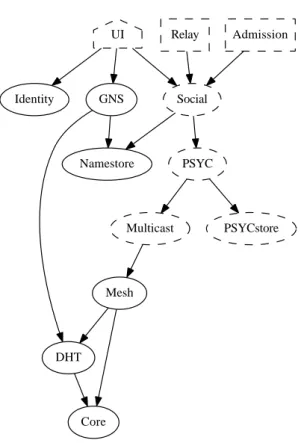
UI Identity GNS Social Relay Admission Namestore DHT PSYC Multicast PSYCstore Mesh CoreFigure 2.0.1: Components used from GNUnet in the social messaging system.
House: application, box: daemon, circle: service, arrow: dependency, dashed: component described here, to be implemented.
The social messaging system we propose to create using GNUnet, a modular peer-to-peer framework. The framework consists of several services — each running as a separate process for fault isolation — which use message passing to communicate with each other. Each service provides abstractions other components can use by linking against a shared library which implements the respective API by communication with the service process. Components relevant to the social messaging system are depicted in Figure 2.0.1. The
central components in the system are:
The Multicast service: implements reliable messaging in multicast groups. Takes care of managing group membership and message replay.
The PSYC service: parses the PSYC protocol syntax and notifies the social service about incoming method calls, also performs decentralized state operations.
The PSYCstore service: used by the PSYC service to store the decen-tralized state, messages, and membership information that belong to groups.
The Social service: models places and user identities, and allows appli-cations to register method handlers for method calls they are interested in. Uses GNS for identity management and PKI.
Applications: user interfaces or background processes that handle certain PSYC method calls.
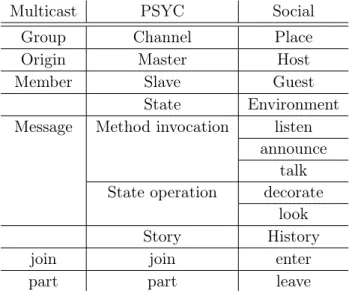
The various layers use different terms to describe related abstractions in an appropriate language for each layer. Table2.0.1 summarizes the mapping between these different terms, which we will explain in more detail for each layer in the system in the following sections.
Multicast PSYC Social
Group Channel Place
Origin Master Host
Member Slave Guest
State Environment Message Method invocation listen
announce talk State operation decorate
look Story History
join join enter
part part leave
Table 2.0.1: Relationships between the terms at the various layers. Note that as the abstractions change, the semantics of the terms do not always match perfectly; thus, the table describes which concepts on the lower layers are used to realize concepts at the higher layers.
Multicast layer: members join a group operated by the origin to ex-change messages.
7
PSYC layer: the master controls a channel where slaves can join to learn about the channel’sstateandstory. The master can performstate
operationsand triggermethod invocations on the slaves.
Social layer: guests can enter a place, talk to the host of the place,
listen to the host’sannouncements, and lookat objects in the place’s
environment, which isdecoratedby the host.
We will now describe the main services of the messaging system: multicast, PSYC, PSYCstore and social. Ultimately, each service will run as a sepa-rate process and comes with a library that provides an API for accessing functionality of the service.
3. Multicast service
We call a set of peers a group. Apolicy is used to determine which peers are allowed to join a group. Each group has a designated member called
theoriginwho is in control of thepolicy and the communication. Peers in
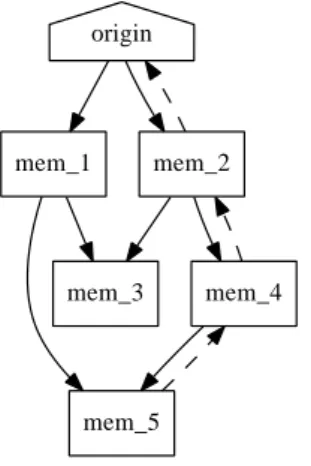
a group that are not the origin are calledmembers. While the origin is in charge of the policy, all members are trusted to enforce it and in particular not to share group communications with non-members. Using the multicast service, the origin can multicast messages to all group members, while group members can only unicast requests to the origin. Figure3.0.1 illustrates the communication structure provided by a multicast group.
origin
mem_1 mem_2
mem_3
mem_5
mem_4
Figure 3.0.1: Participants and message flow in a multicast group. Solid arrow: multicast message, dashed arrow: unicast request.
The central functions of the multicast service thus are to organize peers into multicast groups, to enable membership management, and to provide reliable (multicast) message delivery to the peers in these groups. In the multicast system, group members receive message fragments from one or more members, and can relay messages to other members. Each message fragment is signed by the origin to enable the members to verify the integrity and authenticity of the messages.
The multicast service relies on the mesh service for reliable and confidential communication between peers. Mesh provides an end-to-end encrypted secure communication channel between two peers; other peers that may be involved in message passing are not able to access the data, as encrypted messages are secured using ECDHE (Elliptic Curve Diffie-Hellman Ephemeral) exchange and AES (Advanced Encryption Standard) encryption.
3.1
Multicast API overview
The multicast service exposes the following API, which is used by the PSYC service.
3.1.1 Origin
Functions available to the group’s origin: Start (or restart) a multicast group. Stop a multicast group.
Transmit a message to all members. Join decision: response to a join request.
Callbacks for the origin:
Request received from a group member.
Own messages fragmented and signed, to store them for replay.
3.1.2 Member
Functions available to group members: Join (or rejoin) a multicast group. Part a multicast group.
Transmit a message to the origin.
Request replay of a message from other group members.
Callbacks for group members: Message received for the group.
3.2. Starting the origin 11
3.1.3 Group
Functions available to both the origin and members:
Membership test answer: respond to a membership test query.
Callbacks for the origin and members: Join request received from a peer.
Membership test: the implementation needs to check whether a member was admitted to the group when the given message fragment was sent out. It is needed to ensure message fragments are relayed only to members.
3.2
Starting the origin
A group is fully functional while its origin is started. The origin is stopped when it goes offline, and can be restarted at a later point. After the origin is started, it can start transmitting multicast messages to group members, and it receives join requests from peers and unicast requests from members. To start the origin, the following function of the multicast API is used:
s t r u c t G N U N E T _ M U L T I C A S T _ O r i g i n * G N U N E T _ M U L T I C A S T _ o r i g i n _ s t a r t ( c o n s t s t r u c t G N U N E T _ C O N F I G U R A T I O N _ H a n d l e * cfg , c o n s t s t r u c t G N U N E T _ C R Y P T O _ E c c P r i v a t e K e y * p r i v a t e _ k e y , u i n t 6 4 _ t l a s t _ f r a g m e n t _ i d , G N U N E T _ M U L T I C A S T _ J o i n C a l l b a c k join_cb , G N U N E T _ M U L I T C A S T _ M e m b e r s h i p T e s t C a l l b a c k test_cb , G N U N E T _ M U L I T C A S T _ R e p l a y C a l l b a c k r e p l a y _ c b , G N U N E T _ M U L T I C A S T _ R e q u e s t C a l l b a c k r e q u e s t _ c b , G N U N E T _ M U L T I C A S T _ M e s s a g e C a l l b a c k m e s s a g e _ c b , v o i d * cls ) ;
Group’s private-public key pair: used to identify the group and sign message fragments sent to group members.
Last fragment ID: when restarting a group, the fragment ID to start numbering fragments from. As each member stores message fragments, this is necessary to make sure a rejoining member can replay missed message fragments.
Callbacks: functions to call for requesting replay, testing membership, as well as notifying about joins, unicast requests, and the origin’s own message fragments it sends out. These are explained later in this chapter.
3.3
Stopping the origin
The following function of the multicast API is used to stop the origin:
v o i d
G N U N E T _ M U L T I C A S T _ o r i g i n _ s t o p
( s t r u c t G N U N E T _ M U L T I C A S T _ O r i g i n * o r i g i n ) ;
When the origin is stopped, the group might still function partially: a peer can still join at another online member provided one is known, and the peer is already admitted or no admission is required. Replay requests can still be issued to other members. To shut down a group permanently, including all of its members, an application layer message has to be sent to all members by the origin.
Stopping an origin but leaving other members running improves asynchronous messaging capabilities of the group: if a member was offline for a while, it can reconnect to the group and request replay of missed messages, even if the origin is not online at the moment, provided some of the relays the member got during a previous session are still online.
3.4
Joining a group
3.4.1 Requesting join
To join a group as a member, the multicast API provides the following function: s t r u c t G N U N E T _ M U L T I C A S T _ M e m b e r * G N U N E T _ M U L T I C A S T _ m e m b e r _ j o i n ( c o n s t s t r u c t G N U N E T _ C O N F I G U R A T I O N _ H a n d l e * cfg , c o n s t s t r u c t G N U N E T _ C R Y P T O _ E c c P u b l i c K e y * g r o u p _ k e y , c o n s t s t r u c t G N U N E T _ C R Y P T O _ E c c P r i v a t e K e y * m e m b e r _ k e y , c o n s t s t r u c t G N U N E T _ P e e r I d e n t i t y * origin , s i z e _ t r e l a y _ c o u n t , c o n s t s t r u c t G N U N E T _ P e e r I d e n t i t y * relays , c o n s t s t r u c t G N U N E T _ M e s s a g e H e a d e r * j o i n _ r e q u e s t , G N U N E T _ M U L T I C A S T _ J o i n C a l l b a c k join_cb , G N U N E T _ M U L I T C A S T _ M e m b e r s h i p T e s t C a l l b a c k test_cb , G N U N E T _ M U L I T C A S T _ R e p l a y C a l l b a c k r e p l a y _ c b , G N U N E T _ M U L T I C A S T _ M e s s a g e C a l l b a c k m e s s a g e _ c b , v o i d * cls ) ;
Group’s public key: identifies the group to join, and used to verify signatures of multicast messages.
Member’s private-public key pair: used to identify the member and to sign unicast requests sent to the origin, including the join request.
3.4. Joining a group 13
Origin: the peer identity of the group’s origin, to send the join request to if no relays are known or available.
Relays: peer identities of members of the group that are known to serve as relays, and can be used to send the join request to. This list can include relays known from a previous session, which allows rejoining a group later to replay missed messages, even if the origin is offline. Join request: a message from the application initiating the join process.
The PSYC layer uses this for initiating state synchronization, while applications can supply additional information needed for joining. Callbacks: similar callbacks as for the origin, except for the request
callback, which is only used for the origin.
When joining a group, the multicast service establishes a mesh tunnel to the relays if any given, or to the origin otherwise. After the tunnel is established, the connecting peer sends the join request provided by the application, with the following message header prepended to it, which contains the group ID, member’s public key:
s t r u c t G N U N E T _ M U L T I C A S T _ J o i n R e q u e s t { s t r u c t G N U N E T _ M e s s a g e H e a d e r h e a d e r ; s t r u c t G N U N E T _ C R Y P T O _ E c c S i g n a t u r e s i g n a t u r e ; s t r u c t G N U N E T _ C R Y P T O _ E c c S i g n a t u r e P u r p o s e p u r p o s e ; s t r u c t G N U N E T _ C R Y P T O _ E c c P u b l i c K e y g r o u p _ k e y ; s t r u c t G N U N E T _ C R Y P T O _ E c c P u b l i c K e y m e m b e r _ k e y ; s t r u c t G N U N E T _ P e e r I d e n t i t y m e m b e r _ p e e r ; };
Header: specifies the message type as a join request, and the size of the message.
Group’s public key: associates the mesh tunnel with this multicast group, which is then used in both directions: for multicast messages from the origin and unicast requests to the origin.
Member’s public key: identifies the joining member, and used to verify the signature of this request.
Member’s peer ID: must match the peer the request is coming from to prevent replaying this join request from another peer, as the join request can be sent to other members as well, not just the origin. Signature: the rest of the header fields and the message payload signed
with the member’s private key. This establishes a binding between the peer sending the request and the application layer identity specified by the member’s public key.
3.4.2 Receiving the join request
Once the contacted peer — the origin or another member of the group — received the join request and the group policy requires admission control, the multicast service passes the joining member’s identity and the message payload of the join request to the join callback, which allows the decision to be taken on higher layers of the system:
t y p e d e f v o i d (* G N U N E T _ M U L T I C A S T _ J o i n C a l l b a c k ) ( v o i d * cls ,
c o n s t s t r u c t G N U N E T _ E c c P u b l i c K e y * m e m b e r _ k e y , c o n s t s t r u c t G N U N E T _ M e s s a g e H e a d e r * j o i n _ r e q u e s t , s t r u c t G N U N E T _ M U L T I C A S T _ J o i n H a n d l e * jh ) ;
3.4.3 Responding with a join decision
The multicast service should be informed about the decision using the follow-ing API function:
s t r u c t G N U N E T _ M U L T I C A S T _ R e p l a y H a n d l e * G N U N E T _ M U L T I C A S T _ j o i n _ d e c i s i o n ( s t r u c t G N U N E T _ M U L T I C A S T _ J o i n H a n d l e * jh , int i s _ a d m i t t e d , u n s i g n e d int r e l a y _ c o u n t , c o n s t s t r u c t G N U N E T _ P e e r I d e n t i t y * relays , c o n s t s t r u c t G N U N E T _ M e s s a g e H e a d e r * j o i n _ r e s p o n s e ) ;
Join handle: used to match the join decision to the corresponding join request.
Is admitted? Decision whether the member is admitted.
Relays: List of peer identities serving as relays for other members. If it does not contain the peer’s own ID, it is treated as a redirect to other relays. This allows distributing the load among group members by building multilevel distribution trees for multicast messages in the group. A member tries to establish connections to multiple relays, which helps preventing a malicious or malfunctioning member blocking messages from part of the group.
Join response: application layer message to be sent back with the deci-sion. It has relevance mostly in case of a negative decision, e.g. to give a reason for rejection, or redirect to another group.
The returned replay handle can be used to bring the joined member up to date, if a higher layer protocol requires it. The PSYC layer uses this to perform state synchronization after join, described later in Section4.4.5.
3.5. Parting a group 15
3.5
Parting a group
When a member wants to part from a group, the following function is used:
v o i d
G N U N E T _ M U L T I C A S T _ m e m b e r _ p a r t
( s t r u c t G N U N E T _ M U L T I C A S T _ M e m b e r * m e m b e r ) ;
Calling this function results in shutting down mesh tunnels to all connected group members, but the peer remains a member of the group and can reconnect later, unless an application layer leave request is sent to the origin before parting the group.
3.6
Multicast messages
For sending out a multicast message from the origin to the group, the multicast service provides the following function:
s t r u c t G N U N E T _ M U L T I C A S T _ O r i g i n M e s s a g e H a n d l e * G N U N E T _ M U L T I C A S T _ o r i g i n _ t o _ a l l ( s t r u c t G N U N E T _ M U L T I C A S T _ O r i g i n * origin , u i n t 6 4 _ t m e s s a g e _ i d , u i n t 6 4 _ t g r o u p _ g e n e r a t i o n , G N U N E T _ M U L T I C A S T _ O r i g i n T r a n s m i t N o t i f y notify , v o i d * n o t i f y _ c l s ) ;
Message ID & group generation: used to set header fields for each fragment of the message.
Notify callback: function called to provide the next part of the message when buffer space is available. It is kept being called until it indicates the end of the message is reached. To be able to send messages asyn-chronously, a transmission might be suspended — when there’s no data available yet — and resumed later.
The application calls this function to initiate a multicast message transmission to the group. The notify callback is called later, possibly multiple times. While calling this callback for more data, multicast splits the message into fragments less than 64 KB each, which is the maximum size of GNUnet messages1.
After fragmenting the message, a multicast message header is prepended to each fragment with the following structure:
1
The fragment payload will be slightly less than 64 KB, due to the message headers of each layer (multicast, mesh, core).
s t r u c t G N U N E T _ M U L T I C A S T _ M e s s a g e H e a d e r { s t r u c t G N U N E T _ M e s s a g e H e a d e r h e a d e r ; u i n t 3 2 _ t h o p _ c o u n t e r ; s t r u c t G N U N E T _ C R Y P T O _ E c c S i g n a t u r e s i g n a t u r e ; s t r u c t G N U N E T _ C R Y P T O _ E c c S i g n a t u r e P u r p o s e p u r p o s e ; u i n t 6 4 _ t f r a g m e n t _ i d ; u i n t 6 4 _ t f r a g m e n t _ o f f s e t ; u i n t 6 4 _ t m e s s a g e _ i d ; u i n t 6 4 _ t g r o u p _ g e n e r a t i o n ; e n u m G N U N E T _ M U L T I C A S T _ M e s s a g e F l a g s f l a g s ; };
Header: contains the message type for multicast messages and size of the full message fragment, including the header and payload.
Hop counter: number of hops the message fragment has taken from the origin, updated at each hop thus not signed. It is used to determine shortest paths for unicast requests sent from a member to the origin. Signature: the rest of header fields and the payload signed by the origin.
Members use this to verify integrity and authenticity of the fragment. Signature purpose: specifies the size of signed data and the purpose
for signing. Needed for verifying the signature.
Fragment ID: monotonically increasing counter for identifying and or-dering message fragments. It is also used to detect missed fragments. Starts at 0 with the first message fragment sent to the group, and the
uint64_ttype used allows a maximum of264 fragments in a group.
Fragment offset: byte offset of the current fragment, relative to the beginning of the message. The uint64_t used here limits the last fragment of a message to start at264−1 bytes.
Message ID: opaque to multicast, used by applications to reassemble fragments of the same message. Allows for a theoretical maximum of
264 messages, but the fragment ID counter would likely reach this limit earlier, which is incremented for every fragment of a message.
Group generation: used in groups with restricted history, incremented whenever a member leaves the group. It is used to detect changed mem-bership, even if there are missed messages, as explained in Section3.7. Flags: indicate the first and last fragment of a message. By using a last fragment flag, the size of a message do not have to be prematurely known.
The multicast service does not wait for a full message to arrive before it starts sending fragments to the network: the transmission function uses a notify callback to ask for data for the next fragment, and is called until the there’s
3.7. Testing membership 17
more data for the message. Message transmission happens similarly in case of the higher layer services as well: the body of a larger message sent by an application is transmitted in smaller fragments between the services. This way larger messages can be sent asynchronously to group members, even with smaller messages in between the fragments of a larger message.
After the origin sent out a message fragment, directly connected members receive it, and relay it further towards the rest of the group, possibly through multiple hops.
Before a message fragment can be relayed, a membership test has to be performed for each directly connected member, to determine whether they are supposed to see that particular message fragment. The fragment is then only relayed to those members for whom the membership test returns a positive result. If a fragment was not relayed to a member due to the membership test not being able to confirm membership because of missed messages, this member would notice the missed fragment later and can request it replayed from this or another member of the group.
3.7
Testing membership
The multicast service calls the membership test callback of the API when it needs to make sure a given member has access to a particular message fragment when relaying fragments to other members.
t y p e d e f v o i d (* G N U N E T _ M U L T I C A S T _ M e m b e r s h i p T e s t C a l l b a c k ) ( v o i d * cls , c o n s t s t r u c t G N U N E T _ E c c P u b l i c K e y * m e m b e r _ k e y , u i n t 6 4 _ t m e s s a g e _ i d , u i n t 6 4 _ t g r o u p _ g e n e r a t i o n , s t r u c t G N U N E T _ M U L T I C A S T _ M e m b e r s h i p T e s t H a n d l e * mth ) ;
The implementation of this callback then looks up locally stored membership information in order to answer whether the member in question was admitted when a message fragment with the givenmessage IDandgroup generationwas sent to the group. Thegroup generationheader field is a counter incremented whenever a member is removed from the group, and helps determining group membership even in case of missed fragments: as long as the group generation stays the same, no one has left the group, thus it is safe to relay further fragments.
The result of the membership test is provided with the following API function:
v o i d
G N U N E T _ M U L T I C A S T _ m e m b e r s h i p _ t e s t _ r e s u l t
( s t r u c t G N U N E T _ M U L T I C A S T _ M e m b e r s h i p T e s t H a n d l e * mth , int r e s u l t ) ;
origin mem_1 1,2,4 mem_2 1,2,3,4 ?3 mem_3 4 mem_5 2 1,2,3 mem_4 1,3,4 4 ?2 1 ?3
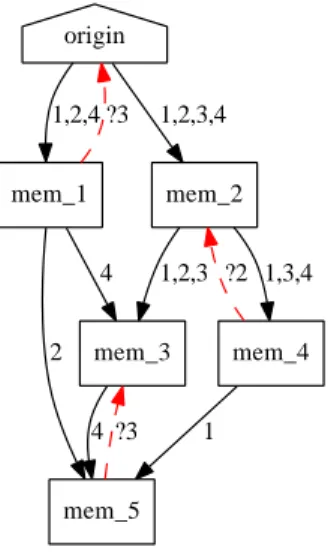
Figure 3.8.1: Message fragment distribution and replay in a multicast group.
The number on an edge indicates the fragment ID. A solid arrow is used for multicast messages, a dashed arrow represents replay requests.
The resultis eitherGNUNET_YES,GNUNET_NO, orGNUNET_SYSERRif there’s not
enough information stored to be able to answer the query, or another error occurred that prevents access to the membership store.
To reduce the number of membership tests that query the local database, the multicast service remembers the membership test result together with the group generation for each connected member. Then it is enough to compare the group generation of the to be relayed fragment with the last known value that passed the membership test for each member. When this simple test returns a negative result, because the group generation changed, a membership test is performed again for each directly connected member, to determine whether any of them left the group before relaying the fragment.
3.8
Replaying multicast messages
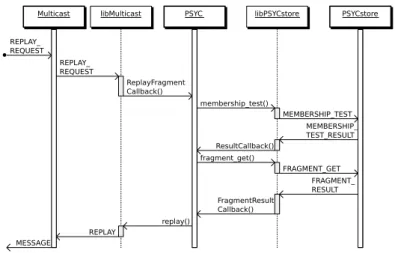
When a group member receives a fragment, it uses the fragment IDheader field to detect any missed fragments. When a missing fragment is noticed, the multicast service requests replay of the fragment from another group member. Figure3.8.1 illustrates message distribution and replay in a group. Refer to Section A.1.2 of the appendix for a sequence diagram of the API function calls and messages sent between the services during replay.
Each missed fragment has to be requested individually, which is necessary to avoid a member requesting a large number of fragments at once that could
3.8. Replaying multicast messages 19
lead to denial of service. Fragments can arrive from multiple sources and out of order, for this reason it is also more efficient to request recently missed fragments one by one, as an already requested fragment could have arrived in the mean time from another source.
Replay of a fragment can be also requested through the multicast API explicitly, using one of the following functions.
One way to request a fragment is byfragment ID:
s t r u c t G N U N E T _ M U L T I C A S T _ M e m b e r R e p l a y H a n d l e * G N U N E T _ M U L T I C A S T _ m e m b e r _ r e p l a y _ f r a g m e n t
( s t r u c t G N U N E T _ M U L T I C A S T _ M e m b e r * member , u i n t 6 4 _ t f r a g m e n t _ i d ,
u i n t 6 4 _ t f l a g s ) ;
Another possibility is to specify a message IDand afragment offset:
s t r u c t G N U N E T _ M U L T I C A S T _ M e m b e r R e p l a y H a n d l e * G N U N E T _ M U L T I C A S T _ m e m b e r _ r e p l a y _ m e s s a g e ( s t r u c t G N U N E T _ M U L T I C A S T _ M e m b e r * member , u i n t 6 4 _ t m e s s a g e _ i d , u i n t 6 4 _ t f r a g m e n t _ o f f s e t , u i n t 6 4 _ t f l a g s ) ;
As applications deal with message IDs instead of fragment IDs, this latter form is useful when an application wants to retrieve all fragments of a particular message.
In both cases replay flags can be specified, which are opaque to multicast and passed to thereplay callback of the multicast API that notifies about incoming replay requests.
When receiving a replay requests, the multicast service notifies about it using one of the following callbacks:
t y p e d e f v o i d (* G N U N E T _ M U L T I C A S T _ R e p l a y F r a g m e n t C a l l b a c k ) ( v o i d * cls , c o n s t s t r u c t G N U N E T _ C R Y P T O _ E c c P u b l i c K e y * m e m b e r _ k e y , u i n t 6 4 _ t f r a g m e n t _ i d , u i n t 6 4 _ t flags , s t r u c t G N U N E T _ M U L T I C A S T _ R e p l a y H a n d l e * rh ) ; t y p e d e f v o i d (* G N U N E T _ M U L T I C A S T _ R e p l a y M e s s a g e C a l l b a c k ) ( v o i d * cls , c o n s t s t r u c t G N U N E T _ C R Y P T O _ E c c P u b l i c K e y * m e m b e r _ k e y , u i n t 6 4 _ t m e s s a g e _ i d , u i n t 6 4 _ t f r a g m e n t _ o f f s e t , u i n t 6 4 _ t flags , s t r u c t G N U N E T _ M U L T I C A S T _ R e p l a y H a n d l e * rh ) ;
This indicates themember’s public key the request is coming from, either a
fragment IDor amessage IDandfragment offsetthat identifies the fragment,
and theflags set for the query.
The implementation of the callback then makes sure the member has access to the requested fragment by performing a membership test, and either returns the fragment from the message store or an error code via the following API call: v o i d G N U N E T _ M U L T I C A S T _ r e p l a y ( s t r u c t G N U N E T _ M U L T I C A S T _ R e p l a y H a n d l e * rh , c o n s t s t r u c t G N U N E T _ M e s s a g e H e a d e r * message , e n u m G N U N E T _ M U L T I C A S T _ R e p l a y E r r o r C o d e e r r o r _ c o d e ) ;
Replay handle: used to match the response with replay request. Message: the message fragment retrieved from the message store, where it
is stored exactly as it arrived from the network along with the signature of the origin, thus the authenticity of a replayed fragment can still be verified by the receiving member.
Error code: used to indicate any errors that can occur during replay. OK: everything is fine, the provided fragment is returned to the
requester. If the result is notOK, a message with the error code is returned instead.
Not found: the message fragment was not found in the message store, either it was already removed because it was too old, or the member has missed it and have never seen it.
Access denied: the member does not have access to the requested fragment. Returned after a failed membership test.
Internal error: an error occurred replay, e.g. the database was not available.
Another variant of the replay function is provided, which uses anotify callback
to return the message. This can be used to replay a message generated by the responding member, which does not contain the signature of the master, and thus it is verified by other means on higher layers.
v o i d
G N U N E T _ M U L T I C A S T _ r e p l a y 2
( s t r u c t G N U N E T _ M U L T I C A S T _ R e p l a y H a n d l e * rh , G N U N E T _ M U L T I C A S T _ R e p l a y T r a n s m i t N o t i f y notify , v o i d * n o t i f y _ c l s ) ;
A replay response can consist of multiple fragments in certain cases, for this reason the end of the replay session is explicitly indicated using the following
3.9. Unicast requests 21 function: v o i d G N U N E T _ M U L T I C A S T _ r e p l a y _ e n d ( s t r u c t G N U N E T _ M U L T I C A S T _ R e p l a y H a n d l e * rh ) ;
3.9
Unicast requests
A member of the group can send a message with a given ID to the origin using the following API function:
s t r u c t G N U N E T _ M U L T I C A S T _ M e m b e r R e q u e s t H a n d l e * G N U N E T _ M U L T I C A S T _ m e m b e r _ t o _ o r i g i n ( s t r u c t G N U N E T _ M U L T I C A S T _ M e m b e r * member , u i n t 6 4 _ t m e s s a g e _ i d , G N U N E T _ M U L T I C A S T _ M e m b e r T r a n s m i t N o t i f y notify , v o i d * n o t i f y _ c l s ) ;
The origin is then informed about an incoming request via the following callback of the API:
t y p e d e f v o i d (* G N U N E T _ M U L T I C A S T _ R e q u e s t C a l l b a c k ) ( v o i d * cls ,
c o n s t s t r u c t G N U N E T _ E c c P u b l i c K e y * m e m b e r _ k e y ,
c o n s t s t r u c t G N U N E T _ M U L T I C A S T _ R e q u e s t H e a d e r * request , e n u m G N U N E T _ M U L T I C A S T _ M e s s a g e F l a g s f l a g s ) ;
An obvious way to implement such requests would be to establish a direct mesh tunnel from the member to the origin, but this would be harder scale to a large number of participants.
Another solution could be to use the reverse path of multicast messages for this purpose. In this case members would relay a message fragment towards the origin, choosing the upstream connection closest to the origin, which is determined using distance information present in thehop counterheader field of incoming multicast messages.
A unicast request would than have a message header — similar to the multicast message header — prepended to an application layer message payload, with the following fields.
s t r u c t G N U N E T _ M U L T I C A S T _ R e q u e s t H e a d e r { s t r u c t G N U N E T _ M e s s a g e H e a d e r h e a d e r ; s t r u c t G N U N E T _ C R Y P T O _ E c c P u b l i c K e y m e m b e r _ k e y ; s t r u c t G N U N E T _ C R Y P T O _ E c c S i g n a t u r e s i g n a t u r e ; s t r u c t G N U N E T _ C R Y P T O _ E c c S i g n a t u r e P u r p o s e p u r p o s e ; u i n t 6 4 _ t f r a g m e n t _ i d ; u i n t 6 4 _ t f r a g m e n t _ o f f s e t ; u i n t 6 4 _ t m e s s a g e _ i d ;
e n u m G N U N E T _ M U L T I C A S T _ M e s s a g e F l a g s f l a g s ; };
Member’s public key: identifies the member the request is coming from.
Signature: the request signed with the member’s private key. Used by the origin to verify the authenticity of the message, as it can be relayed by other group members.
Fragment ID, fragment offset, message ID, and flags: refer to iden-tically named fields of multicast messages in Section3.6. These fields allow unicast requests to be fragmented, similarly to multicast messages. Such member-to-origin requests would still have to be encrypted to prevent relaying group members having access to the message content. For this purpose the member would encrypt each message fragment sent to the origin using a session key agreed upon after an ECDH (Elliptic Curve Diffie-Hellman) exchange with the origin.
Finally, an alternative to sending unicast requests from a member to the origin is using a separate multicast group with reversed roles, and connect the messages on the application layer by adding a reference to a previous message of another multicast group. This allows for a more decentralized communication model, which is suitable for e.g. (micro)blogging applications.
4. PSYC service
The PSYC service models PSYC channels, each using an underlying multicast group. The multicast group’s origin corresponds to the channel master, while its members are called channel slaves on the PSYC layer. The channel master is the owner of the channel that can send messages to it, while a channel slave is a subscriber of the channel, who can receive multicast messages from and send unicast requests to the channel master.
Messages sent to a channel use the PSYC syntax. The PSYC service parses messages it receives from the underlying multicast group, and renders outgoing messages in the PSYC format before sending them out to other members of the group. Once a message is parsed, it notifies about the method call in the message via the PSYC API. The PSYC service does not generate messages by itself, and does not understand the semantics of messages, only the syntax. Each PSYC channel has a decentralized channel state associated with it: a set of persistent key-value pairs replicated on each channel slave. The channel master is in charge of the state: it sends out state modifier operations to the channel. Channel slaves apply these changes to their local state database using the PSYCstore service. As each slave receives the same operations from the master, this results in each slave having the same channel state after receiving all state modifiers the master sent out.
A PSYC message consists of the following parts, in this order:
Routing header: replaced by the multicast message header when PSYC is used over GNUnet.
Length of the message: not needed when the PSYC syntax is used inside GNUnet messages, as the multicast header already indicates the size of each fragment and the last fragment of a message.
Entity header: contains transient variables and state modifiers set by an application. A state modifier defines an operation on the channel state, and consists of an operation, the name of a state variable to modify, and the argument(s) for the operation. The two most important operators are: (set) and= (assign). The former sets a transient variable only for
the message it appears in, the latter assigns a value to a persistent state variable. Further operations on state variables are possible, depending on the type of variable. The variable types and the operations on them are going to be specified later on, as part of future work.
Method name to invoke on the recipient applications. This is the only compulsory part of the message.
Message body: the payload for the message sent by an application. The following is an example of a message invoking a_message_public_shout
method with a transient_volume variable, which is not saved in the channel state:
: _ v o l u m e 100
_ m e s s a g e _ p u b l i c _ s h o u t Hello ,
w o r l d !
The next message contains two state modifiers, each sets a variable for a profile field:
= _ l o c a t i o n _ p l a n e t E a r t h = _ l o c a t i o n _ c o n t i n e n t E u r o p e _ n o t i c e _ p r o f i l e _ l o c a t i o n
The PSYC service uses the PSYCstore service to store message fragments sent to a channel, and to apply channel state operations found in messages. Storing message fragments is necessary in order to facilitate history queries from applications, and replay requests from multicast group members. The PSYC service adds a message header to each PSYC message before it sends it through the multicast service. This header contains additional fields needed by the PSYC layer. One of these fields is the size of the message up to the end of the method name, which is necessary so that parsing of the message can start after all fragments containing modifiers arrived, but before the message body is complete. This way applications can already be notified of a possibly large message before its whole body arrives.
4.1
PSYC API overview
The PSYC API provides functionality for participants of a PSYC channel depending on their role. One set of functions are available only to the channel master, while another set only to channel slaves. There is also a third set of functions available to both the channel master and slaves.
4.1. PSYC API overview 25
4.1.1 Channel master
Functions available to the channel master:
Start (or restart) a channel. Starts the underlying multicast group. Stop a channel. Stops the multicast group and terminates the channel
master.
Transmit a message to a channel through the multicast service.
Join decision: respond to a join request, which is transmitted to the requesting peer through the multicast service.
Callbacks for the channel master:
Request received from a channel slave.
4.1.2 Channel slave
Functions a channel slave has access to:
Join (or rejoin) a remote channel. Sends a join request to the master through the multicast service.
Part a remote channel. Disconnects from a multicast group and termi-nates the channel slave. An application layer leave request should be sent to the master before parting.
Transmit a request to the master using the multicast service.
Callbacks used to notify a channel slave: Message received from the channel master.
4.1.3 Channel
Functions available to both the master and slaves are:
Add/remove a slave to/from the membership database of the channel. Get historic messages for a specified message ID range.
Get a state variable that best matches a given name. Get all state variables that matches a given name prefix.
4.2
Starting the channel master
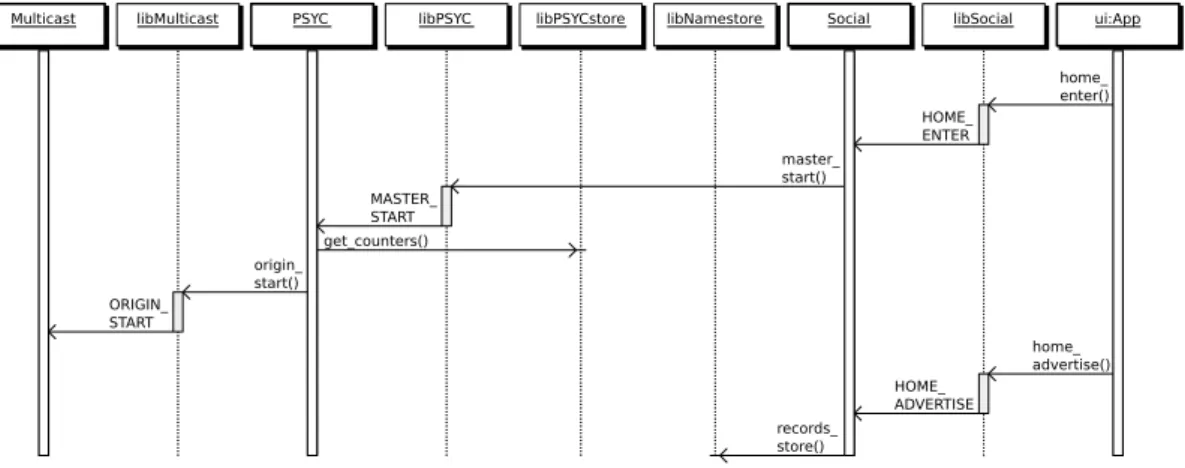
The PSYC channel master corresponds to the group origin on the multicast layer. When starting a PSYC channel master, the underlying multicast group origin is started as well, as described in Section 3.2. The channel can be started and restarted using the following API function:
s t r u c t G N U N E T _ P S Y C _ M a s t e r * G N U N E T _ P S Y C _ m a s t e r _ s t a r t ( c o n s t s t r u c t G N U N E T _ C O N F I G U R A T I O N _ H a n d l e * cfg , c o n s t s t r u c t G N U N E T _ C R Y P T O _ E c c P r i v a t e K e y * c h a n n e l _ k e y , e n u m G N U N E T _ P S Y C _ P o l i c y policy , G N U N E T _ P S Y C _ M e t h o d method , G N U N E T _ P S Y C _ J o i n C a l l b a c k join_cb , v o i d * cls ) ;
Channel’s private-public key pair: used to identify the channel and to sign multicast messages sent to the channel.
Policy: admission control and history access settings. It is a combination of the following flags:
Admission control: join requests have to be approved by an appli-cation running on the master.
Restricted history: a past message can be replayed to only those slaves who were already admitted when the message was originally sent out. To enforce this, the PSYC service maintains a group generation counter incremented after a slave is removed from the channel.
The combination of these flags results in the following policies:
Anonymous channel: no admission control and no restrictions on history. A channel slave can join directly at any other known slave, without the master having to admit the slave first. As the master does not necessarily know about each slave in this case, joins are not announced.
Private channel: admission control with restricted history. A slave has to send a join request to the master first, and the master an-nounces joins so that channel slaves know who the other currently admitted slaves are, which is needed to ensure only authorized slaves receive relayed and replayed messages.
Closed channel: admission control without restricted history. It behaves like a private channel, but slaves have access to past messages as well.
4.3. Stopping the channel master 27
Public channel: no admission control with restricted history. In this case joining slaves are announced to be able to apply history restrictions, for this reason a join request has to be sent to the master first, but slaves are auto-admitted.
Method callback: to inform the social service about method calls in requests from slaves.
Join callback: to inform the social service about join requests.
Before a channel master can be restarted, the PSYC service retrieves the state of counters maintained by the PSYC service from the PSYCstore, so that it can continue incrementing them from their last value. These counters are the message ID, group generation, and state delta. They are described later in this chapter.
4.3
Stopping the channel master
The channel master can be stopped using the following API function:
v o i d
G N U N E T _ P S Y C _ m a s t e r _ s t o p ( s t r u c t G N U N E T _ P S Y C _ M a s t e r * m a s t e r ) ;
When this function is called, the PSYC service stops the underlying multicast group origin, stops maintaining information related to the channel, and disconnects the caller from the PSYC service.
4.4
Joining a channel
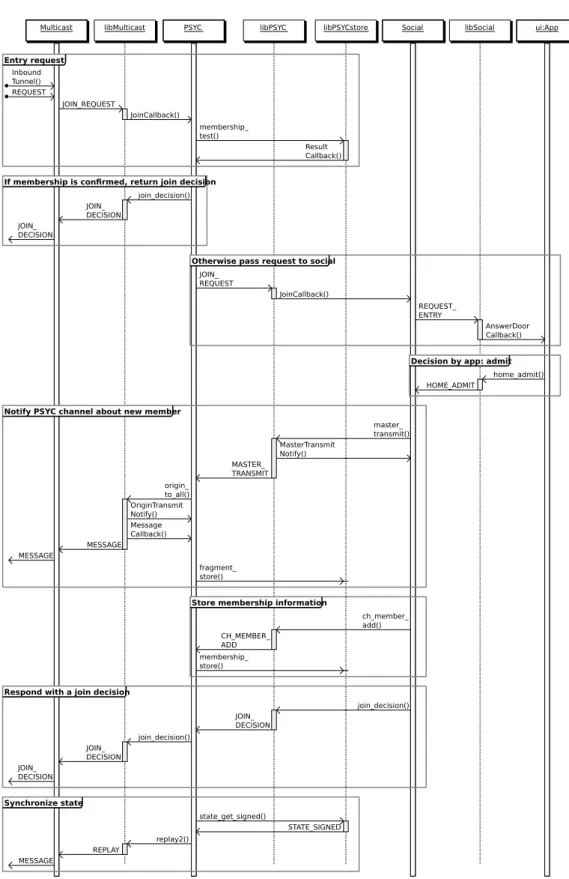
When joining or rejoining a channel as a slave, the PSYC service initiates joining the underlying multicast group, which in turn involves sending out a join request to the origin or one of the given relays, as described in Section3.4. Also refer to Section A.4of the appendix for sequence diagrams of the join process.
4.4.1 Requesting join
The PSYC service provides the following API function for joining a channel:
s t r u c t G N U N E T _ P S Y C _ S l a v e * G N U N E T _ P S Y C _ s l a v e _ j o i n ( c o n s t s t r u c t G N U N E T _ C O N F I G U R A T I O N _ H a n d l e * cfg , c o n s t s t r u c t G N U N E T _ C R Y P T O _ E c c P u b l i c K e y * c h a n n e l _ k e y , c o n s t s t r u c t G N U N E T _ C R Y P T O _ E c c P r i v a t e K e y * s l a v e _ k e y , c o n s t s t r u c t G N U N E T _ P e e r I d e n t i t y * origin ,
s i z e _ t r e l a y _ c o u n t , c o n s t s t r u c t G N U N E T _ P e e r I d e n t i t y * relays , G N U N E T _ P S Y C _ M e t h o d method , G N U N E T _ P S Y C _ J o i n C a l l b a c k join_cb , v o i d * cls , c o n s t c h a r * m e t h o d _ n a m e , c o n s t s t r u c t G N U N E T _ E N V _ E n v i r o n m e n t * env , s i z e _ t d a t a _ s i z e , c o n s t v o i d * d a t a ) ;
Channel’s public key: identifies the channel to join.
Slave’s private-public key pair: the public key identifies the slave, while the private key signs unicast requests sent to the master.
Origin and relays: peer identifiers to join the multicast group at, and send requests to, as described in Section3.4.
Method callback for handling method invocations in multicast messages sent to the group.
Join callback for handling other slaves joining.
Method name, environment, and data: a PSYC-formatted message is constructed from these parameters, which will serve as the join request sent to the master.
Upon calling this function, the PSYC service joins the multicast group using the provided information. It also adds a PSYC message header to the join message it constructs, which indicates the last known message ID that modified the state — this information is requested from the PSYCstore, and needed later for the state synchronization process, which happens right after admission.
4.4.2 Responding to a join request
After the origin or another group member received the join request, the join
callbackof the multicast service notifies the PSYC service about it, which
queries the PSYCstore to determine whether the member is already admitted: if it is, a positive join decision is sent back to the requester.
In case the requester is not a member yet, the process continues differently depending on whether the request was sent to the master or a slave. In the latter case a negative join decision is sent back right away, as a slave is not in charge of the channel. In case of the master, however, the decision is taken by an application, and thus the join request is propagated to higher layers via the join callbackof the PSYC API:
4.4. Joining a channel 29 t y p e d e f int (* G N U N E T _ P S Y C _ J o i n C a l l b a c k ) ( v o i d * cls , c o n s t s t r u c t G N U N E T _ E c c P u b l i c K e y * s l a v e _ k e y , c o n s t c h a r * m e t h o d _ n a m e , s i z e _ t v a r i a b l e _ c o u n t , c o n s t G N U N E T _ E N V _ M o d i f i e r * v a r i a b l e s , s i z e _ t d a t a _ s i z e , c o n s t v o i d * data , s t r u c t G N U N E T _ P S Y C _ J o i n H a n d l e * jh ) ;
Public key identifying the slave requesting join.
Method name, variables, data: parts of the parsed PSYC message sent along with the join request, which contain additional information required for the join on the application layer.
Join handle: used to match the join request with the decision.
Once an application running in the master channel has made a decision about the request, there are three steps remaining for the master to complete the join process: notifying the channel about the new slave, informing the requester about the decision, and synchronizing the channel state of the requester.
4.4.3 Notifying the channel about the new slave
If the decision taken by the application is to admit the slave requesting join, then the slave needs to be added to the membership database of each participant of the channel: the master as well as all the slaves. This is necessary in order to be able to answer membership test queries later on. Adding a slave to the membership database of the channel can be performed via the following function of the PSYC API:
v o i d G N U N E T _ P S Y C _ c h a n n e l _ s l a v e _ a d d ( s t r u c t G N U N E T _ P S Y C _ C h a n n e l * channel , c o n s t s t r u c t G N U N E T _ E c c P u b l i c K e y * s l a v e _ k e y , u i n t 6 4 _ t a n n o u n c e d _ a t , u i n t 6 4 _ t e f f e c t i v e _ s i n c e ) ;
Channel: either a master or slave.
Slave’s public key: identifies the slave this membership change is about. Announced at: ID of the message that announced the membership
Effective since: message ID since the membership change is in effect. This allows the master to give the slave access to past messages from an earlier point in time.
After this function is used by the channel master to update its membership database, the master still needs to transmit a message to notify the channel about the newly joined slave. Existing channel slaves then receive this message, the social service understands the method call notifying about the join, and calls this function to update its own membership database of the channel.
The membership database is updated using the PSYCstore API. The process of storing membership change events is described in Section5.4.1.
4.4.4 Informing the requester about the decision
Finally, the requester needs to be informed about the join decision. In order to do this, the PSYC service is first notified about the decision using the following API function:
v o i d G N U N E T _ P S Y C _ j o i n _ d e c i s i o n ( s t r u c t G N U N E T _ P S Y C _ J o i n H a n d l e * jh , int i s _ a d m i t t e d , u n s i g n e d int r e l a y _ c o u n t , c o n s t s t r u c t G N U N E T _ P e e r I d e n t i t y * relays , c o n s t c h a r * m e t h o d _ n a m e , c o n s t s t r u c t G N U N E T _ E N V _ E n v i r o n m e n t * env , s i z e _ t d a t a _ s i z e , c o n s t v o i d * d a t a ) ;
Join handle that identifies the request this decision is about. Is admitted? The decision taken: GNUNET_YESor GNUNET_NO.
Relays: other multicast group members that can be used as relays. The list of relays are distributed in application layer messages by the master. Method name, environment with variables, data: parts of the PSYC
message to be returned with the decision.
The join decision is then forwarded to the multicast service, which informs the requesting peer about the decision, as described in Section3.4.
4.4.5 State synchronization
In case of a positive join decision, the PSYC service initiates a state synchro-nization process to bring the state of the joining slave up to date. The PSYC
4.5. Parting a channel 31
service chooses between two approaches based on the latest state message ID the joining slave sent along with join request. The first option is to send the latest full state for which a hash is known and replay any additional state modifying messages that were sent after that. The other option is to replay only the individual state modifying messages that the joining slave does not yet have. The cheaper method in terms of bandwidth can be determined based on the size of the full state and the state modifying messages stored in the PSYCstore.
When the full state is used for state synchronization, a message containing all state variables are generated by the responding slave, thus not signed by the master. In order for the joining slave to be able to verify the authenticity of the received state, the channel master periodically generates a hash of all state variables in lexical order, and adds it to a state hashPSYC header field. This hash is always added to multicast messages notifying about a join, as a new slave might not have access to earlier state messages due to history restrictions. The state hash allows the joining slave to verify the state it received, as each multicast message — including the one containing this hash — is signed by the master. If the hash of the received state passes the verification, it is stored in the PSYCstore, and further state modifiers can be applied to it.
4.5
Parting a channel
For slaves wanting to part a channel, the PSYC API provides the following function:
v o i d
G N U N E T _ P S Y C _ s l a v e _ p a r t
( s t r u c t G N U N E T _ P S Y C _ S l a v e * s l a v e ) ;
When this function is called, the PSYC service parts the multicast group and disconnects the caller from the PSYC service. Calling this function does not result in any message being sent out to the network that would change the membership status of the slave. To remove a slave from the membership database of the channel, the following function of the PSYC API is used:
v o i d
G N U N E T _ P S Y C _ c h a n n e l _ s l a v e _ r e m o v e
( s t r u c t G N U N E T _ P S Y C _ C h a n n e l * channel ,
c o n s t s t r u c t G N U N E T _ E c c P u b l i c K e y * s l a v e _ k e y , u i n t 6 4 _ t a n n o u n c e d _ a t ) ;
This function does the opposite of GNUNET_PSYC_channel_slave_add() — described in Section4.4.3— and it is used in a similar way. It removes the
given slave from the channel, and needs to be called by the master as well as every slave of the channel.
The master calls this function either upon a specific request of a slave, or after an unilateral decision to remove the slave from the channel. In either case, the master sends out a message to the channel informing the slaves about the membership change, so that the slaves can call this function, too, in order to update their own membership database. The group generation is incremented after this message has been sent to the channel, which makes sure the leaving slave will not have access to further messages, but it still gets to see this last message, either confirming its own leave request or informing about being kicked.
4.6
Messages from the master
4.6.1 Sending messages
The master can transmit a message to the channel using the following API function: s t r u c t G N U N E T _ P S Y C _ M a s t e r T r a n s m i t H a n d l e * G N U N E T _ P S Y C _ m a s t e r _ t r a n s m i t ( s t r u c t G N U N E T _ P S Y C _ M a s t e r * master , c o n s t c h a r * m e t h o d _ n a m e , c o n s t s t r u c t G N U N E T _ E N V _ E n v i r o n m e n t * env , G N U N E T _ P S Y C _ M a s t e r R e a d y N o t i f y notify , v o i d * n o t i f y _ c l s , e n u m G N U N E T _ P S Y C _ M a s t e r T r a n s m i t F l a g s f l a g s ) ;
Master handle for the channel to send the message to. Method name for the message.
Environment containing state modifiers and transient variables for the message.
Notify callback to notify the caller when it can provide the next part of the body, called possibly multiple times while it still returns data. Flags for the message being transmitted:
Reset state: whether this message resets the channel state, i.e. removes all previously stored state variables. This is achieved by setting the state delta PSYC header field to 0. This field is described in the next section.
Add state hash: generate a hash of the full state and add it to the PSYC header of the message in astate hashfield.
4.6. Messages from the master 33
Increment group generation: whether the message contains a notification about a slave removed from the channel, in which case the group generation is incremented after sending this message. Upon calling this function, the PSYC service renders a PSYC formatted message from the method name, modifiers, and message body. Then it uses the
GNUNET_MULTICAST_origin_to_all()function — described in Section3.6—
to send out a possibly fragmented message to the underlying multicast group. The method name and modifiers are sent out right away, while parts of the body are transmitted as data for it comes in.
4.6.2 Receiving messages
Channel slaves are notified about incoming multicast message fragments via
the message callback of the multicast service. The PSYC service stores each
incoming fragment using the PSYCstore service. Next, to determine how to proceed, it parses the first fragment of the message, which contains the length of the modifiers section and can contain astate delta PSYC header field.
The state deltais present in each message that contains state modifiers, and
it is set to the number of messages since the last message that modified the state. The value 0 means a full state reset, in which case all previously stored state variables are discarded. The state delta allows a channel slave to detect a previously missed message that contained state modifiers, in which case it can not apply further operations on the channel state until all missing messages arrived, as state operations must be performed strictly in the order they were sent out by the master to keep the state consistent across the slaves. The missing messages are requested to be replayed via the multicast service, which then replays explicitly requested message IDs with higher priority. Once there are no missing state messages, the PSYC service still has to wait until all fragments of the modifiers section of the current message arrived before it can start applying operations to the channel state.
After all fragments necessary to apply the outstanding state operations arrived, the PSYC service retrieves these from the PSYCstore, parses the modifiers found in them, and sends the parsed operator–name–value triplets back to the PSYCstore for applying them to the current channel state. This process is described in Section5.3.1.
At this point, when all modifiers of a message are parsed and applied to the channel state, the PSYC service notifies about the incoming method call through the method callback of its API:
t y p e d e f int (* G N U N E T _ P S Y C _ M e t h o d ) ( v o i d * cls , c o n s t s t r u c t G N U N E T _ C R Y P T O _ E c c P u b l i c K e y * s l a v e _ k e y , u i n t 6 4 _ t m e s s a g e _ i d , c o n s t c h a r * m e t h o d _ n a m e , s i z e _ t m o d i f i e r _ c o u n t , G N U N E T _ P S Y C _ M o d i f i e r * m o d i f i e r s , u i n t 6 4 _ t d a t a _ o f f s e t , s i z e _ t d a t a _ s i z e , c o n s t v o i d * data , e n u m G N U N E T _ P S Y C _ M e s s a g e F l a g s f l a g s ) ;
Slave’s public key: NULL for multicast messages (only used in case of unicast requests from slaves, see Section4.7).
Message ID: identifier of the message.
Method name: method name found in the message.
Modifiers: state modifiers and transient variables in the message. Data offset: byte offset of the fragment of the data.
Data: fragment of the message body starting from the offset above. Flags: indicate the first and last fragment of a message.
This function is called first with the method name, modifiers, and first part of the message body, then called again for each further fragment of the body as they arrive. For subsequent calls the modifiers and method name are not present, and the end of the message is indicated with thelast fragmentflag set.
In case of the master, requests from slaves are processed similarly, except that in case of therequest callbackused by the master, the slave’s public key is set, which identifies the source of the message.
4.7
Requests from slaves
Slaves can send requests to the master using the following function of the API, which is very similar to the master’s transmit function described in Section4.6.1. s t r u c t G N U N E T _ P S Y C _ S l a v e T r a n s m i t H a n d l e * G N U N E T _ P S Y C _ s l a v e _ t r a n s m i t ( s t r u c t G N U N E T _ P S Y C _ S l a v e * slave , c o n s t c h a r * m e t h o d _ n a m e , c o n s t s t r u c t G N U N E T _ E N V _ E n v i r o n m e n t * env , G N U N E T _ P S Y C _ S l a v e R e a d y N o t i f y notify , v o i d * n o t i f y _ c l s , e n u m G N U N E T _ P S Y C _ S l a v e T r a n s m i t F l a g s f l a g s ) ;
4.8. History and state requests by applications 35
Slave handle for the channel whose master to send the request to. Method name for the message.
Environment containing transient variables for the message.
Notify callback to notify the caller when it can provide the next part of the body, called possibly multiple times while it still returns data. Flags for the message being transmitted. None defined yet, reserved for
later use.
4.8
History and state requests by applications
An application running in the channel might need to have access to historic messages and state variables it does not keep track of. Both of these are stored by the PSYCstore service, and are accessible through the PSYC service.
4.8.1 Requests for historic messages
Historic messages of a master or slave channel can be requested using the following PSYC API call:
The messages are retrieved from the PSYCstore if available, otherwise a replay request is issued to another member through the multicast service.
s t r u c t G N U N E T _ P S Y C _ S t o r y * G N U N E T _ P S Y C _ c h a n n e l _ s t o r y _ t e l l ( s t r u c t G N U N E T _ P S Y C _ C h a n n e l * channel , u i n t 6 4 _ t s t a r t _ m e s s a g e _ i d , u i n t 6 4 _ t e n d _ m e s s a g e _ i d , G N U N E T _ P S Y C _ M e t h o d method , G N U N E T _ P S Y C _ F i n i s h C a l l b a c k f i n i s h _ c b , v o i d * cls ) ;
The PSYC service retrieves the messages between the startandend message ID(inclusively) from the PSYCstore, and processes them similarly to new messages coming from the multicast service: it parses the fragments of each message, then calls the providedmethod callbackto inform about the method call, transient variables, state modifiers, and the body of the message. For messages retrieved from the PSYCstore a historic flag is also set to make them distinguishable from new messages. If the PSYCstore does not have all the requested messages, replay requests are issued through the multicast service for the missing ones.
4.8.2 State variable requests
The PSYC API provides two ways for requesting state variables of a channel: either request all variables with a given name prefix, or request a single variable that best matches the given name.
For the former case the following function is provided:
u i n t 6 4 _ t G N U N E T _ P S Y C _ c h a n n e l _ s t a t e _ g e t _ a l l ( s t r u c t G N U N E T _ P S Y C _ C h a n n e l * channel , c o n s t c h a r * n a m e _ p r e f i x , G N U N E T _ P S Y C _ S t a t e C a l l b a c k cb , v o i d * c b _ c l s ) ;
This function retrieves either exactly matching or more specific state variables with a matchingname prefix from the PSYCstore and returns them through the provided callback. For instance, a request for _a_bwould return both
_a_b and _a_b_c, while an empty string as prefix would return all state
variables in the channel.
The other option is requesting a variable best matching a given name:
s t r u c t G N U N E T _ P S Y C _ S t a t e Q u e r y * G N U N E T _ P S Y C _ c h a n n e l _ s t a t e _ g e t ( s t r u c t G N U N E T _ P S Y C _ C h a n n e l * channel , c o n s t c h a r * f u l l _ n a m e , G N U N E T _ P S Y C _ S t a t e C a l l b a c k cb , v o i d * c b _ c l s ) ;
In this case the returned variable is either exactly matching or less specific than the requested one: e.g. when a request for _a_b_c is made, the first variable is returned that exists in the following order: _a_b_c,_a_b,_a.