Cedarville University
DigitalCommons@Cedarville
Christian Engineering Conference 2017 Conference
Jun 29th, 1:10 PM - 2:10 PM
Institutional Differences in the Education of
Engineering and Computing Students About
Ethics and Societal Impacts
Angela Bielefeldt
University of Colorado at Boulder, [email protected] Madeline Polmear
University of Colorado Boulder, [email protected] Daniel Knight
University of Colorado Boulder, [email protected] Christoppher Swan
Tufts University, [email protected] Nathan Canney
Seattle University, [email protected]
Follow this and additional works at:http://digitalcommons.cedarville.edu/ christian_engineering_conference
Part of theEngineering Commons, and theHigher Education Commons
This Paper is brought to you for free and open access by
DigitalCommons@Cedarville, a service of the Centennial Library. It has been accepted for inclusion in Christian Engineering Conference by an authorized administrator of DigitalCommons@Cedarville. For more information, please [email protected].
Bielefeldt, Angela; Polmear, Madeline; Knight, Daniel; Swan, Christoppher; and Canney, Nathan, "Institutional Differences in the Education of Engineering and Computing Students About Ethics and Societal Impacts" (2017).Christian Engineering Conference. 2.
Institutional Differences in the Education of Engineering and
Computing Students about Ethics and Societal Impacts
Angela R. Bielefeldt1, Madeline Polmear1, Daniel Knight1, Christopher Swan2, Nathan Canney3
Abstract
This study explored the extent to which faculty report teaching engineering and computing students about ethics and societal impacts (ESI) in courses and via co-curricular activities. The research questions were to determine if there were differences in the topics, teaching methods, assessment methods, and satisfaction with ESI instruction between faculty from religiously-affiliated (RA) and non-religiously religiously-affiliated (NRA) institutions. A national survey was
conducted, with about 1400 responses. This included 122 faculty from 60 RA institutions (across 17 denominations/faiths). Chi-square tests evaluated statistically significant differences (p<0.05). Among 18 ESI topics, six were taught more commonly in courses by faculty at RA institutions: risk and liabilities, engineering and poverty, social justice, ethical failures, safety, and societal impacts of technology. Within individual courses, faculty at RA institutions more commonly taught students about ESI using project based learning, reflections, and service-learning. More individuals from RA vs. NRA institutions assessed ESI instruction in courses (94% vs. 86%). More of the faculty at RA vs. NRA institutions felt that undergraduate students were sufficiently educated about ESI (48% vs. 30%). In co-curricular activities, the topics, teaching methods, and assessment of ESI education did not differ significantly between RA and NRA institutions. In interviews, seven faculty teaching at RA institutions noted that the institutional culture was supportive of ethics education. Overall the results provide interesting information into how faculty try to teach engineering and computing students about ESI issues. The differences noted may be indicative of a higher value being placed on ESI education by RA institutions over that of NRA institutions; however, the majority of faculty at both institution types feel that ESI education efforts could be improved.
Introduction
All higher education institutions generally have desires to educate students for ethical
participation in society. These aspirations are widely endorsed; for example, the Associate of American College & Universities’ (AAC&U’s) “essential learning outcomes” includes personal and social responsibility encompassing ethical reasoning and action, intercultural knowledge and competence, and civic knowledge and engagement. More specifically, engineering and
computing education globally have embraced the imperative to educate students for ethical conduct (ABET; Engineers Australia; IEA; IPENZ) and requirements for ethical behavior of licensed engineers (Engineering Council; NCEES; NSPE). This includes microethics, or individual responsibilities as outlined in various codes of ethical conduct (ASCE 2006; IEEE; etc.). As well, increasing attention is being devoted to macroethical issues (Barry and Herkert 2014), which encompass the broader responsibilities of the profession to society and the environment at large. Preparing engineers to consider macroethical issues is gaining attention
through issues of sustainability, social justice, and bioethics. In this paper, we will collectively refer to microethics and macroethics as “ethics and societal impacts” (ESI).
Despite the requirements for ethics education within accredited programs, the scope of the ethics education of engineering students varies widely. The American Society of Civil Engineers (ASCE) noted concern that the ABET requirements could be met via a few seminars or guest lectures (ASCE 2015). Thus, they chose to raise the bar for the ethics education of civil engineering students, adding a program-specific criterion to “analyze issues in ethics.” This language derives from Bloom’s cognitive taxonomy. However, what is truly desired is ethical behavior in practice. Data from Harding et al. (2006) on student cheating and professional activity is not particularly encouraging in that regard, where given example scenarios a similar percentage of the study participants decided to cheat in a college setting and behave unethically in a workplace setting (~36%). Further, ethics has affective attributes (ASCE 2008) that include values, which some argue are difficult to teach (Birbeck and Andre 2009). This research sought to develop a national picture of how engineering and computing students are educated about ethics, from the perspective of faculty.
Most studies have explored ethics education from the perspective of students. Finelli et al. (2012) proposed a conceptual framework for students’ ethical development in college. The model
included elements of institutional culture from both an organizational context and the peer environment. Thus, one would suspect that different institutional environments could be impactful. Bielefeldt and Canney (2016) found that students attending five Christian-affiliated institutions on average had more positive social responsibility attitudes than students attending 12 secular institutions. But an individuals’ religious and spiritual beliefs were more important than institutional setting in predicting attitudes toward social responsibility. The large study by Finelli et al. (2012) encompassed about 4000 undergraduate students attending 18 institutions; it is unclear if any were religiously affiliated institutions. However, among the students, 29% reported occasionally or frequently participating in an on-campus religious organization. Comegys (2010) found that undergraduate students attending religiously affiliated institutions had attitudes about business that were more ethical than those attending non-religiously affiliated institutions.
How might religion interact with ethical beliefs and behaviors? Religion is often related to morals and values, which in turn impact ethical beliefs (Jun 2005; Flores and Vazquez-Parraga 2009). Tensions between religious views and ethics have also been acknowledged (Irwin 2017). Christian and religious perspectives have been linked with a number of macroethical issues, including environmental protection (Vesilind and Gunn 1999), sustainability / sustainable development (McKeown 2007; Olawale and Yemisi 2012; Rasmussen; Stuerzenhofecker et al. 2010; Vogt 2011), social justice (Todd and Rufa 2013), and bioethics (Foreman 1999). Some articulation of macroethical goals can be found in the mission and vision statements for religiously-affiliated institutions in the U.S. Examples include:
Mission: “educate the whole person… serving the communities of which we are a part in California and around the world; Vision: educate citizens and leaders of competence,
conscience, and compassion and cultivate knowledge and faith to build a more humane, just, and sustainable world.” https://www.scu.edu/aboutscu/mission-vision-values/
Mission: “educate men and women for worldwide leadership and service by integrating academic excellence and Christian commitment within a caring community… the University provides advanced educational opportunities to develop ethical and capable scholars and practitioners who contribute to their academic disciplines, professional fields and society. Beyond the intellectual life, the University pursues the social, physical, ethical and spiritual development of each student.” http://www.baylor.edu/about/index.php?id=88781
Other evidence of interactions between religious beliefs and/or spirituality and ethics have been published. HERI (2005) found that 29% of entering first-year college students with a high spirituality score also had high scores on the Ethic of Caring scale; by comparison, only 5% of those with low spirituality scores had high Ethic of Caring scores. Ethic of caring was defined as measuring “the degree of commitment to values such as helping others in difficulty, reducing pain and suffering in the world, and making the world a better place.” (p. 8) Glanzer & Alleman (2015) found that faculty teaching at institutions affiliated with the Council for Christian
Colleges and Universities (CCCU) integrated their faith identity into their approach to ethics in courses in a number of ways. Lindholm & Astin (2008) found that higher faculty spirituality correlated with great use of student-centered pedagogy; however, this overall relationship failed to hold true among engineering faculty (the sole exception among 14 disciplines). The large HERI study in 2013-2014 (Eagan et al. 2014) found that faculty at religious institutions taught ethical issues more frequently and had more goals for developing students’ moral character; however these results may be due to the disciplines represented and cannot be used to infer that within engineering these differences would be found. Shahjahan (2010) found that for some faculty their spirituality was a key influence in shaping their teaching for social justice. While this study encompassed a range of spiritual traditions (inclusive and beyond Christianity), none of the faculty participants were from engineering disciplines.
Religious faculty and students exist at all types of institutions. Gross and Simmons (2007) reported that “about 50 percent of professors in non-religiously affiliated schools say either that they believe in God despite their doubts or that they have no doubts about God’s existence, this is true of 68.9 percent of professors in religiously-affiliated schools.” (p. 4) Differences were found among institution type (highest percentage of atheists or agnostics at elite doctoral schools, 36.6%) and by discipline (50% mechanical engineering professors atheists or agnostics). Sullins (2004) estimated that at 100 Catholic institutions, the percentage of Catholic faculty ranged from 14 to 87%, with a mean of 50%. The American Freshman study (Eagan et al. 2016) found that among entering college students the percentage who considered the objective of helping others who are in difficulty an essential or very important objective was 73.5% at public 4-year colleges, 74.3% at nonsectarian 4-year private institutions, and 79.9% at Catholic 4-year institutions; the percentage atheist, agnostic and “none” was 26.1% at public 4-year colleges, 33.9% at nonsectarian private 4-yr colleges, and 16.7% at Catholic 4-year colleges. In the study of engineering students by Bielefeldt and Canney (2016), students self-reporting as atheist or indifferent/not religious varied from 45% at three private doctoral institutions, to 26% at three Christian Master’s level institutions, down to 3% at a Christian Baccalaureate institution.
Recently, individuals have written of “secularization” of religiously-affiliated institutions (Arthur 2008; McKinley 2008), making it clear that a simple binary view of secular vs. religiously-affiliated institutions is a gross oversimplification. This idea is also supported by quantitative
data on differing attitudes toward social responsibility of engineering students at five different Christian-affiliated institutions (Bielefeldt and Canney 2016). Abelman and Dalessandro (2009) explored the composite vision statements of 210 different higher education institutions, and found vocabulary usage giving higher DICTION scores for “compelling” (based on usage of words including faith, honesty, and courage) for Catholic and Evangelical institutions (65.2 and 63.7, respectively) compared to secular public institutions (51.6) and “Christ-Centered”/CCCU institutions (48.3); individual institution scores ranged from 74.9 to 42.9. Thus differences among institution types and different religious groups is evident. However, the binary categorization into “religiously-affiliated” (RA) and “non-religiously affiliated” (NRA) or secular institutions is a place to start to explore ideas of intersectionality between religion and engineering ethics education.
Research Questions
RQ1. Determine if there are differences in the satisfaction with overall ethics/societal impacts instruction between faculty from religious-affiliated institutions (RA) and non-religiously affiliated institutions (NRA, including public institutions and nonsectarian private institutions), and if satisfaction correlates with the number of settings where individuals believe that their undergraduate students learn about ESI.
RQ2. Determine if there are differences in the topics, teaching methods, assessment methods for ethics/societal impacts instruction between faculty RA and NRA institutions, in both curricular and co-curricular settings
RQ3. Determine the perspectives of faculty from RA institutions on how the institutional culture relates to the ethics education of engineering/computing students
Methods
Survey. A survey was developed to explore how faculty members taught engineering and computing students about ESI. The survey began with an informed consent statement approved by the Institutional Review Board for Human Subjects Research. There were two versions of the survey: one asked questions about ESI instruction in courses first (curricular survey), followed by questions on potential integration of these topics into co-curricular/informal learning environments. The second survey (curricular survey) asked questions about
co-curricular/informal settings first, followed by questions on ESI instruction in courses. The majority of the questions were multiple-select items related to ESI topics, course and
co-curricular types, ESI teaching methods, and ESI assessment methods. Near the end of the survey individuals were asked to rate the extent to which they believed the ESI instruction of
undergraduate and graduate students in their program was sufficient. The surveys also included an open-ended response question to share thoughts about the education of engineering students regarding ESI, and to optionally volunteer to participate in a follow-on interview. The survey concluded with a series of demographic items on the institution and individual. More details on the survey development and questions have been published (Bielefeldt et al. 2016).
Invitations to the online surveys were distributed via email. The curricular survey was distributed via list serves of the American Society for Engineering Education (ASEE), as well as direct invitations to individuals who authored papers and received NSF grants on engineering ethics education. The co-curricular survey was distributed via professional societies to their list serves and individuals who mentor campus chapters of various groups. Additional details on survey distribution strategies were previously described (Bielefeldt et al. 2016, 2016b). Individuals at RA institutions were not particularly included nor excluded from among the individuals invited to participate in the survey. Responses were collected from February to May, 2016. There were 1448 responses that were over 50% complete; individuals could skip any questions on the survey, resulting in varying numbers of respondents for particular items.
Interviews. A series of interviews were conducted. There were 230 individuals who indicated a willingness to participate in an interview on the survey; 11% from RA institutions (slightly over-represented compared to 8% overall survey respondents from RA institutions). Among this group, 52 were invited to participate in interviews in September 2016 to February 2017; including 9 (17%) from RA institutions and 5 from international institutions. Individuals were selected for interviews to encompass a diversity of ESI topics, teaching settings, disciplines, and institutional characteristics. Among this group, 35 interviews were completed prior to April 1, 2017; 7 from RA institutions. The interviews were conducted via phone or skype, with a typical duration of 30 to 60 minutes. The interviewees were assigned a pseudonym using a random name generator to maintain the confidentiality of the participants. The semi-structured interviews asked questions about the most effective way instructors taught students about ESI, as well as questions about institutional support for ESI. Analysis of the interview responses is on-going. Data. Statistical comparisons were made between responses from those at RA and NRA institutions. Many of these were chi-square tests conducted in Excel. Other tests such as
correlations and comparisons between counts used non-parametric statistical tests in IBM SPSS version 24 (Independent Samples Mann-Whitney U Test). Open-ended responses were coded for themes using emergent methods; inter-rater reliability among three coders was established based on a sub-set of the responses. Further details on the themes emergent from the survey open-ended responses are provided in Canney et al. (2017).
Respondents. An overview of the demographic characteristics of the survey respondents are summarized in Table 1. Individuals were not required to answer questions on the survey.
Therefore, some individuals chose not to identify their institution. For those who did not identify their specific institution but noted they were at a public institution, the institutions were
classified as NRA. Responses were excluded from the dataset for individuals who indicated that they taught at a private institution but did not note the name.
Among the 60 different religiously-affiliated institutions, 17 different denominations were represented. The majority of the 122 respondents were from Catholic-affiliated institutions (52%), including Roman Catholic and Jesuit institutions. Other denominational affiliations identified among the institutions were: Church of Jesus Christ of the Latter-Day Saints, United Methodist, Seventh-Day Adventist, Presbyterian, Church of Christ, evangelical, Lutheran, Christian Reformed, Church of the Brethren, Christian Brothers, Quaker, Mennonite, Church of God, Disciplines of Christ, and interdenominational. Some schools were initially founded or
historically tied with a religious group, but if the institution currently advertised itself as non-sectarian, this classification was used in our study (e.g. Duke University).
TABLE 1. Demographic Characteristics of Respondents
Demographic Characteristic RA, % NRA, % Highest degree awarded at institution* (n=122) (n=1304)
Associates (community college) 0 0.5
Bachelor’s 30 4 Master’s 23 11 Doctoral 47 84 Institution Type* (n=122) (n=1306) Public 0 79 Private 100 21 Respondent Rank (n=122) (n=1300) Full professor 35 34 Associate professor 35 27 Assistant professor 21 17
Senior instructor other full time non-TT 7 12 Others: Full time adjunct or research faculty, part time instructor,
graduate student with teaching role, staff member
2 11 Additional Roles
Dean 3 1
Associate/assistant dean 5 4 Department chair or head 16 7 Director of program or center 7 16 ABET assessment coordinator 6 9 Honor council or similar 2 2
Other 6 9
Disciplines Taught (n=122) (n=1276) Mechanical Engineering
Civil Engineering First-year Engineering
Computer Engineering / Science Electrical Engineering
General Engineering Chemical Engineering Biomedical Engineering Engineering Technology
Humanities and/or social science for engineers Aerospace Engineering
Other (Other, Environmental, Materials, Biological, Industrial,
Engineering Management, Petroleum, Nuclear, Mining, Geological,…)
36* 24 23* 22 21* 12* 10 7 6 6 5 <5% each 20 21 11 17 12 5 10 10 4 6 5 Gender* (n=122) (n=1306) Male 70 64 Female 25 33
Prefer not to say 5 3
Race/Ethnicity (check all that apply) (n=113) (n=1260)
White, non-Hispanic 75 75
Hispanic, Latino 4 6
Black or African American 0 3 Asian
Other
Prefer not to say
11 3 8 8 2 5 Hold a Professional Engineering license (P.E. or similar), yes 25 30 * Chi-square test RA vs. NRA p < 0.05
Disciplines. On average, individuals from RA institutions noted 2.0 different disciplines where they taught engineering students, compared to an average of 1.7 different engineering disciplines for instructors at NRA institutions. The most common discipline among RA instructors was mechanical, a higher percentage compared to individuals at NRA institutions.
Results and Discussion
RQ1: Sufficiency of Ethics Education
Individuals were asked whether they believed undergraduate and graduate students in their program received sufficient education on ethics and/or broader impact issues; results are
summarized in Table 2. A higher percentage of the individuals from RA institutions felt that their undergraduate students received sufficient education on these issues; 48% compared to only 30% at NRA institutions (p=0.0003). At RA institutions, there was a greater perceived deficiency in education on the broader impacts of technology (47%) compared to ethics (33%). This may indicate differences between microethics and macroethics education.
At RA institutions with a graduate program, fewer faculty felt that graduate students received sufficient education on ethical and broader impact issues than undergraduate students in their program (p=0.0006). Here, ethics education was perceived to be lacking by slightly more individuals (69%) compared to education on broader impacts (65%). There were not statistically significant differences in the perceived sufficiency of graduate student education on ethics between faculty at RA and NRA institutions (p=0.61).
TABLE 2. Perceptions of the sufficiency of ESI education in their program
Response Undergrad RA, % (n=102) Undergrad NRA, % (n=1013) Graduate RA, % (n=51) Graduate NRA, % (n=840) Yes, but too much; the time could
be better spent on other topics 2 1 0 1
Yes, a sufficient amount 46 29 25 18
A sufficient amount of ethics, but insufficient on the broader impacts of technology
19 16 6 9
A sufficient amount on the broader impacts of technology, but not enough ethics
5 13 10 10
No, not enough 28 41 59 62
When the 37 open-ended responses from faculty at RA institutions were coded, six reinforced the importance of ESI topics (16%; 14% at NRA) and five indicated that ESI instruction should be improved (14%; 17% at NRA). The most common comments related to theory vs. practice (n=10 at RA, 27%; 7% at NRA). Examples of comments from faculty at RA institutions are:
“[our institution] in particular may prepare the students better than other universities in these areas because of the strong Liberal Education/Philosophy/Theology components of the engineering education.”
“I have found the key to teaching ethics in my courses is to emphasize not only that ethics is about avoiding evil, but also that ethics is about pursuing good. Engineers want to create products that help people. They need to know their profession is intrinsically ethical, and that being a good engineer means being not only technically, but also morally good.” “Engineering programs are too tightly scheduled to permit much introduction of this material; it is a struggle to do this even at a university with a values/ethics/social justice mission, elsewhere it is nearly impossible to get support for adding anything other than the bare minimum required by ABET. Realistically, to get this to be effective, the culture of engineering would have to be motivated to make room and provide resources for an effective and well-integrated ethics curriculum for engineers, not just a single engineering ethics course that never gets referenced by other engineering faculty, or used by the students in any other part of their engineering education.”
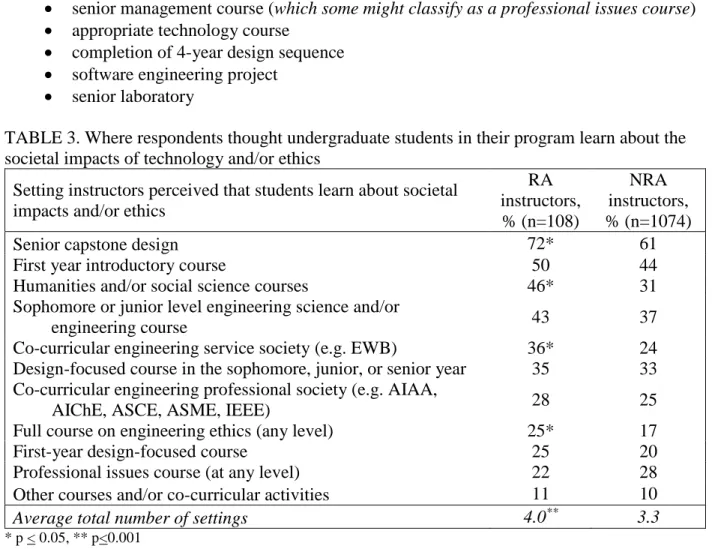
Individuals were asked to indicate where they believed undergraduate students in their program learned about ethics and/or societal impact issues, with 11 choice options presented and unsure. Among faculty at RA institutions, two noted unsure and their responses were not included in the analysis. Among those with an opinion from RA institutions, an average (and median) of 4 settings were noted (with a range of 1 to 9). There was not a statistically significant correlation between the perceived sufficiency of ESI education and number of educational settings where undergraduate students in the program learned about ESI at RA institutions (Spearman’s rho -0.012, sig. 0.908). Individuals at NRA institutions noted an average of 3.3 settings where they believed undergraduate students learned about ESI (median 3, range 1-11; excluding 148 unsure responses); this was lower than RA institutional responses (Mann-Whitney U Test sig. 0.001). The lower average number of settings where individuals at NRA institutions believed that undergraduate students learned about ESI topics is congruent with the larger percentage feeling that undergraduate student education on these issues was insufficient. Among individuals from NRA institutions there was a significant correlation among perceived ESI education sufficiency and number of educational settings (Spearman’s rho -0.177, sig. 0.000, n=975).
The percentage of respondents noting each setting where they believed undergraduate students in their program learned about ESI are shown in Table 3. The majority of instructors at RA
institutions believed that their students learned about ESI in their senior capstone design course and a first-year introductory course; many also indicated humanities and/or social science courses and sophomore or junior level engineering science and/or engineering courses. Among the 27 individuals from RA institutions who believed that undergraduate students in their program learned about ESI via a full course on engineering ethics, 55% also believed that the ESI instruction of their students was sufficient (the highest sufficiency among all course types). The “other” courses written in by respondents from RA institutions included:
• university core curriculum
• ethics course from philosophy department (which was intended to be included under humanities and/or social science courses)
• senior management course (which some might classify as a professional issues course) • appropriate technology course
• completion of 4-year design sequence • software engineering project
• senior laboratory
TABLE 3. Where respondents thought undergraduate students in their program learn about the societal impacts of technology and/or ethics
Setting instructors perceived that students learn about societal impacts and/or ethics
RA instructors, % (n=108) NRA instructors, % (n=1074)
Senior capstone design 72* 61
First year introductory course 50 44
Humanities and/or social science courses 46* 31
Sophomore or junior level engineering science and/or
engineering course 43 37
Co-curricular engineering service society (e.g. EWB) 36* 24
Design-focused course in the sophomore, junior, or senior year 35 33
Co-curricular engineering professional society (e.g. AIAA,
AIChE, ASCE, ASME, IEEE) 28 25
Full course on engineering ethics (any level) 25* 17
First-year design-focused course 25 20
Professional issues course (at any level) 22 28
Other courses and/or co-curricular activities 11 10
Average total number of settings 4.0** 3.3
* p < 0.05, ** p<0.001
Higher percentages of faculty at RA vs. NRA institutions believed that students in their program learned about ethical and societal issues in senior capstone design, humanities/social science courses, co-curricular engineering service groups, and a full course on engineering ethics. Some form of co-curricular experience was also indicated as contributing to student learning about ethics and/or societal impacts by 47% of respondents from RA institutions. This included engineering service groups like EWB (36%) and/or professional societies (28%). Other co-curricular activities listed included: mission trips to other countries; enrichment seminar in computing; required professional development activities.
RQ2. Ethics and Societal Impacts Instruction
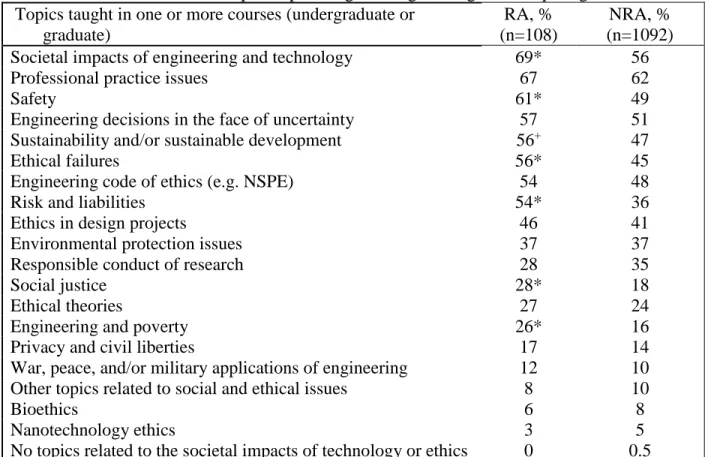
Course topics. Instructors at RA institutions typically taught more ESI topics in their courses to engineering students than instructors at NRA institutions; median of 6 vs. 5, respectively (p= 0.006). The specific ESI topics taught in their courses for engineering students are summarized in Table 4. At RA institutions, the most common ESI topics were the societal impacts of engineering & technology and professional practice issues. Seven ESI topics were taught more commonly by faculty at RA vs. NRA institutions.
TABLE 4. Ethics and societal impact topics taught to engineering and computing students Topics taught in one or more courses (undergraduate or
graduate)
RA, % (n=108)
NRA, % (n=1092)
Societal impacts of engineering and technology 69* 56
Professional practice issues 67 62
Safety 61* 49
Engineering decisions in the face of uncertainty 57 51
Sustainability and/or sustainable development 56+ 47
Ethical failures 56* 45
Engineering code of ethics (e.g. NSPE) 54 48
Risk and liabilities 54* 36
Ethics in design projects 46 41
Environmental protection issues 37 37
Responsible conduct of research 28 35
Social justice 28* 18
Ethical theories 27 24
Engineering and poverty 26* 16
Privacy and civil liberties 17 14
War, peace, and/or military applications of engineering 12 10
Other topics related to social and ethical issues 8 10
Bioethics 6 8
Nanotechnology ethics 3 5
No topics related to the societal impacts of technology or ethics 0 0.5
Chi-square test: * p < 0.05, + 0.05 < p < 0.10
Some topics may differ in the extent of inclusion at RA institutions affiliated with different types of faiths; however, the number of respondents from institutions of different denominational types was too low to evaluate these differences statistically. For example, social justice appeared to vary between institutional denominational affiliations: 40% of Jesuit, 38% Roman Catholic, 23% Catholic (not Jesuit or Roman Catholic), 17% Baptist, 0% United Methodist, and 0% Church of Jesus Christ of Latter-Day Saints.
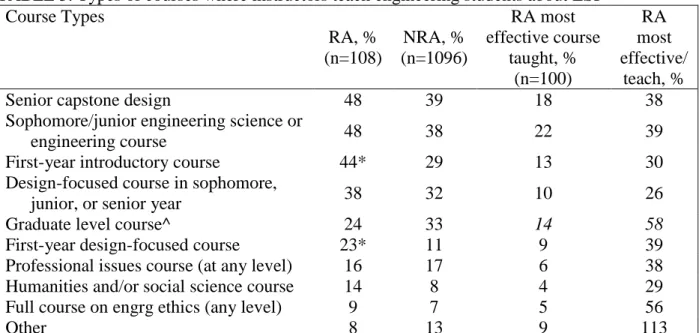
Course Types. Instructors were asked to indicate all of the types of courses where they taught ESI; results are summarized in Table 5. Instructors at both RA and NRA institutions indicated a median of two course types (range 1 to 8). Given that typical teaching loads often range from 3 courses (at highly research active institutions) to 8 courses (for full time instructors), some of the respondents may have infused ESI issues into all of their courses. ESI topics were included most commonly in senior capstone design and sophomore/junior level engineering science and
engineering courses. Examples of the sophomore/junior engineering/engineering science courses are: statics, material and energy balances, mechanics of materials, heat transfer, software
engineering. Two course types were more commonly reported among RA vs. NRA instructors, first-year introductory courses and first-year design focused courses. It is unclear if simply more of the respondents from RA institutions taught these course types, or if more of the individuals who taught these course types infused ESI issues into them.
TABLE 5. Types of courses where instructors teach engineering students about ESI Course Types RA, % (n=108) NRA, % (n=1096) RA most effective course taught, % (n=100) RA most effective/ teach, %
Senior capstone design 48 39 18 38
Sophomore/junior engineering science or
engineering course 48 38 22 39
First-year introductory course 44* 29 13 30
Design-focused course in sophomore,
junior, or senior year 38 32 10 26
Graduate level course^ 24 33 14 58
First-year design-focused course 23* 11 9 39
Professional issues course (at any level) 16 17 6 38
Humanities and/or social science course 14 8 4 29
Full course on engrg ethics (any level) 9 7 5 56
Other 8 13 9 113
Chi-square test: * p < 0.05; italics = some of these were also UG courses ^ as a percentage of instructors at institutions with graduate degrees
There were 100 instructors from RA institutions who described one course where they believed they most effectively taught engineering/computing students about ESI. The majority of the most effective courses were undergraduate (96%), with only 10 describing a graduate level course (6 of these were cross-listed as undergraduate courses). Among the 96 undergraduate courses described, 77% were required for students in one or more engineering/computing majors, 24% were electives for students in one or more engineering/computing majors (1 was both). Looking at the types of courses described as most effective, it appears that graduate level courses and full courses on engineering ethics were perceived as more effective at teaching ethics/social issues; this is because 56-58% of the instructors who reported teaching ESI topics in these courses also selected the course as where they most effectively taught these issues (final column in Table 5). Less effective courses include design-focused courses in sophomore-senior year, humanities & social science courses, and first-year introductory courses. There were also 18 individuals who described a second course where they taught ESI topics.
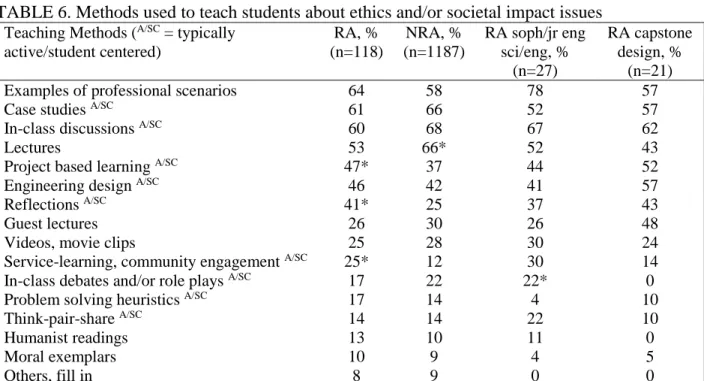
Teaching Methods in Courses. There were 100 instructors at RA institutions who described one or two courses where they taught ethics/societal impact issues (a total of 118 courses described). Given a list of 16 potential teaching methods used to teach ESI, an average of 5.4 methods were used in the most effective courses (n=100) and 4.0 methods were used in the additional course described (n=18). Table 6 shows the percentage of courses where the teaching methods were used. Across all courses, a similar number of teaching methods for ESI were used by instructors at RA and NRA institutions; average 5.3 and 5.1, respectively. Overall, the most popular
methods used to teach ethics and societal impact issues at RA institutions were examples of professional scenarios, case studies, and in-class discussions. In general, similar methods were used to teach ESI by instructors at NRA institutions, with the exception of greater use of project based learning, reflections, and service-learning at RA institutions, and more lectures at NRA institutions. The greater use of active/student centered teaching methods for ESI at RA
spirituality were more likely to use student-centered teaching methods in undergraduate courses (presuming that more spiritual faculty are likely to be found at religiously-affiliated institutions). TABLE 6. Methods used to teach students about ethics and/or societal impact issues
Teaching Methods (A/SC = typically active/student centered) RA, % (n=118) NRA, % (n=1187) RA soph/jr eng sci/eng, % (n=27) RA capstone design, % (n=21)
Examples of professional scenarios 64 58 78 57
Case studies A/SC 61 66 52 57
In-class discussions A/SC 60 68 67 62
Lectures 53 66* 52 43
Project based learning A/SC 47* 37 44 52
Engineering design A/SC 46 42 41 57
Reflections A/SC 41* 25 37 43
Guest lectures 26 30 26 48
Videos, movie clips 25 28 30 24
Service-learning, community engagement A/SC 25* 12 30 14
In-class debates and/or role plays A/SC 17 22 22* 0
Problem solving heuristics A/SC 17 14 4 10
Think-pair-share A/SC 14 14 22 10
Humanist readings 13 10 11 0
Moral exemplars 10 9 4 5
Others, fill in 8 9 0 0
Chi-square test: * p < 0.05, + 0.05 < p < 0.10
It is likely that different teaching methods are used to teach ESI topics in different types of courses. However, given the small number of responses from RA institutions, statistically significant differences were only found for one method (in-class debates). Apparent differences (>15%) were greater use of engineering design and guest lectures in the capstone design courses, compared to greater use of professional scenarios and service-learning (SL) in sophomore/junior engineering/engineering science courses.
The “other” teaching methods written-in by instructors at RA institutions included: • readings of essays that explore biblical implications on engineering perspectives • final Pechakucha talk developing and describing own morale theory
• students write an ethical dilemma short story, play a board game on environmental ethics • students create a work of fiction involving an ethical grey area
• board game dilemma
• ethics papers and design/safety considerations
• participation in a professional meeting or conference, volunteering there • CITI training
• creative writing
Assessment Methods in Courses. Instructors were asked what methods were used to assess student learning of ethical/societal issues. Instructors at RA institutions used an average of 2.4 methods to assess ethics/societal impact learning in their courses (range 1 to 6). The most commonly used methods in courses at RA institutions were individual reflections (57%) and group-based assignments (47%); these assessment methods were less commonly used at NRA
institutions (38% and 33%, respectively). Other assessment methods for ESI instruction used by instructors at RA institutions included: individual homework graded with a rubric (42%),
test/quiz questions (31%), team ratings (18%), individual assignments with right/wrong answers (12%), surveys 8%), individual standardized assessment (e.g. DIT2; 3%), and other methods (14%). In addition, a larger percentage of instructors at NRA institutions did not assess ESI outcomes in any manner (14% compared to 6% at RA institutions).
Co-curricular Learning. The survey also explored co-curricular activities where students may learn about ethical and/or social issues; results are summarized in Table 7. Eighty-five individuals from RA institutions described the topics included in 128 different co-curricular activities that they mentored. These responses were compared to those from 931 individuals from NRA institutions describing 1265 co-curricular activities. For co-curricular activities that
included some education on ESI, an average of about four different topics were included. The topics that were most common across all co-curricular activities were professional issues, safety, and the societal impacts of engineering and technology. Only one topic, environmental
protection issues, differed in prevalence between institution types, being more prevalent at NRA institutions.
TABLE 7. Percentage of co-curricular activities at RA institutions where topics are taught
Topic NRA % All (n=1265) RA % All (n=128) RA % Prof. society (n=57) RA % Design group (n=21) RA % Eng service group (n=17) RA % REU (n=12) Professional issues 62 58 61 57 65 58 Safety 45 44* 35 67 88 33
Societal impacts of engrg & technol. 45 43 46 24 71 42 Engrg. decisions under uncertainty 36 37* 23 67 53 67 Sustainability / sust. development 37 34** 26 29 94 42
Responsible conduct of research 27 26* 19 24 24 67 Engineering code of ethics 29 25 30 14 24 25 Ethics in design 22 24* 21 33 53 17 Risk and liability 19 23* 16 38 59 8 Engineering and poverty 17 17** 9 0 82 0
Environmental protection issues 28+ 17* 14 10 53 25
Social Justice 13 16** 9 0 53 8
War, peace, and/or military 11 16 11 22 18 17 Ethical failures 17 14 19 5 18 8
No topics 9 11* 12 0 0 8
Privacy and civil liberties 19 4 4 0 12 0 Ethical theories 5 4 5 0 5 8 Nanotechnology 2 2 4 0 0 8
Other topics 7 2 4 0 0 0
Bioethics 4 1 2 0 0 0
Average # topics 4.5 4.2 3.7 4.0 7.6 4.4 Chi-square test NRA vs. RA, + p < 0.05
Chi-square test different types of co-curricular activities at RA institutions, *p<0.05, **p<0.001,
Four different types of co-curricular activities were described by the majority of individuals from RA institutions. Nine topics differed in the extent that they were included in these different types of co-curricular activities. For example, safety was highly prevalent in engineering service groups (Engineers Without Borders, Engineers for a Sustainable World, and Engineering World
Health, and others), but much less commonly discussed in professional societies or research experiences for undergraduates (REU). The most widely represented groups within the professional societies category were: American Society of Mechanical Engineers (ASME), American Society of Civil Engineers (ASCE), Institute of Electrical and Electronics Engineers (IEEE), Society of Women Engineers (SWE), and Association of Computing Machinery (ACM). The types of design activities included SAE Baja, ASCE Concrete Canoe, Human Powered Vehicles, EcoMarathon, VEX Robotics, and ChemE Car team. Overall, more ethical/societal impact topics were included in activities with engineering service groups (average 7.6), than other types of co-curricular activities. This indicates that engineering service groups may provide particularly rich opportunities for students to learn about ESI issues in an authentic context. In the co-curricular activities at RA institutions, the most commonly reported methods used to teach students about ESI were: design projects (59%); lectures, presentations, guest speakers (59%) discussions (56%); working with communities (45%); and other (13%). Some of the other methods written in were: attending conferences (n=3), reflection, international travel, field trip, and formal competition. The teaching methods for ESI were similar in frequency compared to co-curricular activities at NRA institutions, with the exception of design projects (only 45% of NRA; chi-test p= 0.002). Only 14% of the co-curricular mentors at RA institutions reported that they assess ESI instruction in these settings; methods included surveys, observations of
discussions, evaluations of projects/reports.
RQ3. Institutional Culture
Seven individuals teaching engineering/computing students at RA institutions agreed to participate in interviews. The institutions represented different Christian affiliations (Baptist, Catholic, Jesuit, Church of Brethren, Church of Christ, Church of the Nazarene, and Lutheran). From Carnegie Basic Classifications the institutions included two doctoral research universities with high research activity, three Master’s institutions (large and medium), and two
Baccalaureate with Arts & Sciences focus. The faculty represented mechanical engineering (n=3), electrical engineering (n=2), and humanities/social sciences (ethics, psychology). The individuals spanned multiple ranks (3 professors, 2 associate professors, 1 assistant professor, 1 full time adjunct or research faculty), and included one female and six males.
The interviews touched on a number of themes connected to the relationship between institutional culture and ethics education. All seven of the interviewees commented on their respective institution’s culture in relation to the value placed on teaching ESI to engineering and computing students. Six of the interviewees directly discussed the religious affiliation of their university in this context. Three of the interviewees mentioned that the religious foundation of their institution motivated an ethics across the curriculum approach to educating engineering students. One interviewee commented that ethics are woven throughout the curriculum because it is “part of who we are, we are a Catholic Marianas university… that religious foundation and the fact that it is part of our common academic program.” The university incorporated practical ethical action as a learning outcome, which translated to an emphasis on ethics throughout the undergraduate experience. Another interviewee, who teaches graduate courses at a Jesuit institution, noted the university is “trying to get ethics across the curriculum, ethics into
into the curriculum.” A professor with a psychology background who teaches a required course on ethical issues in software design noted that the success of his course has resulted from its integration into the computer science program. Ethics has been recognized as a “crucial piece of the curriculum” with ESI spread throughout the curriculum at the Lutheran institution. Students gain exposure to sociotechnical systems and ethical considerations in two courses before taking his course and thus already have a foundation to build on. Students are then required to conduct an ethical analysis on their senior projects to complete the loop. The ethics across the curriculum approach helps students gain an understanding of how ESI topics are embedded in a range of engineering contexts.
Another theme that emerged in the interviews with instructors from RA institutions was the requirement of an ethics course. All of the interviewees explicitly discussed this curricular requirement at their school and five mentioned offerings within and outside of their engineering programs. An instructor at the Catholic institution noted, “ethics courses don’t have to come from philosophy or religion” and that any department can propose a course to fulfill the
requirement. The educator at the Baptist university expressed a similar approach to providing a range of course options for the ethics requirement with engineering students taking classes in business, philosophy, mechanical engineering, and humanitarian engineering. The interviewee from the Lutheran school noted that the ethics requirement was part of the fabric of the liberal arts institution and a reflection of its “emphasis on ethics”. Similarly, any department including philosophy, psychology, computer science, and dance can develop and offer courses to fill the mandate. The requirement for stand-alone ethics courses serves as a curricular manifestation of the emphasis on ethics and provides an educational deep dive into ESI for engineering students. Two of the interviewees also discussed the explicit role that Christianity plays in ethics education at their institutions. The educator at the institution affiliated with the Church of Christ noted he “works from a personal ethics approach through the gospel of Christ.” All of the lectures included in his ethics and professionalism course, which is taken in conjunction with senior design, tie directly to the Bible. He takes a “broad view of ethics” to teach topics “in the sense of things that are very real” to the students. The class begins with students sharing ethics-related situations that they might face in engineering and the course content is then structured around those concerns. By incorporating case studies, discussions, and the Scripture, the interviewee aims to apply the faith that students develop in their community, family, and church contexts to the domain of engineering. The institution requires 16 credits of Bible and ministry courses and he connects the ethics education and critical thinking offered in those courses to engineering content. The interviewee from the institution founded by the Church of the Nazarene noted that the textbook used in his course on technology and social responsibility is from the Christian perspective. At both of these schools, Christianity imbues all aspects of student life, institutional culture, and ethics education.
The interviews also explored how the institution’s denomination impacted its approach to ESI instruction. The professor at the Lutheran institution noted that although the school was
religiously founded, it does not require daily chapel and does not have a faith statement and these are important “caveats” to understanding its academic culture. The interviewee who teaches at the institution affiliated with the Church of the Nazarene commented that the Christian
motivated “learning by serving.” The institution focused on teaching ethics to engineering students through service learning and community outreach. He previously taught at a
Presbyterian school and discerned a difference between the two denominations in their ways of teaching ethics. He noted the Presbyterian institution emphasized thinking rather than doing with the integration of theory, reflection, and philosophy. These comments help parse out the
influence that different Christian denominations have on the institutions’ approach to the ethics education of engineering and computing students. The analysis of the findings from the
qualitative interviews is on-going, and additional themes might emerge in future.
Limitations and Future Work
The primary limitation of the findings is based on the sample – individuals who chose to respond to the survey. It is likely that individuals choosing to take their time to respond to a survey on engineering ethics care about ethics education more than an average faculty member. The second limitation is the relatively small number of individuals from religiously-affiliated institutions that responded to the survey. Not all religiously-affiliated institutions with engineering and
computing degrees were represented, nor are the varying opinions within institutions and across disciplines likely to be fully represented. Further, it is expected that findings might differ among institutions affiliated with different types of Christian faiths; however, the sample size was too small to evaluate such differences. It was also not possible to explore non-Christian religiously-affiliated institutions.
At present, the religious beliefs of individual instructors and the extent to which this impacts their ESI teaching practices in educational settings for engineering and computing students are not known. Highly religious individuals may teach at NRA institutions, and similarly atheists may teach at RA institutions. Individuals at all institutional types are expected to have a range of personal religious beliefs and personal attitudes regarding the importance and relevance of ESI topics. The extent to which institutional culture encourages or discourages faculty from bringing these personal perspectives to their teaching practices could vary. More research is needed to understand these nuanced ideas.
Summary and Conclusions
Nearly half of the faculty at religiously-affiliated institutions (48%) believed that undergraduate engineering and/or computing students in their programs received sufficient education on ethics and societal impact issues; far fewer faculty (30%) at NRA institutions believed that
undergraduate education on ESI was sufficient. On average, faculty at RA institutions believed that undergraduate students learned about ESI in four types of courses and/or co-curricular activities, higher than the average of 3.3 settings among faculty at NRA institutions. The educational settings most widely believed to include ESI at RA institutions include senior capstone design (72%), first year introductory courses (50%), and humanities and/or social science courses (46%). Instructors at RA institutions taught a median of six different ESI topics in their courses; societal impacts of engineering and technology, safety, ethical failures, risk and liabilities, social justice, and engineering and poverty were taught more commonly by faculty at RA institutions compared to NRA institutions. An average of 5.3 methods were used by faculty at RA institutions to teach ESI topics in courses for engineering and/or computing students; the
most common methods were examples of professional scenarios, case studies, and in-class discussions. These same instructors used an average of 2.4 methods to assess ESI instruction, most commonly individual reflections. Co-curricular activities with professional societies, design groups, engineering service groups, and undergraduate research also included ESI education. Interviews with faculty at RA institutions revealed that the institutional cultures were important in supporting the ethics education of engineering and computing students. However, the extent that Biblical grounding and Christian values were included in the ethics education varied. The results provide ideas for infusing ESI into any type of course, focused on various topics using a range of teaching and assessment methods. It appears that on average faculty at RA institutions teach ESI topics more widely across various course types, using a range of rich teaching and assessment methods, than peers at NRA institutions. Further research is needed to explore the reasons behind these differences.
Acknowledgement
This material is based on work supported by the National Science Foundation under Grant Numbers 1540348, 1540341, and 1540308. Any opinions, findings, and conclusions or recommendations expressed in this material are those of the authors and do not necessarily reflect the views of the National Science Foundation.
References
AAC&U, Association of American Colleges and Universities. Essential Learning Outcomes.
http://www.aacu.org/leap/essential-learning-outcomes Accessed March 20, 2017. Abelman, R. and A. Dalessandro. “Institutional Vision in Christian Higher Education: A
Comparison of ACCU, ELCA, and CCCU Institutions.” Journal of Research on Christian Education, vol. 18, no. 1, 2009, pp. 84-119.
ABET. Criteria for Accrediting Engineering Programs. Effective for Reviews During the 2017-2018 Accreditation Cycle, ABET Engineering Accreditation Commission, ABET, 2016. Baltimore, MD.
Arthur, J. “Faith and secularization in religious colleges and universities.” Journal of Beliefs & Values, vol. 29, no. 2, 2008, pp. 197-202.
ASCE, American Society of Civil Engineers. Civil Engineering Body of Knowledge for the 21st Century. Second Edition. ASCE, 2008, Reston, VA.
ASCE, American Society of Civil Engineers. ASCE Code of Ethics. ASCE, 2006, Reston, VA. http://www.asce.org/code-of-ethics/. Accessed 3 Feb. 2017.
ASCE, American Society of Civil Engineers. Commentary on the ABET Program Criteria for Civil and Similarly Named Programs. Effective for the 2016-2017 Accreditation Cycle. ASCE, 2015, Reston, VA. 49 pp.
Barry, B.E. and J.R. Herkert. “Engineering Ethics.” Cambridge Handbook of Engineering Education Research, A. Johri and B.M. Olds, editors. Cambridge Press, 2014, Cambridge. Bielefeldt, A.R. and N.E. Canney. “Relationships between religion, spirituality, and socially
responsible engineering.” Engineering Studies, vol. 8, no. 1, 2016.
http://dx.doi.org/10.1080/19378629.2016.1147567
Bielefeldt, A.R., N.E. Canney, C. Swan and D. Knight. “Efficacy of macroethics education in engineering.” American Society for Engineering Education (ASEE) Annual Conference & Exposition Proceedings, Paper ID #16104, 21 pp., June 26-29, 2016, New Orleans, LA.
Bielefeldt, A.R., D. Knight, C. Swan and N. Canney. “Macroethics education in engineering and computing courses.” Rocky Mountain Section Conference of theAmerican Society for Engineering Education (ASEE), pp. 154-166, Sept. 30 – Oct. 1, 2016b, Cedar City, UT. Birbeck, D. and K. Andre. “The affective domain: beyond simply knowing.” Assessment in
Different Dimensions: A conference on teaching and learning in tertiary education, Conference Papers. 19-20 November 2009, RMIT University, Melbourne. pp. 40-47. Canney, N.E., M. Polmear, A.R. Bielefeldt, D. Knight, C. Swan and E. Simon. “Challenges and
opportunities: faculty views on the state of macroethical education in engineering.”
American Society for Engineering Education (ASEE) Annual Conference & Exposition Proceedings, June 25-28, 2017, Columbus OH.
Comegys, C. “The Impact of Religiously Affiliated Universities and Courses in Ethics and Religious Studies on Students’ Attitude Toward Business Ethics.” Contemporary Issues in Education Research, vol. 3, no. 6, 2010, pp. 35-44.
Eagan, K., E.B. Stolzenberg, J.B. Lozano, M.C. Aragon, M.R. Suchard and S. Hurtado.
Undergraduate Teaching Faculty: The 2013-2014 HERI Faculty Survey. Higher Education Research Institution, 2014, UCLA, Los Angeles.
Eagan, K., E.B. Stolzenberg, A.K. Bates, M.C. Aragon, M.R. Suchard, C. Rios-Aguilar. The American Freshman: National Norms Fall 2015. CIRP – Cooperative Institutional Research Program at the Higher Education Research Institute at UCLA, 2016, Los Angeles.
Engineering Council. UK-SPEC: UK Standard for Professional Engineering Competence. Third edition. 2013. London UK www.engc.org.uk
Engineers Australia. Stage 1 Competency Standard for Professional Engineer.
https://www.engineersaustralia.org.au/sites/default/files/resource-files/2017-03/Stage%201%20Competency%20Standards.pdf 6 pp. Accessed March 18, 2017. Finelli, C.J., M.A. Holsapple, E. Ra, R.M. Bielby, B.A. Burt, D.D. Carpenter, T.S. Harding and
J.A. Sutkus. “An Assessment of Engineering Students’ Curricular and Co-Curricular Experiences and Their Ethical Development.” Journal of Engineering Education, vol. 101 no. 3, 2012, pp. 469-494.
Flores, J. and A.Z. Vazquez-Parraga. “Ethical orientations and attitudes of Hispanic business students.” Journal of Academic Ethics, vol. 7, 2009, pp. 261-275.
Foreman, M.W. Christianity & Bioethics: Confronting Clinical Issues. College Press Publishing Company, 1999, Joplin, Missouri.
Glanzer, P.L. and N.F. Alleman. “The implications of religious identity for teaching ethics.”
Journal of Beliefs & Values, vol. 36, no. 2, 2015, 131-141.
Gross, N. and S. Simmons. “How religious are America’s college and university professors?” Religion and the Public Sphere, Social Science Research Council (SSRC), 6 Feb. 2007.
http://religion.ssrc.org/reforum/Gross_Simmons.pdf Accessed 30 Mar 2017.
Harding, T., C. Finelli, and D. Carpenter. “Cheating in College and its influence on ethical behavior in professional engineering practice.” American Society for Engineering Education (ASEE) Annual Conference & Exposition, Paper 2006-636, 2006, 13 pp.
HERI – Higher Education Research Institute. The Spiritual Life of College Students: A National Study of College Students’ Search for Meaning and Purpose. HERI. 2005. University of California, Los Angeles.
IEA, International Engineering Alliance. 2013. Graduate Attributes and Professional Competencies. Version 3. 16 pp. http://www.ieagreements.org
http://www.ieee.org/about/corporate/governance/p7-8.html Accessed March 20, 2017. IPENZ, Engineers New Zealand. (2013). CA30 Competency Standards with Revised Indicators
(Version 3.2). – Introduction to IPENZ Competence Based Quality Marks. 27 pp. Irwin, J. “Existential thought between ethics and religion as related to curriculum: from
Kierkegaard to Sartre.” Does Religious Education Matter? M. Shanahan, Ed., Routledge, 2017, London.
Jun, S.P. “Moral differences between Protestants and Atheists, and the effects of religion on the morality of Protestants.” IEEE KORUS, 2005, pp. 1044-1047.
Lindholm, J.A. and H.S. Astin. “Spirituality and Pedagogy: Faculty’s Spirituality and Use of Student-Centered Approaches to Undergraduate Teaching.” The Review of Higher Education, vol. 31 no. 2, 2008, pp. 185-207.
McKeown, J. “Christianity and ecological sustainability.” Greener by Degrees: Exploring
Sustainability through Higher Education Curricula, Carolyn Roberts and Jane Roberts, Eds, Cheltenham, 2007, University of Gloucestershire.
McKinley, S.J. “Religious institutions, faith identity and secularization.” Journal of Beliefs & Values, vol. 29, no. 2, 2008, 203-205.
NCEES, National Council of Examiners for Engineering and Surveying. (2016). Model Rules. NCEES, Seneca SC. http://ncees.org/wp-content/uploads/Model-Rules-2016.pdf Accessed March 20, 2017.
NSPE, National Society of Professional Engineers. (2007). NSPE Code of Ethics for Engineers. https://www.nae.edu/File.aspx?id=7378 Accessed Feb. 3, 2017.
NSPE, National Society of Professional Engineers. (2013). Engineering Body of Knowledge. First Edition.
Olawale, S. J-D. and O.M. Yemisi. “The Roles of Religious Education to Peace, Security and Sustainable Development in Nigeria.” IOSR Journal of Humanities and Social Science, vol. 3, no. 6, 2012, pp. 1-5.
Rasmussen, L. “Christianity and Sustainable Communities.” Union Theological Seminary. 7 pp.
http://users.clas.ufl.edu/bron/PDF--Christianity/Rasmussen--Christianity%20and%20Sustainable%20Communities.pdf Accessed Feb. 18, 2017. Shahjahan, R.A. “Toward a spiritual praxis: the role of spirituality among faculty of color
teaching for social justice.” The Review of Higher Education, vol. 33, no. 4, 2010, pp. 473-512.
Stuerzenhofecker, K., R. O’Loughlin and S. Smith. “Sustainability in the Theology Curriculum.”
Sustainability education: Perspectives and practice across higher education, Paula Jones, David Selby, and Stephen Sterling, Eds. Earthscan, 2010, London.
Sullins, D.P. “The Difference Catholic Makes: Catholic Faculty and Catholic Identity.” Journal for the Scientific Study of Religion, vol. 41, no. 1, 2004, pp. 83-101.
Todd, N.R. and A.K. Rufa. “Social Justice and Religious Participation: A Qualitative
Investigation of Christian Perspectives.” American Journal of Community Psychology, vol. 51, 2013, pp. 315-331.
Vesilind, P.A. and A.S. Gunn. “Spiritual dimensions of environmental ethic for engineers.”
Journal of Professional Issues in Engineering Education and Practice, vol. 125, no. 3, 1999, pp. 83-87.
Vogt, M. “Sustainability: A principle of Christian ethics?” Ecojesuit, 18 April 2011.
http://www.ecojesuit.com/sustainability-a-principle-of-christian-ethics/967/ Accessed Feb. 18, 2017.