The use of Process Mining in Business
Process Auditing
Course:
IM9806 Afstudeertraject Business Process Management and IT
Student:
N.J. Wiersma
Student number:
851085576
i
The use of Process Mining in Business
Process Auditing
Het gebruik van Process Mining bij het
auditen van bedrijfsprocessen
Programme:
Open University of the Netherlands, faculty of Management, Science
& Technology
Master Business Process Management & IT
Course:
IM9806 Afstudeertraject Business Process Management and IT
Student:
N.J. Wiersma
Student number:
851085576
Report date:
April 4, 2017
Master Thesis supervisor:
Dr. ir. Ella Roubtsova
Second reader:
Prof. dr. ir. Remko Helms
iii
Abstract
Research literature widely discusses the opportunities of process mining to support audit processes.
By using process mining tools that can automate one or more steps of the auditing process, auditors
can put more focus on the analytic side of auditing, instead of data gathering and taking samples.
However, an approach for conducting process audits with support of process mining tools is still
lacking.
This report presents the application of process mining as a component of business process auditing,
executed within the context of a Dutch municipality. Required elements of the auditing approach are
defined using the literature research conducted prior to this report. An auditing approach that
integrates these elements is developed.
In the empirical part of our research, the auditing approach is applied to two process auditing cases.
The results of the case studies are used to evaluate the hypotheses that process mining can be a part
of process auditing methods and estimate the required activities of the preparation of the process
log data and the audit statements for process mining tools. The case studies show that the
development of a normative process, collecting the set of audit criteria and analyzing of the
completeness of the log data were limiting factors for automation of the audit. Other results concern
with the identification the audit criteria that can and cannot be formalized because of
incompleteness of the log data (82% vs 70% of all limitations) or because of imprecise formulation. It
was found that (20% vs 52%) of audit criteria can be translated into filters used by process mining
tools, allowing for identification of non-compliant cases. Relating the audit criteria to filters and
using process mining tools for auditing makes the audit fast, repeatable and based on all process
cases instead of samples.
Key Terms
iv
Index
Abstract ... iii
Key Terms ... iii
1.
Introduction ... 1
1.1.
Background ... 1
1.2.
Context ... 1
1.3.
Relevance... 2
1.4.
Problem definition ... 2
1.5.
Research goal ... 2
2.
Literature research ... 4
2.1.
Approach for Literature Research ... 4
2.2.
Literature Research execution... 4
2.3.
Results of the Literature research ... 5
2.3.1.
What is the place of process auditing among other types of auditing ? ... 5
2.3.2.
What are the elements of process mining aimed at auditing? ... 8
2.3.3.
How can the use of process mining to support the auditing of business processes be
approached? ... 10
2.3.4.
What are limiting factors in the use of process mining for auditing business processes?
11
2.3.5.
Hypothesis formulated after the literature study ... 11
3.
Towards Auditing supported by Process Mining ... 13
3.1.
Design goal ... 13
3.2.
Design of the Process Audit approach with Process Mining ... 13
3.3.
Design findings ... 14
3.4.
Experimental research strategy ... 16
3.5.
Research approach ... 16
3.5.1.
Case Selection ... 16
3.5.2.
Data sources ... 16
3.5.1.
Data gathering ... 17
3.5.2.
Data access ... 18
3.5.3.
Ethical aspects ... 19
4.
Evaluation of the extended process audit approach: two process audit cases. ... 20
4.1.
Case one: Audit of grant application process ... 20
v
4.1.2.
Step 1: Apply control objectives to business context ... 23
4.1.3.
Step 2: Transform internal controls to audit criteria ... 23
4.1.4.
Step 3: Process Discovery ... 24
4.1.5.
Step 4: Filter against normative model ... 25
4.1.6.
Step 5: Interconnect of business rules and process model... 25
4.1.7.
Report of Audit Conformance ... 26
4.2.
Case Two: Purchasing invoices process ... 27
4.2.1.
Step 0: Preparation of the audit: Identify relevant source documents ... 29
4.2.2.
Step 1: Apply control objectives to business context ... 29
4.2.3.
Step 2: Transform internal controls to audit criteria ... 30
4.2.4.
Step 3: Process Discovery ... 30
4.2.5.
Step 4: Filter against normative model ... 30
4.2.6.
Step 5: Interconnect of business rules and process model... 31
4.2.7.
Report of Audit Conformance ... 32
5.
Discussion of limitations of the proposed approach and recommendations for future work ... 33
References ... 37
Appendix 1: Literature Research ... 38
Appendix 2: Full experimental Protocol – Grant Application Process ... 39
Appendix 3: Sheet of Statements – Grant Application Process ... 42
Appendix 4: List of Disco Filters – Grant Application Process ... 48
Appendix 5: Report of Audit Conformance – Grant Application Process ... 59
Appendix 6: Full Experimental Protocol: Invoices Process ... 61
Appendix 8: Sheet of Statements – Invoices Process ... 63
Appendix 9: List of Disco Filters – Invoices Process ... 67
1
1.
Introduction
1.1.
Background
Auditing is a standard business practice with many applications. Traditionally, the first thing that
comes to mind when thinking about auditing is a financial context, aimed for example at examining
compliancy of a business to tax rules and regulations. This is only one of many uses. Today, one can
audit maintenance engineering practices, health and safety issues, ethical conduct, and of course a
wide variety of IT-related practices such as Information Systems Security, access controls and
business processes.
Conducting a process audit is effort consuming, as human input is needed for all aspects mentioned
in the generic audit definition: obtaining audit evidence, examining the evidence against audit
criteria and reporting the audit findings. To alleviate this effort, conducting an audit can be
supported with methods and tools.
When introducing the research field of process mining, (W. van der Aalst, 2012) presented the
extracting of knowledge from event logs of information systems as an opportunity to discover
processes, check conformance of processes against a predefined model and enhance models.
Auditing a process can be seen as a form of conformance checking, used by the auditors to find out if
the process as implemented in the information system obeys the same business rules as the reference
model. By using process mining tools that can automate one or more steps of process mining, auditors
can put more focus on analysing conformance instead of data gathering and taking samples. Recently,
the necessary techniques have made an appearance in an ever-increasing number of commercial
process analysis tools, such as Fluxicon Disco
1. However, use process-mining supported auditing of
business processes is still not widely applied in practice. In the literature part of this thesis, the
necessary elements of such an approach are investigated and an extended approach is formulated.
This approach is evaluated in the experimental part of this study. Two cases of process audits are
conducted, using a structured process mining approach for support. The limitations related to
application of process mining are mapped to various steps of the approach. Finally, the limitations
identified are used to identify areas for future research.
1.2.
Context
The research conducted in this thesis is positioned in the intersection of the fields of process mining,
business rules and auditing research. Definitions of both the field of process mining and auditing
research are used to describe the elements necessary to formulate a complete process auditing
approach and are elaborated in paragraph 2.3 of the literature review. The empirical part of the
research is executed in the business context of a Dutch Municipality (City of Eindhoven), where two
real-life process audit cases are conducted with support of process mining tooling.
2
1.3.
Relevance
Theoretical: The application of process mining depends on the availability of event data in the
information system. It is not a trivial challenge to develop standard methods that enable
non-process mining-experts (auditors) to use information found in event logs in their day-to-day work.
This thesis adds knowledge to the current practice of business process auditing and to extend the
field of process mining with a methodology for the auditing of processes.
Business context: Traditionally, auditing is conducted by selecting random cases from an information
system and comparing them with a formal process model, in order to verify a number of auditing
criteria (such as separation of concerns for some tasks in the process). This takes time and effort,
which could possibly be reduced by automating it. It could also help in improving the consistency
and comparability of audits that are conducted in multiple time periods. Finally, it enables auditors
to audit all instances of a process instead of a taking a sample, increasing validity of the findings.
1.4.
Problem definition
The problem addressed in this thesis can be summarised as follows:
Literature suggests that process mining techniques and tools can support the conducting of
business process audits, but the adoption of process mining as support for business process
auditing is still limited in real-life business environment.
1.5.
Research goal
In order to address the problem stated in the previous paragraph, the research goal is to understand
what factors limit the application of process mining as support for process auditing, and develop an
approach that addresses the limiting factors. Consequently, we evaluate this approach in the
empirical part of the thesis.
The main research question can be formulated:
In what way can a process audit be conducted, so that it is supported by process mining
techniques and tools?
This question can be answered by addressing a number of sub questions. The first four questions will
be reviewed in the literature research part of this thesis:
1.
What is the place of process auditing among other types of auditing?
2.
What are the elements of process mining aimed at auditing?
3.
How can the use of process mining to support the auditing of business processes be
approached?
3
4.
What are limiting factors in the use of process mining for auditing business processes?
In the empirical part of the thesis, the following sub question is answered:
5.
What factors limit the structured approach of a business process audit supported by process
mining?
4
2.
Literature research
This chapter presents the results of the literature research that was done in preparation for the
empirical part of the thesis. The complete literature report can be found in Appendix 1: Literature
Research.
2.1.
Approach for Literature Research
As a starting point for the literature research the question central to this thesis was revisited and
broken down into its components. This yielded four sub questions mentioned in section 1.5, that
can be answered by examining current literature on the relevant topics.
In all four questions, the concepts of auditing frameworks, process auditing and process mining
techniques can be discerned. Also, a definition of concepts central to the practice of auditing is
needed. We started our research with a search on the following terms:
1.
Process Auditing
2.
Audit framework
The field of process mining is a relatively young field of study but already has produced a large
number of scientific papers. To get a good overview and hands-on experience, a Massive Open
Online Course (MOOC) was followed. Using this as a basis, further literature research was done using
the term:
3.
Process Mining techniques
During our research, it became evident that a link between auditing and process mining was needed.
For this, more searching was done using the term:
4.
Business Rules
For all search terms, Google Scholar was used as the primary search engine. In addition, a list of
relevant process mining literature that was provided on www.processmining.org was evaluated for
relevant papers. In case relevant articles were found in our primary research questions, the
references mentioned in these articles were checked for more interesting material.
2.2.
Literature Research execution
Conducting the search on terms in Google Scholar yielded the following search results:
Term #. Hits
Process auditing +/- 515.000
Audit framework +/- 1.200.000
Process Mining Techniques +/- 2.600.000
Business rules +/- 2.150.000
5
As can be seen, a large body of research was available for all search terms. As it was not feasible to
check all these for relevance, we used articles that were frequently cited as a starting point for
narrowing down the results. To further determine the relevance of an article, a first scan consisted
of reading the abstract and conclusion. Only the relevant articles were listed in Endnote, which was
used as a repository.
Next, all relevant articles were read in full and reviewed in light of the four sub research questions
that needed to be answered. On the basis of contribution to these questions, an article was used in
the literature report or discarded. For all articles, relevant references were noted as well. The final
article count is stated in Table 2.
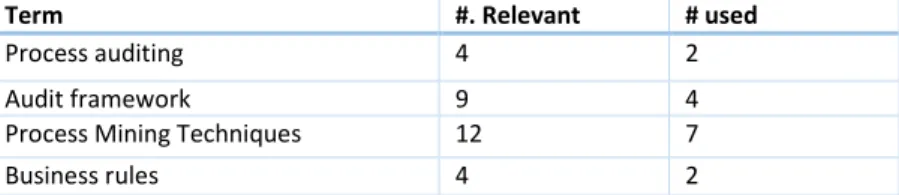
Term #. Relevant # used
Process auditing 4 2
Audit framework 9 4
Process Mining Techniques 12 7
Business rules 4 2
Table 2: Article count
An overview of references used in the literature research can be found at the end of the literature
report in Appendix 1: Literature Research.
2.3.
Results of the Literature research
The literature research is concluded by revisiting the sub-questions stated in section 1.5. The
outcome will act as the theoretical fundaments for the modelling and empirical part of our thesis. In
the following sections, results of the literature research are summarized for all sub-questions.
2.3.1.
What is the place of process auditing among other types of auditing?
Audits can be applied to evaluate business processes. According to (Russell, 2006), business process
audits are used to achieve a number of objectives:
-
Measuring conformance to standards and requirements of the product that is delivered
through the process;
-
Measuring the effectiveness of the process and the instructions that deliver the product.
Auditing a process can be seen as a form of conformance checking, that is used by auditors to find
out if the process as implemented in the information system obeys the same business rules as the
reference model. By using process mining tools that can automate one or more steps of process
mining, auditors can put more focus on analysing conformance instead of data gathering and taking
samples. Recently, the necessary techniques have made an appearance in an ever-increasing
number of commercial process analysis tools. However, literature research did not yield a tested
approach for conducting business process audits using process mining techniques.
To identify elements that are needed for such an approach, first we examine the structural elements
of audits in general.
Karapetrovic and Willborn (2000) show in their study of definitions, concepts and the fundamental
principles and practices of auditing that a variety of audit definitions exists that are applied in a
range of audit topics. The auditing of a business process is an activity that can be applied in different
6
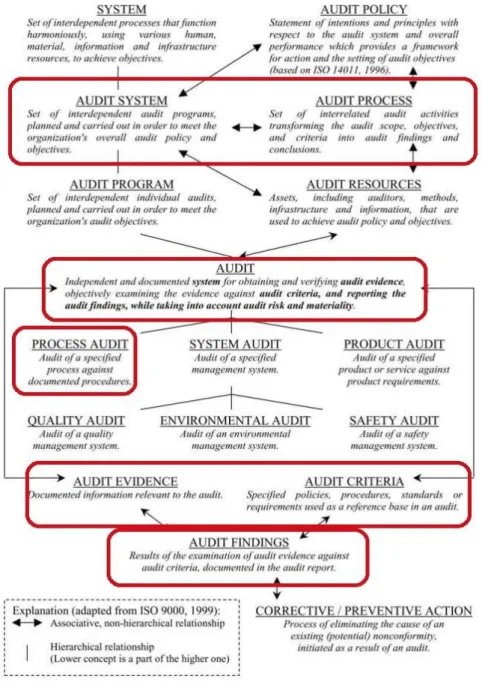
business contexts; this is why a generic definition of auditing and related terms is needed. The
diagram presented in Figure 1 summarises audit terms in context. Indicated in red are audit-related
terms central to this study.
Figure 1 : Audit Concept Diagram. Adapted from "Generic audit of management systems: fundamentals" by
Karapetrovic, S., & Willborn, W., 2000, Managerial Auditing Journal, 15(6), 279-294
As can be seen in the diagram, a process audit is one of many audit types, which is aimed at the
auditing of a specified business process against documented procedures. In combination with the
generic audit definition, we can define the process audit independently as
‘An independent and documented system for obtaining and verifying evidence concerning a business
process, against documented procedures that constitute the audit criteria, and reporting the process
audit findings, while taking into account audit risk and materiality’.
In addition to this definition, the fundamental structural elements that will be used in this thesis are
control objectives, audit process, audit criteria, audit evidence, and audit findings.
7
Control objectives
To start the process of an audit, input is needed about the objectives and regulation that functions
as basis for formulating audit criteria. The business process has to be checked for compliance to
these audit criteria. Three widely used control frameworks were evaluated as a source of control
objectives and their use for generating audit criteria.
1.
The COSO framework became widely accepted as the standard for the design and operation
of internal control systems for companies adopting and evaluating internal control related to
operations, compliance, and financial reporting (Martin, Sanders, & Scalan, 2014).
2.
The Control Objectives for Information and Related Technology (COBIT) can be used as an
extension of the COSO framework (Tuttle & Vandervelde, 2007). COBIT places emphasis on
the business need that is satisfied by each control objective (Ridley, Young, & Carroll, 2004)
3.
ISO/IEC 27002 provides best practice recommendations on information security.
After reviewing, we conclude that it is not possible to derive audit criteria from control frameworks
in a direct way, without first transforming the abstract principles and objectives into concrete audit
criteria concerning the business domain to be audited. For the first step of this transformation, the
framework that is the most suitable has the highest number of control objectives that concern the
business process itself, as opposed to business environment.
The most important concepts defining process auditing are:
Audit process
The audit process is the interrelated set of activities that is performed with the goal to transform
audit evidence into audit findings. For the scope of this thesis, this includes all activities of process
mining that are a part of the transformation.
Audit criteria
To evaluate control objectives that are formulated in a generic manner, business process-specific
audit criteria are needed that are used to check conformance. In this thesis audit criteria are central
to the auditing approach supported by process mining, as they provide a link between the domain of
auditing and the domain of process mining. To be used as such a link audit criteria must be
formulated in a way that can be evaluated by using process mining techniques.
Audit evidence
The sources of audit evidence are relevant to this thesis, as they provide the information that is used
for mining of the process and verification of the audit criteria. In the traditional approach of business
process auditing, audit evidence consists primarily of samples of process output that is manually
evaluated for conformance to a normative process model. For use in a process mining approach, the
audit evidence has to be available in the form of an event log of the information system that is used
to support the business process.
Audit findings
As a result of the process of auditing, the audit findings consist of the verification of all audit criteria
against the audit evidence. Non-conformity to the audit criteria is reported and can be used for
analysis of the underlying factors.
8
2.3.2.
What are the elements of process mining aimed at auditing?
To answer this sub question, elements of process mining and the application of business rules to
compose audit criteria are explored.
Process mining: general principals
Organisations execute
business processes to achieve their business goals. Nowadays, most business
processes are supported by information systems (IS), that help users of the IS within the
organisation to complete the business process in an efficient manner. In most modern businesses,
process auditing is conducted mainly by inspecting the Information Systems that collect the state
and data of cases flowing through a business process.
An information system can support a business process by automating a number of activities. To do
this, a workflow of the supported tasks is presented for the user to follow. This workflow can change
when the user of the IS makes one or many decisions regarding the preferred order of the activities.
The resulting ordering of activities is called the control flow (W. M. P. van der Aalst, 2011) and can
be analysed using process mining techniques.
Process mining is defined as the activity of discovering, monitoring and improving real processes
(i.e., not assumed processes) by extracting knowledge from event logs that are present in
Information Systems (W. M. P. van der Aalst, 2011).
Event log
Central to process mining is the event log, which contains log entries of events that are captured by
an information system. Each entry of the log consists of at least the following information:
case designation
activity label
time stamp.
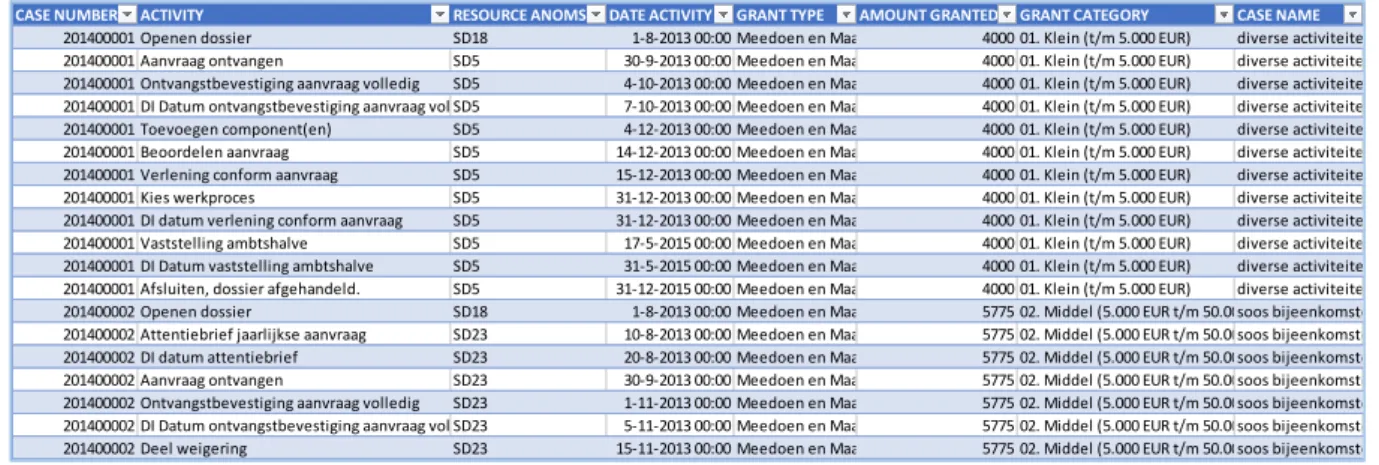
Table 3 shows a part of the event log of the grant application information system, exported from the
production database.
Table 3: Sample log of grant application process
There can be additional fields in each entry such as a designation of the person or role executing the
activity, or an additional time stamp for duration of the activity. However, such fields are not
mandatory. The event log of a process can be seen as a record of all log entries for that process in a
certain time interval.
CASE NUMBER ACTIVITY RESOURCE ANOMS DATE ACTIVITY GRANT TYPE AMOUNT GRANTED GRANT CATEGORY CASE NAME
201400001 Openen dossier SD18 1-8-2013 00:00 Meedoen en Maatschappelijke participatie4000 01. Klein (t/m 5.000 EUR) diverse activiteiten 2014 201400001 Aanvraag ontvangen SD5 30-9-2013 00:00 Meedoen en Maatschappelijke participatie4000 01. Klein (t/m 5.000 EUR) diverse activiteiten 2014 201400001 Ontvangstbevestiging aanvraag volledig SD5 4-10-2013 00:00 Meedoen en Maatschappelijke participatie4000 01. Klein (t/m 5.000 EUR) diverse activiteiten 2014 201400001 DI Datum ontvangstbevestiging aanvraag volledigSD5 7-10-2013 00:00 Meedoen en Maatschappelijke participatie4000 01. Klein (t/m 5.000 EUR) diverse activiteiten 2014 201400001 Toevoegen component(en) SD5 4-12-2013 00:00 Meedoen en Maatschappelijke participatie4000 01. Klein (t/m 5.000 EUR) diverse activiteiten 2014 201400001 Beoordelen aanvraag SD5 14-12-2013 00:00 Meedoen en Maatschappelijke participatie4000 01. Klein (t/m 5.000 EUR) diverse activiteiten 2014 201400001 Verlening conform aanvraag SD5 15-12-2013 00:00 Meedoen en Maatschappelijke participatie4000 01. Klein (t/m 5.000 EUR) diverse activiteiten 2014 201400001 Kies werkproces SD5 31-12-2013 00:00 Meedoen en Maatschappelijke participatie4000 01. Klein (t/m 5.000 EUR) diverse activiteiten 2014 201400001 DI datum verlening conform aanvraag SD5 31-12-2013 00:00 Meedoen en Maatschappelijke participatie4000 01. Klein (t/m 5.000 EUR) diverse activiteiten 2014 201400001 Vaststelling ambtshalve SD5 17-5-2015 00:00 Meedoen en Maatschappelijke participatie4000 01. Klein (t/m 5.000 EUR) diverse activiteiten 2014 201400001 DI Datum vaststelling ambtshalve SD5 31-5-2015 00:00 Meedoen en Maatschappelijke participatie4000 01. Klein (t/m 5.000 EUR) diverse activiteiten 2014 201400001 Afsluiten, dossier afgehandeld. SD5 31-12-2015 00:00 Meedoen en Maatschappelijke participatie4000 01. Klein (t/m 5.000 EUR) diverse activiteiten 2014 201400002 Openen dossier SD18 1-8-2013 00:00 Meedoen en Maatschappelijke participatie5775 02. Middel (5.000 EUR t/m 50.000 EUR)soos bijeenkomsten 2014 201400002 Attentiebrief jaarlijkse aanvraag SD23 10-8-2013 00:00 Meedoen en Maatschappelijke participatie5775 02. Middel (5.000 EUR t/m 50.000 EUR)soos bijeenkomsten 2014 201400002 DI datum attentiebrief SD23 20-8-2013 00:00 Meedoen en Maatschappelijke participatie5775 02. Middel (5.000 EUR t/m 50.000 EUR)soos bijeenkomsten 2014 201400002 Aanvraag ontvangen SD23 30-9-2013 00:00 Meedoen en Maatschappelijke participatie5775 02. Middel (5.000 EUR t/m 50.000 EUR)soos bijeenkomsten 2014 201400002 Ontvangstbevestiging aanvraag volledig SD23 1-11-2013 00:00 Meedoen en Maatschappelijke participatie5775 02. Middel (5.000 EUR t/m 50.000 EUR)soos bijeenkomsten 2014 201400002 DI Datum ontvangstbevestiging aanvraag volledigSD23 5-11-2013 00:00 Meedoen en Maatschappelijke participatie5775 02. Middel (5.000 EUR t/m 50.000 EUR)soos bijeenkomsten 2014 201400002 Deel weigering SD23 15-11-2013 00:00 Meedoen en Maatschappelijke participatie5775 02. Middel (5.000 EUR t/m 50.000 EUR)soos bijeenkomsten 2014
9
Van der Aalst (2011) describes three types of process mining that make use of event logs:
-
Process Discovery takes an event log and generates a process model using the log data. No
other information is needed. Algorithms such as the Alpha Algorithm are used to discover
the model, which is represented in a notation such as a BPMN model or a Petri net.
-
Conformance checking uses a predefined model and compares this to the data in the event
log. By doing this, one can answer questions regarding conformity of real-world behaviour as
recorded in the event log to a model of behaviour as it should be.
-
Process enhancement aims at extending a predefined model by adding information that is
extracted from a log, for example by adding information about bottlenecks and throughput
time.
Business rules
In most cases, the preferred order of the activities the user can choose is not completely free of
constraints. In Information Systems, business rules are implemented in some way to guide the
control flow and to make sure certain boundaries that limit the behaviour of users are respected.
However, no Information Systems exist where all constraints are implemented as business rules: the
resulting system would be very complex and hard to maintain, as both external and internal
constraints frequently change (e.g. new legislation or a new company policy).
There are many ways in which business rules can be formulated. In general, a business rule concerns
one of the following aspects (W. van der Aalst, van Hee, van der Werf, Kumar, & Verdonk, 2011):
•
Ordering based, i.e. about the execution order of tasks in cases;
•
Agent based, i.e. about the involvement of a role or agent in cases and processes;
•
Value based, i.e. in forms belonging to a task.
By formulating business rules, using temporal logic as a language, it becomes possible to describe
workflows and property checks of a process. (Roubtsova, 2005). While using temporal logic in this
way may ensure the logical consistency of the business rule, composing rules in this way might be
challenging for end-users of an auditing tool, with no formal training in logic.
However, knowing the operators of temporal logic, business rules can be formulated using natural
language, or in a controlled natural language such as Semantics of Business Vocabulary and Business
Rules (SVBR) (Spreeuwenberg & Healy, 2010). By using tools that supply a predefined set of
temporal logic operators that are expressed in natural language, it becomes possible for the end
user to compose business rules, for example:
Activity A is eventually followed by Activity B
Subsequently, this rule can be tested against the event log. For this, a simple ordering based rule
such as “no change to a request can be made after it is approved” (W. van der Aalst et al., 2011)
must be matched against the relevant activities that are found in the log. The context-specific
business rule would then be formulated as ‘Activity ‘Order Approved’ must never eventually be
followed by activity ‘Request Changed’’.
In a more advanced example, an agent based rule concerning the 4-eyes principle can be formulated
as 'At least two persons must perform the same task in a case' (Roubtsova, 2005), which can then be
tested as ‘Activity A must eventually be followed by Activity A and Requires a different resource for
each matching pair of events’ in a specific process mining context.
10
2.3.3.
How can the use of process mining to support the auditing of business
processes be approached?
Transforming control objectives to audit criteria
Now that both the elements of process audits and the rule based composing of audit criteria have a
theoretical basis, the final element is the connection of both components using a structured
transformation approach. In an overall methodology on the modelling of control objectives for
business process compliance, Sadiq et al. (2007) propose an approach that we can use as a basis for
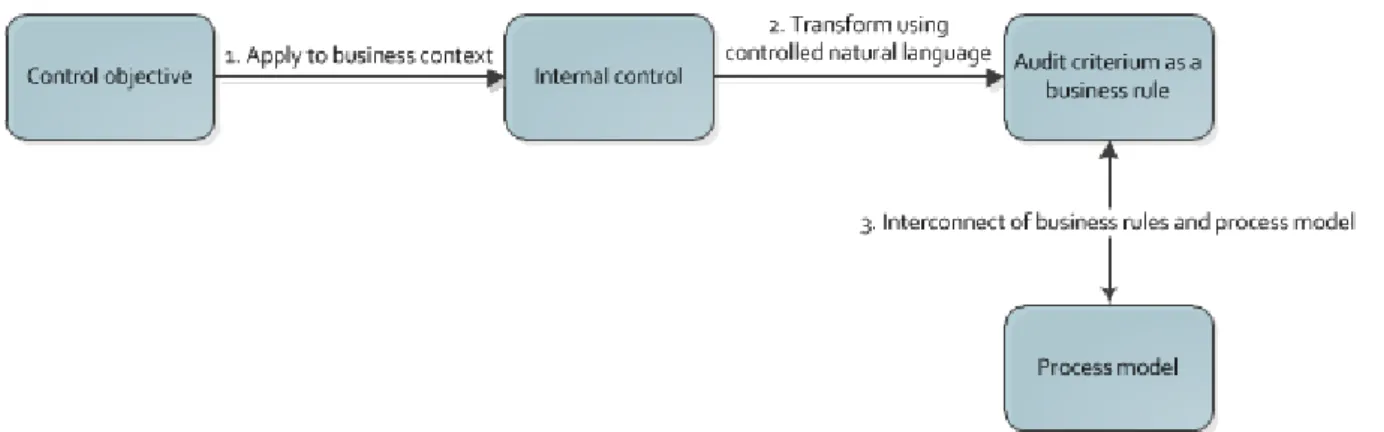
the transformation, which contains the following steps:
1.
Translate control objective to internal control. The control objective is a generic statement
that is applicable on the entire domain of the law or regulation. This objective needs to be
formulated in terms of the specific requirements that are applicable to the business process
that is to be audited. As indicated in paragraph 2.3.1, we have found no control framework
that provides a straightforward transformation of the generic control objectives to internal
controls.
2.
Model the internal controls. In their study, Sadiq et. al (2007) use Formal Contract Language
as a formalism to express normative specifications. While FCL has a high internal consistency
that makes it well-suited for application in the context of a run-time environment of systems
as the basis of an automated internal control verification mechanism, the modelling of rules
in FCL requires significant expertise from a modelling expert. In our thesis, we will use
business rules expressed in controlled natural language for the modelling purposes, as these
are more user-friendly to specify and system-wide consistency is less of an issue in our
narrower context. This step results in audit criteria that are expressed as business rules.
3.
Process model interconnect. This final step plots the audit criteria to activities in the process
model, so that the two can interconnect. Sadiq et al. (2007) use control tags to categorise
the type of FCL rules, which correspond to types of business rules we identified in section
2.3.3.
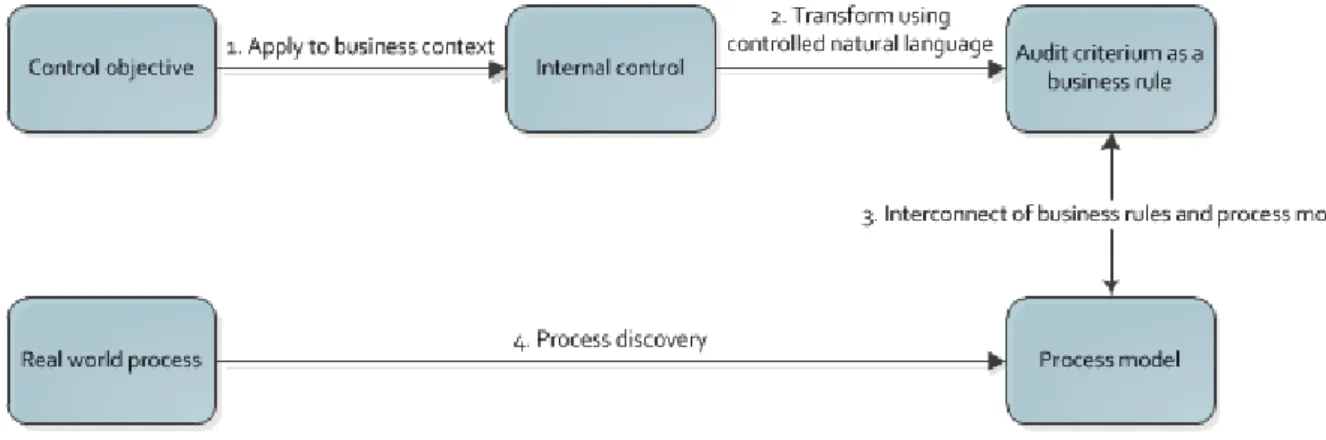
The relations between the steps are visualised as shown in Figure 2.
11
2.3.4.
What are limiting factors in the use of process mining for auditing business
processes?
Now that the required elements of both business process auditing and process mining are known in
answering subquestions 1, 2 and 3, we identify limiting factors by examining the elements
independently.
Normative process model
By examining the definition of conformance checking, we have found that the availability of a
normative process model that describes acceptable behaviour is assumed. It is needed so that audit
criteria can be formulated that are used to test real-world behaviour against the normative model.
As can be seen in Figure 2, the methodology presented assumes the availability of a process model.
Sadiq et al. (2007) do not report how the process model was obtained.
Process mining tools that support the auditing process provide a way to discover the process model.
For a tool to be useful, at least the following functionalities are needed:
1.
Conversion of imported event log to visual process model (process discovery). This is
needed to be able to verify the process model with business experts in a non-technical
manner, and to help identify the relevant activities in the event log as a basis for the
business rules.
2.
Filtering of the model based on activities. This provides insight in the conformance of the
cases in the event log, by showing only the non-conforming cases. For optimal results,
filters for the three types of business rules: order-, value and resource oriented are
needed.
Two tools, Disco and PROM, were evaluated on their suitability for auditing based on the
functionality of both process discovery and filtering. Although PROM has a large and advanced
library of process discovery algorithms, the filtering functionality is lacking. We have found that
Disco has a single process discovery mechanism, and advanced filtering capabilities. As both
functionalities are usable, Disco is therefore best suited as the supporting tool for the empirical part
of our research.
Knowing that Disco and PROM acquire process models from logs, we may apply one of them to get
process models. However, the real-process logs usually result in huge process models. Such huge
process models are too complex for human to grasp and use as a model to structure an audit with
process mining. Therefore, with regards acquisition of process models from logs, we see a gap in
the framework by Sadiq et al. (2007).
2.3.5.
Hypothesis formulated after the literature study
In summary, we have found in reviewing the literature on audit frameworks, business rules and
process mining, that all three areas of expertise are necessary to develop an approach that supports
the auditing of business processes using process mining. However, in our literature review we did
not find an existing audit process approach that integrates all three areas.
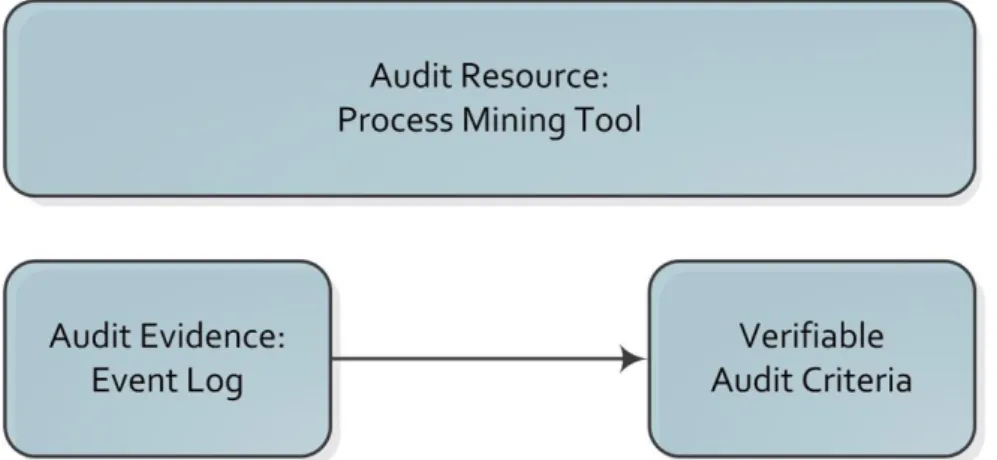
As hypothesis of this thesis, we propose that an audit process approach can be developed to
produce audit findings, by generating verifiable audit criteria using the event log as audit evidence
and process mining techniques as an audit resource to support the process.
12
The relation between the audit evidence that is found in the event log and audit criteria that can be
verified using the audit evidence is shown in Figure 3. Process mining tools can be used to support
this process.
Figure 3: Hypothesis concept diagram
To test our research hypothesis, an approach is presented in chapter 3 that contains all components
that are identified during the literature review. In chapter 4, this approach is applied to two
real-world process audit cases.
13
3.
Towards Auditing supported by Process Mining
3.1.
Design goal
The methodology for transforming control objectives to audit criteria proposed by Sadiq et al. (2007)
and presented in Figure 2 as part of the literature research, is directed to the goal of verifying the
compliance of a business process model based on structured audit criteria. However, the method of
obtaining the business process model is not provided.
As a part of the model design, we have extended the model presented in figure 2 with an approach
that uses process mining to obtain a process model that can be audited.
3.2.
Design of the Process Audit approach with Process Mining
As a first step, we applied the methodology of Sadiq et al (2007) almost directly to the auditing of
the grant application process. This was done by adding the event log of the process to Disco and let
Disco discover the model.
For this purpose, the audit process model presented in Figure 2 was extended with activity 4:
Process discovery as a method to model the business process based on the information found in the
event log. Figure 4 represents the preliminary audit process approach.
Figure 4: Preliminary Audit Process Approach
Central to the experimental part of our research, the proposed approach of applying process mining
in process auditing consists of four activities:
1.
Apply control objective to business context.
Control objectives are generic audit statements that are not directly applicable when
auditing a specific business process. Activity 1 of our approach consists of using information
about the business process to select control objectives that are relevant and then rephrase
them as business specific internal control statements.
2.
Transform using natural controlled language.
Internal control statements that have to be tested in an audit supported by process mining
must be expressed in logically consistent form, that can be tested using automated tools.
14
Activity 2 of our methodology concerns the task of transforming loosely formulated internal
control statements into audit criteria that are formulated as business rules.
3.
Interconnect of business rules and process model.
The audit criteria resulting from activity 2 must be implemented in the process mining
application so they can be verified. Activity 3 expresses the audit criteria as tool filters that
can be applied to the discovered process model. The result of this activity consists of a
unique filter for each audit criterion, which shows all non-compliant cases in the process
model for the criterion.
4.
Process discovery.
The real-world business process must be captured and discovered before it can be audited.
For activity 4, we use the event log of the IT applications that support the business process.
The event log is exported and loaded into the process mining tool, and a process discovery
algorithm is run that generates the process model. The result of this activity is a process
model that is used in activity 3 to apply filters to.
3.3.
Design findings
The approach described in the previous paragraph was tested in a workshop with IT auditors and
end users. Two preliminary limitations to the approach were identified:
1.
Not all internal control statements could be transformed into filters in the process mining
tool. The following causes are identified, that are further investigated in the case studies:
1.
The formulated statement to be audited is ambiguous. This means it cannot be
transformed into a verifiable business rule using controlled language.
2.
The criteria that are needed to verify the statement are not provided. This means that
the event log can be used to verify if a certain outcome has occurred, but not whether
the outcome was the correct one based on predetermined criteria.
3.
Process activities found in the log are not specific enough to be audited. In this situation,
the audit criterion is perfectly verifiable, but the information in the log is not sufficient.
2.
The real world process that was captured in the event log and discovered using the process
mining application resulted in a very complex process model. Without any manual
interpretation, a ‘spaghetti model’ (W. van der Aalst, 2012) as shown in Figure 5 emerges. In
a spaghetti model, it is very hard for humans to see which process activities are of
15
Figure 5: Spaghetti model of unfiltered grant application log
To remedy this shortcoming of the approach shown in Figure 5, an additional step is needed:
4. Filter against normative process model.
As the unfiltered model resulting from activity 4 ‘Process Discovery’ may result in a complex
‘Spaghetti model’, we must simplify the model so that it can be used for auditing. This can
be done by identifying the normative process model from other sources and matching
activities in the normative model with the activities in the unfiltered process model. The
resulting auditable process model can be used in activity 3 ‘the interconnect of business and
process model’.
The resulting, extended process model is presented in Figure 6. As the final step in the model
concerns the interconnect of business rules and process model, the numerical sequence is
adapted to reflect this. Using the model, we are able to filter and mine the real business
process in the log, formulate business rules that function as verifiable audit criteria and
connect both using filters in the process mining tool.
Figure 6: Extended audit process model
The extended audit process model is evaluated by applying it to the case of auditing two
different processes, that comprise the experimental part of our research.
16
3.4.
Experimental research strategy
As a research strategy, we have applied the model of the audit process presented in figure 6 on two
on-site process auditing cases in the municipality of Eindhoven.
Using a case study enables us to conduct an in-depth analysis of the audit approach, by identifying
the limitations that present themselves during the execution of the process audit. The evaluation of
the model is exploratory; for each audit case, a number of limitations in applying the audit
methodology are identified. These limitations are then qualitatively categorised.
Concerning the validity of findings, a shortcoming of this research strategy is the limited scope of the
number of cases. Due to time limitations and the amount of effort that is required to conduct a
complete process audit, only two process audits can be conducted. Nonetheless, for each audit case
over 50 unique audit statements and over 60 related audit limitations are identified. The process
audit approach that is presented in this thesis can be used in additional case studies in a different
context, to remedy these initial shortcomings.
Also, evaluation of the audit approach can be based on comparison to a pre-existing standard to
evaluate the model performance. As we have found no such standard for auditing approaches, a
non-automated process audit for the same process could be used as a baseline. However, the
elements of audit evidence and generating audit findings are not directly comparable (sample taking
versus event logs as audit evidence), so this evaluation should be result-oriented. For instance,
performance can be judged on total effort needed to conduct the audit, error-rate of findings,
sample coverage of audit, and the ability to verify audit criteria.
3.5.
Research approach
3.5.1.
Case Selection
To evaluate the process auditing approach, we need to select appropriate business processes as
cases for the process audit. For this selection, two criteria are used:
1.
The business process must be representative for real-world application. This means the
process should allow behaviour that is commonly found, such as:
a.
Distinct decision points and activities
b.
Possibility of loops (going back to an earlier activity)
c.
Possibility of skipping activities.
2.
The business process must have constraints; not all process flows that are theoretically
possible are allowed.
In addition, the practical requirement of availability of relevant data sources further limited suitable
cases. This resulted in the selection of two cases within the research organisation of the city of
Eindhoven: the application of grants and the purchasing invoices process.
3.5.2.
Data sources
A main difference between a traditional and a process-mining-supported audits is the source of the
real-world process and process model; while these are event logs and tool-generated in the latter, in
the traditional process audits they are usually provided as unstructured (digital) documents to be
used as samples and references.
17
As is shown in Figure 7 below, we can identify different sources of information that are needed to
execute the audit process approach.
Figure 7: Data Sources in the audit process
Resources 1 -6 displayed in yellow need to be available at the start of the case study to conduct a
successful process audit. The documents 7 – 9 that are shown in green result from executing the
audit process. The final document, 9. Report of audit findings and conformance, is the end result of
the audit approach.
3.5.1.
Data gathering
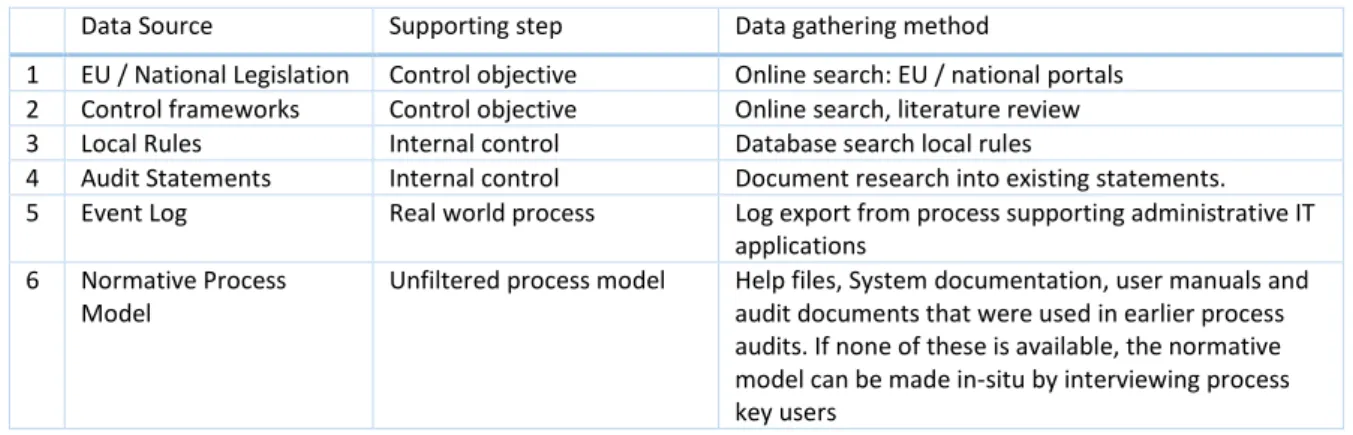
For all sources we identified in Figure 7, the method to gather the data is identified in Table 4 below.
Data Source Supporting step Data gathering method
1 EU / National Legislation Control objective Online search: EU / national portals
2 Control frameworks Control objective Online search, literature review
3 Local Rules Internal control Database search local rules
4 Audit Statements Internal control Document research into existing statements.
5 Event Log Real world process Log export from process supporting administrative IT
applications 6 Normative Process
Model
Unfiltered process model Help files, System documentation, user manuals and audit documents that were used in earlier process audits. If none of these is available, the normative model can be made in-situ by interviewing process key users
Table 4: Data gathering of sources needed for the process audit
The modelling notation language used to document the normative process model has to support the
articulation of business rules as execution logic for the business process, so that a connection
between the verifiable audit criteria and the business process can be made. For our models, we used
BPMN as a modelling language.
As an end result of the application of the audit process approach, filters are developed in the Disco
process mining tool that enable us to verify the audit criteria for all cases in the event log. However,
it is not possible to compose verifiable audit criteria for all identified audit statements. In all five
18
steps of the audit process methodology, limitations that limit the execution of the process step are
identified.
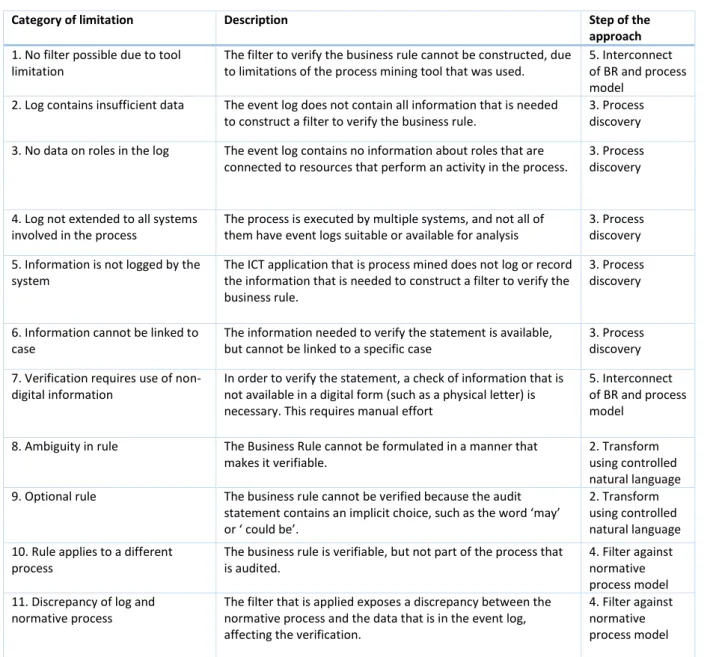
We have found 11 categories of limitations that are displayed in
Category of limitation Description Step of the
approach
1. No filter possible due to tool limitation
The filter to verify the business rule cannot be constructed, due to limitations of the process mining tool that was used.
5. Interconnect of BR and process model
2. Log contains insufficient data The event log does not contain all information that is needed to construct a filter to verify the business rule.
3. Process discovery 3. No data on roles in the log The event log contains no information about roles that are
connected to resources that perform an activity in the process.
3. Process discovery
4. Log not extended to all systems involved in the process
The process is executed by multiple systems, and not all of them have event logs suitable or available for analysis
3. Process discovery 5. Information is not logged by the
system
The ICT application that is process mined does not log or record the information that is needed to construct a filter to verify the business rule.
3. Process discovery
6. Information cannot be linked to case
The information needed to verify the statement is available, but cannot be linked to a specific case
3. Process discovery 7. Verification requires use of
non-digital information
In order to verify the statement, a check of information that is not available in a digital form (such as a physical letter) is necessary. This requires manual effort
5. Interconnect of BR and process model
8. Ambiguity in rule The Business Rule cannot be formulated in a manner that makes it verifiable.
2. Transform using controlled natural language
9. Optional rule The business rule cannot be verified because the audit
statement contains an implicit choice, such as the word ‘may’ or ‘ could be’.
2. Transform using controlled natural language 10. Rule applies to a different
process
The business rule is verifiable, but not part of the process that is audited.
4. Filter against normative process model 11. Discrepancy of log and
normative process
The filter that is applied exposes a discrepancy between the normative process and the data that is in the event log, affecting the verification.
4. Filter against normative process model
Table 5. For all audit statements, the occurrence of these limitations is recorded while conducting
the process audit.
Category of limitation Description Step of the
approach
1. No filter possible due to tool limitation
The filter to verify the business rule cannot be constructed, due to limitations of the process mining tool that was used.
5. Interconnect of BR and process model
2. Log contains insufficient data The event log does not contain all information that is needed to construct a filter to verify the business rule.
3. Process discovery 3. No data on roles in the log The event log contains no information about roles that are
connected to resources that perform an activity in the process.
3. Process discovery
19
4. Log not extended to all systems involved in the process
The process is executed by multiple systems, and not all of them have event logs suitable or available for analysis
3. Process discovery 5. Information is not logged by the
system
The ICT application that is process mined does not log or record the information that is needed to construct a filter to verify the business rule.
3. Process discovery
6. Information cannot be linked to case
The information needed to verify the statement is available, but cannot be linked to a specific case
3. Process discovery 7. Verification requires use of
non-digital information
In order to verify the statement, a check of information that is not available in a digital form (such as a physical letter) is necessary. This requires manual effort
5. Interconnect of BR and process model
8. Ambiguity in rule The Business Rule cannot be formulated in a manner that makes it verifiable.
2. Transform using controlled natural language
9. Optional rule The business rule cannot be verified because the audit
statement contains an implicit choice, such as the word ‘may’ or ‘ could be’.
2. Transform using controlled natural language 10. Rule applies to a different
process
The business rule is verifiable, but not part of the process that is audited.
4. Filter against normative process model 11. Discrepancy of log and
normative process
The filter that is applied exposes a discrepancy between the normative process and the data that is in the event log, affecting the verification.
4. Filter against normative process model
Table 5: Audit limitations using process mining
3.5.2.
Data access
The event logs needed for our research were not accessible without proper authorisation.
Permission was requested by the internal auditors for the purpose of evaluation of the Disco process
mining tooling. This request was granted, and the Business Intelligence administrator was asked to
implement dedicated queries to export the event logs from the IT applications concerned.
3.5.3.
Ethical aspects
When auditing a business process, the audit findings can be sensitive information. For example, it is
possible that a decision to deny a grant application was not taken in a correct manner, and the
denial of the grant was unjustified. If such information becomes public knowledge before a cause for
the error is discovered, this might lead to uncertainty for other applicants whose grant request was
denied. In this research, we report the results of conducting the audit process, but the individual
audit findings for all cases is confidential, as identifying causes for all non-compliant cases is outside
the scope of this thesis.
Also, the event logs that are exported from the IT applications concerned in the audit can contain
information that reflects on individual employees, or have otherwise sensitive data such as the name
of grant applicants. We have anonymised all event logs as the first step after exporting, to prevent
dissemination of logs that contain information that can be tied to individuals.
Finally, during the execution of the research we have found that sometimes additional attributes are
needed to verify specific audit criteria. Before adding such an attribute to the log, a check on
20
4.
Evaluation of the extended process audit approach: two process
audit cases.
In this chapter, we will evaluate the extended automated process audit approach as presented in
chapter 3.3, by applying the model on two process audits that were held at the city of Eindhoven.
The main goal of the evaluation is to identify limitations that are related to the application of the
extended audit approach in a real-life context. To help identification, the audit process that is shown
in Figure 6 is followed for both cases, using the data sources that are summarised in Figure 7. For
each step in the process, results and limitations in application of the audit process are documented.
The processes that are audited are in the domain of the application for communal grants and the
purchasing invoices approval process. Both domains are supported by ICT applications that record
system events that can be used to construct a workflow, thus enabling us to mine the business
processes involved.
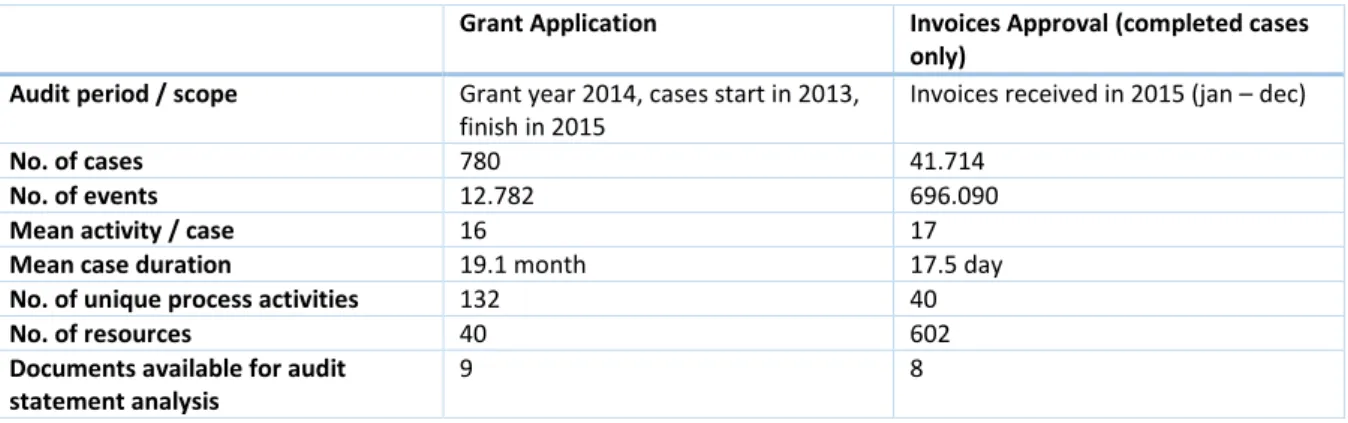
The case studies are conducted on-site, using secondary data sources, namely event logs and
normative documents as research objects for input
into the audit process. Table 6 displays metrics of
the audits.
Grant Application Invoices Approval (completed cases
only)
Audit period / scope Grant year 2014, cases start in 2013,
finish in 2015
Invoices received in 2015 (jan – dec)
No. of cases 780 41.714
No. of events 12.782 696.090
Mean activity / case 16 17
Mean case duration 19.1 month 17.5 day
No. of unique process activities 132 40
No. of resources 40 602
Documents available for audit statement analysis
9 8
Table 6: Metrics of the two audit cases
As one can see from Table 6, the processes differ greatly in terms of case volume, average duration,
and number of unique process activities that are involved. This indicates that the total process of
grant application is more complex than the process of invoices approval. This can also be seen in the
mined process models. However, the mean number of activities executed per case is similar.
4.1.
Case one: Audit of grant application process
In the process of grant applications, citizens or local institutions apply for a monetary allowance
provided by the city. This is called a grant, and can be used to organise an (yearly or one-time)
activity that contributes to the communal goals that the city has defined. Each year, approximately
EUR 50 million is awarded in this manner.
Grants can be awarded for several small scale goals, such as sporting events and local festivals, but
also large grants for welfare support of a special interest groups are issued.
21
Figure 8: Grant Application Process, Normative Process Model
A brief description of the process activities, decision points and activities in the event log that are
related to the process of grant application is summarised in Table 7. In addition to the process of
grant application, also processes of appeal and evaluation of awarded grants are executed. These
processes are out-of-scope of this audit.
Step Name Description Activity in Log (Dutch)
-- Start of Process The grant application process starts with a
received grant application. The application can be sent with regular mail, or e-mail.
--
1. Open Case File After receiving the application, a case file is
opened for the application.
Openen dossier, aanvraag ontvangen
Application complete? Depending on completeness of all necessary information, the application will go to activity (2) or (3).
--
2. Send confirmation letter A confirmation letter is sent to the applicant, to let them know the application is received.
Ontvangstbevestiging aanvraag, Di Datum ontvangstbevestiging,
3. Send request for missing information
A formal request to supply the missing information is sent to the applicant.
Verzoek aanvullen aanvraag, Di Datum verzoek aanvullen aanvraag, Ontvangstbevestiging aanvraag volledig na aanvulling
4. Review application A grant advisor reviews the application on fitness concerning financial and community goals
Beoordelen aanvraag
Clarification needed? Possibly, further clarification by the applicant concerning the application is needed before a decision can be made. In this case, activity (5) is performed.
--
5. Request additional information A request for additional information to clarify financial and/or grant goals is sent
Opvragen extra info aanvraag, DI Datum extra info aanvraag
6. Prepare decision The application is evaluated with respect to
financial feasibility and contribution to grant regime high-level goals.
Toevoegen componenten, Verlening conform aanvraag, Deel Weigering, Verlening weigering
22
7. Confirm decision The grant manager confirms the evaluation to
grant or reject the application for funds and signs the prepared letter.
--
8. Send decision letter to applicant
The letter is sent to the applicant. The grant amount that is allocated is entered and booked to the financial application
DI Datum verlening conform aanvraag, DI Datum deel weigering, DI Datum verlening afwijzing Justification needed? In some grant applications, an accountant
statement or financial report concerning the supported activity is needed after or during the year of the grant application. In other cases, the process ends after activity (8) with a letter sent in activity (12).
Attentiebrief verantwoording
9. Send request for justification A letter is sent to the grant applicant to submit the necessary documents for review.
DI datum attentiebrief verantwoording
On time? A check is made whether the requested
documents are received within the mandatory time interval. If this is not the case, activity (10) is performed.
Verantwoording ontvangen, Rappel verantwoording, DI datum rappel verantwoording
10. Sanction in case of late documents
If a grant justification was not submitted before the mandatory date, a formal sanction is issued. This is a deduction of the grant sum.
DI datum lagere vaststelling met sanctie, DI datum vaststelling conf. verlening met sanctie
11. Evaluate justification The grant advisor evaluates the submitted documents for compliancy to financial and communal guidelines. If there is a noncompliancy, a deduction or total withdrawal of the grant amount allocated is possible.
Beoordelen verantwoording
12. Definitive grant application A formal letter to the grant applicant is prepared, which contains the final decision to maintain or modify the amount that was allocated.
DI datum lagere vaststelling, DI datum vaststelling ambtshalve, DI datum vaststelling conform verlening
End Process
Table 7: Description of activities and roles, Grant Application Process
4.1.1.
Step 0: Preparation of the audit: Identify relevant source documents
As a preparatory step for performing the process audit, we mapped all source documents that
are needed for the auditing of the grant application process, according to the data sources
model that can be found in Table 4, page 17. In Table 8 below, all sources that were identified
are summarised. Data sources 1-4 are used to formulate the business rules. The event log (data
source 5) is used to verify the business rules using a process mining filter. Data source 6 is used
to construct the normative process model.
Data Source Identified source
1 EU/national legislation Wet dwangsom: All requests that are made to the government are legally required to be decided within 60 days of receiving the application ‘algemene wet bestuursrecht (AWB)’: General procedures concerning applications to government institutions
23
‘Wet op het accountantsberoep’: A law that stipulates practices concerning the profession of accountancy
2 General controls The annual auditing by the city accountant and its associated rules and
regulations is proscribed in the guidelines of the Dutch professional accountancy organisation (HRAweb).
The distribution of tasks between internal and external auditors is in rule 610 of the guidelines
3 Local rules The local city procedure for grant applications is described in the ‘ algemene subsidieverordening (ASV)’ .
For all distinct grant types, additional terms and conditions are available as ‘ nadere regels’ .
4 Audit Statements The audit statements are found in the sheet of statements for the grant process (van Hout & Gresel, 2015a, 2015b) that is prepared by the internal auditors. It contains a high-level process breakdown, and matches written statements from data sources 1-3 to parts of the process.
5 Event Log The grant application process is administrated in the ISA4all system, which
is used by all departments that can give grants. In addition to information relevant to the process content, ISA4all registers time, resource and activity name of steps in the process. These are exported and can be used as the event log for the process audit. To obtain the event log of the grant application process, the IBM Cognos BI application is used to select and export the relevant data from the ISA4all system. For this experiment, a selection is made based on the activity date in ISA4all with execution start date values 01-01-2010 <= date <=31-12-2015.
6 Normative process model For the grant application process, no consistent and directly usable process model was available. The following sources contained elements of the process model:
a. The workflow description in the ISA4all system b. The process breakdown in the sheet of statements that
is used by the internal auditors (van Hout & Gresel, 2015a, 2015b)
c. The user process instruction manual (van Hoof-de Groot, 2014).
These sources were analysed and a workshop was held with auditors and end-users, resulting in the normative process model as depicted in Figure 8, using the BPMN notation.
Table 8: Specific Data Sources for the Grant Application Process
4.1.2.
Step 1: Apply control objectives to business context
For the grant application process, control objectives that were found in relevant legislation and
reference control frameworks were reviewed and processed into the audit sheet of statements that
contains the internal controls. In our case, this first step was already performed by internal auditors
as the grant application process had been subjected to audits before. When reviewing the resulting
sheet of statements, it became evident that no exhaustive list exists of all applicable laws and
regulations for the grant application process. The data sources identified are based on best effort by
the internal auditing experts. Next, we checked the control framework that were identified for
statements that could be applied to our specific business context. These were not found.
4.1.3.
Step 2: Transform internal controls to audit criteria
As a next step, local rules pertaining to grants in general, specific type of grants and the height of the
grant amount (grant regime ‘high’, ‘middle’, ‘low’) are reviewed and added to the audit sheet of
statements. For all aspects, a list of applicable regulations was available. The sheet of statements
was presumed complete after all identified local rules were added to the sheet of statements.
24
For easy editing, the sheet of statements was converted to a spreadsheet. For every unique
statement, a separate row in the spreadsheet was inserted. An example of discovered statement
ST48 is:
“During the grant application process, the financial review and content review cannot be performed by
the same employee”. This is a process-specific example of the 4-eye principle.
A total of 52 audit statements are discovered for the grant application process.
Next, all statements are expressed using natural controlled language, resulting in audit criteria that
are verifiable. In case of ST48, the corresponding business rule is formulated as:
“For all cases where activity ‘beoordelen verantwoording’ is executed, the financial part of the
activity and the content part of the activity must be reviewed by two different resources”
Not all 52 statements could be expressed in this way, some limitations were identified.
For example, statement ST47 was found that was formulated as:
“The activities that will be executed if the grant is approved must be described in a SMART manner”