Towards a Simulation-based Communication Tool to
Support Semantic Business Process Management
Paul Stynes1, Owen Conlan2 and Declan O’Sullivan2
1National College of Ireland, Dublin, Ireland
2School of Computer Science and Statistics,
Trinity College, Dublin, Ireland {Owen.Conlan, Declan.OSullivan}@cs.tcd.ie
Abstract. Successfully communicating a Business Executive’s goals and desires to an IT Architect with regard to organizational change presents a major challenge. The most significant problem is relating the changes desired in a semantically consistent and understandable manner and then reflecting the potential impact of those changes on the organizational structure and the business processes carried out within that organization. This paper presents a proposal for a simulation-based communication tool that employs a semantically driven natural-language component to capture a Business Executive’s needs. These needs are translated into a simulation of a business process consisting of semantic web services that represent the evolution of the organizations IT infrastructure and policies. Through an iterative communication loop with the IT Architect the simulation can be used to accurately represent the changes necessary to meet the Business Executive’s needs.
Keywords: Communication, Simulation, Natural Language, SBPM
Introduction
Semantic Business Process Management (SBPM) [7] has the potential to provide a fundamental basis for a common semantic understanding between the Business Executive and the IT Architect. As an approach it espouses the inclusion of ‘meaning’ in business processes. However, the problem of how this meaning will be communicated and negotiated still exists. The authors accept that changes to the organisation and IT required by organisational strategy and vision are not simple and require iterative communication between the Executive and IT Architect. This paper proposes simulation as a basis for communication, is a mechanism for achieving this. The approach utilises a semantically-driven natural language processing to refine a Business Executive’s goals in terms compatible with SBPM and then reflect the potential changes to the IT architecture using web service based simulations. Thus, simulation provides the Executive and IT Architect, with the ability to collaborate interactively in a user-centric and semantically consistent way in order to improve the effectiveness and efficiency of communication and reduce misunderstandings.
The structure of this paper is as follows, firstly an introduction to related work to ground this research in the theory between Semantic Business Process Management (SBPM), Semantically Controlled Natural Language Interfaces (SCNLI) and Simulation. The second section outlines the technical approach and functionality. The third section describes a scenario-based evaluation of the first prototype. The final section discusses this research and expected future direction.
Related Work
This research relates to the intersection between Semantic Business Process Management (SBPM), Semantically Controlled Natural Language Interfaces (SCNLI), and Simulation.
Bernstein et al. [1][2] introduce a Guided Input Natural Language Ontology editor (GINO) that can edit and query ontologies. GINO allows users to enter a guided input sentence through natural language, which is then translated into triple sets or SPARQL statements. Wang et al. [11] presents a portable natural language interface to ontologies (PANTO) that accepts generic natural language queries and outputs SPARQL queries. Schwitter [10] shows how a controlled natural language describes knowledge for the semantic web. These approaches show the potential for natural language interfaces to utilize semantic inference to refine and hone the user’s goals.
Simulation plays an important and inexpensive role in answering what-if questions during process composition. Web based simulation offers an approach to dynamically model a system and make changes to optimise resources in a consequence free environment. The true potential of simulation is in portraying the envisaged impact of certain decisions and changes on an operational system or process. Chandrasekaran et al in [3] examines the synergy between web service technology and simulation. One of the approaches they propose is the creation of simulation models/components from web services in order to provide a high fidelity between the simulation and real world. It provides an ability to plug real web services into simulated entities, thus creating simulations that utilise as much ‘real world’ data as possible.
Proposed Approach
The approach proposed in this paper focuses on a user-centric approach to a lightweight collaborative interaction between the Business Executive and the IT Architect. The Simulation-based Communication Tool allows the Business Executive specify their goals and rules for organisational change through a semantically controlled natural language interface. The system interprets the goal and identifies the business process that can deliver the appropriate services. Then it adapts the services using rules specified with the goal. Through simulation, the Executive may review the impact their goal and rules have on the services of the organisation. This semantically driven approach ensures the terminology used in the specification of goals is consistent with the capabilities of the IT architecture. These goals will be realised by the orchestration of both existing and simulated web services that represents the new/modified business processes.
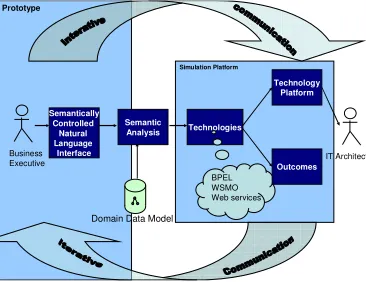
The architecture of the Simulation-based Communication Tool (SCT) is shown in Figure 1 and will be applied to an organisation represented by an institute of higher education. To-date part of the ontology that models the institutes of higher education is modelled based on OWL and stored in Jena.
As part of a prototype due in September 2008, the Semantic Analysis (SA) component will interpret the goal and identify the business process that delivers the appropriate services by using SWRL rules that use the domain ontology. The SA component uses the rules specified with the goal to adapt the services of the business process.
comprise the process. The services represent real or simulated web services of organisational roles and constraints on those roles, current and future IT systems. Currently a BPEL process that orchestrates the interaction between simulated web services has been created. The simulated web services represent the Programmes, Faculty and Classroom resources in institutes of higher education. It is envisaged that the web services will be semantically enabled to ensure that they are automatically identifiable using the Web Service Modelling Ontology. Through simulation, the Executive may review the impact their goal and rules have on the resources and IT systems of the organisation.
The Outcomes component displays successful changes to the organization and business rules that violate organisational constraints. Through several iterations, the Executive may modify, add, or delete rules until they are satisfied with the potential changes to the organisation as witnessed through the simulated outputs. The resulting web service orchestration that fulfils the Executives goal and rules represents the technology platform that supports agile process change as shown in the Technology Platform component.
Prototype
Simulation Platform
Semantically Controlled
Natural Language
Interface
Domain Data Model
Technologies Semantic
Analysis
Business Executive
BPEL WSMO Web services
Technology Platform
Outcomes
[image:4.612.219.402.322.463.2]IT Architect
Figure 1 Architecture of a Simulation based Communication Tool
Prototype experiment
An initial scenario-based evaluation consisting of a PowerPoint mock-up of a natural language user interface for the Business Executive was created around the specific scenario of planning changes to Faculty, Programmes and Classrooms within a higher education setting. The prototype simulates a user interface through a pre-planned sequence of actions and mouse clicks as shown in Figure 2. The Executive can enter a goal and rules such as “Schedule the BSc (Hons) in Software Systems where Faculty teach 14 hours per week”.
department, one acting head of school and one ex-head of school. The study measured the desirability of executives for a semantically grounded controlled natural language interface through the administration of a questionnaire containing 30 items. The major content sections of the questionnaire are Demographics; Perceived Usefulness; Usability Heuristics; User Interface Satisfaction; Screen; Learning; and Project Specific questions; The majority of items are based on a 5 point semantic differential scale. Other items gather feedback on the executive’s perceptions of the positive and negative aspects of the system including any suggested improvements to the system and other scenarios that are relevant to their job.
Schedule Workflow consists of rules for resources related to Programmes, Faculty and Rooms Specify
Organizational Rules and Constraints
Drag and drop resources to the
Goal Editor
Figure 2 Simulation-based Communication User Interface
The analysed data produce results, which indicate that the majority (60%) of this small group of executives desire a semantically controlled natural language interface for specifying goals and rules. A system that automatically interprets a goal to identify a business process, and applies rules to services in the process, is desirable among 70% of Executives. In addition, 60% of Executives welcome a visualisation that displays successful changes to the organization, as well as business rules that violate business constraints.
Some of the comments made by executives that indicate this approach as being desirable are “The idea seems to be very good, esp. the natural language interface, which I particularly like”; “Use of English to set goals”; “Good HCI”; “System will interpret the goal and identify the org process for appropriate service”;
Discussion and Future Work
Executive’s goal, and applies rules to services in the process. Executives also welcome a visualisation that displays successful changes to the organization, as well as business rules that violate business constraints.
Future work will involve the evolving of SCT as part of doctorial research. This involves an investigation of controlled natural language interfaces, completing the domain ontology for higher education, mapping goals and rules to a workflow language such as BPEL, and modifying the web-services so that they are semantically enabled. It is envisaged that a prototype will be ready by September 2008.
References
[1] Bernstein, A. & Kaufmann, E. (2006) GINO-A Guided Input Natural Language Ontology
Editor. IN: Proceedings of the 5th
International Semantic Web Conference.(ISWC 2006), 5-9, November, Athens, USA. Berlin, Springer..pp. 144-157.
[2] Bernstein, A., Kaufmann, E., Göhring, A. & Kiefer, C. (2005) Querying Ontologies: A Controlled English Interface for End-Users. IN: Proceedings of the 4th
International Semantic Web Conference (ISWC 2005), 6-10 November, Galway, Ireland. Berlin, Springer. pp 112-126. [3] Chandrasekaran, S., Silver, G., Miller, J., Cardoso, J. & Sheth, A. (2002) XML-based modeling and simulation: Web service technologies and their synergy with simulation. IN: Proceedings of the 34th
Winter Simulation Conference: exploring new frontiers (WSC 2002), 8-11, December, San Diego, California, USA. Winter Simulation Conference. pp 606-615.
[4] Dietz, Jan L.G. Enterprise Ontology. Springer, Berlin/Heidelberg 2006.
[5] Fox, M. S., Barbuceanu, M., Gruninger, M., Lin, J. (1998) An organization ontology for enterprise modeling IN AI Magazine, Fall 1998, pp. 102-121.
[6] Fox, M.S., (1992), "The TOVE Project: A Common-sense Model of the Enterprise", Industrial and Engineering Applications of Artificial Intelligence and Expert Systems, Belli, F. and Radermacher, F.J. (Eds.), Lecture Notes in Artificial Intelligence # 604, Berlin: Springer-Verlag, pp. 25-34.
[7] Hepp, M., Leymann, F., Domingue, J., Wahler, A. & Fensel, D. (2005). Semantic Business Process Management: A Vision Towards Using Semantic Web Services for Business Process Management. IEEE International Conference on e-Business Engineering (ICEBE 2005), 18th
-21st
October, Beijing, China. IEEE Computer Society, ISBN 0-7695-2430-3. pp. 535-540.
[8] Hepp, M., Roman, D. M. Hepp, D. Roman: An Ontology Framework for Semantic Business
Process Management, proceedings of the 8th international conference Wirtschaftsinformatik 2007, February 28 - March 2, 2007, Karlsruhe. In: Oberweis, A; Weinhardt, C.; Gimpel, H.; Koschmider, A.; Pankratius, V.; Schmizler, B.: eOrganisation: Service-, Prozess, Market-Engineering, Vol. 1, Universitaetsverlag Karlsruhe, pp. 423-440. PDF available at http://www.heppnetz.de/files/hepp-roman-an-ontology-framework-for-SBPM-WI2007.pdf [9] Wetzstein, B., Ma, Z., Filipowska, A., Kaczmarek, M., Bhiri, S., Losada, S., Lopez-Cobo, JM.
& Cicurel, L. (2007) Semantic business process management: a lifecycle based requirements analysis. IN: Proceedings of the Workshop on Semantic Business Process and Product Lifecycle
Management (SBPM 2007), June 7th
, Innsbruck, Austria. pp. 1-11. Available from:
http://sbpm2007.fzi.de/ [Accessed on 29th
February 2008].
[10] Schwitter. R. (2005). A controlled natural language layer for the semantic web. IN: Proceedings of the 25th
SGAI International Conference on Innovative Techniques and Applications of Artificial Intelligence (AI 2005), 12-14 December 2005, Cambridge, UK.Springer, Berlin. pp. 425-434.
[11] Wang, C., Xiong, M., Zhou, Q. & Yu. Y. (2007) Panto: a portable natural language interface to ontologies. IN: Proceedings of the 4th