ESCMID* guideline for the diagnosis and management of
Candida
diseases 2012: adults with haematological malignancies and after
haematopoietic stem cell transplantation (HCT)
A. J. Ullmann1!, M. Akova2!, R. Herbrecht3!, C. Viscoli4!, M. C. Arendrup5, S. Arikan-Akdagli6, M. Bassetti7, J. Bille8, T. Calandra8, E. Castagnola9, O. A. Cornely10, J. P. Donnelly11, J. Garbino12, A. H. Groll13, W. W. Hope14, H. E. Jensen15, B. J. Kullberg11, C. Lass-Flo¨rl16, O. Lortholary17,18, W. Meersseman19, G. Petrikkos20, M. D. Richardson21, E. Roilides22, P. E. Verweij11and M. Cuenca-Estrella23for the ESCMID Fungal Infection Study Group (EFISG)
1)Department of Internal Medicine II, Julius-Maximilians-University, Wu¨rzburg, Germany,2)Department of Medicine, Hacettepe University School of Medicine, Ankara, Turkey,3)Hoˆpital de Hautepierre, University of Strasbourg, Strasbourg, France,4)University of Genoa, IRCCS San Martino-IST, Genoa, Italy,5)Statens Serum Institut, Copenhagen, Denmark,6)Department of Medical Microbiology, Hacettepe University School of Medicine, Ankara, Turkey,7)Santa Maria Misericordia University Hospital, Udine, Italy,8)Infectious Diseases Service, Department of Medicine, Centre Hospitalier Universitaire Vaudois and University of Lau-sanne, LauLau-sanne, Switzerland,9)Instituto Giannina Gaslini, Children’s Hospital, Genova, Italy,10)Department I of Internal Medicine, Clinical Trials Centre Cologne, ZKS Ko¨ln, Center for Integrated Oncology CIO Ko¨lnBonn, Cologne Excellence Cluster on Cellular Stress Responses in Aging-Associated Diseases (CECAD), German Centre for Infection Research, University of Cologne, Cologne, Germany,11)Radboud University Nijmegen Medical Centre, Nijmegen, The Netherlands,12) Univer-sity Hospitals Geneva, Geneva, Switzerland,13)Department of Pediatric Hematology and Oncology, Center for Bone Marrow Transplantation, University Children’s Hospital, Muenster, Germany,14)Antimicrobial Pharmacodynamics and Therapeutics, Department of Molecular and Clinical Pharmacology, University of Liverpool, Liverpool, UK,15)University of Copenhagen, Frederiksberg, Denmark,16)Division of Hygiene & Medical Microbiology, Innsbruck Medical University, Innsbruck, Austria,17)Universite´ Paris Descartes, Service des Maladies Infectieuses et Tropicales, Hoˆpital Necker-Enfants malades, APHP, Centre d’Infectiologie Necker-Pas-teur, IHU Imagine, Paris, France,18)Institut Pasteur, Centre National de Re´fe´rence Mycologie et Antifongiques. Unite´ de Mycologie Mole´culaire, CNRS URA3012, Paris, France,19)University Hospital Gasthuisberg, Leuven, Belgium,20)4th Department of Internal Medicine, School of Medicine, National and Kapodistrian Uni-versity of Athens, ‘ATTIKONHospital, RIMINI1 – Haidari, Athens, Greece,21)Mycology Reference Centre, University Hospital of South Manchester and Man-chester Academic Health Science Centre, University of ManMan-chester, ManMan-chester, UK,22)Third Department of Pediatrics, Aristotle University School of Medicine and Hippokration Hospital, Thessaloniki, Greece, and23)Centro Nacional de Microbiologı´a, Instituto de Salud Carlos III, Madrid, Spain
Abstract
Fungal diseases still play a major role in morbidity and mortality in patients with haematological malignancies, including those undergoing hae-matopoietic stem cell transplantation. AlthoughAspergillusand other filamentous fungal diseases remain a major concern,Candidainfections are still a major cause of mortality. This part of the ESCMID guidelines focuses on this patient population and reviews pertaining to prophylaxis, empirical/pre-emptive and targeted therapy ofCandidadiseases. Anti-Candidaprophylaxis is only recommended for patients receiving allogeneic stem cell transplantation. The authors recognize that the recommendations would have most likely been different if the purpose would have been prevention of all fungal infections (e.g. aspergillosis). In targeted treatment of candidaemia, recommendations for treatment are available for all echinocandins, that is anidulafungin (AI), caspofungin (AI) and micafungin (AI), although a warning for resistance is expressed. Liposomal amphotericin B received a BI recommendation due to higher number of reported adverse events in the trials. Amphotericin B deoxycholate should not be used (DII); and fluconazole was rated CI because of a change in epidemiology in some areas in Europe. Removal of central venous catheters is recommended during candidaemia but if catheter retention is a clinical necessity, treatment with an echinocandin is an option (CIIt). In chronic disseminated candidiasis therapy, recommendations are liposomal amphotericin B for 8 weeks (AIII), fluconazole for >3 months or other azoles (BIII). Granulocyte transfusions are only an option in desperate cases of patients withCandidadisease and neutropenia (CIII).
Keywords:Candida, European, guideline, haematopoietic stem cell transplantation, malignancies
Clin Microbiol Infect2012;18(Suppl. 7): 53–67
Corresponding author:A. J. Ullmann, Infectious Diseases, Department of Internal Medicine II, Julius-Maximilians-University, Oberdu¨rrbacher Str. 6, 97080 Wu¨rzburg, Germany
E-mail: [email protected] This guideline was presented in part at ECCMID 2011.
*European Society for Clinical Microbiology and Infectious Diseases.
Introduction
Infectious complications remain a major obstacle in the
suc-cessful treatment of patients with malignant diseases. This
part of the ESCMID guidelines focuses on the special need of
this patient population with malignancies that had received
chemotherapy or radiotherapy.
Candida
diseases played a
piv-otal role in the past in patients with malignancies [1–3]. In an
Italian study, patients with AML and ALL developed
candida-emia at incidence rates of 2–3% and 4–5%, respectively [4].
In one German hospital, candidaemia remains a disease with
a high fatality rate [5]. Studies report an overall mortality
risk as high as 38% with an attributable mortality of 19% [2].
Risk factors such as previous triazole exposure, age, high
AP-ACHEII scores, renal failure and neutropenia contribute to
these high mortality rates [2,6]. A change in the
Candida
spe-cies epidemiology also needs special attention since
fluconaz-ole sensitive
C. albicans
is not the sole cause of disease [2,7].
Therefore,
Candida
diseases deserve special attention in this
high-risk population. We included recommendations for
hae-matopoietic stem cell transplant recipients, which is an
inte-gral part of the guideline. This guideline is divided into four
parts: prophylaxis, pre-emptive/empirical therapy strategies,
targeted treatment and specific situations in patients with
malignancies.
Numerous guidelines have been published to date and
have usually included all fungal diseases [8–11]. Here, we
focus on Candida diseases with diagnostic procedures
and recommendations for treatment. This guideline was
originally edited as described previously by the first 4
authors and later reviewed and edited by the entire
EFISG (ESCMID Fungal Infection Study Group) guideline
group [155].
Other fungal diseases, for example aspergillosis in this
patient population will also need special attention. The
authors recognize that other filamentous fungal infections
besides aspergillosis play a more pivotal role in the
morbid-ity and mortalmorbid-ity in this patient population (e.g. agents of
mucormycosis) [12–16]. Therefore, the recommendations
for prophylaxis and empirical/pre-emptive therapy would
possibly direct our guideline recommendation in a different
direction because this guideline focuses solely on
Candida
diseases.
The same grading system for the strength of
recommen-dation and its documented quality of evidence are used
throughout of this guideline as in the majority of the EFISG
guidelines. The explanations and abbreviations used in this
document are given in Table 1.
Anti-Candida prophylaxis in allogeneic
haematopoietic stem cell transplantation
The intention of the EFISG recommendations for prophylaxis
in allogeneic haematopoietic stem cell transplantation is to
look at the possibility of reducing morbidity and mortality
due to
Candida
diseases. Obviously, the authors recognize
that the recommendations would have been significantly
dif-ferent if the purpose would have been prevention of all
fun-gal infections (e.g. aspergillosis). The prescribing physician
should be aware of these interpretations. Different immune
deficient situations, often referred to as the ‘net state of
immunosuppression’, need to be appreciated during the
course of allogeneic haematopoietic stem cell transplantation
[17]. During the early post-transplantation phase,
neutrope-nia is a major finding in these patients. Criteria for selecting
prophylaxis throughout the various phases after
transplanta-tion should be a low toxicity profile and good efficacy. For
the purpose of reducing morbidity, various antifungal agents
have similar outcomes as fluconazole and have therefore
received a similarly strong recommendation. But the strength
of recommendation by the EFISG when including all possible
fungal infections (i.e. aspergillosis) would be most likely
dif-ferent.
For prevention during the early neutropenic phase after
transplantation, almost all available azoles are scored as
highly recommended. Indeed, several publications
demon-strated a reduction in morbidity for
Candida
diseases [18–
23]. Later studies utilized voriconazole in comparison with
itraconazole or fluconazole as comparators [24,25]. Despite
TABLE 1.Strength of the EFISG Recommendation and Quality of Evidence. Two parts: Strength of a
Recommendation (SoR) and Quality of Evidence (QoE) Strength of a recommendation
Grade A ESCMID strongly supports a recommendation for use
Grade B ESCMID moderately supports a recommendation for use
Grade C ESCMID marginally supports a recommendation for use
Grade D ESCMID supports a recommendation against use
Quality of Evidence
Level I Evidence from at least one properly designed randomized,
controlled trial
Level II* Evidence from at least one well-designed clinical trial, without
randomization; from cohort or case-controlled analytic studies (preferably from >1 centre); from multiple time series; or from dramatic results of uncontrolled experiments
Level III Evidence from opinions of respected authorities, based on
clinical experience, descriptive case studies, or reports of expert committees
*Added index:
r: Meta-analysis or systematic review of randomized controlled trials.
t: Transferred evidence, that is, results from different patients’ cohorts, or
similar immune-status situation.
h: Comparator group is a historical control.
u: Uncontrolled trial.
the absence of noninferiority testing in the recent
voriconaz-ole trials, an equal outcome compared with fluconazvoriconaz-ole is
assumed and therefore voriconazole received an AI
recom-mendation for the prevention of
Candida
disease.
Posaconaz-ole was not tested in a trial during the early phase of
allogeneic haematopoietic stem cell transplantation but the
duration and severity of neutropenia is very similar to that
observed during induction chemotherapy for AML therapy
[26]. Because of this implied evidence, posaconazole received
an AII
trecommendation. Micafungin and caspofungin were
the only echinocandins so far assessed in prophylaxis and
demonstrated similar efficacy to fluconazole in transplant
recipients [27]. Chou
et al.
used caspofungin in allogeneic
stem cell recipients. In this retrospective study, 7.3% of the
123 patients developed a fungal disease. Two of the nine
cases with fungal disease were
Candida tropicalis
and
Candida
glabrata
infections [28].
In addition to the early neutropenic phase, another time
period plays historically an important role after allogeneic
ha-ematopoietic stem cell transplantation, that is, the first
100 days after transplantation. During this period, patients
are also prone to fungal diseases but not all antifungal agents
(e.g. micafungin and posaconazole) have been tested during
this period [27]. Historically, a few azoles were able to
reduce morbidity and mortality, especially fungal-attributable
mortality, during this phase [18,19]. However, other trials
examined the value of prophylaxis beyond the neutropenic
phase to include this first 100 days period. As for the
vorico-nazole prophylaxis trial that was performed during the first
100 days after transplantation, it had a similar outcome to
fluconazole [24]. Therefore, the AI recommendation with
the intention to reduce morbidity in invasive candidiasis is
ascribed to voriconazole and fluconazole. In the well-known
trials by Goodman
et al.
[18] and Slavin
et al.
[19], survival
advantage was driven by reduced mortality to
Candida
dis-ease. In the trial performed by Marr
et al
. [22], itraconazole
demonstrated superiority to fluconazole but no mortality
dif-ference was noted. Itraconazole was associated with
signifi-cantly more toxicity and this explains a weaker strength of
recommendation
for
itraconazole
than
fluconazole.
It
remains unclear whether patients without GVHD and
recov-ered neutrophils need anti-
Candida
prophylaxis during the
first 100 days after transplantation.
Another important intention for the outcome of patient
care is the survival advantage when using antifungal agents as
prophylaxis. Again, during the early phase of neutropenia, all
azoles except fluconazole received a lower recommendation
(C). During the first 100 days after transplantation, only
fluconazole compared with placebo was able to demonstrate
a survival advantage in
Candida
diseases [18,19]. Both
vorico-nazole trials did not demonstrate any mortality difference
[24,25]. The overall death rate in the Cornely
et al.
[26] trial
was significantly lower in patients with posaconazole, and
therefore, posaconazole received a slightly stronger grade of
recommendation. Finally, during moderate to severe
graft-versus-host disease, posaconazole received a weaker BI
rec-ommendation. In the Ullmann
et al.
[29] trial, posaconazole
had an identical outcome regarding
Candida
infection
com-pared with fluconazole, but the rate of fungal-related death
was lower with posaconazole and consequently posaconazole
received a slightly higher recommendation, although the
Can-dida
-associated death rate was not clear. The association
between intention and the dosage of the intervention,
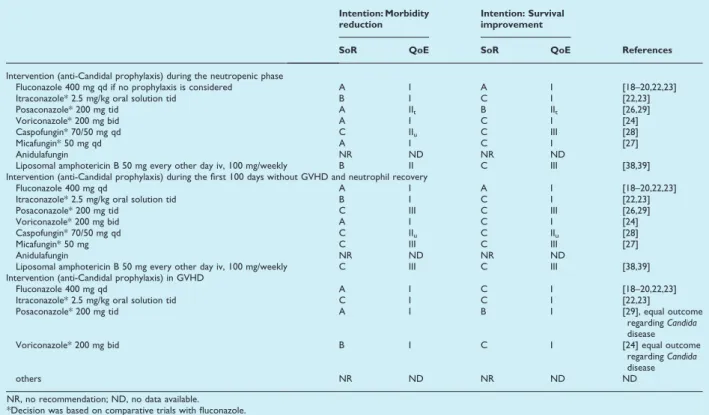
includ-ing strength of recommendation, are noted in Table 2.
Another important scenario of immunosuppression plays a
significant role in the outcome in the transplant recipient.
Due to increased immunosuppressive therapy during the
lat-ter phase (beyond 100 days) in patients with
graft-versus-host disease, slow T-cell recovery and increased risk of
fun-gal infections is obvious. The trial by Ullmann
et al.
[29]
dem-onstrated that posaconazole and fluconazole were equally
efficacious in preventing candida infections. Other drugs
were rated weaker (Table 2). Itraconazole and amphotericin
B deoxycholate received a weaker recommendation because
of a weaker safety profile [22,30–32].
Anti-
Candida
prophylaxis in autologous
haematopoietic stem cell transplantation
and in severe and prolonged neutropenia
In the autologous transplant setting, only the neutropenic
phase can be considered a possible risk situation for
Candida
diseases. But with the improvement of autologous
transplan-tation procedures over time, antifungal prophylaxis is not
rec-ommended for autologous transplantation recipients [33].
Nevertheless, in centres with a high incidence of
Candida
dis-ease, prophylaxis could remain an option, but based on recent
data only a weak C recommendation is provided for
itraco-nazole and posacoitraco-nazole (C) [26,34]. The group was not able
to provide a recommendation when antibody treatment is
co-administered (e.g. rituximab) due to the lack of data, and
obvi-ously, there seems to be no increased risk of fungal infections.
There is indirect evidence for a survival advantage in
prophy-laxis for invasive candida disease, which is only available from
the Cornely
et al.
[26] trial for patients with severe and
pro-longed neutropenia. None were studied with other drugs for
Candida
disease in autologous stem cell recipients. In general,
autologous haematopoietic stem cell transplantation is not
considered a high-risk situation for patients.
The treatment of numerous other malignant diseases
causes neutropenia in varying degrees of severity and
dura-tion. Prophylaxis in this patient population is usually
adminis-tered only if the patient develops profound and prolonged
neutropenia. Again, our group does not support prophylaxis
for the prevention of
Candida
diseases in this setting
(pro-phylaxis: DII).
In nontransplantat settings, all recommendations are very
similar to those for autologous transplantation. There is only
very weak evidence for the use of azole prophylaxis against
Candida
diseases for the group of azoles. The study by
Glasmacher
et al.
[32] saw no difference between fluconazole
and itraconazole. Another randomized placebo-controlled
study demonstrated the superiority of itraconazole for
TABLE 2.Anti-Candidaprophylaxis for allogeneic haematopoietic stem cell recipients
Intention: Morbidity reduction
Intention: Survival improvement
References SoR QoE SoR QoE
Intervention (anti-Candidal prophylaxis) during the neutropenic phase
Fluconazole 400 mg qd if no prophylaxis is considered A I A I [18–20,22,23]
Itraconazole* 2.5 mg/kg oral solution tid B I C I [22,23]
Posaconazole* 200 mg tid A IIt B IIt [26,29]
Voriconazole* 200 mg bid A I C I [24]
Caspofungin* 70/50 mg qd C IIu C III [28]
Micafungin* 50 mg qd A I C I [27]
Anidulafungin NR ND NR ND
Liposomal amphotericin B 50 mg every other day iv, 100 mg/weekly B II C III [38,39]
Intervention (anti-Candidal prophylaxis) during the first 100 days without GVHD and neutrophil recovery
Fluconazole 400 mg qd A I A I [18–20,22,23]
Itraconazole* 2.5 mg/kg oral solution tid B I C I [22,23]
Posaconazole* 200 mg tid C III C III [26,29]
Voriconazole* 200 mg bid A I C I [24]
Caspofungin* 70/50 mg qd C IIu C IIu [28]
Micafungin* 50 mg C III C III [27]
Anidulafungin NR ND NR ND
Liposomal amphotericin B 50 mg every other day iv, 100 mg/weekly C III C III [38,39]
Intervention (anti-Candidal prophylaxis) in GVHD
Fluconazole 400 mg qd A I C I [18–20,22,23]
Itraconazole* 2.5 mg/kg oral solution tid C I C I [22,23]
Posaconazole* 200 mg tid A I B I [29], equal outcome
regardingCandida
disease
Voriconazole* 200 mg bid B I C I [24] equal outcome
regardingCandida
disease
others NR ND NR ND ND
NR, no recommendation; ND, no data available. *Decision was based on comparative trials with fluconazole.
TABLE 3.Anti-Candida prophylaxis outside of allogeneic haematopoietic stem cell transplantation (e.g. autologous haematopoietic stem cell transplantation or chemotherapy induced neutropenia)
Intention Situation
Autologous HCT Severe and prolonged neutropenia
References Intervention SoR/QoE Intervention SoR/QoE
Reduce morbidity and mortality (during and after high dose chemotherapy)
Any prophylaxis DIII Any prophylaxis DIII [33]
Additional antibody treatment (e.g. rituximab)
Any prophylaxis DIII Any prophylaxis DIII
Morbidity reducti on or surviv al advantage* Neu tropenia*
Fluconazole ND Fluconazole CI For autologous
HCT: [26, 34] For neutropenia:
[26, 32, 35-38, 40–43]
Itraconazole CII Itraconazole CI
Posaconazole CIIt Posaconazole CIIt
Voriconazole ND Voriconazole ND
Anidulafungin ND Anidulafungin ND
Caspofungin ND Caspofungin CI
Micafungin ND Micafungin ND
Nystatin DIIt Nystatin DII
Any amphotericin B formulation
ND Any amphotericin
B formulation
DI
*If an institution wishes prophylaxis, weak recommendations for selected antifungal agents are provided. ND, no data.
preventing superficial fungal infection in patients with
haema-tological malignancies and neutropenia [35]. Only one study
by Menichetti
et al.
[36] demonstrated a significant lower
incidence of fungaemia due to
Candida
species in 0.5% of
itr-aconazole recipients and in 4% of placebo recipients, a
differ-ence of 3.5 percentage points (95% CI, 0.5–6%; p <0.01).
Obviously, no overall survival advantage in
Candida
-associated
mortality was noted.[36,37] In the trial by Penack
et al.
[38],
low dose of liposomal amphotericin B did not significantly
prevent
Candida
infections. In a similar but smaller trial by
Cordonnier
et al.
[39], only one of twenty-nine patients
developed probable
Candida
disease. Other trials utilized
var-ious comparators (e.g. amphotericin B/nystatin or fluconazole
vs. itraconazole), but none demonstrated superiority [40,41].
Nystatin, an oral polyene, cannot be recommended as
pro-phylaxis [42]. Only one retrospective trial where micafungin
was assessed as prophylaxis led to a significant decrease in
the occurrence of IFI (from 12.3% to 1.5%, p 0.001) [43]
(Table 3).
Secondary prophylaxis is not indicated in cases of prior
candidaemia without any sign of deep-seated infection when
patients are exposed to a new immunosuppressive therapy
or where prolonged neutropenia is induced by
chemother-apy, autologous or allogeneic HCT. The strength of
recom-mendation for secondary prophylaxis in patients with a
history of deep-seated invasive
Candida
disease (not
candida-emia alone) was rated C III.
Empiric or pre-emptive (diagnostic driven)
antifungal therapy
In patients expected to suffer prolonged duration of
neutro-penia [>10 days] (induction and consolidation chemotherapy
of AML/MDS and autologous, or allogeneic transplantation)
fever occurs frequently and is usually treated primarily with
broad-spectrum antibacterial agents. If the patient does not
defervesce after at least 3–4 days of antibacterial treatment,
the presence of an undetected fungal infection is assumed
and antifungal therapy is usually added with the intention of
preventing further morbidity or death (AII) [44]. Extensive
diagnostic workup is required to exclude a clinically or
mycological documented infection which might require
spe-cific therapy.
Again, similar to the prophylactic indication, a challenge in
providing recommendations was the fact that empirical
treat-ment is not only given for the intention of treating as early
as possible an undetected
Candida
disease, but also any kind
of fungal infection (e.g. filamentous fungal infections). With
regards to a reduction in morbidity, liposomal amphotericin
B and caspofungin received an AI recommendation [44–47]
(Table 4). Voriconazole failed to demonstrate noninferiority
when compared to liposomal amphotericin B but in a subset
analysis of high-risk patients no differences were noted [48].
In a prospective but one-armed trial with micafungin, not a
single patient receiving empiric treatment developed a
break-through fungal infection [49]. In a retrospective trial
compar-ing
micafungin
and
caspofungin,
breakthrough
Candida
diseases were detected at a rate of 0.7% and 2.8%,
respec-tively [50]. Amphotericin B deoxycholate and fluconazole
were not recommended for empirical treatment despite the
existence of adequate studies in the past, because of toxicity
in the first case, and narrow spectrum of action in the
sec-ond case [51–53]. The differences in the grading of
ampho-tericin B formulations lie solely in the different toxicity
profiles [54–56]. Amphotericin B colloidal dispersion causes
infusion-related events similar in frequency and intensity to
amphotericin B deoxycholate and in a direct double-blind
comparison trial amphotericin B lipid complex was more
toxic than liposomal amphotericin B [54,55]. The use of
itr-aconazole provided some promising results in a
noncompara-tor trial and in a recent published trial compared with
amphotericin B [56,57]. In the latter trial, itraconazole had a
better outcome. The major limitation for fluconazole was
TABLE 4.Empiric therapy to treat possibleCandidadisease: All situations causing severe and prolonged neutropenia
Intention Intervention
Allogeneic
HCT included SoR QoE References
Morbidity reduction Liposomal amphotericin B (3 mg/kg/day) Yes A I [44,45,47,55]
Caspofungin (70 mg on day 1 then 50 mg) Yes A I [46,47]
Amphotericin B colloidal dispersion (4 mg/kg/day) Yes C I [54]
Amphotericin B lipid complex (5 mg/kg/day) Yes B I [55]
Itraconazole (200 mg iv q12h on day 1 & 2 then 200 mg iv/day) ND B I [56,57]
Voriconazole (2·6 mg/kg on day 1 then 2·3 mg/kg/day)§ Yes B I [48]
Fluconazole (400 mg/day) ND C* I* [52,53]
Amphotericin B deoxycholate (0.5–1.0 mg/kg/day) Yes D IIt [44,54,56,57]
Micafungin (100 mg) Yes B II [49,50]
Anidulafungin ND NR No data
*Limited use since fluconazole has no mould activity. Application requires appropriate work-up to rule out mould disease.
the lack of antimould activity. Therefore, if fluconazole is
used, it remains essential to rule out a mould infection by
the
Aspergillus
galactomannan index (GMI) ELISA and chest
and sinus CT scan.
A consensus criteria defining pre-emptive (sometimes also
called ‘diagnostic driven’) treatment of fungal infections in
can-cer patients does not exist. The term ‘pre-emptive treatment’
is associated more with filamentous fungi infections than with
Candida
-associated diseases. This approach is not driven by
persistent fever or neutropenia but rather by galactomannan
antigen detection in serum and/or BAL fluid or high-resolution
CT scan in high-risk patients [58]. The role 1,3-
ß
-
D-glucan and
PCR testing for aspergillosis/candidiasis remains controversial
[59,60]. Whether or not any kind of infiltrate in the presence
of
Aspergillus
galactomannan should trigger antifungal therapy is
still debatable, although few experts would not add an
antifun-gal agent in all of these situations. Some experts wait for
Asper-gillus
associated typical radiographic signs [halo, wedge shaped,
air crescent or cavity] before starting treatment [58]. Other
authors are more flexible [61,62]. Basically, no
recommenda-tion can be given at this point on the choice between the
empirical and pre-emptive approach.
No clinical trial has been performed to compare antifungal
drugs for this indication, and therefore, no recommendation
can be made. The main studies which tested the pre-emptive
approach used liposomal or deoxycholate formulation of
amphotericin B or voriconazole [61–63]. As treating
pre-emptively should mean treating at an early phase of disease,
drugs approved for the treatment of fungal diseases might be
effective or at least should be evaluated.
In summary, no data exist regarding whether or not
Candida
diseases can be managed by pre-emptive anti-Candida therapy.
If
Candida
disease is the main concern and the patient is not on
azole prophylaxis, then fluconazole might be a good choice.
However, in contrast to the ICU setting, no trial has
prospec-tively assessed the role of
Candida
spp. colonization or 1,3-
ß
-D
-glucan in these patients [64]. 1,3-
ß
-
D-glucan was assessed
previously in a meta-analysis by Lamoth
et al.
[65] The group
concluded that two consecutive positive antigen tests in
patients with haemato-oncological patients demonstrate a high
specificity, positive predictive value but a low sensitivity.
Therefore, the test needs to be combined with clinical and
radiological assessments and microbiological findings [65].
Mucosal oropharyngeal or oesophageal
candidiasis
Mucosal candidiasis does not play a significant role for
morbidity or mortality in haematological malignancies. The
occurrence of oropharyngeal or oesophageal candidiasis is
more inconvenient than threatening for the patient and
usu-ally easy to treat. For a rapid response, oral azoles, for
example fluconazole, are recommended (AI) [66]. Physicians
should keep in mind that azole-resistant
Candida
species can
be selected during therapy even without prolonged
treat-ment periods [67,68]. Other azoles can then be used [69–
74]. Topical polyenes treatment is recommended for mild
forms as in nonimmunocompromised patients [66,75–78].
Oral candidiasis with dysphagia and thoracic pain when
swallowing is suggestive of oesophageal involvement. In this
situation, topical treatment is not recommended (topical
polyene treatment for oesophagitis: DIII). Cases refractory
to fluconazole can be treated with any other azole if MIC
tests suggest susceptibility [70,71,79–82]. In the event of
severe or refractory disease, intravenous antifungals such as
an echinocandin or liposomal amphotericin B might be
indi-cated [83–90] (Table 5). It is essential to identify the species
causing candidiasis to ensure susceptibility to the chosen
agent [91]. This is a minimum requirement in
immune-com-promised patients, because resistance might have developed
and a mixed aetiology might be possible.
Targeted treatment of invasive candidiasis/
candidaemia
Treatment of invasive candidiasis or candidaemia should
always focus on the success of treatment with improved
sur-vival. Once the diagnosis of candidaemia is established, blood
cultures should be drawn on a daily basis until negativity for
at least two consecutive samples (B I). Treatment should at
least continue for 14 days after the last positive blood
cul-ture [92]. Individuals who have negative blood culcul-tures for
more than 14 days but remain neutropenic at approximately
day 28 (or are not expected to recover from neutropenia)
should be evaluated for the resolution of clinical signs and
symptoms including exclusion of endocarditis and
endoph-thalmitis by appropriate examination. But defining an exact
and appropriate duration of therapy is still an issue of
debate.
It is recommended that for patients who are on
prophy-laxis that the class of drugs for antifungal treatment be
chan-ged (C III). In prospective trials, only a few neutropenic
patients were enrolled [93–97]. This consideration reduces
the level of our recommendation in comparison with
inten-sive care patients. Caspofungin and micafungin trials included
approximately 10% neutropenic patients [94–96]. The
out-come of these patients was also favourable, and therefore,
both agents received an AII
trecommendation. Anidulafungin
on the other hand received a marginally weaker
recommen-dation (BII
t) because there were <3% neutropenic patients in
this trial [97]. The extensive usage of echinocandins could
trigger resistance against this class of antifungal agents in the
future because some areas in the world have demonstrated
an increase in
C. parapsilosis
which usually has higher MICs
compared with other
Candida
species [98,99]. Despite good
sensitivity results, first reports demonstrate caution on the
usage of echinocandins [100,101]. These are some of the
reasons for species discrimination and susceptibility testing
which are highly recommended in these settings.
Fluconazole, once considered gold standard in the
treat-ment of candidaemia received a weaker recommendation
despite positive outcomes in a number of trials [92,102].
These trials are considered out-dated, especially when
con-sidering the risk of the development of resistance. In recent
publications, previous fluconazole or triazole exposure and
gastrointestinal tract surgery are risk factors for
fluconazole-resistant candidaemia. In addition to invasive ventilation,
renal impairment, age >65 years and steroids and triazole
exposure are considered risk factors for death [6,103].
Therefore, fluconazole should only be considered as a
step-down treatment option in neutropenia when the
Candida
species isolates demonstrate susceptibility to fluconazole.
Other azoles had only limited data and because of this,
itraconazole and posaconazole in particular, cannot be
rec-ommended for treatment [104]. On the other hand, more
data exist for voriconazole and it may be considered as an
option [105,106]. Despite equal outcome when compared to
micafungin, liposomal amphotericin B received only a BII
rec-ommendation due to its higher nephrotoxicity profile
[96,107]. Due to different toxicity profiles and weak data of
other lipid formulations of amphotericin B, a C grading for
the recommendation for treating invasive candidiasis or
can-didaemia is given [108–112]. Extensive nephrotoxicity,
con-secutive higher mortality and other unacceptable toxicity are
factors that make amphotericin B deoxycholate not
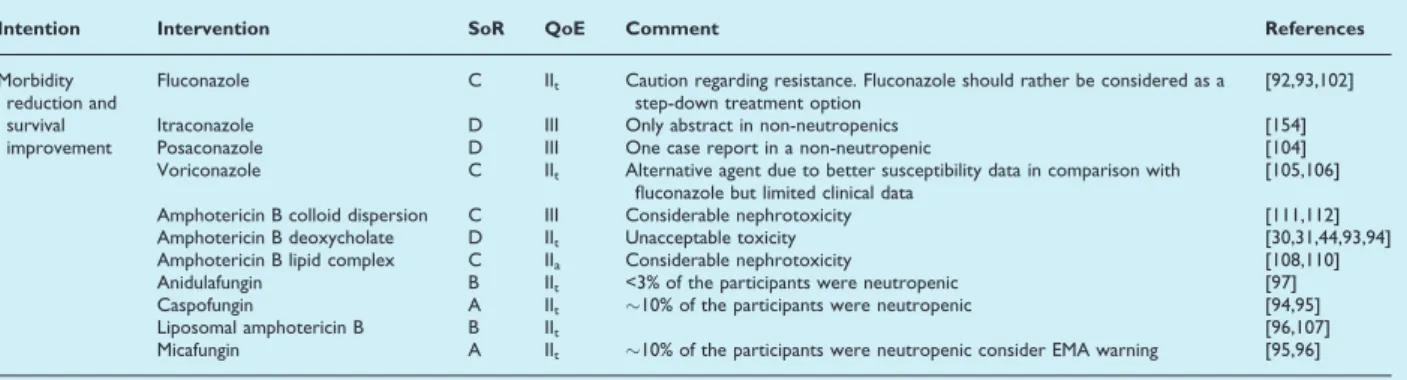
recom-mendable for treatment (DII) [30,31] (Table 6).
If patients were receiving fluconazole or liposomal
ampho-tericin B, a switch to an echinocandin might be desirable
(BII
t). Basically, there is no adequately powered randomized
trial for this situation neither for neutropenic patients nor
for stem cell transplant recipients but the identification of
the
Candida
species and susceptibility testing could be helpful
for making a decision (e.g.
Candida krusei
)(BIII).
In vitro
and animal data of antifungal combinations seem to
improve the efficacy of antifungal treatment. In humans,
espe-cially neutropenic patients this outcome is not so clear-cut.
TABLE 5.Treatment of mucosal oropharyngeal or oesophageal candidiasis. Identification ofCandidaspecies would be desirable
Diseases Intension Intervention SoR/QoE References
Oropharyngeal Eradication Nystatin suspension (non-neutropenic, mild presentation) CIIt [76,77]
Miconazole buccal BIIt [78]
Fluconazole AI [66,75]
Itraconazole solution BIIt [72–74]
Posaconazole AIIt [69,70]
Voriconazole BIII [71]
Echinocandins (anidulafungin, caspofungin) only in very severe and refractory cases BIII [84,149,150]
Liposomal amphotericin B as an option only in very severe and refractory cases CIII
Oesophageal Eradication Fluconazole AIIt [81,82,151–153]
Itraconazole BIIt [72,80,82]
Posaconazole AIIt [70]
Voriconazole AIII [71]
Topical treatment DIII
Echinocandins (anidulafungin, caspofungin and micafugnin) or liposomal amphotericin B only in very severe and refractory cases
BIIt [84–90]
TABLE 6.Targeted treatment of invasive candidiasis/candidaemia in patients with malignancies, usually with neutropenia
Intention Intervention SoR QoE Comment References
Morbidity reduction and survival improvement
Fluconazole C IIt Caution regarding resistance. Fluconazole should rather be considered as a
step-down treatment option
[92,93,102]
Itraconazole D III Only abstract in non-neutropenics [154]
Posaconazole D III One case report in a non-neutropenic [104]
Voriconazole C IIt Alternative agent due to better susceptibility data in comparison with
fluconazole but limited clinical data
[105,106]
Amphotericin B colloid dispersion C III Considerable nephrotoxicity [111,112]
Amphotericin B deoxycholate D IIt Unacceptable toxicity [30,31,44,93,94]
Amphotericin B lipid complex C IIa Considerable nephrotoxicity [108,110]
Anidulafungin B IIt <3% of the participants were neutropenic [97]
Caspofungin A IIt !10% of the participants were neutropenic [94,95]
Liposomal amphotericin B B IIt [96,107]
Only a few combinations have been studied without any
improved outcome. Combination of amphotericin B
deoxych-olate and 5-flucytosine is not recommended due to its toxicity
and erratic pharmacokinetics [113–115]. Efungumab and a lipid
formulation amphotericin B are also not recommended
because flaws in the design of the study hampered outcome
[116]. Efungumab is not an approved or marketed drug. The
combination of amphotericin B deoxycholate and fluconazole
was studied as a sequential therapy and did not demonstrate
any improvement to the comparators [105]. There was even
more toxicity in the amphotericin B group despite a median of
only 3 days of amphotericin B deoxycholate exposure.
Another trial assessed whether this combination was
antago-nistic [117]. Due to its similar outcome, this combination can
be considered an option (CII
t). Other combinations were not
studied but the expert opinion is that antifungal combinations
might be useful in severe deep-seated infections (e.g.
abdomi-nal infection, CNS and endocarditis, CIII).
Chronic disseminated candidiasis
Chronic disseminated candidiasis or hepato-splenic
candidia-sis is a very specific syndrome in patients with malignant
dis-eases. The disease usually occurs after the recovery of
neutrophils due to previous chemotherapy. The diagnosis of
chronic candidiasis is challenging when prior candidaemia has
not been documented. Imaging by ultrasound examination
demonstrates a weaker sensitivity in comparison with CT or
MRI [118–121]. Only one study could show a higher
sensitiv-ity utilizing MRI in comparison with CT [118]. But despite
adequate imaging techniques, the confirmation of the
diagno-sis by biopsy remains troublesome. Histology with culture
positivity is seldom. No comparator trials in regard to
morbidity improvement or survival advantage have been
performed or published. Antigen detection [e.g.
mannan/anti-mannan or 1,3-
ß
-
D-glucan) are probably helpful, but data in
this situation are scarce [122]. Histology requires the use of
special staining (Gomori) and immunohistochemistry and
molecular-genetic workup is highly recommended.
In terms of treatment, only a few case series have been
published [96,123–126]. The experience of treatment is
cur-rently only anecdotal. Lipid formulations of amphotericin B
might be a good choice because of potential accumulation in
the reticulo-endothelial system [127]. Frequently, sequential
approaches are employed empirically, for example liposomal
amphotericin B followed by prolonged treatment of
fluconaz-ole. The disease has been recently considered to be an
inflammatory immune reconstitution syndrome [128]. There
are interesting publications that suggest the co-administration
of steroids at the beginning of treatment [129,130]. The
duration of antifungal treatment appears to be at least
8 weeks. Again the use of amphotericin B deoxycholate is
not encouraged (Table 7).
Biofilms and central venous catheters
Central venous catheters (CVC) play a major role in the
care of this patient population. Once inserted, the removal
or replacement might threaten the life of the patient because
of frequently experienced thrombocytopenia. Upon review
of the published data, a negative outcome during therapy by
not removing the central venous catheter early appears only
to occur in the situation where echinocandins were not used
[6,94–97,131,132]. In the recently published trials, where the
central venous catheter was retained, the outcome was
simi-lar but the numbers noted in those trials were low
[94,95,97]. Additionally, these trials demonstrated an equal
outcome in
C. parapsilosis
disease despite other publications
indicating higher MICs [133,134]. As
C. parapsilosis
is
associ-ated with catheter infections, removal would be desirable.
On the other hand, if catheter retention is clinical
neces-sary, treatment with an echinocandin remains an option.
Nevertheless, persistence of positive blood cultures for yeast
should prompt removal of a central venous catheter. Velasco
and Bigni [135] saw in their study by multivariate analysis
that comorbidities and neutropenia were independently
asso-ciated with mortality in adults and not CVC removal. In a
trial by Liu
et al.,
early catheter removal is associated with
better survival. In this trial, the retention of the catheter,
high APACHE II score or thrombocytopenia was associated
with a higher mortality rate [131]. Nucci
et al.
[136] looked
especially on the outcome in terms of CVC removal and
reported no differences between the groups being given
ca-spofungin, micafungin or liposomal amphotericin B. But
TABLE 7.Treatment of chronic disseminated candidiasis
Intention Intervention Duration SoR/QoE Comments Reference
Eradication Fluconazole Reported duration minimum 3 months BIII [125,126] [125,126]
Other azoles (if susceptibility is expected) BIII Lacking data ND
Amphotericin B deoxycholate DIII Toxicity issues [30,31]
Lipid formulations of amphotericin B 8 weeks AIII Better exposure [96,124]
another work by Andes
et al.
[137] saw in review of seven
clinical trials that improved survival and greater clinical
suc-cess is associated with the use of an echinocandin and
removal of the CVC. A few in vitro studies indicate that
ech-inocandins penetrate
Candida
biofilm better than other
anti-fungal
agents
[138,139].
A
more
clinically
challenging
question is how to handle other implanted hardware, for
example pacemaker, port-a-cath. Unless an association could
be provided, in cases with implanted hardware and with
can-didaemia, retention of the hardware is appropriate but no
published data are available. Unfortunately, no reliable
symp-tom or sign associated with hardware is available (Table 8).
Cytokines, colony-stimulating factors and
granulocyte infusions for the treatment of
invasive candidiasis or candidaemia
The question regarding the use of colony-stimulating factors
or cytokines in the treatment of invasive candidiasis or
candi-daemia remains unanswered. No controlled trials are
avail-able and only anecdotal data from small numbers of patients
exist. As persistent neutropenia is related to treatment
fail-ure, recovery from neutropenia substantiates the efficacy of
antifungal agents [140–142]. Therefore, the use of
colony-stimulating factors appears to be an option (C III). A recent
Cochrane review indicates no mortality differences for all
infections in patients suffering from neutropenia [143]. There
is only a weak recommendation for granulocyte infusions,
but the data are basically from children (CIII) [144–148]. This
treatment might be considered an option in desperate cases.
Transparency Declarations
A.J.U. has received research grants from MSD (Schering Plough) and is/was an advisor or received lecture honorarium from Astellas, Aicuris, Basilea, Gilead, MSD and Pfizer.
M.A. received, during the past 5 years, research grants and honoraria for talks and consultancy from Merck, Pfizer and Gilead.
R.H. has been a consultant or at the advisory board for Astellas pharma, Basilea, Gilead Sciences, Merck Sharp and Dohme, Novartis, Pfizer and Schering Plough. He has been paid for talks on behalf of Astellas, Gilead Sciences, Merck Sharp and Dohme, Pfizer and Schering Plough. He has received research support from Pfizer, travel support from Pfizer and Gilead, and investigator fees for a clinical trial from Pfizer.
C.V. received grants as speaker/moderator in meetings sponsored by Pfizer, Gilead, MSD, Astellas, Abbott, BMS and received grants for participation in advisory boards by Gilead, Astellas, MSD, Pfizer. Further, he obtained research grants for his institution from Pfizer, MSD, Gilead, Abbott, Jansen, BMS, Novartis. He is member of the SAG (Scientific Advisory Group) for antibacterials and antifungals of CHMP-EMA and consultant for Italian Medical Drug Agency Member of various levels of local Infection Control, Antibiotic Stewardship, Vaccine and HIV Committees (Genoa, Liguria, Italy), Nadirex International (Pavia, Italy).
M.C.A. has received grant support from Astellas Pharma, Gilead Sciences, Merck Sharp and Dohme, Pfizer and Schering Plough. She has been a consultant or at the advisory board for Gilead Sciences, Merck Sharp and Dohme, Pfizer, Pcovery and Schering Plough. She has been paid for talks on behalf of Gilead Sciences, Merck Sharp and Dohme, Pfizer, Astellas Pharma and Schering Plough.
S.A.A. has received investigator initiated research grant support from Pfizer and speaker honoraria from Merck and Pfizer. She has been at the Advisory Board for Pfizer-Turkey.
M.B. has received research grants from Pfizer, MSD and Astellas and is/was an advisor or received lecture
honorarium from Astellas, Angelini Farmaceutici, Astra Zeneca, Cubist, Aventis, Bayer, Cephalon, Cubist, Gilead, MSD, Novartis, Shionogi, Pfizer, Teva and Vifor.
TABLE 8.Treatment ofCandidaBiofilm and catheter-related candidaemia
Intention Intervention SoR/QoE Comment Reference
Survival advantage Early catheter removal AIIu Retention and high APACHE II and thrombocytopenia
also associated with higher mortality.
[131,132,137]
Morbidity reduction Catheter retention CIIt Patients in trials treated with echinocandins and CVC
retention had equal outcome (low numbers)
[94–97] If catheter retention use echinocandins or liposomal
amphotericin B, not azoles or amphotericin B deoxycholate
CIIt Worse outcome in non echinocandins trials [94–97,137]
Other implanted hardware (pace-maker, port-a-cath) CIII Keep unless proven associated with candidaemia.
No published data available
J.B., J.G., H.E.J. has nothing to declare. T.C. is member of the Speaker bureau and is advisor or consultant for Astellas, Baxter; bioMe´rieux, EISAI, Evolva, Novartis, Merck Sharp and Dohme-Chibret AG, Pfizer. Grant support from Baxter, bioMe´rieux, Merck Sharp and Dohme-Chibret AG, Roche Diagnostic.
E.C. has participated as invited speaker to symposia organized by Gilead, Pfizer, Astellas, Merck, Novartis and he has been member of advisory boards for Astellas, Pfizer.
O.A.C. is supported by the German Federal Ministry of Research and Education (BMBF grant 01KN1106) and has received research grants from, is an advisor to, or received lecture honoraria from 3M, Cubist, GSK, Sanofi Pasteur, Actelion, Astellas, Basilea, Bayer, Biocryst, Celgene, F2G, Genzyme, Gilead, Merck/Schering, Miltenyi, Optimer, Pfizer, Quintiles, Viropharma.
J.P.D. has received grant support from Astellas, Gilead Sciences, Merck Sharp and Dohme, Pfizer and Schering Plough. He has been a consultant or on an advisory board for Astellas, Gilead Sciences, Merck Sharp and Dohme and Pfizer. He has received remuneration for giving lectures on behalf of Gilead Sciences, Merck and Pfizer.
A.H.G. has received research support from Gilead, Merck and Schering. He has acted as speaker and/or consultant for Astellas, Cephalon, Gilead, Merck, Pfizer, Schering and Vicuron.
W.W.H. has received grant support from National Institute of Health Research (NIHR), Medical Research Council, National Institute for the Replacement,
Refinement and Reduction, of Animals in Research, Pfizer, Gilead, Schering Plough, Merck and Astellas and has served as a speaker on behalf of and as a consultant for Pfizer, Astellas, Gilead, F2G, Vectura and Schering Plough. He also has travel support from ESCMID.
B.J.K. has received research grants from Bio-Me´rieux and Cephalon. He is a consultant to Pfizer and is a member of the Gilead, MSD and Pfizer speaker bureaus.
C.L.-F. has received grant support in the past 5 years from Astellas Pharma, Gilead Sciences, Pfizer, Schering Plough and Merck Sharp and Dohme. She has been an advisor/consultant to Gilead Sciences, Merck Sharp and Dohme, Pfizer, Astellas Pharma and Schering Plough. She has received travel support and has been paid for talks on behalf of Gilead Sciences, Merck Sharp and Dohme, Pfizer, Astellas Pharma and Schering Plough.
O.L. is a member of the MSD board, is a consultant for Astellas and Gilead Sciences and received grants or speaker’s fees from MSD, Astellas, Gilead Sciences and Pfizer.
W.M. has received grant support from MSD and Pfizer. He had been an advisor to MSD and Pfizer. He has received honoraria for presentations on behalf of MSD/Schering Plough and Pfizer.
G.P. has received research grants from Gilead, Astra Zeneca, Novartis, Astellas, GSK, Pfizer and MSD, has acted as paid consultant to Janssen Cilag, Gilead, Astellas, and MSD and is a member of the Gilead, Astellas and MSD speaker’ s bureaus. He has also speaker’s honoraria and received travel support from ESCMID, Pfizer, Astellas, MSD and Gilead Sciences.
M.D.R. has received grants, speaker’s honoraria and travel support from ESCMID, Pfizer, Astellas, MSD and Gilead Sciences. He has also received book royalties from Blackwell Publishing and travel support from Astellas Pharma.
E.R. has received research support from Pfizer, Gilead, Merck, Enzon, Schering and he has made contributions in advisory boards of Gilead, Astellas, Pfizer, Merck, Schering. He has also been paid for talks on behalf of Gilead, Cephalon, Pfizer, Wyeth, Schering, Merck, Aventis and Astellas.
P.E.V. has received research grants and/or travel support and/or travel support from Pfizer, Astellas, Cephalon, Gilead Sciences, Merck and Schering Plough.
M.C.E. has received in the past 5 years grant support from Astellas Pharma, bioMerieux, Gilead Sciences, Merck Sharp and Dohme, Pfizer, Schering Plough, Soria Melguizo SA, Ferrer International, the European Union, the ALBAN program, the Spanish Agency for International
Cooperation, the Spanish Ministry of Culture and Education, The Spanish Health Research Fund, The Instituto de Salud Carlos III, The Ramon Areces
Foundation, The Mutua Madrilen˜a Foundation. He has been an advisor/consultant to the Panamerican Health
Organization, Astellas Pharma, Gilead Sciences, Merck Sharp and Dohme, Pfizer, and Schering Plough. He has been paid for talks on behalf of Gilead Sciences, Merck Sharp and Dohme, Pfizer, Astellas Pharma and Schering Plough.
References
1. Viscoli C, Girmenia C, Marinus A et al. Candidemia in cancer patients: a prospective, multicenter surveillance study by the Inva-sive Fungal Infection Group (IFIG) of the European Organization for Research and Treatment of Cancer (EORTC). Clin Infect Dis
2. Sipsas NV, Lewis RE, Tarrand Jet al.Candidemia in patients with hematologic malignancies in the era of new antifungal agents (2001-2007): stable incidence but changing epidemiology of a still fre-quently lethal infection.Cancer2009; 115: 4745–4752.
3. Mahfouz T, Anaissie E. Prevention of fungal infections in the immu-nocompromised host.Curr Opin Investig Drugs2003; 4: 974–990.
4. Pagano L, Caira M, Candoni A et al. The epidemiology of fungal infections in patients with hematologic malignancies: the SEIFEM-2004 study.Haematologica2006; 91: 1068–1075.
5. Zirkel J, Klinker H, Kuhn Aet al.Epidemiology of Candida blood stream infections in patients with hematological malignancies or solid tumors.Med Mycol2012; 50: 50–55.
6. Slavin MA, Sorrell TC, Marriott Det al.Candidaemia in adult can-cer patients: risks for fluconazole-resistant isolates and death.J Anti-microb Chemother2010; 65: 1042–1051.
7. Kontoyiannis DP, Reddy BT, Hanna H, Bodey GP, Tarrand J, Raad II. Breakthrough candidemia in patients with cancer differs from de novo candidemia in host factors and Candida species but not inten-sity.Infect Control Hosp Epidemiol2002; 23: 542–545.
8. Bohme A, Ruhnke M, Buchheidt Det al.Treatment of invasive fungal infections in cancer patients – recommendations of the Infectious Diseases Working Party (AGIHO) of the German Society of Hema-tology and Oncology (DGHO).Ann Hematol2009; 88: 97–110.
9. Rex JH, Walsh TJ, Sobel JDet al.Practice guidelines for the treat-ment of candidiasis. Infectious Diseases Society of America. Clin Infect Dis2000; 30: 662–678.
10. Bow EJ, Evans G, Fuller Jet al.Canadian clinical practice guidelines for invasive candidiasis in adults.Can J Infect Dis Med Microbiol2010; 21: e122–e150.
11. Pappas PG, Kauffman CA, Andes Det al.Clinical practice guidelines for the management of candidiasis: 2009 update by the Infectious Diseases Society of America.Clin Infect Dis2009; 48: 503–535.
12. Neofytos D, Horn D, Anaissie Eet al.Epidemiology and outcome of invasive fungal infection in adult hematopoietic stem cell trans-plant recipients: analysis of Multicenter Prospective Antifungal Ther-apy (PATH) Alliance registry.Clin Infect Dis2009; 48: 265–273.
13. Kontoyiannis DP, Marr KA, Park BJet al.Prospective surveillance for invasive fungal infections in hematopoietic stem cell transplant recipients, 2001-2006: overview of the Transplant-Associated Infec-tion Surveillance Network (TRANSNET) Database.Clin Infect Dis
2010; 50: 1091–1100.
14. Graf K, Khani SM, Ott Eet al. Five-years surveillance of invasive aspergillosis in a university hospital.BMC Infect Dis2011; 11: 163.
15. Lortholary O, Gangneux JP, Sitbon Ket al.Epidemiological trends in invasive aspergillosis in France: the SAIF network (2005-2007).
Clin Microbiol Infect2011; 17: 1882–1889.
16. Baddley JW, Andes DR, Marr KA et al. Factors associated with mortality in transplant patients with invasive aspergillosis.Clin Infect Dis2010; 50: 1559–1567.
17. Rubin RH, Tolkoff-Rubin NE. Infection: the new problems. Trans-plant Proc1989; 21: 1440–1445.
18. Goodman JL, Winston DJ, Greenfield RAet al.A controlled trial of fluconazole to prevent fungal infections in patients undergoing bone marrow transplantation.N Engl J Med1992; 326: 845–851.
19. Slavin MA, Osborne B, Adams Ret al.Efficacy and safety of fluco-nazole prophylaxis for fungal infections after marrow transplanta-tion – a prospective, randomized, double-blind study. J Infect Dis
1995; 171: 1545–1552.
20. Marr KA, Seidel K, Slavin MAet al.Prolonged fluconazole prophy-laxis is associated with persistent protection against candidiasis-related death in allogeneic marrow transplant recipients: long-term follow-up of a randomized, placebo-controlled trial.Blood2000; 96: 2055–2061.
21. Winston DJ, Maziarz RT, Chandrasekar PHet al. Intravenous and oral itraconazole versus intravenous and oral fluconazole for long-term antifungal prophylaxis in allogeneic hematopoietic stem-cell transplant recipients. A multicenter, randomized trial. Ann Intern Med2003; 138: 705–713.
22. Marr KA, Crippa F, Leisenring Wet al. Itraconazole versus fluco-nazole for prevention of fungal infections in patients receiving allo-geneic stem cell transplants.Blood2004; 103: 1527–1533.
23. Morgenstern GR, Prentice AG, Prentice HG, Ropner JE, Schey SA, Warnock DW. A randomized controlled trial of itraconazole ver-sus fluconazole for the prevention of fungal infections in patients with haematological malignancies. U.K. Multicentre Antifungal Pro-phylaxis Study Group.Br J Haematol1999; 105: 901–911.
24. Wingard JR, Carter SL, Walsh TJet al. Randomized, double-blind trial of fluconazole versus voriconazole for prevention of invasive fungal infection after allogeneic hematopoietic cell transplantation.
Blood2010; 116: 5111–5118.
25. Marks DI, Pagliuca A, Kibbler CCet al.Voriconazole versus itraco-nazole for antifungal prophylaxis following allogeneic haematopoiet-ic stem-cell transplantation.Br J Haematol2011; 155: 318–327.
26. Cornely OA, Maertens J, Winston DJet al.Posaconazole vs. fluco-nazole or itracofluco-nazole prophylaxis in patients with neutropenia.N Engl J Med2007; 356: 348–359.
27. van Burik JA, Ratanatharathorn V, Stepan DEet al.Micafungin ver-sus fluconazole for prophylaxis against invasive fungal infections during neutropenia in patients undergoing hematopoietic stem cell transplantation.Clin Infect Dis2004; 39: 1407–1416.
28. Chou LS, Lewis RE, Ippoliti C, Champlin RE, Kontoyiannis DP. Ca-spofungin as primary antifungal prophylaxis in stem cell transplant recipients.Pharmacotherapy2007; 27: 1644–1650.
29. Ullmann AJ, Lipton JH, Vesole DHet al.Posaconazole or fluconaz-ole for prophylaxis in severe graft-versus-host disease.N Engl J Med
2007; 356: 335–347.
30. Bates DW, Su L, Yu DTet al. Mortality and costs of acute renal failure associated with amphotericin B therapy.Clin Infect Dis2001; 32: 686–693.
31. Ullmann AJ, Sanz MA, Tramarin A et al. Prospective study of amphotericin B formulations in immunocompromised patients in 4 European countries.Clin Infect Dis2006; 43: e29–e38.
32. Glasmacher A, Cornely O, Ullmann AJet al.An open-label random-ized trial comparing itraconazole oral solution with fluconazole oral solution for primary prophylaxis of fungal infections in patients with haematological malignancy and profound neutropenia.J Antimicrob Chemother2006; 57: 317–325.
33. Jathavedam A, Feldman DR, Ishill Net al.Infectious complications from high-dose chemotherapy and autologous stem cell transplanta-tion for metastatic germ cell tumors.Biol Blood Marrow Transplant
2008; 14: 595–600.
34. Nucci M, Biasoli I, Akiti Tet al. A double-blind, randomized, pla-cebo-controlled trial of itraconazole capsules as antifungal prophy-laxis for neutropenic patients.Clin Infect Dis2000; 30: 300–305.
35. Harousseau JL, Dekker AW, Stamatoullas-Bastard Aet al. Itraco-nazole oral solution for primary prophylaxis of fungal infections in patients with hematological malignancy and profound neutropenia: a randomized, double-blind, double-placebo, multicenter trial compar-ing itraconazole and amphotericin B.Antimicrob Agents Chemother
2000; 44: 1887–1893.
36. Menichetti F, Del Favero A, Martino Pet al.Itraconazole oral solu-tion as prophylaxis for fungal infecsolu-tions in neutropenic patients with hematologic malignancies: a randomized, placebo-controlled, dou-ble-blind, multicenter trial. GIMEMA Infection Program. Gruppo Italiano Malattie Ematologiche dell’ Adulto.Clin Infect Dis 1999; 28: 250–255.
37. Gotzsche PC, Johansen HK. Meta-analysis of prophylactic or empir-ical antifungal treatment versus placebo or no treatment in patients with cancer complicated by neutropenia. BMJ 1997; 314: 1238– 1244.
38. Penack O, Schwartz S, Martus Pet al.Low-dose liposomal ampho-tericin B in the prevention of invasive fungal infections in patients with prolonged neutropenia: results from a randomized, single-cen-ter trial.Ann Oncol2006; 17: 1306–1312.
39. Cordonnier C, Mohty M, Faucher Cet al. Safety of a weekly high dose of liposomal amphotericin B for prophylaxis of invasive fungal infection in immunocompromised patients: PROPHYSOME Study.
Int J Antimicrob Agents2008; 31: 135–141.
40. Boogaerts M, Maertens J, van Hoof A et al. Itraconazole versus amphotericin B plus nystatin in the prophylaxis of fungal infections in neutropenic cancer patients. J Antimicrob Chemother 2001; 48: 97–103.
41. Oren I, Rowe JM, Sprecher Het al.A prospective randomized trial of itraconazole vs fluconazole for the prevention of fungal infec-tions in patients with acute leukemia and hematopoietic stem cell transplant recipients.Bone Marrow Transplant2006; 38: 127–134.
42. Gotzsche PC, Johansen HK. Nystatin prophylaxis and treatment in severely immunodepressed patients. Cochrane Database Syst Rev.
2002; 4: CD002033.
43. Hirata Y, Yokote T, Kobayashi Ket al.Antifungal prophylaxis with micafungin in neutropenic patients with hematological malignancies.
Leuk Lymphoma2010; 51: 853–859.
44. Walsh TJ, Finberg RW, Arndt Cet al. Liposomal amphotericin B for empirical therapy in patients with persistent fever and neutro-penia. National Institute of Allergy and Infectious Diseases Mycoses Study Group.N Engl J Med1999; 340: 764–771.
45. Prentice HG, Hann IM, Herbrecht Ret al.A randomized compari-son of liposomal versus conventional amphotericin B for the treat-ment of pyrexia of unknown origin in neutropenic patients. Br J Haematol1997; 98: 711–718.
46. Walsh TJ, Teppler H, Donowitz GRet al.Caspofungin versus lipo-somal amphotericin B for empirical antifungal therapy in patients with persistent fever and neutropenia.N Engl J Med 2004; 351: 1391–1402.
47. Maertens JA, Madero L, Reilly AFet al.A randomized, double-blind, multicenter study of caspofungin versus liposomal amphotericin B for empiric antifungal therapy in pediatric patients with persistent fever and neutropenia.Pediatr Infect Dis J2010; 29: 415–420.
48. Walsh TJ, Pappas P, Winston DJet al.Voriconazole compared with liposomal amphotericin B for empirical antifungal therapy in patients with neutropenia and persistent fever. N Engl J Med 2002; 346: 225–234.
49. Tamura K, Urabe A, Yoshida Met al.Efficacy and safety of micafun-gin, an echinocandin antifungal agent, on invasive fungal infections in patients with hematological disorders. Leuk Lymphoma 2009; 50: 92–100.
50. Kubiak DW, Bryar JM, McDonnell AMet al.Evaluation of caspofun-gin or micafuncaspofun-gin as empiric antifungal therapy in adult patients with persistent febrile neutropenia: a retrospective, observational, sequential cohort analysis.Clin Ther2010; 32: 637–648.
51. Pizzo PA. Management of fever in patients with cancer and treat-ment-induced neutropenia.N Engl J Med1993; 328: 1323–1332.
52. Viscoli C, Castagnola E, Van Lint MT et al. Fluconazole versus amphotericin B as empirical antifungal therapy of unexplained fever in granulocytopenic cancer patients: a pragmatic, multicentre, pro-spective and randomised clinical trial.Eur J Cancer1996; 32A: 814– 820.
53. Winston DJ, Hathorn JW, Schuster MG, Schiller GJ, Territo MC. A multicenter, randomized trial of fluconazole versus amphotericin B
for empiric antifungal therapy of febrile neutropenic patients with cancer.Am J Med2000; 108: 282–289.
54. White MH, Bowden RA, Sandler ESet al.Randomized, double-blind clinical trial of amphotericin B colloidal dispersion vs. amphotericin B in the empirical treatment of fever and neutropenia.Clin Infect Dis1998; 27: 296–302.
55. Wingard JR, White MH, Anaissie E, Raffalli J, Goodman J, Arrieta A. A randomized, double-blind comparative trial evaluating the safety of liposomal amphotericin B versus amphotericin B lipid complex in the empirical treatment of febrile neutropenia. L Amph/ABLC Col-laborative Study Group.Clin Infect Dis2000; 31: 1155–1163.
56. Schuler U, Bammer S, Aulitzky WEet al.Safety and efficacy of itr-aconazole compared to amphotericin B as empirical antifungal ther-apy for neutropenic fever in patients with haematological malignancy.Onkologie2007; 30: 185–191.
57. Boogaerts M, Winston DJ, Bow EJet al.Intravenous and oral itrac-onazole versus intravenous amphotericin B deoxycholate as empiri-cal antifungal therapy for persistent fever in neutropenic patients with cancer who are receiving broad-spectrum antibacterial ther-apy. A randomized, controlled trial.Ann Intern Med2001; 135: 412– 422.
58. Maertens J, Huysmans G, Theunissen K. Early diagnosis and pre-emptive therapy of pulmonary mold infections in high-risk patients.
Curr Infect Dis Rep2008; 10: 459–465.
59. De Vlieger G, Lagrou K, Maertens J, Verbeken E, Meersseman W, Van Wijngaerden E. Beta-D-glucan detection as a diagnostic test for invasive aspergillosis in immunocompromised critically ill patients with symptoms of respiratory infection: an autopsy-based study.J Clin Microbiol2011; 49: 3783–3787.
60. White PL, Mengoli C, Bretagne S et al. Evaluation of Aspergillus PCR protocols for testing serum specimens.J Clin Microbiol 2011; 49: 3842–3848.
61. Cordonnier C, Pautas C, Maury Set al.Empirical versus preemptive antifungal therapy for high-risk, febrile, neutropenic patients: a ran-domized, controlled trial.Clin Infect Dis2009; 48: 1042–1051.
62. Girmenia C, Micozzi A, Gentile Get al.Clinically driven diagnostic antifungal approach in neutropenic patients: a prospective feasibility study.J Clin Oncol2010; 28: 667–674.
63. Maertens J, Theunissen K, Verhoef G et al. Galactomannan and computed tomography-based preemptive antifungal therapy in neu-tropenic patients at high risk for invasive fungal infection: a pro-spective feasibility study.Clin Infect Dis2005; 41: 1242–1250.
64. Gamaletsou MN, Sipsas NV, Kontoyiannis DP. Invasive candidiasis in neutropenic cancer patients.Curr Fungal Infect Rep2011; 5: 34– 41.
65. Lamoth F, Cruciani M, Mengoli Cet al.b-Glucan Antigenemia Assay for the Diagnosis of Invasive Fungal Infections in Patients With Hematological Malignancies: A Systematic Review and Meta-Analysis of Cohort Studies From the Third European Conference on Infec-tions in Leukemia (ECIL-3).Clin Infect Dis2012; 54: 633–43.
66. Chandrasekar PH, Gatny CM. The effect of fluconazole prophy-laxis on fungal colonization in neutropenic cancer patients. Bone Marrow Transplantation Team. J Antimicrob Chemother 1994; 33: 309–318.
67. Akova M, Akalin HE, Uzun O, Gur D. Emergence of Candida krusei infections after therapy of oropharyngeal candidiasis with fluconaz-ole.Eur J Clin Microbiol Infect Dis1991; 10: 598–599.
68. Akova M, Akalin HE, Uzun Oet al. Efficacy of fluconazole in the treatment of upper gastrointestinal candidiasis in neutropenic patients with cancer: factors influencing the outcome.Clin Infect Dis
1994; 18: 298–304.
69. Vazquez JA, Skiest DJ, Nieto Let al.A multicenter randomized trial evaluating posaconazole versus fluconazole for the treatment of